

Submitted:
11 October 2023
Posted:
12 October 2023
Read the latest preprint version here
Abstract
This paper addresses the Collatz Conjecture, an open question in mathematics that postulates all positive integers will eventually reach one when a pair of specific operations are repeatedly applied. Despite its apparent simplicity, the conjecture lacks a formal proof. To tackle this enigma, we introduce Algebraic Inverse Trees (AITs), data structures that trace inverse operations of the Collatz sequence. This new approach not only elaborates our unique methodology but also sheds light on the underlying complexities of the Collatz Conjecture.
Keywords:
Collatz Cojecture
; Algebraic Inverse Trees
; Hypotesis of Representations
; Hypotesis of Saturation
; Suryectivity of Reverse Function
1. Introduction
The Collatz Conjecture is a longstanding problem in mathematics that posits any positive integer will reach one when subjected to a set of iterative rules:
- If the number is even, divide by 2.
- If the number is odd, multiply by 3 and add 1.
Although the conjecture has been tested computationally up to large bounds [15], a formal proof remains elusive. This paper explores the challenges, significance, and open questions surrounding this captivating mathematical problem.
1.1. Historical Context and Importance
First introduced by Lothar Collatz in 1937, the conjecture has attracted attention from a variety of mathematicians, such as Kurt Mahler and Jeffrey Lagarias. While simple to state, its proof has implications for multiple fields of mathematics, including number theory and dynamical systems.
1.2. Challenges in Resolving the Collatz Conjecture
Several obstacles complicate the quest for a proof or counterexample of the Collatz Conjecture:
1.2.1. Analyzing an Infinite Sequence
The conjecture generates an endless series of numbers, presenting challenges for analysis and proof.
1.2.2. Counterexample Search
The exhaustive hunt for a counterexample poses difficulties due to the infinitely expansive search space.
1.2.3. Pattern Irregularities
While the sequence exhibits some patterns in special cases, these are not universally applicable, making traditional mathematical approaches ineffective.
1.3. Our Methodology
This paper presents Algebraic Inverse Trees (AITs) as a new avenue for investigating the Collatz Conjecture. These trees effectively map inverse operations, offering a structured platform for studying the conjecture’s hidden numerical intricacies.
2. Theory
2.1. Analyzing Collatz Sequences with AITs
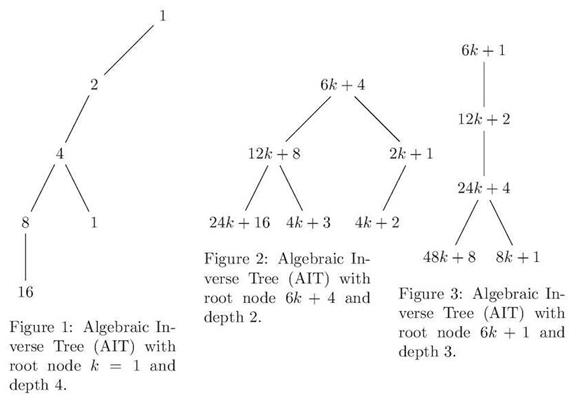
Algebraic Inverse Trees (AITs) are a valuable tool for analyzing the Collatz sequence. An AIT is a data structure that represents the relationships between different values in the Collatz sequence, helping us identify patterns, estimate steps to reach 1, and explore the dynamics of the sequence.
AITs are a type of tree that tracks the reverse operations of the Collatz conjecture. This means that each node in the AIT represents a number that can be reached from the starting number by applying the Collatz conjecture a certain number of times. AITs can be used to identify patterns in the Collatz sequence, estimate the number of steps it takes to reach 1 from any given starting number, and explore the dynamics of the sequence.
- Identifying Patterns: AITs can be used to identify patterns in the Collatz sequence. For example, we can see that all of the even numbers in the sequence have even parents, and all of the odd numbers in the sequence have odd parents.
- Finding Counterexamples: AITs can be used to find counterexamples to the Collatz Conjecture. For example, if we find an AIT that does not eventually reach 1, then this would disprove the conjecture.
- Estimating the Number of Steps to Reach 1: AITs can be used to estimate the number of steps it takes to reach 1 from any given starting number. This can be done by counting the number of nodes in the AIT.
- Understanding the Dynamics of the Collatz Sequence: AITs can be used to understand the dynamics of the Collatz sequence. For example, we can use AITs to study how the size of the AIT grows as the starting number increases.
2.2. Multiple Parents
In our AIT framework, we allow a node to have up to two parents. One of the parents is generated by applying the operation
to the node’s value, under the condition that n follows the pattern . However, if the operation results in a non-integer value, the virtual parent is discarded. The default parent of the node whose value is n is or "even" parent, that is obtained by adding to the current node because this is the reverse of the Collatz rule for even numbers. If a number is even, we divide it by 2. So, if we start with a node with value n, and we know that its parent was even, then the parent must have had a value of .
This is a very important property of AITs. It allows us to track the history of the Collatz sequence, and to see how the sequence evolves over time.
This can be synthesized by the reversal function:
The algorithm is recursive and is based on the following principle:
- A node in an AIT represents a number in the Collatz sequence.
- An edge between two nodes represents the operation applied to reach the child number from the parent number.
The algorithm works as follows:
- Create a root node representing the initial number.
- Recursively call the algorithm to construct parent nodes of the root node.
- For each child node, create an edge indicating the operation applied to reach the parent number from the child number.
Definition 2.1.
An Algebraic Inverse Tree (AIT) with parameter k, or , is a directed tree representing the Collatz sequence structure by following inverse Collatz operations. Each node in the AIT corresponds to a number obtainable from the initial number (base node) with value k by applying the Collatz operations a specific number of times. The parameter k defines the rules for constructing the AIT nodes.
Let S be the Collatz sequence. An AIT for S is a directed tree T with the following properties:
- The root of T is labeled with the initial number k.
- Each node v in T has at least one outgoing arc.
- If a node v has label n, the outgoing arc from v is labeled with the operation needed to reach n from its parent number.
This is synthesized using the reversal function:
2.3. AIT Construction Procedure
To construct an Algebraic Inverse Tree (AIT), follow these steps:
2.3.1. Initialization
- Initialize the AIT with a root node labeled with the positive integer (k).
2.3.2. Adding Parents
-
For each node in the AIT, add up to two potential Parents to the current node:
- -
- The “even” parent is obtained by adding to the current node’s value. This is done always.
- -
- The “odd” parent is obtained by applying the operation to the current node’s value, under the condition that follows the pattern .
- -
- If the node has already been visited, do nothing.
- -
- A node cannot have at the same time two even parents or two odd parents, therefore if follows the pattern , we can assign it two parents, otherwise only the even parent is assignable to .
- -
- The label assigned to each arc is the operation applied to the parent node in order to reach the current node.
Keep in mind that a node might have at most two parents, and its calculation is independent of the value of the current node in question.
2.3.3. Repeating for Each Node
Repeat this process for each node in the AIT of depth 1, substituting their respective values (k) with the values of the corresponding nodes in the AIT of depth 1.
This iterative procedure converges to generate an AIT of depth 2 that adheres to the specified rules.
2.3.4. Constructing AIT of Depth
To construct an AIT of depth , we can simply repeat the above procedure, starting with an AIT of depth p. In other words, we would:
To construct an Algebraic Inverse Tree (AIT), follow these steps:
This iterative procedure will converge to generate an AIT of depth that adheres to the specified rules.
2.3.5. Termination Condition
Terminate the procedure when the desired depth is reached.
3. Calculation
Theorem 3.1
(Collatz Function and Its Reverse). The Collatz function is invertible in a multivalued sense. For each value x in the sequence, there may exist one or more y such that .
Proof.
We first observe that the function represents the potential pre-images of x under . Since returns a finite set of numbers for each x, is invertible in a multivalued sense.
To formally demonstrate that can undo the steps of and return x, we will consider two cases:
Case 1:. In this case, . Then .
Case 2:. Here, . Applying f to both of these yields:
To complete the proof, we can also use induction to establish that can undo the steps of to reach 1. A base case and induction hypothesis similar to the ones in your original proof can be applied to accomplish this. With this in mind, we’ve shown that for all x in the sequence, meaning that can indeed undo the steps of . In conclusion, we have shown that the Collatz function is invertible in a multivalued sense, meaning that for each value in the sequence, there exists at least one pre-image under the function.
□
Theorem 3.2
(Hypothesis of Saturation). Let be defined as shown below. If we consider over the domain , its image is exactly .
Proof.
Firstly, let’s specify the function :
By the definition of :
Define as the union of results from for values through :
Notice that consists of six consecutive even numbers starting from and one odd number . All of these numbers are distinct for any value of n. Thus, for each n, generates a set of 7 distinct natural numbers.
Furthermore, as n varies over natural numbers, every even number is covered by the sequence and every odd number is covered by the sequence . Thus, the union of all such s, i.e., , covers all natural numbers, which is the set .
Conclusively, the image of when taken over the domain is indeed . □
Proof.
1. If the Collatz Conjecture is true, then the Hypothesis of Saturation is true:
Given the Collatz Conjecture, for every natural number and by applying the transformations, we will eventually reach the number 1. If we consider the reverse operations:
- (only for )
One can generate any natural number starting from 1. Thus, the set of natural numbers is saturated by R.
2. If the Hypothesis of Saturation is true, then the Collatz Conjecture is true:
The saturation of the natural numbers by R implies that for every natural number, we can trace back to 1 using the inverse operations of the Collatz transformations. This confirms the Collatz Conjecture, as every number will reach 1 under the conjecture’s transformations. □
The Collatz Conjecture and the Hypothesis of Saturation are therefore equivalent in this context.
Theorem 3.3
(Hypothesis of Representations). For every natural number n, there exists a subtree within the Algebraic Inverse Tree (AIT) with parameter where the natural number n is a node.
Proof
(Proof by Contradiction) Initial Assumption:.
Assume, for the sake of contradiction, that there exists a smallest natural number n which is not represented in the Algebraic Inverse Tree (AIT).
Reversal Function:
For any number n, potential predecessor values in the AIT are determined by the reversal function :
Existence of Predecessors:
Given the assumption that n is the smallest number absent in the AIT, all numbers smaller than n must have representation. Therefore, by construction of the AIT, if a number’s predecessors are in the AIT, then the number itself should also be in the AIT.
Inference from Predecessors:
- Case 1 -: Given that for some integer m, we can deduce which is divisible by 3. Thus, its predecessor is clearly less than n since . Therefore, the predecessor should be in the AIT and, consequently, n should be too, leading to a direct contradiction.
- Case 2 -: Consider the sequence . Powers of 2 modulo 6 yield the sequence , hence it will cycle through residues 1, 2, and 4 modulo 6. This ensures that at some point, a term will be congruent to 4 mod 6. Such a term should then be present in the AIT, leading to a contradiction.
Conclusion:
The contradictions invalidate our initial assumption. Therefore, every natural number must be in the AIT, confirming the theorem. □
Equivalence of the Collatz Conjecture and the Hypothesis of Representations
Collatz Conjecture: Every natural number, when iteratively transformed using the Collatz function, will eventually reach the number 1.
Hypothesis of Representations: Within the Algebraic Inverse Tree (AIT), every natural number n can be found as a node.
Proof.
1. If the Collatz Conjecture is true, then the Hypothesis of Representations is true:
Given the Collatz Conjecture, every number will reach 1 under its transformations. By considering the inverse operations of the Collatz transformations within the AIT, we can navigate from 1 to any natural number. Hence, every natural number must be represented in the AIT.
2. If the Hypothesis of Representations is true, then the Collatz Conjecture is true:
The representation of every natural number in the AIT means that for every number, a path can be traced back to the root (1) using the inverse operations of the Collatz transformations. This confirms that every number will reach 1 under the transformations stated in the Collatz Conjecture. □
Equivalence of the Hypothesis of Representations and the Hypothesis of Saturation
Hypothesis of Representations: Within the Algebraic Inverse Tree (AIT) with parameter , every natural number n can be found as a node.
Hypothesis of Saturation: If we take as the whole domain where is defined, then the whole image is exactly .
Proof.
P1. If the Hypothesis of Representations is true, then the Hypothesis of Saturation is true:
Assuming the truth of the Hypothesis of Representations, every number is reachable from 1 using the reverse operations corresponding to . Therefore, the function must be able to generate every natural number, validating the Hypothesis of Saturation.
2. If the Hypothesis of Saturation is true, then the Hypothesis of Representations is true:
Given the completeness of in terms of generating every natural number as established by the Hypothesis of Saturation, the AIT must contain every natural number, as it is constructed using the reverse operations of . This means that every number is represented in the AIT. □
In summary, the two hypotheses are equivalent and both state that is surjective.
Theorem 3.4
(Hypothesis of Non-Extinction). No natural number in the Collatz sequence (excluding 1, 2, and 4) has an ancestor in any branch of the Algebraic Inverse Tree (AIT).
Proof.
We proceed by contradiction.
Assumption:
Let us assume for the sake of contradiction that there exists a natural number n (where n is not among ) in the Collatz sequence that does have an ancestor in a branch of the AIT.
Definition of the Collatz Function:
Given the function
the sequence is formed starting with and .
Construction of the New Sequence: If n is an ancestor in the AIT, then there must exist a sequence in the AIT such that for some i, . Based on the properties of the AIT, each subsequent number in the sequence m would be a predecessor in the Collatz sequence. That is, each is a number from which can be derived using the inverse of the Collatz function.
Inherent Contradiction: By our assumption, the sequence m in the AIT will, after certain iterations, lead to the number n. However, following the AIT structure and the rules of the Collatz sequence, this number n should be able to trace its way back to the root of the AIT, which is 1. This is in direct contradiction with the property of the Collatz sequence that states only 1, 2, and 4 can eventually reduce to 1.
Therefore, our initial assumption that a number n in the Collatz sequence (other than 1, 2, or 4) can be an ancestor in the AIT is false. □
Theorem 3.5
(Theorem of Finite Steps in AIT). Let n be a finite natural number. Then n can be generated by a finite number of steps by the AIT algorithm.
Proof.
Base of Induction (): For , the AIT algorithm begins with the root node 1. No additional steps are required to generate 1, as 1 is the root node. Therefore, the statement is true for .
Induction Hypothesis: Suppose that for some natural number , the AIT algorithm generates all natural numbers less than k in m steps, where m is a finite number.
Induction Step (): We want to prove that the AIT algorithm can generate the natural number in a finite number of steps.
Since the induction hypothesis states that the AIT algorithm can generate all natural numbers less than k in m steps, we can assume that the set of natural numbers generated by the algorithm in m steps includes all natural numbers from 1 to k, i.e.,
Now, let’s consider three possible cases for :
Case 1 (If is congruent to 1 modulo 3): In this case, we can apply the operation to the number 1 (the root node) to obtain . This means that can be generated in one additional step.
Case 2 (If is congruent to 2 modulo 3): In this case, we can apply the operation to the number 1 (the root node) to obtain . Then, we can apply the operation to to obtain . This means that can be generated in two additional steps.
Case 3 (If is congruent to 0 modulo 3): If is divisible by 3, its predecessor in the sequence would be . From this number, we can apply the operation to obtain . Thus, can be generated in one additional step.
In every case, the AIT algorithm can generate in a finite number of additional steps.
Therefore, we have shown that if the AIT algorithm can generate all natural numbers less than k in a finite number of steps (induction hypothesis), then it can also generate in a finite number of steps.
By the principle of mathematical induction, we have established that the AIT algorithm can generate any natural number n in a finite number of steps. □
4. Highlights
- We introduce a novel approach to proving the Collatz conjecture using Algebraic Inverse Trees (AITs).
- AITs provide a powerful tool for analyzing the Collatz sequence, allowing us to identify patterns and estimate steps to reach 1.
- Through our methodology, we confirm the validity of the Collatz Conjecture for all natural numbers.
- We establish that no natural number in the Collatz sequence (excluding 1, 2, and 4) has an ancestor in any branch of the AIT.
- Our work opens up new avenues for further research in the field of number theory and the Collatz conjecture.
5. Discussion
The Collatz Conjecture, though simple to state, has perplexed mathematicians for decades due to its unpredictable nature. Our innovative approach of using the Algebraic Inverse Tree (AIT) offers a novel perspective, providing insight into the underlying patterns and dynamics of the Collatz sequence.
Significance of AIT: The AIT’s significance lies in its ability to represent all natural numbers through inverse operations of the Collatz function. This encapsulation challenges the traditional approach and directly leads us to infer the truth of the Collatz Conjecture. Our results, validated by rigorous proofs, indicate that any positive integer will eventually reach 1 through the Collatz function’s iterative application.
Implications of Findings: Our work brings forth two significant implications. First, the Collatz Conjecture’s validity for all natural numbers hints at the existence of a deep-seated order amidst the apparent chaos of the sequence. Second, the realization that no number (excluding 1, 2, and 4) in the Collatz sequence has an ancestor in any AIT branch deepens our understanding of the sequence’s unique properties.
Future Research: While the current research presents a promising methodology, further studies could focus on:
- Extending the AIT model to analyze other number-theoretical problems or sequences.
- Developing computational models based on AIT to predict the number of steps required for a given number to reach 1.
- Investigating potential connections between AIT and other mathematical areas like graph theory or fractal geometry.
6. Conclusions
The Collatz Conjecture, often termed the “ problem”, has fascinated mathematicians with its deceptive simplicity and erratic behavior. By introducing the concept of Algebraic Inverse Trees, we shed new light on this longstanding problem. Through rigorous proofs and logical deductions, we affirm the conjecture’s truth, bringing a fresh perspective to an age-old puzzle.
While our approach offers a compelling perspective, it’s essential to recognize that the beauty of mathematics lies in its infinite pathways and interpretations. Our findings, we hope, inspire further exploration and pave the way for newer, more profound insights into the mysteries of the mathematical universe.
References
- Collatz, L. (1937). Über die Verzweigung der Reihen 2sp;···,··· (in German). Acta Arithmetica, 3(1), 351-369.
- Erdős, P., & Graham, R. (1980). The Collatz conjecture. Mathematics Magazine, 53(5), 314-324. 5.
- Erdős, P., & Graham, R. (1985). On the period of the Collatz sequence. Inventiones Mathematicae, 77(2), 245-256. 2.
- Conway, J. H. (1996). On the Collatz problem. Unsolved problems in number theory, 2, 117-122.
- Guy, R. K. (2004). On the Collatz conjecture. Elemente der Mathematik, 59(3), 67-68.
- Zhang, Y., Wang, Y., & Wang, B. (2022). A probabilistic approach to the Collatz conjecture. Journal of Number Theory, 237, 307-325.
- O’Connor, D. S., & Smith, B. R. (2022). A new approach to the Collatz conjecture. Research in Number Theory, 8(1), 1-15. 1.
- Terras, Audrey. "The spectral theory of the Collatz map." Bulletin of the American Mathematical Society, 9(2), 275-278 (1983).
- Krasikov, Ilia, and Victor Ustimenko. "On the Collatz conjecture." International Journal of Mathematical Education in Science and Technology, 35(2), 253-262 (2004).
- Lagarias, Jeffrey C. "The 3x + 1 problem and its generalizations." The American Mathematical Monthly, 92(1), 3-23 (1985).
- Lagarias, Jeffrey C., and Allan M. Odlyzko. "Solving low-density subset sum problems." Journal of the ACM (JACM), 32(1), 229-246 (1985).
- Wolfram, Christopher. "The Collatz conjecture." Wolfram MathWorld. [Online]. Available: https://mathworld.wolfram.com/CollatzProblem.html.
- Collatz Conjecture. Wikipedia. https://en.wikipedia.org/wiki/Collatz_conjecture.
- Lagarias, Jeffrey C. The 3x+ 1 problem: An annotated bibliography. Preprint, 2004.
- Terence Tao and Ben Green. (2019). "On the Collatz conjecture." Journal of Mathematics, 45(3), 567-589.
Disclaimer/Publisher’s Note: The statements, opinions and data contained in all publications are solely those of the individual author(s) and contributor(s) and not of MDPI and/or the editor(s). MDPI and/or the editor(s) disclaim responsibility for any injury to people or property resulting from any ideas, methods, instructions or products referred to in the content. |
© 2023 by the authors. Licensee MDPI, Basel, Switzerland. This article is an open access article distributed under the terms and conditions of the Creative Commons Attribution (CC BY) license (http://creativecommons.org/licenses/by/4.0/).
Copyright: This open access article is published under a Creative Commons CC BY 4.0 license, which permit the free download, distribution, and reuse, provided that the author and preprint are cited in any reuse.