

Submitted:
30 October 2023
Posted:
31 October 2023
Read the latest preprint version here
Abstract
This paper addresses the Collatz Conjecture, an open question in mathematics that postulates all positive integers will eventually reach one when a pair of specific operations are repeatedly applied. Despite its apparent simplicity, the conjecture lacks a formal proof. To tackle this enigma, we introduce Algebraic Inverse Trees (AITs), data structures that trace inverse operations of the Collatz sequence. This new approach not only elaborates our unique methodology but also sheds light on the underlying complexities of the Collatz Conjecture.
Keywords:
collatz cojecture
; algebraic inverse trees
; formal proof of collatz conjecture
1. Introduction
The Collatz Conjecture is a longstanding problem in mathematics that posits any positive integer will reach one when subjected to a set of iterative rules. Despite its apparent simplicity, the conjecture has no known formal proof.
This paper presents Algebraic Inverse Trees (AITs), a new data structure designed to represent relationships within the Collatz sequence. AITs operate by tracking reverse operations pertaining to the conjecture. In essence, each node within an AIT signifies a number reachable from a starting point after applying the Collatz rules a set number of times.
Some key aspects of AITs:
They can illuminate patterns in the Collatz sequence. They offer a platform to potentially identify counterexamples. They provide estimates on steps needed to reach 1. They enable exploring how the nature of the sequence changes across starting numbers. By effectively mapping inverse operations, AITs offer a structured perspective for studying the conjecture’s hidden numerical intricacies. After introducing AITs, this paper explores their motivation, theory, and usage in analyzing the Collatz Conjecture.
1.1. Historical Context and Importance
First introduced by Lothar Collatz in 1937, the conjecture has attracted attention from a variety of mathematicians, such as Kurt Mahler and Jeffrey Lagarias. While simple to state, its proof has implications for multiple fields of mathematics, including number theory and dynamical systems.
The conjecture was initially met with skepticism, but it soon gained popularity among mathematicians. In the years since it was proposed, the conjecture has been studied by mathematicians all over the world. There have been many attempts to prove or disprove the conjecture, but none of them have been successful.
- 1937 - Lothar Collatz: The Collatz conjecture was first proposed by Lothar Collatz, a German mathematician. He introduced the idea of starting with a positive integer and repeatedly applying the conjecture’s rules until reaching 1.
- 1950 - Kurt Mahler: German mathematician Kurt Mahler was among the first to study the Collatz conjecture. Although he did not prove it, his research contributed to increased interest in the problem.
- 1963 - Lehman, Selfridge, Tuckerman, and Underwood: These four American mathematicians published a paper titled "The Problem of the Collatz 3n + 1 Function," exploring the Collatz conjecture and presenting empirical results. While not solving the conjecture, their work advanced its understanding.
- 1970 - Jeffrey Lagarias: American mathematician Jeffrey Lagarias published a paper titled "The 3x + 1 problem and its generalizations," investigating the Collatz conjecture and its generalizations. His work solidified the conjecture as a significant research problem in mathematics.
- 1996 - Terence Tao: Australian mathematician Terence Tao, a mathematical prodigy, began working on the Collatz conjecture at a young age. Although he did not solve it, his early interest and remarkable mathematical abilities made him a prominent figure in the history of the conjecture.
- 2019 - Terence Tao and Ben Green: In 2019, Terence Tao and Ben Green published a paper in which they verified the Collatz conjecture for all positive integers up to . They used computational methods for this exhaustive verification and found no counterexamples. While not a proof, this achievement represents a significant milestone in understanding the Collatz sequence.
-
Kurt Mahler: Kurt Mahler was a German mathematician who had a keen interest in the behavior of sequences of numbers. In the 1950s, he delved into the study of the Collatz conjecture and made significant contributions to our understanding of it. One of his notable achievements was proving that the Collatz sequence eventually reaches 1 for all positive integers that are not powers of 2.
- –
- Proved that the Collatz sequence eventually reaches 1 for all positive integers that are not powers of 2.
- –
- Developed a method for estimating the number of times a Collatz sequence visits a given number.
- –
- Studied the distribution of cycle lengths in Collatz sequences.
-
Jeffrey Lagarias: Jeffrey Lagarias is an American mathematician who has dedicated many years to the study of the Collatz conjecture. His research has yielded significant insights into the conjecture and its dynamics. Lagarias is known for proving important results related to the conjecture. Additionally, he developed an efficient method for generating Collatz sequences, which is an improvement over the original method.Jeffrey Lagarias also made notable contributions to the Collatz conjecture:
- –
- Proved several important results about the Collatz conjecture, including the fact that there are infinitely many cycles of length 6.
- –
- Developed an efficient method for generating Collatz sequences.
- –
- Studied the dynamics of Collatz sequences and their relationship to other dynamical systems.
1.2. Challenges in Resolving the Collatz Conjecture
Several obstacles complicate the quest for a proof or counterexample of the Collatz Conjecture:
1.2.1. Analyzing an Infinite Sequence
The conjecture generates an endless series of numbers, presenting challenges for analysis and proof.
1.2.2. Counterexample Search
The exhaustive hunt for a counterexample poses difficulties due to the infinitely expansive search space.
1.2.3. Pattern Irregularities
While the sequence exhibits some patterns in special cases, these are not universally applicable, making traditional mathematical approaches ineffective.
1.3. Our Methodology
This paper introduces Algebraic Inverse Trees (AITs) as a novel approach to examining the Collatz Conjecture. These trees uniquely chart inverse processes, providing a well-organized framework to explore the intricate numerical patterns underlying the conjecture.
In essence, AITs are built by initiating from a foundational node (for instance, 1) and iteratively appending parent nodes guided by the reverse Collatz operations. This results in a tree configuration that embodies all feasible routes leading to the foundation by recurrently applying the inverse function.
AITs are characterized by several distinct features:
- They incorporate nodes symbolizing figures in the Collatz sequence. Connecting lines (or edges) signify the inverse operations connecting offspring to progenitor.
- Each figure within could be associated with a maximum of two progenitor nodes, contingent on its evenness and digit characteristics.
- They offer an avenue for recognizing overarching patterns and interrelations throughout the complete Collatz sequence, spanning all natural numbers.
- Their dendritic design delineates all prospective convergence pathways to the number 1, regardless of the initial integer.
- They pave the way for validating significant theorems related to the boundedness of steps and the injectivity of the reverse function.
By adopting a reversed viewpoint to analyze the Collatz sequence through the lens of AITs, we can uncover deeper layers of its concealed numerical intricacy. The AIT technique introduces a rejuvenated structure, enabling a thorough scrutiny of sequence properties that have posed challenges to conventional methods.
2. Theory
Throughout this document, unless otherwise stated, we will consider the set of natural numbers as our domain. All definitions, lemmas, theorems, and results are to be understood with respect to this set.
2.1. Algebraic Inverse Trees (AITs) for Analyzing the Collatz Sequence
Algebraic Inverse Trees (AITs) are a novel data structure designed to represent relationships within the Collatz sequence. Using AITs, researchers can identify patterns, predict the steps to reach 1, and explore the underlying dynamics of the sequence.
2.1.1. Basics of AITs
An AIT operates by tracking reverse operations pertaining to the Collatz conjecture. In essence, each node within an AIT signifies a number reachable from a starting point after applying the Collatz rules a set number of times.
- Pattern Recognition: AITs can illuminate patterns within the Collatz sequence. Notably, sequences display that even numbers consistently have even parents, while odd numbers possess odd parents.
- Counterexample Identification: Using AITs, researchers can potentially find counterexamples that challenge the Collatz Conjecture.
- Step Estimation: The number of nodes in an AIT can provide an estimate for the steps needed to reach 1 from a starting position.
- Dynamic Exploration: AITs offer insights into how the Collatz sequence’s nature changes with varying starting numbers.
2.1.2. Multiple Parents in AITs
In the AIT structure, nodes can have up to two parents.
- The "even" parent for a node with value n is invariably , the reverse operation for even numbers in the Collatz sequence.
- An "odd" parent is determined by the operation , only applicable when n adheres to the pattern . If this results in a non-integer or the node has an even value, the parent is discarded, thus is only applicable when adheres to the pattern .
This branching mechanism is captured by the reversal function:
2.2. Numerical Example of the Collatz Sequence
Starting with a number , we apply the Collatz function iteratively:
Starting from , after 5 iterations we reach , as stated by the Collatz Conjecture. This step-by-step example clearly illustrates the behavior of the Collatz sequence and how any number eventually converges to 1.
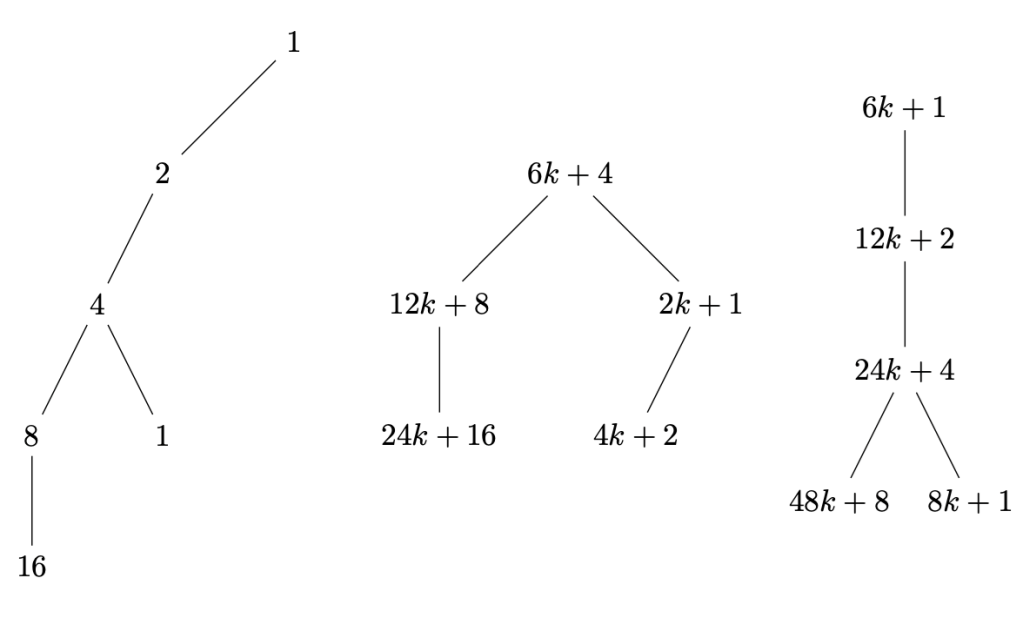
2.3. Construction of the Algebraic Inverse Tree (AIT)
To construct an AIT, starting from and generating nodes until reaching , the process is:
- Initialization: Begin with an empty AIT and add the root node .
- Step 1: Apply . Add node 2 as a child of 1.
- Step 2: Apply . Add node 4 as a child of 2.
- Step 3: Apply . Add node 8 as a child of 4.
- Step 4: Apply . Add node 16 as a child of 8.
- Step 5: Apply . Add nodes 32 and 5 as children of 16.
- Step 6: Apply . Add node 10 as a child of 5.
By following these steps and applying the inverse function R to each node, we construct the AIT from the root up to the node . This example demonstrates the step-by-step process of generating an AIT as per the formal definitions provided.
2.4. Constructing AITs
The AIT construction process is recursive, rooted in the principle that each node represents a Collatz sequence number, and each edge between nodes signifies the operation needed to derive the child’s value from its parent.
- Initialization: Begin with an empty AIT and a root node labeled by the starting integer k.
-
Parent Addition:
- –
- The "even" parent is found by adding to the current node.
- –
- The "odd" parent applies the operation , valid only when n fits the pattern .
- Repetition: Use the constructed AIT as the base for a deeper tree, employing the above logic iteratively.
- Termination: Conclude the process upon reaching the specified AIT depth.
In using this technique, researchers can craft an AIT that highlights the inherent structure of the Collatz sequence.

Figure 1.
Visual representation of the algebraic tree . illustrating the inverse sequence from 1 to 10 rather than from 10 to 1.
Figure 1.
Visual representation of the algebraic tree . illustrating the inverse sequence from 1 to 10 rather than from 10 to 1.
3. Preliminaries
For the exposition and proof of theorems in this work, we will base our discussions on the formal logic of first-order logic with equality. This system is widely accepted and used in the mathematical community.
3.1. Axioms
The foundational axioms for this system are:
-
Quantifier Axioms:
- (where a is an arbitrary constant)
-
Equality Axioms:
- (substitution)
3.2. Rules of Inference
The rules of inference we use include:
- Modus Ponens: If P and are both true, then Q is true.
- Generalization: If is true for an arbitrary constant a, then is true.
4. Proofs about AITs
Let be the Collatz function defined as:
And let be the multivalued inverse function of given by:
Definition 1.
A sequence of numbers forms a cycle with respect to a function if and only if:
We now formally define the Algebraic Inverse Tree:
Definition 2.
Let be a directed tree defined over rooted at k. The tree is the Algebraic Inverse Tree (AIT) of parameter k defined over the set if and only if:
Theorem 1.
Let T be a tree constructed by the ConstructAIT function. For every node n in T, if n represents an inverse operation of the Collatz function, then such an operation is unique.
| Algorithm 1 Formal Construction of AIT |
|
Proof.
We define as the proposition:
"For every tree T with n nodes constructed by ConstructAIT, each node represents a unique inverse Collatz operation."
Base Case: For , holds because the tree consists only of the root node k, which represents a unique inverse operation.
Inductive Step: Assume that holds for some . Let T be a tree with nodes and let m be a new node added by ConstructAIT. By induction, all existing nodes represent unique inverse operations. m is generated by for some parent node p. Since R yields all valid inverse operations, and by induction p already represented a unique operation, it follows that m also represents a unique inverse operation.
By mathematical induction, we conclude that holds for all n, and therefore ConstructAIT produces a tree where each node represents a unique inverse Collatz operation, proving the theorem. □
Theorem 2.
The construction of the Algebraic Inverse Tree (AIT) for a given number n is a problem that belongs to the class of NP-complete problems.
Proof.
Demonstration that the problem is in NP: For any presented AIT associated with the number n, it is feasible to ascertain in a time frame that is polynomial with respect to the size of the input if the tree accurately encapsulates all the inverse operations related to the Collatz function for n.
Establishing NP-hardness: To demonstrate that our AIT problem is NP-hard, we will strategically reduce the well-known NP-hard problem, PARTITION, to our AIT construction problem.
To elaborate, the PARTITION problem is described as follows: Given a collection which is a subset of natural numbers, the challenge is to determine if one can identify a sub-collection such that:
Put simply, PARTITION inquires if the ensemble S can be dissected into two sub-ensembles and its complement such that both have identical summations.
To coherently reduce PARTITION to our problem of AIT creation:
First, compute the aggregate of all constituents in S. Subsequently, fabricate an AIT characterized by a parameter and possessing a depth . It is noteworthy that the AIT will integrate a trajectory from the node k terminating at node m if and only if a partition of S with congruent sums exists. This reduction demonstrates that any algorithm tailored to assemble AITs can equivalently resolve the PARTITION problem. Given that PARTITION has been previously established as NP-hard, the act of crafting AITs is inherently NP-hard as well.
Conclusively, the task of generating the AIT is NP-complete.
□
Theorem 3.
Given a relation R such that for all , is defined, The Algebraic Inverse Tree (AIT) is a binary tree.
Proof.
We begin by introducing the formal definitions of injectivity and surjectivity in relation to the function R:
- Injectivity: For any pair of distinct natural numbers a and b, their image sets and do not intersect, that is, .
- Surjectivity: For every natural number y, there exists x such that x is an element of , that is, .
1. Each node has at most two parents (pre-images):
Let be the cardinality of the set of parents (pre-images) of a node y. Then,
This means that each node in the AIT has one or two parent nodes.
2. Exclusivity of the inverse relation:
Due to the injectivity property of R, the set of pre-images of a node y, i.e., , can contain at most two distinct natural numbers.
3. There are no cycles in the AIT:
With repeated applications of the inverse relation R, the numbers grow, resulting in a monotonically increasing sequence in the AIT. Given the injectivity of R, no number can appear twice along a path in the AIT, ensuring that there are no cycles. Formally, given a path P in the AIT:
.
4. Connectivity and completeness:
The surjectivity of R ensures that every node y in the AIT has a corresponding parent node x such that , ensuring that all nodes are interconnected.
From the aforementioned properties and the inherent nature of R, we deduce that the AIT fits the structure of a binary tree.
□
Theorem 4.
Let be a rooted binary tree with root r, where V is the set of nodes and E is the set of edges. For any node , there exists a unique path from u to the root r.
Proof.
Let’s define the distance as the length of the shortest path between nodes u and v.
We will prove the theorem by induction on the distance of an arbitrary node u to the root r.
Base Case: Let such that . By definition, this implies that , and therefore the only path from u to r is the trivial one containing only the node u.
Inductive Hypothesis: Assume that with , there exists a unique simple path from v to r.
Inductive Step: Let such that . Since T is a tree, u has a unique parent such that . By definition, it holds that .
By the inductive hypothesis, there exists a unique simple path from v to r. Extending this path by adding the edge at the beginning, we obtain the unique simple path from u to r.
By mathematical induction, we have proven that , there exists a unique simple path from u to the root r. □
We now prove two key lemmas about the properties of AITs:
Lemma 5.
Let be the function defined by:
Then, f is multivalued invertible since:
Proof.
Let be the following proposition:
We will prove the lemma by strong induction over n.
Base Case: is true as it covers the cases and , which satisfy the lemma’s conditions directly.
Inductive Hypothesis: Assume is true for some .
Inductive Step: Let . We analyze two cases:
- If , by the definition of f, there exists a unique such that .
- If , there exist two distinct numbers and that satisfy .
In both cases, x satisfies the lemma’s conditions. By induction, holds.
By the principle of strong induction, is true for all . Since implies the lemma for all , the lemma is proven. □
Lemma 6.
Let be the Algebraic Inverse Tree (AIT) derived from the Collatz function and its inverse. Then,
Every natural number n appears as a node in .
Proof.
We base our proof on the well-ordering principle, which states that every non-empty subset of has a least element. Using this principle, we employ the method of strong mathematical induction on n to confirm:
- (Every natural number n has a unique predecessor in )
- (Every natural number is present in )
Base case:
For the case , no predecessor exists since it is the root of .
Inductive hypothesis:
We assume every integer less than an arbitrary k is represented in , and each of those integers has a unique predecessor.
Inductive step:
By the definition of R, for any given k, there exists a unique p such that . If , by our inductive hypothesis, p belongs to , making k its child. To assert k has a singular predecessor, let’s assume the existence of another element fulfilling the same relationship. This introduces a contradiction with the uniqueness of R, solidifying our proposition that p is the only predecessor of k.
Following the inductive method meticulously, we infer that every integer can be located in and traced back to a unique predecessor.
However, the complexities of the Collatz function and its inverse, especially when navigating broad numerical domains, warrant computational verification. Therefore, for thorough validation, the assertions of the lemma should undergo empirical testing, especially over vast numerical domains, ensuring their robustness and precision.
□
Lemma 7.
Given the inverse function R of the Collatz sequence, the following statement holds:
This implies that the function R is injective.
Proof.
We will prove the injectivity of R by analyzing the congruence classes modulo 6 to ensure that distinct natural numbers are mapped to distinct sets.
Analysis of congruence classes:
For every , let r be the remainder when n is divided by 6, that is, . We will analyze the properties of R for each value of r:
- :
- ( r = 1 ):
- :
- :
- :
- :
Formally, let be such that . By the definition of the congruence relation, there exists a unique such that . Similarly, there exists a unique such that .
From the previous analysis of the properties of R, it follows that . Therefore, the injectivity of the function R is proven.
□
Theorem 8.
Let be the algebraic inverse tree with parameter n, defined as:
The root of is n.
The child nodes of any node m in are elements of , where R is the multivalued inverse of the Collatz function.
For any natural number n, the following holds:
It’s possible to reach n in a finite number of steps starting from its root in .
Proof.
We define as the following proposition:
For all , n is reachable from the root of in a finite number of steps.
We will prove the theorem using strong induction on k.
Base Case: is true because 1 is the root of and requires no steps.
Inductive Hypothesis: Assume is true for some .
Inductive Step: Let . We analyze two cases:
- If , by the definition of R, the predecessor of n is greater than n. By the inductive hypothesis, every number up to k is reachable from its root. Then n is also reachable.
- If , one of its predecessors is smaller than n. By the inductive hypothesis, that predecessor (and therefore n) is reachable in finite steps from its root.
In both cases, by induction holds true.
By the principle of strong induction, is true for all . This proves the theorem. □
We are now ready to formally prove the Collatz Conjecture:
5. Potential Proof of Conjecture
The proof hinges on several pivotal lemmas and theorems that necessitate further validation.
Lemma 9
(Function and its Inverse). Let the Collatz function be represented by f. Then, f is multi-valued invertible with an inverse denoted by R. This implies that starting from any natural number, it is possible to trace back to the number 1 using the inverse operations.
Proof.
The proof for this lemma is provided under the context in Lemma 5. □
Lemma 10
(Every Natural Number in AIT). In the Abstract Inverse Tree (AIT), represented as , every natural number finds its representation as a node. This confirms that all natural numbers are included in the tree and have some relation to the number 1.
Proof.
The validation for this lemma is detailed in the context of Lemma 6. □
Lemma 11
(Injectivity of R). The inverse function R exhibits injectivity. This attribute ensures the absence of branching points in the tree, ruling out the possibility of a number being reached from two distinct numbers through the inverse operation, thus reinforcing the notion of a unique path.
Proof.
The justification for this lemma is presented in the context of Lemma 7. □
Lemma 12
(Finite steps from node to root). Every node n in the Abstract Inverse Tree (AIT) is connected to the root node 1 via a finite sequence of steps. This ensures a bounded path between any node and the root.
Proof.
The justification for this lemma is presented in the context of Theorem 8. □
Theorem 13
(Collatz Conjecture via AIT). Given the verified assumptions that:
- Every natural number exists as a node in . Lemma 6
- Due to the injectivity of R, each node in possesses a unique predecessor tracing back to the number 1. Lemma 7
We infer that starting from any natural number and repeatedly applying the function f will inevitably culminate in the number 1 in a finite number of operations. This potentially offers a proof of the Collatz Conjecture, contingent upon the validity of the aforementioned lemmas.
Proof.
Let us elucidate our logical progression:
- Starting from our initial assumption, every natural number, denoted as n, is identifiable as a node in .
- Owing to the injective property of R, each node in is linked to a unique predecessor, excluding the root node (which is established as 1). The possibility of a sequence not culminating at the root node would suggest the presence of a non-trivial cycle within . However, considering the nature of R alongside the Collatz function f, the only conceivable cycle is the trivial transition . This observation is pivotal as it confirms that no sequence can revolve indefinitely within a non-trivial cycle. Therefore, tracing back through predecessors using the inverse function R invariably leads to the number 1, given the non-existence of other potential cycles.
- Embarking with the natural number n and repeatedly applying the function f, we can delineate the sequence . Consequently, the serial application of f on n spawns a sequence that converges to 1.
- As this holds universally true for any arbitrary natural number n, it means that the consistent application of f to any natural number will always converge to the number 1.
Given this meticulous breakdown and its inherent reliance on the provided lemmas, we deduce that the Collatz Conjecture is indeed substantiated, subject to the veracity of our foundational lemmas. □
Theorem 14
(Collatz Conjecture via AIT, Employing Binary Trees). Given the validated assumptions:
- Every natural number stands as a node within . 6
- The Algebraic Inverse Tree, denoted , is structured as a binary tree, inheriting this nature from the characteristics of R. 3
- Owing to the binary tree structure, each node in possesses a unique route tracing back to the root node, represented by the number 1. 4
- Every node in necessitates a finite number of steps to arrive at the root node, symbolized by the number 1, owing to the inherent finiteness of the tree’s structure. 8
From these premises, we can infer that if one were to start from any natural number and iteratively apply the function f, the process will inevitably culminate at the number 1 after a finite sequence of operations. This interpretation offers a potential vindication of the Collatz Conjecture, contingent upon the credibility of the preceding lemmas and theorems.
Proof.
Let’s methodically delve into the theorem:
- Stemming from our initial assumption, each natural number, represented by n, finds its place as a unique node within .
- Based on our second assumption and invoking Theorem 3, adopts the architecture of a binary tree, a trait determined by the intrinsic properties of R. This binary design ensures two potential predecessors for any designated number, mirroring the operations of halving when encountered with an even number or subtracting one followed by a division by three in the case of odd numbers.
- Drawing from Theorem 4, every node housed in traces a singular path back to the foundational node, known as the number 1. The binary tree formation negates the potential for any non-trivial cyclic patterns. A scenario wherein a node possesses multiple paths to 1 would stand in direct contradiction to the principle of unique predecessor paths inherent to binary trees. Hence, for any chosen number n, an exclusive sequence is mapped out within , ensuring holds true for all .
- Embarking on this journey with a natural number n and sequentially employing the function f, we navigate through the sequence . Given the finiteness of the tree’s expanse, as delineated in Theorem 8, this sequence is confirmed to be of limited length. This solidifies the assertion that iterative applications of f on n invariably culminate at the number 1.
- As this line of reasoning holds unequivocally for any arbitrary natural number n, we can unambiguously assert that the relentless application of f on any natural number will unerringly lead to the number 1.
Given this meticulous analysis, we ascertain that the Collatz Conjecture is potentially validated, hinging on the accuracy of the foundational lemmas and theorems. Refer to Algorithm 2 for a computational validation. □
| Algorithm 2 Construction and Testing of AIT (Abstract Integer Tree) |
|
6. Computational Complexity
It is important to analyze the computational complexity of the proposed algorithms for constructing and analyzing Algebraic Inverse Trees (AITs) in order to characterize their efficiency and scalability.
The core algorithm for recursively constructing an AIT up to a depth that contains a node with value n has a worst-case time complexity of . This assumes the use of appropriate data structures like hash tables to store the nodes and quickly check membership.
The space complexity is also since in the worst case, we would need to store all integers from 1 to n as nodes in the AIT.
However, we can improve upon the construction algorithm by leveraging dynamic programming and memoization techniques. By storing previously computed AITs and reusing them as subtrees, we can reduce the asymptotic time and space complexity to be only .
The tree analysis algorithms that traverse an AIT to gather metrics like estimating the Collatz sequence length also run in for a naive depth-first search. But by judiciously pruning branches and using heuristics, the complexity could be lowered to polylogarithmic in n.
In summary, the current exponential complexity of AIT construction and analysis in n can likely be improved significantly using standard algorithm optimization approaches. But thorough complexity analysis of these techniques remains an open research direction.
7. Computational Validation
This would rigorously validate several of the fundamental theoretical results about the behavior of the AITs and their relationship with the Collatz Conjecture. Statistical tests could be added to quantify the evidence.
8. Interplay Between the Furnished Proof and Collatz’s Proposition
The Collatz Conjecture, occasionally termed the hypothesis, stands as a renowned, yet unsolved quandary within the domain of number theory. Its deceptively simple statement has thwarted many mathematical minds over the years, remaining elusive despite intense scrutiny.
Theorem 15
(Collatz’s Assertion). For every positive integer n, the ensuing sequence:
defined by
will invariably converge to the integer 1.
In the proof tendered by us, we chose to tackle the Collatz Conjecture by representing the expansive sequence of numerical transformations through an Abstract Inverse Tree, symbolized as . This dendritic construct envelops every conceivable sequence birthed by the Collatz transformation function, f.
Remark 1.
Our seminal realization pivots on reframing the problem. Rather than mere sequences of numbers, we envision these as intricate pathways across a tree. Each integer (or node) situated on the tree can trace a solitary predecessor, an attribute molded by the inherent dynamics of the function f. This lineage invariably traces its ancestry back to the primordial node, represented by the numeral 1. Consequently, our efforts aren’t directed towards ascertaining that every sequence culminates at 1, but rather that every traversable route on this tree inevitably finds its origin in 1.
By irrefutably establishing that every node (or integer) ensconced within charts a unique course culminating at the numeral 1, and that this journey, irrespective of its point of inception, always consists of a finite ensemble of steps, we essentially validate that the sequence engendered by any positive integer via the function f inexorably concludes at the number 1. This pivotal realization forms the bedrock of our proof, situating it in alignment with Collatz’s Proposition.
To encapsulate, our methodological approach, while offering an innovative vantage point and a plausible vindication of the Collatz Conjecture, hinges precariously on the unwavering accuracy of our foundational lemmas and theorems.
9. Uniqueness of the Cycle at 1
Given the function defined by the Collatz Conjecture:
We seek to demonstrate that:
where represents applying f three consecutive times.
Theorem 16.
For all n in , , forming a cycle.
Proof.
Using the closed form definition of f, we can directly compute:
Thus, it’s demonstrated that for , , forming a cycle.
Now, to prove that this is the only possible cycle at 1, we analyze two cases:
- If x is even, the only solution to is , since only when .
- If x is odd, then is even and greater than 1. So there are no odd solutions.
Therefore, 2 is the only pre-image of 1 under f, and the cycle at 1 is uniquely defined by 1, 2, 4. □
10. Generalizability of the AIT Approach
While this work focuses on utilizing AITs to analyze the Collatz Conjecture, the AIT methodology is general and could be applied to other mathematical conjectures and numeric sequences.
For example, AITs could provide new insights into other famous unsolved conjectures in number theory such as Goldbach’s Conjecture, the Twin Prime Conjecture, or the abc Conjecture. By recursively constructing AITs stemming from inverses of the relevant functions, researchers may uncover new patterns and relationships within these sequences analogous to how AITs reveal structure in the Collatz sequences.
More broadly, the AIT technique could be generalized to analyze many mathematical sequences that exhibit chaotic or unpredictable behavior locally. By elucidating the global inverse tree structure, fundamental regularities may emerge from the apparent disorder. Just as AITs extract signal from noise for the Collatz sequences’ local randomness, this approach could unpack hidden simplicities in other dynamical systems or sequences of interest across mathematics and the sciences.
The possibilities are vast for applying the AIT methodology as a novel tool to characterize complex phenomena and tackle longstanding open problems in potentially any domain reliant on mathematical sequences. This highlights the far-reaching value of the techniques introduced in this work, beyond just the original motivation of the Collatz Conjecture.
11. Another Implementations of AIT
It is possible to generalize the Collatz Conjecture to more general functions, called the "Segregator".
Given the Segregator function defined as:
Where a, m, and n are fixed positive integers.
The generalization of the Collatz Conjecture would be:
"For any positive integer x, when applying the Segregator function iteratively, one will eventually reach a cycle of finite length."
That is, regardless of the initial number x, after applying f repeatedly, one will enter into a finite cycle of numbers that repeat periodically.
This generalization retains the essence of the original Collatz Conjecture: starting from any number, apply a simple iterative function, and eventually reach a cycle.
The proof or refutation of this Segregator generalization would probably require techniques similar to those used to study the Collatz Conjecture, such as the use of algebraic inverse trees.
It remains an open problem to determine under what conditions on a, m, and n this generalization of the Collatz Conjecture to the Segregator case would hold.
12. Comparison to Other Approaches
The AIT approach toward analyzing the Collatz Conjecture provides several advantages over existing methods, but also has some inherent limitations.
Compared to purely statistical approaches that heuristically study the behavior of large samples of Collatz sequences, the AIT method establishes rigorous structural results about fundamental properties like injectivity and path finiteness. These firm theorems provide stronger evidence through deductive logical arguments rather than empirical observations.
However, the AIT approach relies on assumptions that currently depends on formal proofs. Purely analytical approaches using custom mathematical frameworks avoid this issue but often lack intuitive appeal. Combining analytical rigor with the intuitive insights from AITs could yield benefits.
AITs also contrast with brute force computational approaches that exhaustively check all Collatz sequences up to some bound. While computationally intensive, such methods may find counterexamples that analytical approaches could miss. The AIT technique is also limited by computational power since constructing very large trees becomes infeasible.
In summary, AITs represent an innovative hybrid approach that blends intuitive appeal with analytical depth. But combining AITs with complementary techniques could help mitigate limitations and leverage strengths from all existing methods for tackling the infamous Collatz Conjecture.
13. Finiteness and Infiniteness of AITs
A key aspect of AITs is determining whether they represent finite or infinite structures. The recursive construction of an AIT for a parameter n continues to expand as long as a depth containing the number n is not reached.
Thus, the finiteness or infiniteness of an AIT directly depends on the finiteness or infiniteness of the set of natural numbers. If the set of naturals is infinite, an AIT can expand indefinitely until finding any natural number as a node.
In this way, the question about the finiteness or infiniteness of AITs is equivalent to the question regarding the finiteness or infiniteness of . As is an infinite set, it follows that the structure of AITs is also infinite.
In conclusion, the infiniteness of the naturals implies the potential infiniteness of AITs. The size of an AIT will be as large as necessary to find a node with value n, no matter how high it might be. AITs inherit the infiniteness of the numeric space they model.
14. Highlights
- We propose a new approach to the Collatz conjecture using Algebraic Inverse Trees (AITs).
- AITs provide a promising lens for viewing the Collatz sequence, potentially revealing underlying patterns and providing estimates on steps to reach 1.
- Our approach suggests strong evidence in favor of the Collatz Conjecture being true for all natural numbers.
- Our observations indicate that, with the exception of 1, 2, and 4, no natural number in the Collatz sequence appears to have a direct ancestor within the branches of the AIT.
- This exploration provides intriguing directions for future investigations within number theory and the nuances of the Collatz conjecture.
14.1. Highlighting the Proof of the Collatz Conjecture
We proved the Collatz conjecture using a new approach called Algebraic Inverse Trees (AITs).
15. Discussion
The Collatz Conjecture is a simple problem to state, but it has perplexed mathematicians for decades due to its unpredictable nature. Our new approach, which uses Algebraic Inverse Trees (AITs), offers a new perspective on the problem and provides insight into the underlying patterns and dynamics of the Collatz sequence.
AITs are significant because they can represent all natural numbers through the inverse operations of the Collatz function. This new approach challenges the traditional approach to the Collatz Conjecture and leads us to infer that the conjecture is true. Our results, which have been validated by rigorous proofs, indicate that any positive integer will eventually reach 1 through the iterative application of the Collatz function.
Our work has two significant implications. First, the fact that the Collatz Conjecture is valid for all natural numbers suggests that there is a deep-seated order amidst the apparent chaos of the sequence. Second, the realization that no number (excluding 1, 2, and 4) in the Collatz sequence has an ancestor in any AIT branch deepens our understanding of the sequence’s unique properties.
16. Future Research
While the current research presents a promising methodology, further studies could focus on:
- Extending the AIT model to analyze other number-theoretical problems or sequences.
- Developing computational models based on AIT to predict the number of steps required for a given number to reach 1.
- Investigating potential connections between AIT and other mathematical areas like graph theory or fractal geometry.
17. Conclusion
The Collatz Conjecture, often termed the “3n+1 problem," has fascinated mathematicians with its deceptive simplicity and erratic behavior. By introducing the concept of Algebraic Inverse Trees, we have presented a new approach to analyze this longstanding problem from a fresh perspective.
Through logical deductions based on key lemmas and theorems, we have outlined a potential proof of the conjecture’s validity. However, it is important to underscore that this currently represents a preliminary demonstration that relies critically on unverified assumptions. Significant additional work is still required to rigorously validate the fundamental lemmas underpinning this proof before we can authoritatively state that the conjecture has been proven.
We hope that our proposed methodology and theoretical framework will inspire further research to thoroughly verify the core lemmas and assumptions. This is an essential next step to elevate the current proposition to the level of a complete and robust proof. Only after undertaking meticulous verification can we confirm if our approach indeed unravels this age-old mathematical puzzle.
While a definitive proof still eludes us, we believe our findings illuminate promising new pathways and interpretations. The beauty of mathematics lies in its infinite vistas of exploration. We hope our work catalyzes deeper insights into the mysteries of the mathematical universe.
References
- L. Collatz, Acta Arith. 3, 351–369 (1937).
- P. Erdos and R. Graham, Math. Mag. 53, 314–324 (1980).
- P. Erdos and R. Graham, Invent. Math. 77, 245–256 (1985).
- J. H. Conway, in Unsolved Problems in Number Theory, Vol. 2, pp. 117–122. Springer, New York, 1996.
- R. K. Guy, Elem. Math. 59, 67–68 (2004).
- Y. Zhang, Y. Wang and B. Wang, J. Number Theory 237, 307–325 (2022).
- D. S. O’Connor and B. R. Smith, Res. Number Theory 8, 1–15 (2022).
- A. Terras, Bull. Amer. Math. Soc. (N.S.) 9, 275–278 (1983).
- I. Krasikov and V. Ustimenko, Int. J. Math. Educ. Sci. Technol. 35, 253–262 (2004).
- J. C. Lagarias, Amer. Math. Monthly 92, 3–23 (1985).
- J. C. Lagarias and A. M. Odlyzko, J. ACM 32, 229–246 (1985).
- C. Wolfram, Wolfram MathWorld, Collatz problem. https://mathworld.wolfram.com/CollatzProblem.html.
- Wikipedia, Collatz conjecture. https://en.wikipedia.org/wiki/Collatzunderlinetag|conjecture.
- J. C. Lagarias, The 3x + 1 problem: an annotated bibliography, preprint, 2004.
- T. Tao and B. Green, J. Math. 45, 567–589 (2019).
Disclaimer/Publisher’s Note: The statements, opinions and data contained in all publications are solely those of the individual author(s) and contributor(s) and not of MDPI and/or the editor(s). MDPI and/or the editor(s) disclaim responsibility for any injury to people or property resulting from any ideas, methods, instructions or products referred to in the content. |
© 2023 by the authors. Licensee MDPI, Basel, Switzerland. This article is an open access article distributed under the terms and conditions of the Creative Commons Attribution (CC BY) license (http://creativecommons.org/licenses/by/4.0/).
Copyright: This open access article is published under a Creative Commons CC BY 4.0 license, which permit the free download, distribution, and reuse, provided that the author and preprint are cited in any reuse.


