

Submitted:
30 December 2025
Posted:
31 December 2025
Read the latest preprint version here
Abstract
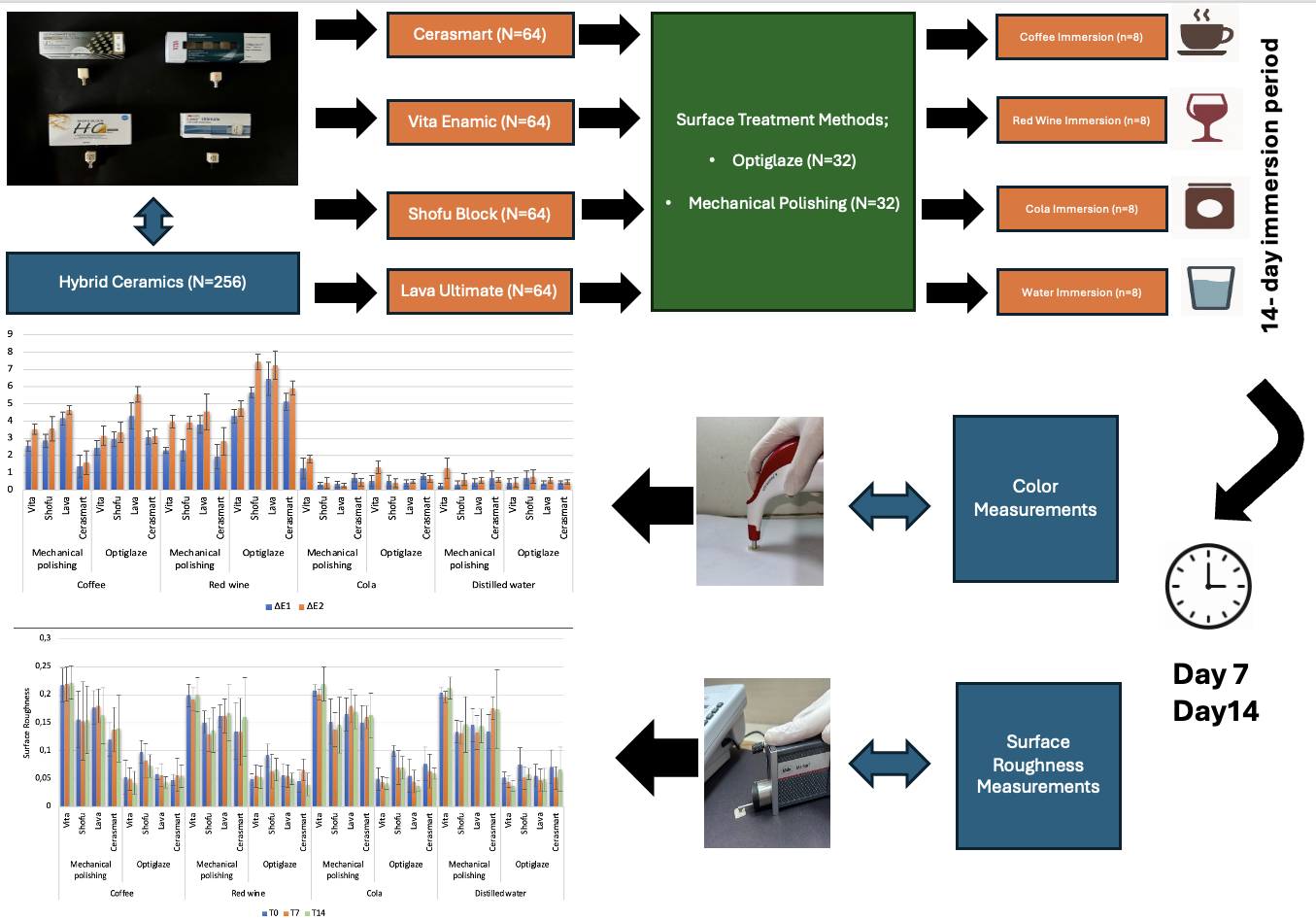
CAD/CAM hybrid ceramic materials have been increasingly used in restorative dentistry due to their ability to combine ceramic strength with the handling advantages of composite resins. The present study focused on how surface treatment protocols and commonly used immersion solutions affect the color stability and surface roughness of these materials. For this purpose, 256 specimens were fabricated from Vita Enamic, Lava Ultimate, Cerasmart, and Shofu Block HC. Following surface treatment using either mechanical polishing or Optiglaze, the specimens were immersed in coffee, red wine, cola, or distilled water for 14 days. Color difference (ΔE₀₀) and surface roughness (Ra) were measured at baseline and after 7 and 14 days. Data were analyzed using three-way repeated measures ANOVA (p < 0.05). Polymer matrix composition and surface treatment significantly influenced color stability and surface roughness (p < 0.05). Coffee and red wine caused the greatest discoloration, particularly in Bis-GMA- and TEGDMA-containing materials, while Cerasmart demonstrated the highest color stability. Although Optiglaze reduced surface roughness, it was associated with increased color change over time. These results emphasize the role of polymer composition and surface treatment in the esthetic performance of hybrid ceramic CAD/CAM materials.
Keywords:
CAD/CAM
; color stability
; hybrid ceramics
; polymer-infiltrated ceramic-network
; resin nanoceramics
; surface roughness
; surface treatment processes
1. Introduction
In recent years, computer-aided design/computer-aided manufacturing (CAD/CAM) technologies have played an important role in restorative dentistry by supporting the development of tooth-colored materials intended to meet growing esthetic needs [1]. Among these materials, hybrid ceramics represent an effective alternative, as they combine the mechanical strength of ceramic structures with the favorable handling characteristics and repair potential of composite resins. Based on how the ceramic phase is incorporated into the polymer matrix, hybrid ceramic CAD/CAM materials are generally divided into two groups. The first group consists of polymer-infiltrated ceramic network (PICN) materials, in which a porous ceramic framework is infiltrated with a polymer. The second group includes resin nano-ceramics (RNC), where nanoceramic fillers are distributed within a highly cross-linked polymer matrix [2].
Developments in polymer matrix design and filler technology have contributed to enhanced mechanical behavior in hybrid ceramic CAD/CAM blocks. Variations in microstructural characteristics, as well as differences in filler type and concentration, may affect not only the mechanical performance of these materials but also their color stability [3]. Among these, Vita Enamic (Vita Zahnfabrik, Bad Säckingen, Germany) represents a PICN material, in which a porous ceramic network is infiltrated with a polymer to combine the advantages of both components. In contrast, Lava Ultimate (3M ESPE, St. Paul, MN, USA), Cerasmart (GC Corp., Tokyo, Japan), and Shofu Block HC (Shofu Inc., Kyoto, Japan) are RNC blocks, in which nanoceramic fillers are embedded in a highly cross-linked polymer matrix [4].
Color stability represents a key property of restorative materials, as it plays a critical role in their long-term clinical performance [5]. Given the wide structural diversity of current hybrid ceramics, evaluating their performance and identifying potential clinical limitations is essential. One commonly reported limitation of these materials is their susceptibility to discoloration over time due to both intrinsic and extrinsic factors [6,7]. Commonly consumed beverages, including coffee, tea, cola, red wine, and fruit juices, have been reported to adversely influence the color stability of CAD/CAM restorative materials [8].
The surface texture of dental restorative materials is widely regarded as an important factor influencing restoration longevity, as increased roughness may facilitate plaque retention and contribute to discoloration [9]. Surface finishing procedures may alter the surface texture and roughness of restorative materials, which can in turn influence color stability and the long-term clinical performance of restorations [10]. Due to the presence of a polymer matrix in hybrid ceramics, conventional glaze firing is not applicable; therefore, mechanical polishing is commonly employed to obtain a smooth and glossy surface [11]. Manufacturers have developed a variety of polishing systems, including disks, kits, and pastes, to produce smooth surfaces through mechanical polishing [12]. Recently, surface sealants have been proposed as alternative glaze materials to limit the staining tendency of resin-based restorative materials. These low-viscosity agents are able to penetrate superficial microstructural irregularities and seal the restoration surface. Through the formation of a thin protective layer, they are intended to reduce water uptake and, consequently, decrease discoloration over time [13].
Although several studies [10,11,12,14] have evaluated the color stability and surface roughness of hybrid ceramics, most have examined only a limited number of materials. Research specifically addressing the effects of Optiglaze on hybrid ceramics is scarce, and while thermal aging has been commonly performed, data on the impact of exposure to different staining solutions remain limited. In addition, previous studies have generally assessed color stability and surface roughness separately, without considering their potential interrelationship. Therefore, the aim of this study was to evaluate the color stability and surface roughness of four commercially available hybrid ceramic CAD/CAM restorative materials after either mechanical polishing or Optiglaze application, followed by immersion in various staining solutions. The null hypotheses were: (1) color and surface roughness are not affected by material type; (2) color and surface roughness are not affected by solution type or immersion time; (3) color and surface roughness are not affected by surface treatment type.
2. Materials and Methods
2.1. Preparation of the Specimens
This in vitro study was conducted on four different CAD/CAM-fabricated hybrid ceramic restorative materials: Lava Ultimate (LU), Vita Enamic (VE), Cerasmart (CS), and Shofu Block HC (SH). For this purpose, CAD/CAM blocks in A2 HT shade with dimensions of 12×14×18 mm were used. The materials used, along with their compositions and manufacturers, are listed in Table 1. CAD/CAM blocks were cut into specimens (n=8) with a thickness of 1.5 mm using a low-speed diamond saw (IsoMet 4000, Buehler, USA) under continuous water irrigation. The specimens were then ground sequentially under water with silicon carbide abrasive papers of 600-, 800-, and 1000-grit for 30 s per grit. Final specimen thickness was confirmed using a digital caliper (Mitutoyo Corp., Tokyo, Japan). A total of 256 specimens, 64 from each material, were obtained and cleaned in distilled water using an ultrasonic cleaning device for 15 minutes.
2.2. Surface Treatment Procedures
For each material, 64 specimens were randomly divided into two groups according to surface treatment: mechanical polishing (MP) (n = 32) and Optiglaze (OG) (n = 32). Mechanical polishing was performed using a diamond-impregnated spiral polishing system (Diacomp Plus Twist, EVE Ernst Vetter, Pforzheim, Germany) in two steps. The procedure was first performed with a pink medium-grit rubber polisher to smooth the surface, followed by a gray fine-grit rubber polisher to achieve a glossy finish. Each polishing step was applied for 30 seconds for each surface.
For the OG, the specimens were air-abraded with 50-µm aluminum oxide (Al₂O₃) particles (Basic Eco, Renfert GmbH, Hilzingen, Germany) at 2.5 bar pressure from a distance of 10 mm. Air abrasion was performed for 10 seconds, followed by rinsing with an air-water spray and drying. The specimens were then silanized with G-Multi PRIMER (GC Corporation, Tokyo, Japan) for 30 seconds and air-dried. Optiglaze Color (GC Corp, Tokyo, Japan) was applied according to the manufacturer's instructions. The coating was polymerized for 40 seconds using the Valo Cordless light-curing unit (Ultradent, USA).
2.3. Immersion Procedure
After completing the surface treatments, the specimens for each material-surface treatment group were randomly divided into four subgroups according to the immersion solution used (n = 8). Group 1: Distilled water, Group 2: Coffee (Nescafe Classic, Nestle, Bursa, Turkey), Group 3: Red wine (Yakut, Kavaklıdere, Ankara, Turkey), Group 4: Cola (Coca-Cola Co., Istanbul, Turkey).
The specimens were immersed in coffee, wine, cola, and distilled water solutions for 14 days. The coffee solution was prepared by dissolving 2 g of coffee in 200 mL of boiling water, stirring until fully dissolved, and filtering through filter paper. The specimens were placed in segmented plastic trays, and the solutions were added to each compartment using a syringe. During the immersion period, the specimens were stored in an incubator at 37°C in a dark environment. To prevent contamination, the solutions were refreshed every 48 hours.
2.4. Color and Surface Roughness Measurements
The initial color measurement of the specimens was performed using a VITA Easyshade spectrophotometer (Vita Zahnfabrik, Bad Säckingen, Germany). To minimize the influence of environmental light and ensure standardized conditions, a color assessment box with D65 standard illumination was used. Before measuring each group, the device was calibrated using a calibration plate. The spectrophotometer probe was positioned at the center of each specimen and the initial color measurement was repeated three times per specimen. The recorded data were used for further analysis. The initial surface roughness measurements were performed using a MarSurf M300 C profilometer (Mahr GmbH, Göttingen, Germany). The device was calibrated before measuring each group. Surface roughness values (Ra) were recorded by taking measurements at three parallel points from the center of each specimen, and the average surface roughness values were recorded.
On days 7 and 14, the specimens were removed from the solutions, rinsed with distilled water, and dried prior to measurement. Color and surface roughness assessments were conducted under the same conditions as the baseline measurements, with each measurement repeated three times. The collected data were recorded for further analysis.
The ∆E00 values were calculated using the following formula to determine the color differences between the groups.
In this study, KL, KC, and KH were set to 1.0. The clinical 50:50% acceptability color difference threshold was set at ∆E00 = 1.8 [15].
Surface roughness values were recorded at baseline, on day 7, and on day 14. The clinical acceptability surface roughness threshold was set at 0.2 μm [16].
2.5. Statistical Analysis
The data obtained in this study were statistically analyzed using IBM SPSS Statistics version 22. Prior to inferential analyses, the normality of the data distribution was examined using both the Kolmogorov–Smirnov and Shapiro–Wilk tests. To investigate the main effects of time, immersion solution, and material type, as well as their possible interaction effects, a three-way repeated-measures analysis of variance (ANOVA) was applied. Multiple comparisons between different time points were performed using the Bonferroni correction, whereas comparisons among the solution and material groups were carried out with the Tukey post hoc test. For all statistical evaluations, the level of significance was set at p < 0.05.
3. Results
The material type, solution type, surface treatment and immersion duration had a statistically significant effect on the color changes of the specimens. The interaction of these factors was also found to be significant in this change. (Table 2) Color change (∆E00) values of the specimens are presented in Table 3.
According to the three-way repeated-measures ANOVA, during coffee storage, ΔE00 values generally showed an increasing trend over time, except for the CS material. Among the materials, the highest ΔE00 values were observed in the LU material. Optiglaze procedure exhibited significantly higher ΔE00 values compared to the mechanical polishing procedure in the LU and CS materials for 2-week storage. Except for the CS mechanical polishing group, ΔE00 values exceeded the clinical acceptability threshold in all other groups from the first week.
During red wine storage, ΔE00 values generally showed an increasing trend over time. All materials showed ΔE00 values above the clinical acceptability threshold from the first week. For all materials, the ΔE00 values of the Optiglaze procedure were significantly higher than those of the mechanical polishing procedure.
During cola storage, ΔE00 values generally exhibited no statistically significant variation over time, except for the VE material. The highest ΔE00 values were observed in the VE material, exhibiting color changes above the clinical acceptability threshold for 2-week storage. VE-mechanical polishing procedure exhibited significantly higher ΔE00 values compared to the Optiglaze procedure.
During distilled water storage, ΔE00 values generally exhibited no statistically significant variation over time, except for the VE-mechanical polishing group. All materials showed ΔE00 values below the clinical acceptability threshold. VE-mechanical polishing procedure exhibited significantly higher ΔE00 values compared to the Optiglaze procedure.
Coffee and red wine solutions exhibited higher ΔE00 values than cola and distilled water in all materials during 2-week storage. In the Optiglaze surface treatment procedure, red wine exhibited significantly higher ΔE00 values than coffee. Additionally, in the CS material with the mechanical polishing procedure, red wine also showed higher ΔE00 values, while in the VE material, cola exhibited significantly higher ΔE00 values than distilled water.
Material type and surface treatment had a statistically significant effect on the surface roughness of the specimens, whereas solution type and immersion duration had no significant effect. The interactions of immersion duration*material and immersion duration*surface treatment were also found to be statistically significant in this change (Table 4). Surface roughness values of the specimens are presented in Table 5.
VE-mechanical polishing group exhibited significantly higher surface roughness values compared to the other groups. Only the VE-mechanical polishing group was above the clinical acceptability surface roughness threshold. Mechanical polishing procedure exhibited significantly higher surface roughness values compared to the Optiglaze procedure across all groups.
4. Discussion
In this study, the color changes and surface roughness values of different hybrid ceramic CAD/CAM restorative materials subjected to various surface treatment procedures were evaluated following immersion in red wine, coffee, cola, and distilled water for 1 and 2 weeks. The first null hypothesis was rejected, as LU exhibited the highest color changes in coffee and red wine, VE demonstrated greater color changes in distilled water and cola, and materials with different microstructural characteristics showed distinct surface roughness values. The second null hypothesis was partially rejected, since the type of solution and immersion duration influenced color stability but did not significantly affect surface roughness values. Color changes increased over time, with the most pronounced discoloration observed in coffee and red wine solutions. The third null hypothesis was rejected, as specimens treated with the Optiglaze procedure showed greater color changes compared to those subjected to mechanical polishing, while simultaneously exhibiting lower surface roughness values.
Guler et al. [17] stated that individuals who consume coffee drink an average of 3.2 cups daily, each lasting approximately 15 minutes. From these findings, they inferred that a 24-hour immersion of restorative materials in coffee is equivalent to nearly one month of clinical coffee intake. In the present study, the color stability of the investigated materials was assessed by immersing them for 14 days in four commonly consumed beverages.
Over the past decades, several color difference formulas have been proposed to improve the correlation between instrumental color measurements and visual perception [18]. In this study, color difference data were analyzed using the CIEDE2000 (ΔE00) formula, as previous studies [15,19] have demonstrated that this formula provides more reliable results than the CIELab (ΔE*ab) formula in assessing color differences, perceptibility, and clinical acceptability thresholds.
Quek et al. [20] immersed LU, VE, and SH materials in different solutions for one week. The study reported that specimens, particularly those immersed in red wine and coffee, exhibited color changes exceeding the clinical acceptability threshold. Alharbi et al. [21] evaluated six different CAD/CAM materials, including VE and LU, after immersion in various solutions for 120 days. The results indicated that red wine and coffee induced greater discoloration in VE and LU compared to distilled water and cola. Furthermore, when immersed in a coffee solution, Lava Ultimate exhibited greater discoloration compared to VE. Sarıkaya et al. [22] immersed LU and VE in different solution combinations and performed thermal aging. The greatest discoloration was observed in the coffee-tea and red wine combinations, with LU exhibiting greater color change compared to VE. The findings of these studies are consistent with those of the present study.
Stamenkovic et al. [23] immersed six different CAD/CAM materials, including CS, LU, SH, and VE, in coffee and red wine solutions. In the coffee solution, the greatest discoloration was observed in LU, followed by SH, VE, and CS. In the red wine solution, CS exhibited less discoloration compared to the other hybrid ceramic materials.
It is suggested that in red wine, the high concentration of pigment molecules, low pH, and alcohol content contribute to the discoloration of resin-based materials [24]. Some studies [25,26] have indicated that this color change occurs because the pigments penetrate deeply into the resin matrix, after which the alcohol and low pH soften the polymer network. The yellow colorants present in coffee are thought to significantly contribute to discoloration by being absorbed into the polymer matrix [27]. Bagheri et al. [28] reported that cola induces less discoloration than coffee, likely because it lacks the yellow chromogenic compounds found in coffee.
The discoloration rate of resin-based CAD/CAM blocks has been reported to be associated with water sorption. Water facilitates the penetration of staining agents into the material matrix, and the discoloration that occurs in this process is directly related to the extent of water absorption [29]. Urethane dimethacrylate (UDMA) has been shown to exhibit lower water sorption and solubility compared to bisphenol A-glycidyl methacrylate (Bis-GMA), and the influence of the polymer matrix on water sorption and color stability has been well established [30]. Another study reported that composites containing triethylene glycol dimethacrylate (TEGDMA) exhibit lower color stability compared to those without TEGDMA, and this effect has been associated with water sorption. This suggests that TEGDMA may increase water absorption, thereby contributing to color change [31]. The highest color change of the LU material in coffee and red wine solutions may be attributed to its Bis-GMA content. SH, on the other hand, has a higher TEGDMA content compared to VE, which may explain its greater susceptibility to discoloration. The CS material does not contain Bis-GMA or TEGDMA monomers, which could account for its higher color stability.
Hybrid ceramics have been developed as an alternative to conventional ceramics to provide tooth-like esthetic restorations. A major advantage of these materials is that restorations can be fabricated in a single milling step without the need for heat treatment [32]. However, the milling process increases the surface roughness of CAD/CAM restorative materials [9]. Surface roughness in restorations is known to contribute to plaque accumulation and discoloration. Rough surfaces may arise during milling and shaping procedures, leading to surface defects that compromise material integrity. Glazing has been proposed as a method to reinforce restorative materials by covering such defects [33]. In the present study, Optiglaze application effectively reduced surface roughness in CAD/CAM hybrid ceramics, in agreement with the observations of Tekçe et al. [34]. The glaze layer can mask microcracks and surface irregularities, producing a smoother and more homogeneous surface compared to conventional mechanical polishing. However, over time, the glaze layer may undergo partial degradation due to chemical and mechanical challenges, potentially facilitating pigment penetration into subsurface layers. Consequently, even in the absence of increased surface roughness, enhanced pigment infiltration may have contributed to greater discoloration relative to mechanically polished specimens.
Çakmak et al. [11] reported that the application of Optiglaze better preserved surface integrity and stability on CS, whereas LU exhibited faster degradation and microcrack formation after thermocycling. In our study, LU also showed greater discoloration than CS when immersed in red wine and coffee solutions. The rapid degradation of the sealant and microcrack formation on the LU surface may have facilitated pigment penetration, leading to increased color change. In contrast, the sealant remained more stable on CS, which may have limited the color change.
In this study, two different surface treatments, Optiglaze and mechanical polishing, were applied. The surface roughness of the groups treated with Optiglaze was found to be lower than that of the mechanical polishing procedure. In the literature, some studies [14,35] have reported that Optiglaze increases surface roughness, while others [34,36] have reported a decrease. In the present study, air drying was applied during the glaze procedures; this may explain the lower surface roughness values observed compared to studies where air drying was not performed. Air drying allows the glaze material to spread more evenly across the surface and fill the micro-pits created by prior sandblasting, resulting in a smoother surface. Further studies are warranted to clarify the role of air-drying protocols in optimizing the surface characteristics and clinical performance of glaze-applied restorations.
Although this study provides meaningful findings, certain limitations should be taken into consideration. Under clinical conditions, restoration thickness may vary substantially depending on the tooth region. In contrast, all specimens in the present study were standardized to a thickness of 1.5 mm to maintain methodological consistency. While this standardization improves experimental control, it may not fully represent the anatomical variability and thickness differences observed in clinical restorations, which could influence stress distribution as well as optical behavior. In addition, color and surface roughness measurements were performed on flat, polished specimens. This approach enables accurate and reproducible measurements; however, it does not completely reflect the complex morphology, curvature, and surface characteristics of restorations used in clinical practice. Such factors may influence light reflection, color perception, and surface wear over time. Furthermore, the in vitro design of the study represents another limitation, as it cannot entirely replicate the multifactorial oral environment. Variables such as thermal fluctuations, enzymatic activity, pH changes, toothbrushing abrasion, and exposure to different mouthrinses—which may affect the surface integrity and optical stability of restorative materials—were not included in the experimental protocol.
For future research to better reflect clinical reality, experimental designs should incorporate thermocycling, mechanical brushing, and relevant chemical challenges that more closely simulate intraoral conditions. In addition, in vivo investigations or long-term clinical studies are needed to confirm these laboratory findings and to support more reliable, evidence-based decisions regarding the selection and maintenance of restorative materials in routine clinical practice.
5. Conclusions
Within the limitations of this in vitro study, it can be concluded that the color stability and surface properties of CAD/CAM hybrid ceramics are strongly influenced by both the polymer matrix composition and the applied surface treatment procedure. Beverages containing chromogenic agents, such as coffee and red wine, induced the most pronounced discoloration, particularly in materials with Bis-GMA and TEGDMA-based matrices, highlighting the pivotal role of polymer chemistry in water sorption and pigment penetration. Although the application of Optiglaze effectively reduced surface roughness by masking surface irregularities, it was also associated with increased discoloration over time, suggesting that the degradation of the glaze layer may facilitate pigment infiltration. These findings underscore the dual impact of polymer-based microstructure and surface protection strategies on the long-term clinical performance of hybrid ceramics. Future research incorporating long-term aging, dynamic oral conditions, and alternative polymer formulations is warranted to further optimize the balance between esthetic stability and surface integrity in CAD/CAM restorative materials.
Author Contributions
Conceptualization: I.K.D.; Methodology: I.K.D.; Software: I.K.D.; Validation: I.K.D., U.D., T.K.; Formal analysis: I.K.D.; Investigation: I.K.D.; Resources: I.K.D., T.K.; Data curation: I.K.D.; Writing—original draft: I.K.D.; Visualization: I.K.D.; Project administration: I.K.D., T.K.; Supervision: T.K.; Writing—review and editing: I.K.D., U.D.; Writing—final editing and publication preparation: I.K.D.; Funding acquisition: I.K.D., T.K. All authors have read and agreed to the published version of the manuscript.
Funding
This research was funded by Gazi University Scientific Research Projects Coordination Unit, TDH-2023-8970.
Data Availability Statement
The data sets generated during the current study are available from the corresponding author upon reasonable request.
Conflicts of Interest
The authors declare no commercial or financial conflicts of interest related to this study.
Abbreviations
| Bis-GMA | Bisphenol A Glycidyl Methacrylate |
| CAD/CAM | Computer-Aided Design / Computer-Aided Manufacturing |
| PICN | Polymer-Infiltrated Ceramic Network |
| RNC | Resin Nano-Ceramic |
| TEGDMA | Triethylene Glycol Dimethacrylate |
| UDMA | Urethane Dimethacrylate |
References
- Al Amri, MD; Labban, N; Alhijji, S; Alamri, H; Iskandar, M; Platt, JA. In vitro evaluation of translucency and color stability of CAD/CAM polymer-infiltrated ceramic materials after accelerated aging. Journal of Prosthodontics 2021, 30(4), 318–328. [Google Scholar] [CrossRef]
- Duarte, Jr S; Sartori, N. Phark J-H: Ceramic-reinforced polymers: CAD/CAM hybrid restorative materials. Current Oral Health Reports 2016, 3(3), 198–202. [Google Scholar] [CrossRef]
- Kang, Y-A; Lee, H-A; Chang, J; Moon, W; Chung, SH; Lim, B-S. Color stability of dental reinforced CAD/CAM hybrid composite blocks compared to regular blocks. Materials 2020, 13(21), 4722. [Google Scholar] [CrossRef]
- Bahadır, HS; Bayraktar, Y. Evaluation of the repair capacities and color stabilities of a resin nanoceramic and hybrid CAD/CAM blocks. The journal of advanced prosthodontics 2020, 12(3), 140. [Google Scholar] [CrossRef]
- Ozen, F; Demirkol, N; Oz, OP. Effect of surface finishing treatments on the color stability of CAD/CAM materials. The Journal of Advanced Prosthodontics 2020, 12(3), 150. [Google Scholar] [CrossRef] [PubMed]
- Paolone, G; Mandurino, M; De Palma, F; Mazzitelli, C; Scotti, N; Breschi, L; Gherlone, E; Cantatore, G; Vichi, A. Color stability of polymer-based composite CAD/CAM blocks: a systematic review. Polymers 2023, 15(2), 464. [Google Scholar] [CrossRef] [PubMed]
- Barutcigil, Ç; Barutcigil, K; Özarslan, MM; Dündar, A; Yilmaz, B. Color of bulk-fill composite resin restorative materials. Journal of Esthetic and Restorative Dentistry 2018, 30(2), E3–E8. [Google Scholar] [CrossRef]
- Arocha, MA; Basilio, J; Llopis, J; Di Bella, E; Roig, M; Ardu, S; Mayoral, JR. Colour stainability of indirect CAD–CAM processed composites vs. conventionally laboratory processed composites after immersion in staining solutions. Journal of dentistry 2014, 42(7), 831–838. [Google Scholar] [CrossRef]
- Alghamdi, WS; Labban, N; Maawadh, A; Alsayed, HD; Alshehri, H; Alrahlah, A; Alnafaiy, SM. Influence of acidic environment on the hardness, surface roughness and wear ability of CAD/CAM resin-matrix ceramics. Materials 2022, 15(17), 6146. [Google Scholar] [CrossRef]
- Kanat-Ertürk B: Color stability of CAD/CAM ceramics prepared with different surface finishing procedures. Journal of Prosthodontics 2020, 29(2), 166–172. [CrossRef]
- Çakmak, G; Subaşı, MG; Yilmaz, B. Effect of thermocycling on the surface properties of resin-matrix CAD-CAM ceramics after different surface treatments. Journal of the Mechanical Behavior of Biomedical Materials 2021, 117, 104401. [Google Scholar] [CrossRef]
- Sagsoz, O; Demirci, T; Demirci, G; Sagsoz, NP; Yildiz, M. The effects of different polishing techniques on the staining resistance of CAD/CAM resin-ceramics. The journal of advanced prosthodontics 2016, 8(6), 417. [Google Scholar] [CrossRef]
- Korkut, B; Bud, M; Kukey, P; Sancakli, HS. Effect of surface sealants on color stability of different resin composites. Medicine and pharmacy reports 2022, 95(1), 71. [Google Scholar] [CrossRef]
- Ozer, N; Oguz, E. Influence of Different Finishing-Polishing Procedures and Thermocycle Aging on the Surface Roughness of Nano-Ceramic Hybrid CAD/CAM Material. Nigerian journal of clinical practice 2023, 26(5), 604–611. [Google Scholar] [CrossRef]
- Paravina, RD; Ghinea, R; Herrera, LJ; Bona, AD; Igiel, C; Linninger, M; Sakai, M; Takahashi, H; Tashkandi, E. Mar Perez Md: Color difference thresholds in dentistry. Journal of Esthetic and Restorative Dentistry 2015, 27, S1–S9. [Google Scholar] [CrossRef]
- Jeong, H-Y; Lee, H-H; Choi, Y-S. Mechanical properties of hybrid computer-aided design/computer-aided manufacturing (CAD/CAM) materials after aging treatments. Ceramics International 2018, 44(16), 19217–19226. [Google Scholar] [CrossRef]
- Guler, AU; Yilmaz, F; Kulunk, T; Guler, E; Kurt, S. Effects of different drinks on stainability of resin composite provisional restorative materials. The Journal of prosthetic dentistry 2005, 94(2), 118–124. [Google Scholar] [CrossRef] [PubMed]
- Luo, MR; Cui, G; Rigg, B. The development of the CIE 2000 colour-difference formula: CIEDE2000. Color Research & Application: Endorsed by Inter. -Society Color Council, The Colour Group (Great Britain), Canadian Society for Color, Color Science Association of Japan, Dutch Society for the Study of Color, The Swedish Colour Centre Foundation, Colour Society of Australia, Centre Français de la Couleur 2001, 26(5), 340–350. [Google Scholar]
- Gómez-Polo, C; Muñoz, MP; Luengo, MCL; Vicente, P; Galindo, P; Casado. AMM: Comparison of the CIELab and CIEDE2000 color difference formulas. The Journal of prosthetic dentistry 2016, 115(1), 65–70. [Google Scholar] [CrossRef] [PubMed]
- Quek, S; Yap, A; Rosa, V; Tan, K; Teoh, K. Effect of staining beverages on color and translucency of CAD/CAM composites. Journal of Esthetic and Restorative Dentistry 2018, 30(2), E9–E17. [Google Scholar] [CrossRef]
- Alharbi, A; Ardu, S; Bortolotto, T; Krejci, I. Stain susceptibility of composite and ceramic CAD/CAM blocks versus direct resin composites with different resinous matrices. Odontology 2017, 105(2), 162–169. [Google Scholar] [CrossRef]
- Yerliyurt, K; Sarıkaya, I. Color stability of hybrid ceramics exposed to beverages in different combinations. BMC Oral Health 2022, 22(1), 180. [Google Scholar] [CrossRef]
- Stamenković, DD; Tango, RN; Todorović, A; Karasan, D; Sailer, I; Paravina, RD. Staining and aging-dependent changes in color of CAD-CAM materials. The Journal of prosthetic dentistry 2021, 126(5), 672–678. [Google Scholar] [CrossRef]
- Ardu, S; Braut, V; Gutemberg, D; Krejci, I; Dietschi, D; Feilzer, AJ. A long-term laboratory test on staining susceptibility of esthetic composite resin materials. Quintessence International 2010, 41(8). [Google Scholar]
- Barutcigil, Ç; Yıldız, M. Intrinsic and extrinsic discoloration of dimethacrylate and silorane based composites. Journal of Dentistry 2012, 40, e57–e63. [Google Scholar] [CrossRef] [PubMed]
- Krajangta, N; Angkananuwat, C; Leelaponglit, S; Saelor, P; Ngamjarrussriwichai, N. Klaisiri A: The Effect of Whitening and Daily Dentifrices on Red Wine Staining in Different Types of Composite Resins. Applied Sciences 2024, 14(24), 12030. [Google Scholar] [CrossRef]
- Rexhepi, I; Santilli, M; D’Addazio, G; Tafuri, G; Manciocchi, E; Caputi, S; Sinjari, B. Clinical applications and mechanical properties of CAD-CAM materials in restorative and prosthetic dentistry: A systematic review. Journal of functional biomaterials 2023, 14(8), 431. [Google Scholar] [CrossRef] [PubMed]
- Bagheri, R; Burrow, M; Tyas, M. Influence of food-simulating solutions and surface finish on susceptibility to staining of aesthetic restorative materials. Journal of dentistry 2005, 33(5), 389–398. [Google Scholar] [CrossRef]
- Osiceanu, G; Bejan, FR; Vasiliu, RD; Porojan, SD; Porojan, L. The Evaluation of Water Sorption Effects on Surface Characteristics and Color Changes in Direct and CAD/CAM Subtractively Processed Resin Composites. Materials 2025, 18(8), 1812. [Google Scholar] [CrossRef] [PubMed]
- Alamoush, RA; Salim, NA; Silikas, N; Satterthwaite, J. D: Long-term hydrolytic stability of CAD/CAM composite blocks. European Journal of Oral Sciences 2022, 130(1), e12834. [Google Scholar] [CrossRef] [PubMed]
- Amirinejad, S; Panahandeh, N; Torabzadeh, H. Properties of Composite Resins Early After Curing: Color Stability, Degree of Conversion, and Dimensional Stability. International Journal of Dentistry 2025, 2025(1), 3702687. [Google Scholar] [CrossRef]
- Lawson, NC; Burgess, JO. Gloss and stain resistance of ceramic-polymer CAD/CAM restorative blocks. Journal of Esthetic and Restorative Dentistry 2016, 28, S40–S45. [Google Scholar] [CrossRef]
- De Jager, N; Feilzer, A; Davidson, C. The influence of surface roughness on porcelain strength. Dental Materials 2000, 16(6), 381–388. [Google Scholar] [CrossRef] [PubMed]
- Tekçe, N; Fidan, S; Tuncer, S; Kara, D; Demirci, M. The effect of glazing and aging on the surface properties of CAD/CAM resin blocks. The journal of advanced prosthodontics 2018, 10(1), 50–57. [Google Scholar] [CrossRef] [PubMed]
- Özarslan, MM; Büyükkaplan, UŞ; Barutcigil, Ç; Arslan, M; Türker, N; Barutcigil, K. Effects of different surface finishing procedures on the change in surface roughness and color of a polymer infiltrated ceramic network material. The journal of advanced prosthodontics 2016, 8(1), 16–20. [Google Scholar] [CrossRef] [PubMed]
- Kara, D; Tekçe, N; Fidan, S; Demirci, M; Tuncer, S; Balcı, S. The effects of various polishing procedures on surface topography of CAD/CAM resin restoratives. Journal of Prosthodontics 2021, 30(6), 481–489. [Google Scholar] [CrossRef]

Table 1.
Materials used in the study.
| Material | Material type | Manufacturer | Composition |
| Cerasmart | Resin nanoceramic | GC Corp., Tokyo, Japan | BisMEPP, UDMA, DMA (29 wt%) Silica and barium glass nanoparticles (Silica (20 nm), barium glass (300 nm)) (71 wt%) |
| Lava Ultimate | Resin nanoceramic | 3M ESPE, St Paul, MN, USA |
BisGMA, UDMA, BisEMA, TEGDMA (20 wt%) SiO2 (20 nm), ZrO2 (4–11 nm), aggregated ZrO2/SiO2 microcluster (80 wt%) |
| Shofu Block HC |
Resin nanoceramic | SHOFU Dental Corporation, Kyoto, Japan |
UDMA + TEGDMA (39 wt%) Silica-based glass and silica (61 wt%) |
| Vita Enamic | Polymer- infiltrated ceramic network | Vita Zahnfabrik, Bad Säckingen, Germany | UDMA, TEGDMA, (14 wt%) fine-structure feldspar ceramic, (86 wt%) |
| Diacomp Plus Twist | Rubber polishing set | EVE Ernst Vetter, Pforzheim, Germany | Two-step rubber-based spiral polishers with diamond particles |
| Optiglaze Color | Light-cured glaze | GC Corp., Tokyo, Japan | PMMA, MMA, photoinhibitory agents, silica. |
Abbreviations: Bis-GMA, Bisphenol A glycidyl methacrylate; UDMA, urethane dimethacrylate; TEGDMA, triethylene glycol dimethacrylate; Bis-EMA, ethoxylated bisphenol A dimethacrylate; DMA, 2,2-bis[4-(2-hydroxy-3-methacryloxypropoxy)phenyl]propane; PMMA, polymethyl methacrylate; MMA, methyl methacrylate; SiO₂, silicon dioxide; ZrO₂, zirconium dioxide; Al₂O₃, aluminum oxide; wt%, weight percent.
Table 2.
Three-Way Repeated Measures ANOVA of Color Change (ΔE00).
| Source | F-Ratio | P-Value |
| Materials | 54.797 | 0.001* |
| Solutions | 1499.317 | 0.001* |
| Surface treatments | 215.061 | 0.001* |
| Immersion duration | 557.177 | 0.001* |
| Immersion duration * Materials | 33.492 | 0.001* |
| Immersion duration * Solutions | 107.48 | 0.001* |
| Immersion duration * Surface treatments | 6.409 | 0.012* |
| Immersion duration * Materials * Solutions | 11.094 | 0.001* |
| Immersion duration * Materials * Surface treatments | 16.273 | 0.001* |
| Immersion duration * Solutions * Surface treatments | 3.956 | 0.009* |
| Immersion duration * Materials * Solutions * Surface treatments | 5.57 | 0.001* |
Table 3.
Color Change (ΔE00) Values of Specimens According to Material and Immersion Duration.
| Solution | Surface Treatment | Material | 1 week | 2 week | p-value |
| Coffee | Mechanical polishing | Vita | 2.54±0.30Aa | 3.54±0.29Ab | 0.001* |
| Shofu | 2.87±0.38Aa | 3.56±0.70Ab | 0.002* | ||
| Lava | 4.16±0.37Ba | 4.66±0.24Bb | 0.001* | ||
| Cerasmart | 1.39±0.66Ca | 1.60±0.69Ca | 0.116 | ||
| p | 0.001* | 0.001* | |||
| Optiglaze | Vita | 2.45±0.42Aa | 3.16±0.55Ab | 0.001* | |
| Shofu | 2.96±0.43Aa | 3.36±0.61Ab | 0.029* | ||
| Lava | 4.30±0.77Ba | 5.56±0.45Bb | 0.001* | ||
| Cerasmart | 3.05±0.38Aa | 3.13±0.44Aa | 0.182 | ||
| p | 0.001* | 0.001* | |||
| Red wine | Mechanical polishing | Vita | 2.31±0.18Aa | 3.97±0.37Ab | 0.001* |
| Shofu | 2.32±0.61Aa | 3.92±0.38Ab | 0.001* | ||
| Lava | 3.82±0.51Ba | 4.55±1.04Ab | 0.008* | ||
| Cerasmart | 1.94±0.70Aa | 2.84±0.80Bb | 0.001* | ||
| p | 0.001* | 0.001* | |||
| Optiglaze | Vita | 4.28±0.39Aa | 4.74±0.46Ab | 0.002* | |
| Shofu | 5.66±0.30BCa | 7.44±0.45Bb | 0.001* | ||
| Lava | 6.44±0.96Ca | 7.24±0.83Bb | 0.001* | ||
| Cerasmart | 5.12±0.50Ba | 5.92±0.4Cb | 0.001* | ||
| p | 0.001* | 0.001* | |||
| Cola | Mechanical polishing | Vita | 1.27±0.60Aa | 1.82±0.23Ab | 0.027* |
| Shofu | 0.31±0.12Ba | 0.42±0.33Ba | 0.260 | ||
| Lava | 0.34±0.16Ba | 0.26±0.11Ba | 0.309 | ||
| Cerasmart | 0.71±0.24Ba | 0.46±0.22Ba | 0.001* | ||
| p | 0.001* | 0.001* | |||
| Optiglaze | Vita | 0.54±0.31ABa | 1.33±0.36Ab | 0.003* | |
| Shofu | 0.54±0.33ABa | 0.40±0.25Ba | 0.221 | ||
| Lava | 0.41±0.17Aa | 0.50±0.12Ba | 0.114 | ||
| Cerasmart | 0.80±0.16Ba | 0.65±0.20Ba | 0.134 | ||
| p | 0.036* | 0.001* | |||
| Distilled water | Mechanical polishing | Vita | 0.25±0.13Aa | 1.28±0.58Ab | 0.002* |
| Shofu | 0.33±0.21Aa | 0.61±0.34Ba | 0.070 | ||
| Lava | 0.44±0.21ABa | 0.57±0.18Ba | 0.283 | ||
| Cerasmart | 0.70±0.41Ba | 0.60±0.15Ba | 0.474 | ||
| p | 0.010* | 0.001* | |||
| Optiglaze | Vita | 0.40±0.26Aa | 0.45±0.28Aa | 0.139 | |
| Shofu | 0.71±0.41Aa | 0.77±0.40Aa | 0.548 | ||
| Lava | 0.39±0.13Aa | 0.59±0.17Ab | 0.005* | ||
| Cerasmart | 0.43±0.11Aa | 0.47±0.12Aa | 0.606 | ||
| p | 0.057 | 0.082 |
Different uppercase letters in the columns indicate differences among materials, while different lowercase letters in the rows indicate changes across immersion durations.
Table 4.
Three-Way Repeated Measures ANOVA of Surface Roughness.
| Source | F-Ratio | p-Value |
| Materials | 12.005 | 0.001* |
| Solutions | 1.446 | 0.230 |
| Surface treatments | 1220.866 | 0.001* |
| Immersion duration | 2.046 | 0.130 |
| Immersion duration * Materials | 4.815 | 0.001* |
| Immersion duration * Solutions | 1.151 | 0.332 |
| Immersion duration * Surface treatments | 12.523 | 0.001* |
| Immersion duration * Materials * Solutions | 0.534 | 0.942 |
| Immersion duration * Materials * Surface treatments | 0.977 | 0.440 |
| Immersion duration * Solutions * Surface treatments | 1.137 | 0.340 |
| Immersion duration * Materials * Solutions * Surface treatments | 0.925 | 0.548 |
Table 5.
Surface Roughness Values of Specimens.
|
Surface
Roughness |
Material | Surface Treatment | Vita | Shofu | Lava | Cerasmart | p-value |
| Baseline | Coffee | Mechanical polishing | 0.217±0.03Aa | 0.156±0.05BCa | 0.177±0.03ABa | 0.120±0.03Ca | 0.001* |
| Optiglaze | 0.053±0.03Ab | 0.098±0.02Bb | 0.059±0.01Ab | 0.048±0.01Ab | 0.001* | ||
| p | 0.001* | 0.012* | 0.001* | 0.001* | |||
| Red wine | Mechanical polishing | 0.199±0.02Aa | 0.151±0.02Ba | 0.162±0.02ABa | 0.135±0.05Ba | 0.001* | |
| Optiglaze | 0.049±0.01Ab | 0.092±0.02Bb | 0.058±0.02Ab | 0.046±0.02Ab | 0.001* | ||
| p | 0.001* | 0.001* | 0.001* | 0.001* | |||
| Cola | Mechanical polishing | 0.208±0.01Aa | 0.152±0.04Ba | 0.165±0.03Ba | 0.151±0.03Ba | 0.001* | |
| Optiglaze | 0.050±0.02Ab | 0.099±0.01Bb | 0.056±0.03Ab | 0.077±0.03ABb | 0.001* | ||
| p | 0.001* | 0.005* | 0.001* | 0.001* | |||
| Water | Mechanical polishing | 0.203±0.01Aa | 0.134±0.02Ba | 0.146±0.03Ba | 0.135±0.03Ba | 0.001* | |
| Optiglaze | 0.052±0.01Ab | 0.076±0.03Ab | 0.057±0.02Ab | 0.071±0.03Ab | 0.175 | ||
| p | 0.001* | 0.001* | 0.001* | 0.001* | |||
| 1 week | Coffee | Mechanical polishing | 0.219±0.03Aa | 0.153±0.07Ba | 0.180±0.03ABa | 0.138±0.04 Ba | 0.007* |
| Optiglaze | 0.050±0.02Ab | 0.083±0.03Bb | 0.057±0.02ABb | 0.057±0.03ABb | 0.024* | ||
| p | 0.001* | 0.025* | 0.001* | 0.001* | |||
| Red wine | Mechanical polishing | 0.192±0.02Aa | 0.129±0.03Ba | 0.163±0.03ABa | 0.134±0.06Ba | 0.006* | |
| Optiglaze | 0.055±0.02Ab | 0.064±0.03Ab | 0.055±0.02Ab | 0.066±0.02Ab | 0.635 | ||
| p | 0.001* | 0.001* | 0.001* | 0.006* | |||
| Cola | Mechanical polishing | 0.200±0.01Aa | 0.138±0.03Ba | 0.179±0.03ACa | 0.160±0.02 BCa | 0.001* | |
| Optiglaze | 0.044±0.01Ab | 0.071±0.03Ab | 0.046±0.02Ab | 0.064±0.03Ab | 0.130 | ||
| p | 0.001* | 0.001* | 0.001* | 0.001* | |||
| Water | Mechanical polishing | 0.196±0.01Aa | 0.132±0.02Ba | 0.133±0.03Ba | 0.176±0.02Aa | 0.001* | |
| Optiglaze | 0.045±0.01Ab | 0.052±0.02Ab | 0.048±0.02Ab | 0.052±0.02Ab | 0.774 | ||
| p | 0.001* | 0.001* | 0.001* | 0.001* | |||
| 2 week | Cola | Mechanical polishing | 0.222±0.03Aa | 0.155±0.06ABa | 0.163±0.05ABa | 0.140±0.06 Ba | 0.020* |
| Optiglaze | 0.043±0.02Ab | 0.073±0.02Bb | 0.044±0.01Ab | 0.055±0.02ABb | 0.008* | ||
| p | 0.001* | 0.009* | 0.001* | 0.006* | |||
| Red wine | Mechanical polishing | 0.200±0.03Aa | 0.137±0.04Aa | 0.168±0.05Aa | 0.160±0.07Aa | 0.091 | |
| Optiglaze | 0.053±0.02ABb | 0.068±0.02Ab | 0.050±0.01ABb | 0.039±0.02Bb | 0.036* | ||
| p | 0.001* | 0.001* | 0.001* | 0.002* | |||
| Cola | Mechanical polishing | 0.219±0.03Aa | 0.146±0.05Ba | 0.170±0.03ABa | 0.163±0.04Ba | 0.006* | |
| Optiglaze | 0.042±0.01Ab | 0.070±0.02Bb | 0.038±0.01Ab | 0.060±0.01ABb | 0.002* | ||
| p | 0.001* | 0.003* | 0.001* | 0.001* | |||
| Water | Mechanical polishing | 0.213±0.02Aa | 0.148±0.05Ba | 0.144±0.03Ba | 0.174±0.07ABa | 0.030* | |
| Optiglaze | 0.037±0.01Ab | 0.059±0.01Ab | 0.049±0.02Ab | 0.067±0.04Ab | 0.066 | ||
| p | 0.001* | 0.002* | 0.001* | 0.004* |
Different uppercase letters in the columns indicate differences among materials, while different lowercase letters in the rows indicate differences among surface treatments.
Disclaimer/Publisher’s Note: The statements, opinions and data contained in all publications are solely those of the individual author(s) and contributor(s) and not of MDPI and/or the editor(s). MDPI and/or the editor(s) disclaim responsibility for any injury to people or property resulting from any ideas, methods, instructions or products referred to in the content. |
© 2025 by the authors. Licensee MDPI, Basel, Switzerland. This article is an open access article distributed under the terms and conditions of the Creative Commons Attribution (CC BY) license (http://creativecommons.org/licenses/by/4.0/).
Copyright: This open access article is published under a Creative Commons CC BY 4.0 license, which permit the free download, distribution, and reuse, provided that the author and preprint are cited in any reuse.