

Submitted:
26 January 2026
Posted:
28 January 2026
You are already at the latest version
Abstract
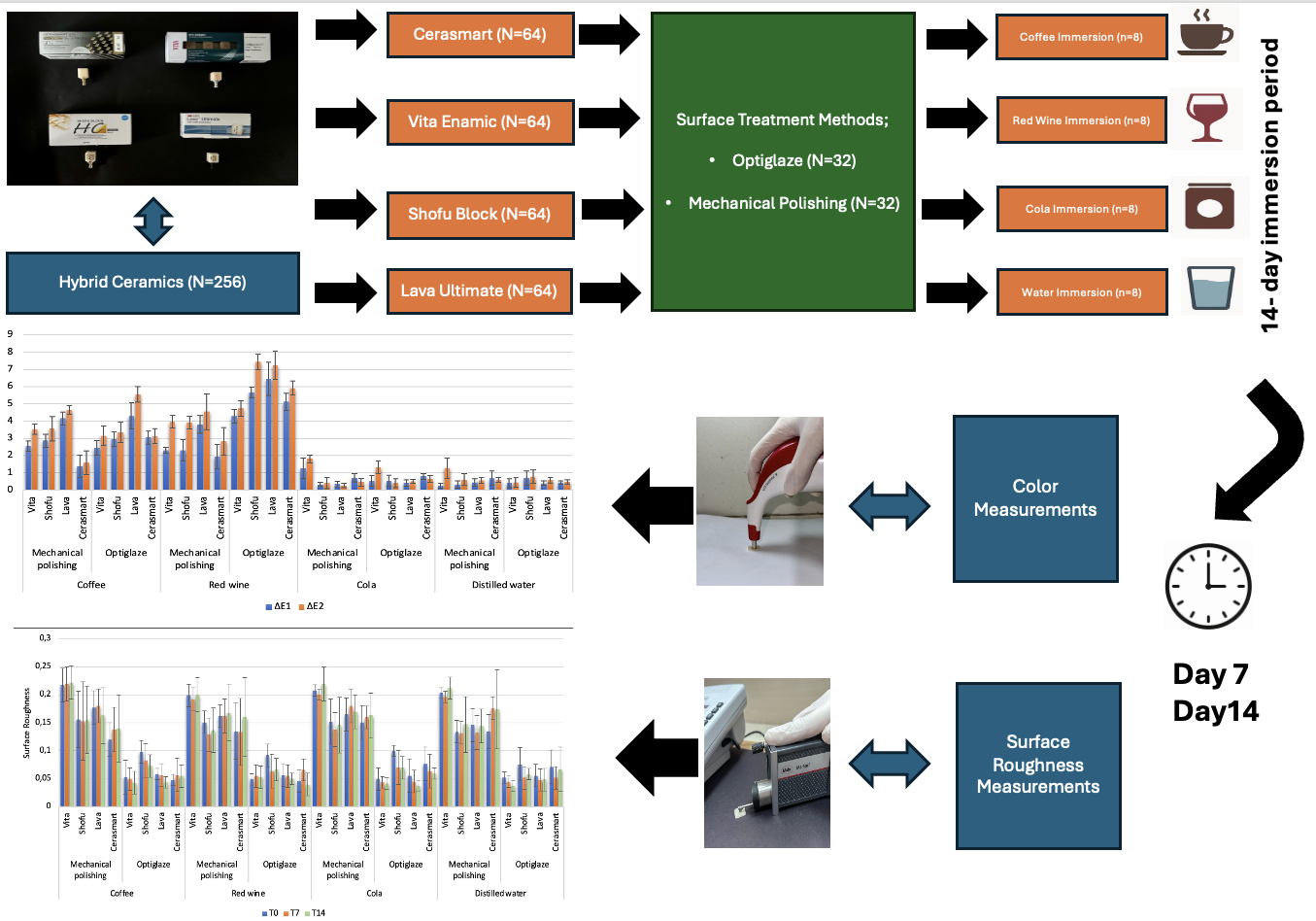
Resin-matrix ceramics are increasingly used in digital dentistry due to their tooth-like elasticity and ease of handling. Color stability is critical for long-term clinical success. This study evaluated the effects of surface finishing and immersion in beverages on the color stability of four resin-matrix ceramics (Cerasmart, Lava Ultimate, Shofu Block HC, and Vita Enamic). A total of 256 specimens were prepared and divided into mechanical polishing and glazing. Glazing was performed using a light-polymerized resin-based surface coating agent (Optiglaze). Specimens were immersed for 14 days in coffee, red wine, cola, or water. Color differences were measured using the CIEDE2000 formula. Three-way repeated measures ANOVA was used to evaluate the color differences, and post hoc analyses were performed using Tukey and Bonferroni tests, with a significance level of p < 0.05. Results showed that surface finishing, material type, beverage type, and immersion time significantly affected color stability. Coffee and red wine caused clinically unacceptable color differences, while mechanically polished specimens demonstrated higher color stability than glazed ones. Lava Ultimate showed the lowest, and Cerasmart the highest, color stability. These findings highlight the role of surface finishing and material choice in maintaining the esthetics of resin-matrix ceramics in patients consuming pigmented beverages.
Keywords:
resin-matrix ceramic
; color stability
; surface finishing
; surface coating agent
; beverages
1. Introduction
Over recent years, computer-aided design and computer-aided manufacturing (CAD/CAM) technology has become an integral part of dental practice [1]. The use of CAD/CAM systems allows clinicians to fabricate restorations that closely reproduce the esthetic appearance and functional properties of natural teeth, contributing to improved clinical performance and patient satisfaction [2]. In particular, chairside CAD/CAM systems combine intraoral scanning, digital design, and restoration fabrication within a single clinical workflow, which can shorten treatment time and reduce the number of patient visits [3]. A wide range of esthetic materials, such as composite resins, ceramics, and zirconia, can be processed using these systems for dental restorative procedures [4]. More recently, resin-matrix ceramics have been introduced as a new category of chairside CAD/CAM materials, aiming to integrate the favorable wear behavior and machinability of composite resins with the mechanical strength of ceramic materials [5].
Resin-matrix ceramics are less brittle and more cost-effective than conventional ceramics. They can be conveniently used chairside, and intraoral repairs can be performed with ease. Their elastic modulus is close to that of natural tooth structure [6]. Resin-matrix ceramics are classified into two groups depending on the manner in which the ceramic phase is incorporated into the polymer matrix. The first group consists of polymer-infiltrated ceramic network (PICN) materials, in which a porous ceramic framework is infiltrated with a polymer. The second group comprises resin nano-ceramic (RNC) materials, in which nanoceramic fillers are dispersed within a highly cross-linked polymer matrix [7,8].
Among these materials, Vita Enamic (Vita Zahnfabrik, Bad Säckingen, Germany) is a PICN material produced by infiltrating a porous, pre-sintered glass–ceramic framework with a polymer, followed by secondary polymerization. This manufacturing process results in a hybrid structure consisting of approximately 86 wt% glass–ceramic as the major phase and about 14 wt% polymer network, mainly based on urethane dimethacrylate (UDMA) and triethylene glycol dimethacrylate (TEGDMA) [9]. In contrast, Lava Ultimate (3M ESPE, St. Paul, MN, USA), Cerasmart (GC Corp., Tokyo, Japan), and Shofu Block HC (Shofu Inc., Kyoto, Japan) are classified as RNC materials [10,11]. Cerasmart has a flexible nanoceramic matrix with an elastic modulus close to dentin, enabling the absorption of functional stresses, and contains approximately 29 wt% resin and 71 wt% silica and barium glass nanoparticles [12]. Lava Ultimate has a chemical composition similar to that of conventional resin composites and is produced by reinforcing a light-cured polymeric matrix containing UDMA, bisphenol A ethoxylate dimethacrylate (Bis-EMA), bisphenol A glycidyl methacrylate (Bis-GMA), and TEGDMA (20 wt%) with silica and zirconia nanoparticles (80 wt%) [13]. Shofu Block HC consists of a resin matrix containing UDMA and TEGDMA, with silica, zirconia, and barium glass fillers dispersed within the inorganic phase [14].
The composition and microstructure of dental materials determine their mechanical and physical properties. Advances in polymer matrix design and filler technology have contributed significantly to the improvement of the mechanical behavior of resin-matrix ceramics [15]. Beyond microstructural variations, differences in filler type and concentration may affect both the mechanical performance and color stability of these materials [16].
Color stability plays a critical role in the long-term clinical performance of restorative materials [17]. Considering the wide structural diversity and the increasing number of resin-matrix ceramics currently available, it is essential to evaluate their performance and identify potential clinical limitations. One of the main limitations of these materials is their susceptibility to staining over time due to both intrinsic and extrinsic factors [18]. Among extrinsic factors, exposure to beverages such as red wine and coffee has been reported as one of the most significant contributors to color differences [19]. Two primary methods are used to evaluate color differences: visual assessment and instrumental analysis. The visual method is typically performed using color scales and is subjective. In contrast, the instrumental method eliminates subjectivity, and devices such as colorimeters and spectrophotometers are commonly employed for this purpose [20].
Surface finishing procedures can alter the surface texture and roughness of restorative materials, which may affect long-term color stability and the clinical success of restorations [21]. Due to the presence of a polymer matrix in resin-ceramics, conventional glaze firing cannot be applied. High-temperature glazing can adversely affect the resin matrix components through heat exposure, potentially leading to surface degradation and color differences over time [22]. Manufacturers have developed a variety of polishing systems, including disks, kits, and pastes, to produce smooth surfaces through mechanical polishing [23]. In recent years, light-polymerized, resin-based surface coating agents, known as glaze materials, have been proposed as surface finishing procedures to reduce the staining tendency of resin-based restorative materials. These low-viscosity materials can penetrate superficial microstructural irregularities and form a thin protective layer, thereby reducing water absorption and consequently minimizing color differences over time [24,25].
Glazing with firing is one of the most commonly used surface finishing procedures for ceramic restorations. Several studies have reported that glazed ceramic materials exhibit better color stability compared to mechanically polished materials [21,26]. Therefore, light-polymerized glaze materials have gained importance for resin-matrix ceramics in order to achieve a surface comparable to that of firing-glazed ceramics. To the best of the authors’ knowledge, there is no study evaluating the effect of light-polymerized glaze materials on the color stability of resin-matrix ceramics. Although many studies have assessed the effects of thermocycling and immersion in different solutions on the color stability of resin-matrix ceramics, research investigating the effect of surface finishing procedures on the color stability of these materials after immersion in different beverages is limited [23,27,28]. Therefore, the aim of this study was to evaluate and compare the color difference values of four different types of resin-matrix ceramic (Cerasmart, Lava Ultimate, Vita Enamic, and Shofu Block HC) after the application of two different surface finishing procedures (mechanical polishing and glazing) and two weeks of immersion in four different beverages (coffee, red wine, cola, and water) using a spectrophotometer. Three null hypotheses were tested in this study: (1) the type of beverage and immersion time have no effect on the color stability of the tested materials; (2) there is no difference in color stability among the tested materials; and (3) surface finishing procedures have no effect on the color stability of the tested materials.
2. Materials and Methods
2.1. Sample Size Calculation
To evaluate the effects of material type, beverage type, and surface finishing procedures on immersion time-dependent color difference (ΔE₀₀) values, a three-way repeated-measures ANOVA was performed. Assuming a medium effect size (f = 0.25), a 5% Type I error probability, a statistical power of 0.95, and a correlation of 0.70 among repeated measurements, the minimum required sample size was calculated using G*Power v.3.1 software. The power analysis indicated that a minimum of 192 specimens was required to achieve sufficient statistical power. In this study, a total of 256 specimens were included, with 8 specimens assigned to each group.
2.2. Specimen Preparation
A total of 256 rectangular specimens with dimensions of 12 × 14 mm and a thickness of 1.5 mm were prepared from A2 shade HT CAD/CAM resin-matrix ceramic blocks of four different materials (Cerasmart, Lava Ultimate, Shofu Block HC, and Vita Enamic). The specimens were sectioned using a low-speed diamond saw (IsoMet 4000, Buehler, USA). The materials used in the study and their compositions are presented in Table 1.
2.3. Surface Finishing Procedures
All specimens were pre-polished to ensure standardization using a grinding and polishing device (Presi Mecapol P230, Grenoble, France) with 600-, 800-, and 1000-grit silicon carbide abrasive papers under continuous water irrigation at 300 rpm for 30 s for each grit. The specimens were then divided into two main groups according to the surface finishing procedure to be applied: mechanical polishing and glazing.
Mechanical polishing was performed in two steps at 10,000 rpm using a diamond-impregnated spiral polishing kit (Diacomp Plus Twist, EVE Ernst Vetter, Pforzheim, Germany), with each step applied for 30 s.
Glazing was performed using a light-polymerized resin-based surface coating agent, OptiGlaze Color (GC Dental Products Europe, Leuven, Belgium), in accordance with the manufacturer’s instructions. Optiglaze was applied as a thin layer to the specimens using a sable brush. Polymerization was performed using a light-curing unit (Valo Cordless; Ultradent, South Jordan, UT, USA) emitting light in the 385–515 nm wavelength range, with an output power of approximately 1000 mW/cm² in standard mode. The applied glaze material was light-cured for 20 s.
2.4. Immersion Procedure
After completion of the surface finishing procedures, each material–surface finishing procedure group was randomly subdivided into four subgroups according to the type of beverage. Accordingly, a total of 256 specimens were allocated into 32 groups based on material type, surface finishing procedure, and beverage type (n = 8 per group). The groups and their code designations are presented in Table 2.
The specimens were immersed for 14 days in coffee (Nescafe Classic; Nestlé, Bursa, Türkiye), red wine (Yakut; Kavaklıdere, Ankara, Türkiye), cola (Coca-Cola Co., Istanbul, Türkiye), and water (control group). The coffee solution was prepared by dissolving 2 g of instant coffee in 200 mL of boiling water, stirring for 10 s, and filtering through filter paper. During the immersion period, the specimens were stored in segmented plastic containers, and the beverages were dispensed using a syringe. The specimens were kept in an incubator at 37 °C in a dark environment. To prevent bacterial contamination, the beverages were completely renewed every 48 h.
2.5. Color Measurements
The color measurements of the specimens were performed using a VITA Easyshade spectrophotometer (Vita Zahnfabrik, Bad Säckingen, Germany). To minimize the influence of ambient light and ensure standardized conditions, a color assessment box with D65 standard illumination was used. The device was calibrated with a calibration plate before measuring each group. The spectrophotometer probe was positioned perpendicularly at the center of each specimen. Each measurement was repeated three times, and the color parameters (L, a, and b*) of each specimen were recorded.
Color measurements were performed at three time points: baseline (after the surface finishing procedures), on day 7, and on day 14. Before each color measurement, the specimens were rinsed with distilled water for 5 s and then air-dried.
The following formula was used to calculate the color difference values of the specimens:
In this study, KL, KC, and KH were set to 1.0. The color differences of the experimental groups were evaluated, and the acceptability threshold was set at 1.8 [29].
2.6. Statistical Analysis
The data obtained in this study were analyzed using IBM SPSS version 22.0. The normality of the data distribution was assessed using the Kolmogorov–Smirnov and Shapiro–Wilk tests. The effects of material type, beverage type, and different surface finishing procedures on time-dependent color difference values (ΔE00) were analyzed using a three-way repeated-measures ANOVA. When significant differences were detected in the ANOVA results, multiple comparisons between different time points were performed using the Bonferroni post hoc test, while comparisons among beverage and material groups were conducted using the Tukey post hoc test. A significance level of p < 0.05 was considered statistically significant.
The study workflow is summarized in Figure 1.
3. Results
The effects of different surface finishing procedures, material type, beverage type, and immersion time on the color difference (ΔE₀₀) values of the specimens were analyzed using a three-way repeated-measures ANOVA, and all main effects as well as interactions were found to be statistically significant (p < 0.05). The results of the three-way repeated-measures ANOVA are presented in Table 3.
Table 4 presents the mean ΔE₀₀ and standard deviations (SD) of test groups.
After two weeks of immersion, the highest ΔE₀₀ was observed in the Sh-Og-Rw and Lu-Og-Rw groups (7.44 ± 0.45 and 7.24 ± 0.83, respectively).
Immersion in coffee resulted in a statistically significant increase in ΔE₀₀ values over time for all specimens except Cerasmart (p < 0.05). Among the coffee-immersed specimens, the highest ΔE₀₀ values were observed in the Lava Ultimate specimens. The Optiglaze coating exhibited significantly higher ΔE₀₀ values compared to the mechanical polishing procedure in Lava Ultimate and Cerasmart specimens after two weeks of coffee immersion (p < 0.05). Except for the Cerasmart–mechanical polishing group, ΔE₀₀ values in all other coffee-immersed specimens exceeded the clinically acceptable threshold (ΔE₀₀ > 1.8) from the first week.
Immersion in red wine resulted in a statistically significant increase in ΔE₀₀ values over time for all specimens (p < 0.05). In all red wine–immersed specimens, the Optiglaze coating exhibited significantly higher ΔE₀₀ values compared to the mechanical polishing procedure (p < 0.05). Moreover, ΔE₀₀ values in all red wine–immersed specimens exceeded the clinically acceptable threshold (ΔE₀₀ > 1.8) from the first week.
Immersion in cola did not result in a statistically significant increase in ΔE₀₀ values over time for all specimens except Vita Enamic (p > 0.05). Among the cola-immersed specimens, the highest ΔE₀₀ values were observed in the Vita Enamic specimens. Except for the Ve–Mp–Co group, ΔE₀₀ values in all other cola-immersed specimens remained below the clinically acceptable threshold (ΔE₀₀ < 1.8) after two weeks of storage. The Ve–Mp–Co group exhibited significantly higher ΔE₀₀ values compared to the Ve–Og–Co group (p < 0.05). Moreover, no significant differences were observed between the surface finishing procedures in specimens immersed in cola (p > 0.05).
Immersion in water did result in a statistically significant increase in ΔE₀₀ values over time for all specimens except Vita Enamic-mechanical polishing group (p > 0.05). All Water-immersed specmines remained below the clinically acceptable threshold (ΔE₀₀ < 1.8). The Ve–Mp–W group exhibited significantly higher ΔE₀₀ values compared to the Ve–Og–W group (p < 0.05). Moreover, no significant differences were observed between the surface finishing procedures in specimens immersed in water (p > 0.05).
According to Tukey’s post hoc multiple comparison test, coffee and red wine beverages exhibited statistically significantly higher ΔE₀₀ values than cola and water in all specimens after two weeks of immersion (p < 0.05). In the Optiglaze coating procedure, red wine showed significantly higher ΔE₀₀ values than coffee (p < 0.05). Moreover, in Cerasmart specimens subjected to the mechanical polishing procedure, red wine exhibited higher ΔE₀₀ values compared to coffee (p < 0.05). In Vita Enamic specimens, cola showed significantly higher ΔE₀₀ values than water (p < 0.05).
4. Discussion
In this study, the effects of surface finishing procedures on the color stability of resin-matrix ceramics were evaluated following immersion in different beverages. Based on the findings, it was observed that different beverage types and immersion durations led to varying degrees of discoloration among the materials, resulting in the rejection of the first null hypothesis. Resin-ceramic materials with different compositions exhibited different levels of color stability, leading to the rejection of the second null hypothesis. Furthermore, surface finishing procedures influenced the color stability of the tested materials, which resulted in the rejection of the third null hypothesis.
In chairside CAD/CAM restorations, the surface obtained immediately after milling is unsuitable for direct cementation. Therefore, prior to intraoral application, restorations must undergo surface finishing and polishing procedures to achieve a clinically acceptable surface These procedures ensure that the restoration surface is smooth and glossy [30]. A polished and smooth surface not only enhances patient comfort but also contributes significantly to the esthetic and biological compatibility of the restoration. Conversely, rough restoration surfaces can increase both discoloration and plaque accumulation, potentially leading to secondary caries and periodontal diseases [31]. In the case of resin-matrix ceramics, surface finishing can be accomplished using either mechanical polishing systems or light-cured, resin-based surface coatings [32]. Mechanical polishing may be performed using single-step, two-step, or multi-step protocols, and its effectiveness can vary according to the composition, form, type, and hardness of the abrasive particles employed [33]. Surface coating agents fill the microporosities on the material surface, creating a surface glaze–like effect; in this way, they aim to obtain a smoother and more homogeneous surface and to provide improved stain resistance [34]. Çakmak et al. [22] investigated the surface properties of two resin-matrix ceramic materials—Lava Ultimate (3M ESPE, St. Paul, MN, USA) and Cerasmart (GC Corporation, Tokyo, Japan)—after the application of two different surface coating agents, Optiglaze (GC Dental Products Europe, Leuven, Belgium) and Palaseal (Kulzer GmbH, South Bend, IN), followed by thermocycling. Accordingly, they reported that although surface coating agents maintained their surface integrity on Cerasmart after thermocycling, they failed to preserve surface integrity on Lava Ultimate, with the occurrence of microcracks and air bubble formation within the coating layer. In the present study, Optiglaze-applied Lava Ultimate exhibited lower color stability than Cerasmart after two weeks of immersion in coffee and red wine. Lava specimens with Optiglaze application exhibited greater staining than Cerasmart specimens after two weeks of coffee and red wine immersion. This finding may be attributed to the gradual loss of surface integrity of the Optiglaze layer on Lava Ultimate over time. The observed difference between the two materials is thought to be related to variations in their microstructure, composition, filler content, and filler particle size.
Özer and Oğuz [35] reported that mechanical polishing procedures were more effective than glaze applications in reducing surface roughness in resin-matrix ceramics. In the present study, specimens subjected to mechanical polishing demonstrated superior color stability following red wine and coffee immersion compared with those receiving glaze application. This outcome may be attributed to variations in surface roughness induced by the respective surface finishing procedures. Several studies [36,37] have reported that surface roughness may influence color stability, as rougher surfaces can facilitate greater staining and pigment adsorption, potentially leading to increased discoloration of restorative materials.
Güler et al. [38] reported that coffee consumers drink an average of 3.2 cups of coffee per day and that each cup is consumed within approximately 15 minutes. Based on these data, it has been suggested that immersing restorative materials in coffee for 24 hours may simulate approximately one month of clinical coffee consumption. In this context, in the present study, the color stability of the tested materials was evaluated by immersing them in four commonly consumed beverages for 14 days, and this duration was assumed to represent long-term clinical exposure.
The use of spectrophotometers in the evaluation of color stability of restorative materials enables an objective color comparison. Color coordinates (L*, a*, and b*) are measured, and color differences are compared using the CIELAB or CIEDE2000 formulas, which are the most frequently employed methods for analyzing color differences [19]. The Perceptibility Threshold refers to the magnitude of color difference that can be visually detected by the human eye, whereas the Acceptability Threshold defines the magnitude of color difference that is considered clinically unacceptable. To ensure clinical relevance, the statistical outcomes of color measurements should be interpreted in conjunction with these threshold values [39]. In the present study, color differences were calculated using the CIEDE2000 (ΔE₀₀) formula, as previous studies [29,40] have reported that CIEDE2000 shows a higher correlation with human visual perception and more accurately reflects perceived color differences compared with the CIELAB (ΔE*ab) formula.
Quek et al. [41] reported that after immersing three resin-matrix ceramics—Lava Ultimate, Vita Enamic (Vita Zahnfabrik, Bad Säckingen, Germany), and Shofu Block HC (Shofu Inc., Kyoto, Japan)— in different solutions for one week, specimens stored in red wine and coffee exhibited color differences exceeding the clinically acceptable threshold. Alharbi et al. [42] further reported that, following immersion of Vita Enamic and Lava Ultimate in various beverages, red wine and coffee induced greater discoloration compared to distilled water and cola. Barutçugil et al. [43] reported that three resin-matrix ceramics—Lava Ultimate, Vita Enamic, and Cerasmart—immersed in coffee and red wine for one month exhibited color differences exceeding the clinically acceptable threshold, with higher discoloration in red wine and coffee compared to water. The findings of the present study are consistent with the literature, showing that the greatest staining occurred in specimens immersed in coffee and red wine. Staining of resin-based materials by red wine has been attributed to its high pigment content (particularly anthocyanins and tannins), low pH, and alcohol concentration; these factors collectively soften the polymer matrix, facilitating deeper pigment penetration into the resin structure and resulting in more pronounced staining [44,45]. Coffee staining of resin-matrix ceramics has been attributed to the absorption of yellow pigments into the polymer matrix, which facilitates deeper pigment penetration and contributes significantly to discoloration [28,46]. Bagheri et al. [47] reported that cola causes less staining than coffee, likely due to the absence of yellow chromogenic compounds present in coffee.
Previous studies [28,42,48] have shown that Lava Ultimate exhibits greater color difference than Vita Enamic, particularly when exposed to beverages such as coffee and red wine. Moreover, several studies [43,49] have reported that Cerasmart demonstrates significantly higher color stability than Lava Ultimate, which has been attributed to differences in their resin matrix composition and monomer content. Mahrous et al. reported that Cerasmart exhibited better color stability compared with VITA Enamic. Stamenkovic et al. [50] immersed six different CAD/CAM materials, including Cerasmart, Lava Ultimate, Shofu Block HC, and Vita Enamic, in coffee and red wine. In the coffee beverage, the greatest color difference was reported for Lava Ultimate, followed by Shofu Block HC, Vita Enamic, and Cerasmart. In the red wine beverage, Cerasmart was reported to exhibit the highest color stability compared with the other resin-matrix ceramic materials. In the present study, Cerasmart exhibited the highest color stability, whereas Lava Ultimate was found to be the material most susceptible to color difference, particularly in coffee and red wine solutions. The staining tendency of resin-based materials has been reported to be associated with water sorption. Water sorption is thought to facilitate the penetration of staining agents into the material matrix, thereby increasing color difference [51]. Restorative materials containing Bis-GMA have been reported to exhibit a greater tendency toward color difference compared with those containing other monomers, owing to their hydrophilic properties [52]. Similarly, materials containing TEGDMA have been reported to exhibit lower color stability compared to those without TEGDMA, and this effect has been associated with water sorption [53]. In the present study, the highest color difference observed in Lava Ultimate can be attributed to its Bis-GMA and TEGDMA content, whereas the absence of these monomers in Cerasmart may explain its higher color stability compared to other resin-matrix ceramics.
This study provides valuable insights into the color stability of resin-matrix ceramics; however, it has certain limitations. Color measurements were performed on flat specimens with standardized thickness. Although this approach ensures accurate and reproducible measurements, it does not fully reflect the complex occlusal morphology of clinical restorations or the variations in restoration thickness depending on the anatomical location of the tooth, both of which may influence color stability. In addition, the in vitro design of the study represents another limitation, as clinical factors that may affect the optical properties of restorative materials—such as intraoral temperature fluctuations, the presence of saliva, masticatory forces, and individual toothbrushing habits—were not included in the experimental protocol. Therefore, future research should aim to simulate more realistic intraoral conditions and conduct long-term clinical studies to evaluate whether the in vitro findings translate into clinically meaningful outcomes.
5. Conclusions
Within the limitations of this in vitro study, it can be concluded that the color stability of resin-matrix ceramics was significantly affected by the applied surface finishing procedures. Specimens immersed in beverages with high chromogenic potential, such as coffee and red wine, showed greater color differences with glaze compared to mechanically polished surfaces. Moreover, beverages containing chromogenic agents, particularly coffee and red wine, caused more pronounced discoloration in materials with Bis-GMA- and TEGDMA-based matrices, highlighting the role of polymer composition in pigment penetration. These findings indicate that both surface finishing procedures and material composition are critical for ensuring long-term esthetic outcomes in resin-matrix ceramic restorations.
Author Contributions
Conceptualization, I.K.D. and T.K.; methodology, I.K.D. and T.K.; software, I.K.D.; validation, I.K.D., U.D. and T.K.; formal analysis, I.K.D.; investigation, I.K.D.; resources, I.K.D. and T.K.; data curation, I.K.D.; writing—original draft preparation, I.K.D. and U.D.; writing—review and editing, I.K.D. and U.D.; visualization, I.K.D.; supervision, T.K.; project administration, I.K.D. and T.K.; funding acquisition, I.K.D. and T.K. all authors have read and agreed to the published version of the manuscript.
Funding
This research was funded by the Scientific Research Projects Coordination Unit of Gazi University (grant no. TDH-2023-8970).
Institutional Review Board Statement
Not applicable.
Informed Consent Statement
Not applicable.
Data Availability Statement
The data presented in this study are available on request from the corresponding author.
Conflicts of Interest
The authors declare no conflicts of interest.
Abbreviations
The following abbreviations are used in this manuscript:
| Bis-EMA |
Bisphenol A Ethoxylate Dimethacrylate |
| Bis-GMA |
Bisphenol A Glycidyl Methacrylate |
| CAD/CAM |
Computer-Aided Design / Computer-Aided Manufacturing |
| CIE |
Internationale de l’Eclairage |
| PICN |
Polymer-Infiltrated Ceramic Network |
| RNC |
Resin Nano-Ceramic |
| TEGDMA |
Triethylene Glycol Dimethacrylate |
| UDMA | Urethane Dimethacrylate |
References
- Nassani, M.Z.; Ibraheem, S.; Shamsy, E.; Darwish, M.; Faden, A.; Kujan, O. A survey of dentists’ perception of chair-side CAD/CAM technology. Healthcare. 2021, 68. [Google Scholar] [CrossRef]
- Ille, C.-E.; Jivănescu, A.; Pop, D.; Stoica, E.T.; Flueras, R.; Talpoş-Niculescu, I.-C.; Cosoroabă, R.M.; Popovici, R.-A.; Olariu, I. Exploring the properties and indications of chairside CAD/CAM materials in restorative dentistry. J. Funct. Biomater. 2025, 16, 46. [Google Scholar] [CrossRef]
- Marchesi, G.; Camurri Piloni, A.; Nicolin, V.; Turco, G.; Di Lenarda, R. Chairside CAD/CAM materials: Current trends of clinical uses. Biology 2021, 10, 1170. [Google Scholar] [CrossRef]
- Hong, M.-S.; Choi, Y.-S.; Lee, H.-H.; Lee, J.-H.; Ahn, J. Comparison of mechanical properties of chairside CAD/CAM restorations fabricated using a standardization method. Materials. 2021, 14, 3115. [Google Scholar] [CrossRef]
- Fathy, H.; Hamama, H.H.; El-Wassefy, N.; Mahmoud, S.H. Clinical performance of resin-matrix ceramic partial coverage restorations: A systematic review. Clin. Oral Investig. 2022, 26, 3807–3822. [Google Scholar] [CrossRef] [PubMed]
- Alfouzan, A.F.; Alnafaiy, S.M.; Alsaleh, L.S.; Bawazir, N.H.; Al-Otaibi, H.N.; Al Taweel, S.M.; Alshehri, H.A.; Labban, N. Effects of background color and thickness on the optical properties of CAD-CAM resin-matrix ceramics. J. Prosthet. Dent. 2022, 128, 497.e491–497.e499. [Google Scholar] [CrossRef]
- Duarte, S., Jr.; Sartori, N.; Phark, J.-H. Ceramic-reinforced polymers: CAD/CAM hybrid restorative materials. Curr. Oral Health Rep. 2016, 3, 198–202. [Google Scholar] [CrossRef]
- Wanderico, C.M.; Picolo, M.Z.D.; Kury, M.; Azevedo, V.L.B.; Giannini, M.; Cavalli, V. Alternative surface treatments strategies for bonding to CAD/CAM resin-matrix ceramics. J. Adhes. Sci. Technol. 2023, 37, 1471–1484. [Google Scholar] [CrossRef]
- Facenda, J.C.; Borba, M.; Corazza, P.H. A literature review on the new polymer-infiltrated ceramic-network material (PICN). J. Esthet. Restor. Dent. 2018, 30, 281–286. [Google Scholar] [CrossRef]
- Bahadır, H.S.; Bayraktar, Y. Evaluation of the repair capacities and color stabilities of a resin nanoceramic and hybrid CAD/CAM blocks. J. Adv. Prosthodont. 2020, 12, 140. [Google Scholar] [CrossRef] [PubMed]
- Sodeyama, M.; Ikeda, H.; Nagamatsu, Y.; Masaki, C.; Hosokawa, R.; Shimizu, H. Printable PICN composite mechanically compatible with human teeth. J. Dent. Res. 2021, 100, 1475–1481. [Google Scholar] [CrossRef] [PubMed]
- Mahrous, A.I.; Salama, A.A.; Shabaan, A.A.; Abdou, A.; Radwan, M.M. Color stability of two different resin matrix ceramics: Randomized clinical trial. BMC Oral Health. 2023, 23, 665. [Google Scholar] [CrossRef]
- Sonmez, N.; Gultekin, P.; Turp, V.; Akgungor, G.; Sen, D.; Mijiritsky, E. Evaluation of five CAD/CAM materials by microstructural characterization and mechanical tests: A comparative in vitro study. BMC Oral Health 2018, 18, 5. [Google Scholar] [CrossRef]
- Papadopoulos, K.; Pahinis, K.; Saltidou, K.; Dionysopoulos, D.; Tsitrou, E. Evaluation of the surface characteristics of dental CAD/CAM materials after different surface treatments. Materials. 2020, 13, 981. [Google Scholar] [CrossRef]
- Kang, Y.-A.; Lee, H.-A.; Chang, J.; Moon, W.; Chung, S.H.; Lim, B.-S. Color stability of dental reinforced CAD/CAM hybrid composite blocks compared to regular blocks. Materials. 2020, 13, 4722. [Google Scholar] [CrossRef]
- Alhassan, M.; Maawadh, A.; Labban, N.; Shono, N.; Alebdi, A.; Alhijji, S.; BinMahfooz, A.M. Color change, biaxial flexural strength, and fractographic analysis of resin-modified CAD/CAM ceramics subjected to different surface finishing protocols. Appl. Sci. 2023, 13, 3415. [Google Scholar] [CrossRef]
- Ozen, F.; Demirkol, N.; Oz, O.P. Effect of surface finishing treatments on the color stability of CAD/CAM materials. J. Adv. Prosthodont. 2020, 12, 150. [Google Scholar] [CrossRef]
- Nagai, T.; Alfaraj, A.; Chu, T.M.G.; Yang, C.C.; Lin, W.S. Color stability of CAD-CAM hybrid ceramic materials following immersion in artificial saliva and wine. J. Prosthodont. 2025, 34, 836–844. [Google Scholar] [CrossRef]
- Paolone, G.; Mandurino, M.; De Palma, F.; Mazzitelli, C.; Scotti, N.; Breschi, L.; Gherlone, E.; Cantatore, G.; Vichi, A. Color stability of polymer-based composite CAD/CAM blocks: A systematic review. Polymers 2023, 15, 464. [Google Scholar] [CrossRef] [PubMed]
- Gad, M.A.; Abdelhamid, A.M.; ElSamahy, M.; Abolgheit, S.; Hanno, K.I. Effect of aging on dimensional accuracy and color stability of CAD-CAM milled and 3D-printed denture base resins: A comparative in-vitro study. BMC Oral Health. 2024, 24, 1124. [Google Scholar] [CrossRef] [PubMed]
- Kanat-Ertürk, B. Color stability of CAD/CAM ceramics prepared with different surface finishing procedures. J. Prosthodont. 2020, 29, 166–172. [Google Scholar] [CrossRef]
- Çakmak, G.; Subaşı, M.G.; Yilmaz, B. Effect of thermocycling on the surface properties of resin-matrix CAD-CAM ceramics after different surface treatments. J. Mech. Behav. Biomed. Mater. 2021, 117, 104401. [Google Scholar] [CrossRef]
- Sagsoz, O.; Demirci, T.; Demirci, G.; Sagsoz, N.P.; Yildiz, M. The effects of different polishing techniques on the staining resistance of CAD/CAM resin-ceramics. J. Adv. Prosthodont. 2016, 8, 417. [Google Scholar] [CrossRef] [PubMed]
- Korkut, B.; Bud, M.; Kukey, P.; Sancakli, H.S. Effect of surface sealants on color stability of different resin composites. Med. Pharm. Rep. 2022, 95, 71. [Google Scholar] [CrossRef]
- Kara, D.; Tekçe, N.; Fidan, S.; Demirci, M.; Tuncer, S.; Balcı, S. The effects of various polishing procedures on surface topography of CAD/CAM resin restoratives. J. Prosthodont. 2021, 30, 481–489. [Google Scholar] [CrossRef] [PubMed]
- Motro, P.F.K.; Kursoglu, P.; Kazazoglu, E. Effects of different surface treatments on stainability of ceramics. J. Prosthet. Dent. 2012, 108, 231–237. [Google Scholar] [CrossRef]
- Silva, E.A.; Simionato, A.A.; Moss, O.B.; Faria, A.C.L.; Rodrigues, R.C.S.; Ribeiro, R.F. Impact of high-consumption beverages on the color, and surface roughness and microhardness of resin-matrix ceramics. Dent. Med. Probl. 2025, 62, 299–307. [Google Scholar] [CrossRef] [PubMed]
- Yerliyurt, K.; Sarıkaya, I. Color stability of hybrid ceramics exposed to beverages in different combinations. BMC Oral Health. 2022, 22, 180. [Google Scholar] [CrossRef]
- Paravina, R.D.; Ghinea, R.; Herrera, L.J.; Bona, A.D.; Igiel, C.; Linninger, M.; Sakai, M.; Takahashi, H.; Tashkandi, E.; Mar Perez, M.D. Color difference thresholds in dentistry. J. Esthet. Restor. Dent. 2015, 27, S1–S9. [Google Scholar] [CrossRef]
- Mota, E.G.; Smidt, L.N.; Fracasso, L.M.; Burnett, L.H., Jr.; Spohr, A.M. The effect of milling and postmilling procedures on the surface roughness of CAD/CAM materials. J. Esthet. Restor. Dent. 2017, 29, 450–458. [Google Scholar] [CrossRef]
- Rashid, H. The effect of surface roughness on ceramics used in dentistry: A review of literature. Eur. J. Dent. 2014, 8, 571–579. [Google Scholar] [CrossRef]
- Alhassan, M.; Maawadh, A.; Labban, N.; Alnafaiy, S.M.; Alotaibi, H.N.; BinMahfooz, A.M. Effect of different surface treatments on the surface roughness and gloss of resin-modified CAD/CAM ceramics. Appl. Sci. 2022, 12, 11972. [Google Scholar] [CrossRef]
- Aydın, N.; Karaoğlanoğlu, S.; Oktay, E.A.; Ersöz, B. Superficial effects of different finishing and polishing systems on the surface roughness and color change of resin-based CAD/CAM blocks. Odovtos Int. J. Dent. Sci. 2022, 23, 87–97. [Google Scholar] [CrossRef]
- Şahin, O.; Dede, D.Ö.; Köroğlu, A.; Yılmaz, B. Influence of surface sealant agents on the surface roughness and color stability of artificial teeth. J. Prosthet. Dent. 2015, 114, 130–137. [Google Scholar] [CrossRef]
- Ozer, N.; Oguz, E. Influence of different finishing-polishing procedures and thermocycle aging on the surface roughness of nano-ceramic hybrid CAD/CAM material. Niger. J. Clin. Pract. 2023, 26, 604–611. [Google Scholar] [CrossRef]
- Topçu, S.; Tekçe, N.; Kopuz, D.; Özcelik, E.Y.; Kolaylı, F.; Tuncer, S.; Demirci, M. Effect of surface roughness and biofilm formation on the color properties of resin-infiltrated ceramic and lithium disilicate glass-ceramic CAD-CAM materials. J. Prosthet. Dent. 2024, 131, 935.e931–935.e938. [Google Scholar] [CrossRef] [PubMed]
- Kareem, A.S.A.; Abdel-Fattah, W.M.; El Gayar, M.I.L. Evaluation of color stability and surface roughness of smart monochromatic resin composite in comparison to universal resin composites after immersion in staining solutions. BMC Oral Health. 2025, 25, 1211. [Google Scholar] [CrossRef]
- Guler, A.U.; Yilmaz, F.; Kulunk, T.; Guler, E.; Kurt, S. Effects of different drinks on stainability of resin composite provisional restorative materials. J. Prosthet. Dent. 2005, 94, 118–124. [Google Scholar] [CrossRef] [PubMed]
- Ghinea, R.; Pérez, M.M.; Herrera, L.J.; Rivas, M.J.; Yebra, A.; Paravina, R.D. Color difference thresholds in dental ceramics. J. Dent. 2010, 38, e57–e64. [Google Scholar] [CrossRef]
- Gómez-Polo, C.; Muñoz, M.P.; Luengo, M.C.L.; Vicente, P.; Galindo, P.; Casado, A.M.M. Comparison of the CIELab and CIEDE2000 color difference formulas. J. Prosthet. Dent. 2016, 115, 65–70. [Google Scholar] [CrossRef]
- Quek, S.; Yap, A.; Rosa, V.; Tan, K.; Teoh, K. Effect of staining beverages on color and translucency of CAD/CAM composites. J. Esthet. Restor. Dent. 2018, 30, E9–E17. [Google Scholar] [CrossRef]
- Alharbi, A.; Ardu, S.; Bortolotto, T.; Krejci, I. Stain susceptibility of composite and ceramic CAD/CAM blocks versus direct resin composites with different resinous matrices. Odontology 2017, 105, 162–169. [Google Scholar] [CrossRef]
- Barutçugil, Ç.; Bilgili, D.; Barutcigil, K.; Dündar, A.; Büyükkaplan, U.Ş.; Yilmaz, B. Discoloration and translucency changes of CAD-CAM materials after exposure to beverages. J. Prosthet. Dent. 2019, 122, 325–331. [Google Scholar] [CrossRef]
- Krajangta, N.; Angkananuwat, C.; Leelaponglit, S.; Saelor, P.; Ngamjarrussriwichai, N.; Klaisiri, A. The effect of whitening and daily dentifrices on red wine staining in different types of composite resins. Appl. Sci. 2024, 14, 12030. [Google Scholar] [CrossRef]
- Llena, C.; Fernández, S.; Forner, L. Color stability of nanohybrid resin-based composites, ormocers and compomers. Clin. Oral Investig. 2017, 21, 1071–1077. [Google Scholar] [CrossRef]
- Elsaka, S.; Taibah, S.; Elnaghy, A. Effect of staining beverages and bleaching on optical properties of a CAD/CAM nanohybrid and nanoceramic restorative material. BMC Oral Health. 2022, 22, 96. [Google Scholar] [CrossRef]
- Bagheri, R.; Burrow, M.; Tyas, M. Influence of food-simulating solutions and surface finish on susceptibility to staining of aesthetic restorative materials. J. Dent. 2005, 33, 389–398. [Google Scholar] [CrossRef]
- Liebermann, A.; Vehling, D.; Eichberger, M.; Stawarczyk, B. Impact of storage media and temperature on color stability of tooth-colored CAD/CAM materials for final restorations. J. Appl. Biomater. Funct. Mater. 2019, 17, 2280800019836832. [Google Scholar] [CrossRef]
- Dermanli, E.; Bayazit, E.O. Color stability of CAD/CAM resin-nanoceramic vs. direct composite materials. Int. Dent. J. 2024, 74, S329. [Google Scholar] [CrossRef]
- Stamenković, D.D.; Tango, R.N.; Todorović, A.; Karasan, D.; Sailer, I.; Paravina, R.D. Staining and aging-dependent changes in color of CAD-CAM materials. J. Prosthet. Dent. 2021, 126, 672–678. [Google Scholar] [CrossRef]
- Osiceanu, G.; Bejan, F.R.; Vasiliu, R.D.; Porojan, S.D.; Porojan, L. The evaluation of water sorption effects on surface characteristics and color changes in direct and CAD/CAM subtractively processed resin composites. Materials 2025, 18, 1812. [Google Scholar] [CrossRef] [PubMed]
- Alamoush, R.A.; Salim, N.A.; Silikas, N.; Satterthwaite, J.D. Long-term hydrolytic stability of CAD/CAM composite blocks. Eur. J. Oral Sci. 2022, 130, e12834. [Google Scholar] [CrossRef] [PubMed]
- Amirinejad, S.; Panahandeh, N.; Torabzadeh, H. Properties of composite resins early after curing: Color stability, degree of conversion, and dimensional stability. Int. J. Dent. 2025, 3702687. [Google Scholar] [CrossRef] [PubMed]
Figure 1.
Workflow of the study.
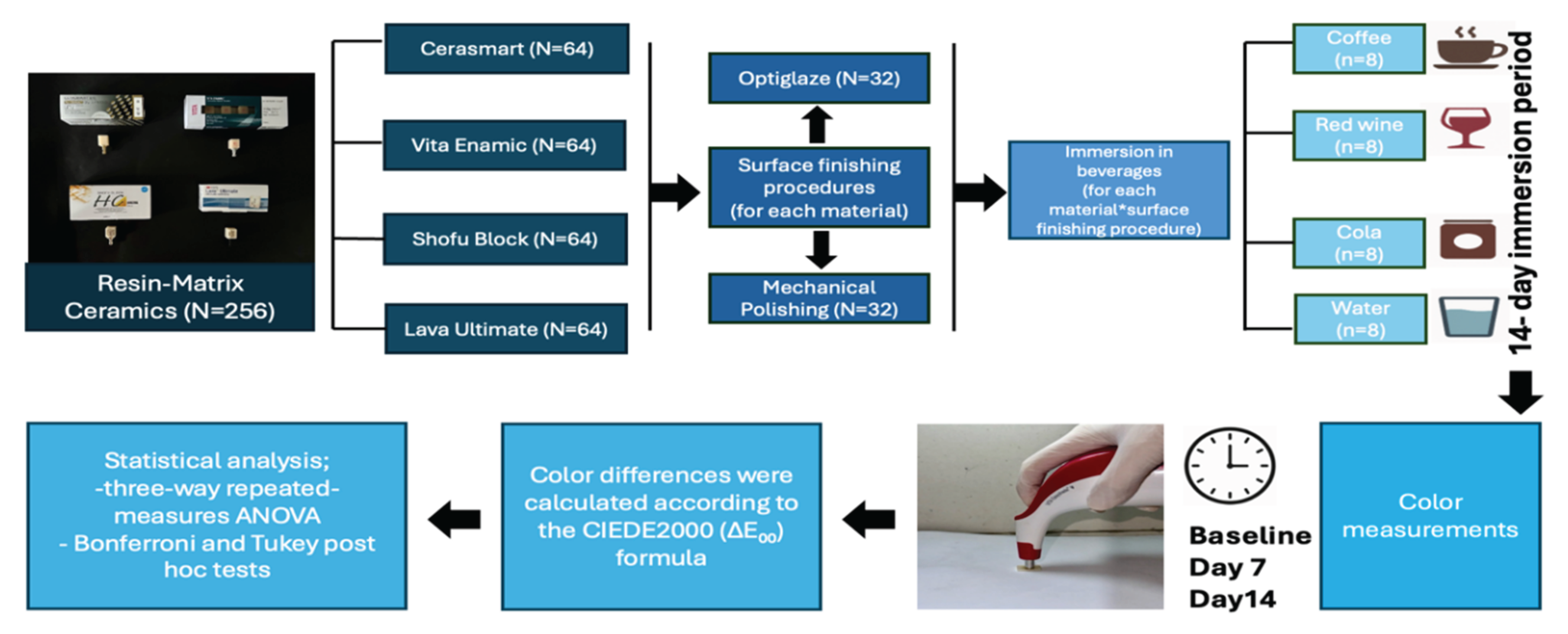

Table 1.
Materials used in the study.
| Material | Material type | Manufacturer | Composition |
| Cerasmart | Resin nanoceramic | GC Corp., Tokyo, Japan | Bis-MEPP, UDMA, DMA (29 wt%) Silica and barium glass nanoparticles (Silica (20 nm), barium glass (300 nm)) (71 wt%) |
| Lava Ultimate | Resin nanoceramic | 3M, St Paul, MN, USA |
Bis-GMA, UDMA, Bis-EMA, TEGDMA (20 wt%) SiO2 (20 nm), ZrO2 (4–11 nm), aggregated ZrO2/SiO2 microcluster (80 wt%) |
| Shofu Block HC |
Resin nanoceramic | Shofu Inc., Kyoto, Japan |
UDMA + TEGDMA (39 wt%) Silica-based glass and silica (61 wt%) |
| Vita Enamic | Polymer-infiltrated ceramic network | Vita Zahnfabrik, Bad Säckingen, Germany | UDMA, TEGDMA, (14 wt%) fine-structure feldspar ceramic, (86 wt%) |
Bis-GMA, Bisphenol A glycidyl methacrylate; UDMA, urethane dimethacrylate; TEGDMA, triethylene glycol dimethacrylate; Bis-EMA, bisphenol ethoxylat A dimethacrylate; DMA, 2,2-bis [4-(2-hydroxy-3-methacryloxypropoxy)phenyl]propane; PMMA, polymethyl methacrylate; MMA, methyl methacrylate; SiO₂, silicon dioxide; ZrO₂, zirconium dioxide; Al₂O₃, aluminum oxide; wt%, weight percent.
Table 2.
Specimen groups and codes based on material, surface finishing, and beverage.
| Material | Surface Finishing | Beverage | Code |
| Cerasmart | Optiglaze | Cola | Cs-Og-Co |
| Cerasmart | Optiglaze | Red wine | Cs-Og-Rw |
| Cerasmart | Optiglaze | Coffee | Cs-Og-Cf |
| Cerasmart | Optiglaze | Water | Cs-Og-W |
| Cerasmart | Mechanihal polishing | Cola | Cs-Mp-Co |
| Cerasmart | Mechanical polishing | Red wine | Cs-Mp-Rw |
| Cerasmart | Mechanical polishing | Coffee | Cs-Mp-Cf |
| Cerasmart | Mechanical polishing | Water | Cs-Mp-W |
| Lava Ultimate | Optiglaze | Cola | Lu-Og-Co |
| Lava Ultimate | Optiglaze | Red wine | Lu-Og-Rw |
| Lava Ultimate | Optiglaze | Coffee | Lu-Og-Cf |
| Lava Ultimate | Optiglaze | Water | Lu-Og-W |
| Lava Ultimate | Mechanihal polishing | Cola | Lu-Mp-Co |
| Lava Ultimate | Mechanihal polishing | Red wine | Lu-Mp-Rw |
| Lava Ultimate | Mechanihal polishing | Coffee | Lu-Mp-Cf |
| Lava Ultimate | Mechanihal polishing | Water | Lu-Mp-W |
| Shofu Block | Optiglaze | Cola | Sh-Og-Co |
| Shofu Block | Optiglaze | Red wine | Sh-Og-Rw |
| Shofu Block | Optiglaze | Coffee | Sh-Og-Cf |
| Shofu Block | Optiglaze | Water | Sh-Og-W |
| Shofu Block | Mechanihal polishing | Cola | Sh-Mp-Co |
| Shofu Block | Mechanihal polishing | Red wine | Sh-Mp-Rw |
| Shofu Block | Mechanihal polishing | Coffee | Sh-Mp-Co |
| Shofu Block | Mechanihal polishing | Water | Sh-Mp-W |
| Vita Enamic | Optiglaze | Cola | Ve-Og-Co |
| Vita Enamic | Optiglaze | Red wine | Ve-Og-Rw |
| Vita Enamic | Optiglaze | Coffee | Ve-Og-Cf |
| Vita Enamic | Optiglaze | Water | Ve-Og-W |
| Vita Enamic | Mechanihal polishing | Cola | Ve-Mp-Co |
| Vita Enamic | Mechanihal polishing | Red wine | Ve-Mp-Rw |
| Vita Enamic | Mechanihal polishing | Coffee | Ve-Mp-Cf |
| Vita Enamic | Mechanihal polishing | Water | Ve-Mp-W |
Table 3.
Three-way repeated-measures results for ΔE₀₀ values.
| Source | Degree of Freedom | F-Value | p-Value |
| Material (M) | 3 | 54.797 | 0.001 |
| Beverage (B) | 3 | 1499.317 | 0.001 |
| Surface finishing (SF) | 1 | 215.061 | 0.001 |
| Immersion time (IT) | 1 | 557.177 | 0.001 |
| M x IT | 3 | 33.492 | 0.001 |
| B x IT | 3 | 107.48 | 0.001 |
| SF x IT | 1 | 6.409 | 0.012 |
| M x B x IT | 9 | 11.094 | 0.001 |
| M x SF x IT | 3 | 16.273 | 0.001 |
| B x SF x IT | 3 | 3.956 | 0.009 |
| M x B x SF x IT | 9 | 5.57 | 0.001 |
Table 4.
Mean ΔE₀₀ and standard deviations (SD) of test groups.
| 1 week | 2 week | ||||
| Beverage | Surface finishing | Material | Mean±SD | Mean±SD | p |
| Coffee | Mechanical polishing | Vita | 2.54±0.30Aa | 3.54±0.29Ab | 0.001 |
| Shofu | 2.87±0.38Aa | 3.56±0.70Ab | 0.002 | ||
| Lava | 4.16±0.37Ba | 4.66±0.24Bb | 0.001 | ||
| Cerasmart | 1.39±0.66Ca | 1.60±0.69Ca | 0.116 | ||
| p | 0.001 | 0.001 | |||
| Optiglaze | Vita | 2.45±0.42Aa | 3.16±0.55Ab | 0.001 | |
| Shofu | 2.96±0.43Aa | 3.36±0.61Ab | 0.029 | ||
| Lava | 4.30±0.77Ba | 5.56±0.45Bb | 0.001 | ||
| Cerasmart | 3.05±0.38Aa | 3.13±0.44Aa | 0.182 | ||
| p | 0.001 | 0.001 | |||
| Red wine | Mechanical polishing | Vita | 2.31±0.18Aa | 3.97±0.37Ab | 0.001 |
| Shofu | 2.32±0.61Aa | 3.92±0.38Ab | 0.001 | ||
| Lava | 3.82±0.51Ba | 4.55±1.04Ab | 0.008 | ||
| Cerasmart | 1.94±0.70Aa | 2.84±0.80Bb | 0.001 | ||
| p | 0.001 | 0.001 | |||
| Optiglaze | Vita | 4.28±0.39Aa | 4.74±0.46Ab | 0.002 | |
| Shofu | 5.66±0.30BCa | 7.44±0.45Bb | 0.001 | ||
| Lava | 6.44±0.96Ca | 7.24±0.83Bb | 0.001 | ||
| Cerasmart | 5.12±0.50Ba | 5.92±0.40Cb | 0.001 | ||
| p | 0.001 | 0.001 | |||
| Cola | Mechanical polishing | Vita | 1.27±0.60Aa | 1.82±0.23Ab | 0.027 |
| Shofu | 0.31±0.12Ba | 0.42±0.33Ba | 0.260 | ||
| Lava | 0.34±0.16Ba | 0.26±0.11Ba | 0.309 | ||
| Cerasmart | 0.71±0.24Ba | 0.46±0.22Bb | 0.001 | ||
| p | 0.001 | 0.001 | |||
| Optiglaze | Vita | 0.54±0.31ABa | 1.33±0.36Ab | 0.003 | |
| Shofu | 0.54±0.33ABa | 0.40±0.25Ba | 0.221 | ||
| Lava | 0.41±0.17Aa | 0.50±0.12Ba | 0.114 | ||
| Cerasmart | 0.80±0.16Ba | 0.65±0.20Ba | 0.134 | ||
| p | 0.036 | 0.001 | |||
| Water | Mechanical polishing | Vita | 0.25±0.13Aa | 1.28±0.58Ab | 0.002 |
| Shofu | 0.33±0.21Aa | 0.61±0.34Ba | 0.070 | ||
| Lava | 0.44±0.21ABa | 0.57±0.18Ba | 0.283 | ||
| Cerasmart | 0.70±0.41Ba | 0.60±0.15Ba | 0.474 | ||
| p | 0.010 | 0.001 | |||
| Optiglaze | Vita | 0.40±0.26Aa | 0.45±0.28Aa | 0.139 | |
| Shofu | 0.71±0.41Aa | 0.77±0.40Aa | 0.548 | ||
| Lava | 0.39±0.13Aa | 0.59±0.17Ab | 0.005 | ||
| Cerasmart | 0.43±0.11Aa | 0.47±0.12Aa | 0.606 | ||
| p | 0.057 | 0.082 |
Different uppercase letters in the columns indicate statistically significant differences among materials, while different lowercase letters in the rows indicate statistically significant differences among immersion times.
Disclaimer/Publisher’s Note: The statements, opinions and data contained in all publications are solely those of the individual author(s) and contributor(s) and not of MDPI and/or the editor(s). MDPI and/or the editor(s) disclaim responsibility for any injury to people or property resulting from any ideas, methods, instructions or products referred to in the content. |
© 2026 by the authors. Licensee MDPI, Basel, Switzerland. This article is an open access article distributed under the terms and conditions of the Creative Commons Attribution (CC BY) license (http://creativecommons.org/licenses/by/4.0/).
Copyright: This open access article is published under a Creative Commons CC BY 4.0 license, which permit the free download, distribution, and reuse, provided that the author and preprint are cited in any reuse.


