Preprint
Article

This version is not peer-reviewed.

Effects of Boron Toxicity and the Application of an Extract from the Brown Alga Laminaria digitata on the Agronomic, Nutritional, and Metabolic Response of Tomato Plants

A peer-reviewed article of this preprint also exists.

Submitted:

29 December 2025

Posted:

29 December 2025

You are already at the latest version

Abstract

The use of unconventional water sources, such as those from marine desalination plants, is challenging for agriculture due to boron concentrations exceeding 0.5 mg L-1, which can impact crop yield and quality. To ensure sustainability, it is crucial to understand crop responses to high boron levels and to develop strategies to mitigate its toxic effects. This study evaluated the impact of irrigation with a nutrient solution containing 15 mg L-1 of boron on tomato plants (‘Optima’ variety). To alleviate boron toxicity, two biostimulant products based on an extract from the brown alga Laminaria digitata and other active ingredients were applied foliarly. Agronomic, nutritional, and metabolic parameters were analyzed, including total yield, number of fruits per plant, and fruit quality. Additionally, mineral analysis and metabolomic profiling of leaves and fruits were performed, focusing on amino acids, organic acids, sugars, and other metabolites. A control treatment was irrigated with a nutrient solution containing 0.25 mg L-1 of boron. The results showed that a boron concentration of 15 mg L-1 significantly reduced yield by 45% and degraded fruit quality. Mineral and metabolomic analyses revealed reduced Mg and Ca concentrations, increased P and Zn levels, excessive boron accumulation, and alterations in nitrogen Krebs cycle metabolism. Biostimulants did not significantly improve agronomic performance, likely due to high boron accumulation in the leaves, though its application affected the nutritional and metabolic profiles.

Keywords: 
;  ;  ;  ;  

1. Introduction

Tomato (Solanum lycopersicum L.) is one of the most widely consumed horticultural crops worldwide due to its nutritional value and health benefits. It is a climacteric fruit rich in micronutrients, vitamins and bioactive compounds such as carotenoids, sugars and polyphenols, which exhibit antioxidant, anti-inflammatory and antimicrobial properties [1]. However, tomato production and fruit quality are increasingly affected by adverse environmental conditions, including high temperatures, water scarcity and other abiotic stresses, among which boron (B) toxicity has gained particular relevance [2].
Boron is an essential micronutrient involved in several physiological and structural processes in plants, but its adequate range between deficiency and toxicity is narrow. When present at excessive concentrations in soil or irrigation water, B becomes toxic and limits crop yield and quality, particularly in arid and semi-arid regions [3]. Typical symptoms of B toxicity include chlorosis and necrosis, oxidative stress and impairment of photosynthetic activity [4]. In tomato, exposure to high B concentrations has been shown to reduce biomass accumulation and water status and to induce oxidative stress responses, ultimately compromising plant performance [5]. Despite these observations, information regarding the effects of high B concentrations in irrigation water on tomato productivity and fruit quality remains limited. The increasing demand for food has promoted intensive agricultural practices and the use of unconventional water resources, such as reclaimed wastewater and desalinated seawater, which are often characterized by elevated concentrations of B and salts [6]. Under these conditions, the development of sustainable agronomic strategies to mitigate B toxicity while maintaining crop productivity has become a major challenge.
Among the different approaches proposed to alleviate abiotic stress in crops, plant biostimulants have emerged as a promising and environmentally friendly strategy. According to European Union Regulation 2019/1009, plant biostimulants are defined as products that stimulate plant nutrition processes with the aim of improving nutrient use efficiency, tolerance to abiotic stress and crop quality. Their application at low doses has been associated with improvements in agronomic performance and nutrient uptake efficiency [7,8]. Within this context, algae-based biostimulants have attracted increasing attention. Algae are photosynthetic organisms capable of synthesizing a wide range of bioactive compounds, and their extracts have been reported to enhance plant growth, nutrient acquisition and tolerance to abiotic stress [9]. However, their biochemical composition may vary depending on species and environmental conditions, which influences their biostimulant activity [10]. In particular, brown algae of the genus Laminaria are considered a sustainable source of bioactive compounds and have shown potential to improve plant growth and stress tolerance in agricultural systems [11]. Despite the increasing use of algae-based biostimulants, their effectiveness in mitigating B toxicity in tomato plants has been scarcely investigated. Therefore, the objectives of this study were: (i) to characterize the agronomic, nutritional and metabolic responses of tomato plants to irrigation with excess B (15 mg L⁻¹); (ii) to evaluate whether the foliar application of biostimulant products formulated from Laminaria digitata extract improves plant tolerance to B toxicity; and (iii) to explore the metabolic mechanisms associated with these responses.

2. Materials and Methods

2.1. Plant Material and Cultivation Conditions

‘Optima’ variety tomato plants (Solanum lycopersicum L.) were used in this experiment, and were obtained from a commercial nursery (BabyPlant, Santomera, Murcia, Spain). When the plants reached an average height of 10 to 20 cm, those with the greatest height uniformity and without any symptoms of nutritional deficiency or disease were selected. These plants were transplanted into previously-hydrated coconut fiber bags (Grupo Fico, Almería, Spain), with a capacity of 40 L and dimensions of 100 x 18 x 16 cm. The substrate was composed of coconut mesocarp residue, specifically a mixture of 70% coconut chip and 30% coconut fiber. For the experiment, a total of ninety-six plants were transplanted, distributed in thirty-two coconut fiber bags, with eight bags per treatment. Each bag contained three plants, and each experimental unit consisted of two bags, i.e., six plants. Twenty-four plants per treatment were distributed equally using a completely randomized block design, with four blocks, where each block contained two bags (six plants) per treatment.
The experiment was carried out between March and June 2023 in a multitunnel greenhouse at the research facilities of the Centro de Edafología y Biología Aplicada del Segura (CEBAS-CSIC), located in Santomera (Murcia, Spain). The greenhouse included a cooling system designed to keep the internal temperature below 35 ºC. Irrigation was applied according to the crop's demand using a system of 2 L h-1 self-compensating drippers. As for fertigation, the tomato plants were irrigated with a 100% Hoagland nutrient solution (NS) composed of KNO3 (54 g 100L-1), Ca(NO3)2 (84 g 100L-1), KH2PO4 (14 g 100L-1), MgSO4 (26 g 100L-1), Fe-EDTA (2 g 100L-1) and micronutrients (2 g 100L-1). The irrigation was controlled from a computer, which was configured with specific settings that determined the frequency and amount of NS to be applied at each irrigation event. These settings were established to ensure that the drainage volume exceeded 15%, with the aim of preventing the accumulation of salts at the bottom of the cultivation bag.

2.2. Treatment with Boron and Application of Products with an Extract from the Brown Alga Laminaria digitata

The experiment consisted of tomato plants being divided into two groups: i) control, which were irrigated with a Hoagland nutrient solution containing a B concentration of 0.25 mg L-1, and ii) B treatment, which were irrigated with a Hoagland nutrient solution containing a final concentration of 15 mg L-1 of B, applied in the form of boric acid (H3BO3).
For this experiment, an aqueous extract from the brown alga Laminaria digitata was used, with the biomass provided by Ocean Rainforest (Kaldbak, Faroe Islands), and collected in the Faroe Islands. The biomass of this species was dehydrated in a heat chamber at 35 °C for 48 hours, following the procedures established by the supplier. The extract was prepared at the CEBAS-CSIC by heating the dry biomass with distilled water (4 g of dry weight (dw) of algae per 100 mL) for 1 hour at a temperature of 90 °C. Afterward, it was allowed to cool slightly, after which it was filtered under vacuum using Whatman 42 filter paper (Whatman plc, Maidstone, UK). From this extract, two products were formulated: i) MA1, which contained 300 mL L-1 of the algae extract, supplemented with metalloids Se (0.2 x 10⁻³%) and Si (0.069%), and with micronutrients Mn (0.21 g L-1), Fe (0.37 g L-1) and Zn (0.25 g L-1), using Na₂SeO₄, H₄SiO₄, MnSO₄, Fe-DTP and ZnSO₄; and ii) MA2, which contained 50 mL L-1 of the algae extract, enriched with the same metalloids and micronutrients as MA1, in addition to the amino acids Asp (0.06%), Glu (0.06%), Thr (0.03%), Tyr (0.03%) and Ser (0.03%), and other active ingredients such as L-Fucose (0.12 x 10⁻³%), Fucosterol (0.12 x 10⁻³%), Mannitol (0.02%) and Alginic acid (0.25 x 10⁻³%). All compounds were purchased from a commercial supplier (Merck) in pure form. Before application, Tween-80 was added to both products as a surfactant and emulsifying agent to enhance the dispersion of the product on the leaves.
The products MA1 and MA2 were formulated by the company Atlántica Agrícola SA (Villena, Spain), and were applied foliarly during the following crop stages: 1. Vegetative growth phase, 2. Reproductive flowering phase of the second cluster, 3. Reproductive fruit set phase of the second cluster, and 4. Full reproductive phase up to the fifth cluster. The necessary volume was applied to ensure that the plants were thoroughly soaked with the product (dew point). Therefore, the treatments tested were as follows: 1) Control -B, 2) Control +B, 3) MA1+B, and 4) MA2+B.

2.3. Agronomic and Chemical Evaluation of Tomato Plant Fruits

To evaluate the production of tomato plants, the fruits were harvested twice a week when they reached their commercial size, over a period of four weeks. For each treatment and block, production (kg plant-1) was determined, and the fruits were weighed individually using a precision scale (PS 600.R2, Radwag, Radom, Poland). The mean fruit weight for each treatment was measured and expressed in grams (g). Additionally, the number of fruits per plant (number plant-1) was recorded, the equatorial (mm) and longitudinal (mm) diameters were measured using a 200 mm digital caliper (Kalkum Ezquerra, Haro, Spain), and firmness was determined using a penetrometer (FT 011, STL Daselab SL, Valencia, Spain), expressed in kilograms (kg). Furthermore, the fruits were visually inspected to check for physiological alterations, and were classified as commercial or non-commercial, with non-commercial fruits being those with visible damage on more than 20% of the total fruit surface.
In order to analyze the chemical quality of the tomato fruit juices, four samplings were carried out during the last two weeks of the harvest period. In each sampling, ten fruits per treatment were randomly selected, resulting in a total of forty fruits per sampling. At the end of the fourth sampling, a total of one hundred sixty fruits were collected, equivalent to forty fruits per treatment. The fruits from each treatment in each sampling were processed by blending using a household Moulinex blender, resulting in four experimental replicates per treatment. The juice obtained from each experimental replicate was filtered to remove suspended solids and divided into three aliquots, each considered a biological replicate. The following chemical parameters were measured in the juices from these fruits: i) pH and electrical conductivity (EC; expressed in mS cm-1) determined using the corresponding LaquaTwin electrodes (Horiba Ltd., Kyoto, Japan); ii) total soluble solids (TSS) were assessed through refractive index measurements and expressed in °Brix using a digital refractometer (PAL-1, Atago Co. Ltd., Tokyo, Japan); iii) titratable acidity, where the acid solution was neutralized with an alkali and expressed in grams of citric acid per liter of tomato juice, using an automated titrator (Eco Titrator, Metrohm, Herisau, Switzerland); iv) reducing sugars, quantified according to the protocol described by Nelson [12] and Somogyi [13], and expressed in mg g-1 dw; v) total phenols, analyzed following the method of Singleton [14] and expressed in mg g-1 dw; vi) antioxidant activity, evaluated using the DPPH radical discoloration technique proposed by Brand-Williams [15] in a spectrophotometer (BIOTEK Powerwave XS2, Marshall Scientific, Hampton, USA), and expressed as a percentage of inhibition; and vii) boron, determined by the spectrophotometric method using azomethine-H described by Wolf [16], and expressed in mg L-1.

2.4. Sampling of Leaves and Fruits from Tomato Plants

For the mineral analysis and metabolomic study of the tomato plant leaves, samples were collected after the application of the MA1 and MA2 products during the following crop stages: 1. Vegetative growth phase, 2. Reproductive flowering phase of the second cluster, 3. Reproductive fruit set phase of the second cluster, and 4. Full reproductive phase up to the fifth cluster. During each phase, eight leaf samples were harvested (six leaves per treatment and block), of which four were used for mineral analysis and the remaining four for the metabolomic study. All leaves were washed with distilled water. For mineral analysis, they were dried in a heat chamber at 60 °C for a minimum of 48 hours. In parallel, those for metabolomic analysis were immediately frozen in liquid nitrogen and stored at -80 °C until processing.
On the other hand, for the mineral analysis and metabolomic study of the tomato fruits, samples were collected in the fourth week of harvest. In that week, six fruits per treatment were randomly selected from the four blocks of the trial. Only fruits classified as commercial according to the previously described criteria were included. Each fruit was washed with distilled water, immediately frozen in liquid nitrogen, and stored at -80 °C until processing. Both analyses were carried out individually on the same six fruits, with each fruit considered as an experimental unit.

2.5. Mineral Analysis of Leaves and Fruits from Tomato Plants

The concentration of macronutrients magnesium (Mg), potassium (K), calcium (Ca), and phosphorus (P), and micronutrients manganese (Mn), iron (Fe), and zinc (Zn) present in the tomato plant leaf samples, was determined using an inductively coupled plasma optical emission spectrometry system (ICP-OES, Iris Intrepid II, Thermo Electron Corporation, Waltham, USA), after digesting 100 mg dw sample with HNO3:H2O2 (5:3 v/v) using a microwave (CERM Mars Xpress, North Carolina, USA). The data were expressed in g 100g-1 dw for macronutrients and mg kg-1 dw for micronutrients. Additionally, the concentration of B was determined in both leaves and fruits of tomato plants following the same procedure described previously. For the fruits, the samples were previously freeze-dried. The results were expressed in mg kg-1 dw.

2.6. Metabolomic Analysis of Tomato Plants Leaves and Fruits

A metabolomic study was conducted on the leaf and fruit samples of tomato plants stored at -80 °C. The samples were freeze-dried and extracted following the protocol of van der Sar et al. [17], as thoroughly described by Alfosea-Simón et al. [18]. Subsequently, the samples were then analysed with a Bruker 500 MHz spectrometer (Bruker Biospin, Rheinstetten, Germany), featuring a 5 mm Prodigy BBO CryoProbe cooled with nitrogen. The 1H-NMR spectra were processed using the Chenomx NMR Suite version 9 software (Chenomx Inc., Edmonton, Canada). The metabolites detected and quantified were: amino acids γ-Aminobutyric acid (GABA), Alanine (Ala), Asparagine (Asn), Aspartic acid (Asp), Glutamic acid (Glu), Glutamine (Gln), Isoleucine (Ile), Leucine (Leu), Phenylalanine (Phe), Proline (Pro), Threonine (Thr), Tryptophan (Trp), Tyrosine (Tyr), and Valine (Val); organic acids Citrate (Cit), Ferulate (Fer), Formate (For), and Malate (Mal); sugars Fructose (Fru), Glucose (Glc), myo-Inositol (MI), Sucrose (Sac), and UDP-Glucose (UG); and other metabolites such as ADP, Chlorogenate (Chl), Choline (Cho), and Trigonelline (Tri). The data were expressed in mg g-1 dw.

2.7. Statistical Analysis

In this study, a one-factorial design with four treatments was used: 1) Control -B (0.25 mg L-1), 2) Control +B (15 mg L-1), 3) MA1+B, and 4) MA2+B. The statistical analysis of the data included an analysis of variance (ANOVA) using the SPSS statistical program version 29 (Chicago, Illinois, USA). On the one hand, the control -B plants were compared to the control +B plants to evaluate the effects of B toxicity on tomato plants. On the other hand, the treatments with B were compared to determine whether the application of the biostimulant products (MA1 and MA2) modified the agronomic, nutritional, and metabolic responses as compared to the plants irrigated with B without biostimulants. The values presented for each treatment in the agronomic evaluation of the fruits, mineral analysis, and metabolomic study of the leaves, correspond to the average of four experimental replicates (n=4), with each replicate being the average of six plants placed in each block. For the chemical quality analysis of the juices, the values were based on the average of four experimental replicates (n=4) per treatment, with three biological replicates per experimental replicate. In the case of the mineral analysis and the metabolomic study of the fruits, the values were obtained from the averages of six experimental replicates (n=6), with each replicate being an individual fruit randomly collected from the four blocks of the trial. When the ANOVA was significant (p ≤ 0.05), Duncan's HSD test was applied to separate the means.

2.8. Generative artificial intelligence statement

Generative artificial intelligence tools were used exclusively for language editing and grammatical improvement. No AI tools were used for data analysis, interpretation, or generation of scientific content.

3. Results

3.1. Agronomic and Chemical Evaluation of Tomato Plant Fuits

The irrigation with NS containing 15 mg L-1 of B (control treatment with boron, +B) caused a significant reduction in several agronomic performance indicators in tomato plants, as compared to the control without boron (-B) (Table 1). The total production per plant decreased by 45%, from 6.12 kg per plant in the control -B to significantly lower values in the control +B treatment (3.36 kg per plant). Additionally, the average fruit weight showed a reduction of 36%, while the number of fruits per plant, which averaged 41, did not show significant differences between treatments. Furthermore, the equatorial and longitudinal diameters decreased by 13% and 15%, respectively, and fruit firmness was reduced by 8.5%. On the other hand, when comparing the plants from the control +B treatment with those treated with the biostimulant products MA1 and MA2, non significant differences were observed in the various parameters studied.
Figure 1. shows the evolution of yield per plant, number of fruits per plant, and mean fruit weight throughout the entire experimental period. Yield per plant (kg plant⁻¹) increased progressively in all treatments during the experiment. When comparing Control-B and Control+B, both treatments showed a similar evolution during the first weeks of the trial. In Week 4, however, Control+B tended to reach higher mean yield values (≈6 kg plant⁻¹) than Control-B (≈3–3.5 kg plant⁻¹), reflecting a trend towards higher production in Control+B during the final stages of the experiment. When Control+B was compared with MA1 and MA2 treatments, no clear differences were observed among them.
The number of fruits per plant increased progressively throughout the trial in all treatments. Treatments showed a comparable evolution during the first weeks, and although Control+B tended to reach higher mean values in the final weeks (≈40 fruits plant⁻¹) compared to the other treatments (≈30–35 fruits plant⁻¹), these differences reflect only trends in the productive response (Figure 1).
Mean fruit weight showed a heterogeneous trend throughout the experimental period among treatments. Control-B exhibited higher mean fruit weight values during the final stages of the experiment, reaching approximately 150 g, whereas Control+B, MA1 and MA2 remained within a lower range (≈90–100 g; Figure 1)). These observations should be interpreted with caution and considered as trends, without establishing conclusive differences among treatments.
To evaluate the harvest quality, in addition to the parameters mentioned above, the pH, electrical conductivity (EC), total soluble solids (TSS), titratable acidity, reducing sugars, total phenols, antioxidant activity, and B concentration in the tomato fruit juice were analyzed (Table 2). The results showed only significant differences in B concentration between the control -B and control +B treatments, with an approximately 2.4-fold increase in B concentration in the juices as compared to the control -B. On the other hand, the control +B, MA1+B, and MA2+B treatments did not show significant differences in the different variables analyzed.

3.2. Mineral Analysis in Leaves and Fruits of Tomato Plants

The high concentration of B in the NS significantly influenced the foliar concentrations of Mg, Ca, P, and Zn when comparing the control +B plants with the control -B. The control +B treatment notably reduced the concentrations of Mg and Ca, with decreases of 42% and 39%, respectively, while the concentrations of P and Zn approximately doubled compared to the control -B. Furthermore, the application of the products MA1 and MA2 showed significant effects on the foliar concentrations of K, Mn, and Zn. In the case of K, the MA2 product increased its concentration by 25%, while the levels of Mn and Zn increased considerably after the application of both products formulated from an algal extract (Table 3).
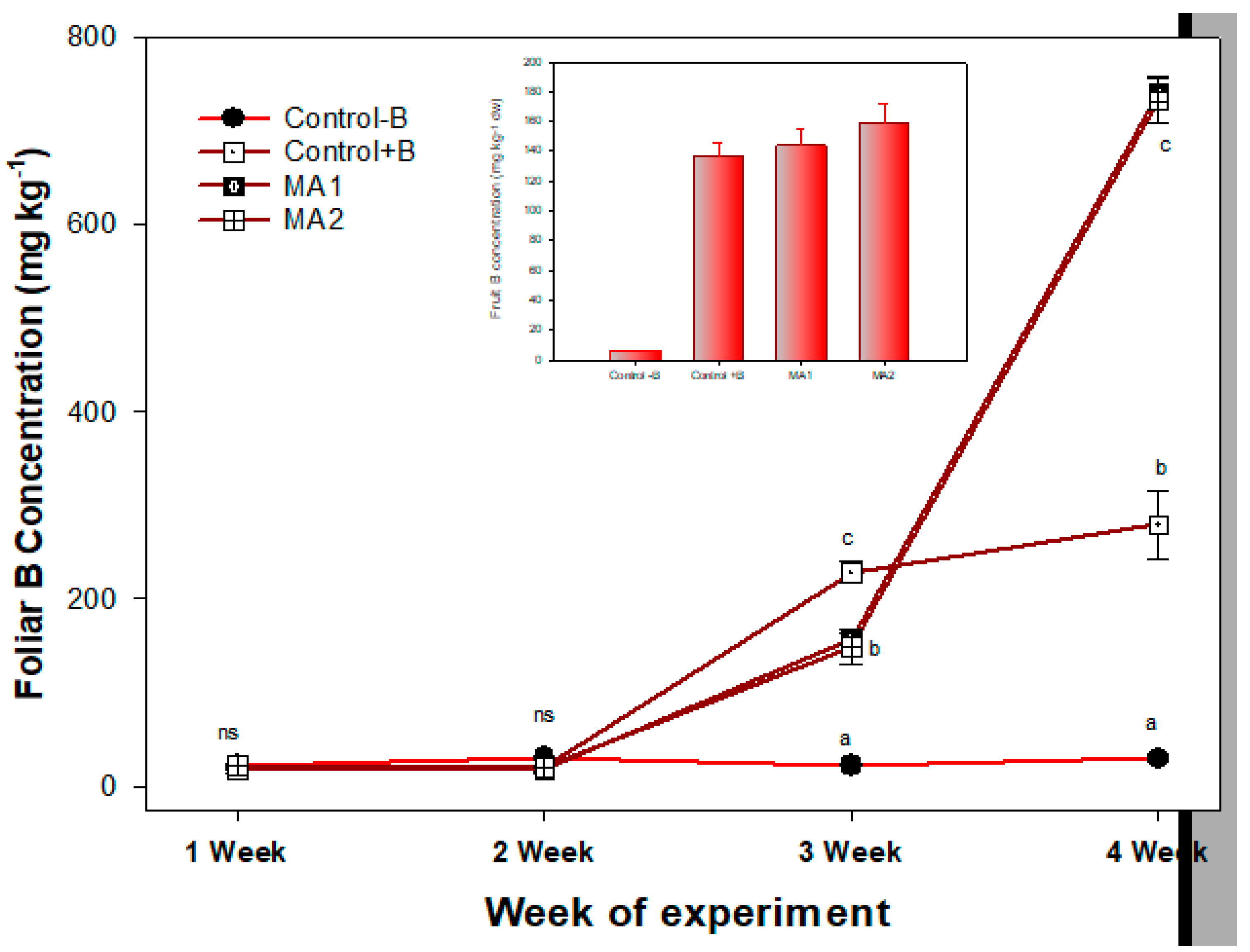
Figure 2 shows the concentration of B in the leaves of the four treatments studied during the different phenological phases of the crop. In the control -B, the foliar concentration of B remained constant over time, around 27 mg kg-1 dw. In contrast, the control +B treatment progressively increased its B concentration starting from the vegetative growth phase, reaching a final value of 278.7 mg kg-1 dw. A similar accumulation pattern was observed in the plants from the MA1+B and MA2+B treatments. However, by the end of the experiment, these treatments reached higher concentrations, accumulating around 740 mg kg-1 dw, which significantly exceeded the levels of the control +B treatment. In the case of the fruits, the accumulation of B was higher in plants exposed to a high concentration of this element in the NS. However, no significant differences were found between the treatments with a high B content (control +B, MA1+B, and MA2+B; Figure 2).

3.3. Metabolomic Study of Tomato Plant in Leaves and Fruits

In tomato leaves, the analysis using 1H-NMR allowed for the identification and quantification of 26 metabolites, including the amino acids GABA, Ala, Asn, Asp, Glu, Gln, Ile, Leu, Phe, Pro, Thr, Trp, Tyr, and Val; the organic acids Cit, Fer, For, and Mal; the sugars Fru, Glc, MI, Sac, and UG; and other metabolites such as Chl, Cho, and Tri (Table 4 and Table 5). In the plants from the control +B treatment, 46% of the analyzed metabolites showed significant changes as compared to the control -B plants. Under these conditions, an increase in GABA, Ala, Glu, Pro, Cit, For, and UG was observed, while the levels of Asn, Gln, Fer, Fru, and Glc decreased significantly. Regarding the metabolic responses of plants treated with the biostimulant products MA1 and MA2, some significant changes were observed as compared to the control +B treatment. The application of the MA2 product increased the concentrations of Ala, Tyr, For, and Chl, and reduced the levels of Asn, Gln, and UG. On the other hand, the biostimulant MA1 induced milder changes, increasing the concentrations of Ala, Tyr, and Chl, and decreasing those of Asn, Gln, and UG.
The analysis of the metabolic profile of tomato fruits revealed alterations associated with B toxicity. Among the quantified metabolites, we quantified the amino acids GABA, Ala, Asn, Asp, Glu, Gln, Ile, Leu, Phe, Pro, Thr, Trp, Tyr, and Val; the organic acids Cit and Mal; the sugars Fru, Glc, and Sac; and other metabolites such as ADP, Chl, Cho, and Tri (Table 6). In this context, the comparison between the control -B and control +B treatments showed significant changes in several of these metabolites. The concentrations of Asn, Asp, Gln, Ile, Leu, Thr, Trp, Cit, Mal, ADP, Cho, and Tri increased, while the concentration of Sac significantly decreased as compared to the control -B. On the other hand, the application of the biostimulant products MA1 and MA2 only affected the Pro content, which was significantly reduced in both treatments as compared to the control +B.

4. Discussion

4.1. Effects of Boron Excess on Tomato Yield and Productivity

Understanding crop responses to excess micronutrients is essential for maintaining productivity under suboptimal irrigation conditions. In this context, evaluating the impact of micronutrient excess on crop yield becomes particularly relevant. In this study, irrigation with a nutrient solution containing 15 mg L⁻¹ of B caused a 45% reduction in total yield in tomato plants of the ‘Optima’ variety. This reduction was mainly associated with a decrease in mean fruit weight, while the number of fruits per plant remained unaffected, indicating that the fruit development stage is more sensitive to excess B than flowering and fruit set.
Similar responses have been reported in tomato under high B concentrations. Kaya et al. [19] showed that irrigation of Target F1 tomato plants with 2.0 and 4.0 mg L⁻¹ of B for three months reduced yield from 2.8 kg plant⁻¹ in control plants to 2.6 and 2.3 kg plant⁻¹, respectively. Yield reductions of 7% and 18% were mainly attributed to a decrease in mean fruit weight at 2.0 mg L⁻¹, while both fruit weight and fruit number were affected at 4.0 mg L⁻¹. The results of the present study are consistent with these findings, identifying the reduction in mean fruit weight as the main factor responsible for yield losses under high B concentrations. In other crops, the effects of excess B on crop performance have also been evaluated. In grapevine, Yermiyahu et al. [20] reported that irrigation with B concentrations of up to 3.0 mg L⁻¹ did not result in significant reductions in commercial fruit yield, despite the appearance of toxicity symptoms. Overall, these studies indicate that crop responses to excess B are species- and cultivar-dependent, highlighting the need for crop-specific assessments when using irrigation water with elevated B concentrations.

4.2. Impact of Boron Toxicity on Fruit Quality Attributes

Furthermore, the data collected during the study showed that the presence of B at high concentrations in the nutrient solution negatively affected the commercial quality of tomato fruits, leading to a reduction in fruit size and firmness. These effects suggest that excess B may interfere with processes related to cell expansion and cell wall structure during fruit development, which are critical determinants of fruit growth and texture.
In contrast, no significant differences were observed in the analyzed chemical quality parameters, including pH, electrical conductivity, total soluble solids, acidity, reducing sugars, total phenols, and antioxidant activity, indicating that primary fruit composition was not substantially altered under the conditions evaluated. These results are consistent with those reported by Smit and Combrink [21], who found that increasing B concentration in the nutrient solution (0.02–0.64 mg L⁻¹) did not cause significant changes in fruit pH, acidity, or total soluble solids. Interestingly, those authors reported a decrease in fruit firmness under B deficiency, whereas in the present study, reduced firmness was associated with B toxicity, suggesting that fruit firmness is particularly sensitive to both deficient and excessive B supply. This response supports the idea that optimal B homeostasis is required to maintain cell wall integrity and mechanical resistance in tomato fruits.

4.3. Boron-Induced Nutritional Imbalances and Their Physiological Implications

On the other hand, irrigation with water containing high B concentrations has been shown to induce nutritional imbalances in plants, affecting the uptake and accumulation of several macro- and micronutrients. In the present study, excess B led to a clear reduction in foliar Mg and Ca concentrations, while P and Zn levels increased, although remaining within ranges considered adequate for tomato nutrition. These changes indicate that high B availability alters nutrient homeostasis without necessarily inducing classical deficiency symptoms for most elements.
From a mechanistic perspective, the reduction in Ca availability is particularly relevant, given its central role in cell wall stabilization and membrane integrity. Thus, even moderate decreases in Ca concentration, without reaching deficiency thresholds, may negatively affect fruit structural properties. In this context, the reduction in fruit firmness observed in the present study could be partially explained by the B-induced decrease in Ca concentration, consistent with the established role of Ca in maintaining fruit texture and mechanical resistance [22]
Similar B-induced nutritional imbalances have been reported in other crops. In banana, Karantzi et al. [23] reported increased K, Mn and Cl concentrations together with reduced Mg and Ca under B toxicity. Likewise, Luo et al. [24] described contrasting changes in macro- and micronutrient concentrations in grapefruit exposed to excess B. In tomato, Markiewicz et al. [25] also observed that increasing B supply altered leaf nutrient composition, particularly affecting Ca and Mg. Collectively, these studies support the notion that excess B disrupts nutrient homeostasis across species, with Ca-related effects being especially relevant for fruit quality traits.

4.4. Boron Accumulation and Mechanistic Basis of Toxicity

In this experiment, tomato plants subjected to the control +B treatment showed a rapid and sustained accumulation of B in the leaves, reaching concentrations considered toxic for tomato plants already from the vegetative growth stage [26]. In addition, B accumulation was also observed in the fruits, with significantly higher B concentrations in the control +B treatment compared to the control −B. These results confirm that exposure to elevated B levels in the nutrient solution leads to substantial B accumulation in both vegetative and reproductive tissues.
Although the physiological bases of B toxicity are not yet fully understood, it has been proposed that excess B may exert its toxic effects through its ability to bind to compounds containing multiple hydroxyl groups in cis configuration, thereby interfering with key cellular processes [27]. In this context, the reduction in tomato fruit production and quality observed under high B conditions may be associated with several interconnected factors: (i) alterations in the nutritional status of the leaves; (ii) direct accumulation of B in leaves and fruits; and (iii) changes in plant metabolic processes, which are discussed in the following section.

4.5. Metabolic Disturbances Associated with Boron Toxicity

The metabolomic analysis of tomato leaves showed that B toxicity caused significant alterations in primary metabolism. Of the 26 metabolites detected, twelve showed significant differences in their concentrations compared to the control −B. These changes affected metabolites involved in nitrogen metabolism, plant responses to abiotic stress, and the tricarboxylic acid (TCA) cycle.
These results indicate that excess B may impair nitrogen assimilation [28], disrupt metabolic pathways associated with stress tolerance [29,30,31], and negatively affect energy metabolism by altering the TCA cycle, potentially limiting the energy supply required to sustain essential physiological processes [32]. Similar metabolic disruptions have been reported in alfalfa, where B toxicity reduced metabolites related to amino acid and carbohydrate metabolism, leading to flower drop and reduced seed yield [33]. In fruits, B toxicity also caused significant alterations in metabolite levels, particularly in amino acids, organic acids, sucrose, and compounds associated with energy and membrane metabolism. Comparable responses were reported by Michailidis et al. [34] in sweet cherry plants exposed to B. Overall, these metabolomic changes suggest that excess B leads to a general metabolic imbalance in both leaves and fruits, contributing to the reduction in plant performance and fruit quality observed under high B conditions.

4.6. Role of Laminaria digitata–Based Biostimulants Under Boron Stress

Another objective of this study was to assess whether the application of Laminaria digitata–based biostimulants (MA1 and MA2) could modify the tolerance and agronomic, nutritional and metabolic responses of tomato plants exposed to high B concentrations. Although extracts of L. digitata are known to contain carbohydrates, polyphenols, mineral nutrients and compounds with hormonal activity [35,36], both biostimulants were additionally enriched with amino acids, carbohydrates, polyols, micronutrients and silicon-based compounds. Under the severe B stress conditions imposed in this study, the application of these products did not result in improvements in yield or fruit quality. This limited agronomic response is likely related to the high level of B toxicity, which may have constrained the capacity of plants to respond to biostimulant-induced signaling. Nevertheless, both biostimulants induced measurable nutritional and metabolic responses, including increases in Mn and Zn concentrations and formulation-dependent effects on K accumulation [37,38].
At the metabolic level, MA1 and MA2 induced distinct and tissue-specific responses, mainly affecting leaf metabolism, while fruit metabolism was only marginally altered. Previous studies have reported beneficial effects of brown algae extracts under other abiotic stresses [39,40]. However, despite their demonstrated effectiveness under different stress conditions, the specific application of algae-based biostimulants to mitigate B toxicity in tomato plants remains largely unexplored.
Overall, these results suggest that while the current formulations were not effective in alleviating severe B toxicity, the observed nutritional and metabolic responses highlight the potential for improved efficacy through formulation optimization, particularly under lower B stress levels or with targeted adjustment of bioactive components.

5. Conclusions

In this study, it was demonstrated that a high boron concentration in the nutrient solution (15 mg L⁻¹) negatively affects total tomato production, mainly through a reduction in mean fruit weight, without significantly altering the number of fruits per plant. In parallel, boron toxicity reduced the commercial quality of the fruits, decreasing their size and firmness, while no significant changes were observed in chemical quality parameters. The reduction in yield and fruit quality under high boron conditions may be associated with a combination of factors, including decreased Mg and Ca concentrations, increased P and Zn levels in leaves, substantial boron accumulation in vegetative and reproductive tissues, and alterations in metabolic pathways related to nitrogen metabolism, abiotic stress responses and the Krebs cycle. Biostimulant products formulated with Laminaria digitata extracts and other active ingredients were applied in an attempt to mitigate the negative effects of boron toxicity. Although their application did not result in significant improvements in agronomic performance or fruit quality, measurable changes were detected in leaf nutritional status and in the metabolic profiles of both leaves and fruits. However, these responses were insufficient to counteract the toxicity caused by the high boron accumulation in leaf tissue. Future studies should focus on optimizing the formulation of algae-based biostimulants and evaluating a broader range of boron concentrations in order to better understand plant responses to boron stress and the potential effectiveness of these products under less severe conditions.

Author Contributions

Author Contributions: Conceptualization, F.G.-S.; methodology, F.G.-S., V.N.-P. and E.F.-M.; formal analysis, V.N.-P. and E.F.-M.; investigation, V.N.-P., E.F.-M., S.S.-G. and V.G.-N.; data curation, V.N.-P. and E.F.-M.; writing—original draft preparation, V.N.-P. and E.F.-M.; writing—review and editing, F.G.-S., S.S.-G. and V.G.-N.; supervision, project administration and funding acquisition, F.G.-S. All authors have read and agreed to the published version of the manuscript.

Data Availability Statement

The data presented in this study are included in the article and its supplementary material. Further inquiries can be directed to the corresponding author.

Acknowledgments

This project was funded by the Ministry of Science and Innovation under the Collaborative Challenges call. Project: Formulation of new biostimulant products with seaweed extracts for citrus and horticultural crops irrigated with non-conventional waters (BIOBORO). RTC2019-006954-2. The authors used ChatGPT (OpenAI) exclusively to improve language clarity and grammar. The authors take full responsibility for the content of the manuscript.

References

  1. Raiola, A.; Rigano, M.M.; Calafiore, R.; Frusciante, L.; Barone, A. Enhancing the health-promoting effects of tomato fruit for biofortified food. Mediators Inflamm. 2014, 2014, 1–16. [CrossRef]
  2. Krishna, R.; Karkute, S.G.; Ansari, W.A.; Jaiswal, D.K.; Verma, J.P.; Singh, M. Transgenic tomatoes for abiotic stress tolerance: status and way ahead. 3 Biotech 2019, 9, 143. [CrossRef]
  3. Nable, R.O.; Bañuelos, G.S.; Paull, J.G. Boron toxicity. Plant Soil 1997, 193, 181–198. [CrossRef]
  4. Cervilla, L.M.; Blasco, B.; Ríos, J.J.; Romero, L.; Ruiz, J.M. Oxidative stress and antioxidants in tomato (Solanum lycopersicum) plants subjected to boron toxicity. Ann. Bot. 2007, 100, 747–756. [CrossRef]
  5. Kaya, C.; Sarıoğlu, A.; Ashraf, M.; Alyemeni, M.N.; Ahmad, P. Gibberellic acid-induced generation of hydrogen sulfide alleviates boron toxicity in tomato (Solanum lycopersicum L.) plants. Plant Physiol. Biochem. 2020, 153, 53–63. [CrossRef]
  6. Chen, C.-Y.; Wang, S.-W.; Kim, H.; Pan, S.-Y.; Fan, C.; Lin, Y.J. Non-conventional water reuse in agriculture: A circular water economy. Water Res. 2021, 199, 117193. [CrossRef]
  7. Du Jardin, P. Plant biostimulants: Definition, concept, main categories and regulation. Sci. Hortic. 2015, 196, 3–14. [CrossRef]
  8. Rouphael, Y.; Colla, G. Synergistic biostimulatory action: designing the next generation of plant biostimulants for sustainable agriculture. Front. Plant Sci. 2018, 9, 1655. [CrossRef]
  9. Khan, W.; Rayirath, U.P.; Subramanian, S.; Jithesh, M.N.; Rayorath, P.; Hodges, D.M.; Critchley, A.T.; Craigie, J.S.; Norrie, J.; Prithiviraj, B. Seaweed extracts as biostimulants of plant growth and development. J. Plant Growth Regul. 2009, 28, 386–399. [CrossRef]
  10. Stengel, D.B.; Connan, S.; Popper, Z.A. Algal chemodiversity and bioactivity: Sources of natural variability and implications for commercial application. Biotechnol. Adv. 2011, 29, 483–501. [CrossRef]
  11. Schiener, P.; Black, K.D.; Stanley, M.S.; Green, D.H. The seasonal variation in the chemical composition of the kelp species Laminaria digitata, Laminaria hyperborea, Saccharina latissima and Alaria esculenta. J. Appl. Phycol. 2015, 27, 363–373. [CrossRef]
  12. Nelson, N. A photometric adaptation of the Somogyi method for the determination of glucose. J. Biol. Chem. 1944, 153, 375–380. [CrossRef]
  13. Somogyi, M. Notes on sugar determination. J. Biol. Chem. 1952, 195, 19–23. [CrossRef]
  14. Singleton, V.L.; Orthofer, R.; Lamuela-Raventós, R.M. Analysis of total phenols and other oxidation substrates and antioxidants by means of Folin–Ciocalteu reagent. Methods Enzymol. 1999, 299, 152–178.
  15. Brand-Williams, W.; Cuvelier, M.E.; Berset, C. Use of a free radical method to evaluate antioxidant activity. LWT–Food Sci. Technol. 1995, 28, 25–30. [CrossRef]
  16. Wolf, B. Improvements in the azomethine-H method for the determination of boron. Commun. Soil Sci. Plant Anal. 1974, 5, 39–44. [CrossRef]
  17. van der Sar, S.; Kim, H.K.; Meissner, A.; Verpoorte, R.; Choi, Y.H. Nuclear magnetic resonance spectroscopy for plant metabolite profiling. In: The Handbook of Plant Metabolomics; Wiley: New York, NY, USA, 2013; pp. 57–76.
  18. Alfosea-Simón, M.; Simón-Grao, S.; Zavala-Gonzalez, E.A.; Cámara-Zapata, J.M.; Simón, I.; Martínez-Nicolás, J.J.; Lidón, V.; García-Sánchez, F. Physiological, nutritional and metabolomic responses of tomato plants after the foliar application of amino acids aspartic acid, glutamic acid and alanine. Front. Plant Sci. 2021, 11, 581234. [CrossRef]
  19. Kaya, C.; Tuna, A.L.; Dikilitas, M.; Ashraf, M.; Koskeroglu, S.; Guneri, M. Supplementary phosphorus can alleviate boron toxicity in tomato. Sci. Hortic. 2009, 121, 284–288. [CrossRef]
  20. Yermiyahu, U.; Ben-Gal, A.; Sarig, P. Boron toxicity in grapevine. HortScience 2006, 41, 1698–1703. [CrossRef]
  21. Smit, J.N.; Combrink, N.J.J. The effect of boron levels in nutrient solutions on fruit production and quality of greenhouse tomatoes. South Afr. J. Plant Soil 2004, 21, 188–191. [CrossRef]
  22. Hernández-Pérez, O.I.; Valdez-Aguilar, L.A.; Alia-Tejacal, I.; Cartmill, A.D.; Cartmill, D.L. Tomato fruit yield, quality, and nutrient status in response to potassium: calcium balance and electrical conductivity in the nutrient solution. J. Soil Sci. Plant Nutr. 2020, 20, 484–492. [CrossRef]
  23. Karantzi, A.D.; Papadakis, I.E.; Psychoyou, M.; Ioannou, D. Nutrient status of the banana cultivar ‘FHIA-01’ as affected by boron excess. Acta Hortic. 2016, 1139, 399–404. [CrossRef]
  24. Luo, Z.; Zhang, L.; Hu, W.; Wang, Y.; Tao, J.; Jia, Y.; Miao, R.; Chen, L.-S.; Guo, J. Excessive boron fertilization-induced toxicity is related to boron transport in field-grown pomelo trees. Front. Plant Sci. 2024, 15, 1438664. [CrossRef]
  25. Markiewicz, B.; Muzolf-Panek, M.; Kaczmarek, A. Effect of deficit and over-standard boron content in nutrient solution on the biological value of tomato fruit. J. Elem. 2019, 24. [CrossRef]
  26. Brown, P.H.; Barker, A.V.; Pilbeam, D.J. Handbook of Plant Nutrition. CRC Press, Boca Raton, FL, USA, 2006.
  27. Reid, R. Can we really increase yields by making crop plants tolerant to boron toxicity? Plant Sci. 2010, 178, 9–11. [CrossRef]
  28. Cervilla, L.M.; Blasco, B.; Ríos, J.J.; Rosales, M.A.; Rubio-Wilhelmi, M.M.; Sánchez-Rodríguez, E.; Romero, L.; Ruiz, J.M. Response of nitrogen metabolism to boron toxicity in tomato plants. Plant Biol. 2009, 11, 671–677. [CrossRef]
  29. Eraslan, F.; Inal, A.; Gunes, A.; Alpaslan, M. Boron toxicity alters nitrate reductase activity, proline accumulation, membrane permeability, and mineral constituents of tomato and pepper plants. J. Plant Nutr. 2007, 30, 981–994. [CrossRef]
  30. Riaz, M.; Kamran, M.; El-Esawi, M.A.; Hussain, S.; Wang, X. Boron-toxicity induced changes in cell wall components, boron forms, and antioxidant defense system in rice seedlings. Ecotoxicol. Environ. Saf. 2021, 216, 112192. [CrossRef]
  31. Zhang, Q.; Ackah, M.; Wang, M.; Amoako, F.K.; Shi, Y.; Wang, L.; Dari, L.; Li, J.; Jin, X.; Jiang, Z.; Zhao, W. The impact of boron nutrient supply in mulberry (Morus alba) response to metabolomics, enzyme activities, and physiological parameters. Plant Physiol. Biochem. 2023, 200, 107649. [CrossRef]
  32. Sang, W.; Huang, Z.-R.; Qi, Y.-P.; Yang, L.-T.; Guo, P.; Chen, L.-S. An investigation of boron-toxicity in leaves of two citrus species differing in boron-tolerance using comparative proteomics. J. Proteomics 2015, 123, 128–146. [CrossRef]
  33. Chen, L.; Xia, F.; Wang, M.; Wang, W.; Mao, P. Metabolomic analyses of alfalfa (Medicago sativa L. cv. ‘Aohan’) reproductive organs under boron deficiency and surplus conditions. Ecotoxicol. Environ. Saf. 2020, 202, 111011. [CrossRef]
  34. Michailidis, M.; Bazakos, C.; Kollaros, M.; Adamakis, I.S.; Ganopoulos, I.; Molassiotis, A.; Tanou, G. Boron stimulates fruit formation and reprograms developmental metabolism in sweet cherry. Physiol. Plant. 2023, 175, e13946. [CrossRef]
  35. Thorsen, M.K.; Woodward, S.; McKenzie, B.M. Kelp (Laminaria digitata) increases germination and affects rooting and plant vigour in crops and native plants from an arable grassland in the Outer Hebrides, Scotland. J. Coast. Conserv. 2010, 14, 239–247. [CrossRef]
  36. Shenker, M.; Plessner, O.E.; Tel-Or, E. Manganese nutrition effects on tomato growth, chlorophyll concentration, and superoxide dismutase activity. J. Plant Physiol. 2004, 161, 197–202. [CrossRef]
  37. Alloway, B.J. Zinc in Soils and Crop Nutrition. IZA and IFA, Paris, France, 2008.
  38. Stengel, D.B.; Connan, S.; Popper, Z.A. Algal chemodiversity and bioactivity: Sources of natural variability and implications for commercial application. Biotechnol. Adv. 2011, 29, 483–501. [CrossRef]
  39. Borella, M.; Baghdadi, A.; Bertoldo, G.; Della Lucia, M.C.; Chiodi, C.; Celletti, S.; Deb, S.; Baglieri, A.; Zegada-Lizarazu, W.; Pagani, E.; Monti, A.; Mangione, F.; Magro, F.; Hermans, C.; Stevanato, P.; Nardi, S. Transcriptomic and physiological approaches to decipher cold stress mitigation exerted by brown-seaweed extract application in tomato. Front. Plant Sci. 2023, 14, 1232421. [CrossRef]
  40. Di Stasio, E.; Van Oosten, M.J.; Silletti, S.; Raimondi, G.; dell’Aversana, E.; Carillo, P.; Maggio, A. Ascophyllum nodosum-based algal extracts act as enhancers of growth, fruit quality, and adaptation to stress in salinized tomato plants. J. Appl. Phycol. 2018, 30, 2675–2686. [CrossRef]
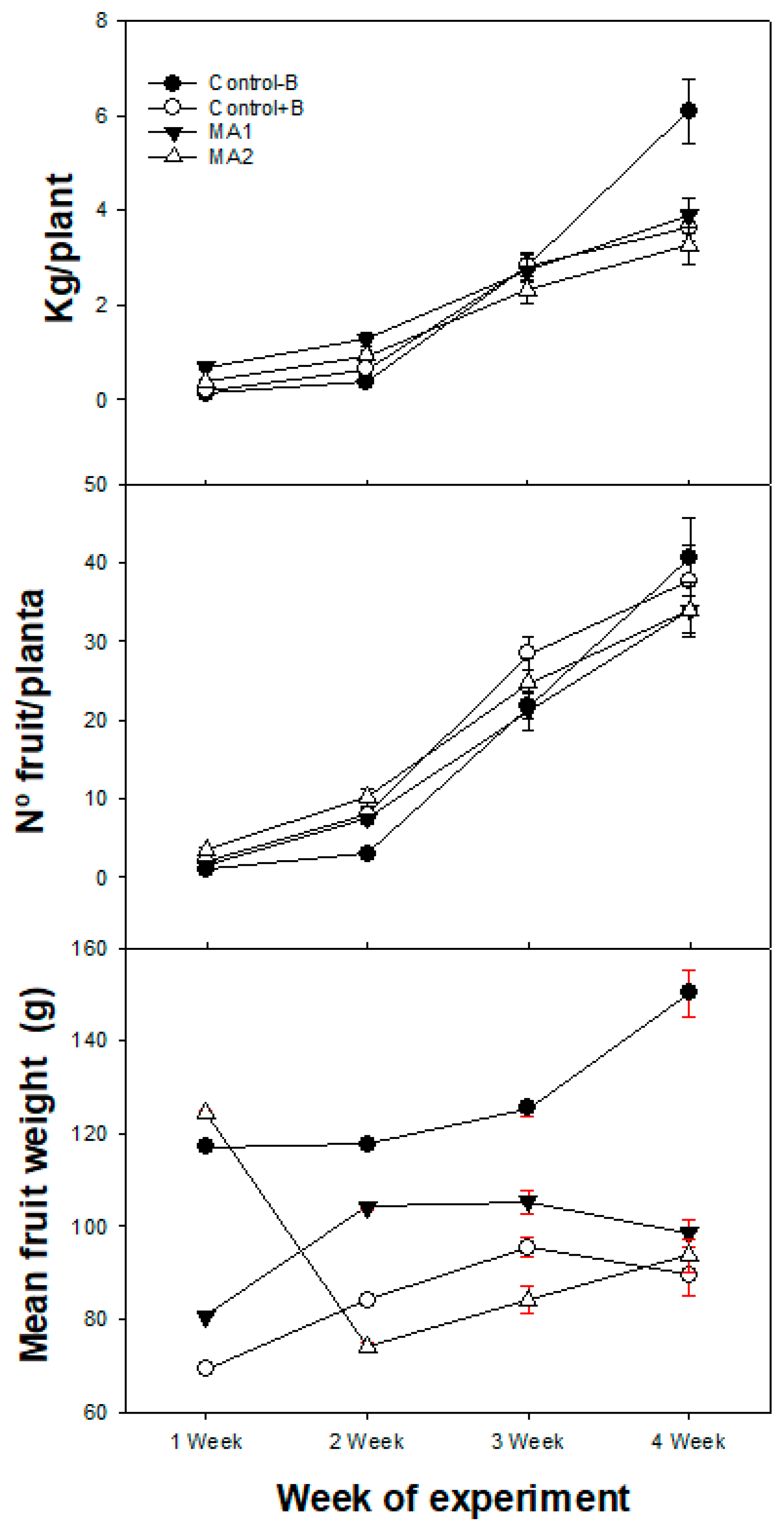
Figure 1. Evolution of yield per plant (kg plant⁻¹), number of fruits per plant, and mean fruit weight (g) during the experimental period in tomato plants subjected to the different treatments: Control −B, Control +B, MA1+B and MA2+B. Values represent means ± standard error.
Preprints 191930 g001
Figure 2. Evolution of foliar boron (B) concentration (mg kg⁻¹ dw) during the experimental period in tomato plants subjected to the different treatments: Control −B, Control +B, MA1+B and MA2+B. Values represent means ± standard error (n = 4). Different letters indicate significant differences among treatments within the same sampling time according to Duncan’s test (p ≤ 0.05); ns indicates non-significant differences. The inset shows the boron concentration in tomato fruits at the end of the experiment (Week 4).
Preprints 191930 g002
Table 1. Production and physical quality parameters of tomato fruits in the different treatments studied.
Treatment Production
(kg plant-1)
Average fruit weight (g) Fruits
(number plant-1)
Control -B 6.12* 152.7* 41
Control +B 3.36 97.3 35
MA1+B 3.18 97.7 33
MA2+B 3.00 95.6 32
ANOVA ns ns ns
Treatment Equatorial diameter (mm) Longitudinal diameter (mm) Firmness (kg)
Control -B 66.7* 55.1* 79.9*
Control +B 58.1 47.1 73.1
MA1+B 58.8 46.9 70.4
MA2+B 76.9 50.6 74.5
ANOVA ns ns ns
Data were analyzed by one-way ANOVA. ns indicates no significant differences among treatments (p > 0.05). An asterisk (*) in the Control −B treatment indicates significant differences with respect to Control +B (p ≤ 0.05). Values are means of four experimental replicates (n = 4).
Table 2. Chemical quality parameters of tomato fruit juices for the different treatments studied.
Treatment pH EC (mS cm-1) TSS (ᵒBrix) Acidity
Control -B 4.29 4.58 5.40 5.12
Control +B 4.21 4.79 4.70 5.46
MA1+B 4.21 4.86 4.90 5.29
MA2+B 4.12 4.73 4.80 5.54
ANOVA ns ns ns ns
Treatment Reducing sugars (mg g-1 dw) Total phenols (mg g-1 dw) Antioxidant activity (% inhibition) Boron
(mg L-1)
Control -B 41.6 0.24 2 3.23*
Control +B 34.4 0.24 1 7.62
MA1+B 34.8 0.27 1 9.54
MA2+B 34.7 0.27 1 9.04
ANOVA ns ns ns ns
Data were analyzed by one-way ANOVA. ns indicates no significant differences among treatments (p > 0.05). An asterisk (*) in the Control −B treatment indicates significant differences with respect to Control +B (p ≤ 0.05). Values are means of four experimental replicates (n = 4).
Table 3. Mineral analysis in tomato plant leaves for the different treatments studied.
Mg K Ca P
Treatment g 100g-1 dw
Control -B 1.24* 2.31 4.46* 0.29*
Control +B 0.72 2.48 b 2.71 0.54
MA1+B 0.64 2.42 b 2.87 0.52
MA2+B 0.64 3.09 a 2.79 0.54
ANOVA ns ** ns ns
Mn Fe Zn
Treatment mg kg-1 dw
Control -B 142.7 137.6 11.7*
Control +B 140.0 b 149.2 20.8 b
MA1+B 364.4 a 145.1 387.7 a
MA2+B 483.1 a 160.2 551.4 a
ANOVA *** ns ***
Data were analyzed by one-way ANOVA. ns indicates no significant differences among treatments (p > 0.05). An asterisk (*) in the Control −B treatment indicates significant differences with respect to Control +B (p ≤ 0.05). ** and *** denote significant differences at p ≤ 0.01 and p ≤ 0.001, respectively, for Boron treatment (+B). Values are means of four experimental replicates (n = 4).
Table 4. Concentration of amino acids (mg g-1 dw) in tomato leaves in the different treatments studied.
GABA Ala Asn Asp Glu Gln Ile
Treatment mg g-1 dw
Control -B 0.75* 0.33* 12.5* 0.85 1.55* 7.14* 0.40
Control +B 1.19 0.64 b 4.06 a 1.19 2.85 3.37 a 0.22
MA1+B 0.97 0.77 b 0.88 b 1.11 3.18 2.06 b 0.23
MA2+B 1.32 1.02 a 0.92 b 1.17 2.92 2.18 b 0.20
ANOVA ns ** *** ns ns * ns
Leu Phe Pro Thr Trp Tyr Val
Treatment mg g-1 dw
Control -B 0.25 0.40 0.61* 0.35 0.44 1.06 0.27
Control +B 0.25 0.28 2.41 0.43 0.32 1.22 b 0.22
MA1+B 0.24 0.28 2.99 0.37 0.29 1.44 b 0.22
MA2+B 0.27 0.31 3.30 0.37 0.31 1.98 a 0.27
ANOVA ns ns ns ns ns * ns
Data were analyzed by one-way ANOVA. ns indicates no significant differences among treatments (p > 0.05). An asterisk (*) in the Control −B treatment indicates significant differences with respect to Control +B (p ≤ 0.05). *, ** and *** denote significant differences at p ≤ 0.01, p ≤ 0.01 and p ≤ 0.001, respectively, for Boron treatment (+B). Values are means of four experimental replicates (n = 4).
Table 5. Concentration of organic acids, sugar, and other metabolites (mg g-1 dw) in tomato leaves in the different treatments studied.
Cit Fer For Mal
Treatment mg g-1 dw
Control -B 12.0* 1.49* 0.02* 11.2
Control +B 23.7 0.26 0.03 b 16.2
MA1+B 18.9 0.001 0.03 b 12.5
MA2+B 20.7 0.001 0.09 a 15.7
ANOVA ns ns *** ns
Fru Glc MI Sac UG
Treatment mg g-1 dw
Control -B 45.9* 30.4* 7.51 26.9 0.46*
Control +B 14.1 13.3 7.29 22.7 0.93 a
MA1+B 10.7 11.8 6.76 21.3 0.67 b
MA2+B 11.5 17.5 7.29 21.3 0.74 b
ANOVA ns ns ns ns **
Chl Cho Tri
Treatment mg g-1 dw
Control -B 0.76 0.49 0.85
Control +B 2.24 b 1.47 1.54
MA1+B 2.84 b 1.27 1.40
MA2+B 4.83 a 1.11 1.75
ANOVA * ns ns
Data were analyzed by one-way ANOVA. ns indicates no significant differences among treatments (p > 0.05). An asterisk (*) in the Control −B treatment indicates significant differences with respect to Control +B (p ≤ 0.05). * and ** denote significant differences at p ≤ 0.05 and p ≤ 0.01, respectively, for Boron treatment (+B). Values are means of four experimental replicates (n = 4).
Table 6. Concentration of amino acids, organic acid and sugars (mg g-1 dw) in tomato fruits in the different treatments studied.
GABA Ala Asn Asp Glu Gln Ile
Treatment mg g-1 dw
Control -B 9.10 0.72 6.59* 9.21* 18.0 30.5* 0.54*
Control +B 10.6 0.71 10.9 13.5 27.8 48.5 1.04
MA1+B 11.6 0.84 10.2 13.6 27.7 45.9 0.91
MA2+B 9.26 0.70 9.09 13.5 24.1 41.8 0.75
ANOVA ns ns ns ns ns ns ns
Leu Phe Pro Thr Trp Tyr Val
Treatment mg g-1 dw
Control -B 0.46* 1.44 0.36 1.30* 0.26* 0.18 0.41
Control +B 0.79 1.65 0.43 a 1.94 0.47 0.20 0.48
MA1+B 0.70 1.66 0.24 b 1.65 0.57 0.19 0.42
MA2+B 0.55 1.52 0.15 b 1.56 0.37 0.18 0.32
ANOVA ns ns *** ns ns ns ns
Fru Glc Sac Cit Mal
Treatment mg g-1 dw
Control -B 383.9 293.9 9.32* 87.1* 10.2*
Control +B 345.7 284.7 1.94 121.7 16.2
MA1+B 348.4 284.8 2.16 110.8 14.4
MA2+B 365.8 305.2 5.44 95.3 13.6
ANOVA ns ns ns ns ns
ADP Chl Cho Tri
Treatment mg g-1 dw
Control -B 1.39* 0.60 1.22* 0.35*
Control +B 3.20 0.74 1.80 1.00
MA1+B 3.33 0.70 1.66 0.96
MA2+B 2.73 0.72 2.29 0.71
ANOVA ns ns ns ns
Data were analyzed by one-way ANOVA. ns indicates no significant differences among treatments (p > 0.05). An asterisk (*) in the Control −B treatment indicates significant differences with respect to Control +B (p ≤ 0.05). *** denote significant differences at p ≤ 0.001, for Boron treatment (+B). Values are means of four experimental replicates (n = 4).
Disclaimer/Publisher’s Note: The statements, opinions and data contained in all publications are solely those of the individual author(s) and contributor(s) and not of MDPI and/or the editor(s). MDPI and/or the editor(s) disclaim responsibility for any injury to people or property resulting from any ideas, methods, instructions or products referred to in the content.
Copyright: This open access article is published under a Creative Commons CC BY 4.0 license, which permit the free download, distribution, and reuse, provided that the author and preprint are cited in any reuse.
Prerpints.org logo

Preprints.org is a free preprint server supported by MDPI in Basel, Switzerland.

Subscribe

Disclaimer

Terms of Use

Privacy Policy

Privacy Settings

© 2026 MDPI (Basel, Switzerland) unless otherwise stated