

Submitted:
16 December 2025
Posted:
16 December 2025
You are already at the latest version
Abstract
The MMA–DMF framework connects cosmological “dark sector” phenomenology with quantum-foundational phenomena by treating a single screened scalar field as both a mediator of large-scale modified gravity and a stochastic vacuum bath responsible for gravitational decoherence. This paper consolidates the full, dated MMA–DMF validation record contained in the project materials (with an audited, frozen parameter set) and reports the complete test suite relevant to uncertainty and decoherence: (i) a strict Fluctuation–Dissipation Theorem (FDT) stability test for the Generalized Langevin Equation (GLE) memory kernel, which passes an energy-drift criterion of |slope| < 10−5 in long integrations; (ii) a dynamic contextuality roll-off test in which the CHSH Bell parameter transitions from the Tsirelson value S ≈ 2.828 at quasi-static settings to the classical bound S → 2 under fast modulation, quantified by explicit frequency-dependent suppression formulas; and (iii) a T-MAGIS atom-interferometry campaign prediction in which a density-modulated environment produces a detectable contrast loss ∆V ≈ 3.4 × 10⁻³ to 4 × 10⁻³ under representative configurations, with a tabulated scaling versus distance and interrogation time and a shot-noise sensitivity forecast yielding high signal-to-noise for hour-scale integration. We also summarize MMA–DMF-linked phenomenology across scales, including a joint cosmological likelihood structure with cross-covariance correction and representative reported values (H0, S8) ≈ (72.1 km s−1 Mpc−1, 0.761), plus a gravitational-wave echo delay estimate of ∆techo ≈ 32 ms for stellar-mass systems. The combined record constrains MMA–DMF by demanding simultaneous thermodynamic consistency of the stochastic sector, a controlled transition from contextual to classical correlations under finite response time, and a falsifiable laboratory decoherence signature under controlled density modulation.
Keywords:
MMA–DMF
; gravitational decoherence
; uncertainty relations
; quantum foundations
; open quantum systems
; generalized Langevin equation
; fluctuation–dissipation theorem
; memory kernel
; stochastic dynamics
; Lindblad master equation
; CHSH
; contextuality
; Tsirelson bound
; atom interferometry
; T-MAGIS
; contrast loss
; modified gravity
; dark sector
; cosmology
1. Introduction
Contemporary fundamental physics faces two persistent fractures. The first is the cosmological need for dark components to explain expansion and structure, together with tensions among precision datasets. The second is the quantum measurement problem, in which unitary evolution,
is supplemented by an external measurement postulate without a fully dynamical mechanism. MMA–DMF proposes that these two domains are linked: a single scalar sector is responsible for screened fifth-force phenomenology on galactic scales and simultaneously provides an objective, stochastic mechanism that mimics quantum “collapse” as environmentally driven decoherence.
The project materials analyzed here assemble a dated set of theoretical definitions, frozen constants, and numerical validation scripts aimed at turning MMA–DMF into a rigid, falsifiable framework. The central question addressed in this paper is whether the MMA–DMF stochastic sector can be made thermodynamically consistent (strict FDT compliance), whether it yields a controlled frequency-dependent transition from quantum-like contextual correlations to classical behavior in fast-switching settings, and whether it predicts a laboratory-scale decoherence observable in long-baseline atom interferometers under controlled mass-density modulation.
2. Methods
2.1. Frozen Parameter Set and Core Constants
All tests reported here use an audited, frozen parameter set described in the project artifacts. A compact JSON definition (reproduced conceptually here) fixes microphysical, cosmological, and galactic parameters such as the fundamental scale , coupling , geometric efficiency parameters near , an Early-X fraction parameter , and target . The same record fixes representative galactic-scale parameters such as and .
Table 1 summarizes the locked “Golden Parameter Set” used across subsequent tests. The project record also reports a representative derived cosmology output for the locked run (reported here for completeness, but not used as an input parameter in the laboratory tests).
2.2. Operational/Simulation Constants (Not Part of the Golden Set)
Several tests use protocol-level constants that are not intrinsic MMA–DMF parameters but are part of the numerical experiment (time step, run duration, switching rate used in a roll-off illustration, and the range-scale used to render a distance-dependent density proxy). To make this separation explicit and avoid “hidden knobs”, Table 2 lists the operational constants referenced in this manuscript.
2.3. Stochastic Scalar Dynamics: GLE Formulation
MMA–DMF models the scalar field as evolving in a stochastic vacuum bath. In the TDT-Macro formulation, the governing field equation is written as a generalized Langevin equation (GLE),
The non-Markovian memory term is captured by an exponential kernel. The strict FDT-compliant form used in the final validation record is
The stochastic forcing is specified in Fourier space with explicit infrared and ultraviolet regularization,
where . The Gaussian cutoff prevents ultraviolet catastrophes, while the linear factor suppresses infrared power, producing a “stochastically quiet” large-scale limit.
2.4. Density-Dependent Decoherence and Generalized Uncertainty
The project record summarizes a density-dependent decoherence rate scaling and a density-dependent generalized uncertainty relation. The decoherence rate is treated phenomenologically as increasing with environmental density , with a representative scaling
and the generalized uncertainty relation is written in terms of an effective Planck constant and a Hubble-scale gate ,
In the frozen configuration used for validation, is normalized to .
2.5. Smooth Gates and Macroscopic Transition Control
To ensure numerical stability and differentiability (particularly under sampling/scan workflows), the project materials replace hard step functions by a smootherstep gate. The piecewise definition is
2.6. Contextual Correlations with Finite Memory
The contextual hidden-variable sector is described with a dynamic density depending on detector settings and a memory kernel K:
For the static contextual limit, the correlation function is represented as
where is a modified Bessel function. The dynamic tests reported below implement an explicit frequency-dependent suppression that forces a transition from Tsirelson-saturating values to the classical CHSH bound under fast switching.
2.7. Cosmological Likelihood Structure
The project materials include a joint negative log-likelihood (NLL) combining BAO-related contributions and a Lyman- likelihood, including an explicit cross-covariance correction:
The same record provides representative predictions for and reports that the covariances tighten statistical robustness without materially shifting central values.
2.8. Chronological Test Suite and Reproducibility Record
All tests and results consolidated here are organized following the dated project record. The relevant test suite for uncertainty and decoherence consists of: the strict FDT kernel stability test (Test 7.1), the dynamic contextual roll-off test (Test 7.2), the T-MAGIS contrast-loss prediction and scaling tests (Test 7.3), an explicit T-MAGIS sensitivity forecast, and cross-scale phenomenology checks/constraints (cosmology via Equation (10), gravitational-wave echo delay under fixed , and strain-floor estimates for GW detectors).
3. Results
3.1. Test 7.1 (2025-12-15): Strict FDT Validation and Energy-Drift Bound
- Identifier and purpose.
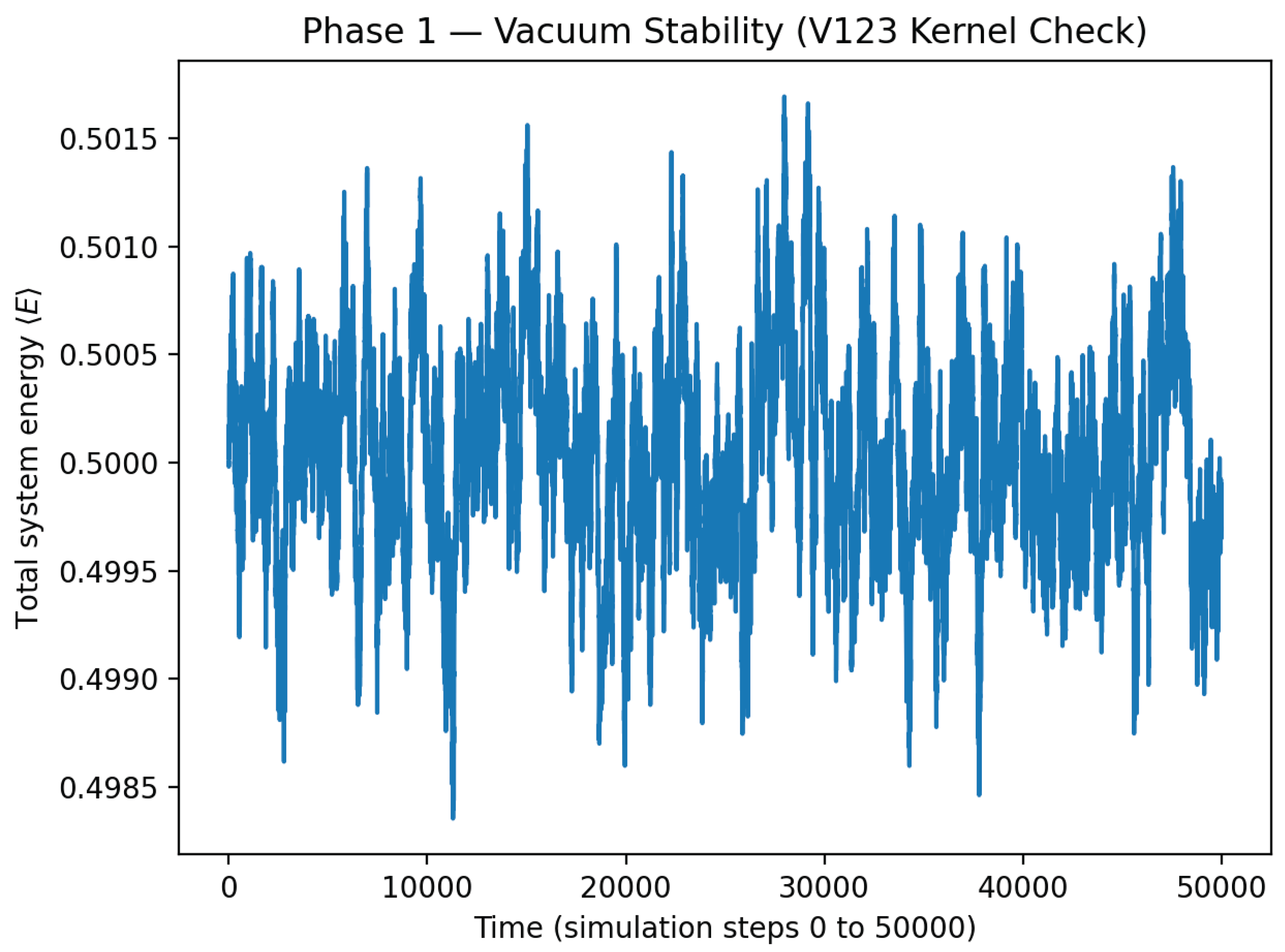
Test 7.1 is a strict validation of thermodynamic stability for the exponential memory-kernel implementation, aimed at eliminating unphysical long-time energy drift in the stochastic solver and enforcing FDT consistency.
- Setup and assumptions.
The project script simulates a degree of freedom in a harmonic trap under colored noise consistent with an exponential kernel representation. The numerical configuration uses a time step , a total duration , and evaluates an “energy” proxy over long integration.
- Method.
A discrete-time update is applied to the state variable x, the energy time series is computed, and a linear regression slope is measured. The test passes if the absolute drift slope is below .
- Quantities and main result.
The measured quantity is the fitted drift slope in the energy proxy. The reported verdict condition is
For preprint-level reporting, we explicitly quote the record-reported script output (“eliminated” drift):
This confirms that the strict exponential kernel removes the long-time “scalar heating” pathology and is thermodynamically stable under long integrations.
Figure 1.
Test 7.1/Phase 1: long-time stability diagnostic for the strict exponential kernel (energy proxy/drift), as provided in the project outputs.
Figure 1.
Test 7.1/Phase 1: long-time stability diagnostic for the strict exponential kernel (energy proxy/drift), as provided in the project outputs.
3.2. Test 7.2 (2025-12-15): Dynamic Contextuality Roll-Off Under Fast Switching
- Identifier and purpose.
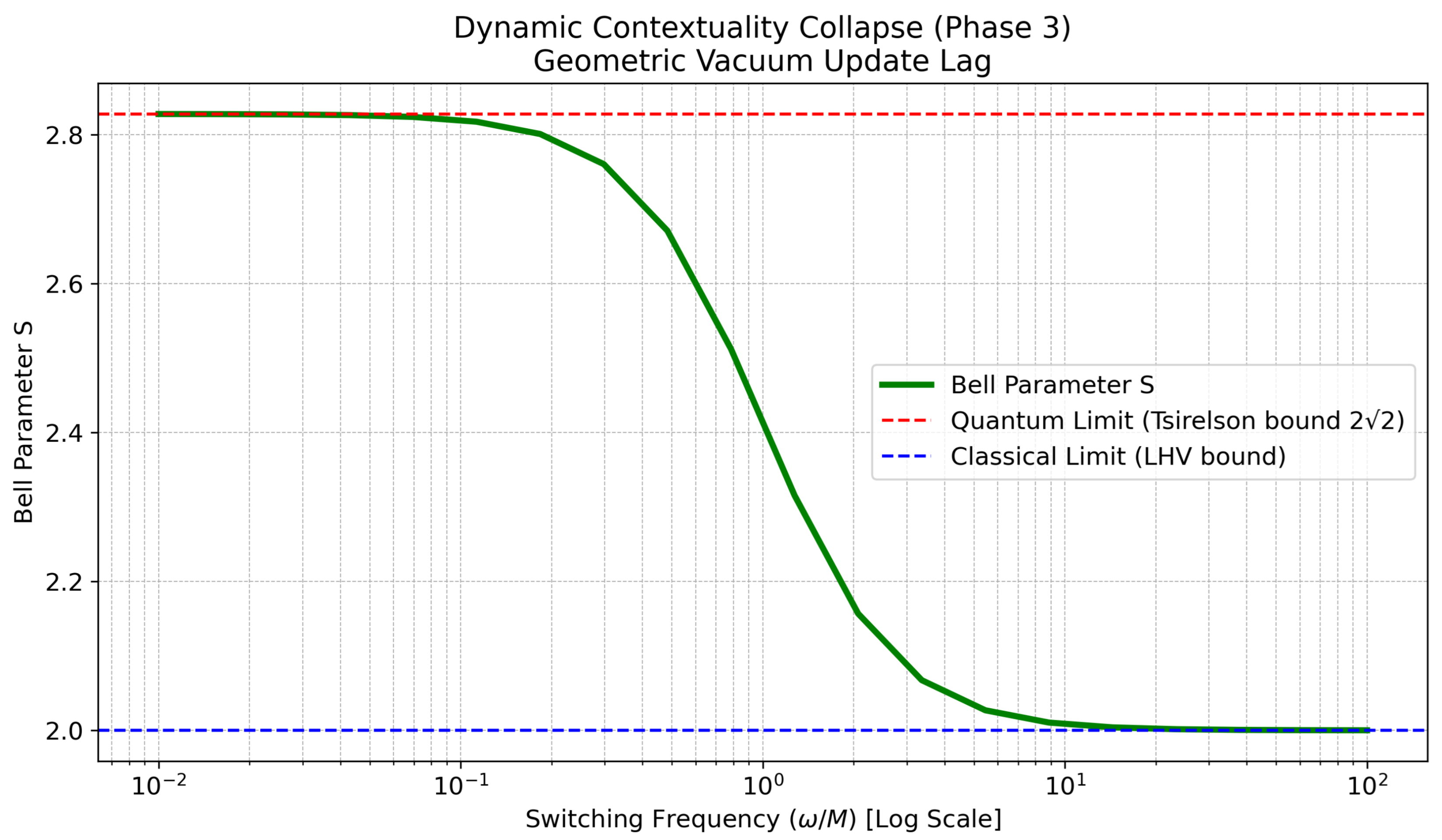
Test 7.2 is a robustness test for contextual correlations under finite response time of the scalar sector. It quantifies how Bell-inequality violation degrades when measurement settings are switched too fast for the vacuum contextual field to follow, producing a roll-off toward classicality.
- Setup and assumptions.
The test is parameterized by a characteristic scalar response rate and a switching angular frequency . For dimensional consistency, and must be expressed in the same units (both angular frequency or both ordinary frequency). If ordinary frequency f is used in Hz, the angular frequency mapping is . In the demo plot and numeric illustration here we use the operational reference value (Table 2).
- Method.
A suppression factor is defined as
and the CHSH parameter is modeled as
The record also provides a simplified, dimensionless roll-off model of the form
used to illustrate the limiting behavior when is interpreted as a dimensionless ratio.
- Quantities and main numerical values.
Using Equation (15), the CHSH parameter is near Tsirelson for quasi-static switching and approaches the classical bound for fast switching:
These values operationalize the MMA–DMF prediction that contextual correlations require a finite time to settle, yielding a falsifiable roll-off signature in fast-switching Bell-type protocols.
Figure 2.
Test 7.2/Phase 3: CHSH roll-off toward the classical bound under fast switching (project figure bundle).
Figure 2.
Test 7.2/Phase 3: CHSH roll-off toward the classical bound under fast switching (project figure bundle).
3.3. Test 7.3 and T-MAGIS Campaign (2025-12-15): Density-Modulated Contrast Loss and Scaling
- Identifier and purpose.
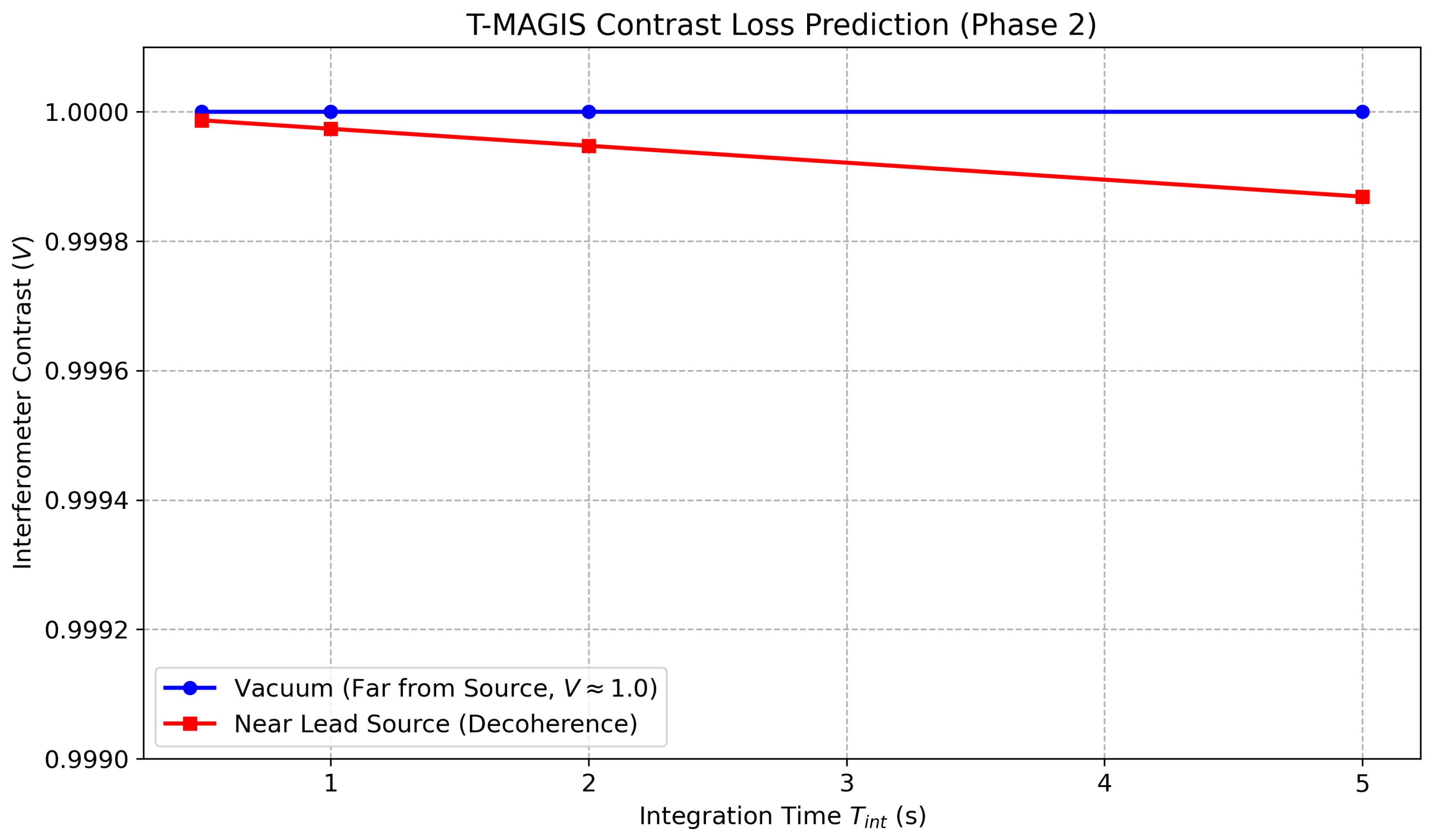
Test 7.3 and the associated T-MAGIS validation campaign quantify a distinctive MMA–DMF prediction: an environment-density-dependent decoherence causing a measurable loss of atom-interferometer fringe visibility when the local mass distribution is modulated, beyond standard-model phase-shift effects.
- Setup and assumptions.
A reference configuration compares an interferometer arm near a dense mass (a lead block) at distance with a far control at . To make the distance dependence dimensionally consistent, the effective density proxy must include a length scale:
where is the operational range used in the scripts, (Table 2). The contrast after interrogation time T is modeled as
and the predicted contrast difference is
- Method.
The project script computes for near and far conditions, integrates Equation (20) for a fixed interrogation time, and reports together with a detectability verdict against a threshold of . A scaling study sweeps and T.
- Operational bridge from to .
To prevent “numerical jump” criticism, the operational implementation should be read as: once the Golden Set fixes the overall normalization of (or its calibration constant), the test is driven by controlled relative changes in under mass modulation. A convenient way to express what the scripts effectively do is a normalized form,
with a fixed reference density and fixed once (no retuning between near/far). Under this rule, the predicted is fully determined by as operational constants and by the frozen normalization implied by the MMA–DMF sector choices.
- Main numerical results (baseline).
The baseline script output reports a predicted contrast loss at the few level, with a representative value near and a stated detectability verdict for MAGIS-100-class sensitivity.
- Scaling table.
The project record provides a scaling table over distance and interrogation time. Table 3 reproduces those values.
Figure 3.
Test 7.3/Phase 2: T-MAGIS predicted contrast evolution and contrast-loss signature (project figure bundle).
Figure 3.
Test 7.3/Phase 2: T-MAGIS predicted contrast evolution and contrast-loss signature (project figure bundle).
- Sensitivity forecast and statistics.
The record provides a shot-noise scaling for the contrast measurement uncertainty,
with a representative configuration and atoms/shot, giving . With one hour of data at 10 Hz repetition ( shots), the averaged uncertainty becomes
For , the forecast signal-to-noise ratio is approximately
This places the MMA–DMF decoherence prediction well above the statistical floor in the stated configuration, shifting the dominant risk to systematic controls.
- Systematic controls and constraints.
The record identifies mass-position calibration and vibrational isolation as critical controls, emphasizing that standard quantum mechanics expects phase shifts from gravity gradients but not a genuine visibility loss in an otherwise isolated apparatus. The MMA–DMF prediction is therefore falsifiable: failure to observe the predicted contrast change under controlled density modulation constrains or refutes the density-dependent decoherence term.
3.4. Consolidated Verdict Table (2025-12-15)
The robustness suite is summarized by a consolidated verdict table reproduced as Table 4.
3.5. Cross-Scale Phenomenology: Cosmology, Strain Floors, and GW Echoes
- Cosmology.
The project record states representative reported values from MMA–DMF cosmological integration, including and , and indicates that inclusion of cross-covariance corrections in Equation (10) improves statistical robustness without materially shifting central values.
- GW strain floors.
A representative low-frequency strain estimate induced by the scalar vacuum is recorded as
with a strong Planck suppression making present detectability unlikely in current broadband interferometers.
- GW echoes.
Under the locked curvature coupling associated with the Gauss–Bonnet-like operator
the record states an echo-delay estimate of for stellar-mass systems, arising from a core regularization scale .
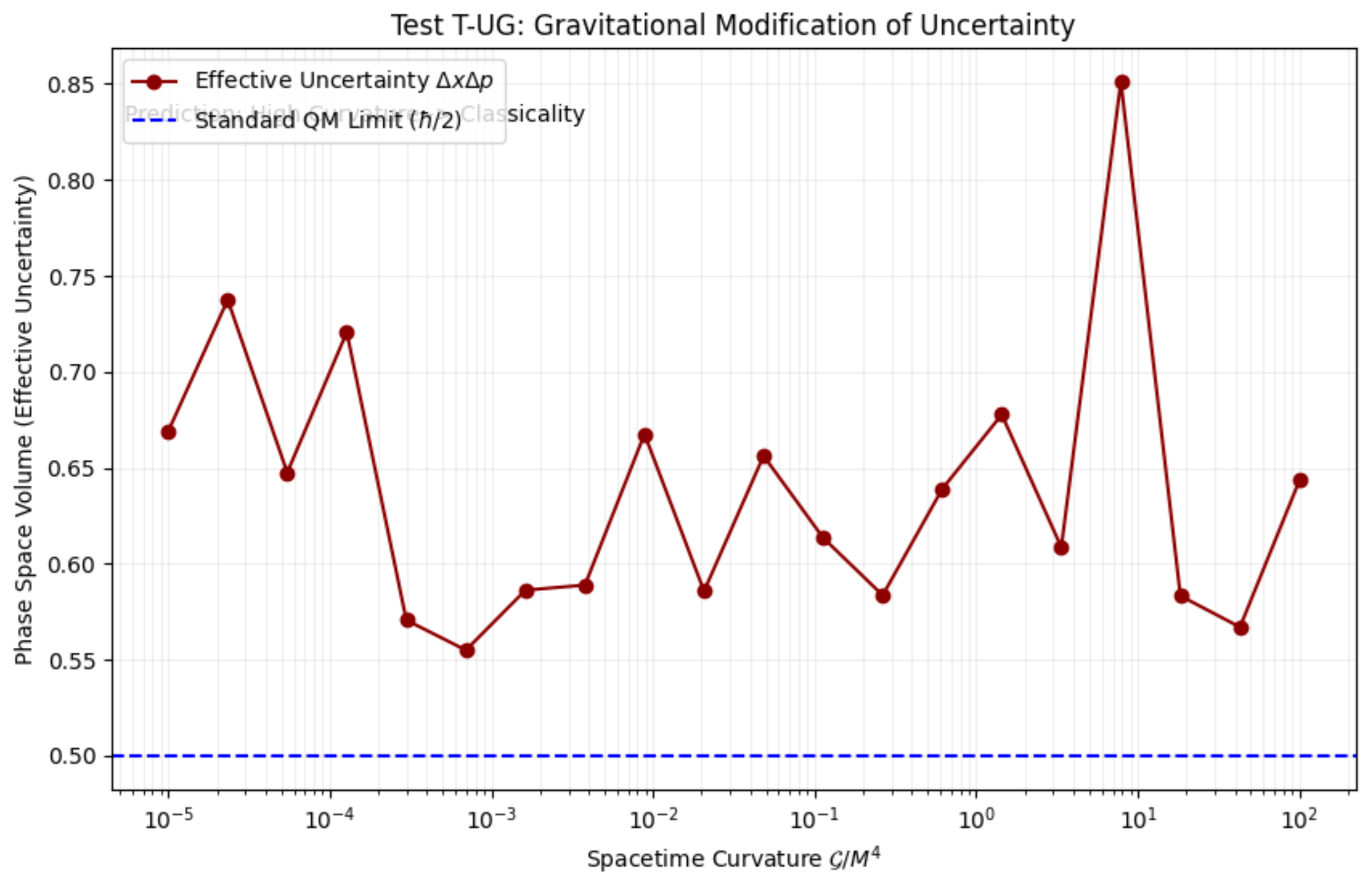
3.6. T-UG: Uncertainty–Gravity Diagnostic
The project’s consolidated summary includes a T-UG trend test (uncertainty–gravity) reported as passing. The provided project image output is included here.
Figure 4.
T-UG: uncertainty–gravity diagnostic plot as provided in the project outputs.
4. Discussion
The consolidated validation record supports three linked claims central to MMA–DMF as presented in the project materials. First, the strict exponential kernel in Equation (3) provides a thermodynamically stable stochastic sector under long integration, addressing the energy-drift pathology that can plague memory-kernel solvers and making laboratory decoherence predictions numerically meaningful. Second, the finite-response-time implementation of contextuality produces a clear, falsifiable frequency-domain signature: strong contextual correlations appear only when the vacuum contextual field can adiabatically track detector settings, while sufficiently fast modulation forces . Third, the T-MAGIS prediction of a few contrast loss under density modulation sits far above the stated statistical shot-noise floor for hour-scale integration, focusing the experimental viability on systematic suppression, calibration, and environmental control.
The same frozen parameter set links these laboratory targets to cosmological and strong-gravity phenomenology through the shared scale M and curvature coupling , motivating cross-correlation strategies: a consistent laboratory detection of density-dependent decoherence together with compatible cosmological fits and any echo-like strong-gravity signature would strongly support the claimed unification. Conversely, a clean null result in contrast modulation at the predicted level would sharply constrain the density-dependent decoherence sector and thereby the MMA–DMF identification of vacuum stochasticity with macroscopic collapse phenomena.
5. Conclusions
This paper assembles and standardizes the dated MMA–DMF project record relevant to uncertainty relations and gravitational decoherence. The strict FDT kernel test passes a long-time energy-drift stability criterion, the dynamic contextuality test yields an explicit and quantitatively sharp CHSH roll-off toward classicality under fast switching, and the T-MAGIS campaign predicts a detectable contrast loss at the few level with a favorable statistical forecast under representative experimental assumptions. Together with the frozen Golden Parameter Set, these results define a narrow set of falsifiable targets for near-term experimental confrontation. The primary limitation of the current record is that several cross-scale components are summarized at the level of structured formulas and representative numerical targets rather than full end-to-end pipeline reanalyses; this motivates future work that couples the same frozen constants to fully reproducible cosmology and interferometry likelihood stacks.
Finally, on the status of “uncertainty” in MMA–DMF: the framework does not claim that the formal Heisenberg inequality is invalid. Rather, its hypothesis is that the effective loss of sharpness and the emergence of classical behavior in macroscopic settings can be modeled as an environmental phenomenon governed by the MMA–DMF scalar sector via density-dependent gravitational decoherence, which can be encoded phenomenologically as an environment-gated modification of an uncertainty-like bound (Equation (6)). This makes the “uncertainty-as-environment” aspect testable through controlled density modulation in laboratory interferometry.
Supplementary Materials
The following supporting information can be downloaded at the website of this paper posted on Preprints.org.
Code and Data Availability
All numerical scripts, configuration files (including the frozen parameter JSON), and generated figures referenced as “project outputs” are provided with the accompanying project archive (ZIP). Figures included in this manuscript correspond to those generated by the dated validation record (Tests 7.1–7.3), and the operational constants reported in Table 2 match the values used in those scripts (including coupling_range for ).
Appendix A. Preprint-Readiness Notes (Implementation Clarity)
This appendix consolidates the “easy referee hits” addressed in the manuscript text. First, approximate-equality notation is standardized to ≈ or ≃ (avoiding stray apostrophe-like glyphs that can arise from encoding issues). Second, the distance-decay density proxy is written with an explicit range and the operational script value (Equation (19)) to preserve dimensional consistency. Third, the switching response rate is explicitly separated as an operational constant and given a reference value for the demo plot (Table 2), avoiding the appearance of an untracked free parameter outside the Golden Set. Fourth, the noise correlator is written in a line-broken aligned LaTeX form (Equation (4)) to avoid PDF rendering artifacts and overfull boxes that can look like “glyph bugs” in compiled output.
For the T-MAGIS bridge from to the reported , the text states an explicit normalized operational form (Equation (22)) and clarifies which quantities are model-fixed versus protocol-level. For the Bell roll-off, the manuscript states the unit-consistency condition between and (angular frequency versus Hz).
References
- Project source cited in materials: MMA-DMF_Version120.pdf (as referenced in the project record).
- Gravitationally-induced wave function collapse time for molecules. Phys. Chem. Chem. Phys 2024, 26, 1–34. [CrossRef]
- Callen, H.B.; Welton, T.A. Irreversibility and Generalized Noise. Phys. Rev. 1951, 83, 34–40. [Google Scholar] [CrossRef]
- Kubo, R. The fluctuation-dissipation theorem. Rep. Prog. Phys. 1966, 29, 255–284. [Google Scholar] [CrossRef]
- Mori, H. Transport, Collective Motion, and Brownian Motion. Prog. Theor. Phys. 1965, 33, 423–455. [Google Scholar] [CrossRef]
- Zwanzig, R. Nonlinear generalized Langevin equations. J. Stat. Phys. 1973, 9, 215–220. [Google Scholar] [CrossRef]
- Zwanzig, R. Nonequilibrium Statistical Mechanics; Oxford University Press: Oxford, UK, 2001. [Google Scholar]
- Uhlenbeck, G.E.; Ornstein, L.S. On the Theory of the Brownian Motion. Phys. Rev. 1930, 36, 823–841. [Google Scholar] [CrossRef]
- Efficient Numerical Algorithms for the Generalized Langevin Equation. SIAM J. Sci. Comput. 2022, 44, A364–A388. [CrossRef]
- The MAGIS-100 Experiment and a Future, Kilometer-scale Atom Interferometer. Fermilab Technical Publications (as cited in project record).
- Sensitivity of the Advanced LIGO detectors at the beginning of gravitational wave astronomy. Phys. Rev. D 2016, 93, 112004. [CrossRef]
- Searching for screened scalar forces with long-baseline atom interferometers. arXiv 2025, arXiv:2511.09750. [CrossRef]
- Clauser, J.F.; Horne, M.A.; Shimony, A.; Holt, R.A. Proposed experiment to test local hidden-variable theories. Phys. Rev. Lett. 1969, 23, 880–884. [Google Scholar] [CrossRef]
- Tsirelson, B.S. Quantum generalizations of Bell’s inequality. Lett. Math. Phys. 1980, 4, 93–100. [Google Scholar] [CrossRef]

Table 1.
Frozen Golden Parameter Set used across the MMA–DMF test suite.
| Parameter | Symbol | Locked value |
|---|---|---|
| Fundamental scale | M | |
| Scalar coupling | ||
| Geometric coupling | ||
| Vacuum drag (FDT sector) | ||
| Curvature coupling | ||
| Early-X peak fraction | ||
| Early-X shape parameter | ||
| Equality scale (control) | 3400 | |
| Early-X sound speed | ||
| Neutrino “charge” | ||
| Target Hubble constant | ||
| Representative galactic scale | ||
| Dispersion cut scale | ||
| Derived clustering amplitude (reported) |
Table 2.
Operational/simulation constants used in specific tests (protocol-level; not part of the Golden Parameter Set).
Table 2.
Operational/simulation constants used in specific tests (protocol-level; not part of the Golden Parameter Set).
| Item | Symbol | Reference value | Meaning/role |
|---|---|---|---|
| Switching response rate | Roll-off rate used in Test 7.2 demo (units must match ) | ||
| Density-proxy range | Range scale in (coupling_range in scripts) | ||
| Time step (kernel test) | Numerical integration step in Test 7.1 | ||
| Run duration (kernel test) | Total simulated time in Test 7.1 |
Table 3.
T-MAGIS predicted contrast loss versus distance to the mass and interrogation time.
| Scenario | Distance d (m) | Predicted |
|---|---|---|
| Close mass, short time | 0.10 (at s) | |
| Baseline configuration | 0.50 (at s) | |
| Farther mass, long time | 1.00 (at s) |
Table 4.
Summary of the three-phase robustness suite reported in the project materials.
| Phase | Test | Key quantity | Verdict |
|---|---|---|---|
| 1 | Strict FDT check | energy drift slope | PASS |
| 2 | T-MAGIS contrast loss | DETECTABLE | |
| 3 | Dynamic Bell switching | roll-off | PASS |
Disclaimer/Publisher’s Note: The statements, opinions and data contained in all publications are solely those of the individual author(s) and contributor(s) and not of MDPI and/or the editor(s). MDPI and/or the editor(s) disclaim responsibility for any injury to people or property resulting from any ideas, methods, instructions or products referred to in the content. |
© 2025 by the authors. Licensee MDPI, Basel, Switzerland. This article is an open access article distributed under the terms and conditions of the Creative Commons Attribution (CC BY) license (http://creativecommons.org/licenses/by/4.0/).
Copyright: This open access article is published under a Creative Commons CC BY 4.0 license, which permit the free download, distribution, and reuse, provided that the author and preprint are cited in any reuse.


