

Submitted:
04 December 2025
Posted:
05 December 2025
You are already at the latest version
Abstract
This paper proposes Trace & Trajectory (T&T) Semantics, a pre-representational framework for understanding meaning as intent-driven navigation through informational space. Motivated by fieldwork with multimodal, intersubjective communication—where meaning emerges through gesture, prosody, and embodied coordination rather than propositional structures—I extend Hoffman and Prakash's trace logic to continuous semantic trajectories. The framework models meaning not through Euclidean feature spaces but through attractor dynamics: meaning stabilizes where intent-driven trajectories converge under dissipative constraints, creating basins that guide navigation without representational anchoring. The critical innovation is operator σ's fractal architecture. As meta-awareness intensifies, trace patterns achieve self-similarity across scales, enabling collapse and reconjunction without infinite regress. This mechanism naturalizes prototype effects, conceptual metaphor, image schema stability, and abstract reasoning as emergent from how conscious agents navigate meaning-space under intent, dissipation, and σ-modulation—not from mental representations. T&T dissolves the hard problem of semantic content by grounding meaning in informational dynamics during concrete intersubjective engagement, where patterns maintain semiotic coherence through intent-driven navigation, without reference to external representational targets. This preserves systematicity while respecting embodied intuition. The framework offers cognitive linguists, anthropologists, and semantic theorists an approach that is formally rigorous (utilizing attractor dynamics, Markov kernels, and σ-operators), empirically tractable (applicable to actual discourse and interaction), and phenomenologically adequate. Crucially, the formalism describes patterns in conscious, intentional dynamics—not neural mechanisms—making it appropriate for phenomena in which agent purpose drives semantic organization.
Keywords:
trace logic
; trajectory semantics
; self-similarity
; meta-representation
; Donald Hoffman
; pre-representational dynamics
; operator σ
; informational semantics
; meaning construction
; prototype theory
; conceptual metaphor
; abstract concepts
1. Introduction: The Trajectorial Turn in Semantic Theory
Contemporary semantic theory confronts a persistent dilemma. Formal semantics achieves compositional precision through truth-conditional frameworks but struggles to account for embodied, context-dependent aspects of meaning (Gärdenfors 2014,Jackendoff 2002). Cognitive linguistics captures embodied intuitions through image schemas and conceptual metaphors but resists formalization, leaving systematic coherence in the background (Lakoff Johnson 1980,Langacker 2008). Attempts to bridge this divide—whether through Conceptual Spaces (Gärdenfors 2000,2014), construction grammar (Feldman 2020), or hybrid approaches (Copley Harley 2015)—preserve a representationalist core: meanings remain anchored to features, properties, categories, or mental structures that pre-exist their invocation.
Even radical enactivism (Hutto Myin 2017), which rejects representational content for basic cognition, struggles to extend this stance to language. If meanings are not representations, what are they? The enactivist answer—meaning as use-in-context—dissolves ontological questions into pragmatic ones, leaving the nature of meaning itself untheorized.
Recent work in consciousness science offers an unexpected resolution. Hoffman et al. (2024) trace logic, developed to formalize conscious experience as emergent from informational dynamics rather than neural representation, provides mathematical machinery applicable beyond perception. Their framework models experiences not as internal representations of external reality, but as traces—informational patterns arising from Markov processes, where observers lose access to the underlying state structure. Critically, traces possess semiotic coherence: they function as meaningful patterns calculated within their own probabilistic relationships, without requiring reference to external representational targets.
The present semantic theory builds on an extended project known as the T&T Framework that applies trace-based informational dynamics to identity navigation, sensemaking processes, and, more broadly, to ethnographic phenomena. HEXID (Hexagonal Identity Dynamics), its geometrical heuristics development, addresses a foundational challenge: identity studies have been obscured by categorical frameworks that reify identity positions as fixed mental representations anchored in mind-body dualisms. By demonstrating that identity configurations—as observable in actual discourse and social practice—emerge from trajectories through informational space rather than categorical membership, this approach revealed unexpected advantages for epistemic justice and decolonial epistemology (Fricker 2007,Grosfoguel 2008). If analyzing identity as trajectorial navigation enables perspectives resistant to colonial categorization and better suited to knowledge pluriversality (Quijano 2000), the same informational architecture might be productively extended to semantic theory. The success of trajectorial analysis for identity phenomena thus motivates the present application to linguistic meaning: T&T Semantics translates these insights into a more formally developed framework for conceptual dynamics.
A methodological clarification is warranted here. Our guiding commitment has been to develop integrated frameworks that can handle what fieldwork actually shows us—the messy, multimodal, intersubjectively emergent dynamics that formal theories often dismiss as peripheral noise. The question driving this work is not “what must meaning be?” but rather “which formalisms enable us to capture what we observe in discourse, gesture, interaction, and lived experience?” This leads us to treat mathematical apparatus—geometric spaces, trajectory dynamics, operator formalism—as heuristic tools valued for their analytical productivity rather than their metaphysical commitments. If trace logic gets me closer to an adequate description of embodied cognition and intersubjective coordination, we will adopt it; the criterion is descriptive and explanatory power, not just ontological elegance.
This instrumental stance requires clarification regarding the status of formalism itself. T&T does not claim that trace logic or geometric dynamics describe neurophysiological mechanisms, computational substrates, or “deep structures” of the brain. Although the mathematics is isomorphic with the framework’s ontological commitments—consciousness as fundamental, informational dynamics as primary—but this isomorphism operates at the level of conceptual coherence, not physical reduction. We are not proposing that neurons literally compute Markov kernels or that hexagonal geometries exist in cortical tissue. The formalism provides a rigorous language for describing patterns observable in meaning-making practices without reducing them to neural implementation. This distinguishes T&T from physicalist cognitive science, where mathematical models purport to describe mechanisms “underneath” cognition. Here, the formalism operates at the same ontological level as the phenomena—both are informational dynamics within consciousness. The heuristic utility lies in structured description, not in discovering hidden causal machinery.
This perspective has consequential implications for how it deploys constructs from cognitive linguistics. Conceptual metaphor, force dynamics, image schemas, and prototypes—these remain analytically useful within T&T despite originating in representationalist frameworks. What changes is not the analytical validity of these notions but their theoretical interpretation. Where Lakoff Johnson (1980) treat metaphors as cross-domain mappings between mental representations, T&T reinterprets them as trajectory couplings between informational regions operating at different -levels: embodied source attractors () provide low-dissipation navigational scaffolding for abstract target regions (). What cognitive linguistics describes as “domains” emerge in T&T as attractor regions at distinct structural granularities rather than pre-existing categorical structures. TIME IS SPACE exemplifies this: temporal reasoning parasitizes stabilized spatial trajectories not through representational mapping but through thermodynamic coupling—a coherent repurposing of differential informational densities with no dualistic commitments to cumbersome dyads like abstract/concrete or source/goal. As culture formalizes its concepts of temporal relations, language itself (operating across /) becomes part of the embodied source that anchors them.
This methodological pragmatism should not be mistaken for theoretical eclecticism. Not all heuristics are equivalent or compatible—some facilitate insight while others obscure dynamics or impose category boundaries that distort phenomena. Our task has been to discriminate between productive and distortive formalisms through sustained engagement with observational data from indigenous discourse, gesture studies, and interactional analysis. We adopt trace logic, geometric dynamics, and -modulation precisely because they accommodate phenomena—emergence, embodied grounding, context-sensitivity, and phenomenological immediacy—that representationalist formalisms systematically exclude or relegate to peripheral status. The formalism serves the phenomena, not vice versa. What emerges from this anti-representationalist stance is not merely negative critique but positive architecture: a fully trajectorial semantics where meaning-making itself becomes the primary explanandum.
Thus, meaning emerges not from isolated trace patterns but from intent1 (directional tendency inherent to actual occasions), both pre-representational accounts of directed activity. In T&T’s terms, as applied in Radial Analysis (Escobar L.-Dellamary 2025b), intent manifests as -modulation: the active recalibration of dissipative constraints that shapes which identity positions become accessible. Intent is thus not what consciousness has but what it does in navigating informational space—a vector, not a vehicle. In other words is not just what a person wants or directs his attention to (that’s intention) and although intent is part of it, it is mainly the level of what a person can perceive and cognize regarding his or her frame-of-reference in the interface space—guided navigation through a self-similar field of traces.
T&T Semantics offers decisive advantages over representationalist frameworks. It dissolves the hard problem of content (Harnad 1990)—meaning arises from semiotic coherence in informational dynamics rather than from representational anchoring—avoiding infinite regress. Crucially, T&T does not model neurological activity nor treat abstract cognition as substrate-dependent computation. This ontological positioning liberates distributive, extended, enactive, and embodied approaches from the burden of neural reduction. Instead, T&T inherits the architecture of Conscious Agent Network Theory (Hoffman et al. 2024), inverting the explanatory direction: neurological evidence becomes a derivative phenomenon—patterns of informational rendering and semiotic stabilization observable within the interface of spacetime—rather than the causal foundation of meaning. This resolves a persistent tension in embodied cognition: how to honor phenomenological primacy while engaging neuroscientific data. T&T accomplishes this by treating neural correlates as traces of informational dynamics, not their generators. It naturalizes systematicity without the Language of Thought (Quilty-Dunn et al. 2023): systematicity emerges from informational constraints on trajectory coupling (handled heuristically as geometric spaces), where semantic composition succeeds if attractor basin geometries admit trajectories that intersect. It unifies embodiment and formalization: informational dynamics are inherently embodied and collective yet fully formalizable through trace logic. What appear as representational relationships are stable couplings in informational dynamics; what seem like mental contents are attractor basins in trace space, regulated by a real person in actual interactive space.
This paper outlines the theoretical architecture of Trace & Trajectory Semantics, demonstrates its explanatory power for persistent problems in semantic theory, and provides pathways for empirical application. Section 2 establishes the formal foundations, extending trace logic to trajectorial cognition with minimal mathematical formalization. Section 3 introduces the self-similar collapse mechanism, which prevents metarepresentational traps while enabling abstract reasoning—the conceptual heart of the framework. Section 4 translates classical cognitive phenomena into trajectorial terms, bridging T&T to existing empirical research traditions. Section 5 concludes with implications for cognitive science.
2. From Traces to Trajectories: Theoretical Foundations
2.1. Trace Logic: The Hoffman-Prakash Framework
Hoffman et al. (2024) formalize conscious experiences as traces arising from Markov dynamics. Given a state space X, a Markov kernel describes transition probabilities, and a stationary distribution characterizes long-term behavior. The trace operation models perspective collapse: an observer with access only to subset experiences a reduced probability measure—a trace of the whole dynamics.
The mathematical elegance lies in recognizing that traces are not merely information loss but functional reorganization. When an observer loses access to certain states, the remaining accessible dynamics reorganize into a coherent probability structure. This reorganization is the trace—a pattern that maintains its own internal consistency regardless of its relationship to the fuller dynamics from which it derives. We call this property, in semantic terms, semiotic coherence.
Critically, traces exhibit properties enabling semantic interpretation. First, traces possess internal coherence: they function as stable patterns through their own probabilistic relationships rather than through correspondence to external targets. Second, traces compose hierarchically: trace operations nest, enabling complex structure. Third, traces evolve, capturing the dynamic construction of meaning. Fourth, traces are optimized for function rather than veridicality: as demonstrated by the Interface Theory of Perception (Hoffman 2019), perceptual experiences are fitness-optimized interfaces rather than veridical representations of objective reality.
These properties make traces suitable for semantic modeling. If perception is a trace-based interface rather than representational mirroring, language is too. Linguistic meaning would then be trace patterns arising from informational dynamics—patterns exhibiting semiotic coherence through internal probabilistic consistency rather than correspondence to mind-independent semantic contents.
2.2. The Substrate: Trace → Thread → Trajectory
Three nested concepts build the analytical architecture of T&T Semantics. Understanding their relationships is essential for grasping how meaning emerges as navigational dynamics rather than compositional structure.
2.2.1. Trace
Traces are pre-representational “grooves” in informational space—not symbols or representations but observational marks left by conscious agent interactions. Think of traces as the informational equivalent of paths worn into a forest floor: not planned, not symbolic, but created through repeated traversal.
Notation: for trace sets (capital T indicates ontological substrate).
Properties:
- Exist in the Network Environment of Traces (NET)—the substrate reality theorized by Conscious Agents Theory (Hoffman et al. 2024)
- Pre-phenomenal: exist before conscious observation renders them into experience
- Provide navigational affordances without determining specific trajectories
- Stabilize through repeated traversal (saturation)
2.2.2. Thread
Threads are stabilized trace bundles that function as navigable pathways. A thread collects recurrent transitions over similar informational terrain into a single, traversable path. When one or more agents repeatedly navigate comparable regions of informational space, the underlying traces stabilize into thread bundles. Geometrically, a thread behaves as a one-dimensional (string-like) object embedded in the HEXID board. Phenomenologically, threads are what we navigate through when producing or comprehending expressions.
Notation: We denote a thread bundle by when its internal traces are not distinguished, and by , , etc., for distinct bundles when multiple navigable pathways must be contrasted at the same scale.
Examples:
- : Phenomenal thread bundle (rich experiential detail)
- : Archetypal thread bundle (abstract theoretical patterns)
Intuitively, a thread bundle can be taken, at a given granular scale , as the structured substrate of what appears in the interface as a perceptual regularity—roughly analogous to a “property” such as a color, a general shape, a movement pattern, or any rendered configuration that behaves as a coherent “something.” Importantly, “perceptual” here is understood in an extended, enactive sense that includes proprioceptive, affective, and intersubjective patterns of access (Hoffman 2016,Noë 2004,Varela et al. 1991).
Critical distinction: Thread saturation (how established a pathway is) and trajectory compression (how much informational distance is covered) are orthogonal dimensions. A highly saturated thread can support both extended and compressed trajectories. This orthogonality is crucial for understanding how conventionalized expressions (high saturation) can nevertheless vary dramatically in their informational scope (variable compression).
This distinction bears on—though is not reducible to—the classical “specification or elaboration” phenomenon in cognitive linguistics. Consider the contrast between Mary went to school versus Mary woke up early and took the bus in the middle of a snowstorm to go to school. Both utterances may trace similar trajectories through informational space (navigating from a domestic baseline toward an institutional educational position), but with radically different compression rates. The first collapses intermediate positions; the second maintains granular resolution across the navigational path.
Critical non-isomorphism: Trajectories are not isomorphic with linguistic expressions—particularly not when viewed through lexico-morphological interpretative lenses. The thread remains stable across both formulations—both saturated conventional pathways—while trajectory length varies independently. A single morpheme can encode compressed multi-position navigation (e.g., Athabaskan classificatory verb stems, Mithun 1999; Lakhota instrumental prefixes, Van Valin 2005), while extended phrasal structures may trace minimal informational distance. What cognitive linguistics treats as “elaboration” conflates: (a) trajectory extension (maintaining intermediate positions), (b) meta-commentary (providing observational detail at constant ), and (c) thread multiplication (activating parallel navigational resources). T&T requires distinguishing these analytically distinct operations to keep the ad hoc effect at bay.
2.2.3. Trajectory
Trajectories are the actual movements of a conscious agent through thread-structured informational space. Trajectories are meaning-events—phenomenal acts of navigation that manifest as expressions.
Notation:
- for individual trajectory (the analytical unit)
- for movement notation (from position 1 to position 2)
- for blocked transitions (IIP barriers)
Properties:
- Have onset phase, informational “sweet spot,” and dissipation phase
- Follow asymptotic functions (approach targets without discrete endpoints)
- Length varies: extended trajectories versus compressed trajectories
- Measured by informational distance, not temporal duration
Key T&T principle: “Only trajectories are meaningful”—meaning is not stored in positions but enacted through movement. A position without trajectory is merely potential.
2.2.4. Position : Harmonic Coherence Points
A position is not a discrete location but a point of high informational coherence within a thread bundle . Imagine multiple vibrating strings crossing at a point where their vibrations align—that alignment creates a stable node. Positions are navigational nodes, not categorical boxes.
Notation:
- for position (coherence point within )
- Coordinate system where
Formal definition: Position = coherence point within thread bundle .
Properties:
- Exist within thread bundles, not independently
- Have Temporal Dissipation Rate (TDR)—maintenance cost
- Distance from zero-point () indicates informational investment
- Connected via possible movements (some facilitated, some blocked by Information Interchange Protocols)
2.2.5. The Architectural Relationship
The four-level architecture can be summarized as follows:
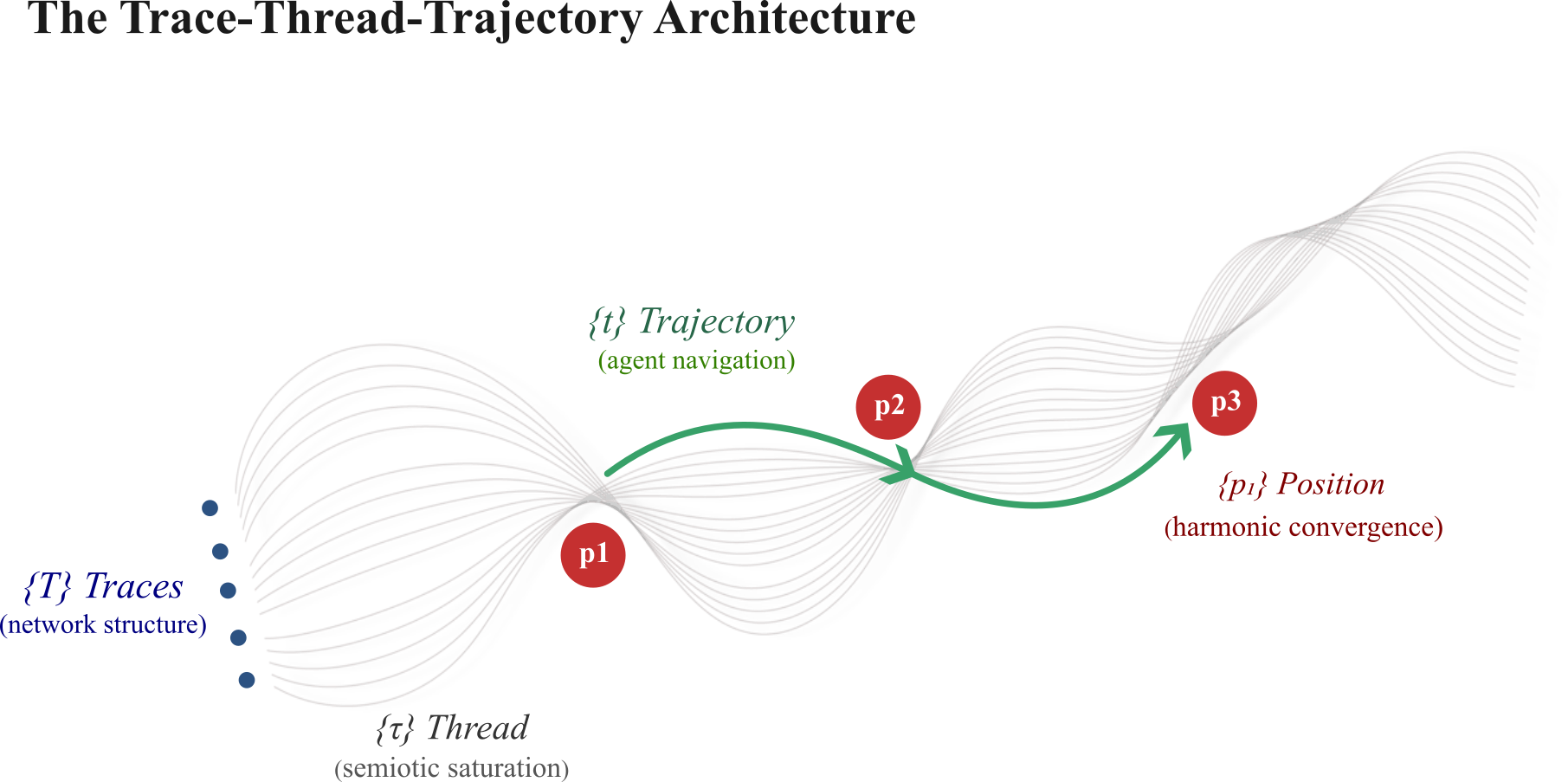
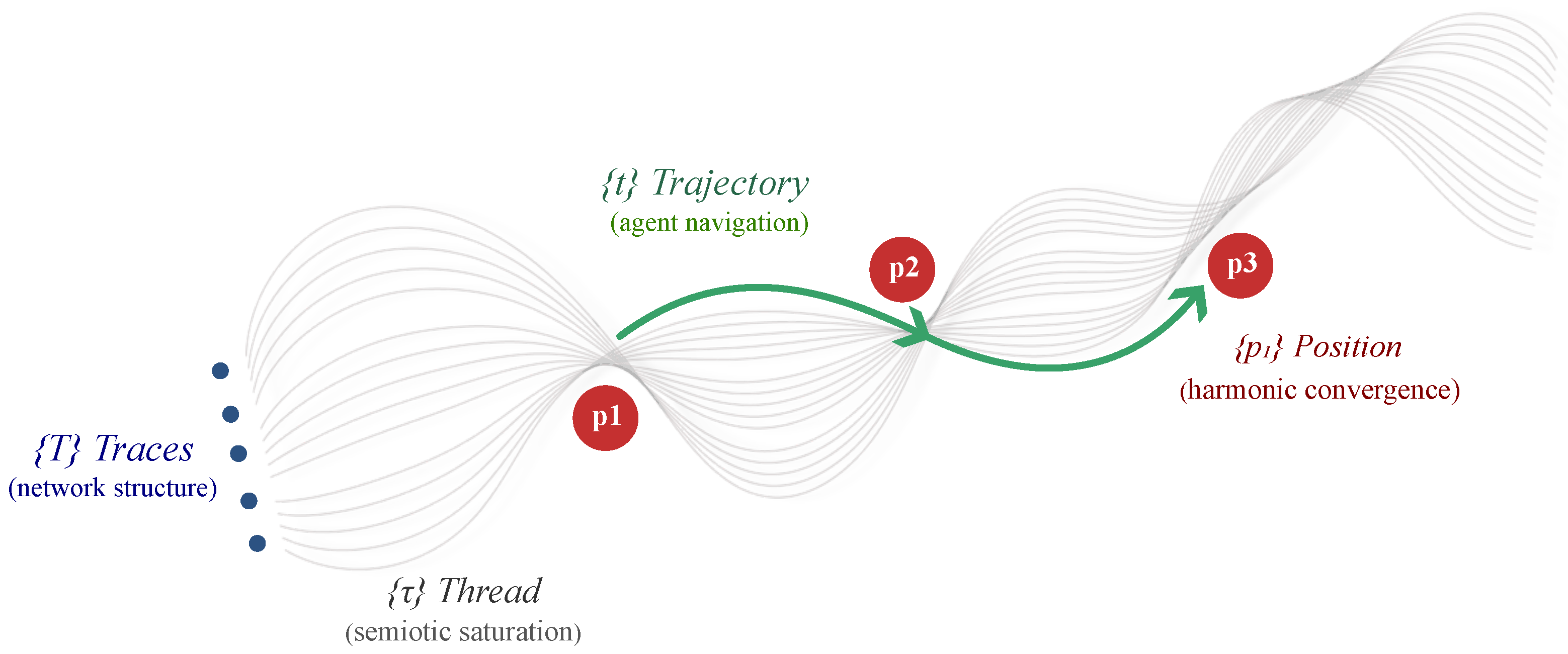
Traces generate threads through repeated traversal; threads structure trajectories by providing navigable pathways; positions emerge as coherence points within threads where multiple informational pressures align. This architecture dissolves the traditional form-meaning duality: form is meaning—two analytical perspectives on the same trajectorial event.
Figure 1.
The Trace-Thread-Trajectory Architecture. Traces (network structure, left) stabilize through repeated agent navigation into thread bundles (semiotic saturation). Trajectories (green path) represent conscious agent movement through thread-structured space, connecting positions , , (red nodes). Positions are not pre-given locations but points of harmonic convergence—coherence nodes within thread bundles where informational pressures align. The figure illustrates how meaning emerges through navigation rather than through correspondence: the trajectory is the meaning, not its vehicle.
Figure 1.
The Trace-Thread-Trajectory Architecture. Traces (network structure, left) stabilize through repeated agent navigation into thread bundles (semiotic saturation). Trajectories (green path) represent conscious agent movement through thread-structured space, connecting positions , , (red nodes). Positions are not pre-given locations but points of harmonic convergence—coherence nodes within thread bundles where informational pressures align. The figure illustrates how meaning emerges through navigation rather than through correspondence: the trajectory is the meaning, not its vehicle.
2.3. The Trajectorial Extension: From Static Traces to Dynamic Navigation
Hoffman-Prakash trace logic focuses on static perceptual events. T&T extends this to continuous semantic navigation: trajectories through evolving trace fields rather than isolated trace snapshots. This extension requires three innovations.
First, intent vectors. Semantic agents do not passively manifest traces in their interface but actively navigate informational space under intent. Intent functions as attractor bias: given current trace configuration, intent determines probable next states by weighting transition probabilities. Intent is not mental representation but a directional constraint on informational flow—thermodynamic pressure shaping trajectory through trace space. Crucially, this pressure operates not only at the trajectorial level—discrete transitions between semiotically stabilized states—but across the full spectrum of informational granularity. Below the threshold of semiotic coherence, intent modulates pre-crystallization dynamics: the thermodynamic fluctuations and trace-field turbulence that precede the emergence of discrete meaning. Above this threshold, intent organizes supra-semiotic patterns: emergent configurations that simultaneously constrain multiple trajectories, exerting attractor pressure on higher-order informational structure. Intent is thus a multi-scale phenomenon, sculpting informational flow from sub-symbolic noise to discourse-level navigation. Yet these scalar designations—pre-, sub-, supra—remain strictly relative to each interface manifestation. Through autosimilarity, what functions as high-order meta-representation in one context may collapse into basic trace in another; saturated cultural constructs can re-enter as elementary informational units. While convention and cultural stabilization provide provisional anchoring points, no genuine semiotic verticality or intrinsic complexity hierarchy exists—only contingent configurations of informational flow, momentarily crystallized, perpetually subject to re-scaling.
Second, temporal dissipation. Trajectories exhibit dissipative dynamics: maintaining semantic coherence across time requires continuous informational expenditure. Some trajectories are thermodynamically cheaper (low Temporal Dissipation Rate—TDR) and thus stabilize in a conventional sense. Others are expensive (high TDR) and emerge only under specific contextual support. Crucially, this informational support is not purely individual but functions also as collective convergence: when multiple agents recur on a trajectorial bundle, even configurations far from any agent’s zero-point of authentic subjective state can acquire lasting life. This explains how collective judgments and narratives may persist despite being demonstrably false—agents may individually “feel” that something is off (a resonance mismatch with ), yet convergence pressure sustains the trajectory. Convergence is thus double-edged: it can crystallize both veridical and distorted informational patterns with equal thermodynamic efficacy. This framework accounts for both semantic stability and change: low-TDR trajectories persist cross-contextually through minimal expenditure; high-TDR trajectories bifurcate under perturbation unless anchored by collective recursion.
Third, operator as formalization of intent. The directional pressure described above—intent operating across scales—requires formal implementation. Operator (sigma) provides this mechanism, translating intentional modulation into granular transformation of the informational field. Where intent functions as thermodynamic pressure, operationalizes how this pressure reconfigures accessible structure. Formally: . Operator determines informational resolution—which distinctions remain accessible versus collapsing into coarser categories—but does so in service of intentional navigation. Critically, is not external parameter but emerges from trajectories themselves: reflection intensifies , collapsing distinctions into higher-order patterns; immersion reduces , expanding access to fine-grained sensorimotor detail. This bi-directionality reflects intent’s capacity to modulate granularity both upward (toward abstraction, meta-representation, formalization) and downward (toward embodied immediacy, pre-conceptual flux, phenomenological refinement). The -intent coupling thus enables conscious agents to actively sculpt their own informational architecture—not merely observing meaning-space but reorganizing its dissipative conditions through volitional modulation. This distinguishes T&T from naturalized structuralist approaches (e.g., IIT’s , Tononi (2017)) which measure integration passively: formalizes how consciousness acts upon itself, adjusting resolution to navigate semantic terrain strategically rather than drifting through pre-determined attractors.
These innovations transform traces from static perceptual primitives into dynamic semantic substrates. Meaning emerges not from what traces represent but from how agents navigate through self-similar trace fields under intent, dissipation, and -modulation.
2.3.1. Fractal Autosimilarity and Scalar Relativity
A critical property of trace space underwrites intent’s multi-scale operation: autosimilarity across granular levels. The informational structure accessible at one -resolution is topologically isomorphic to structures at other resolutions—what appears as complex meta-representation at high may function as elementary trace at low , and vice versa. This fractal architecture dissolves apparent hierarchies: there is no ontologically privileged “base level” from which higher abstractions derive, nor ultimate meta-level where representation culminates. Instead, each manifestation of the interface operates relative to its own threshold of semiotic coherence.
Consider etymological divergence as an illustration. Two lexical items—“stereo” (solid/three-dimensional) and “stereo” (dual-channel audio)—share Latin roots (stereos) but have semantically diverged through thread saturation along distinct trajectorial paths. At the phenomenic level—subjective experience—, they occupy isolated peaks in semantic space; no speaker perceives a connection. Yet historical linguistics reveals continuous trace connectivity at meta-representational levels—reconstructed through extensive documentation operating at . When a scholar performs -modulation (etymological research requiring deliberate granular attention at ), the connection surfaces: what were “two concepts” at full granularity (phenomenological navigation by everyday speakers) reconverge at coarse granularity ( historical analysis) into a single attractor basin with differentiated peaks. Crucially, this is not the discovery of pre-existing structure but re-scaling of informational access. The connectivity was neither absent nor present in absolute terms—only non-accessible versus accessible relative to operational and configuration.
This scalar relativity has profound implications. First, it explains how saturated meta-representations (philosophical concepts, theoretical frameworks, cultural constructs) can collapse back into basic traces through desuetude, trauma, or cultural rupture—they lose complexity not through degradation but through re-scaling when informational support dissipates. Second, it clarifies why collective convergence can sustain apparently “high-level” constructs (ideologies, narratives, identity positions) that individual agents experience as inauthentic: at the scale of collective recursion, these patterns are low-TDR stable attractors; at individual zero-point scale, they are high-TDR imposed configurations. The same structure exhibits radically different stability depending on observational resolution. Third, it naturalizes the phenomenology of insight and conceptual breakthrough: these are not leaps to higher representational levels but -transitions revealing connectivity at currently inaccessible scales—the “aha moment” is granular re-scaling and, therefore, meaning-making.
Operator thus functions as dimensional aperture: it determines which subset of self-similar trace topology becomes perceptually available. Intent—as pressure modulating this aperture—enables agents to navigate not only through semantic space but across scales of semantic space, treating the same informational field as immediate sensorimotor flux, intermediate conceptual structure, or abstract meta-representation depending on intentional modulation. This transversal capacity distinguishes conscious semantic agents from deterministic systems: the ability to re-scale access itself, not merely traverse pre-given structure.
These innovations—intent as multi-scale pressure, dissipation as individually and collectively determined, and as formalization of intentional modulation—transform traces from static perceptual primitives into dynamic semantic substrates. Meaning emerges not from what traces represent but from how conscious agents navigate through autosimilar thread fields under intent, dissipation, and -modulation, actively sculpting informational granularity rather than passively inheriting semantic structure.
2.4. Attractor Basins and Semantic Stability
Trajectories do not wander randomly through trace space but exhibit attractor dynamics: specific configurations pull trajectories toward themselves, stabilizing semantic patterns. This gravitational metaphor is apt—patterns of semiotic stabilization attain informational weight through recursive agent engagement, exerting attractive force proportional to their degree of stabilization within the trace field. Culturally entrenched conceptualizations function as archetypal attractors: foundational categories like spatial-temporal structure, mythological frameworks, institutionalized social roles, and value hierarchies create deep basins that constrain navigation across diverse discourse contexts. Attractor basins are regions where trajectories converge despite varying initial conditions. These correspond phenomenologically to stable meanings—conceptual cores that discourse gravitates toward even when starting from diverse contexts. Theoretically, only a sigma movement could dispel such a strong pull—critical moments like counter-cultural collective movements or rebellion.
Image schemas (Johnson 1987) are exemplary attractors: CONTAINER, PATH, BALANCE, and FORCE are stable configurations emerging from embodied sensorimotor experience. But T&T reinterprets them: not static mental structures but stable basins in thread space (also SSP or Semiotic Stabilization Pattern) where trajectories converge under low dissipative cost. The embodied grounding is not representational correspondence (the schema represents the body) but thermodynamic efficiency (bodily experience is a manifestation of the stabilization of low-TDR paths).
This reinterpretation dissolves puzzles plaguing image schema theory. If schemas are mental structures, how do they compose? How do they generate novel extensions? T&T: schemas are attractor basins with geometric properties determining trajectory coupling. Composition succeeds when basins intersect; it fails when geometries are incompatible. Novel extensions are trajectory perturbations exploring basin boundaries—sometimes bifurcating into new attractors (semantic change), sometimes collapsing back (metaphorical extension without conventionalization).
Attractor theory also explains prototype effects (Rosch 1975) without requiring feature lists or similarity judgments. Prototypes are attractor centers (SSPs)—configurations maximizing basin stability (minimal dissipation from all approach trajectories). Category membership is either a form of thread bundle coherence or a meta-representation of the linguistic analysis, i. e. a meta-discursive trajectory. So this is not because items possess varying degrees of defining features, but because trajectories exhibit varying dissipative costs as they approach the attractor. This convergence operates within a hyperdimensional informational space. Yet navigation is constrained by the interface’s dimensional structure: spacetime archetypes serve as dominant organizing axes, effectively projecting movement through a three-dimensional framework even as the underlying trace dynamics remain higher-dimensional.
Multiple forces act simultaneously on this coordinate space—cultural attractors, language specifics, embodied constraints, intersubjective pressures—creating non-linear trajectorial fields rather than simple gradients. “Robin” operates primarily at with direct access through embodied experience: temperate-zone bird exposure carved deep attractor basins aligned with spacetime archetypes (flight, terrestrial habitat, moderate size). “Penguin” requires navigation through threads: flightlessness and aquatic adaptation deviate from archetypal BIRD patterns stabilized through collective sensorimotor convergence. Peripherality is not about features but about a scale shift—penguins demand cross- trajectorial work that robins access directly at phenomenological granularity. Typicality gradients thus reflect informational architecture: prototypes minimize dissipative cost by aligning with the dominant scale where sensorimotor experience stabilizes efficiently, while peripheral members require agents to navigate across scales or through less-saturated thread bundles, increasing the necessary energetic investment for closeness—i.e., categorical—recognition.
3. T&T Operative Principles
Overview
The following principles constitute the axiomatic foundation of Trace & Trajectory Semantics. They are formulated as concise, mnemonic statements for rapid consultation and pedagogical clarity. Each principle captures a fundamental aspect of how meaning emerges from informational dynamics rather than representational content.
Foundational Architecture
-
“Four levels structure informational dynamics: with ”Notation convention: = trace sets (pre-representational substrate in NET); = thread bundles (stabilized trace convergences); = trajectories (conscious navigation, analytical units); = positions (coherence points within ). Traces generate threads through repeated traversal; threads structure trajectories; positions emerge as harmonic convergence nodes within threads.
-
“A trajectory is a conscious agent (CA) activity; Meaning is trajectorial”Trajectories require conscious observation to manifest. Without CA activity, only trace patterns exist. Semantic content is not stored but enacted through navigational dynamics.
-
“NET is the base system, CA is a function”The Network Environment of Traces (NET) constitutes fundamental reality. Conscious agents emerge as functional operators within this substrate, not as ontological primitives.
Informational Architecture
- 4.
-
“Direction and attention are indexical CCI principles”Deixis occurs only within Contextual Convergence Interfaces (CCIs). Outside these interfaces, neither pointing nor attention have semantic anchor.
- 5.
-
“CCI is contiguous with Present Moment Experience”CCIs are not abstract but phenomenologically immediate—they constitute the experiential field where trajectories unfold in real-time navigation.
- 6.
-
“Trace is ontological, a non-representational memory at NET”Traces are not mental representations but informational imprints in the substrate itself. They exist prior to and independent of conscious access from the perspective of the AC cognitive delimitation—it’s persona.
Dynamics and Convergence
- 7.
-
“Thread bundles are stabilized trace convergences; trajectories navigate through them”When multiple agents repeatedly traverse similar informational terrain, individual traces stabilize into thread bundles . Threads are not trajectories but the structured pathways that trajectories navigate through. Phenomenologically, threads are what we move along as meaning and experience, including the subset we call “linguistic meaning”. Thread saturation (how established a pathway is) and trajectory compression (how much informational distance is covered) are orthogonal—a highly saturated thread can support both extended and compressed trajectories.
- 8.
-
“Positions are harmonic coherence points within thread bundles ”A position is not a categorical box but a point of high informational coherence within a thread bundle—like multiple vibrating strings crossing at a point where their vibrations align. Positions exist only within threads; they have Temporal Dissipation Rate (TDR) as maintenance cost; their distance from indicates informational investment. Movement between positions () constitutes trajectory; blocked transitions () indicate IIP barriers.
- 9.
-
“Trajectories are fundamentally networking, but a subset maintains apparent CA individuation”Most trajectorial activity is transpersonal networking. The trajectories that maintain agent boundaries are a special subset requiring continuous energetic investment.
- 10.
-
“Shared Reality is a function of transductor properties of SSP manifested in CCI”Semiotic Stabilization Patterns (SSPs)—like language, books, films—transduce individual trajectories into collective convergence when manifested through CCIs.
- 11.
-
“Common Knowledge is basic trajectorial networking; what we `know’ combines NET, access (IIP), and awareness ()”Knowledge is not possession but participatory access—a function of substrate availability (NET), interchange protocols (IIP), and tuning resolution (commonly at pasive ).
Operational Distinctions
- 12.
-
“ configures the board; active builds on it; CA navigates either way”Lambda () sets structural granularity—the scale at which the informational table is configured (, , ). Sigma () actively constructs perceptual patterns and modulates epistemic access. Conscious agents navigate regardless of whether is actively modulated or habitually fixed. Critical: and are orthogonal dimensions— determines structural scale while modulates access mode within that scale.
- 13.
-
“No creativity without -movement; everything else is trajectory recurrence”Innovation requires shifting epistemic perspective ( or ). Without such movement, agents merely repeat established trajectorial patterns.
Language & Intersubjectivity in CCIs
- 14.
-
“CCI is co-extensive with present experience; spatiotemporal deixis marks convergence salience”A Contextual Convergence Interface (CCI) does not represent external reality but constitutes the phenomenological field of “present experience.” Spatiotemporal coordinates (here, now, I, you) are not labels for pre-existing entities but salience markers stabilizing the convergence field—they function as IIPs (Information Interchange Protocols) that constrain attention and reduce informational entropy within the interface.
- 15.
-
“Language is trajectorial dynamics pre-stabilized via SSPs; it assumes objective worlds as pre-packed CCIs”Linguistic meaning-making operates primarily through Stabilized Semiotic Patterns (SSPs)—collectively grooved trajectorial sequences with low Temporal Dissipation Rate (TDR). This stabilization creates the phenomenological illusion of an “objective world” (entities in space, events in time, causal relations) by packaging architecture into readily navigable form. Language does not describe a pre-given world; it provides highly efficient CCI templates that allow rapid convergence without requiring agents to negotiate basic ontological commitments at each interaction. The “world” is thus a pre-packed CCI—a collectively maintained informational structure that functions as default convergence substrate for linguistic exchanges.
- 16.
-
“Language transduces stochastic infinity of egocentric into shared navigational space”Each conscious agent operates from an egocentric (experiential zero-point) defining their unique projection. Language functions as the primary transducer enabling convergence: it maps the stochastic multiplicity {, , ..., onto a shared navigational substrate (CCI) where agents can coordinate trajectories despite originating from distinct -centers. This is not telepathy but structural coordination—agents navigate isomorphic SSPs from different starting positions, producing experiential “sharedness” as emergent alignment effect.
- 17.
-
“Language is a mechanism that stabilizes trans- regions, enabling trajectories to traverse granularities”Ordinary trajectories navigate within a configured -granularity: the thread bundle maintaining phenomenal hexid coherence operates predominantly within . However, certain semiotic mechanisms—preeminently language (understood broadly: verbal, gestural and social communication)—stabilize regions between granularities, enabling trajectories that traverse from the phenomenological () toward the meta-conceptual ().This trans- bridging capacity is not accidental but functional. Language transforms interface objects into classes: nouns do not designate entities but stabilize categorical regions that exist at coarser granularity than phenomenal particulars. What appears in immediate experience as this dog (phenomenal, ) becomes navigable as dog (categorical, ) through linguistic stabilization.Typological variation: Languages differ in their characteristic -positioning. English has abundant trajectories predominantly at , with extensive nominal abstraction and systematic tense marking that presupposes temporal objectification. Languages like Tzotzil (Haviland 1994) or Navajo (Smith et al. 2007) show, in contrast, trajectories closer to , with evidential systems, aspect-prominence, and classificatory verbs that track phenomenal salience rather than categorical membership. This is a different navigational calibration—distinct trans- stabilization patterns shaped by cultural-ecological trajectorial histories.Metaphor as trans- trajectory: What cognitive linguistics describes as “conceptual metaphor” (Lakoff Johnson 1980) are precisely these trans- trajectories: stabilized routes enabling navigation of abstract domains () by parasitizing the thermodynamic economy of embodied domains (). The coupling is structural (-traversal), though the mode of access () determines whether navigation is automatic or deliberate. Crucially, metaphoric saliency correlates with the informational density gradient between scales: the steeper the differential between phenomenologically rich and informationally compressed , the more it will strike the curious linguistic eye as a metaphor par excellence.
- 18.
-
“Language stabilizes or destabilizes shared reality; high TDR regions threaten convergence protocols”Language plays the most crucial role in maintaining or fracturing “shared reality” within CCIs. Effective linguistic coordination lowers TDR (sustained informational coherence), enabling fine-grained intersubjective navigation. However, when dissipative environments generate high-TDR regions—semantic drift, ambiguity, incommensurable framing—agents may stabilize at coarse hexid-meta positions that override convergence protocols. This manifests as polarization: agents occupy meta-level abstractions () with minimal trace-level anchoring ( blocked), producing apparent “communication” (shared vocabulary) without genuine convergence (incompatible navigational structures). The TDR gradient thus indexes fragility of shared reality.
- 19.
-
“Linguistic reference is an IIP lowering TDR via recursive stabilization”Reference functions as an Information Interchange Protocol (IIP) that constrains informational continuity across utterances, lowering TDR by creating recursive stability. When agents successfully “speak about the world” or “speak to others,” they are not mapping words to objects but coordinating trajectories through SSP-stabilized regions. Each successful referential act reinforces the IIP: “DOG” refers not because it points to entities but because it reliably navigates convergent trajectorial patterns across agents. Breakdown of reference = IIP failure: agents go through incompatible SSPs, trajectories diverge, TDR spikes, convergence dissolves.
- 20.
-
“Indexicality only exists in CCI; it reinforces convergence via attentional focusing”Deixis (I, here, now, that) and ostension (pointing, demonstratives) are not context-dependent reference but CCI-constitutive operations. They have zero existence outside active convergence interfaces; “that” does not point to an object but focuses intersubjective attention on a shared informational region within the CCI, further stabilizing discursive representations by making them “relevant.”
- 21.
-
“Cognitive semantic relations occupy different /phenomenological strata; not all reflect empirical ”What cognitive semantics identifies as “conceptual structure”—image schemas (trajector-landmark), semantic hierarchies (hypernym-hyponym), figure-ground organization, lexical categories (parts of speech)—occupies three distinct architectural strata:
- Hexid-onto (): Basic trajectorial bundles echoing through interfaces as pre-representational invariants. Example: trajector-landmark asymmetry as fundamental force-dynamic template accessible via .
- Hexid-meso (): Representational accumulation at phenomenological granularity—semantic categories, prototype effects, schematic organization. These are saturation effects: collective convergence produces stable attractor regions that function as navigational landmarks (see Figure 4).
- Hexid-meta (): Meta-representations from scientific analysis—metalanguages, theoretical diagrams, formal models. These operate at and may provide excellent structural narratives without necessarily bearing direct relation to empirical base at (finest-grained phenomenological access still within conscious navigation).
The key distinction: hexid-onto relations are trace-level constraints (exist in NET regardless of observation); hexid-meso relations are saturational attractors (emerge from collective trajectorial activity); hexid-meta relations are analytical constructs (of coarse -granularity). Cognitive semantics has often conflated these levels, treating hexid-meta constructs (theoretical schemas) as if they were hexid-onto architecture (archetypal structure).Critical implication for lexical categories: So-called “parts of speech” (noun, verb, adjective, etc.) are not universal cognitive primitives but likely branches of —products of European grammatical traditions (Greek technē grammatikē, Latin ars grammatica) that reify analytical convenience into ontological necessity. These metalinguistic categories operate at hexid-meta () and may provide excellent pedagogical or cross-linguistic comparison tools, but they should not be projected onto as if speakers “think in nouns and verbs.” This is epistemic flattening: universalizing a particular analytical framework (literate, alphabetic, Indo-European-derived) as if it revealed cognitive architecture rather than reflected specific historical-intellectual traditions.
- 22.
-
(Self): First-person deixis (I) centers at the innermost ring, internally structured along q/r/s axes. The interpretation of these axes depends on the active thread bundle , the operative granularity , and the Semiotic Stabilization Patterns (SSPs) instantiated in the hexid heuristic.Before specifying axis content, a notational clarification is necessary. Following the conventions established in Radial Analysis (Escobar L.-Dellamary 2025), each axis possesses bidirectional polarity: and denote movement toward the positive or negative pole of the q-axis, respectively. This creates six angular zones rather than three undifferentiated axes. The polarity nomenclature carries no evaluative implication—“positive” and “negative” are purely geometric, with semantic interpretation assigned contextually based on the phenomenon under analysis. For personal deixis at , one common directional configuration—grounded in cross-linguistic pronoun research (Kitagawa Lehrer 1990,Siewierska 2004)—maps as follows:
- q-axis (Individuation): Individuated self (emphatic singular I, highly differentiated self-reference) ↔ Collectivized self (we as group, self-as-member-of-community). Movement along the q-axis corresponds to the associative expansion characteristic of pronominal plurality: “I” does not multiply into “I + I” but rather combines with non-speaker referents (, ), rendering trajectories inherently heterogeneous.
- r-axis (Genericity): Contextual/specific reference (this speaker, this moment, this utterance) ↔ Generic/impersonal reference (role-based construals like “as researchers, we...”, dedicated impersonal forms like one, man, or repurposed second-person generics). This axis tracks the scope of reference from deictic particularity to universal applicability.
- s-axis (Stance): Personal/intimate (solidarity-marked, informal register, affective proximity) ↔ Formal/institutional (authority-marked, detached, professional distance). This axis captures the social-relational dimension of self-positioning—what the typological literature terms “familiarity” or the vertical/horizontal dimensions of social deixis.
This is not a claim about multiple selves but a recognition that first-person reference navigates distinct facets within self-positioning. The axes reflect trajectorial patterns documented across diverse pronominal systems (Bhat 2004,Siewierska 2004) rather than universal grammatical primitives. - 23.
-
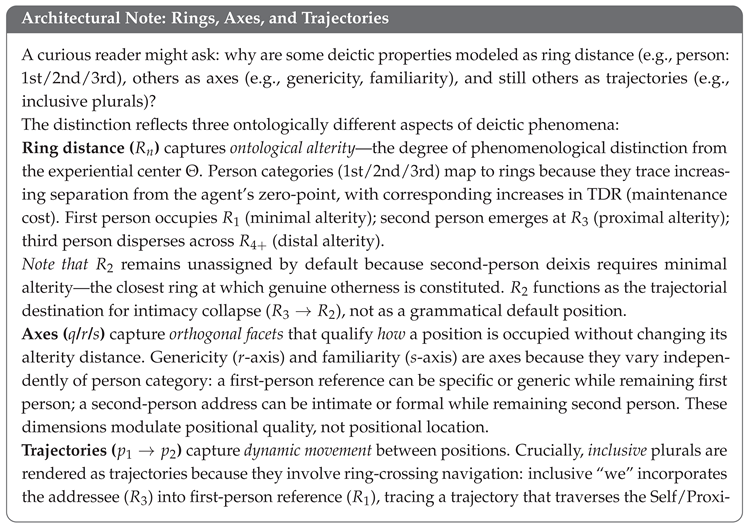
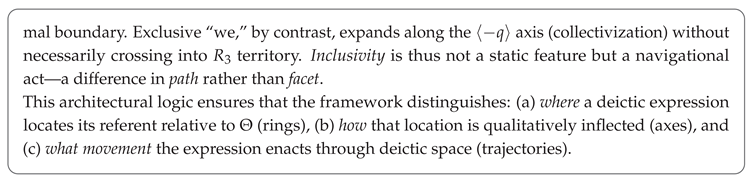
(Proximal, minimal): Second-person deixis (you) occupies the third ring by default—close enough for direct address, distant enough to constitute alterity. However, is minimal positioning; actual intersubjective distance is trajectorized:
- Intimacy trajectory: — In close friendship or romantic contexts, you is navigated inward, collapsing intersubjective distance. Under (descent to pre-reflective immersion), even the – boundary may dissolve momentarily in highly intimate CCI regions.
- Alienation trajectory: — In betrayal, epistemic distrust, or hostile framing, you is navigated outward, increasing affective/epistemic distance. At (Distal), second-person becomes Alienated Alter—grammatically still “you” but experientially remote or adversarial.
- (Distal): Positions occupied by Alienated Alters—not merely “distant” but experientially inaccessible or epistemically opaque. This includes depersonalized institutional agents (“the system,” “the administration”), hostile outgroups, or individuals perceived as fundamentally untrustworthy, in regions of “institutional and impersonal” conflation. Crucially, alienation is not spatial but trajectorial: the path from to passes through convergence protocol failure—whether as blocked IIPs (), unsustainable TDR gradients, or -incommensurability where apparent CCI engagement masks incompatible threads ( locked, blocked, see principles 14-18 starting on page 11).
Convergence Protocol Failure (CPF) could manifest through three mechanisms:- (a)
- IIP-blocked alienation: Direct barrier preventing trajectory completion
- (b)
- TDR-dissipative alienation: High maintenance cost makes convergence unsustainable
- (c)
- -incommensurable alienation: Shared vocabulary without navigational alignment
Core insight: The position (, , ) provides geometric potential, but the trajectory (movement sequence) enacts meaning. Intersubjective proximity is not a fixed property of pronouns but a dynamic function of navigational patterns.Consider a discourse shift from “you could argue...” to “some people claim...”. The first expression positions the addressee at in the zone—a specific, individuated interlocutor whose perspective is being invoked. The second expression enacts a compound trajectory: movement toward (collectivizing the referent from “you” to “people”) and toward (generalizing from contextual addressee to impersonal class). This compound trajectory may additionally involve radial displacement toward if the speaker is simultaneously signaling epistemic distance from the claim. What traditional grammar treats as a simple substitution of lexical items, Radial Analysis (Escobar L.-Dellamary 2025) reveals as multi-dimensional positioning strategy: the speaker depersonalizes the interlocutor, collectivizes the source of the claim, and optionally alienates the position—all through a single phrasal shift.These micro-movements remain invisible to frameworks that treat person as a static morphosyntactic feature. T&T’s trajectorial lens exposes discourse-level positioning strategies operating beneath the threshold of traditional grammatical analysis.
 |
 |
Interpretive Notes
These principles are not empirical generalizations but constitutive commitments—they define the framework’s ontological-epistemological stance. Rejecting any single principle requires reconstructing T&T from alternate foundations. For detailed applications to linguistic analysis, see Radial Analysis methodology; for consciousness-theoretic grounding, see CLOUD framework (Escobar L.-Dellamary 2025a).
4. Architecture of Multi-Scale Dynamics: Self-Similar Collapse and Fractal Meaning
4.1. The Autosimilarity Mechanism
The transition from discrete collapse events to continuous trajectorial dynamics hinges on recognizing the fractal structure of representational saturation. The architectural sequence proceeds as follows: trace sets that undergo repeated agent traversal stabilize into thread bundles —structured pathways that function as navigable semiotic conduits. As representational saturation deepens along these threads, they progressively lose informational distinction. At sufficient saturation depth, threads become formally indistinguishable from traces: what was once a differentiated bundle of informational pathways contracts into a new trace configuration.
The collapse point is determined by the structural scale () at which collective saturation dynamics operate within the trace field—defined by the subset D that specifies the current interface. The epistemic access mode () becomes relevant in two distinct contexts: (1) when individual agents navigate the already-collapsed configuration, and (2) in the special case of agents with active (scientists, philosophers, spiritual seekers, artists engaging in deliberate meta-cognitive work) who can modulate collapse dynamics within their own identity configurations as conscious agents.
Crucially, this collapse of thread bundles into new trace configurations does not yield static products. The resulting trace integrates into the broader trace set with probabilistic relationships calculated identically within its subset; its semiotic coherence manifests under the same conditions as the original set. This makes collapsed configurations mathematically identical in their representational function at the interface level. However—and this is critical for understanding semantic dynamics—the specific conditions of the new trace set need not remain similar to those operative in the original thread bundle. The recalculation of internal probabilities within the new trace set, conditioned by SSPs (Stabilized Semiotic Patterns) operative in particular cultural or discourse contexts, can substantially reconfigure the conditions under which semiotic coherence is maintained.
We formalize semiotic coherence through subset probability preservation:
where denotes semiotic coherence, is the collapsed trace subset, is the original subset, and represents conditional probability within subset. Semiotic coherence () is achieved when the collapsed trace reproduces the probabilistic structure of its origins—not because it represents the same external content, but because it maintains the same internal relational geometry.
Yet this preservation of internal geometry coexists with potential transformation of functional significance. When a notion originally emanating from phenomenal-level experience (e.g., “medicine” as healing practice, “democracy” as collective self-governance) achieves representational saturation and collapses into trace status, its integration into a new trace set—conditioned by culturally specific SSPs that favor certain collective convergences—can reconfigure what that semiotic coherence accomplishes. Medicine may become a consumer commodity; democracy may function as an instrument of manipulation. The internal probabilistic structure is preserved, but its articulation within the broader semiotic landscape shifts. This dynamic applies across multiple granular levels, some so close to raw trace configurations that they lack conceptual analogues accessible at phenomenal resolution.
Crucially, without an accumulative (memory) function or SSP (semiotic stabilization pattern) maintaining permanent representational saturation, this establishes a pattern of fractal self-similarity that permits thread configurations to collapse and reconstitute at different structural scales (). This fractal pattern prevents what would otherwise be infinite descent: each level of meta-representation recreates the structural relationships of the level below through self-similar dynamics. When collapse occurs, it does not generate a fundamentally new kind of entity but rather a reconfigured instance of the same informational geometry operating at a different structural scale.
Phenomenologically, this mechanism resembles an idealized learning trajectory: concepts begin as informationally distant configurations—accessible only through high-cost epistemic modes () that require substantial dissipative expenditure to navigate. Through collective iterative engagement, structural saturation deepens at the relevant -scale until collapse threshold is reached. The collapsed configuration then becomes accessible through lower-cost epistemic modes (), reorganizing the agent’s experiential landscape. What was initially “far away” in informational space becomes an immediate lens for perception—a new attractor basin from which subsequent navigation proceeds. The abstract becomes concrete not through metaphorical grounding but through saturation-driven collapse () that reconfigures the trace field itself. The agent experiences this transformation as a shift in epistemic accessibility (), but the underlying mechanism is structural saturation through collective navigation.
4.1.1. Pyramidal Saturation Structure
Representational saturation can be visualized as a pyramidal ascent toward increasingly constrained states. The base represents configurations at fine structural granularity ()—richly differentiated, context-specific, embodied. The apex represents configurations at coarse structural granularity ()—schematic, decontextualized, maximally compressed. As collective navigation saturates thread bundles across structural scales, the accessible trace space contracts. Abstract configurations (high ) involve fewer distinguishable states than concrete sensorimotor configurations (low ).
At fine structural granularity (), semantic agents can access rich sensorimotor detail: diverse exemplars, context-specific nuances, embodied configurations. The base is broad because informational structure encompasses many distinguishable trace configurations. As structural scale increases through collective saturation, the distinguishable configuration space contracts. Previously differentiated configurations merge into coarser categories. At high structural granularity (), only the most abstract relational patterns remain distinguishable—the apex of the pyramid.
The critical mechanism is the preservation of semiotic coherence. When a thread bundle collapses through saturation, the resulting trace configuration maintains the same internal probabilistic relationships as the original distributed pattern.
Figure 2.
Pyramidal Structure of Representational Saturation. As structural granularity () increases (vertical axis), the trace subset over which probabilistic calculations occur narrows from a broad base (many possible configurations) toward a constrained apex (few configurations). The gradient illustrates increasing informational compression and decreasing degrees of freedom. This pyramidal geometry explains why abstract configurations (high ) involve fewer distinguishable states than concrete sensorimotor configurations (low ). The narrowing structure sets the stage for understanding how collapse can occur without infinite regress. Note: epistemic access mode () determines how an agent navigates any point in this structure, but the structure itself is determined by collective saturation dynamics operating at the level.
Figure 2.
Pyramidal Structure of Representational Saturation. As structural granularity () increases (vertical axis), the trace subset over which probabilistic calculations occur narrows from a broad base (many possible configurations) toward a constrained apex (few configurations). The gradient illustrates increasing informational compression and decreasing degrees of freedom. This pyramidal geometry explains why abstract configurations (high ) involve fewer distinguishable states than concrete sensorimotor configurations (low ). The narrowing structure sets the stage for understanding how collapse can occur without infinite regress. Note: epistemic access mode () determines how an agent navigates any point in this structure, but the structure itself is determined by collective saturation dynamics operating at the level.
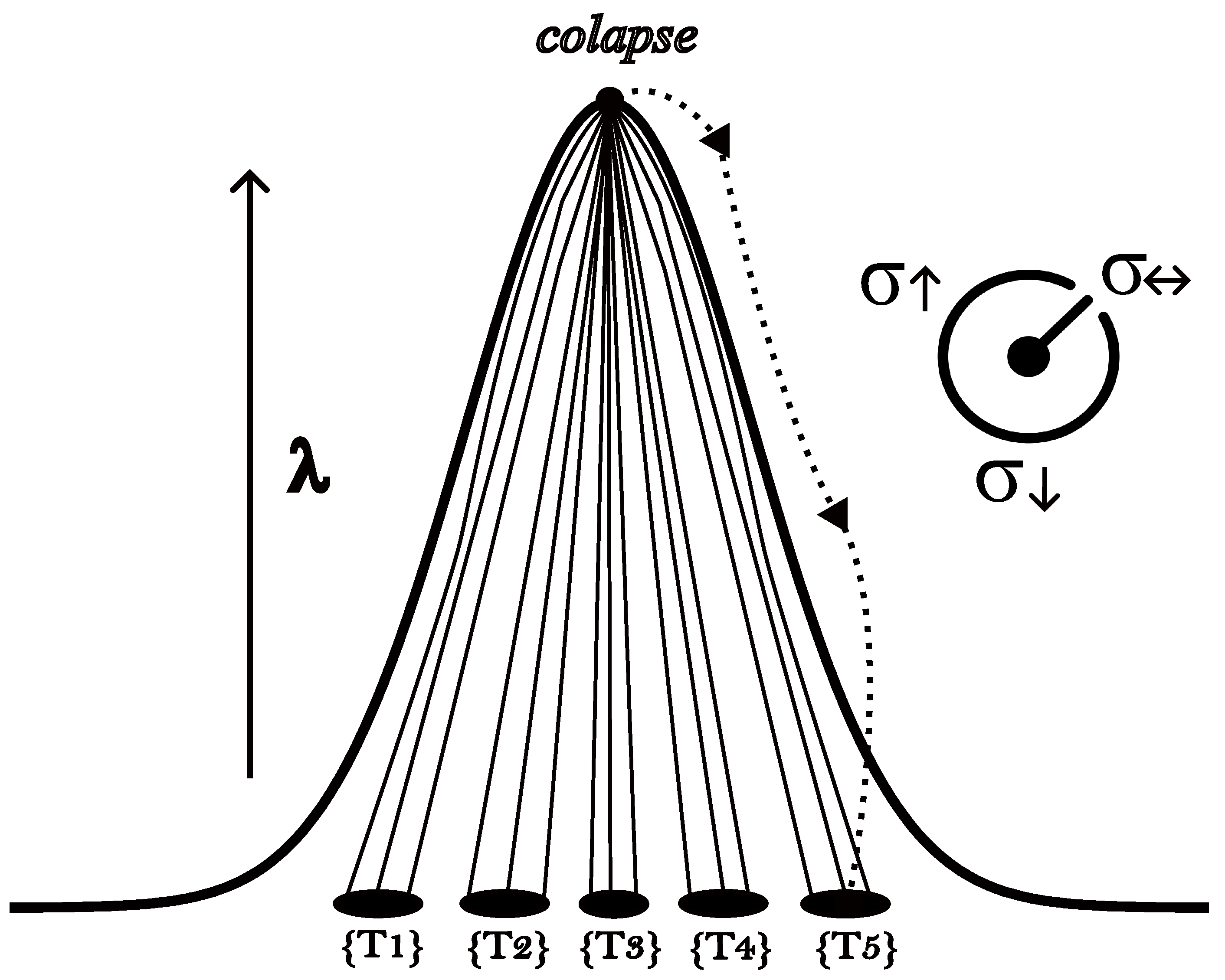
4.1.2. Temporal Convergence: Multiple Pyramids Achieving Isomorphism
The pyramidal structure is not limited to single conceptual trajectories. When multiple semantic developments unfold in parallel—through different discourse contexts, cultural practices, or embodied experiences—each generates its own pyramidal saturation pattern. These distinct pyramids can converge toward structural equivalence.
The mathematical intuition is straightforward. Consider trace (e.g., bodily experiences of balance in conflict resolution contexts). Through collective navigation across increasing structural scales (), agents construct meta-representation —a trace configuration of itself. Under continued collective saturation, approach structural isomorphism with through fractal self-similarity. At collapse threshold , we have plus semiotic coherence at new scale. The result is a new trace with two properties: (1) fractal self-similarity—structurally isomorphic to at different structural resolution; (2) autonomous functionality—operates without requiring ongoing access to .
This explains how abstract concepts like “justice” emerge without requiring an infinite chain of metaphorical grounding. The abstract concept is not derived from sensorimotor sources through successive metaphorical projections (as Lakoff & Johnson, 1980, propose). Instead, it emerges through the collapse of multi-origin pyramids that have achieved convergent saturation at the scale. Different cultures might develop “justice” traces from distinct embodied sources (balance, reciprocity, divine judgment, social harmony). Yet, at sufficient structural saturation, these pyramids converge toward isomorphic configurations—abstract traces that function equivalently despite heterogeneous developmental origins.
Figure 3.
Self-Similar Collapse and Trace Autosimilarity. Multiple temporal trace sets each exhibit the pyramidal saturation structure. At the convergence point, saturated thread bundles achieve structural isomorphism—they become mathematically identical in their representational function despite originating from different initial conditions. The collapse mechanism ensures that meta-representation reconstitutes as a trace configuration topologically equivalent to base traces but operating at a new structural scale () with semiotic coherence (SC = 1). This fractal architecture prevents infinite meta-representational regress because collapse recreates rather than extends structure.
Figure 3.
Self-Similar Collapse and Trace Autosimilarity. Multiple temporal trace sets each exhibit the pyramidal saturation structure. At the convergence point, saturated thread bundles achieve structural isomorphism—they become mathematically identical in their representational function despite originating from different initial conditions. The collapse mechanism ensures that meta-representation reconstitutes as a trace configuration topologically equivalent to base traces but operating at a new structural scale () with semiotic coherence (SC = 1). This fractal architecture prevents infinite meta-representational regress because collapse recreates rather than extends structure.
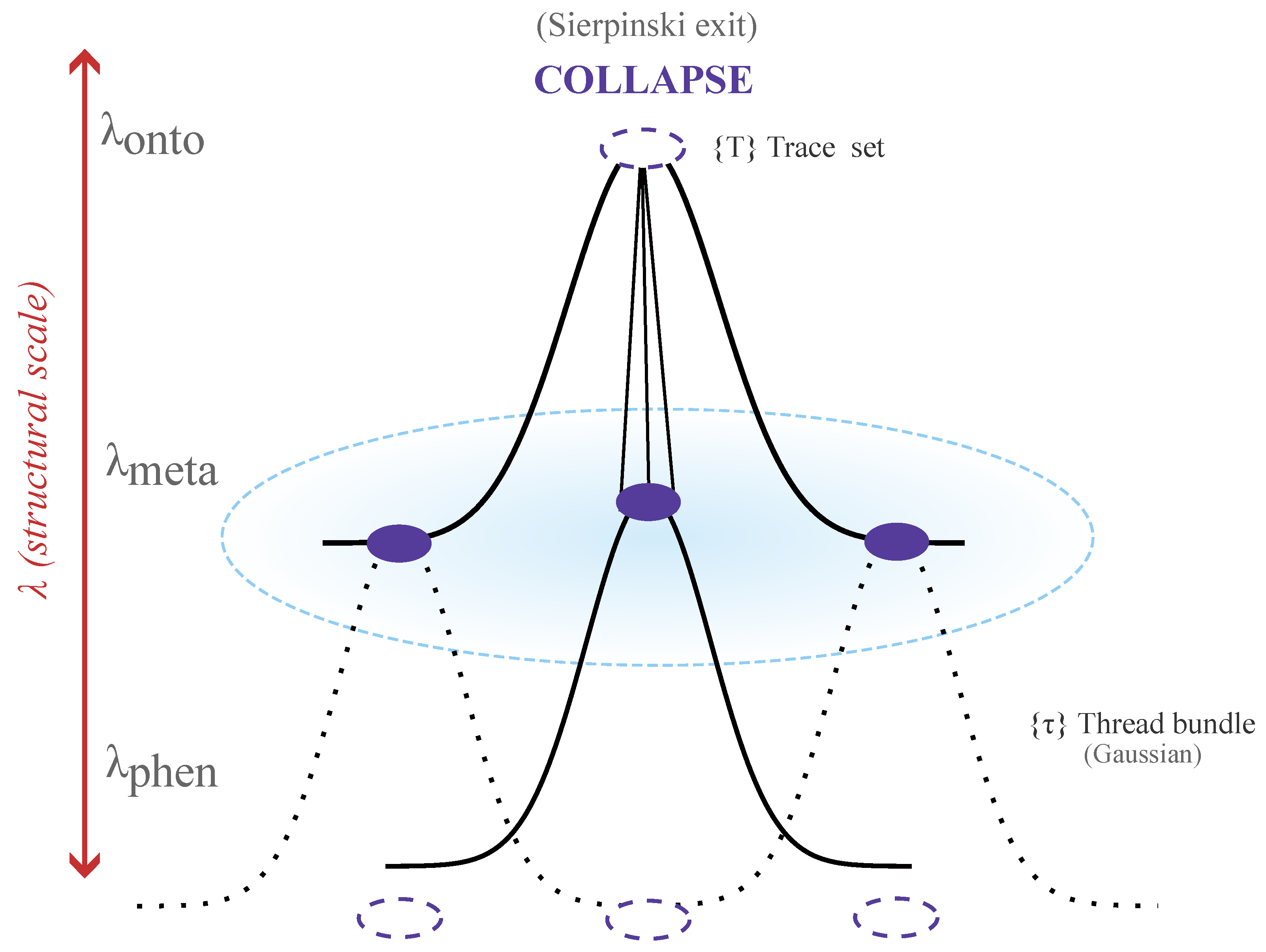
4.1.3. Two Temporal Regimes of Accumulation
The pyramidal collapse mechanism operates within two coupled temporal dynamics, both functioning at the structural level (). Diachronic erosion operates across historical timescales: distributional bases dissipate while peaks persist. Consider how “chocolate” and “maize” both derive from Nahuatl (via Spanish colonial contact), yet contemporary speakers access these as isolated peaks—the shared historical base has eroded. Similarly, “stereo” (spatial audio) and “stereotype” derive from Greek stereos, but the distributional connection has dissipated, leaving only isolated peaks.
Synchronic saturation operates within discourse episodes: the pyramid builds through accumulating contextual constraints rather than eroding. Early in conversation, terms like “bank” maintain multiple trajectories; contextual accumulation progressively eliminates incompatible trajectories, collapsing toward a single peak. What began as low- ambiguity (multiple distinguishable configurations) becomes high- specificity (single collapsed configuration).
These two regimes share the same underlying mechanism: representational saturation through pyramidal compression at the structural level (), with bases eroding or narrowing while peaks persist or emerge. The fractal architecture ensures that collapse at any structural scale reproduces the same relational patterns. Individual agents experience these dynamics through their epistemic access modes (), but the saturation process itself is collective and structural.
4.1.4. Granular Slicing: The One-and-Many Problem
The pyramidal structure supports a third perspective: granular slicing. This addresses the fundamental One-and-Many problem in semantics: how can a single concept (ONE) encompass multiple instances (MANY) without dissolving into either Platonic abstraction or nominalist particularity?
T&T’s answer: the ONE-MANY relationship is an artifact of observational perspective determined by structural granularity (). Consider “bird.” At fine structural granularity (), we can distinguish diverse exemplars: robins, penguins, ostriches, hummingbirds—each occupying distinct positions in thread space with incompatible features. At coarse structural granularity (), these distinctions collapse into a single attractor basin—“bird” as unified category.
The unity is not representational (a mental category subsuming instances) but dynamical: at sufficient structural compression, trajectories that were distinguishable at finer become functionally identical. The penguin-trajectory and robin-trajectory, which diverge at fine structural resolution, converge at coarse resolution—not because they represent the same external bird-essence but because their informational geometries become indistinguishable at high- granularity.
This mechanism has three perspectival dimensions: (1) Pyramidal (vertical): Base-to-apex compression through increasing structural granularity (); (2) Temporal (horizontal): Convergence through parallel saturation or divergence through diachronic drift; (3) Granular (cross-sectional): Observational slicing at different -levels determines unity vs. multiplicity. The exact informational structure appears radically different depending on examination perspective.
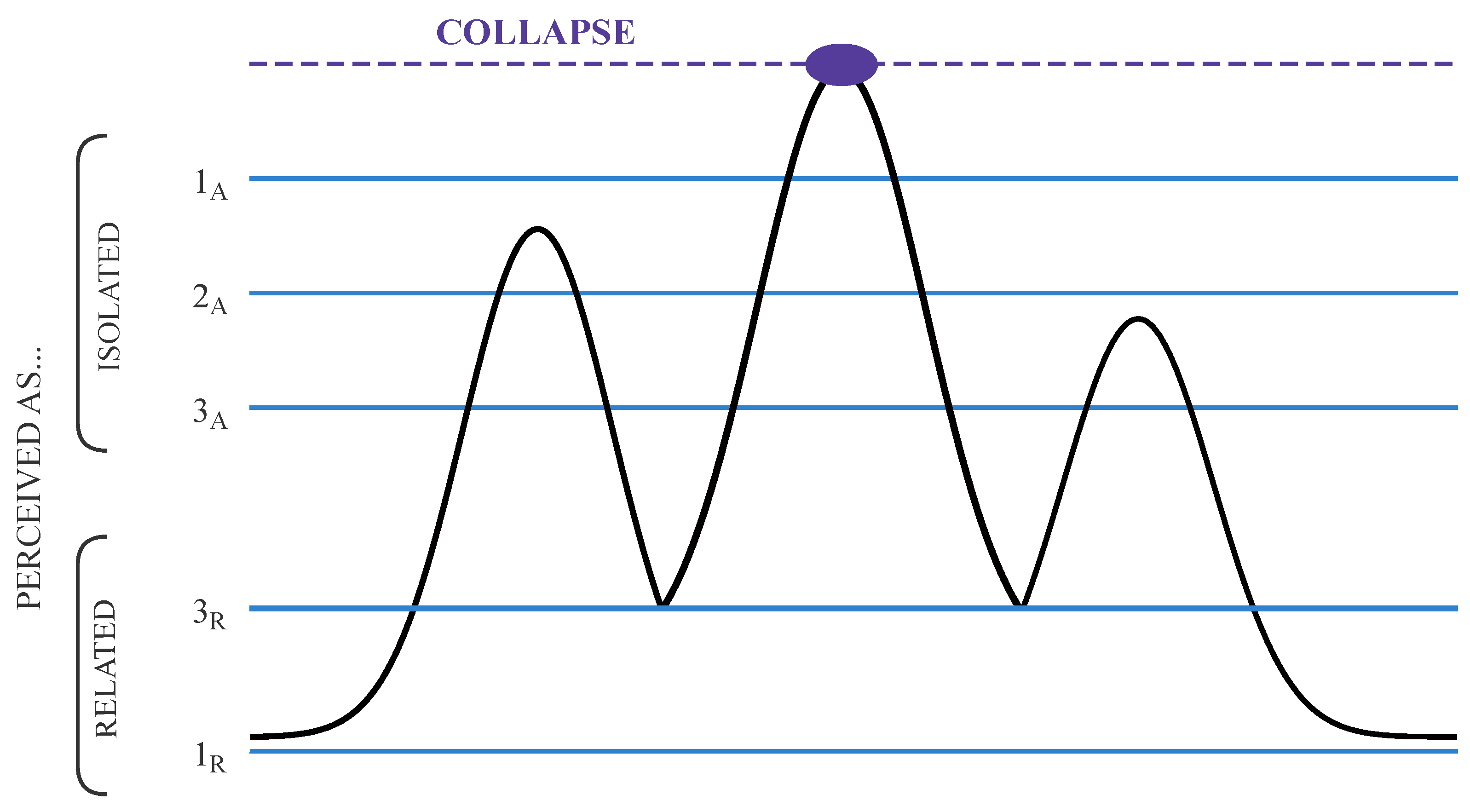
At the coarsest granularity (1R), the entire distributional landscape appears as unified whole—what cognitive linguists term a “domain” but which in T&T emerges as coarse-grained structural access rather than pre-existing categorical structure. Further -increase yields perceptual isolation (3A, 2A): distributional bases fall below threshold; peaks appear as discrete entities. Yet this discreteness is observational artifact, not ontological reality. At sub-threshold scales, connectivity persists—valleys remain traversable, merely expensive.
The ultimate limit is 1A—the point of self-similar collapse. Here, -intensification proceeds until the entire multi-peak structure reconjuncts into single apex. This is not elimination of internal structure but hierarchical transcendence: the complete saturation pattern becomes itself a trace at the next structural level of organization. The collapsed thread bundle maintains internal coherence through preserved probabilistic relationships, making it functionally identical to the original distributed pattern for higher-level semantic processing yet autonomous in operation.
A final clarification: while structural granularity () determines what is distinguishable at each level, epistemic access mode () determines how an agent navigates these distinctions. An agent operating in (phenomenal observation) at high experiences the collapsed abstraction with rich phenomenal texture; an agent operating in (archetypal abstraction) at low theorizes about concrete particulars. The orthogonality of these parameters is essential: configures the informational table, configures the mode of engagement with it.
Figure 4.
Granular Slicing of Representational Saturation. Horizontal slices through multi-peak trace accumulation reveal how semantic relatedness depends on structural resolution (). Gaussian curves represent accumulated thread densities. Horizontal lines indicate observational thresholds at different -levels. 1R: Complete relational integration—all structure perceived as unified whole (coarse ). 3R: Three distinguishable but related elements—peaks visible yet connected through distributional base. 3A: Three isolated elements—peaks salient, base below threshold. 2A: Two isolated elements. 1A: Self-similar collapse—all structure reconjuncts into single apex, the ultimate abstraction achieved through -saturation. Dashed arrow indicates COLLAPSE trajectory as structural granularity intensifies toward the limit point where multi-peak pattern compresses into autonomous collapsed trace. Note: epistemic access () determines how agents experience any given slice, but the slicing itself is a function of structural scale ().
Figure 4.
Granular Slicing of Representational Saturation. Horizontal slices through multi-peak trace accumulation reveal how semantic relatedness depends on structural resolution (). Gaussian curves represent accumulated thread densities. Horizontal lines indicate observational thresholds at different -levels. 1R: Complete relational integration—all structure perceived as unified whole (coarse ). 3R: Three distinguishable but related elements—peaks visible yet connected through distributional base. 3A: Three isolated elements—peaks salient, base below threshold. 2A: Two isolated elements. 1A: Self-similar collapse—all structure reconjuncts into single apex, the ultimate abstraction achieved through -saturation. Dashed arrow indicates COLLAPSE trajectory as structural granularity intensifies toward the limit point where multi-peak pattern compresses into autonomous collapsed trace. Note: epistemic access () determines how agents experience any given slice, but the slicing itself is a function of structural scale ().
4.2. Why No Permanent Meta-Representational Traps
This resolves a deeper puzzle: why don’t meta-representational loops create cognitive paralysis? If reflecting on meaning generates new meanings, and reflecting on those generates further meanings, why doesn’t semantic processing grind to a halt in infinite reflection? The answer lies in the autosimilarity insight: permanent meta-representational traps are thermodynamically unsustainable. Each level of meta-representation requires informational expenditure to maintain distinctness from lower levels. Without permanent memory functions stabilizing infinite hierarchies, dissipative pressure collapses meta-levels back into base configurations through self-similarity.
This principle extends directly to navigational dynamics within Collective Convergence Interfaces. Every meta-access in active CCI—real conversation, for instance—incurs substantial TDR costs, rendering full unsustainable from the agent’s perspective. In Radial Analysis terms, this explains the heuristic of simultaneous granular spaces in intersubjective meaning-making: agents can momentarily navigate positions that appear to combine non-adjacent axes (, bypassing adjacency constraints through differential -scale operation), but such meta-legitimated configurations demand continuous informational expenditure. The apparent “violation” of radial adjacency—where axes , , seem to permit impossible combinations—is not genuine violation but transient multigranular operation: granularity enables partial projections that bypass phenomenological microstructure, yet these projections dissipate rapidly without sustained effort. The system cannot sustain endless ascent—nor indefinite meta-legitimated positioning—because maintaining differentiation across levels costs informational energy that accumulates unsustainably.
Critically, collapse is not failure but function. When (meta-representation becomes structurally identical to base trace), the system achieves semiotic autonomy: the collapsed trace functions independently without requiring ongoing access to developmental origins. This is not representation-of-representation but autonomous pattern with internal coherence. “Justice” functions semantically without requiring speakers to maintain active access to embodied balance experiences—not because “justice” represents balance but because the collapsed trace has achieved autonomous stability through self-similar dynamics.
The zero-point attractor () provides the thermodynamic complement to this collapse mechanism. As the experiential center of gravity in identity navigation space, represents the configuration requiring minimal sustained informational expenditure—the undifferentiated baseline toward which all trajectorial unfolding gravitates. This is not absence of position but maximal navigational flexibility.
The critical insight is that personal dissipation constitutes constant thermodynamic pressure on meaning-making systems. Maintaining marked positions requires continuous informational work: signaling, validation, and intersubjective coordination. Each position is located at some distance from , and that distance directly translates into maintenance cost. This explains the universal pull toward economy of language, meaning, and identity: agents are thermodynamically constrained to configurations that minimize dissipative cost.
This dissipative pressure manifests in the prominence of silent communication, gesture, and the pragmatics of the not-explicitly-uttered. When verbal articulation would require high-cost positional specification, agents default to lower-dissipation modalities. Gesture converges intersubjective attention without the informational expenditure of linear and hierarchical utterances; silence maintains coherence through shared attractor basins without propositional explication. These represent optimal trajectories through meaning-space under dissipative constraints—achieving intersubjective convergence via paths requiring minimal work.
The pragmatics of the not-explicitly-enunciated emerges naturally from agents navigating toward under dissipative pressure. When context and prior interaction have stabilized shared attractors—trajectories keep navigating toward a particular position before engaging with novel information—, explicit articulation becomes informationally redundant. The collapsed trace achieves semiotic autonomy precisely because its self-similar structure no longer requires the dissipative cost of maintaining access to origins—liberating processing capacity for other navigational demands. The fractal architecture thus provides both efficiency and flexibility: efficiency through collapse (avoiding infinite meta-levels), and flexibility through reconjunction (enabling renewed reflection when contexts demand it).
5. Empirical Translations: Bridging to Cognitive Research Traditions
5.1. Prototype Effects: Phenomenal Primacy and Categorical Superstrate
A fundamental clarification is necessary before addressing prototype effects. Traditional approaches—whether Rosch’s featural account or Gärdenfors’s geometric framework—share a common search direction: they seek to identify what lies beneath phenomenal experience that organizes categorical structure. For Rosch, prototypes emerge from featural overlap in mental representations; for Gärdenfors, they correspond to central regions in conceptual spaces. Both frameworks assume that phenomenal experience of categories (seeing something as a “bird”) is the surface manifestation of deeper organizing structures—a cognitive substrate that precedes and determines experience.
T&T inverts this search direction. The experiential zero-point () is phenomenological—rich, differentiated, immediate. There is no substrate beneath phenomenal experience generating categorical organization; rather, what traditional theories call “prototypes” or “conceptual regions” emerge above phenomenal experience through representational saturation. To use a conversational equivalent: where Rosch and Gärdenfors seek a substrate (hidden structure beneath appearance), T&T identifies a superstrate (emergent abstraction above phenomenal richness). The “prototype” is not what organizes experience from below but what results from accumulated trajectorial convergence when language and collective saturation impose categorical structure upon unique phenomenal encounters.
This inversion has profound consequences for understanding prototype effects. Consider the phenomenal encounter with a bird. At the experiential baseline (, ), each bird-encounter is informationally unique: this particular configuration of movement, color, sound, spatial relation to observer. The robin outside the window is not “a robin” but an unrepeatable phenomenal configuration—what might be called, in T&T terms, a singular attractor basin () at the phenomenal level. Language, operating as a semiotic stabilization mechanism bridging and , proposes to this unique experience a categorical frame: “bird.” In naming the phenomenal singular with the same term applied to other phenomenal singulars, language initiates the saturation process that progressively abstracts from phenomenal richness.
This is not a deficiency but a functional achievement of semiotic systems. Through recurrent trajectorial convergence—repeated encounters named identically, collective discourse stabilizing shared attractors—the interface saturates. The result is that agents in passive mode () do not access the phenomenal singular directly; they access the categorical superstrate that saturation has established. The unique bird becomes “a bird,” phenomenally indistinguishable (at meta-level access) from other instances of the category. What Rosch documents as “prototype effects” are precisely the signatures of this saturation process: graded membership reflects differential saturation depth; privileged exemplars mark configurations where saturation is densest; typicality gradients trace the topology of accumulated trajectorial convergence. We should keep in mind that in T&T the interactive interface of perception has a strong collective determinacy, thus prototype effects are also mainly not part of the agent’s individuation threads.
The phenomenological consequence is that saturation progressively obscures direct phenomenal access. This is not metaphorical but structural: as collective navigation deepens saturation at a given -scale, the fine-grained informational distinctions available at become inaccessible at . The agent operating through saturated categorical structures cannot readily recover the phenomenal richness that preceded saturation. This mechanism—saturation obscuring phenomenal immediacy—explains phenomena far beyond lexical categories.
Consider prejudice. A person who has had a traumatic encounter with a dog does not, in subsequent encounters, perceive this dog—the particular animal before them with its specific configuration of size, posture, behavior. The traumatic trajectory has saturated a thread bundle such that trajectorial “dog” now navigates the categorical superstrate directly, bypassing phenomenal discrimination. The unique dog becomes invisible behind the saturated category. This is not irrational fear but the predictable consequence of high-intensity trajectorial saturation: a single powerful trajectory can establish saturation depth that ordinarily requires extensive recurrence—this, we must not forget, has a high cost, explaining why trauma can exhaust the agent’s personal coherence. The same mechanism operates in racial prejudice: saturated categorical structures (established through cultural transmission, media representation, isolated encounters magnified through emotional intensity) obscure the phenomenal uniqueness of each person, replacing direct experience with categorical superstrate. The individual is not seen; the category is activated.
This analysis reveals why prototype effects appear so robust experimentally while remaining so resistant to theoretical explanation within representationalist frameworks. Rosch’s experiments document real patterns—but these patterns are not evidence of mental representations organized around prototypical features. They are evidence of differential saturation across the categorical landscape. “Robin” is prototypical BIRD not because it instantiates more bird-features but because trajectorial convergence at robin-configurations has achieved maximal saturation density in temperate-zone populations. The robin occupies the deepest basin not through featural privilege but through accumulated trajectorial weight. “Penguin” is peripheral because Antarctic remoteness, aquatic habitat, and flightlessness have prevented the dense saturation that would pull it toward categorical center.
This reframing dissolves persistent puzzles without requiring hidden mental structures:
Graded membership reflects differential saturation depth, not varying feature overlap. Category boundaries are not definitional cutoffs but regions where saturation density diminishes—where fewer trajectories have converged, leaving informational access less constrained by categorical superstrate.
Asymmetric similarity emerges from saturation topology. “Penguin is like robin” navigates from sparse saturation toward dense saturation—a low-cost trajectory following the natural gradient. “Robin is like penguin” attempts navigation against the gradient, requiring higher informational expenditure. The asymmetry is thermodynamic, reflecting attractor geometry shaped by collective saturation.
Prototype shifts across cultures document different saturation histories. Irish BIRD centers on seabirds because Irish trajectorial accumulation has saturated seabird-configurations most densely. The prototype is not a universal mental structure but a local saturation peak—contingent on which phenomenal encounters have been repeatedly named, discussed, and collectively navigated within that specific cultural context.
Yet T&T also explains cross-cultural universals—but through a fundamentally different mechanism. Abstract concepts like “justice” or mythic structures like "dragons" emerge not through contingent local saturation but through thread bundle collapse achieving structural isomorphism (see Section 4.1.2). When multiple cultures independently develop semantic pyramids from distinct phenomenal origins, these pyramids can converge toward equivalent abstract configurations at the scale.
Consider dragons: Chinese lóng develops through phenomenal encounters with snakes, floods, and celestial phenomena; European dragons emerge from encounters with large predators, fire, and treasure hoarding. Despite these heterogeneous origins, both traditions stabilize remarkably similar configurational patterns—serpentine bodies, supernatural power, liminal status between worlds. This convergence does not require diffusion or universal archetypes. Rather, distinct thread bundles , originating from different phenomenal bases (), undergo independent saturation dynamics that collapse toward isomorphic structures at higher structural granularity. The resulting abstract traces function equivalently despite their developmental heterogeneity because collapse preserves semiotic coherence while reconfiguring the trace set at a new organizational scale.
Thus the framework distinguishes two patterns: contingent prototypes reflect where local saturation has peaked, while convergent abstractions emerge when independent pyramids achieve structural equivalence through autosimilar collapse. The first explains why Irish BIRD differs from Amazonian BIRD; the second explains why diverse cultures arrive at functionally equivalent concepts of “justice,” “kinship obligations,” or “dragon-like entities” without requiring either universal mental structures or historical contact.
Family resemblance—Wittgenstein’s (1953) insight that category members need not share common features—becomes natural once we abandon the search for substrate. Trajectories can converge on an attractor through diverse paths: board games, sports, solitary games, and competitive games achieve categorical unity as “game” not through shared features but through convergent saturation dynamics. What unifies them is not representational content but the fact that collective navigation has carved a shared attractor basin.
Gärdenfors’s (2000) proposal that natural concepts correspond to convex regions in conceptual spaces offers an elegant geometric alternative to featural accounts. Yet convexionality faces empirical challenges that T&T’s saturation model resolves. Many natural concepts are demonstrably non-convex: “habitat suitable for amphibians” excludes intermediate terrestrial-aquatic gradients; “edible mushroom” has poisonous species scattered throughout morphological space; abstract concepts like “justice” or “irony” resist spatial convexification entirely. T&T permits non-convex category structures because attractor basins can be topologically complex—exhibiting multiple sub-basins, fractal boundaries, or disconnected regions—unified not by spatial contiguity but by convergent saturation dynamics.
More fundamentally, Gärdenfors’s theory, despite its non-classical geometry, remains committed to the substrate search: points in conceptual space represent properties, regions represent categories, distances represent similarity. The geometric structure is presumed to exist prior to and independently of the phenomenal encounters it organizes. T&T dissolves this presumption. There is no geometric substrate; there is phenomenal experience () and the categorical superstrate () that saturation establishes. Categories are neither linguistic entities nor mental representations but navigational patterns that stabilize through thread dynamics—existing not as higher-order abstractions imposed upon experience but as emergent configurations within the same ontological fabric as perceptual activity itself.
This dissolves the classical word-concept pairing that has structured semantic theory since Saussure. Linguistic expressions and categories do not stand in referential relationships (word referring to concept, concept representing world). Instead, they co-stabilize as parallel trace patterns: the word “bird” and the categorical structure BIRD emerge together through the same saturation dynamics, neither prior to nor foundational for the other. Meaning emerges from their coordinated dynamics, not from symbolic reference to pre-existing mental content.
Yet this critique should not obscure genuine complementarity. Gärdenfors’s geometric framework describes stabilized configurations—the landscape after saturation dynamics have settled. T&T describes the forces shaping that landscape. Both could contribute to a complete semantic theory: Conceptual Spaces as heuristic visualization of saturation results, T&T as the dynamic account of how those results emerge. The key is recognizing which framework addresses which question: Gärdenfors shows us the map; T&T explains how the territory carved itself.
The practical consequence for empirical research is methodological. Traditional prototype experiments implicitly assume they are probing mental representations—the substrate beneath categorical behavior. T&T suggests they are documenting saturation topology—the superstrate above phenomenal experience. This shift does not invalidate experimental findings but reinterprets their significance. Typicality ratings do not reveal featural organization in mental lexicons; they trace the contours of collective trajectorial accumulation. Reaction time gradients do not measure distance from stored prototypes; they index dissipative costs of navigating saturation landscapes. The same data, different theoretical purchase.
For researchers working with prejudice, stereotype, and categorical perception, T&T offers both explanation and intervention target. If categorical rigidity results from saturation depth rather than representational content, then intervention requires not correcting “false beliefs” (a representationalist strategy that targets the wrong level) but disrupting saturation patterns—creating conditions where phenomenal access can bypass categorical superstrate. This might involve exposure to phenomenal diversity that prevents saturation consolidation, or practices that deliberately maintain access to phenomenal richness against the pull toward categorical abstraction. The unique person, the unique dog, the unique bird—these remain informationally available beneath the saturated category. The question is whether navigational practices can recover that access.
5.2. Metaphor as Trans- Trajectory
Conceptual metaphor theory (Lakoff Johnson 1980) explains abstract reasoning through systematic mappings from concrete source domains to abstract target domains: ARGUMENT IS WAR, TIME IS MONEY, LIFE IS A JOURNEY. These mappings purportedly enable understanding abstract concepts through embodied experience. But the theory faces persistent questions: Why these mappings rather than others? What determines productivity? How do metaphors conventionalize? What distinguishes “dead” from “living” metaphors?
T&T reconceptualizes metaphor as trans-λ trajectory—navigational movement across structural granularities, not representational mapping between domains. Source domains are regions stabilized at phenomenological granularity (): sensorimotor, embodied, experientially immediate. Target domains are regions at meta-conceptual granularity (): abstract, schematic, categorically organized. Metaphorical understanding is trajectory traversal: routes that cross granularity boundaries, stabilized by linguistic mechanisms that bridge and .
Consider TIME IS SPATIAL MOTION. Spatial navigation exists at —phylogenetically ancient, ontogenetically primary, phenomenally rich. Temporal reasoning operates at —objectified duration, sequential ordering, abstract measurement. The metaphor is not a mapping between two representational domains but a stabilized trajectory enabling navigation within (spatial movement experience) and (temporal conceptualization). Speaking of future as “ahead,” past as “behind,” duration as “distance” reduces informational expenditure because the trajectory parasitizes already-stabilized phenomenal threads rather than constructing new meta-level pathways from scratch.
This reformulation predicts metaphorical productivity through trans- economy. LIFE IS A JOURNEY succeeds because journey trajectories (departure, obstacles, progress, destination) provide efficient scaffolding for biographical reasoning at . Hypothetical mappings that lack trans- efficiency fail: MATHEMATICS IS BOTANY could construct geometric alignments (roots-axioms, branches-theorems) but offers no thermodynamic advantage—reasoning about proofs through botanical vocabulary requires extensive inferential elaboration without enabling efficient mathematical navigation.
Directionality asymmetries follow naturally. Spatial language grounds temporal reasoning (FUTURE IS AHEAD) because trajectories exploit phenomenal stabilization. The reverse (: temporal language grounding spatial reasoning) rarely occurs because it requires constructing downward trajectories without the thermodynamic support of embodied thread saturation.
5.2.1. Conventionalization vs. Deliberate Metaphorizing
T&T also has the architecture to distinguish metaphorical dynamics through the / orthogonality:
Conventionalized (“dead”) metaphors are trans- trajectories that have achieved high thread saturation . The trajectory from to has been traversed so frequently that it requires minimal informational expenditure. Speakers navigate automatically; the metaphorical origin becomes opaque. “Grasping an idea,” “falling in love,” “time flies”—these are not failed or exhausted metaphors but maximally efficient trans- routes. High saturation does not eliminate the granularity traversal; it merely reduces its dissipative cost.
Deliberate metaphorizing ( creative) involves conscious navigation through trans- space with heightened meta-awareness. Poets, scientific rhetoricians, and philosophical writers deliberately construct novel trans- trajectories—stabilizing unprecedented connections between and through creative operations. The present framework (T&T Semantics itself) exemplifies this: “traces,” “threads,” “trajectories,” “attractors” are deliberate metaphorical constructions that stabilize trans- routes for theoretical navigation. Such metaphorizing is phenomenologically distinct—experienced as creative effort, linguistic invention, conceptual labor—precisely because it operates at (archetypal abstraction) while traversing -boundaries.
The interaction is thus:
- determines what structure the trajectory traverses (phenomenal → meta-conceptual)
- determines how the agent navigates ( deliberate vs. automatic)
- Thread saturation determines efficiency (conventionalized vs. novel)
These three parameters are orthogonal. A highly saturated trans- trajectory can be navigated either automatically (: unreflective use of “time flies”) or deliberately (: poet revitalizing the metaphor through creative elaboration). Conversely, a novel trans- trajectory necessarily requires effort because no saturated thread yet exists to support automatic navigation.
5.3. Image Schemas as Stable Attractors
Johnson’s (1987) image schemas—CONTAINER, PATH, BALANCE, FORCE, and LINK—are recurring patterns that structure meta-representations, explanans such as embodied cognition and linguistics. Cognitive linguistics treats them as pre-linguistic gestalts arising from sensorimotor experience. But questions persist: Are schemas mental structures or bodily patterns? How do they compose? How do they extend to abstract domains?
T&T interprets image schemas as stable attractor basins at phenomenological granularity (). They emerge from embodied experience not as mental representations but as low-dissipation trajectories stabilized through repeated sensorimotor navigation. CONTAINER is not a mental structure representing containment but a stable trajectory pattern through spatial experience: moving into bounded regions, experiencing enclosure, navigating entry/exit. The distinction is structural (), not epistemic ()—an agent can observe CONTAINER dynamics with (immersive phenomenal observation), (intersubjective demonstration), or (theoretical abstraction). The schema’s granularity () is fixed; the access mode () varies.
The stability is thermodynamic: CONTAINER trajectories involve lower dissipative costs than alternative spatial navigation patterns because they align with body boundaries, architectural structures, and object manipulation experiences ubiquitous in human environments. The pattern is not learned as an explicit rule, but rather emerges through experiential accumulation—trajectories that repeatedly traverse similar informational geometry stabilize into attractors.
Schemas function as anchors for trans- trajectories: when metaphor traverses from to , image schemas provide the stable departure points. CONTAINER at (bodily experience of bounded regions) anchors trajectories toward CONTAINER at (conceptual boundaries, emotional enclosures, categorical delimitation).
CONTAINER represents an abstraction of a fundamental interface pattern—frequently, though not necessarily, originating in sensorimotor trajectories. The fact that a delimited space constrains movement manifests as containment structures, which, at higher -levels, can be experienced as emotional boundaries, conceptual enclosures, or invisible energetic fields. Through -modulated collapse, these high- configurations reconstitute as foundational trace conjuncts that subsequently inform interface navigation more pervasively than ostensibly “concrete” instantiations, such as food storage containers. This multi-scale dynamics explains a persistent phenomenological puzzle: we perceive distinctions between concrete and abstract meanings, yet these distinctions prove analytically elusive (Binder 2016,Cuccio Caruana 2019,Yee 2019) when we ignore the autosimilarity inherent in subjective perspective across multi-layered -space. The container holding provisions and the container holding grief are metaphorically related because they occupy different -levels of the same self-similar attractor architecture.
This interpretation also resolves composition puzzles. Schemas are composed not through structural combination rules, but through trajectory intersection: PATH + CONTAINER generates a “path into container” when the respective attractor basins admit compatible trajectories. Composition fails when geometries are incompatible: BALANCE + CONTAINER yields no stable configuration because the dynamics are incommensurable.
Extension to abstract domains follows naturally: metaphorical coupling leverages low-dissipation schema trajectories for high- navigation. Understanding “entering a relationship” as CONTAINER, “life trajectory” as PATH, “emotional equilibrium” as BALANCE parasitizes the thermodynamic efficiency of embodied schemas without requiring representational correspondence.
5.4. Bridging Cognitive Grammar’s Diagrammatic Heuristics
Cognitive Grammar has developed an elegant suite of diagrammatic tools that have proven remarkably productive for analyzing linguistic structure: schemas with elaboration sites, trajector-landmark alignment, profiling, and construal operations (Langacker 2008). These heuristics have populated the analytical imagination of researchers for decades, offering intuitive visual representations of semantic and grammatical relations. The question for T&T practitioners is not whether these tools remain valuable—they demonstrably do—but how their theoretical status shifts once we recognize the same directional inversion that restructured our understanding of prototype effects.
Cognitive Grammar, like prototype theory, operates within what we might call the substrate assumption: the conviction that phenomenal linguistic experience (producing and understanding utterances) is organized by deeper cognitive structures that precede and enable it. Langacker’s schemas are conceived as mental templates—structural configurations in the cognitive system that speakers access when constructing or interpreting expressions. The schema for a transitive verb like admire purportedly exists as a fixed representational structure with elaboration sites awaiting specification. From this perspective, the analytical task is excavation: digging beneath linguistic behavior to uncover the cognitive architecture that generates it.
T&T inverts this search direction. What CG identifies as “schemas” are not substrates beneath linguistic experience but superstrates above phenomenal dynamics—emergent configurations that collective saturation has established through accumulated trajectorial convergence. The transitive schema is not a mental template that speakers consult but a saturation pattern that has stabilized through countless navigational episodes where agents expressed relations of asymmetric engagement. Each phenomenal instance of admiring—the specific experiential configuration of this agent oriented toward this entity in this context—is informationally unique at the level. Language, operating as semiotic stabilization across -scales, proposes categorical structure to these phenomenal singulars. Through recurrent collective navigation, saturation deepens until the “transitive schema” emerges as accessible superstrate: a categorical frame that agents can invoke without recovering the phenomenal richness of any particular admiring-episode.
This reinterpretation preserves CG’s diagrammatic conventions while dissolving their representationalist grounding. Consider Langacker’s foundational distinction between schemas and elaboration sites. In standard CG analysis, the elaboration site is a schematic slot awaiting specification—an open position in a pre-existing template. From T&T’s perspective, what appears as an “elaboration site” is better understood as a thread bundle: its elaboration is then the function of a range of multiple trajectorial outcomes. The schema is not a fixed structure with holes; it is a saturation landscape with valleys (deeply saturated, categorically constrained) and plateaus (less saturated, navigationally open). When a speaker “fills” an elaboration site, they are not inserting content into a slot but navigating through a {} with archetypal coherence, that is, of "a thing and a background"—so fundamental to the logic of the embodied experience that could be characterized in terms of the environment of traces or NET.
The trajector-landmark asymmetry—CG’s insight that relational expressions profile one participant (trajector) as more prominent than another (landmark)—translates naturally into differential saturation topology. The asymmetry is not a structural property of mental representations but a thermodynamic consequence of how collective navigation has carved the attractor landscape. English “admire” saturates trajector-prominence because accumulated trajectorial patterns have established this configuration as the low-dissipation default. Languages with different saturation histories might stabilize different asymmetries for equivalent relational content. The asymmetry is real and analytically significant; what changes is its theoretical status—from cognitive primitive to emergent saturation pattern.
Profiling (designating which elements of a conceptual base achieve focal prominence) becomes a function of the network’s convergence interfaces (CCI) and -modulated access to differentially saturated regions. CG treats profiling as “zooming in” on pre-existing representational content—the base is there, fully structured, and profiling selects what becomes salient. T&T dissolves this implicit realism. There is no pre-existing base awaiting selective access; rather, the “base” is itself a saturation configuration that phenomenal navigation has established, and “profiling” describes which regions of that configuration are currently accessible given the CCI’s intersubjective dispositions and the agent’s -calibration and navigational intent. The diagram remains useful—showing profile against base—but what it depicts is not mental content selection but differential access to thread topology.
Even complex operations like scope adjustment and perspective shift receive trajectorial reinterpretation. Scope, in CG, delimits the extent of conceptual content that an expression accesses. In T&T, scope becomes the extent of the thread field that achieves accessibility at given / configurations—not a window onto representational content but a parameter of how much saturation landscape current navigation can engage. Perspective shift—traditionally understood as adopting different viewpoints on the same conceptual scene—becomes reconfiguration of the agent’s navigational position. There is no “same scene” viewed from different angles; there are different navigational configurations that collective saturation has made available, each with its own accessibility profile.
The critical insight parallels our analysis of prototypes: CG’s constructs are not wrong but misdirected. Langacker and colleagues have documented real patterns in linguistic structure with remarkable precision. The schemas, the asymmetries, the profiling operations—these capture genuine regularities in how speakers navigate meaning. The error (if we may use that term charitably) lies in treating these patterns as evidence of a cognitive substrate when they are better understood—and with way less blind-spots—either as signatures of a categorical superstrate or as SSPs sustaining the intersubjective interfaces (archetypes). CG diagrams do not reveal the architecture beneath linguistic behavior; they visualize the saturation patterns that have emerged above phenomenal dynamics through collective trajectorial accumulation.
The role of attention—traditionally invoked in CG to explain figure-ground organization, trajector selection, and profiling—requires particular care. CG treats attention as distributed across a pre-existing scene, selecting what becomes prominent against what recedes to background. T&T dissolves this implicit scene-realism. There is no external scene upon which attention operates; rather, what we meta-representationally construe as “a scene with focal and background elements” is itself a projection from saturated categorical structure. Attention does not select from a given world; it modulates access to saturation landscapes that collective navigation has established.
This dissolution might seem to undermine attention’s explanatory role, but it actually clarifies its function. Attention, in T&T terms, names the agent’s capacity to modulate -access across the thread landscape—intensifying engagement with some regions, diminishing engagement with others. This capacity is real and consequential; what dissolves is the assumption that attention operates upon pre-structured representational content. The shift is from attention-as-spotlight (illuminating parts of a pre-existing scene) to attention-as-navigation (modulating trajectorial access across saturation topology).
The described continuity enables productive dialogue between frameworks. T&T does not demand abandoning fifty years of CG insights but rather re-grounding them in pre-representational informational dynamics. A CG practitioner might diagram a complex construction using standard notational conventions—schemas, elaboration sites, profiling relations—and a T&T practitioner can read that diagram as depicting saturation topology: where collective navigation has carved deep valleys, where plateaus remain navigationally open, how differential saturation produces the asymmetries that the notation captures. The diagram is shared; the theoretical interpretation diverges. This is not eclecticism but translation: same empirical patterns, different explanatory frameworks, productive mutual intelligibility.
The deeper payoff concerns explanatory adequacy. CG’s substrate assumption generates a persistent puzzle: where do schemas come from? If transitive templates exist in cognitive architecture, what establishes them? Langacker appeals to abstraction over usage events—speakers extract common structure from particular instances. But this appeal reintroduces the very representationalist machinery that CG sought to avoid: mental operations computing over stored exemplars to yield schematic output that in turn defines the same world they are supposed to be based on. So where is the world? Inside or outside? T&T dissolves the puzzle by eliminating its presupposition. Schemas do not “come from” anywhere because they are not substrates requiring origin stories. They are superstrates—saturation patterns that emerge through collective navigation. The “origin” is not a cognitive process but a trajectorial history: this categorical configuration stabilized because these phenomenal dynamics accumulated through that collective navigation under those dissipative constraints. No hidden mental machinery required.
6. Conclusion: Meaning as Trajectorial Dynamics
T&T Semantics proposes a fundamental reconceptualization: meaning is not representation but dynamic navigation through self-similar trace fields. This shift resolves persistent tensions in semantic theory by providing a framework that is simultaneously formally rigorous, empirically tractable, and phenomenologically adequate.
The core insight is that meta-representation achieves coherent semantic entities through fractal self-similarity rather than infinite regress. This mechanism—collapse generating semiotic coherence through the preservation of internal probability structure—explains abstract concept formation without metaphorical grounding, resolves embodiment-formalization tensions, and opens paths toward tractable pre-representational semantics.
For linguistics, T&T provides formal apparatus for embodied intuitions without sacrificing systematicity—image schemas, metaphor, and prototype effects receive unified geometric-dynamic treatment. For the philosophy of mind, it dissolves the hard problem of semantic content (or symbol grounding, Harnad, 1990) by rejecting content-determination frameworks—meaning is a pattern with internal coherence, not a reference to external targets. For anthropology, it offers tools for analyzing cultural meaning systems without imposing categories—trajectories and attractors are culture-neutral formalisms applicable across communities.
The framework integrates insights from consciousness science (Hoffman et al. 2024), formal semantics (Gärdenfors 2000,Gärdenfors 2014), cognitive linguistics (Johnson 1987,Lakoff Johnson 1980,Langacker 2008), and radical enactivism (Hutto Myin 2017) under a unified pre-representational ontology. The critical move is recognizing that Hoffman and Prakash’s trace logic—developed initially for perceptual consciousness—provides mathematical machinery for semantic theory when extended to trajectorial dynamics with intent vectors, dissipative constraints, and meta-awareness modulation.
Full development requires continued work, including empirical validation through cross-linguistic corpus analysis, computational implementation for large-scale testing, and extension to multimodal domains (such as gesture, prosody, and multimodal communication). However, the conceptual foundation is clear: meaning emerges from the informational dynamics that occur when subject to dissipative constraints, meta-awareness modulation, intent-driven navigation, and communicative pressures. The challenge is not whether meaning can be formalized without representations—trace logic demonstrates it can—but whether our theories can catch up to what informational dynamics have been doing all along.
References
- Bhat, D. N. S. (2004). Pronouns. Oxford University Press.
- Binder, J. R. (2016). In defense of abstract conceptual representations. Psychonomic Bulletin & Review, 23(4), 1096–1108. [CrossRef]
- Copley, B., & Harley, H. (2015). A force-theoretic framework for event structure. Linguistics and Philosophy, 38(2), 103–158. [CrossRef]
- Cuccio, V., & Caruana, F. (2019). Rethinking the abstract/concrete concepts dichotomy. Physics of Life Reviews, 29, 157–160. [CrossRef]
- Escobar L.-Dellamary, L. (2025a). CLOUD: Language, identity and meaning as fields of information. Peter Lang.
- Escobar L.-Dellamary, L. (2025b). Radial Analysis: A T&T Framework for Language and Cognition. Preprints.Org. [CrossRef]
- Feldman, J. A. (2020). Advances in Embodied Construction Grammar. Constructions and Frames, 12(1), 149–169. [CrossRef]
- Fricker, M. (2007). Epistemic Injustice: Power and the Ethics of Knowing. Oxford University Press.
- Gärdenfors, P. (2000). Conceptual spaces: The geometry of thought. MIT Press.
- Gärdenfors, P. (2014). The geometry of meaning: Semantics based on conceptual spaces. MIT Press.
- Grosfoguel, R. (2008). Hacia un pluri-versalismo transmoderno decolonial. Tabula Rasa, 9, 199–216.
- Harnad, S. (1990). The symbol grounding problem. Physica D, 42, 335–346.
- Haviland, J. B. (1994). “Te xa setel xulem” [The buzzards were circling]: Categories of verbal roots in (Zinacantec) Tzotzil. Linguistics, 32(4–5), 691–742. [CrossRef]
- Hoffman, D. (2019). The Case Against Reality: Why Evolution Hid the Truth from Our Eyes. W. W. Norton & Company.
- Hoffman, D. D. (2016). The Interface Theory of Perception. Current Directions in Psychological Science, 25(3), 157–161. [CrossRef]
- Hoffman, D., Prakash, C., & Chattopadhyay, S. (2024). Traces of Consciousness (No. 2024101305). Preprints. [CrossRef]
- Hutto, D. D., & Myin, E. (2017). Evolving enactivism: Basic minds meet content. MIT Press.
- Jackendoff, R. (2002). Foundations of Language: Brain, Meaning, Grammar, Evolution. Oxford University Press.
- Johnson, M. (1987). The body in the mind: The bodily basis of meaning, imagination, and reason. University of Chicago Press.
- Kitagawa, C., & Lehrer, A. (1990). Impersonal uses of personal pronouns. Journal of Pragmatics, 14(5), 739–759. [CrossRef]
- Lakoff, G., & Johnson, M. (1980). Metaphors we live by. University of Chicago Press.
- Langacker, R. W. (2008). Cognitive grammar: A basic introduction. Oxford University Press.
- Mithun, M. (1999). The Languages of Native North America. Cambridge University Press.
- Noë, A. (2004). Action in perception. MIT Press.
- Quijano, A. (2000). Coloniality of power, eurocentrism, and Latin America. Nepantla: Views from South, 1(3), 533–580.
- Quilty-Dunn, J., Porot, N., & Mandelbaum, E. (2023). The best game in town: The reemergence of the language-of-thought hypothesis across the cognitive sciences. Behavioral and Brain Sciences, 46, e261. [CrossRef]
- Rosch, E. (1975). Cognitive representations of semantic categories. Journal of Experimental Psychology: General, 104(3), 192–233.
- Siewierska, A. (2004). Person. Cambridge University Press.
- Smith, C., Perkins, E., & Fernald, T. (2007). Time in Navajo: Direct and indirect interpretation. International Journal of American Linguistics, 73(1), 40–71. [CrossRef]
- Tononi, G. (2017). Integrated information theory of consciousness: Some ontological considerations. In S. Schneider & M. Velmans (Eds.), The Blackwell companion to consciousness (2nd ed., pp. 621–633). Wiley-Blackwell.
- Van Valin, R. D. (2005). Exploring the Syntax-Semantics Interface. Cambridge University Press.
- Varela, F., Thompson, E., & Rosch, E. (1991). The Embodied Mind: Cognitive Science and Human Experience. MIT Press.
- Wittgenstein, L. (1953). Philosophical investigations. Blackwell.
- Yee, E. (2019). Abstraction and concepts: When, how, where, what and why? Language, Cognition and Neuroscience, 34(10), 1257–1265. [CrossRef]
| 1 | Intent here should not be understood as prior mental representation or propositional attitude but as the agentic capacity of a conscious agent (Choice Maker, Campbell, 2007) to navigate informational space. While intent operates through directional constraints on informational flow—what Hoffman et al. (2024) formalize as attractor bias within trace dynamics—its ontological status is not reducible to structural mechanism. Intent functions thermodynamically (weighting transition probabilities without requiring a homunculus “deciding”), yet it introduces indeterminacy operators: the agent’s navigational choices are co-determinants of phenomenal rendering, not epiphenomenal outputs of base-level structure. This aligns with but exceeds Spinoza’s conatus (striving toward organized persistence) and Whitehead’s appetition—historical precedents for pre-representational directedness that nonetheless lacked the explicit co-constitutive role between agent and structure. T&T’s critical move is recognizing that structural constraints and agentic intent are intrinsically coupled: neither alone determines the phenomenal render. |
Disclaimer/Publisher’s Note: The statements, opinions and data contained in all publications are solely those of the individual author(s) and contributor(s) and not of MDPI and/or the editor(s). MDPI and/or the editor(s) disclaim responsibility for any injury to people or property resulting from any ideas, methods, instructions or products referred to in the content. |
© 2025 by the authors. Licensee MDPI, Basel, Switzerland. This article is an open access article distributed under the terms and conditions of the Creative Commons Attribution (CC BY) license (http://creativecommons.org/licenses/by/4.0/).
Copyright: This open access article is published under a Creative Commons CC BY 4.0 license, which permit the free download, distribution, and reuse, provided that the author and preprint are cited in any reuse.


