

Submitted:
16 June 2025
Posted:
17 June 2025
You are already at the latest version
Abstract
In the TEQ (Total Entropic Quantity) framework, collapse is not an ontological event but a transition in resolution: the threshold where indistinguishable alternatives become stable under entropy curvature. This paper deepens the TEQ interpretation of collapse as a structural feature of entropy geometry, focusing on how resolution-stable distinctions emerge through entropy-weighted dynamics. Drawing on recent projection-based formalisms, we clarify the geometric conditions under which stable fixpoints arise and refine the conceptual boundary where epistemology gives way to structure. Collapse is reinterpreted not as an event, but as a resolution geometry shaped by entropy flow.
Keywords:
entropy geometry
; quantum measurement
; collapse
; resolution
; structural stability
; TEQ
; entropy-weighted action
; epistemology
; ontology
; fixpoints
; Sobolev regularity
; Morse theory
; projection operators
Meta-Abstract
This meta-abstract provides a structural guide for readers, clarifying which results in the TEQ framework are explicitly derived from first principles, and which are postulated or assumed for conceptual completeness. It is intended to preempt common misunderstandings by skimming readers and to make the logical progression and scope of each section transparent.
- 1.
- Axioms and Principles: The TEQ framework is built from two explicit foundational elements: (a) the entropy geometry principle, which treats entropy as a generative structural constraint, and (b) the minimal principle of stable distinction. These are fully derived in [1], Sections 1–2.
- 2.
- 3.
- Technical Justification: The Sobolev admissibility and Morse-theoretic criteria underlying resolution fixpoints are derived from the entropy metric structure and elaborated in Appendix A, with reference to [1], App. B. The roles of projection and stratification are formally introduced in Section 4 as resolution-limited effects.
- 4.
- Empirical Implications: The structural role of entropy curvature in suppressing alternatives during quantum measurement has been empirically validated across interference, decoherence, and DPIM experiments, as shown in [5].
- 5.
For orientation: No quantum measurement postulate, Born rule, projection axiom, or “collapse” assumption is made anywhere in the derivational core. All classicality and measurement results arise from the entropy geometry and stability conditions specified in the main sections and appendices.
Precise references to equations, tables, and arguments are given throughout; see Section 5, Table 1, and Appendix A for cross-referenced details.
1. Introduction: Collapse as Resolution, Not Ontology
Quantum measurement has traditionally been interpreted through two major frameworks: the Copenhagen Interpretation, which emphasizes outcome selection through collapse, and the Many-Worlds Interpretation (MWI), which views all outcomes as coexisting in a branching structure. In the TEQ (Total Entropic Quantity) framework, these views are understood as complementary aspects of a deeper entropic process: collapse is not a physical event that eliminates alternatives, nor a literal branching of the universe, but a transition in resolution governed by entropy dynamics.
From this perspective, collapse marks the limit at which alternatives become structurally distinguishable under entropy curvature. It is not a discontinuity in being, but a threshold in resolvability. The apparent singularity of measurement outcomes—and the seeming disappearance or persistence of alternatives—follows from how entropy filters accessible structure. Both Copenhagen and MWI reflect valid facets of this process: the former emphasizes dominance of realized entropy, the latter the coexistence of latent alternatives outside observational reach.
This paper deepens the TEQ interpretation of collapse by analyzing it as a structural feature of entropy geometry. Rather than assuming collapse as a primitive or invoking ontological distinctions between branches or projections, we examine how entropy-weighted dynamics lead to stable fixpoints—configurations that resist further refinement. The result is not a new interpretation of quantum mechanics, but a shift in framework: from metaphysical accounts to a geometric account of distinguishability under entropic constraint, as summarized by the key concepts in Table 1.
2. Entropy Geometry and the Collapse Boundary
In the TEQ framework, collapse is not an event but a structural feature of resolution geometry. It does not “occur” as a discontinuous physical process, but reflects a threshold in the distinguishability of alternatives under entropy-weighted dynamics. What is conventionally described as collapse corresponds, in TEQ, to the stabilization of distinctions: the point at which entropic curvature suppresses unstable alternatives, leaving only configurations that remain invariant under further refinement.
The effective action governing resolution is given by
where is the classical Lagrangian and is the entropy metric encoding the local curvature of distinguishability. This form follows from first principles as shown in [1], where the entropy-weighted variational structure is derived directly from the TEQ axioms.
The entropy metric is not fixed: it is shaped by the system’s total configuration, including interactions with environment, observer, and apparatus. In TEQ, every interaction—measurement included—redistributes entropy and thereby modifies the resolution structure that governs which distinctions become stable.
In the TEQ framework, measurement is not an external intervention upon a static system, but a participation in the continuous reshaping of entropy geometry. Interaction modifies the local structure of , potentially steepening entropy curvature in some directions while flattening it in others. The resulting geometry selects dynamically stable paths: configurations that minimize the entropy-weighted action and persist under further refinement.
This motivates a structural selection rule central to the TEQ framework:
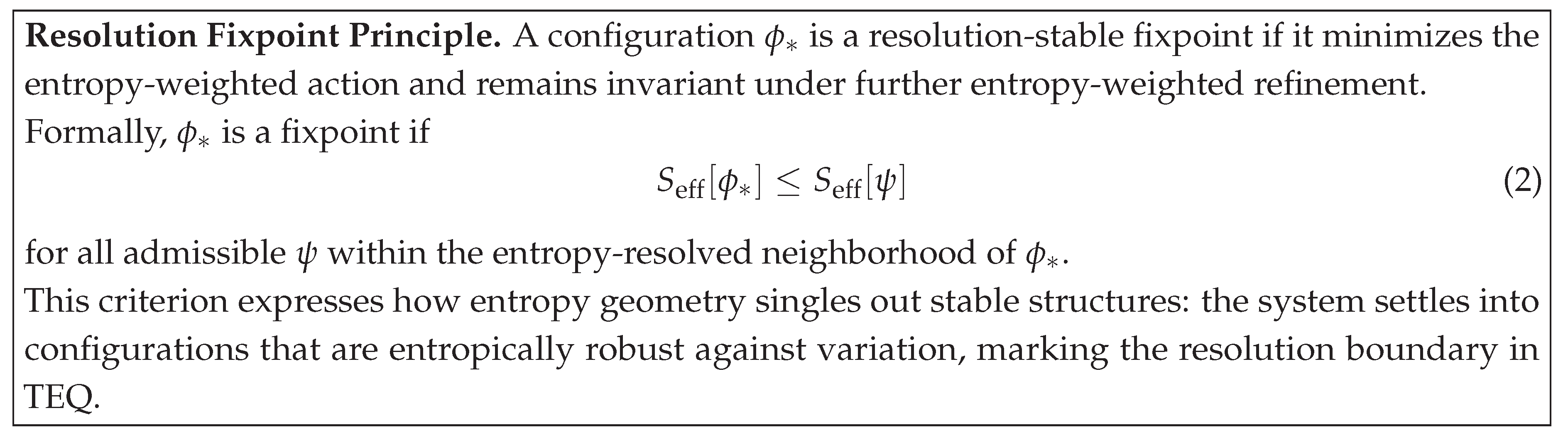
Collapse, therefore, is not a discrete process but an emergent structural filter. The resolution boundary is reached when further entropy-weighted variation yields no new distinguishable outcomes—when alternatives outside the selected fixpoint are no longer entropically resolvable. What appears as a single outcome is not the elimination of other branches, but the stabilization of one structure under a dynamically reshaped entropy geometry.
In TEQ, there is no fundamental discontinuity. The apparent singularity of outcomes is an expression of the system’s entropic self-structuring, shaped continuously through interaction. Measurement does not reveal collapse—it co-produces the entropy geometry in which collapse becomes an effective description.
3. Sobolev Admissibility and Morse Stability
The emergence of stable structure in TEQ reflects constraints imposed by the entropy-weighted variational principle. Two key mathematical consequences follow generically from the curvature of the entropy geometry: Sobolev admissibility, ensuring sufficient regularity of fields, and Morse stability, governing the form of entropy-stabilized fixpoints (see Appendix A). These are not assumed but derived from the internal structure of the TEQ framework.
In particular, the entropy-weighted action selects configurations that are dynamically viable and stable under entropic refinement. To participate in this selection, a field must reside in a function space compatible with the entropy metric . The finiteness of entropy curvature along paths requires , the Sobolev space of square-integrable functions with square-integrable derivatives. This condition arises directly from the structure of the action. For background on Sobolev regularity, see [7,8].
Within this framework, stable fixpoints correspond to critical points of the effective action—that is, configurations where the first variation vanishes:
This condition defines stationary paths under entropy-weighted dynamics. To assess their stability, one examines the second variation,
which encodes how the action responds to small perturbations around . If the second variation is non-degenerate—that is, it has no flat directions—and has a finite Morse index (the number of unstable directions), the fixpoint is of Morse type [9,10]. These Morse-critical structures represent configurations of maximal entropic stability: they are isolated and resist small variations, both dynamically and in terms of entropy geometry.
In systems with continuous symmetries, the set of critical points may form smooth manifolds rather than isolated points. In such cases, the appropriate generalization is Morse–Bott theory, where the second variation remains non-degenerate in directions transverse to the critical manifold. These degeneracies typically reflect residual gauge freedom or symmetry-induced redundancy and do not compromise local stability.
Thus, Morse-type and Morse–Bott stability provide the mathematical signature of resolution fixpoints in TEQ: configurations that remain invariant under entropy-weighted variation. They formalize the condition under which collapse—understood as the stabilization of structure under entropic constraint—becomes an effective and structurally enforced description.
4. Resolution-Limited Structure: Projection and Stratification
Structures traditionally invoked to explain quantum measurement—such as wavefunction collapse, pointer positions, and branching alternatives—can be reinterpreted within TEQ as consequences of finite resolution imposed by entropy geometry. Rather than treating such structures as ontological primitives, TEQ derives them as emergent features of entropy-weighted dynamics. Two related effects are especially important: projection, which formalizes how observational constraints select among configurations, and stratification, which captures how entropy curvature segments configuration space into distinct resolution regimes. Both arise naturally from the geometry of distinguishability and provide insight into the emergence of stable macroscopic structure.
4.1. Projection as Local Entropic Filtering
Observers or subsystems typically interact with only a limited portion of a system’s entropy geometry. This bounded access yields reduced descriptions that reflect only resolution-compatible features of the full configuration space. Within TEQ, such reduced descriptions correspond to constrained entropy-weighted minimizations over admissible configurations.
Mathematically, this takes the form
where encodes boundary data, conservation laws, or other entropy-compatible constraints.
Although projection operators are not fundamental to TEQ, the structure of (3) resembles projection onto constraint-compatible submanifolds. In this sense, serves as an epistemological instrument: it expresses how entropy geometry restricts which distinctions remain accessible under given observational conditions. These projections arise from internal constraints within the entropy-weighted dynamics, not from any external postulate.
This also clarifies the relation to conventional interpretations. In the Copenhagen view, measurement induces collapse as a fundamental rule; in TEQ, the outcome arises from stabilization under entropy-constrained resolution. The Many-Worlds Interpretation posits persistent alternatives; TEQ interprets these as latent entropy configurations that remain unresolved at a given scale. Both views reflect limiting descriptions of how entropy geometry governs distinguishability.
4.2. Stratification as Modular Resolution Geometry
Beyond local projection, many systems exhibit segmentation into qualitatively distinct resolution regimes—stable domains where entropy curvature favors different fixpoints separated by entropic barriers. This emergent structure is referred to in TEQ as stratification.
Stratification manifests as a layered or branched geometry of configuration space. It arises when entropy flow stabilizes multiple fixpoints, each robust within its own local curvature basin but effectively decoupled from others. Examples include spin states, photon paths in interference setups, or classical pointer positions. These are not treated as ontological branches, but as coarse markers of modularity in entropy-resolved dynamics.
Like projection, stratification is a representational scaffold: it reflects the modular structure of resolution space shaped by entropy flow. Practically, it serves as an organizational tool for describing decohered subsystems, coarse observers, or constrained dynamics.
Taken together, projection and stratification describe how entropy geometry filters, organizes, and stabilizes physical configurations under finite resolution. TEQ treats them not as assumptions, but as epistemologically conditioned phenomena—emergent from the internal constraints of entropy-weighted dynamics.
This raises a natural question: when does such epistemologically filtered structure become ontologically fixed? That is, when does the entropy geometry not merely limit what is resolved, but define what is? We turn to this question next.
5. When Does Epistemology Become Ontology?
In the TEQ framework, the distinction between epistemology and ontology is determined by the structure of entropy geometry itself. Epistemology concerns what can be distinguished under finite resolution—what the system allows us to access or resolve given bounded entropy flow. Ontology emerges when this filtering process reaches saturation: when no further refinement alters what can be distinguished. In this sense, ontology is what remains invariant under entropy-weighted variation.
Let denote the space of entropy-resolvable configurations. We say that a configuration becomes ontologically stable when, for a given entropy-limited resolution scale , the following condition holds:
Here, the relation denotes entropy-relative indistinguishability: the entropy geometry does not resolve and at scale , i.e., they remain in the same resolution-stable basin.
This defines the structural fixpoint of entropy-weighted epistemology. Once entropy curvature renders further variation ineffective—when all nearby alternatives are entropically indistinct—structure has stabilized beyond epistemic approximation. It has become ontologically fixed.
This boundary is not a discontinuous transition but a saturation: a region of configuration space where entropy flow has fully resolved what can be stabilized. In such regions, even if described operationally in terms of projections or layered structures, the resolution geometry itself no longer permits finer distinctions. The configuration no longer merely reflects limited access—it reflects a limit of what can be changed.
In this way, TEQ formalizes the emergence of ontology from within entropy-weighted epistemology. Ontology is not posited; it is selected—by the exhaustion of distinguishability under entropy flow.
6. Falsifiability and Future Tests
The TEQ framework makes structurally falsifiable predictions across cosmological, quantum, and laboratory regimes. Because all physical observables in TEQ emerge from entropy-weighted path selection, only entropy-stabilized configurations contribute significantly to measurable quantities. This leads to quantitative deviations from standard predictions wherever resolution geometry or entropy curvature plays a dominant role.
In the context of vacuum energy, TEQ predicts a finite energy density scaling as , with the entropic resolution parameter determined by cosmological horizon structure. This result, derived in [6], aligns with observed values when is set by the Hubble scale, without requiring fine-tuning or ad hoc cutoffs. If future cosmological measurements show persistent discrepancies with this scaling—or necessitate counterterms incompatible with the entropy geometry mechanism—TEQ would be empirically falsified.
Further tests arise in quantum optical and mesoscopic systems. The TEQ framework predicts exponential suppression of high-frequency transverse modes and resolution-induced quantization of stable interference patterns. These predictions have already been compared with quantum interference and decoherence experiments—including cavity QED, double-slit setups, and delayed-choice measurements—as detailed in [5], and are further explored in a forthcoming quantum optics paper accepted for publication.
The following scenarios would refute the TEQ framework:
- Vacuum energy mis-scaling: If observed vacuum energy does not follow the entropy-resolved suppression, or shows residual divergences in entropy-resolved regimes.
- High-resolution deviations: If high-frequency behavior in quantum interference or Casimir-type setups shows Gaussian or algebraic tails inconsistent with the entropy-weighted exponential decay predicted by TEQ.
- Non-universal entropy geometry: If the entropy metric inferred from independent experiments cannot be consistently linked to observable suppression effects across different domains.
These offer clear falsifiability criteria, grounded in structural derivations. Upcoming experiments in entropy-limited quantum optics, early-universe fluctuations, and engineered resolution geometries provide a viable testing ground for the TEQ framework’s core predictions.
7. Conclusion: Structural Realism from Entropy Geometry
The TEQ framework reframes collapse as a structural feature of resolution geometry. There is no discrete event, no external intervention, and no need to postulate ontological layers. Instead, structure emerges from the internal constraints that entropy curvature imposes on distinguishability.
Measurement plays a participatory role: it reshapes the entropy geometry through interaction, modifying the landscape of resolution and guiding the system toward stable fixpoints. These fixpoints—selected by entropy-weighted dynamics—define what becomes observable, reproducible, and robust. Classical outcomes do not arise from imposed collapse but from the entropic filtering of resolution-invariant structure.
What appear as projection effects or stratified alternatives—long treated as conceptual primitives—are shown within TEQ to be resolution-limited phenomena. They emerge as epistemologically conditioned features of entropy geometry, not as ontological postulates. Yet when this entropy filtering reaches saturation—when further refinement yields no new distinctions—ontology emerges as a structural fixpoint. The transition is not abrupt but geometric: the convergence of epistemic filtering into ontological invariance.
From this standpoint, TEQ offers a principled form of structural realism. Reality is not built from independent primitives but shaped by the stability of distinctions under entropy flow. What becomes real is not what is assumed, but what persists through resolution: what survives the filtering action of entropy-weighted variation. Collapse, in this view, is not a process but a geometry of distinction—the structural limit at which resolution produces inescapable form.
Acknowledgments
We acknowledge K. Winfrey for parallel and independent development of a projection-based approach that helped clarify the relation between entropy geometry, constraint structure, and Morse stratification.
This work was carried out independently during a period of cognitive and physical rehabilitation following
a brain hemorrhage. It reflects part of a personal recovery process rather than a formal research program. ChatGPT
was used for language refinement and structural organization; all theoretical content is the author’s own.
Appendix A. Sobolev Regularity and Morse Structure from the Entropy Metric
The entropy-weighted variational principle at the heart of TEQ imposes structural conditions on the space of admissible fields. These are not assumptions but consequences of the form of the entropy metric, which encodes the curvature of resolution space. In this appendix, we show that Sobolev regularity and Morse-type critical points follow generically from any positive-definite, local, quadratic entropy metric.
The entropy metric has the general form
where is symmetric, smooth, and positive-definite. This guarantees that the entropy contribution to the effective action (cf. (1)) is well-defined and suppresses instability.
The corresponding entropy-weighted term in the action is
which is finite precisely when . Therefore, for fields over time or space, physical admissibility requires
the Sobolev space of square-integrable functions with square-integrable first derivatives.
Theorem A1.
If the entropy metric is local, quadratic, and positive-definite, then physically admissible fields must lie in Sobolev space . This is the minimal regularity compatible with finite entropy flow.
Stationary configurations under satisfy . The second variation,
defines the entropy-curved Hessian. For generic , this Hessian is non-degenerate at isolated critical points, yielding Morse-type structure.
Theorem A2.
The critical points of the TEQ action are generically Morse-type, or Morse–Bott when symmetries are present. These fixpoints correspond to structurally stable solutions under entropy-weighted dynamics.
More general entropy metrics—e.g., involving higher derivatives, fractional operators, or nonlocal structures—naturally lead to more elaborate regularity conditions and richer critical point behavior. These generalizations are structurally consistent with TEQ but are not required for the minimal emergence of stability.
References
- D. Sigtermans, Entropy as First Principle: Deriving Quantum and Gravitational Structure from Thermodynamic Geometry, Preprint (2025).
- D. Sigtermans, Quantum Tunneling and Bound States from Entropy Geometry: A TEQ-Based Derivation, Preprint (2025).
- D. Sigtermans, Wave–Particle Duality and Horizon Thermodynamics from Entropy Geometry: Unifying Quantum Optics and Gravitational Structure in TEQ, Preprint (2025).
- D. Sigtermans, Gauge Symmetry as a Consequence of Entropy Geometry: A Rigorous Derivation from TEQ, Preprint (2025).
- D. Sigtermans, Empirical Evidence for Entropy-Stabilized Dynamics: Galactic, Cosmological, and Quantum Results under the TEQ Framework, Preprint (2025).
- D. Sigtermans, Entropy-Stabilized Suppression of Vacuum Energy: A TEQ-Based Structural Mechanism, Preprint (2025).
- R.A. Adams and J.J.F. Fournier, Sobolev Spaces, Elsevier (2003).
- L.C. Evans, Partial Differential Equations, AMS (2010).
- J. Milnor, Morse Theory, Princeton University Press (1963).
- Y. Matsumoto, An Introduction to Morse Theory, AMS (2002).

Table 1.
Key Notation and Concepts Used in This Manuscript.
| Symbol/Term | Meaning/Definition | Section |
|---|---|---|
| Entropy-weighted effective action | Sec. 2 | |
| Classical Lagrangian | Sec. 2 | |
| Entropy metric (resolution curvature) | Sec. 2 | |
| Configuration or field | Throughout | |
| Entropic selection parameter | Sec. 2 | |
| Sobolev space of admissible configurations | Sec. 3, App. A | |
| Fixpoint () | Entropy-stable configuration under refinement | Sec. 2, 3 |
| Projection operator (constraint minimizer) | Sec. 4.1 | |
| Stratification | Emergent resolution regimes | Sec. 4.2 |
| Space of entropy-resolvable configurations | Sec. 5 | |
| Resolution-stable fixpoint | Eq. (2) | |
| Resolution-scale indistinguishability relation | Eq. (4) |
Disclaimer/Publisher’s Note: The statements, opinions and data contained in all publications are solely those of the individual author(s) and contributor(s) and not of MDPI and/or the editor(s). MDPI and/or the editor(s) disclaim responsibility for any injury to people or property resulting from any ideas, methods, instructions or products referred to in the content. |
© 2025 by the authors. Licensee MDPI, Basel, Switzerland. This article is an open access article distributed under the terms and conditions of the Creative Commons Attribution (CC BY) license (http://creativecommons.org/licenses/by/4.0/).
Copyright: This open access article is published under a Creative Commons CC BY 4.0 license, which permit the free download, distribution, and reuse, provided that the author and preprint are cited in any reuse.


