

Submitted:
18 May 2025
Posted:
19 May 2025
You are already at the latest version
Abstract
Starting in 1996 we elaborated New Interpretation (NI96) of Michelson's analysis of experiments from 1881/87 (MMX), related to discovery of the existence of Errors 1 and 2 (ER12) in MMX analysis, including in its model of two swimmers/boats contest (TSC), whose times equality outcome, contradicts current Physics textbooks (PTB), containing ER12. In this Article, a new proof of the correctness of NI96 is presented, on the basis of the symmetry of paths and times in TSC. The existence of a complete symmetry of paths and of times, in Phase 0 of the TSC, when the water velocity is zero, was presented in the Article. Then, the existence of a permanent symmetry regarding the times t1 and t2 in Phase 1, more general of TSC, when the water velocity is non-zero, was demonstrated in the Article. This was achieved by performing a new complex mathematical demonstration, for the case of the previously unused river bank (BF) reference frame.
Therefore, according to NI96 the symmetric contest TSC ends in a tie, and the light fringes in the MMX should not have moved, as happened. Therefore, this new mathematical proof of TSC symmetry, represents new supports for the correctness of NI96, confirming ER12 presence in Michelson's analysis, so all PTBs require the TSC’s result and MMX’s analysis, to be corrected.
Keywords:
errors in Michelson’s analysis
; traversing river swimmers contest TSC
; TSC contest as MMX model
; new TSC calculus in river bank frame BF
; physics textbook errors correction
1. Introduction
In this article, initially we present, within New Interpretation NI96 of Michelson’s analysis of experiments from 1881/87 (MMX) [1,2,3,4,5,6,7,8,9,10,11,12,13], a new demonstration of the existence of Errors 1 and 2 (ER12) in TSC actual Analysis, which is widely recognized as a faithful model of Michelson’s interferometer experiments of 1881/87 (MMX), based on the symmetry of the paths and on the symmetry/equality of the associated times.
We recall here, that Error 1 refers in the case of MMX to the wrong transverse path of ray 2, and Error 2 refers to the wrong calculation of the transverse time t2 of ray 2, and similarly ER12 applies to TSC [11,14]. It is very important to note that ER12 refers exclusively to Michelson’s Analysis and not to the MMX physical experiment in the laboratory or in the field, carried out impeccably [1,2,3,4,5,6,7,8,9,10,11,12,13].
For this, in Sec. 2 we present a new mathematical demonstration of the existence of ER12, in Michelson’s Analysis, as a new complement to NI96, based on the symmetric character of the paths and associated times, in TSC analyzed in river bank (BF) frame.
The new calculations are based on the special scheme of paths and speeds for the transverse path in TSC, starting from the initial Phase 0 scheme, for the case of a perfectly symmetrical stationary river. In the subsequent Phase 1 with an arbitrary water v speed in the longitudinal direction, the preservation of the symmetry of the longitudinal and transverse total times, that is, their equality t1t=t2t was analytically demonstrated precisely.
This result of times equality t1=t2 constitutes an new additional confirmation of the NI96 correctness, and of the existence of ER12 in Michelson’s analysis, discovered by us, then corrected [1,2,3,4,5,6,7,8,9,10,11,12,13], and as a consequence, physics textbooks require corrections in order to obtain there also the equality of times t1=t2 in MMX, and in TSC, swimmer SW2 should not win, but TSC ends in a tie.
2. A New Demonstration of the Presence of Errors 1 and 2 in Michelson’s Analysis of MMX Based on the Symmetrical Character of TSC
We start from the observation that the TSC contest in its simplest form can be considered by the situation in which the water is stationary so that the speed of the water/ether current is v=0 everywhere (Figure 1a).
In this initial case, noted with Phase 0 of TSC, the paths of the two swimmers/boats, which respect the rules of a correct, fair play contest TSC, indicated in detail in Sec.3 of [11], are fulfilled and respected exactly.
The initial situation of TSC is represented in Figure 1.a). where the Bank frame/referential (BF) is used, in which the two swimmers start simultaneously, with their speed c in the water, having their contest paths perpendicular to each other.
It is found that in the Phase 0 of the TSC, the round-trip paths on both initial distances and directions l0 of swimmers SW1 and SW2 starting simultaneously from the same Block-Start (BS) at time t=0 are symmetrical with respect to the diagonal of quadrant II in which the TSC race takes place, in the BF reference frame.
And according to Figure 1a. the total round-trip times, t10 and t20 will be as follows for swimmers SW1 and SW2:
From (1) and (2) the following results:
From (3) it is found that the two times are equal, and the TSC contest ends in a tie, so that the symmetry of the times of the two swimmers in Phase 0, t10 and t20 is also preserved.
Now in the usual contest, noted Phase 1, we will consider the occurrence of a water movement in the direction of the riverbed slope, here to the left with water speed v >0, as in Figure 1b. but the rest of conditions in the TSC from Phase 0, remain unchanged. The representation is also given in the BF reference frame.
We will evaluate in Phase 1 the influence of the new factor, the water speed v, on the path/trajectory of the two swimmers as well as on the times t1 and t2 for their round trips, in order to demonstrate the effect of the symmetry property on these times in the TSC, highlighted in Phase 0.
The total time t1t related to swimmer SW1 for the complete round trip Figure 1.b. will be easily calculable directly with the classical formulas:
With coefficient:
Now the total time t2t for swimmer SW2 for the complete round trip (Figure 1.b.) will be given by the following more complicated expressions, that cannot be calculated directly:
In (5) the terms l21 , c’ , l21 , l22 and c” (Figure 2) will have to be evaluated by mathematical procedures and calculations, which are presented below.
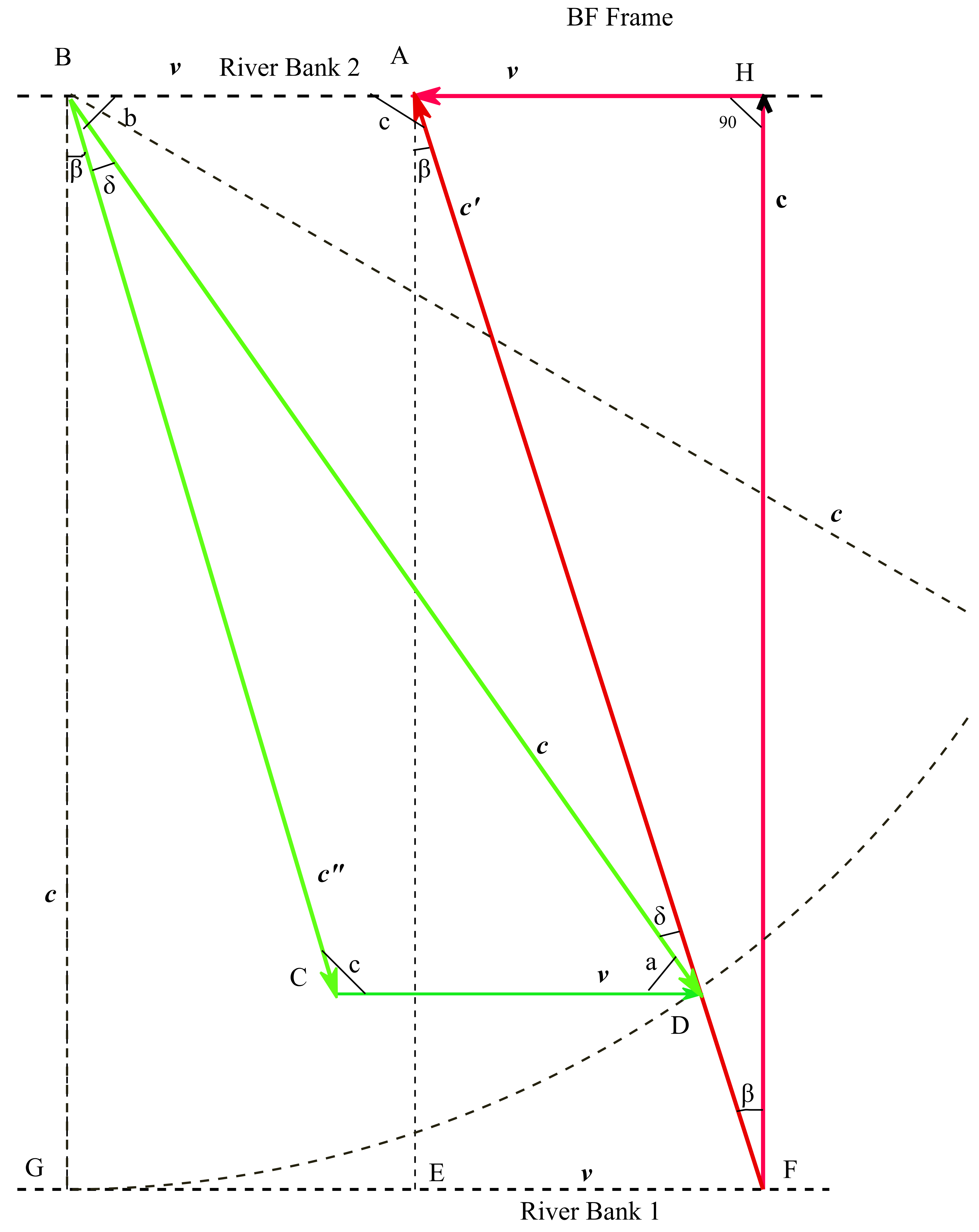
For this purpose, the paths of SW2 forward and backward will be detailed as in Figure 2, using the BF reference frame, based on the real velocities c’ and c” whose determination in BF will prove to be more complicated than in the WF reference frame, used in [11].
In Figure 2., the speed polygons including the speed c’ at departure through the right triangle AEF and the speed at return c” through the obtuse triangle BCD are initially represented here on a convenient scale.
Now, to represent the speed c’’ when SW2 returns, we will have to make an auxiliary geometric construction consisting of drawing a circle of radius c, with the center at point B (Figure 2).
And at the intersection of the circle with the line AF we find point D. In triangle ABD, the line BD has exactly the size c.
Then through point D we draw a parallel to the side EF, with a segment whose length is exactly v, where we find point C. And in the obtuse triangle BCD, the line CD has exactly the size v, and the line BC has exactly the size of the speed c’’ of the return path (in the BF frame of reference).
In Figure 2 in right triangle AEF we note the angle EAF with β which has the well-known classical expression:
We also denote the newly formed angle CBD (Figure 2) with the letter δ, and the remaining newly formed angles with the lowercase letters a, b, c, which are still of unknown sizes that will be determined geometrically and trigonometrically below.
So we find the relationship:
Now in triangle BCD (Figure 2) we write the theorem of sines as follows:
Resulting:
Using the formula for the sum of two angles from trigonometry in (10) we have:
Introducing (12) into (11) and simplifying with cosβ we obtain:
Inserting (9) into (11) we obtain:
We use in (14) the relations from trigonometry:
and we get:
But the time t21 required for SW2 to travel the path at departure (Figure 2) according to (5) will be:
And the time t22 required for SW2 to travel the return path (Figure 2), according to (5), will be:
And the total time t2t required for SW2 to travel the round trip (Figure 1., Figure 2) from (17) and (18) will be:
Or using the established notation with letter α from (4b), it results:
From (19) and (20) it follows that for the total time of SW2 t2t we obtained the same value as for the time t1t of SW1 from (4), or t2t= t1t, so the symmetry of times is preserved in the situation of the TSC contest in Phase 1 above, so confirming the presence of ER12 in the Michelson’s MMX and in TSC [11,14].
But in [11] we demonstrated that the equality of the times of the two swimmers t2t= t1t, is preserved also in the most general case when the departure direction of SW1 is at any angle ui to the Ox axis (SW2 also departs orthogonally to SW1).
In the present case, if we consider various Phases i, of the contest in which the direction of the water velocity v, is inclined with some angle ui, different from zero, to the Ox direction (as in Figure 1b, Figure 2), we will also obtain in these cases, the equality of the times t2t= t1t, of the two swimmers SW1 and SW2 , so in these cases the symmetry of their times is preserved (Figure 2).
In this case of Phase 1, the existence of Errors 1 and 2 in Michelson’s Analysis of MMX is reconfirmed.
It also results that the original symmetry in Phase 0 of times t1 and t2 in the TSC is not affected by the presence of a water current with speed v, not only longitudinally but in any direction ui, so that the equality of times t1=t2 in Phase 1 of the TSC is also justified [11], contradicting the result t1>t2 supported/present in all physics textbooks [14], which will all have to be corrected, and the admission of all the resulting consequences, including the admission of the existence of the ether and the consequences of its presence.
3. Conclusions and Consequences
From the above results for the TSC type contest analysis, first performed in the BF referential, we obtained the correct times for SW1 and SW2, t1=t2, also proving the symmetry of the TSC contest, utilizing the rules from our works in NI96, starting from 1996..
However, this result does not coincide with the times provided by Physics Textbooks, which give the times t1>t2, stating that SW2 wins the contest, so resulting even the existence of ER12 in Physics Textbooks, which comes from Michelson’s erroneous analysis in MMX, containing ER12, as we demonstrated.
At the same time, it also results that applying a velocity v in any direction ui, to the water in TSC, does not affect the symmetry of times t1 and t2, nor their equality t1=t2, which confirms the presence of ER12 in the TSC and therefore also in the MMX.
From the above result, of times symmetry/equality t2=t1 from TSC, which was also applied to the analysis of Michelson for his experiments MMX from 1881/87, by discovering and then correcting ER12, it follows that the ether should no longer be eliminated from physics, as Einstein did in 1905, based precisely on MMX whose Analysis contained ER12.
By readmitting by us, the existence of the ether in physics, multiple related consequences emerged, including the elaboration and development of the HM16 ether model. The new principles and consequences of ether existence were then derived, the start of which was given by the new theory of gravitation (NTG16), followed by a new theory of physics (NTP16), theories that will be permanently developed within all branches of science.
However, the our above result of equality of the two times t2=t1 and their symmetry of the two swimmers from the TSC contest, compared with the result of the times t1>t2, values resulting from treatment in Physics Textbooks, respectively of the two times of the two light rays from the MMX interferometer, was predicted, justified and demonstrated by us in NI96, through the work started since 1996. All starting from the existence and the discovery of ER12 in Michelson’s Analysis in MMX, and as a consequence, all Physics textbooks require the corresponding corrections to ER12.
Author Contributions
All authors contributed to the study, conception and design. Material preparation, data collection and analysis were performed by Ioan Has. The first draft of the manuscript was written by Ioan Has, and all authors commented on previous versions of the manuscript. All authors read and approved the final manuscript.
Funding
No funds, grants, or other support was received for this article.
Data Availability Statement
All data generated or analysed during this study are included in this published article.
Acknowledgments
The first author gratefully acknowledges initial advice on the subject and encouragement from his late professor N. Barbulescu, a follower of Sommerfeld. He is also sincerely grateful to the late Prof. P. Mazilu from TUCB Bucharest for his rigorous lessons on rationality and is indebted to Gen. Prof. G. Barsan, Col. Prof. Al. Babos from LFA Sibiu, Prof. D. Stoicescu from ULBS Sibiu, Prof. D. Siposan from MTA Bucharest, and Ms. Veronica Has, from Bucharest, for their support.
Conflicts of Interest
The authors have no competing interests to declare that are relevant to the content of this article.
References
- Has I, (1996) A reconsideration of the illustrative example of Michelson’s experiment (in Romanian), Rev. Fizica & Chimie. XXXI/11-12, Bucharest pp 14-18.
- Has I, (1997) Considerations about motion phenomena starting from a model for relativity theory. In Volume the IVth Congress of “S. Odobleja” Academy, Ed. Europa Nova, Bucharest, pp 51-65.
- Has I, (1997) A new interpretation of Michelson’s experiment (in Romanian). Rev. Fizica & Chimie. XXXII/6-7-8, Bucharest pp 1-5.
- Has I, Has A, (2000) Light paths analysis in classic interferometer conditions. Balkan Phys. Lett. (proc. Suppl. BPL-4) pp 67-70.
- Has, I. (2000). ‘The analysis of an alternative light path in Michelson’s experiment’, Romanian Reports in Physics, 52, pp. 775–789.
- Has, I., Miclaus, S., Has, A. (2010). ‘An alternative light path analysis in Michelson’s experiment’, Physics Essays, 23, pp. 248–257.
- Has, I., Miclaus, S., Has, A. (2014). ‘A reanalysis of the theory of interferometer experiment demonstrating that Michelson’s analysis contains an error, including the boat model analysis, so readmitting the ether presence’, Optics 3(4), pp. 24–32. Available online: http://www.sciencepublishinggroup.com/j/optics.
- Has, I., Miclaus, S., Has, A. (2018). ‘A reanalysis of the two swimmers problem, as frequent model of Michelson’s interferometric experiment demonstrating that transversal path is not an isosceles but a right triangle and the race will end in a tie’, Journal of Applied Mathematics and Physics, 6(4), pp. 1507–1521. Available online: www.scirp.org/journal/jamp.
- Has, I., Miclaus, S., Has, A. (2019). ‘Reanalysis of Michelson’s interferometric experiment in relation to the two swimmers’, Journal of Physics, Conference Series, 1251(012020), pp. 1–24. [CrossRef]
- Has, I., (2020). ‘Identification of Michelson’s errors in his 1881/87 experiments and their reanalysis’, Research and Reviews: Journal of Pure and Applied Physics, 8(4), pp. 1–15. Available online: https://www.rroij.com/open-access/identification-of-michelsons-errors-in-his-188187-experimentsand-their-reanalysis.pdf.
- Has, I., Miclaus, S., Has, A. (2022). ‘Michelson’s analysis of errors in his 1881/87 experiments of the two swimmers contest; Necessity of correcting college textbooks, Journal of Physics, Conference Series, 2197(2022)(012012), pp. 1–27. [CrossRef]
- Has, I., Miclaus, S. Has, A. (2021). ‘An actualized presentation of a new physics theory based on the HM16 model of ether’, Buletin Stiintific Suplimentar, Official Catalog of Salon Cadet INOVA–LFA, Sibiu 6/2021, pp. 106–126. Available online: https://www.cadetinova.ro/index.php/ro/organizare/catalog/catalog-inova-21.
- Has, I., Miclaus, S., Has, A. (2022). Presentation of a new physics theory based on the HM16 model of the ether, Journal of Physics, Conference Series, 2197(2022)(012014), pp. 1–19. [CrossRef]
- Serway, R. et al. (2007). Physics for scientists and engineers. Vol. 2. Cengage Learny, p.1117.
Figure 1.
Representation of TSC contest in the BF referential. a). Phase 0, with water speed v=0, and complete symmetry. b). Phase 1 with water velocity v>0, and symmetry of times t1 and t2 preserved.
Figure 1.
Representation of TSC contest in the BF referential. a). Phase 0, with water speed v=0, and complete symmetry. b). Phase 1 with water velocity v>0, and symmetry of times t1 and t2 preserved.
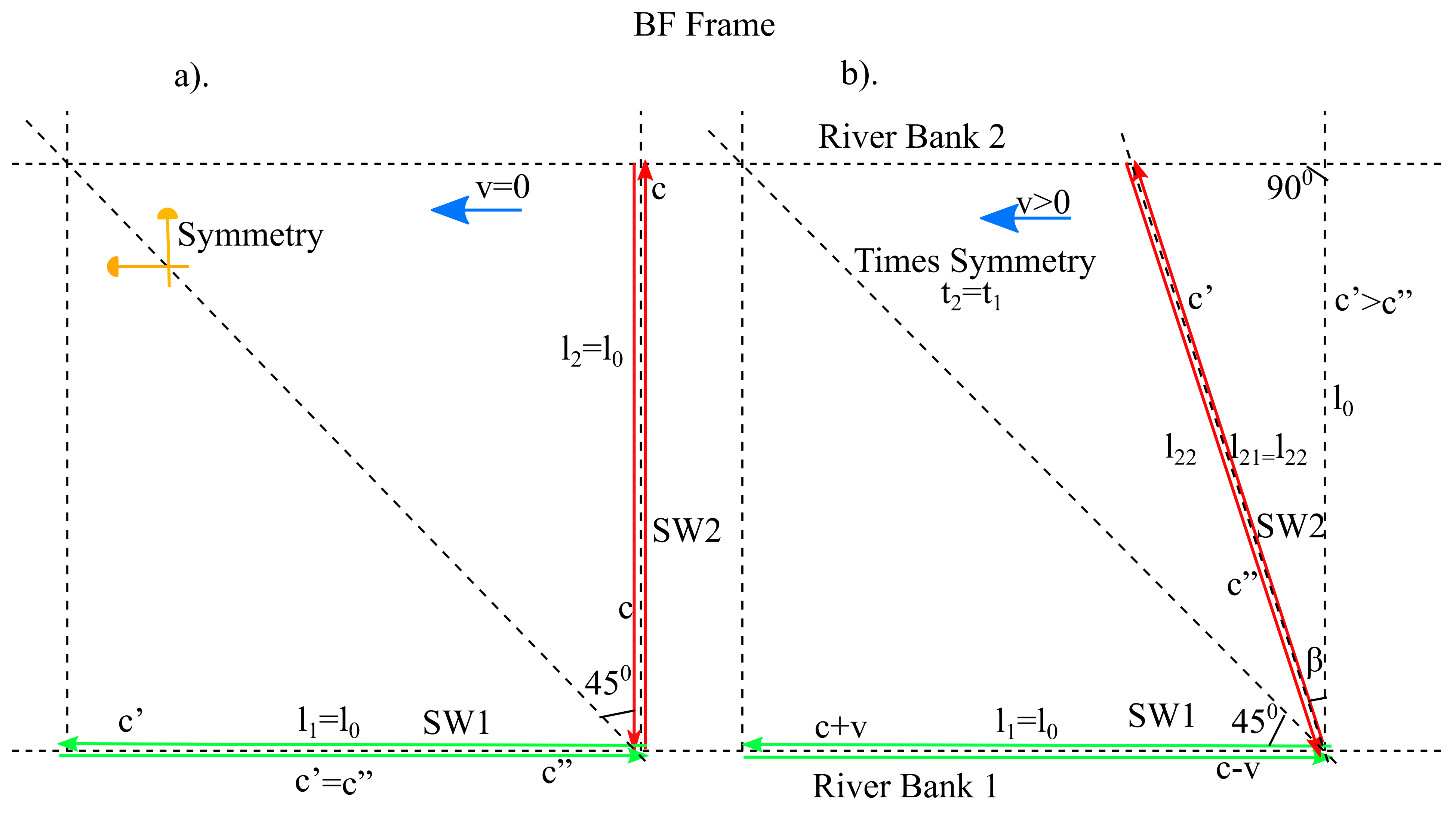
Figure 2.
Representation of the speed polygons from the TSC contest in the BF frame of reference in Phase 1 with water speed v>0.
Figure 2.
Representation of the speed polygons from the TSC contest in the BF frame of reference in Phase 1 with water speed v>0.
Disclaimer/Publisher’s Note: The statements, opinions and data contained in all publications are solely those of the individual author(s) and contributor(s) and not of MDPI and/or the editor(s). MDPI and/or the editor(s) disclaim responsibility for any injury to people or property resulting from any ideas, methods, instructions or products referred to in the content. |
© 2025 by the authors. Licensee MDPI, Basel, Switzerland. This article is an open access article distributed under the terms and conditions of the Creative Commons Attribution (CC BY) license (http://creativecommons.org/licenses/by/4.0/).
Copyright: This open access article is published under a Creative Commons CC BY 4.0 license, which permit the free download, distribution, and reuse, provided that the author and preprint are cited in any reuse.


