

Submitted:
21 April 2025
Posted:
21 April 2025
You are already at the latest version
Abstract
A composition of composite cement with the possibility of reducing the proportion of clinker to 15% by weight on aluminosilicate rocks has been developed. The object of the study is the production of composite cement using aluminosilicate rocks of the Kazakhstan deposits - Mynaral and Kuyuk. The patterns of thermal activation processes of polymineral clays and the compositions of the products of firing active mineral additives have been established. It has been established that the clay shale of the Mynaral deposit heat-treated at 900°C has the highest activity. The qualitative and quantitative phase composition of active mineral additives, the main physical and mechanical properties of the obtained composite cements have been studied and determined. It has been established that the best strength properties are possessed by composite cements with additives of 15% of clay shales fired at 800 - 900°C.
Keywords:
composite portland cement
; grinding
; active mineral additives
; heat treatment
; hydration processes
; strength
1. Introduction
The most common building material is concrete. The first mentions of it date back to 5600 BC. In those distant times, the binder was lime. And only 200 years ago, a new unique binder appeared - Portland cement, the production of which today is more than 4 billion tons.
Over the past 100 years, concrete has revolutionized the global construction environment. All over the world, concrete structures play a key role in providing housing for an ever-growing population, providing transport on land, sea and air, supporting energy production, as well as industry and providing protection. Without Portland cement concrete, it would be impossible to build roads and railways, bridges and dams, high-rise buildings and skyscrapers, and any reinforced concrete structures would not be possible. Today, concrete and cement mortars remain economical and energy-efficient building materials.
However, cement production is characterized by high emissions of CO2, a greenhouse gas, since the main raw materials for the production of cement clinker are carbonate-containing rocks, the decomposition of which releases CO2. In addition, the high temperatures of obtaining cement clinker require high fuel consumption, the combustion of which also produces carbon dioxide.
The cement industry is estimated to be responsible for ~7-8% of anthropogenic CO2 emissions worldwide. With the world population set to grow to 9.8 billion by 2050, demand for cement will continue to increase as 68% of the world's population will live in cities by then. Reducing these emissions will be an urgent issue if the world is to continue to meet its climate goals. Concrete is the most common building material. The earliest records of it date back to 5600 BC. At that time, lime was the binder. It was only 200 years ago that a new, unique binder appeared - Portland cement, the production of which today amounts to over 4 billion tons.
Over the past 100 years, concrete has revolutionized the global construction environment. Around the world, concrete structures play a key role in providing housing for an ever-growing population, providing transportation on land, sea and air, supporting energy production, as well as industry and providing protection. Without Portland cement concrete, it would be impossible to build highways and railways, bridges and dams, high-rise buildings and skyscrapers, and any reinforced concrete structures would be impossible. Today, concrete and cement mortars remain economical and energy-efficient building materials.
The cement industry is estimated to account for ~7-8% of anthropogenic CO2 emissions worldwide. With the global population set to grow to 9.8 billion by 2050, demand for cement will continue to increase as 68% of the world's population will live in cities by then. Reducing these emissions will be an urgent issue if the world is to continue to meet its climate goals [1].
As of January 1, 2019, the World Business Council for Sustainable Development (WBCSD) transferred the Cement Sustainability Initiative (CSI) to the Global Cement and Concrete Association (GCCA). CSI's activities focus on the carbon footprint of the industry [2]. All CSI members continuously reduce CO2 emissions at their sites, measure and report them using a consistent methodology and Key Performance Indicators (KPIs).
To support these efforts, CSI has created a global database of CO2 and energy efficiency reports from cement plants. This voluntary database provides standardised, accurate and verified information to help the industry understand its current and future performance potential.
The European Cement Bureau Cembureau has prepared the 2050 ROADMAP to identify the CO2 reduction potential across the entire cement and concrete value chain (Figure 1). The key finding of the strategy is that CO2 emissions can be reduced by acting at every stage of the value chain – clinker production, cement, concrete, construction and (re) carbonation – to achieve net zero emissions by 2050 [3,4].
1. Savings in clinker production – reducing CO2 emissions through the use of decarbonised raw materials, energy efficiency measures, the use of “alternative fuels” to replace fossil fuels, and innovations such as hydrogen and kiln electrification.
Using decarbonised raw materials to replace part of the limestone in the kiln reduces the overall emissions from limestone decarbonisation. Globally, this is projected to reduce the sector’s overall emissions by 2%.
Alternative fuels are produced from secondary materials, i.e. waste or by-products, and can be biomass, fossil or mixed (fossil and biomass) alternative fuels. On average, globally, the use of alternative fuels is projected to increase from the current 6% to 43% by 2050. Innovations such as hydrogen and kiln electrification are projected to play a minor role from 2040.
2. Savings in cement and binders. In cement plant or concrete plant, fly ash, granulated blast furnace slag, ground limestone and other materials can be used to produce concrete with reduced CO2 emissions. In the roadmap, this direction is described by the ratio of clinker and binder. The availability of fly ash and granulated blast furnace slag in the world is currently different and will decrease in the future.
In the coming decades, the use of ground limestone and the introduction of calcined clays will be increased to compensate for the reduction in the supply of fly ash and granulated blast furnace slag and to reduce the clinker content of cement. The global average clinker factor is currently 0.63. It is projected to decrease to 0.58 and 0.52 by 2030 and 2050, respectively.
3. Concrete production efficiency. In terms of concrete production, industrialization is a key specific lever. The transition from small-scale concrete mixing using bagged cement to industrial processes provides significant savings in CO2 emissions due to compliance with mix specifications and quality control. Increased use of admixtures and improved aggregate processing are good opportunities for saving CO2 emissions in concrete production. On average, worldwide, optimizing concrete production in terms of binder use could lead to a reduction in binder demand by 5% and 14% in 2030 and 2050, respectively.
4. Carbon capture, use and storage. This is an emerging area and its contribution is expected to become significant only after 2030, once commercial viability and the necessary infrastructure are in place. Once captured, the CO2 will be used in the cement and concrete industry, by other industries or stored. It is projected that 1.370 million tons of CO2 will be captured, used and stored by 2050.
5. Decarbonization of electricity. Emissions from electricity generation used in cement and concrete production will be net zero worldwide in the coming decades. Electricity demand in the sector will increase by 2030 in line with growth in overall production and by 2050 primarily due to electricity demand for carbon capture. This growth in demand will be offset by decarbonization of electricity. The reduction in CO2 emissions by 2030 will be 54% compared to 2020, and 100% by 2050.
6. Recarbonization is the natural process of CO2 absorption by concrete. This process is well understood and included in regulations. This roadmap uses IVL 01 methodology level 1, which allows for a value of 20% for recarbonization, which applies to the theoretical maximum possible carbonation per ton of clinker (525 kg CO2/ton), i.e. 105 kg CO2/ton clinker. From 2020 to 2050, the clinker ratio in cement and concrete decreases (see cement and binder savings). The reduction in clinker per m3 of concrete and the total clinker volume globally leads to a slight decrease in recarbonization over the next decades. Global recarbonisation is projected to be 318 and 242 Mt CO2 in 2030 and 2050 respectively.
7. Design and construction efficiencies can be achieved through the application of many specific levers. The primary means of unlocking design opportunities is to ensure that CO2 reduction is a design parameter in addition to the current parameters of quality, cost, speed and the specific project owner requirements. This can be achieved through the choice of concrete slab geometry and system, the choice of concrete column spacing and the optimization of concrete strength/member size/reinforcement percentage. Across all projects globally, CO2 reductions through design and construction measures are projected to be 7% and 22% in 2030 and 2050 respectively.
If these steps are not taken, CO2 emissions are projected to increase to 3.8 Gt by 2050 [5].
The projected CO2 emissions presented above show that significant reductions are only projected after 2030-2040, mainly due to carbon capture, use and storage (CCUS) technologies and design and construction efficiency. CCUS technologies require energy, are still very expensive at this stage and lead to an increase in the cost of cement. The implementation of existing and the development of innovative mitigation technologies will require significant funding.
Different countries are looking for approaches to reducing CO2 emissions in different ways, but the most easily implemented technological solutions should still be used first.
The Republic of Kazakhstan (RK), like the entire world community, adheres to the principles of the Paris Agreement on making a national contribution to achieving sustainable development goals and maintaining the increase in global average temperature, takes measures to implement the state environmental policy to reduce the negative impact on the environment and preserve natural resources for future generations of the Republic of Kazakhstan [10,11,12].
One of the ways to reduce the amount of harmful emissions into the atmosphere, carbon dioxide released during the production of Portland cement clinker is the use of active mineral additives, which will reduce the share of clinker in the cement. That is, it is necessary to develop effective compositions of composite cements in which part of the expensive clinker is replaced by active mineral additives. Reducing the share of clinker accordingly reduces the volume of CO2 emissions into the atmosphere. This is a pressing global problem that causes concern in Europe, the USA, China, and all other countries of the planet [13,14].
Thus, in accordance with the National Carbon Quota Plan for 2022-2025 approved by the Government of the Republic of Kazakhstan [15] and the Environmental Code of the Republic of Kazakhstan dated January 9, 2007 (subparagraph 7) Article 16), the total volume of quotas for greenhouse gas emissions in regulated areas of activity amounted to 108.8 million tons, including for the manufacturing industry (in particular, the production of building materials - cement, lime, gypsum and brick). Including quotas for CO2 emissions from cement plants amount to 6.02 million tons for 2022; 5.55 million tons in 2023; 5.5 million tons in 2024; 5.2 million tons in 2025 [15]. The volume of quotas allocated to cement industry enterprises for 2023-2025 is presented in Figure 3 (using 4 cement enterprises of the Republic of Kazakhstan as an example).
Each cement plant in the Republic of Kazakhstan has its own quotas, which are most likely determined by the level of CO2 emissions at a given plant. However, all enterprises in the industry face the task of reducing CO2 emissions in cement production in one way or another. Therefore, a relevant and inexpensive measure may be the production of composite cements with a partial replacement of the clinker share in cement to maintain and increase the annual volume of manufactured products, which is urgently needed by builders.
One of the areas of solving energy saving and environmental issues in cement production is waste disposal, replacing part of the clinker with high cost price with natural or artificial, i.e. natural or man-made additives, obtaining low-clinker cements [16,17,18]. Additives are not available in all regions where cement plants are located. The most accessible today are pozzolans, blast furnace, phosphorus slags, ashes, etc. The task of researchers is to find and increase the range and volume of high-quality mineral additives. Moreover, these materials should be located near the cement production in order to reduce logistics costs.
Clay shales are quite common in the Republic of Kazakhstan and are used as raw materials for producing Portland cement clinker. Granulated slags, shale, limestone, and thermal power plant ash are used to produce composite cements CEM II/A-K, CEM II/V-K at the plants of Kazakhstan: “Gejuba Shieli Cement” LLC, “Semey Cement” LLC, “Caspian Cement” LLC, etc. [12].
Heat-treated clay rocks are quite effective and are used as active mineral additives (AMA) in cement production. AMA replaces clinker, increases the strength of Portland cement, and has an optimal effect on the processes of clinker grinding and the formation of the structure of hardening cement stone.
2. Materials and Methods
2.1. Materials and Sample Preparation
With the improvement of the economic situation and the development of urban development and industry in rapidly developing countries, the demand for cement products increases. It is known that cement production has no moral and physical boundaries, and the development of the cement industry has its important place in the economy, aimed at ensuring that industrial and urban development enterprises can compete and develop stably. Scientists are making great efforts to reduce the consumption of natural raw materials with their partial replacement with by-products in cement production and reduce carbon dioxide emissions.
In recent years, the cement industry has paid great attention to mineral additives. This is not a new direction, because for several decades, standards have allowed the use of limestone, slag, pozzolana and ash, and dust as additives. But the renewed interest in optimizing the use of these materials can be considered relevant today. The use of additional raw materials here - mineral additives allows not only to reduce the cost of cement (in most cases, these materials are much cheaper than clinker), but also to reduce the specific amount of CO2 emissions [19,20,21,22,23,24,25,26,27,28].
Potapova E.N. et al. [29] investigated the pozzolanic activity of three mineral additives – metakaolin, tripoli and silica gel using various methods for determining the pozzolanic activity. It was found that metakaolin showed the highest activity in absorbing lime from lime mortar. The results of determining the activity of additives using the express method obtained by the authors correlate well with the results using the Frattini method. The express methods for determining the activity proposed by the authors, developed by Strokova V.V. and co-authors, can be used not only for highly active AMA, but also for less active AMA. In this case, it is possible to use the classical method.
Mechai A.A. et al. propose introducing dehydrated clay, and dolomite is proposed as a carbonate rock [30]. The authors determined the pozzolanic activity of mineral additives from four Belarusian deposits. In order to increase pozzolanic activity, the authors carried out heat treatment of mineral additives. As a result of the experiments, it was found that the clays of the “Lukoml” deposit, heat treated at a temperature of 900°C, have the highest pozzolanic activity.
Yakubzhanova Z.B. [31] studied the chemical-mineralogical, physicochemical and technological properties of glyage-like rock mass and basaltic andesite, on the basis of which the compositions of hybrid additives “glyage + phosphozol” and “glyage + basaltic andesite” with a high glyage content (up to 20%) were developed. The physicomechanical properties of Portland cement were studied with the replacement of up to 30% of clinker with hybrid additives. The possibility of obtaining new types of composite Portland cements of the PC400-KD30 brands with hybrid additives with a high glyage content due to the targeted regulation of the hydration process, the synthesis of crystalline products and the formation of a dense low-porosity composite was shown.
Yuldashev F.T. [32] proposed to improve the environmental situation in cement production by using man-made waste, in particular the active mineral additive “Phosphozol” and ash and slag waste up to 20% by weight. The author determined the optimal chemical and technological parameters of raw material mixtures for obtaining the composite additive “Phosphozol”.
Mukhiddinov D.D. [33] proposed complex additives including microsilica and slag. At a dosage of more than 25%, the strength of the resulting cements does not decrease.
Malova E.Yu. [34] studied the hydration products of Portland cements with carbonate-containing additives. The author found that a decrease in the pH of the cement mortar in the presence of carbonates is one of the reasons for the slowdown in the setting of the cement paste and, perhaps, some decrease in the strength of cements with the introduction of 20% carbonates. The author developed new concrete compositions and studied their construction, technical and operational properties. The results of scientific research were confirmed in the process of industrial tests at plants during the production of composite cements and the production of concrete products based on them. A significant economic effect was obtained.
Atabaev F.B. [35] studied the hydraulic activity of raw materials in order to determine the possibility of their use as an active mineral additive, partial replacement of the clinker component and improvement of the operational properties of cements. Substandard foundry slags from the machine-building and metallurgical (Bekabad metal plant) industries and small waste from soda plants obtained by slaking lime together with waste from marble production, used as fillers, were used as hydraulic additives. It was found that the introduction of 10% of the mass of marble into the composition of slag cements increases their strength.
To significantly reduce carbon dioxide emissions into the atmosphere, it is also possible to obtain composite cement clinkers based on various industrial wastes [36]. Thus, phosphorus and blast furnace slags, with partial replacement of natural raw materials in the batch for obtaining clinker, reduce the heat consumption for the decomposition of carbonates, the specific consumption of raw materials per 1 ton of clinker decreases, and the mass of material that must be heated to the sintering temperature of clinker decreases. As a result, the firing temperature and fuel consumption decrease, which leads to a reduction in CO2 emissions [37,38].
Cement hydration is a complex process. The introduction of mineral additives into composite cements further complicates this process. During the hydration process, new hydrate compounds are formed, which contribute to the hardening process of the cement [39,40].
The process of hardening of Portland cement can be considered as the formation of a complex structure occurring in the cement-water system as a result of hydration of clinker minerals and participation of the resulting hydrated phases in the formation of gel-crystalline conglomerate-cement stone. When mixing cement powder with water, a plastic dough is formed, which over time loses mobility and begins to thicken and compact, turning into a solid body without significant strength. The beginning of this stage (setting) for most cements is 1-1.5 hours, and the end is 4-5 hours after mixing with water.
Cherkasov V.D. et al. [41,42] developed effective active mineral additives based on chemically modified diatomite, studied the processes of hydration and structure formation of cement composites with the addition of modified diatomite.
Mansour M., Konan K.L. et al. [43] studied the processes of obtaining, hydration and hardening of composite cements with additives of metakaolin, kaolin, etc.
Abroad, composite cements are quite widespread and allow manufacturers to effectively save on expensive clinker while reducing carbon dioxide emissions.
Summarizing the above material, the following can be noted:
- one of the most relevant and widespread areas today to ensure sustainable production of Portland cement and energy conservation, solving environmental problems is the replacement of part of the clinker in Portland cement with natural active mineral additives;
- Portland cement with active mineral additives is an easily produced and in-demand material today;
- research on the development of composite cements is aimed not only at reducing the cost of Portland cement, improving environmental conditions, but also at ensuring high quality of the resulting products and using local reserves of available raw materials.
2.2. Experimental Setup for Thermal Treatment of Oil-Contaminated Soil
In this work, clay shales from two deposits were used to obtain composite cements: Mynaralskoye (SM) and Kuyuk (SK) (Republic of Kazakhstan, Zhambyl region).
Clay shales are rocks of metamorphic origin. Structure - shale. Consists of very small particles of clay minerals, quartz impurities. Color - light green gray with brown inclusions. Distinctive features - easy separation into long individual columns and tiles under mechanical impact. When touched by water, it gives a characteristic vent or clay smell. Origin - compacted thin shale rocks formed as a result of the process of dynamometamorphism from clusters of clay rocks. Texture - shale with parallel arrangement of shells and embroidered minerals. Dynamometamorphism occurs under the influence of high pressure. Rocks crystallize partially or completely with a change in mineral composition and without changes. In weakly metamorphosed rocks, hidden crystalline or transitional structures are found, including relict ones, subject to metamorphism.
The study of clay shales as a mineral additive was carried out in accordance with the requirements of *GOST 25094-2015, chemical analysis according to **GOST 5382-2019. Averaged samples were selected from the samples by quartering and thoroughly crushed until completely passing through sieve No. 008. Clay shales, hydrated cement stone were studied using SEM, X-ray diffraction, and DTA. X-ray phase analysis of hydrated cement stone was performed on an X-Ray Diffractometry device with a Bruker AXS D8 attachment (Karlsruhe, Germany) with a copper (Cu) anode and a Vantec PSD detector [44].
The average chemical composition of the materials used is presented in Table 1.
The results of scanning electron microscopy analysis of the materials used are presented in Figure 4, Figure 5 and Figure 6.
X-ray phase analysis of Portland cement CEM I 42.5N (Figure 7a) confirmed that it contains the following main minerals and dihydrate gypsum: alite 3CaO SiO2: d/n – 2.79; 2.77; 2.57; 2.25; 2.97; 1.73; 3.05 Å; belite 2CaO SiO2: d/n – 2.79; 2.77; 2.31; 2.43; 2.86; 1.82; Å; tetracalcium aluminoferrite 4CaO Al2O3 Fe2O3: d/n – 2.64; 1.82; 1.54; 1.92 Å; tricalcium aluminate 3CaO Al2O3: d/n – 2.16; 4.09; 1.91 Å; gypsum CaSO4 2H2O: d/n –2.88; 3.07; 2.69 Å.
The following diffraction maxima were recorded in the X-ray diffraction pattern of the SM clay shale (Figure 7b): quartz - SiO2: d/n - 3.35; 1.814; 1.538 Å; hydromica (K<1Al2[OH]2(AlSi3O10)⋅nH2O): d/n - 3.141; 4.42; 1.484; 2.103; 2.546 Å; chlorite (Mg,Fe)6-2x(Al, Fe)2x[OH]8(Si4-2xAl2x)O10: d/n – 7.02; 3,54; 4.68; 1.536 Å; kaolinite (Al2[OH]4Si2O5) :d/n – 7.15; 3.56; 2.49; 2.34 Å; calcite CaCO3:d/n – 3.03; 1.868; 1.913; 2.087 Å; hematite – Fe2O3 : d/n– 2.697; 2.519; 1.835; 1.688; 1.484 Å; rutile TiO2: d/n– 2.188; 1.664; 3.243; 1.623 Å. The obtained X-ray diffraction pattern indicates the polymineral composition of clay shales. Mineralogical composition of clay shale, wt.%: quartz - 26.52, kaolinite - 12, calcite - 7.23, chlorite - 15, hydromica - 39.09, rutile - 0.16.
The following diffraction maxima were recorded in the X-ray diffraction pattern of the SlK clay shale (Figure 7c): quartz - SiO2: d/n - 3.26; 1.813; 1.539 Å; hydromica (K<1Al2[OH]2(AlSi3O10)⋅nH2O): d/n - 3.05; 4.41; 1.483; 2.104; 2.545 Å; chlorite (Mg,Fe)6-2x(Al, Fe)2x[OH]8(Si4-2xAl2x)O10: d/n – 7.04; 3.54; 4.71; 1.538 Å; kaolinite (Al2[OH]4Si2O5) d/n – 7.14; 3.54; 2.47; 2.35 Å; calcite CaCO3: d/n – 3.028; 1.868; 1.913; Å; hematite – Fe2O3: d/n– 2.697; 2.519; 1.835; 1.687 Å, rutile TiO2: d/n– 3.242; 2.187; 1.687; 1.624 Å. Slate is a polymineral rock containing the following (%): quartz - 27.29, kaolinite - 13, calcite - 6.49, chlorite - 16, hydromica - 36.26, rutile - 0.96.
The following minerals are recorded in the diffractogram of the clay shale of the SK (Figure 8), obtained on an X-Ray Diffractometry device with a Bruker AXS D8 [45] attachment:
- (1)
- 00-046-1045(*), quartz – SiO2,. Y: 27.32 %, d x by: 1. d/n – 3.34; 4.26; 2.45; 2.27; 2.12; 1.813; 1.534;1.372; 1.380 Å WL: 1.5406, syngony: hexagonal. Unit cell indices: a - 4.91370, b - 4.91370, c - 5.40470. ɑ = 90, β = 90, γ = 120.
- (2)
- 00-005-0586 (*), calcite – СаСО3, Y: 4.40 %, d x by: 1. d/n – 3.029; 1.0444; 1.869; 1.912; 2.088 Å. WL: 1.5406, syngony: rhombohedral. Unit cell indices: a - 4.98900, b - 4.98900, c - 17.06200. ɑ = 90, β = 90, γ = 120.
- (3)
- 00-042-0018 (C), hydroaluminosilicate – H - 18.9, Al -18.9, Si - 173.1, O–384; Y: 2,71 %, d x by: 1. WL: 1.5406. d/n - 4.41; 1.483; 2.57Å.
- (4)
- 00-006-0221 (D), kaolinite 1 Md - Al2Si2O5(OH)4, Y: 1.08 %, d x by: 1. d/n – 7.14; 3.556; 1.486; 2.330; 1.336 Å. WL: 1.5406, monoclinic syngony. Unit cell indices: a - 5.18000, b - 9.02000, c - 20.04000. ɑ = 90, β = 95.5, γ = 90.
- (5)
- 00-001-0527 (D), kaolinite - Al2Si2O5(OH)4, Y: 2.15 %, d x by: 1. d/n – 7.14; 3.556; 1.486; 2.330; 1.336 Å. WL: 1.5406, triclinic syngony. Unit cell indices: a - 5.18000, b - 9.02000, c - 20.04000. ɑ = 90, β = 95.5, γ = 90.
- (6)
- 00-029-1489 (*), hydromica - (K<1Al2[OH]2(AlSi3O10)⋅nH2O), Y: 26.96 %, d x by: 1. d/n – 4.41; 1.484; 2.545; 2.104; 2.351Å.WL: 1.5406, syngony – hexagonal. Unit cell indices: a - 5.16280, b - 8.96200, c - 19.97700. ɑ = 90.000, β = 95.738, γ = 90.000.
- (7)
- 00-045-1375 (C), donbassite – Al4.33(Si3Al)O10(OH)8, Y: 2.53 %, d x by: 1. d/n – 4.80; 3.536; 2.334; 2.834; 1.662 Å. WL: 1.5406, syngony – monoclinic.
- (8)
- 00-029-1489 (І), chlorite - (Mg,Fe)6-2x(Al, Fe)2x[OH]8(Si4-2xAl2x)O10, d/n – 4.41; 1.483; 2.57.Y: 11.08 %, d x by: 1. WL: 1.5406, syngony – hexagonal. Unit cell indices: a - 8.14400, b - 12.98900, c - 7.16000. ɑ = 92.100, β = 116.560, γ = 90.210.
- (9)
- 00-003-0016 (D), montmorillonite - Al2O3·4SiO2·xH2O, Y: 2.39 %, d x by: 1. d/n –4.45; 1.495; 2.576; 1,697 Å.WL: 1.5406.
- (10)
- 00-002-0104 (D), dickite - Al2O3·2SiO2·2H2O, Y: 0.90 %, d x by: 1. d/n – 7.24; 3.59; 2.347; 1.659; 1.323Å.WL: 1.5406, syngony – monoclinic.
The experimental part of the work presents the main physicochemical changes occurring during the firing of clay shales at temperatures of 700-900 °C. For this purpose, the clay shales were pre-crushed and then abraded on a disk abrader to a particle size of 2-5 mm. Then the material was dried in a SNOL-3.5/3m drying cabinet at a temperature of 90 °C for 1 hour.
The firing of clay shales was carried out in an SNOL 7.2/1100 electric furnace at temperatures of 700 °C, 800 °C and 900 °C. Isothermal holding at these temperatures was 1 hour.
An X-ray diffraction analysis of the fired clay shales was performed. The main physicochemical changes occurring during the firing of shales were studied using X-ray diffraction analysis. The studies were conducted using the equipment of the Central Laboratory of Certification Testing of Building Materials, Kazakhstan, Almaty (Figure 9).
In the X-ray diffraction pattern of the clay shales of the SiM type fired at 900 °C (Figure 9), the diffraction maxima of the following minerals were recorded: β-кварц-SiO2 d/n– 4.27; 3.34; 2.458; 2.282; 1.817, 1.543Å; anhydrous mica (K<1Al2(AlSi3O10)d/n – 3.13; 4.51; 1.4834; 2.132; 2.52 Å; chlorite (Mg,Fe)6-2x(Al, Fe)2x(Si4-2xAl2x)O10 d/n –3.4571; 1.543 Å; hematite – Fe2O3 – 2.7004; 1.8211; 1.693; 1.483 Å; rutile TiO2 d/n – 2.132; 1.693; 3.241Å.
In the X-ray diffraction pattern of the SlK clay shale (Figure 10), fired at 900 °C, the diffraction maxima of the following minerals were recorded: α-quartz - SiO2 d/n – 3.34; 1.813; 1.534; 1.372; 1.380 Å, chlorite, (Mg,Fe)6-2x(Al, Fe)2x(Si4-2xAl2x)O10 d/n – 13.86; 1.538; 7.02; 4.68; 3.534Å.
3. Results and Discussion
3.1. Determination of the Activity of Mineral Additives by the Classical Method
The activity of the mineral additive was determined by the lime absorption method. The method is based on determining the amount of lime absorbed over a certain period of time. The activity of the burnt clay shales SM and SK was determined by titration. The duration of the experiment was 30 days, titration was carried out periodically every two or three days, the obtained data were recorded in the table for determining the activity of mineral additives.
Based on the titration results, the following results of the activity of mineral additives were obtained (Figure 11 and Figure 12).
As can be seen from the diagram of SM, during the process of shale firing at 700 oC its activity increases to 26-27 mg, during firing at 800oC to 31-31.5 mg, at a temperature of 900 oC - to 34.4 mg CaO. The fired shale SK absorbs up to 27-28.2 mg CaO.
3.1.1. Physical and Mechanical Testing of Composite Cements
The effect of shales fired at 700, 800 and 900°C on the physical and mechanical properties of composite cements was studied. The cements were obtained by joint grinding of the starting materials for 30 min to a specific surface of 4100 to 4200 cm2/g. The specific surface area of the powders was determined using a PSKh-K device. The amount of fired clay shales introduced during grinding ranged from 5 to 15%.
Physical and mechanical tests were carried out in accordance with the requirements of GOST 310.1-76 and 310.3-76***. Cement paste of normal density was prepared in a spherical bowl. Cement mortar was prepared in a laboratory automated mixer ALS-5. The normal density of cement paste without shale additives, with the addition of 5 - 15% shale SM was 27-28%, and shale SK 27.3%. With an increase in the dosage of shale to 15%, the water requirement of the dough increased to 27.5%.
The normal density of the cement paste was determined using a Vicat device, the compressive and bending strength were determined on prism samples measuring 40x40x160 mm.
The compressive strength of cement without additives (control) for 28 days was 48 MPa. The maximum compressive strength was demonstrated by cement with 15% additive SM – 51 MPa.
The density of cement stone was determined in accordance with the requirements of GOST 12730.1-2020****. The density value was calculated as the ratio of the mass of the cement stone sample to the volume (g/cm3). The results of physical and mechanical tests of composite cements with additives of 5-15% burnt shale SM are given in Table 2 and Figure 13.
The introduction of 5-15% of SM shale fired at 700–900 °C into composite cements increases the strength of the cement stone at all stages of hardening. The best strength indicators are demonstrated by cements with the addition of 15% of SM shale fired at 900 °C. The strength at the age of 3–28 days is 5-6.2% higher than that of the control samples. This can be explained by the formation of an additional amount of calcium hydrosilicates during the interaction of the fired shale minerals with Ca(OH)2, and the compaction of the cement stone structure.
This is also proven by the high activity of SM clay shale fired at 900 °C as a mineral additive by the absorption method with lime from lime mortar. The amount of absorbed CaO at the age of 30 days was 33.0–34.4 mg.
The results of tests of composite cements with additions of 5-15% of burnt clay shale SK are presented in Table 3 and Figure 14.
As can be seen from the data in Table 3, the normal density of the cement paste is 27-28%. The setting times of all cements meet the requirements of GOST**. An increase in the dosage of burnt shale SK from 5 to 15% slightly slows down the beginning and end of the setting of the cement paste. The strength of composite cements depends both on the firing temperature of the clay shale SK and on the dosage of the burnt additive. With an increase in the dosage of shale, the average density of the cement stone decreases monotonously from the initial 2250 g/cm3 to 2145 - 2200 g/cm3. An increase in the firing temperature of SK shale clearly increases the strength of the cement stone. However, the strength of the samples with the addition of burnt shale is slightly lower than that of the control samples. The best strength indicators at the age of 28 days are shown by cements with the introduction of 15% burnt shale SK, compared to samples containing 5 and 10% of the additive.
The lower strength of cements with the addition of SK shale is explained by the lower absorption of CaO from the lime solution. According to our data, it was 27.4–28.2 mg CaO after 30 days, which is significantly less than that of SM shale (33–34.3 mg).
X-ray diffraction patterns of cement stone hardened for 28 days, without additives and with 15% SlM clay shale, fired at 700–900 °C, are shown in Figure 15.
1 - cement stone without additives, 2 - with the addition of 10% of clay shale fired at 700 oC, 3 - with the addition of 10% of shale fired at 800oC, 4 - with the addition of 15% of shale fired at 900 oC.
Using a scanning electron microscope, a study was carried out of the microstructure of hydrated cement stone without additives and with additives of 5–15% of SM shale fired at 700–900 °C (Figure 16 and Figure 17).
In the micrograph of the cement stone without additives (Figure 18), crystals of portlandite Ca(OH)2 in the form of colorless crystals were found. Portlandite in the early stages ensures rapid hardening and high strength of the cement stone. It was also found that in cement stones without additives, dicalcium hydrosilicate type C2SH (A) are found in the form of colorless rhombic prisms.
As can be seen in the micrograph (Figure 19), the bulk of the cement stone, containing 15% of clay shales SlM, fired at 900 °C, is made up of dicalcium hydrosilicates C2SH (B) in the form of colorless rhombic prisms and C2SH (B) of irregular shape. Portlandite in the form of long oblong large crystals is found inside them. This cement stone has the highest indicator in the process of determining the compressive strength, which is confirmed by the optimality of the structure from the point of view of microscopic studies.
Cement stone with the addition of 15% of SM clay shale, fired at 900 °C, contains a very small amount of calcium monosulphate hydrosulphoaluminate in the form of colourless hexagonal plates - 3CaO•CaSO4•12H2O, ettringite in the form of colourless long needle-shaped crystals - 3CaO•Al2O3•3CaSO4•31H2O and quartz particles - SiO2.
3.1.2. Approximate Calculation of Reduction of CO2 Emissions from Production of 1 Ton of Composite Cement with Addition of 15% Burnt Shale
The production of composite cements with burnt shale is planned to be implemented at Shymkentcement LLP. According to calculations at this plant, when producing 1 ton of clinker, carbon dioxide emissions amount to 776 kg of CO2. The introduction of 15% of the active mineral additive of burnt clay shale SM during the grinding of composite cement allows to reduce the clinker component in the production of this cement by 15%.
Thus, a reduction in the proportion of clinker in composite cement by 15% due to the introduction of a mineral additive allows to reduce CO2 emissions into the atmosphere by the same amount.
When producing 1 ton of composite cement with the addition of 15% burnt shale, emissions will be:
776 kg - (776 x 0.15) = 659.6 kg CO2 per ton of composite cement
The reduction in emissions due to the use of 15% of the mineral additive developed by us will be:
776 - 659.6 = 116.4 kg per ton of cement
With an annual production of, for example, 1.000.000 tons of composite cement, the reduction in emissions will be:
1.000.000 x 0.1164 = 116,400 tons of CO2
4. Conclusions
The chemical and mineralogical composition of the materials used in the research work was fully studied using the physicochemical methods of research: SEM, X-ray fluorescence, DTA and IR. The clay shales of the Mynaral deposit and the Kuyuk deposit consist mainly of quartz, clay minerals (hydromica, chlorite, kaolinite), small amounts of calcite, hematite, rutile minerals. The SM clay shales contain 70.41% SiO2, 10.38% Al2O3, 10.64% FeO, 5.38% CaO and, according to their chemical composition, are suitable for use as an active mineral additive to clinker in the production of cement.
During the firing of Mynaral shale at 700°C, its activity increases to 26-27 mg, at a firing temperature of 800°C to 31-31.5 mg, at a temperature of 900°C - up to 34.4 mg CaO. The fired shale of the Kuyuk deposit absorbs up to 27-28.2 mg CaO.
The introduction of Mynaral shale fired at 700-900°C in an amount of 5-15% into composite cements increases the strength of cements at the age of 3-28 days by 5-6.2%. This can be explained by the formation of an additional amount of calcium hydrosilicates during the interaction of fired shale minerals with Ca(OH)2, compaction of the structure of the cement stone.
Thermal activation of mineral additives does not require significant additional fuel and energy costs. Thermal treatment of shale can be carried out by introducing finely crushed shale onto a clinker layer in the kiln cooler. The result is an active mineral additive with low cost and high quality.
Reducing the proportion of clinker in composite Portland cement by 15% will reduce CO2 emissions into the atmosphere. With the production of 1 million tons of cement, CO2 emissions will decrease by 116.400 tons.
Author Contributions
Conceptualization, (Baurzhan Amiraliyev), (Bakhitzhan Taimasov), (Ekaterina Potapova), (Meiram Begentayev); Methodology, (Baurzhan Amiraliyev), (Bakhitzhan Sarsenbaev); Software, (Mukhtar Dauletiyarov), (Aknur Kuandykova); Validation, (Baurzhan Amiraliyev) (Bakhitzhan Taimasov), (Ekaterina Potapova); Formal analysis, (Ekaterina Potapova), (Aidana Abdullin); resources, (Nurzhan Ainabekov); Data curation, (Baurzhan Amiraliyev), (Bakhitzhan Taimasov); Writing—original draft preparation, (Aidana Abdullin); Writing—review and editing, (Baurzhan Amiraliyev), (Bakhitzhan Taimasov), (Ekaterina Potapova); Visualization, (Mukhtar Dauletiyarov), (Aknur Kuandykova); Supervision, (Ekaterina Potapova), (Nurzhan Ainabekov), (Bakhitzhan Taimasov); Project administration, (Meiram Begentayev), (Bakhitzhan Sarsenbaev), (Mukhtar Dauletiyarov); Funding acquisition, (Ekaterina Potapova), (Bakhitzhan Taimasov), (Ekaterina Potapova);. All authors have read and agreed to the published version of the manuscript.
Funding
This research is funded by the Committee of Science of the Ministry of Science and Higher Education of the Republic of Kazakhstan (Grant No. BR21882292 – “Integrated development of sustainable construction industries: innovative technologies, optimization of production, effective use of resources and creation of technological park”).
Data Availability Statement
The data used to support the findings of this study are included within the article.
Conflicts of Interest
The authors declare no conflict of interest.
References
- Hegde S.B. Cement Industry Striving for Carbon Neutrality// Cement and its application. 2023. 1. Рр. 66-69. https://en.jcement.ru/magazine/598/56349/.
- GCCA Sustainability Guidelines for the monitoring and reporting of CO2 emissions from cement manufacturing. October 2019. – URL: https://gccassociation.org/wp-content/uploads/2019/10/GCCA_ Guidelines_CO2Emissions_v04_AMEND.pdf.
- CEMBUREAU. 2020. Activity Report. N° Editeur: D / 2021 / 5457 / May. – URL: https://www.cembureau.eu/media/1sjf4sk4/cembureau-activity-report-2020.pdf.
- https://gccassociation.org/concretefuture/.
- https://gccassociation.org/concretefuture/getting-to-net-zero/.
- J.H.A. Rocha, R.D. Toledo Filho, N.G. Cayo-Chileno. Sustainable alternatives to CO2 reduction in the cement industry: A short review// Materialstoday: Proceedings. Volume 57, Part 2, 2022, Pages 436-439. [CrossRef]
- Bashmakov I.A., Potapova E.N., Borisov K.B., Lebedev O.V., Guseva T.V. Cement Sector Decarbonization and Development of Environmental and Energy Management Systems// Stroitelʹnye Materialy. 2023. № 9. Pp. 4-12.
- Potapova E.N., Guseva T.V., Tolstykh T.O., Bubnov A.G. Technological, technical, organizational and managerial solutions for the sustainable development and decarbonization of cement sector // Technique and technology of silicates. – 2023. Vol. 30, No2. – Pp. 104 – 115. https://tsilicates.com/2023_tts2.
- Lochana Poudyal, Kushal Adhikari. Environmental sustainability in cement industry: An integrated approach for green and economical cement production// Resources, Environ. Sustain. 2021. Volume 4, June 2021, 100024. [CrossRef]
- Environmental Code of the Republic of Kazakhstan dated 2 January 2021 No. 400-VI ZRC. Astana. 2020 (with amendments and additions as of 12.12.2024). [Ekologicheskii kodeks Respubliki Kazahstan] https://adilet.zan.kz/rus/docs/K2100000400.
- Resolution of the Government of the Republic of Kazakhstan dated 28 October 2021 No. 775 ‘On Approval of the Rules for Development, Application, Monitoring and Revision of Best Available Techniques Guides’. Astana. RK. 2021. [Ob utverjdenii Pravil razrabotki_ primeneniya_ monitoringa i peresmotra spravochnikov po nailuchshim dostupnim tehnikam] https://adilet.zan.kz/rus/docs/P2100000775.
- On Approval of the Best Available Techniques Guide ‘Cement and Lime Production’ Resolution of the Government of the Republic of Kazakhstan dated 24 October 2023 No. 941. Astana. RK. 2021. [Proizvodstvo cementa i izvesti] https://adilet.zan.kz/rus/docs/P2300000941.
- M. Fantini, M. Spinelli, F. Malli, M. Gatti, S. Consonni. CLEANKER project: CO2 capture in the cement industry // Cement and its applications, 2020. №2. - p.78-80. [Proekt CLEANKER_ ulavlivanie SO2 v cementnoi promishlennosti] https://jcement.ru/magazine/vypusk-2-2020/proekt-cleanker-ulavlivanie-co-v-tsementnoy-promyshlennosti/.
- Magistri M. The challenge of low clinker cements / M. Magistri, P. D'Arcangelo., D. Padovani // ibausil. – September 2023. https://cadd.mapei.com/wp-content/uploads/2023/11/The-challenge-of-low-clinker-cements-Ibausil-September-2023.pdf.
- Order of the Minister of Ecology, Geology and Natural Resources of the Republic of Kazakhstan dated 11 July 2022 No. 525 ‘On Approval of the National Carbon Plan’. [Ob utverjdenii nacionalnogo plana uglerodnih kvot] https://adilet.zan.kz/rus/docs/V2200028798.
- Ozerova E.M., Kaigorodov O.N. Waste utilisation in the Russian cement industry // Cement and its application, 2020. №4. - p.33-35. [Ispolzovanie othodov v Rossiiskoi cementnoi promishlennosti] https://jcement.ru/magazine/vypusk-4-2020/ispolzovanie-otkhodov-v-rossiyskoy-tsementnoy-promyshlennosti/.
- M.I. Sanche de Rojas, A. Asencio, M. Frias, I. Cuevas, C. Medina Low clinker cements containing construction waste and scrap as pozzolanic additive // Cement and its application, 2020. №2. - p. 84-89. [Nizkoklinkernie cementi_ soderjaschie stroitelnie othodi i lom kak puccolanovuyu dobavku] https://jcement.ru/magazine/vypusk-2-2020/nizkoklinkernye-tsementy-soderzhashchie-stroitelnye-otkhody-i-lom-kak-putstsolanovuyu-dobavku/.
- Abramson I.G. Problems and prospects of the sustainable development of the basic building materials industry / I.G. Abramson // Cement and its application. - 2007. №6. - p.123-128. [Problemi i perspektivi ustoichivogo razvitiya industrii osnovnih stroitelnih materialov] https://jcement.ru/magazine/vypusk-6-239/problemy-i-perspektivy-ustoychivogo-razvitiya-industrii-osnovnykh-stroitelnykh-materialov/.
- Korchunov I., Dmitrieva E., Potapova E., Sivkov S., Morozov A. Frost Resistance of The Hardened Cement with Calcined Clays// Iranian Journal of Materials Science and Engineering. 2022. 19(4). Р. 1-9. [CrossRef]
- Smolskaya E.A., Potapova E.N., Korshunov I.V., Sivkov S.P. Properties of geopolymer cement based on thermally activated clay// Cement and its application. 2024. No. 1. pp. 50-54. https://jcement.ru/magazine/vypusk-1-2024/svoystva-geopolimernogo-tsementa-na-osnove-termoaktivirovannykh-glin/ (circulation date: 23.05.2024). [CrossRef]
- Franco Zunino, Karen L. Scrivener. Going Below 50% Clinker Factor in Limestone Calcined Clay Cements (LC3): A Comparison with Pozzolanic Cements from the South American Market. Proceedings of the 75th RILEM Annual Week 2021. RILEM, vol. 40. 2023. Рр. 60-64. [CrossRef]
- Jørgen Skibsteda, Ruben Snellings. Reactivity of supplementary cementitious materials (SCMs) in cement blends. Cement and Concrete Research. Volume 124, October 2019, 105799. [CrossRef]
- Antunes M., Santos R.L., Pereira J., Rocha P., Horta R.B., Colaço R. Alternative Clinker Technologies for Reducing Carbon Emissions in Cement Industry: A Critical Review. Materials 2022, 15, 209. [CrossRef]
- Dikshit A.K., Gupta S., Chaturvedi S.K., Singh L.P. Usage of lime sludge waste from paper industry for production of Portland cement Clinker: Sustainable expansion of Indian cement industry. Case Studies in Chemical and Environmental Engineering. 2024. 9, 100557. [CrossRef]
- Gapparov J., Syrlybekkyzy S., Filin A., Kolesnikov A., Zhatkanbayev Y. Overview of techniques and methods of processing the waste of stale clinkers of zinc production. MIAB Min. Informational Anal. Bull. 2024. 4. p 44–55 . [CrossRef]
- Zhanikulov N., Sapargaliyeva B., Agabekova A., Alfereva Y., Baidibekova A., Syrlybekkyzy S., Nurshakhanova L., Nurbayeva F., Sabyrbaeva G., Zhatkanbayev Y., Studies of Utilization of Technogenic Raw Materials in the Synthesis of Cement Clinker from It and Further Production of Portland Cement. June 2023. Journal of Composites Science 7 (6) : 226. [CrossRef]
- Guillermo Hernández-Carrillo, Alejandro Durán-Herrera, Arezki Tagnit-Hamou. Effect of Limestone and Quartz Fillers in UHPC with Calcined Clay. Materials 2022, 15 (21), 7711; [CrossRef]
- Ram K., Flegar M., Serdar M., Scrivener K. Influence of Low- to Medium-Kaolinite Clay on the Durability of Limestone Calcined Clay Cement (LC3) Concrete. Materials 2023, 16, 374. [CrossRef]
- Potapova E.N., Manushina A.S., Zyryanov M.S., Urbanov A.V. Methods for determining the pozzolanic activity of mineral additives // Building materials, equipment, technologies of the XXI century. 2019. № 11-12 (250-251). p. 47-51. [Metodi opredeleniya puccolanovoi aktivnosti mineralnih dobavok] https://www.elibrary.ru/item.asp?edn=gytmng.
- Mechay A.A., Baranovskaya E.I., Popova M.V. Composite Portland cement with the use of mineral additives based on natural raw materials / Proceedings of BSTU, 2022, Series 2, No.2. - p.100-106. [Kompozicionnii portlandcement s ispolzovaniem mineralnih dobavok na osnove prirodnogo sirya] https://elib.belstu.by/bitstream/123456789/50310/1/13.%20%D0%9C%D0%B5%D1%87%D0%B0%D0%B9.pdf.
- Yakubzhanova and N.Dj. Makhsudova., M.I. Iskandarova, A.I. Buriev, G. B. Begzhanova, D.D. Mukhitdinov. Z.B. // Technological foundations for solving the problem of metallurgy and TPP waste utilization for the development of "green" technology for the production of composite cements //1V International Scientific ash conference Construction Mechanics & Water Resources Engineering CONMECHYDRO 2022. dedicated to the 70th anniversary of the birth and memory of professor Uktam Pardaevich Umurzakov. August 23-24, 2022, Tashkent, Uzbekistan. Sub. 0191. (Scopus & Web of Science, Melville, AIP Publishing, New York 2023). https://www.researchgate.net/publication/367538651_Technological_foundations_for_solving_problem_of_metallurgy_and_TPP_waste_utilization_for_development_of_Green_technology_for_composite_cements_production.
- Yuldashev F.T. Ecosystem improvement by utilisation of technogenic wastes, use of active mineral additive ‘phosphozol’ in cement production. Belgorod: Izd-vo BSTU. 2022. - 203 p. [Uluchshenie ekosistemi putem utilizacii tehnogennih othodov ispolzovanie aktivnoi mineralnoi dobavki «fosfozol» v proizvodstve cementov] https://api.scienceweb.uz/storage/publication_files/6563/17860/659ce53f3f895___%D0%9C%D0%BE%D0%BD%D0%BE%D0%B3%D1%80%D0%B0%D1%84%D0%B8%D1%8F%20%D0%A4%D0%9E%D0%A1%D0%A4%D0%9E%D0%97%D0%9E%D0%9B%20%D0%91%D0%B5%D0%BB%D0%B3%D0%BE%D1%80%D0%BE%D0%B4.pdf.
- Mukhiddinov D.D. Composite Portland cements with the use of hybrid additives / Proceedings of II-Resp. NPK ‘Innovative developments and prospects of development of chemical technology of silicate materials’. 2022. Tashkent. - p. 361-363. [Kompozicionnie portlandcementi s primeneniem gibridnih dobavok] https://api.scienceweb.uz/storage/publication_files/4727/18086/659f9cf004cd4___13.pdf.
- E.Y. Malova, V.K. Kozlova, V.I. Vereshchagin, Y.S. Sarkisov, N.P. Gorlenko, A.N. Pavlova. Geonics: from geochemistry of defernite, spurrite and their analogues to the creation of artificial materials based on cement systems // Polzunov Bulletin No. 1, 2017. p 78-83. [Geonika: ot geohimii defernita_ spurrita i ih analogov k sozdaniyu iskusstvennih materialov na osnove cementnih sistem] https://journal.altstu.ru/media/f/old2/pv2017_01/pdf/078malova.pdf.
- Атабаев Ф.Б., Фузайлoва Ф.Н., Турсунoва Г.Р., Ахмедoва Д.У. Эффективные шлакoкарбoнатные пoртландцементы. // Journal of new century innovations. Vol. 14 No. 4. 2022.https://newjournal.org/new/article/view/546.
- Kuandykovaм A.Ye., B.T. Taimasov, E.N. Potapova, B.K. Sarsenbayev, M.S. Dauletiyarov, N.N. Zhanikulov, B.B. Amiraliyev, A.A. Abdullin «Production of portland cement clinker based on industrial waste» // Journal of Composites Science 2024, 8, 257. [CrossRef]
- Kuandykova А.E., Taimasov B., Potapova E.N., Dauletyiarov M.C., Amiraliyev B.B. INVESTIGATION OF CHEMICAL AND MINERALOGICAL COMPOSITION AND TECHNOLOGICAL PROPERTIES OF INDUSTRIAL WASTE FOR CEMENT PRODUCTION /Proceeding Χ International Conference Industrial Technologies and Engineering ICITE – 2023. Volume 1. P.180-184. https://istina.ipmnet.ru/publications/article/684609465/.
- A. Kuandykova, B. Taimasov, N. Zhanikulov, E. Potapova. Application of clinker from Aschisai metallurgical plant for synthesis of belite clinker. Series // Izvestiya ROO ‘NATIONAL ACADEMY OF SCIENCES OF THE REPUBLIC OF KAZAKHSTAN’. Series CHEMISTRY AND TECHNOLOGY 1 (458) January - march 2024.Almaty, NASRK -p.70-83. [Belittі klinker sintezdeu үshіn aschіsai metallurgiyali zauitiniң klinkerіn қoldanu] https://www.researchgate.net/publication/379366985_NEW_STRATEGY_FOR_THE_SYNTHESIS_OF_35-DIARYLPYRAZOLES_BASED_ON_CHALCONES.
- Andrzej M.В. Cement–based composites. Materials, mechanical properties and performance / M.В. Andrzej. – 2009. – 526 p. https://www.researchgate.net/publication/268442900_Cement-Based_Composites_Materials_Mechanical_Properties_and_Performance.
- Mansour M. Metakaolin as a pozzolan for high performance mortar / M. Mansour, M. Abadla, R. Jauberthi, I. Messaoudene // Cement, Wapno, Beton. – 2012. – №2. – P. 102–108.https://www.researchgate.net/publication/279699584_Metakaolin_as_a_pozzolan_for_high-performance_mortar.
- Cherkasov V.D. Structure formation of cement composites with the addition of modified diatomite / V.D. Cherkasov, V.I. Buzulukov, A.I. Emelyanov // Construction Materials. - 2015. - №11. - p. 75-77. [Strukturoobrazovanie cementnih kompozitov s dobavkoi modificirovannogo diatomita] https://cyberleninka.ru/article/n/strukturoobrazovanie-tsementnyh-kompozitov-s-dobavkoy-modifitsirovannogo-diatomita.
- Cherkasov V.D. Active mineral additive on the basis of chemically modified diatomite / V.D. Cherkasov, V.I. Buzulukov, A.I. Emelyanov, E.V. Kiselev, D.V. Cherkasov // Izvestiya Vuzov. Construction. - 2011. - №12. - p. 50-55. [Aktivnaya mineralnaya dobavka na osnove himicheski modificirovannogo diatomita] https://bik.sfu-kras.ru/elib/view?id=PRSV-/%D0%90%2043-721410.
- Konan K.L. Comparison of surface properties between kaolin and metakaolin concentrated lime solutions / K.L. Konan, C. Peyratout, A. Smith, J.P. Bonnet, et. al. // Journal of Colloid and Interface Science. – 2009. – Vol. 339, №1. – P. 103–109.https://pubmed.ncbi.nlm.nih.gov/19682702/.
- Klyuchkov N.В. High-resolution X-ray diffractometry and reflectometry: guidelines for laboratory works on materials diagnostics / N. V. Klyuchkov. - Saint-Petersburg: CCP ‘Materials science and diagnostics in advanced technologies’ at A. F. Ioffe Federal Institute of Physics and Technology, 2010. - 18 p. [Visokorazreschayuschaya rentgenovskaya difraktometriya i reflektometriya: metodicheskie ukazaniya k laboratornim rabotam po diagnostike materialov] http://www.school.ioffe.ru/phys/files/HRXRD_XRR_v.n1.0.pdf.
- Bolotskikh O.N. European methods of physical and mechanical testing of cement / O.N. Bolotskikh. N. European methods of physical and mechanical testing of cement / O. N. Bolotskikh. - KHNAGH, 2012. - 60 p. [Evropeiskie metodi fiziko_mehanicheskih ispitanii cementa] https://www.chitalkino.ru/bolotskikh-o-n/evropeyskie-metody-fiziko-mekhanicheskikh-ispytaniy-tsementa/.
- Sagitova G., Ainabekov N., Daurenbek N., Assylbekova D., Sadyrbayeva A., Bitemirova A., Takibayeva G. (2024). Modified Bitumen Materials from Kazakhstani Oilfield. Advances in Polymer Technology. 2024. 1-10. 10.1155 / 2024 / 8078021. [CrossRef]
- Bondarenko V.P., Golubev V.G., Zhantasov M.K., Sadyrbayeva A.S., Nadirova Z.H.K., Ainabekov N.B. (2017). Investigation of anti-corrosion properties of environmentally safe additives to drilling solutions based on tar of cotton oil. Chimica Oggi / Chemistry Today. 35. 32-36. https://www.teknoscienze.com/tks_article/investigation-of-anti-corrosion-properties-of-environmentally-safe-additives/.
- *GOST 25094-2015 Active mineral additives for cements. Method for determination of activity. Standard Inform Publishing House: Moscow, Russia, 2016.
- **GOST 5382-2019 Cements and cement production materials. Methods of chemical analysis. Standard Inform Publishing House: Moscow, Russia, 2019.
- ***GOST 310.1-76 and 310.3-76 Cements. Test methods. IPK Publishing House of Standards: Moscow, Russia, 2016.
- ****GOST 12730.1-2020 Concretes. Methods of density determination. Standard Inform Publishing House: Moscow, Russia, 2021.
Figure 1.
Cembureau 2050 roadmap to reduce CO2 emissions along the cement value chain: clinker, cement, concrete, construction, re-carbonization [3].
Figure 1.
Cembureau 2050 roadmap to reduce CO2 emissions along the cement value chain: clinker, cement, concrete, construction, re-carbonization [3].
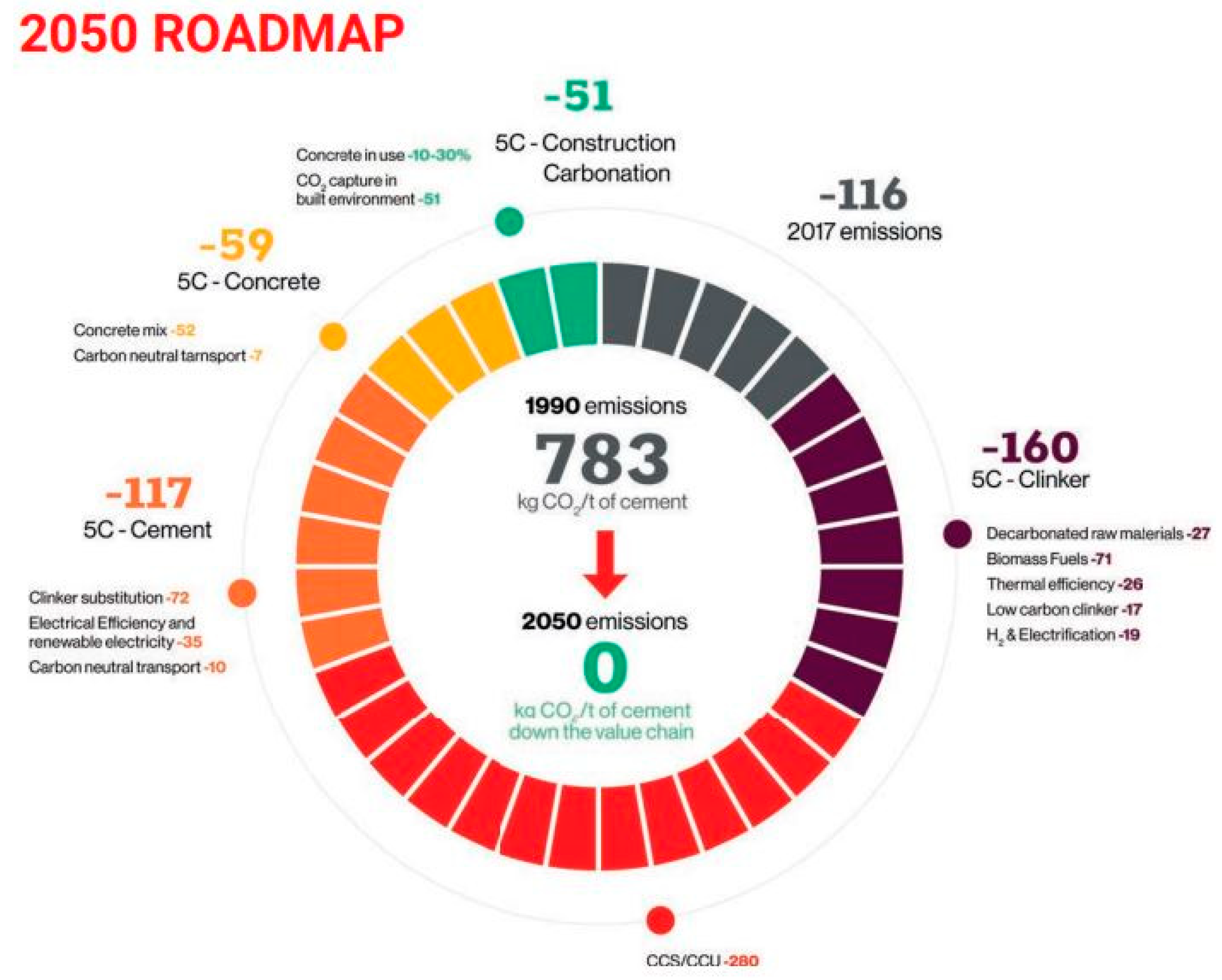
Figure 2.
Actions to achieve a net zero future [4].
Figure 2.
Actions to achieve a net zero future [4].
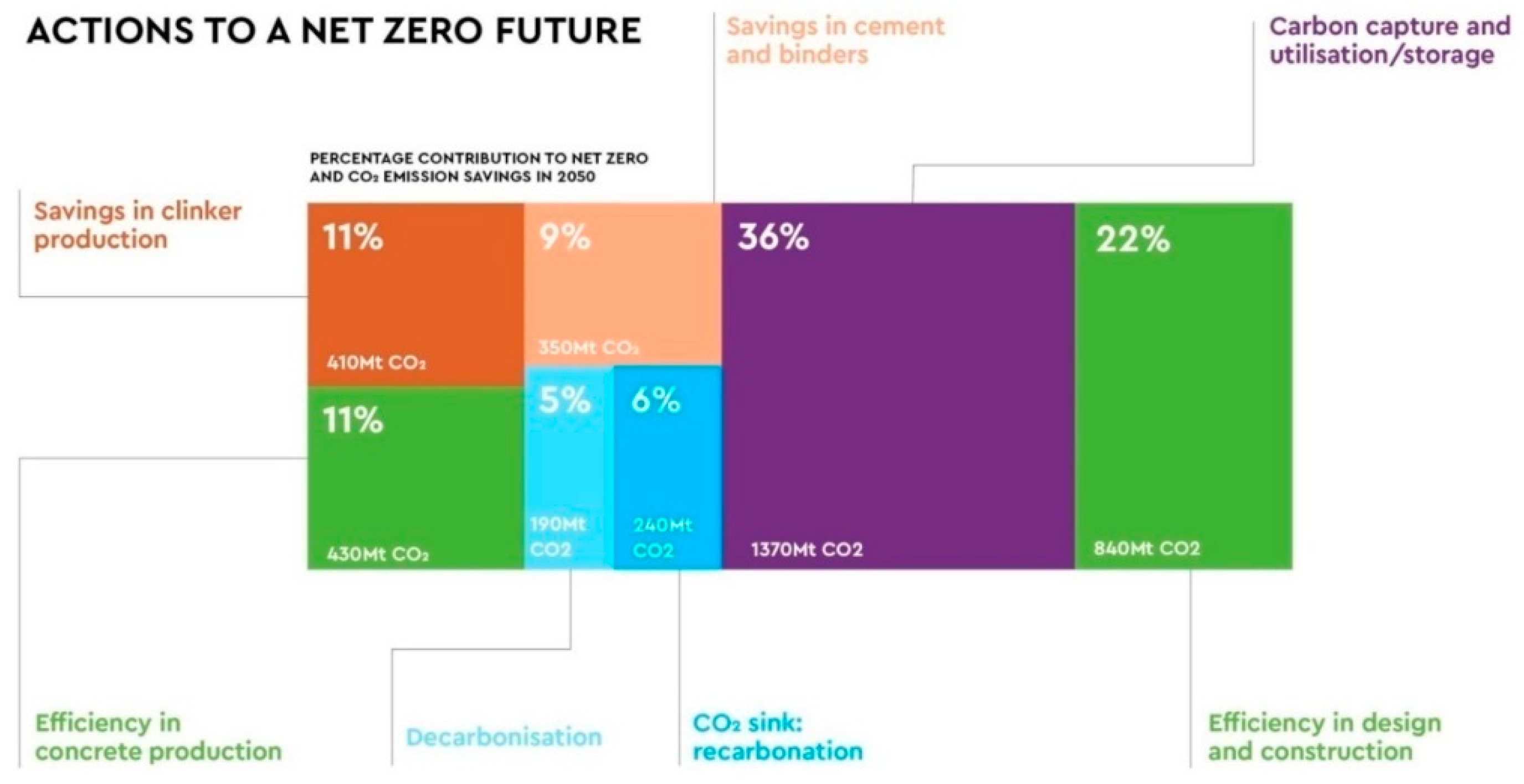
Figure 3.
CO2 emission quotas for cement plants in Kazakhstan until 2025.
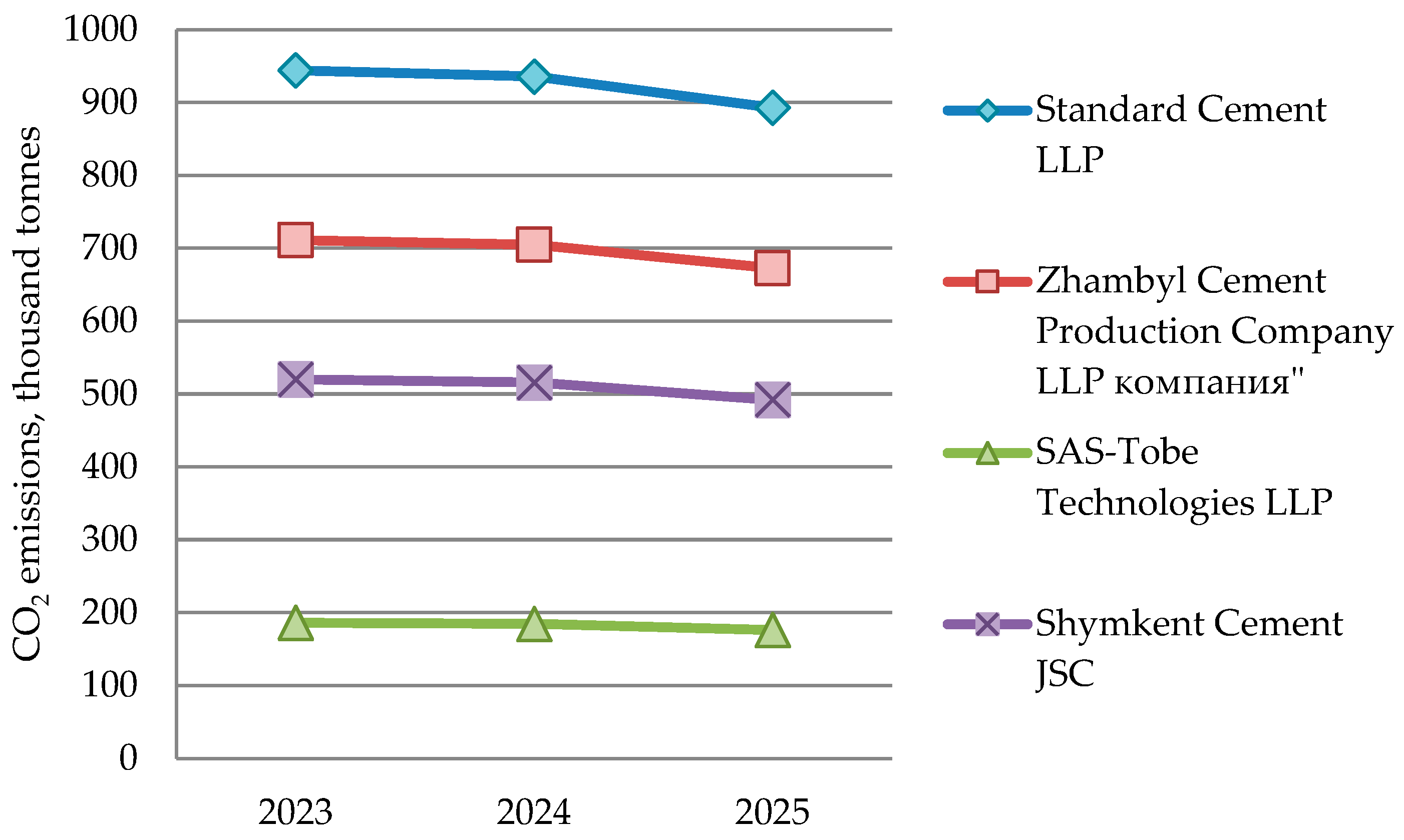
Figure 4.
Chemical composition, structure and local X-ray spectral analysis of Portland cement CEM I 42.5N.
Figure 4.
Chemical composition, structure and local X-ray spectral analysis of Portland cement CEM I 42.5N.
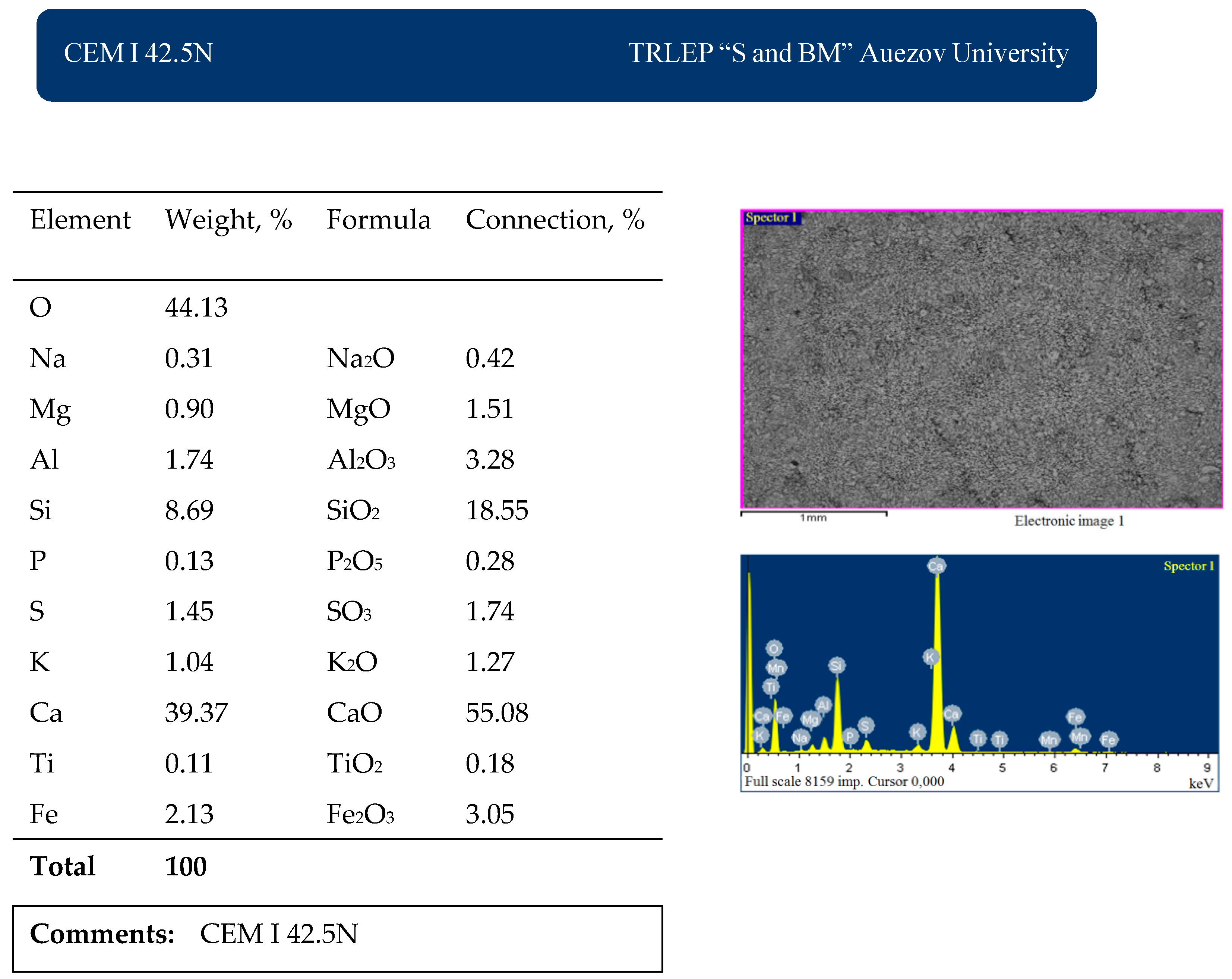
Figure 5.
Chemical composition, structure and local X-ray spectral analysis of clay shale from the Mynaralskoye.
Figure 5.
Chemical composition, structure and local X-ray spectral analysis of clay shale from the Mynaralskoye.
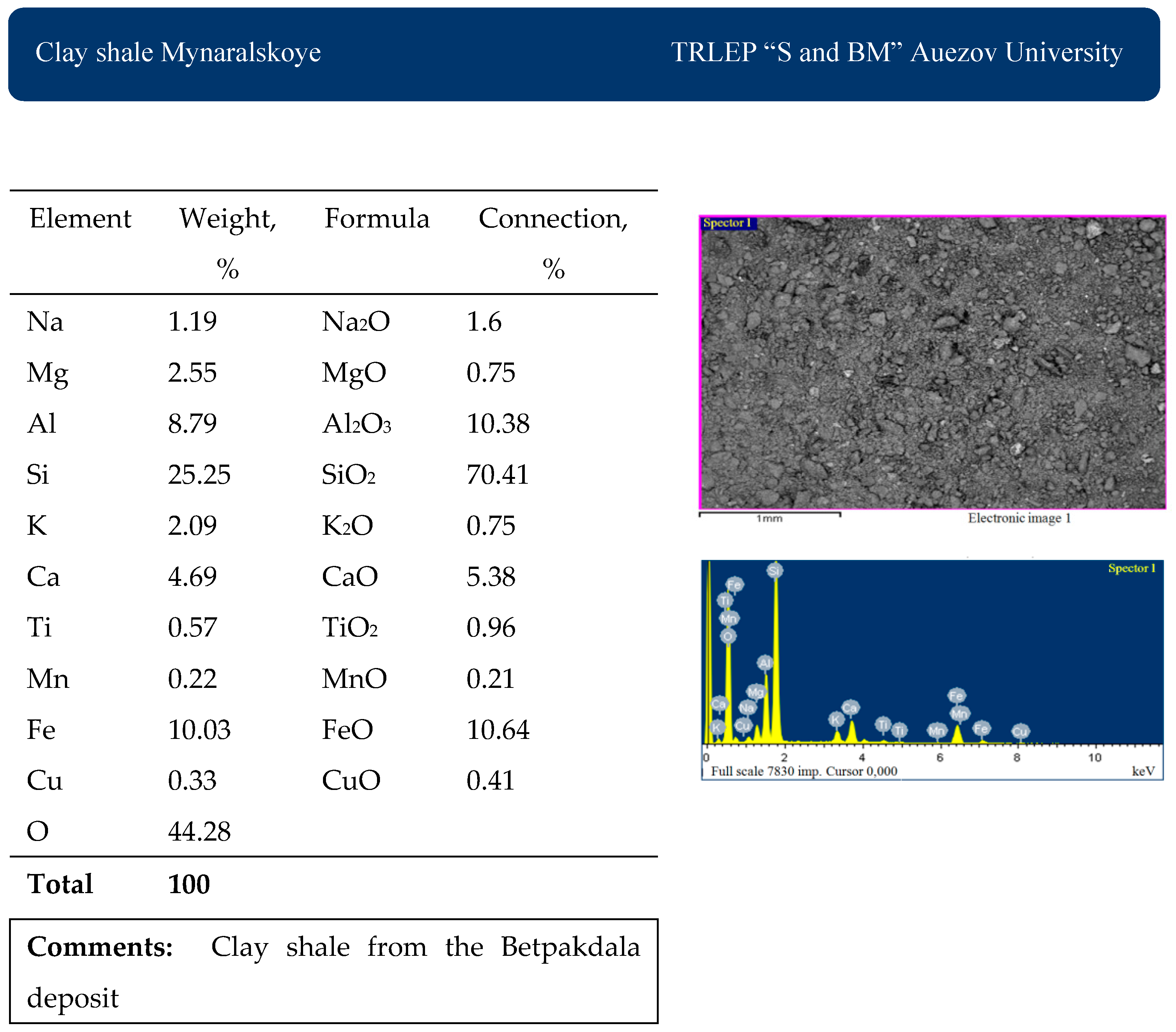
Figure 6.
Chemical composition, structure and local X-ray spectral analysis of clay shale from the Kuyuk.
Figure 6.
Chemical composition, structure and local X-ray spectral analysis of clay shale from the Kuyuk.
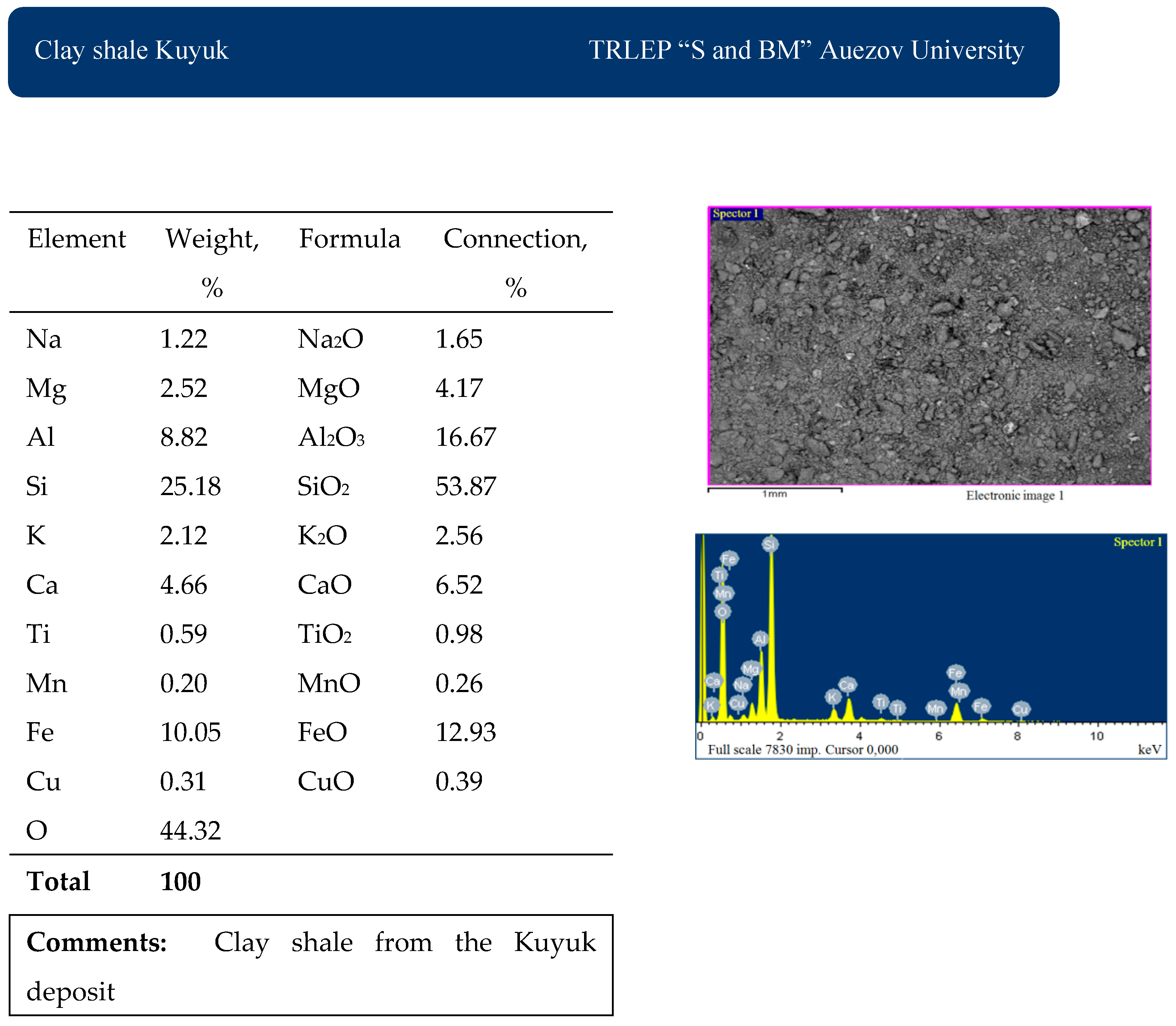
Figure 7.
Radiographs of the materials used: a- CEM I 42.5N; b- Clay shale from the Mynaralskoye; c- Clay shale from the Kuyuk.
Figure 7.
Radiographs of the materials used: a- CEM I 42.5N; b- Clay shale from the Mynaralskoye; c- Clay shale from the Kuyuk.
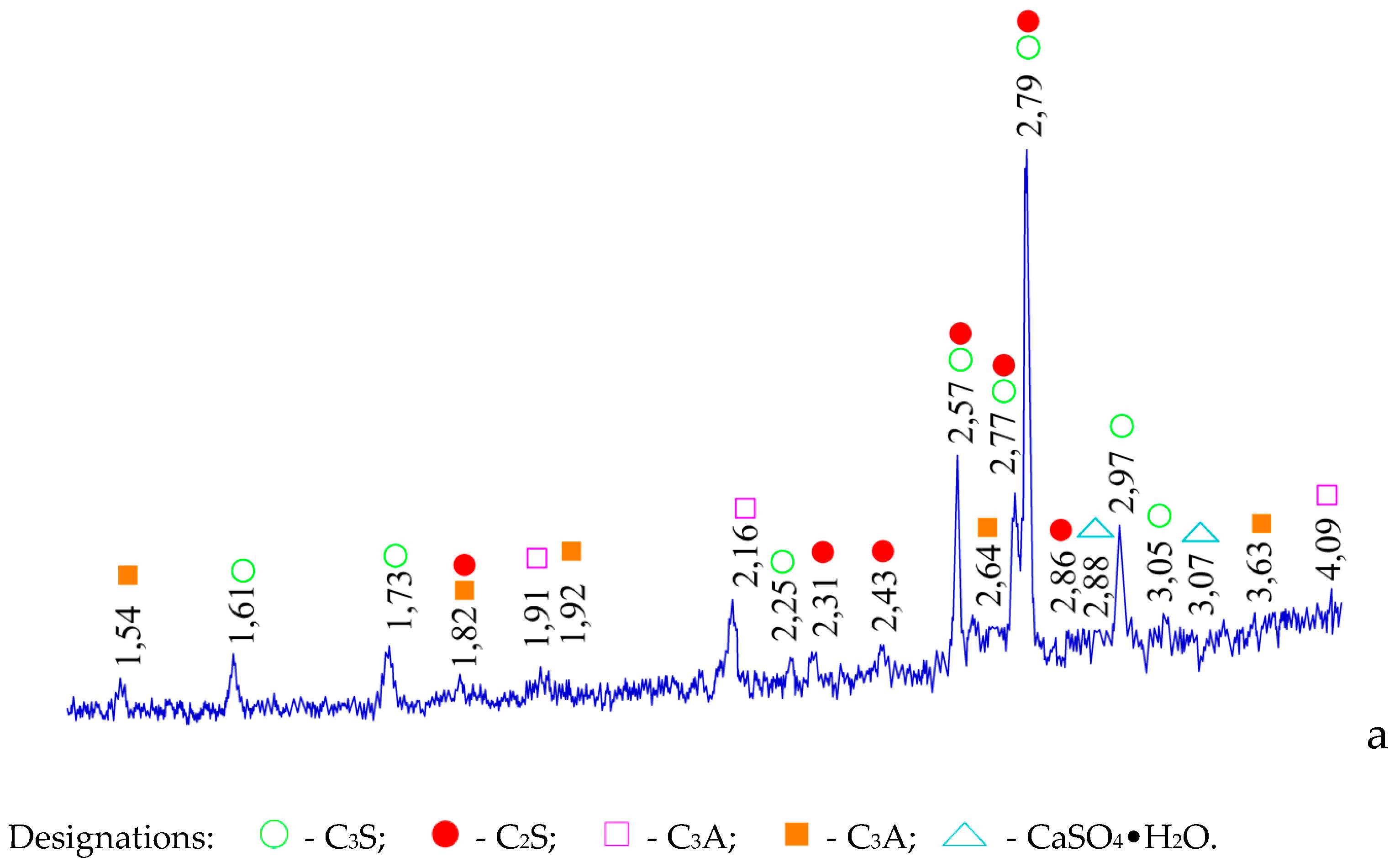
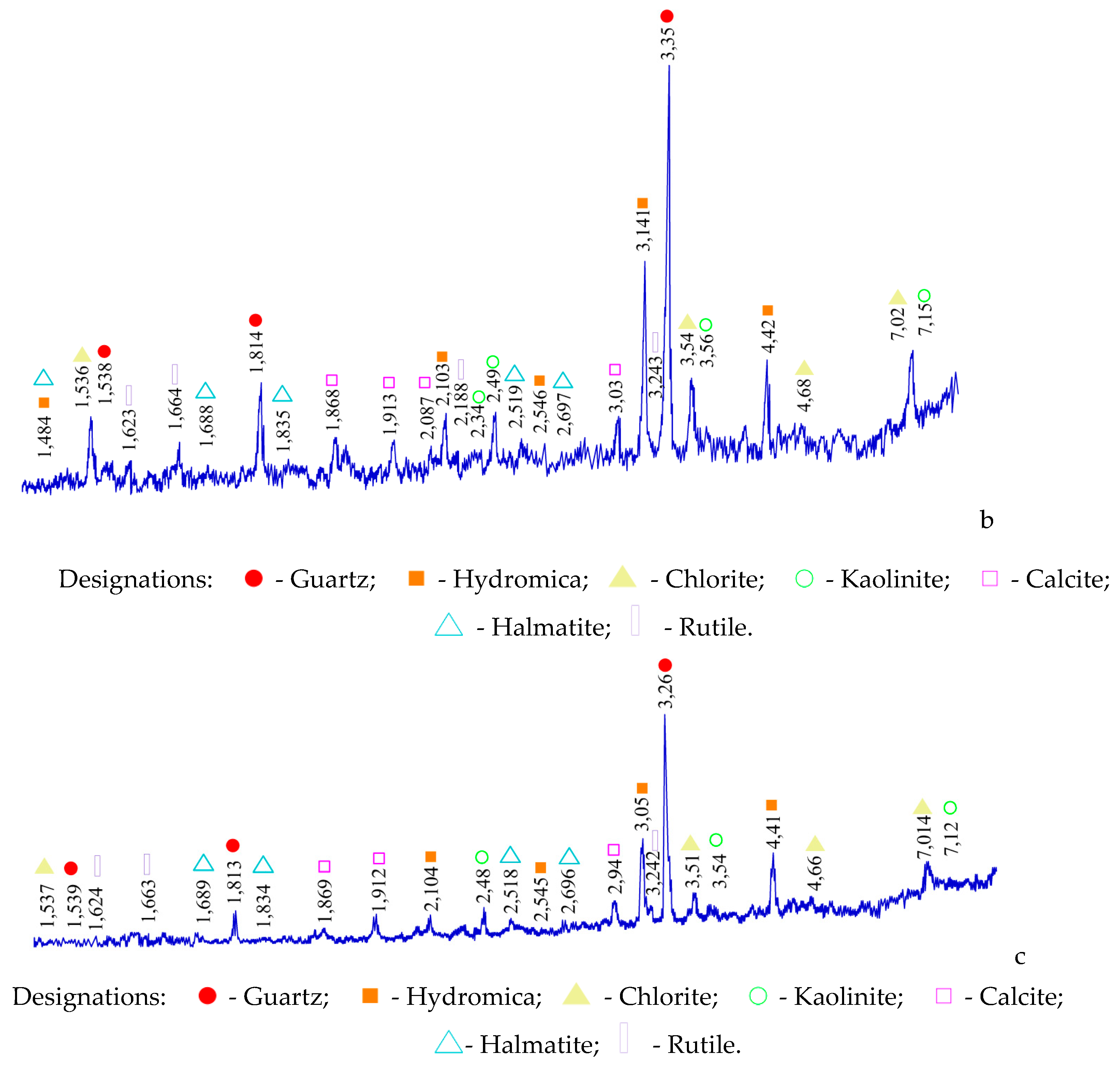
Figure 8.
Diffraction pattern of clay shale Kuyuk.
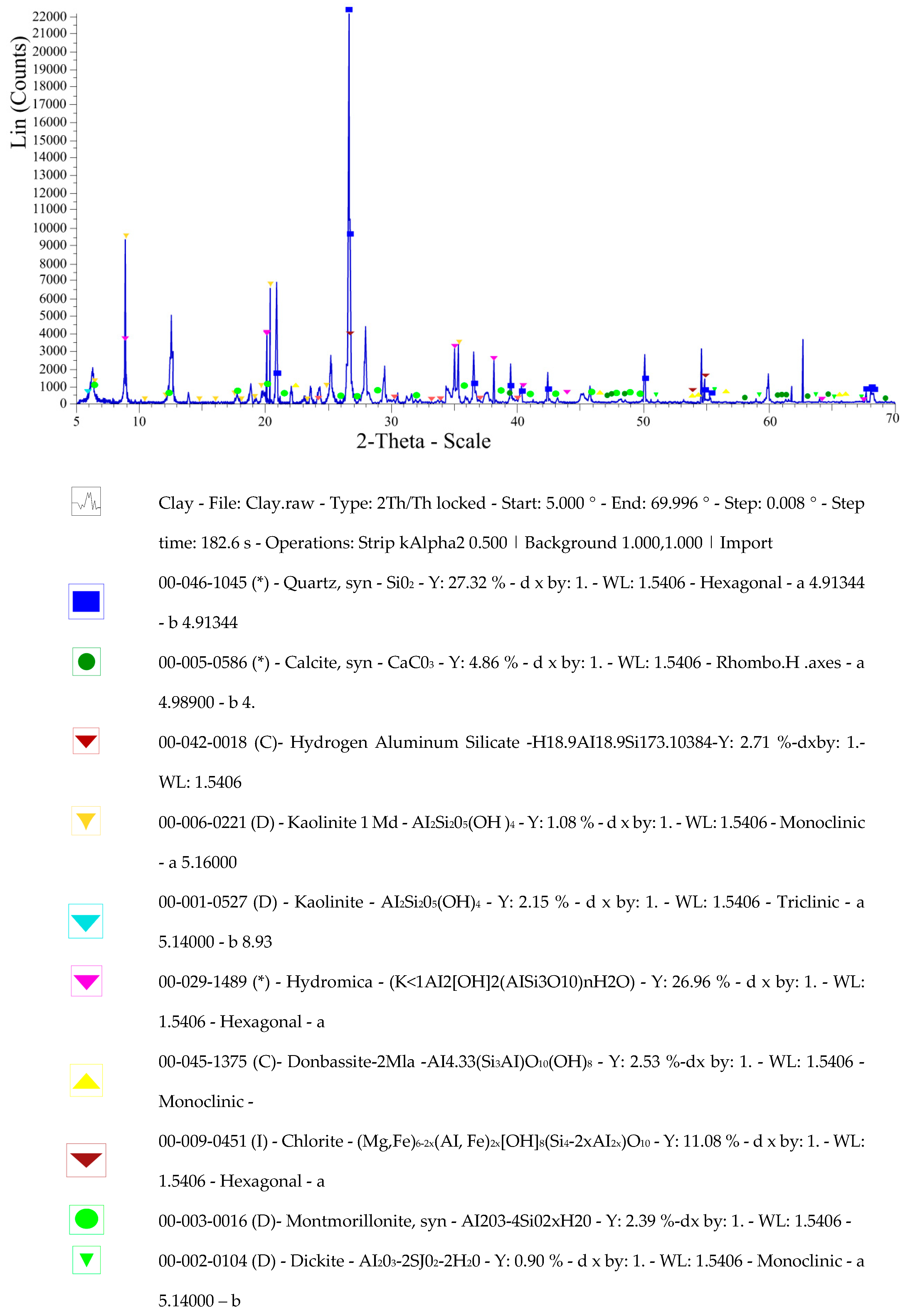
Figure 9.
X-ray diffraction patterns of burnt clay shales of the SM type at a temperature of 900 °C.
Figure 9.
X-ray diffraction patterns of burnt clay shales of the SM type at a temperature of 900 °C.
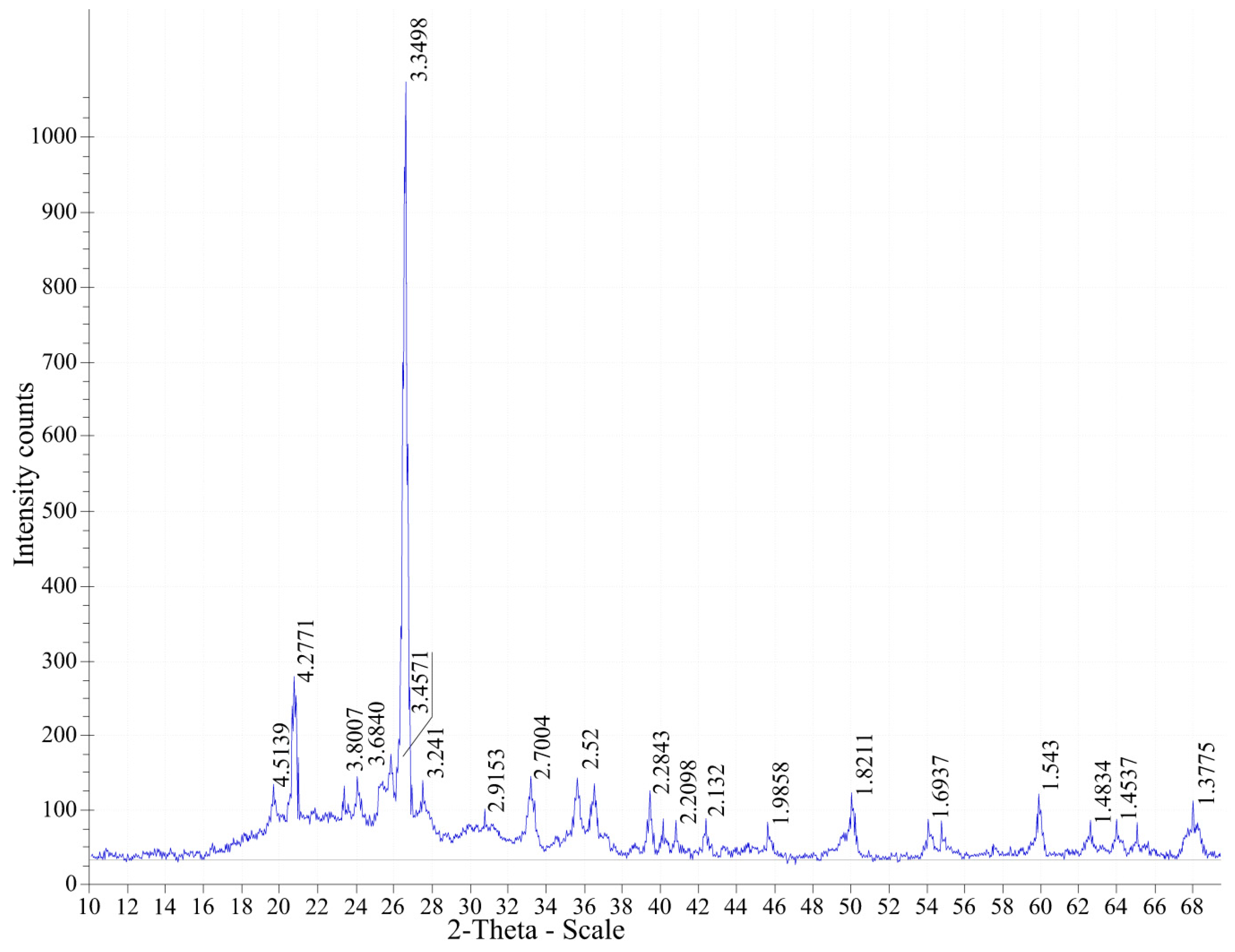
Figure 10.
X-ray diffraction pattern of SK clay shale fired at a temperature of 900°C.
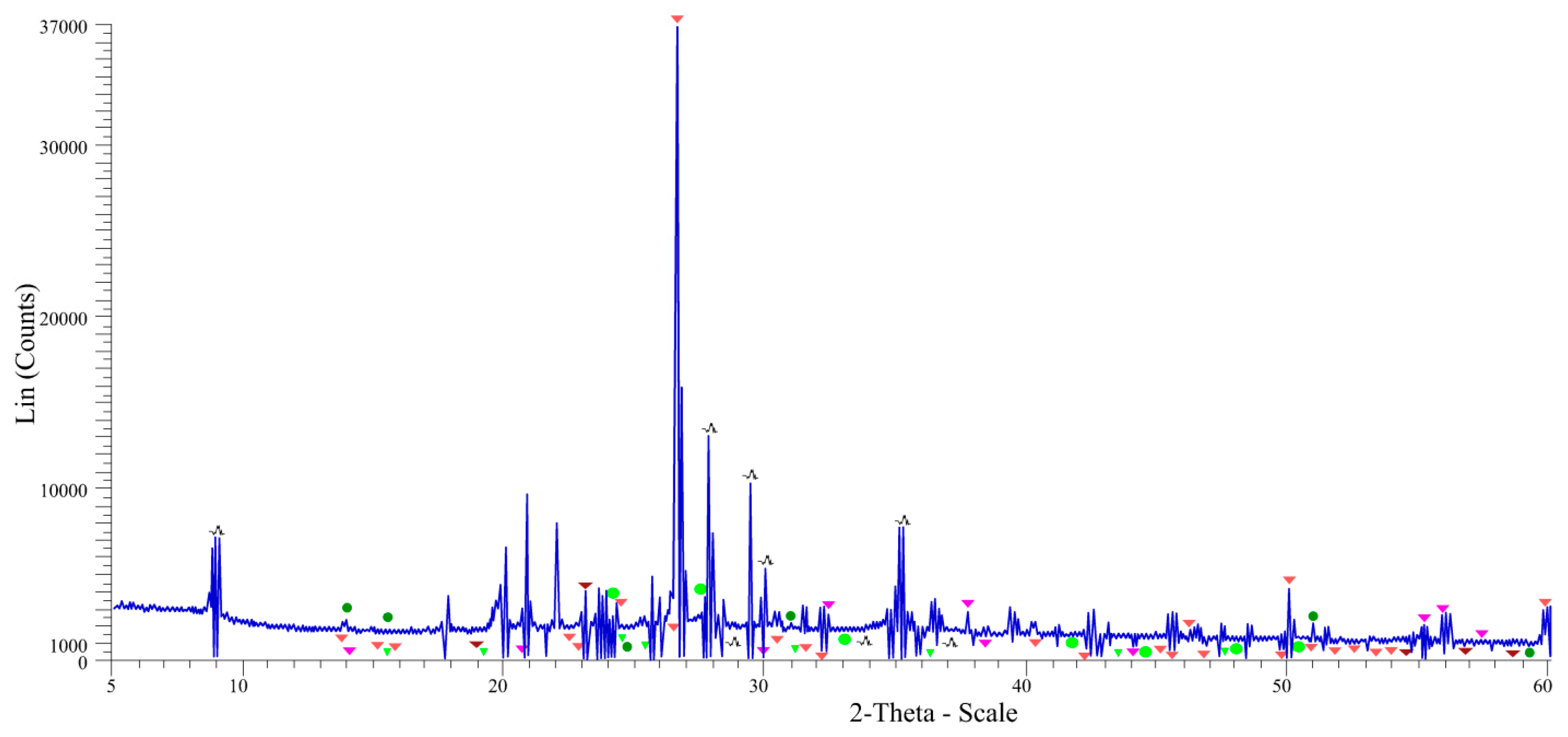
Figure 11.
Effect of the firing temperature of SM on lime absorption.
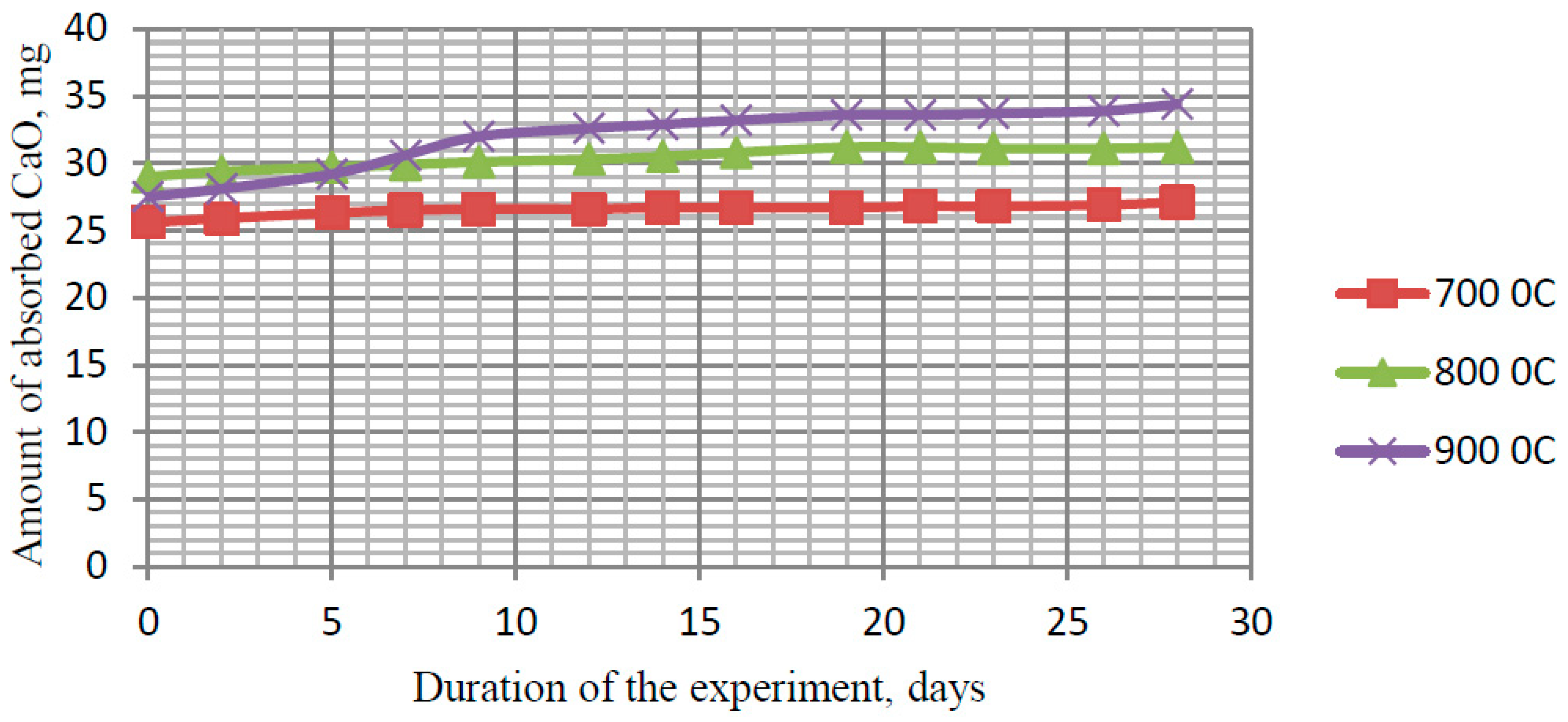
Figure 12.
The effect of the firing temperature of the SM on lime absorption.
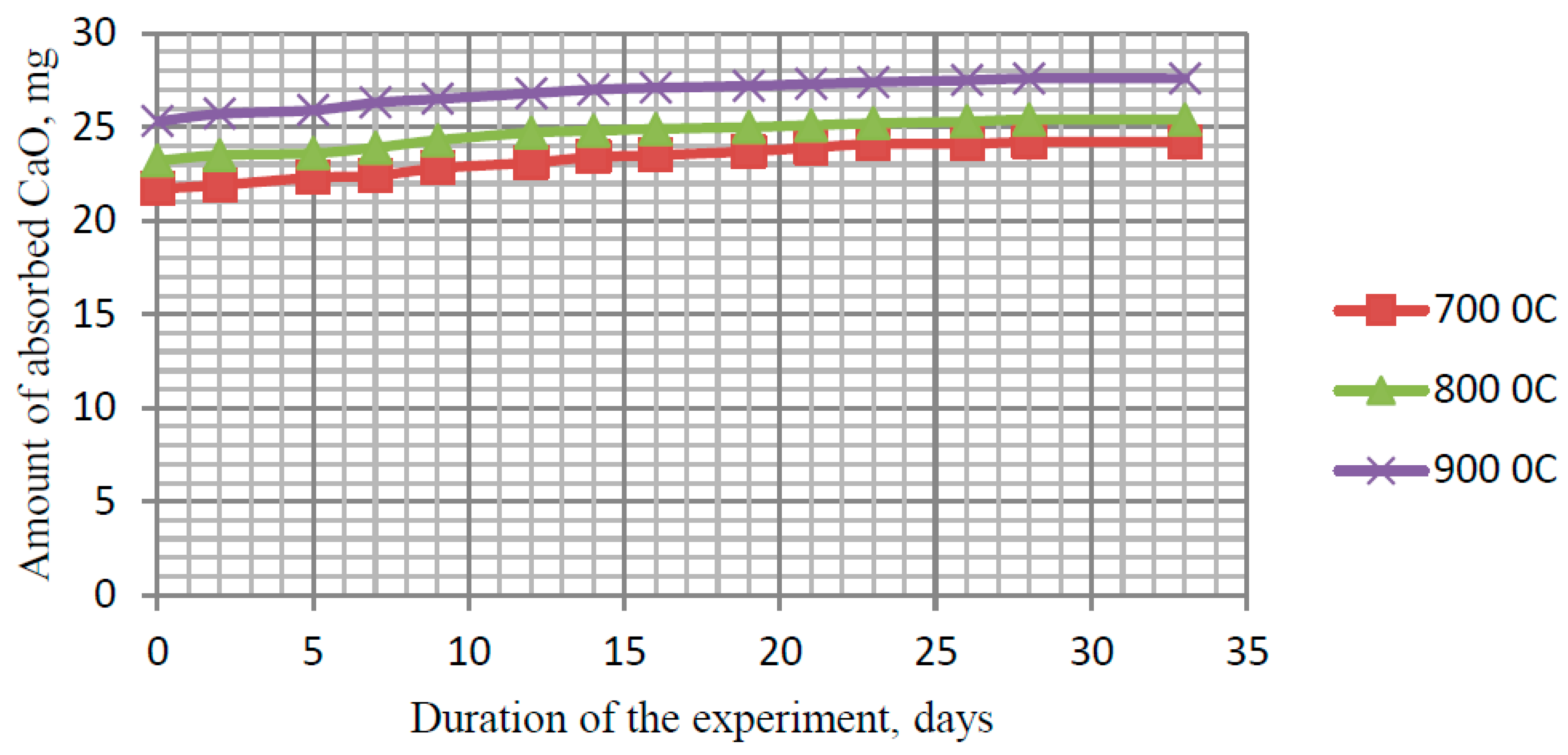
Figure 13.
Results of physical and mechanical tests of cements without additives and with additives of clay shale SM fired at 700-900 °C.
Figure 13.
Results of physical and mechanical tests of cements without additives and with additives of clay shale SM fired at 700-900 °C.
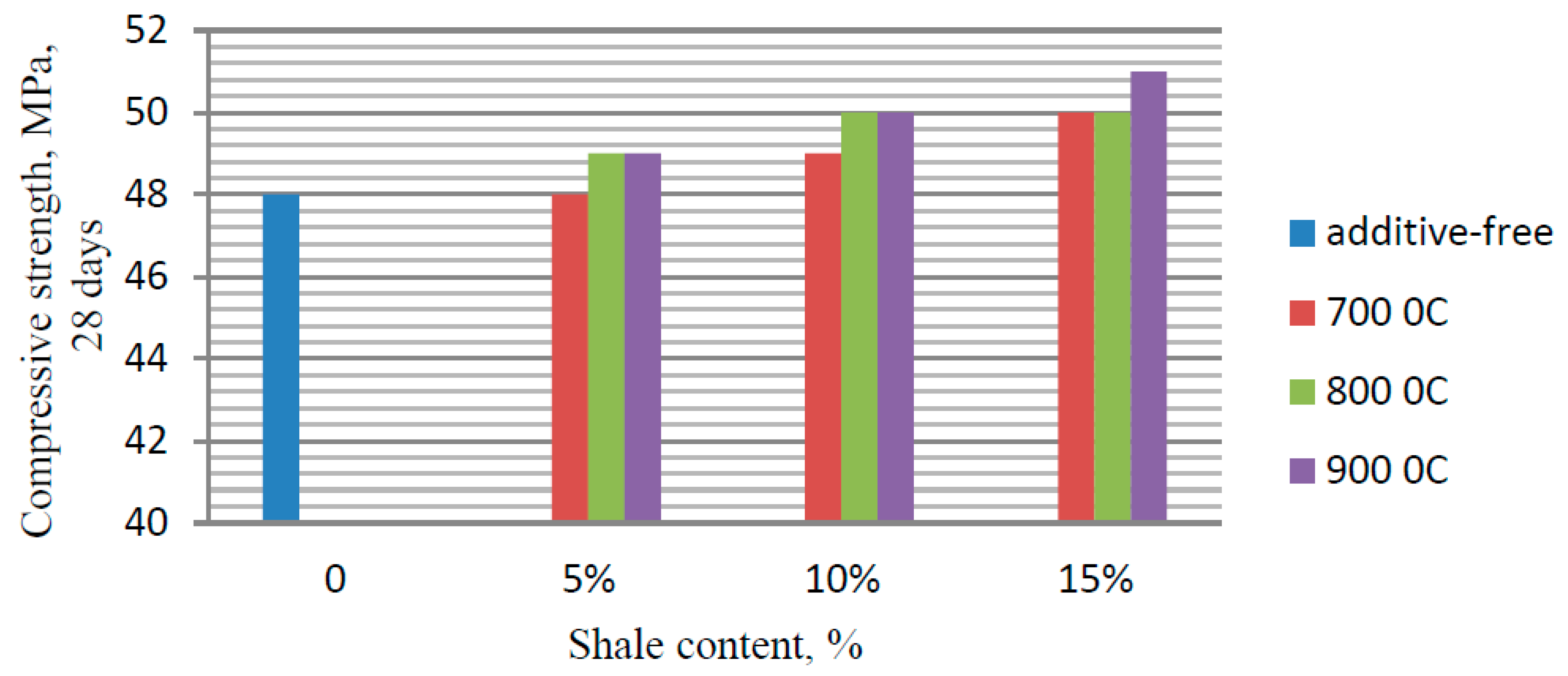
Figure 14.
Results of physical and mechanical tests of cements without additives and with additives of clay shale SK, fired at 700-900 °C.
Figure 14.
Results of physical and mechanical tests of cements without additives and with additives of clay shale SK, fired at 700-900 °C.
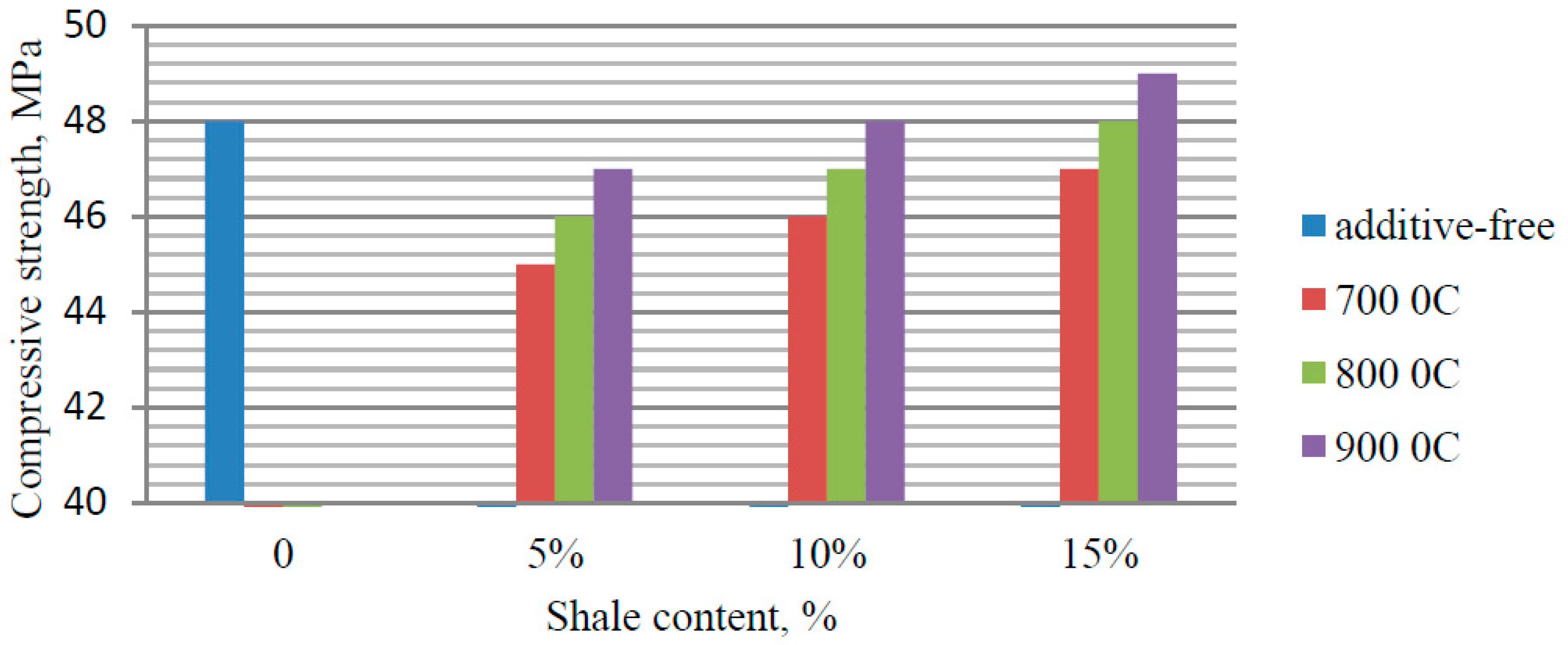
Figure 15.
X-ray diffraction patterns of cement stone aged 28 days, without additives and with 10-15% of clay shale SM, fired at 700-900 °C.
Figure 15.
X-ray diffraction patterns of cement stone aged 28 days, without additives and with 10-15% of clay shale SM, fired at 700-900 °C.
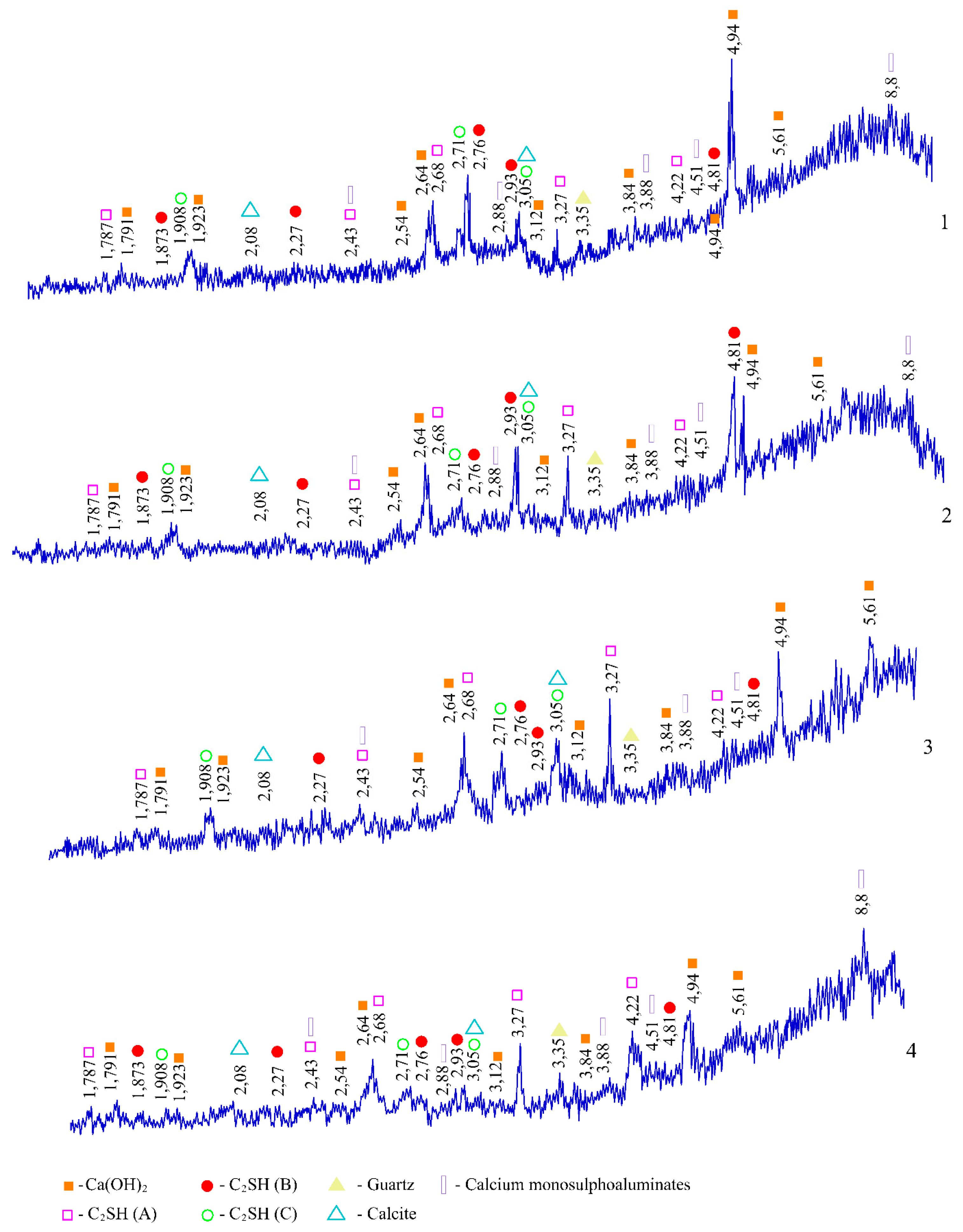
Figure 16.
SEM analysis of hydrated cement stone without additives. Hardening 28 days.
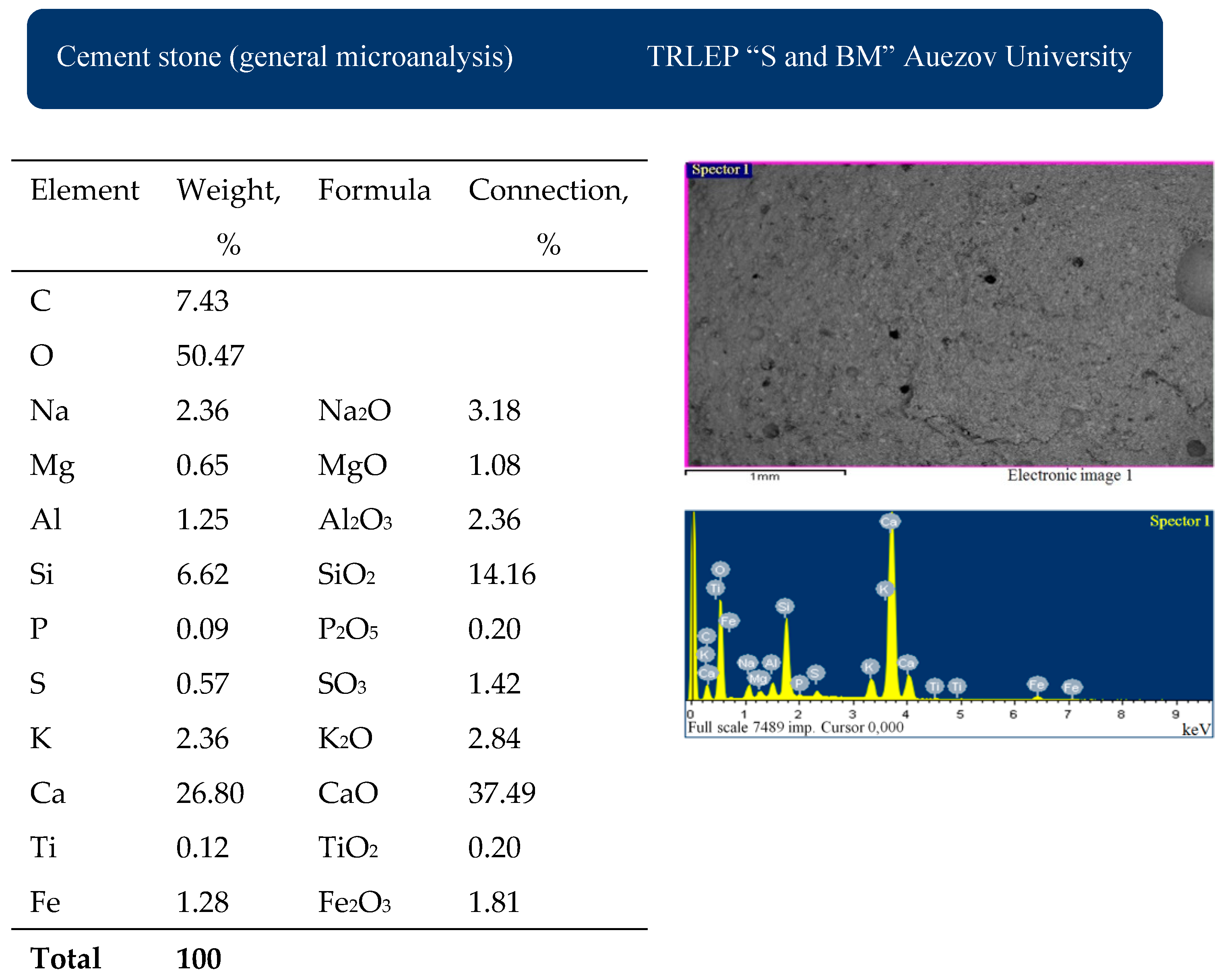
Figure 17.
SEM analysis of hydrated cement stone with the addition of SM shale fired at 900°C. Hardening for 28 days.
Figure 17.
SEM analysis of hydrated cement stone with the addition of SM shale fired at 900°C. Hardening for 28 days.
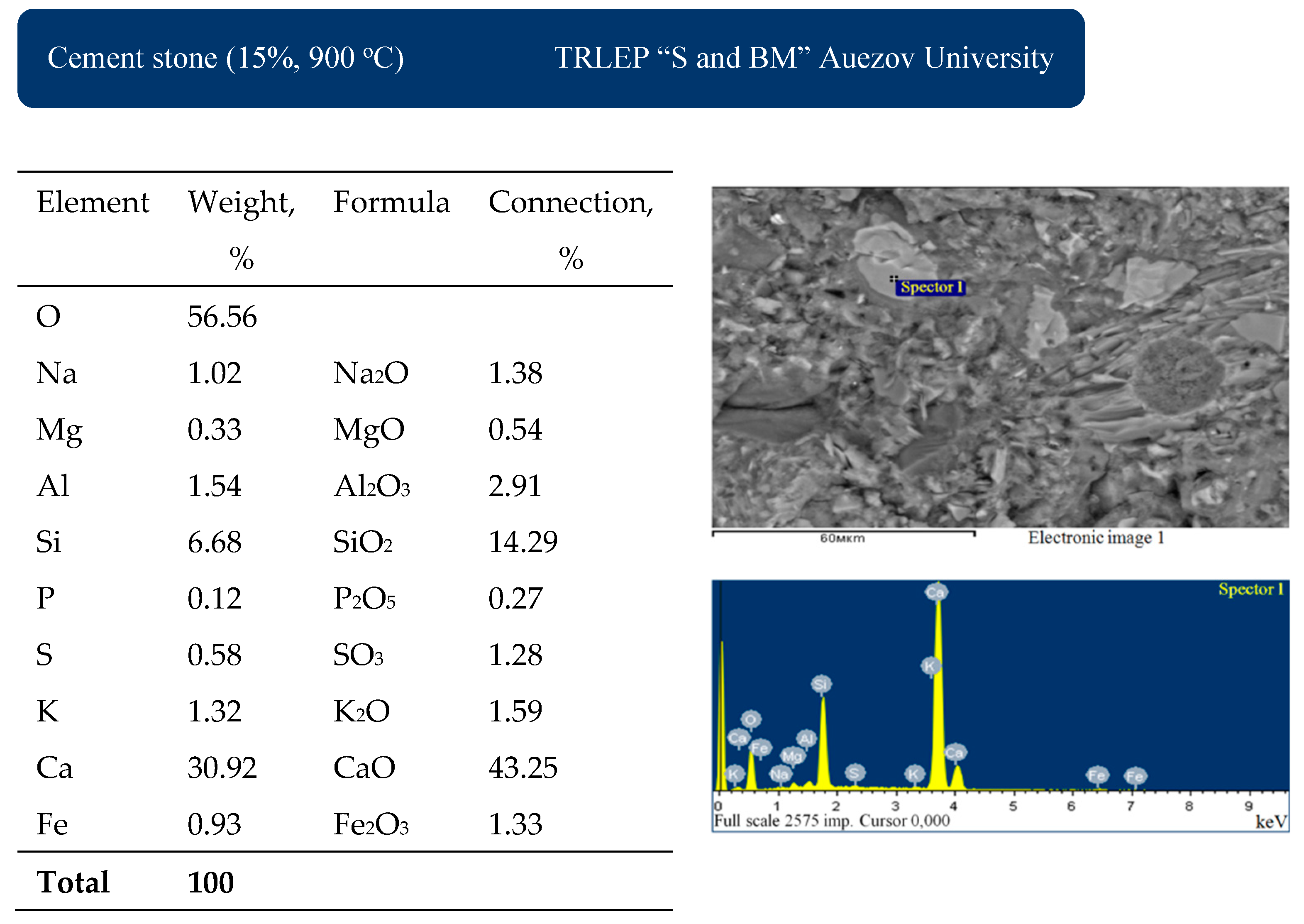
Figure 18.
Microphotographs of cement stone without additives 28 days of hardening Magnification: a - x250; b - x500; c-x1000.
Figure 18.
Microphotographs of cement stone without additives 28 days of hardening Magnification: a - x250; b - x500; c-x1000.
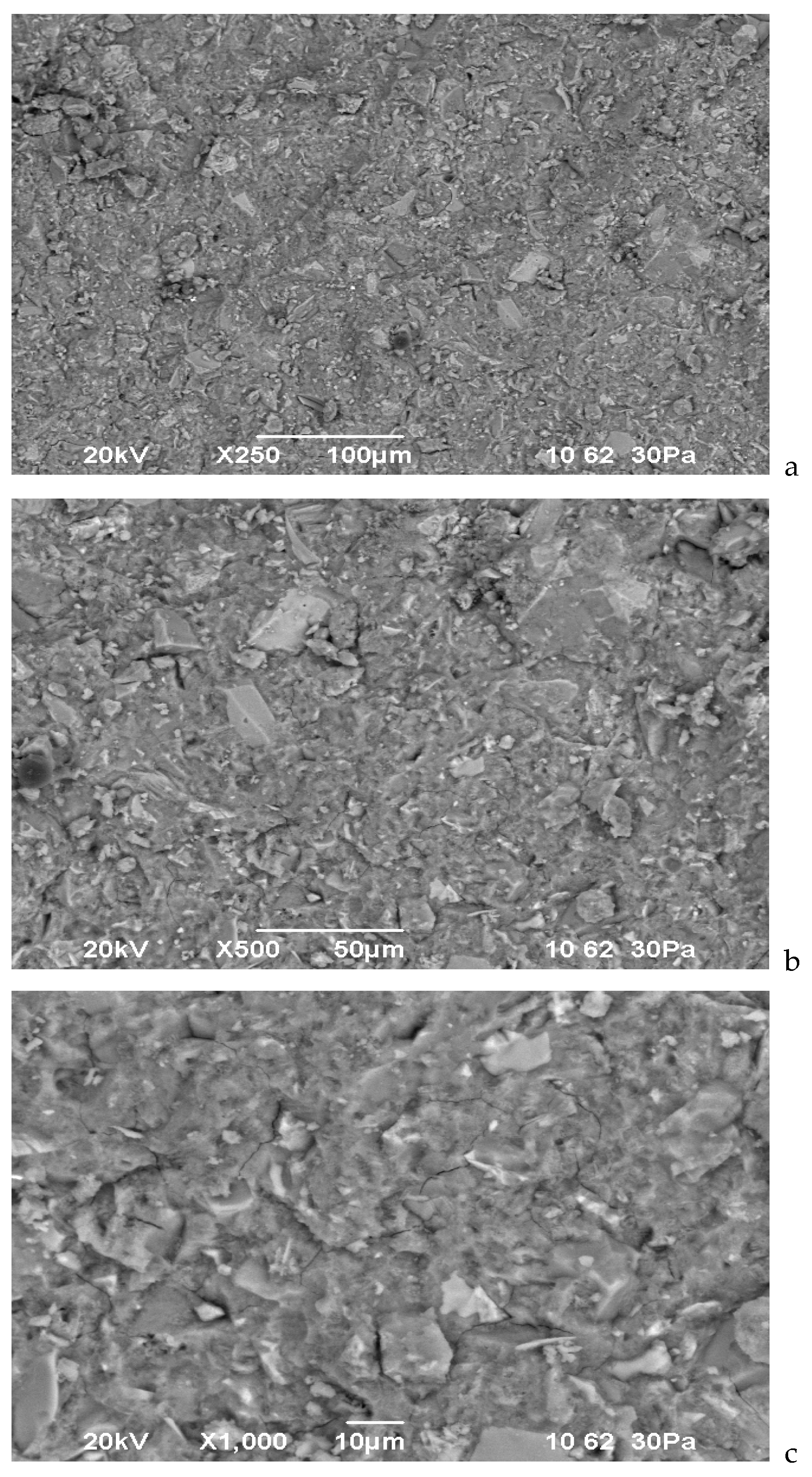
Figure 19.
Microphotographs of cement stone with the addition of 15% of SM clay shale fired at 900 °C, hydrated for 28 days. Magnification: a - x250; b - x500; c-x1000.
Figure 19.
Microphotographs of cement stone with the addition of 15% of SM clay shale fired at 900 °C, hydrated for 28 days. Magnification: a - x250; b - x500; c-x1000.
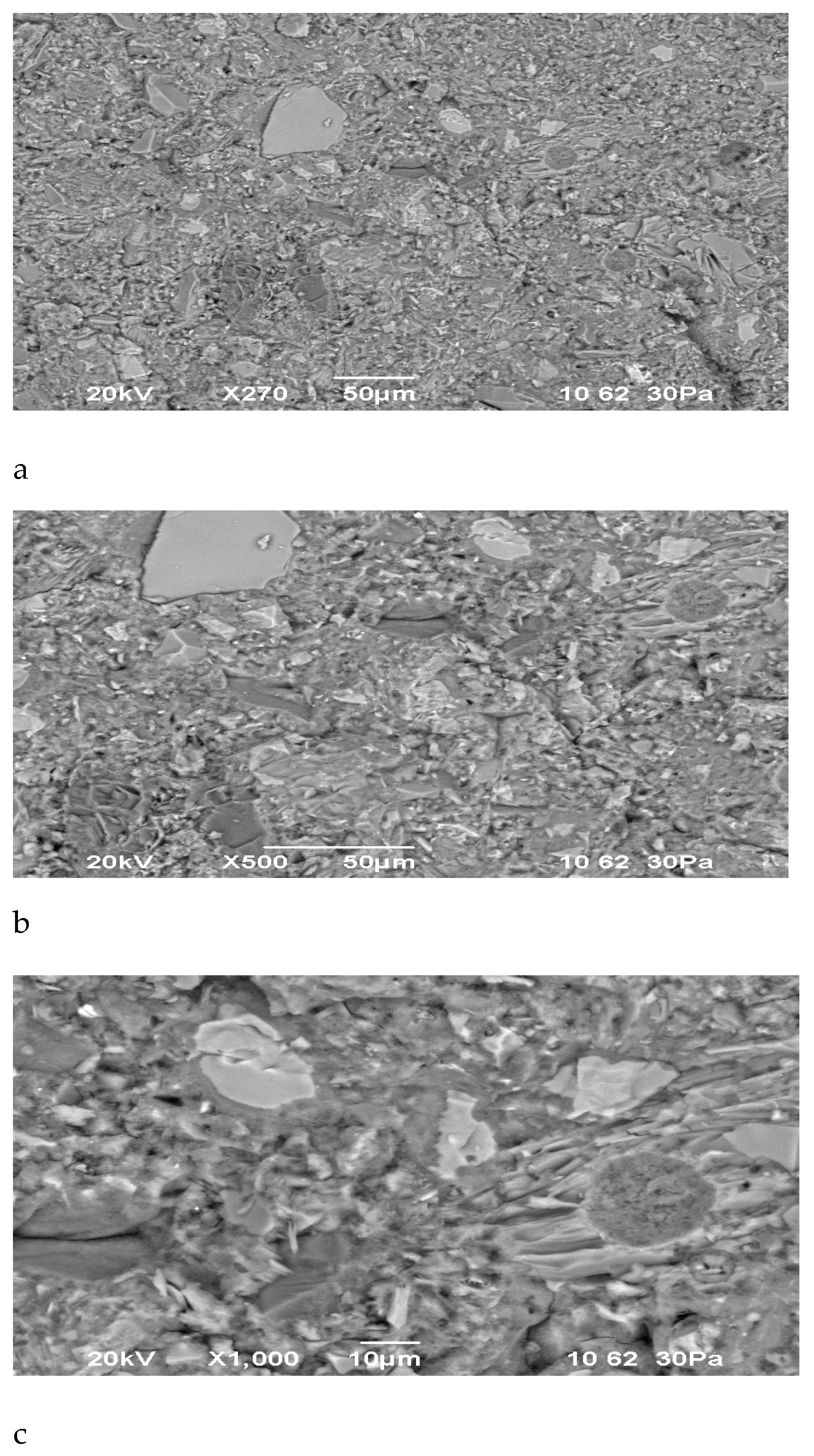

Table 1.
Average chemical compositions of the materials used.
| Name | Chemical composition, % | ||||||
|---|---|---|---|---|---|---|---|
| SiO2 | Al2O3 | CaO | Fe2O3 (FеO) | Na2O | K2O | MgO | |
| CEM I 42.5N | 18.55 | 3.28 | 55.08 | 3.05 | 0.42 | 1.27 | 1.51 |
| Mynaral clay shale SM | 70.41 | 10.38 | 5.38 | 10.64 | 1.6 | 0.75 | 0.75 |
| Kuyuk clay shale SK | 53.86 | 16.66 | 6.53 | 12.94 | 1.64 | 2.55 | 4.16 |
Table 2.
Results of physical and mechanical tests of cements with the addition of clay shale SM, fired at 700-900 °C.
Table 2.
Results of physical and mechanical tests of cements with the addition of clay shale SM, fired at 700-900 °C.
| Shale additives, % | WC | Setting time, h-min |
Compressive strength, MPa |
Average density g/cm3 |
|||
|---|---|---|---|---|---|---|---|
| start | end | 3 days | 7 days | 28 days | |||
| 0 | 27.0 | 2-40 | 4-10 | 32 | 35 | 48 | 2250 |
| 700 0С | |||||||
| 5 | 27.0 | 2-50 | 4-20 | 33 | 36 | 48 | 2245 |
| 10 | 27.0 | 2-55 | 4-30 | 33 | 38 | 49 | 2250 |
| 15 | 27.0 | 3-10 | 4-45 | 33 | 36 | 50 | 2265 |
| 800 0С | |||||||
| 5 | 27.0 | 2-40 | 4-15 | 33 | 37 | 49 | 2260 |
| 10 | 27.0 | 2-50 | 4-30 | 33 | 40 | 50 | 2270 |
| 15 | 28.0 | 3-10 | 4-50 | 34 | 38 | 50 | 2275 |
| 900 0С | |||||||
| 5 | 27.0 | 2-50 | 4-25 | 33 | 38 | 49 | 2260 |
| 10 | 27.0 | 2-55 | 4-50 | 33 | 39 | 50 | 2275 |
| 15 | 28.0 | 3-15 | 4-55 | 34 | 36 | 51 | 2290 |
Table 3.
Results of physical and mechanical tests of cements without additives and with the addition of 5-15% clay shale SK, fired at 700-900 °C.
Table 3.
Results of physical and mechanical tests of cements without additives and with the addition of 5-15% clay shale SK, fired at 700-900 °C.
| Shale additives, % | WC | Setting time, h-min |
Compressive strength, MPa |
Average density g/cm3 |
|||
|---|---|---|---|---|---|---|---|
| start | end | 3 days | 7 days | 28 days | |||
| 0 | 27.0 | 2-40 | 4-10 | 32 | 35 | 48 | 2250 |
| 700 0С | |||||||
| 5 | 27.0 | 2-55 | 4-25 | 31 | 34 | 45 | 2235 |
| 10 | 27.0 | 3-05 | 4-45 | 30 | 33 | 46 | 2242 |
| 15 | 27.0 | 3-15 | 4-55 | 30 | 32 | 47 | 2145 |
| 800 0С | |||||||
| 5 | 27.0 | 2-50 | 4-20 | 32 | 34 | 46 | 2240 |
| 10 | 27.0 | 3-00 | 4-40 | 31 | 34 | 47 | 2245 |
| 15 | 28.0 | 3-10 | 4-50 | 30 | 33 | 48 | 2160 |
| 900 0С | |||||||
| 5 | 27.0 | 2-55 | 4-25 | 32 | 34 | 47 | 2240 |
| 10 | 27.0 | 3-05 | 4-45 | 32 | 34 | 48 | 2245 |
| 15 | 28.0 | 3-10 | 4-50 | 31 | 34 | 49 | 2250 |
Disclaimer/Publisher’s Note: The statements, opinions and data contained in all publications are solely those of the individual author(s) and contributor(s) and not of MDPI and/or the editor(s). MDPI and/or the editor(s) disclaim responsibility for any injury to people or property resulting from any ideas, methods, instructions or products referred to in the content. |
© 2025 by the authors. Licensee MDPI, Basel, Switzerland. This article is an open access article distributed under the terms and conditions of the Creative Commons Attribution (CC BY) license (https://creativecommons.org/licenses/by/4.0/).
Copyright: This open access article is published under a Creative Commons CC BY 4.0 license, which permit the free download, distribution, and reuse, provided that the author and preprint are cited in any reuse.


