

Submitted:
08 April 2025
Posted:
09 April 2025
You are already at the latest version
Abstract
Diplotaxis tenuifolia, a species with high nutritional value, was recently introduced in Romania, being necessary in-depth research to develop an efficient cultivation technology to maximize its agronomic and economic potential. Therefore, the aim of the present study was to evaluate the influence of three mulch treatments, white polyethylene film (WLDPE), black polyethylene film (BLDPE) and nonmulched (NM), along with three fertilization regimes, organic (OF), chemical (ChF) and nonfertilized (NF), on the Bologna perennial wall‒rocket cultivar from 2022–2023. The results showed that the use of white polyethylene film and the application of organic fertilizer led to superior quantitative and qualitative results compared with those of the other experimental variants. The use of white film mulch without fertilization resulted in a yield of 52.73 t·ha−1, whereas organic fertilization alone produced a yield of 61.17 t·ha−1. The combination of WLDPE mulching with organic fertilization achieved a yield of 58.45 t·ha−1. These values are significantly greater than or comparable to the control yield, which reached 53.66 t·ha−1. Furthermore, PCA highlighted that the WLDPE×OF experimental variant was also associated with the highest values of lycopene, photosynthetic rate and chlorophyll A content. In contrast, the Bologna cultivar experienced the greatest oxidative stress under the nonfertilized regime, with the most pronounced effects observed when no mulching was applied.
Keywords:
yield
; tunnel crops
; food diversity
; nutrition and fertilization measures
1. Introduction
Diplotaxis tenuifolia is a functional food because of the direct connection between its consumption and health benefits [1]. The leaves of this species have a recognizable taste [2] and are distinguished by their dual characteristics, being both a nutritious food and a remedy with therapeutic potential [3]. Rich in glucosinolates, vitamin C, and polyphenol contents, perennial wall rockets are increasingly valued for their antioxidant properties and potential role in protecting against cancer and heart disease [4,5]. Originally present in wild flora, Diplotaxis tenuifolia is gaining particular importance [6] in the context of conservation and environmental protection because of the sustainable cultivation technologies associated with it [7].
The cultivation of perennial wall‒rocket depends on environmental factors and applied technologies [8]. Among the most common technologies are mulching and fertilization. Although many studies have been performed on Eruca sativa [9], the optimal cultivation technologies for this species do not necessarily apply to Diplotaxis tenuifolia. These two species can respond differently to the same growing conditions [10,11,12]. Therefore, further studies are needed to establish the best cultivation practices for perennial wall‒rocket. As highlighted by Guijarro-Real [13], careful analysis of cultivation techniques is crucial for converting edible wild plants into crops. This analysis is essential for achieving efficient large-scale production while maintaining high quality, including nutritional value. In this context, testing various growing conditions can help identify the most suitable environments for the cultivation of perennial wall‒rocket.
Mulch film plays an important role in reducing soil water evaporation [14], improving the soil microclimate, increasing the soil temperature and stopping weed growth [15]. Thus, its use is highly recommended for the majority of vegetable crops, especially leafy vegetables [16], as a shortage of water can significantly reduce yields by decreasing both the number and size of leaves per plant [17]. In perennial wall‒rocket crops, insufficient water negatively impacts quality, including its antioxidant content [18]. The mulching film plays a protective role by covering the soil and helping to create a local microclimate around the base of the plant. Furthermore, it helps maintain optimal temperature and humidity levels, which in turn promotes crop growth [19]. Another aspect that strongly impacts the growth and development of plants is the colour of the mulching film [10]. Various types of mulching films are available for vegetable cultivation, with black mulching film being the most common [20]. However, other colours, such as brown, transparent, and white, are also utilized [21].
The production of leafy vegetables is also highly dependent on the fertilization technology used [16,20]. It is essential to manage the use of fertilizers carefully for plants with short growth cycles, as these plants exhibit rapid growth rates and high nutrient requirements. These plants can accumulate excessive amounts of nutrients, increasing their vulnerability to disease and posing risks to human health and the environment [4,23]. For example, Tallarita et al. [4] reported that a perennial wall‒rocket is a hyperaccumulator of nitrates that is capable of storing up to 9000 mg kg⁻¹ f.w. or more, according to growth conditions, often exceeding the maximum limits established by European legislation. Another important aspect of fertilization is the choice of fertilizer type. Some studies have shown that, over the long term, the effectiveness of chemical fertilizers has diminished [22], which has led farmers to increasingly explore the use of organic fertilizers.
Perennial wall‒rocket, native to the Mediterranean and western Asia [24,25], can be affected by cold winters and the high humidity of Romania's climate, and both protective measures and studies are needed to establish optimal growing conditions. Research on this species in Romania is quite limited. One notable study conducted by Teliban et al. [26] evaluated the effects of mulching, along with chemical and biological fertilization, on the growth of perennial wall‒rocket during the autumn months of September and October. The researcher reported that the highest yield, at 25.3 t·ha−1, was achieved in the experimental variant that used chemical fertilization along with white polyethylene film mulch. Instead, Precupeanu et al. [27] investigated the growth and development of the cultivar Seledor in the spring‒summer climatic conditions of Romania's northeast region. This research examined the effects of chemical and organic fertilization, as well as the use of white and black film mulching. The findings of this study indicated that the highest yields were associated with organic fertilization and mulching with white polyethylene film. However, they also noted that the increase in ambient temperature during the spring‒summer season led to a decrease in yield. The seasonal dependence of yield was further highlighted in a study conducted by Caruso et al. [28], who reported that the highest production levels of the cultivar Nature occurred during the spring cycle (13.2 t·ha−1), followed by the autumn‒winter cycle (11.9 t·ha−1) and the winter cycle (11.0 t·ha−1). Consequently, a more in-depth study on different perennial wall‒rocket cultivars is necessary to validate previous findings and determine the most suitable growing season under Romania’s climatic conditions.
In this context, this study aimed to optimize the yield and quality of the Bologna perennial wall‒rocket cultivar by evaluating the interaction between mulching and fertilization under the northeastern climatic conditions of Romania. Specifically, this study assessed the individual and combined effects of white polyethylene film (WLDPE), black polyethylene film (BLDPE), and nonmulched (NM) practices, along with organic, chemical, and unfertilized regimes. The impact of these treatments was assessed through various measurements, including the CO₂ assimilation rate, the number of leaves, the leaf area index per nest, yield, dry matter and water content, as well as antioxidant activities (measured via DPPH and ABTS assays), total phenolic content (TPC), tannin, chlorophyll A and B, lycopene, and β-carotene levels. Therefore, the findings of this study are highly valuable for identifying the most effective perennial wall‒rocket cultivation methods in the northeastern region of Romania.
2. Results
2.1. Individual Influences of Factors on the Characteristics of Perennial Wall‒Rocket
The measurement of photosynthetic activity in perennial wall‒rocket plants revealed that different fertilization regimes and mulching practices significantly affect plant growth. As shown in Figure 1, plants grown with WLDPE and BLDPE mulch presented a significantly higher rate of carbon dioxide assimilation than did those grown without mulch, with WLDPE resulting in the highest assimilation rate (13.69 µmol m−2 s−1). In terms of fertilization, only the organic fertilization regime significantly increased the assimilation rate of the plants, reaching 14.38 µmol m−2 s−1. Generally, increased rates of assimilation are associated with improved plant growth and higher yields.
The evaluation of fertilization and mulching practices by counting the number of leaves per nest and measuring the biomass, leaf area, and total harvest revealed that WLPDE produced the highest values for these parameters, as indicated by the assimilation rate measurements. Notably, the number of leaves ranged from 557.33 to 660.67 for the WLDPE mulch, indicating a difference of up to 14% compared with the other two mulching methods. The nonmulched variant presented intermediate results, with an average of 634 leaves per nest. The LAI of leaves ranged from 9481.45 cm2·cm−2 for BLDPE mulch to 11309.75 cm2·cm−2 for WLDPE mulch, with the nonmulched variant achieving an intermediate value of 10895.cm2·cm−2. However, by correlating the LAI values with the number of leaves, it was found that a single leaf from the NM variant had a larger LAI (17.19 cm2·cm−2) than those from the BLDPE (16.42 cm2·cm−2) mulch variants did (Table 1).
In terms of yield, under the influence of the BLDPE mulch, the lowest yield (45.54 t·ha−1) was obtained, which was 23.76% lower than that under the WLDPE mulch (56.36 t·ha−1). The difference between these two yields is considered statistically significant at p ≤ 0.05.
The data presented in Table 1 indicate that variations in the fertilization regime did not significantly affect the yield of perennial wall rockets. However, compared with chemical fertilization, the organic fertilization regime effectively increased production, leading to a yield increase of 7.71 t·ha⁻¹. Additionally, the leaves presented a greater leaf area, as demonstrated by the presented data.
The dynamics of the harvests presented in Figure 2 indicate that Diplotaxis tenuifolia, which is grown under the climatic conditions of northeastern Romania, exhibited varying behaviour across different harvests due to the impact of mulching and fertilization. As outlined in Table 1, organic fertilization resulted in the highest total yield per hectare, starting at 20.35 t·ha−1 at the first harvest and decreasing to 5.73 t·ha−1 by the last harvest. This practice consistently produced higher yields than the other variants throughout all harvests. In contrast, chemical fertilization had a negative effect on the first harvest, yielding only 16.07 t·ha−1, whereas the value was 19.99 t·ha−1 for the nonfertilized variant. However, in subsequent harvests, the chemically fertilized plants achieved higher yields (17.17 t·ha−1 and 10.69 t·ha−1) than did the NF plants (15.05 t·ha−1 and 9.90 t·ha−1).
With respect to the use of mulch, the results indicated that BLDPE mulch produced the highest yield during the first harvest. However, for the subsequent three harvests, the highest yields were recorded with the white mulched variants.
The data presented in Table 2 indicate that only mulching practices had a significant effect on both water content and leaf dry weight. The highest water content was found in the yield harvested from experimental variants mulched with WLDPE (91.71%), whereas the highest dry matter content was recorded in the yield from BLDPE-mulched variants (8.95%). Statistically, the three gradations of the fertilization regime did not significantly influence the water content or leaf dry weight. However, under organic fertilization, the yield had the highest water content (91.49%), whereas chemical fertilization increased the dry weight of the yield (8.79%).
The analysis of functional compounds, specifically total phenolic content (TPC) and tannin contents, revealed that the applied fertilization and mulching practices had no significant effect on their concentrations in the leaves of perennial wall‒rocket (as shown in Table 2). Notably, the nonmulched and nonfertilized treatments presented the highest TPC values, with values of 2.04 mg GAE·100 g−1 and 2.07 mg GAE·100 g−1, respectively.
The results of the DPPH and ABTS tests on leaf antioxidant activity (Figure 3) indicated that the lowest DPPH values appeared in the variants mulched with white film (0.46 mmol TE·100 g⁻¹ d.w.) and those receiving organic fertilization (0.45 mmol TE·100 g⁻¹ d.w.). In contrast, the nonmulched variant and the variant mulched with the BLPDE film both presented higher values of 0.48 mmol TE·100 g⁻¹ d.w. In terms of the fertilization regime, the nonfertilized variant presented the highest value (0.49 mmol TE·100 g−¹ d.w.), whereas the chemically fertilized samples presented values similar to those of the nonfertilized and black film mulched variants (0.48 mmol·TE 100 g−¹ d.w.). The nonmulched variant presented the highest antioxidant activity (0.48 mmol TE·100 g−¹ d.w.), followed by the white film-mulched variant (0.46 mmol·TE 100 g−¹ d.w.), and the black film-mulched variant presented the lowest value (0.45 mmol TE·100 g−¹ d.w.). The values obtained for the fertilization factor were closely aligned, with a slight decrease for the chemically fertilized variant (0.46 mmol TE·100 g−¹ d.w.).
The two types of mulching films significantly influenced the accumulation of chlorophyll A, chlorophyll B, lycopene, and β-carotene compared with the control group (see Table 3). The variant with black mulch presented the highest levels of chlorophyll A (93.45 mg·100 g−1 d.w.), chlorophyll B (39.12 mg·100 g−1 d.w.), and β-carotene (5.99 mg·100 g−1 d.w.). In contrast, the white mulch treatment resulted in the highest concentration of lycopene (9.76 mg·100 g−1 d.w.). With respect to the fertilization factor, no significant differences were observed among the variants; however, chemical fertilization resulted in the lowest pigment values overall. Organic fertilization led to the highest concentrations of chlorophyll A (94.92 mg·100 g−1 d.w.) and lycopene (9.73 mg·100 g−1 d.w.), whereas the control treatment presented the highest values for chlorophyll B (39.18 mg·100 g−1 d.w.) and β-carotene (5.36 mg·100 g−1 d.w.).
2.2. Cumulative Influence of Factors on the Characteristics of Perennial Wall‒Rocket
Figure 4 illustrates the impact of factor interactions on assimilation rates in perennial wall‒rocket leaves. The highest rates were observed for the WLDPE × OF, WLDPE × ChF, BLDPE × NF, and BLDPE × OF variants, ranging from 14.5 µmol m⁻² s⁻¹ to 15.07 µmol m⁻² s⁻¹, with the WLDPE × ChF recording the highest value. However, no statistically significant differences were detected among these variants. In contrast, the lowest assimilation rate (9.10 µmol m⁻² s⁻¹) was recorded for the BLDPE × ChF variant.
The data presented in Table 4 show that the highest number of leaves was quantified in the WLDPE × ChF variant (670.67), whereas the highest LAI was quantified in the NF × OF variant. The 663.33 collected leaves from this variant had an LAI of 12,039.34 cm²·cm⁻² and yielded 687.26 g per nest, corresponding to the highest yield of all experimental variants at 61.17 t·ha⁻¹. The next two most productive variants were WLDPE × OF and WLDPE × ChF, with yields of 58.45 t·ha⁻¹ and 57.91 t·ha⁻¹, respectively.
The data in Figure 5 show the varying effects of mulching practices and fertilization regimes across the four harvest yields. At the first harvest, the highest yield (23.74 t·ha⁻¹) was from the nonmulched variant with organic fertilization, followed by the unfertilized variant with black film (21.75 t·ha⁻¹). In the second harvest, the organic fertilized variant mulched with white film led to the highest yield (23.41 t·ha⁻¹), closely followed by the WLDPE × ChF variant (22.23 t·ha⁻¹). In the third harvest, the highest yield (12.70 t·ha⁻¹) resulted from the combination of white film mulching with chemical fertilization, closely followed by the NM × OF variant (12.63 t·ha⁻¹). In the fourth harvest, the highest yield was from the WLDPE × NF variant (8.47 t·ha⁻¹), followed by the WLDPE × ChF variant (7.17 t·ha⁻¹). The lowest yield was recorded for the chemically fertilized × black film mulched variant (2.06 t·ha⁻¹).
With respect to the influence of the interaction between the factors on the water content and dry weight, the results presented in Table 5 revealed that the BLDPE × ChF plants presented the lowest water content and the highest dry weight. In contrast, the plants of the experimental variants WLPDE × ChF and WLDPE × OF presented the highest water contents, at 91.95% and 91.79%, respectively.
The data in Table 5 indicate that the interaction between factors had no significant effect on the total polyphenol content but led to significant differences in the tannin content. The highest TPC content was detected in the leaves of the WLDPE × NF variant (2.17 mg GAE·100 g−1 D.W.), whereas the highest tannin content was detected in the NM × NF variant (0.07 mmol·100 g−1 D.W.). However, the combination of white mulching film with organic and chemical fertilization resulted in the lowest TPC content in the leaves collected from these two experimental variants (1.84 mg GAE·100 g−1 D.W.). The lowest tannin levels (0.05 mmol·100 g⁻¹ D.W.) were detected in the NM × OF and BLDPE × ChF variants.
The results of the antioxidant activity analyses presented in Figure 6 indicate that the highest activity, as determined by the DPPH test, was observed in the nonmulched and unfertilized variant and mulched with black foil and treated with chemical fertilizer (0.54 mmol TE 100 g−1 d.w.). The lowest value was recorded for the interaction between nonmulched and organic fertilization (0.43 mmol TE 100 g−1 d.w.).
The results from the ABTS test indicated that the combination of white mulching film and chemical fertilization led to the highest antioxidant activity in the Bologna perennial wall‒rocket leaves (0.50 mmol TE 100 g−1 d.w.), closely followed by the nonmulched variant combined with either no fertilization or organic fertilization (0.49 mmol TE 100 g−1 d.w.). In contrast, the lowest ABTS value was detected in the leaves harvested from the white mulched and organically fertilized plants (0.43 mmol TE 100 g−1 d.w.).
The interaction effects among factors significantly influenced the levels of chlorophyll A, chlorophyll B, lycopene, and β-carotene in the leaves of the Bologna perennial wall‒rocket. The combination of white mulching and organic fertilization resulted in the highest contents of chlorophyll A (101.45 mg·100 g−1 d.w.) and lycopene (10.16 mg·100 g−1 d.w.) (Table 6). In contrast, the variant with black film mulch and no fertilization presented the maximum values for chlorophyll B (42.45 mg·100 g−1 d.w.) and β-carotene (6.35 mg·100 g−1 d.w.). The nonmulched and nonfertilized treatments presented the lowest chlorophyll A content (84.16), whereas the white film mulch and chemical fertilization treatments presented the lowest levels of chlorophyll B (32.47 mg·100 g−1 d.w.) and β-carotene (3.80 mg·100 g−1 d.w.). Furthermore, the lowest amount of lycopene was observed in the nonmulched and chemically fertilized variant.
2.3. Dimensionality Reduction and Exploratory Causal Statistical Analysis of Data
The results of the principal component analysis (PCA) applied to the entire dataset, illustrated in Figure 7, revealed that four of the eight independent principal component axes had eigenvalues greater than 1. The eigenvalues of PC1 and PC2 were 6.89 and 3.49, respectively, and these two principal components together accounted for 69.13% of the total variability, indicating that the majority of the information regarding the growth and quality traits of perennial wall‒rocket under the influence of mulching and fertilization regimes was captured by these two components. The main positive contributors to PC1 included yield/ha and yield/nest (0.341), LAI/nest (0.346), and water content (0.330), whereas the negative contributors to PC1 included dry matter content (−0.330), TPC (−0.279) and β-carotene (−0.234). For PC2, the significant positive contributors included the CO2 assimilation rate (0.245), chlorophyll A (0.476), chlorophyll B (0.385), lycopene (0.348) and β-carotene (0.324), whereas the greatest negative contributors were ABTS (−0.349), TPC (−0.306) and tannins (−0.261) (Table 7).
The PCA of the entire dataset demonstrated that the growth patterns of perennial wall‒rocket can be significantly influenced by mulching and fertilization regimes. Depending on the combination of these regimes, they can have either similar or distinct effects on plant traits. For example, the experimental variant WLDPE × ChF is positioned close to the growth traits and is associated with relatively high values. The WLDPE × OF variant is associated with increased levels of lycopene, CO2 assimilation rates, and chlorophyll A. In contrast, the BLDPE × NF combination is associated with the highest contents of chlorophyll B and β–carotene. The positioning of NM × NF, WLDPE × NF, and NM × ChF near traits such as tannins, DPPH, and TPC indicated that the highest levels of these compounds can be found in the leaves of perennial wall‒rocket cultivated under these conditions.
To better understand the effects of fertilization and mulching practices, PCA was conducted along with Pearson correlation analysis on subsets of data grouped by the type of fertilization regime or mulch used. The findings from these analyses, illustrated in Figure 8 and Figure 9, indicated that changes in fertilizer type or mulching practices have distinct effects on the measured variables, as they are positioned in different quadrants. For example, in the nonfertilized variants, the absence of mulch increased the contents of tannins and antioxidant compounds, measured as ABTS and DPPH. In contrast, the plants grown with the BLDPE mulch presented a relatively high CO2 assimilation rate and chlorophyll A, chlorophyll B, lycopene and β-carotene contents, whereas those grown with the WLDPE mulch presented increased TPC contents in the leaves. Under organic fertilization, the highest levels for most of the analysed traits were associated with WLDPE mulch. Chemical fertilization combined with BLDPE increased the dry matter content; DPPH, chlorophyll A, chlorophyll B, and β-carotene contents; and, in combination with WLDPE, the yield, number of leaves per plant, leaf area, CO2 assimilation rate, ABTS content, tannin content, and lycopene content increased (Figure 8c). Overall, the PCA results revealed that perennial wall‒rocket experienced the greatest oxidative stress under the nonfertilization regime, regardless of the mulching practice. Additionally, the nonfertilization regime combined with WLDPE and BLDPE mulching is detrimental to perennial wall‒rocket yield.
The Pearson correlation diagrams revealed that the fertilization regime or the type of mulch also influenced the relationships among the variables (Figure 8 and Figure 9). For example, in the absence of fertilization, yield is strongly negatively correlated with traits related to plant physiology (CO2 assimilation rate, chlorophyll A, chlorophyll B with r < − 0.87), whereas yield is strongly positively correlated with traits associated with oxidative stress (TPC, DPPH, ABTS and tannins with r > 0.61). Furthermore, yield was highly negatively correlated with the number of leaves per nest and dry matter content, whereas the traits related to plant physiology were strongly negatively correlated with those associated with oxidative stress (Figure 8a). Organic fertilization generally induced moderate to strong positive correlations between morphological and physiological traits, whereas weakly negative to moderately positive correlations were found between morphophysiological and oxidative stress-related traits (Figure 8b).
3. Discussion
Proper fertilization and mulching practices are essential for supporting the rapid growth and overall health of leafy vegetables, ultimately optimizing yield at harvest [29,30,31,32,33]. The selection of the appropriate type of mulch and fertilizer depends on the specific needs of the plant as well as the climatic conditions of the growing area. Diplotaxis tenuifolia L. is a long-day plant that prefers relatively low temperatures, and relatively high temperatures can stress plants, leading to accelerated flowering and inhibited vegetative growth [34,35,36]. Caruso et al. [6] reported faster growth and development rates in the 2–25°C temperature range. Moreover, this species is capable of growing in harsh and nutrient-poor soils in its natural habitat [24,37] and has low-moderate nutritional requirements [6]. Moreover, it is a crop with multiple growing cycles, allowing successive harvests that maximize yield and optimize resource consumption [38].
The results of the present study revealed that the yield of perennial wall‒rocket is influenced by both the harvesting period and the combination of fertilization regimes with mulching practices. Specifically, the findings demonstrated that BLDPE was the most effective at relatively cold ambient temperatures, resulting in the highest yield during the first harvest when the plants were grown at relatively low temperatures. In contrast, the yields from the other three harvests were lower than those from the WLDPE mulched or nonmulched variants, and these differences are directly related to the properties and advantages of the mulching films. Mulching with low-density polyethylene (LDPE) film is widely recognized for its ability to regulate soil temperature effectively [39,40]. According to Gheshm and Brown [41], black polyethylene mulch significantly increases soil temperature, whereas white-on-black polyethylene mulch maintains temperatures similar to those in bare soil plots. Tarara [40] reported that at a depth of 10 cm, soil temperatures were approximately 4°C lower under white and aluminized reflective plastics than under black plastics and 1 to 2°C lower than those in bare soil. The temperature reduction observed with the white film is attributed to its high reflectivity, which prevents excessive heat buildup. In addition, some of the reflected radiation reaches the lower leaves of plants, increasing illumination and photosynthesis, which can stimulate plant growth [40]. Thus, during cold periods, BLDPE enhances soil warming through its sunlight-attracting mechanism, creating a favourable microclimate for perennial wall‒rocket growth. However, in hot conditions, it may cause overheating, reducing yield compared with white film, which reflects sunlight and maintains a more stable soil temperature. Song et al. [42] reported positive results for white mulch film in a study on garlic, whereas Zhao et al. [43] reported similar outcomes for corn. However, in melon cultivation—a crop that requires high temperatures—white mulch film is associated with the lowest yield [21]. Caruso's study [44] reinforced the idea that perennial wall‒rocket grow better with reduced sunlight exposure and hence temperature, demonstrating improved performance in summer when shaded.
Chemical fertilizers do not consistently promote better plant growth and development than organic fertilizers do, as highlighted by this study. Furthermore, the effects of fertilizers on the growth and development of perennial wall‒rocket are also influenced by their combination with mulching practices and depend on the time at which they are applied. The lower yields observed at harvest from chemical fertilization, in comparison with organic and nonfertilized methods, may be attributed to lower temperatures that reduce nutrient availability in the soil [45]. Additionally, chemical fertilizers can negatively impact the activity of soil microorganisms, which are already affected by cold conditions [46]. Soils rich in organic matter maintain an active microbial ecosystem even at cooler temperatures. Therefore, this ecosystem helps breakdown nutrients and makes them available to plants [46]. The lower yield at the fourth harvest under chemical fertilization than under the other two fertilization regimes may be due to the fact that chemical fertilizers at high temperatures can exacerbate plant stress, as the fast release of nutrients can overwhelm the ability of plants to absorb them properly. Instead, organic fertilizers release nutrients more gradually, which aligns better with the plant's needs, thus reducing stress [47,48]. This is why organic farming practices, which prioritize soil health, often result in better crop productivity [49]. A higher yield under the influence of organic fertilizer than under the control and chemical fertilization regimes was also reported by Stanojković-Sebić [9] in arugula. In contrast, Teliban et al. [26] reported that the highest yield of perennial wall‒rocket, at 25.3 t·ha−1, was achieved in an experimental variant that used chemical fertilization along with white polyethylene film mulch. Two additional species that have shown positive results under organic fertilization are quinoa and broccoli, according to the studies conducted by Chirita et al. [50] and Fracchiolla et al. [51].
The results of the present study also revealed that chemical fertilization, especially in combination with BLDPE, resulted in a reduced assimilation rate in plants compared with both the fertilized and unfertilized groups. Furthermore, the leaves of these plants presented significantly lower water contents. Chemical fertilization is known to lead to the accumulation of salts in the soil, which creates osmotic stress in plants. High salt concentrations make it more difficult for plants to absorb water and nutrients, causing them to expend more energy to take up what they need. As a result, plants may become dehydrated, wilt, and struggle to grow properly. The increased energy demand also reduces the ability of plants to perform vital processes such as photosynthesis, further stunting growth and lowering yields. Additionally, excess salts can harm roots, limiting their function and contributing to nutrient imbalances [52]. Furthermore, the detrimental effects of chemical fertilization on plants are intensified by heat stress [53,54], as soil temperatures rise under black polyethylene mulch [40,41].
The results of functional compound content in leaves revealed that perennial wall‒rocket experienced the greatest oxidative stress under the nonfertilization regime, with the most pronounced effects observed in combination with nonmulching. In this experimental variant, TPC, DPPH and ABTS had the highest values. This increase may be due to nutrient deficiency, which acts as a stress factor for perennial wall‒rocket. A lack of nutrients causes an increase in the production of phenolic compounds and antioxidants as a protective mechanism [55,56,57]. Hata et al. [58] also reported that, compared with mineral fertilizer, unfertilized romaine lettuce contains higher concentrations of phenolic compounds (TPCs) and antioxidant compounds. In the control group, the TPC reached 1234.99 mg GAE 100 g−1 of d.w., whereas the DPPH level was 119.97 µmol TE g−1 of d.w. In contrast, the romaine lettuce that received mineral fertilization presented a TPC level of 960.22 mg GAE 100 g−1 of d.w. and a DPPH level of 91.95 µmol TE g−1 of d.w.
Tannins function primarily as defense compounds, protecting plants from pests and abiotic stresses such as drought, heat, and high UV radiation [59]. The elevated tannin content in the NF × NM variant may indicate that these plants experienced water deficiency, as mulching is known to reduce soil water evaporation. Furthermore, a lower tannin content may enhance the taste of plants, as tannins result in a bitter or astringent flavour [60,61]. Traditionally, tannins have been viewed as having antinutritional properties. However, recent evidence indicates that consuming tannins may actually provide health benefits [62], suggesting that foods containing tannins can be advantageous to human health. Compared with the tannin levels detected in white cabbage, broccoli, Italian kale, savoy cabbage, green cauliflower, cauliflower, and Brussels sprouts by Heimler et al. [63], the values detected in this study in perennial wall‒rocket are significantly lower.
The interaction between mulching and fertilization also influences the levels of lipophilic pigments in perennial wall‒rocket in different ways. The results revealed that the combination of white mulch and organic fertilization, which also resulted in high crop output, resulted in the highest concentrations of chlorophyll A and lycopene. Conversely, the combination of black mulch and no fertilization resulted in the highest levels of chlorophyll B and β-carotene. Overall, both types of mulch increased the concentrations of chlorophyll A, chlorophyll B, lycopene, and β-carotene in perennial wall rock compared with those in the control. According to Tang et al. [29], mulching enhances the chlorophyll content in plants primarily by improving soil moisture, regulating temperature, and increasing nutrient availability. The positive influence of mulching films on pigment content was also reported by de Jahan et al. [64] in salad. With respect to the type of fertilization applied, the analysis revealed that the content did not vary significantly. Nevertheless, chemical fertilization led to the lowest values for most pigments. In contrast, organic fertilization resulted in the highest concentrations of chlorophyll A and lycopene. Ikyo et al. [65] reported that, under chemical fertilization, the levels of chlorophyll A and B in Amaranthus spp. and Corchorus olitorius leaves were lower than those in those fertilized with pig manure. The increase in pigment content under organic fertilization is attributed primarily to the gradual and sustained release of mineral nutrients, which support chlorophyll synthesis in plants throughout the growing period [66].
PCA and Pearson analysis were used in this study to identify the key patterns and relationships in the growth and quality traits of perennial wall‒rocket, and their usefulness in the statistical analysis of data has been demonstrated in various studies [73–76]. This analysis revealed that the combination of organic fertilization and WLDPE mulching most effectively enhanced the morphological and physiological traits of perennial wall‒rocket among all the experimental variants considered. The results from the Pearson correlation analysis revealed that both organic fertilization and WLDPE film resulted in weakly negative and moderately strong positive correlations between morphological and physiological traits, whereas the other fertilization regimes and mulching practices caused a negative correlation between the traits. For example, regardless of the fertilization regime, there are moderate to strong positive correlations between yield and leaf water content, indicating that adequate leaf water availability is maintained. However, when BLDPE mulching film was used, a strong negative correlation was observed between yield and leaf water content. These findings suggest that the mulching film may induce stress, potentially leading to excessively high soil temperatures or altered root-zone aeration, which negatively impacts the relationship between leaf water content and yield. In terms of mulching practices, positive correlations between morphological and physiological characteristics were identified when WLDPE mulching film was used. Furthermore, negative correlations were detected between morphophysiological and oxidative stress traits. This implies that WLDPE mulching film supports plant growth by promoting favourable interactions between morphological and physiological traits. Therefore, organic fertilization combined with WLDPE film mulching effectively supports the growth of perennial wall‒rocket under the specific climatic conditions of the study area, optimizing both the structural development and physiological functions of the plant.
4. Materials and Methods
4.1. Design of the Experiment and Research Protocol
The experiment was carried out during the spring‒summer crop cycle in a plastic tunnel at the ‘V. Adamachi’ Farm, part of the Iasi University of Life Sciences, during 2022 and 2023. In the autumn off-season, barley was grown in the tunnel and later incorporated into the soil to facilitate the restoration of soil structure and achieve uniformity in mineral content. At the time of incorporation, the plants had reached an approximate height of 15 cm.
The effects of white polyethylene film (WLDPE), black polyethylene film (BLDPE) and nonmulched (NM) practices, in combination with organic fertilization (OF), chemical fertilization (ChF) and nonfertilization (NF) regimes, on ‘Bologna’ perennial wall‒rocket was investigated.
Crop fertilization was performed in 4 stages. The initial stage, known as base fertilization, was performed prior to planting, while the subsequent three stages were carried out after each harvest. For organic fertilization, chicken manure with the following composition was used: organic nitrogen, 4%; phosphorus, 4%; water-soluble potassium, 4%; and organic matter, 72%. Chemical fertilization consisted of the application of soluble NPK, which contained 23% total nitrogen (17% ammonia nitrogen and 6% nitrate nitrogen), 5% phosphoric anhydride, 5% potassium oxide, 29% sulfuric anhydride, 0.10% iron, 0.05% manganese and 0.10% zinc. A total of 28 kg NPK for the chemically fertilized variant and 200 kg for the organically fertilized version were applied per 1000 m2. Before application, the fertilizer was dissolved in water. The fertilizer doses were calculated considering that only 60% of the nitrogen, phosphorus and potassium from organic fertilizer is available for plant uptake in the year of application [67]. After the main fertilization, the soil was mulched with plastic film of 60 μm.
Seedlings were obtained in an alveolar tray in a greenhouse at 18–20°C day/16–18°C night and 70–75% relative humidity (RH). The plants were planted in a polytunnel 30 days after germination. In both years, sowing took place on March 6th, and planting was conducted on April 7th. The first harvest occurred 30 days after planting in the field, followed by subsequent harvests (second, third, and fourth) at 30-day intervals.
The perennial wall‒rocket leaves were harvested early in the morning, at 3–5 cm above the cotyledons, to avoid damaging the regenerating shoots [68]. The samples were immediately sent to the laboratory and stored in a refrigerator to maintain their turgor until analysis, which occurred on the same day. All maintenance work during the growing season was performed according to the literature [6,69].
The variations in temperature and atmospheric humidity at the plant level during the experimental period were monitored and recorded via an electronic Data Logger® device. The data registered were plotted in Figure 11.
4.2. Analytical Methods for the Evaluation of Analysed Parameters
The results of the quantitative analyses were summarized by items such as mass, number of leaves, leaf area per nest and yield. Quality analyses refer to the percentage of dry matter and water, photosynthetic assimilation rate (A), antioxidant activity (DPPH and ABTS), total phenolic content (TPC), tannins, chlorophyll A, chlorophyll B, lycopene and β-carotene.
Leaf gas exchange parameters were analysed via a portable LCpro T® (ADC BioScientific Ltd.) intelligent photosynthesis system [27].
The leaf area index (LAI) was analysed via a Li-3100® surface area meter manufactured by LICOR, Inc. Lincoln, Nebraska, USA. The dry mass of each sample was determined by drying in a MOV-112F oven (SANYO Electric Co., Ltd., Japan) at 70°C until a constant weight was achieved [18]. The dried samples were subsequently used to determine the contents of functional compounds and lipophilic pigments.
The extraction of functional compounds from perennial wall‒rocket samples consisted of mixing 2 mg of dry sample with 1 mL of 80% methanol and 20% formic acid solution (phase A). The mixture was subjected to ultrasonication for 10 min, followed by centrifugation at 15000 rpm and 4°C for 15 min. Afterward, the liquid phase was collected, and the biomass pellet was again subjected to the extraction procedure described above. The liquid phase collected from the two extractions was brought up to 2 mL with phase A and stored at −80°C until the analysis of total phenolics, tannins and antioxidant activity [70].
The total polyphenol content (TPC) was determined via the Folin‒Ciocalteu reagent following the Slinkard–Singleton method [71]. The procedure consisted of mixing 10 µL of hydrophilic extract with 175 µL of distilled water and 12 µL of Folin-Ciolcalteu reagent. After allowing the mixture to react for 3 minutes, 30 µL of a 20% aqueous sodium carbonate solution was added, and the samples were kept in the dark for 60 minutes. After this incubation period, their absorbance was measured at 765 nm via a microplate spectrophotometer (Thermo Scientific Multiskan GO). The data obtained were compared with a series of known concentrations of gallic acid standards, which were prepared via the same method. The results were expressed as gallic acid equivalents (GAE) in milligrams per 100 g dry weight (mg GAE·100 g−1 D.W.).
The tannin content was determined via the vanillin method. The procedure consisted of adding 25 µL of sample, 150 µL of vanillin solution and 75 µL of HCl to a reaction tube. The mixture was homogenized and incubated for 20 minutes at room temperature. After incubation, the absorbance of the solution was measured at 500 nm via a spectrophotometer. The concentration of tannins was determined by comparing the sample's absorbance to a standard curve established with catechin [70].
The antioxidant activity was measured via the ABTS test at 730 nm via a Thermo Scientific Multiskan GO microplate spectrophotometer. The samples were prepared by mixing 175 µL of distilled water, 190 µL of ABTS solution, and 10 µL of plant extract and then keeping them in the dark for 15 minutes before absorbance measurement. The ABTS solution was prepared by dissolving 38.6 mg of ABTS reagent in 10 mL of 2.45 mM potassium persulfate solution (334.4 mg dissolved in 500 mL of distilled water). The solution was incubated for 16 hours in the dark to allow the formation of the ABTS radical before use in the analysis. Trolox standards were prepared in 0.1 mM methanol, and the calibration curve was obtained following the same steps as those for the sample [70].
Antioxidant activity was determined via the DPPH test. A 3.5 mg sample of the DPPH radical was dissolved in 10 mL of methanol and adjusted to an absorbance of 0.98 at 515 nm. In each well of a microplate, 100 µL of DPPH solution and 10 µL of either Trolox or the sample were added. The initial absorbance was recorded at 515 nm, followed by the addition of methanol or DPPH radical, on the basis of the obtained readings. After the reaction period, the absorbance was measured again at 515 nm via a microplate spectrophotometer (Thermo Scientific Multiskan GO), with the decrease in absorbance indicating the antioxidant activity of the sample [70].
The extraction of lipophilic pigments was conducted under low-light conditions to prevent pigment degradation, following the isolation protocol described by Nagata and Yamashita [72]. The extraction procedure involved mixing 0.2 g of dry material with 1 mL of a hexane and acetone mixture (4:6, v:v), followed by centrifugation at 15,000 rpm for 15 minutes. The liquid phase was collected, and the pellet was subjected to a second extraction. Both liquid phases were subsequently stored at −80°C until analysis. The absorbance of the extract was measured at 453, 505, 645, and 663 nm via a Synergy HTX multimode microplate reader. The concentrations of chlorophyll A, chlorophyll B, β-carotene, and lycopene were calculated via the formulas provided by Nagata and Yamashita [72].
4.3. Statistical Analysis of the Results
Multiple statistical techniques were used to analyse the relationships between variables and to extract the relevant information from the dataset obtained in this study. Initially, ANOVA was performed to determine the presence of statistically significant differences in the data. This was followed by a means comparison conducted with Duncan’s test at a significance level of p≤ 0.05. This part of the statistical analysis was performed in SPSS version 26, and the results are reported as the means ± standard deviations. Additionally, principal component analysis (PCA) was employed to reduce the dimensionality of the data while retaining important variability, effectively summarizing the dominant patterns and relationships. Pearson correlation coefficients were calculated to evaluate the linear relationships among the analysed traits. Both analyses were conducted via the OriginLab Pro 2025 free trial. Together, these methods provide insights into how fertilization regimes and mulching practices impact perennial wall‒rocket, highlighting the significant changes in traits and the relationships between variables.
5. Conclusions
The ‘Bologna’ cultivar growth under northeastern Romanian conditions responded differently to mulching and fertilization treatments.
The highest yield perennial wall‒rocket was achieved under white mulching and organic fertilization. Organic fertilization consistently increased yields and increased photosynthetic activity. Notably, the highest polyphenol content was observed in the nonmulched and unfertilized treatments. In contrast, the antioxidant activity was lower in the high-yield versions, whereas the photosynthetic pigment levels were stimulated by mulching, particularly with black film.
The interaction between mulching and fertilization had a significant effect on both the yield and quality of perennial wall‒rocket. Although the maximum yields per crop varied, mulching with white film, in conjunction with organic or chemical fertilization, generally supported strong yields. The peak polyphenol content was detected in the white film-mulched and unfertilized samples, whereas the highest antioxidant activity was detected in the stress-associated samples. Furthermore, in the case of the Bologna cultivar, the levels of photosynthetic pigments are influenced by white plastic mulch and chemical fertilization.
Author Contributions
Conceptualization, V.S., C.P. and G.C.T.; methodology, C.P., G.C.T., J.L.O.-D., J.M.M.-R. and V.S.; validation, V.S., J.M.M.-R. and M.R.; formal analysis, C.P. and M.R.; investigation, C.P., G.R., M.R. and G.C.T.; data curation, C.P., G.R., G.C.T., M.R., J.L.O.-D., J.M.M.-R. and V.S.; writing—original draft preparation, C.P., M.R. and V.S.; writing—review and editing, C.P., M.R. and V.S.; supervision, J.M.M.R. and V.S. All authors have read and agreed to the published version of the manuscript.
Data Availability Statement
Data are contained within the article.
Acknowledgments
The authors express their deep gratitude to “Ion Ionescu de la Brad” Iasi University of Life Sciences, Romania, and the Andalusian Institute of Agricultural and Fisheries Research and Training, Cordoba, Spain, for their invaluable support throughout the execution of this study.
Conflicts of Interest
The authors declare that they have no conflicts of interest.
References
- Ressurreição, S.; Salgueiro, L.; Figueirinha, A. Diplotaxis Genus: A Promising Source of Compounds with Nutritional and Biological Properties. Molecules 2024, 29, 2612. [Google Scholar] [CrossRef]
- Bonasia, A.; Lazzizera, C.; Elia, A.; Conversa, G. Nutritional, biophysical and physiological characteristics of wild rocket genotypes as affected by soilless cultivation system, salinity level of nutrient solution and growing period. Front. Plant Sci. 2017, 8. [Google Scholar] [CrossRef]
- Signore, A.; Amoruso, F.; Gallegos-Cedillo, V.M.; Gómez, P.A.; Ochoa, J.; Egea-Gilabert, C.; Costa-Pérez, A.; Domínguez-Perles, R.; Moreno, D.A.; Pascual, J.A.; et al. Agro-Industrial compost in soilless cultivation modulates the vitamin C content and phytochemical markers of plant stress in rocket salad (Diplotaxis tenuifolia (L.) DC.). Agronomy 2023, 13, 544. [Google Scholar] [CrossRef]
- Tallarita, A.V.; Golubkina, N.; De Pascale, S.; Sękara, A.; Pokluda, R.; Murariu, O.C.; Cozzolino, E.; Cenvinzo, V.; Caruso, G. Effects of selenium/iodine foliar application and seasonal conditions on yield and quality of perennial wall rocket. Horticulturae 2025, 11, 211. [Google Scholar] [CrossRef]
- Roșca, M.; Mihalache, G.; Teliban, G.C.; Butnariu, M.; Covașa, M.; Cara, I.G.; Rusu, O.R.; Hlihor, R.M.; Ruocco, M.; Stoleru, V. Assessment of perennial wall-rocket (Diplotaxis tenuifolia) growth under Pb(II) stress – Preliminary studies. Acta Hortic. 2025, 445–452. [Google Scholar] [CrossRef]
- Caruso, G.; Parrella, G.; Giorgini, M.; Nicoletti, R. Crop systems, quality and protection of Diplotaxis tenuifolia. Agriculture 2018, 8, 55. [Google Scholar] [CrossRef]
- Signore, A.; Renna, M.; Santamaria, P. Agrobiodiversity of Vegetable Crops: Aspect, Needs, and Future Perspectives. In Annual Plant Reviews online; Roberts, J.A., Ed.; Wiley, 2019; pp. 41–64 ISBN 978-1-119-31299-4.
- Troiano, S.; Novelli, V.; Geatti, P.; Marangon, F.; Ceccon, L. Assessment of the sustainability of wild rocket (Diplotaxis tenuifolia) production: application of a multi-criteria method to different farming systems in the province of Udine. Ecological Indicators 2019, 97, 301–310. [Google Scholar] [CrossRef]
- Stanojković-Sebić, A.; Miladinović, V.; Stajković-Srbinović, O.; Pivić, R. Response of arugula to integrated use of biological, inorganic, and organic fertilization. Microorganisms 2024, 12, 1334. [Google Scholar] [CrossRef]
- Hall, M.K.D.; Jobling, J.J.; Rogers, G.S. Fundamental differences between perennial wall rocket and annual garden rocket influence the commercial year-round supply of these crops. JAS 2015, 7, p1. [Google Scholar] [CrossRef]
- Reis, J.M.; Pereira, R.J.; Coelho, P.S.; Leitão, J.M. Assessment of wild rocket (Diplotaxis tenuifolia (L.) DC.) Germplasm accessions by NGS identified SSR and SNP markers. Plants 2022, 11, 3482. [Google Scholar] [CrossRef]
- Stajnko, D.; Berk, P.; Orgulan, A.; Gomboc, M.; Kelc, D.; Rakun, J. Growth and glucosinolate profiles of Eruca sativa (Mill.) (rocket salad) and Diplotaxis tenuifolia (L.) DC. under different LED lighting regimes. Plant Soil Environ. 2022, 68, 466–478. [Google Scholar] [CrossRef]
- Guijarro-Real, C.; Adalid-Martínez, A.M.; Aguirre, K.; Prohens, J.; Rodríguez-Burruezo, A.; Fita, A. Growing conditions affect the phytochemical composition of edible wall rocket (Diplotaxis erucoides). Agronomy 2019, 9, 858. [Google Scholar] [CrossRef]
- El-Beltagi, H.S.; Basit, A.; Mohamed, H.I.; Ali, I.; Ullah, S.; Kamel, E.A.R.; Shalaby, T.A.; Ramadan, K.M.A.; Alkhateeb, A.A.; Ghazzawy, H.S. Mulching as a sustainable water and soil saving practice in agriculture: A review. Agronomy 2022, 12, 1881. [Google Scholar] [CrossRef]
- Di Mola, I.; Cozzolino, E.; Ottaiano, L.; Riccardi, R.; Spigno, P.; Petriccione, M.; Fiorentino, N.; Fagnano, M.; Mori, M. Biodegradable mulching film vs. traditional polyethylene: effects on yield and quality of San Marzano tomato fruits. Plants 2023, 12, 3203. [Google Scholar] [CrossRef]
- Caruso, G.; De Pascale, S.; Nicoletti, R.; Cozzolino, E.; Rouphael, Y. Productivity, nutritional and functional qualities of perennial wall-rocket: Effects of pre-harvest factors. Folia Horticulturae 2019, 31, 71–80. [Google Scholar] [CrossRef]
- Lamont, W.J. Plastic Mulches for the Production of Vegetable Crops. In A Guide to the Manufacture, Performance, and Potential of Plastics in Agriculture; Elsevier, 2017; pp. 45–60 ISBN 978-0-08-102170-5.
- Stefanelli, D.; Good.w.in, I.; Jones, R. Minimal nitrogen and water use in horticulture: effects on quality and content of selected nutrients. Food Research International 2010, 43, 1833–1843. [Google Scholar] [CrossRef]
- Mahadeen, A.Y. Effect of polyethylene black plastic mulch on growth and yield of two summer vegetable crops under rain-fed conditions under semi-arid region conditions. American Journal of Agricultural and Biological Sciences 2014, 9, 202–207. [Google Scholar] [CrossRef]
- He, G.; Wang, Z.; Hui, X.; Huang, T.; Luo, L. Black film mulching can replace transparent film mulching in crop production. Field Crops Research 2021, 261, 108026. [Google Scholar] [CrossRef]
- Ban, D.; Žanić, K.; Dumičić, G.; Gotlin Čuljak, T.; Goreta Ban, S. The type of polyethylene mulch impacts vegetative growth, yield, and aphid populations in watermelon production. Journal of Food, Agriculture & Environment 2009, 7, 543–550. [Google Scholar]
- Antonious, G. The impact of organic, inorganic fertilizers, and biochar on phytochemicals content of three Brassicaceae vegetables. Applied Sciences 2023, 13, 8801. [Google Scholar] [CrossRef]
- Tayoh, L.N. Destruction of Soil Health and Risk of Food Contamination by Application of Chemical Fertilizer. In Ecological and Practical Applications for Sustainable Agriculture; Bauddh, K., Kumar, S., Singh, R.P., Korstad, J., Eds.; Springer: Singapore, 2020; pp. 53–64 ISBN 978-981-15-3372-3.
- Nicoletti, R.; Raimo, F.; G, M. Diplotaxis tenuifolia: Biology, production and properties. European Journal of Plant Science and Biotechnology 2007, 1, 36–43. [Google Scholar]
- Precupeanu, C.; Munteanu, N.; Caruso, G.; Rădeanu, G.; Teliban, G.C.; Cojocaru, A.; Stan, T.; Popa, L.D.; Stoleru, V. Preliminary studies on biology and harvest technology at Diplotaxis tenuifolia (L.) D.C. Acta Hortic. 2024, 321–328. [Google Scholar] [CrossRef]
- Teliban, G.-C.; Caruso, G.; Munteanu, N.; Cojocaru, A.; Popa, L.-D.; Stoleru, V. Greenhouse perennial wall-rocket crop as influenced by mulching and fertilization practices. Scientific Papers. Series B, Horticulture 2020, LXIV, 474–480.
- Precupeanu, C.; Rădeanu, G.; Teliban, G.C.; Caruso, G.; Stoleru, V. Interaction effect of planting time, mulching and fertilization on perennial wall-rocket. Acta Hortic. 2025, 537–544. [Google Scholar] [CrossRef]
- Caruso, G.; Stoleru, V.; De Pascale, S.; Cozzolino, E.; Pannico, A.; Giordano, M.; Teliban, G.; Cuciniello, A.; Rouphael, Y. Production, Leaf quality and antioxidants of perennial wall rocket as affected by crop cycle and mulching type. Agronomy 2019, 9, 194. [Google Scholar] [CrossRef]
- Tang, Z.; Lu, J.; Xiang, Y.; Shi, H.; Sun, T.; Zhang, W.; Wang, H.; Zhang, X.; Li, Z.; Zhang, F. Farmland mulching and optimized irrigation increase water productivity and seed yield by regulating functional parameters of soybean (Glycine max L.) leaves. Agricultural Water Management 2024, 298, 108875. [Google Scholar] [CrossRef]
- Iqbal, R.; Raza, M.A.S.; Valipour, M.; Saleem, M.F.; Zaheer, M.S.; Ahmad, S.; Toleikiene, M.; Haider, I.; Aslam, M.U.; Nazar, M.A. Potential agricultural and environmental benefits of mulches—a review. Bulletin of the National Research Centre 2020, 44, 75. [Google Scholar] [CrossRef]
- Wang, X.; Fan, J.; Xing, Y.; Xu, G.; Wang, H.; Deng, J.; Wang, Y.; Zhang, F.; Li, P.; Li, Z. Chapter Three - The Effects of Mulch and Nitrogen Fertilizer on the Soil Environment of Crop Plants. In Advances in Agronomy; Sparks, D.L., Ed.; Academic Press, 2019; Vol. 153, pp. 121–173.
- Ma, D.; Chen, L.; Qu, H.; Wang, Y.; Misselbrook, T.; Jiang, R. Impacts of plastic film mulching on crop yields, soil water, nitrate, and organic carbon in Northwestern China: A meta-analysis. Agricultural Water Management 2018, 202, 166–173. [Google Scholar] [CrossRef]
- Hazrati, S.; Mousavi, Z.; Mollaei, S.; Sedaghat, M.; Mohammadi, M.; Pignata, G.; Nicola, S. Optimizing nitrogen fertilization to maximize yield and bioactive compounds in Ziziphora clinopodioides. Agriculture 2024, 14, 1690. [Google Scholar] [CrossRef]
- Chen, M.; Zhang, T.-L.; Hu, C.-G.; Zhang, J.-Z. The role of drought and temperature stress in the regulation of flowering time in annuals and perennials. Agronomy 2023, 13, 3034. [Google Scholar] [CrossRef]
- Leijten, W.; Koes, R.; Roobeek, I.; Frugis, G. Translating flowering time from Arabidopsis thaliana to Brassicaceae and Asteraceae crop species. Plants 2018, 7, 111. [Google Scholar] [CrossRef]
- Morales, M.R.; Janick, J.; Whipkey, A. Arugula: A Promising Specialty Leaf Vegetable. In Proceedings of the Trends in new crops and new uses Proceedings of the Fifth National Symposium; Atlanta, Georgia, USA, 10-13 November 2001, 2002; pp. 418–423.
- Scarano, A.; Semeraro, T.; Chieppa, M.; Santino, A. Neglected and underutilized plant species (NUS) from the Apulia Region worthy of being rescued and re-included in daily diet. Horticulturae 2021, 7, 177. [Google Scholar] [CrossRef]
- Bantis, F.; Kaponas, C.; Charalambous, C.; Koukounaras, A. Strategic successive harvesting of rocket and spinach baby leaves enhanced their quality and production efficiency. Agriculture 2021, 11, 465. [Google Scholar] [CrossRef]
- Amare, G.; Desta, B. Coloured plastic mulches: impact on soil properties and crop productivity. Chemical and Biological Technologies in Agriculture 2021, 8, 4. [Google Scholar] [CrossRef]
- Tarara, J.M. Microclimate modification with plastic mulch. HortSci 2000, 35, 169–180. [Google Scholar] [CrossRef]
- Gheshm, R.; Brown, R.N. The effects of black and white plastic mulch on soil temperature and yield of crisphead lettuce in Southern New England. HortTechnology 2020, 30, 781–788. [Google Scholar] [CrossRef]
- Song, J.; Jia, H.; Wang, Y.; Zhang, X.; Yang, W.; Zhang, T.; Wang, N.; Yang, J.; Wang, H. Evaluation of the effects of degradable mulching film on the growth, yield and economic benefit of garlic. Agronomy 2024, 15, 93. [Google Scholar] [CrossRef]
- Zhao, Y.; Zhang, F.; Li, L.; Yang, X.; Zhang, F.; Zhao, W.; He, Q. Substitution experiment of biodegradable paper mulching film and white plastic mulching film in Hexi Oasis irrigation area. Coatings 2022, 12, 1225. [Google Scholar] [CrossRef]
- Caruso, G.; Formisano, L.; Cozzolino, E.; Pannico, A.; El-Nakhel, C.; Rouphael, Y.; Tallarita, A.; Cenvinzo, V.; De Pascale, S. Shading affects yield, elemental composition and antioxidants of perennial wall rocket crops grown from spring to summer in Southern Italy. Plants 2020, 9, 933. [Google Scholar] [CrossRef]
- Nafziger, E. Soil Temperatures and Fall Ammonia Application. Available online: https://origin.farmdocdaily.illinois.edu/2019/10/soil-temperatures-and-fall-ammonia-application.html (accessed on 20 March 2025).
- Horwath, W. 12 - Carbon Cycling and Formation of Soil Organic Matter. In Soil Microbiology, Ecology and Biochemistry (Third Edition); Paul, E.A., Ed.; Academic Press: San Diego, 2007; pp. 303–339 ISBN 978-0-12-546807-7.
- Liu, Y.; Lan, X.; Hou, H.; Ji, J.; Liu, X.; Lv, Z. Multifaceted ability of organic fertilizers to improve crop productivity and abiotic stress tolerance: review and perspectives. Agronomy 2024, 14, 1141. [Google Scholar] [CrossRef]
- Da Cruz Bento, B.M.; França, A.C.; Oliveira, R.G.; Sardinha, L.T.; Soares Leal, F.D. Organic fertilization attenuates heat stress in lettuce cultivation. Acta Agron. 2021, 69. [Google Scholar] [CrossRef]
- Stoleru, V.; Teliban, G.C.; Cojocaru, A.; Rusu, O.R.; Stan, T.; Gutui, B.; Munteanu, N.; Lobiuc, A. Future perspectives of organic and conventional fertilizers on the morphological and yield parameters of tomato. Acta Hortic. 2025, 177–184. [Google Scholar] [CrossRef]
- Chiriță, R.; Apostol, M.; Teliban, G.C.; Stan, T.; Jacobsen, S.E.; Stoleru, V. Abiotic stress effect on quinoa species (Chenopodium quinoa Willd.) under fertilization management. Acta Hortic. 2025, 479–486. [Google Scholar] [CrossRef]
- Fracchiolla, M.; Renna, M.; D’Imperio, M.; Lasorella, C.; Santamaria, P.; Cazzato, E. Living mulch and organic fertilization to improve weed management, yield and quality of broccoli raab in organic farming. Plants 2020, 9, 177. [Google Scholar] [CrossRef] [PubMed]
- Sharma, A. A review on the effect of organic and chemical fertilizers on plants. IJRASET 2017, V, 677–680. [Google Scholar] [CrossRef]
- Jo, S.-H.; Kim, J.-H.; Moon, J.-H.; Yang, S.-Y.; Baek, J.-K.; Song, Y.-S.; Shon, J.-Y.; Chung, N.-J.; Lee, H.-S. Effects of mineral fertilization (NPK) on combined high temperature and ozone damage in rice. BMC Plant Biology 2024, 24, 974. [Google Scholar] [CrossRef] [PubMed]
- Mishra, S.; Spaccarotella, K.; Gido, J.; Samanta, I.; Chowdhary, G. Effects of heat stress on plant-nutrient relations: an update on nutrient uptake, transport, and assimilation. Int J Mol Sci 2023, 24, 15670. [Google Scholar] [CrossRef] [PubMed]
- Gupta, R.; Verma, N.; Tewari, R.K. Micronutrient deficiency-induced oxidative stress in plants. Plant Cell Rep 2024, 43, 213. [Google Scholar] [CrossRef]
- Zhang, Z.; Lynch, J.P.; Zhang, B.; Wang, Q. Chapter 14 - NPK Deficiency Modulates Oxidative Stress in Plants. In Plant Macronutrient Use Efficiency; Hossain, M.A., Kamiya, T., Burritt, D.J., Tran, L.-S.P., Fujiwara, T., Eds.; Academic Press, 2017; pp. 245–265 ISBN 978-0-12-811308-0.
- Hosseini, S.J.; Tahmasebi-Sarvestani, Z.; Pirdashti, H.; Modarres-Sanavy, S.A.M.; Mokhtassi-Bidgoli, A.; Hazrati, S.; Nicola, S. Investigation of yield, phytochemical composition, and photosynthetic pigments in different mint ecotypes under salinity stress. Food Science & Nutrition 2021, 9, 2620–2643. [Google Scholar] [CrossRef]
- Hata, F.T.; da Silva, D.C.; Yassunaka-Hata, N.N.; de Queiroz Cancian, M.A.; Sanches, I.A.; Poças, C.E.P.; Ventura, M.U.; Spinosa, W.A.; Macedo, R.B. Leafy vegetables’ agronomic variables, nitrate, and bioactive compounds have different responses to Bokashi, mineral fertilization, and boiled chicken manure. Horticulturae 2023, 9, 194. [Google Scholar] [CrossRef]
- Dehghanian, Z.; Habibi, K.; Dehghanian, M.; Aliyar, S.; Asgari Lajayer, B.; Astatkie, T.; Minkina, T.; Keswani, C. Reinforcing the bulwark: unravelling the efficient applications of plant phenolics and tannins against environmental stresses. Heliyon 2022, 8, e09094. [Google Scholar] [CrossRef]
- Troszyńska, A.; Narolewska, O.; Wołejszo, A. Extracts from selected tannin-rich foods – a relation between tannins content and sensory astringency. Pol. J. Food Nutr. Sci. 2007, 57, 329–334. [Google Scholar]
- Soares, S.; Brandão, E.; Guerreiro, C.; Soares, S.; Mateus, N.; de Freitas, V. Tannins in food: insights into the molecular perception of astringency and bitter taste. Molecules 2020, 25, 2590. [Google Scholar] [CrossRef]
- Ojo, M.A. Tannins in foods: nutritional implications and processing effects of hydrothermal techniques on underutilized hard-to-cook legume seeds–a review. Prev Nutr Food Sci 2022, 27, 14–19. [Google Scholar] [CrossRef]
- Heimler, D.; Vignolini, P.; Dini, M.G.; Vincieri, F.F.; Romani, A. Antiradical activity and polyphenol composition of local Brassicaceae edible varieties. Food Chemistry 2006, 99, 464–469. [Google Scholar] [CrossRef]
- Shah Jahan, M.; Sarkar, D.Md.; Chakraborty, R.; Muhammad Solaiman, A.H.; Akter, A.; Shu, S.; Guo, S. Impacts of plastic filming on growth environment, yield parameters and quality attributes of lettuce. Not Sci Biol 2018, 10, 522–529. [Google Scholar] [CrossRef]
- Ikyo, B.; Enenche, D.; Omotosho, S.; Ofeozo, M.; Rotimi, T. Spectroscopic analysis of the effect of organic and inorganic fertilizers on the chlorophylls pigment in Amaranth and Jute Mallow vegetables. Nig Ann pure App Sci 2020, 3, 115–121. [Google Scholar] [CrossRef]
- Cui, X.; Lu, H.; Lu, Y.; Gao, P.; Peng, F. Replacing 30 % chemical fertilizer with organic fertilizer increases the fertilizer efficiency, yield and quality of cabbage in intensive open-field production. Cienc. Rural 2022, 52, e20210186. [Google Scholar] [CrossRef]
- Stoleru, V.; Inculet, S.-C.; Mihalache, G.; Cojocaru, A.; Teliban, G.-C.; Caruso, G. Yield and nutritional response of greenhouse grown tomato cultivars to sustainable fertilization and irrigation management. Plants 2020, 9, 1053. [Google Scholar] [CrossRef]
- Schiattone, M.I.; Leoni, B.; Cantore, V.; Todorovic, M.; Perniola, M.; Candido, V. Effects of irrigation regime, leaf biostimulant application and nitrogen rate on gas exchange parameters of wild rocket. Acta Hortic. 2018, 17–24. [Google Scholar] [CrossRef]
- Durazzo, A.; Azzini, E.; Lazzè, M.; Raguzzini, A.; Pizzala, R.; Maiani, G. Italian wild rocket [Diplotaxis tenuifolia (L.) DC.]: Influence of agricultural practices on antioxidant molecules and on cytotoxicity and antiproliferative effects. Agriculture 2013, 3, 285–298. [Google Scholar] [CrossRef]
- Cuevas, F.J.; Pradas, I.; Ruiz-Moreno, M.J.; Arroyo, F.T.; Perez-Romero, L.F.; Montenegro, J.C.; Moreno-Rojas, J.M. Effect of organic and conventional management on bio-functional quality of thirteen plum cultivars (Prunus salicina Lindl.). PLoS ONE 2015, 10, e0136596. [Google Scholar] [CrossRef]
- Slinkard, K.; Singleton, V.L. Total phenol analysis: automation and comparison with manual methods. Am J Enol Vitic. 1977, 28, 49–55. [Google Scholar] [CrossRef]
- Nagata, M.; Yamashita, I. Simple method for simultaneous determination of chlorophyll and carotenoids in tomato fruit. J. Japan. Soc. Food Sci. Technol. 1992, 39, 925–928. [Google Scholar] [CrossRef]
- Cojocaru, A.; Carbune, R.-V.; Teliban, G.-C.; Stan, T.; Mihalache, G.; Rosca, M.; Rusu, O.-R.; Butnariu, M.; Stoleru, V. Physiological, morphological and chemical changes in pea seeds under different storage conditions. Sci Rep 2024, 14, 28191. [Google Scholar] [CrossRef]
- Souza, R.R. de; Cargnelutti Filho, A.; Toebe, M.; Bittencourt, K.C. Sample size and genetic divergence: a principal component analysis for soybean traits. European Journal of Agronomy 2023, 149, 126903. [Google Scholar] [CrossRef]
- Elhawary, S.M.A.; Ordóñez-Díaz, J.L.; Nicolaie, F.; Montenegro, J.C.; Teliban, G.-C.; Cojocaru, A.; Moreno-Rojas, J.M.; Stoleru, V. Quality responses of sweet pepper varieties under irrigation and fertilization regimes. Horticulturae 2025, 11, 128. [Google Scholar] [CrossRef]
- Tamagno, S.; Sadras, V.O.; Haegele, J.W.; Armstrong, P.R.; Ciampitti, I.A. Interplay between nitrogen fertilizer and biological nitrogen fixation in soybean: implications on seed yield and biomass allocation. Sci Rep 2018, 8, 17502. [Google Scholar] [CrossRef]
Figure 1.
CO₂ assimilation rate in Bologna perennial wall-rocket leaves under the individual influence of mulching and fertilization regimes. The values are presented as the means ± standard errors from three independent replications. Different lowercase letters indicate significant differences between groups at p ≤ 0.05 according to Duncan's test, with 'a' representing the highest value. WLDPE - white polyethylene film; BLDPE - black polyethylene film; NM – nonmulched; OF – organic fertilization; ChF – chemical fertilization; NF – nonfertilized.
Figure 1.
CO₂ assimilation rate in Bologna perennial wall-rocket leaves under the individual influence of mulching and fertilization regimes. The values are presented as the means ± standard errors from three independent replications. Different lowercase letters indicate significant differences between groups at p ≤ 0.05 according to Duncan's test, with 'a' representing the highest value. WLDPE - white polyethylene film; BLDPE - black polyethylene film; NM – nonmulched; OF – organic fertilization; ChF – chemical fertilization; NF – nonfertilized.
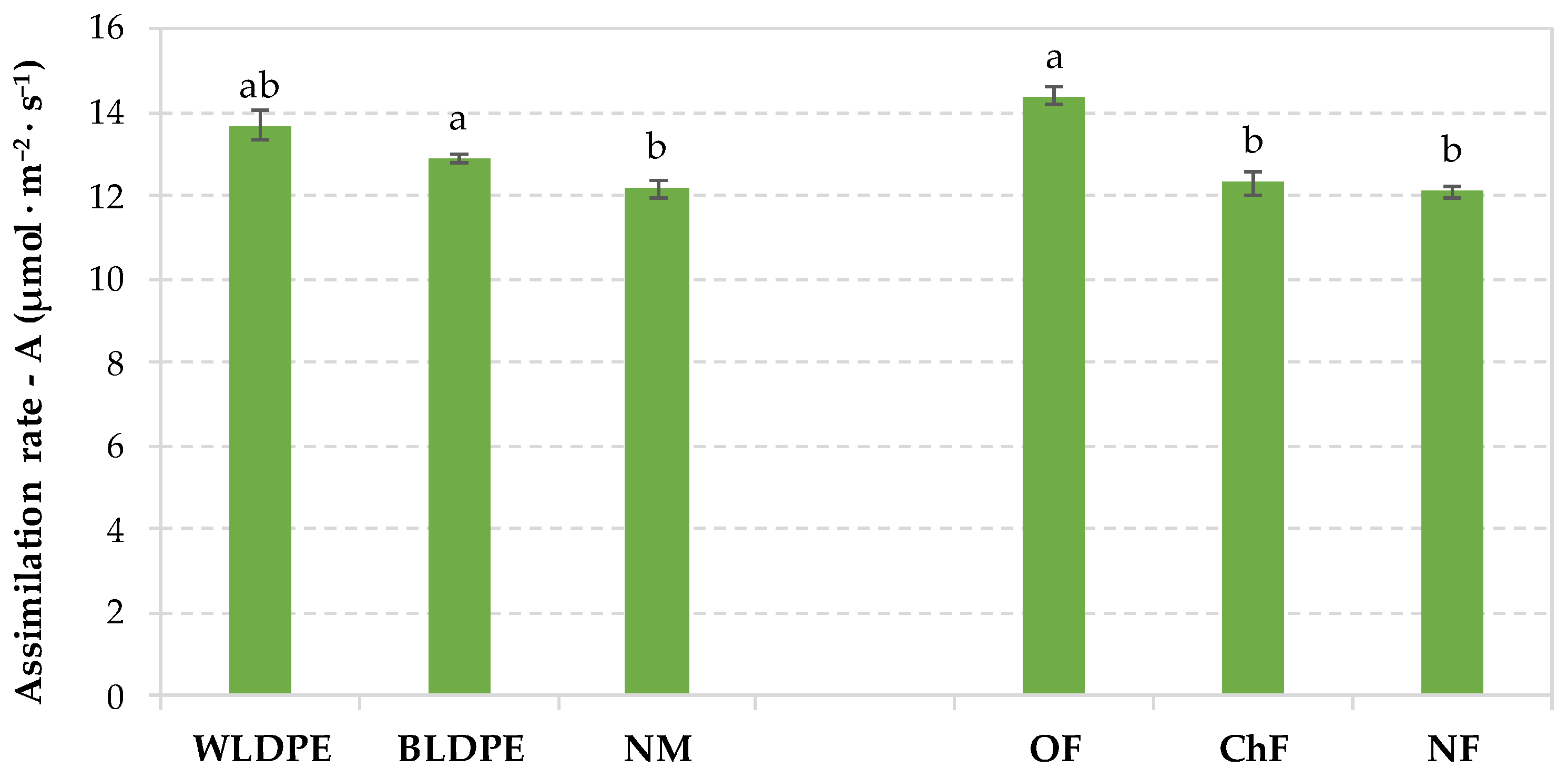
Figure 2.
Harvest dynamics under the individual influence of mulching and fertilization regimes. The values are presented as the means ± standard errors from three independent replications. Different lowercase letters (a-b) at the same harvest indicate significant differences between groups at p ≤ 0.05 according to Duncan's test, with 'a' representing the highest value. WLDPE - white polyethylene film; BLDPE - black polyethylene film; NM – nonmulched; OF – organic fertilization; ChF – chemical fertilization; NF – nonfertilized.
Figure 2.
Harvest dynamics under the individual influence of mulching and fertilization regimes. The values are presented as the means ± standard errors from three independent replications. Different lowercase letters (a-b) at the same harvest indicate significant differences between groups at p ≤ 0.05 according to Duncan's test, with 'a' representing the highest value. WLDPE - white polyethylene film; BLDPE - black polyethylene film; NM – nonmulched; OF – organic fertilization; ChF – chemical fertilization; NF – nonfertilized.
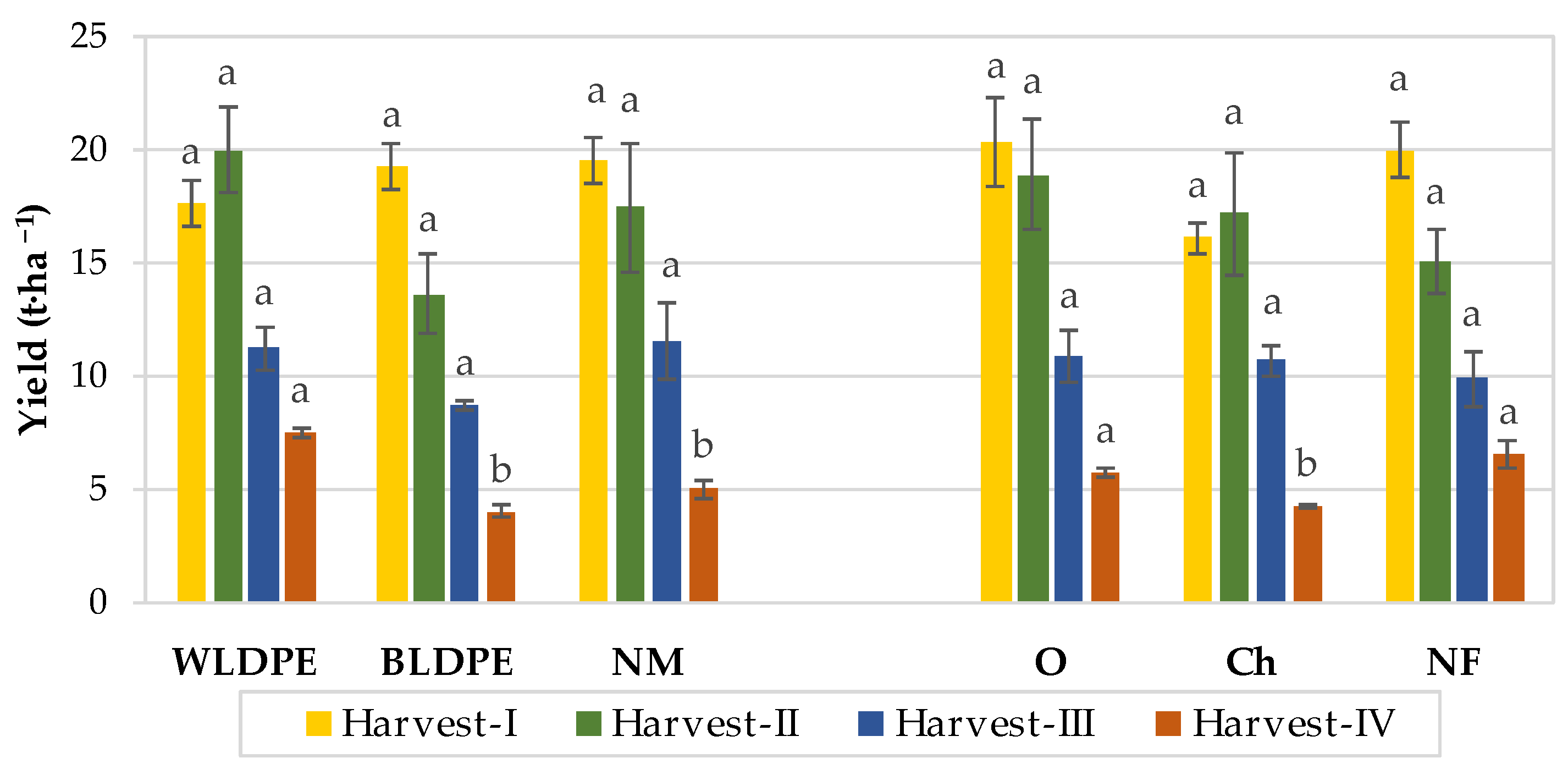
Figure 3.
Individual effects of factors on antioxidant activity in Bologna perennial wall‒rocket leaves. The values are presented as the means ± standard errors from three independent replications. Different lowercase letters within the same antioxidant activity parameter indicate significant differences between groups at p ≤ 0.05 according to Duncan's test, with 'a' representing the highest value. WLDPE - white polyethylene film; BLDPE - black polyethylene film; NM – nonmulched; OF – organic fertilization; ChF – chemical fertilization; NF – nonfertilized.
Figure 3.
Individual effects of factors on antioxidant activity in Bologna perennial wall‒rocket leaves. The values are presented as the means ± standard errors from three independent replications. Different lowercase letters within the same antioxidant activity parameter indicate significant differences between groups at p ≤ 0.05 according to Duncan's test, with 'a' representing the highest value. WLDPE - white polyethylene film; BLDPE - black polyethylene film; NM – nonmulched; OF – organic fertilization; ChF – chemical fertilization; NF – nonfertilized.
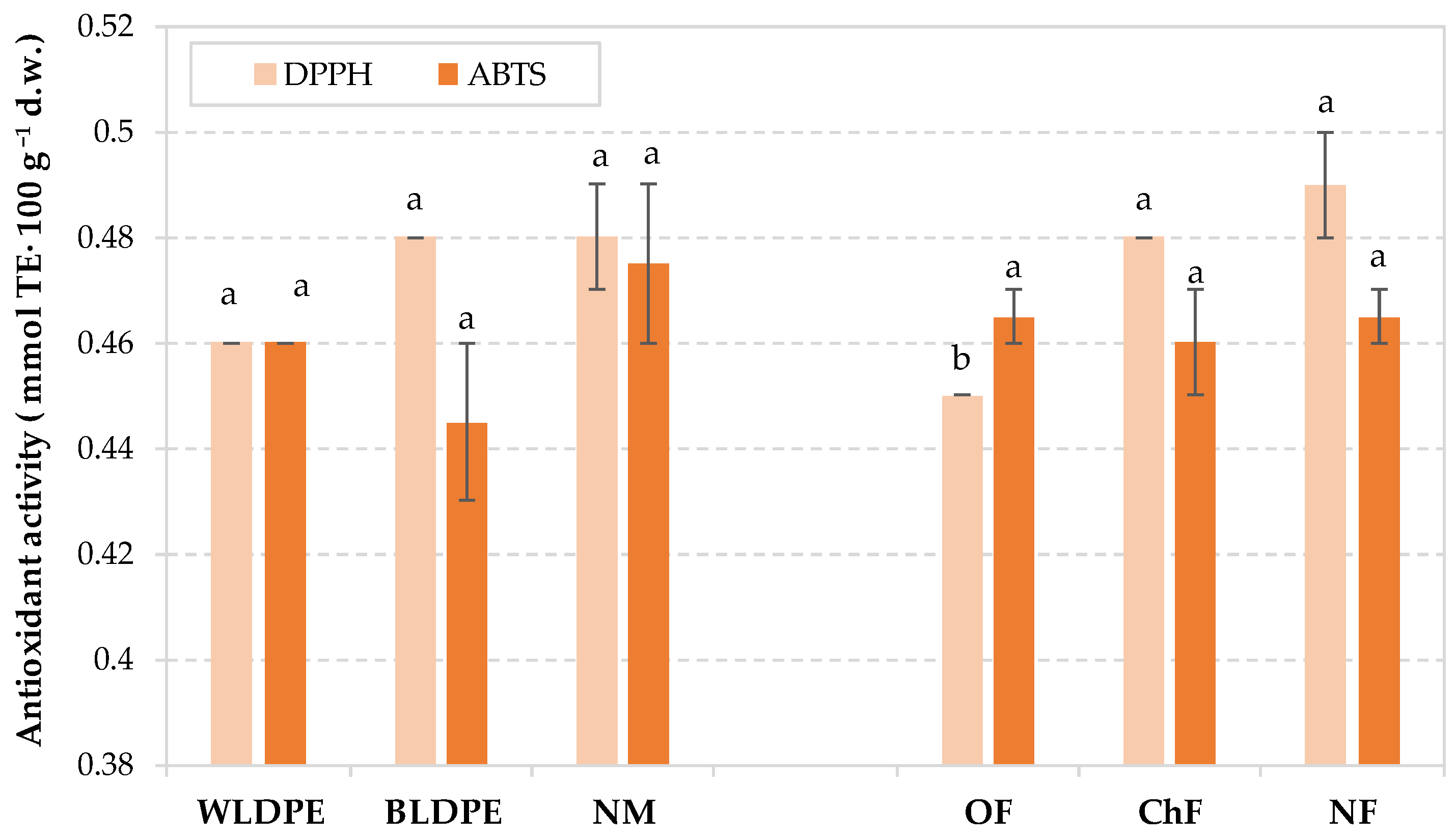
Figure 4.
Effects of factor interactions on the CO2 assimilation rate in Bologna perennial wall‒rocket leaves. The values are presented as the means ± standard errors from three independent replications. Different lowercase letters indicate significant differences between groups at p ≤ 0.05 according to Duncan's test, with 'a' representing the highest value. WLDPE - white polyethylene film; BLDPE - black polyethylene film; NM – nonmulched; OF – organic fertilization; ChF – chemical fertilization; NF – nonfertilized.
Figure 4.
Effects of factor interactions on the CO2 assimilation rate in Bologna perennial wall‒rocket leaves. The values are presented as the means ± standard errors from three independent replications. Different lowercase letters indicate significant differences between groups at p ≤ 0.05 according to Duncan's test, with 'a' representing the highest value. WLDPE - white polyethylene film; BLDPE - black polyethylene film; NM – nonmulched; OF – organic fertilization; ChF – chemical fertilization; NF – nonfertilized.
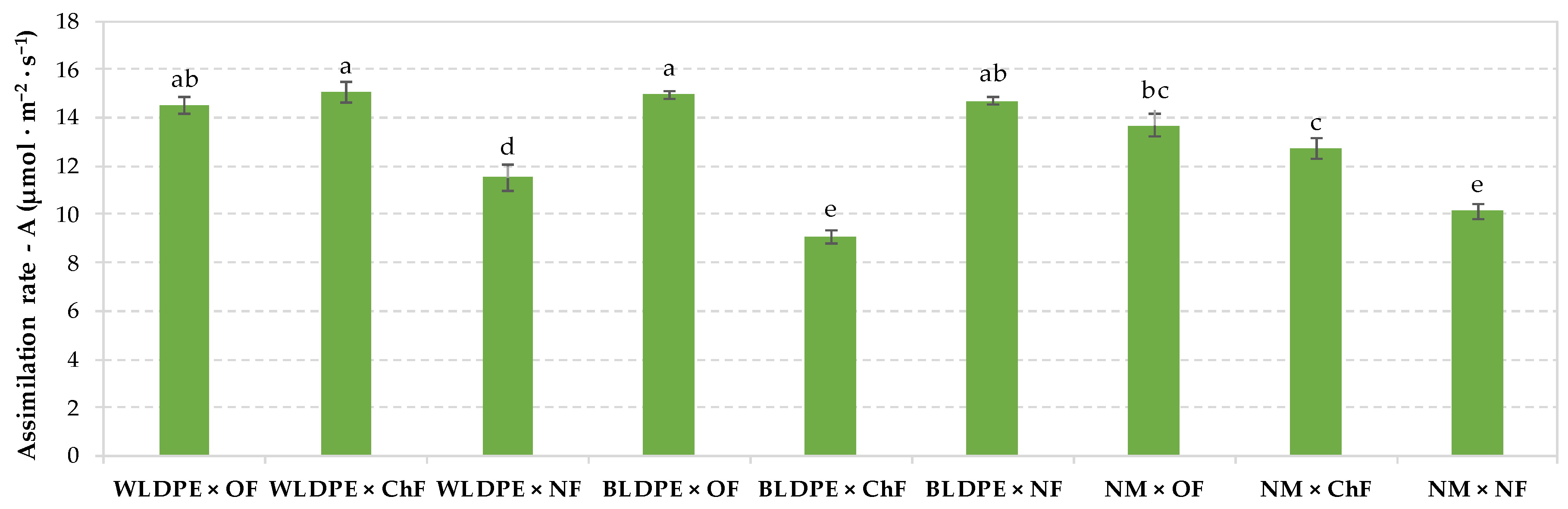
Figure 5.
Influence of factors interactions on harvest dynamics of Bologna perennial wall‒rocket. The values are presented as the means ± standard errors from three independent replications. Different lowercase letters at the same harvest indicate significant differences between groups at p ≤ 0.05 according to Duncan's test, with 'a' representing the highest value. WLDPE - white polyethylene film; BLDPE - black polyethylene film; NM – nonmulched; OF – organic fertilization; ChF – chemical fertilization; NF – nonfertilized.
Figure 5.
Influence of factors interactions on harvest dynamics of Bologna perennial wall‒rocket. The values are presented as the means ± standard errors from three independent replications. Different lowercase letters at the same harvest indicate significant differences between groups at p ≤ 0.05 according to Duncan's test, with 'a' representing the highest value. WLDPE - white polyethylene film; BLDPE - black polyethylene film; NM – nonmulched; OF – organic fertilization; ChF – chemical fertilization; NF – nonfertilized.
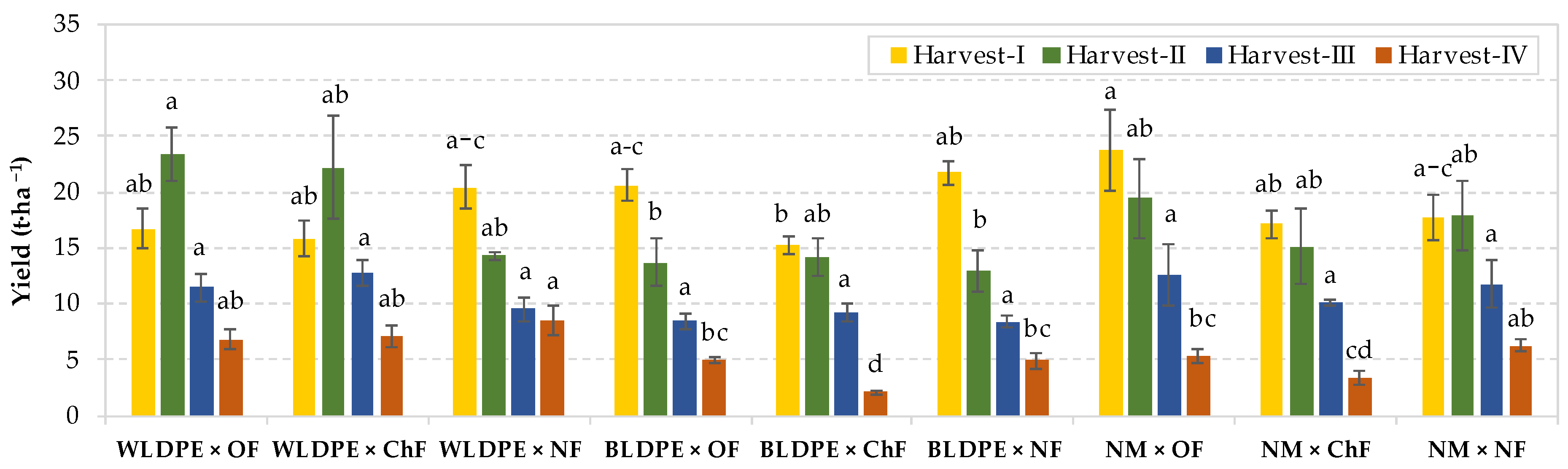
Figure 6.
Effects of factors interactions on antioxidant activity in Bologna perennial wall‒rocket leaves. The values are presented as the means ± standard errors from three independent replications. Different lowercase letters within the same antioxidant activity parameter indicate significant differences between groups at p ≤ 0.05 according to Duncan's test, with 'a' representing the highest value. WLDPE - white polyethylene film; BLDPE - black polyethylene film; NM – nonmulched; OF – organic fertilization; ChF – chemical fertilization; NF – nonfertilized.
Figure 6.
Effects of factors interactions on antioxidant activity in Bologna perennial wall‒rocket leaves. The values are presented as the means ± standard errors from three independent replications. Different lowercase letters within the same antioxidant activity parameter indicate significant differences between groups at p ≤ 0.05 according to Duncan's test, with 'a' representing the highest value. WLDPE - white polyethylene film; BLDPE - black polyethylene film; NM – nonmulched; OF – organic fertilization; ChF – chemical fertilization; NF – nonfertilized.
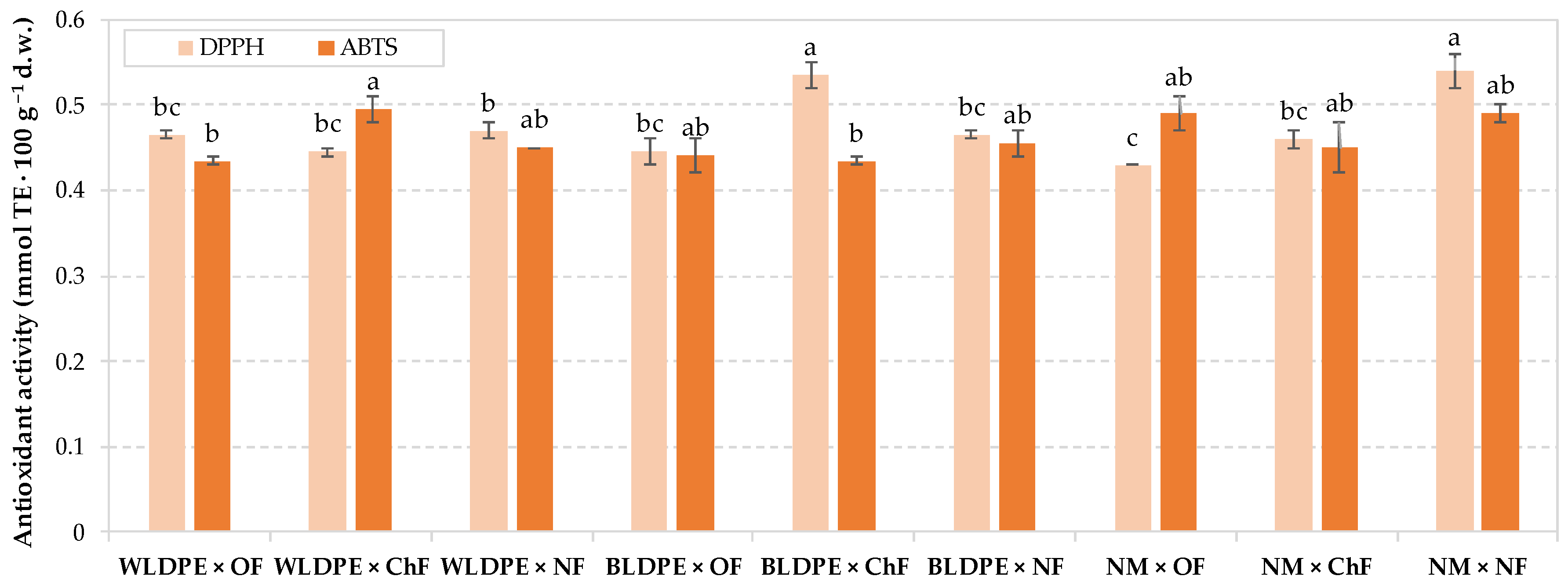
Figure 7.
Principal component analysis score plot showing the variation in growth and quality traits of perennial wall‒rocket under different mulching and fertilization treatments.
Figure 7.
Principal component analysis score plot showing the variation in growth and quality traits of perennial wall‒rocket under different mulching and fertilization treatments.
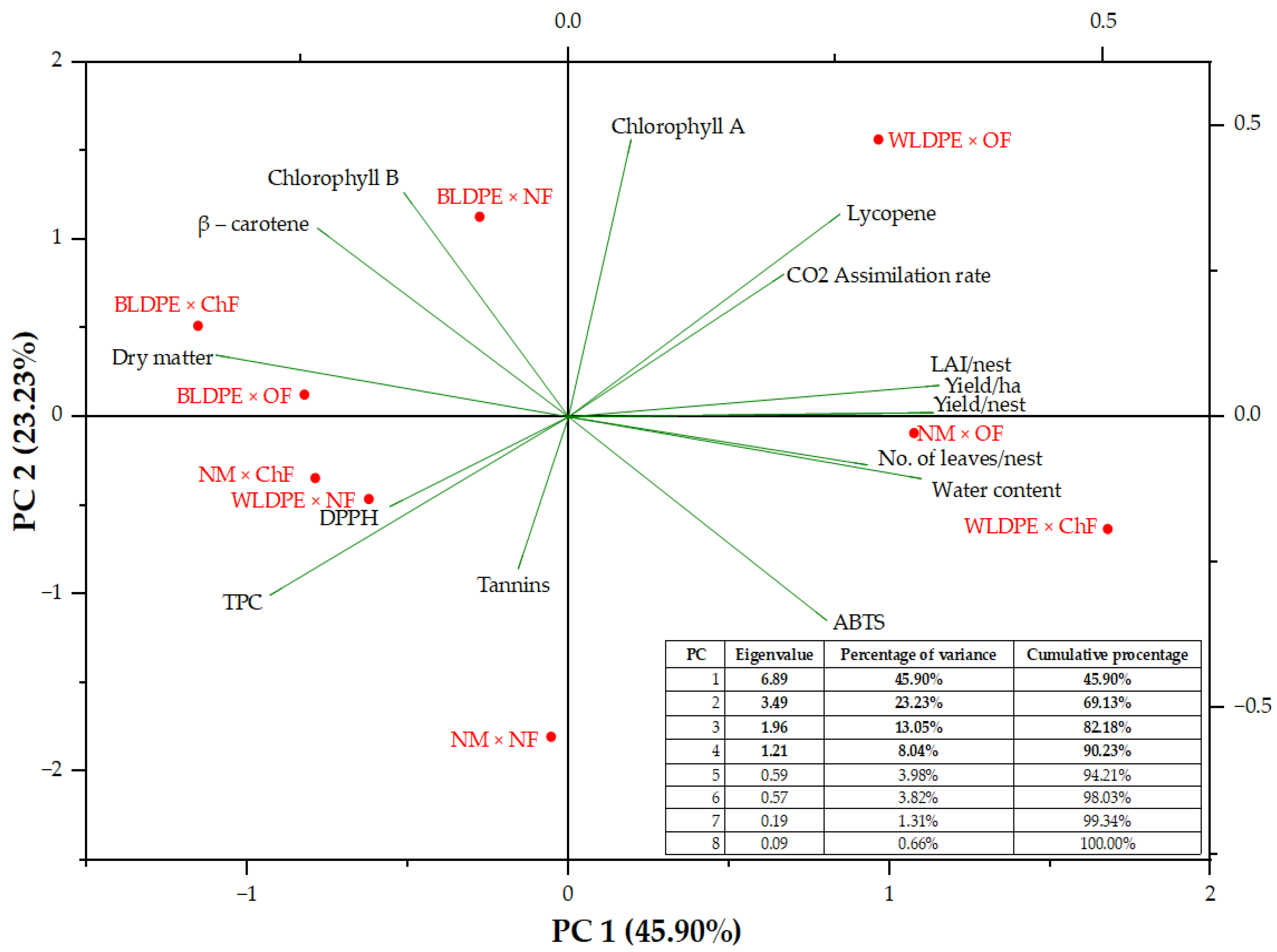
Figure 8.
PCA score plot and Pearson correlation diagram showing the variation in growth and quality traits of perennial wall‒rocket under the influence of (a) nonfertilized, (b) organic fertilization, and (c) chemical fertilization regimes.
Figure 8.
PCA score plot and Pearson correlation diagram showing the variation in growth and quality traits of perennial wall‒rocket under the influence of (a) nonfertilized, (b) organic fertilization, and (c) chemical fertilization regimes.
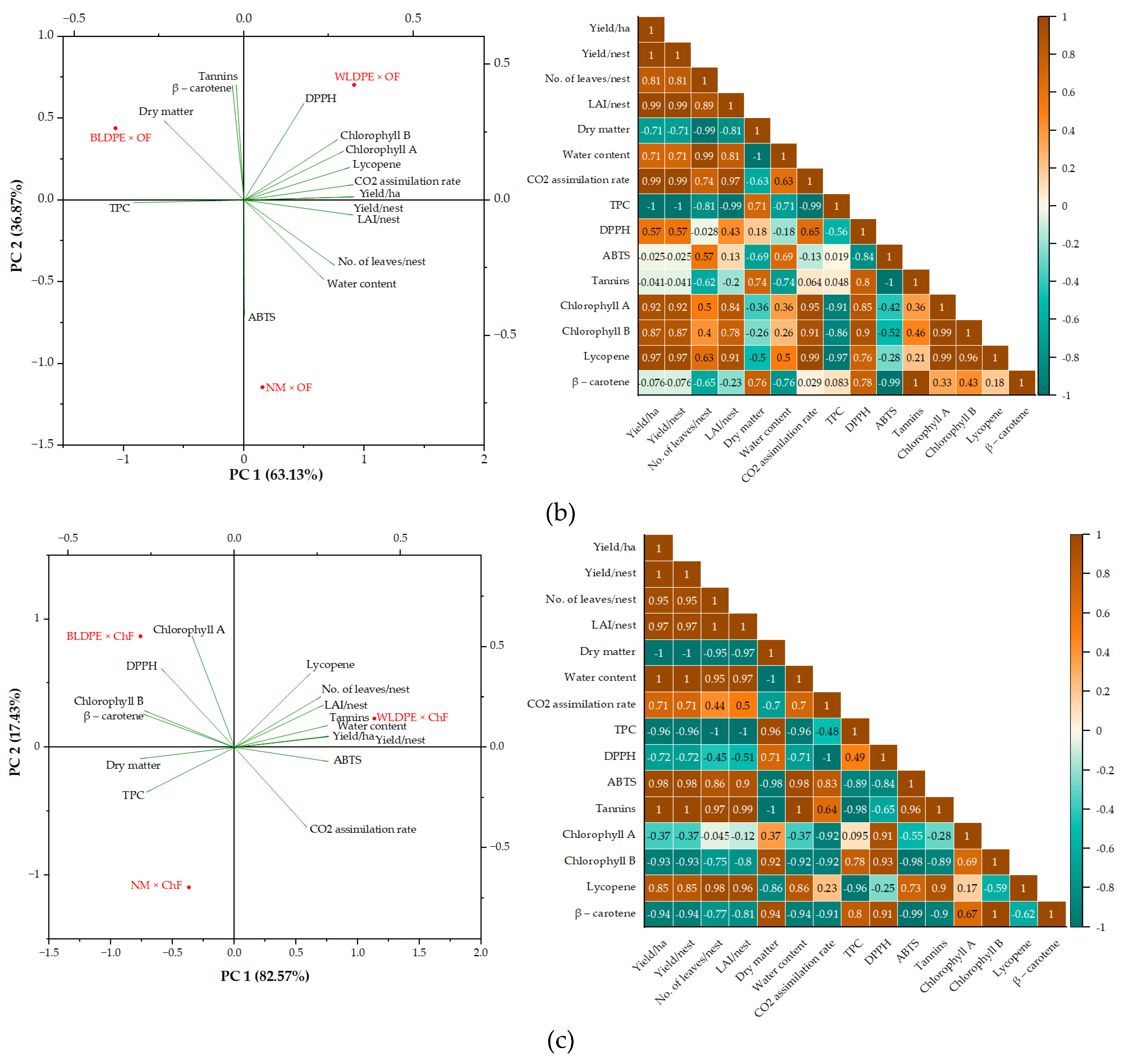
Figure 9.
PCA score plot and Pearson correlation diagram showing the variation in growth and quality traits of perennial wall‒rocket under the influence of (a) nonmulching, (b) WLDPE and (c) BLDPE mulch.
Figure 9.
PCA score plot and Pearson correlation diagram showing the variation in growth and quality traits of perennial wall‒rocket under the influence of (a) nonmulching, (b) WLDPE and (c) BLDPE mulch.

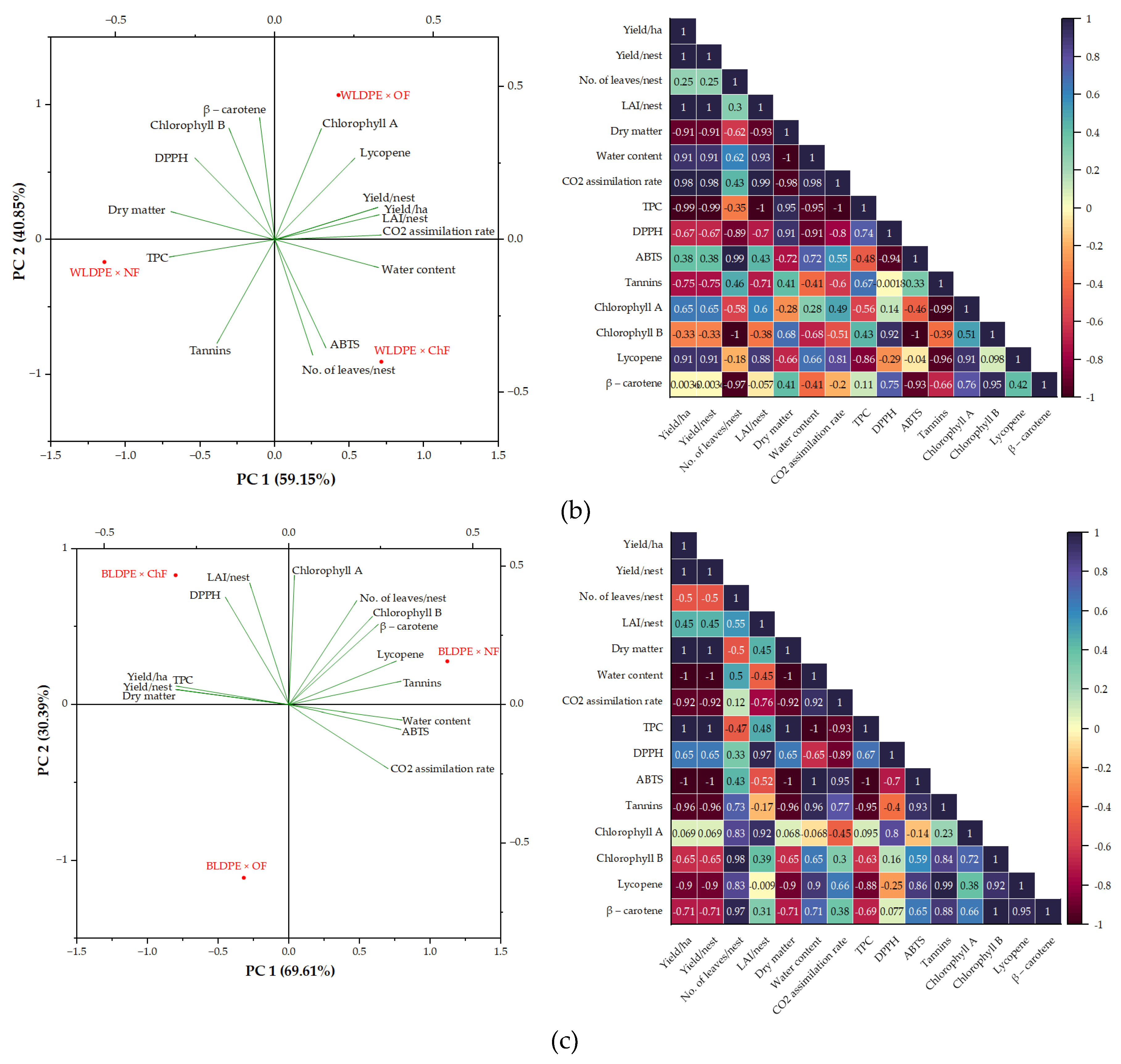
Figure 10.
Experimental protocol scheme (Original).
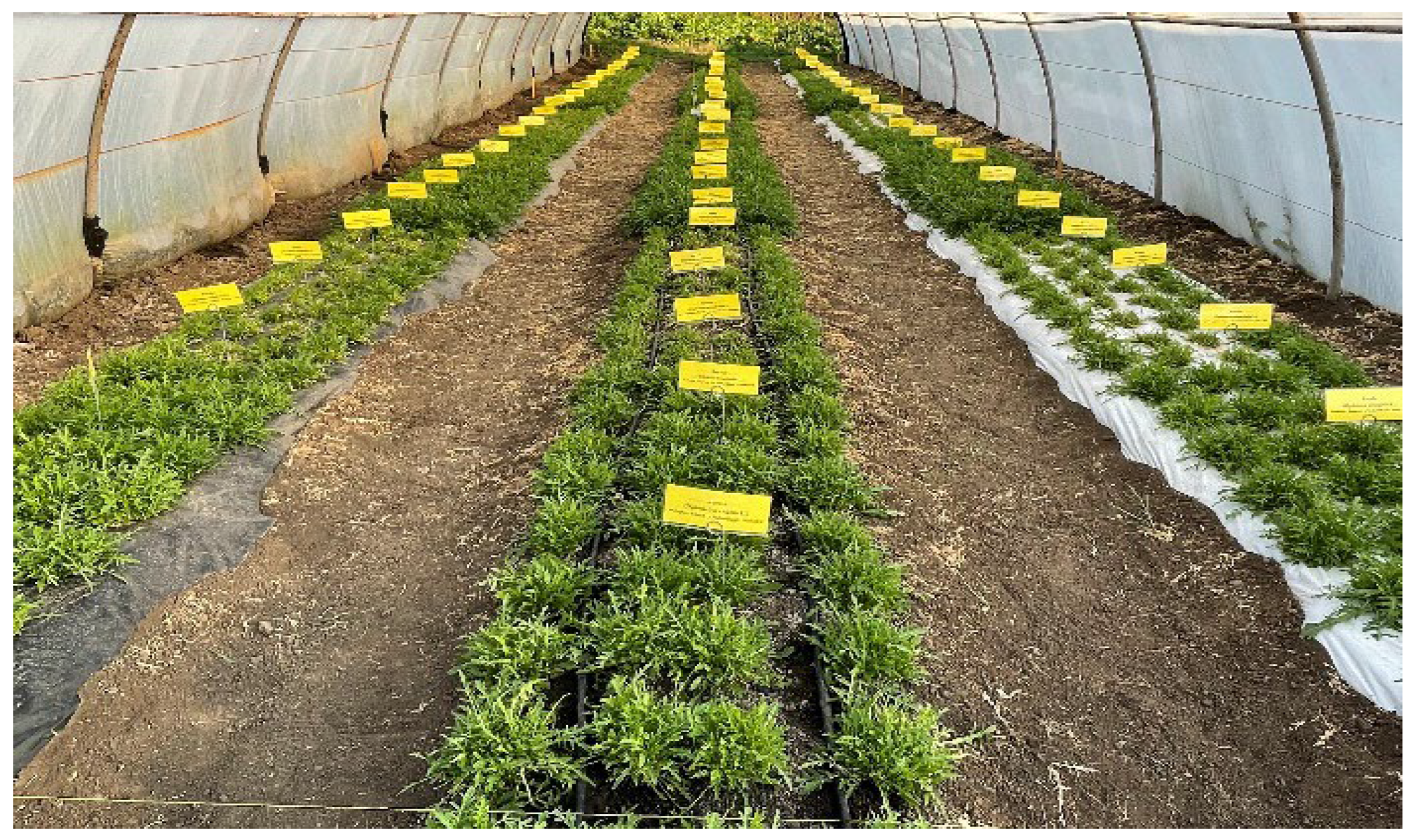
Figure 11.
Trends of the temperature and relative humidity inside the polytunnel during the experiments in (a) 2022 and (b) 2023.
Figure 11.
Trends of the temperature and relative humidity inside the polytunnel during the experiments in (a) 2022 and (b) 2023.
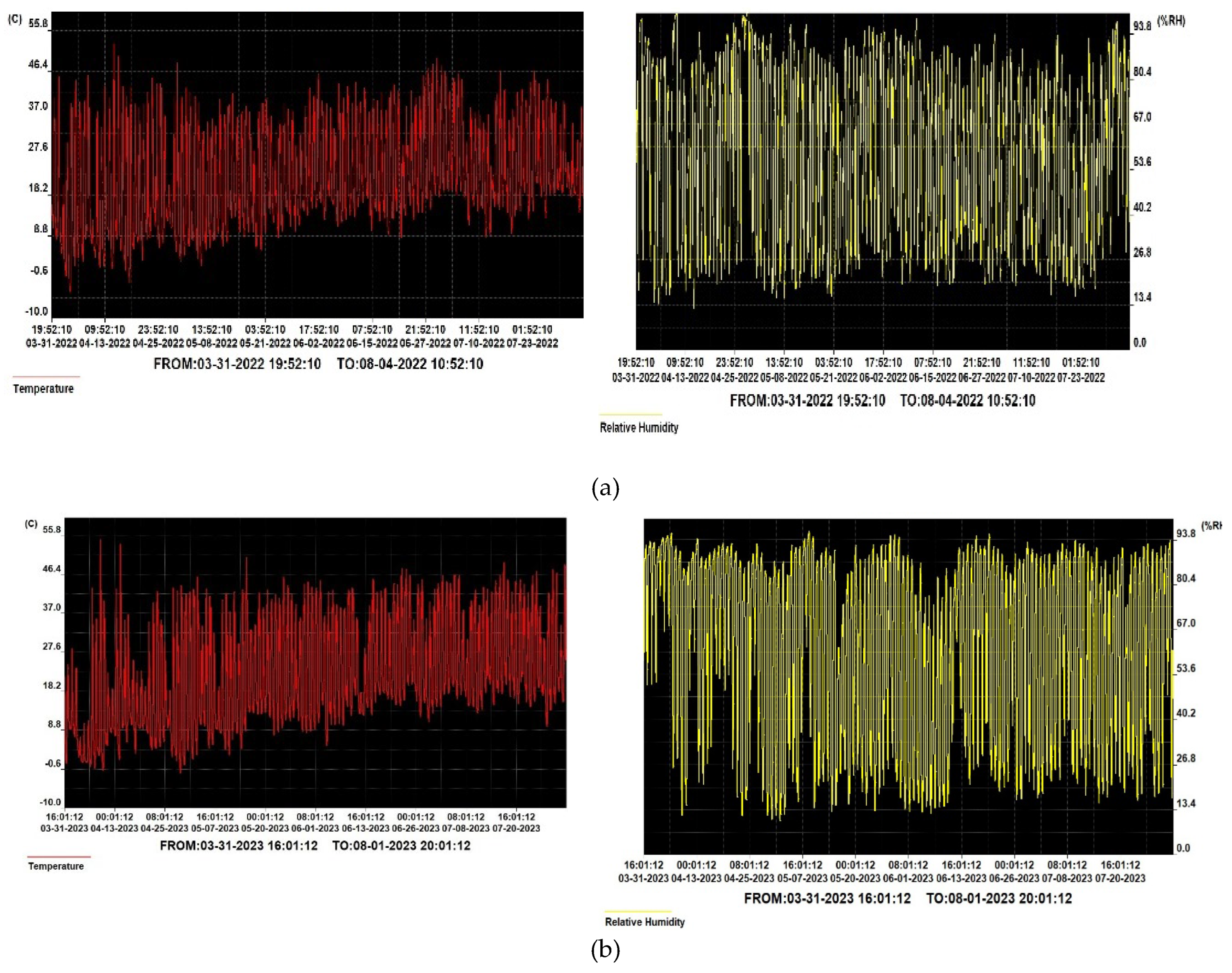

Table 1.
Individual influences of the studied factors on the agro‒morphological traits of the Bologna perennial wall‒rocket.
Table 1.
Individual influences of the studied factors on the agro‒morphological traits of the Bologna perennial wall‒rocket.
| Experimental variant |
Leaves/nest | LAI (cm2·cm−2) |
Total Yield | |
|---|---|---|---|---|
| nest (g) | t·ha−1 | |||
| WLDPE | 660.67 ± 24.20 | 11309.75 ± 416.52 a | 633.31 ± 25.22 a | 56.36 ± 2.24 a |
| BLDPE | 577.33 ± 23.30 | 9481.05 ± 269.29 b | 511.64 ± 11.76 b | 45.54 ± 1.05 b |
| NM | 634.00 ± 27.05 | 10895.45 ± 505.19 ab | 601.38 ± 42.59 ab | 53.52 ± 3.79 ab |
| Signification | ns | * | * | * |
| OF | 636.44 ± 17.77 | 11027.83 ± 330.97 | 627.24 ± 18.42 | 55.82 ± 1.64 |
| ChF | 591.67 ± 13.83 | 10090.26 ± 562.68 | 540.61 ± 39.11 | 48.11 ± 3.48 |
| NF | 643.89 ± 39.86 | 10568.16 ± 422.30 | 578.47 ± 19.98 | 51.48 ± 1.78 |
| Signification | ns | ns | ns | ns |
The values are presented as the means ± standard errors from three independent replications. Different lowercase letters in the same column indicate significant differences between groups at p ≤ 0.05 according to Duncan's test, with 'a' representing the highest value. * indicates significant differences between the compared means, whereas ns denotes nonsignificant differences. WLDPE - white polyethylene film; BLDPE - black polyethylene film; NM – nonmulched; OF – organic fertilization; ChF – chemical fertilization; NF – nonfertilized.
Table 2.
Individual influences of factors on water content, dry weight, total phenolic content and tannin contents in Bologna perennial wall‒rocket leaves.
Table 2.
Individual influences of factors on water content, dry weight, total phenolic content and tannin contents in Bologna perennial wall‒rocket leaves.
| Experimental variant | Water content (%) |
Dry matter (%) |
TPC (mg GAE·100 g−1 d.w.) |
Tannins (mmol·100 g−1 d.w.) |
|---|---|---|---|---|
| WLDPE | 91.71 ± 0.07 a | 8.29 ± 0.07 b | 1.95 ± 0.11 | 0.06 ± 0.01 |
| BLDPE | 91.05 ± 0.09 b | 8.95 ± 0.09 a | 1.98 ± 0.15 | 0.06 ± 0.01 |
| NM | 91.41 ± 0.11 ab | 8.59 ± 0.11 b | 2.04 ± 0.08 | 0.06 ± 0.01 |
| Signification | * | * | ns | ns |
| OF | 91.49 ± 0.07 | 8.51 ± 0.07 | 1.91 ± 0.12 | 0.06 ± 0.01 |
| ChF | 91.21 ± 0.08 | 8.79 ± 0.08 | 1.99 ± 0.13 | 0.06 ± 0.01 |
| NF | 91.47 ± 0.12 | 8.53 ± 0.12 | 2.07 ± 0.10 | 0.06 ± 0.00 |
| Signification | ns | ns | ns | ns |
The values are presented as the means ± standard errors from three independent replications. Different lowercase letters in the same column indicate significant differences between groups at p ≤ 0.05 according to Duncan's test, with 'a' representing the highest value. * Indicates significant differences between the compared means, whereas ns denotes nonsignificant differences. WLDPE - white polyethylene film; BLDPE - black polyethylene film; NM – nonmulched; OF – organic fertilization; ChF – chemical fertilization; NF – nonfertilized.
Table 3.
Individual influences of the studied factors on the leaf pigment content of the Bologna perennial wall‒rocket.
Table 3.
Individual influences of the studied factors on the leaf pigment content of the Bologna perennial wall‒rocket.
| Experimental variant | Chlorophyll A (mg·100 g−1 d.w.) |
Chlorophyll B (mg·100 g−1 d.w.) |
Lycopene (mg·100 g−1 d.w.) |
β-carotene (mg·100 g−1 d.w.) |
|---|---|---|---|---|
| WLDPE | 93.14 ± 1.97 | 36.00 ± 0.33 | 9.76 ± 0.21 | 4.77 ± 0.05 b |
| BLDPE | 93.45 ± 0.82 | 39.12 ± 0.83 | 9.40 ± 0.19 | 5.99 ± 0.23 a |
| NM | 87.24 ± 2.86 | 35.70 ± 1.18 | 9.17 ± 0.27 | 4.6 ± 0.26 b |
| Signification | ns | ns | ns | * |
| OF | 94.92 ± 0.15 | 37.05 ± 0.18 | 9.73 ± 0.05 | 5.03 ± 0.29 |
| ChF | 91.21 ± 2.25 | 35.81 ± 1.04 | 9.29 ± 0.19 | 4.91 ± 0.20 |
| NF | 89.25 ± 1.17 | 38.18 ± 1.02 | 9.41 ± 0.22 | 5.36 ± 0.01 |
| Signification | ns | ns | ns | ns |
The values are presented as the means ± standard errors from three independent replications. Different lowercase letters in the same column indicate significant differences between groups at p ≤ 0.05 according to Duncan's test, with 'a' representing the highest value. * Indicates significant differences between the compared means, whereas ns denotes nonsignificant differences. WLDPE - white polyethylene film; BLDPE - black polyethylene film; NM – nonmulched; OF – organic fertilization; ChF – chemical fertilization; NF – nonfertilized.
Table 4.
Effect of factor interactions on the agromorphological traits of the Bologna perennial wall‒rocket.
Table 4.
Effect of factor interactions on the agromorphological traits of the Bologna perennial wall‒rocket.
| Experimental variant |
Leaves/nest | LAI (cm2·cm−2) |
TOTAL YIELD | |
|---|---|---|---|---|
| Nest (g) | t·ha−1 | |||
| WLDPE × OF | 655.00 ± 27.75 a | 11328.77 ± 196.48 ab | 656.78 ± 10.13 ab | 58.45 ± 0.90 ab |
| WLDPE × ChF | 670.67 ± 36.55 a | 11556.13 ± 1245.31 ab | 650.73 ± 83.00 a−c | 57.91 ± 7.39 a−c |
| WLDPE × NF | 656.33 ± 28.85 a | 11044.36 ± 265.19 ab | 592.42 ± 9.34 a−d | 52.73 ± 0.83 a−d |
| BLDPE × OF | 591.00 ± 20.07 ab | 9715.37 ± 443.82 bc | 537.68 ± 23.29 b−d | 47.85 ± 2.07 b−d |
| BLDPE × ChF | 519.67 ± 35.03 b | 8842.67 ± 450.49 c | 457.10 ± 22.34 d | 40.68 ± 1.99 d |
| BLDPE × NF | 621.33 ± 29.49 ab | 9885.11 ± 513.22 a−c | 540.12 ± 22.92 b−d | 48.07 ± 2.04 b−d |
| NM × OF | 663.33 ± 31.17 a | 12039.34 ± 970.78 a | 687.26 ± 66.15 a | 61.17 ± 5.89 a |
| NM × ChF | 584.67 ± 15.07 ab | 9871.99 ± 325.64 a−c | 514.01 ± 28.82 cd | 45.75 ± 2.56 cd |
| NM × NF | 654.00 ± 66.30 a | 10775.01 ± 681.02 a−c | 602.87 ± 41.90 a−c | 53.66 ± 3.73 a−c |
The values are presented as the means ± standard errors from three independent replications. Different lowercase letters in the same column indicate significant differences between groups at p ≤ 0.05 according to Duncan's test, with 'a' representing the highest value. WLDPE - white polyethylene film; BLDPE - black polyethylene film; NM – nonmulched; OF – organic fertilization; ChF – chemical fertilization; NF – nonfertilized.
Table 5.
Effects of interaction factors on water content, dry weight, total phenolic content and tannin contents in Bologna perennial wall‒rocket leaves.
Table 5.
Effects of interaction factors on water content, dry weight, total phenolic content and tannin contents in Bologna perennial wall‒rocket leaves.
| Experimental variant | Water content (%) |
Dry matter (%) |
TPC (mg GAE·100 g−1 d.w.) |
Tannins (mmol·100 g−1 d.w.) |
|---|---|---|---|---|
| WLDPE × OF | 91.79 ± 0.01 ab | 8.21 ± 0.01 cd | 1.84 ± 0.12 | 0.06 ± 0.01 a−c |
| WLDPE × ChF | 91.95 ± 0.10 a | 8.05 ± 0.10 d | 1.84 ± 0.02 | 0.06 ± 0.01 a−c |
| WLDPE × NF | 91.39 ± 0.29 bc | 8.61 ± 0.29 bc | 2.17 ± 0.19 | 0.06 ± 0.00 ab |
| BLDPE × OF | 91.09 ± 0.20 cd | 8.91 ± 0.20 ab | 1.99 ± 0.17 | 0.06 ± 0.01 a−c |
| BLDPE × ChF | 90.73 ± 0.08 d | 9.27 ± 0.08 a | 2.05 ± 0.17 | 0.05 ± 0.00 bc |
| BLDPE × NF | 91.35 ± 0.03 bc | 8.65 ± 0.03 bc | 1.90 ± 0.12 | 0.06 ± 0.00 ab |
| NM × OF | 91.60 ± 0.01 ab | 8.40 ± 0.01 cd | 1.90 ± 0.04 | 0.05 ± 0.01 c |
| NM × ChF | 90.96 ± 0.24 cd | 9.04 ± 0.24 ab | 2.10 ± 0.20 | 0.06 ± 0.01 a−c |
| NM × NF | 91.67 ± 0.10 ab | 8.33 ± 0.10 cd | 2.14 ± 0.01 | 0.07 ± 0.01 a |
| Signification | * | * | ns | * |
The values are presented as the means ± standard errors from three independent replications. Different lowercase letters in the same column indicate significant differences between groups at p ≤ 0.05 according to Duncan's test, with 'a' representing the highest value. * Indicates significant differences between the compared means, whereas ns denotes nonsignificant differences. WLDPE - white polyethylene film; BLDPE - black polyethylene film; NM – nonmulched; OF – organic fertilization; ChF – chemical fertilization; NF – nonfertilized.
Table 6.
Effects of interaction factors on chlorophyll A, chlorophyll B, lycopene and β-carotene contents in Bologna perennial wall‒rocket leaves.
Table 6.
Effects of interaction factors on chlorophyll A, chlorophyll B, lycopene and β-carotene contents in Bologna perennial wall‒rocket leaves.
| Experimental variant | Chlorophyll A (mg·100 g−1 d.w.) | Chlorophyll B (mg·100 g−1 d.w.) |
Lycopene (mg·100 g−1 d.w.) |
β-carotene (mg·100 g−1 d.w.) |
|---|---|---|---|---|
| WLDPE × OF | 101.45 ± 3.74 a | 38.47 ± 0.90 ab | 10.16 ± 0.36 a | 5.74 ± 0.31 a−c |
| WLDPE × ChF | 89.51 ± 1.15 b−d | 32.47 ± 0.08 c | 9.73 ± 0.16 ab | 3.80 ± 0.07 d |
| WLDPE × NF | 88.45 ± 1.00 b−d | 37.07 ± 0.01 b | 9.38 ± 0.10 ab | 4.77 ± 0.09 cd |
| BLDPE × OF | 87.79 ± 2.33 b−d | 35.87 ± 0.29 bc | 9.19 ± 0.07 ab | 5.68 ± 0.55 a−c |
| BLDPE × ChF | 97.45 ± 5.17 ab | 39.05 ± 2.16 ab | 9.25 ± 0.51 ab | 5.96 ± 0.19 ab |
| BLDPE × NF | 95.13 ± 0.38 a−c | 42.45 ± 0.62 a | 9.78 ± 0.14 ab | 6.35 ± 0.33 a |
| NM × OF | 90.88 ± 0.95 b−d | 36.16 ± 0.02 bc | 9.54 ± 0.01 ab | 3.86 ± 0.19 d |
| NM × ChF | 86.69 ± 2.73 cd | 35.91 ± 1.06 bc | 8.89 ± 0.23 b | 4.98 ± 0.34 bc |
| NM × NF | 84.16 ± 4.89 d | 35.03 ± 2.45 bc | 9.07 ± 0.61 ab | 4.95 ± 0.25 bc |
The values are presented as the means ± standard errors from three independent replications. Different lowercase letters in the same column indicate significant differences between groups at p ≤ 0.05 according to Duncan's test, with 'a' representing the highest value. WLDPE - white polyethylene film; BLDPE - black polyethylene film; NM – nonmulched; OF – organic fertilization; ChF – chemical fertilization; NF – nonfertilized.
Table 7.
Eigenvalues of the correlation matrix showing the affinities of the growth and quality traits of perennial wall‒rocket to PCs.
Table 7.
Eigenvalues of the correlation matrix showing the affinities of the growth and quality traits of perennial wall‒rocket to PCs.
| Traits | Extracted Eigenvectors | |||||||
|---|---|---|---|---|---|---|---|---|
| PC1 | PC2 | PC3 | PC4 | PC5 | PC6 | PC7 | PC8 | |
| Yield/ha | 0.341 | 0.007 | 0.134 | −0.321 | −0.157 | 0.196 | 0.128 | 0.134 |
| Yield/nest | 0.341 | 0.007 | 0.134 | −0.321 | −0.157 | 0.196 | 0.128 | 0.134 |
| No. of leaves/nest | 0.279 | −0.083 | 0.148 | 0.149 | 0.763 | −0.165 | −0.176 | 0.072 |
| LAI/nest | 0.346 | 0.054 | 0.158 | −0.303 | 0.033 | −0.029 | 0.078 | 0.146 |
| Dry matter | −0.330 | 0.106 | −0.112 | −0.320 | 0.278 | 0.130 | −0.170 | 0.163 |
| Water content | 0.330 | −0.106 | 0.112 | 0.320 | −0.278 | −0.130 | 0.170 | −0.163 |
| CO2 assimilation rate | 0.201 | 0.245 | −0.407 | 0.242 | 0.016 | 0.384 | −0.016 | 0.584 |
| TPC | −0.279 | −0.306 | 0.080 | −0.093 | 0.156 | 0.003 | 0.706 | 0.166 |
| DPPH | −0.167 | −0.154 | 0.576 | −0.137 | −0.139 | −0.181 | −0.258 | 0.315 |
| ABTS | 0.241 | −0.349 | −0.048 | 0.276 | −0.146 | −0.280 | −0.255 | 0.274 |
| Tannins | −0.047 | −0.261 | 0.439 | 0.319 | 0.154 | 0.640 | −0.028 | 0.038 |
| Chlorophyll A | 0.058 | 0.476 | 0.257 | −0.158 | 0.073 | −0.185 | −0.104 | 0.099 |
| Chlorophyll B | −0.154 | 0.385 | 0.189 | 0.360 | −0.021 | −0.301 | 0.374 | 0.390 |
| Lycopene | 0.254 | 0.348 | 0.171 | 0.129 | 0.217 | 0.084 | 0.213 | −0.413 |
| β — carotene | −0.234 | 0.324 | 0.249 | 0.199 | −0.267 | 0.248 | −0.213 | −0.093 |
Disclaimer/Publisher’s Note: The statements, opinions and data contained in all publications are solely those of the individual author(s) and contributor(s) and not of MDPI and/or the editor(s). MDPI and/or the editor(s) disclaim responsibility for any injury to people or property resulting from any ideas, methods, instructions or products referred to in the content. |
© 2025 by the authors. Licensee MDPI, Basel, Switzerland. This article is an open access article distributed under the terms and conditions of the Creative Commons Attribution (CC BY) license (http://creativecommons.org/licenses/by/4.0/).
Copyright: This open access article is published under a Creative Commons CC BY 4.0 license, which permit the free download, distribution, and reuse, provided that the author and preprint are cited in any reuse.


