

Submitted:
07 January 2025
Posted:
08 January 2025
You are already at the latest version
Abstract
Project completion on schedule and within budget is always an accomplishment. Several building projects overspent their budgets. Cost overruns in road-building projects are common despite their detrimental impact on the construction sector. This report examines global cost overruns, finds local reasons, assesses and analyses them by relevance, and recommends practical mitigation strategies for top construction parties in Oman, including "clients," "consultants," and "contractors." A comprehensive literature review and local road practitioners helped identify 52 reasons. These theories were explored using a cross-sectional questionnaire given to 85 road specialists, who prioritized the factors by local cost overrun significance. The study found that the top five issues in Oman include contractors not being paid on time, incomplete design at bidding, design defects, cost miscalculation, and financial problems. This survey also found substantial agreement among project partners on the most important causes. SPSS 24.0 and MS Excel were used to examine quantitative data in four phases utilizing the relative significance index, mean value, chi-square test, and bivariate analysis. The pioneering character of this research will benefit road construction management. society because it provides a good starting point for local academics, identifies local road construction management deficiencies, and offers practical mitigation methods to avoid cost overruns. The results imply that project parties must enhance planning, budgeting, engineering design, terrain analysis, and compliance with new rules by using technology effectively.
Keywords:
costs overrun causes
; construction projects roads
; construction projects
1. Introduction
The research benefits the road construction management community by providing insights, highlighting flaws, and proposing solutions to reduce cost overruns. Cost refers to the money a customer agrees to pay for building or buying a facility. Cost overrun, often known as budget overrun, refers to unforeseen expenses that exceed the budgeted amount owing to inaccurate cost assessment during the budgeting phase as stated by [1,2,3]. It is the difference between the initial predicted cost and the actual cost at the end of a project. Cost overruns may occur due to underestimating the actual project costs, including high maintenance expenses for equipment. Cost overruns in construction projects globally pose significant challenges for both developed and developing nations. These overruns significantly impact stakeholders such as clients, contractors, and consultants, leading to potential litigation, cash flow challenges, and disagreements. Cost overruns are particularly prevalent in low-income countries, where budgets often surpass 100% of the projected project expenses [4,5,6,7]. For years, Oman’s construction sector has struggled with cost overruns, with costs rising by 28.61% from their initial estimates; exceeding the project’s budget might have financial ramifications, affecting the entire country’s budget. Cost increases might result in an increased capital-output ratio for the entire economy. There is a scarcity of research on cost overruns in building projects, notably road projects, in Oman. As a result, conducting studies on cost overruns in Oman’s construction sector is critical for understanding the reasons and proposing efficient remedies. Cost overruns are a major concern in the worldwide construction sector and are caused by a variety of variables. Improper planning, material pricing variations, design modifications, and weather conditions are among the leading culprits.
International exposure of cost overturns
In Saudi Arabia, the low-bid procurement technique was recognized as the primary culprit, resulting in modification orders, scope deviation, and inaccuracies in the bid’s commercial offer [8]. In India, the main causes were land acquisition, tender cancellation, poor contractor mobilization, equipment assembly, funding challenges, legal issues, equipment supply delay, scope creep, forest clearance, delayed construction progress, and cost inflation.
In Afghanistan, important factors included corruption, customer payment delays, contractor finance issues, modification orders, and security [9,10]. The major causes identified in Malaysia include the design modifications, project delays, disputes between project participants, changes in material prices, inadequate project planning, an inexperienced team, the complexity of construction work, poor cost estimation, poor project management, poor site management, delayed material procurement, site conditions, and a lack of personnel
Critical cost overruns in Bahrain included design revisions, construction blunders, timetable delays, inadequate supervision and site management, inaccurate time and cost estimates, preparatory delays, and design approval during the procurement process [14,15,16]. In poor nations, material price changes were determined to be the most significant driver of cost overruns.
In the UAE, [11] conducted a structured questionnaire survey to investigate the causes of cost overruns in road projects and suggested potential remedies. They used the Importance Index (II) to rank the top ten causes, and they discovered that sluggish decision-making was the most significant source of cost overruns, among others.
According to [11], 41 variables contribute to cost overruns in road projects in Saudi Arabia and Jordan. The most crucial concerns were administrative challenges, past-due payments, a lack of communication among construction partners, and decision-making delays. The UAE instance demonstrated that decision-making delays are a major factor contributing to cost overruns in road construction. However, financial and payment concerns were not significant in the UAE instance.
In Jordan, the most significant sources of cost overruns were topographical conditions, weather conditions, variation orders, labour availability, design flaws, projected project costs, market circumstances, material price variations, scheduled project timeline, and emergency works as discussed by [12,13]. The delay in decision-making had a small influence on cost overruns in Jordan’s road projects, ranking 17th out of 19 categories.
The research methodology, specifically the mechanism for rating factors, is not clearly defined. The detected cost overrun reasons are lower than in the UAE and Saudi examples; however, more components should be found and quantitative research methods used. The outcomes should be discussed in order to identify links between the acquired results. [14,15,16] looked at the reasons for cost overruns in road projects in Ethiopia, Jordan, and the UAE.
They found 40 variables contributing to cost overruns, with the top six ordered from most crucial to least critical. These problems include material price fluctuations, cost underestimation, material supply delays, inadequate contract document review, lack of collaboration throughout design, and poor cost planning.
In Ethiopia, Jordan, and the UAE, poor project time estimation is the leading source of cost overruns. In Jordan and Ethiopia, material price variations and inadequate cost planning are the most important causes. The top ten key reasons for cost overruns in India [17,18,19] include land acquisition, cost escalation, delayed payments, force majeure, design modification, utility relocation, rise in quantity volume, material availability, design flaws, and interest rate variations. Design flaws are ranked among the top ten reasons for cost overruns in the UAE, Jordan, and India. In India and Saudi Arabia, payment delays are the most common issue. Weather and site circumstances are among the leading factors in Jordan and India. The study technique, data analysis, and outcome discussions were all well-presented.
Comprehensive suggestions were issued to address the top ten major reasons for cost overruns. The results were validated twice using RII and MV analysis to ensure correctness. [16] found nine key sources of cost overruns in highway projects throughout Pakistan, India, Jordan, and the UAE. They employed quantitative and qualitative research methods to identify 30 common causes and devise mitigation strategies. The study discovered that design errors, slow decision-making processes, client financial difficulties, owner interference, decision-making delays, material fluctuations, poor contract management, design mistakes, and labour shortages were the leading causes of cost overruns in Pakistan, India, and Jordan. In Nigeria, [20] found numerous key drivers of cost overruns in road-building projects, including inflation, material price changes, government policies, and variation orders. Material price variations are regarded as important reasons for cost overruns in Nigeria, Pakistan, Ethiopia, and Jordan since they are external elements controlled by the global market and should be factored into the project budget early on. Government-related difficulties, policy changes, and rising material prices are all key reasons for the cost overrun.
2. Materials and Methods
The research approach entails using both quantitative and qualitative methodologies to analyse and comprehend the perspectives of participants on a topic. Qualitative research helps academics comprehend the underlying meaning of human experience and provide theoretically rich findings, whereas quantitative research allows researchers to classify data by gathering numerically backed information. Data is obtained from both primary and secondary sources, with primary data coming directly from respondents and secondary data coming from books, the internet, and documents. This study utilized both primary and secondary data. The questionnaire has a brief introduction, a demographic part, and a section on the reasons for cost overruns. Variables in the questionnaire include gender, age, education level, job experience, tenure, nationality, and organization type. The expenses overrun reasons section lists the most crucial causes of cost overruns in Oman’s road projects, which are further classified into five categories: client-related, contractor-related, design-related, other stakeholders-related, and external-related.
The study focusses on investigating the causes of cost overruns in road construction projects in the Sultanate, specifically examining the Muscat branches of selected organizations. A questionnaire was created to collect demographic information and rate the relevance of 52 identified cost overrun factors using a Likert scale. The sample size was estimated using Krejcie and Morgan’s estimation formula, which was then applied to the chosen population. The questionnaire was separated into two sections: demographic information and cost-overrun factors. Section 1 requested respondents to answer seven multiple-choice questions on demographics, education level, and organization type. Section 2 asked respondents to rate the relevance of the 52 identified cost overrun factors on a 4-point Likert scale. The questionnaire was delivered to road professionals in three groups: 40 clients, 35 consultants, and 38 contractors. The overall response rate was 75.22 percent, with contractors receiving the fewest replies . Contractors received the lowest rating when compared to customers and consultants, which might be attributed to contractor unavailability and the rearrangement of work environments and business processes. Cronbach’s alpha was used to assess the reliability of the replies, and it returned a reliability number of 0.959. The study’s goal is to determine the most significant cost overrun sources and their influence on road building projects in the Sultanate
3. Results and Discussion
Most respondents were male, with 83.5% falling within the age range of 25-35. Young people and middle-aged adults were the majority, accounting for 11.8% of the total samples aged 47-57 as shown in Table 1.
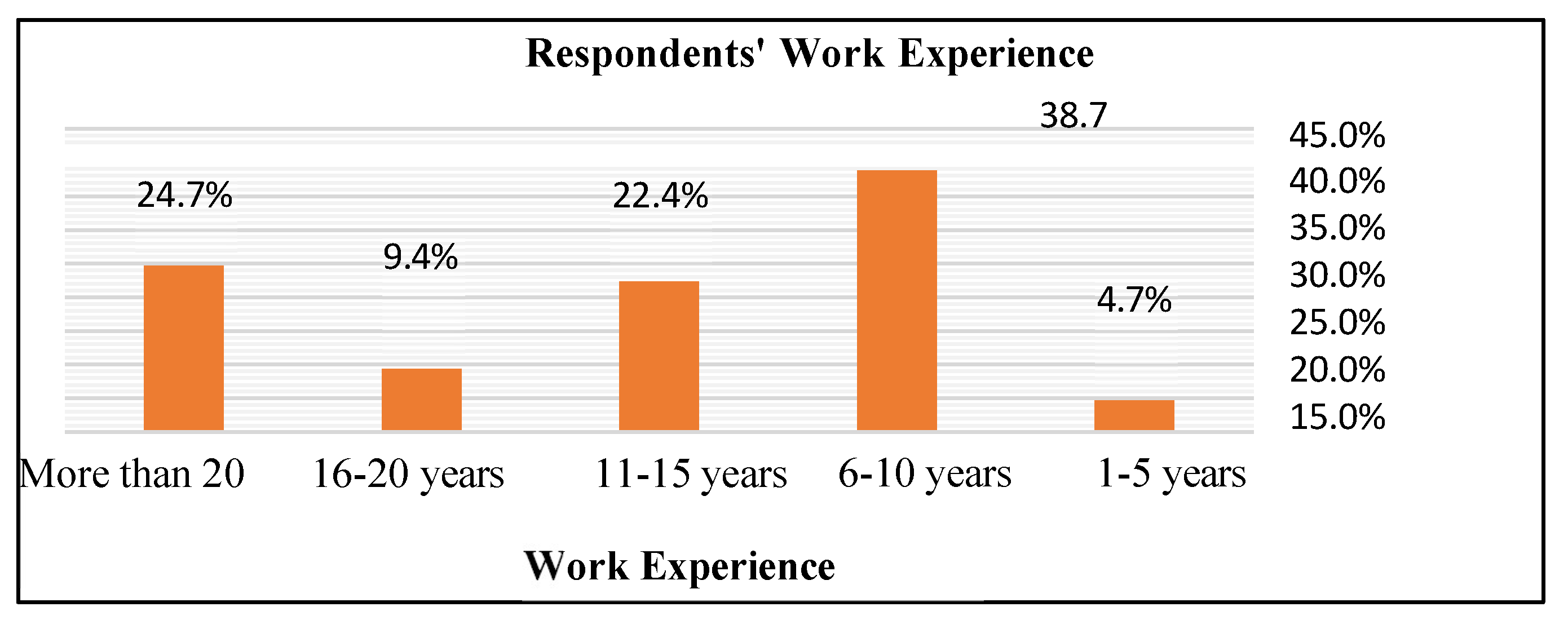
Work experience varies by organisation, with 38.7% having 6–10 years and 24.7% having more than 20 years. However, individuals with 11–15 years and 16–20 years of experience accounted for 22.4% and 9.4% of the samples, respectively. Most respondents had a decent understanding of construction management and were aware of cost overrun issues in road projects as mentioned in Figure 1.
9% of respondents held top management roles, 21% were project managers, and 6% were construction managers. Most respondents had a bachelor’s degree, including 28.2% senior engineers, 15.3% project managers, 12.9% engineers, 7.1% top management, 2.4% construction managers, and 1.2% resident engineers, and the percenatge of the repsondents are shown in Figure 2 and Figure 3 respectively.
Education levels varied, with most respondents possessing a bachelor’s degree, including 28.2% senior engineers, 15.3% project managers, 12.9% engineers, 7.1% top management, 2.4% construction managers, and 1.2% resident engineers.
The study focusses on the most significant reasons for cost overruns in road construction projects in Oman. The central tendency values were calculated using SPSS 24.0 and then used to find the most often seen scores. The results were categorized into three groups based on impact levels: highly impactful causes (RII > 0.700), moderately impactful causes (RII between 0.600 and 0.700), and low-impact causes (RII < 0.600).
The RIIs are divided into three categories: causes with very high impact (the most crucial causes) with RIIs greater than 0.700, causes with average to high effect (RIIs between 0.600 and 0.700), and causes with very low to low impact (RIIs less than 0.600). Table 3 and Table 4 lists the prioritised causes and their RIIs, which are depicted by a radar diagram shown in Figure 4.
According to the graphic, the majority of the causes fall somewhere between medium and extremely high impact. The average central tendency values show that the most common scores fall between medium effect (scale=2) and high effect (scale=3), with mean, median, and mode values of 2.26, 2.22, and 2.50, respectively. The data will be analysed to recommend cost-cutting solutions that may benefit parties involved in road development in Oman.
The report reveals the top 10 most significant reasons for cost overruns in road building projects in the Sultanate of Oman. These include contractor non-payment (overdue/delay payments), incomplete design at the time of tender, design errors, cost underestimation, funding difficulties, slow decision-making, time underestimation, design changes due to faulty design during construction, external related factors like COVID-19, improper project planning, uncontrolled design changes, time underestimation for completing the project, other stakeholders’ slow decision-making, unknown soil, and physics.
The most significant causes of cost overruns are attributed to clients, designers, contractors, external factors, and other stakeholders. Clients are viewed as the most accountable party for cost overruns, accounting for 33% of the five identified sources. Contractors are not committed to paying contractors on time, resulting in late payment fees and the potential loss of payment discounts. Late payments could disrupt financial flow, leaving contractors unable to pay suppliers, subcontractors, and employees, potentially resulting in project failure.
Payment delays are a major cause of cost overruns in Saudi road projects, with many contractors arranging payments through bank loans and suffering additional costs owing to penalty rates. Failure to pay contractors can lead to construction businesses going bankrupt [21,22,23,24,25]. Overdue payments can be caused by unrealistic cash flow, poor financial management, inability to generate funds, failure to follow prescribed processes, and failing to agree on accomplished job estimates.
[26,27,28,29] discovered that financial challenges experienced by clients are significant drivers of cost overruns in highway projects in Pakistan and Oman. The shifting oil prices have worsened the budget deficit, resulting in delayed payments to road contractors. In 2015, Oman lost $10 billion in revenue when oil prices fell. Intermittent stoppages owing to cash flow issues and delays in progress payment to contractors are the primary reasons for project delays, resulting in cost overruns [30].
Another issue is that the customer makes slow decisions and follows lengthy and unneeded practices. This might result in cost overruns owing to anticipated claims from contractors and the client’s organisational structure. Another important reason for cost overruns is poor project planning, which includes insufficient timetables and poorly defined budgets [31,32,33]. Underestimating the project’s completion time is also important since it affects project expenditures and contract price.
Road construction is linear, requiring enormous building sites that overlap with urban designs. Land acquisition concerns have a significant influence, with many projects delayed due to landowners’ reluctance to transfer their property or negotiation for compensation. In Oman, several projects are approved by the Ministry of Finance but are delayed owing to land constraints, resulting in excessive expenditures [34,35,36]. To resolve these concerns, the customer asked NESPAK, the design and construction supervisor, to provide extra consulting services and modify the remaining lengths to meet the most recent Oman Highway Design Standards.
Design difficulties are the second most common source of cost overruns in road construction. These difficulties include incomplete design at the tender stage, design flaws, design modifications caused by defective design during construction, uncontrolled design changes, and insufficient ground investigations. Incomplete design during the tendering stage causes repeated revisions to the projects, resulting in cost overruns. Incomplete contract agreements raise the possibility of significant cost overruns, resulting in claims, extra pay, and conflicts between customers and contractors.
Design faults lead to claims and litigation expenses, and there is a strong association between design errors and design modifications caused by bad design during construction. Changes made after construction began are more difficult and expensive to implement, resulting in delays, wasted materials, and disagreements amongst stakeholders [37]. Uncontrolled design modifications have a significant influence on cost overruns since they may not be properly recorded, quantified in terms of value, or represented in budget revisions.
Inadequate ground investigations are another major source of cost excess. Insufficient findings in geotechnical research reports might result in unanticipated excavation tasks, particularly in mountainous locations with difficult morphology. Unexpected work can increase project expenses and cause delays. As a result, it is critical for clients to be aware of these design concerns and take the appropriate actions to mitigate their influence on the project.
Unexpected topographical conditions, such as rock fall and unstable soils, are among the leading reasons for cost overruns in road construction in Oman. These circumstances, which might be the result of subpar ground investigations or unexpected terrain characteristics, may force contractors to confront physical limits. This can result in modifications to building processes, design revisions, and improved real site conditions.
Cost overruns in road construction vary according to region, laws, and policies. However, some countries have similar causes, such as contractors not being paid on time, incomplete design at tender, design errors, cost underestimation, funding difficulties, slow decision-making by stakeholders, right of way and land acquisition issues, and late stakeholder requests [38]. The most researched nations are neighbours that share comparable building characteristics, customs, and legislation and policies. However, bureaucracy, laws, and policies cause delays in decision-making. The most common reasons for cost overruns in road projects are financial and economic difficulties such as inflation, currency rates, excessive loan interest rates, economic instability, and corruption. The critical Costs Overrun Causes between Oman and other Countries are sdisplayed in Table 5.
The study utilised the Kendall Coefficient of Concordance (W) to assess the agreement in ranking 52 cost overrun factors among customers, consultants, and contractors as shown in Table 6. The findings revealed that the most significant reasons for cost overruns in road projects are financial and economic difficulties such as inflation, currency rates, excessive interest rates on loans, economic instability, and corruption.
This study aims to determine the level of agreement among three observers in evaluating the causes of cost overruns. The two primary hypotheses are the null hypothesis (H0) and the alternative hypothesis (H1), with the former asserting that there is no link in ranks and the latter stating that there is. The null hypothesis is rejected if its probability is equal to or less than the significance threshold (p), which often ranges between 0.05 and 0.01. The threshold of significance used in this study is 0.05.
To calculate the Chi-Square (X2) value, and the Chi-Square distribution table to determine the likelihood of the null hypothesis being valid. The degrees of freedom for the cost overrun factors in this study are higher than those indicated in the Chi-Square distribution table. Bivariate analysis was used to show the link between two variables and how much the difference in one variable corresponds with the difference in the other variable. The findings show various variables with substantial connections, including contractors not paid on time vs. funding challenges, design flaws vs. design revisions caused by bad design during construction, and cost underestimation vs. time underestimation.
A substantial association was identified between client finance challenges and contractor payment delays, with a Pearson’s r coefficient of 0.533, showing a positive linear relationship between the two factors. This signifies that the pending contractor payments and late payments issue can only be handled if the customer gets all project funding.
This means that when design errors and omissions rise, modifications in design during the building phase increase in a direct proportion. To limit these revisions, consultants and clients can increase the quality of their designs, drawings, and reports.
Cost and time underestimate are likewise highly associated, with a Pearson’s r correlation of 0.594. This means that as contractor planners’ failures to estimate project duration rise, so do contractor cost engineers’ failures to estimate project cost. Contractors may better anticipate their project budgets by engaging qualified planning engineers to correctly forecast project length, construction activities, and resource allocation. This includes:
- Overdue/delayed contractor payments: clients should not begin any project without sufficient cash, plan projects based on existing financial resources, and factor in contingency provisions when developing project budgets.
- Incomplete design at the time of tender: Clients should retain a professional and qualified consultant to develop tender and contract documentation, including a preliminary design rather than a concept design.
- Design errors: When choosing a consultant, clients should re-examine selection criteria, form a separate panel of design specialists, and include technology such as BIM into the project.
- Cost underestimation: Contractors can improve their cost estimating procedures by using worldwide standard norms when creating BOQs, such as NRM.
Contractors should track cost performance by keeping records of finished projects and implementing technologies such as BIM and CostX tools to ensure accurate predictions. This will maximise contractors’ profits. To solve financing issues, customers should develop strategic goals in collaboration with the government and construct a financial management system to track cash flow and forecast budget shortfalls. The government could also implement measures to expedite loan release for infrastructure projects. Clients should practise agile decision-making to encourage cooperation and efficiency. Contractors should recruit experienced planners and create a database of prior projects. Hiring experienced designers and factoring in contingency plans for unexpected events might help to solve time underestimation.To eliminate design flaws during construction, customers should select qualified designers, perform a thorough design review, and include a condition requiring the usage of BIM software on all projects. COVID-19 situations should be addressed by working with all parties involved, creating new rules, and assisting contractors in gaining relevant permissions.Improper project planning may be addressed by implementing technologies such as Primavera 6 and educating employees to improve the planning process. Clients should create a clear scope of work, establish communication channels with design team members, and implement a design change management strategy.
Finally, clients should have a clear scope of each project, as well as the necessary construction jobs, to avoid underestimating the time required to complete the project.
4. Conclusions
It emphasizes the importance of understanding the project’s timeline, addressing stakeholder decision-making delays, hiring a specialist consultant for unforeseen soil and terrain conditions, allocating an adequate budget for site geotechnical investigations, implementing a contractor quota system, addressing right of way and land acquisition issues, and preparing a comprehensive stakeholder interface matrix. The matrix also emphasizes the need for early stakeholder interaction, including time contingency and risk assessment, value of a one-stop-shop platform for contractors and consultants, which may save time and money spent visiting different authorities. The matrix also addresses the requirement for a professional consultant for projects that cross high terrain, ensuring that terms for unforeseen events are incorporated into the contract. Before signing the contract, the consultant should examine the probable effects of bad site circumstances and assign risk accordingly, and the necessity for a government strategy for land purchases, which includes developing a national policy and revising laws and regulations. The customer should begin land acquisition early and appoint a professional to identify and estimate land compensation for each project. In summary, the matrix underscores the importance of effective communication, stakeholder engagement, and mitigation strategies in project management.
Author Contributions
Author Contributions: Conceptualization, H A.M .; methodology, H A.M and O.S.A; software, K.K validation, O.S.A formal analysis, A.M; investigation, A.S.B and A.A.M; resources, A.M. and A.E; data curation, H.AM and K.K.P, writing—original draft preparation, K.K.P.; writing—review and editing, .H.A.M.; visualization, O.S.A. and K.K.P.; supervision, H.A.M; project administration, O.S.A.; funding acquisition, O.S.A. All authors have read and agreed to the published version of the manuscript.
Funding
Please add: This research was funded by The Research Council, TRC, Oman, grant number BFP/GRG/EI/21/091
Institutional Review Board Statement
This study obtained its data through experimental testing of materials, without the involvement of humans or animals. The Ethics Committee at Near East University approved the study protocols.
Data Availability Statement
The authors extend sincere gratitude to the Departments of Civil Engineering at MEC and Ministry of Transport, Communications and Information Technology for their cooperation and provision of data.
Conflicts of Interest
The authors declare no competing financial interests or personal relationships that could have influenced this work.
References
- African Development Bank. Study on Road Infrastructure Costs: Analysis of Unit Cost and Cost Overruns of Road Infrastructure Projects in Africa; AFDB: Abidjan, 2014. [Google Scholar]
- Ahmada, Z., Anigbogub, N. and Molwusb, J. Conceptual Framework for Minimizing Road Projects’ Cost Overruns. Journal of Applied Sciences & Environmental Sustainability 2019, 11(5), 49–62. [Google Scholar]
- Akinsiku, O. and Ajay, O. The Effects of Delayed Payment of Contractors on Construction Project Delivery in Nigeria. ‘The Construction, Building and Real Estate Research Conference of the Royal Institution of Chartered Surveyors’, Toronto, 20- 22 September 2016; RICS: London, 22 September 2016. [Google Scholar]
- Belachew, A., Mengesha, W. and Mohammed, M. Causes of Cost Overrun in Federal Road Projects of Ethiopia in Case of Southern District. American Journal of Civil Engineering (AJCE) 2017, 5(1), 27–40. [Google Scholar] [CrossRef]
- Al Amri, T. and Marey-Pérez, M. Impact of Covid-19 On Oman’s Construction Industry. Technium Social Sciences Journal 2020, 9, 661–670. [Google Scholar] [CrossRef]
- Safinia, S., Al-Hinai, Z., Yahia, H. A.,; Abushammala, M. F. Sustainable construction in sultanate of Oman: Factors effecting materials utilization. Procedia engineering 2017, 196, 980–987. [Google Scholar] [CrossRef]
- Shahi, K. Evaluation of Current Construction Permitting Process in City of Toronto and Future of Permitting in the Global Construction Industry. Unpublished dissertation, University of Toronto, Toronto, 2018. [Google Scholar]
- Cotton, M. and Mahroos-Alsaiari, A. Key Actor Perspectives on Stakeholder Engagement in Omani Environmental Impact Assessment: An Application Of Q- Methodology. Journal of Environmental Planning and Management 2014, 58(1), 91–112. [Google Scholar]
- AlHosani, I. and Venkatachalam, S. Identification of Factors Affecting Cost Overruns in UAE’s Road Projects. UAE Graduate Students Research Conference (GSRC), UAE University, 27-28 April 2016; UAEU: Al Ain, 28 April 2016. [Google Scholar]
- Aljohani, A., Ahiaga-Dagbui, D. and Moore, D. Construction Projects Cost Overrun: What Does the Literature Tell Us? International Journal of Innovation, Management and Technology 2017, 8(2), 137–143. [Google Scholar]
- Alzebdeh, K., Bashirb, H. and Al Siyabic, S. Applying Interpretive Structural Modeling to Cost Overruns in Construction Projects in The Sultanate of Oman. The Journal of Engineering Research 2015, 12(1), 53–68. [Google Scholar]
- Ahady, S., Gupta, S. and Malik, K. A Critical Review of Causes of Cost Overrun in Construction Industries in Developing Countries. International Research Journal of Engineering and Technology 2017, 4(3), 2550–2558. [Google Scholar]
- Ahmad, Z., Anigbogu, N. and Molwus, J. Peculiarities of Road Projects’ Cost Overruns. International Journal of Scientific & Engineering Research 2018, 9(6), 121–124. [Google Scholar]
- Amoa-Abban, K. and Allotey, S. Cost Overruns in Building Construction Projects: A Case Study of a Government of Ghana Project in Accra. Journal of Developing Country Studies 2014, 4(24), 54–64. [Google Scholar]
- Barnham, C. Quantitative and Qualitative Research: Perceptual Foundations. International Journal of Market Research 2015, 57(6), 837–854. [Google Scholar] [CrossRef]
- Berger, R. Now I See It, Now I Don’t: Researcher’s Position and Reflexivity in Qualitative Research. Qualitative Research 2015, 15(2), 219–234. [Google Scholar] [CrossRef]
- Al-Yousfi, W. M., Yahia, H. A.,; Kishore, R. Instigating Smart City Infrastructure in Oman: Considering Social Benefits and Economic Values. Journal of Student Research 2019. [Google Scholar]
- Sohu, S., Abdullah, A., Nagapan, S., Rind, T. and Jhatial, A. Controlling Measures for Causes of Cost Overrun in Highway Projects of Sindh Province. Engineering, Technology & Applied Science Research 2019, 9(3), 4276–4280. [Google Scholar]
- Akinsiku, O. and Ajay, O. The Effects of Delayed Payment of Contractors on Construction Project Delivery in Nigeria. The Construction, Building and Real Estate Research Conference of the Royal Institution of Chartered Surveyors, Toronto, 20- 22 September 2016; RICS: London, 2016. [Google Scholar]
- Pinto, J. Lies, damned lies, and project plans: Recurring human errors that can ruin the project planning process. Business Horizon 2013, 56(5), 643–65. [Google Scholar] [CrossRef]
- Chan, A. and Oppong, G. Managing the Expectations of External Stakeholders in Construction Projects. Engineering, Construction and Architectural Management 2017, 24(5), 736–756. [Google Scholar] [CrossRef]
- Abusafiya, H. and Suliman, S. Causes and Effects of Cost Overrun on Construction Project in Bahrain: Part I (Ranking of Cost Overrun Factors and Risk Mapping). Modern Applied Science 2017, 11(7), 20–27. [Google Scholar] [CrossRef]
- Adugna, N. A Study of Causes of Delay and Cost Overrun in Office Construction Projects in the eThekwini Municipal Area, South Africa. Unpublished Master thesis, Durban University of Technology, Durban, 2015. [Google Scholar]
- Albalushi, I., Usman, F. and Alnuaimi, A. Construction Cost Overrun and Variations: Investigation on Its Causes and Consequences. Australian Journal of Basic and Applied Sciences 2013, 7(14), 311–323. [Google Scholar]
- Dattalo, P. Determining Sample Size: Balancing Power, Precision, and Practicality; Oxford University Press, Inc: New York, 2008. [Google Scholar]
- Goyal, A. An Analysis of Cost Overrun in the Construction Industry. Unpublished dissertation, Arizona State, Arizona, 2017. [Google Scholar]
- Haddadi, A., Hosseini, A., Johansen, A. and Olsson, N. Pursuing Value Creation in Construction by Research -A Study of Applied Research Methodologies. Procedia Computer Science 2017, 121, 1080–1087. [Google Scholar] [CrossRef]
- Hampson, A. and Perera, S. Contractual Procedures in The Construction Industry, 7th ed; Routledge: New York, 2018. [Google Scholar]
- Hartley, J. Concurrent Engineering: Shortening Lead Times, Raising Quality, and Lowering Costs; Routledge: New York, 2017. [Google Scholar]
- Kitchenham, B. and Pfleeger, S. Principles of Survey Research Part 5: Populations and Samples. Software Engineering Notes 2002, 27(5), 17–20. [Google Scholar] [CrossRef]
- Yahia, H. A., Al-Shukaili, A. M., Manchiryal, R. K., Eissa, T.,; Mohammed, A. A. Strategic Planning for the Development of Smart Cities in Oman. In The Emerald Handbook of Smart Cities in the Gulf Region: Innovation, Development, Transformation, and Prosperity for Vision 2040; Emerald Publishing Limited., 2024; pp. 289–304. [Google Scholar]
- Kothari, C. Research Methodology Methods and Techniques, 2nd ed; New Age International Pvt Ltd: New Delhi, 2004. [Google Scholar]
- Krejcie, R. and Morgan, D. Determining Sample Size for Research Activities. Educational and Psychological Measurement 1970, 30, 607–610. [Google Scholar] [CrossRef]
- Banerjee, P.,; Yahia, H. A. Evaluation of Project Cost Management and Cost Trend Analysis. Engineering Research Transcripts 2023, 4, 59–66. [Google Scholar]
- Lee, J. Cost Overrun and Cause in Korean Social Overhead Capital Projects: Roads, Rails, Airports, And Ports. Journal of Urban Planning and Development 2008, 134(2), 59–62. [Google Scholar] [CrossRef]
- Lende, P. and Rathod, A. Study of Factors Affecting Cost Overrun in Road Construction Project. International Journal of Research in Engineering, Science and Management 2018, 1(8), 115–119. [Google Scholar]
- Levy, S. Project Management in Construction, Middle East Handbook 2019. Unpublished handbook. Dubai: Linesight, 7th ed; McGraw Hill Professional Linesight: Dubai, 2017. [Google Scholar]
- Lohr, S. Sampling: Design and Analysis, 2nd ed; Cengage Learning, Inc: Boston, 2009. [Google Scholar]
- Meduri, S. and Annamalai, T. Unit Costs of Public and PPP Road Projects: Evidence from India. Journal of Construction Engineering and Management 2013, 139(1), 35–43. [Google Scholar] [CrossRef]
- Petticrew, M. and Roberts, H. Systematic Reviews in the Social Sciences: A Practical Guide; Blackwell Publishing Ltd: Oxford, 2006. [Google Scholar]
- Al Sulaimani, S. H. K.,; Yahia, H. Evaluating the impact of change orders on construction projects in Oman. Journal of Student Research 2021. [Google Scholar]
- Ke, Y., Ling, F. and Ning, Y. Public Construction Project Delivery Process in Singapore, Beijing, Hong Kong and Sydney. Journal of Financial Management of Property and Construction 2013, 18(1), 6–25. [Google Scholar] [CrossRef]
- Al-Harthi, F. M., Al Manwari, D. A.,; Yahia, H. A. Identification and assessment of risk factors affecting construction project in Oman. Journal of Student Research 2021. [Google Scholar]
- Al Adawi, O. S., Al Hina, S. S., Yahia, H. A.,; Manchiryal, R. K. Governmental Stakeholders Impact on Construction Projects in Oman. Journal of Student Research 2019. [Google Scholar]
- Sekaran, U. Research Methods for Business: A Skill Building Approach, 3rd ed; John Wiley & Sons Ltd: New York, 2000. [Google Scholar]
Figure 1.
Respondents work Experience.
| Ages (% of Total) |
Total |
|||||
|---|---|---|---|---|---|---|
| Age and Gender | Under 25 years old | 25-35 years old |
36-46 years old |
47-57 years old |
Above 57 years old | |
| Male | 0.0% | 40.0% | 22.4% | 11.8% | 9.4% | 83.5% |
|
Female |
1.2% | 14.1% | 1.2% | 0.0% | 0.0% | 16.5% |
| Total | 1.2% | 54.1% | 23.5% | 11.8% | 9.4% | 100.0% |
Figure 2.
Respondents’ Positions.
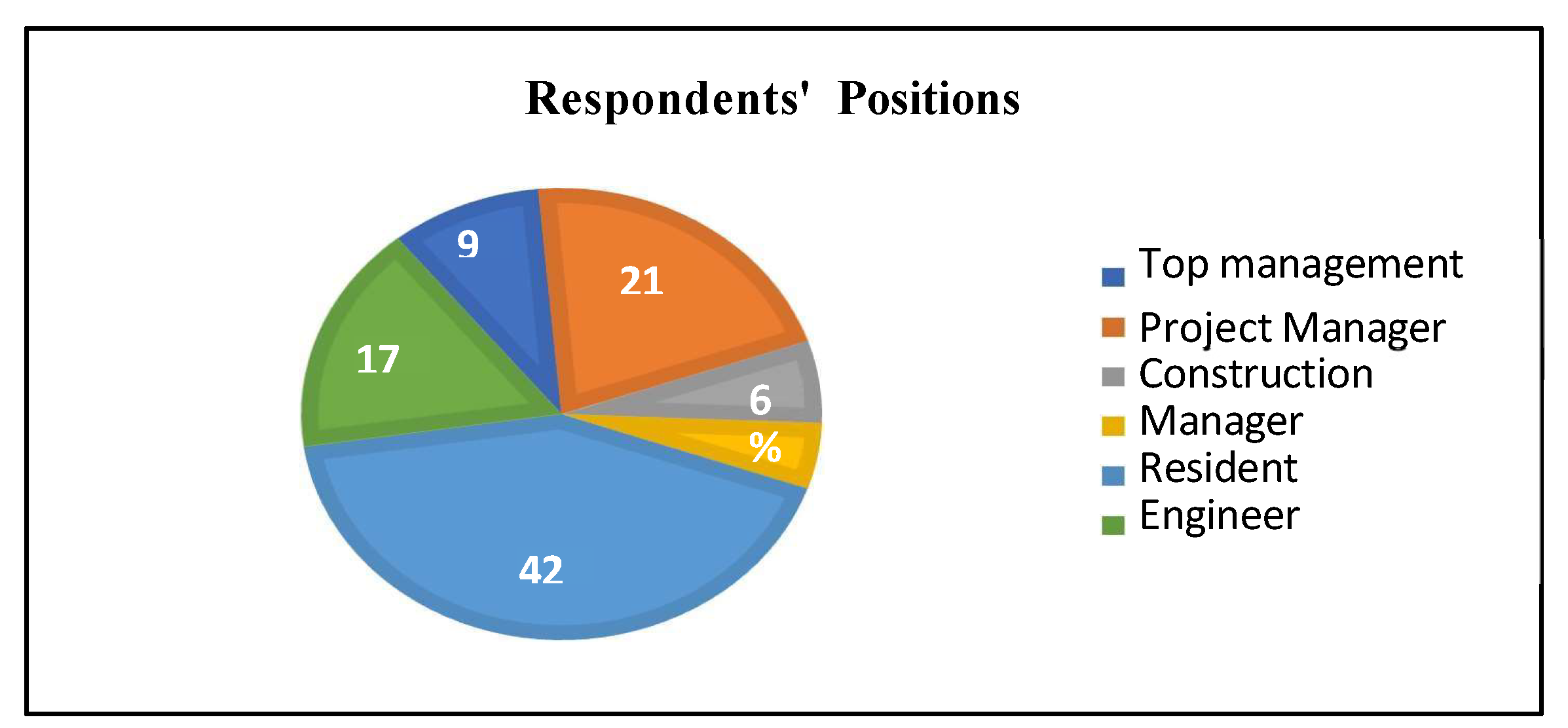
Figure 3.
Percentage of Respondets From Each Organization.
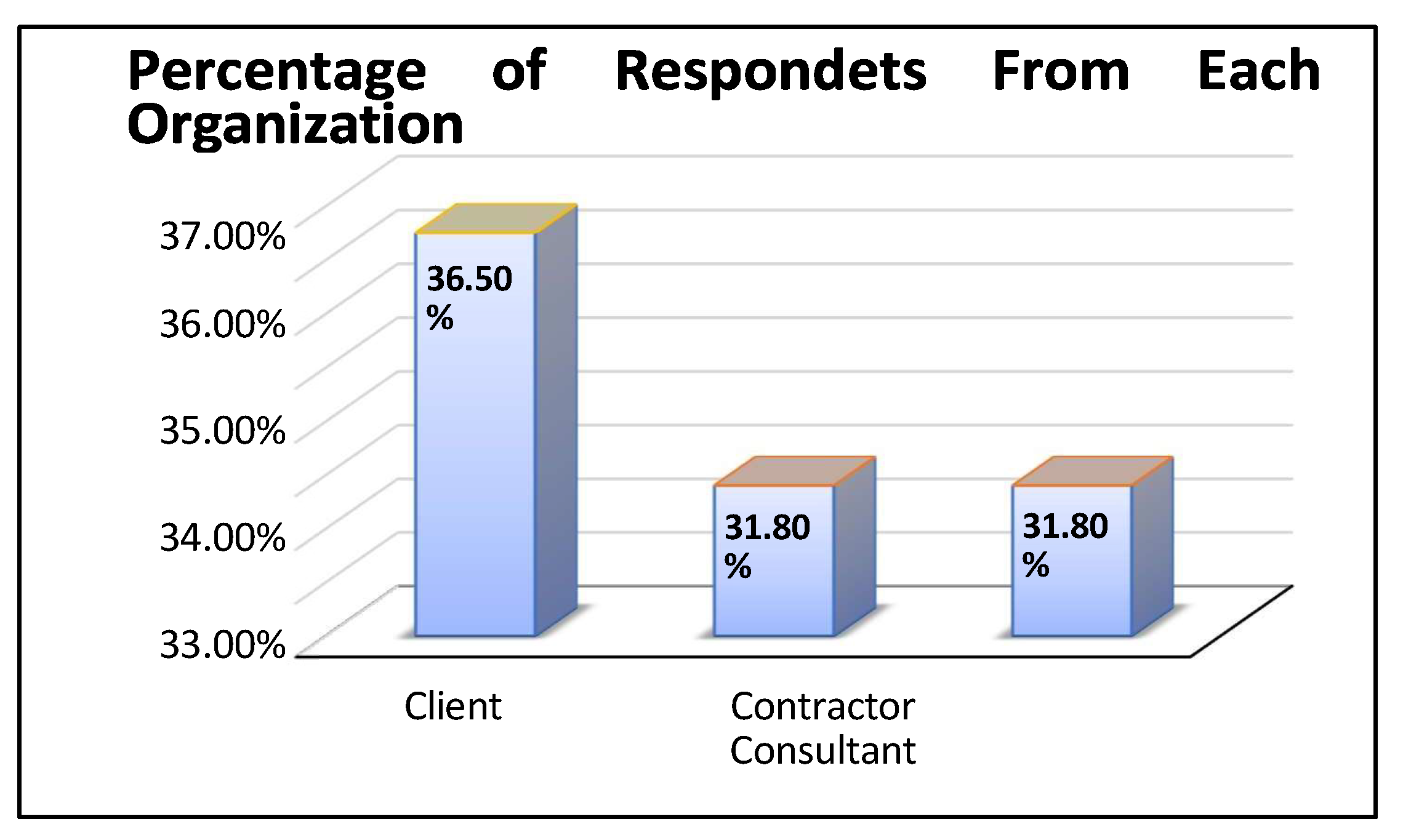
Figure 4.
Radar Diagram Showing the RIIs and Rankings of the Costs Overrun Causes.
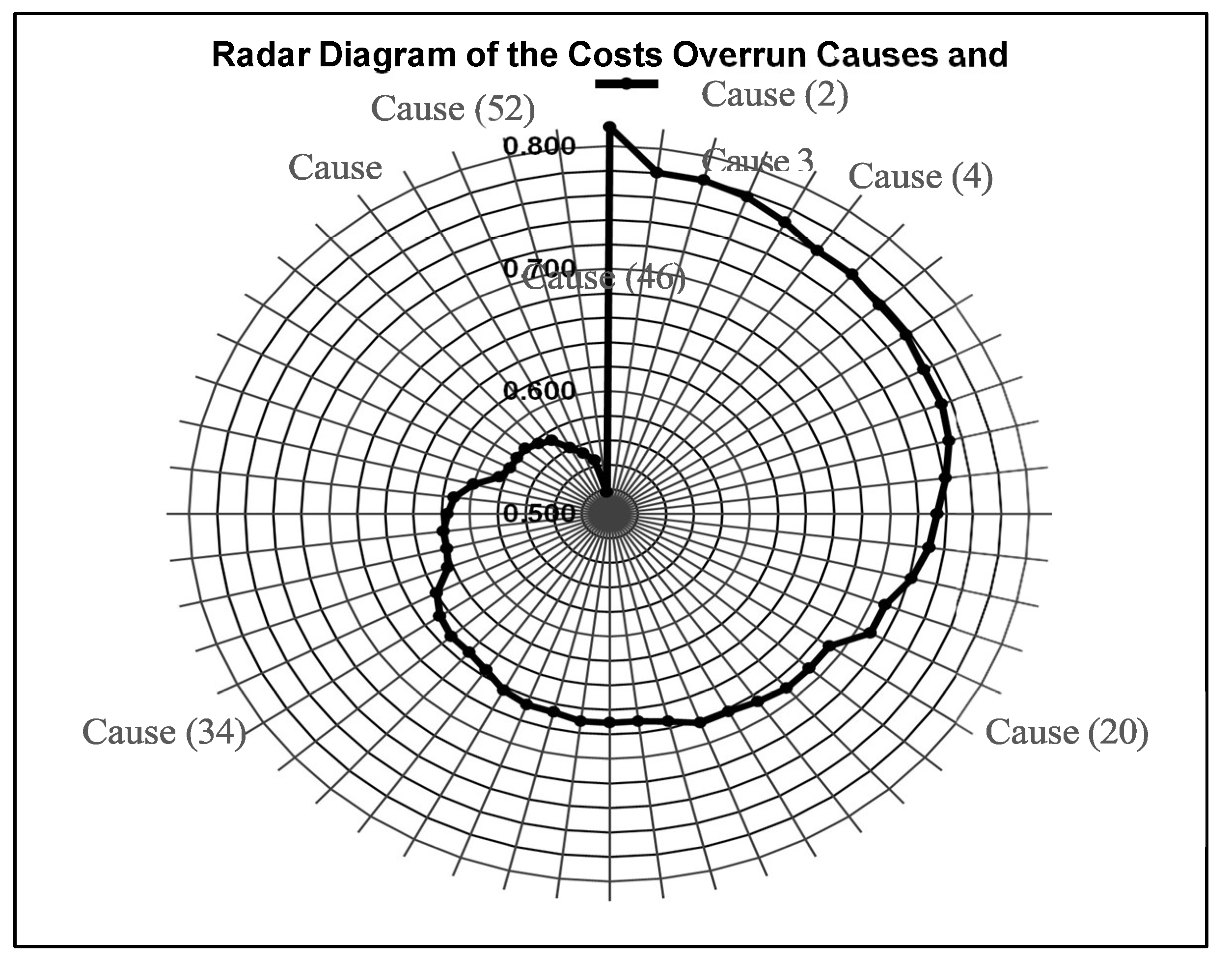

Table 1.
Age and Gender of the respondents.
| Ages (% of Total) |
Total |
|||||
|---|---|---|---|---|---|---|
| Age and Gender | Under 25 years old | 25-35 years old |
36-46 years old |
47-57 years old |
Above 57 years old | |
| Male | 0.0% | 40.0% | 22.4% | 11.8% | 9.4% | 83.5% |
|
Female |
1.2% | 14.1% | 1.2% | 0.0% | 0.0% | 16.5% |
| Total | 1.2% | 54.1% | 23.5% | 11.8% | 9.4% | 100.0% |
Table 2.
Work Experience and education of the repsondents.
| Work Experience (% of Total) |
Total |
|||||
|---|---|---|---|---|---|---|
| Education | 1-5 years |
6-10 years |
11-15 years |
16-20 years |
> 20 years |
|
| PhD | 0.0% | 0.0% | 0.0% | 0.0% | 2.4% | 2.4% |
| Master | 0.0% | 5.9% | 8.2% | 2.4% | 8.2% | 24.7% |
| Bachelor | 4.7% | 29.4% | 12.9% | 7.1% | 12.9% | 67.1% |
| Diploma | 0.0% | 3.5% | 1.2% | 0.0% | 1.2% | 5.9% |
| Total | 4.7% | 38.8% | 22.4% | 9.4% | 24.7% | 100.0% |
Table 3.
Cost overturn causes and RII.
| Group | Cost Overrun Causes | RII | Central Tendency | Rank | ||
|---|---|---|---|---|---|---|
| Mean | Median | Mode | ||||
| Client- Related | Contractors are not paid on time (overdue/delay payments) |
0.816 |
2.45 |
3.00 |
3.00 |
1 (1) |
| Design- Related |
Incomplete design at the time of tender |
0.780 | 2.34 | 3.00 | 3.00 | 2 (2) |
| Design- Related | Design errors | 0.780 | 2.34 | 2.00 | 3.00 | 2 (3) |
| Contractor- Related |
Cost underestimation | 0.776 | 2.33 | 3.00 | 3.00 | 3 (4) |
| Client- Related |
Funding difficulties | 0.769 | 2.31 | 2.00 | 3.00 | 4 (5) |
| Client- Related | Slow decision-making | 0.761 | 2.28 | 2.00 | 2.00 | 5 (6) |
| Contractor- Related |
Time underestimation | 0.761 | 2.28 | 2.00 | 3.00 | 5 (7) |
| Design- Related | Design changes due to faulty design during construction |
0.757 |
2.27 |
2.00 |
3.00 |
6 (8) |
| External Related |
Corona Virus COVID-19 | 0.757 | 2.27 | 3.00 | 3.00 | 6 (9) |
| Client- Related | Improper project planning | 0.753 | 2.26 | 2.00 | 2.00 | 7 (10) |
| Design- Related |
Uncontrolled design changes |
0.753 | 2.26 | 2.00 | 2.00 | 7 (11) |
| Client- Related | Time underestimation for completing the project | 0.749 | 2.25 | 2.00 | 2.00 | 8 (12) |
| Other Stakeholders- Related |
Slow decision-making by various project’s stakeholders |
0.741 |
2.22 |
2.00 |
2.00 |
9 (13) |
| External Related | Unforeseen soil and physical terrain conditions | 0.733 | 2.20 | 2.00 | 2.00 | 10 (14) |
| Design- Related |
Inadequate ground investigations |
0.729 | 2.19 | 2.00 | 2.00 | 11 (15) |
| Contractor- Related | Funding difficulties faced by contractors | 0.722 | 2.16 | 2.00 | 3.00 | 12 (16) |
| Client- Related |
Right of Way and land acquisition issues |
0.710 | 2.13 | 2.00 | 2.00 | 13 (17) |
| Other Stakeholders- Related | Late requests by various project’s stakeholders such as utilities and other concerned authorities |
0.710 |
2.13 |
2.00 |
2.00 |
13 (18) |
Table 3.
RII Range and Impact level.
| RII Range | Impact Level | Causes within the Range | No. of Causes |
|---|---|---|---|
| >0.700 | Very High Impact (MostCritical) | Cause (1) to Cause (18) | 18 |
| 0.600-0.700 | Average to High Impact | Cause (19) to Cause (42) | 24 |
| <0.700 | Very Low to Low Impact | Cause (43) to Cause (52) | 10 |
Table 4.
The Most Critical Costs Overrun Causes with their MVs and Ranking.
| Group | Cost Overrun Causes | MV | Rank |
|---|---|---|---|
| Client-Related | Contractors are not paid on time (overdue/delay payments) | 2.447 | 1 (1) |
| Design-Related | Incomplete design at the time of tender | 2.341 | 2 (2) |
| Design-Related | Design errors | 2.341 | 2 (3) |
| Contractor-Related | Cost underestimation | 2.329 | 3 (4) |
| Client-Related | Funding difficulties | 2.306 | 4 (5) |
| Client-Related | Slow decision-making | 2.282 | 5 (6) |
| Contractor-Related | Time underestimation | 2.282 | 5 (7) |
| Design-Related | Design changes due to faulty design during construction | 2.271 | 6 (8) |
| External Related | Corona Virus COVID-19 | 2.271 | 6 (9) |
| Client-Related | Improper project planning | 2.259 | 7 (10) |
| Design-Related | Uncontrolled design changes | 2.259 | 7 (11) |
| Client-Related | Time underestimation for completing the project | 2.247 | 8 (12) |
| Other Stakeholders- Related |
Slow decision-making by various project’s stakeholders |
2.224 | 9 (13) |
| External Related | Unforeseen soil and physical terrain conditions | 2.200 | 10 (14) |
| Design-Related | Inadequate ground investigations | 2.188 | 11 (15) |
| Contractor-Related | Funding difficulties faced by contractors | 2.165 | 12 (16) |
| Client-Related | Right of Way and land acquisition issues | 2.129 | 13 (17) |
| Other Stakeholders- Related |
Late requests by various project’s stakeholders such as utilities and other concerned authorities |
2.129 | 13 (18) |
Table 5.
Critical Costs Overrun Causes between Oman and other Countries.
| Most Critical Causes of Costs Overrun in Roads’ Project of Oman | UAE | KSA | Jordan | Ethiopia | India | Pakistan | Nigeria | |
| Contractors are not paid on time (overdue/delay payments) | × | × | × | |||||
| Incomplete design at the time of tender |
||||||||
| Design errors | × | × | × | × | ||||
| Cost underestimation | × | × | ||||||
| Funding difficulties | × | |||||||
| Slow decision-making | × | × | ||||||
| Time underestimation | ||||||||
| Design changes due to faulty design during construction |
× | |||||||
| Corona Virus COVID-19 | ||||||||
| Improper project planning | × | |||||||
| Uncontrolled design changes |
× | × | ||||||
| Time underestimation for completing the project | × | × | × | |||||
| Slow decision-making by project’s stakeholders |
× | |||||||
| Unforeseen terrain conditions | × | |||||||
| Inadequate ground investigations |
||||||||
| Funding difficulties faced by contractors |
||||||||
| Right of Way and land acquisition issues | × | |||||||
| Late requests by project’s stakeholders | × | |||||||
Table 6.
Variables of Calculating (W).
| No. | Variables | Description and Equations | Ref. | Result |
|---|---|---|---|---|
| 1 | W | 12S m2 (n3 − n) |
Eq. (6) | NA |
|
2 |
S |
N Σ(Ri − R¯)2 i=1
|
Eq. (7) |
78941.9230 |
| 3 | n | Number of costs overrun causes | NA | 52 |
| 4 | m | Number of ranking parties | NA | 3 |
| 5 | Numerator | 12S | NA | 947303.076 |
| 6 | Denominator | m2(n3-n) | NA | 1265004 |
| 7 | ∴ W | Dividing row 5 and 6 to find (W) | NA | 0.74885381 |
Disclaimer/Publisher’s Note: The statements, opinions and data contained in all publications are solely those of the individual author(s) and contributor(s) and not of MDPI and/or the editor(s). MDPI and/or the editor(s) disclaim responsibility for any injury to people or property resulting from any ideas, methods, instructions or products referred to in the content. |
© 2025 by the authors. Licensee MDPI, Basel, Switzerland. This article is an open access article distributed under the terms and conditions of the Creative Commons Attribution (CC BY) license (http://creativecommons.org/licenses/by/4.0/).
Copyright: This open access article is published under a Creative Commons CC BY 4.0 license, which permit the free download, distribution, and reuse, provided that the author and preprint are cited in any reuse.


