

Submitted:
27 November 2024
Posted:
28 November 2024
You are already at the latest version
Abstract
This research undertakes a comparative analysis of current and emerging hydrogen (H₂) production technologies, evaluating them based on quantitative and qualitative decision criteria. The quantitative criteria include cost of H2 production ($/kg H₂), energy consumption (MJ/kg H₂), global warming potential (kg CO₂-eq/kg H₂), and technology energy efficiency (%). The qualitative criteria encompass technology readiness level (TRL) and availability of supply chain materials (classified as low, medium, or high). To achieve these objectives, an extensive literature review has been conducted, systematically assessing the selected H2 production technologies against the aforementioned criteria. The insights synthesized from the literature provide a foundation for an informed, science-based evaluation of the potentials and techno-economic challenges that these technologies face in achieving the 1-1-1 goal set forth by the U.S. Department of Energy (DOE) in 2021. This ambitious target aims for a H2 production cost of $1/kg H2 within one decade (by the end of 2031), including costs associated with production, delivery, and dispensing at H2 fueling stations (HRS). Also, DOE established an interim target of $2/kg H₂ by 2026. This research concludes that among the examined H2 production technologies, water electrolysis and biomass waste valorization emerge as the most promising near-term solutions to meet DOE 1-1-1 goal.
Keywords:
hydrogen production
; sustainable hydrogen
; waste valorization
; bio-based waste upcycling
; DOE 1-1-1 goal
; clean hydrogen
; circular economy
1. Introduction
Hydrogen is a major contributor to the global effort to achieve the net-positive environmental goal that goes beyond the net-zero goal that focuses only on offsetting CO2 emissions. The net-positive goal reenforces the overarching intent of circular economy bio-based waste valorization for H2 production is one of the key technology pathways for sustainable H2 production [1]. However, energy transition from the current fossil-based technologies to sustainable H2 production is a physical transformation in its early stages and there are many technical, economic, and supply-chain logistics challenges that need to be sorted before at-scale adoption of H2-based technologies can be realized [2,3,4]. Accordingly, the present research aims to improve the current state of knowledge about these challenges by conducting a comparative science-based viability assessment among current and emerging hydrogen-production technologies. The assessment evaluated the selected technologies against specific quantitative and qualitative decision criteria. Based on the insights generated from the comparative assessment, conclusions are made about the most promising H2 production technologies that could meet U.S. DOE 1-1-1 clean energy goal as described in its 2021 ‘Hydrogen Shot’ Summit. In addition, techno-economic challenges of the selected H2 production pathways are highlighted.
The remainder of this manuscript is organized as follows: Section 2 outlines the research methodology employed, Section 3 presents the results, Section 4 discusses the findings, and Section 5 summarizes the conclusions of the comparative assessment. Additionally, Appendix A includes the supplementary data sources for the values presented in Tables 1 through 9 in Section 3.
2. Research Method
To achieve the objectives of this research, extensive literature reviews (using Google Scholar, Web of Science, and Scopus) were conducted to assemble the relevant quantitative and qualitative data. Subsection 2.1 highlights the key findings of the literature reviews. The collated information was mapped to specific decision criteria that support the comparative assessment. In addition, the steam-methane reforming (SMR) technology, with and without carbon capture and storage (CCS), was used as the benchmark H2 production technology. The employed decision criteria are detailed in subsection 2.2, while Subsection 2.3 provides an overview of the evaluated H₂ production technologies.
2.1. Literature Reviews and Key Findings
As an introduction to this subsection, it is worth noting that by 2050, the global energy demand is anticipated to be around 30 terawatts (TW), which is double that of 2011 [5]. Hydrogen is specifically being considered as an alternative fuel in the transportation sector to power fuel cell electric vehicles [6] and for electrifying the commercial aviation (viz., the hybrid-electric and all-electric aircraft). The U.S. DOE projected that clean H2 could be produced for $2/kg H2 by 2025 (H2New, 2021)1 and in its 2021 ‘Hydrogen Shot’ Summit, DOE drafted its long-term goal to reduce the cost of clean H2 production to $1 per kg H2 in 1 decade (Hydrogen Shot, 2021).[2]
Herein, a literature review of 102 published sources was conducted on various H2-producing technologies, specifically the most prominent conventional technologies and the most promising greener technologies. With a couple exceptions, only papers and reports published in the last decade (2013-2024) were consulted, with an effort to rely on publications from the past 5 years whenever possible, in order to ensure the comparative analysis contained the most updated information. From these sources, both quantitative and qualitative data was extracted to support the comparative assessment of H2 production technologies.
The conventional methods of H2 production provide either ‘gray’ or ‘blue’ hydrogen. Steam- methane reforming (SMR) is widely acknowledged as the most well-established method [3], and it is often used as a point of reference to analyze and compare the performance and feasibility of the none conventional methods. Because SMR is a very mature technology, it is thoroughly studied and producing low-cost hydrogen, but it also has low potential for technical improvements that will improve efficiency or performance [7,8]. Several papers studying the conventional methods of producing blue H2 discuss how CCS reduces emissions significantly, but also increases production cost and decreases energy efficiency [8,9,10,11,12].
Waste valorization was evaluated as a more sustainable H2 production technology. Utilizing waste streams eliminates both the polluting effects of waste build-up and the need for energy-intensive and high-emitting waste incineration. Biomass is a broad term that can be prepared as a feedstock from organic sources, such as grass, wood, agricultural products, animal waste, food scraps, municipal solid waste, and algae, and it can be valorized by methods, such as gasification, pyrolysis, supercritical water gasification, and dark fermentation [11,13]. One study noted that food waste is specifically suitable for H2 production for a number of reasons, such as its carbohydrate richness, wide availability, and low cost [14]. Another study explained that converting food waste to H2 via dark fermentation is energetically advantageous because it can be achieved under ambient temperature and pressure with low chemical energy requirements, but it must be performed onsite to be feasible due to the high-water content and biodegradability of food waste [15]. Even more so than food waste fermentation, gasification of biomass is a highly studied process due to its convenient utilization of diverse waste streams and production of clean biohydrogen. Biomass gasification is currently faced with low conversion and thermal efficiencies, but they can be improved with the optimization of the process temperature, the catalyst used, and the biomass content [16].
Glycerol is another promising waste stream to utilize for H2 generation, as it is produced abundantly as a byproduct of the transesterification of biomass to biodiesel. By strategically incorporating H2 production plants into existing biodiesel production plants, glycerol could even become a free material stream. A simulation-based life cycle assessment (LCA) compared the environmental and health impacts of several glycerol-based hydrogen production technologies–ATR, APR, and SCWR–versus those of the conventional method of SMR [17]. A techno-economic analysis (TEA) compared the cost of hydrogen produced from APR and steam reforming of glycerol, revealing that APR is slightly less expensive but still not competitive with SMR [18]. Another report on pathways to produce H2 from biomass provided H2 production costs and TRLs of SCWR, APR, and SR of glycerol [16].
Water electrolysis is widely considered a promising method of sustainably producing H2 due to fairly negligent carbon emissions [19,20,21]. A number of sources compared powering electrolyzers with the local electricity grid mix versus renewables. Because the grid mix varies so widely, a wide range of H2 cost values were reported, but in general, it is agreed that costs could be reduced by strategically utilizing renewable power sources rather than relying on the grid mix [22,23,24,25,26]. Research has recently explored utilizing wind power and solar PV power to produce green H2 by electrolysis [20]. While discussed to a lesser extent, other renewables like hydropower and nuclear power are also contenders for more sustainable electrolysis power sources [27,28,29]. While hydropower is a well-established renewable electricity source, one report noted that it will be overtaken by solar PV power due to its lower levelized cost of electricity (LCOE) and higher energy capacity [30]. Nuclear energy is also a firmly established renewable energy source, but still setbacks such as social apprehension keep it from becoming the focus of green H2 research [28]. Different renewable energy sources make more sense for different areas, depending on what natural resources are most abundant and consistent in a given region [25]. Therefore, cost and energy efficiency analyses [31] are further complicated with the additional variable of energy source.
The TRL of water electrolysis varies depending on the technology and the energy source utilized. However, as explored in a variety of reports, electrolysis is a fairly well-developed technology, particularly AKE, PEM, and SOE more so than AEM [9,16,22,32,33,34,35]. In addition to its nearly negligible global warming impact, its high TRL makes electrolysis an attractive green H2 production technology. However, high H2 production costs and high energy requirements are setbacks that are keeping electrolysis from replacing the conventional methods. One paper noted that despite its low GWP and high technological readiness, solar PV-powered electrolysis will only be able to take the forefront as a potential option for H2 production when its energy efficiency is improved, which will also subsequently lower its high production costs [5,36].
Electrolyzers are oftentimes divided into two classes: low-temperature electrolyzers (LTEs) and high-temperature electrolyzers (HTEs). The U.S. DOE has invested R&D funding into these two types of electrolysis in order to promote the most durable, effective, and efficient system of green H2 production. The characteristics of LTE, such as PEM, is that it is commercially available, but it isn’t durable, efficient, or affordable enough, while the characteristics of HTE, such as SOE, is that it is less mature, but has potential for higher efficiency and a longer lifespan [37]. According to one paper, SOEs are advantageous because of their ability to co-electrolyze steam and carbon dioxide in a single step and, thus, eliminating the need for an expensive and maintenance-intensive water-gas shift reactors [38]. SOEs operate at high temperatures, meaning they require greater energy input, but also that they can utilize low-cost active metals rather than expensive noble metals [38]. The Global Hydrogen Review claims that AEME electrolysis combines the benefits of PEME and AKE, since it does not require expensive platinum utilized by PEME nor the corrosive electrolyte used in AKE, but it is a less mature technology [22].
Emerging technologies for clean H2 production are also evaluated in this research. Because of the novelty of these technologies, they will not have very high TRLs, with most still being in the research and early development stages [16,22,39]. Several studies of thermochemical decomposition via both solar and nuclear power demonstrate that these technologies are far from being commercially mature [9,34]. However, even though the technologies are immature, their TEA reveal that several of the emerging technologies, like bio-photolysis, biomethane pyrolysis. and ESMR, are potentially able to produce H2 for competitive prices [11,28,40,41]. ESMR is especially attractive when considered as an easily implemented technology to help aid in the transition from gray to cleaner H2. It utilizes the same natural gas feedstock, but incorporates renewable electricity to lower emissions, resulting in a system that is more sustainable than the conventional methods and more economically and technically feasible than the other emerging technologies [41]. Among the emerging H2 production technologies is the so-called white color, from natural origin, however due to its rare occurrence in the Earth’s rock, there is no commercial interest at this point in time [42]. This geologic H2 (aka., white, gold, or natural H2) is found beneath Earth’s surface and is postulated to be produced by high-temperature reactions between water and iron-rich minerals.[3]
Most of the other emerging technologies still require more technological development to compete with the standard hydrogen prices [24,43]. Strategic plant optimization can help lower production costs. For example, H2 costs from ammonia thermal decomposition via fixed bed reactors and PSA-membranes are expected to decrease if plants are built to be larger and centralized, which would lead to economies of scale and less expensive ammonia costs [44,45]. One article discussed how the fluctuations in H2 production costs via thermochemical processes are mainly due to variable electricity prices, but the utilization of reliable green electricity from renewable sources like solar PV and wind turbines can greatly reduce production costs [11]. The lack of comprehensive studies of promising emerging technology, like biomethane pyrolysis and SMC, has been called out and discussed. These turquoise-H2 producing technologies [46] are preferable to SMR due to lower emissions and energy requirements, but still the information on them is sparse and the data is often conflicting and inconsistent [47]. There tends to be a disproportionate focus on green-H2 production technologies, particularly water electrolysis, despite other promising candidates. Further analysis of these emerging technologies will open up a slew of diverse avenues for clean hydrogen production.
Another reason to invest more resources in a wider range of promising clean H2 production technologies is their potential to be combined and integrated into hybrid systems. This integration process can strategically lower H2 production cost, decrease energy requirements and carbon emissions, increase efficiency, and utilize waste to make useful products. A well-established example of technology integration is the addition of CCS to gray H2 production technology, a method that succeeds in reducing emissions, but also tends to increase production cost and energy consumption, while reducing process efficiency [7,8,10,17,47]. More technically advanced and economically and energetically efficient combinations can be devised. One paper performed an energy analysis of an integrated system with SMC and SOE for the production of turquoise H2 and clean methanol [38]. Another paper examined hybrid wind and solar PV energy systems, finding that the combination of power sources meets the load demand and minimizes emissions and system costs [48]. A study reported that the energy output of FWF can be increased by 7-9 times with a 2-stage fermentation process that results in H2 produced via dark fermentation and methane produced via anaerobic digestion [15]. This methane could then be utilized as renewable natural gas to be injected into the existing natural grid infrastructure.
2.2. Quantitative and Qualitative Decision Criteria
The following set of decision criteria were used as the framework by which the selected H2 production technologies were compared as discussed in the Results Section 3.
2.2.1. Quantitative Decision Criteria
- ▪
- Cost of hydrogen production ($/kg H2)
This criterion represents the cost to produce one kilogram of H2 from the given technology. It is an indicator of the economic viability of each technology. To account for the time-value of money, H2 production costs that are collected from the published literature are adjusted to 2024 dollar using the Chemical Engineering Plant Cost Index[4], CEPCI, (Maxwell, 2020). To adjust H2 product cost from a previous year to 2024, Eq. (1) is applied:
Where the subscript YOP signifies the year of publication of H2 production cost.
- ▪
- Energy consumption (MJ/kg H2)
This quantitative criterion represents the amount of energy (MJ) required to produce one kilogram of H2 from the given technology.
- ▪
- Global warming impact (Kg CO2-eq/kg H2)
This quantitative criterion represents the global warming potential (GWP) of the H2 production technology and shows how many kilograms of CO2 are emitted per kilogram of H2 produced.
- ▪
- Technology energy efficiency
The energy efficiency of a technology is defined as the ratio of the lower heating value (LHV) of produced H2 to total energy supplied to the H2 production process. This efficiency is expressed as a percentage value. Some publications reported this process energy efficiency in terms of high heating value (HHV) and in order to keep comparisons between the production technologies consistent, these values are converted herein to be in terms of LHV by multiplying the reported value by the ratio of H2 LHV to HHV as shown by Eq. (2).
In addition to creating consistency in this comparative assessment, evaluating the technology energy efficiency in terms of LHV rather than HHV is more conservative as it gives the lower bound of the efficiency and, therefore, does not overestimate this efficiency value.
2.2.2. Qualitative Decision Criteria
- ▪
- Technology readiness level (TRL)
Technology readiness level5 is a qualitative criterion that reflects the maturity of a given technology on a nine-point scale (1-9). A higher number indicates greater maturity and readiness for commercialization. The following color-coded chart depicts the TRL scale as technologies advance from research to development (R&D) to deployment (Figure 1).
- ▪
- Supply chain material availability
Supply chain material availability is reflective of the availability and ease of accessibility of raw materials, energy, and equipment for the given H2 production technology. This criterion assesses the technologies on a three-point scale: low, medium, and high. Due to the qualitative and broad nature of this criterion, a simple three-point scale prevents the need for tedious analysis and difficult rankings. However, in order to avoid oversimplification, a comment section is provided to provide clarity on ratings if deemed necessary.
2.3. Hydrogen Production Technologies Being Evaluated
The production technologies being evaluated are as follows:
- ▪
- Conventional via steam-methane reforming (SMR)
The conventional method for H2 production is steam-methane reforming (SMR), which accounts for around 50% of H2 production [5]. This method converts natural gas (primarily methane) and steam to H2 and carbon CO2, a byproduct which contributes to global warming. The second conventional method of producing gray hydrogen is coal gasification, but it is not included in this research because it is less common than SMR. Autothermal reforming (ATR) of natural gas in yet another conventional technology for H2 production. ATR is similar to SMR in that it produces H2 and CO2 but it has the advantage of producing more exothermic from the partial oxidation that occur in the [8]. The produced H2 from SMR, coal gasification, ATR is denoted as ‘gray’ H2. Integration of carbon capture and storage (CCS) with any of these conventional technologies produces the so-called ‘blue’ H2. While integration with CCS results in CO2 emission reduction, both production cost and energy consumption are shown to increase compared to the case without CCS.
- ▪
- Hydrogen production by waste valorization
The utilization of various waste streams for hydrogen production is examined in food waste fermentation (FWF), waste plastics gasification (wPG), and biomass gasification with and without CCS. The valorization of biodegradable food waste by dark fermentation, can help alleviate the waste management crisis and reduce the production of carbon emissions and toxic pollutants in overcrowded landfills, while also producing more eco-friendly H2 [49,50,51]. Data-driven interpretation, comparison and optimization of H2 production from supercritical water gasification of biomass. Gasification is the high temperature partial oxidation of waste feedstocks, like plastics or biomass, to produces syngas, which is a mixture of CO and H2. Syngas can be further converted to make other useful chemicals using the Fischer–Tropsch (FT) process or combusted to generate steam for electricity generation [52].
- ▪
- Waste byproduct reforming (glycerol from biodiesel production)
A promising waste stream to utilize for H2 production is the glycerol byproduct that results from biodiesel production via the transesterification of agricultural crops [17]. The technologies studied that convert glycerol into hydrogen are supercritical water reforming (SCWR), aqueous-phase reforming (APR), autothermal reforming, and steam reforming (SR).
- ▪
- Greener hydrogen production via water electrolysis
The water electrolysis technologies considered herein are alkaline electrolyzer (AKE), proton exchange membrane electrolyzer (PEME), anion exchange membrane electrolyzer (AEME), and solid oxide electrolyzer (SOE) via solar photovoltaic (PV) power, wind power, hydropower, grid mix electricity, and nuclear power. Hydrogen produced via water electrolysis with renewable energy is called green H2 and is characterized by its low global warming impact. Electrolysis powered by grid mix electricity does not produce green H2, but it benefits from utilizing the current electricity grid. The US grid electricity mix is roughly as follows: 38% natural gas, 17% coal, 20% nuclear, 11% wind, 7% hydropower, 5% solar, and 2% other [53].
- ▪
- Emerging hydrogen production technologies
Various emerging clean H2 production technologies were evaluated in this comparative analysis. The high-temperature processes biomethane pyrolysis and solar methane cracking (SMC) produce the so-denoted ‘turquoise’ H2 and carbon-black. SMC utilizes concentrated solar energy to power the high-temperature process, resulting in even cleaner hydrogen [38]. Biophotolysis, electrified steam-methane reforming (ESMR), and ammonia (NH3) thermal decomposition via fixed-bed reactor and via PSA-membrane technology were also evaluated in this research. Biophotolysis utilizes sunlight energy to convert water to hydrogen through biological systems [40]. ESMR combines traditional SMR with renewable electricity. Both solar thermal powered thermochemical decomposition of water and nuclear-powered thermochemical decomposition of water were researched. There are many variations in nuclear-powered thermochemical decomposition, but only four of the most promising cycles were included in this study. These are the three-step sulfur-iodine (S-I) cycle, the two-step hybrid sulfur (HyS) cycle, the four-step copper-chlorine (Cu-Cl) cycle, and the three-step magnesium-chlorine (Mg-Cl) cycle.
3. Results
The sources introduced in the literature review subsection 2.1 were examined to perform a comparative analysis among the H2 production technologies for the decision criteria introduced in subsection 2.2. The quantitative and qualitative results of the comparative analysis are organized in Table 1, Table 2, Table 3, Table 4, Table 5, Table 6, Table 7, Table 8 and Table 9. As shown below, Table 1, Table 2 and Table 3 give the cost of H2, energy consumption, and global warming impact of the technologies. Table 4, Table 5 and Table 6 provide the energy efficiencies in terms of (LHV)H2 of the technologies. Table 7, Table 8 and Table 9 show the TRL and supply chain material availability of the technologies.
It should be noted that for most decision criteria, the results are recorded as a range of values. This is because multiple sources were cross referenced in order to provide the most accurate data. For each technology, there are a variety of conditions, such as plant size and local electricity cost, that can vary widely. Therefore, a technology’s performance for a given criteria cannot be given in a single value without being very specific about plant specifications (viz., technology type, production capacity, etc.). Providing a range of values from multiple sources is less limiting to the overarching objective of the comparative assessment. It is important to note that for waste plastic gasification [54] with CCS and biomass gasification with CCS (Table 1), as well as biomethane pyrolysis (Table 3), certain papers reported their global warming impact as a negative value. These scenarios imply that net carbon emissions are negative by utilizing waste streams that would have emitted more carbon otherwise and also by capturing the carbon emissions associated with gasification.
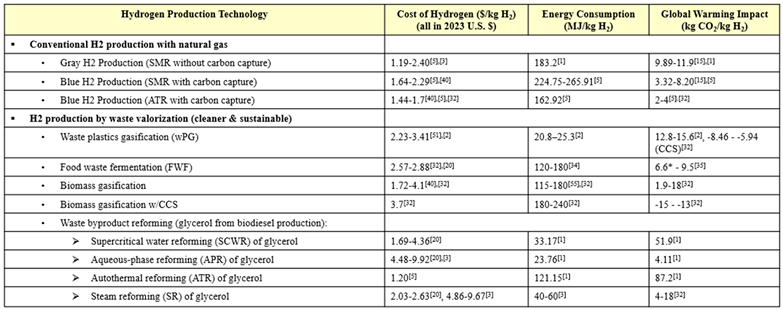
The key insights to be drawn from the reported data in Table 1 are as follows:

Table 1.
Cost of H2 ($/kg H2), energy consumption (MJ/kg H2), and GWP (kg CO2/kg H2) of conventional production technologies and waste valorization technologies.
Table 1.
Cost of H2 ($/kg H2), energy consumption (MJ/kg H2), and GWP (kg CO2/kg H2) of conventional production technologies and waste valorization technologies.
 |
- a)
- For conventional H2 production from natural gas: a.1) Due to the exothermic heat generation, the ATR technology has the lowest energy consumption (MJ/kg H2), a.2) Without CCS, SMR technology has the highest CO2 emissions (kg CO2/kg H2), and a.3) As would expected, integrating CCS with the conventional H2 production technology increases the cost of H2 production ($/kg H2), however, this cost increase is impacted by other location-dependent externalities such as cost of energy, cost of electricity, labor cost, etc.
- b)
- For H2 production via waste valorization: b.1) Biomass gasification with CCS technology has the highest energy consumption (MJ/kg H2), b) Aqueous-phase reforming (APR) of glycerol has the lowest CO2 emissions (kg CO2/kg H2), and b.3) Cost of H2 production ($/kg H2) using ATR of glycerol seems to be the lowest compared to the other waste valorization technologies.
Table 2.
Cost of H2 ($/kg H2), energy consumption (MJ/kg H2), and GWP (kg CO2/kg H2) of various water electrolysis technologies with different energy sources.
Table 2.
Cost of H2 ($/kg H2), energy consumption (MJ/kg H2), and GWP (kg CO2/kg H2) of various water electrolysis technologies with different energy sources.
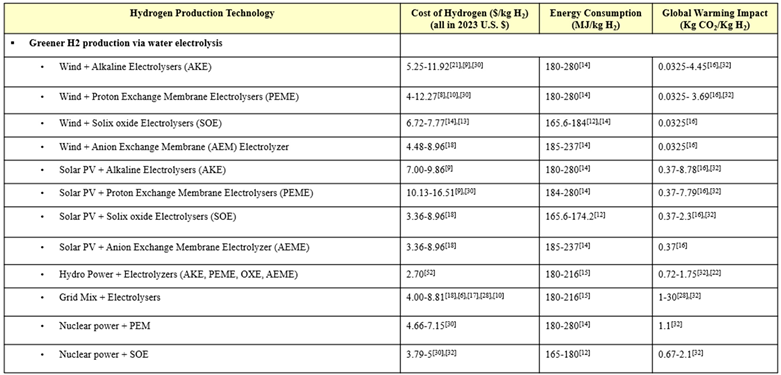 |
The data summarized in Table 2 shows that:
- PEME technology that uses solar PV electricity tend to have the highest cost of H2 production ($/kg H2) compared to the other technologies.
- Water electrolyzers that use electricity from the grid mix tend to have the highest CO2 emission (kg CO2/kg H2).
Table 3.
Cost of H2 production ($/kg H2), energy consumption (MJ/kg H2), and GWP (kg CO2/kg H2) of emerging clean H2 technologies.
Table 3.
Cost of H2 production ($/kg H2), energy consumption (MJ/kg H2), and GWP (kg CO2/kg H2) of emerging clean H2 technologies.
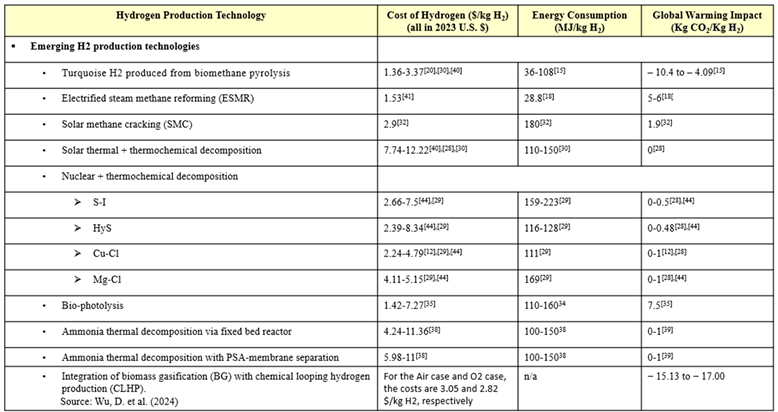 |
For the data shown in Table 3 for the emerging H2 production technologies, the following observations can be derived:
- Thermochemical decomposition integrated with solar thermal as well as ammonia thermal decomposition with PSA membrane separation seem to the highest cost of H2 production ($/kg H2).
- Electrified steam-methane reforming (ESMR) had the lowest energy consumption (MJ/kg H2).
- CO2 emissions (kg CO2/kg H2) from the evaluated emerging H2 production technologies seem to be low with biomethane pyrolysis as the most environmentally friendly followed by thermochemical decomposition integrated with solar thermal.
Table 4.
Energy efficiencies (%) of conventional H2 production technologies and waste valorization H2 production technologies.
Table 4.
Energy efficiencies (%) of conventional H2 production technologies and waste valorization H2 production technologies.
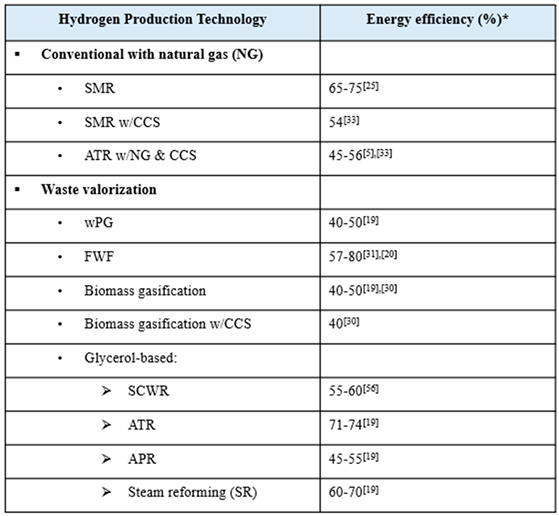 |
Table 4 shows that SMR and steam reforming (SR) of glycerol feedstock have the highest energy efficiency. Biomass gasification technology integrated with CCS has the lowest energy efficiency. Carbon capture and storage (CCS) tends to increase the energy consumption and, hence, lowers the energy efficiency of the technology being evaluated.
Table 5.
Energy efficiencies (%) of H2 production via various water electrolysis technologies with different energy sources.
Table 5.
Energy efficiencies (%) of H2 production via various water electrolysis technologies with different energy sources.
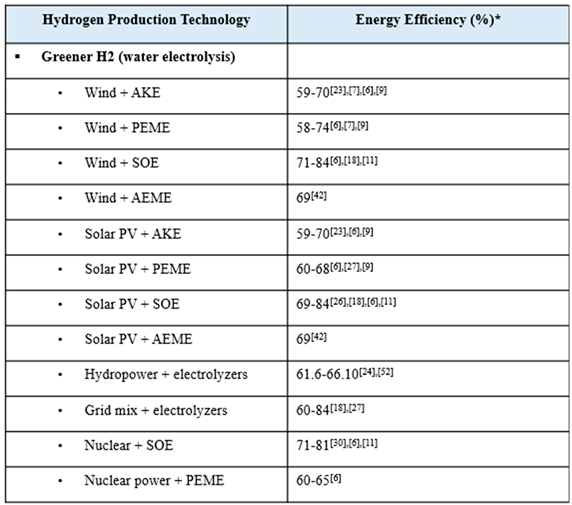 |
Table 5 shows that solid-oxide electrolyzers (SOE) using electricity from wind turbines, solar PV, and nuclear power seem to have the highest energy efficiency.
Table 6.
Energy efficiencies (%) of emerging clean H2 production technologies.
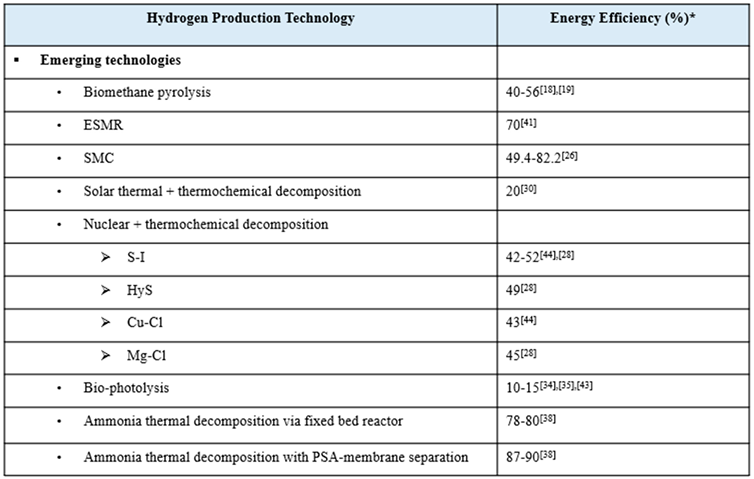 |
Table 6 shows that, among the evaluated emerging H2 production technologies, ammonia thermal decomposition integrated with PSA membrane separation to be the most energy-efficient technology and bio-photolysis as the least energy-efficient technology.
Table 7.
Color-coded technology readiness level (TRL) and supply chain material availability of conventional and waste valorization H2 production technologies.
Table 7.
Color-coded technology readiness level (TRL) and supply chain material availability of conventional and waste valorization H2 production technologies.
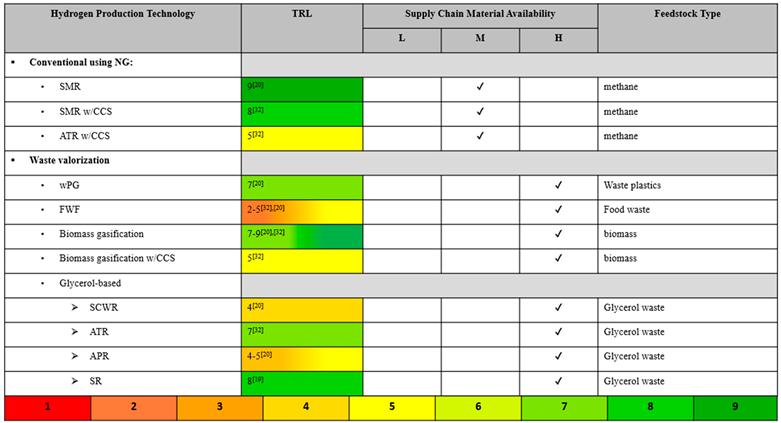 |
As shown in Table 7, SMR is the most mature & commercial-scale technology and, hence, has the TRL of 9. Food waste fermentation (FWF) technology is least mature and, hence, has the lowest TRL in the 2 to 5 range. Steam reforming of glycerol has a high TRL of 8. Glycerol supercritical water reforming (SCWR) and aqueous-phase reforming (APR) have lower TRL compared to more mature ATR technology. With respect to supply chain feedstock availability, glycerol waste, biomass, waste plastic and food waste are more available compared to natural gas (primarily methane).
Table 8.
Color-coded technology readiness level (TRL) and supply chain material availability of H2 production via various water electrolysis technologies with different energy sources.
Table 8.
Color-coded technology readiness level (TRL) and supply chain material availability of H2 production via various water electrolysis technologies with different energy sources.
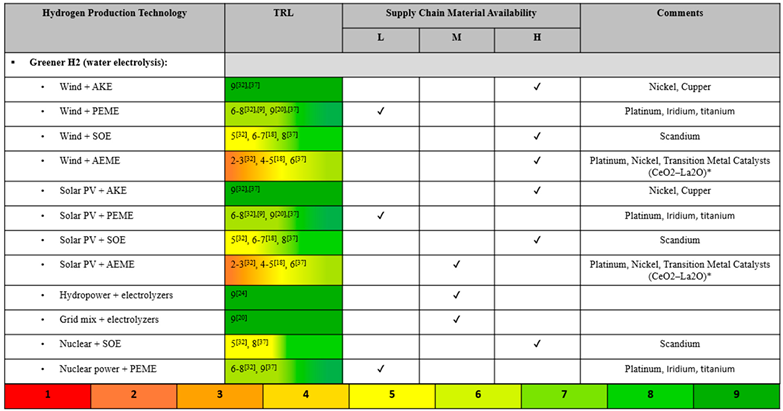 |
As displayed in Table 8, the alkaline electrolyzer (AKE) is the most mature technology with TRL of 9 and the least mature electrolyzer technology is the anode exchange membrane electrolyzer type with a TRL as low as 2 or 3. Supply chain availability of metals used in the electrolyzer electrodes are for the most part location-dependent.
Table 9.
Color-coded technology readiness level (TRL) and supply chain material availability of emerging clean H2 production technologies.
Table 9.
Color-coded technology readiness level (TRL) and supply chain material availability of emerging clean H2 production technologies.
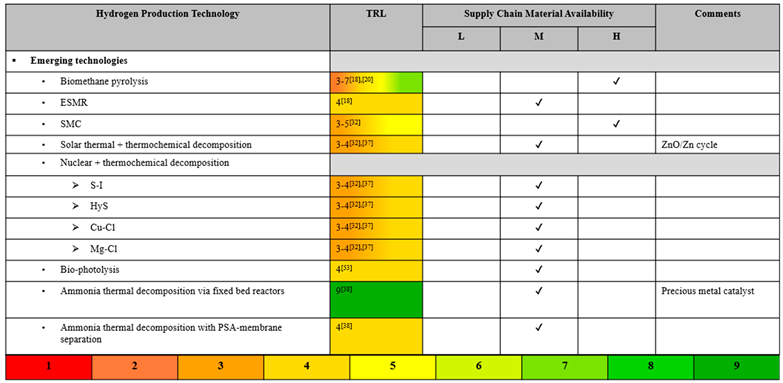 |
From Table 9, it can be seen that ammonia thermal decomposition via fixed bed reactors seem to have the highest TRL of 9. All other H2 production technologies have lower TRLs which are indicative that these technologies did not achieve the required maturity level to be commercialized at scale. Once again, supply chain material availability is highly location-dependent among other externalities.
4. Discussion
Based on the results presented (Tables 1 through 9) in Section 3, the following discission and insights can be synthesized:
- Conventional H2 production via SMR has the low-cost advantage (around $1-2/kg H2) and high TRL. However, SMR technology without CCS suffers from the high global warming impact of around 11 kg CO2/kg H2, as well as its nonrenewable feedstock requirement of natural gas.
- SMR with CCS and ATR with CCS result in lower global warming impacts, but they still produce around 2-8 kg CO2/kg H2, which is higher than the emissions of the majority of H2 production via water electrolysis. Also, the energy requirements (MJ/kg H2) of blue H2 production technologies are generally higher than those of gray H2 production technologies. The emerging carbon capture, utilization, and storage (CCUS) is expected to add additional environmental and economic values that go beyond CCS only.6
- Assessment of waste valorization as an alternative to the conventional methods for H2 production reveals that its most robust advantage is its high supply chain material availability due to using waste as the feedstock. The various methods utilize different waste streams that would otherwise contribute to costly waste management and environmental issues like toxic leaching and emission of air pollutants from landfills and waste incineration.
- In terms of GWP, waste valorization methods that are integrated with CCS can produce negative carbon emissions with the utilization of waste that otherwise would have been incinerated. Otherwise, when only considering carbon emissions, these technologies are not necessarily more sustainable than the conventional methods, with the exception of APR with a promising GWP of 4.11 kg CO2/kg H2 (Khalil, 2021). Therefore, incorporating CCS technology into waste valorization technologies will enhance their environmental benefits.
- Waste plastics gasification (wPG), food waste fermentation (FWF), and biomass gasification with and without CCS are somewhat more expensive than the conventional methods (around $2-4/kg H2), but not so expensive as to be uncompetitive, particularly when potential for technological improvements and economies of scale are taken into considered. The energy requirements of the processes range vastly, from 20-240 MJ/kg H2, but as noted earlier, these values vary widely with plant location, energy sources, and many other externalities. Therefore, it is perhaps more meaningful to examine energy efficiency, which is fairly average for wPG and biomass gasification (40-50%) and slightly higher for FWF. Improvements in technology will improve energy efficiency and subsequently further decrease production costs.
- Examining the four methods of glycerol conversion (data in Table 1) reveals that APR is more attractive than both ATR and SCWR, not only due to its lower carbon emissions, but also its lower energy consumption [17]. Therefore, APR outperforms its glycerol-based counterparts in sustainability and energy consumption, but with a TRL of 4-5, APR is not a mature technology yet and is, therefore, currently the most expensive, followed by steam reforming (SR), then SCWR, and finally ATR [17]. Also, the energy efficiencies of the four technologies range from 45-74, with APR performing the least efficiently. Considering all factors, APR is the most worthwhile technology of the four glycerol-based hydrogen production processes to improve upon.
- The compiled literature data about water electrolysis reveals that it is a very promising technology for green H2 production, producing close to zero carbon emissions. The performance of electrolysis varies depending on the specific technology and electricity source. First examining costs in Table 2, hydropower and nuclear power currently produce the least expensive H2, around $2.7/kg H2. The grid mix, wind power, and solar PV power are slightly more expensive, with wind generally less expensive than solar PV. In terms of the types of electrolyzer, SOE and AEME are more cost-effective than PEME and AKE. For wind and solar PV power, the most optimal costs for SOE and AEME are $3.36-6.72/kg H2 and for PEME and AKE the most optimal costs are $4-10.13/kg H2. The energy requirements for the various technologies and power sources are comparable to one another, ranging from 165-280 MJ/kg H2. However, energy efficiency does differ, with wind-powered electrolysis slightly more efficient than solar PV, and with SOE being the most efficient type of electrolyzer.
- Examining TRLs of water electrolysis technologies in Table 8, PEME and AKE are the most technologically mature, but their material supply chain availabilities are not very high in terms of availability. PEME specifically has a lower material supply chain availability score because it requires a rare metal (platinum) catalyst. Taking all of the criteria into consideration, a case could be made for any of the water electrolysis processes, but SOE powered by renewable electricity appears to be an especially worthwhile technology to focus on in the future. The source of renewable electricity that should be utilized depends on the characteristics of the region in which the electrolyzer is built. While wind energy showed greater energy efficiency and lower production cost in the literature review, this does not necessarily mean it is the most optimal option everywhere. Also, an important alternative that was not in the scope of this research is the possibility of utilizing multiple sources of renewable electricity in conjunction with, or integrating them into, the electricity grid mix. A hybrid configuration can ensure a more stable and reliable electricity supply, particularly in the case of wind and solar PV, which are known to be intermittent sources.
- The literature review also revealed some encouraging data about the emerging H2 production technologies. Biomethane pyrolysis, ESMR, supercritical water gasification of sewage sludge [56], industrial CO-to-H2 via water gas shift reaction [57], solar thermal thermochemical decomposition, nuclear thermochemical decomposition, bio-photolysis, and ammonia thermal decomposition were herein investigated, all of which are in the late research and early development stages, except for ammonia thermal decomposition via fixed bed reactors, which exhibits a TRL of 9. Because these technologies are mostly laboratory-scale or small-scale, data relies heavily on simulations and models. Out of the emerging technologies, currently biomethane pyrolysis, ESMR, and bio-photolysis predict the lowest hydrogen costs of minimum costs of $1.36-1.53 per kg H2. Nuclear thermochemical decomposition is not far behind, at $2.24-4.11/kg H2, with price varying by almost $2 depending on the cycle type. Solar thermal thermochemical decomposition and ammonia thermal decomposition are currently not competitive and will need a lot of technological development and improvements to become viable options for hydrogen production. However, ammonia decomposition via fixed bed reactors or PSA-membranes can produce H2 at a high energy efficiency with close-to-zero carbon emissions, while utilizing ammonia as a renewable feedstock. Therefore, more so than solar thermal decomposition, which has a low energy efficiency, the strategic integration of ammonia thermal decomposition technologies has fairly high prospects as long as production costs are lowered.
- Out of the rest of H2 production technologies, nuclear thermal thermochemical decomposition and biomethane pyrolysis appear to be the most promising. The production of ‘turquoise’ H2 via biomethane pyrolysis has low energy requirements and has a negative global warming potential by utilizing an otherwise high-emitting feedstock. Thermochemical decomposition with nuclear power has an energy demand similar to SMR and produces zero carbon emissions. The most promising cycles are S-I, HyS, and Cu-Cl. The energy efficiencies of the two technologies are between 40-56%, which could be improved upon with more research and design optimization. The other technologies exhibit some advantages, such as ESMR’s high energy efficiency and the potentially low production cost of bio-photolysis, but due to their higher GWPs, they are more practical as transitional technologies rather than long-term solutions.
5. Conclusions and Recommendations
This research evaluated various H2 production technologies based on cost ($/kg H2), energy consumption (MJ/kg H2), technology efficiency (%), and carbon emissions (kg CO2-eq/kg H2). Steam Methane Reforming (SMR) with and without Carbon Capture and Storage (CCS) served as the benchmark H2 production technology. Despite its low cost, SMR without CCS has high carbon emissions. Water electrolysis, hindered by high energy demands (kWh/kg H2) and high costs ($/kg H2), shows promise with advancements in renewable energy sources for green electricity production. Waste valorization methods, such as biomass gasification, or reforming, and food waste fermentation, offer dual benefits of waste management and sustainable H2 production, albeit at higher costs at this early stage of development. Emerging technologies like biomethane pyrolysis and nuclear-powered thermochemical cycles also present promising avenues for achieving clean and sustainable H2 production with minimal environmental impact.
Future research should focus on enhancing the technological maturity, scalability, and cost-efficiency of promising yet underdeveloped H2 production technologies, such as biomass waste valorization via gasification (or reforming) and water electrolysis using low-cost green electricity, to achieve negative carbon emissions and competitive production costs. Additionally, the impact of governmental policies and incentives on H2 economics should be rigorously analyzed to provide a comprehensive techno-economic framework for sustainable H2 production. Emphasizing the environmental and social impacts of these technologies and conducting comparative life cycle assessments along the supply chains and across different countries can further elucidate the global viability and societal benefits of green H2 initiatives.
Author Contributions
Dr. Yehia F. Khalil is the sole contributor to this research.
Funding
Please add: This research received no external funding.
Institutional Review Board Statement
Not relevant to this study.
Informed Consent Statement
Not applicable.
Data Availability Statement
The original contributions presented in the research are included in the article, further inquiries can be directed to the corresponding author.
Acknowledgments
The author of this research is grateful to the valuable comments and reviews provided by his colleagues from the University of Oxford, University of Cambridge, and Imperial College of London in the United Kingdom as well as by Harvard University un the U.S.
Conflicts of Interest
The author declares no conflicts of interest.
- 1.
- H2NEW: Hydrogen (H2) from Next-generation Electrolyzers of Water LTE Task 3c: System and Techno-economic Analysis (nrel.gov)
- 2.
- Hydrogen Shot. (2021). Office of Energy Efficiency and Renewable Energy. https://www.energy.gov/eere/fuelcells/hydrogen-shot
- 3.
- Hidden hydrogen: Earth may hold vast stores of a renewable, carbon-free fuel | Science | AAAS
- 4.
- Chemical Engineering, WWW.CHEMENGONLINE.COM, MAY 2024
- 5.
- Technology Readiness Levels - NASA
- 6.
- The global forecast to 2030 for CCUS technologies is expected to grow at an average compound annual growth rate (CAGR) of 24.0%, from $3.1 billion in 2023 to $12.9 billion in 2030 (Source: MarketsandMarkets (MnM) Newsletter, 2024).
Appendix A
Supplemental Sources of Data Reported in Tables 1 though 9 (Section 3)
This Appendix is cited in the main text under each table in the Results Section 3. The sources of data reported in Tables 1 though 9 are provided below as follows:
Table 1. Cost of H2 ($/kg H2), energy consumption (MJ/kg H2), and GWP (kg CO2/kg H2) of conventional production technologies and waste valorization technologies.
* Osman et al., 2024 (https://doi.org/10.1002/wene.526)
[1] Khalil, 2021 (https://doi.org/10.1093/ce/zkab018)
[2] Afzal et al., 2023 (https://doi.org/10.1039/D3GC00679D)
[3] Khodabandehloo et al., 2020
[5] Oni et al., 2022 (https://doi.org/10.1016/j.enconman.2022.115245)
[15] Diab et al., 2022 (https://doi.org/10.1016/j.ijhydene.2022.05.299)
[19] Parthasarathy, P. & Narayanan, K.S., 2014 (https://doi.org/10.1016/j.renene.2013.12.025)
[20] Lepage et al., 2021 (https://doi.org/10.1016/j.biombioe.2020.105920)
[32] Wilkinson et al., 2023 (https://doi.org/10.1016/j.cesys.2023.100116)
[34] Nikolaidis & Poullikkas, 2017 (https://doi.org/10.1016/j.rser.2016.09.044)
[35] Acar, 2023 (http://dx.doi.org/10.1016/j.ijhydene.2014.12.035)
[40] Ali & Shin, 2022 (https://doi.org/10.3390/en15218246)
[51] Lan & Yao, 2022 (https://www.nature.com/articles/s43247-022-00632-1)
[55] Li et al., 2020 (https://doi.org/10.1016/j.energy.2019.116588)
Table 2. Cost of H2 ($/kg H2), energy consumption (MJ/kg H2), and GWP (kg CO2/kg H2) of various water electrolysis technologies with different energy sources.
[6] Christensen, 2020 (https://theicct.org/wp-content/uploads/2021/06/final_icct2020_assessment_of-_hydrogen_production_costs-v2.pdf)
[8] Jang et al., 2022 (https://doi.org/10.1016/j.enconman.2022.115695)
[9] Schnuelle et al., 2020 (https://doi.org/10.1016/j.ijhydene.2020.08.044)
[10] Clark et al., 2023 (https://doi.org/10.1016/j.enconman.2023.117595)
[12] Saeedmanesh, 2021 (https://escholarship.org/uc/item/6x19c8wf)
[13] Lamagna et al., 2022 (https://doi.org/10.1016/j.egyr.2022.10.355)
[14] IRENA, 2021 (https://www.irena.org/-/media/Files/IRENA/Agency/Publication/2020/Nov/IRENA_Green_Hydrogen_breakthrough_2021.pdf?la=en&hash=40FA5B8AD7AB1666EECBDE30EF458C45EE5A0AA6)
[15] Diab et al., 2022 (https://doi.org/10.1016/j.ijhydene.2022.05.299)
[16] Suleman et al., 2016 (https://doi.org/10.1016/j.ijhydene.2015.12.225)
[17] IEA, 2023 (https://www.iea.org/reports/energy-technology-perspectives-2023)
[18] IEA, 2021 (https://www.iea.org/reports/global-hydrogen-review-2021)
[21] Webinar: Wind-to-Hydrogen, 2013 (https://www.energy.gov/eere/fuelcells/webinar-wind-hydrogen-cost-modeling-and-project-findings)
[22] Koroneos, 2004 (https://doi.org/10.1016/j.ijhydene.2004.01.016)
[28] Edvan & Costa, 2023 (https://doi.org/10.1016/j.ijhydene.2023.09.232)
[30] El-Emam & Özcan, 2019 (https://doi.org/10.1016/j.jclepro.2019.01.309)
[32] Wilkinson et al., 2023 (https://doi.org/10.1016/j.cesys.2023.100116)
[52] Karayel et al., 2023 (https://doi.org/10.1016/j.ijhydene.2022.04.084)
Table 3. Cost of H2 production ($/kg H2), energy consumption (MJ/kg H2), and GWP (kg CO2/kg H2) of emerging clean H2 technologies.
[12] Saeedmanesh, 2021 (https://escholarship.org/uc/item/6x19c8wf)
[15] Diab et al., 2022 (https://doi.org/10.1016/j.ijhydene.2022.05.299)
[18] IEA, 2021 (https://www.iea.org/reports/global-hydrogen-review-2021)
[20] Lepage et al., 2021 (https://doi.org/10.1016/j.biombioe.2020.105920)
[28] Edvan & Costa, 2023 (https://doi.org/10.1016/j.ijhydene.2023.09.232)
[29] El-Emam et al., 2020 (https://doi.org/10.1016/j.jclepro.2020.121424)
[30] El-Emam & Özcan, 2019 (https://doi.org/10.1016/j.jclepro.2019.01.309)
[32] Wilkinson et al., 2023 (https://doi.org/10.1016/j.cesys.2023.100116)
[35] Acar, 2023 (http://dx.doi.org/10.1016/j.ijhydene.2014.12.035)
[38] Kanaan et al., 2023 (https://doi.org/10.1016/j.rser.2023.113784)
[39] Cha et al., 2021 (https://doi.org/10.1016/j.rser.2021.111562)
[40] Yousefi Rizi & Shin, D., 2022 (https://doi.org/10.3390/en15218246)
[41] Mehanovic et al., 2023 (https://doi.org/10.1016/j.enconman.2022.116549)
[44] Safari & Dincer, 2020 (https://doi.org/10.1016/j.enconman.2019.112182)
Table 4. Energy efficiencies (%) of conventional H2 production technologies and waste valorization H2 production technologies.
[5] Oni, A.O. et al., 2022 (https://doi.org/10.1016/j.enconman.2022.115245)
[19] Parthasarathy, P. & Narayanan, K.S. 2014 (https://doi.org/10.1016/j.renene.2013.12.025)
[20] Lepage et al., 2021 (https://doi.org/10.1016/j.biombioe.2020.105920)
[25] IRJET Journal, 2020 (https://www.academia.edu/44307163/IRJET_REVIEW_PAPER_ON_HYDROGEN_THE_FUEL_OF_FUTURE?amp%3Bswp=rr-rw-wc-57873971&%3Bnav_from=7992dc07-7621-4e2d-a8a1-1ed8ca920f22&%3Brw_pos=17)
[30] El-Emam & Özcan, 2019 (https://doi.org/10.1016/j.jclepro.2019.01.309)
[31] Mohanakrishna, G. et al., 2023 (https://doi.org/10.1016/j.scitotenv.2023.163801)
[33] Martínez-Rodríguez, A. & Abánades, A., 2020 (https://doi.org/10.3390/e22111286)
[55] Yakaboylu, O. et al., 2015 (https://doi.org/10.3390/en8020859)
* Energy efficiency is defined as the ratio of the lower heating value, (LHV)H2, of H2 in product gas to total energy supplied to the process (Parthasarathy, Narayanan, 2014).
Table 5: Energy efficiencies (%) of H2 production via various water electrolysis technologies with different energy sources.
[6] Christensen, A., 2020 (https://theicct.org/wp-content/uploads/2021/06/final_icct2020_assessment_of-_hydrogen_production_costs-v2.pdf)
[7] Tebibel, H., 2021 (https://doi.org/10.1016/j.enconman.2021.114125)
[9] Schnuelle, C. et al., 2020 (https://doi.org/10.1016/j.ijhydene.2020.08.044)
[11] Technical Targets for High Temperature Electrolysis, 2022 (https://www.energy.gov/eere/fuelcells/technical-targets-high-temperature-electrolysis)
[18] IEA, 2021 (https://www.iea.org/reports/global-hydrogen-review-2021)
[23] Ursúa, A. et al., 2009 (https://doi.org/10.1016/j.ijhydene.2009.02.017)
[26] Banu, A. & Bicer, Y., 2023 (https://doi.org/10.1016/j.ijhydene.2023.09.163)
[27] Li, L. & Brouwer, J., 2015 (https://doi.org/10.1016/j.ijhydene.2015.01.044)
[30] El-Emam & Özcan, 2019 (https://doi.org/10.1016/j.jclepro.2019.01.309)
* Energy efficiency is defined as the ratio of the lower heating value, (LHV)H2, of H2 in product gas to total energy supplied to the process (Parthasarathy, Narayanan, 2014).
Table 6. Energy efficiencies (%) of emerging clean H2 production technologies.
[18] IEA, 2021 ((https://www.iea.org/reports/global-hydrogen-review-2021)
[19] Parthasarathy, P. & Narayanan, K.S. 2014 (https://doi.org/10.1016/j.renene.2013.12.025)
[26] Banu A. & Bicer, Y., 2023 (https://doi.org/10.1016/j.ijhydene.2023.09.163)
[28] Edvan & Costa, 2023 (https://doi.org/10.1016/j.ijhydene.2023.09.232)
[30] El-Emam & Özcan, 2019 (https://doi.org/10.1016/j.jclepro.2019.01.309)
[34] Nikolaidis, P. & Poullikkas, A., 2017 (https://doi.org/10.1016/j.rser.2016.09.044)
[35] Acar, 2023 (http://dx.doi.org/10.1016/j.ijhydene.2014.12.035)
[38] Kanaan et al., 2023 (https://doi.org/10.1016/j.rser.2023.113784)
[41] Mehanovic, D. et al., 2023 (https://doi.org/10.1016/j.enconman.2022.116549)
[43] Nagarajan, D. et al., 2017 (https://doi.org/10.1016/j.biortech.2016.12.104)
[44] Safari, F. & Dincer, I., 2020 (https://doi.org/10.1016/j.enconman.2019.112182)
* Energy efficiency is defined as the ratio of the lower heating value, (LHV)H2, of H2 in product gas to total energy supplied to the process (Parthasarathy, Narayanan, 2014).
Table 7. Color-coded technology readiness level (TRL) and supply chain material availability of conventional and waste valorization H2 production technologies.
[19] Parthasarathy, P. & Narayanan, K.S., 2014 (https://doi.org/10.1016/j.renene.2013.12.025)
[20] Lepage et al., 2021 (https://doi.org/10.1016/j.biombioe.2020.105920)
[32] Wilkinson et al., 2023 (https://doi.org/10.1016/j.cesys.2023.100116)
Table 8. Color-coded technology readiness level (TRL) and supply chain material availability of H2 production via various water electrolysis technologies with different energy sources.
* Zainal, B.S. et al., 2024 (https://doi.org/10.1016/j.rser.2023.113941)
[9] Schnuelle et al., 2020 (https://doi.org/10.1016/j.ijhydene.2020.08.044)
[18] IEA, 2021 (https://www.iea.org/reports/global-hydrogen-review-2021)
[20] Lepage et al., 2021 (https://doi.org/10.1016/j.biombioe.2020.105920)
[24] Altayib & Dinçer, 2022 (https://doi.org/10.1016/j.energy.2021.122780)
[32] Wilkinson et al., 2023 (https://doi.org/10.1016/j.cesys.2023.100116)
[37] Guide, 2023 (https://www.iea.org/data-and-statistics/data-tools/etp-clean-energy-technology-guide)
Table 9. Color-coded technology readiness level (TRL) and supply chain material availability of emerging clean H2 production technologies.
[18] IEA, 2021 (https://www.iea.org/reports/global-hydrogen-review-2021)
[20] Lepage et al., 2021 (https://doi.org/10.1016/j.biombioe.2020.105920)
[32] Wilkinson et al., 2023 (https://doi.org/10.1016/j.cesys.2023.100116)
[37] Guide, 2023 (https://www.iea.org/data-and-statistics/data-tools/etp-clean-energy-technology-guide)
[38] Kanaan et al., 2023 (https://doi.org/10.1016/j.rser.2023.113784)
[54] Frowijn & van Stark, 2021 (https://doi.org/10.1016/j.seta.2021.101631)
References
- Lui, J. , Paul, M. C., Sloan, W. and You, S. (2022). Techno-economic feasibility of distributed waste-to-hydrogen systems to support green transport in Glasgow. Int. J. Hydrogen Energy, 3532. [Google Scholar] [CrossRef]
- The Paris Agreement | UNFCCC. (2020). Unfccc.int. https://unfccc.int/process-and-meetings/the-paris-agreement U.S. National Clean Hydrogen Strategy and Roadmap (23). U.S. National Clean Hydrogen Strategy and Roadmap | Hydrogen Program (energy. 20 June.
- Frueh, S. (2024). Can Hydrogen Help the Energy Transition? Panel Explores the Benefits and Challenges. National Academies of Science, Engineering, and Medicine.
- Ghasemi, A. , Rad, H. N., and Akrami, M. (2024). Biomass-to-Green Hydrogen: A Review of Techno-Economic-Enviro Assessment of Various Production Methods. Hydrogen. [CrossRef]
- Dincer, I. and Acar, C. (2015). Review and evaluation of hydrogen production methods for better sustainability. [CrossRef]
- Alternative Fuels Data Center: Hydrogen. (2023). Energy.gov. https://afdc.energy.gov/fuels/hydrogen_basics.html#:~:text=The%20energy%20in%202.
- IRJET Journal. (2020). IRJET- REVIEW PAPER ON HYDROGEN: THE FUEL OF FUTURE, /: https, 4430.
- Oni, A. O. , Anaya, K., Giwa, T., Di Lullo, G., & Kumar, A. (2022). Comparative assessment of blue hydrogen from steam methane reforming, autothermal reforming, and natural gas decomposition technologies for natural gas-producing regions. Energy Conversion and Management, 1152. [Google Scholar] [CrossRef]
- Wilkinson, J. , Mays, T.J., & McManus, M. (2023). Review and meta-analysis of recent life cycle assessments of hydrogen production. Cleaner Environmental Systems, 1001. [Google Scholar] [CrossRef]
- Comparative Analysis of Energy and Exergy Performance of Hydrogen Production Methods. Entropy, 22(11), 1286–1286. https://doi.org/10.3390/e22111286 Maxwell, C. (2020). Cost Indices – Towering Skills. Toweringskills.com. https://toweringskills.com/financialanalysis/cost-indices/. 22(11), 1286–1286. [CrossRef] [PubMed]
- Yousefi Rizi, H.A. & Shin, D. (2022). Green Hydrogen Production Technologies from Ammonia Cracking. ( 15(21), 8246–8246. [CrossRef]
- Patel, S.K.S.; et al. (2024). Recent developments in hydrogen production, storage, and transportation: Challenges, opportunities, and perspectives. Fire, 7. [CrossRef]
- Hosseinzadeh, A.; et al. (2022). Techno-economic and environmental impact assessment of hydrogen production processes using bio-waste as renewable energy resource. Renewable and Sustainable Energy Reviews, 1119. [Google Scholar] [CrossRef]
- Cudjoe, D. , Chen, W.M., & Zhu, B. (2022). Valorization of food waste into hydrogen: Energy potential, economic feasibility and environmental impact analysis. Fuel, 1244. [Google Scholar] [CrossRef]
- Jarunglumlert, T. , Prommuak, C., Putmai, N., & Pavasant, P. (2018). Scaling-up bio-hydrogen production from food waste: Feasibilities and challenges. International Journal of Hydrogen Energy. [CrossRef]
- Lepage, T. , Kammoun, M., Schmetz, Q., & Richel, A. (2021). Biomass-to-hydrogen: A review of main routes production, processes evaluation and techno-economical assessment. Biomass and Bioenergy, 1059. [Google Scholar] [CrossRef]
- Khalil, Y. (2021, Sept). Simulation-based environmental-impact assessment of glycerol-to-hydrogen conversion technologies. Clean Energy, 5. [CrossRef]
- Khodabandehloo, M. , Larimi, A., & Khorasheh, F. (2020). Comparative process modeling and techno-economic evaluation of renewable hydrogen production by glycerol reforming in aqueous and gaseous phases. Energy Conversion and Management. [CrossRef]
- Ashwath, J.; et al. (2021). Life Cycle Analysis of Hydrogen. AIP Conference Proceedings, 0200. [Google Scholar] [CrossRef]
- Sapnken, F. E.; et al. (2024). Green hydrogen demand in Cameroon’s energy sectors by 2040. Renewable and Sustainable Energy Reviews, 205, 114834, 1-16. [CrossRef]
- Ajeeb, A. , Neto, R. C., and Baptista, P. (2024). Life cycle assessment of green hydrogen production through electrolysis: A literature review. Sustainable Energy Technologies and Assessments,. [CrossRef]
- IEA. (2021), Global Hydrogen Review 2021, IEA, Paris. https://www.iea. 2021.
- Christensen, A. (2020). Assessment of Hydrogen Production Costs from Electrolysis: United States and Europe. International Council on Clean Transport. 2021. [Google Scholar]
- Edvan, F. (2023). Multiple criteria evaluation of hydrogen production processes for use in automotive sector. International Journal of Hydrogen Energy. [CrossRef]
- Clark, C.E. , Barker, A., Brunik, K., Kotarbinski, M., Grant, E., Roberts, O., King, J., Andrew, Bhaskar, P., & Bay, C. J. (2023). Opportunities for green hydrogen production with land-based wind in the United States. Energy Conversion and Management, 1175. [Google Scholar] [CrossRef]
- Lima, T. M.; et al. (2024). An Overview of Hydrogen Production from Renewable Sources and Its Main Applications. ChemistrySelect,. [CrossRef]
- Koroneos, C. , Dompros, A., Roumbas, G., and Moussiopoulos, N. (2004). Life cycle assessment of hydrogen fuel production processes. International Journal of Hydrogen Energy, /: https, 1450. [Google Scholar] [CrossRef]
- El-Emam, R.S. & Özcan, H. (2019). Comprehensive review on the techno-economics of sustainable large-scale clean hydrogen production. Journal of Cleaner Production. [CrossRef]
- Gerhardt-Morsdorf, J.; et al. (2024). Exergetic life cycle assessment for green hydrogen production. Energy, 1315. [Google Scholar] [CrossRef]
- Lee, B.; et al. (2021). Economic Parity Analysis of Green Methanol Synthesis Using Water Electrolysis Based on Renewable Energy. ACS Sustainable Chemistry & Engineering. [CrossRef]
- Sharma, M.; et al. (2023). Premier, Progress and Prospects in Renewable Hydrogen Generation: A Review. Fermentation, 9. [CrossRef]
- Schnuelle, C. , Wassermann, T., Fuhrlaender, D., & Zondervan, E. (2020). Dynamic hydrogen production from PV & wind direct electricity supply – Modeling and techno-economic assessment. International Journal of Hydrogen Energy, 2995. [Google Scholar] [CrossRef]
- Altayib, K. & Dinçer, I. (2022). Development of an integrated hydropower system with hydrogen and methanol production. ( 240, 122780–122780. [CrossRef]
- Guide, T. (2023). ETP Clean Energy Technology Guide – Data Tools - IEA.
- Li, J.; et al. (2024). Techno-economic analysis of electrochemical hydrogen production coupled with alternative oxidation. Chemical Engineering Science, 1-33. [CrossRef]
- Naqvi, S.R.; et al. (2024). Techno economic analysis for advanced methods of green hydrogen production. Current Opinion in Green and Sustainable Chemistry, 1-26. [CrossRef]
- H2NEW: Hydrogen (H2) from Next-Generation Electrolyzers of Water LTE Task 3c: System and Technoeconomic Analysis. (2021). DOE Hydrogen Program. https://www.nrel.gov/docs/fy21osti/79835.pdf.
- Banu, A. , & Biçer, Y. (2023). Energy and exergy analysis of an integrated system with solar methane cracking and co-electrolysis of CO2/H2O for efficient carbon management. International Journal of Hydrogen Energy. [CrossRef]
- Mersbet, N. H. , Kerboua, K., and Hoinkis, J. (2024). Hydrogen production from wastewater: A comprehensive review of conventional and solar powered technologies. Renewable Energy, 1204. [Google Scholar] [CrossRef]
- Nagarajan, D. , Lee, D.H., Kondo, A., & Chang, J.S. (2017). Recent insights into biohydrogen production by microalgae – From biophotolysis to dark fermentation. Bioresource Technology. [CrossRef]
- Mehanovic, D. , Al-Haiek, A., Leclerc, P., Rancourt, D., Fréchette, L., & Picard, M. (2023). Energetic, GHG, and economic analyses of electrified steam methane reforming using conventional reformer tubes. ( 276, 116549–116549. [CrossRef]
- Germscheidt, R. L.; et al. (2021). Hydrogen Environmental Benefits Depend on the Way of Production: An Overview of the Main Processes Production and Challenges by 2050. Adv. Energy Sustainability Res. [CrossRef]
- Safari, F. , & Dinçer, I., (2020). A review and comparative evaluation of thermochemical water splitting cycles for hydrogen production. Energy Conversion and Management, 1121. [Google Scholar] [CrossRef]
- Kanaan, R. , Henrique, P., Achard, P., & Beauger, C. (2023). Economical assessment comparison for hydrogen reconversion from ammonia using thermal decomposition and electrolysis. Renewable & Sustainable Energy Reviews, 1378. [Google Scholar] [CrossRef]
- Cha, J. , Park, Y., Brigljević, B., Lee, B., Lim, D., Lee, T., Jeong, H., Kim, Y., Sohn, H., Mikulčić, H., Lee, K.M., Nam, D., Lee, K.B., Yoon, C. W., & Jo, Y.S. (2021). An efficient process for sustainable and scalable hydrogen production from green ammonia. Renewable & Sustainable Energy Reviews, 1156. [Google Scholar] [CrossRef]
- Pashchenko, D. (2024). Green hydrogen as a power plant fuel: What is energy efficiency from production to utilization? Renewable Energy, 223, 120033, 1-11. [CrossRef]
- Diab, J. , Fulcheri, L., Hessel, V., Rohani, V., & Frenklach, M. (2022). Why turquoise hydrogen will Be a game changer for the energy transition. ( 47(61), 25831–25848. [CrossRef]
- Abdin, Z. & Mérida, W. (2019). Hybrid energy systems for off-grid power supply and hydrogen production based on renewable energy: A techno-economic analysis. Energy Conversion and Management, 1079. [Google Scholar] [CrossRef]
- Mohanakrishna, G. , Sneha, N.P., Rafi, S.M., & Sarkar, O. (2023). Dark fermentative hydrogen production: Potential of food waste as future energy needs. Science of the Total Environment, 1638. [Google Scholar] [CrossRef]
- Chen, Z.; et al. (2024). Upcycling of plastic wastes for hydrogen production: Advances and perspectives. Renewable and Sustainable Energy Reviews, 1143. [Google Scholar] [CrossRef]
- Azadvar, S. and Tavakoli, O. (2024). Data-driven interpretation, comparison and optimization of hydrogen production from supercritical water gasification of biomass and polymer waste: Applying ensemble and differential evolution in machine learning algorithms. Int. J. Hydrogen Energy. [CrossRef]
- Afzal, S. , Singh, A., Nicholson, S., Uekert, T., DesVeaux, J. S., Eric, Dutta, A., Carpenter, A., Baldwin, R. M., & Beckham, G. T. (2023). Techno-economic analysis and life cycle assessment of mixed plastic waste gasification for production of methanol and hydrogen. Green Chemistry, 5085. [Google Scholar] [CrossRef]
- Short-Term Energy Outlook -, U.S. Energy Information Administration (EIA). (2023). Eia.gov. https://www.eia.gov/outlooks/steo/report/BTL/2023/02-genmix/article.php Sources of Greenhouse Gas Emissions | Greenhouse Gas (GHG) Emissions | US EPA. (2014). Chicago.gov. https://climatechange.chicago.
- Lan, K. and Yao, Y. (2022). Feasibility of gasifying mixed plastic waste for hydrogen production and carbon capture and storage. Communications Earth & Environment. [CrossRef]
- Parthasarathy, P. and Narayanan, K.S. (2014). Hydrogen production from steam gasification of biomass: Influence of process parameters on hydrogen yield – A review. Renewable Energy. [CrossRef]
- Hu, D.; et al. (2024). Thermodynamic and environmental analysis of integrated supercritical water gasification of sewage sludge for power and hydrogen production. Energy, 299, 131568, 1-15. [CrossRef]
- Fatimah, M.; et al. (2024). Industrial waste gases as a resource for sustainable hydrogen production - Resource availability, production potential, challenges, and prospects. Carbon Capture Science & Technology, 12, 100228, 1-15. [CrossRef]
- Nikolaidis, P. , & Poullikkas, A. (2017). A comparative overview of hydrogen production processes. Renewable & Sustainable Energy Reviews. [CrossRef]
- Acar, C, and Dincer, I. ( 218, 835–849. [CrossRef]
- Lan, K. , & Yao, Y. (2022). Feasibility of gasifying mixed plastic waste for hydrogen production and carbon capture and storage. Communications Earth & Environment. [CrossRef]
- Li, G. , Cui, P., Wang, Y., Liu, Z., Zhu, Z., & Yang, S. (2020). Life cycle energy consumption and GHG emissions of biomass-to-hydrogen process in comparison with coal-to-hydrogen process. Energy, 1165. [Google Scholar] [CrossRef]
- Jang, D. , Kim, K., Kim, K.H., Kang, S. (2022). Techno-economic analysis and Monte Carlo simulation for green hydrogen production using offshore wind power plant. Energy Conversion and Management, /: https, 1156. [Google Scholar]
- Saeedmanesh, A. (2021). Solid Oxide Electrolysis Cell (SOEC) and System Technology for Widespread Use with Renewable Energy, /: https.
- Lamagna, M. , Ferrario, A. M., Garcia, D. A., McPhail, S. J., & Comodi, G. (2022). Reversible solid oxide cell coupled to an offshore wind turbine as a poly-generation energy system for auxiliary backup generation and hydrogen production. Energy Reports, 1427. [Google Scholar] [CrossRef]
- IRENA. (2021). Making the breakthrough: Green hydrogen policies and technology costs, /: Renewable Energy Agency. https, 2020.
- Suleman, F. , Dinçer, I., & Agelin-Chaab, M. (2016). Comparative impact assessment study of various hydrogen production methods in terms of emissions. ( 41(19), 8364–8375. [CrossRef]
- IEA. (2023). Energy Technology Perspectives 2023, /: https, 2023.
- Webinar: Wind-to-Hydrogen Cost Modeling and Project Findings. (2013). Energy.gov. https://www.energy.
- Karayel, G.K. , Javanı, N., & Dinçer, I. (2023). Hydropower for green hydrogen production in Turkey. ( 48(60), 22806–22817. [CrossRef]
- El-Emam, R.S. , Özcan, H., & Zamfirescu, C. (2020). Updates on promising thermochemical cycles for clean hydrogen production using nuclear energy. ( 262, 121424–121424. [CrossRef]
- Yakaboylu, O. , Harinck, J., Smit, K., & Wiebren de Jong. (2015). Supercritical Water Gasification of Biomass: A Literature and Technology Overview. Energies. [CrossRef]
- Tebibel, H. (2021). Methodology for multi-objective optimization of wind turbine/battery/electrolyzer system for decentralized clean hydrogen production using an adapted power management strategy for low wind speed conditions. Energy Conversion and Management, 1141. [Google Scholar] [CrossRef]
- Ursúa, A. , Marroyo, L., Gubía, E., Gandı́a, L., Diéguez, P.M., & Sanchis, P. (2009). Influence of the power supply on the energy efficiency of an alkaline water electrolyser. ( 34(8), 3221–3233. [CrossRef]
- Li, Z. & Brouwer, J. (2015). Dynamic operation and feasibility study of a self-sustainable hydrogen fueling station using renewable energy sources. International Journal of Hydrogen Energy, 3837. [Google Scholar] [CrossRef]
- Frowijn, L.S.F. & van Sark, W.G.J.H.M. (2021). Analysis of photon-driven solar-to-hydrogen production methods in the Netherlands. Sustainable Energy Technologies and Assessments, 1016. [Google Scholar] [CrossRef]
Figure 1.
Technology readiness levels (TRL).

Disclaimer/Publisher’s Note: The statements, opinions and data contained in all publications are solely those of the individual author(s) and contributor(s) and not of MDPI and/or the editor(s). MDPI and/or the editor(s) disclaim responsibility for any injury to people or property resulting from any ideas, methods, instructions or products referred to in the content. |
© 2024 by the authors. Licensee MDPI, Basel, Switzerland. This article is an open access article distributed under the terms and conditions of the Creative Commons Attribution (CC BY) license (http://creativecommons.org/licenses/by/4.0/).
Copyright: This open access article is published under a Creative Commons CC BY 4.0 license, which permit the free download, distribution, and reuse, provided that the author and preprint are cited in any reuse.


