
Submitted:
02 September 2024
Posted:
03 September 2024
You are already at the latest version
Abstract
The decline in global pollinator populations has raised serious concerns about the sustainability of ecosystems and agricultural productivity. Urban environments, often characterized by habitat loss and environmental stressors, are considered challenging habitats for pollinators. However, urban green spaces, including street and ornamental trees, can play a crucial role in supporting pollinators by providing essential food resources. This study aimed to evaluate the sugar and amino acid production of eight urban tree species to determine their potential contributions to pollinator nutrition. Our findings revealed significant variability among species regarding nectar volume, sugar content, and amino acid composition, emphasizing the importance of considering multiple factors when assessing the utility of floral resources. Consequently, Tilia amurensis, Heptacodium miconioides, Aesculus turbinata, and Wisteria floribunda demonstrated superior potential in supporting urban pollinator communities. Contrastingly, Sorbus commixta, Styrax japonicus, and Cornus kousa, often favored for their aesthetic appeal, showed less potential. This study underscores the need for urban tree selection that prioritizes species that provide diverse and abundant nutritional resources for pollinators while balancing aesthetic and ecological values. Our results offer a foundation for better-informed urban biodiversity management and contribute to creating pollinator-friendly urban environments.
Keywords:
unban tree
; floral resource
; availability
; sugar yield
; amino acid composition
1. Introduction
Plant–pollinator interactions are essential for the survival of both parties [1,2]. The transfer of pollen by pollinators contributes to seed production and the maintenance of genetic diversity in flowering and entomophilous plants. Pollinators utilize the nectar and/or pollen collected from plants as nutritional resources, which are vital for the growth, development, and immune system maintenance of their colonies and individuals [3].
In recent years, a decline in pollinators has been reported in many countries [4,5,6]. This decline is believed to be caused by stressors such as habitat loss, parasites and diseases, pesticides, lack of flowers and monotonous diets, competition, and climate change, which may act alone or in combination, thereby exacerbating the situation [7]. The reduction in the abundance and diversity of pollinators threatens ecosystem sustainability [8] and can decrease agricultural crop production, posing risks to food security [9]. Consequently, the importance of pollinators is being increasingly recognized today.
Urban areas are generally considered less suitable habitats for pollinators compared with non-urbanized areas due to various factors such as habitat loss, fragmentation, and environmental pollution [10]. Additionally, forest loss and soil sealing associated with urban expansion are major factors that reduce plant resources, leading to a shortage of food resources for pollinators [11]. Despite these vulnerabilities, urban green spaces are increasingly recognized as beneficial for the recovery of pollinator populations [12]. As the importance of biodiversity in urban areas has been recognized, many cities worldwide have planted numerous trees over the past several decades, increasing plant diversity [13] and, consequently, urban pollinator diversity [14,15]. Undoubtedly, the high pollinator diversity and abundance levels recorded in urban green spaces offer an optimistic outlook for improving pollinator-friendly urban environments [16,17,18,19,20].
Street and ornamental trees are important components of urban green spaces, not only contributing to human well-being and mental health [21] but also serving as vital food sources for pollinators [22,23,24,25]. Considering the significant impact that food resources harvested from flowers have on maintaining pollinator populations, providing urban pollinators with high-quality, nutritionally balanced diets is essential for their growth and development [26,27]. Additionally, managing and establishing plants with staggered blooming periods to ensure a continuous supply of food resources is essential [28,29,30]. Unfortunately, however, the selection of street trees today has primarily been based on human-centered values such as aesthetic appeal, economic cost, air pollution mitigation, pest sensitivity, and maintenance costs [31,32]. The aspect of providing food resources for pollinators in urban areas has not been sufficiently considered [33]. Therefore, to effectively manage floral resources in urban areas or to establish ‘bee pastures,’ more extensive knowledge about the quantity and quality of floral rewards provided by urban trees is required [34].
Furthermore, since the concentration and composition of sugars and amino acids in nectar vary among plant species [35,36,37,38,39], the qualitative and quantitative composition of nectar should be individually assessed for each species. Applying a consistent research protocol is crucial to ensure accuracy in interspecies comparisons. Additionally, information on amino acids in floral nectar is still very limited [40]. To the best of our knowledge, no studies have attempted to comprehensively analyze the total production of sugars and amino acids together.
This study quantitatively assessed the total nectar and amino acid production of eight tree species commonly used as street and ornamental trees, applying a consistent research methodology. Our findings can contribute to distinguishing between urban trees that offer more abundant and diverse food resources for pollinators and those that do not. Additionally, the study highlights the risks of relying solely on fragmented information in interspecies comparisons, offering a more comprehensive methodological approach.
2. Results
2.1. Growth and Flowering
The growth characteristics and blooming periods of the sampled trees were recorded (Table 1). The height and canopy width of each species varied due to the different ages of the trees. The canopy width was used to quantify the blooming quantity per unit area for each sampled tree.
S. commixta and W. floribunda began blooming in late April, with flowering periods of 11 and 15 days, respectively. S. japonicus and A. turbinata started blooming in early May, each with a flowering period of 13 and 15 days, respectively. C. kousa bloomed for approximately a month, from mid-May to early July. T. amurensis and K. paniculata began blooming in mid to late June, with flowering periods of 14–16 days. The latest blooming species was H. miconioides, which flowered for 22 days from August 24 to September 14.
We surveyed the blooming quantity per tree and multiplied it by the number of trees per hectare, calculated based on canopy width, to estimate the number of flowers per hectare (Table 2). Although A. turbinata had the highest number of flowers per tree, T. amurensis had the highest number of flowers per hectare. Similarly, while W. floribunda had 3.5-fold more flowers per tree than S. commixta, their number of flowers per hectare was similar. In contrast, H. miconioides had only 1.8-fold more flowers per tree than C. kousa, but the difference in the number of flowers per hectare was greater, with H. miconioides having 5.3-fold more.
2.2. Nectar Volume and Composition
Significant differences in nectar volume per flower were observed among the eight tree species (Figure 1, p < 0.0001). S. japonicus had the highest nectar volume per flower at 3.71±1.18 μL, followed by H. miconioides at 2.67±0.38 μL, A. turbinata at 1.23±0.10 μL, W. floribunda at 0.90±0.26 μL, T. amurensis at 0.72±0.12 μL, K. paniculata at 0.61±0.18 μL, C. kousa at 0.34±0.06 μL, and S. commixta at 0.11±0.03 μL.
2.3. Sugar Content
Significant differences in the sugar content per unit volume were observed among the tree species (Figure 2A, p < 0.0001). T. amurensis had the highest free sugar content per unit volume at 1,345.8±313.7 μg/μL, whereas C. kousa had the lowest at 128.2±26.2 μg/μL, a more than 10-fold difference. The second-highest free sugar content per unit volume was found in A. turbinata (919.5±107.8 μg/μL), followed by K. paniculata (735.3±183.8 μg/μL), W. floribunda (723.8±154.9 μg/μL), H. miconioides (600.8±119.9 μg/μL), S. japonicus (453.6±64.5 μg/μL), and S. commixta (254.5±20.0 μg/μL).
The sugar composition of the nectar showed that all species except C. kousa were dominated by sucrose, with significant differences among species (Figure 2B, p < 0.0001). In particular, S. japonicus contained 96.5% sucrose with no detectable glucose. W. floribunda and A. turbinata had sucrose compositions of over 80% (84.3 and 87.5%, respectively), while K. paniculata and H. miconioides had over 70% sucrose (79.0 and 73.6%, respectively). In contrast, C. kousa was dominated by glucose and fructose at 51.4 and 42.2%, respectively, compared with only 6.5% sucrose.
To verify the differences in sugar composition ratios, we analyzed the correlations (Figure 3). The sucrose to hexose ratio (SH ratio) exhibited different patterns among the species, with significant variability (0.1–28.1, p < 0.0001). All species except C. kousa were classified as sucrose-dominant (sucrose 51–100%), whereas C. kousa was classified as hexose-dominant (sucrose 0–9%) (Figure 3A).
A very high positive correlation was found in the ratio of glucose to fructose across all species (Figure 3B, R2 = 0.965), suggesting that when sucrose is hydrolyzed into glucose and fructose, they are produced at nearly equal concentrations, although glucose was slightly more prevalent than fructose (over 1.0). However, variability among the species was observed (p = 0.0002).
2.4. Amino Acid Content and Composition
Significant differences in the content of amino acids per unit volume were observed among the tree species (Figure 4A, p < 0.0001). S. japonicus had a significantly higher amino acid content (785.2±11.4 μg/L) compared with those of the other species, followed by H. miconioides with 439.3±63.7 μg/L. W. floribunda, C. kousa, and K. paniculata had similar amino acid contents of 363.4±43.1, 381.9±31.2, and 351.2±38.3 μg/L, respectively, while S. commixta (118.6±18.6 μg/L) and A. turbinata (125.0±11.5 μg/L) had the lowest amino acid contents per unit volume.
The analysis of the amino acid composition in the floral nectar, categorized into essential, non-essential, and non-protein amino acids, also revealed significant differences among the species (Figure 4B, p < 0.0001). Generally, all species had non-essential amino acids (59.7–80.3%) as the largest proportion, followed by essential amino acids (13.6–33.3%) and non-protein amino acids (1.0–8.1%). S. commixta and W. floribunda had higher proportions of essential amino acids than those of the other species, whereas K. paniculata and H. miconioides had relatively higher proportions of non-protein amino acids.
The floral nectar of the eight tree species contained 16–22 amino acid types (Figure 5). Among the 10 essential amino acids, arginine, isoleucine, leucine, phenylalanine, threonine, and valine were present in all tree species, whereas methionine was found only in W. floribunda and H. miconioides. As a result, W. floribunda and H. miconioides contained all 10 essential amino acids, A. turbinata, T. amurensis, and K. paniculata contained 9, S. commixta contained 8, and S. japonicus and C. kousa contained 7 and 6, respectively. All nine non-essential amino acids were found in all species except for tyrosine, which was absent in S. commixta. Among the non-protein amino acids, GABA was found in all species, whereas citrulline was found only in S. japonicus and K. paniculata, and taurine and ornithine were found only in K. paniculata.
Among the 15–23 amino acids found in each species, the dominant amino acids (comprising more than 10% of the total) were as follows (Figure 5B, shown in light red to red): proline (26.0%), tryptophan (16.6%), glutamic acid (13.2%), and aspartic acid (10.8%) were predominant in S. commixta; asparagine (39.5%), tyrosine (16.2%), and phenylalanine (12.6%) were predominant in W. floribunda; serine (32.6%) and glutamic acid (16.8%) were predominant in S. japonicus; proline (25.3%) and glutamic acid (22.0%) were predominant in A. turbinata; asparagine (32.9%) and glutamine (12.5%) were predominant in C. kousa; proline (34.4%) and asparagine (18.7%) were predominant in T. amurensis; proline (19.6%) and glutamic acid (10.9%) were predominant in K. paniculata; proline (39.0%) was predominant in H. miconioides.
2.5. Production Potential of Sugar
The sugar content per flower, calculated by multiplying the nectar volume per flower by the sugar content per unit volume, showed significant variability among tree species (Figure 6A, p < 0.0001). S. japonicus (1.68±0.24 mg/flower) and H. miconioides (1.61±0.32 mg/flower) had relatively high values. They were followed by A. turbinata (1.13±0.13 mg/flower), T. amurensis (0.97±0.23 mg/flower), W. floribunda (0.65±0.14 mg/flower), K. paniculata (0.45±0.11 mg/flower), C. kousa (0.04±0.01 mg/flower), and S. commixta (0.03±0.00 mg/flower).
The sugar production per tree resulted in a significant change in ranking among the tree species (Figure 6B, p < 0.0001). A. turbinata showed the highest production (932.7±117.7 g/tree), followed by T. amurensis (177.4±48.9 g/tree), K. paniculata (142.2±22.8 g/tree), and W. floribunda (113.3±26.6 g/tree). H. miconioides (5.9±2.1 g/tree), S. commixta (1.4±0.6 g/tree), S. japonicus (0.9±0.2 g/tree), and C. kousa (0.1±0.0 g/tree) showed relatively low production.
The sugar yield per hectare, based on the number of flowers per hectare, was highest in T. amurensis (87.6±24.1 kg/ha), with A. turbinata (71.8±9.1 kg/ha) also performing well. H. miconioides (41.1±14.8 kg/ha), W. floribunda (34.3±8.1 kg/ha), and K. paniculata (24.0±3.8 kg/ha) showed relatively good nectar production, whereas S. commixta (1.4±0.6 kg/ha), S. japonicus (1.4±0.3 kg/ha), and C. kousa (0.2±0.1 kg/ha) exhibited very low performance (Figure 6C, p < 0.0001).
2.6. Production Potential of Amino Acid
S. japonicus had the highest amino acid content per flower at 2.91±0.04 μg/flower, followed by H. miconioides at 1.17±0.17 μg/flower. The other six species had amino acid production per flower ranging from 0.13 to 0.33 μg/flower, with S. commixta having the lowest production (Figure 7A).
Based on the number of flowers per tree, A. turbinata had the highest amino acid production per tree at 126.8±16.0 mg/tree, followed by K. paniculata (67.9±10.9 mg/tree), W. floribunda (56.9±13.4 mg/tree), and T. amurensis (32.5±9.0 mg/tree), all showing significant production levels. In contrast, the other four species (S. commixta, S. japonicus, C. kousa, and H. miconioides) had very low productivity, ranging from 0.6 to 4.3 mg/tree (Figure 7B).
In terms of amino acid yield per hectare, H. miconioides had the highest at 30.1 g/ha, followed by W. floribunda (17.2±4.1 g/ha), T. amurensis (16.1±4.4 g/ha), K. paniculata (11.5±1.8 g/ha), and A. turbinata (9.8±1.2 g/ha). The other three species (S. commixta, S. japonicus, and C. kousa) had very low yields, ranging from 0.6 to 2.4 g/ha (Figure 7C).
3. Discussion
3.1. Evaluating the Usefulness of Floral Resources Requires a Comprehensive Consideration of Various Factors
Our study emphasizes that evaluating the usefulness of urban floral resources for pollinators requires a comprehensive consideration of various factors. We identified significant variability in the potential total sugar and amino acid production among the tree species. Notably, when the results of nectar volume per flower, sugar and amino acid content per unit volume, and the number of flowers for comparison between species were standardized using production potential per tree and per hectare, the rankings of the species changed significantly. For example, T. amurensis ranked only fifth in nectar secretion per flower (Figure 2), but due to its high sugar content per unit volume (Figure 3A) and large number of flowers (Table 2), it rose to first place in sugar yield per hectare (Figure 7). Conversely, S. japonicus exhibited excellent production per flower due to its high nectar volume per flower, but its very low number of flowers per tree and per hectare resulted in it ranking the lowest in total sugar and amino acid production potential (Figure 7 and Figure 8).
On the other hand, H. miconioides, which ranked second in sugar and amino acid content per flower, had low production per tree due to a small number of flowers. However, this was because the surveyed trees had a small canopy width of 1.2 m (fewer flowers per tree but more trees per hectare). As a result, H. miconioides ranked third in sugar productivity and first in amino acid production per hectare, making it an excellent food tree for pollinator. Another example is A. turbinata, which had relatively low nectar volume and amino acid content per flower, resulting in very low amino acid production per flower. However, due to the large number of flowers per tree, it ranked first in amino acid production per tree. Nevertheless, this was an illusion caused by surveying large trees with many flowers per tree, and its actual amino acid production per hectare ranked only fifth overall.
Potential total sugar and amino acid production is recognized as a good indicator for evaluating the availability of floral resources [19]. However, due to differences not only among species [22,23,41,42,43] but also within varieties of the same species [24,44,45]), individual studies are required for each plant species, applying the same measurement criteria. Particularly, evaluating tree species is challenging because it is almost impossible to use materials of the same age or size. Therefore, our case study can serve as a valuable reference. Our study further clarifies the inadequacy of using fragmented information alone to evaluate the value of floral resources in terms of providing food resources for pollinators. Concluding that floral resources are either highly valuable or lacking based solely on fragmented information about the plant may be premature.
3.2. Sugar and Amino Acid Availability
Considering the dependency of pollinators on floral resources [12,46], flowers that are attractive to pollinators must provide sufficient profitable rewards such as sugars, proteins, and amino acids [47]. Therefore, to achieve the fundamental goal of improving pollinator-friendly habitats, expanding our knowledge of the floral resources provided by different tree species is essential [25]. Accordingly, we quantified and compared the sugar and amino acid production of the eight urban tree species in Korea (Figure 7 and Figure 8). The results showed that sugar productivity was highest in T. amurensis (87.6 kg/ha), followed by A. turbinata (71.8 kg/ha), H. miconioides (41.1 kg/ha), and W. floribunda (34.3 kg/ha). Amino acid productivity ranked as follows: H. miconioides (30.1 g/ha) > W. floribunda (17.2 g/ha) > T. amurensis (16.6 g/ha) > K. paniculata (11.5 g/ha). Notably, the sugar and amino acid productivity rankings were not consistent (Figure 8). For example, T. amurensis, which had the highest sugar production, ranked third in amino acid production, while S. japonica, which ranked third in sugar production, ranked first in amino acid production. Meanwhile, A. turbinata, which had the second-highest sugar production, only ranked fifth in amino acid productivity. S. commixta, S. japonicus, and C. kousa were found to produce very low amounts of sugars and amino acids. Therefore, we do not recommend these three species for enhancing energy sources for insect visitors in urban areas.
The qualitative and quantitative composition of amino acids varies among and within species [38,39]. The functional significance of amino acids to pollinators is still under discussion [40], but they clearly offer more than just nutritional rewards [48]. Honeybees that consume various amino acids exhibit increased lifespan and fecundity as well as improved memory and learning abilities [49,50]. Our study not only highlights the significant differences in amino acid productivity among the eight species but also emphasizes the compositional differences between them. The variation in amino acid composition among species that bloom at different times can potentially provide pollinators with more nutritionally balanced food resources. For instance, in our study, the nectar of S. commixta lacked histidine, methionine, and tyrosine, which were available from W. floribunda, which blooms at a similar time. Similarly, S. japonicus nectar lacked histidine, lysine, and methionine, but these were present in the nectar of A. turbinata, which blooms almost simultaneously. Conversely, S. japonicus had elevated levels of phenylalanine, threonine, tryptophan, aspartic acid, glutamic acid, serine, and glutamine, which were relatively low in A. turbinata (Figure 5A). Considering the complementary relationship between T. amurensis and K. paniculata, which bloom sequentially, T. amurensis had higher levels of histidine, tryptophan, and asparagine, whereas K. paniculata had higher levels of isoleucine, threonine, aspartic acid, and serine.
Recent studies have highlighted the importance of non-protein amino acids (NPAAs) in nectar. While the functional significance, biological roles, and association with different types of pollinators are still not fully understood [40,51,52], Carlesso et al. [53] suggested that NPAAs in nectar might be a cooperative strategy that enhances the transfer of pollen between conspecific plants by encouraging pollinators to learn and recognize the traits of the associated flowers. Additionally, Nepi [48] noted that NPAAs in nectar could potentially influence nectar-mediated plant-animal interactions and play a role in protecting nectar from microbial invasion. Our study found that the concentrations of NPAAs in the nectar of the eight tree species ranged from 1.0 to 8.1%, with significant variability (Figure 5B). GABA was consistently detected as the most abundant NPAA (Figure 6). GABA is a prominent NPAA in floral nectar [54,55] and is the most abundant inhibitory neurotransmitter in the insect brain [56]. This amino acid plays essential roles in olfactory processing and learning [57,58] and is known to enhance the memory capabilities of honeybees [53]. Additionally, in our study, taurine, which was found only in K. paniculata, is an important neuromodulator in the insect brain along with GABA and β-alanine and can interact with the neural activity of nectar foragers shortly after ingestion [59,60].
3.3. Limitations
Our study has several limitations. First, our findings are based on observations over a single year. Blooming periods and flower abundance have been established to vary significantly from year to year [24,42]. Additionally, various factors can influence volume and concentration of nectar (reviewed in [61]). Therefore, continuous monitoring and repeated studies are necessary. Second, we did not assess pollen production and quality. Pollen is also a crucial food resource for pollinators, and differences in pollen production among plant species have been confirmed in several previous studies [41,62]. The three species that recorded low sugar and amino acid rewards in our study (S. commixta, S. japonicus, and A. turbinata) may have significant pollen reward values. We clearly recognize the limitations of this study and plan future research to address these issues.
4. Material and Methods
4.1. Study Site and Tree Species
The study species comprised eight tree species commonly planted in parks and as street trees and ornamental trees in the urban areas of South Korea (Figure 8). Sorbus commixta Hedl., Styrax japonicus Siebold & Zucc., Aesculus turbinata Blume, Tilia amurensis Rupr., Koelreuteria paniculata Laxm. are designated as honey plants under the ‘Beekeeping Industry Promotion and Support Act’ and are recommended for the establishment of honey plant complexes in South Korea. Wisteria floribunda (Willd.) DC and Cornus kousa Bürger ex. Hance are well-known to Korean beekeepers as excellent honey plants, while Heptacodium miconioides is a honey plant newly discovered by our research team.
The trees under investigation were planted for landscape purposes at the Division of Forest Biological Resources, National Institute of Forest Science, Suwon, South Korea (37° 15’ 55” N and 126° 57’ 29.9” E, elevation: 44 m). They were growing healthily without pest damage and competition from surrounding trees. Three to seven trees per species were used in the experiment.
We recorded the start and duration of blooming in 2022. Blooming was considered to have started when more than 5% of the total flower buds had bloomed. Full bloom was recorded when the cumulative blooming rate reached 45–55%, and termination of blooming was recorded when more than 95% of the flowers had bloomed and withered. The abundance of flowering was surveyed between the start of blooming and full bloom. The number of flowers per tree was calculated as the product of the number of inflorescences per tree and the number of flowers per inflorescence [23]. The number of flowers per inflorescence included both bloomed and unbloomed flowers. The number of flowers per hectare was calculated by multiplying the number of flowers per tree by the number of trees per hectare, which was determined by dividing 10,000 m² (1 ha) by the square of the tree’s canopy width.
4.2. Nectar Measurement
Nectar volume measurements were conducted at the full bloom phase for each tree. All previously bloomed flowers were removed (at 4:00 p.m.), and pollination bags with a pore size of 0.3 mm were used to prevent nectar loss. Since the lifespan of the flowers of all tree species was 2 days, we collected at least 100 flowers on the second day after bagging them. Afterward, we carefully removed unnecessary parts (such as petals and peduncles) to the extent that nectar loss was minimized and placed the flowers in a 50-mL tube equipped with nylon mesh. These tubes were centrifuged at 4,000 rpm for 4 min. The collected nectar in the tubes was quantified using 50–100 μL syringes. After adding 10 volumes of 80% ethanol (v/v), the nectar was further purified using a 0.45-μm centrifugal filter to remove pollen included in the nectar. The samples were stored frozen at -20°C until the analysis of sugars and amino acid content.
4.3. Sugar and Amino Acid Analysis
The analysis of free sugar content was performed using an HPLC system (Dionex Ultimate 3000; Dionex, Sunnyvale, CA, USA). The mobile phase was deionized water at a flow rate of 0.5 mL/min, and the column oven was maintained at 80°C. Detection was achieved using a Shodex Ri-101 (Showa Denko America, Inc., New York, NY, USA) coupled with an Aminex 87P column (300 × 7.8 mm, Bio-Rad Laboratories, Hercules, CA, USA). Free sugars were quantified using the external standard method; high-purity standards (99.5%) of sucrose, glucose, and fructose (Sigma-Aldrich, St. Louis, MO, USA) were used.
4.4. Amino Acid Content and Composition
The collected nectar samples were analyzed for amino acids using O-phthalaldehyde (OPA) and fluorenylmethyl chloroformate (FMOC) derivatization. The samples were sequentially mixed with borate buffer, OPA/mercaptopropionic acid, and FMOC reagent and then analyzed using an HPLC 1200 series system (Agilent Technologies, Santa Clara, CA, USA). The mobile phase consisted of two solutions: Solution A, containing 10 mM Na2HPO4 and 10 mM Na2B4O7·10H2O at pH 8.2, and Solution B, a mixture of water, acetonitrile, and methanol in a 10:45:45 ratio. The gradient conditions were set to start at 100:0 (v/v, %) of Solution A to Solution B from 26 to 28 min, changing to 0:100 from 28 to 30.5 min, and then reverting to 100:0 after 30.5 min. The flow rate was maintained at 1.5 mL/min with an injection volume of 0.5 μL. The INNO C-18 column (150 mm × 4.6 mm, 5 μm; Youngjin Biochrom Co., Ltd., Seongnam, Republic of Korea) was maintained at 40°C. The UV detector was set at 338 nm, and for fluorescence detection, the OPA derivative was monitored at emission and excitation wavelengths of 450 and 340 nm, respectively, while the FMOC derivative was detected at emission and excitation wavelengths of 305 and 266 nm, respectively.
4.5. Production Potential
We estimated the potential production using the nectar secretion volume, sugar and amino acid content per unit volume, and the number of flowers per tree and per hectare. The sugar and amino acid production per flower were calculated by multiplying the nectar volume per flower by the respective content per unit volume. Finally, the nectar and amino acid yield per hectare were determined using the number of flowers per hectare.
a Nectar content (mg/flower) = Nectar volume (μL/flower) × Free sugar content (μg/μL) × 0.001 (for unit conversion: μg to mg).
Honey yield (kg/ha) = Nectar contents (mg/flower) a × Number of flower (ea/ha) × 0.000001 (for unit conversion: mg to kg)
4.6. Statistics
The collected data were analyzed using the integrated statistical software package SAS 8.2 (SAS Institute, Cary, NC, USA) to identify differences in the number of flowers, nectar secretion volume, free sugar and amino acid content per unit volume, and nectar and amino acid production among the species through one-way analysis of variance (ANOVA). Post-hoc comparisons were performed using Duncan’s multiple range test (significance level < 0.05).
5. Conclusions
We quantitatively evaluated the floral resource availability (total sugar and amino acid production) of eight tree species recommended for planting in urban green spaces in South Korea. Although these eight species are known as excellent nectar plants in Korea, information provided by non-experts should be considered with caution. We found that sugar availability varied by up to 438-fold and amino acid production by up to 50-fold between species. Moreover, tree species with high total sugar production did not always align with those with high amino acid production. Therefore, selecting pollinator-friendly plant species should be based on a comprehensive survey and analysis of various factors, such as nectar volume, concentration per unit volume, and standardized flower numbers per tree and per hectare. Lastly, we propose the continuous accumulation of data, such as that presented in Figure 9, which shows the blooming periods, sugar, and amino acid productivity, to improve and manage sustainable habitats and food resources for pollinators in urban environments.
Author Contributions
S.-J. N., project administration, designed study, methodology, investigation, data analysis, draft writing, graphic design, formal analysis, statistical analysis, writing—review and editing, collecting references; J.-M. P., planned and performed the experiments; data curation; writing—review and editing; Y.-k. K., methodology, investigation, planning and performing the experiments, writing—review, and editing. All authors have read and agreed to the published version of the manuscript.
Funding
This study was supported by the National Institute of Forest Science [Project No. FG0403-2023-03-2024].
Data Availability Statement
Data are contained within the article.
Conflicts of Interest
The authors declare no conflicts of interest.
References
- Ollerton, J.; Winfree, R.; Tarrant, S. How many flowering plants are pollinated by animals? Oikos 2011, 120, 321–326. [Google Scholar] [CrossRef]
- Garibaldi, L.A.; Sáez, A.; Aizen, M.A.; Fijen, T.; Bartomeus, I. Crop pollination management needs flower-visitor monitoring and target values. J. Appl. Ecol. 2020, 57, 664–670. [Google Scholar] [CrossRef]
- Willmer, P. Pollination and Floral Ecology. Princeton University Press, Princeton, New Jersey, USA. 2011.
- Potts, S.G.; Biesmeijer, J.C.; Kremen, C.; Neumann, P.; Schweiger, O.; Kunin, W.E. Global pollinator declines: trends, impacts and drivers. Trends Ecol. Evol. 2010, 25, 345–353. [Google Scholar] [CrossRef]
- Rhodes, C.J. Pollinator decline – An ecological calamity in the making? Sci. Prog. 2018, 101, 121–160. [Google Scholar] [CrossRef]
- López-Uribe, M.M.; Ricigliano, V.A.; Simone-Finstrom, M. Defining pollinator health: A holistic approach based on ecological, genetic, and physiological factors. Annu. Rev. Anim. Biosci. 2020, 8, 269–294. [Google Scholar] [CrossRef]
- Goulson, D.; Nicholls, E.; Botías, C.; Rotheray, E.L. Bee declines driven by combined stress from parasites, pesticides, and lack of flowers. Science 2015, 347, 1255957. [Google Scholar] [CrossRef]
- Hennig, E.I.; Ghazoul, J. Plant-pollinator interactions within the urban environment. Perspect. Plant Ecol. Evol. Syst. 2011, 13, 137–150. [Google Scholar] [CrossRef]
- Ghazoul, J. Buzziness as usual? Questioning the global pollination crisis. Trends Ecol. Evol. 2005, 20, 367–373. [Google Scholar] [CrossRef] [PubMed]
- Harrison, T.; Winfree, R. Urban drivers of plant-pollinator interactions. Funct. Ecol. 2015, 29, 879–888. [Google Scholar] [CrossRef]
- Ferreira, P.A.; Boscolo, D.; Lopes, L.E.; Carvalheiro, L.G.; Biesmeijer, J.C.; da Rocha, P.L.B.; Viana, B.F. Forest and connectivity loss simplify tropical pollination networks. Oecologia 2020, 192, 577–590. [Google Scholar] [CrossRef]
- Silva, V.H.D.; Gomes, I.N.; Cardoso, J.C.F.; Bosenbecker, C.; Silva, J.L.S.; Cruz-Neto, O.; Oliveira, W.; Stewart, A.B.; Lopes, A.V.; Maruyama, P.K. Diverse urban pollinators and where to find them. Biol. Conserv. 2023, 281, 110036. [Google Scholar] [CrossRef]
- Kabisch, N.; Haase, D. Green spaces of European cities revisited for 1990–2006. Landsc. Urban Plan. 2013, 110, 113–122. [Google Scholar] [CrossRef]
- Threlfall, C.G.; Mata, L.; Mackie, J.A.; Hahs, A.K.; Stork, N.E.; Williams, N.S.G.; Livesley, S.J. Increasing biodiversity in urban green spaces through simple vegetation interventions. J. Appl. Ecol. 2017, 54, 1874–1883. [Google Scholar] [CrossRef]
- Baldock, K.C.R.; Goddard, M.A.; Hicks, D.M.; Kunin, W.E.; Mitschunas, N.; Morse, H.; Osgathorpe, L.M.; Potts, S.G.; Robertson, K.M.; Scott, A.V.; et al. A systems approach reveals urban pollinator hotspots and conservation opportunities. Nat. Ecol. Evol. 2019, 3, 363–373. [Google Scholar] [CrossRef]
- Aleixo, K.P.; de Faria, L.B.; Groppo, M.; Castro, M.M.N.; da Silva, C.I. Spatiotemporal distribution of floral resources in a Brazilian city: Implications for the maintenance of pollinators, especially bees. Urban For. Urban Green. 2014, 13, 689–696. [Google Scholar] [CrossRef]
- Braaker, S.; Ghazoul, J.; Obrist, M.K.; Moretti, M. Habitat connectivity shapes urban arthropod communities: the key role of green roofs. Ecology 2014, 95, 1010–1021. [Google Scholar] [CrossRef] [PubMed]
- Baldock, K.C.R.; Goddard, M.A.; Hicks, D.M.; Kunin, W.E.; Mitschunas, N.; Osgathorpe, L.M.; Potts, S.G.; Robertson, K.M.; Scott, A.V.; Stone, G.N.; et al. Where is the UK’s pollinator biodiversity? The importance of urban areas for flower-visiting insects. Proc. R. Soc. B 2015, 282, 20142849. [Google Scholar] [CrossRef]
- Hicks, D.M.; Ouvrard, P.; Baldock, K.C.R.; Baude, M.; Goddard, M.A.; Kunin, W.E.; Mitschunas, N.; Memmott, J.; Morse, H.; Nikolitsi, M.; et al. Food for pollinators: Quantifying the nectar and pollen resources of urban flower meadows. PLOS ONE 2016, 11, e0158117. [Google Scholar] [CrossRef]
- Wenzel, A.; Grass, I.; Belavadi, V.V.; Tscharntke, T. How urbanization is driving pollinator diversity and pollination–a systematic review. Biol. Conserv. 2020, 241, 108321. [Google Scholar] [CrossRef]
- Marselle, M.R.; Bowler, D.E.; Watzema, J.; Eichenberg, D.; Kirsten, T.; Bonn, A. Urban street tree biodiversity and antidepressant prescriptions. Sci. Rep. 2020, 10, 22445. [Google Scholar] [CrossRef]
- Somme, L.; Moquet, L.; Quinet, M.; Vanderplanck, M.; Michez, D.; Lognay, G.; Jacquemart, A.-L. Food in a row: urban trees offer valuable floral resources to pollinating insects. Urban Ecosyst. 2016, 19, 1149–1161. [Google Scholar] [CrossRef]
- Jachuła, J.; Denisow, B.; Strzałkowska-Abramek, M. Floral reward and insect visitors in six ornamental Lonicera species – Plants suitable for urban bee-friendly gardens. Urban For. Urban Green. 2019, 44, 126390. [Google Scholar] [CrossRef]
- Strzałkowska-Abramek, M. Nectar and pollen production in ornamental cultivars of Prunus serrulate (Rosaceae). Folia Hort. 2019, 31, 205–212. [Google Scholar] [CrossRef]
- Dmitruk, M.; Strzałkowska-Abramek, M.; Bożek, M.; Denisow, B. Plants enhancing urban pollinators: Nectar rather than pollen attracts pollinators of Cotoneaster species. Urban For. Urban Green. 2022, 74, 127651. [Google Scholar] [CrossRef]
- Alaux, C.; Ducloz, F.; Crauser, D.; Le Conte, Y. Diet effects on honeybee immunocompetence. Biol. Lett. 2010, 6, 562–565. [Google Scholar] [CrossRef]
- Filipiak, M.; Kuszewska, K.; Asselman, M.; Denisow, B.; Stawiarz, E.; Woyciechowski, M.; Weiner, J. Ecological stoichiometry of the honeybee: Pollen diversity and adequate species composition are needed to mitigate limitations imposed on the growth and development of bees by pollen quality. PLOS ONE 2017, 12, e0183236. [Google Scholar] [CrossRef]
- Hülsmann, M.; von Wehrden, H.; Klein, A.M.; Leonhardt, S.D. Plant diversity and composition compensate for negative effects of urbanization on foraging bumble bees. Apidologie 2015, 46, 760–770. [Google Scholar] [CrossRef]
- Salisbury, A.; Armitage, J.; Bostock, H.; Perry, J.; Tatchell, M.; Thompson, K. Enhancing gardens as habitats for flower-visiting aerial insects (pollinators): should we plant native or exotic species. J. Appl. Ecol. 2015, 52, 1156–1164. [Google Scholar] [CrossRef]
- Gomes, I.N.; Bosenbecker, C.; Silva, V.H.D.; Cardoso, J.C.F.; Pena, J.C.; Maruyama, P.K. Spatiotemporal availability of pollinator attractive trees in a tropical streetscape: unequal distribution for pollinators and people. Urban For. Urban Green. 2023, 83, 127900. [Google Scholar] [CrossRef]
- Hartig, T.; Kahn, P.H. Living in cities, naturally. Science 2016, 352, 938–940. [Google Scholar] [CrossRef]
- Willis, K.J.; Petrokofsky, G. The natural capital of city trees. Science 2017, 356, 374–376. [Google Scholar] [CrossRef] [PubMed]
- Liu, J.; Slik, F. Are street trees friendly to biodiversity? Landsc. Urban Plan. 2022, 218, 104304. [Google Scholar] [CrossRef]
- Rodney, S.; Purdy, J. Dietary requirements of individual nectar foragers, and colony-level pollen and nectar consumption: a review to support pesticide exposure assessment for honey bees. Apidologie 2020, 51, 163–179. [Google Scholar] [CrossRef]
- Chalcoff, V.R.; Aizen, M.A.; Galetto, L. Nectar concentration and composition of 26 species from the temperate forest of South America. Ann. Bot. 2006, 97, 413–421. [Google Scholar] [CrossRef]
- Wolff, D. Nectar sugar composition and volumes of 47 species of Gentianales from a southern Ecuadorian montane forest. Ann. Bot. 2006, 97, 767–777. [Google Scholar] [CrossRef] [PubMed]
- Liu, Y.; Dunker, S.; Durka, W.; Dominik, C.; Heuschele, J.M.; Honchar, H.; Hoffmann, P.; Musche, M.; Paxton, R.J.; Settele, J.; Schweiger, O. Eco-evolutionary processes shaping floral nectar sugar composition. Sci. Rep. 2024, 14, 13856. [Google Scholar] [CrossRef]
- Gardener, M.C.; Gillman, M.P. Analyzing variability in nectar amino acids: Composition is less variable than concentration. J. Chem. Ecol. 2001, 27, 2545–2558. [Google Scholar] [CrossRef]
- Petanidou, T.; Van Laere, A.; Ellis, W.N.; Smets, E. What shapes amino acid and sugar composition in Mediterranean floral nectars? Oikos 2006, 115, 155–169. [Google Scholar] [CrossRef]
- Nicolson, S.W. Sweet solutions: Nectar chemistry and quality. Phil. Trans. R. Soc. B 2022, 377, 20210163. [Google Scholar] [CrossRef]
- Strzałkowska-Abramek, M.; Jachuła, J.; Wrzesień, M.; Bożek, M.; Dąbrowska, A.; Denisow, B. Nectar production in several Campanula species (Campanulaceae). Acta Sci. Pol. Hortorum Cultus. 2018, 17, 127–136. [Google Scholar] [CrossRef]
- Dmitruk, M.; Wrzesień, M.; Strzałkowska-Abramek, M.; Denisow, B. Pollen food resources to help pollinators. A study of five Ranunculaceae species in urban forest. Urban For. Urban Green. 2021, 60, 127051. [Google Scholar] [CrossRef]
- Fishchuk, O.; Odintsova, A. Micromorphology and anatomy of the flowers in Clivia spp. and Scadoxus multiflorus (Haemantheae, Amaryllidaceae). Acta Agrobot. 2021, 74, 7417. [Google Scholar] [CrossRef]
- Bertazzini, M.; Forlan, G. Intraspecific variability of floral nectar volume and composition in rapeseed (Brassica napus L. var. oleifera). Front. Plant Sci. 2016, 7. [Google Scholar] [CrossRef] [PubMed]
- Na, S.J.; Kim, Y.K.; Park, J.M. Nectar characteristics and honey production potential of five rapeseed cultivars and two wildflower species in South Korea. Plants 2024, 13, 419. [Google Scholar] [CrossRef] [PubMed]
- Nascimento, V.T.; Agostini, K.; Souza, C.S.; Maruyama, P.K. Tropical urban areas support highly diverse plant-pollinator interactions: an assessment from Brazil. Landsc. Urban Plan. 2020, 198, 103801. [Google Scholar] [CrossRef]
- McCallum, K.P.; McDougall, F.O.; Seymour, R.S. A review of the energetics of pollination biology. J. Comp. Physiol. B 2013, 183, 867–876. [Google Scholar] [CrossRef]
- Nepi, M. Beyond nectar sweetness: The hidden ecological role of non-protein amino acids in nectar. J. Ecol. 2014, 102, 108–115. [Google Scholar] [CrossRef]
- Chalisova, N.I.; Kamyshe, N.G.; Lopatina, N.G.; Kontsevaya, E.A.; Urtieva, S.A.; Urtieva, T.A. Effect of encoded amino acids on associative learning of honey bee: Apis mellifera. J. Evol. Biochem. Physiol. 2011, 47, 607–610. [Google Scholar] [CrossRef]
- Simcock, N.K.; Gray, H.E.; Wright, G.A. Single amino acids in sucrose rewards modulate feeding and associative learning in the honeybee. J. Insect Physiol. 2014, 69, 41–48. [Google Scholar] [CrossRef]
- Roguz, K.; Bajguz, A.; Chmur, M.; Gołębiewska, A.; Roguz, A.; Zych, M. Diversity of nectar amino acids in the Fritillaria (Liliaceae) genus: Ecological and evolutionary implications. Sci. Rep. 2019, 9, 15209. [Google Scholar] [CrossRef]
- Vandelook, F.; Janssens, S.B.; Gijbels, P.; Fischer, E.; van den Ende, W.; Honnay, O.; Abrahamczyk, S. Nectar traits differ between pollination syndromes in Balsaminaceae. Ann. Bot. 2019, 124, 269–279. [Google Scholar] [CrossRef]
- Carlesso, D.; Smargiassi, S.; Pasquini, E.; Bertelli, G.; Baracchi, D. Nectar non-protein amino acids (NPAAs) do not change nectar palatability but enhance learning and memory in honey bees. Sci. Rep. 2021, 11, 11721. [Google Scholar] [CrossRef] [PubMed]
- Bell, E.A. Nonprotein amino acids of plants: Significance in medicine, nutrition, and agriculture. J. Agric. Food Chem. 2003, 51, 2854–2865. [Google Scholar] [CrossRef] [PubMed]
- Silva, F.A.; Chatt, E.C.; Mahalim, S.-N.; Guirgis, A.; Guo, X.; Nettleton, D.S.; Nikolau, B.J.; Thornburg, R.W. Metabolomic Profiling of Nicotiana Spp. Nectars indicate that pollinator feeding preference is a stronger determinant than plant phylogenetics in shaping nectar diversity. Metabolites 2020, 10, 214. [Google Scholar] [CrossRef] [PubMed]
- Schäfer, S.; Bicker, G. Distribution of GABA-like immunoreactivity in the brain of the honeybee. J. Comp. Neurol. 1986, 246, 287–300. [Google Scholar] [CrossRef]
- Sachse, S.; Galizia, C.G. Role of inhibition for temporal and spatial odor representation in olfactory output neurons: A calcium imaging study. J. Neurophysiol. 2002, 87, 1106–1117. [Google Scholar] [CrossRef]
- Raccuglia, D.; Mueller, U. Focal uncaging of GABA reveals a temporally defined role for GABAergic inhibition during appetitive associative olfactory conditioning in honeybees. Learn. Mem. 2013, 20, 410–416. [Google Scholar] [CrossRef]
- Bicker, G. Taurine-like immunoreactivity in photoreceptor cells and mushroom bodies: A comparison of the chemical architecture of insect nervous systems. Brain Res. 1991, 560, 201–206. [Google Scholar] [CrossRef]
- Mustard, J.A.; Jones, L.; Wright, G.A. GABA signaling affects motor function in the honey bee. J. Insect Physiol. 2020, 120, 103989. [Google Scholar] [CrossRef]
- Brito Vera, G.A.; Pérez, F. Floral nectar (FN): drivers of variability, causes, and consequences. Braz. J. Bot. 2024, 47, 473–483. [Google Scholar] [CrossRef]
- Antoń, S.; Denisow, B. Nectar production and carbohydrate composition across floral sexual phases: contrasting patterns in two protandrous Aconitum species (Delphinieae, Ranunculaceae). Flora 2014, 209, 464–470. [Google Scholar] [CrossRef]
Figure 1.
Nectar volume per flower of eight tree species. Data were subjected to one-way ANOVA with post-hoc comparisons using Duncan’s multiple range test at the 5% significance level. Different letters above each bar indicate significant differences between the tree species.
Figure 1.
Nectar volume per flower of eight tree species. Data were subjected to one-way ANOVA with post-hoc comparisons using Duncan’s multiple range test at the 5% significance level. Different letters above each bar indicate significant differences between the tree species.
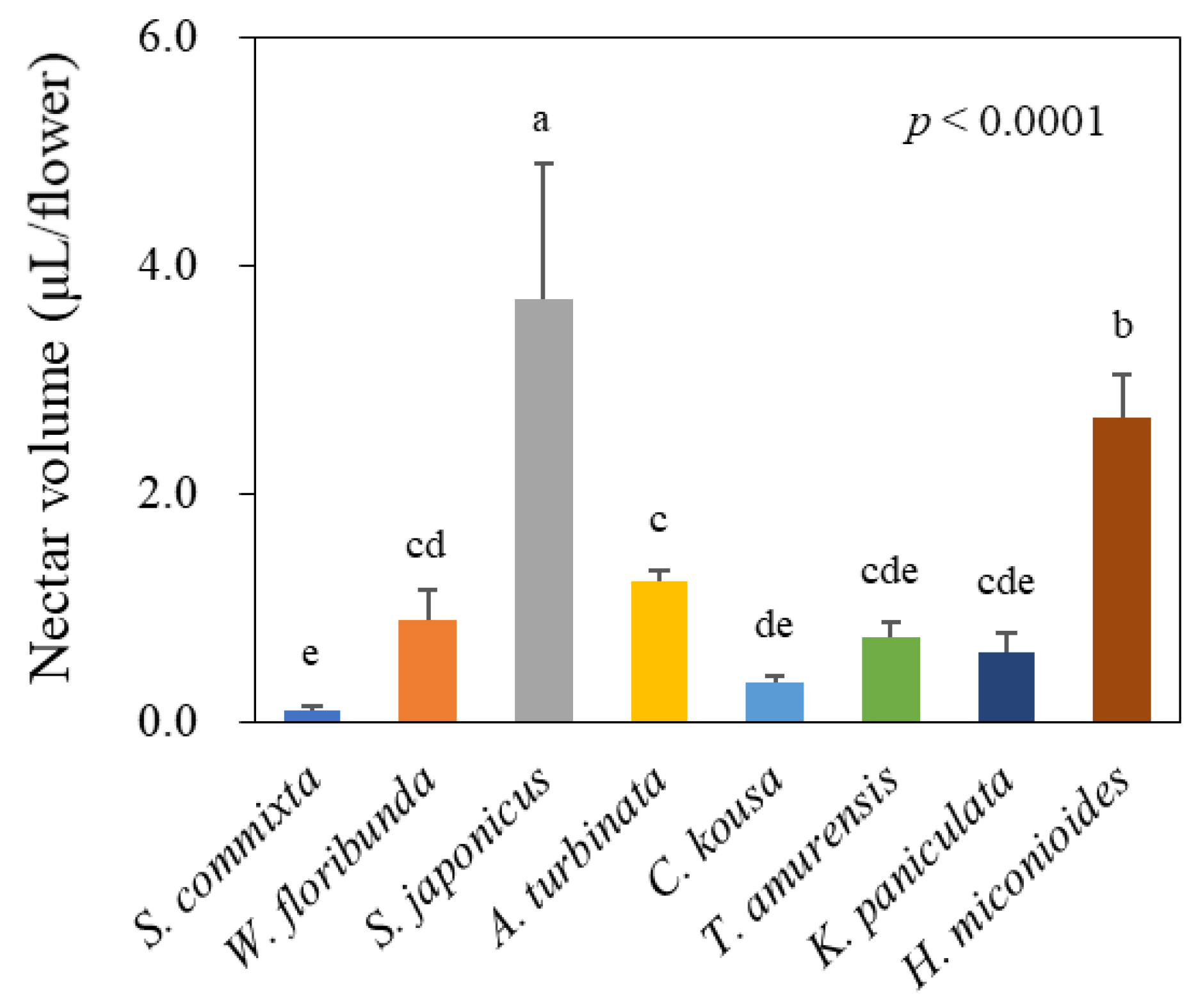
Figure 2.
Sugar content (A) and composition (B) of eight urban tree species. Data were subjected to one-way ANOVA with post-hoc comparison using Duncan’s multiple range test at the 5% level. Different letters before (A) and within (B) each bar indicate statistical differences.
Figure 2.
Sugar content (A) and composition (B) of eight urban tree species. Data were subjected to one-way ANOVA with post-hoc comparison using Duncan’s multiple range test at the 5% level. Different letters before (A) and within (B) each bar indicate statistical differences.
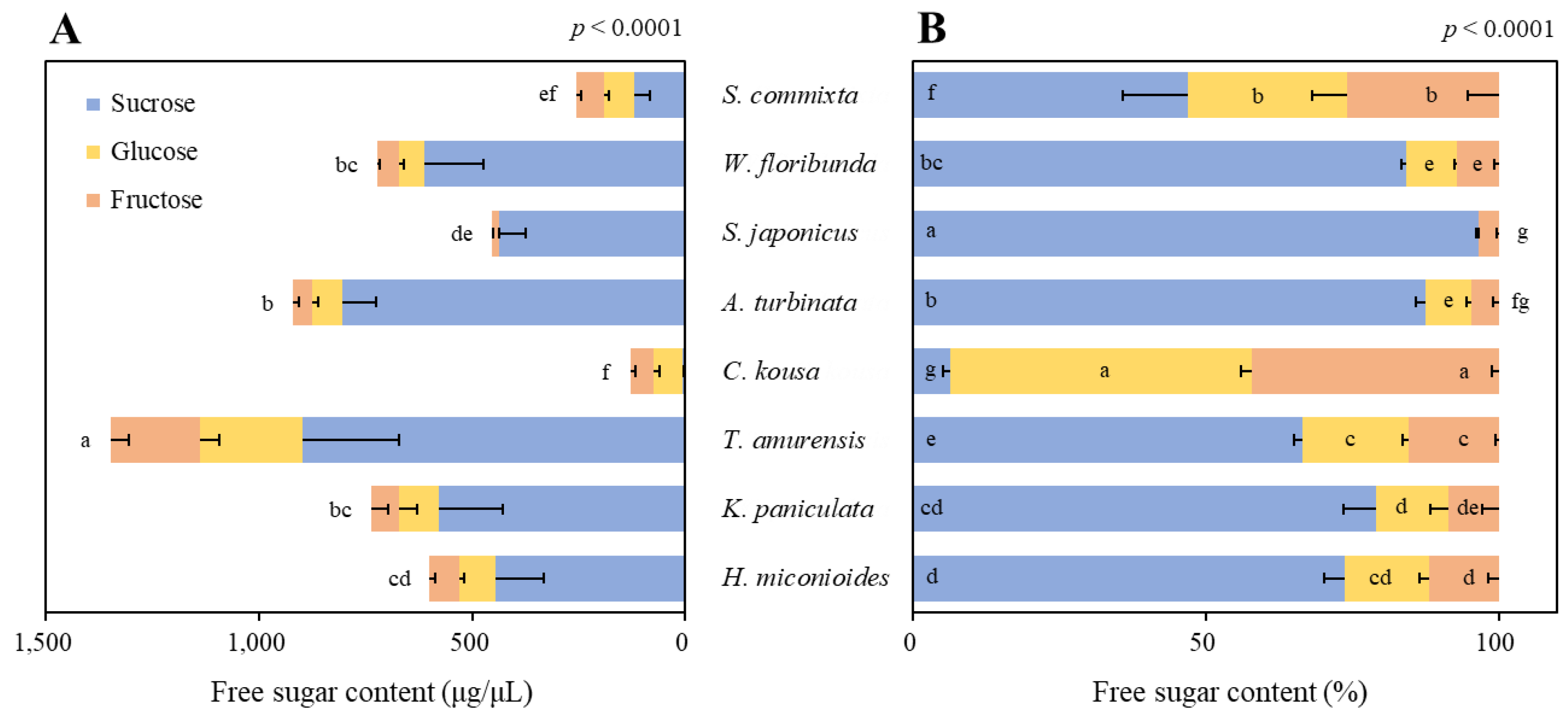
Figure 3.
Correlation analysis of sugar content. (A) Sucrose to hexose correlation. (B) Glucose to fructose correlation. Insets in (A) and (B) show sucrose to hexose (SH) and glucose to fructose (GF) ratios, respectively, in the eight street tree species.
Figure 3.
Correlation analysis of sugar content. (A) Sucrose to hexose correlation. (B) Glucose to fructose correlation. Insets in (A) and (B) show sucrose to hexose (SH) and glucose to fructose (GF) ratios, respectively, in the eight street tree species.
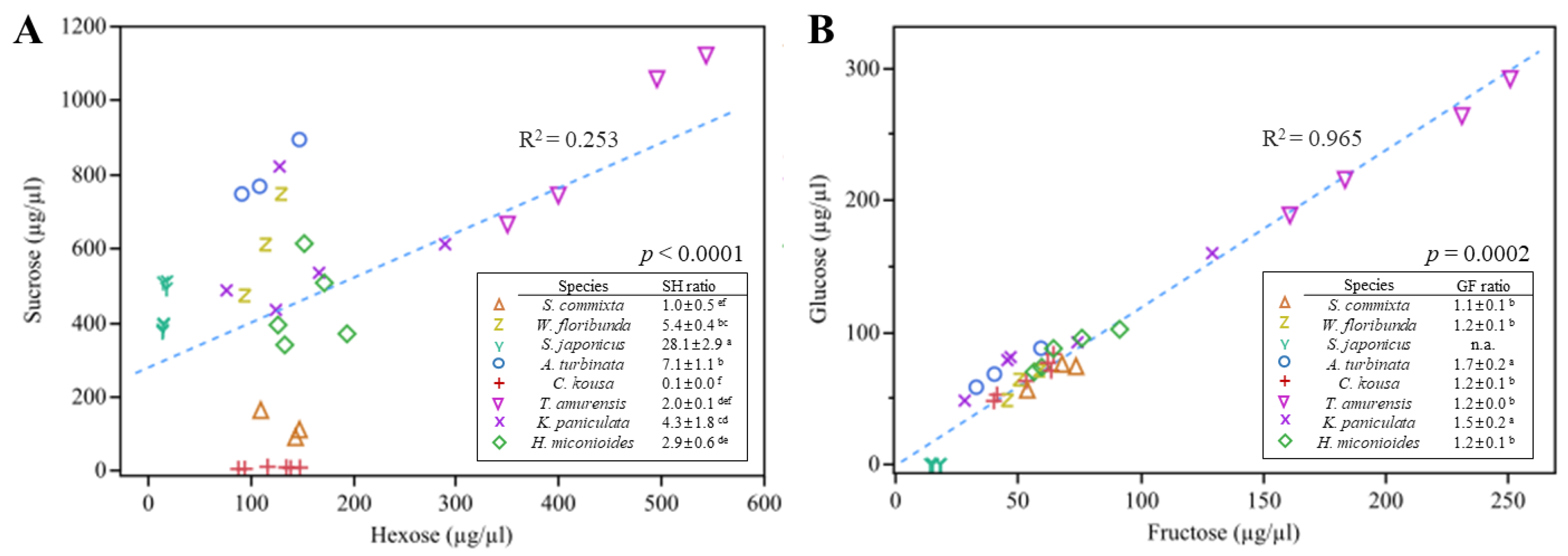
Figure 4.
Amino acid content (A) and composition (B) of the eight urban trees in Korea. Data were subjected to one-way ANOVA with post-hoc comparison using Duncan’s multiple range test at the 5% level. Different letters before (A) and within (B) each bar indicate statistical differences. Explanations: EAAs, essential amino acids; NEAAs, non-essential amino acids; NPAAs, non-protein amino acids.
Figure 4.
Amino acid content (A) and composition (B) of the eight urban trees in Korea. Data were subjected to one-way ANOVA with post-hoc comparison using Duncan’s multiple range test at the 5% level. Different letters before (A) and within (B) each bar indicate statistical differences. Explanations: EAAs, essential amino acids; NEAAs, non-essential amino acids; NPAAs, non-protein amino acids.
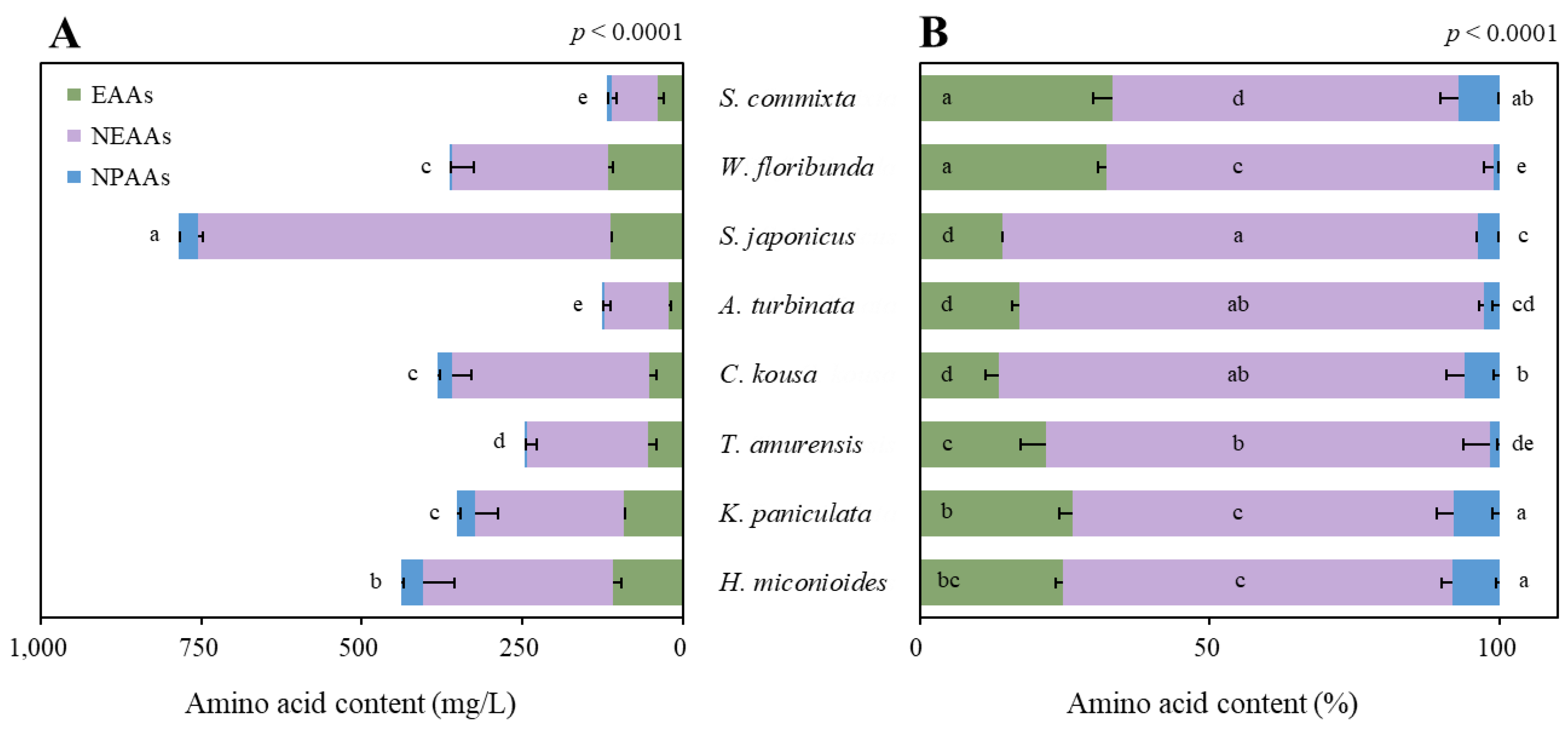
Figure 5.
Detailed comparison of amino acid content (A) and composition (B) of eight street tree species in Korea. Explanations: Arg, arginine; His, histidine; Iso, isoleucine; Leu, leucine; Lys, lysine; Phe, phenylalanine; Thre, threonine; Try, tryptophane; Val, valine; Aspa, aspartic acid; Glua, glutamic acid; Asp, asparagine; Ser, serine; Glu, glutamine; Gly, glycine; Ala, alanine; Tyr, tyrosine; Pro, proline; Cit, citrulline; Tau, taurine; Orn, ornithine; NPAAs, non-protein amino acids.
Figure 5.
Detailed comparison of amino acid content (A) and composition (B) of eight street tree species in Korea. Explanations: Arg, arginine; His, histidine; Iso, isoleucine; Leu, leucine; Lys, lysine; Phe, phenylalanine; Thre, threonine; Try, tryptophane; Val, valine; Aspa, aspartic acid; Glua, glutamic acid; Asp, asparagine; Ser, serine; Glu, glutamine; Gly, glycine; Ala, alanine; Tyr, tyrosine; Pro, proline; Cit, citrulline; Tau, taurine; Orn, ornithine; NPAAs, non-protein amino acids.
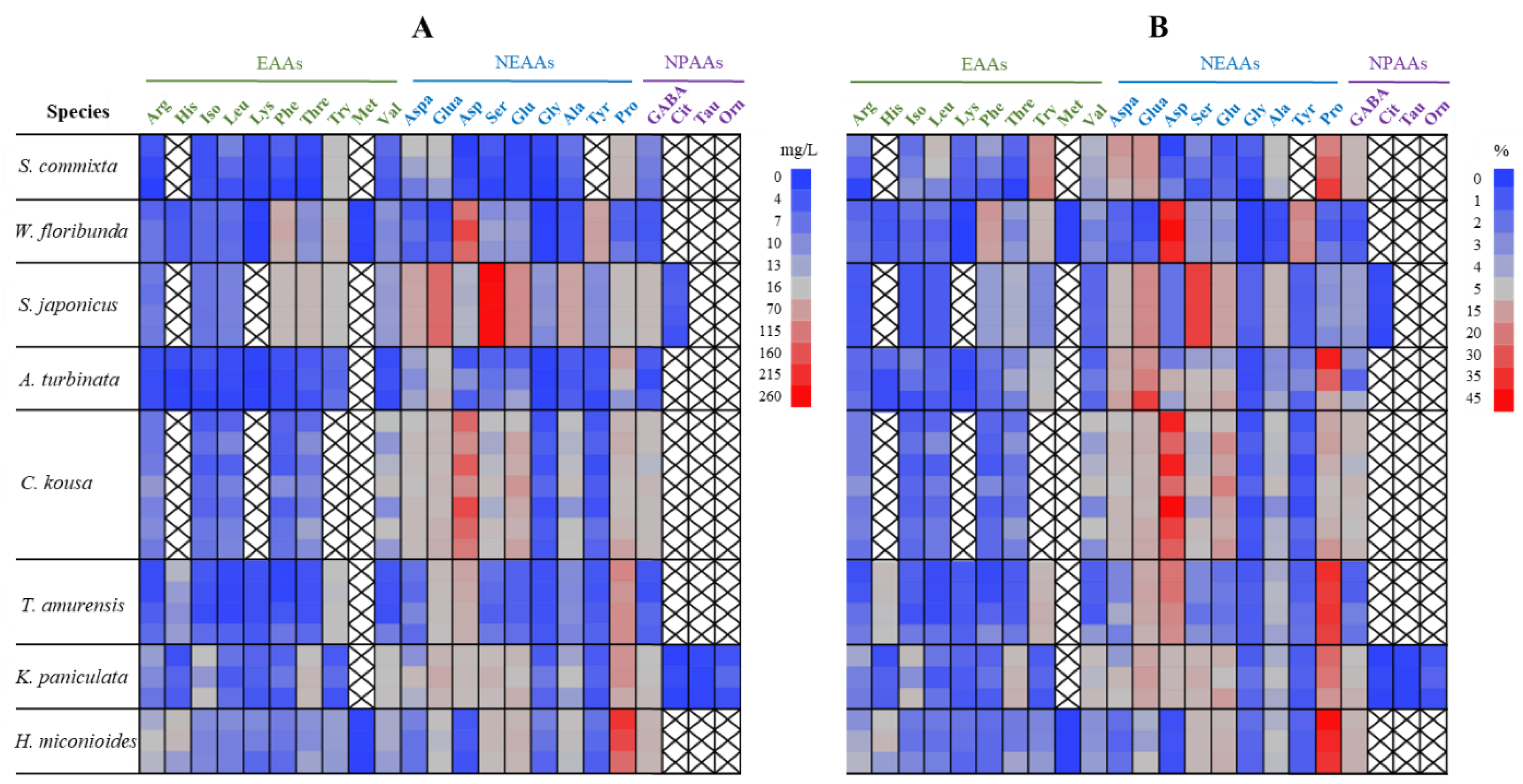
Figure 6.
Assessment of sugar content per flower (A), production per tree (B), and yield per hectare (C) among eight urban tree species. Data were subjected to one-way ANOVA with post-hoc comparison using Duncan’s multiple range test at the 5% level. Different letters after each bar indicate significant differences.
Figure 6.
Assessment of sugar content per flower (A), production per tree (B), and yield per hectare (C) among eight urban tree species. Data were subjected to one-way ANOVA with post-hoc comparison using Duncan’s multiple range test at the 5% level. Different letters after each bar indicate significant differences.
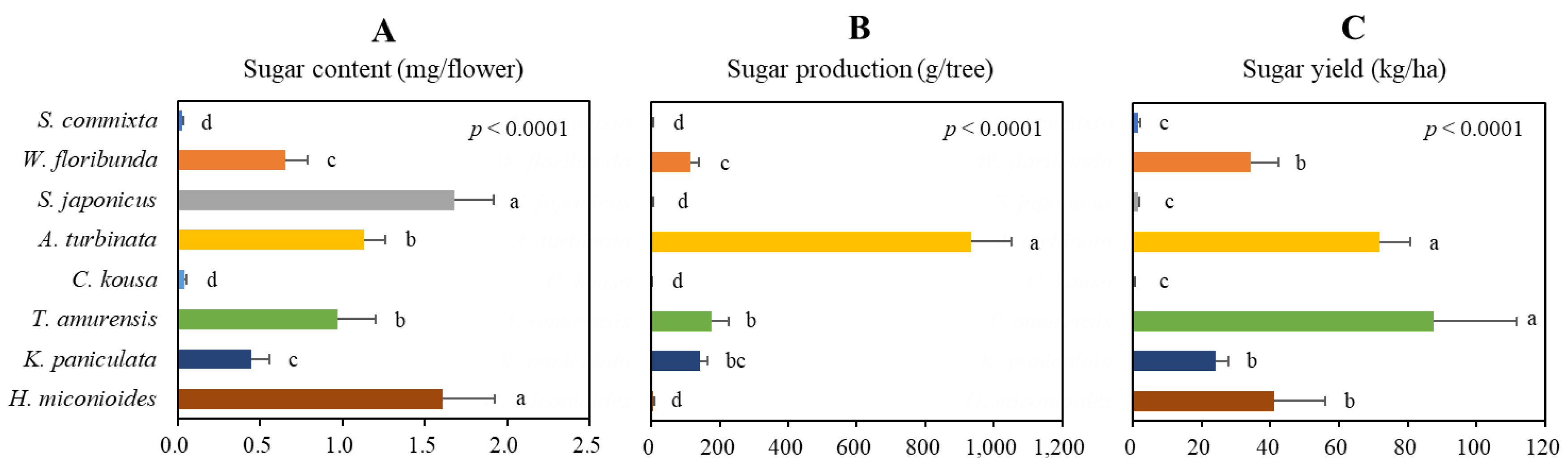
Figure 7.
Assessment of amino acid content per flower (A), production per tree (B), and yield per hectare (C) among eight urban tree species. Data represent the mean±SD. Data were subjected to one-way ANOVA with post-hoc comparison using Duncan’s multiple range test at the 5% level. Different letters after each bar indicate significant differences.
Figure 7.
Assessment of amino acid content per flower (A), production per tree (B), and yield per hectare (C) among eight urban tree species. Data represent the mean±SD. Data were subjected to one-way ANOVA with post-hoc comparison using Duncan’s multiple range test at the 5% level. Different letters after each bar indicate significant differences.
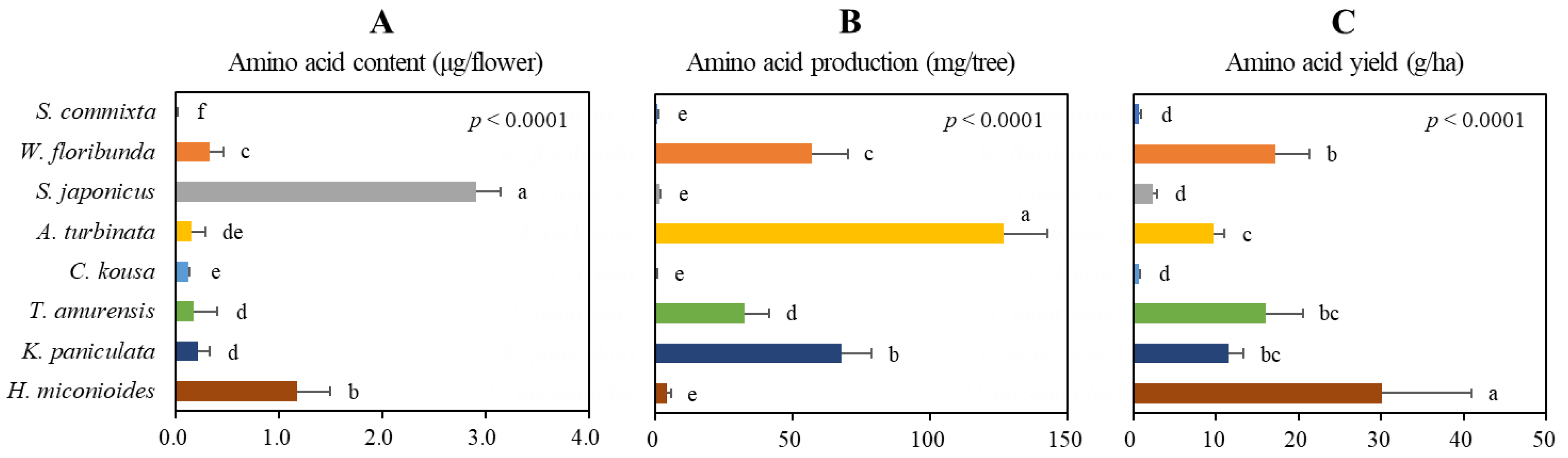
Figure 8.
Flower morphology and nectar foraging by honeybees in eight urban tree species.
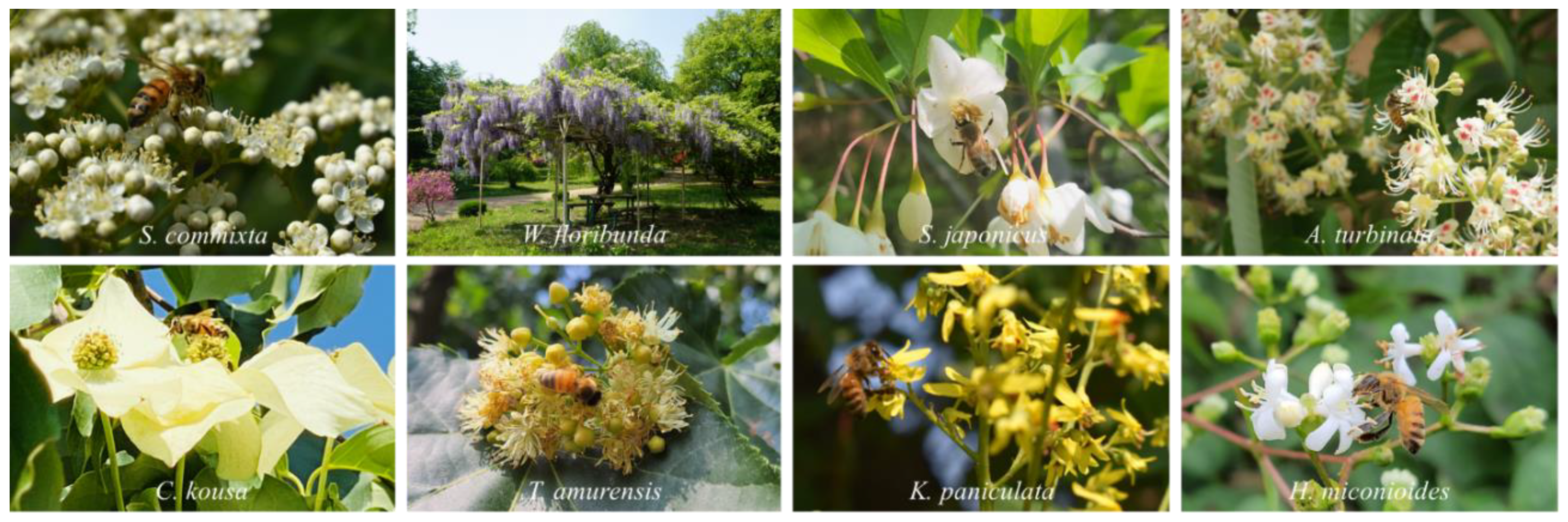
Figure 9.
Comparison of amino acid (A) and nectar (B) productivity by flowering time. By continuously accumulating such data, we can identify urban pollinators with nutritionally balanced and continuous food resources year-round.
Figure 9.
Comparison of amino acid (A) and nectar (B) productivity by flowering time. By continuously accumulating such data, we can identify urban pollinators with nutritionally balanced and continuous food resources year-round.
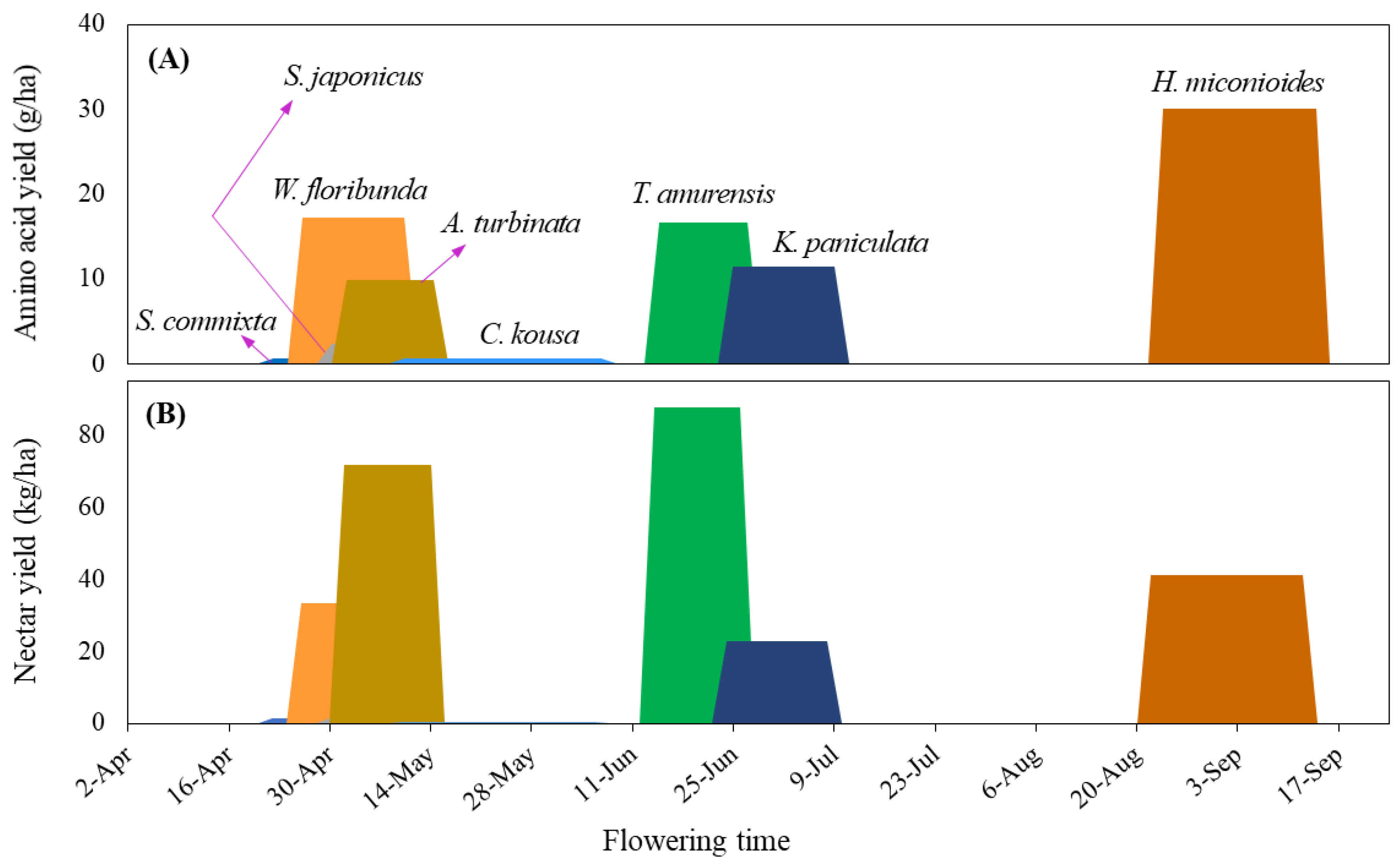

Table 1.
Results of the survey on growth and flower characteristics.
| Species | Height (m) | Crown width (m) | Flowering period | Flowering day |
| S. commixta | 3.3±0.5 | 3.1±0.4 | Apr 23–May 3 | 11 |
| W. floribunda | 3.0 | 3 x 11 * | Apr 27–May 11 | 15 |
| S. japonicus | 3.3±0.2 | 2.6±0.3 | May 1–May 15 | 15 |
| A. turbinata | 15.7±0.8 | 11.4±0.4 | May 3–May 15 | 13 |
| C. kousa | 3.9±1.7 | 2.0±0.3 | May 12–Jun 7 | 27 |
| T. amurensis | 4.8±1.4 | 4.5±1.3 | Jun 16–Jun 28 | 14 |
| K. paniculata | 5.6±0.9 | 7.7±0.2 | Jun 24–Jul 9 | 16 |
| H. miconioides | 2.1±0.3 | 1.2±0.2 | Aug 24–Sep 14 | 22 |
*Data represent the means ± SD. The W. floribunda survey data describes the vine plant covering the roof of an iron frame, with the length and width indicated (Refer to Figure 8).
Table 2.
Blooming abundance and number of flowers per hectare in eight urban tree species.
| Species | Number of flowers per tree (thous.) | Number of flowers per ha (thous.) | ||
| Mean±SD | Min - Max | Mean±SD | Min–Max | |
| S. commixta | 49.5±20.7d | 21.6–82.1 | 51,515±21,540b | 22,441–85,401 |
| W. floribunda | 174.0±40.9c | 134.6–216.2 | 52,723±12,393b | 40,785–65,526 |
| S. japonicus | 0.6±0.0e | 0.4–0.7 | 829±154d | 633–976 |
| A. turbinata | 824.7±104.1a | 720.6–928.8 | 63,460±8,009b | 55,450–71,469 |
| C. kousa | 2.0±0.7e | 1.1–2.6 | 4,943±1,661a | 2,811–6,559 |
| T. amurensis | 182.3±50.0c | 100.4–279.6 | 90,019±24,814a | 49,556–138,050 |
| K. paniculata | 318.3±50.9b | 267.4–369.2 | 53,684±8,589c | 45,094–62,273 |
| H. miconioides | 3.7±1.3e | 2.0–6.2 | 25,600±9,237c | 14,000–42,933 |
| p-value | < 0.0001 | - | < 0.0001 | - |
Data represent the means ± SD. Data were subjected to one-way ANOVA with post-hoc comparisons using Duncan’s multiple range test at the 5% significance level. Different letters in each column indicate statistical differences.
Disclaimer/Publisher’s Note: The statements, opinions and data contained in all publications are solely those of the individual author(s) and contributor(s) and not of MDPI and/or the editor(s). MDPI and/or the editor(s) disclaim responsibility for any injury to people or property resulting from any ideas, methods, instructions or products referred to in the content. |
© 2024 by the authors. Licensee MDPI, Basel, Switzerland. This article is an open access article distributed under the terms and conditions of the Creative Commons Attribution (CC BY) license (http://creativecommons.org/licenses/by/4.0/).
Copyright: This open access article is published under a Creative Commons CC BY 4.0 license, which permit the free download, distribution, and reuse, provided that the author and preprint are cited in any reuse.


