

Submitted:
29 July 2024
Posted:
30 July 2024
You are already at the latest version
Abstract
Despite copious research, the methods for assessing upper- and lower-limb motor coordination are limited. We devised a simplified evaluation method based on upper- and lower-limb motor coordination jumping and conducted a practical examination of the characteristics of the motion and applicability of the evaluation method. Overall, 88 high-school athletes with comparable competitive abilities were included in this study. The participants were divided into two groups based on their prior experience with motor coordination training (24 in the experienced group; 64 in the inexperienced group). First, a population proportion test was employed to assess the success rate of the four upper- and lower-limb motions in each task. This revealed significant difference between all tasks, except for the fourth motion, indicating that different motions have varying degrees of difficulty and that the combination of motions with differing difficulty coefficients can result in the creation of entirely new tasks with varying degrees of difficulty. Second, the experienced group demonstrated significantly superior performance compared to the inexperienced group by a t-test. These results confirmed that athletes (with the same level of competitive ability) trained in upper and lower limb motor coordination were able to excel in this evaluation method, confirming its validity.
Keywords:
motor coordination of the upper and lower limbs
; motor coordination training
; simple evaluation method
1. Introduction
1.1. Motor Coordination
Motor coordination is a fundamental component of human motor skills as demonstrated by Vandorpe et al. [1], Jaworski et al. [2], and Iorga et al. [3]. Motor coordination is achieved by coordinating the movements of each body part involved in an intended movement. In biomechanics, motor coordination is defined as the coordinated movement of multiple body parts to achieve an intended movement, such as walking [4]. In neurophysiology, stimulation of proprioceptors has been demonstrated to regulate cortical motor excitability and provide valuable insights into enhancing motor function and performance [5,6]. Additionally, Lopes et al. [7] indicated that motor coordination is a significant predictor of physical performance in childhood, as evidenced by data obtained from a longitudinal study of children in the Azores. Moreover, Krasovsky et al. [8] contended that motor coordination is of paramount importance not only as a general human system but also as a complex and sophisticated human system. In other words, the ability to coordinate movements is a prerequisite for athletes to use their bodies in complex and sophisticated ways.
Motor coordination has been the subject of extensive research, with studies examining the coordination between the right and left hands [9,10], as well that between the eyes and hands [11,12,13,14]. Moreover, studies have been conducted on the coordination between the upper and lower limbs [15,16]. The aforementioned motor coordination is not exclusive to general human movements such as walking and jumping; it is also commonly observed in sports such as volleyball, gymnastics, dance, and martial arts. Thus, research on motor coordination is expected to enhance athletic performance.
1.2. Motor Coordination Training
In recent years, there has been growing interest in motor coordination training as a means of improving motor skills and performance. Enhancing motor coordination is expected to have a favorable impact on the acquisition of motor skills, performance in competitive settings, and prevention of injuries [17,18]. In particular, it has attracted attention in fields targeting athletes and children. Trecroci et al. [19] reported that the introduction of “jump rope” training to enhance the motor skills of prepubertal soccer players yielded positive outcomes in terms of overall athletic competence as soccer players and positive growth in motor coordination. Furthermore, Boichuk et al. [20] observed that 15–17-year-old males who engaged in regular motor coordination training demonstrated enhanced performance in competitive sports. Therefore, effective motor coordination training is expected to contribute to the development of competitive athletes.
Conversely, the training methods that are becoming more prevalent exhibit shortcomings in terms of quality and efficacy. Watanabe [21] notes that proficiency in riding a bicycle does not necessarily translate into proficiency in riding a unicycle. In other words, although both require balance skills, a higher level of balance ability is required to be able to ride a unicycle. Consequently, although training on bicycles is effective in improving balance, it is not possible to determine whether general or advanced balance skills are acquired. Furthermore, regarding strength training for high-school athletes, it has been argued that a consistent standard evaluation method is necessary to evaluate training effectiveness. This is because the same training methods do not necessarily lead to the expected growth in ability, depending on the experience of the instructor [22,23]. We hypothesized that by conducting regular assessments of motor coordination in athletes undergoing training, it will be possible to adjust their training plans and future strategies. Consequently, this study focused on the assessment of motor coordination. In particular, few methods are available for assessing the motor coordination of the upper and lower limbs. Therefore, this study initially focused on the upper and lower limbs.
1.3. Evaluation Methods
Although numerous studies have been conducted on motor coordination training [24], there is a paucity of research on evaluation methods. For instance, Kochanowicz et al. [25] employed a force plate to assess motor coordination in children engaged in gymnastics. However, these measurements require advanced expertise and specialized equipment. The advantage of evaluation methods that employ specialized equipment is their precision. However, when evaluating training outcomes, it is more appropriate to rapidly grasp the results of everyday training than to employ precise but time-consuming evaluation methods. Therefore, the development of straightforward evaluation techniques is imperative. In recent years, advancements in straightforward evaluation techniques have been made in many fields. Narita et al. [26] employed tasks such as hopscotch, walking in a line with alternating steps, and standing on one leg to assess motor coordination in children during their developmental period. Similarly, Shimura et al. [27] employed a 20-meter mini-hurdle run to assess motor coordination in children during their developmental period. Szabo et al. [28] also evaluated motor coordination in children between the ages of 9 and 10 years.
Conversely, although the methodologies employed in these studies are straightforward evaluation techniques, the criteria for evaluation are constrained to children within the developmental stage. Wulf et al. [29] observed that the same task may be perceived as more or less challenging by groups with varying skill levels. In other words, evaluation tasks for children in the developmental stage are not sufficiently challenging for healthy individuals or athletes, and are thus inadequate as general evaluation methods. Moreover, although methodologies for evaluating motor coordination, such as eye–hand, upper limbs only, and lower limbs only, have been proposed, all of these require the utilization of specialized equipment. Consequently, there is a paucity of methods for evaluating upper and lower limb motor coordination in a straightforward manner without the use of specialized equipment. Accordingly, the objective of this study was to develop a method for evaluating upper and lower limb motor coordination that does not require specialized equipment and can accommodate varying levels of difficulty.
In developing the methodology for evaluating upper- and lower-limb coordination, the “rhythm jump” [30], as described by the Rhythm Training Association, was utilized as a point of reference. The rhythm jump is a four-beat jumping exercise wherein participants move their upper and lower limbs in time at a set tempo. This exercise requires motor coordination skills for the upper and lower limbs, as the upper and lower limbs move independently yet simultaneously. In addition, modifying the motion patterns of the upper and lower limbs allows for alterations in the level of difficulty. This approach is regarded as an efficacious training methodology that encompasses motor coordination of both the upper and lower limbs. Moreover, the rhythm jump can be executed without the need for any specialized equipment and can be performed simultaneously by a large number of individuals. Thus, the rhythm jump allows for a wide variety of movements with a wide range of difficulty levels achievable through the combination of motions, rendering it an appropriate choice for evaluation methods. Accordingly, in the present study, we concentrated on the four types of lower-limb motions utilized in previous investigations. This resulted in the formulation of 16 distinct motion patterns, comprising combinations of motions where the feet are apart and those where the feet are apposed upon landing. Subsequently, these were examined to ascertain their suitability for evaluating the motor coordination of the upper and lower limbs.
1.4. Purpose of This Study
n this study, preliminary experiments were conducted using 16 different types of motion tasks created as combinations of feet-apart or feet-together jump patterns according to the same upper-limb pattern. To facilitate evaluation, evaluations can be performed according to the motor coordination ability of an individual’s upper and lower limbs by conducting different difficulty levels of motion tasks. Accordingly, six tasks were selected based on the results of the pilot experiment and the difficulty level of each task was clarified. In this study, only six of the 16 tasks were implemented. However, if the motion characteristics of the tasks developed in this study are clarified, it will be possible to adjust their difficulty and customize them as a test to evaluate the motor coordination abilities of various participants. In addition, this study aimed to examine the motions of a subset of athletes with a low assumed skill level and clarify their characteristics. The rationale for selecting this group was to allow for a comparison with the general population in terms of motor coordination of the upper and lower limbs. Furthermore, the motion characteristics reflected in the results would provide more accurate suggestions.
Furthermore, the validity of the assessment test can be enhanced by accurately reflecting the strengths and weaknesses of the motor coordination skills. Therefore, this study aimed to confirm the validity of the test by selecting groups with varying assumed skill levels and examining whether higher and lower skill levels yielded higher and lower scores, respectively, as anticipated.
2. Materials and Methods
2.1. Participants
This study included 88 high-school athletes. The group of experienced participants consisted of 24 players from a high-school girls’ volleyball team who engaged in routine motor coordination training, which entailed coordinated motion of the upper and lower limbs in rhythm as a team. The group of inexperienced participants consisted of 64 players from a high-school boys’ baseball team who had not previously engaged in this training regimen (33 first-year and 31 second-year students). The training program was conducted on two occasions per week.
With regard to other factors, the two groups of participants in this study differed in terms of sex and type of sport. Notably, both baseball and volleyball are ball games that require the ability to use both the upper and lower limbs. However, in contrast to activities such as dance and gymnastics, which demand a high degree of motor coordination between the upper and lower limbs, they are also distinct from activities such as weightlifting, which require almost no motor coordination between the upper and lower limbs. In other words, the requisite motor coordination of the upper and lower limbs is identical in both sports.
The participants were selected from among high-school athletes with the same level of competition and fitness, with the exception of the motor coordination ability. The experienced participants constituted a team that had attained the second position in the Shiga Prefecture Girls’ Volleyball High School Ranking (2021, 2022). The inexperienced participants had previously attained a fourth-place ranking in the Kyoto High School Baseball Tournament (2021, 2022). Both teams had previously achieved rankings of four or higher in the Kinki region. We took great care to ensure that apart from their training experience, there were no other significant differences between the two groups.
2.2. Explanation of the Motions and Tasks
In this study, the task employed a series of light jumps in time, in accordance with the beat of a metronome. The postures assumed at the onset of each metronome sound were designated as the “postures,” and the motions of the upper and lower limbs were executed in time with the transitions between metronome sounds. In this study, a series of four motions was defined as a single series, and a task was defined as four consecutive series of the same series.
The upper-limb motions are shown in Figure 1A. The first motion was defined as the simultaneous upward movement of both hands above the head. In this instance, the typical first motion was to simultaneously raise the hands from the shoulders on the same side to the top of the head. In addition, the first motion, performed only at the beginning of the task, involved raising the hands from the sides of the body to the top of the head. In the second motion, both hands were simultaneously moved from the head to the shoulder on the same side. During the third motion, the hands were in a stationary position and remained on the same side as the shoulder. In the fourth motion, the hands were moved from the same shoulder to the opposite shoulder, subsequently making contact with the opposite shoulder before returning to the original shoulder.
Figure 1B depicts a representative image of the lower body. Two distinct categories of lower-body postures were identified: the feet were either positioned apart or together. Two distinct types of motions were identified. The feet were kept either apart or together, and the aforementioned motions were performed with the feet either apart or together. The term “keeping the feet together” refers to maintaining the feet in the aforementioned “feet together” posture. Conversely, “keeping the feet apart” denotes the act of keeping the feet in the “feet apart” posture. The motion involving both feet apart and together was defined as the motion from the feet together position to the feet apart position (“feet apart” motion) and from the feet apart position to the feet together position (“feet together” motion).
The upper-limb motion patterns used in this study were all the same. The same upper-limb pattern and different lower-limb patterns were used to make up one task. Figure 1B shows the six lower-limb motion patterns. These six tasks were used in this study. These six lower limb patterns were selected from 16 lower limb patterns. Regarding the reasons for the selection, through pilot experiments, it was found that using all 16 types of lower-limb patterns placed a burden on the participants. Next, it was found that there were four very easy patterns in which all participants succeeded after a few practice sessions. These four patterns were deemed unsuitable for the test tasks in terms of difficulty, so they could not be used in the test but were used as introductory tasks. It was possible to classify the remaining 12 lower limb patterns into six types of patterns that corresponded to each other in pairs. Therefore, one task was selected from each of the six types from among the 12 patterns.
The metronome tempo was set to 120 beats per minute (BPM), and the interval between motions was set to 500 ms. The rationale behind the selection of 120 BPM was informed by preliminary trials, which demonstrated that 120 BPM was the optimal tempo for a typical participant. This was neither excessively fast nor slow. As shown in Figure 1A,B, the first series began with preparatory posture, landing, and posturing at 500 ms. Subsequently, the transition to the second motion occurred without stopping. The second motion required landing and posturing at 1000 ms and transitioning to the third motion simultaneously. The third motion required landing and posturing at 1500 ms and transitioning to the fourth motion simultaneously. The fourth motion required landing and posturing at 2000 ms; these four consecutive motions, which landed at 2000 ms, were treated as the first series. The second series was then performed without stopping, and this process was repeated four times, with the same series of four motions performed each time. Figure 1B shows the timing of each of the lower limbs’ postures in one series of each task as well as the feet apart or together motion.
2.3. Implementation Procedure
The implementation procedure commenced with an explanation of the assignment. Following the introduction to the postures of the upper and lower limbs, the motions of the upper and lower limbs, and the meaning of the series, the motions of the upper and lower limbs were practiced separately to ascertain the level of understanding of these motions. Subsequently, a metronomic sound of 120 BPM was played, and the two introductory assignments, namely, keeping the feet together and keeping the feet apart, were introduced. Participants were then instructed to perform four consecutive series of jumps. The objective was to ascertain whether the participants had retained the requisite understanding of how to jump, with both the upper and lower limbs working together.
Subsequently, the participants were permitted to engage in unstructured practice. The participants were presented with six tasks for the actual test and allotted 5 minutes for free practice. Regarding the time of free practice, the findings of the pilot experiment indicated that free practice periods of 5–10 minutes had a negligible impact on the outcomes. It can thus be posited that setting the duration of free practice to 5 minutes represents a reasonable approach. Furthermore, it can be proposed that extending the practice time within a specific range has no effect on the results. During the free practice, the participants were permitted to repeat the tasks as often as they wished within the allotted time, regardless of whether they achieved success or failure. Additionally, the participants were permitted to visualize the movements without physical movement, irrespective of the practice method.
Following the free practice session, the six tasks were initiated. This test was conducted for each task in the prescribed order, with the subsequent task presented for confirmation once the preceding task was completed. A brief period of relaxation was permitted between tasks; however, practice during the session and stopping the session were not permitted. As this test was conducted only once, the measurement was considered complete once all six tasks were completed.
2.4. Data Processing
The dataset comprised video data from the tests conducted on all participants. The researchers employed visual inspection and motion analysis to ascertain the accuracy of each participant’s performance. If the participants’ motions deviated from the prescribed trajectories of the upper limbs, order of the lower limb motions, or prescribed postures at the time of landing, even if only one movement or posture was not aligned with the standard, it was classified as a failure. In the case of a series, even if only one motion was unsuccessful, the entire series was considered unsuccessful. It was the responsibility of each researcher to validate all video data. To further confirm the accuracy of the data, the records of all researchers were compared.
To facilitate analysis, the process was divided into two parts: examination of motion and examination of the evaluation index. Initially, the number of successful attempts at the first, second, third, and fourth motions in the first series (displayed as M1-S1, M2-S1, M3-S1, and M4-S1, respectively), or the first motion in the second series (displayed as M1-S2), was examined for all inexperienced participants. The initial stage of the data recording process involved ascertaining the proportion of participants who achieved success with M1-S1 in each task. The subsequent phase of the investigation involved ascertaining the proportion of participants who achieved success with M1-S1 and M2-S1. The subsequent step was to ascertain the proportion of participants who achieved success with both the M1-S1, M2-S1 and then M3-S1 sequences. Subsequently, the percentage of participants who achieved success in all four motions within the first series (M1-S1 to M4-S1) was calculated. Ultimately, the percentages of participants who achieved success in all five motions (M1-S1, M2-S1, M3-S1, M4-S1, and M1-S2) were determined. The population proportion test was employed with the significance level set at 5%.
Subsequently, all the participants were assessed for their ability to complete the tasks successfully. Three principal evaluation indices were employed, and each series was evaluated separately. First, the index of success for the four series was defined as whether all four series in one task were successfully completed. The percentages of individuals who achieved this level of success were also recorded. Subsequently, the index of success in at least one series was defined as the proportion of participants who achieved success in at least one of the four series in a single task. The percentages of successful individuals per task were recorded. Lastly, the mean number of successful series out of the four in a single task was established as an evaluation index, and the mean number of successful series by task was recorded. Furthermore, comparisons were made between tasks for each evaluation index. Cochran’s Q test was conducted with a significance probability of 5% for the trend.
Finally, the experienced and inexperienced participants were compared. The mean number of tasks successfully completed (index of having succeeded in four series and index of having succeeded in at least one series) for the six tasks and the mean number of successful series out of a total of 24 series for the six tasks were recorded. A two-sample t-test was conducted with a significance level of 5% between the two groups.
3. Results
3.1. Comparison of Motions
Table 1 compares the motions across the six tasks. Consequently, the success rate for M1-S1 was 100% for all six tasks (1–6), with no significant differences observed. For M2-S1, the success rates for Tasks 1–4 were significantly higher than those for Tasks 5 and 6 (χ2 = 45.874, p < .001). No significant differences were observed between Tasks 1–4 or between Tasks 5 and 6. With regard to M3-S1, it was observed that Tasks 1, 2, and 5 exhibited significantly higher success rates than Tasks 3, 4, and 6 (χ2 = 106.161, p < .001). No significant differences were observed between Tasks 1, 2, and 5, or between Tasks 3, 4, and 6. With regard to M4-S1, no significant differences were observed between the various tasks (χ2 = 2.254, p = .881). In M1-S2, Tasks 1–4 exhibited significantly higher results than tasks 5 and 6 (χ2 = 87.604, p < .001). No significant differences were observed between Tasks 1–4 or between Tasks 5 and 6.
Table 1 presents a comparison of the motions of the six tasks. The results of the comparison between the tasks, as determined through the population proportion test for the difference in population proportions, are presented as “a” or “b.” The value of “a” was found to be significantly higher than “b” (p < .05). No significant difference was identified between the values designated as “a” and “a” or between the values designated as “b” and “b.”
3.2. Comparison between Six Tasks
A comparison of the six tasks is presented in Figure 2A, which also shows the percentage of participants who succeeded in each of the four series and the comparison between the tasks. The results showed that both the inexperienced and experienced groups demonstrated significantly higher values for Tasks 1 (45.3% and 79.2%, respectively) and 2 (39.1% and 62.5%, respectively). The percentages of participants who succeeded in Tasks 4 (inexperienced: 4.7%; experienced: 20.8%), 5 (inexperienced: 0.0%; experienced: 8.3%), and 6 (inexperienced: 0.0%; experienced: 8.3%) were notably lower. For the group of inexperienced participants, only, task 3 (12.5%) exhibited a significantly lower success rate than Tasks 1 and 2 (task 1: Q = -5.073, p < .001; task 2: Q = -4.107, p < .001).
Figure 2B shows the percentage of participants who achieved success in at least one series as well as a comparison between tasks. Consequently, both the inexperienced and experienced groups demonstrated significantly better performance on Tasks 1 (inexperienced: 89.1%; experienced: 95.8%) and 2 (inexperienced: 89.1%; experienced: 100%) than on the other tasks. The inexperienced group demonstrated significantly better performance on Tasks 5 (56.3%) and 6 (17.2%) than the experienced group (75% and 54.2%, respectively). In the inexperienced group, the mean scores for Tasks 1 and 2 were significantly higher than those for Tasks 3 (53.1%) and 4 (39.1%). Furthermore, for the group of inexperienced participants, Task 6 exhibited a significantly lower performance than the other four tasks, with the exception of Task 4 (Task 3: Q = 4.218, p < .001; Task 5: Q = 4.585, p < .001). For the experienced participants, Tasks 3 (87.5%) and 4 (83.3%) exhibited significantly higher performance than Tasks 5 and 6.
Figure 2C shows the mean number of successful series and a comparison between the tasks. As a consequence, both the inexperienced and experienced groups exhibited significantly elevated values for Task 1 (inexperienced: 2.66 ± 1.44 series; experienced: 3.63 ± 0.90 series). Furthermore, both the inexperienced and experienced groups demonstrated higher success rates for Tasks 1 and 2 (Inexperienced: 0.90 ± 1.42 series; Experienced: 3.42 ± 0.86 series) compared to the remaining four tasks. For the group of experienced participants, only Task 6 (1.08 ± 1.26 series) exhibited a significantly lower mean than the other five tasks (Task 3: t = 4.368, p < .001; Task 4: t = 3.745, p < .001; Task 5: t = 2.996, p = .006).
3.3. Comparison of Inexperienced and Experienced Groups
Figure 2A shows the outcomes of a comparison between the groups by task, as determined using the chi-squared test. With the exception of Task 3 (χ2 = 3.429, p = .640), the group of experienced participants exhibited significantly higher scores than the group of inexperienced participants in all other five tasks. Figure 3A also depicts a comparison of the inexperienced and experienced groups with respect to the evaluation index of the four successful series. The results of the comparison using the t-test revealed that the group of experienced participants (2.08 ± 1.67 tasks) exhibited significantly higher values than the group of inexperienced participants (1.02 ± 1.03 tasks) (t = 3.617, p < .001). Furthermore, the maximum number of successful tasks for the inexperienced group was four (one individual, 2.0%) and no participant achieved five or six successful tasks. The maximum number of successful tasks for the experienced participants was six, with two individuals (8.3%) achieving this level of success. None of the participants achieved a score of five.
Figure 2B shows the outcomes of the comparison between groups based on task performance. The results of the comparison using the chi-square test showed that the group of experienced participants scored significantly higher than the group of inexperienced participants for tasks 3 (χ2 = 8.80, p = .003), 4 (χ2 = 13.619, p < .001), and 6 (χ2 = 12.034, p < .001). Figure 3B also depicts the mean number of tasks successfully completed out of the six tasks, as well as the percentage of successful participants for each number of successful tasks, based on the evaluation index of having succeeded in at least one series. The results of the comparison using the t-test demonstrated that the group of experienced participants exhibited a significantly higher value than the group of inexperienced participants (4.96 ± 1.34 tasks vs. 3.44 ± 1.36 tasks; t = 4.648, p < .001). Furthermore, the index revealed that the maximum number of successful tasks for the inexperienced group is six. Notably, no participants in the experienced group achieved zero successful tasks.
Figure 3C depicts the mean number of successful series out of the 24 series, along with the percentage of each successful series based on the evaluation index of the mean number of successful series. The results of the comparison using the t-test demonstrated that the group of experienced participants exhibited a significantly higher value than the group of inexperienced participants, with an average of 14.00 ± 5.42 series and 8.13 ± 4.70 series, respectively (t = -5.002, p < .001). Furthermore, the group of inexperienced participants exhibited the highest success rate in five series, with 9 individuals (14.1%) achieving this outcome. In contrast, the group of experienced participants demonstrated the highest success rate among the 12 series, with 4 individuals (16.7%) attaining this level of performance.
4. Discussion
4.1. Characteristics of Motions
All participants demonstrated success with the M1-S1 motion. Furthermore, preparatory poses performed before motion jumps in the first series were excluded from the evaluation because they were unique to that series. Therefore, M1-S1 differs from the first motion of the other series, and, owing to its lack of alignment with the characteristics of the motions within the scope of the evaluation, it was not considered in this study.
M2-S1 was the point of departure for the examination. During the second motion, the upper limb moved laterally from the center of the head to both shoulders on the same side. In a symmetrical human body, when moving the upper and lower limbs on the same side simultaneously, they tend to move in the same direction, based on the body’s midline [31,32,33,34]. Furthermore, Nakagawa et al. [35,36] demonstrated that movements on the same side of the upper and lower limbs in the horizontal plane are more stable and can be performed with greater accuracy than movements on the opposite side. Therefore, for the feet apart or together motion, Task 1 (feet apart motion) exhibited a high success rate owing to the alignment of the upper and lower limb movements in a single direction from the center outwards to both sides. This allows for a more natural and fluid motion. In contrast, Tasks 5 and 6 (feet together) required the lower limbs to move from both sides towards the center of the body in a direction different from that of the upper limbs. However, with regard to the “keeping the feet apart or together” motion, regardless of whether the feet are apart or together, the lower limbs do not move on the same or opposite side as the upper limbs. Consequently, it is postulated that this does not affect the directionality of motion. It is therefore surmised that the reason for Tasks 2–4 of the “keeping feet apart or together” motion also exhibited a high success rate, given that they were maintenance motions. These tasks entailed maintaining the same posture without being affected by directionality.
The following section examines the characteristics of M3-S1. In the third motion, the upper limbs are positioned on both shoulders without any movement. As observed by Meesen et al. [37], when engaging in motor coordination exercises targeting the upper and lower limbs, there is a proclivity to move both the upper and lower limbs simultaneously. In other words, when the lower limbs are moved in a feet-apart or together motion, the upper limbs, which are not permitted to move, are likely to move in conjunction with the lower limbs. It can be posited that the high success rates observed for Tasks 1, 2, and 5 may be attributed to the nature of the motion involved, namely, keeping the feet apart or together. This is due to the fact that both the upper and lower limbs are kept stationary (with the exception of the jump), thereby reducing the potential for interference from other movements. Conversely, the low success rates observed for Tasks 3, 4, and 6 may be attributed to the nature of the motion involved, namely, keeping the feet apart. This is due to the fact that the aforementioned tasks involve a greater degree of movement, which may have resulted in a higher level of interference from other movements.
The following section examines the characteristics of M4-S1. In contrast to M2-S1 and M3-S1, no distinction was observed in the success rate between the tasks, irrespective of whether the motion involved the feet being apart or together, or a combination of the two. In the fourth motion, the upper limbs exhibited a pause in the middle of the jump, with the hands positioned on the shoulders on the opposite side. At the time of landing, the upper limbs were required to perform two motions: contralateral and lateral. It is essential that the motion is executed at a faster pace than that of the lower body. Thus, it is postulated that the rhythms of the upper and lower limbs are distinct. Kobayashi et al. [38] indicated that when a rhythm mismatch occurs, motivation tends to decline if the rhythm and motion are not synchronized. In other words, the alteration in rhythm observed in the fourth motion may have evoked a sense of inadequacy in the participants, potentially leading to a disruption in the coordination between the upper and lower limbs. Therefore, the fourth motion presents a challenge owing to the upper limb motion regardless of the combination of lower limb motions. In other words, the fourth motion was inherently challenging. Nevertheless, it is postulated that the complexity of the lower limb motions does not influence the overall difficulty of the task, as each has a comparable level of difficulty.
Finally, an examination of M1-S2 is warranted. M1-S2 involves the movement of both hands from the same shoulder to the center of the head in an inward direction, which is the opposite of M2-S1. It is postulated that M1-S2 has an inverse relationship in terms of difficulty to M2-S1 in terms of the direction of the upper and lower limbs. Therefore, for Tasks 1 and 3 with the feet together, the lower limb motion involves closing the feet from a separate position towards the center of the body. As this is in the same direction as the upper limb (towards the inside), it has an opposite relationship to Task 1 of the second motion (the upper and lower limbs both move in an outward direction). This finding is consistent with those of the previous studies. As demonstrated by Semjen [31], Carson et al. [32], Byblow et al. [33], Temprado et al.[34], Nakagawa et al.[35], and Nakagawa et al. [36], the motion is executed with greater stability and accuracy, resulting in a high success rate. In contrast, Task 2 involved the motion of the feet apart. Although there was no significant difference in the success rate between Tasks 1, 3, and 4, the success rates remained below 90%. This discrepancy could be attributed to the fact that the lower limbs undergo lateral motion, whereas the upper limbs exhibit different directional movements. However, considering the aforementioned observations regarding the motion of keeping the feet apart or together, the success rate for Task 4, which involved keeping the feet together, was notably high, exceeding 90%. Conversely, the success rates for Tasks 5 and 6, which entailed keeping the feet apart, were markedly low at approximately 30%. In other words, the assumption that the direction of motion would remain unaffected due to its lack of correlation with the direction of the upper limbs, regardless of whether the feet were kept together or apart, was deemed erroneous.
In the case of the “keeping the feet apart” motion, the lower limbs are in fact kept apart, resulting in a conscious difference in the directionality of the upper limbs. It has been postulated that the lower limbs may be close together when they move inward. In contrast, keeping the feet together involves conscious effort to maintain the lower limbs in a fixed position, allowing the upper limbs to move inward without affecting the perception of ipsilateral movement. This explains the high success rate observed in this study. Muraoka et al. [39] suggested that psychological factors might influence limb movement patterns. If this new proposal is indeed more accurate, then in –M2-S1, for Task 2 of the “keeping the feet apart” motion, the lower limbs were aware that they were in a separate position, and because they were in the same direction as the upper limbs, they could be treated as ipsilateral motions, which is why the success rate was high. In contrast, the success rates for Tasks 3 and 4 of –M2-S1 should have been low given that the upper and lower limbs were perceived as contralateral movements. However, the observed success rate was high and this was regarded as an exceptional case within the context of this study. Thus, it can be inferred that in –M2-S1 and M1-S2, there was also an awareness of the same-side or contralateral movements of the upper and lower limbs in the feet apart and together. If the upper and lower limbs consciously move to the same side, the success rate is high. Conversely, if the upper and lower limbs consciously moved to the opposite sides, the success rate was low.
In conclusion, it can be posited that the reasons affecting the difficulty of the four motions used in this experiment are similar to those affecting the difficulty of new motions. These reasons pertain to the ability to maintain consistency between the upper and lower limbs, either in motion or conscious judgment. Therefore, achieving consistency is the key to coordinating the upper and lower limbs.
4.2. The Difficulty and Characteristics of the Six Tasks
Regarding the difficulty and characteristics of the six tasks used in this study, irrespective of experience, the three evaluation indices for Tasks 1 and 2 exhibited higher values than those observed for the remaining four tasks. With the exception of the fourth motion, which was not considered as a factor influencing task difficulty owing to the aforementioned considerations, there were no motions in Task 1 that could be classified as difficult. In Task 2, only the first motion was identified as slightly challenging. Prior research on attention capacity has indicated that as conditions become more complex, greater attention is required, thereby making it more challenging to automate motor control [40,41,42,43]. In other words, as the difficulty of the motions increased, the success rate of the task decreased and the difficulty level increased. Thus, it can be inferred that Tasks 1 and 2 are relatively straightforward and require minimal attention, making them amenable to automation. By contrast, Task 2 is also relatively straightforward to automate, although one moderately challenging motion does exist, which leads to the conclusion that it can be distinguished from Task 1.
Subsequently, Tasks 3–6 were examined. A notable discrepancy was observed between Tasks 3, 4, 5, and 6 in terms of the success rate of at least one series. However, the group of inexperienced participants who successfully completed the four series in Tasks 5 and 6 were not included in this analysis. With regard to challenging motions (with the exception of the fourth motion), only the third proved to be problematic in Tasks 3 and 4. However, in Task 5, two motions (first and second) were identified as difficult, whereas in Task 6, all three motions (first, second, and third) were classified as challenging. Therefore, Tasks 3 and 4 require a degree of attention for motor control automation. Given the near-equivalent difficulty levels of Tasks 3 and 4, it can be inferred that the same evaluation effect can be obtained by performing either task similarly. Nevertheless, it is recommended that this task be performed as an alternative or a reserve task. Tasks 5 and 6 are relatively demanding in terms of the amount of attention required for motor control automation with two or more difficult motions. Task 6 was assumed to require the greatest degree of attention.
Furthermore, the difficulty of the tasks was influenced by the number of challenging motions, as evidenced by the six tasks included in this study and the observations made during the development of other tasks. In other words, it was also inferred that the evaluation method proposed in this study allows for the free combination and adjustment of the series composition and difficulty levels according to the characteristics and difficulty of the motions involved.
4.3. Validity of the Test
A comparison of the results obtained from the group of inexperienced participants with those from the group of experienced participants revealed that the latter demonstrated superior performance across all three evaluation indices. A substantial body of research has demonstrated that motor coordination can be enhanced through targeted training [44,45,46,47]. In other words, it can be stated that the group of experienced participants who received motor coordination training on a weekly basis exhibited a higher skill level than the group of inexperienced participants who did not receive such training. It can be reasonably predicted that those with higher scores will perform better. In other words, the results obtained in this study align with the anticipated outcomes. Accordingly, this study proposed a task that could reflect the strength and weakness of the motor coordination skills of the upper and lower limbs. Furthermore, it can reflect the skill level not only in terms of experience but also within the same group. This is considered a valid evaluation method.
Furthermore, among the experienced participants, even with the stringent evaluation index of “success for the four series”, there were participants who demonstrated success in all six tasks. However, this was not observed in the inexperienced participants. Notably, none of the participants in the inexperienced group succeeded in Tasks 5 and 6. With the evaluation index of “success in at least one series”, half the experienced group succeeded in all six tasks. In contrast, the inexperienced group demonstrated a lower success rate even when the criterion was relatively relaxed. With regard to the number of successful series, the group of inexperienced participants exhibited the highest level of success, with five out of the 24 series completed successfully. The group of experienced participants exhibited the highest success rate, with 12 completed by most participants. Moreover, in Tasks 1 and 2, the vast majority of participants in the experienced group achieved success, whereas less than 50% of those in the inexperienced group were able to do so. Wulf et al. [29] highlighted that the difficulty of a task is relative, with participants with relatively high skill levels tending to find even difficult tasks to be relatively straightforward. In other words, for the inexperienced participants, Tasks 5 and 6 were particularly challenging, and it may be preferable to exclude them from the measurement process. In contrast, the experienced participants found Tasks 1 and 2 to be exceedingly simple, suggesting that they may be less suitable as test tasks and that more challenging options should be employed instead.
Furthermore, the test can be conducted with minimal effort, requiring approximately 10 minutes from the initial explanation to the conclusion of the assessment, with no specialized equipment. Considering these findings, the evaluation method proposed in this study is a useful and effective approach for accurately assessing upper- and lower-limb motor coordination skills. It offers a high degree of flexibility in terms of setting and can be easily implemented, making it a valuable addition to existing assessment tools.
4.4. Limitations
The practicality of the devised evaluation method was verified in this study. However, some limitations were identified. First, the sample size was relatively small, and the study included only two categories of athletic activity. To validate this method, it is necessary to increase the number of participants and types of athletic activity. Second, the group of experienced participants exhibited superior performance compared with the group of inexperienced participants. However, the efficacy of the motor coordination training received by the two groups before and after the training period was not evaluated through objective testing. In other words, it is not possible to definitively conclude that the observed improvement in the experienced participants is solely attributable to motor coordination training. Therefore, it is essential to pursue further investigation through subsequent surveys to substantiate the validity of these findings.
Author Contributions
Conceptualization, Runjie Li and Noriyuki Kida; Methodology, Runjie Li, Megumi Gonno and Noriyuki Kida; Validation, Runjie Li, Megumi Gonno and Noriyuki Kida; Formal analysis, Runjie Li, Megumi Gonno and Noriyuki Kida; Investigation, Runjie Li, Chisato Yamamoto, Tetsuya Miyazaki, Tomoyuki Matsui, Megumi Gonno, Teruo Nomura, Kohei Okado, Masashi Ito, Toru Morihara and Noriyuki Kida; Data curation, Runjie Li, Megumi Gonno, Masashi Ito and Noriyuki Kida; Writing – original draft, Runjie Li and Noriyuki Kida; Writing – review & editing, Runjie Li, Megumi Gonno, Teruo Nomura and Noriyuki Kida; Supervision, Noriyuki Kida. All authors have read and agreed to the published version of the manuscript.
Funding
This research received no external funding.
Institutional Review Board Statement
The study was conducted in accordance with the Declaration of Helsinki and approved by the Ethics Committee of Kyoto Institute of Technology (protocol code 2019-17).
Informed Consent Statement
Informed consent was obtained from all subjects or their family members.
Data Availability Statement
The data are available from the corresponding author upon request.
Acknowledgments
We appreciate all the research staff who supported our research, and all individuals who agree with the contents of this manuscript.
Conflicts of Interest
The authors declare no conflicts of interest.
References
- Vandorpe, B.; Vandendriessche, J.; Vaeyens, R.; Pion, J.; Matthys, S.; Lefevre, J.; …; Lenoir, M. Relationship between sports participation and the level of motor coordination in childhood: A longitudinal approach. Journal of Science and Medicine in Sport 2012, 15, 220–225. [Google Scholar] [CrossRef] [PubMed]
- Jaworski, J.; Lech, G.; Ambroży, T.; Żak, M. Identification of coordination motor abilities determining the sports skill level in elite male badminton players. Human Movement 2021, 22, 9–15. [Google Scholar] [CrossRef]
- Iorga, A.; Jianu, A.; Gheorghiu, M.; Crețu, B.D.; Eremia, I.A. Motor Coordination and Its Importance in Practicing Performance Movement. Sustainability 2023, 15, 5812. [Google Scholar] [CrossRef]
- Ishii, S. Kokannsetsushuhenbuukosetsunorigakuryouhou. Japanese Physical Therapy Association 2012, 39, 230–234. [Google Scholar]
- Kaelin-Lang, A.; Luft, A.R.; Sawaki, L.; Burstein, A.H.; Sohn, Y.H.; Cohen, L.G. Modulation of human corticomotor excitability by somatosensory input. The Journal of physiology 2002, 540, 623–633. [Google Scholar] [CrossRef]
- Rosenkranz, K.; Rothwell, J.C. Modulation of proprioceptive integration in the motor cortex shapes human motor learning. Journal of Neuroscience 2012, 32, 9000–9006. [Google Scholar] [CrossRef] [PubMed]
- Lopes, V.P.; Rodrigues, L.P.; Maia, J.A.; Malina, R.M. Motor coordination as predictor of physical activity in childhood. Scandinavian journal of medicine & science in sports 2011, 21, 663–669. [Google Scholar]
- Krasovsky, T.; Levin, M.F. Toward a better understanding of coordination in healthy and poststroke gait. Neurorehabilitation and neural repair 2010, 24, 213–224. [Google Scholar] [CrossRef]
- Semjen, A.; Summers, J.J.; Cattaert, D. Hand coordination in bimanual circle drawing. Journal of Experimental Psychology: Human Perception and Performance 1995, 21, 1139. [Google Scholar] [CrossRef]
- Swinnen, S.P.; Vangheluwe, S.; Wagemans, J.; Coxon, J.P.; Goble, D.J.; Van Impe, A.; …; Wenderoth, N. Shared neural resources between left and right interlimb coordination skills: the neural substrate of abstract motor representations. Neuroimage 2010, 49, 2570–2580. [Google Scholar]
- Candra, O. The contribution of eye-hand coordination to basketball lay up shoot skills. 1st Progress in Social Science, Humanities and Education Research Symposium (PSSHERS 2019); Atlantis Press, August 2020; pp. 864–869. [Google Scholar]
- Abbas, H.H.; Langridge, R.W.; Marotta, J.J. Eye–hand coordination: memory-guided grasping during obstacle avoidance. Experimental brain research 2022, 240, 453–466. [Google Scholar] [CrossRef]
- Fitrianto, A.T.; Prayoga, H.D. Comparison of physical fitness levels and hand-eye coordination of students aged 10-12 years. Journal Activator 2023, 1, 46–52. [Google Scholar]
- Suryadi, D.; Suganda, M.A.; Samodra YT, J.; Wati ID, P.; Rubiyatno, R.; Haïdara, Y.; …; Saputra, E. Eye-hand coordination and agility with basketball lay-up skills: A correlation study in students. JUMORA: Jurnal Moderasi Olahraga 2023, 3, 60–71. [Google Scholar] [CrossRef]
- Sidiropoulos, A.; Magill, R.; Gordon, A. Coordination of the upper and lower limbs during walking in children with cerebral palsy. Gait & Posture 2021, 86, 251–255. [Google Scholar]
- Zhu, C.; Liu, Q.; Meng, W.; Ai, Q.; Xie, S.Q. An attention-based cnn-lstm model with limb synergy for joint angles prediction. 2021 IEEE/ASME International Conference on Advanced Intelligent Mechatronics (AIM); IEEE, July 2021; pp. 747–752. [Google Scholar]
- Biino, V.; Giustino, V.; Gallotta, M.C.; Bellafiore, M.; Battaglia, G.; Lanza, M.; … Schena, F. Effects of sports experience on children’s gross motor coordination level. Frontiers in Sports and Active Living 2023, 5, 000. [Google Scholar] [CrossRef] [PubMed]
- Di Paolo, S.; Zaffagnini, S.; Pizza, N.; Grassi, A.; Bragonzoni, L. Poor motor coordination elicits altered lower limb biomechanics in young football (soccer) players: implications for injury prevention through wearable sensors. Sensors 2021, 21, 4371. [Google Scholar] [CrossRef] [PubMed]
- Trecroci, A.; Cavaggioni, L.; Caccia, R.; Alberti, G. Jump rope training: Balance and motor coordination in preadolescent soccer players. Journal of sports science & medicine 2015, 14, 792. [Google Scholar]
- Boichuk, R.; Iermakov, S.; Kovtsun, V. Influence of motor coordination indicators on efficiency of game activity of volleyball players at the stage of specialized basic training. 2017. [Google Scholar]
- Watanabe, H. Cho enryoku toreeningu no sonnzaironn wo tou. Denshou 2007, 7, 81–94. [Google Scholar]
- Tokairin, Y. A study on resistance training for handball teams of high school boys : A case of the champion team of inter-high school athletic championship. The Japan Journal of Coaching Studies 2007, 20, 99–111. [Google Scholar]
- Matsunami, K. Examination of posture evaluation feedback method during lower limb muscle strength training. Journal of Life Support Engineering 2022, 34, 25–25. [Google Scholar] [CrossRef]
- Shigeoka, Y.; Nishimoto, T. Immediate Effects of Short Coordination Training. Kawasaki journal of medical welfare 2020, 30, 231–236. [Google Scholar]
- Kochanowicz, K.; Boraczynska, L.B.; Boraczynski, T. Quantitative and qualitative evaluation of motor coordination abilities in gymnast girls aged 7–9 years. Baltic Journal of Health and Physical Activity 2009, 1, 7. [Google Scholar] [CrossRef]
- Narita, A.; Tamashiro, Y.; Yonehara, K.; Morita, A. Rehabilitation therapists’ assessment and intervention methods for children needing professional support during after-school day service. Memoirs of Osaka Shin-ai College 2023, 56, 1–5. [Google Scholar]
- Shimura, M.; Kariyama, Y.; Ogata, M. Development of an index for evaluation of rhythm adjustment ability when combining running jumping movements: Focusing on the long jump as performed by elementary school students Jpn. J. Phys. Educ. Health Sport Sci. 2022, 67, 577–589. [Google Scholar] [CrossRef]
- Szabo, D.A.; Neagu, N.; Sopa, I.S. Research regarding the development and evaluation of agility (balance, coordination and speed) in children aged 9-10 years. Health, Sports & Rehabilitation Medicine 2020, 21. [Google Scholar]
- Wulf, G.; Töllner, T.; Shea, C.H. Attentional focus effects as a function of task difficulty. Research quarterly for exercise and sport 2007, 78, 257–264. [Google Scholar] [CrossRef] [PubMed]
- Tsuda, Y. Effect of rhythm-trianing on elementary school children’s physcical strength, their exercise capacity, and the number of visit to the school health center. Mimasaka University Departmental Bulletin Pape 2017, 50, 15–19. [Google Scholar]
- Semjen, A.; Summers, J.J.; Cattaert, D. Hand coordination in bimanual circle drawing. Journal of Experimental Psychology: Human Perception and Performance 1995, 21, 1139. [Google Scholar] [CrossRef]
- Carson, R.G.; Thomas, J.; Summers, J.J.; WaltersAndras Semjen, M.R. The dynamics of bimanual circle drawing. The Quarterly Journal of Experimental Psychology: Section A 1997, 50, 664–683. [Google Scholar] [CrossRef]
- Byblow, W.D.; Summers, J.J.; Semjen, A.; Wuyts, I.J.; Carson, R.G. Spontaneous and intentional pattern switching in a multisegmental bimanual coordination task. Motor control 1999, 3, 372–393. [Google Scholar] [CrossRef]
- Temprado, J.J.; Swinnen, S.P.; Carson, R.G.; Tourment, A.; Laurent, M. Interaction of directional, neuromuscular and egocentric constraints on the stability of preferred bimanual coordination patterns. Human movement science 2003, 22, 339–363. [Google Scholar] [CrossRef] [PubMed]
- Nakagawa, K.; Muraoka, T.; Kanosue, K. Factors that determine directional constraint in ipsilateral hand–foot coordinated movements. Physiological reports 2013, 1. [Google Scholar] [CrossRef] [PubMed]
- Nakagawa, K.; Kawashima, S.; Mizuguchi, N.; Kanosue, K. Difference in activity in the supplementary motor area depending on limb combination of hand–foot coordinated movements. Frontiers in Human Neuroscience 2016, 10, 499. [Google Scholar] [CrossRef] [PubMed]
- Meesen RL, J.; Wenderoth, N.; Temprado, J.J.; Summers, J.J.; Swinnen, S.P. The coalition of constraints during coordination of the ipsilateral and heterolateral limbs. Experimental Brain Research 2006, 174, 367–375. [Google Scholar] [CrossRef] [PubMed]
- Kobayashi, R.; Tokumaru, M. Rhythm correction system for promoting motivation towards exercise. In Proceedings of the 38th Fuzzy System Symposium, Japan Society for Fuzzy Theory and Intelligent Informatics; 2022; pp. 722–727. [Google Scholar]
- Muraoka, T.; Nakagawa, K.; Kato, K.; Qi, W.; Kanosue, K. Interlimb coordination from a psychological perspective. The Journal of Physical Fitness and Sports Medicine 2016, 5, 349–359. [Google Scholar] [CrossRef]
- Wulf, G.; Lauterbach, B.; Toole, T. Learning benefits of an external focus of attention in golf. Journal of Sport and Exercise Psychology 1998, 20, 51. [Google Scholar]
- Filoteo, J.V.; Maddox, W.T. Quantitative modeling of visual attention processes in patients with Parkinson’s disease: Effects of stimulus integrality on selective attention and dimensional integration. Neuropsychology 1999, 13, 206. [Google Scholar] [CrossRef] [PubMed]
- Wulf, G.; McNevin, N.H.; Fuchs, T.; Ritter, F.; Toole, T. Attentional focus in complex skill learning. Research quarterly for exercise and sport 2000, 71, 229–239. [Google Scholar] [CrossRef]
- An, J.; Wulf, G. Golf skill learning: An external focus of attention enhances performance and motivation. Psychology of Sport and Exercise 2024, 70, 102563. [Google Scholar] [CrossRef] [PubMed]
- Silva LA, D.; Doyenart, R.; Henrique Salvan, P.; Rodrigues, W.; Felipe Lopes, J.; Gomes, K.; …; Silveira, P. C. Swimming training improves mental health parameters, cognition and motor coordination in children with Attention Deficit Hyperactivity Disorder. International journal of environmental health research 2020, 30, 584–592. [Google Scholar] [CrossRef]
- Tymoshenko, O.; Arefiev, V.; Domina, Z.; Malechko, T.; Bondar, T.; Tymchyk, M.; …; Prontenko, K. Exercise machines in speed and coordination development among students playing basketball. International Journal of Human Movement and Sports Sciences 2021, 9, 347–355. [Google Scholar] [CrossRef]
- Norouzi, E.; Gerber, M.; Pühse, U.; Vaezmosavi, M.; Brand, S. Combined virtual reality and physical training improved the bimanual coordination of women with multiple sclerosis. Neuropsychological rehabilitation 2021, 31, 552–569. [Google Scholar] [CrossRef] [PubMed]
- Wang, D.; Luo, Y.; Yang, J.; Zhao, Z.; Han, J. Muscle strength coordination training for athletes in mountaineering sports. Revista Brasileira de Medicina do Esporte 2022, 29, e2022_0289. [Google Scholar] [CrossRef]
Figure 1.
Images of jump motion of the upper and lower limbs and six types of tasks. (A) Jump motion of the upper limbs (B) Jump motion of the lower limbs.
Figure 1.
Images of jump motion of the upper and lower limbs and six types of tasks. (A) Jump motion of the upper limbs (B) Jump motion of the lower limbs.
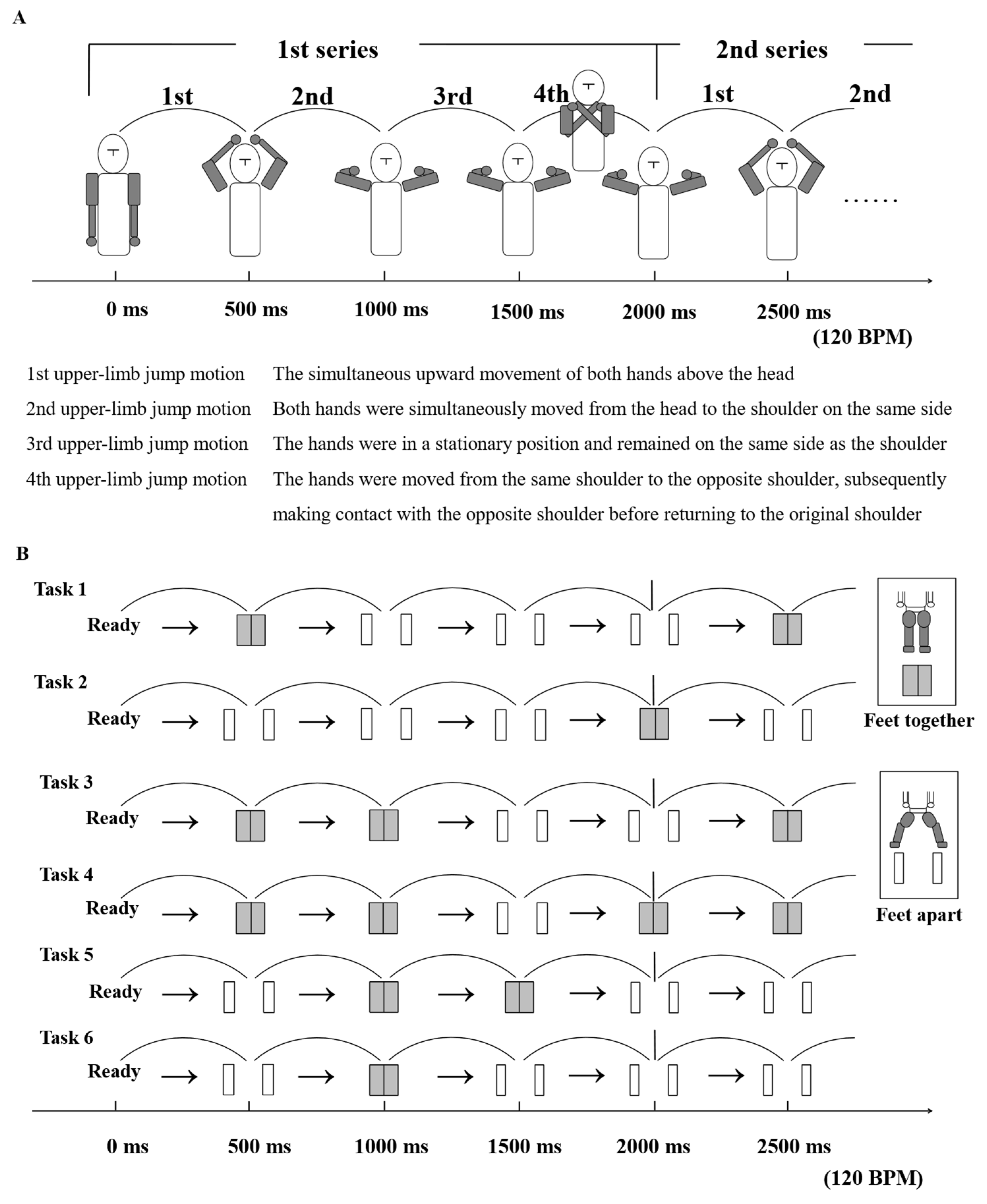
Figure 2.
Comparison between six tasks. (A) Percentage of successful with four series; (B) Percentage of success with at least one series; (C) Average number of successful series. The results of the comparison between the tasks using the Cochran’s Q test are presented in the form of “a”, “b” and “c.” The value indicated by “a” is significantly higher than both “b” and “c.” Similarly, the value indicated by “b” is significantly higher than “c.” The value indicated by “a,b” indicates that no significant difference was detected between “a” and “b.” Finally, the value indicated by “b,c” indicates that the value was significantly lower than “a,” but no significant difference was detected between “b” and “c” (p < .05).
Figure 2.
Comparison between six tasks. (A) Percentage of successful with four series; (B) Percentage of success with at least one series; (C) Average number of successful series. The results of the comparison between the tasks using the Cochran’s Q test are presented in the form of “a”, “b” and “c.” The value indicated by “a” is significantly higher than both “b” and “c.” Similarly, the value indicated by “b” is significantly higher than “c.” The value indicated by “a,b” indicates that no significant difference was detected between “a” and “b.” Finally, the value indicated by “b,c” indicates that the value was significantly lower than “a,” but no significant difference was detected between “b” and “c” (p < .05).
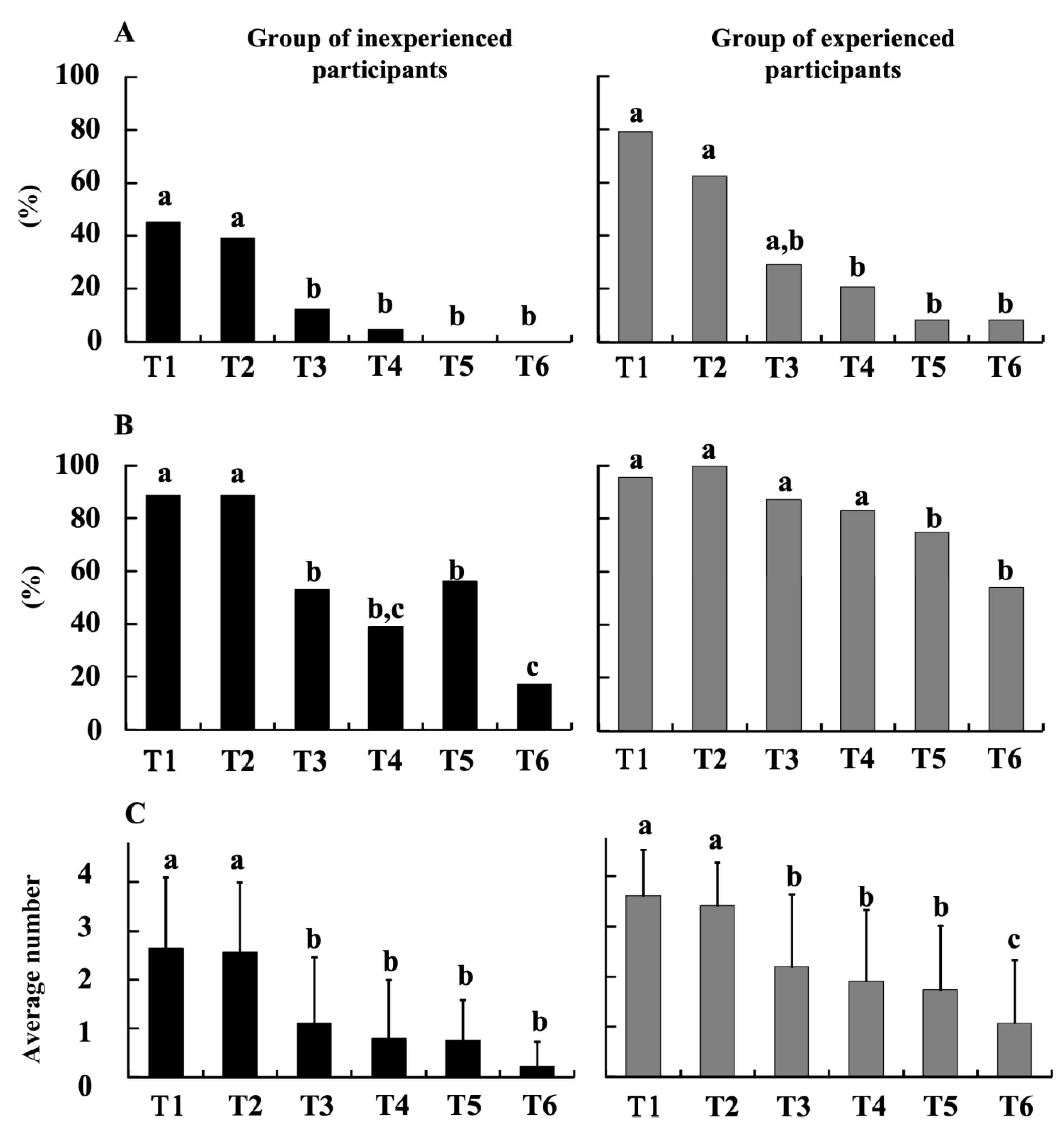
Figure 3.
Comparison between two groups: an inexperienced group and an experienced group. (A) The average number of successful tasks based on the evaluation index for four series of successes; (B) The average number of successful tasks based on the evaluation index for at least one series of successes; (C) The average number of successful series based on the evaluation index for successful series. (*p < .05; **p < .01).
Figure 3.
Comparison between two groups: an inexperienced group and an experienced group. (A) The average number of successful tasks based on the evaluation index for four series of successes; (B) The average number of successful tasks based on the evaluation index for at least one series of successes; (C) The average number of successful series based on the evaluation index for successful series. (*p < .05; **p < .01).
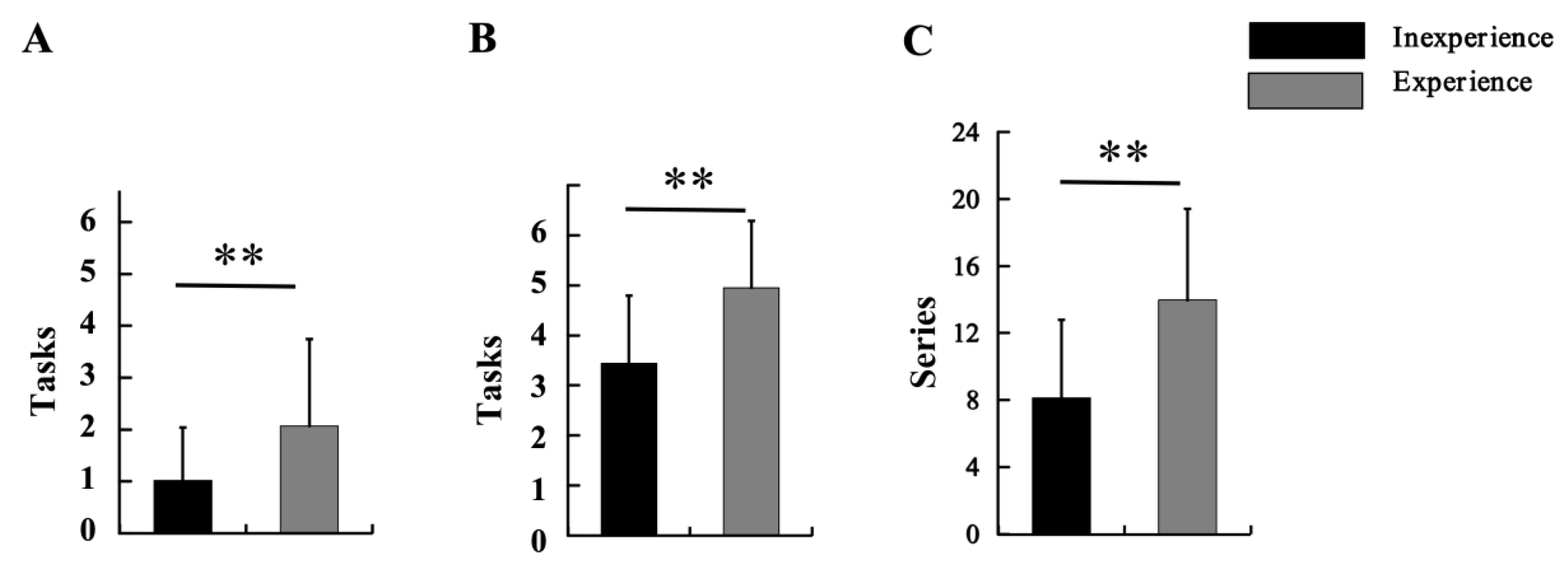

Table 1.
Comparison of motions between six tasks.
| Task 1 | Task 2 | Task 3 | Task 4 | Task 5 | Task 6 | |||||||
| % | % | % | % | % | % | |||||||
| M1-S1 | 100.0 | a | 100.0 | a | 100.0 | a | 100.0 | a | 100.0 | a | 100.0 | a |
| M2-S1 | 96.9 | a | 95.3 | a | 96.9 | a | 92.2 | a | 71.9 | b | 70.3 | b |
| M3-S1 | 98.4 | a | 96.7 | a | 62.9 | b | 47.5 | b | 95.7 | a | 35.6 | b |
| M4-S1 | 77.0 | a | 86.4 | a | 82.1 | a | 78.6 | a | 79.5 | a | 75.0 | a |
| M1-S2 | 100.0 | a | 88.2 | a | 90.6 | a | 100.0 | a | 31.4 | b | 33.3 | b |
Disclaimer/Publisher’s Note: The statements, opinions and data contained in all publications are solely those of the individual author(s) and contributor(s) and not of MDPI and/or the editor(s). MDPI and/or the editor(s) disclaim responsibility for any injury to people or property resulting from any ideas, methods, instructions or products referred to in the content. |
© 2024 by the authors. Licensee MDPI, Basel, Switzerland. This article is an open access article distributed under the terms and conditions of the Creative Commons Attribution (CC BY) license (http://creativecommons.org/licenses/by/4.0/).
Copyright: This open access article is published under a Creative Commons CC BY 4.0 license, which permit the free download, distribution, and reuse, provided that the author and preprint are cited in any reuse.


