

Submitted:
09 May 2023
Posted:
12 May 2023
You are already at the latest version
Abstract
Three-point shooting plays an important role in determining the outcome of the basketball games, and could be relevant for player selection. However, there has been little research into the relationship between basketball players' physical capacities, metabolic capacities and three-point shooting accuracy, particularly among female players. The aim of this study was to examine the relationship between physical capacities, metabolic capacities and dynamic three-point shooting accuracy in female professional basketball players. Twelve female professional basketball players from the Women’s Chinese Basketball Association (WCBA) league (age: 19.04±1.31 years, height: 181.33±4.90cm, playing experience: 7.83±1.7 years) were recruited for this study. Pearson correlations and multiple linear regression analysis were run to assess the relationship between physical capacities, metabolic capacities and dynamic three-point shooting. Results showed that coordination, balance, core strength and relative average power were positively correlated with the three-point shooting accuracy (r>0.58, P<0.05), while no other variables showed significant correlations. The current study suggests that coaching staff should consider coordination, balance, core strength and anaerobic capacities when selecting players as well as in their training periodization if three-point shooting accuracy is considered relevant.
Keywords:
basketball skills
; physical fitness
; basketball testing
; dynamic shooting
; shooting accuracy
1. Introduction
From the perspective of metabolic capacities, basketball is an highly intermittent, aerobic-anaerobic sport [1]. Specifically for female basketball, players average 5,215±314 meters per game, including walking (456±20m), jogging (1,517±93m), running (1,850±13m), and sprinting (925±184m) [2]. Additionally, authors further pointed out that players perform 35±11 jumps, 49±17 sprints and 58±19 high-intensity runs. Researchers have highlighted that aerobic capacity can aid in the faster resynthesis of phosphocreatine during intermittent high-intensity exercise, which is a key determinant of high-level basketball performance [3], and also anaerobic capacity has a greater impact on basketball players' performance [4]. Specifically, the ability to produce repetitive explosive efforts, such as jumps, accelerations and decelerations, changes of direction are all critical elements in the efficient movement process with and without the ball, directly affecting game performance [5] as well as player selection [6].
On the other hand, understanding the specific physical capacities required by basketball competition is the foundation for designing appropriate training [7,8]. Several studies have reported that the physical capacities play an important role in determining the basketball players’ performance. Studies investigating the importance of strength for basketball players have reported that good lower extremity strength is positively associated with motor control and coordination of the lower limb joints, thus influencing the players’ ability to sprints, change of directions, and jumps [9,10,11]. Similarly, Ferioli et al. investigated the difference in players’ physical capacities regarding different Divisions of the NCAA basketball league, founding that players in Division I performed better Peak power output and absolute peak force than Division II and III [12]. Additionally, as part of the strength, many studies highlighted the important role of core strength [1,13]. As the core connects the upper and lower part of the body, proper core strength is essential to transfer forces in complex, multiplanar movement than involve both the upper and lower extremities. Importantly, the core is essential for balance and postural control [1,13], which help players to maintain motor controls even under the influence of physical contacts, which are frequent in the basketball game. Furthermore, previous studies have showed that players with better speed, agility and jump capacities have substantial advantages in competition scenarios such as rebounding, blocking and shooting [14].
While the physical capacities and metabolic capacities of basketball players have been extensively researched, less efforts have been produced in understanding the relationships they have with specific performance aspects such as shooting. With the development of modern basketball, the trends of the three-point popularity have greatly changed the game. In recent years, many National Basketball Association (NBA) teams have emphasized more three-point shooting attempts as an essential part for preparing the game [15]. Ibáñez et al. reported that elite basketball players tend to take longer distance shots with more combination movements (e.g., dribble and shoot, catch and shoot) to create space than amateur players [16]. Game-related statistic showed that three-point field goal attempts/field goal attempts (%) (3PA/FGA(%)) has increased in the NBA at an average annual rate of 0.6% over the past 40 years, indicating that three-point shooting is becoming more and more important in high level basketball games. Furthermore, Stavropoulos et al, in the 2019 Men's Basketball World Cup, reported that assists, two-point field goal percentage and three-point field goal percentage are the key factors determining the outcome of the game [17]. The increase of usage of three-point shots in modern basketball has been fostered by data science approaches, which collectively found how three-point shooting from certain spots of the court is a more efficient option than the two-point shooting [18].
From the physical perspective, shooting from the three-point area requires faster releasing speed, maintaining the proper flight angle and direction shot [18], which might be related to high specific physical capacities. From the physiological perspective, one study showed that the three-point shooting at 80% max heart rate is significantly lower than 20% max heart rate [19], which suggests the importance of metabolic capacities and motor control at high intensities for three-point shooting efficiency. To our knowledge, the relationship between physical capacities, metabolic capacities and three-point shooting has not been deeply analyzed. Given the importance of three-point shooting in modern basketball, coaches and researchers are quite interested in the matter [20]. However, mainly focused on technical skills, with little information available on how physical capacities and metabolic capacities relate to three-point shooting accuracy, especially regarding dynamic three-point shooting, which is what is required during games. Therefore, the aim of this study was to examine the relationship between physical capacities, metabolic capacities and dynamic three-point shooting in female professional basketball players. Identifying the most important physical and metabolic capacities associated with three-point shooting might have considerable practical significance for player selection and training periodization in high-level basketball players.
2. Materials
2.1. Participants
Twelve female basketball players (age:19.04±1.31 years, body height:181.33±4.90cm, body fat: 24.38±2.71%, playing experience: 7.83±1.7 years) participated in the study. All players played in the Women's Chinese Basketball Association league (WCBA) (top national league). Player’s training plans featured skills and team ball trainings of around 12.5 hours per week (5 days ×2.5 hours/day), while physical conditioning accounted for 10 hours a week (5 days x 2 hours/day). To avoid the interference of fatigue on testing, players were asked to restrain from training sessions one day before testing. All players had no illness or injury. A detailed explanation of the study procedures was provided, and players gave written informed consent prior to the testing procedure. The Beijing Sport University Ethics Committee approved the study, which was performed following the ethical standards of the Declaration of Helsinki (code:2023036H).
2.2. Procedures
Players’ physical capacities, metabolic capacities and three-point shooting were assessed over three days. Before the start of each testing day, all players had 10 minutes warm up for physical and metabolic capacities tests consisting of 5 min jogging, 5 min dynamic stretching. For shooting test, the warm up consisted of 5 min jogging, 5 min dynamic stretching and 5 min casual shooting. On the first day, the one-repetition maximum (RM) deep squat, one-RM bench press, 20m sprint, lane agility test, vertical jump, Functional Movement Screen (FMS), plank support and supine static tests were conducted. The aforementioned tests were selected since the one-RM deep squat, one-RM bench press and vertical jump test can evaluate players' strength [21], and the 20m sprint test and lane agility test are important to determine the speed and agility, respectively [22,23]. Additionally, many studies have used the FMS, plank and supine static tests to measure players’ coordination, core stability, and body control ability [24,25]. Furthermore, on day 1 body height, body mass were measured using ultrasound meter [26] (Tanita WB-380, Japan), and the body fat percentage was obtained through an electronic body composition device (Tanita RD545, Japan) [27]. The 20-meter sprint and vertical jump height were measured using SmartSpeed Timing Gate System (Fusion Sport, Australia) and Kistler three-dimensional force measuring platform (9260AA, Noraxon, USA), respectively. Their reliability and validity have been confirmed by previous studies [28,29,30]. The FMS consists of 7 movement patterns: deep squat, hurdle step, inline lunge, shoulder mobility, active straight-leg raises, trunk stability push-up, and rotary stability. The scoring criteria is rated on three, two, one and zero, respectively. Three is given if the individual can perform the movement without any compensations according to the established criteria; two is given if the individual can perform the movement but must utilize poor mechanics and compensatory patterns to accomplish the movement; one is given if the individual cannot perform the movement pattern even with compensations; zero is given if the individual has pain during any part of the movement. The participant were allowed to try three times for each movement pattern and the best performance were chose [31]. Additionally, the one-RM deep squat, one-RM bench press, 20m sprint, plank test, supine static test, and lane agility test (Figure 1) were performed under the guidance of previous studies [6,25,32].
On the second day, the maximum oxygen uptake, peak power, peak power relative value, average power, average power relative value was examined. Previous studies have confirmed that oxygen uptake is considered to reflect athletes’ aerobic capacity and peak power, peak power relative value, average power and average power relative value are considered to reflect athletes’ anaerobic capacity [33,34]. To evaluate players’ aerobic capacity (metabolic capacities), the Lode treadmill (Lode, Valiant Ultra 450, Netherlands) was used, connected with the cardiopulmonary function testing system (Cortex, Leipzig, Germany) to measure players’ maximal oxygen consumption using the direct measurement test [35,36]. Anaerobic capacity was evaluated using the 30 Second Wingate Test, performed on a cycle Ergometer (MONARK, 894E, Sweden) [37].
On the third day, the 90 second (s) dynamic three-point shooting was examined. The shooting test is presented in Figure 2. Players dribbled the ball any direction from the start area to the three-point line, performing a three-point shot. Then, they ran to catch the rebound, and dribbled out of the three-point line to attempt another three-point shot. Players were asked to repeat this for 90 seconds. All players were encouraged to catch the rebound at full speed to take as many shots as possible. The backboard clock (ZJS-3C, JinLing, China) was used to count 90s. Each player executed the test two times (i.e., after all players executed the three-point shooting one time, players executed a second time in the same order as the first time) and the best performance was recorded. The 90s dynamic three-point shooting were used to determine the shooting accuracy since it is similar to the game situation in which players execute shooting off the dribble frequently. Additionally, this shooting test is used to evaluate players’ shooting skills in the WCBA and CBA (China Basketball Association) draft.
2.3. Statistical Analysis
Descriptive statistics (mean ± standard deviations) were calculated. The assumption of normality was confirmed through the use of the Kolmogorov-Smirnov test. Pearson Correlation Coefficient was used to evaluate the correlation between variables. Multiple linear regression was carried out to assess the relationship between physical capacities, metabolic capacities and three-point shooting accuracy.
In order to detect the multicollinearity of independent variables, Variance Inflation Factor (VIF) was used [38]. The VIF showed a high multicollinearity between the value of 1RM bench press and supine static test (VIF > 5). Therefore, the 1RM bench press was removed. The stepwise regression analysis was used to identify collinearity of variables and the result showed that there were multicollinearity issues between the value of peak power and relative peak power, and between the value of average power and relative average power. Therefore, the value of peak power and value of average power were removed. Statistical significance was set at p<0.05 and calculations were performed using SPSS (version 26).
3. Results
The descriptive statistics of physical capacities, metabolic capacities and dynamic three-point shooting are presented in Table 1. Mean value, standard deviation (Sd), minimum value and maximum value were calculated for all variables.
The results of Pearson correlation coefficients and multiple linear regression analysis between physical capacities and dynamic three-point shooting accuracy are shown in Table 2 and Figure 3. The 7 physical capacities variables (FMS, 20m Sprints, lane agility test, 1RM deep squat, vertical jump, plank support test, and supine static test) were included in the multiple regression analysis due to multicollinearity issues. The multiple linear regression analysis showed that the adjusted R2 was 0.335, explaining 33.5% variation in dynamic three-point shooting accuracy. Additionally, the FMS score was significantly correlated with the dynamic three-point shooting accuracy (r=0.632, p<0.05, 95%CI [0.000 to 0.875]). Furthermore, the performance of plank support was significantly correlated with the dynamic three-point shooting performance (r=0.584, p<0.05, 95%CI [-0.001 to 0.888]). However, no significant correlation was found between 1RM bench press, 1RM squat, 20m sprint, supine static test, vertical jump and dynamic three-point shooting (P>0.05).
On the other hand, the results of Pearson correlation coefficients and multiple linear regression analysis between metabolic capacities and dynamic three-point shooting are shown in Table 3 and Figure 3. After removing independent variables due to multicollinearity issues, 3 metabolic capacities (maximal oxygen consumption, relative peak power, relative average power) were included in the multiple regression analysis. The multiple linear regression analysis showed that the adjusted R2 was 0.313, explaining 31.3% of dependent variable’s variation. Furthermore, the relative average power was significantly correlated with dynamic three-point shooting performance(r=0.596, p<0.05, 95%CI [-0.156 to 0.898]). However, there was no significant correlation for the maximal oxygen consumption, average peak power (P > 0.05).
4. Discussion
Three-point shooting is key performance indicator in basketball [39] and the increase of usage of three-point shots in modern basketball has been collectively reported by data science approaches [18]. However, there has been little research into the relationship between basketball players' physical capacities, metabolic capacities, and three-point shooting accuracy, particularly among professional female players, which is a population that, generally, has received less attention compared to male counterparts. The aim of this study was to determine the relationship between and dynamic three-point shooting accuracy. The results of the current study showed that there was a significant positive correlation between the coordination and balance (assessed with FMS), core strength (Plank support test) and dynamic three-point shooting accuracy; Furthermore, anaerobic capacity (relative average power) was highly correlated with the dynamic three-point shooting accuracy. Differently, there were no significant correlations of three-point shooting with absolute strength (1RM bench press and squat), agility, speed, aerobic capacity (VO2 max), anaerobic peak power, relative peak power and average power.
Previous studies have reported that the FMS test can effectively evaluate coordination, body control and flexibility [24,40,41]. Researchers further mentioned that lower FMS scores may lead to unbalanced muscle strength in basketball players which can negatively affect shooting technique [42,43] . This study found a positive, large correlation between FMS test score and dynamic three-point shooting accuracy, indicating that better coordination and body control contributed to three-point shooting accuracy. A study by Nakano et al. [44] investigated how basketball players use two kinds of hierarchical redundancy (ball height level and body height level) to perform free throws. In fact, they found that coordination was positively connected to the consistency of shooting parameters, and it improved shooting accuracy, which is in agreement with our findings. Therefore, it appears that coordination and motor control have relevant association with three-point shooting, an important key performance indicator in basketball.
Differently, there were no correlations between dynamic three-point shooting and squat, bench press, 20-meter sprint, or vertical jump. On the other hand, as shooting distance increases, the lower extremity needs to produce more force to accelerate the ball speed, and the upper extremity must adjust the motion to maintain a balanced and stable shooting, which requires good coordination [45]. This also corresponds to our finding that shooting is a technical skill depending mostly on motor control/coordination instead of pure physical capacities. To this end, this study suggest that coaching staff need to design appropriate coordination, body control training, enhancing the stability, and coordination of all joints and muscles.
The Pearson correlation coefficient analyses showed a large, positive correlation between the plank support test and dynamic three-point shooting accuracy. Previously, Chen et al. [46] showed that a 8-weeks core strength intervention improved free throw accuracy improved by 14.0% and dynamic shooting accuracy improved by 36.2% in collegiate male basketball players. Furthermore, Liu [47] divided 40 college male basketball players into core strength training (experimental) group and traditional strength training (control) group. After 12 weeks, dynamic shooting accuracy in core strength training group increased by 32.8%, which was higher than that of the traditional strength training group. The role of the core is essential in whole-body movements, as it integrates and bypasses forces from distal segments. Additionally, basketball competitions feature intense physical contact, which can impair players’ shooting technique [48]. Therefore, it is important for players to have proper core strength to maintain balance and stabilizing the body when shooting. Similarly, Liu [49] noticed that the body's vestibular sensation, proprioception, and central system's ability to regulate muscles are significantly improved as core strength improves, which can effectively improve players’ dynamic balance ability required for three-point shooting.
It has been suggested that anaerobic capacity is a more critical factor in basketball game than aerobic capacity [50] seen by Supej et al. as an “anti-fatigue” ability in determining jump height and shooting biomechanics when shooting from a long distance [51]. The current study found that players with higher relative average power have better dynamic three-point shooting accuracy. In terms of the shooting test in this study, players were asked to take as many shots as they could while running to pick up the ball after each shot, a task which required high anaerobic endurance. This finding is in line with Pojskic et al. [52], who also found that the relative anaerobic power measured in anaerobic sprint test was positively correlated with dynamic three-point shooting accuracy. Authors further concluded that players with good anaerobic endurance can reduce the negative effects that fatigue on the shooting accuracy. Additionally, studies have pointed out that elite basketball players can adjust the shooting motion, by modifying shooting height and biomechanical factors, when they are fatigued, in order to maintain a higher shooting efficiency [53,54,55]. Regarding the other metabolic capacities assessed, there was no significant correlation between the maximal oxygen uptake and the dynamic three-point shooting. A possible explanation for this might be that the 90s dynamic three-point shooting test relatively short, requiring less aerobic metabolism energy supply, but more anaerobic supply [56]. Since basketball game are characterized by intense phases of activity relying on the anaerobic metabolism, the current study suggest to combine anaerobic endurance training with shooting drills in order to effectively improve shooting efficiency in real game settings [6].
5. Limitation
This study has some limitations. Firstly, physical demands and physiological responses during the dynamic three-point shooting were not monitored. Future studies are recommended to include the physical demands (e.g. accelerometry) [57] and physiological responses [58] during testing, such as blood lactic acid and heart rate, to better analyze and interpret the correlation between physical demands, metabolic capacities and shooting performance. In addition, the shooting test in this study is just one type of three-point dynamic shooting. In the future, other dynamic shootings should be investigated, such as catch and shoot, or a combination of catch and dribble shots.
6. Conclusions
The purpose of the current study was to determine the relationship between physical capacities, metabolic Capacities and dynamic three-point shooting. This study has showed that coordination, balance, core strength, and relative average power were significantly correlated with dynamic three-point shooting in female basketball players. However, there were no significant correlations between strength, speed, agility, aerobic capacity and dynamic three-point shooting. The findings of this study suggest that developing coordination, balance, core strength, and relative average power of female basketball players may help improve their dynamic three-point shooting accuracy. Basketball practitioners and directors might consider testing players’ coordination, balance, core strength and relative average power capacities seen the importance of three-point shooting for success in basketball [59].
Author Contributions
FL, XM, and MZ contributed to the conception and design of the study. TR and PS collected the data and performed data analysis. MZ and FL wrote the first draft of the manuscript. PS, TR, and TV made critical revision of the manuscript. All authors have read and agreed to the published version of the manuscript.
Funding
This research received no external funding.
Institutional Review Board Statement
The study was conducted according to the guidelines of the Declaration of Helsinki, and approved by the Ethics Committee of Beijing Sport University (ethical code 2023036H, approval date 13 March 2023.
Informed Consent Statement
Informed consent was obtained from all subjects involved in the study.
Data Availability Statement
The data presented in this study are available on request from the corresponding author.
Conflicts of Interest
The authors declare no conflict of interest.
References
- F.A. Engel, L. Rappelt, S. Held, L. Donath, Can high-intensity functional suspension training over eight weeks improve resting blood pressure and quality of life in young adults? A randomized controlled trial, International journal of environmental research and public health 16 (2019) 5062. [CrossRef]
- P.F. Aschendorf, C. Zinner, A. Delextrat, E. Engelmeyer, J. Mester, Effects of basketball-specific high-intensity interval training on aerobic performance and physical capacities in youth female basketball players, The Physician and sportsmedicine 47 (2019) 65-70. [CrossRef]
- Delextrat, M. Gruet, F. Bieuzen, Effects of small-sided games and high-intensity interval training on aerobic and repeated sprint performance and peripheral muscle oxygenation changes in elite junior basketball players, The Journal of Strength & Conditioning Research 32 (2018) 1882-1891. [CrossRef]
- Delextrat, D. Cohen, Strength, power, speed, and agility of women basketball players according to playing position, The Journal of Strength & Conditioning Research 23 (2009) 1974-1981. [CrossRef]
- F. Erculj, M. Blas, M. Bracic, Physical demands on young elite European female basketball players with special reference to speed, agility, explosive strength, and take-off power, The Journal of Strength & Conditioning Research 24 (2010) 2970-2978. [CrossRef]
- Y. Cui, F. Liu, D. Bao, H. Liu, S. Zhang, M.-Á. Gómez, Key anthropometric and physical determinants for different playing positions during National Basketball Association draft combine test, Frontiers in psychology 10 (2019) 2359. [CrossRef]
- J.B. Taylor, A.A. Wright, S.L. Dischiavi, M.A. Townsend, A.R. Marmon, Activity demands during multi-directional team sports: a systematic review, Sports Medicine 47 (2017) 2533-2551. [CrossRef]
- X. Schelling, L. Torres-Ronda, Conditioning for basketball: Quality and quantity of training, Strength & Conditioning Journal 35 (2013) 89-94.
- G. Ziv, R. Lidor, Physical attributes, physiological characteristics, on-court performances and nutritional strategies of female and male basketball players, Sports Medicine 39 (2009) 547-568. [CrossRef]
- M.J. Decker, M.R. Torry, D.J. Wyland, W.I. Sterett, J.R. Steadman, Gender differences in lower extremity kinematics, kinetics and energy absorption during landing, Clinical biomechanics 18 (2003) 662-669. [CrossRef]
- Tsiokanos, E. Kellis, A. Jamurtas, S. Kellis, The relationship between jumping performance and isokinetic strength of hip and knee extensors and ankle plantar flexors, Isokinetics and exercise science 10 (2002) 107-115. [CrossRef]
- D. Ferioli, E. Rampinini, A. Bosio, A. La Torre, M. Azzolini, A.J. Coutts, The physical profile of adult male basketball players: Differences between competitive levels and playing positions, Journal of sports sciences 36 (2018) 2567-2574. [CrossRef]
- Sannicandro, G. Cofano, Core stability training and jump performance in young basketball players, International Journal of Science and Research (IJSR) 6 (2017) 479-482.
- U. Alemdaroğlu, The relationship between muscle strength, anaerobic performance, agility, sprint ability and vertical jump performance in professional basketball players, Journal of human kinetics 31 (2012) 149. [CrossRef]
- M. Jaguszewski, Increasing role of three-point field goals in National Basketball Association, (2020).
- S.J. Ibáñez, S. Feu, J. García, I. Parejo, M. Cañadas, Shot differences between professional (ACB) and amateur (EBA) basketball teams. Multifactorial study, Revista de psicología del deporte 18 (2009) 313-317.
- N. Stavropoulos, P. Kolias, A. Papadopoulou, G. Stavropoulou, Game related predictors discriminating between winning and losing teams in preliminary, second and final round of basketball world cup 2019, International Journal of Performance Analysis in Sport 21 (2021) 383-395. [CrossRef]
- H.N. Gorshahri, M.A. Khazaeli, The relationship between kinematic and anthropometric variables of three-point jump shot from two different zones and the angle of the ball’s entry into the basket of the national male basketball players of Iran, Pharmacophore 9 (2018) 49-56.
- J. Padulo, G. Attene, G.M. Migliaccio, F. Cuzzolin, S. Vando, L.P. Ardigò, Metabolic optimisation of the basketball free throw, Journal of sports sciences 33 (2015) 1454-1458. [CrossRef]
- F. Veljović, D. Čaušević, D. Šečić, E. Begic, N. Selimović, D. Jahić, H. Ganija, A. Voloder, S. Burak, Biomechanical analysis of three-point shot in basketball, Periodicals of Engineering and Natural Sciences (PEN) 9 (2021) 684-690.
- Levinger, C. Goodman, D.L. Hare, G. Jerums, D. Toia, S. Selig, The reliability of the 1RM strength test for untrained middle-aged individuals, Journal of science and medicine in sport 12 (2009) 310-316. [CrossRef]
- W. Young, A. Russell, P. Burge, A. Clarke, S. Cormack, G. Stewart, The use of sprint tests for assessment of speed qualities of elite Australian rules footballers, International journal of sports physiology and performance 3 (2008) 199-206. [CrossRef]
- E. Stojanovic, N. Aksovic, N. Stojiljkovic, R. Stankovic, A.T. Scanlan, Z. Milanovic, Reliability, usefulness, and factorial validity of change-of-direction speed tests in adolescent basketball players, The Journal of Strength & Conditioning Research 33 (2019) 3162-3173. [CrossRef]
- T. Okada, K.C. Huxel, T.W. Nesser, Relationship between core stability, functional movement, and performance, The Journal of Strength & Conditioning Research 25 (2011) 252-261.
- T.K. Tong, S. Wu, J. Nie, Sport-specific endurance plank test for evaluation of global core muscle function, Physical Therapy in Sport 15 (2014) 58-63. [CrossRef]
- R. Šindelářová, P. Soukup, Z. Broukal, The relationship of obesity to the timing of permanent tooth emergence in Czech children, Acta Odontologica Scandinavica 76 (2018) 220-225. [CrossRef]
- P. Sansone, B. Makivic, R. Csapo, P. Hume, A. Martínez-Rodríguez, P. Bauer, Body Fat of Basketball Players: A Systematic Review and Meta-Analysis, Sports Medicine-Open 8 (2022) 1-21.
- J.L. Oliver, R.W. Meyers, Reliability and generality of measures of acceleration, planned agility, and reactive agility, International journal of sports physiology and performance 4 (2009) 345-354.
- R. Stanton, M. Hayman, N. Humphris, H. Borgelt, J. Fox, L. Del Vecchio, B. Humphries, Validity of a smartphone-based application for determining sprinting performance, Journal of Sports Medicine 2016 (2016). [CrossRef]
- P. Zandiyeh, L.R. Parola, B.C. Fleming, J.E. Beveridge, Wavelet analysis reveals differential lower limb muscle activity patterns long after anterior cruciate ligament reconstruction, Journal of Biomechanics 133 (2022) 110957. [CrossRef]
- Beardsley, B. Contreras, The functional movement screen: A review, Strength & Conditioning Journal 36 (2014) 72-80.
- G.-x. Ni, Back extensor's endurance evaulation, Chinese Journal of Sports Medicine 20 (2001) 196-198.
- G. Ranković, V. Mutavdžić, D. Toskić, A. Preljević, M. Kocić, G. Nedin-Ranković, N. Damjanović, Aerobic capacity as an indicator in different kinds of sports, Bosnian journal of basic medical sciences 10 (2010) 44.
- M.F. Zupan, A.W. Arata, L.H. Dawson, A.L. Wile, T.L. Payn, M.E. Hannon, Wingate anaerobic test peak power and anaerobic capacity classifications for men and women intercollegiate athletes, The Journal of Strength & Conditioning Research 23 (2009) 2598-2604. [CrossRef]
- N.M. Schutte, I. Nederend, J.J. Hudziak, M. Bartels, E.J. de Geus, Twin-sibling study and meta-analysis on the heritability of maximal oxygen consumption, Physiological Genomics 48 (2016) 210-219. [CrossRef]
- R. Goenarjo, O. Dupuy, S. Fraser, N. Berryman, A. Perrochon, L. Bosquet, Cardiorespiratory fitness and prefrontal cortex oxygenation during Stroop task in older males, Physiology & Behavior 242 (2021) 113621. [CrossRef]
- R. Dotan, O. Bar-Or, Load optimization for the Wingate anaerobic test, European journal of applied physiology and occupational physiology 51 (1983) 409-417.
- J.I. Daoud, Multicollinearity and regression analysis, Journal of Physics: Conference Series, IOP Publishing, 2017, pp. 012009. [CrossRef]
- S. Ibáñez, S. Feu, J. García, M. Cañadas, I. Parejo, Multifactorial study of shot efficacy in the Spanish professional basketball league, Perceptual and Motor Skill (2008).
- K. Kraus, E. Schütz, W.R. Taylor, R. Doyscher, Efficacy of the functional movement screen: a review, The Journal of Strength & Conditioning Research 28 (2014) 3571-3584.
- T. Hotta, S. Nishiguchi, N. Fukutani, Y. Tashiro, D. Adachi, S. Morino, H. Shirooka, Y. Nozaki, H. Hirata, M. Yamaguchi, Functional movement screen for predicting running injuries in 18-to 24-year-old competitive male runners, The Journal of Strength & Conditioning Research 29 (2015) 2808-2815. [CrossRef]
- F. Erčulj, M. Supej, The impact of fatigue on jump shot height and accuracy over a longer shooting distance in basketball, Baltic Journal of Sport and Health Sciences 4 (2006). [CrossRef]
- F.M. Verhoeven, K.M. Newell, Coordination and control of posture and ball release in basketball free-throw shooting, Human movement science 49 (2016) 216-224. [CrossRef]
- N. Nakano, Y. Iino, Y. Inaba, S. Fukashiro, S. Yoshioka, Utilizing hierarchical redundancy for accurate throwing movement, Human Movement Science 81 (2022) 102918. [CrossRef]
- N. Nakano, S. Fukashiro, S. Yoshioka, The effect of increased shooting distance on energy flow in basketball jump shot, Sports biomechanics 19 (2020) 366-381. [CrossRef]
- W.-H. Chen, H.-J. Wu, S.-L. Lo, H. Chen, W.-W. Yang, C.-F. Huang, C. Liu, Eight-week battle rope training improves multiple physical fitness dimensions and shooting accuracy in collegiate basketball players, The Journal of Strength & Conditioning Research 32 (2018) 2715-2724. [CrossRef]
- Q.-s. Liu, Study on Influence of Core Strength Training for University Men's Basketball Athlete on Physical Quality and Basic Technology, Journal of Guangzhou Sport University 36 (2016) 81-84.
- T. Ozmen, M. Aydogmus, M. Yana, A. Simsek, Effect of core strength training on balance, vertical jump height and throwing velocity in adolescent male handball players, The Journal of sports medicine and physical fitness 60 (2020) 693-699. [CrossRef]
- Y. Liu, A Study on the Importance of Core Strength and Coordination Balance during Basketball Based on Biomechanics, Molecular & Cellular Biomechanics 19 (2022) 131-139. [CrossRef]
- J.R. Hoffman, G. Tenenbaum, C.M. Maresh, W.J. Kraemer, Relationship between athletic performance tests and playing time in elite college basketball players, The Journal of Strength & Conditioning Research 10 (1996) 67-71.
- M. Supej, Impact of fatigue on the position of the release arm and shoulder girdle over a longer shooting distance for an elite basketball player, The Journal of Strength & Conditioning Research 23 (2009) 1029-1036. [CrossRef]
- H. Pojskic, N. Sisic, V. Separovic, D. Sekulic, Association between conditioning capacities and shooting performance in professional basketball players: an analysis of stationary and dynamic shooting skills, The Journal of Strength & Conditioning Research 32 (2018) 1981-1992. [CrossRef]
- T. Ahmed, The effect of upper extremity fatigue on grip strength and passing accuracy in junior basketball players, Journal of human kinetics 37 (2013) 71. [CrossRef]
- F. Li, Z. Li, I. Borović, T. Rupčić, D. Knjaz, Does fatigue affect the kinematics of shooting in female basketball?, International Journal of Performance Analysis in Sport 21 (2021) 754-766.
- T. Rupčić, L. Feng, B.R. Matković, D. Knjaz, V. Dukarić, M. Baković, A. Matković, I. Svoboda, M. Vavaček, H. Garafolić, The impact of progressive physiological loads on angular velocities during shooting in basketball-case study, Acta Kinesiologica 14 (2020) 102-109.
- M.H. Diener, L.A. Golding, D. Diener, Validity and reliability of a one-minute half sit-up test of abdominal strength and endurance, Research in Sports Medicine: An International Journal 6 (1995) 105-119. [CrossRef]
- P. Sansone, A. Ceravolo, A. Tessitore, External, internal, perceived training loads and their relationships in youth basketball players across different positions, International Journal of Sports Physiology and Performance 17 (2021) 249-255. [CrossRef]
- P. Sansone, L. Gasperi, B. Makivic, M. Gomez-Ruano, A. Tessitore, D. Conte, An ecological investigation of average and peak external load intensities of basketball skills and game-based training drills, Biology of Sport 40 (2023) 649-656. [CrossRef]
- M.Á. Gómez Ruano, F. Alarcón López, E. Ortega Toro, Analysis of shooting effectiveness in elite basketball according to match status, Revista de Psicología del Deporte 24 (2015) 0037-0041.
Figure 1.
Layout of Lane Agility Test.
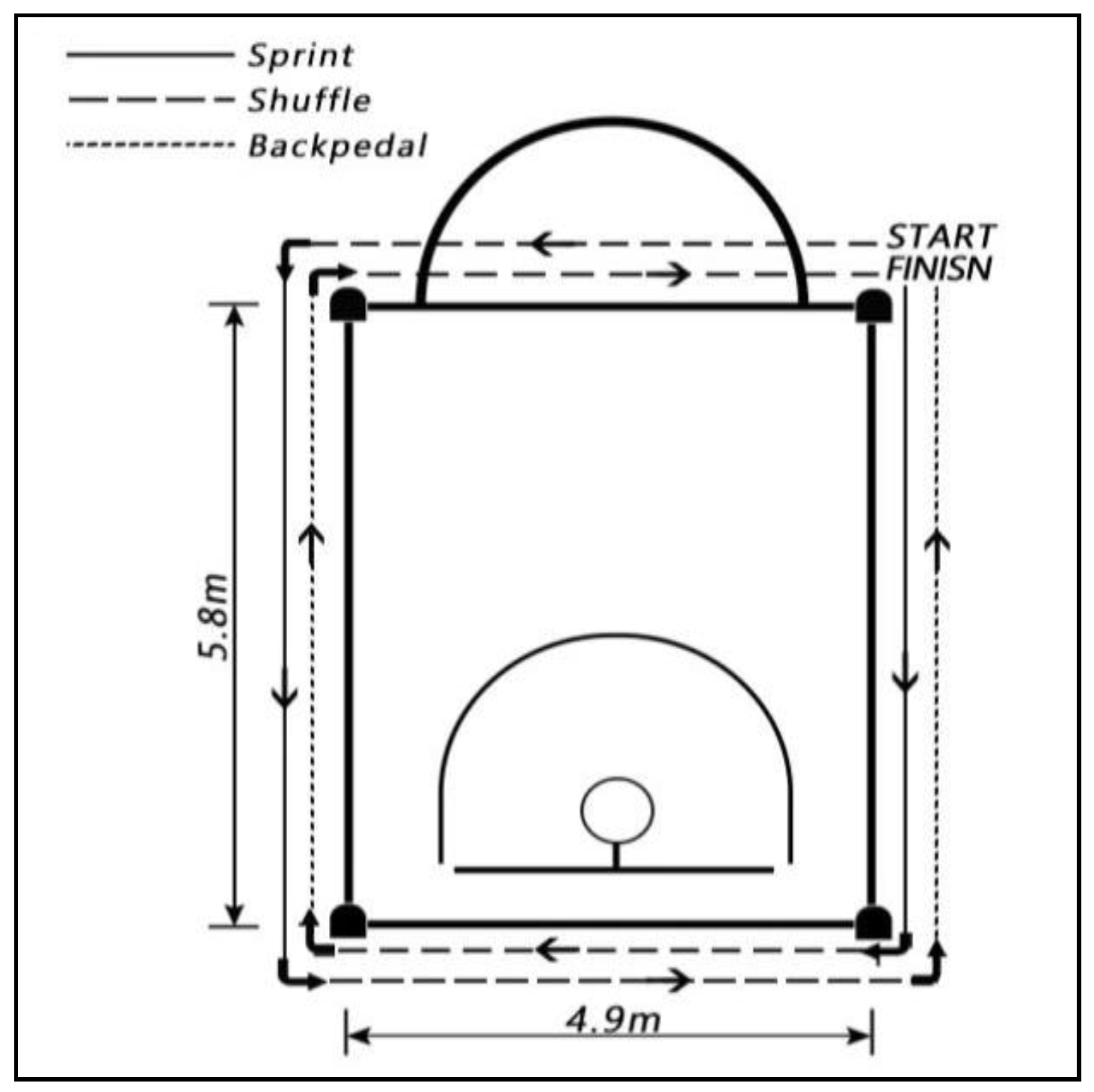
Figure 2.
Layout of 90s Dynamic Three-point Shooting Test.
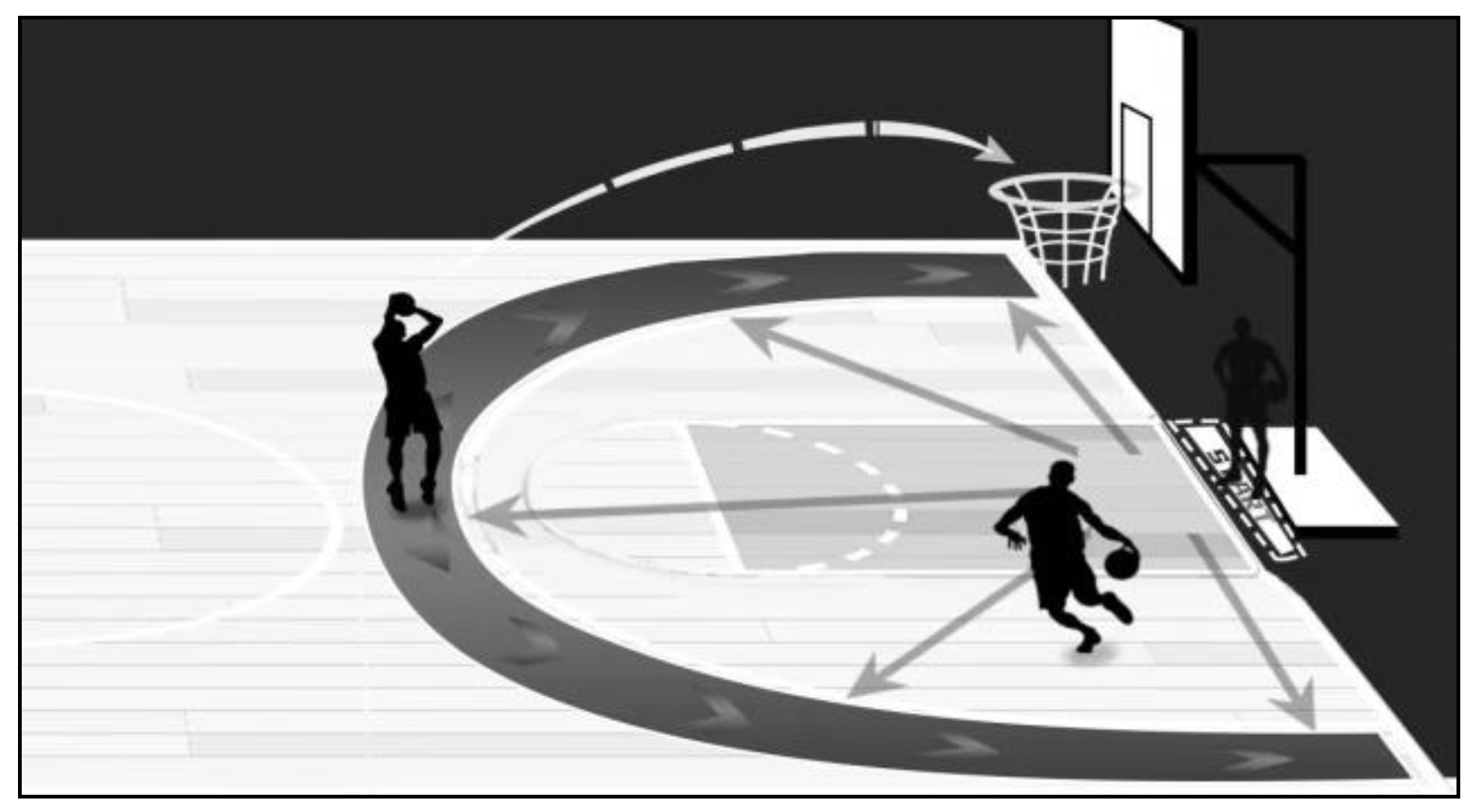
Figure 3.
The results of Pearson correlation analysis between physical capacities, metabolic capacities and three-point shooting. Note: FMS=Functional Movement Screen; 1RM Bench press=1-Repetition Maximum Bench press; 1RM Deep squat=1-Repetition Maximum Deep squat; VO2 max=Maximal Oxygen consumption; R-PePOW=Relative Peak Power; R-AvePOW=Relative Average Power; AvePOW=Average Power; PePOW=Peak Power; 90s TPST=Three-point Shooting Test; *=p<0.05.
Figure 3.
The results of Pearson correlation analysis between physical capacities, metabolic capacities and three-point shooting. Note: FMS=Functional Movement Screen; 1RM Bench press=1-Repetition Maximum Bench press; 1RM Deep squat=1-Repetition Maximum Deep squat; VO2 max=Maximal Oxygen consumption; R-PePOW=Relative Peak Power; R-AvePOW=Relative Average Power; AvePOW=Average Power; PePOW=Peak Power; 90s TPST=Three-point Shooting Test; *=p<0.05.
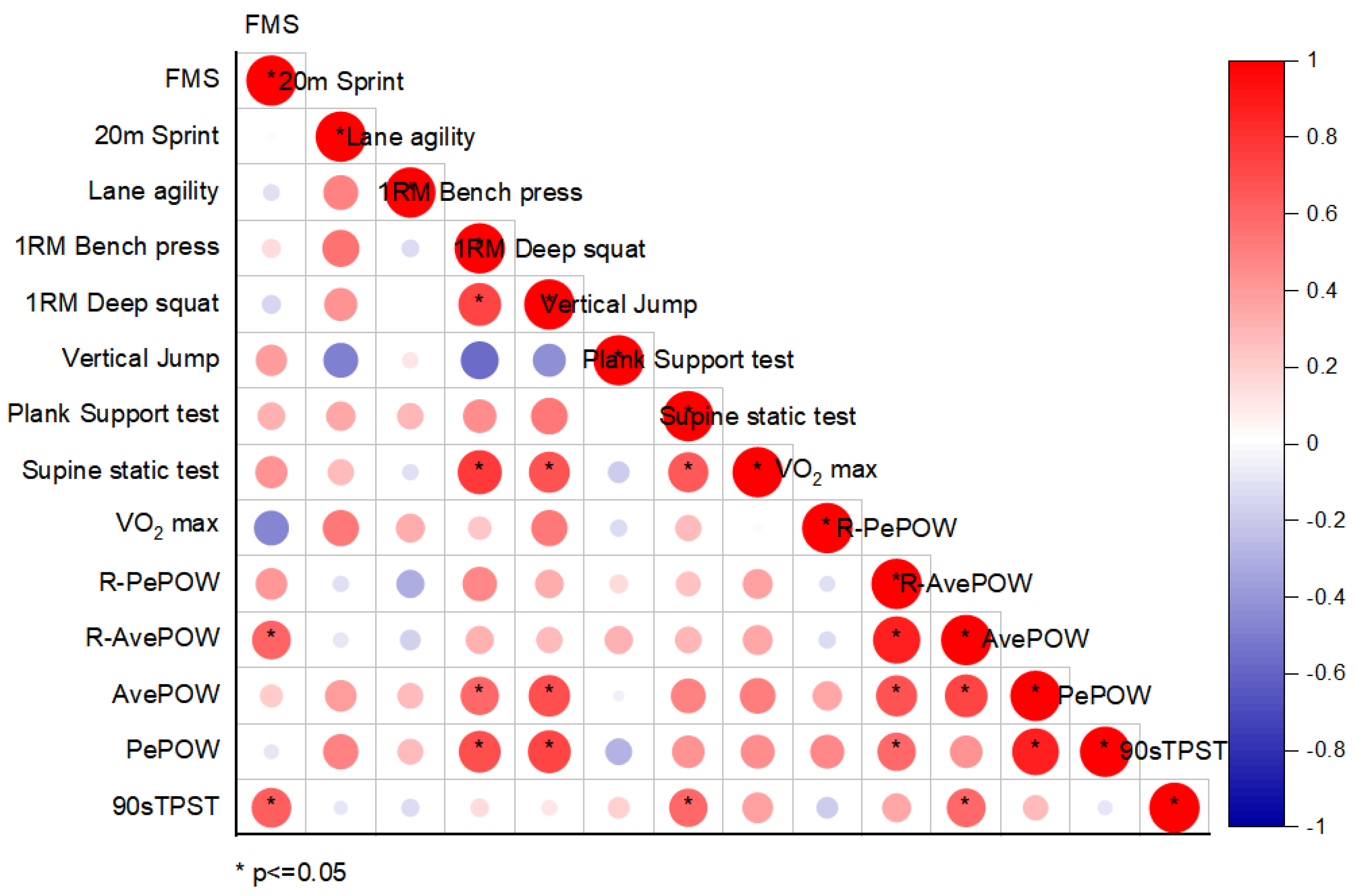

Table 1.
Descriptive statistics of physical capacities, metabolic capacities and three-point shooing.
Table 1.
Descriptive statistics of physical capacities, metabolic capacities and three-point shooing.
| Variables | Mean | SD | Minimum | Maximum |
|---|---|---|---|---|
| Age (y) | 19.04 | 1.31 | 16.75 | 21.17 |
| Height (cm) | 181.33 | 4.90 | 175.00 | 192.00 |
| Weight (kg) | 71.01 | 4.99 | 63.50 | 81.90 |
| Body fat rate (%) | 24.38 | 2.71 | 20.10 | 29.60 |
| Training experience (y) | 7.83 | 1.70 | 5.00 | 11.00 |
| FMS | 14.75 | 2.42 | 10.00 | 18.00 |
| 20m Sprint (s) | 3.40 | 0.10 | 3.24 | 3.58 |
| Lane Agility Test (s) | 13.08 | 0.58 | 12.27 | 14.19 |
| Vertical Jump (cm) | 53.08 | 4.08 | 47.00 | 60.00 |
| 1RM bench press (kg) | 55.33 | 6.30 | 43.00 | 65.00 |
| 1RM deep squat (kg) | 90.67 | 13.97 | 65.00 | 115.00 |
| Supine static test (s) | 132.67 | 28.96 | 96.00 | 180.00 |
| Plank support test (s) | 210.67 | 56.65 | 156.00 | 322.00 |
| Maximum oxygen uptake (ml/kg/min) | 46.75 | 3.19 | 42.00 | 53.00 |
| Relative Peak Power (w/kg) | 9.50 | 0.61 | 8.23 | 10.18 |
| Relative Average Power (w/kg) | 7.18 | 0.63 | 5.87 | 7.81 |
| Average power (w) | 508.64 | 47.16 | 419.97 | 592.18 |
| Peak power (w) | 673.61 | 54.23 | 587.75 | 768.97 |
| Dynamic three-point shots made (n) | 10.42 | 1.44 | 8.00 | 13.00 |
Table 2.
the results of Pearson Correlation Coefficients and Multiple Linear Regression analysis between physical capacities and dynamic three-point shooting accuracy (N=12).
Table 2.
the results of Pearson Correlation Coefficients and Multiple Linear Regression analysis between physical capacities and dynamic three-point shooting accuracy (N=12).
| Variables | r (95%CI) | SIG(two tailed) | β | VIF |
|---|---|---|---|---|
| FMS | 0.632(0.000 to 0.875) | 0.027* | 0.894 | 3.661 |
| 20m Sprint(s) | -0.084(-0.760 to 0.647) | 0.795 | -0.521 | 3.523 |
| Lane Agility Test(s) | -0.133(-0.721 to 0.771) | 0.680 | -0.007 | 2.590 |
| 1RM deep squat(kg) | 0.107(-0.378 to 0.616) | 0.741 | 0.346 | 4.326 |
| Vertical Jump(cm) | 0.194(-0.323 to 0.691) | 0.545 | -0.37 | 2.865 |
| Plank support test(s) | 0.584(-0.001 to 0.888) | 0.046* | 0.710 | 2.445 |
| Supine static test(s) | 0.373(-0.126 to 0.793) | 0.232 | -0.620 | 4.485 |
| Model summary | Adjusted R2=0.335 | D-W=2.064 | ||
Note: *r=Pearson’s product-moment correlation coefficients; 95% CI=95% confidence interval; SIG=significant difference; β=standardized coefficient; R2=Adjusted coefficient of determination; *=Statistical significance of p<0.05; VIF=Variance Inflation Factor.
Table 3.
the results of Pearson correlation coefficients and Multiple linear regression analysis between metabolic capacities and dynamic three-point shooting accuracy (N=12).
Table 3.
the results of Pearson correlation coefficients and Multiple linear regression analysis between metabolic capacities and dynamic three-point shooting accuracy (N=12).
| Variables | r (95%CI) | SIG(two tailed) | β | VIF |
|---|---|---|---|---|
| Maximal oxygen consumption(ml/kg/min) | 0.044(-0.499 to 0.474) | 0.891 | 0.894 | 1.014 |
| Relative Peak Power(w/kg) | 0.34(-0.584 to 0.773) | 0.279 | -0.521 | 4.375 |
| Relative Average power(w/kg) | 0.596(-0.156 to 0.898) | 0.041* | -0.007 | 4.372 |
| Model summary | Adjusted R2=0.313 | D-W=2.406 | ||
Note: *r=Pearson’s product-moment correlation coefficients; 95% CI=95% confidence interval; SIG=significant difference; β=standardized coefficient; R2=Adjusted coefficient of determination; *=p<0.05; VIF=Variance Inflation Factor.
Disclaimer/Publisher’s Note: The statements, opinions and data contained in all publications are solely those of the individual author(s) and contributor(s) and not of MDPI and/or the editor(s). MDPI and/or the editor(s) disclaim responsibility for any injury to people or property resulting from any ideas, methods, instructions or products referred to in the content. |
© 2023 by the authors. Licensee MDPI, Basel, Switzerland. This article is an open access article distributed under the terms and conditions of the Creative Commons Attribution (CC BY) license (http://creativecommons.org/licenses/by/4.0/).
Copyright: This open access article is published under a Creative Commons CC BY 4.0 license, which permit the free download, distribution, and reuse, provided that the author and preprint are cited in any reuse.


