

Submitted:
10 July 2024
Posted:
11 July 2024
You are already at the latest version
Abstract
In many European countries over the last decades, arable fields dominate agriculture landscapes, leading to a very intensive land-use practices. This reason seems to be the main cause of popula-tions declines for numerous farmland species, including the European hare (Lepus europaeus Pallas, 1778). The Research institute for Animal Production (National Agricultural and Food Centre, Luzianky, Slovakia) has been engaged in a long monitoring project (project currently run-ning), collecting certain indicators of hare population dynamics during hunting season since 1987 to 2023 in the Slovak Danubian Lowland. In the same macro-area (Čiližská Radvaň and Lehnice) a study was conducted on the influence of permanent semi-natural vegetation in relation to re-cruitment, population density and production. The whole monitored period was aggregated into 5-years intervals (for a total of 7 time-intervals), with the aim of analyzing the brown hare popu-lation dynamics. Spring hare density in the Danubian Lowland is currently 20.8 hares/km2, with harvests of 4.6 hares/km2. During all the monitoring period, bag’s animals have been examined following the regular hunting operations for the purpose of age determination (weight of eye lenses), sex ratio and productivity. The results of our analysis showed that the proportion of juve-nile in bag (PYB) among those shot varied from 37.0 % of the last 5-years interval (2018-2023), to a maximum of 51.0 % in interval of years 1998-2002. On total average there were 1.86 juveniles per adult female (r). The proportion of adult females in gamebag varied from 22.58 % (years in-terval 1992-1997) to 31.26 % (years interval 2018-2023). Sex-ratio (SI; males : females) among shot hares showed a value of 0.50, ranged from 0.48 in the period 2008-2012 to 0.52 in the first observed period (years 1987-1991) and in the last one (years 2018-2023). Average weight of shot hares was 4.04 kg (juveniles 3.83 kg, adults 4.27 kg, adult males 4.21 kg and females 4.32 kg). There was a large positive effect of set-aside with special mixtures, created for hares in large-scale farmed agrarian landscape, on hare density, bag and recruitment. In model hunting grounds with such set-asides increased the spring stock by 25 %, bag by 100 % and recruitment by 20 %. This study reveals that the management of European brown hare is not sustainable, and the population is decreasing. It is proved through the decline of harvest hares and by population dynamics parameters. Environmental improvements lead to the stabilization and increasing of requested parameters.
Keywords:
biodiversity
; conservation
; game management
; population dynamics
1. Introduction
Density and bags of hare (Lepus europaeus) are currently at historically low levels throughout Europe. Decline in the populations of hare has been experienced in many areas across its geographic range in Europe, beginning in the 1960s, with the intensification of agricultural practices as main cause [1]. Although the problem has been studied intensively, and much new information obtained [1,2,3], the causes of this decline have not yet been adequately explained, and there are clearly regional differences. The population density of this species might be affected by external factors such as climate, feed availability, diseases and predators, but also by internal factors such as reproductive rate and ability for adaptation and anthropogenic factors [4]. Some recovery is apparent in Germany [5,6], but in Slovakia there has not yet been any marked increase in hare density [7]. Similar negative trend has been reported in a number European countries such as France, Denmark, Poland, Serbia, and Italy [8,9]. Despite its currently declining numbers, the European brown hare represents one of the most important game species throughout Slovakia countryside. The dynamics of hares seem resilient to even heavy hunting pressure, though local population dynamic data may be needed to ensure sustainable harvest [10].
We had expected that the changes in agriculture in Slovakia following the collapse of communism in 1989 would result in increased small game populations including hares, but this did not occur. In the branch of agriculture, hunting and related services the number of employees in organizations with over 20 persons decreased by about 250 thousand employees in the period of ten years. The decrease was mainly influenced by the decline of employees in agricultural cooperatives. In the year 1989 there were almost 261 thousand employees in agricultural cooperatives, while in 1998 it was only 69 thousand employees (data source: Statistical office of the Slovak Republic, www.slovak.statistics.sk). In addition, Slovakia has been faced a decline in livestock production, a decrease of cultivation of perennial fodder crops, and specialization of agricultural enterprises in production of only a few crop types, mainly sunflower, rape and soybean. This loss of crop diversity was unfavorable for hares. Only locally, in some hunting grounds, there was an increase in hare density and hunting bags, associated with crops such as sunflower, maize, soybean and melons in which hares cause substantial damage [11].
This study aimed to evaluate any changes in the population size and distribution of the brown hare in Slovak Danubian Lowland in the last decades (1987 - 2023). In particular, the analyses aimed to i) identify the environmental variables that influence the distribution of the species, (ii) identify the variations of dynamic’s indices (sex ratio, age structure and productivity) over the years, iii) highlight any population trend in relation to climate change. We used hunting bag data for this purpose. These offer a good monitoring strategy, as they can be used as a general index of long-term trends, and they can give indications regarding changes in population size and distribution [12,13].
2. Materials and Methods
2.1. Study Area
The research was performed on a set of selected hunting grounds in the Slovak part of the Danubian Lowland, on the left side of the river Danube. Elevation above sea level is 103–160 m, soil is predominantly chernozem, alkaline, annual precipitation depth 550–600 mm. Average annual air temperature 9.6–10.5 °C. Climate is continental, very warm and dry; summers are hot with temperatures higher than 30 °C, winters quite mild with low covering of snow of short duration. The area is deforested; forest percentage varies from 0 to 10 %. Arable land is in absolute prevalence (66–97 %); mainly cereals including maize (65–80 %), sunflower and rape are grown on it [14]. There is intensive agriculture on large plots with average area of 61 ha. There are also orchards and vineyards but many of these are being liquidated, which is very unfavorable for the game. Semi-natural vegetation was virtually eliminated during the communist era [15]. In this area remained preserved predominantly large agricultural units from the period before the political changes in 1989 with high degree of specialization; it means that one farm grows only a low number of crops and it realizes a so-called blockade of plots, so one and the same crop is grown on a very large continuous area. Animal production was considerably reduced, and therefore acreage of grown fodder crops decreased markedly.
2.2. Indicators of Population Dynamics
Brown hare census carries mandatory every hunting organizations under Law 247/2009 every year to the March, 31. Mostly used census method is counting on whole area of hunting ground, or at the part of it and the subsequent conversion per unit area. Hunting statistics for Slovakia are collected by the Ministry of Agriculture and Rural Development. The hunting season for brown hare lasts from 1 November to 31 December, but most are shot and caught (and live exported) in December. From 1987 to 2023, age structure, body weight (a total of 3,119 animals, immediately after their capture), sex ratio and productivity were determined by examination of hares in hunting bags. The whole monitored period was grouped into 5-years intervals (for a total of 7 time-intervals), with the aim of analyzing the brown hare population dynamics.
Sex was determined by visual inspection of the genitalia. Hares were classified into juveniles or adults on the basis of eye lens dry weight [16]. A total of 12,845 eye lenses were weighed (1 eye lens from each shot hare). Eyeballs were dissected from shot hares using forceps and scissors. Each eyeball with an indication of the number and location of the hare was placed in a tube with fixative (4 % formaldehyde). After 14 days of the fixation, lenses were cut out and dried to constant weight at 100 °C (24 hours). Weight was measured on a Sartorius balance to the nearest 0.001 g. After construction of the frequency distribution graph according to the weight of the eye lens, threshold was determined, which was around 280 mg. According to this value, hares were classified, to this year’s group and older.
As indicators of population dynamics in this research we used: ratio of yearlings in the bag, reproduction coefficient, reproduction index, sex ratio, coefficient of population increase and population increase. Furthermore, criteria were set for the determination of population increase based on the ratio of yearlings in the bag – an increase of over 60% was considered as excellent, 50-60% as medium and less than 50% as poor [14]. The formulas for calculating the studied indicators [13] are showed below:
- o
- Ratio of yearlings in the bag
PYB = (Njuv / N) x 100
- o
- Coefficient of reproduction
R = Njuv / Nad
- o
- Reproduction index
r = Njuv / Nadf
- o
- Sex ratio
Si = F / N
- o
- Population increase
PI% = ((%juv – 30) / (100 - %juv)) x 100
Legend: N: total number of individuals; Nad: number of adults; Nadf: number of adult female; F: number of female; PYB: proportion of youngs in the bag.
While determining the spring number of hares in the researched areas, we applied the method of counting test areas (transect method), where we counted the spring number of hares as a mean number of hares per area units [14].
2.3. Semi-Natural Vegetation Model Area
The influence of permanent semi-natural vegetation in the model area of the Hunters Association Veľký Grob (48o 14’ 56’’ N, 17o 29’ 25’’ E) was studied. The influence of small fields or grazing grounds for hares on their recruitment, population density and production were determined on model areas Čiližská Radvaň (47o 52’ N, 18o 05’ E; 1,691 ha; of which 35 ha were forest) between years 1998 and 2008, and Lehnice (48o 4’ 9’’ N, 17o 27’ 17’’ E; 1,958 ha; 45 ha forest) between years 2001 and 2005. To improve the environment we used a specially-developed seed mixture consisting of 7 species of grass (Festuca rubra, Festuca pratensis, Phleum pratense, Dactylis glomerata, Lolium multiflorum, Lolium perene, Poa pratensis), 3 species of cereals (Avena sativa, Secale cereale, Fagopyrum esculentum), 4 species of clover (Trifolium pratense, Medicago sativa, Trifolium repens, Lotus corniculatus), 4 species of other legumes (Faba vulgaris, Pisum sativum, Glycine max, Vicia sativa), 3 species of Brassicaceae (Sinapis alba, Brassica napus, Brassica oleracea) and Phacelia [17].
2.4. Statistical Analysis
Statistical analysis was performed Statdisk v. 12.0.2 software using Student’s t-test and Scheffe’s test for data regarding brown hare weights, with the animal sex as source of variation. Data on indicators of hare population’s dynamics were submitted to analysis of variance (one-way ANOVA), performing a linear correlation and regression (significance level 0.05).
3. Results and Discussion
3.1. Hare Population’s Dynamic
In the first half of the 20th century the brown hare was per capita the most important game species in Slovakia, forming more than 70 % of total game production. At the beginning of the 1960s it still formed more than 60 % of total game production but subsequently red deer and then wild boar displaced the hare from first place. The highest bags of hares in Slovakia were recorded in 1973 (341,005 individuals) and 1974 (344,727 individuals) during an era of intensive large-scale agriculture (data source: Statistical office of the Slovak Republic, www.slovak.statistics.sk). In 1975 hare bags collapsed. They recovered quickly during 1976–77 but collapsed again in 1978–79. From 1980 until the end of the 2007, bags were relatively stable around a much lower average of 40,223 per annum, but still showed a slight decline during this period. A sharp fall from 1995 to 1996 (the lowest recorded in Slovakia) was associated with a prolonged cold period during winter 1995–96 and very heavy rainfall in 1996 (110 % of normal, during May 170 %). Only slightly less extreme was fall between 2002 and 2003, this time associated with unusually high summer temperatures and drought in 2003. The annual air temperature of the year 2003 at the Hurbanovo Observatory was 1.2 °C above the 1961–1990 annual average. This value makes the year 2003 the sixth warmest one from 1871. This contribution is devoted to profound analysis of unusual extreme high temperatures in the May–August season and very low precipitation totals in the February–August season in Slovakia in 2003. In 2007, 31,856 hares were shot or caught in Slovakia (data source: Statistical office of the Slovak Republic, www.slovak.statistics.sk), equivalent to 0.71 hares per km2 of hunted area or 1.36 per km2 of agricultural area, during 2010–2012 it was only 0.36 hares per km2 of hunted area or 0.67 per km2 of agricultural area in average (e.g. in the Czech Republic it is 1.68 hares km2 hunting area, or 2.96 hares km2 agricultural area). Bags per 1 km2 often differ considerably even between neighboring hunting grounds with similar ecological conditions, and there are also marked differences among years. The bags vary from 0 to 30 hares km2. Up to less than one third of gamebag create the live-caught animals intended mainly for export.
During the entire monitoring period (1987-2023) the climatic conditions were collected and evaluated, according to available database of Slovak Hydrometeorological Institute, Bratislava. According to several studies conducted in Slovakia [18] and Germany [19] all parameters of weather conditions might have influenced the survival and health conditions of the hares, but our study did not reveal any significant influence of climatic conditions when correlated with the indicators of brown hare population dynamics in Slovak Danubian Lowland.
Data regarding brown hare body weights are reported in Table 1. No statistical differences were observed between male and female into juvenile’s category. The weight of adult females was significantly higher as of adult males (P<0.05). However for age estimation is this parameter unsuitable as maximum registered weight of subadult individual was 4.9 kg and minimum of adult 3.0 kg.
In literature similar data for juvenile weights are reported in northwestern Croatia area [13], while in the same area lower weights were observed for adult animals. The studies in Slovenia and Poland [21,22] revealed that males were heavier than females, contrary to our data that state that females are heavier on average, as reported by other authors in previous research in Germany and Slovakia [14,22].
As already mentioned, entire period was grouped into 5-years intervals (for a total of 7 time-intervals), with the aim of analyzing the brown hare population dynamics. According to [23], the optimal strategy of hare management goes through the understanding the population dynamics. For this purpose, several indicators of population dynamics (Table 2) were analysed based on National Agricultural and Food Centre monitoring project, collecting data during hunting season since 1987 to 2023 in the Slovak Danubian Lowland. In the overall sample (N=3,119), a statistically (P=0.05) and strong decrease of caught animals was observed, varying from the highest number in the first time-interval (1987-1991; no. 1154) to the lowest number in the last time-interval (2018-2023; no. 206). Based on animal gender, female animals were tendentially always more than male animals, except for the time-interval 1998-2002. The sex ratio (Si) ranged from the lowest value of 0.48 (time-interval 2008-2012) to 0.52 (first time-interval 1987-1991 and last time-interval 2018-2023) in favor of female animals. A lower sex ratio was determined by [24] between 1980 and 1982 in the Czech Republic and [25] in Poland. While [14] (0.51), [20] (0.52) and [26] (0.54) reported very similar values of Si in favor of females. Considering the present data, we can conclude that the Si values obtained in the monitoring-research were normal, despite the slightly larger number of females.
The dynamics indicator of Slovak Danubian Lowland showing the ratio of yearlings in the bag (PYB) during varied from the highest value of 51% (time-interval 1998-2002) to the lowest value of 37% (time-interval 2018-2023). In 1950s and 1960s the ratio of yearlings in Europe ranged from 60-80% and in today’s research the ratio of yearlings in a population remains around or below 50% [22]. The last (time-interval 2018-2023) and statistically (P<0.05) decrease value of PYB, observed in our research, clearly proves that the studied area is experiencing a dramatic decline in brown hare population.
Date regarding population increase (PI%) in the studied area ranged (P<0.05) from a good value of 40-44 % (long time-interval 1987-2007) to a poor 16% (last time-interval 2018-2023). The analysis of PI indicator seems to be poorly used, since other European researchers did not describe this indicator of population dynamics. By the way, in Croatia a wide range of 12.9-75 % was reported in 2004/2005 [13], and in Serbia a range of 32-133% was observed in the period 1973-1998 [27].
Reproduction index (r) as an indicator of survival of litter per female ranged from 2.30 (time-interval 1992-1997) to 1.26 (time-interval 2018-2023). The good value of the 1990’s years had already reported in Slovakia by [14]. While similarly low values from 1.0 to 2.0 were obtained in the Czech Republic [28]. In Croatia, [13] reported very good value (3.40 and 2.27) in lowland and mountain habitats respectively, for the hunting season 2004/2005. The coefficient of reproduction (R) ranged from 1-1.05, during the long period from 1987 to 2007, to statistically lower value of 0.65 in the last monitored period (2018-2023). In literature, [28] determined the mean factor R of 0.74 in the Czech Republic in the period 1980-1984. Recently, [13] reported values of 0.72-1.31 for the lowland habitat and 0.61-1.15 for mountain habitat in Croatia, underlining favorable conditions existing in that area for the reproduction of hares. The reasons for these differences across Europe in the increase and survival of litter per female (r) and the coefficient of reproduction (R) can be found in the ways of territory’s management and a complex variety of biotic and abiotic factors which can affect the survival of hares. According to [14], the real reasons for these differences should be researched individually. Of considerable interest are the data of % adult females in bag and % young females out of total number of female animals. In the last period of monitoring (2018-2023), the highest value (31.26%) was recoded for % adult females in bag, and an increased value of 57% for young females out of total number of female animals. These positive increasing trends should make people think (researchers, associations, local authority and policy makers) because they represent a potential natural resource to work on for developing concrete actions for wild game and territory management.
3.2. Improvement of Environment for Hares
Permanent landscape vegetation is of great positive importance for hare population in large-scale intensively managed agrarian landscape, both in terms of trophic and topic aspects, mainly in winter period. In the selected hunting district of Veľký Grob we found out, however, that population density of hares is not directly connected with distribution of forest and scattered vegetation but in the first place with accessible sources of feed [15]. Small field forests, windbreaks and game refuges are of the greatest importance for hares during winter in very adverse and windy weather. [29] reported that, with average density of 30 hares per 100 ha, their temporary concentration at convenient localities can reach up to 300 individuals per 100 ha.
Based on our observations from a number of hunting grounds, in which we created small grazing fields for wild game, it was clearly evident the great importance what sufficient amount of feed has for this game. In the hunting district Čiližská Radvaň rose bag of hares by 100 % with the increase of small fields acreage from 0 to 0.21 % out of its total area. (Figure 1). The dependence of set-aside surface and harvest of hares is highly correlated (r=0.817). Spring stocks are also highly correlated (r=0.884).
Similarly in hunting district Lehnice increased the proportion of young and subadult hares in gamebag from 48 % to 53 % with increase of small fields’ acreage from 0.05 % to 0.23 % of its total acreage (r=0.774) (Figure 2). When evaluating this hunting ground, we took into consideration neither the great decrease in recruitment in the unfavorable year 2003 nor its great increase in the next year but balanced values from the regression curve. It seems that these small fields had more influence on increase of density and bag of hares than on level of their recruitments though they are not negligible either. Hares grazed intensively on these fields during the whole year, however, after the harvest and during the non-vegetation period at the most. Our observations also confirm it and, based on them, an average up to 39 hares per 1 ha in the fields during the autumn was counted. The presence of set-aside according to [30] was associated with higher hare numbers in arable areas. Authors evaluated this fact as the influence of habitat richness. Positive evaluation of set-asides is given by [31]. This was proved also by findings of [32]; the large plots of agricultural monocultures having extraordinary negative influence on population dynamics of hare.
Other authors [33] describe the increasing habitat heterogeneity as the main benefit for hares, especially in highly homogeneous, intensively managed landscapes. [34] report that hares exploit those parts of the farm where there is easy access to a variety of crops, hare numbers in autumn were positively associated with landscape diversity. Authors supposed that hare numbers have declined on farms where the landscape has been simplified by field enlargement and block farming. [35] monitored hares in Italy, and they found out that brown hares avoided uncultivated fields, while they selected habitat improvements and forage crops. [7] underlines the importance of habitat quality for health status of hares.
Several authors have remarked in their studies the importance of diversity in biotope for hares [36,37,38]. Very heavy losses are caused also by road traffic as we showed in our previous study [39]. If we want improve density and production of hares in present agrarian landscape we must concentrate first of all on improvement of the biotope.
4. Conclusions
The results of our research showed the heterogeneity of indicators of population dynamics in Slovak Danubian Lowland and their comparability to findings obtained in most European countries. The management of European brown hare (Lepus europaeus) is not sustainable, and the population is dramatically decreasing. It is proved through declining the hare harvest and by population dynamics parameters. Environmental improvements lead to the stabilization and increasing of requested parameters. It is crucial, necessary and urgent to continue the research across the entire Slovak territory to establish actual population trends, as a precondition of rational management. To tackle population declines, it might be useful to take on place (at local level) targeted restocking programmes involved the release of captive-bred individuals into the wild. These wildlife restocking operations must be under strict control to avoid the risk of pathogens introduction in new areas and the threat posed on the integrity of locally adapted genetic diversity.
Author Contributions
Conceptualization, F.V. and J.S.; methodology, F.V. and T.S.; validation, F.V. and L.O.; investigation, J.S., T.S., R.J., and P.S.; data curation, F.V.; writing—original draft preparation, F.V. and J.S.; writing—review and editing, F.V.; supervision, F.V. and J.S. All authors have read and agreed to the published version of the manuscript.
Funding
This research was funded by Project Interreg Hungary-Slovakia, grant number HUSK/2302/1.2/018.
Conflicts of Interest
The authors declare no conflicts of interest.
References
- Smith, R.K.; Vaughan Jennings, N.; Harris, S. A quantitative analysis of the abundance and demography of European hares Lepus europaeus in relation to habitat type, intensity of agriculture and climate. Mamm Rev 2005, 35, 1–24. [CrossRef]
- Jansson, G.; Pehrson, Å. The recent expansion of the brown hare (Lepus europaeus) in Sweden with possible implications to the mountain hare (L. timidus). Eur J Wildl Res 2007, 53, 125–130. ttps://doi.org/10.1007/s10344-007-0086-2.
- Tsokana, C.N.; Sokos, C.; Giannakopoulos, A.; Birtsas, P.; Valiakos, G.; Spyrou, V; Athanasiou, L.V.; Rodi Burriel, A. European Brown hare (Lepus europaeus) as a source of emerging and re-emerging pathogens of Public Health importance: A review. Vet Med Sci 2020, 00, 1–15. [CrossRef]
- Treml, F.; Pikula, J.; Bandouchova, H.; Horakova, J. European brown hare as a potential source of zoonotic agents. Vet Med 2007, 52(10), 451–456. [CrossRef]
- Bartel, M.; Grauer, A.; Greiser, G.; Klein, R.; Muchin, A.; Straus, E.; Wenzelides, L. Winter A Wildtierinformationssystem der Länder Deutschlands. In proceedings of Status und Entwicklung ausgewählter Wildtierarten in Deutschland (2002–2005), Jahresbericht 2005. Deutscher Jagdschutz – Verband e.V., Bonn, 2006.
- Grauer, A, Greiser G, Klein R, Muchin A, Strauss E, Wenzelides L, Winter A Wildtierinformationssystem der Länder Deutschands. In Proceedings of Status und Entwicklung ausgewählter Wildtierarten in Deutschland, Jahresbericht 2007. Deutscher Jagdschutz – Verband e.V., Bonn, 2008.
- Dubinský, P.; Vasilková, Z.; Hurníková, Z.; Miterpáková, M.; Slamečka, J.; Jurčík, R. Parasitic infections of the European brown hare (Lepus europaeus Pallas, 1778) in south-western Slovakia. Helminthologia 2010, 47(4), 219–225. [CrossRef]
- Edwards, P.J.; Fletcher, M.R.; Berny, P. Review of the factors affecting the decline of the European brown hare, Lepus europaeus (Pallas, 1778) and the use of wildlife incident data to evaluate the significance of paraguat. Agr Ecosyst Environ 2000, 79, 95-103. [CrossRef]
- Amori, G.; Contoli, L.; Nappi, A. In Mammalia II: Erinaceomorpha, Soricomorpha, Lagomorpha, Rodentia. Fauna d’Italia. Edizioni Calderini de Il Sole-24 Ore, Italy, 2008, Volume 44.
- Schmidt, N.M.; Asferg, T.; Forchhammer, M.C. Long-term patterns in European brown hare population dynamics in Denmark: effects of agriculture, predation and climate. BMC Ecol 2004, 4, 15. [CrossRef]
- Slamečka, J.; Grácová, M.; Gašparík, J.; Hell, P.; Massányi, P. Damages in agriculture caused by European hare (Lepus europaeus) and protection against them. In proceedings of 3rd World Lagomorph Conference, Abstract Book. Morelia, , Michoacán de Ocampo, México, p 137, 10–13 November 2008.
- Cattadori, I.M.; Haydon, D.T.; Thirgood, S.J.; Hudson, P.J. Are indirect measures of abundance a useful index of population density? The case of red grouse harvesting. Oikos 2003, 100(3), 439–446. [CrossRef]
- Pintur, K.; Popovic, N.; Alegro, A.; Severin, K.; Slavica, A.; Kolic, E. Selected indicators of brown hare (Lepus europaeus Pallas, 1778) population dynamics in northwestern Croatia. Vet Arhiv 2006, 76, S199-S209.
- Slamečka, J.; Hell, P.; Jurčík, R. Brown hare in the Westslovak Lowland. Acta Sci Nat Brno 1997, 31(3–4), 58–67.
- Hell, P.; Rášo, V.; Slamečka, J. Contribution to knowing the effect of landscape vegetation on field game in agrarian country (in Slovak). Folia venatoria 2003, 33, 63–77.
- Suchentrunk, F.; Willing, R.; Hartl, G.B. On eye lens weights and other criteria of the Brown hare (Lepus europaeus Pallas, 1778). Z Säugetierkunde 1991, 56, 365–374.
- Slamečka, J.; Hell, P.; Gašparík, J.; Rajský, M. Súčasný stav a možnosti ekologizácie životného prostredia zveri v agrárnej krajine. In proceedings of Životné prostredie a poľovníctvo, Zborník referátov z medzinárodnej konferencie, Levice. SCPV Nitra, Slovakia, pp 23–34, 25 March 2006.
- Hell, P.; Slamečka, J.; Flak, P. Einflus der Witterungsverhältnisse auf die Strecke und den Zuwachs des Feldhasen in der südslowakischen Agrarlandschaft. Beitr Jagd Wildforsch 1997, 22,165-172.
- Nyenhuis, H. Der Einfluss des Wetters auf die Besatzschwankungen des Feldhasen (Lepus europaeus). Z Jagdwiss 1995, 41, 182-187. [CrossRef]
- Kolar, B. Večina uplenjenih zajcev je bila starejših od 2 let. Lovec 2003, 11, 519-521.
- Krupka, J.; Dziedzic, R.; Lipecka, C. Ocena biometryczna zajaca (Lepus europaeus Pallas) na Lubelszczyznie. In proceedings of Zeszyty Problemowe Postepow Nauk Rolniczych, Warszava, Poland, Panstwowe Wydawn, Naukowe, 259, 211-216, 1981.
- Bensinger, S. Untersuchungen zur Reproduktionsleistung von Feldhäsinnen (Lepus europaeus PALLAS, 1778), gleichzeitig ein Beitrag zur Ursachenfindung des Populationsrückganges dieser Wildtierart. Inaugural-Dissertation. Veterinärmedizinische Fakultät, Universität Leipzig, Leipzig, Germany, 2002.
- Marboutin, E.; Bray, Y.; Peroux, R.; Mauvy, B.; Lartiges, A. Population dynamics in European hare and sustainable harvest rates. J Appl Ecol 2003, 40, 580-591.
- Semizorová, I. Die Hasenproduktion unter den gegenwärtigen Bedingungen in Tschechoslowakei. Beitr Jagd- und Wildf 1986, 14, 204-209.
- Raczynski, J. Studies on the European Hare. V. Reproduction. Acta Theriol 1964, 9, 305-352. [CrossRef]
- Wasilewski, M. Population dynamics of the European hare Lepus europaeus Pallas, 1778 in Central Poland. Acta Theriol 1991, 36, 267-274. [CrossRef]
- Šelmić, V.; Đaković, D.; Novkov, M. Istraživanja realnog prirasta zečijih populacija i mikropopulacija u Vojvodini. Godišnji izveštaj o naučnoistraživačkom radu u organizaciji LS Vojvodine, Novi Sad. pp.3-9, 1999.
- Semizorová, I.; Švarc, J. Zajíc [Hare]. SZN, Praha, pp.168, 1987.
- Vodňanský, M. In Sommer wird es eng. Die Pirsch 2003, 8, 8–9.
- Hutchings, M.R.; Harris, S. The current status of the brown hare (Lepus europaeus) in Britain. School of Biological Science, University of Bristol, Woodland Road, Btistol BS8 1UG. Joint Nature Conservation Committee, 1996, 42-52.
- Reichlin, T.; Klansek, E.; Hackländer, K. Diet selection by hares (Lepus europaeus) in arable land and its implications for habitat management. Eur J Wildl Res 2006, 52, 109–118. [CrossRef]
- Rühe, F.; Fischbeck, I.; Rieger, A. Zum Einfluss von Habitatmerkmalen aud die Populations dichte von Feldhasen (Lepus europaeus PALLAS) in Agrargebieten Norddeutschlands. Beitr zur Jagd- und Wildf 2004, 29, 333–342.
- Smith, R.K.; Jennings–Vaughan, N.; Robinson, A.; Harris, S. Conservation of European hares Lepus europaeus in Britain: is increasing habitat heterogeneity in farmland the answer? J Appl Ecol 2004, 41, 1092–1102. [CrossRef]
- Tapper, S.C.; Barnes, F.W. Influence of farming practice on the ecology of the brown hare (Lepus europaeus). J Appl Ecol 1986, 23, 39–52. [CrossRef]
- Genghini, M.; Capizzi, D. Habitat improvement and effects on brown hare Lepus europaeus and roe deer Capreolus capreolus: a case study in northern Italy. Wildl Biol 2005, 11(4), 319–329. [CrossRef]
- Marboutin, E.; Aebischer, N. Does harvesting arable crops influence the behaviour of the European hare Lepus europaeus? Wildl Biol 1996, 2, 83–91. [CrossRef]
- Meriggi. A.; Alieri, R. Factors affecting brown hare density in northern Italy. Ethol Ecol & Evol 1989, 1, 255–264. [CrossRef]
- Paniek, M.; Kamieniarz, R. Relationships between density of brown hare Lepus europaeus and landscape structure in Poland in the years 1981–1995. Acta Theriol 1999, 44, 67–75.
- Hell, P.; Plavý, R.; Slamečka, J.; Gašparík, J. Losses of mammals (Mammalia) and birds (Aves) on roads in the Slovak part of the Danube Basin. Eur J Wildl Res 2005, 51, 35–40. [CrossRef]
Figure 1.
Development of hare shooting and acreage of tilled set-aside (Čiližská Radvaň).
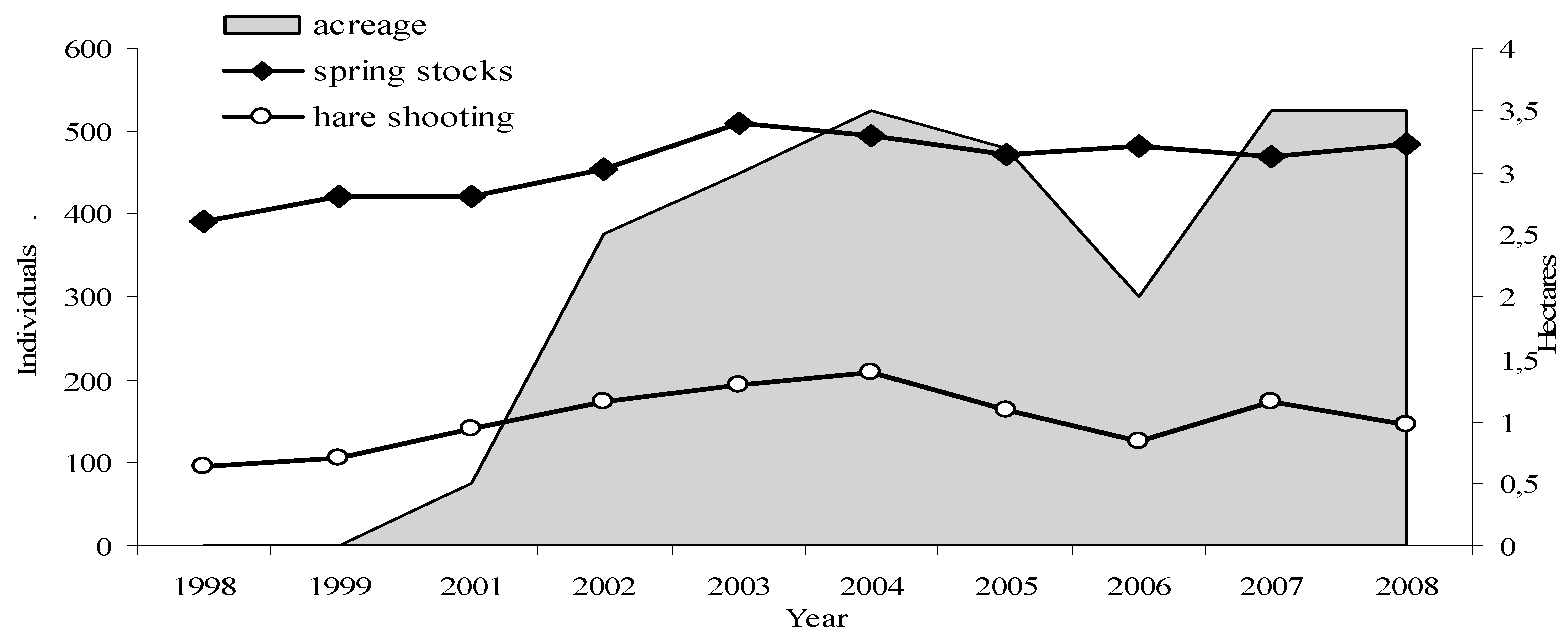
Figure 2.
Recruitment of hares and acreage of set-asides (Lehnice).
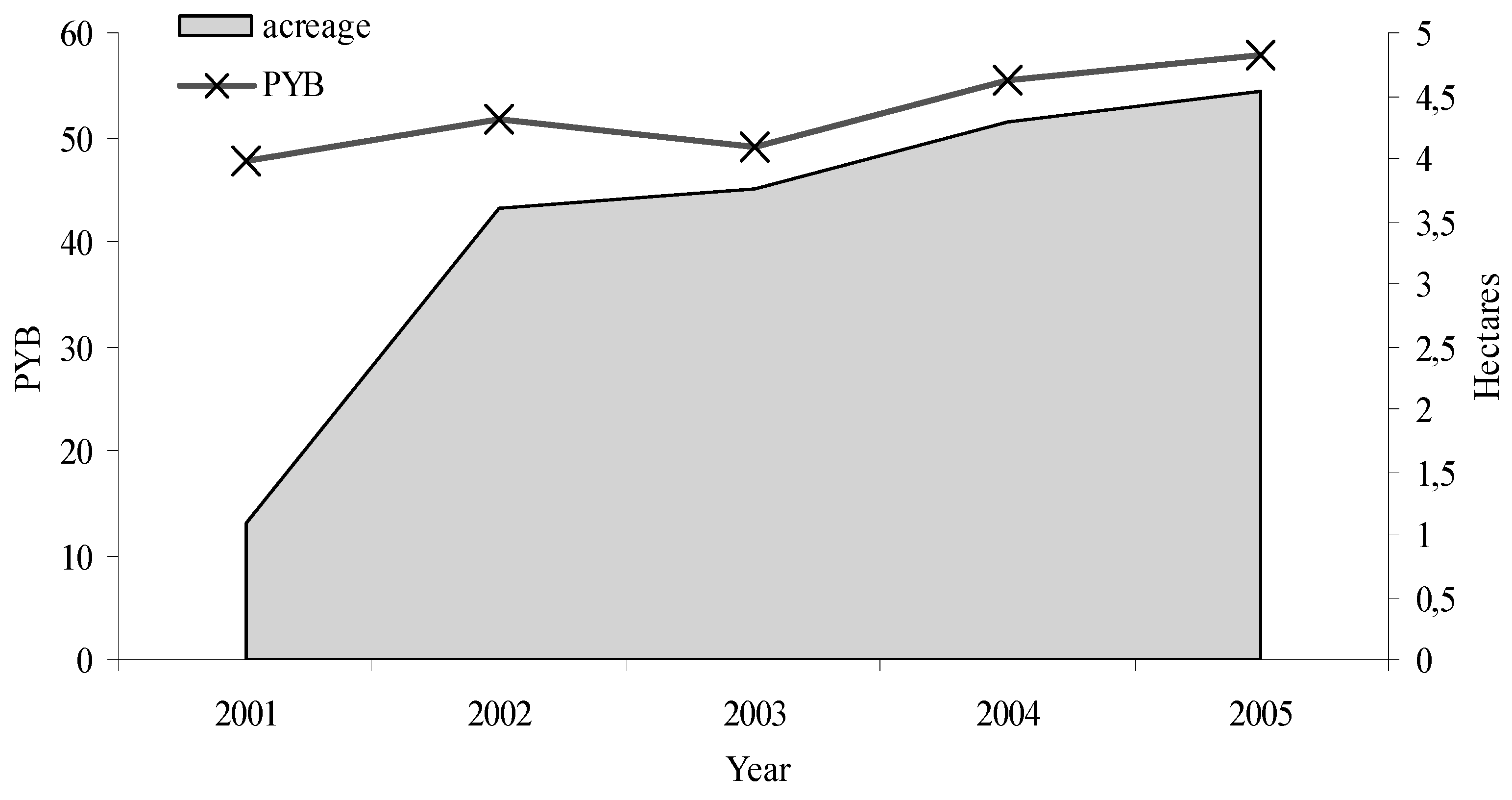

Table 1.
Average brown hare weights (kg) in Slovak Danubian Lowland.
| Male | Female | SE | p-Value* | |
|---|---|---|---|---|
| Juvenile | 3.83 | 3.85 | 0.014 | 0.602 |
| Adult | 4.21a | 4.32b | 0.077 | 0.049 |
*Different letters on the same row mean statistical difference for P<0.05.
Table 2.
Indicators+ of brown hare population dynamics in Slovak Danubian Lowland.
| 1987-1991 | 1992-1997 | 1998-2002 | 2003-2007 | 2008-2012 | 2013-2017 | 2018-2023 | SE | p-Value* | Corr. Coeff. | |
|---|---|---|---|---|---|---|---|---|---|---|
| N | 1154a | 505b | 320c | 386c | 277cd | 271cd | 206d | 234.7 | .050 | -0.753 |
| Njuv | 584a | 250b | 164bc | 196bc | 113c | 117c | 83c | 119.2 | .043 | -0.769 |
| PYB | 49a | 50a | 51a | 46ab | 41ab | 45ab | 37b | 2.410 | .021 | -0.830 |
| R | 1.00 | 1.00 | 1.05 | 1.00 | 0.70 | 0.88 | 0.65 | 0.098 | .065 | -0.725 |
| r | 2.05 | 2.30 | 2.15 | 2.03 | 1.52 | 1.70 | 1.26 | 0.185 | .021 | -0.827 |
| Si | 0.52 | 0.51 | 0.50 | 0.50 | 0.48a | 0.50 | 0.52 | 0.012 | .497 | -0.311 |
| adult female | 283a | 115b | 78c | 96bc | 76c | 78c | 63c | 56.95 | .050 | -0.739 |
| males | 558a | 247b | 162c | 197c | 125cd | 131cd | 97d | 104.6 | .032 | -0.795 |
| total females | 596a | 258b | 157c | 201bc | 132c | 140c | 109d | 116.6 | .039 | -0.779 |
| % adult females in bag | 25.04c | 22.58d | 24.57c | 25.89c | 27.87b | 27.85b | 31.26a | 1.170 | .010 | 0.876 |
| % young fem on total female | 48b | 44c | 50b | 53ab | 58a | 55ab | 57a | 2.697 | .012 | 0.863 |
| PI% | 40a | 40a | 44a | 40a | 19c | 31b | 16c | 6.920 | .046 | -0.732 |
+ N: total number of individuals; PYB: proportion of youngs in the bag; R= coefficient of reproduction; r= reproduction index; Si= sex ratio; PI%= population increase; *Different letters on the same row mean statistical difference for P<0.05.
Disclaimer/Publisher’s Note: The statements, opinions and data contained in all publications are solely those of the individual author(s) and contributor(s) and not of MDPI and/or the editor(s). MDPI and/or the editor(s) disclaim responsibility for any injury to people or property resulting from any ideas, methods, instructions or products referred to in the content. |
© 2024 by the authors. Licensee MDPI, Basel, Switzerland. This article is an open access article distributed under the terms and conditions of the Creative Commons Attribution (CC BY) license (http://creativecommons.org/licenses/by/4.0/).
Copyright: This open access article is published under a Creative Commons CC BY 4.0 license, which permit the free download, distribution, and reuse, provided that the author and preprint are cited in any reuse.


