
Submitted:
27 May 2024
Posted:
27 May 2024
You are already at the latest version
Abstract
Pea shoots is a popular vegetable in certain regions of the world due to their unique taste and abundance of health-promoting phytochemicals. The perishable nature and susceptibility of root rot of pea shoots necessitate a new soilless production system located close to the market. This study compared the growth of pea shoots using various cultivation methods in LED plant factory. The results showed that early topping (4 days after transplanting, ET) promoted early harvest compared to later topping (20 days after transplanting, LT) and increased the number of harvested shoots by extending the harvest time to 2.8 times, ultimately resulting in a substantial yield improvement. Moreover, the yield of ET with lower planting density (72 plants m-2, ET-LD) was 8.7% higher than ET with higher planting density (126 plants m-2, ET-HD). Particularly, the average fresh weight of individual pea shoots under ET-LD exceeded that of ET-HD by 48.9%. It is advisable to consider adopting ET-LD for the cultivation of pea shoots in LED plant factory. Based on ET-LD, the yield, nutritional quality, and light use efficiency of pea shoots were further explored at different stages under three levels of light intensity (50, 100, 150 μmol m-2 s-1). Contrasted against the light intensity of 50 μmol m-2 s-1, the average fresh weight per pea shoots, number of harvested, and total fresh yield under light intensity of 150 μmol m-2 s-1 treatment increased by 60.2%, 62.8%, and 165.1%, respectively. Meanwhile, the fresh weight per pea shoots, photosynthetic capacity, soluble sugar and vitamin C levels in leaves, as well as light use efficiency and photon yield, initially increased and then decreased with the extension of the planting period. Among these, soluble sugar, LUE, and PY started to decrease after reaching the maximum value at 60-70 days after transplanting. In conclusion, light intensity of 150 μmol m-2 s-1 with a photoperiod of 16 h d-1 using LEDs, combined with early topping within a planting period of 60-70 days, proves to be suitable for the hydroponic production of pea shoots in LED plant factory.
Keywords:
LED lighting
; Light use efficiency
; Pea
; Photon yield
; Plant factory
; Topping
1. Introduction
Tender shoots of pea (Pisum sativum L.), including 2-4 pairs of leaves and immature tendrils, and may also include small flower buds or blossoms are referred to as pea shoots [1]. Pea shoots have become popular as a specialty vegetable in certain regions of Asia and Africa due to their mild "pea-pod" flavor, characterized by a delicate, crisp, light, and refreshing taste [2,3]. Notably, the levels of chlorophyll, carotenoids, vitamin C, total phenols, flavonoids, and other bioactive compounds, along with their antioxidant capacity in the leaves, exceed those found in lettuce, spinach, and celery [4,5]. Concurrently, it is also a traditional vegetable in China, which was cultivated on a certain scale in Yunnan, Sichuan, Chongqing, and other provinces [6]. The two primary cultivation methods for pea shoots are open field cultivation and greenhouse cultivation with supplementary lighting, with the former being more prevalent. In open field cultivation, peas are ordinarily sown in autumn with a plant spacing of 10-15 cm and row spacing of 20-30 cm, 2-3 seeds per hole, resulting in 30 plants m-2. The initial harvest typically begins 40 to 50 days after sowing, followed by subsequent harvests approximately every 7 to 15 days, continuing until early February to early April of the following year [6]. Each cycle allows for 6 to 8 harvests, resulting in a yield of 1.87 kg m-2 [1,6]. In greenhouse cultivation, such as the case in Canada, pea shoots provide a low-heating alternative compared to traditional greenhouse vegetables such as tomatoes, cucumbers, and peppers. However, supplemental lighting is crucial for successful production due to the limited natural light in winter [7]. Supplemental lighting in greenhouse cultivation of peas has been shown to effectively enhance pea shoots and pod production [7,8,9]. For example, Kong et al. [7] conducted experiments on supplemental lighting for pea shoots cultivation in a greenhouse. The first harvest, targeting shoots with one fully unfolded leaf and shoot tip, was performed 32 days after sowing. Subsequent harvests occurred every 10-14 days, continuing until over 50% of the plants reached the flowering stage. The findings revealed that increasing the daily light integral (DLI) from 5.3 to the range of 8.1 to 9.8 mol m-2 d-1 resulted in an almost fourfold increase in cumulative yield.
Pea shoots production also encounters additional constraints. Harvesting, for example, is labor-intensive and substantially increases production costs in regions with high labor expenses [1]. Additionally, once harvested, pea shoots should not be squeezed or stored at room temperature for extended periods. Instead, they should be promptly sold or maintained at a temperature of 0-4 °C to preserve freshness. The perishable nature of pea shoots makes their appropriateness solely to local cultivation and distribution, rather than enabling long-distance transport. This factor presents an additional obstacle to achieving widespread mass production [7]. Consequently, it is necessary to explore a suitable cultivation method that maintains high yield, high efficiency and close to consumers, to facilitate the development of this industry.
Recently, urban residents in Asian countries such as Japan and China have increasingly adopted indoor cultivation using plant factories with artificial light (PFALs), including household PFALs. This trend is expected to promote a new lifestyle of local production and local consumption [10,11]. PFALs are closed plant production systems designed to achieve higher crop yields and superior quality by precisely controlling the growth environment. These systems efficiently alleviate the influence of unfavorable weather conditions and unexpected emergencies on plant growth, ensuring continuous and optimized cultivation [12,13]. Additionally, the application of light-emitting diodes (LED) lighting in PFALs provides the possibility of precise regulation of light environment for crops. Previous studies have shown that increasing light intensity within a defined range enhances photosynthesis, resulting in a proportional increase in dry mass accumulation [14]. Meanwhile, light environment has been identified as a key factor influencing the nutritional quality of leafy vegetables [15]. Combining the advantages of plant factory technology and LED lighting technology, we propose that PFALs have the potential to address the challenge of pea shoots being unsuitable for long-distance transportation due to their perishable nature. Furthermore, PFALs offer promising prospects for improving both the yield and quality of pea shoots. Therefore, there is an urgent need to develop cultivation methods and appropriate light recipes for pea shoots in PFALs.
The main objective of this study was to establish a preliminary cultivation method and determine an appropriate light recipe for pea shoots production in PFALs. To achieve this, we conducted a comprehensive comparison of the growth of pea plants and the yield of pea shoots under various cultivation methods, while recording the phenological stages. Additionally, we explored the effects of light intensity combined with early topping on the growth of pea plants, and analyzed the yield, nutritional quality, and light energy use efficiency of pea shoots at different stages.
2. Materials and Methods
2.1. Plant Materials and Growth Conditions
Pea seeds (Pisum sativum L. cv. Zhongyang) with full grains were selected, then the seeds were washed and soaked for 24 hours before being placed in a petri dish to promote germination. After three to four days, the soaked seeds were placed in polyurethane sponge cubes (L23 mm × W23 mm × H23 mm, manufactured by Shengjie Sponge Products Factory, China) in a seedling tray (L330 mm × W240 mm × H50 mm) filled with nutrient solution in an environmental controlled plant factory with artificial lighting (China Agricultural University, Beijing, China). The stock solution comprises the following compounds: Ca(NO3)2·4H2O, KNO3, NH4H2PO4, KH2PO4, MgSO4·7H2O, Na2B4O7·10H2O, MnSO4·H2O, ZnSO4·7H2O, CuSO4·5H2O, Na2MoO4·2H2O, Na2Fe7-DTPA, with concentrations of 1086.0, 521.0, 139.0, 22.0, 476.0, 2.7, 1.9, 2.7, 2.4, 0.5, 10.0 mg L -1, respectively. The electronic conductivity (EC) was adjusted with RO water according to seedling size, ranging from 0.6 to 1.2 mS cm-1, while maintaining the pH between 5.5 and 6.5. Seedling tray was placed in the light environment with PPFD of 100 µmol m-2 s-1 and photoperiod of 16 h d-1. Air temperatures and relative humidity of the growth ambient were maintained at 18-22 °C and 60%-75%, respectively. Approximately nine to ten days later, uniform and healthy seedlings were selected for trial treatments.
2.2. Experimental Design
For the topping method trial, pea seedlings with well-developed roots and consistent growth were chosen for cultivation trials involving late topping (LT) and early topping (ET) with different planting densities in an environmental controlled plant factory with artificial lighting, totaling three treatments (Table 1). The cultivation shelf of LT consisted of one Acrylonitrile butadiene styrene (ABS) cultivation bed (L1200 mm × W600 mm × H70 mm) and one ABS board with 4 mm thickness and planting holes (20 mm diameter). Each experimental unit (L590 mm × W400 mm) is planted with 9 plants, replicated three times, resulting in a planting density of 39 plants m-2. In contrast, the cultivation shelf of ET consisted of three ABS cultivation beds, each with a layer height of 38 cm. Each experimental unit (L590 mm × W400 mm) under ET-LD is planted with 17 plants, replicated three times, resulting in a planting density of 72 plants m-2, while each experimental unit under ET-HD is planted with 30 plants, also replicated three times, resulting in a planting density of 126 plants m-2. All plants were grown under an PPFD of 100 µmol m-2 s-1 and a photoperiod of 16 h d-1 provided by white plus red LEDs (WR-16 W, Beijing Lighting Valley Technology Co., Ltd., China), with a red to blue ratio (R:B ratio) of 4.4. Among them, LT installed 7 LED lamps on the top of plant, while ET used 4 LED lamps to ensure an average PPFD of 100 µmol m-2 s-1 for the canopy when the seedlings were transplanted to the cultivation shelf. Healthy seedlings were selected and transplanted to the cultivation shelf at 14 days after sowing. Late Topping (LT) did the topping of the pea plant with height of 50-60 cm at 20 days after transplanting based on the open field production method of topping at 30-40 days after sowing. Early Topping (ET) involved topping the plants when they reached a height of 20-30 cm, typically around 4 days after transplanting. Each subsequent harvest was determined by whether the length of the pea shoots reached 10-15 cm.
For the trial of light intensity, we had evaluated the effect of light intensity combined with early topping on yield and quality of pea shoots in an environmental controlled plant factory with artificial lighting, a total of three treatments (Table 1). The seedlings were transplanted on a shelf of three layer with a layer height of 38 cm, and a nylon rope of 52 grids was constructed 10-15 cm above the planting board to hold the pea seedlings and prevent them from falling. Each experimental unit (L590 mm × W400 mm) is planted with 17 plants, resulting in a planting density of 72 plants m-2, and three replicates are implemented. The seedlings of all treatments grown under the photoperiod of 16 h d-1 provided by white plus red LEDs with a R:B ratio of 4.4. The light intensity in the canopy of ET-P050, ET-P100, and ET-P150 was ensured to reach 50, 100, and 150 μmol m-2 s-1, respectively, when the seedlings were transplanted to the cultivation shelf by installing 2, 4, and 8 LED lamps on the top 15 cm of the plants.
Following transplanting, a water level of about 5 cm was maintained within the cultivation bed to facilitate the absorption of the nutrient solution by the seedling roots. The composition of the hydroponic nutrient solution remained the same as that used during the seedling stage. The pH range of nutrient solution was 5.5-6.5, and the EC value was 2.2-2.6 mS cm-1 (The pH value of tap water was 7.59, the EC value was 0.5 mS cm-1). Water pump was used to increase the dissolved oxygen in nutrient solution for 24 h cycle irrigation, with a flow rate of approximately 10 L min-1. The ambient air temperatures and relative humidity were kept within the range of 20 ± 2 °C and 60% ± 10%, respectively.

Table 1.
Topping methods, plant density and light intensity in the topping method trial and the light intensity trial.
Table 1.
Topping methods, plant density and light intensity in the topping method trial and the light intensity trial.
| Trial | Treatment symbol |
Topping method |
Plant density | Light intensity |
| plants m-2 | μmol m-2 s-1 | |||
| Topping method | LTi | Late | 39 | 100 |
| ET-LDii | Early | 72 | 100 | |
| ET-HDiii | Early | 126 | 100 | |
| Light intensity | ET-P050iv | Early | 72 | 50 |
| ET-P100iv | Early | 72 | 100 | |
| ET-P150iv | Early | 72 | 150 |
LT denote later topping (20 days after transplanting); ET-LD denote early topping (4 days after transplanting) with the plant density of 72 plants m-2; ET-HD denote early topping with the plant density of 126 plants m-2; ET-P050, ET-P100 and ET-P150 denote the method of early topping under light intensity of 50, 100 and 150 µmol m-2 s-1, respectively.
2.3. Measurements
2.3.1. Yield of Pea Shoots
The total number of harvested pea shoots in each treatment was recorded, and the total fresh weight was measured with an electronic analytical balance (FA1204B, BioonGroup, Shanghai, China). This facilitated the calculation of the fresh weight of each pea shoots. To determine the fresh weight of individual pea shoots (FWs), five pea shoots were randomly chosen from each treatment at 15, 24, 53, and 65 days after transplanting (DAT). This procedure was repeated five times for each treatment. Subsequently, the selected pea shoots were dried in an oven at 105 °C for 1 h, followed by 75 °C for 48 h. The dry weight of five pea shoots was measured, and the dry weight of a single pea shoots (DWs) was calculated. The water content was calculated according to the Equation (1):
2.3.2. Leaf Gas Exchange Measurement
The LI-6400XT portable photosynthesis system (LI-COR, Inc., USA) was utilized to assess the photosynthetic parameters of both young and mature leaves of pea plants. These parameters encompassed the net photosynthetic rate (Pn, µmol m-2 s-1), stomatal conductance (Gs, mol m-2 s-1), intercellular CO2 concentration (Ci, µmol mol-1), and transpiration rate (Tr, mmol m-2 s-1). Measurements were conducted at 41 and 80 days after transplanting, correspondingly. The ambient parameters of chamber were set as follows: the light intensity remained consistent with the trial treatments, while the airflow rate, temperature, and CO2 concentration were maintained at the same levels across all treatments: 500 µmol s-1, 25 °C, and 400 µmol mol-1, respectively.
2.3.3. Chlorophyll Fluorescence Characteristics
Chlorophyll fluorescence parameters were measured using multifunctional plant efficiency analyzer (M-PEA, Hansatech, Inc., UK) at 41 and 80 days after transplanting. The PSⅡ maximal photochemical efficiency (Fv/Fm) of new and old leaves of pea plants were measured after dark adaptation of 30 mins.
2.3.4. Quality Determination
The quality of leaves and stems of pea shoots in this study was assessed at 15, 36, and 74 days after transplanting, including the content determination of soluble sugar, soluble protein, vitamin C and nitrate, and these were determined by anthrone colorimetric method [16], Coomassie brilliant blue G-250 method [17], 2,6-dichlorophenol indophenol titration method [16] and sulfosalicylic acid colorimetr method [18], respectively.
2.3.5. Light Energy Use Efficiency
Two indexes in this study, light use efficiency (LUE, [13]) and photon yield (PY, [19]), were used to characterize the light energy use efficiency of pea shoots at different times and stages. According to Equations (2) and (3).
where, f is the conversion coefficient from dry mass to chemical energy, about 20 MJ kg-1; D (kg m-2) is the total dry weight of pea shoots harvested per unit area after transplanting; PARL (MJ m-2) is the intercepted effective photosynthetic radiation per unit area of pea plants after transplanting, FWT (g m-2) is the total fresh weight of pea shoots harvested per unit area; DLI (mol m-2 d-1) is the amount of light energy received by the canopy of pea plants per unit area in a day; DAT (d) is the days after transplanting.
2.4. Statistical Analysis
The data in this study were presented as mean ± standard deviation (SD). Statistical analysis was performed using one-way analysis of variance (ANOVA), followed by Fisher's least significant difference (LSD) test to compare relevant means. Significance levels were set at P < 0.01 and P < 0.05. All statistical analyses were conducted using IBM SPSS 26 (IBM Corp., Armonk, NY, USA). Based on the data trend, the logistic growth curve (Y = YM ∗ Y0 / ((YM − Y0) ∗ exp (−k ∗ X) + Y0) of GraphPad Prism 9 (v9.4.0, GraphPad Software, San Diego, CA, USA) was selected to fit the fresh weight per unit area, the number of harvested of pea shoots, as well as LUE and PY of whole cultivation period. A second order polynomial (Y = A + B ∗ X + C ∗ X2) was chosen to fit the nutritional quality, LUE and PY of pea shoots.
3. Results
3.1. Growth of Pea Shoots under Different Cultivation Methods
3.1.1. Growth Process of Pea Shoots under Different Cultivation Methods
The length of the pea production cycle varied between LT and ET, consequently affecting the length of the harvest period for pea shoots (Figure 1). Although the seedling stage duration remained consistent for both methods, differences emerged in the timing of topping. Specifically, ET was implemented 16 days earlier than LT, resulting in an initial harvest advancement of 16 days. Moreover, pea pods appeared at 18 days from the first harvested under LT, while ET appeared at 51 days. Consequently, the length of harvest period of ET was 2.8 times that of LT. Additionally, the planting period of ET was 79 days, which was 1.5 times that of LT.
3.1.2. Yield of Pea Shoots under Different Cultivation Methods
The total fresh weight, total number of harvested and fresh weight per plant of pea shoots exhibited variations across different cultivation methods (Figure 2). Specifically, the total fresh weight of ET was higher than that of LT, and the cumulative yield of ET-LD reached 1136.7 g m-2 at 55 days after transplanting and was higher than that of ET-HD (Figure 2A). When the production period was less than 42 days, the total fresh weight of ET-HD was higher than that of ET-LD, which should be since the number of pea shoots harvested under ET-HD was higher than that in ET-LD. However, with a production period exceeding 42 days, the fresh weight of individual pea shoots under ET-LD increased, narrowing the gap in the number harvested, thereby resulting in a higher total fresh weight compared to ET-HD. Additionally, the fresh weight per pea shoots under ET was significantly lower than that of LT (Figure 2C), yet the number of harvested under ET-LD and ET-HD was 5.9 and 8.0 times that of LT, respectively.
3.2. Effect of Light Intensity Combined with ET on Growth and Quality of Pea Shoots
3.2.1. Biomass of Pea Shoots under Different Light Intensity Combined with ET
The effects of light intensity on total biomass, the number of harvested, as well as fresh and dry weight per pea shoots were consistent (Figure 3). Throughout the cultivation process, ET-P150 exhibited the highest total biomass and total number of harvested, reaching 2883.5 g m-2 and 2128, respectively, while ET-P050 showed the lowest values at 1087.6 g m-2 and 1307, respectively. Consequently, the total biomass of ET-P150 was 2.7 times that of ET-P050. During the entire cultivation cycle, the fresh weight per pea shoots was consistently highest under ET-P150, whereas it was consistently lowest under ET-P050.
It is evident that the fresh and dry weight per pea shoots (Figure 3C and D) across all treatments steadily declines with the extension of the planting period. Furthermore, light intensity significantly influenced the water content of pea shoots (Figure 3E). At 15, 24, and 53 days after transplanting, the water content of ET-P150 was significantly lower compared to ET-P050 and ET-P100, showing decreases of 0.9%, 0.8%, and 0.6% compared to ET-P050, respectively. However, no significant difference in water content was observed at 65 days after transplanting.
3.2.2. Leaf Gas Exchange Measurement of Pea Shoots at Different Periods
The photosynthetic capacity of new (fully expanded leaves on the pea shoots) and old leaves (functional leaves retained on the plant after harvesting pea shoots) of pea shoots was significantly affected by light intensity, and it decreased with the extension of planting period (Table 2). The Pn of new and old leaves of ET-P150 was the highest in the whole cultivation cycle, while that of ET-P050 was the lowest. Compared with new and old leaves of ET-P050, the Pn of ET-P150 at 41 days after transplanting was significantly increased by 119.7% and 57.9%, respectively. Similarly, at 80 days after transplanting, the Pn of ET-P150 increased significantly by 357.5% and 51.3% compared to new and old leaves of ET-P050, respectively. However, the trend of intercellular CO2 concentration (Ci) in the new and old leaves was opposite to the Pn. There was no consistent trend in stomatal conductance (Gs) and transpiration rate (Tr) of new and old leaves at 41 and 80 days after transplanting. On the other hand, new leaves showed no significant difference in Fv/Fm under different light intensity at 41 and 80 days after transplanting. Nonetheless, the Fv/Fm of old leaves in ET-P150 was significantly higher than ET-P050, while no significant difference was observed between ET-P150 and ET-P100.
3.2.3. Quality of Pea Shoots at Different Periods
Light intensity significantly affected the quality of pea shoots leaves and stems, with changes observed as the planting period extended (Figure 4). Soluble sugar content in the leaves of ET-P150 consistently reached the highest level, peaking at 62.3 mg g-1 after 74 days of transplantation. However, in the stems of ET-P150, soluble sugar content was only higher than that of ET-P050 and ET-P100 at 15 days post-transplanting, subsequently decreasing compared to other treatments (Figure 4A). At 36 and 74 days after transplanting, vitamin C levels in ET-P150 leaves were significantly higher than those in ET-P050, showing improvements of 93.6% and 48.4%, respectively. Meanwhile, the vitamin C in stems of ET-P150 was significantly higher than that of ET-P050 at 15 and 74 days after transplanting, but there was no significant difference at 34 days after transplanting (Figure 4B). There was no significant difference of soluble protein in pea shoots leaves under different light intensity during the whole cultivation cycle. The soluble protein content of stems of ET-P150 was significantly higher than that of other treatments at 15 days after transplanting, which increased by 22.7% and 27.7%, respectively. Nevertheless, it decreased to as low as 1.24 mg g-1 at 74 days after transplantation (Figure 4C).
There was no significant difference of nitrate content in leaves of different light intensity during the whole cultivation cycle. Meanwhile, the nitrate content of stem of ET-P050 was significantly higher than that of ET-P100 and ET-P150 at 15 days after transplanting, which increased by 26.3% and 22.2%, respectively. Whereas it was always the lowest and significantly lower than that of ET-P150 at 36 and 74 days after transplanting, which decreased by 34.2% and 28.7% (Figure 4D). Additionally, the leaves consistently showed higher levels of soluble sugars, vitamin C, and soluble proteins compared to the stems, while maintaining consistently lower levels of nitrate content throughout the cultivation cycle. The levels of vitamin C and soluble protein in the leaves initially increased before decreasing, reaching peak values of 2.71 mg g-1 and 15.51 mg g-1, respectively. In contrast, the soluble sugar content in the leaves gradually increased, reaching its maximum value of 62.3 mg g-1. The nitrate content initially decreased before increasing with its minimum value being 1098.3 mg g-1. As for the stems, the levels of soluble sugar and soluble protein initially increased before subsequently decreasing, whereas the content of nitrate and vitamin C initially decreased before increasing.
3.2.4. Light Energy Use Efficiency of Pea Shoots at Different Periods and Stages
Light intensity affected both the LUE and PY of the accumulated weight of pea shoots. A logistic growth curve was chosen to fit the mean values, resulting in a strong fit, with an R2 exceeding 0.9 (Figure 5A and B). The LUE and PY of ET-P050 reached peak values at 60-70 days after transplanting, calculating 0.022 and 4.7 g mol-1, respectively. In contrast, the corresponding values for the ET-P150 were lower, calculating 0.021 and 4.3 g mol-1, respectively. In addition, light intensity significantly affected LUE and PY of whole cultivation cycle (Figure 5C). The LUE and PY of whole cultivation cycle decreased significantly when the light intensity was increased from 50 to 100 µmol m-2 s-1, but the correlation values increased significantly when the light intensity was further increased to 150 µmol m-2 s-1 and gradually approached ET-P050. The LUE of the whole cultivation cycle for ET-P050 was 0.031, significantly higher than that of ET-P100, yet not significantly different from that of ET-P150. The PY of ET-P050 was 6.3 g mol-1, which was significantly higher than that of other treatments.
3.2.5. Correlation Analysis between Light Intensity and Various Indicators
The correlations between light intensity and various indicators of pea shoots are shown in Figure (Figure 6). Light intensity exhibited a positive correlation with the levels of soluble sugar and vitamin C in leaves, vitamin C and nitrate in stems, as well as fresh and dry weight. Specifically, light intensity was significantly positively correlated with vitamin C in leaves, nitrate in stems, as well as fresh and dry weight. However, a negative correlation was observed between light intensity and soluble sugar in stems, as well as water content, with the correlation being especially significant in the case of soluble sugar in stems. Additionally, light intensity showed a negative correlation with soluble protein, although the correlation was not statistically significant.
4. Discussion
4.1. Early Topping and Appropriate Planting Density Can Improve the Yield
Topping is widely acknowledged as a crucial practice for enhancing crop yield and improving crop quality [20]. This practice primarily stimulates the generation of axillary shoots by enhancing the flow of sugars into them and reducing the inhibitory impact of auxins on cytokinins [21]. In this study, we observed that early topping enhances the total fresh yield of pea shoots (Figure 2). Although early topping reduces the individual weight of pea shoots, it leads to increased harvest frequency by promoting axillary shoot production. Moreover, early topping extends the duration of the harvest period by elongating the vegetative growth stage, culminating in an overall improvement in the total yield of pea shoots (Figure 1). Consequently, early topping was conducive to the formation of pea shoots.
Planting density is a critical factor affecting both crop yield and quality, as higher densities result in competition for essential resources such as light, water, and nutrients [22,23]. This study revealed that the total fresh weight of pea shoots of the high-density treatment was highest in the early stage, while the total fresh weight of pea shoots of low-density treatment was highest at 42 days after transplanting. This phenomenon can be attributed to the fact that the fresh weight per pea shoots under ET-LD increased by 47.8%, while the decrease in the number of harvested shoots was only 34.4%. As a result, the total fresh weight of pea shoots under ET-LD exceeded that of ET-HD by the end of a single crop cycle. Besides, Spies et al. [24] showed that when plant density was very low, the difference in branching potential among different varieties of pea was more than twofold. The optimum economic plant density for the pea cultivars ranged between 59-84 plants m-2. Therefore, it is essential to consider the specific characteristics of the variety when determining the planting density in the future. Pea varieties used for pea shoots production can refer to ET-LD used in this study and cultivate 72 plants m-2.
4.2. Higher Light Intensity Combined with ET-LD Can Improve Yield and Quality
Light serves as the primary driver of photosynthesis and directly impacts the yield and quality of crops [25,26]. Low light intensity can reduce leaf photosynthetic rate, leading to a subsequent decline in dry matter accumulation. Conversely, high light intensity can trigger photoinhibition, photooxidation, and photodamage, ultimately culminating in decreased yields [27]. Kong et al. [7] suggested that the optimal supplementing light scheme for the greenhouse production of pea shoots in winter was a PPFD of 50-80 µmol m-2 s-1 with a photoperiod of 16 h d-1. It was also proposed that DLI between 9.4 and 11.1 mol m-2 D-1 could be used as the target level for greenhouse production of peas pod in winter [8]. Our correlation analysis (Figure 6) revealed a significant relationship between light intensity and the fresh weight and dry weight of pea shoots, suggesting a significant improvement in pea shoots yield. This contradicted the findings of Zhu et al. [28], who found that the fresh weight and chlorophyll content of pea shoots grew better under conditions of low PPFD (62-87 µmol m-2 s-1) than high PPFD (87-112 µmol m-2 s-1), suggesting that lower PPFD could increase the fresh weight of pea shoots. This difference may be attributed to the shorter growth period (10 days after sowing), which requires lower light intensity compared to the present study. In this study, we investigated the influence of three different levels of light intensity on the biomass accumulation of pea shoots within 81 days after transplanting. The findings indicated that the highest light intensity led to the optimal results. However, it is worth considering that increasing light intensity beyond that of ET-P150 could potentially be more optimal for maximizing yields in PFAL production.
PFALs exhibit higher productivity and resource use efficiency compared to conventional greenhouse systems over a shorter period [29,30]. In this study, the highest yield of pea shoots within 81 days, reaching 2.88 kg m-2, was achieved under 150 μmol m-2 s-1 combined with early topping (Figure 3). Assuming the equipment occupies 70% of the floor area and there are four planting floors in PFALs, the production efficiency is calculated to be 0.10 kg m-2 d-1, exceeding that of greenhouse supplemental LED lighting production at 0.03 kg m-2 d-1 [7]. Therefore, the method of ET-P150 with 72 plants m-2 can be used for pea shoots production in PFALs and will be more promising as the initial cost of PFALs and electricity costs decrease.
With the improvement of vegetable quality requirements, growers are increasingly interested in improving the nutritional quality, especially the content of vitamin C and nitrite in vegetables [31]. Numerous studies have explored the impact of light intensity on the nutritional quality of vegetables. Higher light intensity has been found to boost the activity of key enzymes involved in nitrate and vitamin C metabolism. Additionally, it provides increased energy for carbon dioxide fixation, resulting in accelerated vitamin C synthesis and nitrate assimilation [15]. In this study, it was found that light intensity was positively correlated with soluble sugar and vitamin C content in leaves, as well as vitamin C content in stems, among which could significantly increase vitamin C content in leaves (Figure 6). This was similar with the results of Chen et al. [32] that light intensity could improve the nutritional value, and the higher light intensity leads to higher levels of vitamin C. However, there was no significant difference in nitrate content in leaves of pea shoots under three levels of light intensity (Figure 4D); nevertheless, light intensity showed a positive correlation with nitrate content in stems of pea shoots. Thus, the conclusion of Voutsinos et al. [33] that higher light intensity provides more carbohydrate and photochemical energy to stimulate nitrate assimilation into amino acid in vegetable leaves was not confirmed, but the same as the research results of Maria et al. [34], light intensity has no significant effect on nitrate accumulation. This may also be because under low light conditions (50-150 μmol m-2 s-1), the nitrate content is primarily influenced by nitrogen supply rather than light intensity. Besides, nitrate reduction sites are usually located in organelles such as chloroplasts [35], and it is noted that leaves have higher chlorophyll content than stems (Table S1-S3 Supplemental) than that of stems. Hence, the nitrate content in leaves was lower than that in stems (Figure 4D).
The marketable yield of vegetables is intricately influenced by the balance between dry matter mass and water content, where a decrease in water content often indicates improved quality [36]. A negative correlation between light intensity and water content, although the difference was not statistically significant (Figure 6). Moreover, the water content of the ET-P150 was significantly lower compared to that of the ET-P050 (Figure 3C). This phenomenon can be attributed to the robust photosynthetic capacity exhibited by pea plants under high light intensity, leading to the accumulation of a greater amount of dry matter [14].
4.3. The LUE of Pea Shoots Showing an Optimal Response with Planting Period
Crops yield and quality as well as input resource use efficiency are important factors to evaluate PFALs performance [37], among which the cost of electricity consumed by artificial lighting is one of the main challenges limiting commercial PFALs for leaf vegetable production. LUE was defined as the ratio of accumulated dry weight of a plant during a certain planting period to the amount of PAR absorbed by the canopy of the plant during that period [38], which is affected by factors such as light intensity [39], temperature [40] and CO2 [32,38]. Results of previous studies on the effect of light intensity on LUE are contradictory. Ye et al. [39] found that the LUE of four plant species rapidly rose to LUEmax with the increase of light intensity under the condition of low light intensity, but declined when light intensity surpassed saturation levels. Conversely, Ahmed et al. [37] proposed a negative correlation between LUE and light intensity, indicating that high electricity consumption reduced LUE during production. In this study, it was found that the LUE of the accumulated weight of whole cultivation cycle under ET-P050 was always higher than that of ET-P100 and ET-P150 within 70 days after transplanting. However, the LUE of ET-P150 gradually approached that of ET-P050 after 70 days of transplantation (Figure 5A). This phenomenon may be attributed to the fact that the Pn and Fv/Fm of old leaves of pea plants under the ET-P150 consistently outperformed those of both ET-P050 and ET-P100 throughout the cultivation period (Table 2). The enhanced photosynthetic performance in ET-P150 resulted in increased the yield of pea shoots, thus contributing to its higher LUE. Therefore, it is reasonable that the LUE of ET-P050 and ET-P150 exhibited minimal difference in the later stages (Figure 5A). This finding is consistent with the study by Pennisi et al. [19], which indicated that a PPFD of 250 µmol m-2 s-1 requires higher electrical energy compared to lower light intensity, but increased yield can improve energy use efficiency (EUE) and LUE. Moreover, it corroborates with the findings of Fu et al. [41], suggesting that while the highest LUE can be achieved under low light intensity conditions, this approach may limit the potential increase in yield. Consequently, they recommend the utilization of higher light intensity during production. Based on these findings, it is suggested to use a PPFD of 150 instead of 50 µmol m-2 s-1 in PFALs production.
At 60-70 days after transplanting, the LUE and PY of the accumulated weight peaked before gradually decreasing (Figure 5A and B). This trend could be attributed to the decline in photosynthetic capacity (Table 2) and the pigments content (Table S1-S3 Supplemental) within the leaves of the pea plants. Alternatively, it may correspond to the transition of pea plants into the reproductive growth stage (Figure 1). These observations are consistent with the findings of Chen et al. [32], where the photosynthetic capacity of lettuce leaves displayed an initial increasing trend during the first 25 days after transplanting, followed by a rapid decline after 5 days. This indicated that the plant was growing poorly during this period and could not improve its growth further at the same level of energy consumption. Therefore, it is advisable to clean these pea plants at 60-70 days after transplanting.
5. Conclusions
Early topping can effectively enhance the harvest frequency and increase the quantity by stimulating the generation of axillary shoots and extending the harvest period. Considering the yield from various cultivation methods in PFALs, it is recommended to adopt the ET method, where topping is performed when the plant height reaches 20-30 cm (about 4 days after transplanting) and a plant density of 72 plants m-2 is maintained to optimize pea shoots production. Additionally, based on the yield, quality, and LUE of pea shoots under different light intensity combined with early topping, it is advisable to use a PPFD of 150 μmol m-2 s-1 with a photoperiod of 16 h d-1 provided by LEDs. To improve the nutritional quality and light use efficiency of pea shoots, it is recommended to replace the pea plants under the ET-P150 condition with new seedlings at 60-70 days after transplanting, enabling the cultivation of 5-6 rounds per year in PFALs.
Supplementary Materials
The following supporting information can be downloaded at the website of this paper posted on Preprints.org, Tables S1–S3: The photosynthetic pigment content of pea shoots at 15, 36 and 74 days after transplanting.
Acknowledgments
This research was supported by the earmarked fund for China Agriculture Research System (CARS-21).
References
- Miles, C.A.; Sonde, M. Pea shoots. Washington State University Cooperative Extension, Pullman, WA, USA, 2003. Available online: https://www.researchgate.net/publication/242372648_Pea_Shoots.
- Lim, T.K. Edible medicinal and non-medicinal plants: Volume 1. Fruits 2013, 16, 132–135. [Google Scholar] [CrossRef]
- Kong, Y.; Zheng, Y. Response of growth, yield, and quality of edible-podded snow peas to supplemental LED lighting during winter greenhouse production. Can J Plant Sci 2019, 99, 676–687. [Google Scholar] [CrossRef]
- Ma, J.; Sun, B.; Xue, S.L.; Xia, X.; Tian, Y.X.; Zhang, F.; Wang, S. Analysis of main nutrients, bioactive compounds and antioxidant capacities in pea tip. Food Machinery 2016, 32, 47–51. [Google Scholar] [CrossRef]
- Santos, J.; Herrero, M.; Mendiola, J.A.; Oliva-Teles, M.T.; Ibanez, E.; Delerue-Matos, C.; Oliveira, M.B.P.P. Assessment of nutritional and metabolic profiles of pea shoots: The new ready-to-eat baby-leaf vegetable. Food Res Int 2014, 58, 105–111. [Google Scholar] [CrossRef]
- Yu, H.T.; Yang, F.; Hu, C.Q.; Yang, X.; Wang, Y.B.; Lv, M.Y.; Wang, L.P. A New Pea Variety Specialized for Sprout Production-Yunwan No.1. China Veg 2020, 92–95. [Google Scholar] [CrossRef]
- Kong, Y.; Llewellyn, D.; Zheng, Y. Response of growth, yield, and quality of pea shoots to supplemental light-emitting diode lighting during winter greenhouse production. Can J Plant Sci 2018, 98, 732–740. [Google Scholar] [CrossRef]
- Kong, Y.; Zheng, Y. Response of growth, yield, and quality of edible-podded snow peas to supplemental LED lighting during winter greenhouse production. Can J Plant Sci 2019, 99, 676–687. [Google Scholar] [CrossRef]
- North, T.; Maki, S.L. Pisum sativum L. shoot architecture manipulation in hydroponics with LED lighting and increased dissolved oxygen. Acta Hortic 2022, 1337, 323–326. [Google Scholar] [CrossRef]
- Takagaki, M.; Hara, H.; Kozai, T. Micro- and mini-PFALs for improving the quality of life in urban areas. In Plant Factory; Chiba, Japan, 2016; pp. 91–104. [Google Scholar] [CrossRef]
- Kozai., T.; Niu, G. Plant factory as a resource-efficient closed plant production system. In Plant Factory; Japan, 2016; pp. 69–90. [Google Scholar] [CrossRef]
- Avgoustaki; Despoina, D.; Xydis, G. Indoor vertical farming in the urban nexus context: Business growth and resource savings. Sustainability 2020, 12, 1965. [Google Scholar] [CrossRef]
- Kozai, T. Resource use efficiency of closed plant production system with artificial light: Concept, estimation and application to plant factory. P Jpn Acad B-Hys 2013, 89, 447–461. [Google Scholar] [CrossRef]
- He, D.X.; Kozai, T.; Niu, G.; Zhang, X. Light-emitting diodes for horticulture: Materials, processes. Devices Appl 2019, 513–547. [Google Scholar] [CrossRef] [PubMed]
- Fu, Y.M.; Li, H.Y.; Yu, J.; Liu, H.; Cao, Z.Y.; Manukovsky, N.S.; Liu, H. Interaction effects of light intensity and nitrogen concentration on growth, photosynthetic characteristics and quality of lettuce (Lactuca sativa L. Var. youmaicai). Sci Hortic 2017, 214, 51–57. [Google Scholar] [CrossRef]
- Li, H.S. Experimental principle and technology of plant physiology and biochemistry. Higher Education Press: China, 2000; pp. 123–124. [Google Scholar]
- Bradford, M.M. A rapid and sensitive method for the quantitation of microgram quantities of protein utilizing the principle of protein-dye binding. Anal Biochem 1976, 72, 248–254. [Google Scholar] [CrossRef] [PubMed]
- Cataldo, D.A.; Haroon, M.; Schrader, L.E.; Youngs, V.L. Rapid colorimetric determination of nitrate in plant-tissue by nitration of salicylic-acid. Commun Soil Sci Plant Anal 1975, 6, 71–80. [Google Scholar] [CrossRef]
- Pennisi, G.; Pistillo, A.; Orsini, F.; Cellini, A.; Spinelli, F.; Nicola, S.; Fernandez, J.A.; Crepaldi, A.; Gianquinto, G.; Marcelis, L.F.M. Optimal light intensity for sustainable water and energy use in indoor cultivation of lettuce and basil under red and blue LEDs. Sci Hortic 2020, 272, 109508–109518. [Google Scholar] [CrossRef]
- Wei, S.L.; Gao, T.M.; Zhang, H.Y.; et al. Effect on sesame yield, quality and photosynthetic character after topping in different stage in different site. Acta Agri BorealiSinica 2010, 25, 170–174. [Google Scholar] [CrossRef]
- Gaudreau, S.; Missihoun, T.; Germain, H. Early topping: An alternative to standard topping increases yield in cannabis production. Plant Sci Today 2020, 7, 627–630. [Google Scholar] [CrossRef]
- Feng, Y.P.; Shen, H.H.; Luo, Y.K.; Xu, L.C.; Liu, S.S.; Zhu, Y.K.; Zhao, M.Y.; Xing, A.J.; Fang, J.Y. Effects of planting density on growth and biomass of Medicago sativa. Chin J Plant Ecol 2020, 44, 248–256. [Google Scholar] [CrossRef]
- Yucel, D. Impact of plant density on yield and yield components of pea (Pisum sativum ssp. sativum L.) cultivars. J Agric Biol Sci 2013, 8, 169–174. [Google Scholar] [CrossRef]
- Spies, J.M.; Warkentin, T.; Shirtliffe, S. Basal branching in field pea cultivars and yield-density relationships. Can J Plant Sci 2010, 90, 679–690. [Google Scholar] [CrossRef]
- Chen, X.L.; Yang, Q.C.; Song, W.P.; Wang, L.C.; Guo, W.Z.; Xue, X.Z. Growth and nutritional properties of lettuce affected by different alternating intervals of red and blue LED irradiation. Sci Hortic 2017, 223, 44–52. [Google Scholar] [CrossRef]
- Kromdijk, J.; Głowacka, K.; Leonelli, L.; Gabilly, S.T.; Iwai, M.; Niyogi, K.K.; Long, S.P. Improving photosynthesis and crop productivity by accelerating recovery from photoprotection. Science 2016, 354, 857–861. [Google Scholar] [CrossRef] [PubMed]
- Yi, Z.H.; Cui, J.J.; Fu, Y.M.; Yu, J.; Liu, H. Optimization of light intensity and nitrogen concentration in solutions regulating yield, vitamin C, and nitrate content of lettuce. J Hortic Sci Biotech 2021, 96, 62–72. [Google Scholar] [CrossRef]
- Zhu, X.S.; Zhou, X.L.; Liu, M.Q. Effect of LED supplemental lighting system on the growth of pea shoots. 2013 10th China SSL 2013, 104–107. [Google Scholar] [CrossRef]
- Van Delden, S.H.; SharathKumar, M.; Butturini, M.; et al. Current status and future challenges in implementing and upscaling vertical farming systems. Nat Food 2021, 2, 944–956. [Google Scholar] [CrossRef] [PubMed]
- Kang, J.H.; Krishnakumar, S.; Atulba, S.L.S.; Jeong, B.R.; Hwang, S.J. Light intensity and photoperiod infuence the growth and development of hydroponically grown leaf lettuce in a closed-type plant factory system. Hortic Environ Biote 2013, 54, 501–509. [Google Scholar] [CrossRef]
- Hermsdorff, H.H.M.; Barbosa, K.B.F.; Volp, A.C.P.; Bressan, B.P.J.; Zulet, M.A.; Martinez, J.A. Vitamin C and fibre consumption from fruits and vegetables improves oxidative stress markers in healthy young adults. Br J Nutr 2012, 107, 1119–1127. [Google Scholar] [CrossRef] [PubMed]
- Chen, D.Y.; Mei, Y.H.; Liu, Q.; Wu, Y.J.; Yang, Z.C. CO2 enrichment promoted the growth, yield and light-use efficiency of lettuce in plant factory with artificial lighting. Agron J 2021, 113, 5196–5206. [Google Scholar] [CrossRef]
- Voutsinos, O.; Mastoraki, M.; Ntatsi, G.; Liakopoulos, G.; Savvas, D. Comparative assessment of hydroponic lettuce production either under artificial lighting, or in a Mediterranean greenhouse during wintertime. Agriculture 2021, 11, 503. [Google Scholar] [CrossRef]
- Maria, G.; Ewa, B.; Bozena, M.; Stanislaw, K.; Jacek, D.; Waldemar, K.; Anna, W.; Justyna, S.G. Assessment of romaine lettuce cultivars grown in a vertical hydroponic system at two levels of LED light intensity. Sci Hortic 2023, 313, 111913. [Google Scholar] [CrossRef]
- Guerrero, M.G. Assimilatory Nitrate Reduction. In Techniques in bioproductivity and photosynthesis (Second Edition); Spain, 1985; pp. 165–172. [Google Scholar] [CrossRef]
- Acharya, U.K.; Subedi, P.P.; Walsh, K.B. Robustness of tomato quality evaluation using a portable Vis-SWNIRS for dry matter and colour. Int J Anal Chem 2017, 2863454. [Google Scholar] [CrossRef] [PubMed]
- Ahmed, H.A.; Tong, Y.X.; Li, L.; Sahari, S.Q.; Almogahed, A.M.; Cheng, R.F. Integrative effects of CO2 concentration, illumination intensity and air speed on the growth, gas exchange and light use efficiency of lettuce plants grown under artificial lighting. Horticulturae 2022, 8, 270. [Google Scholar] [CrossRef]
- Ye, Z.P.; Zhang, H.L.; Huang, Z.A.; Yang, X.L.; Kang, H.J. Model construction of light use efficiency and water use efficiency based on a photosynthetic mechanistic model of light response. Plant Physiol 2017, 53, 1116–1122. [Google Scholar] [CrossRef]
- Ye, Z.P.; Yang, X.L.; Kang, H.J. Comparison of light-use and water-use efficiency for C3 and C4 species. Acta Agri Zhejiangensis 2016, 28, 1867–1873. [Google Scholar]
- Li, Y.B.; Tao, F.L. Research progress on the mechanism of high light use efficiency in wheat. Chinese Journal of Agrometeorology 2022, 43, 93–111. [Google Scholar] [CrossRef]
- Fu, W.G.; Li, P.P.; Wu, Y.Y. Effects of different light intensities on chlorophyll fluorescence characteristics and yield in lettuce. Sci Hortic 2012, 135, 45–51. [Google Scholar] [CrossRef]
Figure 1.
The whole cultivation process and the key phenological period of LT and ET. LT denotes topping at 20 days after transplanting, while ET denotes topping at 4 days after transplanting.
Figure 1.
The whole cultivation process and the key phenological period of LT and ET. LT denotes topping at 20 days after transplanting, while ET denotes topping at 4 days after transplanting.
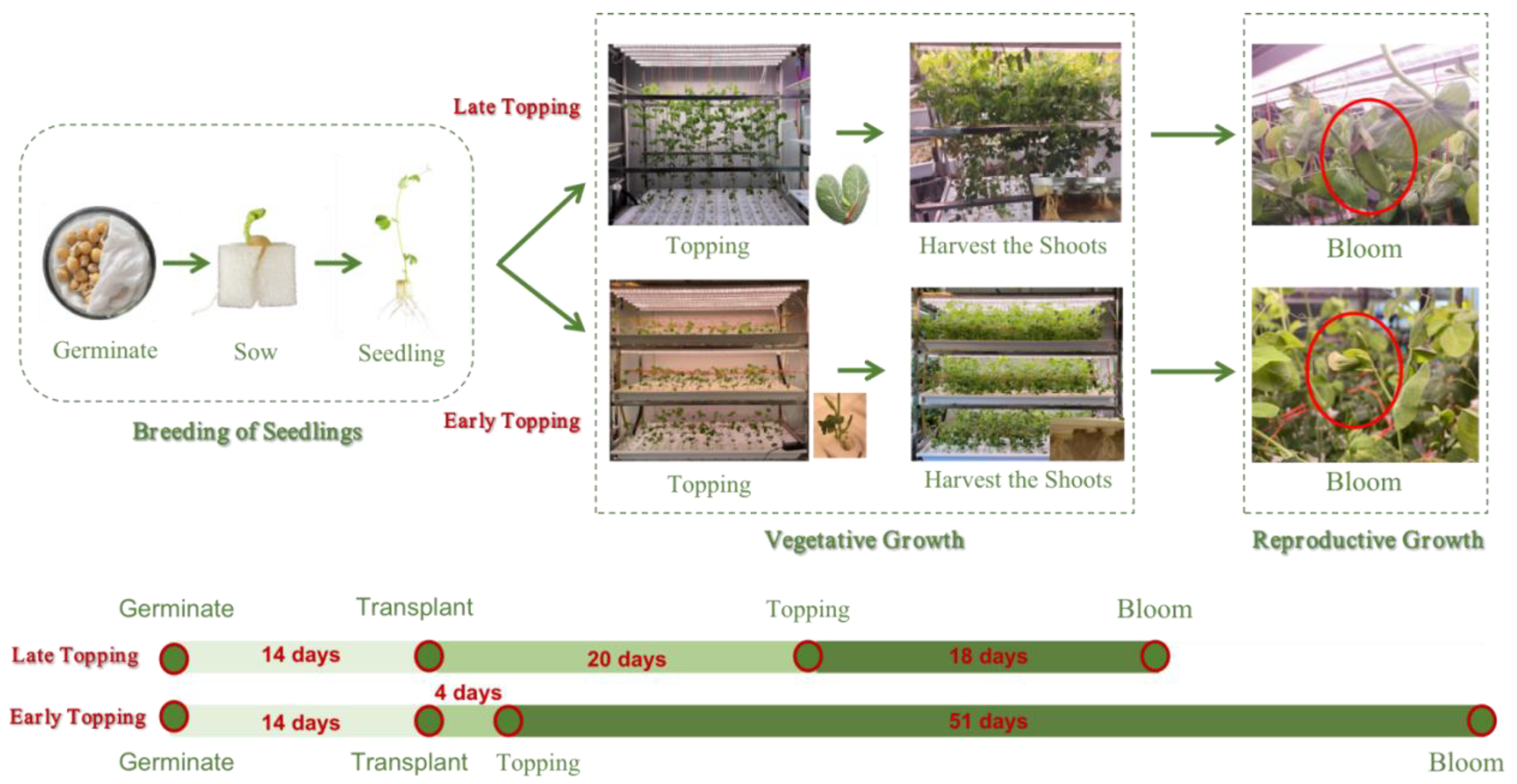
Figure 2.
The total fresh weight (A) and total number of harvested (B) per unit area at different cultivation stages under different cultivation methods. Based on the data trend, the logistic growth curve was selected to fit the total fresh weight and the number of harvested of pea shoots. However, LT could not be fitted because the harvest data were only available for three time points. The fresh weight per pea shoots (C) for LT was calculated from the mean values of three harvests (n = 5), while for ET-LD and ET-HD, the mean values were calculated from the mean values of four harvests (n = 5). Bars that do not share the same letter are significantly different at the 5% level, according to LSD's multiple comparison test. LT denote later topping (20 days after transplanting) with the plant density of 39 plants m-2; ET-LD denote early topping (4 days after transplanting) with the plant density of 72 plants m-2; ET-HD denote early topping with the plant density of 126 plants m-2.
Figure 2.
The total fresh weight (A) and total number of harvested (B) per unit area at different cultivation stages under different cultivation methods. Based on the data trend, the logistic growth curve was selected to fit the total fresh weight and the number of harvested of pea shoots. However, LT could not be fitted because the harvest data were only available for three time points. The fresh weight per pea shoots (C) for LT was calculated from the mean values of three harvests (n = 5), while for ET-LD and ET-HD, the mean values were calculated from the mean values of four harvests (n = 5). Bars that do not share the same letter are significantly different at the 5% level, according to LSD's multiple comparison test. LT denote later topping (20 days after transplanting) with the plant density of 39 plants m-2; ET-LD denote early topping (4 days after transplanting) with the plant density of 72 plants m-2; ET-HD denote early topping with the plant density of 126 plants m-2.
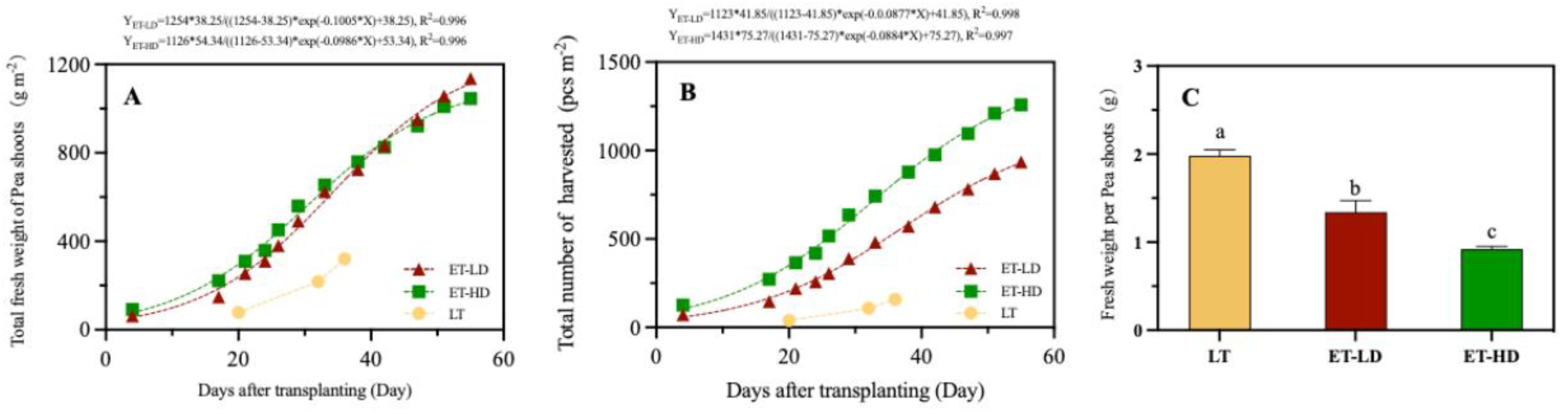
Figure 3.
The total fresh weight (A), total number of harvested (B) per unit area under different light intensity combined with ET. Based on the data trend, the logistic growth curve was selected to fit the total fresh weight and the number of harvested of pea shoots. The fresh weight (C) and dry weight (D) per pea shoots, as well as the water content (E) of pea shoots at 15, 24, 53 and 65 days after transplanting. A second order polynomial was chosen to fit their trends throughout the cultivation cycle. The different small letters denote significance at the 0.05 level, according to LSD’s multiple comparison test. Identical letters signify no significant differences, and "NS" represents no significant differences between all treatments. Vertical bars represent the ± SE (n = 5). ET-P050, ET-P100 and ET-P150 denote the method of early topping under light intensity of 50, 100 and 150 µmol m-2 s-1, respectively.
Figure 3.
The total fresh weight (A), total number of harvested (B) per unit area under different light intensity combined with ET. Based on the data trend, the logistic growth curve was selected to fit the total fresh weight and the number of harvested of pea shoots. The fresh weight (C) and dry weight (D) per pea shoots, as well as the water content (E) of pea shoots at 15, 24, 53 and 65 days after transplanting. A second order polynomial was chosen to fit their trends throughout the cultivation cycle. The different small letters denote significance at the 0.05 level, according to LSD’s multiple comparison test. Identical letters signify no significant differences, and "NS" represents no significant differences between all treatments. Vertical bars represent the ± SE (n = 5). ET-P050, ET-P100 and ET-P150 denote the method of early topping under light intensity of 50, 100 and 150 µmol m-2 s-1, respectively.
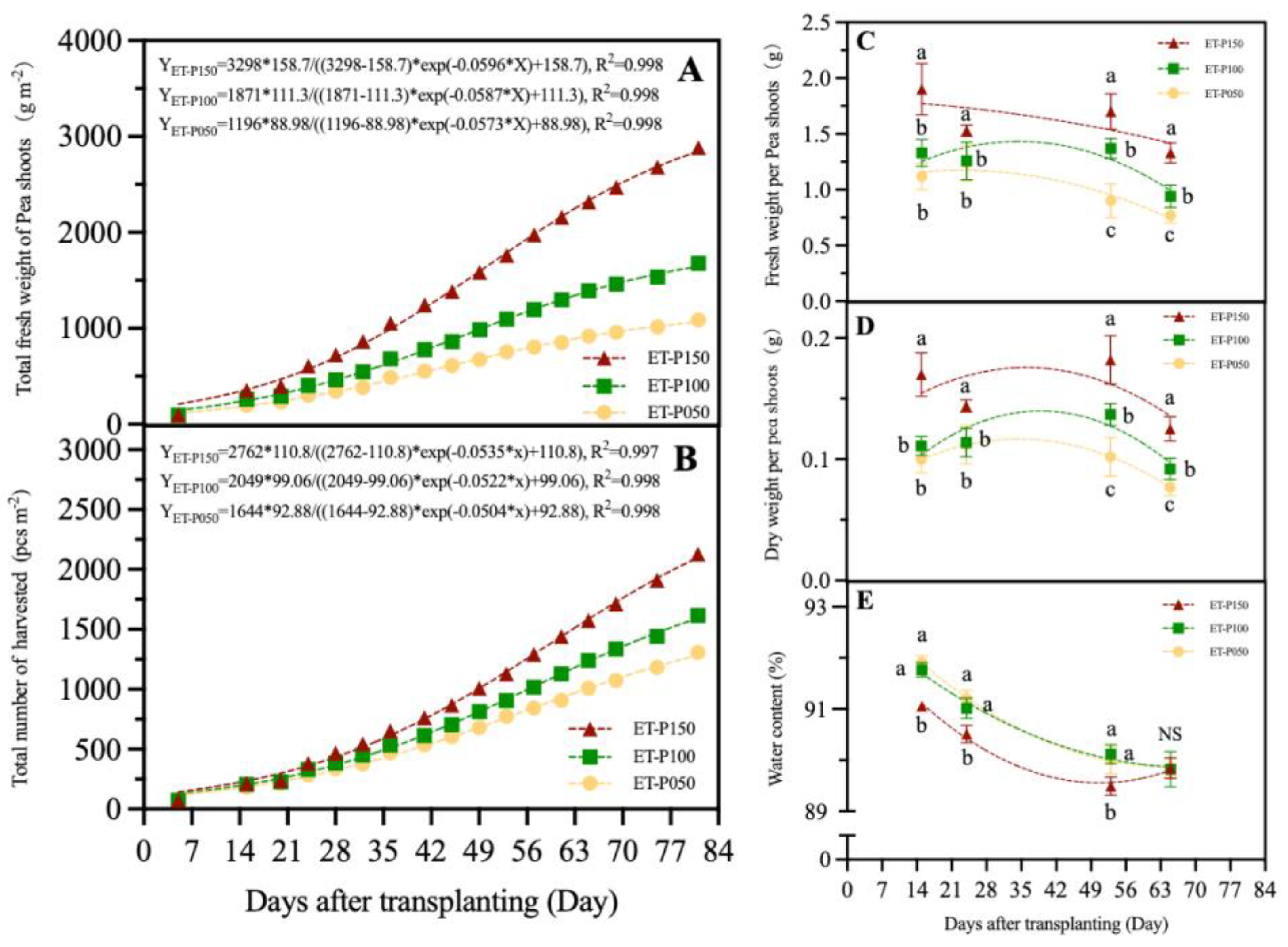
Figure 4.
The content of soluble sugar (A), vitamin C (B), soluble protein (C) and nitrate (D) in leaves and stems of pea shoots under different light intensity combined with ET at 15, 36 and 74 days after transplanting. A second order polynomial was chosen to fit their trends throughout the cultivation cycle. The different small letters denote significance at the 0.05 level, according to LSD’s multiple comparison test. Identical letters signify no significant differences, and "NS" represents no significant differences between all treatments. Vertical bars represent the ± SE (n = 5). ET-P050, ET-P100 and ET-P150 denote the method of early topping under light intensity of 50, 100 and 150 µmol m-2 s-1, respectively.
Figure 4.
The content of soluble sugar (A), vitamin C (B), soluble protein (C) and nitrate (D) in leaves and stems of pea shoots under different light intensity combined with ET at 15, 36 and 74 days after transplanting. A second order polynomial was chosen to fit their trends throughout the cultivation cycle. The different small letters denote significance at the 0.05 level, according to LSD’s multiple comparison test. Identical letters signify no significant differences, and "NS" represents no significant differences between all treatments. Vertical bars represent the ± SE (n = 5). ET-P050, ET-P100 and ET-P150 denote the method of early topping under light intensity of 50, 100 and 150 µmol m-2 s-1, respectively.
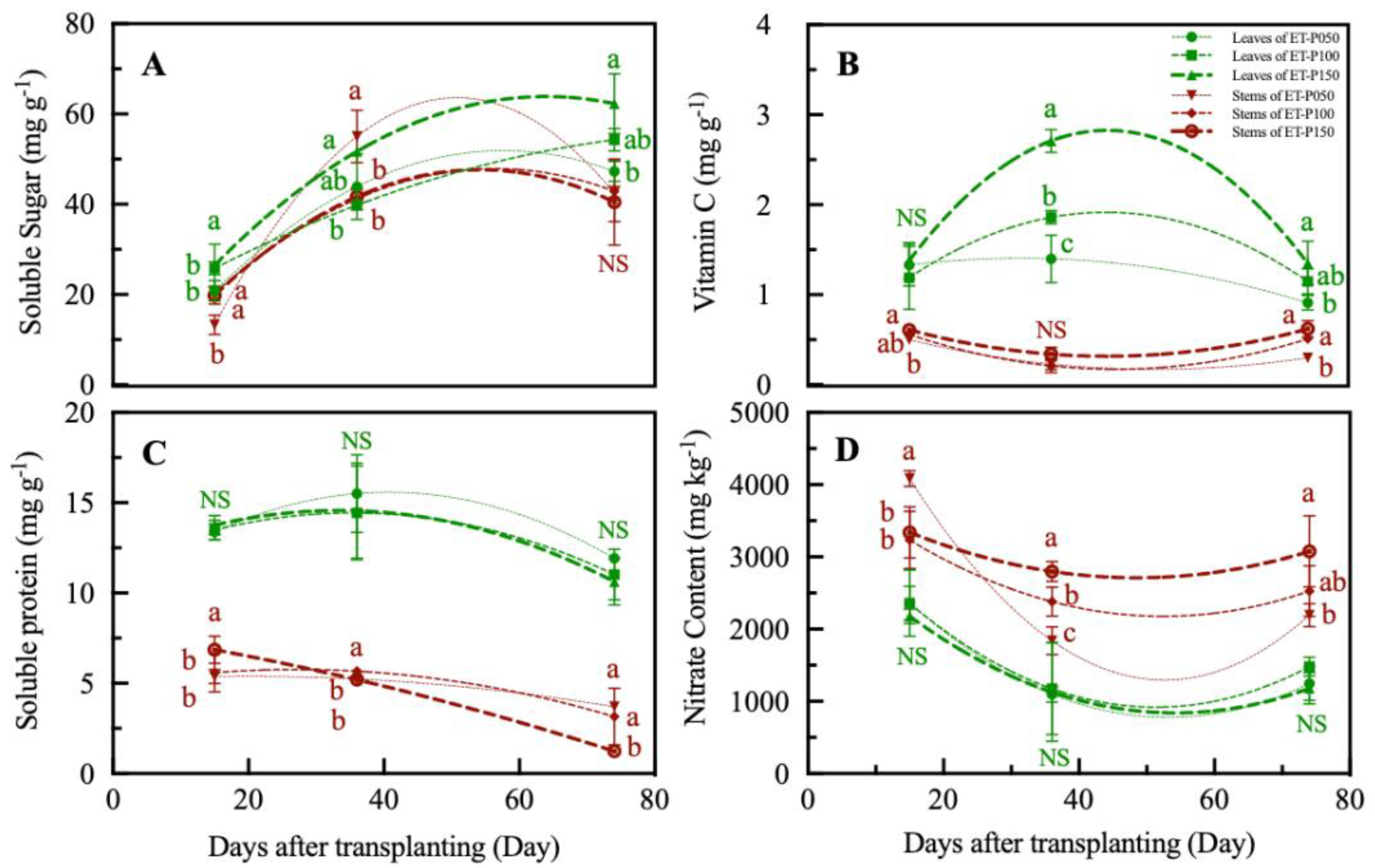
Figure 5.
The LUE (A) and PY (B) of accumulated weight of pea shoots during the whole cultivation process under different light intensity combined with early topping. Based on the data trend, the logistic growth curve was selected to fit the mean values. The LUE and PY of whole cultivation cycle (C) under light intensity of 50, 100 and 150 µmol m-2 s-1. These mean values were obtained by averaging the LUE and PY of the pea shoots from 15 harvests. The different small letters denote significance at the 0.05 level, according to LSD’s multiple comparison test. Identical letters signify no significant differences, and "NS" represents no significant differences between all treatments. Vertical bars represent the ± SE (n = 8). * Represents a significant correlation at the 0.05 level, and *** represents a significant correlation at the 0.001 level. ET-P050, ET-P100 and ET-P150 denote the method of early topping under light intensity of 50, 100 and 150 µmol m-2 s-1, respectively.
Figure 5.
The LUE (A) and PY (B) of accumulated weight of pea shoots during the whole cultivation process under different light intensity combined with early topping. Based on the data trend, the logistic growth curve was selected to fit the mean values. The LUE and PY of whole cultivation cycle (C) under light intensity of 50, 100 and 150 µmol m-2 s-1. These mean values were obtained by averaging the LUE and PY of the pea shoots from 15 harvests. The different small letters denote significance at the 0.05 level, according to LSD’s multiple comparison test. Identical letters signify no significant differences, and "NS" represents no significant differences between all treatments. Vertical bars represent the ± SE (n = 8). * Represents a significant correlation at the 0.05 level, and *** represents a significant correlation at the 0.001 level. ET-P050, ET-P100 and ET-P150 denote the method of early topping under light intensity of 50, 100 and 150 µmol m-2 s-1, respectively.
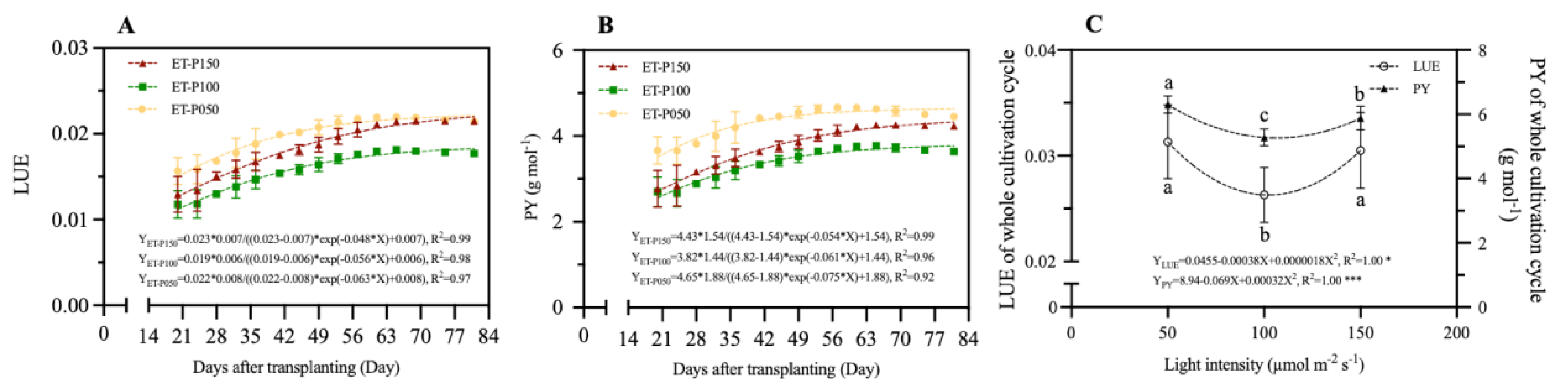
Figure 6.
Correlation analysis between light intensity and various indicators of pea shoots. * Represents a significant correlation at the 0.05 level, and ** represents a significant correlation at the 0.01 level. Blue and red circle represent negative and positive correlation. The numbers are correlation coefficients, and the larger circles mean stronger correlations. -L and -S denote leaves and stem of pea shoots.
Figure 6.
Correlation analysis between light intensity and various indicators of pea shoots. * Represents a significant correlation at the 0.05 level, and ** represents a significant correlation at the 0.01 level. Blue and red circle represent negative and positive correlation. The numbers are correlation coefficients, and the larger circles mean stronger correlations. -L and -S denote leaves and stem of pea shoots.
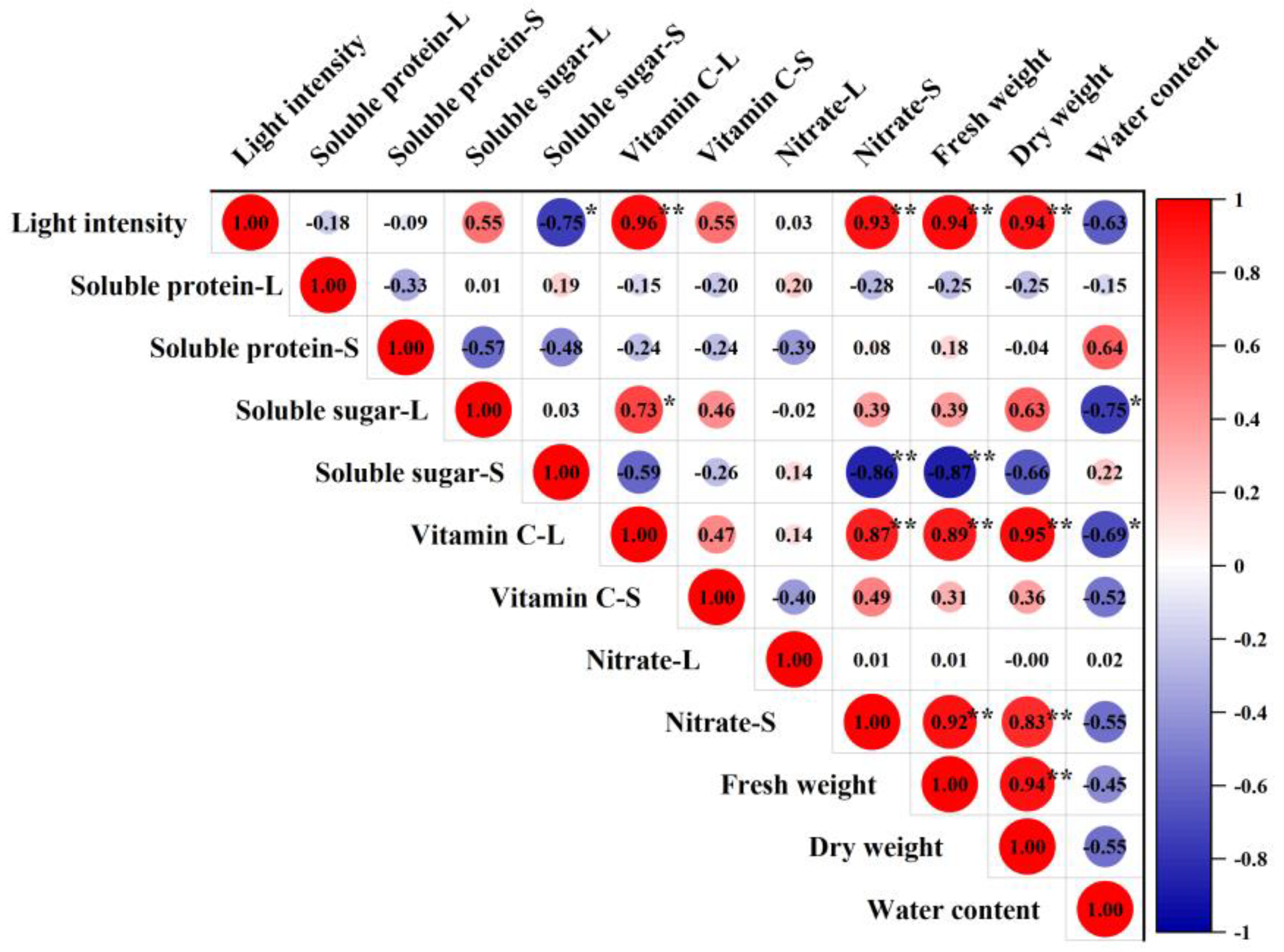
Table 2.
The leaf gas exchange measurement (net photosynthetic rate (Pn), stomatal conductance (Gs), intercellular CO2 concentration (Ci), transpiration rate (Tr)) and the PSⅡ maximal photochemical efficiency (Fv/Fm) of new (fully expanded leaves on the pea shoots) and old (functional leaves retained on the plant after harvesting pea shoots) leaves of pea shoots at 41 and 80 days after transplanting.
Table 2.
The leaf gas exchange measurement (net photosynthetic rate (Pn), stomatal conductance (Gs), intercellular CO2 concentration (Ci), transpiration rate (Tr)) and the PSⅡ maximal photochemical efficiency (Fv/Fm) of new (fully expanded leaves on the pea shoots) and old (functional leaves retained on the plant after harvesting pea shoots) leaves of pea shoots at 41 and 80 days after transplanting.
| Trial treatment | Pn | Gs | Ci | Tr | Fv/Fm | ||
| μmol m-2 s-1 | mol m-2 s-1 | μmol mol-1 | mmol m-2 s-1 | ||||
| New leaves | 41 DATi | ET-P050 | 4.6 ± 0.6 C c | 0.29 ± 0.10 A a | 357.1 ± 11.8 A a | 1.4 ± 0.3 NS | 0.835 ± 0.001 NS |
| ET-P100 | 7.0 ± 0.9 B b | 0.24 ± 0.03 A ab | 333.3 ± 5.7 A b | 1.3 ± 0.2 NS | 0.837 ± 0.004 NS | ||
| ET-P150 | 10.2 ± 0.2 A a | 0.19 ± 0.03 A b | 285.4 ± 15.3 B c | 1.2 ± 0.2 NS | 0.835 ± 0.008 NS | ||
| 80 DAT | ET-P050 | 1.2 ± 0.1 C c | 0.30 ± 0.06 A b | 385.8 ± 0.9 A a | 2.0 ± 0.3 NS | 0.842 ± 0.002 NS | |
| ET-P100 | 3.3 ± 0.2 B b | 0.51 ± 0.05 A a | 379.1 ± 1.5 A a | 2.8 ± 0.7 NS | 0.839 ± 0.003 NS | ||
| ET-P150 | 5.5 ± 0.7 A a | 0.48 ± 0.11 A a | 367.0 ± 5.9 B b | 2.6 ±1.2 NS | 0.845 ± 0.003 NS | ||
| Old leaves | 41 DAT | ET-P050 | 4.8 ± 0.4 B b | 0.37 ± 0.11 A a | 362.6 ± 3.3 A a | 1.7 ± 0.3 A a | 0.814 ± 0.004 B b |
| ET-P100 | 7.0 ± 0.4 A a | 0.20 ± 0.04 B b | 320.4 ± 12.5 B b | 1.1 ± 0.2 B b | 0.824 ± 0.008 AB a | ||
| ET-P150 | 7.6 ± 1.1 A a | 0.22 ± 0.02 AB b | 321.0 ± 16.1 B b | 1.3 ± 0.1 AB b | 0.832 ± 0.001 A a | ||
| 80 DAT | ET-P050 | 3.5 ± 0.2 B b | 0.52 ± 0.08 NS | 387.3 ± 1.7 A a | 2.7 ± 0.4 B b | 0.796 ± 0.011 B b | |
| ET-P100 | 3.5 ± 0.4 B b | 0.69 ± 0.07 NS | 380.8 ± 0.8 A a | 3.5 ± 0.2 A a | 0.820 ± 0.004 A a | ||
| ET-P150 | 5.3 ± 0.1 A a | 0.53 ±0.25 NS | 367.1 ± 11.4 A b | 2.5 ± 0.2 B b | 0.831 ± 0.004 A a | ||
DAT denote the days after transplanting. ET-P050, ET-P100 and ET-P150 denote the method of early topping under light intensity of 50, 100 and 150 µmol m-2 s-1, respectively. The different capital letters within the same period indicate highly significant differences at the 0.01 probability level (n = 5) according to LSD’s multiple comparison test, while different small letters denote significance at the 0.05 level. Identical letters signify no significant differences, and "NS" represents no significant differences between all treatments.
Disclaimer/Publisher’s Note: The statements, opinions and data contained in all publications are solely those of the individual author(s) and contributor(s) and not of MDPI and/or the editor(s). MDPI and/or the editor(s) disclaim responsibility for any injury to people or property resulting from any ideas, methods, instructions or products referred to in the content. |
© 2024 by the authors. Licensee MDPI, Basel, Switzerland. This article is an open access article distributed under the terms and conditions of the Creative Commons Attribution (CC BY) license (http://creativecommons.org/licenses/by/4.0/).
Copyright: This open access article is published under a Creative Commons CC BY 4.0 license, which permit the free download, distribution, and reuse, provided that the author and preprint are cited in any reuse.


