

Submitted:
03 April 2024
Posted:
04 April 2024
You are already at the latest version
Abstract
Cellulose nanofibrils (CNFs) are materials with high aspect ratio. Typically, TEMPO-oxidised, or cationic CNFs consist of long fibrils (up to 2 μm) with very low thickness (less than 10 nm). Derived from their high aspect ratio, CNFs form strong hydrogels with high elasticity at low concentrations. Thus, CNF suspensions appear as an interesting rheology modifier to be applied in cosmetics, paints, foods, as a mineral suspending agent, among other applications.
The high viscosity results from the strong 3D fibril network, which is related to good fibrillation of the material, allowing the nanofibrils to overlap. The overlap concentration (c*) was found to vary from ca. 0.13 to ca. 0.60 wt.% depending on the type and intensity of the pre-treatment ap-plied during the preparation of the CNFs. The results confirm the higher tendency for the fibres treated with CHPTAC (cationic) and TEMPO to form a 3D network, resulting in the lowest c*.
For the TEMPO-oxidised CNF suspensions, it was also found that aggregation is improved at acidic pH conditions due to lower charge repulsion among fibrils, leading to an increase in the suspension viscosity, as well as higher apparent yield stresses. TEMPO CNF suspensions with low content of carboxylic groups tend to precipitate at moderate acidic pH values.
Keywords:
Hydrogels
; cellulose nanofibres
; degree of polymerization
; charge density
; entanglement
; aggregation
1. Introduction
Cellulose nanofibres are a quite recent type of nanomaterials, which can be obtained by intensive mechanical treatment of cellulose fibres. The most common mechanical treatments are high-pressure homogenization (HPH), microfluidization, grinding, twin screw extrusion, cryo-crushing, and high-intensity ultrasonication [1]. Usually, the cellulose fibres treated only by mechanical processes do not present a high level of conversion to nanofibres, even when a highly intensive treatment is applied; for example, cellulose fibres treated only by mechanical treatment using HPH with two passes only resulted in ca. 6% conversion to nanofibres [2]. Even increasing the number of cycles, the yield in nanofibres is usually low; for example, Jeencham et al. reported a yield in nanofibers of 14.7% applying 15 cycles of HPH, when preparing CNF from cassava pulp [3].
The chemical pre-treatment is a suitable way to improve nanofibrillation degree. Among the chemical pre-treatments commonly used, TEMPO-mediated oxidation is one of the most used. The nanofibres obtained from TEMPO-oxidized fibres consist of very thin (less than 10 nm) and long fibrils, which result in a material with high aspect ratio [4]. The high aspect ratio and the crystallinity are key factors for the formation of stiff hydrogels at relatively low CNF concentrations [5]. This favourable property enables the use of CNFs as rheology modifiers with potential application in paints, foods, cosmetics, suspending agents in mineral applications among others [6].
Another pre-treatment suitable for the preparation of CNFs that emerged recently is cationization [7]. The introduction of cationic groups, especially quaternary ammonium groups, into the cellulose structure, not only enhances the degree of fibrillation but also expands the type of applications due to the new CNF properties introduced by the cationic groups such as antimicrobial properties [8]. Another recent application which presents high potential is the use of cationic CNFs as flocculants in wastewater treatment [9]. The introduction of positively charged groups can be achieved by different processes, being the most common the direct cationization through the reaction of the cellulose fibres with 2,3-epoxypropyltrimethylammonium chloride (EPTAC) [10], and a two-step cationization, using Girard's reagent T (GT) after oxidation by periodate [7]. The first method, due to the nature of the modification (direct cationization in mild conditions) does not result in extended depolymerization of cellulose; contrary, the second method, in which strong oxidation is applied to form cellulose dialdehyde, being the cationic groups added in aldehyde moieties, results in large depolymerization of cellulose. On the other hand, the amount of cationic groups which can be introduced using the first method is quite limited, but for the second method high charge density CNFs can be obtained [7]. As expected, the fibrillation degree obtained when applying the first or the second method is quite different, being the second method (for highly charged celluloses) able to produce nanofibres in larger extension.
The charge density, the fibrillation degree and the fibril dimensions have a deep impact on the rheology of CNF suspensions [5] because the rheology of polymeric solutions or CNF suspensions is controlled by the physical entanglement of polymeric chains/cellulose nanofibres and their aggregation [11,12]. Nechyporchuk et al. point out that the CNF suspensions produced using mechanical fibrillation, with or without enzymatic pre-treatment (no surface chemical modification), possess highly flocculated structure and are not able to induce high increase in the rheology of suspensions, contrary to the ones containing surface modification such as, carboxylation, carboxymethylation, and quaternization [13]. In the case of CNFs containing charged groups, in which the charge density could be affected by external stimulus, as it is the case of carboxylic groups in TEMPO CNFs, it is possible to tune the rheology of the suspensions by changing the pH conditions [12,14,15]. In literature are reported works dealing with the study of different ways to control the rheology of TEMPO CNFs, proposing the addition of salts [14,15,16], the ageing effect [17], gelation induced by heat [18], gelation induced by alcohol adding [19], and the use of surfactants [20].
On the other hand, Kopac et al. reported the effect of the quaternization reaction, its optimization and fibril characteristic effects on the rheology of cationic micro- and nanofibrillated cellulose [21]. Moberg et al. studied the effects of particle/fibril dimensions and surface characteristics on the rheological properties of nanocellulose suspensions [22]. They have concluded that the length (or the aspect ratio) of the particles played a very important role on the rheology of the suspensions.
However, no studies have been reported comparing the effect of different pre-treatments during the CNF preparation, and different contents of charged groups, on the rheology and gelation of CNF suspensions. In the present work, four different samples of negatively charged CNFs (TEMPO-oxidised), containing different levels of carboxylic groups and degrees of fibrillation, were compared for their rheological behaviour with five samples of cationic CNFs (one prepared by direct cationization and four by two-step cationization) containing different levels of cationic groups and degrees of fibrillation. Additionally, dynamic light scattering, and zeta potential determinations were performed to shed light on the aggregation extension and its impact on the gelation of CNF suspensions.
2. Results and Discussion
The type of pre-treatment during CNF production has a great impact on the properties of the obtained materials. For example, if no pre-treatment is used previous to mechanical fibrillation, the extension of nanofibres production is very limited. Moreover, the enzymatic pre-treatment can increase the degree of fibrillation, but not to very high levels. For example, the use of an enzymatic pre-treatment, followed by two HPH passes, was able to increase the degree of fibrillation from ca. 6% to ca. 17% for a bleached kraft Eucalyptus pulp [2,23]. On the other hand, the use of chemical pre-treatments enables to obtain CNF suspensions with high degrees of fibrillation, up to 95% or more, using the same two passes in HPH. Table 1 summarizes the main properties of the prepared CNFs, by applying different chemical pre-treatments, followed by two passes in HPH, using as starting material bleached kraft Eucalyptus pulp.
The level of nanofibrils generated by the intensive mechanical treatment (HPH) is clearly influenced by the concentration of oxidizing agents, sodium hypochlorite and periodate, used during the pre-treatments. It is possible to find a clear relation between the amount of oxidizing agent and the degree of fibrillation. Increasing oxidising agent led to higher charge densities (samples T1.41 and GT1.68), resulting in the swelling of the fibres, and consequently, higher contents of nanofibrils are formed. However, these exhaustive chemical pre-treatments resulted in a relevant decrease in the degree of polymerization of cellulose molecules. For example, the starting material (BEKP) presented a DP of ca. 2990, and the sample T1.41 showed a DP of ca. 365, being the decrease more pronounced when periodate oxidation followed by cationization with GT reagent was used (GT1.68 showed a DP of only ca. 26). As a consequence, the dimensions and shape of the formed nanofibrils are also highly affected, being the fibrils formed in the sample GT1.68 very short in length. One of the most valuable characteristics of CNFs is their high aspect ratio, which endows these materials with peculiar properties. One of these properties is the ability of materials with high aspect ratio to form gels at low concentration, due to the easy network formation caused by the entanglement of the thin and long fibrils. Figure 1 presents digital photos of CNF samples with different charged groups at different contents.
From Figure 1 it is possible to infer that the degree of fibrillation has a deep impact on the ability of suspensions of cellulose nanofibres to form gels; similarly, the aspect ratio of the fibrils has a key role in their formation of gels. The sample T0.74 presents a moderate level of fibrillation reducing the possibility of the formation of the entangled network at a concentration of 0.80 wt.%, and thus a gel was not obtained at the higher concentration tested. On the other hand, the samples with higher degrees of fibrillation (T1.14, T1.27 and T1.41) formed gel, at the same concentration, due to the higher content of fibrils with the capacity to contribute to the formation of the three-dimensional network and an increased capacity to resist to flow. The sample GT1.68 presents a fibrillation degree of ca. 100% and thus it should be expected to observe a strong gel for this suspension. However, due to the high destruction of the fibrils' integrity during the pre-treatment step, the formed nanofibrils present a short length and are not prone to form a network, being not observed the formation of a gel for all the tested concentrations. Long fibrils could touch each other and easily form a strong network; contrary, short fibrils couldn’t touch and the formation of highly viscous suspensions and/or gels could not be observed or was only observed for highly concentrated samples. The behaviour shown by the suspensions of CNFs follows the one observed for other polymers, where it was clearly demonstrated a high decrease in overlap concentration of the polymer as the MW increases [24].
Figure 2 presents the flow curves of suspensions of TEMPO-oxidised CNFs, at ca. 0.80 wt.% and neutral pH.
The increase of the amount of sodium hypochlorite used during the pre-treatment of TEMPO-oxidised samples led to higher fibrillation of the cellulose fibres and this resulted in higher viscosity of the samples (at low shear rate values). The trend obtained shows an increase in shear viscosity of the samples at low stresses, as well as a shift to higher stress values for the yield stress of the samples, from ca. 1 Pa for the sample with lower charge density, to ca. 100 Pa for the sample with higher charge density. Undoubtedly, the increase in nanofibres with low thickness led to a strong reinforcement of the network, and the resistance to flow was increased about 100 times (at the same suspension concentration), due to the larger opportunity of the nanofibrils to physically interact with the neighbour ones and form highly entangled networks, which present high resistance to flow.
Independently of the CNF nanofiber content, the increase in the concentration of the CNF suspensions always led to an increase in the viscosity of the suspensions. Figure 3 shows the flow curves of TEMPO-oxidised CNFs with lower (T0.74) and higher (T1.41) charge density.
As expected, the viscosity of the suspensions increased when the suspension concentration was raised, both for the less charged CNFs and for the more charged ones. However, the increment in viscosity values was not with the same magnitude. For the CNF with the lowest charge, the increment in the viscosity was about six orders of magnitude, and for the highly charged CNF sample, the increment was ca. eight orders of magnitude. Similarly, the overlap concentration (transition from a diluted to a semi-diluted regime) occurs in lower concentration values for the sample with higher charge density, due to the larger amount of thin and long nanofibres able to form an entangled network at lower concentration, ca. 0.09 wt.%. On the other hand, the sample with lower charge density only attains similar values of viscosity for the higher concentration and the overlap concentration is estimated to be between 0.18 and 0.35 wt.%, where a significative increase in viscosity is observed, due to the starting of CNF entanglements and consequent viscosity raise.
Being the TEMPO-oxidised CNFs negatively charged, by the presence of carboxylic groups introduced in the carbon C6 of cellulose molecules through the sodium hypochlorite oxidation, mediated by TEMPO radical, the behaviour of the CNFs in suspension will be deeply affected by the protonation/deprotonation of the carboxylic groups present. Figure 4 depicts the effect of the change of the suspension pH, and consequently the change in carboxylic groups protonation when pH is decreased, in the yield stress of the CNF suspensions.
The decrease in the pH of the suspensions and the consequent decrease in the negative charge of CNFs increased the CNF aggregation and led to a shift in the yield stress of the suspensions. For example, for the suspension of T0.74, the yield stress value goes from 0.1 Pa to ca. 8 Pa with the decrease of the pH from 6.9 to 3.5. A further decrease in the pH of the suspensions of T0.74 resulted in the precipitation of the respective CNF due to the very low negative charge and extensive aggregation. The large decrease of negative charges, by protonation of carboxylic groups led to a large loss of counterion entropy, resulting in extensive aggregation and low dispersibility of the nanofibrils, and consequent precipitation. Contrary, for the highly charged CNF, the decrease in pH of the suspension, until pH 2.3, did not result in CNF precipitation. It was observed that the effect of pH decrease is more progressive, and the larger shift in yield stress values only occurs for the transition from pH 2.8 to pH 2.3, contrary to the suspension of T0.74 where the main change happens for the pH transition from 5.5 to 4.5. This could be explained by the higher number of negative sites in the T1.41 sample, which even facing a decrease in negative charges by lowering the pH still presents a high enough number to avoid extensive aggregation of the nanofibrils. The larger effect observed for the sample with a lower charge density occurs close to the pKa of carboxylic groups (ca. 4.8 [25]), with approximately 50% of the carboxylic groups being protonated at this pH value. Due to the low substituent group content, this decrease in 50% of charged groups is enough to give rise to extensive aggregation, and a further decrease in pH led to phase separation (precipitation).
Contrary to the negatively charged CNFs produced in the present work, which contain charged groups without permanent charge, the cationic ones prepared contain quaternary ammonium groups (permanent charges) and thus the amount of charged groups in the latter CNFs does not suffer the effects of pH changes. Figure 5 illustrates the flow curves of different cationic CNFs, at a concentration of 0.80 wt.%.
The sample CH0.78, prepared by direct cationization of cellulose with CHPTAC, even presenting a moderate degree of substitution and fibrillation was the one which showed the highest value for yield stress point, ca. 10 Pa, of all the cationic CNF suspensions tested. Comparing this sample with a negatively charged CNF sample with a similar charge density (T0.74) it is possible to observe that the cationic CNF suspension presents higher viscosity and yield stress. It is also important to note that sample T0.74 presents a higher degree of fibrillation (ca. 50%) almost twice the value obtained for CH0.78 (29%), A possible explanation for the higher viscosity obtained for a sample with lower fibrillation could be the low degradation of the cellulose molecules when CHPTAC is used for cellulose cationization and CNF preparation, being the DP obtained very close to that of native BEKP. Thus, the formed fibrils, even if not at a very high content, are long and could easily entangle with others and form a strong network. Besides, for the samples prepared by two-step cationization a different trend was observed compared to TEMPO-oxidised CNFs. Samples with a low degree of substitution (GT0.23 and GT0.32) presented a very low degree of fibrillation (6 and 12%, respectively) and did not form a gel, presenting therefore low to moderate viscosity values. The sample with an intermediate level of cationization (GT0.90) was the one of the GT series that showed higher values of viscosity, which can be attributed to the high level of fibrillation obtained, 98%. Making a comparison with a TEMPO-oxidised CNF sample with a similar degree of fibrillation (T1.41), the viscosity of the cationic CNF suspension is much lower, due to the greater destruction of cellulose structure induced by the intensive oxidation during the aldehyde formation; the DP of the sample GT0.90 is only 47 (64 times lower than the value obtained for the starting cellulose – BEKP present a DP of 2990). Conversely, the DP of the sample T1.41 is only 8 times lower than the DP observed for starting cellulose. Figure 6 depicts the flow curves of CH0.78 and cationic CNF with the highest degree of substitution, for different CNF concentrations.
The difference between the samples is substantial, being the sample GT1.68 much less viscous than CH0.78, even though the sample prepared by direct cationization (CH0.78) presents a lower level of cationic groups and fibrillation degree. For samples obtained by direct cationization of cellulose hydroxyl groups, it was not possible to obtain higher degrees of cationization, even increasing the ratio cationizing agent/cellulose, due to some steric hindrance related to the position of the cellulose ring where the reaction occurs, carbon C6 [7,26]. Conversely, for the two-step cationization, it was possible to obtain high levels of cationization (up to 1.68 mmol/g) but an extensive degradation of the cellulose structure was observed. This destruction led to a shortening of the nanofibrils' length and resulted in a large increment of the overlap concentration (c*). The estimated value of c* for the different cationic samples prepared was quite different, varying from 0.13 wt.% (CH0.78) to 0.60 wt.% (GT1.68), having a clear influence also on the viscosity of the suspensions, as observed in Figure 6.
Figure 7 represents the flow curves of CNF suspensions prepared by applying different pre-treatments for different levels of treatment.
From Figure 7 it is clear that the pre-treatment applied, as well as the level of treatment, have a deep impact on the rheology of the CNF suspensions. Different trends were observed depending on the pre-treatment. For example, the oxidation of cellulose fibres, mediated by TEMPO radical (samples T0.74 and T1.41), led to an increase in the viscosity of the CNF suspensions and yield stress point, due to the higher level of nanofibrils produced, without a drastic destruction of the cellulose structure. Contrarily, the two-step cationization (samples GT0.90 and GT1.68) resulted in extensive degradation of the cellulose structure and the suspensions with higher levels of cationic groups were not able to form a gel or even a suspension with high viscosity. The length of nanofibrils is demonstrated to be a critical parameter for the formation of a 3D network and induces a high increase in viscosity. Long fibrils can easily entangle and form a robust network, which results in strong resistance to flow (sample CH0.78). Thus, the level of nanofibrils formed after HPH play a central role om the gelation of aqueous suspensions of charged CNF, but it was shown that this only happens if the level of shortening of CNF is not very high.
Figure 8 summarizes the main properties of the CNF suspensions prepared and their influence on the rheology, referring to the formation or not of gels for suspensions containing 0.80 wt.% CNF in an aqueous medium.
3. Conclusions
The present work explored the effects of different pre-treatments used in the preparation of CNFs on the rheology of aqueous suspensions of CNFs containing different charged groups and different levels of modification. It was observed that TEMPO-oxidized CNFs can easily form strong and stiff gels, due to high levels of nanofibrillation and reasonable preservation of the length of the produced nanofibres. On the other hand, cationization of cellulose through a two-step procedure induces extensive degradation of CNF structure, leading to short nanofibres and cellulose chains with low DP. As a consequence, the suspensions of cationic CNF with high cationic charge density, GT1.68, did not form a gel at the highest concentration studied (0.80 wt.%), and this CNF was not even able to induce a significant increase in the viscosity of the suspensions. The direct cationization method, through CHPTAC grafting on the C6 of cellulose molecules, generated interesting results, enabling a moderate level of nanofibrillation without extensive structure degradation. The suspensions presented high viscosity but without the formation of a gel at 0.80 wt.%. From the obtained results it was possible to conclude that a high level of nanofibrillation combined with a not too low length of the obtained nanofibres are the key factors to form strong gels. The TEMPO CNFs could fulfil these requisites thus forming gels, whereas the cationic CNFs did not. The charge repulsion between charged groups of nanofibrils, and the associated entropy of the counterions, revealed to play a role in the rheology of the suspensions, but not so pronounced as the structure of the nanofibres. The content in charged groups was revealed to be very important in keeping the nanofibres in suspension and avoiding extensive aggregation and precipitation of nanofibers, when factors, such as the pH value in TEMPO-oxidized CNF suspensions, are modified and decrease the extent of those groups present in the CNF particles. In sum, the present work demonstrates the potential of the use of charged CNFs as rheology modifiers, being especially attractive the TEMPO-oxidised CNFs with high levels of carboxylic groups, which can form gels at low concentrations. On the other hand, cationic CNFs produced by direct cationization, and by two-step cationization with moderate levels of derivatization, also present good rheological properties, and additionally present other interesting properties such as antimicrobial activity.
4. Materials and Methods
4.1. Materials
The starting cellulose material used was industrial bleached Eucalyptus kraft pulp (BEKP), never dried, with a composition of 80–85 wt.% cellulose, 14–19 wt.% xylan, 0.3 wt.% lignin and 0.4 wt.% extractives [27]. For the chemical surface modification of BEKP, different chemicals were used. TEMPO-mediated oxidation was carried out using NaClO (different ratios of NaClO/g of dry pulp, from 4 to 12 mmol of NaClO per g of dry pulp) and catalytic amounts of TEMPO radical and NaBr, following the methodology developed by Saito et al. [28]. 2,2,6,6-Tetramethylpiperidine 1-oxyl (TEMPO radical, > 98% purity) and NaBr were acquired from Sigma-Aldrich. NaClO (14% active chlorine in aqueous solution) was obtained from VWR chemicals. It was also used NaOH (pellets, acquired from VWR) to control the pH of the reaction. The cationization of the cellulose fibres was achieved by two different methods, direct cationization of cellulose, using (3-chloro-2-hydroxypropyl) trimethylammonium chloride (CHPTAC) [7] and by two-step cationization: oxidation with sodium periodate followed by reaction of the aldehyde groups with (carboxymethyl)trimethylammonium chloride hydrazide, Girard's reagent T – GT [26]. For the direct cationization, CHPTAC (60 wt.% aqueous solution from Sigma Aldrich) and sodium hydroxide pellets were used during the preparation of cationic cellulose fibres. In the two-step cationization, sodium periodate (NaIO4, from SP), acetic acid glacial (from VWR), isopropanol (from Labsolve) and GT (from Sigma-Aldrich) were used. For the determination of the content in aldehyde groups and charge density (cationic and anionic groups), hydroxylamine hydrochloride, sodium hydroxide and hydrochloric acid 1 M aqueous solutions (all from Sigma-Aldrich) were used in the titrations. Distilled water was used for the preparation of all the samples. All chemicals were used as received without further purification.
4.2. Chemical Modification (Pre-Treatment) and Preparation of Nanofibres
TEMPO-mediated oxidation: To prepare TEMPO CNF samples, the cellulose fibres, industrial never-dried bleached Eucalyptus globulus kraft pulp, were dispersed in water, being previously dissolved the necessary amounts of TEMPO-radical and NaBr. Afterwards, the fibres were oxidised with NaClO using different ratios (from 4 to 12 mmol of NaClO per g of dry pulp). The oxidized fibres were filtered and washed thoroughly with distilled water. Finally, the oxidized fibres were dispersed at 1.0 wt.% consistency in distilled water and mechanically treated in a high-pressure homogenizer (GEA Niro Soavi, model Panther NS3006 L), using two passes through the homogenizer, first at 500 bar and next at 1000 bar. Suspensions with a consistency in the range of 0.80 and 1.00 wt.% were obtained.
Direct cationization: a direct cationization method was used to covalently bond quaternary ammonium groups to BEKP using CHPTAC, a precursor of 2,3-epoxypropyltrimethylammonium chloride (EPTAC) [10]. The reactive epoxide was prepared in situ by alkalinization of CHPTAC with sodium hydroxide [7]. The formed epoxide reacted with the available hydroxyl groups of cellulose, in alkaline conditions, to form an ether linkage at the C6 position of the anhydroglucose unit (AGU) adding cationic charges to cellulose. BEKP was dispersed in water, containing NaOH (at a ratio of NaOH/AGU molar ratio of 9) and a consistency of 3 wt.%. The fibre suspension was stirred for 20 min at 20 ºC, after which CHPTAC was added in a CHPTAC/AGU molar ratio of 6 [7]. The reaction followed at 65 ◦C for 8 h. Then, the obtained cationized fibres were filtered and washed thoroughly with distilled water until the washing water conductivity reached a constant value, close to the value of distilled water. Finally, the pre-treated cationic fibres were dispersed in distilled water at 1.0 wt.% consistency and mechanically treated in a high-pressure homogenizer (GEA Niro Soavi, model Panther NS3006 L), applying two passes through the homogenizer, first at 500 bar and second at 1000 bar. Suspensions containing 0.90 wt.% of cationic cellulose nanofibres (CH0.78) were obtained.
Two-step cationization: the second method to add cationic charges to cellulose consisted of an indirect cationization (two-step). To do so, first cellulose was converted into a more reactive form, dialdehyde cellulose (DAC), through oxidation with sodium metaperiodate (NaIO4). This reaction opened the C2-C3 bond and converted the two vicinal hydroxyl groups of AGU into aldehyde groups [26]. Cellulose cationization was attained by reacting the DAC with GT reagent, obtaining a stable imine structure with quaternary ammonium groups [29]. The first step of the reaction was the preparation of DAC, being processed by dispersing BEKP in a water/isopropanol (IPA) mixture (10%v/v IPA), to act as a free radical scavenger and reduce the depolymerization of cellulose [30], at 70 ºC and a consistency of 2.5 wt.% of cellulose fibres. Different molar ratios of sodium periodate/AGU were used to obtain different levels of cellulose oxidation. The reactions were left to continue for 4h, in the absence of light to minimize the photodegradation of sodium periodate. Afterwards, the oxidized fibres (DACs) were extensively washed with water and the amount of aldehyde groups (degree of substitution, DSa) was determined, based on the oxime reaction between the aldehyde groups and hydroxylamine hydrochloride, by potentiometric titration (using sodium hydroxide as titrating agent [31]). After determining the number of aldehyde groups of each sample, the undried DACs were dispersed in acidified water (10%v/v of acetic acid) at a consistency of 5.0 wt.%. Based on the previous determination of aldehyde groups, a specific molar ratio of GT to aldehyde groups was loaded into the reaction media [7]. The reaction between the GT reagent and the aldehyde groups of cellulose was performed at 70 ◦C for 90 minutes. Then, the samples were filtered, under vacuum, through a filter paper with a pore size of 11 μm and extensively washed with a mixture of water/IPA (1:9 v/v), until the conductivity of the washing solvent was constant. The cationic cellulose fibres were dispersed in water (1.0 wt.%) and subjected to a two passes mechanical treatment in an HPH (GEA Niro Soavi, model Panther 115 NS3006L), first pass at 500 bar and a second pass at 1000 bar. Suspensions with a consistency varying between 0.90 and 1.10 wt.% were obtained.
4.3. Characterization of the Obtained Cellulose Nanofibres
For all the prepared samples, the degree of fibrillation, degree of polymerization, zeta potential, hydrodynamic radius and charge density were measured. The degree of nanofibrillation was determined in duplicate after centrifugation of aqueous CNF suspensions (0.2 wt.%) at 9000 rpm for 30 min. The precipitate was discarded, and the content of the supernatant was assumed as the content of the sample in nanofibrillated material. For determination of the degree of polymerization, dried CNF samples were dissolved in cupriethylenediamine, and the intrinsic viscosity was determined according to ISO standard 5351:2010. The degree of polymerization (DP) was then estimated using the Mark-Houwink equation, with parameters K = 0.42, a = 1 [32].
The hydrodynamic radius of the cellulose nanofibrils was obtained by dynamic light scattering measurements. The experiments were carried out, at 25 °C, in a Zetasizer NanoZS equipment (ZN 3500, Malvern Instruments, UK), with a laser of 532 nm wavelength, using a backscatter angle detection of 173°. The concentration of CNF suspensions used was 0.05 wt.%, being the suspensions centrifuged at 4000 rpm for 10 min, previously to size determinations, in order to remove residual large particles, present in suspension. The concentration of the suspensions used for size determination was lower than the estimated overlap concentration (for all the prepared samples), to avoid extensive interactions among nanofibrils. A glass cuvette was used for all the size determinations, being the suspensions gently inserted in the cuvette and checked for the presence of bubbles. The particle size was determined, based on six repetitions, according to the non-negative least-squares (NNLS) algorithm, using the Zetasizer Nano software (version 7.11). Additionally, zeta potential measurements were carried out with the same equipment, using appropriate zeta cuvettes, being the zeta potential values estimated using the same software, by electrophoretic light scattering, based on six repetitions for each sample.
The charge density of the different samples was estimated by titration, according to the nature of the sample. For TEMPO-mediated oxidized samples, the carboxyl content was determined, in duplicate, by conductometric titration of aqueous suspensions of CNF (acidified to pH of ca. 3 with HCl) and titrated with NaOH 0.01 M (standard solution). The charge density (mmol/g) was estimated from the CNF sample carboxyl content. Moreover, the charge density of cationic nanofibrils (expressed in mmol/g) was estimated using a potentiometric titration method [33]. To do so, a given mass of the different cationic CNF suspensions (corresponding to 200 mg dry matter) was dispersed in 150 mL of distilled water and the pH of the suspension was adjusted to 11 with a 0.1 M NaOH aqueous solution (this step allow the conversion of the cationic quaternary ammonium groups to their OH‾ form, by exchange the Cl‾ with OH‾ ions). The suspensions were then titrated, at a temperature of 35 ◦C, using a 0.01 M HCl (standard solution) until the inflexion point of the pH curve was attained.
4.4. Rheology of CNF Suspensions
4.4.1. Nanofibres Suspensions Preparation
The CNF suspensions for rheology studies were prepared by dilution of the original suspension of nanofibres, by weighing the desired amount of suspension and adding the required mass of distilled water. Suspensions of different concentrations from 0.80 to 0.09 wt.% of the different CNFs containing different charged groups and at different levels of modification were prepared. Suspensions were kept under stirring for 30 min to ensure good dispersion of the nanofibres. To study the effect of the pH of the suspension, a 0.5 M stock solution of acetic acid was prepared, and the pH of the suspensions adjusted to the desired values, between neutral pH and pH ca. 2.3. After the pH adjustment, all the samples were left to equilibrate for 30 min under agitation and pH was measured again after this period to check possible variations.
4.4.2. Rheology of the Suspensions
All the rheological studies were performed at constant temperature (25 °C), ensured by a water recirculatory bath (Haake Phoenix II, Germany), in a controlled stress rheometer (Haake, Model RS1, Germany), using different geometries. A cone-plate geometry (C60/1) was used for the rotational tests of TEMPO-oxidized CNF suspensions, and a plate-plate geometry (PP20Ti) for the oscillatory tests. For the suspensions of cationic CNF, a cylindrical bob and cup sensor (Z34 DIN Ti) with a gap of 7.2 mm was used, due to the low viscosity of some suspensions. The same temperature control was used during the measurements applying the bob and cup geometry. For all the samples, flow curves were obtained in controlled stress mode applying shear stresses ranging between 0.1 and 150.0 Pa, being the range adjusted to each sample for better data acquisition. The storage modulus (G’) and loss modulus (G”) were accessed by performing stress sweep oscillatory experiments from 0.1 to 100 Pa, being the range adapted to each sample. Rheological data were treated using the Haake RheoWin 4.20.005 software (Haake, Germany).
Author Contributions
Alves, L.: Conceptualization, Investigation, Funding acquisition, Methodology, Writing – original draft, Writing – review & editing. Magalhães, S.: Investigation, Writing – review & editing. Pedrosa, J.: Investigation, Methodology, Writing – review & editing. Ferreira, P. J. T.: Funding acquisition, Writing – review & editing. Gamelas, J. A. F.: Funding acquisition, Methodology, Writing – review & editing. Rasteiro, M. G.: Funding acquisition, Writing – review & editing.
Funding
The work was supported by the Portuguese Foundation for Science and Technology (FCT) through Strategic Research Centre Project UIDB00102/2020 (https://doi.org/10.54499/UIDB/00102/2020) and by the R&D Project “FILCNF-New generation of composite films of cellulose nanofibrils with mineral particles as high strength materials with gas barrier properties” (PTDC/QUIOUT/31884/2017, CENTRO 01-0145-FEDER-031884). Luís Alves acknowledges FCT for the financial support through the researcher grant 2021.00399.CEECIND (https://doi.org/10.54499/2021.00399.CEECIND/CP1656/CT0025). Solange Magalhães acknowledges the Portuguese Foundation for Science and Technology for the PhD grant 2020.07638.BD.
Conflicts of Interests
The authors declare no conflict of interest.
References
- Alves, L.; Ferraz, E.; Gamelas, J.A.F. Composites of nanofibrillated cellulose with clay minerals: A review. Advances in Colloid and Interface Science 2019, 272, 101994. [Google Scholar] [CrossRef] [PubMed]
- Alves, L.; Ramos, A.; Rasteiro, M.G.; Vitorino, C.; Ferraz, E.; Ferreira, P.J.T.; Puertas, M.L.; Gamelas, J.A.F. Composite Films of Nanofibrillated Cellulose with Sepiolite: Effect of Preparation Strategy. Coatings 2022, 12, 303. [Google Scholar] [CrossRef]
- Jeencham, R.; Le, H.M.; Numpaisal, P.-O.; Ruksakulpiwat, Y. Preparation of cellulose nanofiber from cassava pulp by high-pressure homogenizer. AIP Conference Proceedings 2023, 2884. [Google Scholar] [CrossRef]
- Nechyporchuk, O.; Belgacem, M.N.; Bras, J. Production of cellulose nanofibrils: A review of recent advances. Industrial Crops and Products 2016, 93, 2–25. [Google Scholar] [CrossRef]
- Jowkarderis, L.; van de Ven, T.G.M. Rheology of semi-dilute suspensions of carboxylated cellulose nanofibrils. Carbohydrate Polymers 2015, 123, 416–423. [Google Scholar] [CrossRef] [PubMed]
- Turbak, A.F.; Snyder, F.W.; Sandberg, K.R. Microfibrillated cellulose, a new cellulose product: properties, uses, and commercial potential; ; ITT Rayonier Inc., Shelton, WA: 1983; pp. Medium: X; Size: Pages: 815-827.
- Pedrosa, J.F.S.; Rasteiro, M.G.; Neto, C.P.; Ferreira, P.J.T. Effect of cationization pretreatment on the properties of cationic Eucalyptus micro/nanofibrillated cellulose. International Journal of Biological Macromolecules 2022, 201, 468–479. [Google Scholar] [CrossRef] [PubMed]
- Tavakolian, M.; Jafari, S.M.; van de Ven, T.G.M. A Review on Surface-Functionalized Cellulosic Nanostructures as Biocompatible Antibacterial Materials. Nano-Micro Letters 2020, 12, 73. [Google Scholar] [CrossRef] [PubMed]
- Ribau Teixeira, M.; Ismail, A.; Medronho, B.; Alves, L.; Pedrosa, J.F.S.; Ferreira, P.J.T.; Serrão Sousa, V.; Rosa da Costa, A.M. Nanofibrillated cationic cellulose derivatives as flocculants for domestic wastewater treatment. Journal of Water Process Engineering 2024, 58, 104817. [Google Scholar] [CrossRef]
- Song, Y.; Sun, Y.; Zhang, X.; Zhou, J.; Zhang, L. Homogeneous Quaternization of Cellulose in NaOH/Urea Aqueous Solutions as Gene Carriers. Biomacromolecules 2008, 9, 2259–2264. [Google Scholar] [CrossRef]
- Alves, L.; Lindman, B.; Klotz, B.; Böttcher, A.; Haake, H.-M.; Antunes, F.E. Rheology of polyacrylate systems depends strongly on architecture. Colloid and Polymer Science 2015, 293, 3285–3293. [Google Scholar] [CrossRef]
- Alves, L.; Ferraz, E.; Lourenço, A.F.; Ferreira, P.J.T.; Rasteiro, M.G.; Gamelas, J.A.F. Tuning rheology and aggregation behaviour of TEMPO-oxidised cellulose nanofibrils aqueous suspensions by addition of different acids. Carbohydrate Polymers 2020, 237, 116109. [Google Scholar] [CrossRef]
- Nechyporchuk, O.; Belgacem, M.N.; Pignon, F. Current Progress in Rheology of Cellulose Nanofibril Suspensions. Biomacromolecules 2016, 17, 2311–2320. [Google Scholar] [CrossRef] [PubMed]
- Hubbe, M.A.; Tayeb, P.; Joyce, M.; Tyagi, P.; Kehoe, M.; Dimic-Misic, K.; Pal, L. Rheology of Nanocellulose-rich Aqueous Suspensions: A Review. BioResources 2017, 12, 9556–9661. [Google Scholar] [CrossRef]
- Sato, Y.; Kusaka, Y.; Kobayashi, M. Charging and Aggregation Behavior of Cellulose Nanofibers in Aqueous Solution. Langmuir 2017, 33, 12660–12669. [Google Scholar] [CrossRef] [PubMed]
- Fukuzumi, H.; Tanaka, R.; Saito, T.; Isogai, A. Dispersion stability and aggregation behavior of TEMPO-oxidized cellulose nanofibrils in water as a function of salt addition. Cellulose 2014, 21, 1553–1559. [Google Scholar] [CrossRef]
- Šebenik, U.; Krajnc, M.; Alič, B.; Lapasin, R. Ageing of aqueous TEMPO-oxidized nanofibrillated cellulose dispersions: a rheological study. Cellulose 2019, 26, 917–931. [Google Scholar] [CrossRef]
- Calabrese, V.; Muñoz-García, J.C.; Schmitt, J.; da Silva, M.A.; Scott, J.L.; Angulo, J.; Khimyak, Y.Z.; Edler, K.J. Understanding heat driven gelation of anionic cellulose nanofibrils: Combining saturation transfer difference (STD) NMR, small angle X-ray scattering (SAXS) and rheology. Journal of Colloid and Interface Science 2019, 535, 205–213. [Google Scholar] [CrossRef]
- da Silva, M.A.; Calabrese, V.; Schmitt, J.; Celebi, D.; Scott, J.L.; Edler, K.J. Alcohol induced gelation of TEMPO-oxidized cellulose nanofibril dispersions. Soft Matter 2018, 14, 9243–9249. [Google Scholar] [CrossRef] [PubMed]
- Quennouz, N.; Hashmi, S.M.; Choi, H.S.; Kim, J.W.; Osuji, C.O. Rheology of cellulose nanofibrils in the presence of surfactants. Soft Matter 2016, 12, 157–164. [Google Scholar] [CrossRef]
- Kopač, T.; Krajnc, M.; Ručigaj, A. A rheological study of cationic micro- and nanofibrillated cellulose: quaternization reaction optimization and fibril characteristic effects. Cellulose 2022, 29, 1435–1450. [Google Scholar] [CrossRef]
- Moberg, T.; Sahlin, K.; Yao, K.; Geng, S.; Westman, G.; Zhou, Q.; Oksman, K.; Rigdahl, M. Rheological properties of nanocellulose suspensions: effects of fibril/particle dimensions and surface characteristics. Cellulose 2017, 24, 2499–2510. [Google Scholar] [CrossRef]
- Alves, L.; Ramos, A.; Ferraz, E.; Ferreira, P.J.T.; Rasteiro, M.G.; Gamelas, J.A.F. Design of cellulose nanofibre-based composites with high barrier properties. Cellulose, 2023. [Google Scholar] [CrossRef]
- Kronberg, B.; Holmberg, K.; Lindman, B. Polymers in Solution. In Surface Chemistry of Surfactants and Polymers, 2014; pp. 175-195. [CrossRef]
- Wågberg, L.; Decher, G.; Norgren, M.; Lindström, T.; Ankerfors, M.; Axnäs, K. The Build-Up of Polyelectrolyte Multilayers of Microfibrillated Cellulose and Cationic Polyelectrolytes. Langmuir 2008, 24, 784–795. [Google Scholar] [CrossRef] [PubMed]
- Pedrosa, J.F.S.; Alves, L.; Neto, C.P.; Rasteiro, M.G.; Ferreira, P.J.T. Assessment of the Performance of Cationic Cellulose Derivatives as Calcium Carbonate Flocculant for Papermaking. Polymers 2022, 14, 3309. [Google Scholar] [CrossRef] [PubMed]
- Henriques, P.; Martinho, M.; Serrano, M.d.L.; Mendes de Sousa, A.P.; Brites Alves, A.M. Xylooligosaccharides production by acid hydrolysis of an alkaline extraction filtrate from Eucalyptus globulus bleached kraft pulp. Industrial Crops and Products 2021, 159, 113066. [Google Scholar] [CrossRef]
- Saito, T.; Kimura, S.; Nishiyama, Y.; Isogai, A. Cellulose Nanofibers Prepared by TEMPO-Mediated Oxidation of Native Cellulose. Biomacromolecules 2007, 8, 2485–2491. [Google Scholar] [CrossRef] [PubMed]
- Grenda, K.; Arnold, J.; Gamelas, J.A.F.; Rasteiro, M.G. Environmentally friendly cellulose-based polyelectrolytes in wastewater treatment. Water Science and Technology 2017, 76, 1490–1499. [Google Scholar] [CrossRef]
- Kristiansen, K.A.; Potthast, A.; Christensen, B.E. Periodate oxidation of polysaccharides for modification of chemical and physical properties. Carbohydrate Research 2010, 345, 1264–1271. [Google Scholar] [CrossRef] [PubMed]
- Wei, J.; Du, C.; Liu, H.; Chen, Y.; Yu, H.; Zhou, Z. Preparation and Characterization of Aldehyde-Functionalized Cellulosic Fibers through Periodate Oxidization of Bamboo Pulp. BioResources 2016, 11, 8386–8395. [Google Scholar] [CrossRef]
- Henriksson, M.; Berglund, L.A.; Isaksson, P.; Lindström, T.; Nishino, T. Cellulose Nanopaper Structures of High Toughness. Biomacromolecules 2008, 9, 1579–1585. [Google Scholar] [CrossRef]
- Shunkevich, A.A.; Akulich, Z.I.; Mediak, G.V.; Soldatov, V.S. Acid–base properties of ion exchangers. III. Anion exchangers on the basis of polyacrylonitrile fiber. Reactive and Functional Polymers 2005, 63, 27–34. [Google Scholar] [CrossRef]
Figure 1.
Digital photos of 0.80 wt.% aqueous suspensions of T0.74, T1.14, T1.27 and Cat. CNFs. The photos were taken at room temperature.
Figure 1.
Digital photos of 0.80 wt.% aqueous suspensions of T0.74, T1.14, T1.27 and Cat. CNFs. The photos were taken at room temperature.
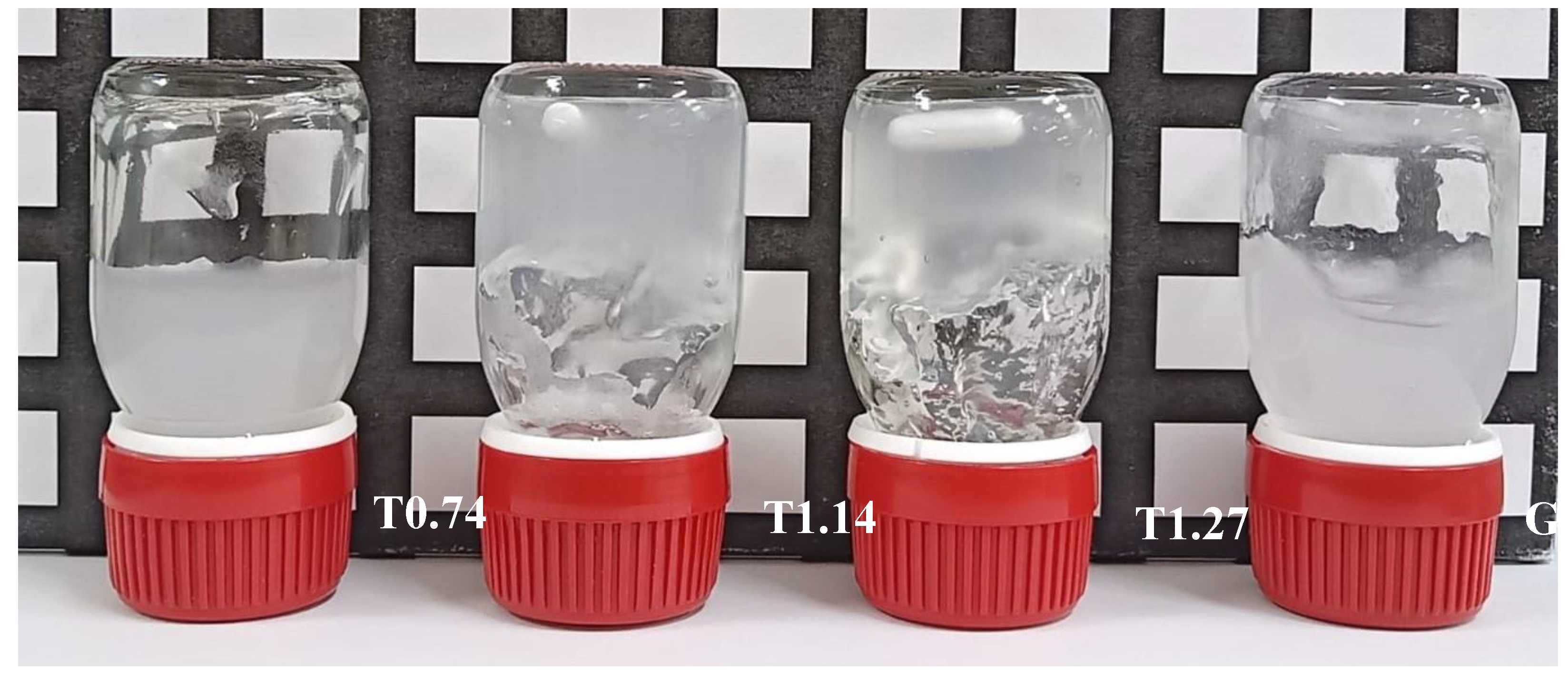
Figure 2.
Flow curves of TEMPO-oxidised CNFs at a concentration of 0.80 wt.%, at 25ºC.
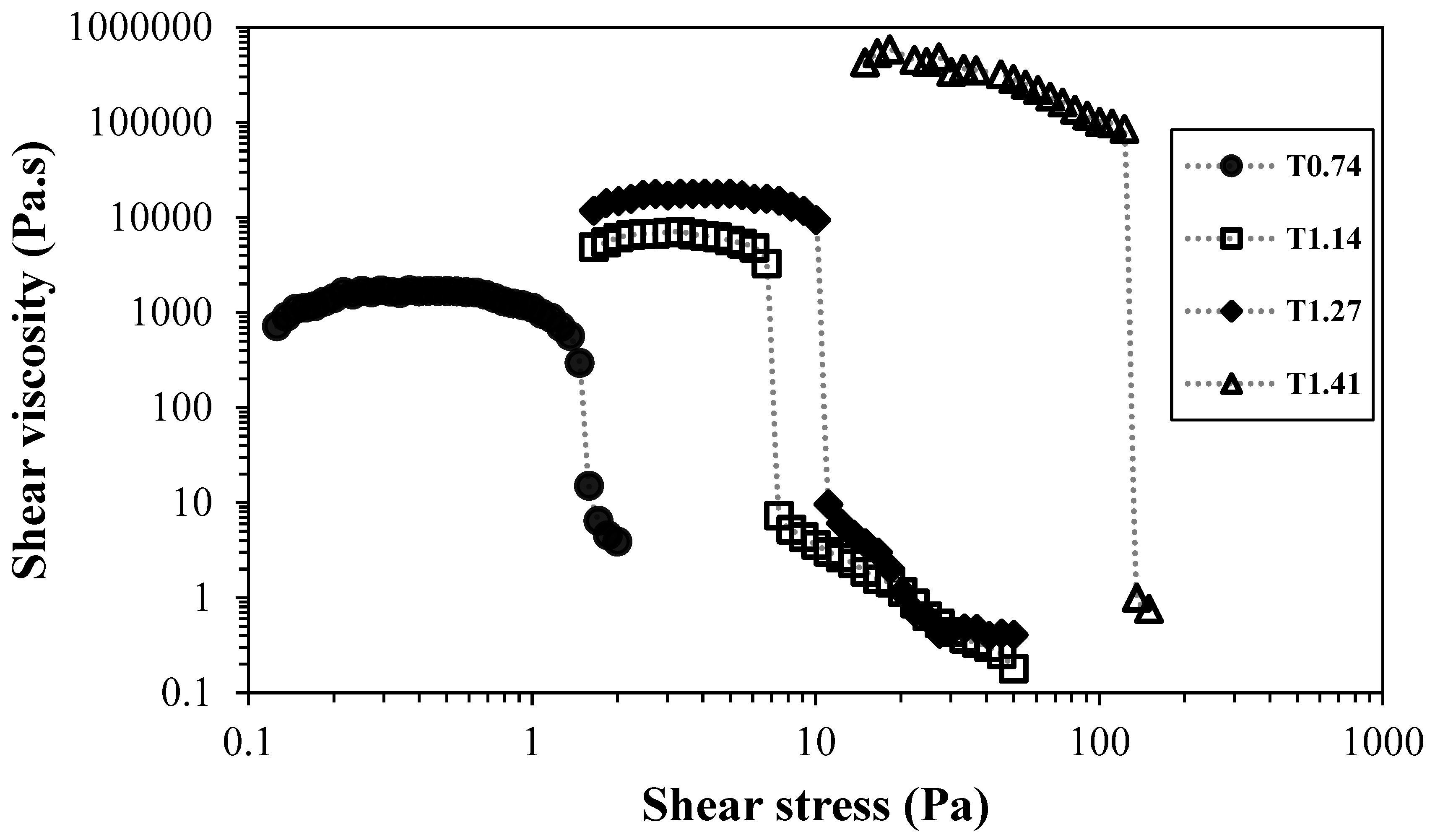
Figure 3.
Flow curves of TEMPO-oxidised CNFs at different concentrations. Top – T0.74; bottom – T1.41. The measurements were performed at 25ºC.
Figure 3.
Flow curves of TEMPO-oxidised CNFs at different concentrations. Top – T0.74; bottom – T1.41. The measurements were performed at 25ºC.
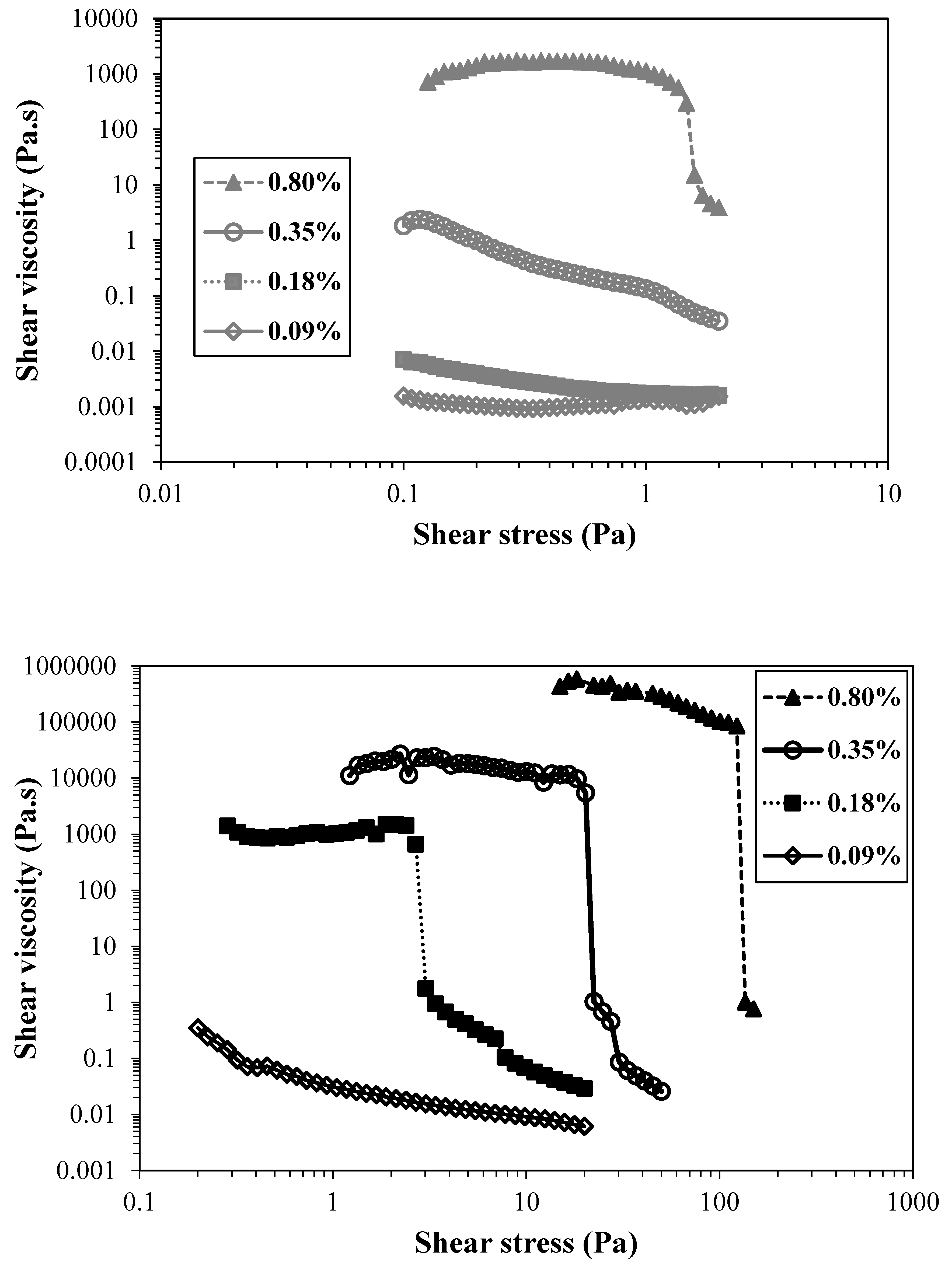
Figure 4.
Yield stress of TEMPO CNF suspensions as function of the pH for T0.74 (top) and T1.41 (bottom). The determinations were made at 25ºC, being constant the concentration of the suspensions (0.35 wt.%).
Figure 4.
Yield stress of TEMPO CNF suspensions as function of the pH for T0.74 (top) and T1.41 (bottom). The determinations were made at 25ºC, being constant the concentration of the suspensions (0.35 wt.%).
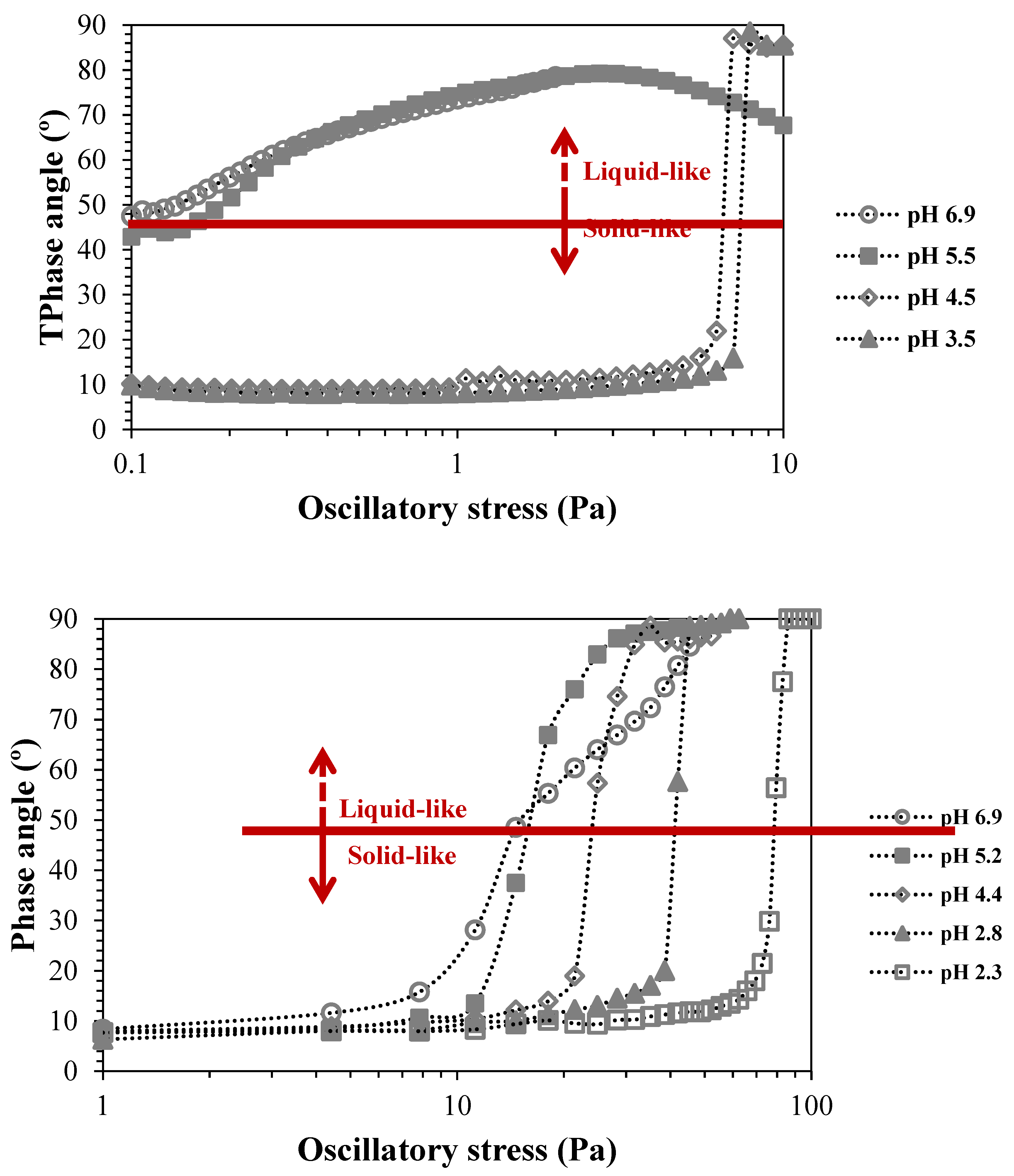
Figure 5.
Flow curves of cationic CNFs prepared by different pre-treatments. CH0.78 was prepared by direct cationization with CHPTAC, and the GT series was prepared by two-step cationization. The flow curves were obtained at 25ºC for a CNF concentration of 0.80 wt.%.
Figure 5.
Flow curves of cationic CNFs prepared by different pre-treatments. CH0.78 was prepared by direct cationization with CHPTAC, and the GT series was prepared by two-step cationization. The flow curves were obtained at 25ºC for a CNF concentration of 0.80 wt.%.
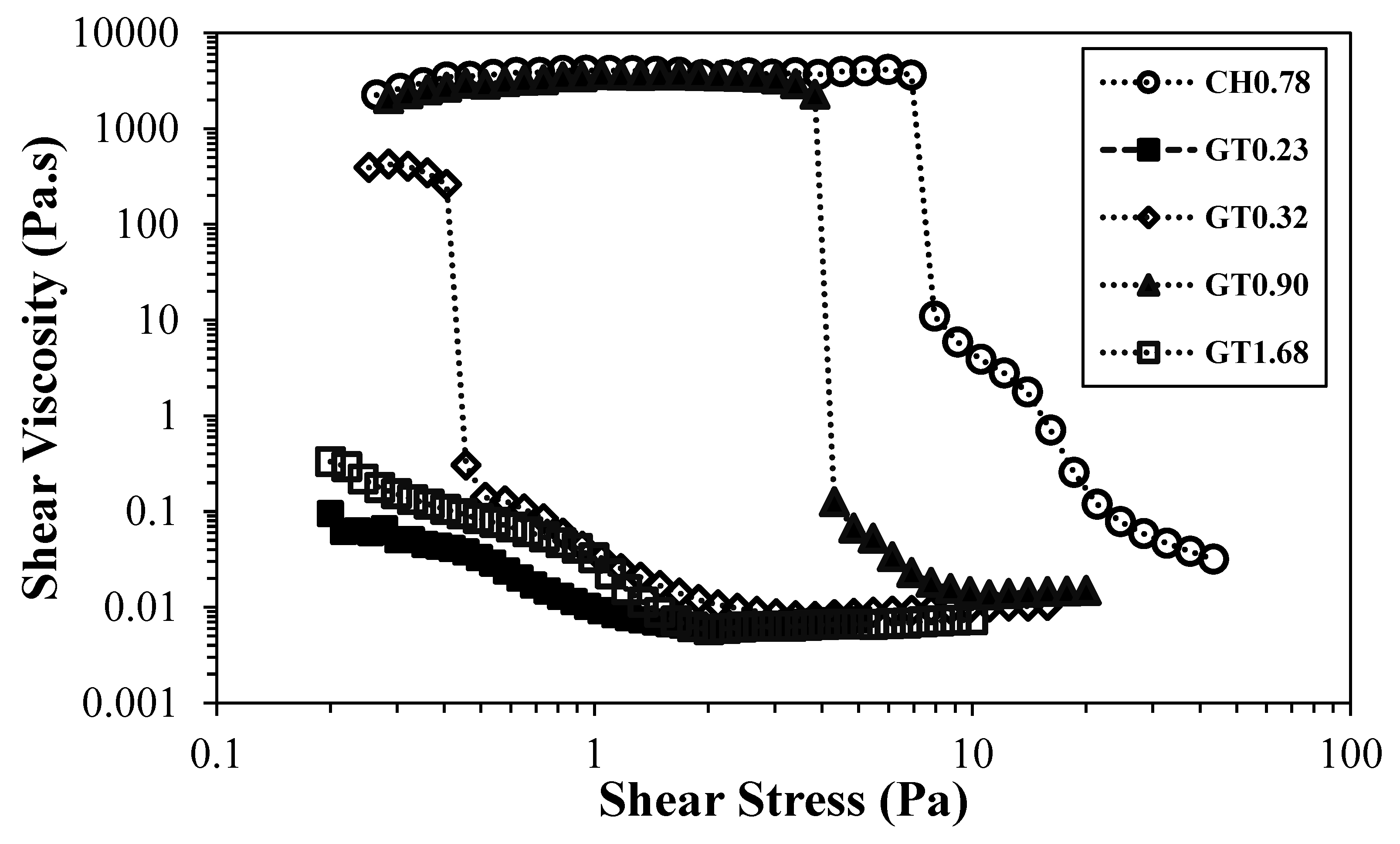
Figure 6.
Flow curves of cationic CNFs at different concentrations. Top – pre-treated with CHPTAC (CH0.78); bottom – pre-treated with periodate and GT reagent (GT1.68). Measurements were performed at 25 ºC.
Figure 6.
Flow curves of cationic CNFs at different concentrations. Top – pre-treated with CHPTAC (CH0.78); bottom – pre-treated with periodate and GT reagent (GT1.68). Measurements were performed at 25 ºC.
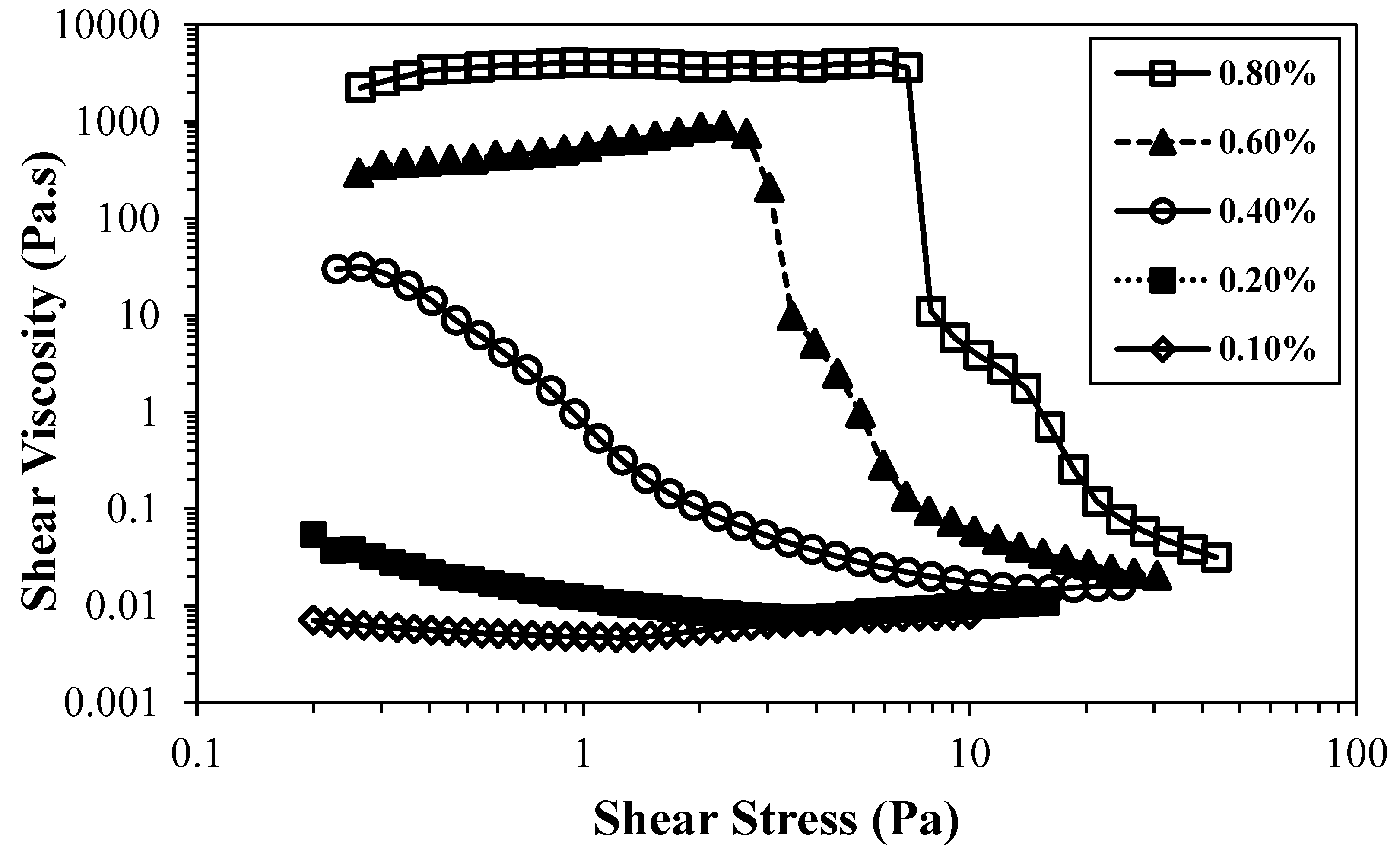
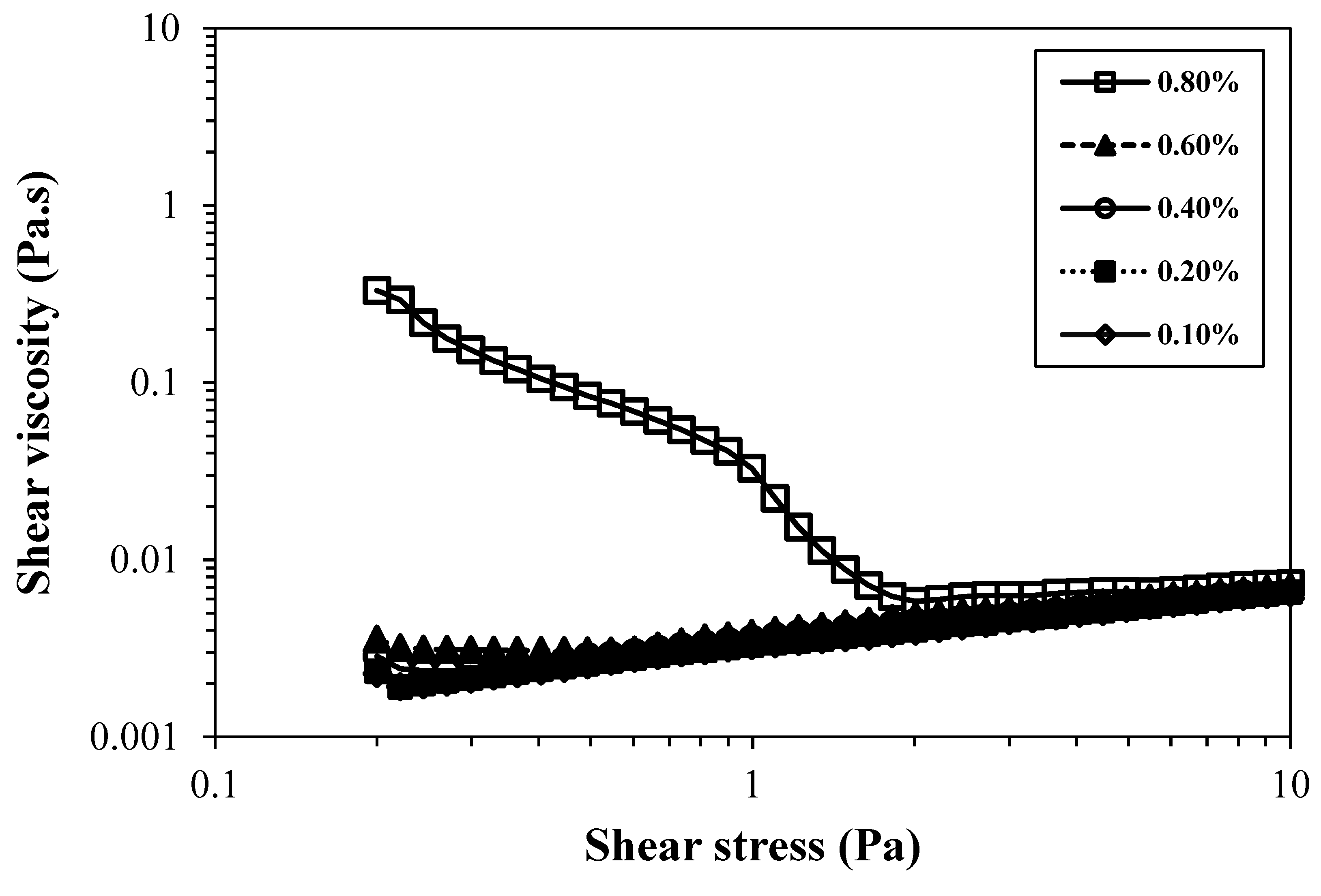
Figure 7.
Effect of pre-treatment on the viscosity of 0.80 wt.% CNF suspensions (at 25 ºC).
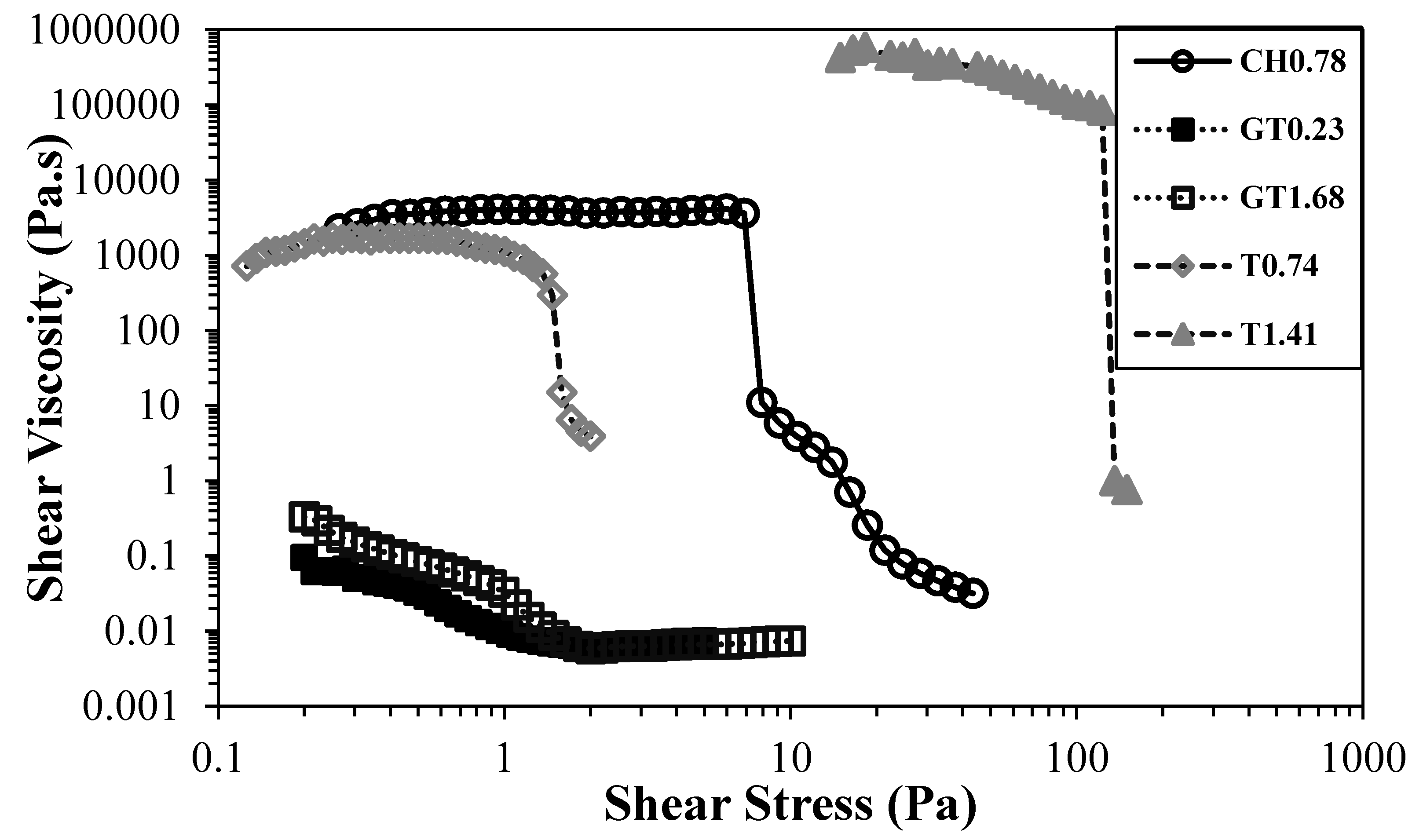
Figure 8.
Scheme of the factors affecting viscosity and gel formation (at a CNF concentration of 0.80 wt.%) for different CNFs.
Figure 8.
Scheme of the factors affecting viscosity and gel formation (at a CNF concentration of 0.80 wt.%) for different CNFs.
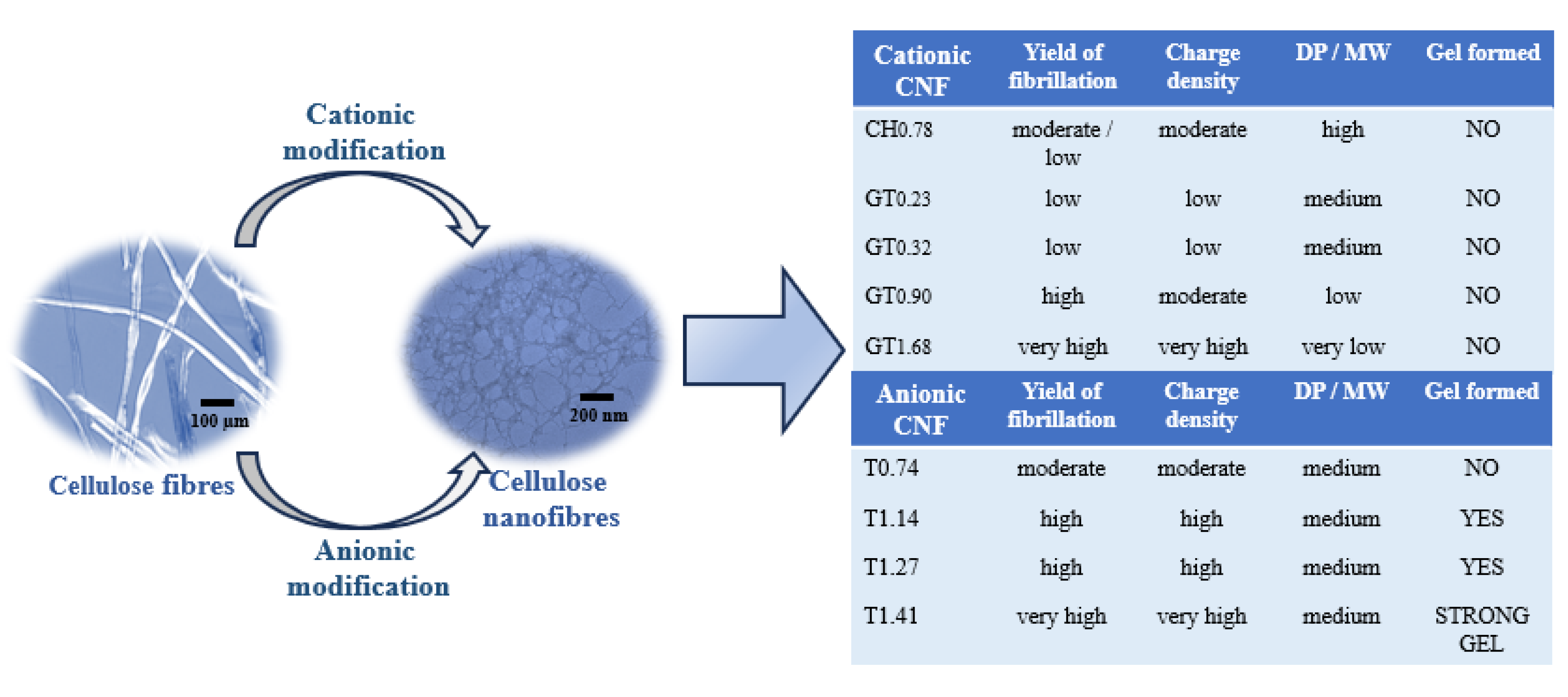

Table 1.
Characterization of the produced CNFs.
| CNF | Charge density (mmol/g) | Degree of fibrillation (%) | Intrinsic viscosity (mL/g) | Degree of polymerization | Zeta potential (mV) | Hydrodynamic radius (nm) |
|---|---|---|---|---|---|---|
| CH0.78 | 0.78 | 29.0 | 965 | 2859 | + 26 ± 3 | --- |
| GT0.23 | 0.23 | 6.0 | 183 | 437 | +24 ± 2 | --- |
| GT0.32 | 0.32 | 12.0 | 102 | 244 | +29 ± 5 | --- |
| GT0.90 | 0.90 | 98.0 | 20 | 47 | +27 ± 2 | 147 ± 4 |
| GT1.68 | 1.68 | 100.0 | 11 | 26 | +30 ± 3 | 106 ± 15 |
| T0.74 | 0.74 | 49.3 | 160 | 381 | – 42 ± 10 | 381 ± 19 |
| T1.14 | 1.14 | 65.5 | 143 | 340 | – 46 ± 4 | 479 ± 40 |
| T1.27 | 1.27 | 88.1 | 150 | 355 | – 49 ± 6 | 317 ± 21 |
| T1.41 | 1.41 | 100.0 | 153 | 365 | – 82 ± 10 | 161 ± 14 |
Disclaimer/Publisher’s Note: The statements, opinions and data contained in all publications are solely those of the individual author(s) and contributor(s) and not of MDPI and/or the editor(s). MDPI and/or the editor(s) disclaim responsibility for any injury to people or property resulting from any ideas, methods, instructions or products referred to in the content. |
© 2024 by the authors. Licensee MDPI, Basel, Switzerland. This article is an open access article distributed under the terms and conditions of the Creative Commons Attribution (CC BY) license (http://creativecommons.org/licenses/by/4.0/).
Copyright: This open access article is published under a Creative Commons CC BY 4.0 license, which permit the free download, distribution, and reuse, provided that the author and preprint are cited in any reuse.


