

Submitted:
15 September 2023
Posted:
19 September 2023
You are already at the latest version
Abstract
This paper focuses on the relationship between Mental Health and the Landscape. It aims to find out how people respond to Biophilic inspired landscape design in a healthcare setting. The focal point is not to cure diseases but to help them deal with the physiological, psychological, and psycho-social imbalance and provide a healing environment for the overall well-being of an individual. For this study, a Multispecialty Hospital was selected where an Indoor Healing Garden is used as a retrofitting tool to reduce stress and thus reconnect humans with nature. A multi-method approach is being used for this study. Initially, a questionnaire was conducted for the targeted users categorized into three types – patients, staff, and visitors to know their longing for the landscape. Based on this data and available literature, an evidence-based design was proposed. This conceptual design model is then shown to the targeted user and the response is recorded. The data has then collaborated with similar studies done earlier and design elements are highlighted which helps in creating a restorative environment by reducing stress and increasing recovery rate and thus approaching sustainable development.
Keywords:
Architectural Design
; Built environment
; Sustainability
; Psychology of design
; Behavioural Design
1. Introduction
In recent times, the importance of mental health and overall well-being has gained prominence, particularly in the wake of the Covid-19 pandemic. This emphasis on well-being is not only a response to contemporary concerns but also aligns with the United Nations Agenda 2030, which is recognized as one of the 17 pivotal Sustainable Development Goals. The Comprehensive Mental Health Action Plan 2013-30, succeeding its 2013-2020 predecessor, further underscores the significance of mental health promotion. This heightened awareness of mental health has permeated even into the realm of healthcare architecture. This research endeavors to explore the profound impact of integrating elements of nature into hospital design, a concept that addresses the disconnection from nature engendered by technological advancements and its adverse effects on mental health.
This disconnection from nature has been linked to a range of psychological issues, including stress, depression, anxiety, and bipolar disorder. To address this issue, the concept of biophilic architecture has emerged as a powerful approach, fostering improved cognitive behavior and the overall well-being of individuals. Biophilia, initially introduced by social psychologist Eric Fromm in "The Heart of Man" (1964) and popularized by biologist Edward Wilson in his book "Biophilia" (1984), posits that humans have an innate biological need for a physical, mental, and social connection with nature. While ancient civilizations recognized the benefits of natural environments for health, the relentless focus on scientific and technological advancements has eroded this vital connection over time.
However, in the past two decades, the role of healing gardens and the importance of well-designed indoor and outdoor spaces in healthcare settings have been rediscovered. This resurgence has given rise to a new branch of architecture known as Design and Health [15]. Numerous studies have extolled the significance of these design elements and anticipate a vast scope for further exploration. Historical evidence, such as the experiences of injured soldiers during World War II who engaged in horticultural activities to expedite their recovery, underscores the positive impact of nature on healing. Research by [1] revealed that patients with views of nature experienced shorter post-operative stays, fewer negative comments from caregivers, reduced medication use, and fewer post-operative complications compared to those with views of a wall. Patients undergoing dental treatment, when surrounded by natural elements, have reported better outcomes [Heerwagen J., 1990]. Similarly, incorporating natural scenes and sounds during bronchoscopy has improved the overall experience [16]. Additionally, nursing home residents with access to nature, either physically or visually, tend to have higher caloric intake and engage in more physical activity [17]. Furthermore, in 2005, Kellert introduced "Restorative Environment Design," aimed at fostering the human-nature connection [18]. This approach involves promoting positive human-nature relationships through biophilic design strategies and incorporating environmentally friendly design strategies to mitigate the negative effects of the surrounding environment. Mandelbrot in 1977 suggests that fractal patterns present in nature if mimicked through several elements of the built environment can reduce stress and promote well-being. Several theorists, researchers & design practitioners have been working for nearly 3-4 decades to determine the various aspects of nature that have the greatest impact on our fulfillment with the built environment. Findings from some of the theories are being used in this study, They are Psycho-evolutionary and Restorative preferences which are further classified as Attention Restoration Theory (ART), Stress Reduction Theory (SRT), and Perceptual Fluency Account (PFA). ART was devised by Stephen and Rachel Kaplan [19] who hypothesized that nature has the potential to renew attention after being mentally fatigued. SRT given by Roger Ulrich in 1983 states that unfamiliar events or environments, resemble a threat to humans, thus inducing stress and negative emotions until specific environment features like vegetation, complexity, symmetry, textures, views, vistas, etc. are introduced. Lastly, PFA acts as the intersection of the above two theories and synthesizes that the human brain responds more fluently and frequently in a natural setting in a structural manner than in an urban setting with a dominant built environment. Some pieces of evidence that have a physiological and psychological impact on the biophilic design of humans are discussed in Table 1.
In light of these findings, this research paper delves into the multifaceted concept of healing gardens in hospitals and their potential to enhance mental health and overall well-being through biophilic design strategies and environmentally conscious approaches. This approach aims to nurture a positive connection between humans and nature by using biophilic design and environmentally friendly strategies to counteract adverse environmental impacts. Thus, this research explores the multifaceted concept of healing gardens in hospitals and their capacity to boost mental health and overall well-being through these approaches.
Healing garden and its evolution: Healing gardens intend to reduce the stress of the user by using several natural elements with a peculiar design in the garden [Faba, 2002] However, every garden is a healing garden to some extent, but a specifically designed space encourages restoration from stress and has several positive influences on patients, visitors, and staff or caregivers is termed as Healing garden [20]. A Healing garden must stimulate five senses to promote relaxation, an improved immune system, and emotional well-being [21]. Based on a study, there are seven key themes associated with patient healing and two of them center around the incorporation of healing gardens. The first theme highlights the Healing Garden as a protected self-expression space, while the second theme underscores the potential of Healing Gardens to enhance the quality of life for patients, benefiting them both physically and psychologically [22]. As exercise is not meant only for unfit people similarly, the healing garden is not just for the ill. In some existing literature, healing gardens are of various types, like therapeutic gardens, sensory gardens, restorative gardens, horticultural therapy gardens, etc., and at times they are used interchangeably [23,24,25,26,27,28] The evolution of the Healing Garden is difficult to mark but its existence from the beginning of human settlements and rising communities implies it is a very old concept [29] [30] It is also found as an integral part of medieval hospitals in monastic societies in Europe. Persian Garden, Monastic Cloister Garden, and the Japanese Zen Garden replicated the healing environment throughout the world. Research has shown that implementing the Persian garden model for healing purposes in medical centers is beneficial and has a positive impact on mental health and stress reduction [31].

Table 1.
Studies that have the physiological and psychological impact of biophilic design on humans (Source: Author, after the mentioned author).
Table 1.
Studies that have the physiological and psychological impact of biophilic design on humans (Source: Author, after the mentioned author).
| S.No. | Author | Year | Research Outcomes |
|---|---|---|---|
| 1 | Ulrich | 1979 | Observed that patients having a view of nature from their window, recovered early and required fewer pain relievers compared to the ones faced walls. |
| 2 | Moore | 1981 | Found that prison residents looking at nature had 24% less frequent health care visits |
| 3 | Ulrich et al. | 1991 | Used electrocardiograms (ECGs) and measured pulse rate, frontal muscle tension and skin conductance as well as self-assessment of emotional states to further investigate the physiological relationship to nature. Both physiological and verbal findings indicated that recovery from stress was faster in a natural setting than in an urban one. |
| 4 | Berto | 2005 | Conducted three experiments involving 32 participants and concluded that the recovery environment and experience, including nature, greatly assisted in the recovery of mental fatigue. |
| 5 | Biederman and Vessel | 2006 | Suggested that seeing nature stimulates mu-opioid receptors in the human brain and the releases more endomorphin. |
| 6 | Taylor | 2006 | Found that fractal dimensions provoke stronger physiological responses, many of which indicate stress relief. |
| 7 | Hägerhäll et al. | 2008 -12 | Suggested that human responsiveness is not limited to direct exposure to green and there may be different human reactions to different forms of nature. |
| 8 | Ivarsson and Hagerhall | 2008 | Suggested the need for a better understanding of the morphology of the natural environment and its potential for recovery after the different results between gardens were observed. |
| 9 | Berman et al. | 2008 | Studied the interaction with nature in the restoration of direct attention and the improvement of cognitive function by comparing the urban and natural environments. They have also added that Environments that are devoid of any representation of nature can not only make people psychologically unwell and regressive in their behavior, but people can also display physical symptoms and responses. |
| 10 | Park and Mattson | 2008 | Suggested that plants should be used in hospitals as auxiliary healing mode. |
| 11 | Li et al. | 2011 | shown that exposure to nature reduces heart rate variability and pulse rate, lowers blood pressure, lowers cortisol, and increases parasympathetic nervous system activity, while sympathetic nervous system activity has been shown to decrease. These reactions contribute to improved cognitive function, working memory, and learning rates. Walking in the forest also revealed that levels of the hormone DHEA tended to increase. |
| 12 | Matsunaga et al. | 2011 | Showed that when older women were exposed to the hospital’s green rooftop forest, they were more physiologically relaxed and recovered. |
| 13 | Berman MG et al. | 2012 | Suggested that exposure to nature could be a valid supplement to treating depression and other disorders, with improvements to mood and memory span. |
| 14 | Tyrväinen et al. | 2014 | Investigated the psychological effects (resilience, vitality, mood, creativity) and the physiological effects of short-term immersion in nature. The results suggested that even short-term exposure to nature had a positive effect on stress compared to the urban built environment. |
| 15 | Guéguen and Stefan | 2016 | Observed that a short immersion in nature evoked a more positive mood and a greater desire to help others. |
2. Research Methodology
2.1. Location
For this study, a Multi-specialty 1200-bed “M.Y. Hospital” in Central India was selected. It was established in 1955 and named after King Holkar Maharaj Yashwant Rao which was India’s First Medical Institute named King Edward Medical School in 1848. Being Asia’s Largest and still the largest in Central India in 2020 it is spread over 25 Acre of land and has strong network connectivity. The factors considered to explore the potential zones to intervene landscape were: Accessibility, Visibility, Safety, Security, and Maximum usage. As per the above factors, 4 Atrium (14x24m, 336 sqm) of IPD block (17500 sqm) comprising (G+6) no. of floors were chosen. They are easily approachable by vertical circulation, visible from the windows of different wards at all levels and also from the corridors and balconies facing towards them. Being centrally located Staff can easily observe and visit the patients at any time.
2.2. Procedure
The study adopted a multi-method approach comprising three stages. In Stage 1, a questionnaire was conducted and 63 people were interviewed personally which is shown in Table 2. The questionnaire aimed to understand user requirements and preferences of the landscape. The targeted users were patients, staff, and visitors as per the hierarchy of preference. Utmost care of their privacy and comfort was taken and the terminologies used were easy and translated in the local language to make them feel comfortable. It was observed that 82% respondents would like to spend time in the garden, 13% denied it due to fear as they had never experienced this before and it didn’t matter much to 5% of the respondents. The color preference was found to be bright and movable and comfortable furniture over fixed ones. When different plant materials were introduced they felt nostalgic and shared old memories. Several plants acted as a reminder of different seasons and Indian festivals to them. They wished to have medicinal plants as Ayurveda has deep roots in India. They wanted to have a dedicated place for worship, yoga, meditation, and freedom of movement as they were tired of lying on the bed. A few suggested having counseling sessions or group therapies out in the garden and even wished to adapt horticultural therapy if advised by doctors. A few wished to have birds and animals, especially fish, ducks, rabbits, nightingale, and butterflies as they enjoyed watching them. Apart from this, the other recorded data based on the questionnaire prepared is highlighted in Figure 2. Four categories are being formed as per the order of preference namely Preference-A, Preference-B Preference-C, and Preference-D. Preference– A has the maximum number of respondents and preference – D has the least. The five variables used here in terms of preferences are Plant material, Type of furniture, Kind of activities, Design elements, and extent of privacy.
Stage II: Based on the “14 patterns of Biophilic Design” Improving Health & Well-Being in the Built Environment by Terrapin Bright Green,[32] a conceptual design model was evolved incorporating the data collected by questionnaire. Table 4 shows the pattern used in the respective atriums. The four atriums are designed on 4 different concepts. Atrium-I (A-I), focuses on the Olfactory System by using Aromatic flowers namely, Murraya paniuclata, Lavandula angustifolia, and Gardenia jasmenoids. The flowers chosen were considered allergens and indoor conditions. The Atrium-II (A-II), highlighted water as a healing element and expressed in various forms like a waterfall, pond, fountain, etc. as every sound of water has a different effect on human mood. Researchers at Brighton and Sussex Medical School of England found the healing effects of water sound that are mentioned in Table 3.
The central form chosen is inspired by the Spiral Water Channel found at Neelkanth Palace in Mandav. (Figure 1)
a prominent heritage place near this location, as a familiar element in a new place, makes the user comfortable. Atrium-III (A-III) is dedicated to women, especially for the gynecology ward or for those who are going to deliver a baby. Such patients go through terrible pain and require a stress-free environment. The labor pain sometimes remains for 2-3 days and they are advised to do light physical activities. So, considering their basic requirements and the sensitivity of the case the garden aims to relieve their stress, which will help them to deliver a baby. The Atrium–IV (A-IV) is dedicated to the staff, as a break from the routine enhances work efficiency and alleviates mood. The design also accommodates small meetings or discussion areas in a natural setting, to give a feeling of being in nature.
Stage-III These Four designed Atriums were then shown to the respective users in the form of images and a walkthrough (a virtual tour) to provide them with a three-dimensional visualization and an experience of being in the garden to get honest comments. The software used- AutoCAD, Sketch-up, Photoshop, and Lumion. However, they were aware of the current scenario of the atriums but the pictures of the same were also shown for the comparative analysis. They were asked to rate the gardens and highlight the design element they liked the most.
Table 4.
Presence of biophilic patterns in the 4 atrium.
| 14 Patterns of Biophilic Design | Abbreviation | Atrium-I | Atrium-II | Atrium-III | Atrium-IV | |
|---|---|---|---|---|---|---|
| Nature in the space | Visual connection with nature | VC | ||||
| Connection with natural systems | CW | |||||
| Dynamic & diffuse Light | DD | |||||
| Non-Visual Connection with nature | NV | |||||
| Non-Rhythmic Sensory stimuli | NR | |||||
| Thermal & Airflow Variability | TA | |||||
| Presence of water | PW | |||||
| Natural Analogues | Biomorphic Forms & Patterns | BF | ||||
| Material Connection with Nature | MC | |||||
| Complexity & Order | CO | |||||
| Nature of the space | Prospect | PR | ||||
| Mystery | MY | |||||
| Refuge | RE | |||||
| Risk/Peril | RI | |||||
2.3. Results and Recommendation
By the time the conceptual model was evolved 6 patients had been discharged, so a new set of 10 patients and 8 visitors were added to the remaining set making a total of (37) patients,(16) staff, and (14) visitors, thus enlarging the window of users view. Their appreciation expressed a lot about their liking towards the conceptual model, but it was difficult to pick one Atrium. So, to quantify these subjective measures a Comparative Analysis Review System was generated based on the five parameters namely, preferable Plant Materials (PM), Seating area (SA), Design layout (DL), Activities offered (AT), and Time of stay in the garden (TS). Users were asked to award points ranging from 1-4, where 4 is highly preferable and 1 is the least. It was observed that when a cumulative result was generated, (A-IV) scored the maximum points (17) and (A-II) scored the least (12). But ironically when atrium are analyzed independently, a user would like to spend maximum time (TS) in (A-II) and least in (A-IV) however they have highly opted (A-IV) and (A-III) for the kind of activities offered (AT). So, for the study, cumulative points are not considered, rather individually scored points are extracted to highlight the preferable characteristic of a garden to be adopted in the future (Figure 2). Then a table was prepared to enlist the design elements and characteristics of each atrium. A five-star rating system was adopted for this exercise. Five stars are highly appreciated and one star is least appreciated. In Table 5, it was observed that the garden with bright colors and sufficient seating was preferred the most. That implies (A-I) which had bright colors, fixed and movable both kinds of seating were preferred over (A-II) which used water as a major design element. They have opted (A-I) to feel relaxed and spend maximum time while (A-II) to quickly feel cool and refreshed. Knowing the benefits of soaking legs in cold/hot water, they appreciated Water Dip Therapy with proper hygiene and maintenance. The garden dedicated to women won everyone’s hearts due to the caring thought behind it. Women felt important, got emotional, and appreciated the concept of balance between rest and exercise. The safety and privacy factors made them more comfortable. The garden dedicated to staff was found to be a perfect balance of work and rest area. The green raised bed with the required privacy caught the user’s eye. Staff members found it as an escape from the stressful schedule and the unnecessary interrogation of the visitors. Being in proximity they will be able to take small breaks to restore energy. The small meeting area, lunch area, and nap area have added value to it. The recorded data is graphically represented in Table 5 expressing star rating with the percentage of respondents. Once the data was collected, the users were asked to add or remove any design feature, and a new set of users were also introduced. They have suggested the following things:
Figure 2.
Comparative Analysis of atriums based on the Five Parameters.
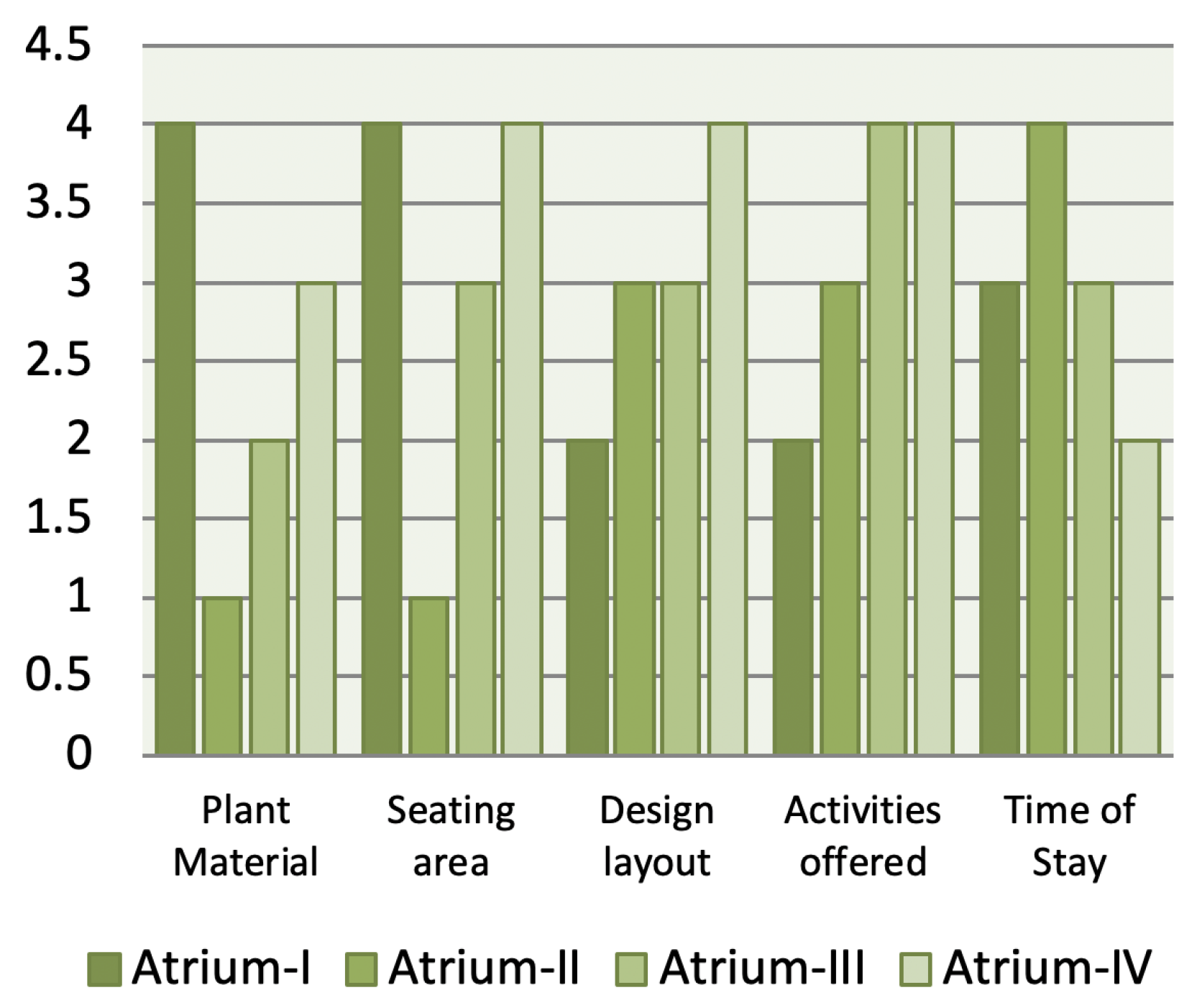
Table 5.
Five Star Rating System for the design elements of each atrium.
| Design Elements | 5 Star (%) | 4 Star (%) | 3 Star (%) | 2 Star (%) | 1 Star (%) | |
|---|---|---|---|---|---|---|
| Atrium I | Aromatic Flowers (Murraya, Lavandula, Gardenia) | 67 | 28 | 3 | 2 | 0 |
| Fixed & movable seating | 75 | 23 | 2 | 0 | 0 | |
| Semi Covered Rest Area | 85 | 10 | 0 | 0 | 5 | |
| Atrium II | Water fountain | 72 | 28 | 0 | 0 | 0 |
| Water curtain | 58 | 12 | 3 | 28 | 2 | |
| Water Dip Therapy | 89 | 11 | 0 | 0 | 0 | |
| Wall mounted waterfall | 69 | 31 | 0 | 0 | 0 | |
| Meandering pathway | 48 | 13 | 0 | 0 | 39 | |
| Atrium III | Semi Covered Rest Area | 95 | 1 | 0 | 0 | 4 |
| Green pathway | 98 | 2 | 0 | 0 | 0 | |
| Raised Flower Bed | 59 | 38 | 3 | 0 | 0 | |
| Seating around pond | 73 | 12 | 11 | 2 | 2 | |
| Steps for exercise | 68 | 27 | 5 | 0 | 0 | |
| Atrium IV | Rest area with green bed | 97 | 0 | 0 | 3 | 0 |
| Small meeting area | 94 | 6 | 0 | 0 | 0 | |
| Movable Furniture | 87 | 9 | 4 | 0 | 0 | |
| Organic shaped pond | 52 | 38 | 6 | 2 | 2 | |
| Sand track | 79 | 13 | 1 | 1 | 6 |
- Provision of more seating area or recliners to have a small nap in the A-II.
- More covered seating area in A-II
- A worship place or chanting of mantras.
- Pets or birds.
- Horticultural Therapy.
- A mini amphitheater for performing arts or to watch on occasion.
- Provision of Physiotherapy.
- More medicinal plants and label their names and benefits.
- Food cart or drinking fountain.
3. Discussion
The data collected suggest that there are several design elements in the landscape which help in creating a restorative environment. The suggestions are drawn from this particular study collaborated with earlier studies in the field of indoor healing gardens in a healthcare facility [33]. The following elements can be used in any healthcare facility to reduce stress and alleviate the mood.
- Bright colours.
- Aromatic Flowers.
- Use of water in different ways.
- Semi-covered rest area.
- Movable and comfortable furniture.
- Freedom of movement.
- Variety of spaces, like private, semi-private and public.
- Incorporating the principles of universal architecture to provide equal benefits to all.
- Materials chosen should not hinder the movement.
- 14 Patterns of Biophilic design, except- Risk, which comes under the `nature of the space’ as patients get scared and are reluctant to such kind of adventure. (Table 4)
- A worship place, meditation place or a space dedicated for group therapies.
- Plant materials should be non-allergic.
- Understanding Physiological, psychological and psychosocial needs of different users.
- Biomorphic forms and patterns.
- Create opportunities to socialize with others.
- Safety and security measures must be taken.
- The garden should be accessible at any time.
- Sufficient light and ventilation in an indoor setting.
- Familiar sculptures or design elements to make them comfortable in a new setting.
- Different rooms fulfilling various user requirements.
- Specifying elements that stimulate five senses.
- Hygiene and quality maintenance is required to contribute good health for patients as well as plants.
4. Conclusion and Future Work
Healing landscape offers an aroma of hope, the warmth of comfort, cool breezes of peace, pebbles of challenges, a waterfall of opportunities, and nature’s sound of encouragement. Together they improve quality of life and promote a healthy well being. This research has outlined landscape design principles for the creation of Indoor Healing Gardens, which have the potential to establish stress-free environments for patients, staff, and visitors alike. These design recommendations are based on the findings of this study, serving as an initial list that can be expanded upon with further research. While this investigation was confined to indoor healing gardens due to existing design limitations, the integration of both indoor and outdoor healing spaces promises even greater benefits and design possibilities. The choice of plant materials will be influenced by the macro and microclimate of each location, ensuring that each healing garden possesses a unique character for the betterment of humanity and the environment. Future research avenues may explore the specific impacts of natural elements on distinct user groups within healthcare settings, including patients, staff, and visitors. By incorporating even minor landscape interventions into hospital architecture, we can significantly contribute to the creation of restorative environments that enhance mental and physical well-being, aligning with the principles of sustainable development.
References
- Ulrich, R.S. View through a window may influence recovery from surgery. Science 1984, 224, 420–421. [Google Scholar] [CrossRef]
- Moore, E.O. A prison environment’s effect on health care service demands. Journal of environmental systems 1981, 11, 17–34. [Google Scholar] [CrossRef]
- Ulrich, R.S.; Simons, R.F.; Losito, B.D.; Fiorito, E.; Miles, M.A.; Zelson, M. Stress recovery during exposure to natural and urban environments. Journal of environmental psychology 1991, 11, 201–230. [Google Scholar] [CrossRef]
- Berto, R. Exposure to restorative environments helps restore attentional capacity. Journal of environmental psychology 2005, 25, 249–259. [Google Scholar] [CrossRef]
- Biederman, I.; Vessel, E.A. Perceptual pleasure and the brain: A novel theory explains why the brain craves information and seeks it through the senses. American scientist 2006, 94, 247–253. [Google Scholar] [CrossRef]
- Taylor, R.P. Reduction of physiological stress using fractal art and architecture. leonardo 2006, 39, 245–251. [Google Scholar] [CrossRef]
- Hägerhäll, C.M.; Laike, T.; Küller, M.; Marcheschi, E.; Boydston, C.; Taylor, R. Human physiological benefits of viewing nature: EEG responses to exact and statistical fractal patterns. Nonlinear Dynamics, Psychology & Life Sciences 2015, 19. [Google Scholar]
- Ivarsson, C.T.; Hagerhall, C.M. The perceived restorativeness of gardens–Assessing the restorativeness of a mixed built and natural scene type. Urban forestry & urban greening 2008, 7, 107–118. [Google Scholar]
- Berman, M.G.; Jonides, J.; Kaplan, S. The cognitive benefits of interacting with nature. Psychological science 2008, 19, 1207–1212. [Google Scholar] [CrossRef]
- Park, S.H.; Mattson, R.H. Effects of flowering and foliage plants in hospital rooms on patients recovering from abdominal surgery. HortTechnology 2008, 18, 563–568. [Google Scholar] [CrossRef]
- Li, Q.; Otsuka, T.; Kobayashi, M.; Wakayama, Y.; Inagaki, H.; Katsumata, M.; Hirata, Y.; Li, Y.; Hirata, K.; Shimizu, T.; others. Acute effects of walking in forest environments on cardiovascular and metabolic parameters. European journal of applied physiology 2011, 111, 2845–2853. [Google Scholar] [CrossRef] [PubMed]
- Matsunaga, K.; Park, B.J.; Kobayashi, H.; Miyazaki, Y. Physiologically relaxing effect of a hospital rooftop forest on older women requiring care. Journal of the American Geriatrics Society 2011, 59, 2162–2163. [Google Scholar] [CrossRef] [PubMed]
- Tyrväinen, L.; Ojala, A.; Korpela, K.; Lanki, T.; Tsunetsugu, Y.; Kagawa, T. The influence of urban green environments on stress relief measures: A field experiment. Journal of environmental psychology 2014, 38, 1–9. [Google Scholar] [CrossRef]
- Guéguen, N.; Stefan, J. “Green altruism” short immersion in natural green environments and helping behavior. Environment and behavior 2016, 48, 324–342. [Google Scholar] [CrossRef]
- Dilani, A. Design & health: The therapeutic benefits of design; Svensk byggtjänst, 2001.
- Diette, G.B.; Lechtzin, N.; Haponik, E.; Devrotes, A.; Rubin, H.R. Distraction therapy with nature sights and sounds reduces pain during flexible bronchoscopy: A complementary approach to routine analgesia. Chest 2003, 123, 941–948. [Google Scholar] [CrossRef] [PubMed]
- Cohen, U.; Weisman, G.D. Holding on to home: Designing environments for people with dementia. (No Title) 1991.
- Kellert, S.R. Building for life: Designing and understanding the human-nature connection. Renewable Resources Journal 2006, 24, 8. [Google Scholar]
- Kaplan, R.; Kaplan, S. The experience of nature: A psychological perspective; Cambridge university press, 1989.
- Ulrich, R.; Gilpin, L. Healing arts. Nursing 1999, 4, 128–133. [Google Scholar]
- Stark, A. Innovation in the Design of the ICU. Minnesota Physician 2004, pp. 32–36.
- Hastuti, A.S.O.; Lorica, J. The Effect of Healing Garden to Improve the Patients Healing: An Integrative Literature Review. Journal of Health and Caring Sciences 2020, 2, 34–47. [Google Scholar] [CrossRef]
- Marcus, C.C.; Barnes, M. Gardens in healthcare facilities: Uses, therapeutic benefits, and design recommendations; Center for Health Design Martinez, CA, 1995.
- Miller, W.L.; Crabtree, B.F. Healing landscapes: patients, relationships, and creating optimal healing places. Journal of Alternative & Complementary Medicine 2005, 11, s–41. [Google Scholar]
- Pouya, S.; Demirel, Ö. What is a healing garden? Akdeniz University Journal of the Faculty of Agriculture 2015, 28, 5–10. [Google Scholar]
- Simson, S.; Straus, M. Horticulture as therapy: Principles and practice; CRC Press, 1997.
- Stigsdotter, U.; Grahn, P. What makes a garden a healing garden. Journal of therapeutic Horticulture 2002, 13, 60–69. [Google Scholar]
- Ulrich, R.S. Health benefits of gardens in hospitals. Paper for conference, Plants for People International Exhibition Floriade, 2002, Vol. 17, p. 2010.
- Brown, T.; McLafferty, S.; Moon, G.; others. A companion to health and medical geography; Wiley Online Library, 2010.
- Marcus, C.C.; Barnes, M. Healing gardens: Therapeutic benefits and design recommendations; Vol. 4, John Wiley & Sons, 1999.
- Hashemin, S.A.; Kazemi, A.; Bemanian, M. Examining the Influence of Healing Garden on Mental Health of the Patients by Emphasizing Stress Reduction. Journal of Environmental Science and Technology 2020, 21, 263–276. [Google Scholar]
- Ryan, C.O.; Browning, W.D.; Clancy, J.O.; Andrews, S.L.; Kallianpurkar, N.B. Biophilic design patterns: emerging nature-based parameters for health and well-being in the built environment. ArchNet-IJAR: International Journal of Architectural Research 2014, 8, 62. [Google Scholar] [CrossRef]
- Paraskevopoulou, A.T.; Kamperi, E. Design of hospital healing gardens linked to pre-or post-occupancy research findings. Frontiers of Architectural Research 2018, 7, 395–414. [Google Scholar] [CrossRef]
Figure 1.
Spiral Water Channel (Source: Author)
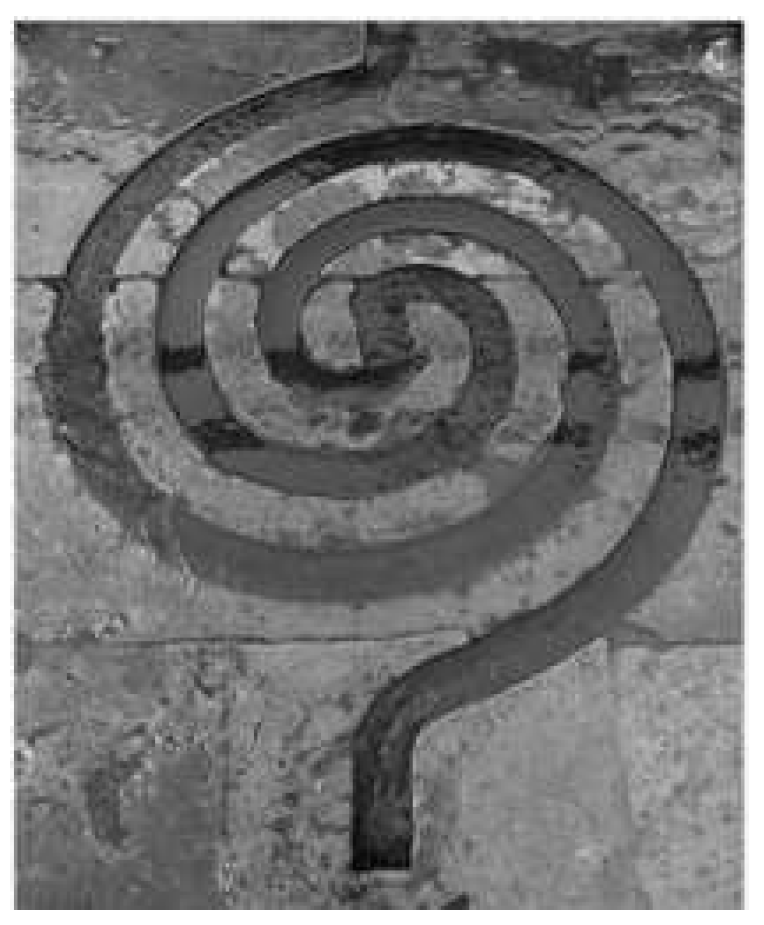
Table 2.
Data recorded from the questionnaire.
| Questions | Preference- A | Preference- B | Preference- C | Preference- D |
|---|---|---|---|---|
| How do you feel when you spend time I a garden? |
Calmer,more relaxed, less stressed | Better, more positive | Refreshed,Stronger | No change |
| 47% | 78% | 22% | 3% | |
| What activity do you prefer in a garden? |
To walk or exercise | To meditate | To sleep | To eat |
| 50% | 32% | 12% | 6% | |
| What element do you like the most in a garden? |
Flowers, Plants | Water Fountain | Comfortable seating | Birds and animals |
| 49% | 23% | 15% | 13% | |
| What’s the thing that bother you most here? |
No movement, need to be on bed | Can’t Socialize | Smell | Nothing |
| 60% | 25% | 12% | 6% | |
| If asked to spend some time in garden would you like to come out? |
Yes | Doesn’t Matter | No | |
| 82% | 13% | 5% | 13% | |
| What time should the garden be accessible? | Every time | Morning | Evening | Night |
| 75% | 14% | 8% | 3% | |
| Do you feel stressed out when you need to visit again for check ups? |
Yes | Sometimes | No | |
| 56% | 35% | 9% | ||
| What kind of furniture would you prefer? | Movable | Fixed | Doesn’t matter | |
| 60% | 36% | 3% | ||
| What kind of colors would you prefer? | Bright | Light | Doesn’t matter | |
| 73% | 23% | 3% | ||
| Would you prefer a Garden view from your window? |
Yes | Doesn’t Matter | No | |
| 92% | 8% |
Table 3.
Effects of different sounds of water.
| Type of sound | Effect on human mood |
|---|---|
| Ocean Waves | Positive, Restorative |
| Waterfall | Calming, Relaxing, Helps In Sleep |
| Rainfall | Exciting, Generation Of Thoughts |
Disclaimer/Publisher’s Note: The statements, opinions and data contained in all publications are solely those of the individual author(s) and contributor(s) and not of MDPI and/or the editor(s). MDPI and/or the editor(s) disclaim responsibility for any injury to people or property resulting from any ideas, methods, instructions or products referred to in the content. |
© 2023 by the authors. Licensee MDPI, Basel, Switzerland. This article is an open access article distributed under the terms and conditions of the Creative Commons Attribution (CC BY) license (http://creativecommons.org/licenses/by/4.0/).
Copyright: This open access article is published under a Creative Commons CC BY 4.0 license, which permit the free download, distribution, and reuse, provided that the author and preprint are cited in any reuse.


