
Submitted:
23 October 2024
Posted:
24 October 2024
You are already at the latest version
Abstract
In many conurbations, the pressure on the quality of living increases and affects the most vulnerable, human, and non-human populations the most. In this article we describe a mapping and designing investigation how a green metropolis can be developed. The approach used is to make a distinction between the landscape pain, the ways of healing and the opportunities to create environments that people can love. We found that this approach reveals concrete and widespread pain in the metropolis, such as interventions in natural landscapes (rivers and mountains), air pollution, ecological degradation, and hydrological disconnections. The strategy to heal this pain is to uncover the currently hidden and invisible creeks and rivers, then create an abundant zone of ecological space around it before integrating human activities and urban uses. In addition to this, specific design principles have been developed for hydro-ecological corridors, water retention, green islands, and greenways. These places can be replicated to support the healing strategy. These places create an environment that the urban residents love. The analysis of landscape pain, the healing strategies, and the local places to love, can be applied to enhance the quality of life for many urban residents and non-human ecologies in metropolitan areas around the globe.
Keywords:
metropolis
; Monterrey
; landscape pain
; regional scale
; urban planning
; green
; pain-heal-love
1. Introduction
With more people living in cities than ever before, since 2014 more than half [1], and rising to 68% by 2050 [2], it is paramount to create healthy, clean, and livable living conditions for the urban residents. Many cities experiment with green infrastructure [3,4,5,6,7,8], urban ecology [9,10,11], and climate adaptive policies and plans [12,13,14,15], but even so many have trouble finding the right and impactful solutions to transform cities from its industrial variants into a symbiotic urban future [16,17,18,19].
In this article we aim to overcome the fragmentation of widespread sole and separated solutions in silos such as biodiversity, water sensitivity, green infrastructure, or urban forestry. Many of the related initiatives operate often on a too small scale to have an profound impact, and should be interconnected and planned at the large scale of the metropolis itself. We propose an analytical, and strategic approach, supported by greener spaces at the local scale.
2. Background
In 2020 there are 1934 metropolises with more than 300,000 inhabitants representing approximately 60% of the world’s urban population [20]. According to the Oxford dictionary and Collins English dictionary a metropolis is “a large city or conurbation which is a significant economic, political, and cultural area for a country or region, and an important hub for regional or international connections, commerce, and communications” [21,22].
For many years the largest conurbations were the metropolises, however in recent years megacities, or megalopolises emerged throughout the world. A megalopolis, following the work of Gottmann, refers to two or more roughly adjacent metropolitan areas that, through a commonality of systems—e.g., of transport, economy, resources, and ecologies—experience a blurring of the boundaries between the population centers [23], such that while some degree of separation may remain, their perception as a continuous urban area is of value, e.g., "to coordinate policy at this expanded scale" [24]. Simply put, a megalopolis is a clustered network of big cities. Gottmann defined its population as 25 million [25], while Doxiadis defined a small megalopolis a similar cluster with a population of about 10 million [26,27]. Although some claim that more condensed and large metropolises are greener [28], opposing urban sprawl, it is a limited scope to oil-dependent mobility mainly. The argument it creates may support sustainability (e.g. reduced carbon emissions), it does not necessarily create a greener, natural, or more biophilic city, offering residents to connect with nature in a meaningful way [29]. Despite the fact there are significant efforts to green cities and metropolises [30,31,32,33,34], larger cities tend to be less green, in terms of GHG emissions, in comparison with smaller cities and towns [35]. The number and area of green spaces is more related to climate, demography, and social-economic conditions than the size per se with large cities in high income countries have more adequate green provision than those in less privileged circumstances [36].
We live in perilous times [37], as changes in climate move ever faster and become more unpredictable and potentially more impactful. Cities are seen both as the cause and the possible solution to reducing the harmful greenhouses gases that are causing global temperatures to rise [38].
Generally, biodiversity is impacted by human (urban) activities. This is happening in a direct way through habitat loss, fragmentation, and the introduction of new species, but also in an indirect way as humans tend to change climate, the hydrological networks, the soil, and chemical conditions of the environment [39]. Apart from the number of people living in urban centers [2], approximately 50% of the global GDP depends on biodiversity [40]. Therefore, cities deserve to be reimagined as enhancing biodiversity and all its attached benefits, instead of accepting that urban areas are destructive to it. Metropolises can reduce its vulnerability for climate change, improve human health and well-being, and enhance a sustainable, regenerative development [41,42].
Apart from the pressure on biodiversity and natural habitats, cities and metropolises also use considerably more resources [43,44]. Urban areas, despite covering only around 3% of the Earth's land surface, are responsible for approximately 75% of the world's natural resource usage [45]. The concentration of industrial production and population in cities leads to a significant demand for resources like water, food, and energy [45]. Studies reveal that cities exhibit high tendencies of consumer-like behavior due to the concentration of tertiary sectors within urban areas, leading to high resource utilization but low output [46].
Furthermore, metropolises and urbanized areas have a significant impact on human health [47]. For example, the emissions of all kinds of particles and gases into the air leads to higher levels of air pollution [48,49,50,51], but it also causes high levels of heavy metals in road dust [52,53,54], which end up in the human body via the intake of leafy vegetables and other food [55,56] or via ground and drinking water [57,58,59]. The urban fabric also has impact on the physical health of people [60,61,62,63], for instance through the options for exercise in green spaces [64,65], accessibility of parks and green spaces [66,67,68] or the lack of abundance of infrastructure that stimulates active transport [69,70,71]. The mental health implications of living in an urban context are also clear [72,73,74,75]. As an example, the risk at ADHD is increasing for people living in urban contested environments as opposed to people living in a natural environment [76]. At the same time, children with ADHD function better in nature than in built environments [77], while pollution and a lack of green spaces are risk factors for ADHD, as children living in greener and less polluted areas have a 50% lower risk of developing the disorder [78]. In short, more trees mean less ADHD [79].
Reduced biodiversity, the use of more than reasonable amounts of resources and the degradation of human health which all take place or are caused by our urban lifestyles, the construction of vast areas of built-up areas and an ever-increasing consumption pattern, directly or indirectly exacerbate problems in large conurbations. Some of the most pressing are related to environmental threats such as climate change, scarcity of resources, social inequality and slums, exclusion of disadvantages people from technology, and ill-working governance models [80].
In this sense, the human activities, of which most occur in cities, increase emissions of Greenhouse Gases (GHG) in the atmosphere, the main cause of climate change. Roughly half of these are caused by combustion of fossil fuels to generate electricity and heat (or cooling), industrial activities and transport. This affects urban environments and the humans living there, the most [81]. As a result of the fast-growing populations in cities, metropolises, and megalopolises these areas are the most vulnerable for climate change impacts, and at the same time are a major factor in causing it. Rising temperatures and the increase of hard surfaces in cities leads to accelerated amounts of areas that suffer from urban heat island effects, which are responsible for 4% of summer related deaths [82]. In Europe alone providing 30% of green cover could prevent up to 2,664 premature deaths [82].
People that suffer most from these heating conditions and the occasional climate disasters, such as floods or hurricanes, are often the most vulnerable and not the ones that are mostly responsible for causing climate change [83]. And with more than 50% of its residents in some cities live without regular income in disadvantaged communities, problems such as security and social disparity exaggerate [84] as is their vulnerability for unprecedented climate impacts. And analyses show that this is not easy to alter: the number of homeless people (in 2017 roughly 2% of global population and 20% without adequate housing) is said to proportionally increase with progressing urbanization, and this is mainly caused by social injustice in cities [85]. The poor are relegated to neighborhoods with poor infrastructure and limited access to services, mentally far away from the enclaves for the rich and wealthy. This unequal use (and production) of urban space causes socio-economic and health disparities, including mental illnesses, political exclusion, and territorial stigmatization [86]. This exacerbates their vulnerability for climate impacts caused by others.
With more people living in metropolises and megalopolises, the conclusion can be drawn that in a time of accelerating climate change [87], biodiversity is under pressure, too many resources are used, and human health is at stake, and these problems have the highest impact on the most vulnerable inhabitants. Cities have become places where the privileged are closest to nature, can use the resources they want, have the easiest access to health care and can escape from floods and heat islands as they wish. As urban residents experience their environment in an integrated way [88,89,90], a holistic effort is needed to reduce the impacts of biodiversity loss, climate change and resource depletion, while improving human health and social equity. In this article we offer a methodological approach, which is illustrated using the Monterrey Metropolitan Area in the northern part of Mexico.
3. Materials and Methods
3.1. Monterrey Metropolitan Area (MMA)
The area of study is the region of Monterrey (Figure 1), the second largest city of Mexico, located in the northeast of the country. The metropolis marks the transition of the Sierra Madre Oriental in the west-southwest to the northeastern arid plain of Tamaulipas. The region is the southernmost part of the watershed of the Rio Grande (or Rio Bravo), eventually flowing in the Gulf of Mexico. The city is built in a valley surrounded by the mountains and isolated mountainous hills. This topographical condition causes high temperatures in summer, easily above 40ºC, and many days with one of the worst air qualities on earth. In 2020, the metropolis was inhabited by a little more than 5.3 million people, divided over 15 municipalities [91]. The total area considered is roughly 70x70km.
3.2. Methods
For this research we have used a mixed methods approach. The different parts and steps are reflected in Figure 2.
Firstly, for the identification of the main current problems in the region an extensive internet search has been undertaken, using a range of sites such as google scholar, science direct, JSTOR, and web of science. In total over 400 articles have been scanned and of these a selection of the most relevant (their spatial scale, typical problems) articles have been used to the analysis (in Section 2).
Secondly, the existing conditions in the region have been mapped using a range of available sources (Table 1). The following themes and topics were part of this spatial investigation: water systems, elevation, ecology, landscape, soil and geology, amount of green space, urban growth, densities, climate impacts.
Thirdly, to not only depend on technical mapped information of the region, but we also sought more emotional-psychological ways to describe the current problems as experienced by the population living in the Anthropocene [107,108]. Therefore, we used the work of Glenn Albrecht, who developed a new vocabulary to give words to these feelings [109,110,111,112,113]. Based on these the main vocabulary has been ordered according to their role in describing the experience; whether they describe current pain, ways to heal that pain, or regenerate love and affection for a future environment.
Fourthly, a second mapping exercise was undertaken to identify the elements of pain in the region. The elements that people experience as painful, such as infrastructural barriers, extra-large buildings, impaired mountains and natural reserves, air pollution and disrupted waterways. The maps and the used sources are summarized in Table 2.
Fifthly, we inquired the municipal policies and ambitions. 15 municipal and State policy plans have been analyzed, and all written policy objectives and spatial strategies were assessed and categorized to belong to pain, heal or love. Additionally, 11 in-depth interviews were conducted with strategic employees in these organizations (directors, heads of planning department, chairmen1. After explaining the findings of the landscape pain mapping exercise, the interviewees were asked which spatial strategies for healing and loving they would emphasize and asked them to draw these on a regional map.
Sixth, the design phase of the research consisted of two parts. In the first part several design workshops have been held with the research team and client to develop a range of future scenarios for the metropolitan development. These were focused on the development of healing strategies. In the end four of these were selected as being distinct enough to discuss the desired green metropolis. The development of a regional spatial strategy how to grow into a greener metropolis was also part of these workshops and had the objective to identify the process of green urban development. The second part focused on creating design principles that visualize urban environments which residents could embrace, affectionate and love. These design principles have been created in different ways and for several typical spaces in the metropolis. Several design principles were subject of design workshops with the research team, others have emerged out of the work of four Master theses by students Landscape Architecture in Delft University of Technology, and some have been created by students of the Master of Architecture and Urban Design at Tecnológico de Monterrey. Some of the typical spaces are hydrological corridors, green streets, urban forests, urban gardens, rivers and creeks, retention basins, sub-metro greenways, avenues, green islands (transformation of large parking areas), and green roofs on industrial sites. For each of these one or more visualizations have been designed.
4. Results
4.1. Urban Problems Hit Disadvantaged Human and Natural Communities the Most
The literature review (Section 2) revealed our current conurbations, in which a growing number of people is living causes or exaggerates problems that are crucial for our survival. The resource depletion, biodiversity loss, and being a motor of climate change and its impacts, has severe consequences for human health, physically and mentally. In these conurbations the most disadvantaged people, who have, in majority, not caused these problems suffer the most from it.
4.2. Discrepancy Between the Natural Qualities and Urban Impacts
The existing conditions of the Monterrey Metropolis are formed by its natural landscape of mountains, forests, creeks, and rivers, and rapidly degenerating due to urban growth, industrial and human impacts, and climate change. This led to a city that is stuck in its economic paradigm, of growth and inevitably more pollution and pressure on the natural landscape. The maps of the ecology, water system, forestry, geology, and soil illustrate the natural interdependencies of ecology, water, air, and soil. On the other hand, the maps of urban and human induced aspects show a darker side: urban heat islands, air pollution, social inequal accessibility of green, and deficit of green space dominate the existing city [119].
4.3. Need for Making a Distinction Between the Pain, Its Healing, and the Desired Love
To systematically create regenerative urban futures, understanding of causes and possible solutions is not enough. This research revealed that emotional attachment to certain activities, images and uses of the urban realm represent a deeper, more confronting and exciting impression of the city than simple land-use and mobility patterns can. Earth emotions [112] (Table 3) can be subdivided in three categories.
- Pain - The emotions that are painful (visual, emotional, physical, health) highlight all elements that people might experience as unpleasant, hurting.
- Heal – These emotions can help to compensate for the pain, solving the painful elements to a healthy, neutral state. For instance, by building with nature, the negative impact of painful activities and urban uses can be healed.
- Love – actions that not only solve the painful elements (heal) but transform them in a way that people can embrace them, develop affection, and love their environments again.
Every emotion is caused by concrete urban spaces, uses or activities. By categorizing them, each set of urban actions is mapped for the Monterrey Metropolitan area.
4.4. Landscape Pain Is Widespread
The analysis of all pain in the metropolitan region is represented on a series of maps. The following topics have been identified as being painful:
- Quarries and housing in nature reserves. In the Metropolitan Area of Monterrey (MMA), 1289 ha. of excavations (quarries) are found in mountainous slopes. In addition, 29,928 constructions (houses, buildings) are in or on the slopes of mountains and hills. Of these, 3497 are in Natural Protected Areas [119].
- Green spaces. There is a lack of access to green spaces and limited amount of green space per person. In the entire Metropolitan Area, including the urban fringes and agricultural land, there is 22.2 m2 of green space per inhabitant [119]. However, these green spaces are not equitably accessible to all inhabitants, and the indicator is not representative of a green city compared to the 51 m2 per capita in Barcelona [96]. At the same time, it is advised to have a minimum of 9.5 m2 of green space per inhabitant [120]. Although this indicator is outdated and is an average while urban areas are composed of very different densities, functionalities, and activities, it still gives an indication how well cities do. When parks and green spaces in the urban precincts of the Monterrey Metropolitan Area are calculated, there is only a mere 4 m2 of green space per capita.
Furthermore, applying the 3-30-300 rule [121], the advised 30% of tree cover is only met in 50% of the Monterrey Metropolitan Area [119], and only 43% of the population has access to a green public space within 300m [119], or within a five-minute walk [122]. For vulnerable groups such as children (25%) and elderly (40%), this accessibility is even lower [119]. This unbalanced distribution of green spaces over the different neighborhoods in the city leads to the most vulnerable urban population to live in the hottest conditions, suffering from urban heat [123]. In Monterrey, approximately 40% of the population that faces a medium or high social gap [98] has access to a public green space [119].
- Main roads (over six lanes) and surface parking. In the MMA 670 km of highways over six lanes are found and over 996 ha. for parking, which is two thirds of the space allocated for public parks. The emissions caused by the cars using this infrastructure is estimated at 7,764,568 tons of CO2/year. This car-infrastructure has profound impacts on human health through air pollution, soil degradation and a general decline of quality of life [124,125,126].
- Large or extra-large sized buildings. In the MMA a total of 972 buildings over 10,000m2 (XL) and another 7628 between 2500 and 10,000m2 (L) are found [119]. These buildings, mainly logistics and industrial, have no or a large deficit of green spaces on and around them. It causes large, uncovered surfaces, which are a main cause of the urban heat island effect [127,128].
- Abandoned rail tracks and public transport elevated above ground (metro system). The 411 kms of rail tracks provide a noise problem, as many of these lines generate levels of 80-100dB [129] and 19.3 kms of elevated metro lines signify spatial problems in the form of exaggerating barriers between neighborhoods and rivers and green spaces, creating problematic underpasses and reduce the views on the surrounding mountainous landscape.
- Polluting industries such as the Pemex-refinery emit the majority of PM10 and PM2.5 particles, causing adverse effects on human health including life-threatening diseases [130]. It is estimated that, in 2021, 1684 deaths were directly related to air pollution.
Apart from the visual effects, landscape pain (Figure 3) shows a strong correlation between places where large concentrations of oversized buildings are found, the lack of green cover, the urban heat islands, and air pollution. Its serious impact on air quality and urban heat has severe negative effects for human and ecological health.
Additionally, hydrological pain has been identified. Sprawl and uncontrolled urban growth have led to natural waterways that have been obstructed by 17,003 constructions (Figure 4). These are houses, other buildings, streets and roads, or simply unknown obstacles, through which the water disappears or cannot flow naturally. Not coincidentally, this causes local urban floods, and is also related to the concentrations of urban heat in the MMA. Because of this, water quality and regulation of the hydrological cycle is disturbed, negatively impacting natural ecosystems [131].
4.5. Governmental Policies Focus on Pain and Heal
The analysis of governmental policies show that most measures, objectives, and plans focus on identifying the current pain (35 policies) or objectives related to healing (25 policies). The attention for creating a future environment that people will be able to embrace, or love is represented by only two policies [119].
During the interviews undertaken with strategic planners, directors and advisors in municipal planning agencies or community organizations revealed that there is a strong preference for strategies that enhance the health, beauty, and ecological quality of the city. On the map that the interviewees sketched a range of proposals were suggested. The main aspects that were mentioned is the continuation of green and blue systems (rivers and creeks, green spaces, ecological networks), reforestation and large-scale green projects, such as planning a greenbelt, and integrating green, ecological networks, and waterways in the different neighborhoods, streets, and squares.
4.6. Ways to Heal
Once the landscape and hydrological pains are distinguished, strategies can be developed to heal these conditions. Two different strategies are found to be helpful, a process approach (Figure 5) and a scenario-based regional design (Figure 6).
The first strategy aims to highlight the spatial priorities, or, in other words, which elements of the planning process are considered first, and which ones later. This approach is based in the so-called landscape first theory [132,133,134,135,136,137,138], which emphasizes to use the understanding of the natural landscape conditions first, before implementing other, non-human or urban entities. For the Monterrey Metropolitan Area this means uncovering and reconnecting the waterways, creeks, and rivers throughout the region, providing each of them with an abundant zone for green, ecology and water retention, after which the spaces remain where urban activities can find a place (Figure 5). This way the network is reestablished which serves the mitigation of urban heat, improves humidity and the air quality, and provides an environment in which both humans and non-humans thrive and are healthy.
The second strategy is explorative through design. For this scenario planning [140,141,142,143] is used to design four explorative possible visions for the regional future. This way distinct and coherent storylines are explored. We mention here only two of these: The BAU-scneario and the ReConquer the City-scenario (Figure 6). In the first scenario the city grows uncontrolled and reaches a population of up to 10 million, meanwhile occupying large parts of the natural landscape. Within this sprawl, small batches of green spaces are incorporated as parks, and sports facilities. The second scenario limits the boundaries of the Metropolitan Area by creating a wide green belt [144], at the same time green cover takes back space from the urban by covering roofs, roads, and the abundant bio-ecological network. The basis for this scenario lies in the natural landscape with its waterways, hills, and mountains.
The scenarios are explicitly not meant to make choices or decisions but illustrate the potential futures under certain conditions.
It may be concluded that the combination of the process approach and the explorative scenarios, lead to a future for the region that is based in the landscape, and celebrates the green-blue corridors and networks.
4.7. Ways to Love
Once the strategies to heal the landscape pain are discovered, concrete interventions can be designed that support this regional strategy. These are design principles for hydro-ecological corridors, water retention, green islands, and green ways. Each of these can be replicated in many similar conditions and are designed to present residents an environment they can embrace and love, but foremost that brings a healthy and pleasant environment close.
The hydro-ecological corridors (Figure 7) integrate nature into the city, renaturalizing the watersheds [126], and reducing temperatures in the MMA.
Water retention spaces (Figure 8) are designed to recharge the aquifer by infiltration and absorption in the soil meanwhile reducing flood risk and improving the natural habitats. These are crucial to keep the runoff water, store it and release slowly.
Green islands (Figure 9) are integrated in neighborhoods through green roofs and facades. The use of these novel green spaces can be very functional, such as for the growth of food. Additionally, these green spaces reduce the impermeable surface, regulates temperature hence minimizing urban heat, and captures excess rainwater.
Finally, greenways (Figure 10) can reform current rail tracks, elevated metro lines and six lane-roads. The greening of these spaces allows pedestrian a safe crossing, regulates the local water system, preventing droughts and floods, and enhances biodiversity.
These four design principles can be used to implement in similar situations throughout the MMA. It provides attractive environments for the residents and creates a better living condition for humans and non-humans alike.
5. Discussion
In many cities, national policies, and overarching organizations such as UN Habitat [146] and the WEF [147], a pledge is made for naturalizing the urban environment, in the form of tree-planting programs [148], sponge cities [149], urban rewilding [150] and many more. Most of these emphasize the need to counteract an economic driven urban development, industrially and commercially created precincts, without a lot of attention to the quality of life, lives, and nature. In many ways, we might not have a good answer to tan ever progressing urbanity. And the question is in which direction we need to search for answers?
- Is it spatially precise in determining a nature-beneficial land-use [158]?
Undoubtedly, each of these perspectives have their own merit and most likely deserve to be investigated separately. However, designing a true green metropolis needs to go beyond one or a couple of these perspectives. It needs to connect spatial scales and recognize the relevant socio-ecological views.
6. Conclusions
The ways landscape pain is felt differs for each viewpoint, and healing will be adequate at different scales. An inherent deeply felt love for the environment can only be embraced when philosophical, religious, indigenous, and political are aligned and concretized at the (hyper)local scale.
This requires a staggered strategy, in which the landscape pain is understood at the regional, watershed scale, identifying healing opportunities by designing spatial strategies that are based in the natural landscape. This implies the natural systems in the region are prioritized over human made systems. Current spatial planning and urban design is often too fragmented by the development of individual projects on a plot-by-plot basis, to halt urbanization and reconnect water- and ecological systems throughout urban metropolises. To achieve this, structural programs for upscaling the design principles throughout the region need to be implemented, which need to be executed at the above-municipal scale.
Mapping and understanding the regional landscape pain first, after which healing strategies at regional level can be created and translated in concrete design principles which make the urban environment be loved by its residents is a novel approach that can shine a light on a green metropolitan future.
Author Contributions
Conceptualization, R.R.; methodology, R.R.; software, M.R.; validation, R.R., and R.J.; formal analysis, R.J., P.R., M.R., and M.O.; investigation, R.R., R.J., P.R., M.R., and M.O.; resources, R.R.; data curation, P.R., M.R. and M.O.; writing—original draft preparation, R.R.; writing—review and editing, R.R.; visualization, R.J., P.R., M.R., and M.O.; supervision, R.R.; project administration, R.J.; funding acquisition, R.R. All authors have read and agreed to the published version of the manuscript.
Funding
This research was funded by the Fondo Ambiental Metropolitano de Monterrey (FAMM).
Acknowledgments
The authors would cordially acknowledge the permanent support of Alfonso Garza Garza, Cesar Chavez and Sergio Rodriguez for their suggestions and comments throughout the research project.
Conflicts of Interest
The authors declare no conflicts of interest.
| 1 | Secretariat of Territorial and Economic Competitiveness and the Directorate of Environment of Guadalupe, Institute of Urban Planning and Management of San Pedro Garza García (IMPLANG), San Pedro Parques, Chipinque Ecological Park Association, Clab North Region of Tecnológico de Monterrey, Directorate of Green Development of the Municipality of Monterrey, Subsecretariat of Territorial Planning and Public Space Nuevo León Council for Strategic Planning, Monterrey Region Urbanism Society, Citizen Observatory for Air Quality of the Monterrey Metropolitan Area, and the Water Center of Tecnológico de Monterrey. |
References
- United Nations, Department of Economic and Social Affairs, Population Division (2015). World Urbanization Prospects: The 2014 Revision, (ST/ESA/SER.A/366).
- United Nations, Department of Economic and Social Affairs, Population Division (2019). World Urbanization Prospects: The 2018 Revision (ST/ESA/SER.A/420). New York: United Nations.
- Ashinze, U.K. , Edeigba, B.A., Umoh, A.A., Biu, P.W., Daraojimba, A.I. Urban green infrastructure and its role in sustainable cities: A comprehensive review. World Journal of Advanced Research and Reviews 2024, 21, 928–936. [Google Scholar] [CrossRef]
- Hanna, E.; Comín, F.A. Urban Green Infrastructure and Sustainable Development: A Review. Sustainability 2021, 13, 11498. [Google Scholar] [CrossRef]
- Ahern, J. Green infrastructure for cities: The spatial dimension. In Cities of the Future Towards Integrated Sustainable Water and Landscape Management. Novotny, V., Brown, P., Eds.; IWA Publishing: London, UK, 2007.
- Ramyar, R.; Ackerman, A.; Johnston, D.M. Adapting cities for climate change through urban green infrastructure planning. Cities 2021, 117, 103316. [Google Scholar] [CrossRef]
- Grabowski, Z.J.; McPhearson, T.; Matsler, A.M.; Groffman, P.; Pickett, S.T. What is green infrastructure? A study of definitions in US city planning. Frontiers in Ecology and the Environment 2022, 20, 152–160. [Google Scholar] [CrossRef]
- Singh, A.K.; Singh, H.; Singh, J.S. Green infrastructure of cities: An overview. Proceedings of the Indian National Science Academy 2020, 86, 1–14. [Google Scholar] [CrossRef]
- Russo, A.; Cirella, G.T. Urban sustainability: integrating ecology in city design and planning. Sustainable human–nature relations: Environmental scholarship, economic evaluation, urban strategies 2020, 187-204.
- Van Zyl, B.; Cilliers, E.J.; Lategan, L.G.; Cilliers, S.S. Closing the gap between urban planning and urban ecology: A South African perspective. Urban Planning 2021, 6, 122–134. [Google Scholar] [CrossRef]
- Verma, P.; Singh, R.; Singh, P.; Raghubanshi, A.S. Urban ecology–current state of research and concepts. In Urban ecology; Verma, P., Singh, R., Singh, P., Raghubanshi, A.S., Eds.; Elsevier: Amsterdam, the Netherlands, 2020; pp. 3–16. [Google Scholar] [CrossRef]
- Aboagye, P.D.; Sharifi, A. Urban climate adaptation and mitigation action plans: A critical review. Renewable and Sustainable Energy Reviews 2024, 189, 113886. [Google Scholar] [CrossRef]
- Araos, M.; Berrang-Ford, L.; Ford, J.D.; Austin, S.E.; Biesbroek, R.; Lesnikowski, A. Climate change adaptation planning in large cities: A systematic global assessment. Environmental Science & Policy 2016, 66, 375–382. [Google Scholar]
- Sturiale, L.; Scuderi, A. The role of green infrastructures in urban planning for climate change adaptation. Climate 2019, 7, 119. [Google Scholar] [CrossRef]
- Luo, X.; Yu, C.W.; Zhou, D.; Gu, Z. Challenges and adaptation to urban climate change in China: a viewpoint of urban climate and urban planning. Indoor and Built Environment 2019, 28, 1157–1161. [Google Scholar] [CrossRef]
- Mulder, K. Urban symbiosis as a strategy for sustainabilising cities: An overview of options and their potential, pitfalls and solutions. Civil Engineering Research Journal 2017, 2, 1–7. [Google Scholar] [CrossRef]
- Horn, E.; Proksch, G. Symbiotic and regenerative sustainability frameworks: moving towards circular city implementation. Frontiers in Built Environment 2022, 7, 780478. [Google Scholar] [CrossRef]
- Karpouzou, P. Symbiotic Citizenship in Posthuman Urban Ecosystems: Smart Biocities in Speculative Fiction. Symbiotic Posthumanist Ecologies in Western Literature, Philosophy and Art 2016, 9, 99. [Google Scholar]
- Pasini, R. The Symbiotic Field. Landscape Paradigms and Post-Urban Spaces. The Urban Book Series, Springer: Cham, Switzerland, 2017.
- UN Habitat Global State of Metropolis 2020_ Population Data Booklet. UN Habitat: Nairobi, Kenia, 2020. Available online: https://unhabitat.org/sites/default/files/2020/09/gsm-population-data-booklet-2020_3.pdf (accessed on 6 October 2024).
- Oxford dictionaries. Available online: https://web.archive.org/web/20160307093630/http://www.oxforddictionaries.com/definition/english/metropolis?q=Metropolis (accessed on 8 October 2024).
- Collins dictionary. Available online: https://www.collinsdictionary.com/dictionary/english/metropolis (accessed on 8 October 2024).
- Gottman, J. Megalopolis: The Urbanized Northeast Seaboard of the United States. MIT Press: Cambridge, US, 1961.
- Hagler, Y. Defining US megaregions. America 2050, 2009. Available online: https://s3.us-east-1.amazonaws.com/rpa-org/pdfs/2050-Paper-Defining-US-Megaregions.pdf (accessed on 6 October 2024).
- Gottmann, J. Since Megalopolis. The Urban Writings of Jean Gottmann. The Johns Hopkins University Press, Baltimore, US and London UK, 1989, pp. 163.
- Doxiadis, C.A. The emerging Great Lakes Megalopolis. Ekistics and The New Habitat 2005, 72(430-435), 167–168. [CrossRef]
- Florida, R. Who's Your City? How the Creative Economy Is Making Where to Live the Most Important Decision of Your Life. Basic books: New York, US, 2009.
- Owen, D. Green Metropolis: Why Living Smaller, Living Closer, and Driving Less Are the Keys to Sustainability. Riverhead books: New York, US, 2009.
- Beatley, T. (2010) Green Metropolis. A new book argues that Manhattan is the greenest city in the United States. Places Journal.[online], 2010. Available online: https://placesjournal.org/article/green-metropolis/?cn-reloaded=1 (accessed on 6 October 2024). [CrossRef]
- De Vries, W.T. Urban greening for new capital cities. A meta review. Frontiers in Sustainable Cities 2021, 3, 670807. [Google Scholar] [CrossRef]
- Esmail, B.A.; Cortinovis, C.; Suleiman, L.; Albert, C.; Geneletti, D.; Mörtberg, U. Greening cities through urban planning: A literature review on the uptake of concepts and methods in Stockholm Urban Forestry & Urban Greening 2022, 72, 127584.
- McGrath, B.; Pickett, S.T. The metacity: A conceptual framework for integrating ecology and urban design. Challenges 2011, 2, 55–72. [Google Scholar] [CrossRef]
- Platt, R.H. Regreening the metropolis: pathways to more ecological cities. Annals of the New York Academy of Sciences 2004, 1023, 49–61. [Google Scholar] [CrossRef] [PubMed]
- Yao, L. Assessment of long time-series greening signatures across the urban–rural gradient in Chinese cities. Ecological Indicators 2024, 160, 111826. [Google Scholar] [CrossRef]
- Oliveira, E.A.; Andrade Jr, J.S.; Makse, H.A. Large cities are less green. Scientific reports 2014, 4, 4235. [Google Scholar] [CrossRef]
- Han, Y.; He, J.; Liu, D.; Zhao, H.; Huang, J. Inequality in urban green provision: A comparative study of large cities throughout the world. Sustainable Cities and Society 2023, 89, 104229. [Google Scholar] [CrossRef]
- Ripple, W.J.; Wolf, C.; Gregg, J.W.; Rockström, J.; Mann, M.E.; Oreskes, N.; Lenton, T.M.; Rahmstorf, S.; Newsome, T.M.; Xu, C.; Svenning, J.-C.; Cardoso Pereira, C.; Law, B.E.; Crowther, T.W. The 2024 state of the climate report: Perilous times on planet Earth. BioScience 2024, biae087. [Google Scholar] [CrossRef]
- UN News Cities: a 'cause of and solution to' climate change. Available online: https://news.un.org/en/story/2019/09/1046662 (accessed on 10 October 2024).
- Kowarik, I. Novel urban ecosystems, biodiversity, and conservation. Environmental pollution 2011, 159(8-9), 1974-1983.
- Alshaye, I.; Oudah, T. Resilience in the Anthropocene: Mainstreaming Na- ture-based Solutions to Build Resilient Cities [Whitepaper]. Urban20, 2020. Available online: https://www.urban20.org/wp-content/uploads/2020/11/Resilience-in-the-Anthropocene.pdf (accessed on 6 October 2024).
- Bulkeley, H.; Kok, M.; Xie, L. Policy Brief: Realising the Urban Opportunity: Cities and Post-2020 Biodiversity Governance. PBL Netherlands Environmental Assessment Agency: The Hague, the Netherlands, 2021.
- San Gil León, A.; Coetzee, I.; Blatch, T. Nature Based Urban Solutions: To- wards Transformative Change: Urban Contri- butions To Achieving The Global Biodiversity Agendas. [Whitepaper]. Urban20, 2020. Available online: https://www.urban20.org/wp-content/uploads/2020/11/Towards-Transformative-Change.pdf (accessed on 6 October 2024).
- Bahers, J.-B.; Rosado, L. The material footprints of cities and importance of resource use indicators for urban circular economy policies: A comparison of urban metabolisms of Nantes-Saint-Nazaire and Gothenburg. Cleaner production letters 2023, 4, 100029. [Google Scholar] [CrossRef]
- Papa, R.; Gargiulo, C.; Zucaro, F.; Angiello, G.; Carpentieri, G. Urban Energy Consumptions: Its Determinants and Future Research. WIT transactions on ecology and the environment 2014, 191, 561–570. [Google Scholar] [CrossRef]
- Giezen, M.; Roemers, G. Metabolism in Context: The Metabolic Planner: Reflection on urban planning from the perspective of urban metabolism. Master Studio urban Planning, Utrecht University, Utrecht, the Netherlands, 2014, pp. 14–27.
- Tan, L.M.; Arbabi, H.; Tingley, D.D.; Brockway, P.E.; Mayfield, M. Mapping resource effectiveness across urban systems. npj Urban Sustainability 2021, 1, 1–14. [Google Scholar] [CrossRef]
- Ashley, J.; Zhou, B.; Barry, M. The impact of megacities on health: preparing for a resilient future. The Lancet Planetary Health 2017, 1, e176–e178. [Google Scholar]
- Feuyit, G.; Nzali, S.; Lambi, J.N.; Laminsi, S. Air quality and human health risk assessment in the residential areas at the proximity of the Nkolfoulou landfill in Yaoundé Metropolis, Cameroon. Journal of Chemistry 2019, (1), 3021894. [Google Scholar] [CrossRef]
- Ilyas, S.Z.; Khattak, A.I.; Nasir, S.M.; Qurashi, T.; Durrani, R. Air pollution assessment in urban areas and its impact on human health in the city of Quetta, Pakistan. Clean Technologies and Environmental Policy 2010, 12, 291–299. [Google Scholar] [CrossRef]
- Jeong, S.J. The impact of air pollution on human health in Suwon City. Asian journal of atmospheric environment 2013, 7, 227–233. [Google Scholar] [CrossRef]
- Oguntoke, O.; Adeyemi, A. Degradation of urban environment and human health by emissions from fossil-fuel combusting electricity generators in Abeokuta metropolis, Nigeria. Indoor and Built Environment 2017, 26, 538–550. [Google Scholar] [CrossRef]
- Faisal, M.; Wu, Z.; Wang, H.; Hussain, Z.; Azam, M.I. Human health risk assessment of heavy metals in the urban road dust of Zhengzhou metropolis, China. Atmosphere 2021, 12, 1213. [Google Scholar] [CrossRef]
- Nkansah, M.A.; Darko, G.; Dodd, M.; Opoku, F.; Bentum Essuman, T.; Antwi-Boasiako, J. Assessment of pollution levels, potential ecological risk and human health risk of heavy metals/metalloids in dust around fuel filling stations from the Kumasi Metropolis, Ghana. Cogent environmental science 2017, 3, 1412153. [Google Scholar] [CrossRef]
- Soltani, N.; Keshavarzi, B.; Moore, F.; Tavakol, T.; Lahijanzadeh, A.R.; Jaafarzadeh, N.; Kermani, M. Ecological and human health hazards of heavy metals and polycyclic aromatic hydrocarbons (PAHs) in road dust of Isfahan metropolis, Iran. Science of the total environment 2015, 505, 712–723. [Google Scholar] [CrossRef] [PubMed]
- Adedokun, A.H.; Njoku, K.L.; Akinola, M.O.; Adesuyi, A.A.; Jolaoso, A.O. Potential human health risk assessment of heavy metals intake via consumption of some leafy vegetables obtained from four market in Lagos Metropolis, Nigeria. Journal of Applied Sciences and Environmental Management 2016, 20, 530–539. [Google Scholar] [CrossRef]
- Fang, Y.; Nie, Z.; Yang, Y.; Die, Q.; Liu, F.; He, J.; Huang, Q. Human health risk assessment of pesticide residues in market-sold vegetables and fish in a northern metropolis of China. Environmental Science and Pollution Research 2015, 22, 6135–6143. [Google Scholar] [CrossRef]
- Nawaz, R.; Nasim, I.; Irfan, A.; Islam, A.; Naeem, A.; Ghani, N.; Ullah, R. Water Quality Index and human health risk assessment of drinking water in selected urban areas of a Mega City. Toxics 2023, 11, 577. [Google Scholar] [CrossRef]
- Ogarekpe, N.M.; Nnaji, C.C.; Oyebode, O.J.; Ekpenyong, M.G.; Ofem, O.I.; Tenebe, I.T.; Asitok, A.D. Groundwater quality index and potential human health risk assessment of heavy metals in water: A case study of Calabar metropolis, Nigeria. Environmental Nanotechnology, Monitoring & Management 2023, 19, 100780. [Google Scholar]
- Sohail, M.T.; Ehsan, M.; Riaz, S.; Elkaeed, E.B.; Awwad, N.S.; Ibrahium, H.A. Investigating the drinking water quality and associated health risks in metropolis area of Pakistan. Frontiers in Materials 2022, 9, 864254. [Google Scholar] [CrossRef]
- Chen, J.; Chen, S.; Landry, P.F.; Davis, D.S. How dynamics of urbanization affect physical and mental health in urban China. The China Quarterly 2014, 220, 988–1011. [Google Scholar] [CrossRef]
- Frank, L.D.; Engelke, P.O. The built environment and human activity patterns: exploring the impacts of urban form on public health. Journal of planning literature 2001, 16, 202–218. [Google Scholar] [CrossRef]
- Lopez, R.P.; Hynes, H. P. Obesity, physical activity, and the urban environment: public health research needs. Environmental Health 2006, 5, 1–10. [Google Scholar] [CrossRef]
- Pineo, H.; Glonti, K.; Rutter, H.; Zimmermann, N.; Wilkinson, P.; Davies, M. Urban health indicator tools of the physical environment: a systematic review. Journal of urban health 2018, 95, 613–646. [Google Scholar] [CrossRef]
- Hillsdon, M.; Panter, J.; Foster, C.; Jones, A. The relationship between access and quality of urban green space with population physical activity. Public health 2006, 120, 1127–1132. [Google Scholar] [CrossRef]
- Huang, C.; Yang, J.; Lu, H.; Huang, H.; Yu, L. Green spaces as an indicator of urban health: Evaluating its changes in 28 mega-cities. Remote Sensing 2017, 9, 1266. [Google Scholar] [CrossRef]
- Akpinar, A. How is quality of urban green spaces associated with physical activity and health? Urban forestry & urban greening 2016, 16, 76–83. [Google Scholar]
- Coombes, E.; Jones, A. P.; Hillsdon, M. The relationship of physical activity and overweight to objectively measured green space accessibility and use. Social science & medicine 2010, 70, 816–822. [Google Scholar]
- Pietilä, M.; Neuvonen, M.; Borodulin, K.; Korpela, K.; Sievänen, T.; Tyrväinen, L. Relationships between exposure to urban green spaces, physical activity and self-rated health. Journal of outdoor recreation and tourism 2015, 10, 44–54. [Google Scholar] [CrossRef]
- Nieuwenhuijsen, M.; Khreis, H. Transport and Health. In Urban Health, Galea, S., Ettman, S.K., Vlahov, D., Eds.; Oxford Academic: New York, US, 2019. [Google Scholar] [CrossRef]
- Sallis, J.F.; Frank, L.D.; Saelens, B.E.; Kraft, M.K. Active transportation and physical activity: opportunities for collaboration on transportation and public health research. Transportation research part A: policy and Practice 2004, 38, 249–268. [Google Scholar] [CrossRef]
- Zapata-Diomedi, B.; Knibbs, L.D.; Ware, R.S.; Heesch, K.C.; Tainio, M.; Woodcock, J.; Veerman, J.L. A shift from motorised travel to active transport: What are the potential health gains for an Australian city? PLoS One 2017, 12, e0184799. [Google Scholar] [CrossRef]
- Chu, A.; Thorne, A.; Guite, H. The impact on mental well-being of the urban and physical environment: an assessment of the evidence. Journal of Public Mental Health 2004, 3, 17–32. [Google Scholar] [CrossRef]
- Krefis, A.C.; Augustin, M.; Schlünzen, K.H.; Oßenbrügge, J.; Augustin, J. How does the urban environment affect health and well-being? A systematic review. Urban science 2018, 2, 21. [Google Scholar] [CrossRef]
- Oliver, J.E. Mental life and the metropolis in suburban America: The psychological correlates of metropolitan place characteristics. Urban Affairs Review 2003, 39, 228–253. [Google Scholar] [CrossRef]
- Rose, N. Mental health, stress and the contemporary metropolis. In Urban transformations and public health in the emergent city; Keith, M., De Souza Santos, A.A., Eds.; Manchester University Press: Manchester, UK, 2020; pp. 35–54. [Google Scholar]
- Donovan, G.H.; Michael, Y.L.; Gatziolis, D.; 't Mannetje, A.; Douwes, J. Association between exposure to the natural environment, rurality, and attention-deficit hyperactivity disorder in children in New Zealand: a linkage study. The Lancet Planetary Health 2019, 3, e226–e234. [Google Scholar] [CrossRef]
- Van den Berg, A.; Van den Berg, C. A comparison of children with ADHD in a natural and built setting. Child: Care, Health and Development 2011, 37, 430–439. [Google Scholar] [CrossRef]
- Yuchi, W.; Brauer, M.; Czekajlo, A.; Davies, H.W.; Davis, Z.; Guhn, M.; Jarvis, I.; Jerrett, M.; Nesbitt, L.; Oberlander, T.F.; Sbihi, H.; Su, J.; Van den Bosch, M. Neighborhood environmental exposures and incidence of attention deficit/hyperactivity disorder: A population-based cohort study. Environment International 2022, 161107120. [Google Scholar] [CrossRef]
- Thygesen, M.; Engemann, K.; Holst, G.J.; Hansen, B.; Geels, C.; Brandt, J. .; Dalsgaard, S. The association between residential green space in childhood and development of attention deficit hyperactivity disorder: a population-based cohort study. Environmental health perspectives 2020, 128, 127011. [Google Scholar] [CrossRef] [PubMed]
- WEF 5 big challenges facing big cities of the future, 2018. Available online: https://www.weforum.org/agenda/2018/10/the-5-biggest-challenges-cities-will-face-in-the-future/ (accessed on 12 October 2014).
- WWF Klimawandel – Die größte Bedrohung für unseren Planeten, 2021. Available online: https://www.wwf.de/themen-projekte/klima-energie/klimawandel (accessed on 10 October 2024).
- Iungman, T.; Cirach, M.; Marando, F.; Pereira-Barboza, E.; Khomenko, S.; Masselot, P.; Quijal-Zamorano, M.; Mueller, N.; Gasparrini, A.; Urquiza, J.; Heri, M.; Thondoo, M.; Nieuwenhuijsen, M. Cooling cities through urban green infrastructure: a health impact assessment of European cities. The Lancet published online January 31. 2023. [Google Scholar] [CrossRef] [PubMed]
- Bathiany, S.; Dakos, V.; Scheffer, M.; Lenton, T.M. Climate models predict increasing temperature variability in poor countries. Sci.Adv. 2018, 4, eaar5809. [Google Scholar] [CrossRef] [PubMed]
- Heeg, S. Megacities am Rande des Kollaps?: Von Slums und »Gated Communities« ; wie der städtische Raum zerfällt. Forschung Frankfurt: Wissenschaftsmagazin der Goethe-Universität 2008, 26, 34–40. [Google Scholar]
- Chamie, J. As Cities Grow, So Do the Numbers of Homeless. YaleGlobal Online, 2017. Available online: https://archive-yaleglobal.yale.edu/content/cities-grow-so-do-numbers-homeless (accessed on 10 October 2024).
- UN-Habitat World Cities report 2022, Envisaging the future of cities. UN-Habitat: Nairobi, Kenya, 2022. Available online: https://unhabitat.org/sites/default/files/2022/06/wcr_2022.pdf (accessed on day month year).
- Forster, P.M.; Smith, C.; Walsh, T.; …; Zhai, P. Indicators of Global Climate Change 2023: annual update of key indicators of the state of the climate system and human influence. Earth Syst. Sci. Data 2024, 16, 2625–2658. [CrossRef]
- Alsayed, S.S. Urban human needs: conceptual framework to promoting urban city fulfills human desires Front. Sustain. Cities 2024, (6). [CrossRef]
- Chang, C.C.; Cox, D.T.C.; Fan, Q.; Nghiem, T.P.L.; Tan, C.L.Y.; Oh, R.R.Y.; Lin, B.B.; Shanahan, D.F.; Fuller, R.A.; Gaston, K.J. , Carrasco, L.R. People's desire to be in nature and how they experience it are partially heritable. PLoS Biol. 2022, 20, e3001500. [Google Scholar] [CrossRef]
- Krupat, E. People in Cities. The Urban Environment and its Effects. Cambridge University Press: Cambridge, US, 1985.
- SEDATU.; CONAPO.; INEGI Metrópolis de Mexico 2020. Gobierno de Mexico: Mexico City, Mexico, 2024. Available online: https://www.gob.mx/cms/uploads/sedatu/MM2020_06022024.pdf (accessed on 13 October 2024).
- Lehner, B.; Verdin, K.; Jarvis, A. New global hydrography derived from spaceborne elevation data. Eos, Transactions, American Geophysical Union 2008, 89, 93–94. [Google Scholar] [CrossRef]
- INEGI (Instituto Nacional de Estadística y Geografía) (2020). Simulador de flujos de agua de cuencas hidrográficas (SIATL). Available online: https://antares.inegi.org.mx/analisis/red_hidro/siatl/# (accessed on 15 March 2024).
- Secretaría de Medio Ambiente de Nuevo León Listado de Árboles y Plantas Nativas del Estado de Nuevo León [PDF], 2023. Available online: https://historico.nl.gob.mx/publicaciones/listado-de-arboles-y-plantas-nativas-del-estado-de-nuevo-leon (accessed on 6 October 2024).
- INEGI. Registro vehicular en los 18 municipios del Área Metropolitana de Monterrey. Instituto Nacional de Estadística y Geografía: Mexico City, Mexico, 2023.
- Instituto Nacional d'Estadística i Institut d'Estadística de Catalunya, 2022. Available online: https://www.idescat.cat/emex/?id=080193&lang=es (accessed on day month year).
- GHS Settlement Characteristics, 2018. Available online: https://developers.google.com/earth-engine/datasets/catalog/JRC_GHSL_P2023A_GHS_BUILT_C (accessed on 7 October 2024).
- CONEVAL Índice de Rezago Social 2020 a nivel nacional, estatal, municipal y localidad, 2020. Available online: https://www.coneval.org.mx/Medicion/IRS/Paginas/Indice_Rezago_Social_2020.aspx (accessed on 20 October 2024).
- CONAGUA Informe de precipitaciones y eventos hidrometeorológicos en México, 2021. Comisión Nacional del Agua.
- Carpio, A.; Ponce-Lopez, R.; Lozano-García, D.F. Urban form, land use, and cover change and their impact on carbon emissions in the Monterrey Metropolitan area, Mexico, Urban Climate 2021, 39, 100947. [CrossRef]
- Copernicus agencia aspacial EuropeaMapa de la isla de calor urbano (UHI), 2024. Available online: https://browser.dataspace.copernicus.eu (accessed on day month year).
- Global Land Analysis & Discovery Global forest loss due to fire, 2022. Available online: https://glad.earthengine.app/view/global-forest-loss-due-to-fire (accessed on 8 October 2024).
- Observatorio de la Calidad del Aire Datos históricos sobre la calidad del aire en el Área Metropolitana de Monterrey. Instituto Nacional de Ecología y Cambio Climático: Mexico City, Mexico, 2024.
- BCStats (2023). Available online: https://www2.gov.bc.ca/assets/gov/data/statistics/people-population-community/population/pop_bc_annual_estimates.csv (accessed on day month year).
- INEGI Censo Poblacional, 2020. Available online: www.inegi.org.mx/programas/ccpv/2020/#resultados_generales (accessed on day month year).
- Servicio Meteorológico Nacional Información meteorológica y climatológica. Comisión Nacional del Agua, 2023. Available online: https://smn.conagua.gob.mx/ (accessed on day month year).
- Crutzen, P.J.; Stoermer, E.F. The “Anthropocene”. Glob. Chang. Newsl. 2000, 41, 17–18. [Google Scholar]
- Crutzen, P.J. Geology of mankind. Nature 2002, 415, 23. [Google Scholar] [CrossRef] [PubMed]
- Albrecht, G. Ecopsychology in the symbio-cene. Ecopsychology 2014, 6, 58–59. [Google Scholar] [CrossRef]
- Albrecht, G. Exiting the Anthropocene and Entering the Symbiocene. 2015. Available online: https://glennaalbrecht.wordpress.com/2015/12/17/exiting-the-anthropocene-and-entering-the-symbiocene/ (accessed on 14 April 2024).
- Albrecht, G.A. Negating solastalgia: An emotional revolution from the Anthropocene to the Symbiocene. American Imago 2020, 77, 9–30. [Google Scholar] [CrossRef]
- Albrecht, G.A. Earth emotions: New words for a new world. Cornell University Press: Ithaka, US, 2019.
- Albrecht, G.; Sartore, G.M.; Connor, L.; et al., Solastalgia: The distress caused by environmental change. Australasian Psychiatry 2007, 15(1_suppl), S95–S98. [CrossRef]
- Sirko,W.; Kashubin, S.; Ritter, M.; Annkah, A.; Bouchareb, Y.S.E.; Dauphin, Y.; Keysers, D.; Neumann, M.; Cisse, M.; Quinn, J.A. Continental-scale building detection from high resolution satellite imagery 2021. arXiv:2107.12283.
- Open buildings dataset (Google Earth Engine). Available online: https://sites.research.google/gr/open-buildings/#open-buildings-download (accessed on 8 October 2024).
- Debbage, N.; Marshall Shepherd, J. The urban heat island effect and city contiguity. Computers, Environment and Urban Systems 2015, 54, 181–194. [Google Scholar] [CrossRef]
- Balon, N.; Hrdalo, I.; Mrđa, A.; Kamenečki, M.; Tomić Reljić, D.; Pereković, P. Landscape urbanism—Retrospective on development, basic principles and application. Architecture 2023, 3, 739–752. [Google Scholar] [CrossRef]
- Cao, Q.; Liu, Y.; Georgescu, M.; Wu, J. Impacts of landscape changes on local and regional climate: A systematic review. Landscape Ecology 2020, 35, 1269–129. [Google Scholar] [CrossRef]
- Roggema, R., Junco López, R., Ramirez Suarez, M., Ramirez Leal, P., Ortiz Díaz, M. Monterrey Green Metropolis. A regional plan for a regenerative future. Tecnológico de Monterrey and Fondo Ambiental Metropolitano de Monterrey: Monterrey, Mexico, 2024.
- WHO Health Indicators of Sustainable Cities in the Context of the Rio+20 UN Conference on Sustainable Development. WHO.; Geneva, Switzerland, 2012.
- Konijnendijk, C.C. Evidence-based guidelines for greener, healthier, more resilient neighborhoods: Introducing the 3–30–300 rule. Journal of forestry research 2023, 34, 821–830. [Google Scholar] [CrossRef]
- WHO Urban green spaces: A brief for action. World Health Organization, Regional Office for Europe: Bonn, Germany. 2017. Available online: https://www.who.int/europe/publications/i/item/9789289052498 (accessed on 20 October 2024).
- Zhou, W.; Wang, J.; Cadenasso, M.L. Effects of the spatial configuration of trees on urban heat mitigation: A comparative study. Remote Sensing of Environment 2017, 195, 1–12. [Google Scholar] [CrossRef]
- Litman, T. Transportation and public health. Annual Review of Public Health 2013, 34, 217–233. [Google Scholar] [CrossRef]
- Shoub, D. The high cost of free parking. Planner Press: Chicago, US, 2011.
- Wolch, J.R.; Byrne, J.; Newell, J.P. Urban green space, public health, and environmental justice: The challenge of making cities 'just green enough'. Landscape and Urban Planning 2014, 125, 234–244. [Google Scholar] [CrossRef]
- Rizwan, A.M.; Dennis, L.Y.C.; Liu, C. A review on the generation, determination and mitigation of urban heat island. Journal of Environmental Sciences 2008, 20, 120–128. [Google Scholar] [CrossRef] [PubMed]
- Santamouris, M. Analyzing the heat island magnitude and characteristics in one hundred Asian and Australian cities and regions. Science of The Total Environment 2015, 512-513, 582-598. [CrossRef]
- CDC (Center for Disease Control and Prevention) What Noises Cause Hearing Loss? 2020. Available online: www.cdc.gov/nceh/hearing_loss/what_noises_cause_hearing_loss.html (accessed on 20 October 2024).
- Kheifets, L.; Swanson, J. Electric and magnetic fields and cancer: The epidemiological evidence. Environmental Research 2020, 186, 109565. [Google Scholar] [CrossRef]
- Smith, J.; Davies, C. Urban Hydrology: Managing Runoff in Cities. Environmental Science and Technology 2020, 54, 745–760. [Google Scholar]
- Nature-Driven Urbanism; Roggema, R., Ed.; Springer: Dordrecht, The Netherlands, 2020. [Google Scholar]
- Roggema, R. From Nature-based to Nature-driven: Landscape first for the design of Moeder Zernike. Sustainability 2021, 13, 2368. [Google Scholar] [CrossRef]
- Roggema, R.; Monti, S. Nature driven planning for the FEW-Nexus in Western Sydney. In TransFEWmation. Towards Design-Led Food-Energy-Water Systems for Future Urbanization; Roggema, R., Ed.; Springer: Dordrecht, The Netherlands, 2021; pp. 59–94. [Google Scholar]
- Roggema, R.; Keeffe, G.; Tillie, N. Nature-based urbanization: Scan opportunities, determine directions and create inspiring ecologies. Land 2021, 10, 651. [Google Scholar] [CrossRef]
- Roggema, R.; Tillie, N.; Hollanders, M. Designing the adaptive landscape: Leapfrogging stacked vulnerabilities. Land 2021, 10, 158. [Google Scholar] [CrossRef]
- Nijhuis, S. Landscape-Based Urbanism: Cultivating Urban Landscapes Through Design. In Design for Regenerative Cities and Landscapes: Rebalancing Human Impact and Natural Environment; Roggema, R., Ed.; Springer: Dordrecht, The Netherlands, 2022; pp. 249–277. [Google Scholar]
- Nijhuis, S.; Xiong, L.; Cannatella, D. Towards a Landscape-based Regional Design Approach for Adaptive Transformation in Urbanizing Deltas. Res. Urban. Ser. 2022, 6, 55–80. [Google Scholar]
- Roggema, R. From your balcony to the World: An ecocathedric approach to regenerating urban landscapes. Keynote Forum on Urban Innovation and Sustainability, San Pedro Garza Garcia, Mexico, 19 February 2024.
- Ramirez, R., Selsky, J.W., Van der Heijden, K. Business planning for turbulent times: new methods for applying scenarios. Routledge: Abingdon, UK, 2010.
- Roggema, R., Dassen, T. Thinking in Improbabilities. In Roggema, R., Ed. Trends in Urban Design: Insights for the Future Urban Professional, Springer: Dordrecht, the Netherlands, 2023, pp. 69–79.
- Van der Heijden, K. Scenarios: the art of strategic conversation. John Wiley & Sons: Hoboken, US,2005.
- Wright, G.; Van der Heijden, K.; Burt, G.; Bradfield, R.; Cairns, G. Scenario planning interventions in organizations: An analysis of the causes of success and failure. Futures 2008, 40, 218–236. [Google Scholar] [CrossRef]
- Bishop, P.; Martinez Perez, A.; Roggema, R.; Williams, L., Eds.; Repurposing the green belt in the 21st century. UCL Press: London, UK, 2020, 168pp. [CrossRef]
- Van der Wel, P. Hydrate Monterrey: A spatial strategy to implement green and blue infrastructure in order to tackle droughts and heat stress in Monterrey, Mexico (Master's thesis). Architecture and the Built Environment, Delft University of Technology, 2024.
- UN Habitat Greener Cities Partnership (UN-Habitat and UN Environment, 2016. Available online: https://unhabitat.org/greener-cities-partnership (accessed on 21 October 2024).
- WEF Nature Positive: Guidelines for the Transition in Cities, Insight report. In collaboration with Oliver Wyman, 2024. Availabe online: https://www3.weforum.org/docs/WEF_Nature_Positive_Guidelines_for_the_Transition_in_Cities_2024.pdf. (accessed on 21 October 2024).
- Trees of the World. Available online: https://treecitiesoftheworld.org (accessed on day month year).
- Yu, K. The sponge city: Planning, Design and Political Design. In Architecture and the Climate Emergency - Everything Needs to Change, Pelsmakers, S., Newman, N., Eds.; RIBA Publishing: London, UK, 2021, pp. 47–55.
- C40 Cities and ARUP Urban Rewilding. The value and co-benefits of nature in urban spaces, 2023. Available online: https://c40.my.salesforce.com/sfc/p/#36000001Enhz/a/Hp000000haJF/GiSUGhj3_IYcI_fm4n08xW8Vap411v2vVsjom_rGzCw (accessed on 21 October 2024).
- Latour, B. Face à Gaïa. Huit Conferences Sur le Nouveau Régime Climatique; Éditions La Découverte: Paris, France, 2015.
- Armstrong, K. Sacred Nature: Restoring our Ancient Bond with the Natural World. Penguin Books: London, UK, 2022.
- Watson, J.Lo—TEK. Design by Radical Indigenism. Taschen GmbH: Cologne, Germany, 2019.
- Yunkaporta, T. Sand Talk. How Indigenous Thinking Can Save the World. Harper Colllins Publishers: New York, US, 2019.
- Ministerie van BZK Nationale Omgevingsvisie. Duurzaam perspectief voor onze leefomgeving. Den Haag, the Netherlands: Ministerie van Binnenlandse Zaken en Koninkrijksrelaties, 2020. Available online: https://www.denationaleomgevingsvisie.nl/publicaties/novi-stukken+publicaties/handlerdownloadfiles.ashx?idnv=1760380 (accessed on 22 October 2024).
- Ministerie van BZK Voorontwerp Nota Ruimte. Den Haag, the Netherlands: Ministerie van Binnenlandse Zaken en Koninkrijksrelaties, 2024. Available online: https://open.overheid.nl/documenten/15f91cbd-8b38-47e7-a036-5f8f4310e886/file (accessed on 22 October 2024).
- Ministerie van LNV. Natuurbeleidsplan. Den Haag, the Netherlands: Ministerie van Landbouw, Natuurbeheer en Visserij, 1990.
- Roggema, R.; Van Nispen, F.; Statenus, I. Het nieuwe natuurrijk Nederland, Essay, 2021. Available online: https://natuurrijknederland.org/samenvatting/ (accessed on 21 October 2024).
- Hemel, Z. Visionaire planologie. Rooilijn 2021, 54. Available online: https://www.rooilijn.nl/artikelen/visionaire-planologie/ (accessed on 22 October 2024).
- Balz, V.E.; Zonneveld, W.A.M. Regional Design in the Context of Fragmented Territorial Governance: South Wing Studio. European Planning Studies 2014, 23, 871–891. [Google Scholar] [CrossRef]
- Mang, N. The Curitiba of Jaime Lerner. Available online: https://www.morethangreen.es/en/the-curitiba-of-jaime-lerner/ (accessed on 22 October 2024).
- Fajardo, A.; Andrews, M. Does Successful Governance Require Heroes? The Case of Sergio Fajardo and the City of Medellín: A Reform Case for Instruction. WIDER Working Paper 2014/035. Helsinki: UNU-WIDER, 2014. [CrossRef]
- Corgo, J.; Cruz, S.S.; Conceição, P. Nature-based solutions in spatial planning and policies for climate change adaptation: A literature review. Ambio 2024, 53, 1599–1617. [Google Scholar] [CrossRef] [PubMed]
- Huan, Y.; Nijhuis, S.; Tillie, N. Urban agriculture as a landscape approach for sustainable urban planning. An example of Songzhuang, Beijing. Front. Sustain. Sec. Resilience 2024, 5. [Google Scholar] [CrossRef]
- Hoban, A. Water Sensitive Urban Design Approaches and Their Description. In Approaches to Water Sensitive Urban Design; Sharma, A.K., Gardner, T., Begbie, D., Eds.; Woodhead Publishing: Sawston, UK, 2019. [Google Scholar] [CrossRef]
- Kuller, M.; Bach, P.M.; Ramirez-Lovering, D.; Deletic, A. Framing water sensitive urban design as part of the urban form: A critical review of tools for best planning practice, Environmental Modelling & Software 2017, 96, 265–282. [CrossRef]
Figure 1.
Monterrey Metropolitan Area (source: Google Earth).
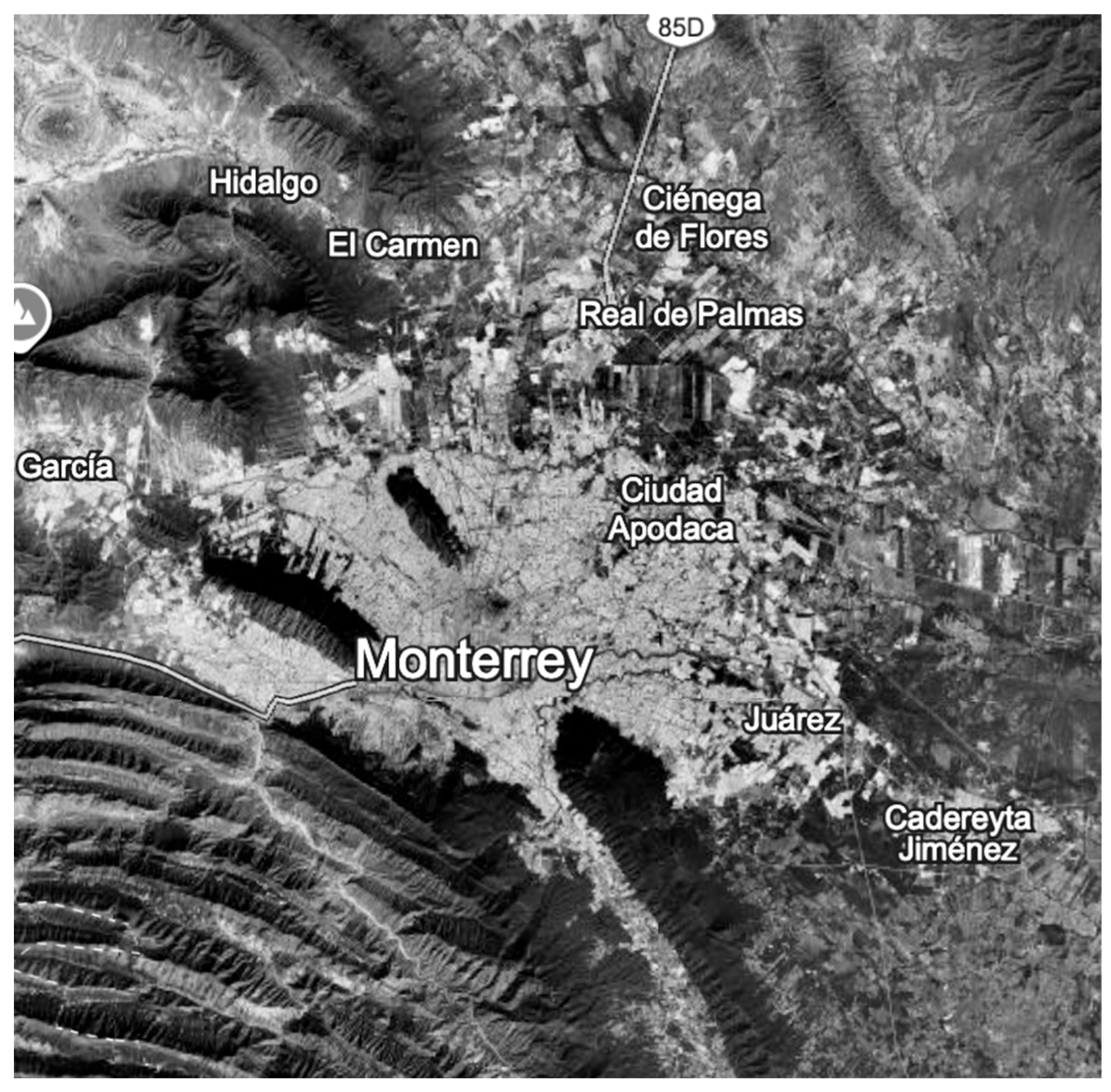
Figure 2.
Overview over the steps and parts of the research.
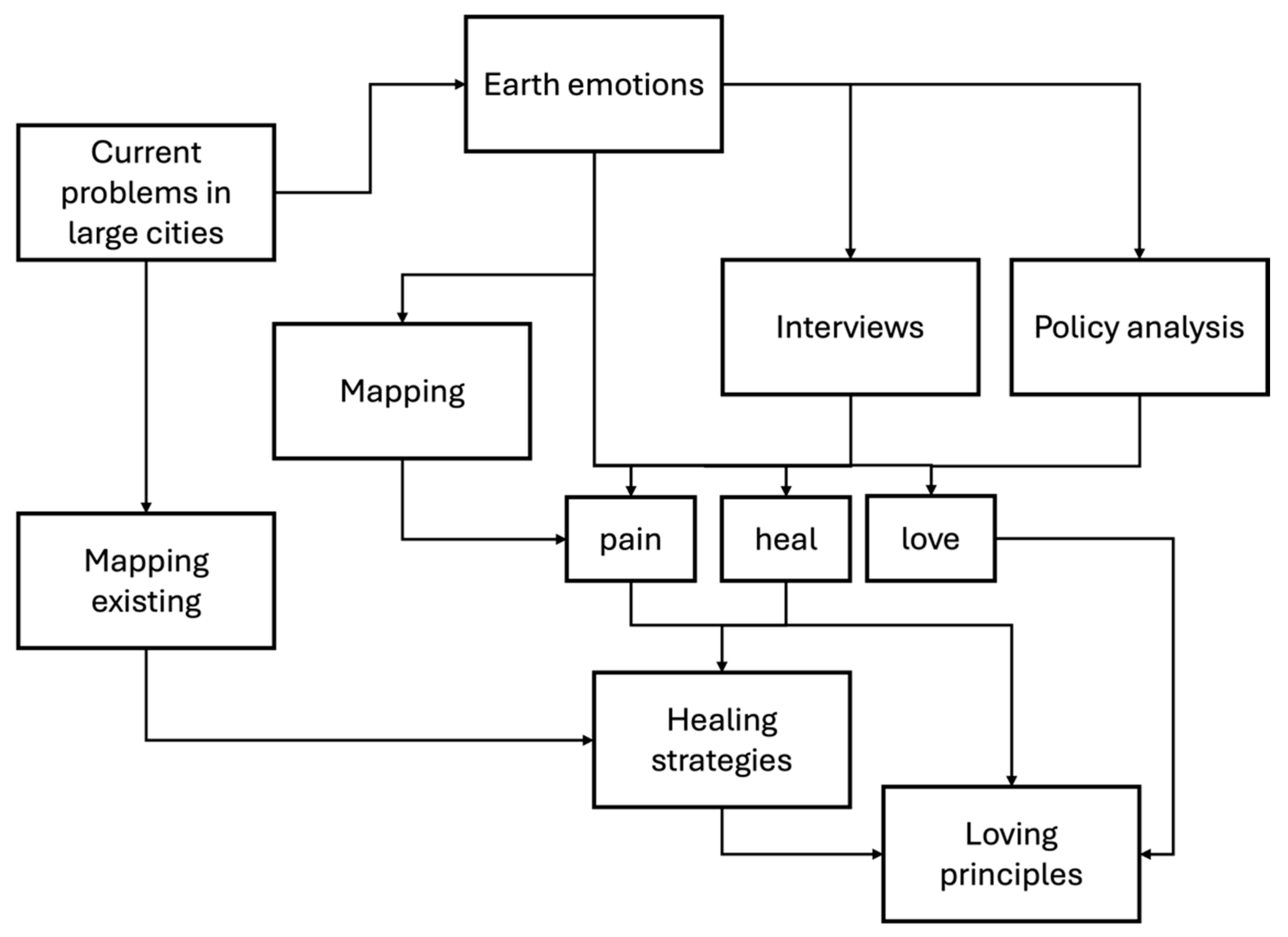
Figure 3.
Map with integrated aspects of landscape pain [119].
Figure 3.
Map with integrated aspects of landscape pain [119].
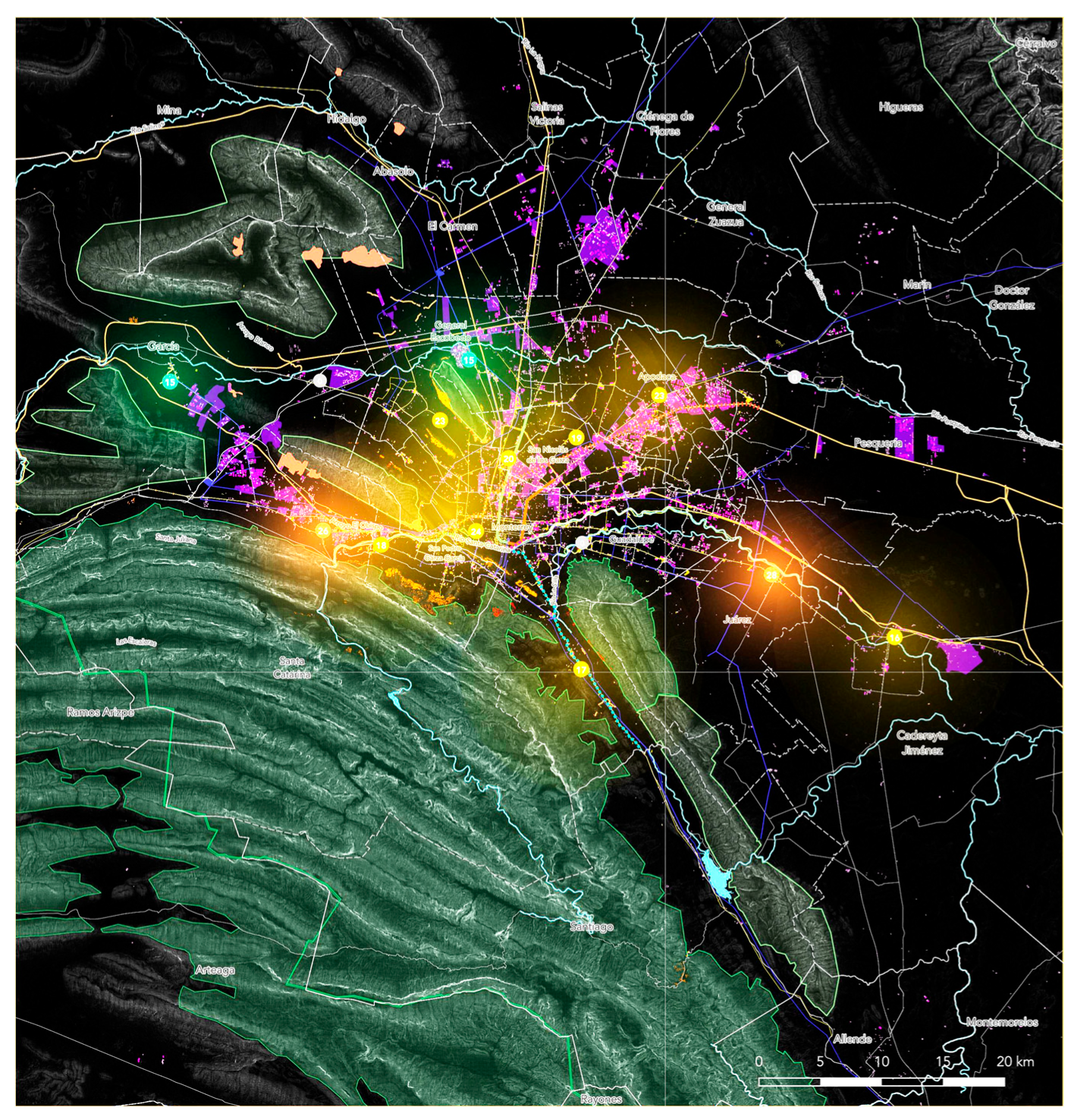
Figure 4.
Map of hydrological pain [119].
Figure 4.
Map of hydrological pain [119].
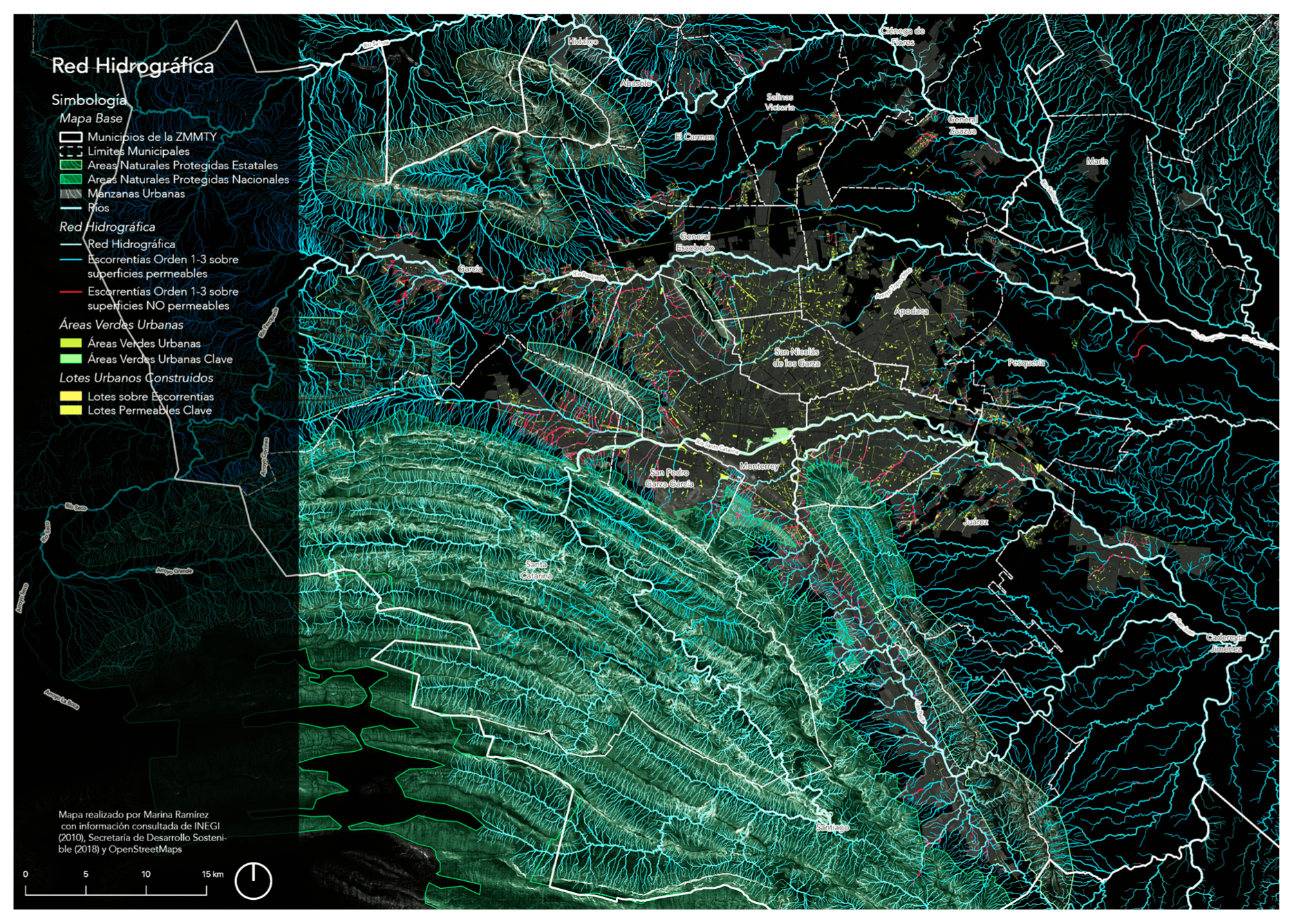
Figure 5.
Strategy to uncover creeks and waterways, greening the regional network, and find spaces for urbanity within [139].
Figure 5.
Strategy to uncover creeks and waterways, greening the regional network, and find spaces for urbanity within [139].
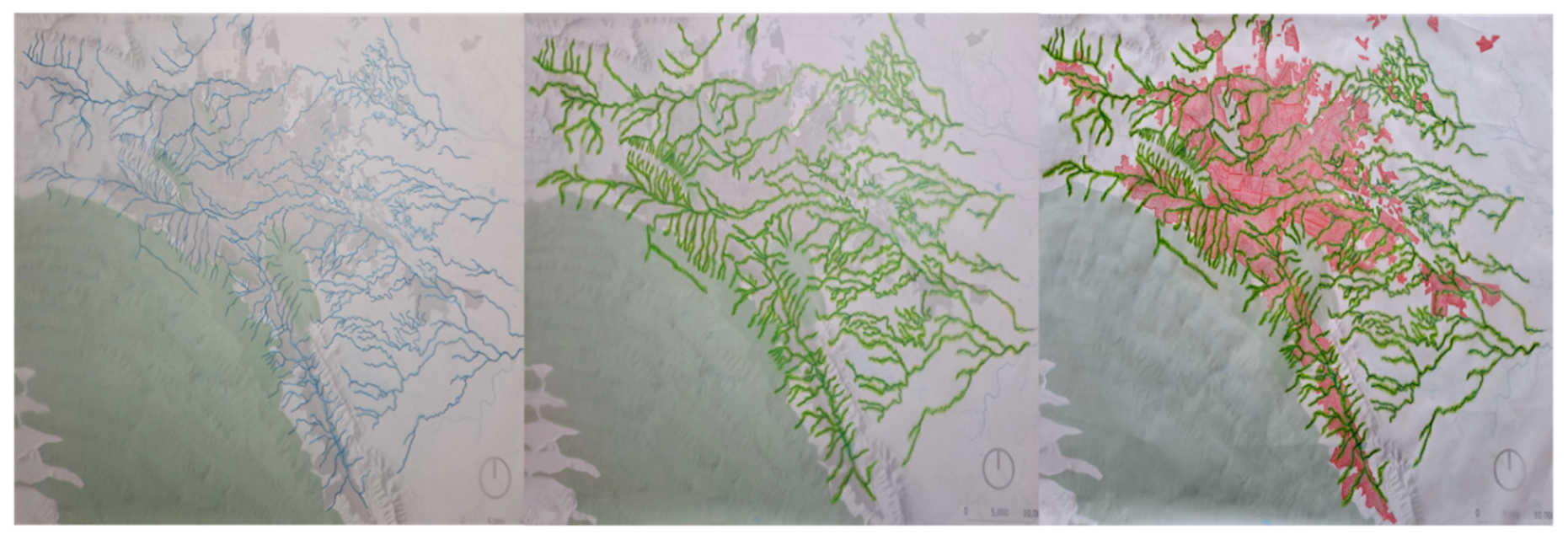
Figure 6.
Strategy to uncover creeks and waterways, greening the regional network, and find spaces for urbanity within [119].
Figure 6.
Strategy to uncover creeks and waterways, greening the regional network, and find spaces for urbanity within [119].
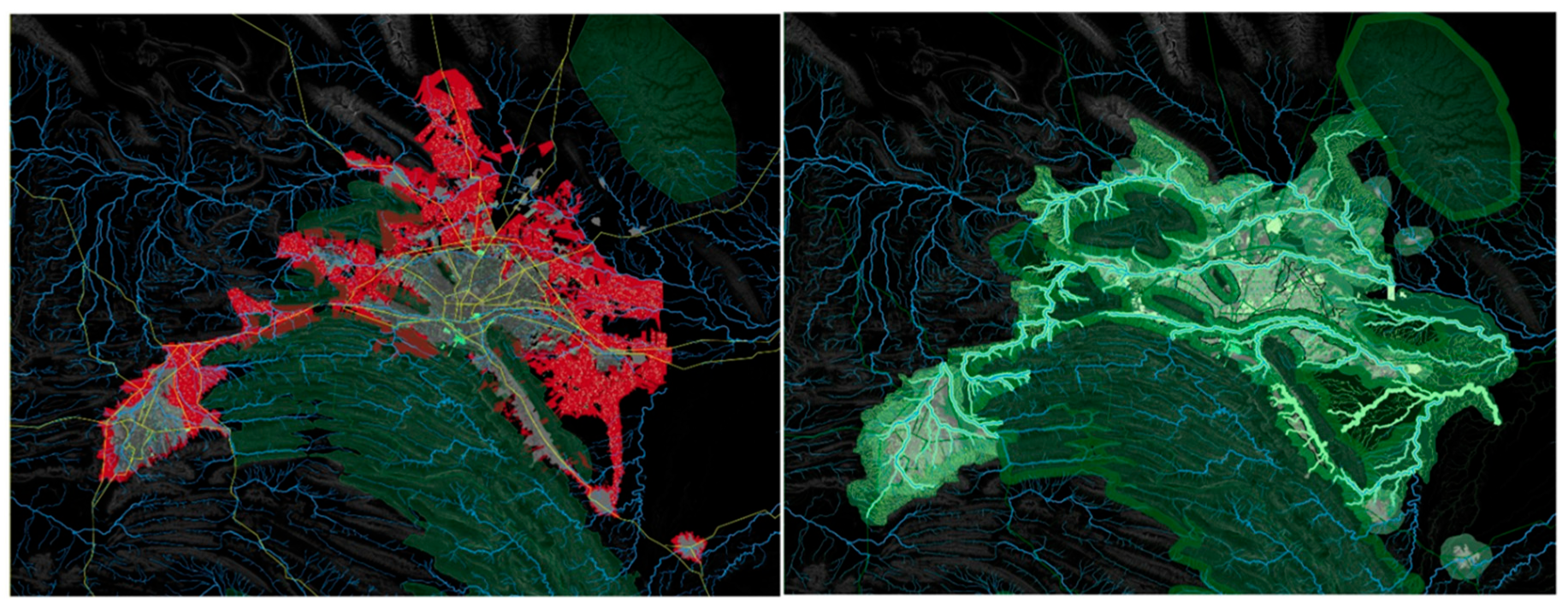
Figure 7.
transforming a street into a hydro-ecological corridor [145].
Figure 7.
transforming a street into a hydro-ecological corridor [145].
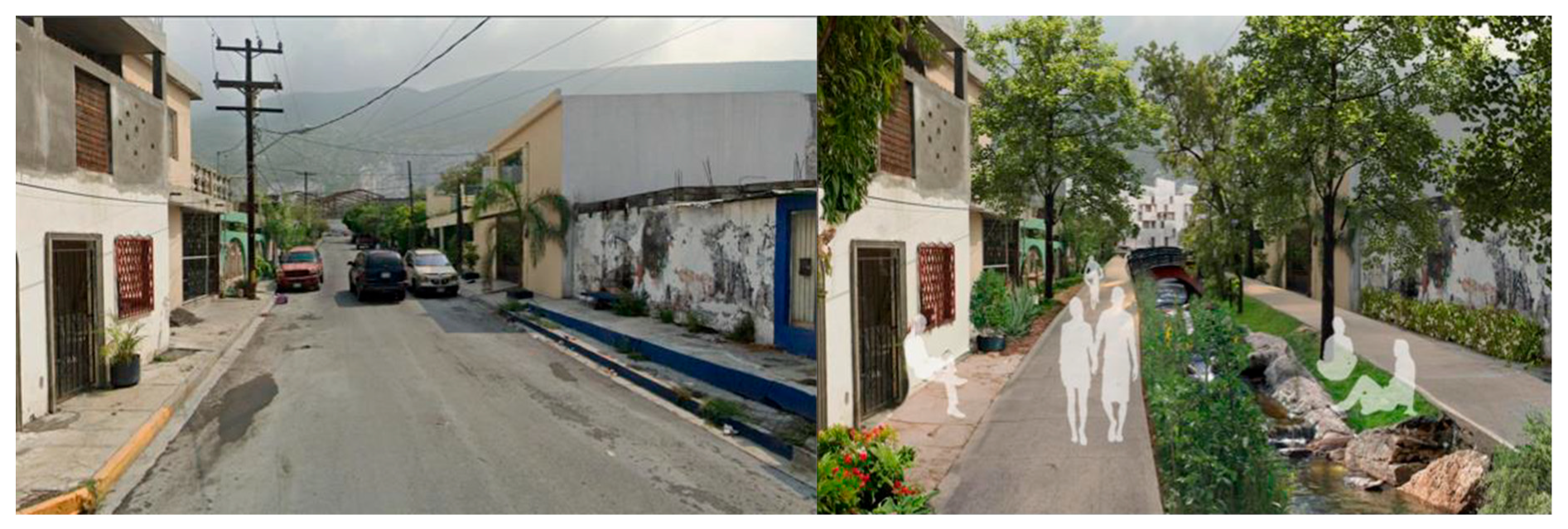
Figure 8.
Water retention design principle [145].
Figure 8.
Water retention design principle [145].
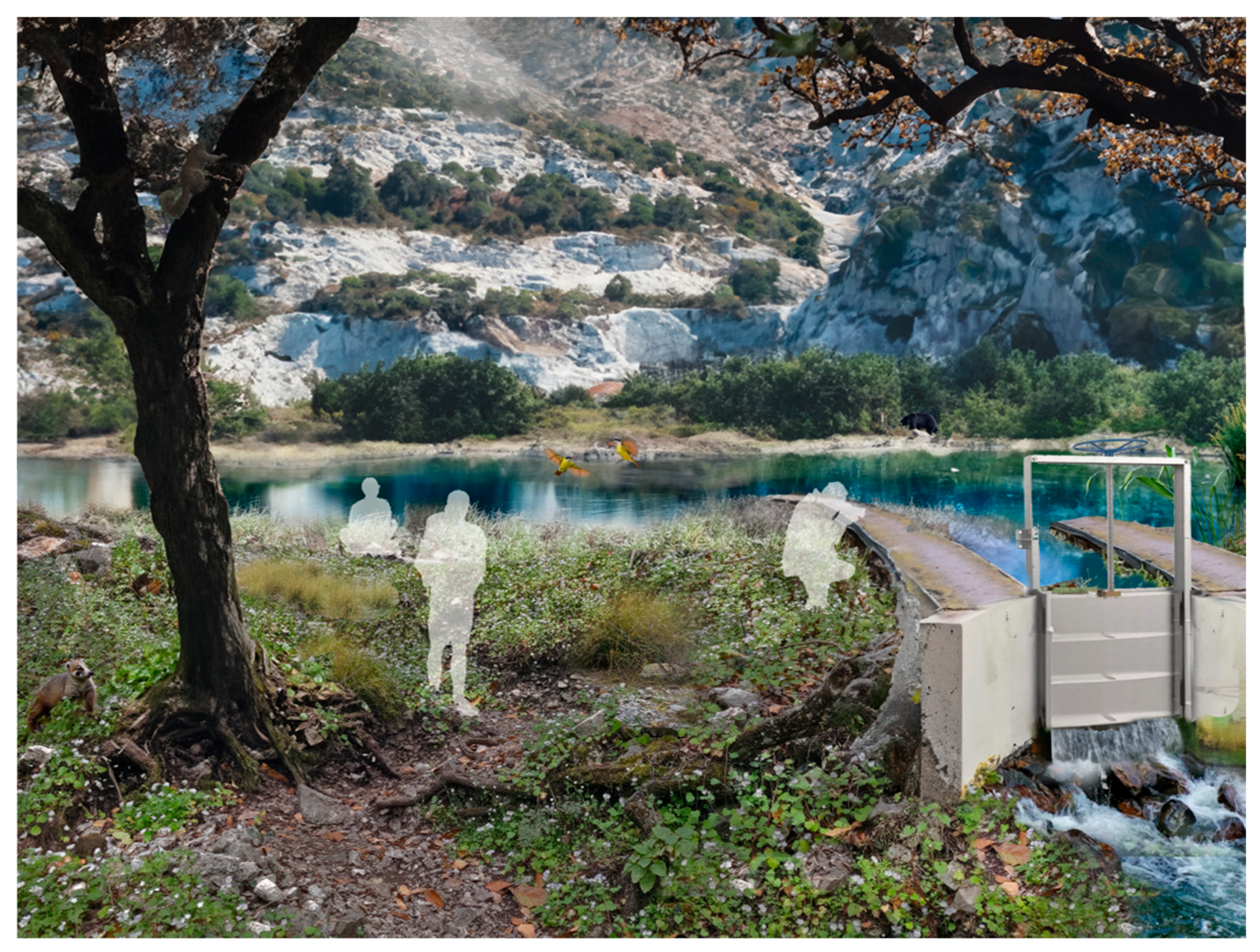
Figure 9.
Transformation of impermeable surfaces into green productive oases [119].
Figure 9.
Transformation of impermeable surfaces into green productive oases [119].
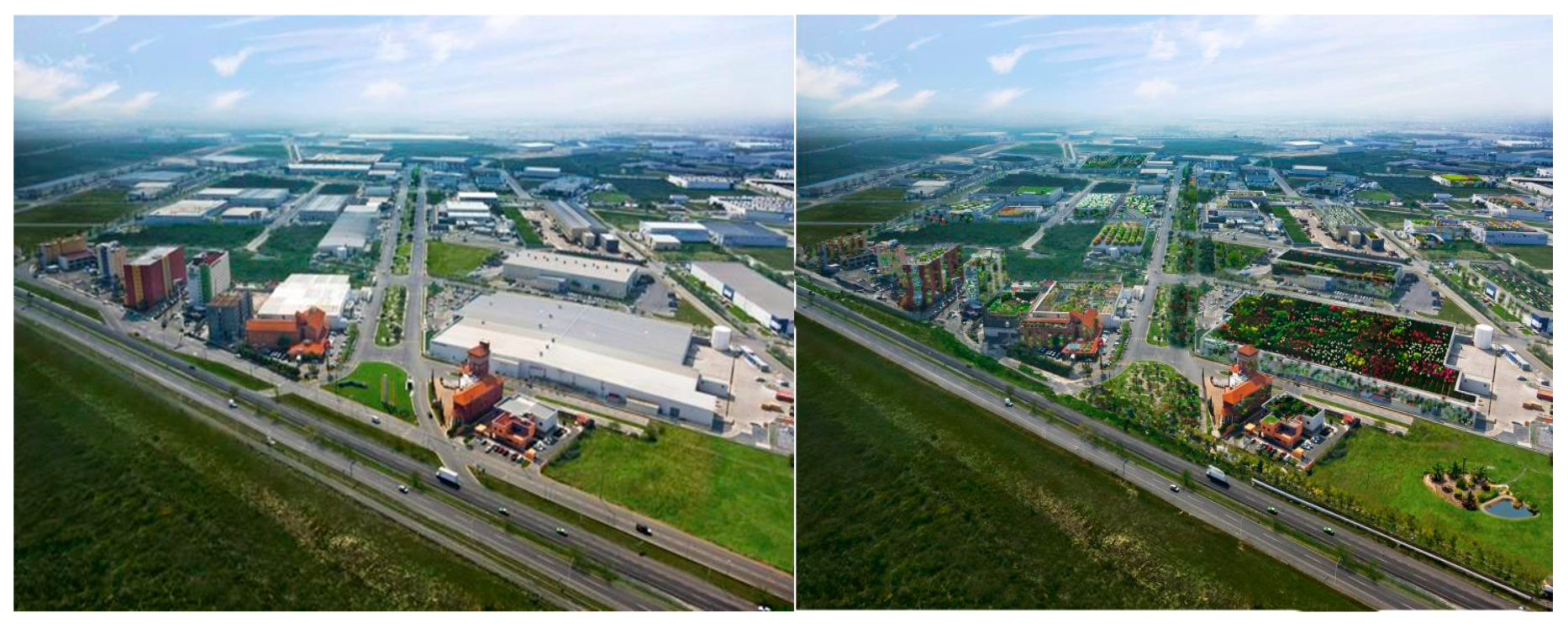
Figure 10.
Design principle of a greenway [119].
Figure 10.
Design principle of a greenway [119].
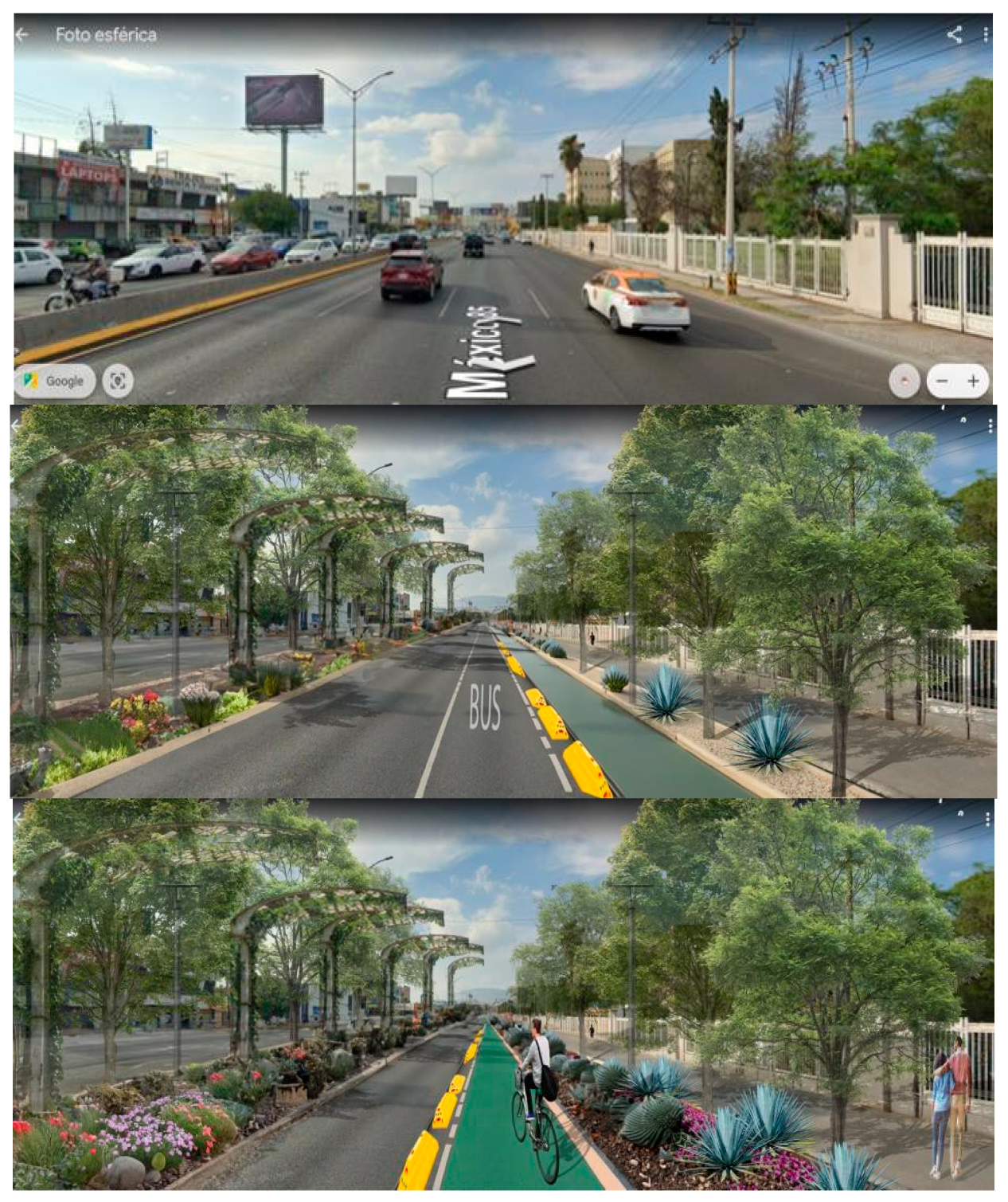

Table 1.
Maps current conditions and sources used [92,93,94,95,96,97,98,99,100,101,102,103,104,105,106].
| Map | Data source |
|---|---|
| Rio Bravo basin | Lehner et al., 2008 |
| Monterrey´s subbasins | INEGI 2020 |
| Ecoregions | Secretaría de Medio Ambiente de Nuevo León 2023 |
| Land cover | NALCMS |
| Green cover, city comparison | INEGI (2020), BC Stats (2023), Instituto Nacional d’Estadística I Institut d’Estadística de Catalunya (2022), GHS Settlement Characteristics (2018). |
| Percentage natural area | NALCMS 2020, GHSL 2018 |
| Proximity to green spaces and accessibility by vulnerable groups | LANDSAT 2019, Population and Housing Census, INEGI, 2020 Open Street Maps, CONEVAL 2020 |
| Heat index | URSA, BID |
| Rainfall | CONAGUA, Servicio Meteorologico Nacional, 2023 |
| Urban growth | Secretaria de Desarrollo Sustentable de Nuevo Leon, Carpio et al., 2021, GHSL and Consejo Nuevo Leon |
| Urban density | Secretaría de Desarrollo Sustentable de Nuevo León (2018), Carpio et.al (2021), GHSL and Consejo Nuevo León (2023). |
| Urban heat islands and wildfires | Copernicus Agencia Espacial Europea (2024); Global land análisis and discovery (2022) |
| Air quality | OCCAMM 2024 |
| Map | Data sources |
|---|---|
| Quarries and constructions in natural reserves | NPA, Open buildings dataset (Google Earth Engine), Sirko et al., 2021 |
| Large roads (more than 6 lanes each way) | INEGI |
| XL and L buildings | Open buildings dataset (Google Earth Engine, https://sites.research.google/gr/open-buildings/#open-buildings-download). Sirko et al., 2021 |
| Heat islands | Debbage and Marshall Shepherd, 2015 |
| Railways and above metro system | INEGI, PRIMUS 2019 |
| Energy infrastructure/air quality | Secretaria de Desarrollo Sustentable de Nuevo Leon, 2018. |
| Hydrological obstructions | INEGI 2010, Open buildings dataset |
| Landscape transformation | Balon et al., 2023; Cao et al., 2020 |
Table 3.
Identification of pain, heal and love based on Earth emotions’ vocabulary (after [112]).
Table 3.
Identification of pain, heal and love based on Earth emotions’ vocabulary (after [112]).
| Verb | Translation | Etymology | Explanation |
|---|---|---|---|
| PAIN | |||
| Terraphthora |
Earth-destroyer |
terra = earth; phthora = to destroy, destroy, ruin | In the Anthropocene they were still given the title 'polluter'. 'Earth's lawyer' Polly Higgins didn't use the word 'ecocide' for nothing. In the Netherlands, multinationals such as Shell and Tata Steel and previously DSM are considered the biggest destroyers of the earth. But you can also think of traffic and transport, or bio-industry and large-scale livestock farming. Earth destroyers will be increasingly held accountable, both by the public and politicians. |
| Tierratrauma | Earth trauma |
tierra = region/zone; trauma = wound | What has been happening to the Earth in recent decades is increasingly affecting people as a trauma. We could say that 'those who are sensitive to it' increasingly suffer from a traumatic stress syndrome, which is not 'post-', but 'present-'. An 'acute Earth-based existential trauma in the present' |
| Solastalgia | Consolation | solari = to comfort; nostalgia = longing for past times | The more nature and the environment around us are compromised, the less comfort we will experience from that immediate environment. We are more likely to long for a time and a state when nature still offered us comfort, and the planet was not in such hopeless trouble. A 'pain or distress caused by the loss -or lack of- solace and the sense of desolation connected to the present state of one's home and territory.' |
| Terrafuria |
Climate rage |
terra = earth; furia = anger, rage | Recently, 'terrafuria' has been regularly expressed by activists. For example, when they glue themselves to paintings or to talk show tables. Also consider the book How to blow up a pipeline by the Swedish professor Andreas Malm. The anger about what Greta Thunberg now calls 'climate collapse' is becoming increasingly manifest. It seems as if we are moving from the stage of protest and demonstration to action and use of force. 'The extreme anger unleashed within those who can clearly see the self-destructive tendencies in the current forms of industrial-technological society and feel they must protest and act to change its direction' |
| HEAL | |||
| Sumbiofact |
Built-with-nature |
sumbio = from the close cooperation between two or more different biological entities; factum = operation, creation, result of action/deed | It is becoming a hip subgenre in architecture and design: buildings that are almost completely 'natural', but are somewhat 'controlled' or 'nudged' by humans. For example, a bridge made of trees and lianas over a river. The bridge was created because humans sent something natural, but without causing damage to nature (such as mining or clothing dyeing, which uses water that must then be disposed of polluted). It is therefore about 'built with nature' and not obtained through exploitation or extraction. 'Fabricated by human/nature interaction. As distinct from 'artefact', an object made by a human being, artificially' |
| Symbiocene |
symbiosis = living together; kainos = new | History can be divided into geological periods, this is also called geo-chronology. The duration and characteristics of the older eras are based on stratigraphy, the sequence of rock layers found worldwide. Since the Holocene (that era started 11,700 years ago), humans have been a more important 'determiner' of the era than the rock layers. 'The era in Earth history that comes after the Anthropocene. The Symbiocene will be in evidence when there is no discernible impact of human activity on the planet other than the temporary remains of their teeth and bones. Everything that humans do will be integrated within the support systems of all life and will leave no trace' |
|
| LOVE | |||
| Endomophilia |
Own-place-love |
endemos = native, at home, born and raised in, among us; philia = love for | If nature and the environment are threatened, we will love that (immediate) environment more. And as the environment and nature face a less certain - and more worrying - future, our love for the beauty of our own immediate natural environment will increase. How much love can you have for nature, the environment and the climate (and therefore also biodiversity)? If our 'own place love' increases, the Symbiocene will approach more quickly, you would say. 'The particular love of that which is locally and regionally distinctive as felt by the people of that place'. |
| Eutierria |
Planet connection |
eu = good; terra = earth; tierra = region/zone | When and how do you feel one with the earth, and when do you feel it most? This is different for every person: do you live in the countryside or in a busy city? Are you someone who often seeks out nature? Do you have an eye and feeling for it or do you view nature as 'the space between two cities'? Are you only looking for a connection with the earth on holiday or when traveling? It might be nice to think back about how that applies to you personally: has your bond with nature and the environment and the earth changed, how has it developed 'over the years'? 'A positive and good feeling of oneness with the Earth and its life forces where the boundaries between self and the rest of nature are obliterated and a deep sense of peace and connectedness pervades consciousness' |
| Psychoterratic |
Earth soul movements |
psyche = the human soul or spirit; terratic = relating to the earth | Our existence seems to be increasingly influenced by the question: 'what are we doing to the earth?'. Or: 'how can I minimize the pain of the earth with my actions or by denying myself things or making sacrifices myself?' Those who feel strongly connected to nature and the earth also experience its pain and joy. Such earth-related emotions are likely to increase as we humans become increasingly concerned about the fate of the earth. 'Emotions related to (positively and negatively) perceived and felt states of the Earth'. |
| Terranascia |
Soil enricher |
terra = earth; nascia = to be born | 'Green Gold', re-greening of parched deserts and fallow regions. It seem like magic. For example, the food forests that are springing up like mushrooms in the east of the country, or the plans to green the Sahara again. 'Earth creator' |
Disclaimer/Publisher’s Note: The statements, opinions and data contained in all publications are solely those of the individual author(s) and contributor(s) and not of MDPI and/or the editor(s). MDPI and/or the editor(s) disclaim responsibility for any injury to people or property resulting from any ideas, methods, instructions or products referred to in the content. |
© 2024 by the authors. Licensee MDPI, Basel, Switzerland. This article is an open access article distributed under the terms and conditions of the Creative Commons Attribution (CC BY) license (http://creativecommons.org/licenses/by/4.0/).
Copyright: This open access article is published under a Creative Commons CC BY 4.0 license, which permit the free download, distribution, and reuse, provided that the author and preprint are cited in any reuse.


