

Submitted:
09 May 2023
Posted:
10 May 2023
You are already at the latest version
Abstract
Our understanding of the diversity of life on our planet and the possibility of finding or sustaining life elsewhere in the universe plays a central role in supporting human space settling and exploration. Astrobiology and its outcomes require a multidisciplinary and comprehensive approach, in which the microbial, geological, chemical, astronomical, and physical domains of research are interlinked. An example of the applications of astrobiology and space microbiology is the use of extremophiles for in-situ resource utilization through biomining and bioleaching. To better understand the multidisciplinary research landscape in this area, we have quantitatively reviewed the global scientific literature on astrobiology with a focus on biomining and bioleaching through bibliometric network analysis, investigating patterns and trends in its development over time. The network analysis of the keywords co-occurrence highlights different connecting and overlapping clusters, illustrating the multidisciplinary character of astrobiology. Temporal analyses show a recent focus on topics related to microbiology and geomicrobiology, emphasizing the role that these fields will play in future astrobiology research. In conclusion, astrobiology, biomining, and bioleaching research are timely responding to the identification of these techniques as tools for biotechnological applications, expected to play a crucial role in long-term human space exploration.
Keywords:
biomining
; bioleaching
; astrobiology
; A. ferrooxidans
; acidophiles
; space biology
; bibliometric network analysis
1. Introduction
Astrobiology is becoming increasingly important as human exploration of space progress [1]. Since its inception, it has evolved from a strong focus on the study of the origin, evolution, and distribution of life in space, to the inclusion of biotechnological applications which aim to support space exploration and in-situ Resource Utilization (ISRU). These include, for instance, biomining, bioleaching, space (micro)biology and astrobotany, all applications with a strong industrial potential [2,3]. However, a thorough consideration of the different areas which influenced the development and evolution of astrobiology over time has not been analyzed in depth. To better understand how astrobiology has changed, it is necessary to retrace its evolution.
Astrobiology is a multidisciplinary field combining physics, chemistry, biology, geology and planetary sciences (i.e., exoplanets research, space probe development, comet studies, etc.) [2,4,5,6,7]. The first contributions came from physical sciences; in the 17th century, Isaac Newton and Edmond Halley suggested the participation of comets in planetary evolution with the establishment of the “Goldilocks Zone” i.e., the range of distance from a star allows the right temperature for water to remain in a liquid state. Astrobiological studies then moved to a more biologically-oriented view, particularly focused on extremophilic organisms and extreme environments on Earth, as analogues of what could be found in other planetary bodies [8,9]. Investigating the origin and evolution of life, considering the evolution of metabolism and early-Earth geochemistry, has been deemed increasingly important [10].
Despite the success of space exploration and the plans to establish human settlements on other planetary bodies, practical limitations need to be considered and solved. These include the unsustainability of transferring resources from Earth to long interplanetary distances, and the potential limited resources available on extraterrestrial environments. This has stimulated the interest in space biomining and bioleaching, i.e., the process of using microorganisms to extract metals of interest from rock ores or mining waste [11,12,13]. Some microorganisms, including some bacteria and fungi, are able to colonize extreme environments, e.g., acidic environments enriched with heavy metals, Acid Mine Drainage—AMD. Scientists mined resources such as transition metals, which are useful in metal powdering and metal sintering processes [14]. Through biomining and bioleaching, it will be possible to build tools for human survival using 3D printing techniques through metal sintering and powdering [15]. This approach can also be used to remediate metal-contaminated sites, a process termed bioremediation [16,17].
Some microbes, for instance, Acidithiobacillus ferrooxidans [18] can oxidize or reduce transition metals (i.e., iron and copper), depending on the oxygen concentration in the environment, altering their mobility in aqueous solutions [18,19]. The ability to recover dissolved metals versus their solid forms makes bioleaching one of the most widely used techniques in biomining. In the case of poorly soluble metals, selected microorganisms are used to break down surrounding minerals and facilitate their extraction from the rock [20]. The most valuable metals currently targeted by biomining operations are copper, uranium, nickel, iron, and gold [21]. Microorganisms are especially proficient at oxidizing sulfur-bearing minerals. If the metal of interest is dissolved directly, the process is termed “bioleaching”, while it is enriched in relation to the material left behind, the process is termed “bio-oxidation”. Both processes involve microbial reactions occurring wherever microorganisms, rock, and essential nutrients such as oxygen and sulfur species coexist. These processes can be performed in space environments, for example on lunar regolith and on Martian basalts that provide the right facilities for microbial growth [22]. Experiments conducted both on Earth and on the International Space Station (ISS) demonstrated the feasibility of rare earth element extraction by biomining using microbes that can mobilize metals [23]. Space biomining and bioleaching are becoming the cutting-edge branch of astrobiology with a particular interest in human space exploration. Their research requires a combination of interdisciplinary expertise and knowledge, for which astrobiologists are particularly well suited [3,11].
In the present study, we performed a quantitative astrobiological literature search by applying bibliometric techniques. We employed a focus on recent achievements in space biomining and bioleaching to identify possible patterns and trends in astrobiology and to examine their evolution over time.
2. Materials and Methods
We performed a bibliometric analysis of the global scientific literature on astrobiology, biomining, and bioleaching. Research articles were searched on May 4th, 2022, in the Scopus databases. The research was performed by searching for two different strings using Boolean operators: 1) “astrobiology”, 2) “astrobiology” AND “biomining” OR “bioleaching” in the document title, abstracts, and keywords of scientific papers. We choose a range of dates for each string capable to let us export the maximum number of documents possible. From 2013 to 2022 for the first string and from 2004 to 2022 for the second string.
The research metadata was exported as CSV files after selecting the “Citation information”, “Bibliographical information”, and “Abstract and keywords” options. The results were then analyzed by means of VOSviewer (version 1.6.13), designed to create network maps based on bibliographic data. Network maps are generated in such a way that the position of the displayed items (e.g., keywords, authors, countries) are assigned according to the degree of their relatedness; the closely related elements are grouped, while the weakly related ones are more distant. Items are also uniquely assigned to clusters, each consisting of a set of closely related items.
In order to examine the trends of the main topics linked to astrobiology, the co-occurrence maps of the author's keywords were generated. Co-occurrence networks of keywords are based on the number of publications in which two keywords occur together in the title, abstract, or keyword list and express their relationship quantitatively. For the first network map, a minimum threshold of 18 occurrences was set to visualize the 200 most important author’s keywords. For the second network map, a minimum threshold of 2 occurrences was set to visualize the 30 most important author’s keywords. The clustering resolution has been reduced from 1 (i.e., the default value) to 0.85 to optimize the number of clusters displayed (Picone et al, 2020) i.e., each cluster is a series of nodes inside a network of information. In addition, the overlay visualization of VOSviewer was applied to allow the representation of the network elements on a time gradient, which expresses how the co-occurrence of the network items has evolved over time. This visualization feature is based on the average publication year of the documents in which the keywords occurred.
A list of terms used throughout the paper can be found in Table 1.
3. Results
3.1. First String Analysis
The bibliographical search of the string “astrobiology” returned a set of 2,519 documents (2,000 most recently downloaded - data sources have limits on the amount of data exportable) from 2013 to 2022. Of the 8,819 keywords, 200 were displayed by VosViewer according to the occurrences threshold set (Figure 1, Table S1). For the second string [“astrobiology” AND “biomining” OR “bioleaching”] in the Scopus database, only a set of 8 documents was found in the years from 2004 to 2021.
In the co-occurrence map (Figure 1), the 200 keywords were grouped in 6 different clusters and sized proportionally to their number of occurrences (Table S1). Because they derive from the string “astrobiology” only (first string), this analysis allows the monitoring of astrobiology’s “hot-topics” and their multidisciplinary connection.
Cluster 1 includes 61 keywords (red bullets) and broadly focuses on topics related to microbiology and extreme environments. Frequent keywords are ecosystems and microorganisms, which are directly connected to the study targets for astrobiology e.g., Archaea, Bacteria, extremophiles, habitat, lakes, Antarctica, and to physical-chemical parameters as e.g., pH, radiation, microgravity, ultraviolet rays.
Cluster 2, consists of 52 items (green bullets), including the central keyword astrobiology. The cluster is dominated by subjects dealing with physics and astrophysics, i.e. astrophysics, extrasolar planets, interplanetary flight, planetary atmosphere, stars, and thermodynamics. In addition, the cluster is strongly linked to Cluster 1, i.e., connected to keywords e.g., biology, amino acids, and life detection.
Cluster 3, composed of 32 items (blue bullets), focuses on chemistry, location, and methods of astrobiological studies. The cluster is dominated by a few main keywords, e.g., chemistry, Mars, and procedures. Additional frequent keywords are biosignature, biomarkers, minerals, organic compounds, and oxidation-reduction reactions.
Cluster 4, which consists of 29 items (yellow bullets) includes (as cluster 1) the theme of biodiversity and life in relation to astrobiology, as shown by the presence of exobiology, space flight, animals, evolution, life, and origin of life.
Cluster 5, consists of 25 items (violet bullets) and has a strong connection to astronomy as shown by the main keywords: astronomy, space, and extraterrestrial environment. This cluster is linked with a strong connection with all the other clusters.
Cluster 6, with only one item (light blue bullet), is referred to as “earth, planet” in relation to mars, astrobiology, and astronomy keywords.
It is worth noting that clusters 1, 2, and 3 have keywords associated with life forms, the origin of life, microorganisms, and astronomy, highlighting the multidisciplinary and transdisciplinary nature of astrobiology. In the first keywords, ordered by the number of links (after the main keyword), we find metabolism, bacteria, the origin of life, and microbiology. Microbiology shows connections to five of the map’s six clusters, with the exception of cluster 6. Among its most common co-occurrences, the most significant are those with mars, earth, planet, and metabolism, indicating the path that scientific research in astrobiology is taking. The study of the Earth and microorganisms serves as a natural laboratory for planetary studies.
Clusters 3, 4, 5, and partially cluster 2, show a high degree of overlap. Some keywords are placed in between. Cluster 4 partially overlaps with both Clusters and Cluster 3. Clusters 4 and 5 are strongly interconnected, with astronomy nested between exobiology, extraterrestrial environment, and biosignatures. This reflects the role of astronomical approaches in astrobiological studies, with biology and life sciences playing a significant role. Clusters 3 and 4 partially overlap through a broad network area focused on research topics related to the microbiological part of the map (cluster 1). In this section, bacteria are a major stakeholder category, explicitly represented on the map and linked to the main keywords e.g., mars, astrobiology, exobiology, and extraterrestrial environment. The incorporation of microbial life into astrobiological studies is truly a key strategy. In the search for life in the cosmos and in support of space exploration, there is a need to focus on extremophiles capable of performing their metabolic functions in extreme environments, e.g., the Moon, Mars, or the ISS. Astrobiologists are now focusing on extremophile organisms on Earth and their environments to better understand the possible spread of life in the universe.
Surprisingly, cluster 6 is inextricably linked to all of the other clusters. This cluster’s high degree of overlap is likely due to the fact that life is known to exist only on Earth. The high degree of overlap of clusters 2, 3, 4, and 5, and the thick web of connections on the network map confirms the interconnectedness of astrobiological research topics. It underlines the interdisciplinary nature and the high relatedness of their studies. The entire left part and the right part of the network map of Figure 1 show a panorama of the actual trend of astrobiology, which contains common elements of the integration of the biological part with the astronomical.
Figure 2 shows the overlay visualization map based on the year of document publication, which provides a temporal perspective for interpreting the co-occurrence network map of keywords (the color scale and time range in the map are chosen automatically by the program to better underline the variations existing in the literature).
The distribution of the keywords along a temporal gradient provided an immediate representation of astrobiology evolution and identified the most recent trends. The overlay visualization map shows a current focus on concepts that encompass the microbial dimension, e.g., extremophile, microbial communities, and the focus on other planetary bodies, e.g., Mars and Enceladus. In addition, it clearly shows an interaction with the geological components, e.g., minerals, sediment, and geological sediments. Other keywords such as evolution, planets, the origin of life, extraterrestrial environment, and space flight are distributed evenly over the publication period, which indicates a homogeneous appearance of space in astrobiology.
As shown in Figure 1, the central keywords astrobiology and Exobiology are closely related, both in terms of the proximity of their locations on the network map and the strength of their connection (high link strength, i.e., the high number of co-occurrences). This happens because they are improperly used as synonyms of the same word. Astrobiology deals with the study of life on Earth and in Space, and Exobiology deals with the study of the likelihood of the existence of life exclusively outside of Earth. To support this hypothesis, the overlay shows no temporal divergence in their co-occurrence (Figure 2). Both astrobiology and exobiology are in the middle of the chronological publication spectrum.
According to scientific literature, the keyword water and its relatives are the oldest on the map. The left part of the network map in Figure 2 (clusters 1, 3, and 4) included research topics recently explored in astrobiology, e.g., extremophiles, animals, microgravity, and extreme environments.
3.2. Second String Analysis
The bibliographical search for the second string in the Scopus database yielded 8 documents published from 2004 to 2021. Of the 224 keywords, 30 were displayed according to the occurrences threshold set (Figure 4, Table S3). In the co-occurrence network map, the 30 main keywords were grouped into 4 different clusters, in contrast to the first string, which showed 6 clusters. These clusters are arranged in size and location in proportion to their number of occurrences.
Cluster 1 consists of 11 items (red bullets) and is focused and linked to the main topic of research e.g., astrobiology and bioleaching, with keywords related to biotechnological organisms for space exploration and settling, e.g., bacteria, acidophile, microbiology, metabolism, and minerals.
Cluster 2 contains 7 items (green bullets), including keywords related to non-human research e.g., microbial metabolism, proteobacteria, extreme environment, and extremophiles. This cluster has a strong focus on the incorporation of the microbial component, extreme biology in particular, into space exploration, as suggested by the keywords (Table S3).
Cluster 3 consists of 7 elements (blue bullets), including the keyword acidophiles which is common to all clusters and closely related to the other keyword in the network. The main topics of the cluster are geomicrobiology, the iron cycle, and the sulfur cycle, underscoring the role of geobiochemistry in astrobiology.
Cluster 4 with 5 items (yellow bullets), similar to cluster 2, is related to specific microbial research in bioleaching and biomining. including key organisms and mechanisms, which could be of relevance in astrobiology. All 5 items show the same number of linkages and are referred to as model organisms in biomining and bioleaching processes, i.e., Acidithiobacillus ferrooxidans. Other keywords useful in understanding how this organism works are: mineral, sulfide, and sulfur.
The first three clusters have keywords explicitly linked to astrobiology and focus on microbial research and geomicrobiology. They showed a strong relationship between microbiology and geological environments. By sorting the number of links in descending order, it is possible to understand that the bioleaching processes are strongly linked to microbiology, with particular attention to sulfur and iron metabolism. Iron is one of the most fundamental transition metals (along with copper, nickel, vanadium, tungsten, and molybdenum) that human civilization must use in space exploration and in-situ resource exploitation.
Cluster 4 looks more specifically at life forms that could be useful in refining transition metals. The focus is closely related to Acidithiobacillus ferrooxidans. Furthermore, Cluster 4 goes deep into microbial metabolism and shows that microbes in the iron and sulfur cycles are useful in biotechnological approaches and in the endogenous Earth processes (biogeochemical cycles).
Cluster 4 visually shows a high degree of overlap with all other clusters, as some keywords are placed between the network ranges of all clusters. Cluster 2 and Cluster 3 partially overlap. The intersection between these clusters is highly interconnected, showing the microbial metabolism and the geomicrobiological keywords at the center of the intersection. Both clusters are linked via the keyword sulfur to Cluster 4, as a central element in the reduction and oxidation of many transition metals in biological processes. Cluster 1 with the keyword astrobiology is the one from which the other clusters originate and overlap. It contains some of the most important keywords that can summarize all topics .g., non-human, astrobiology, bioleaching, and microbiology. Microbial involvement is fundamental to colonizing other planetary bodies, as we can see from the Mars keyword, which is strongly related to the main network keywords. It is interesting to note that a few terms which would be intuitively associated to Cluster 2 (metabolism), 3 (bioleaching, acidophiles) and 4 (iron, minerals), are actually associated with Cluster 1, which is astrobiology-dominated. On the other hand, mars, which should intuitively be linked to Cluster 1, belong to Cluster 3, which is geology-dominated.
Figure 5 shows the overlay visualization map based on the year of document publication (the color scale and the time range in the figure are chosen automatically by the program to better underline the variations present in the literature).
The distribution of the keywords along a temporal gradient allowed the understanding of the importance and development of biomining and bioleaching research in astrobiology. The overlay visualization map shows a current focus on microbial research, particularly on extremophiles on the ISS and in extreme environments around the globe. Other keywords e.g., mineral, sulfide, and metabolism are equally distributed over the publication time frame, suggesting the homogeneous importance of geological studies in the mining resources using microbial metabolism.
4. Discussion
The results of the two bibliometric analyses performed showed the evolution of astrobiology from the conventional concept of exoplanets and astronomy studies to a broader spectrum that integrates ecology, microbiology, and geochemistry. These patterns and trends in astrobiology are to be placed in the broader context of the development of space sciences, which are used to identify space engineering, planetology, cosmology, astrophysics, astronomy, and space exploration. The exclusion of the microbiological and biogeochemical presence in astrobiology is due to the fact that it is a relatively new science, officially born around the 1970s.
In recent years, astrobiology has evolved from astronomical research into more biological research, encompassing numerous other scientific subjects such as geology, and microbiology. The focus of astrobiology, in addition to discovering how life arose and how it can be distributed in the cosmos, is towards aiding space exploration, which is triggering new research areas such as astrobotany and space biomining [24,25].
As we can see from string analysis, there is a growing trend in the temporal gradient where research is increasingly integrating biological and microbiological approaches as well as biogeochemistry for resource extraction in space environments, based on what is known on Earth about extreme environments is, and extremophile organisms. The results of this study confirm that biological approaches are increasingly gaining ground in astrobiology and are creating new research niches that are less explored. Biomining and bioleaching play central roles in life sciences applied to space environments, and there is a trend toward organisms capable of colonizing extreme environments and even extracting resources using their own metabolism [26].
One of the main focuses is the extraction of iron and transition metals in metal sintering processes following biomining. The biological genus Acidithiobacillus is considered to be one of the most commonly used to carry out this process. Acidithiobacillus ferrooxidans is the best candidate for a model organism to perform resource extraction in extreme terrestrial environments and on other planets, e.g., Moon and Mars [27]. The keywords mars, microbiology, minerals, and Acidithiobacillus are very predominant in networks, with some present in both string analyses. With the astronomical and biological fields being given equal importance, space biomining and geomicrobiology have made strong contributions to opening up astrobiology to biotechnology research lines and promoting astrobiology and ISRU as tools to support efforts toward a sustainable obtainment of resources on Earth [28]. The compelling issue of obtaining resources for sustainable human space exploration is the main reason why space biomining is becoming increasingly relevant. It is therefore surprising not to find the keywords ISRU, in situ resource utilization, or even just resource from our analysis, particularly from the one resulting from the second string. This could partially be explained by the observation that space biomining is more intuitively linked to the niche area of space biology, rather than astrobiology, despite being linked and partially deriving from it. For instance, papers from recent space biomining experiments performed aboard the ISS never use the term astrobiology [23], and probably escaped our analysis. This could explain the low number of documents found using the second string. On the other hand, this indicates the multidisciplinary variety of research areas that branch from astrobiology.
By recognizing the crucial influence of microorganisms in natural systems and at the same time their ability to extract resources, biomining and bioleaching are considered analytical units for the study of astrobiology and human space exploration. On the Moon and on Mars, natural resource extraction is a major concern, both from a sustainability perspective and from an operational perspective. It is interesting that processes involving microorganisms are becoming increasingly important in this area [29]. The use of extremophile organisms appears to be a viable alternative for mining on the moons and planets of our solar system. The integration of microbes into astrobiological processes for human space exploration has entailed the development of more complex devices capable of flying over the ISS and landing on other planetary and satellite surfaces. Astrobiology’s relatively new focus on biomining and bioleaching confirms the increasing interest of the scientific community in extreme environments and extremophiles as tools for the biotechnological enhancement of our society [11].
Analysis of the scientific literature on astrobiology revealed a wide variety of issues affecting different disciplines and a strong connection between them. The temporal analyses showed how astrobiology is timely responding to the identification of biomining and bioleaching as tools, expanding one of astrobiology’s main areas of study and opening it to multi-disciplinary research lines, connecting astronomy, astrophysics, geology, chemistry, and biology [30].
Author Contributions
Conceptualization, L.T., D.G., G.C. and A.R.; methodology, L.T.; software, L.T.; validation L.T. and B.B.; formal analysis, L.T., B.B. and E.P.; investigation, L.T. and B.B.; data curation, L.T.; writing-original draft preparation, L.T., B.B. and E.P.; writing-review and editing, L.T., P.D.D., A.C., L.I., C.M., S.F., M.T.M.T, G.N., A.M.P, V.D.C., R.S., D.G., G.C. and A.R.; visualization, L.T.; supervision, D.G., G.C. and A.R. All authors have read and agreed to the published version of the manuscript.
Funding
This work has been conducted thanks to the following funding: the PhD program PON ‘‘Ricerca e Innovazione” 2014-2020, DM n.1061 (10/08/2021) and n. 1233 (30/07/2020) by the Ministero dell’Università e della Ricerca (MUR); the ASI-INAF agreements I/024/12/0 and 2020-4-HH.0, by the Italian Space Agency (ASI). DG was partially supported by funding from the European Research Council (ERC) under the European Union’s Horizon 2020 research and innovation program Grant Agreement No. 948972—COEVOLVE—ERC-2020-STG.
Data Availability Statement
No new data were created.
Acknowledgments
We thank Prof. Pier Paolo Franzese (University of Naples—Parthenope) for organizing a seminar on bibliometric network analysis, and we thank Dr. Flavio Picone (University of Palermo) for the short course on VOSviewer. L.T. is grateful to the ExoBioNapoli group, the ExoPlaNats group, the GiovannelliLab for their support and all the members of the PhD commission. We thank MUR (Ministero dell’Università e della Ricerca) for the PhD program PON “Ricerca e Innovazione” 2014-2020, DM n.1061 (10/08/2021) and n. 1233 (30/07/2020).
Conflicts of Interest
The authors declare no conflict of interest.
References
- Cockell, C. “Astrobiology” and the Ethics of New Science. Interdiscip. Sci. Rev. 2001, 26. [Google Scholar] [CrossRef]
- Chyba, C.F.; Hand, K.P. Astrobiology: The Study of the Living Universe. Annu. Rev. Astron. Astrophys. 2005, 43, 31–74. [Google Scholar] [CrossRef]
- Gumulya, Y.; Zea, L.; Kaksonen, A.H. In Situ Resource Utilisation: The Potential for Space Biomining. Miner. Eng. 2022, 176, 107288. [Google Scholar] [CrossRef]
- Magliano, C.; Covone, G.; Ienco, R.M.; Cacciapuoti, L.; Inno, L.; Rotundi, A.; Fiscale, S.; Gallo, F.; Tonietti, L.; Muscari Tomajoli, M.T. The Efficiency of the Oxygenic Photosynthesis on Earth-like Planets in the Habitable Zone. 2022, 44, 582. [Google Scholar]
- Rotundi, A.; Sierks, H.; Della Corte, V.; Fulle, M.; Gutierrez, P.J.; Lara, L.; Barbieri, C.; Lamy, P.L.; Rodrigo, R.; Koschny, D.; et al. Dust Measurements in the Coma of Comet 67P/Churyumov-Gerasimenko Inbound to the Sun. Science 2015, 347, aaa3905. [Google Scholar] [CrossRef] [PubMed]
- Piccirillo, A.M.; Della Corte, V.; Ferretti, S.; Musolino, A.; Zakharov, V.; di Paolo, F.; Rotundi, A.; Ammannito, E.; Amoroso, M.; Bertini, I.; et al. A Dedicated Simulation Chain for Hypervelocity Impacts Effects on DISC Sensor. 2022, 44, 211. [Google Scholar]
- Magliano, C.; Covone, G.; Dobal, R.; Cacciapuoti, L.; Tonietti, L.; Giacalone, S.; Vines, J.I.; Inno, L.; Jenkins, J.S.; Lissauer, J.J.; et al. A Systematic Validation of Hot Neptunes in TESS Data. Mon. Not. R. Astron. Soc. 2023, 519, 1562–1577. [Google Scholar] [CrossRef]
- Shu, W.-S.; Huang, L.-N. Microbial Diversity in Extreme Environments. Nat. Rev. Microbiol. 2022, 20, 219–235. [Google Scholar] [CrossRef]
- Merino, N.; Aronson, H.S.; Bojanova, D.P.; Feyhl-Buska, J.; Wong, M.L.; Zhang, S.; Giovannelli, D. Living at the Extremes: Extremophiles and the Limits of Life in a Planetary Context. Front. Microbiol. 2019, 10. [Google Scholar] [CrossRef]
- Bang, C.; Dagan, T.; Deines, P.; Dubilier, N.; Duschl, W.J.; Fraune, S.; Hentschel, U.; Hirt, H.; Hülter, N.; Lachnit, T.; et al. Metaorganisms in Extreme Environments: Do Microbes Play a Role in Organismal Adaptation? Zoology 2018, 127, 1–19. [Google Scholar] [CrossRef]
- Santomartino, R.; Zea, L.; Cockell, C.S. The Smallest Space Miners: Principles of Space Biomining. Extremophiles 2022, 26, 7. [Google Scholar] [CrossRef] [PubMed]
- Mahajan, S.; Gupta, A.; Sharma, R. Bioleaching and Biomining. In Principles and Applications of Environmental Biotechnology for a Sustainable Future; Singh, R.L., Ed.; Applied Environmental Science and Engineering for a Sustainable Future; Springer: Singapore, 2017; pp. 393–423. ISBN 978-981-10-1866-4. [Google Scholar]
- Schippers, A.; Hedrich, S.; Vasters, J.; Drobe, M.; Sand, W.; Willscher, S. Biomining: Metal Recovery from Ores with Microorganisms. In Geobiotechnology I: Metal-related Issues; Schippers, A., Glombitza, F., Sand, W., Eds.; Advances in Biochemical Engineering/Biotechnology; Springer: Berlin, Heidelberg, 2014; pp. 1–47. ISBN 978-3-642-54710-2. [Google Scholar]
- Abe, Y.; Kokubo, T.; Yamamuro, T. Apatite Coating on Ceramics, Metals and Polymers Utilizing a Biological Process. J. Mater. Sci. Mater. Med. 1990, 1, 233–238. [Google Scholar] [CrossRef]
- Duda, T.; Raghavan, L.V. 3D Metal Printing Technology. IFAC-Pap. 2016, 49, 103–110. [Google Scholar] [CrossRef]
- Vidali, M. Bioremediation. An overview. Pure Appl. Chem. 2001, 73, 1163–1172. [Google Scholar] [CrossRef]
- Iwamoto, T.; Nasu, M. Current Bioremediation Practice and Perspective. J. Biosci. Bioeng. 2001, 92, 1–8. [Google Scholar] [CrossRef] [PubMed]
- Quatrini, R.; Johnson, D.B. Acidithiobacillus Ferrooxidans. Trends Microbiol. 2019, 27, 282–283. [Google Scholar] [CrossRef]
- Valdés, J.; Pedroso, I.; Quatrini, R.; Dodson, R.J.; Tettelin, H.; Blake, R.; Eisen, J.A.; Holmes, D.S. Acidithiobacillus Ferrooxidans Metabolism: From Genome Sequence to Industrial Applications. BMC Genomics 2008, 9, 597. [Google Scholar] [CrossRef]
- Johnson, D.B. The Biogeochemistry of Biomining. In Geomicrobiology: Molecular and Environmental Perspective; Barton, L.L., Mandl, M., Loy, A., Eds.; Springer Netherlands: Dordrecht, 2010; pp. 401–426. ISBN 978-90-481-9204-5. [Google Scholar]
- Rana, S.; Mishra, P.; Wahid, Z. ab; Thakur, S.; Pant, D.; Singh, L. Microbe-Mediated Sustainable Bio-Recovery of Gold from Low-Grade Precious Solid Waste: A Microbiological Overview. J. Environ. Sci. 2020, 89, 47–64. [Google Scholar] [CrossRef]
- Anand, M.; Crawford, I.A.; Balat-Pichelin, M.; Abanades, S.; van Westrenen, W.; Péraudeau, G.; Jaumann, R.; Seboldt, W. A Brief Review of Chemical and Mineralogical Resources on the Moon and Likely Initial in Situ Resource Utilization (ISRU) Applications. Planet. Space Sci. 2012, 74, 42–48. [Google Scholar] [CrossRef]
- Cockell, C.S.; Santomartino, R.; Finster, K.; Waajen, A.C.; Eades, L.J.; Moeller, R.; Rettberg, P.; Fuchs, F.M.; Van Houdt, R.; Leys, N.; et al. Space Station Biomining Experiment Demonstrates Rare Earth Element Extraction in Microgravity and Mars Gravity. Nat. Commun. 2020, 11, 5523. [Google Scholar] [CrossRef]
- Briot, D. The Creator of Astrobotany, Gavriil Adrianovich Tikhov. In Astrobiology, History, and Society: Life Beyond Earth and the Impact of Discovery; Vakoch, D.A., Ed.; Advances in Astrobiology and Biogeophysics; Springer: Berlin, Heidelberg, 2013; pp. 175–185. ISBN 978-3-642-35983-5. [Google Scholar]
- Acevedo, F. The Use of Reactors in Biomining Processes. Electron. J. Biotechnol. 2000, 3, 10–11. [Google Scholar] [CrossRef]
- Brierley, C.L. How Will Biomining Be Applied in Future? Trans. Nonferrous Met. Soc. China 2008, 18, 1302–1310. [Google Scholar] [CrossRef]
- Goebel, B.M.; Norris, P.R.; Burton, N.P. Acidophiles in Biomining. In Applied Microbial Systematics; Priest, F.G., Goodfellow, M., Eds.; Springer Netherlands: Dordrecht, 2000; pp. 293–314. ISBN 978-94-011-4020-1. [Google Scholar]
- Sanders, G.B.; Larson, W.E. Progress Made in Lunar In Situ Resource Utilization under NASA’s Exploration Technology and Development Program. 2012, 457–478. [Google Scholar] [CrossRef]
- Dreyer, C.B.; Abbud-Madrid, A.; Atkinson, J.; Lampe, A.; Markley, T.; Williams, H.; McDonough, K.; Canney, T.; Haines, J. A New Experimental Capability for the Study of Regolith Surface Physical Properties to Support Science, Space Exploration, and in Situ Resource Utilization (ISRU). Rev. Sci. Instrum. 2018, 89, 064502. [Google Scholar] [CrossRef]
- Martínez-Bellange, P.; von Bernath, D.; Navarro, C.A.; Jerez, C.A. Biomining of Metals: New Challenges for the next 15 Years. Microb. Biotechnol. 2022, 15, 186–188. [Google Scholar] [CrossRef]
Figure 1.
Co-occurrence network map of keywords in the global scientific literature on astrobiology. The size of each keyword (node) in the network is directly proportional to its number of occurrences in the documents analyzed. Colors indicate clusters to which keywords are univocally assigned based on their reciprocal relatedness.
Figure 1.
Co-occurrence network map of keywords in the global scientific literature on astrobiology. The size of each keyword (node) in the network is directly proportional to its number of occurrences in the documents analyzed. Colors indicate clusters to which keywords are univocally assigned based on their reciprocal relatedness.
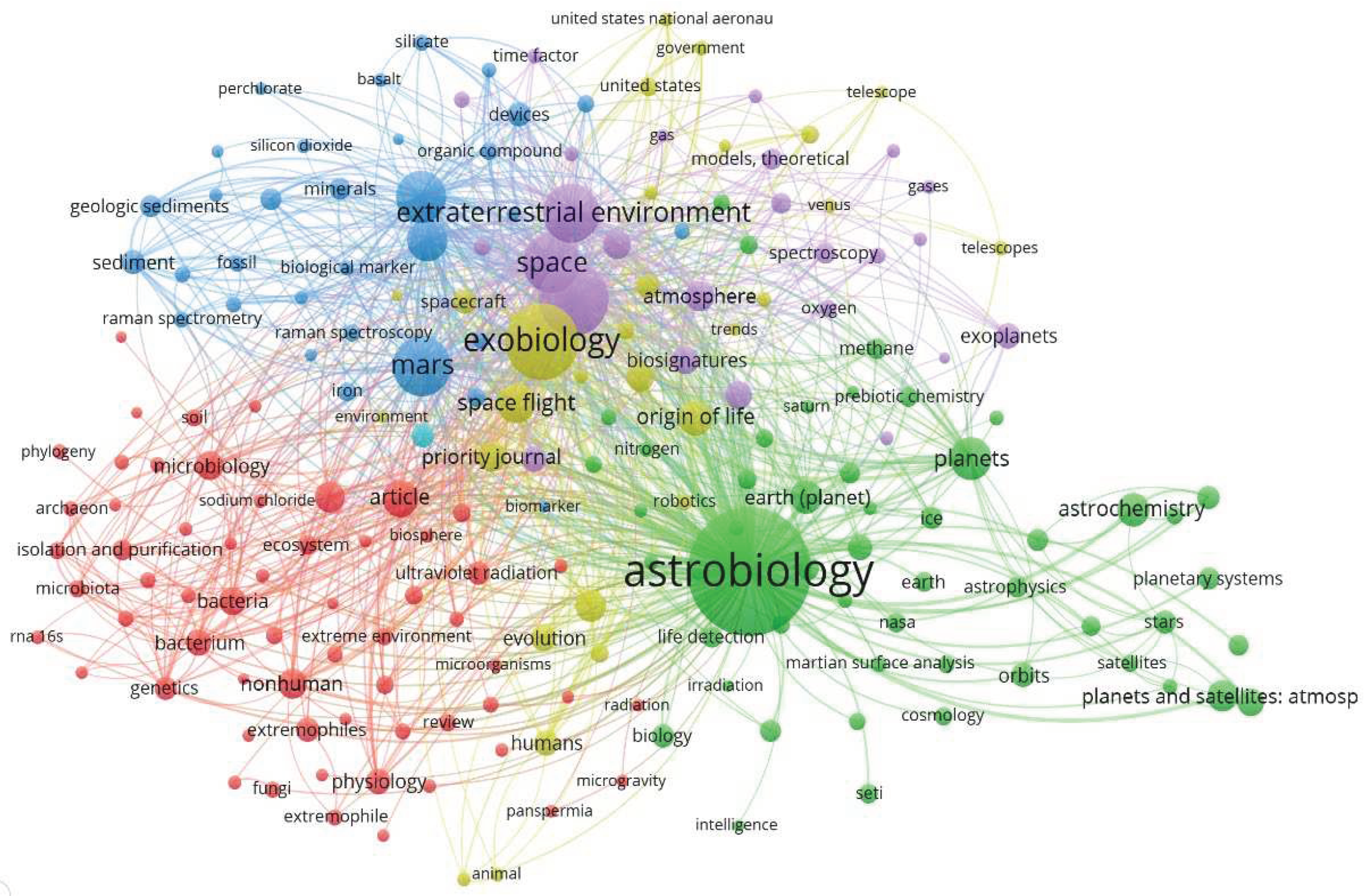
Figure 2.
Overlay visualization of the co-occurrence network map of keywords. Keywords are represented based on the average year of publication of documents they occur in, on a color gradient from blue (older publication), to green (publication equally distributed across the timespan), to yellow (more recent publications). The color gradient is chosen automatically by the program to underline the differences through time.
Figure 2.
Overlay visualization of the co-occurrence network map of keywords. Keywords are represented based on the average year of publication of documents they occur in, on a color gradient from blue (older publication), to green (publication equally distributed across the timespan), to yellow (more recent publications). The color gradient is chosen automatically by the program to underline the differences through time.
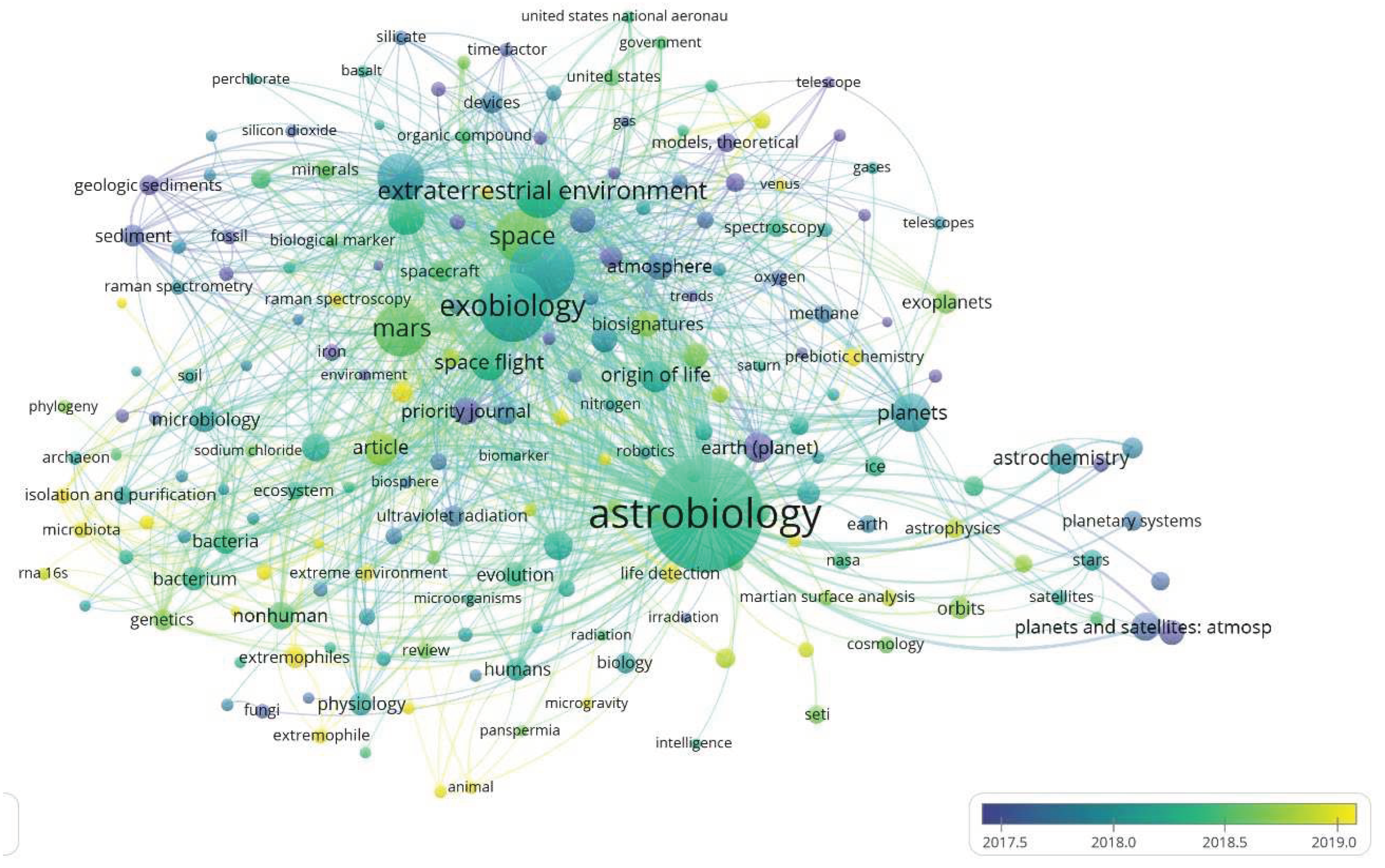
Figure 4.
Co-occurrence network map of keywords in the global scientific literature on astrobiology, biomining, and bioleaching. The size of each keyword (node) in the network is directly proportional to its number of occurrences in the documents analyzed. Colors indicate clusters to which keywords are univocally assigned based on their reciprocal relatedness.
Figure 4.
Co-occurrence network map of keywords in the global scientific literature on astrobiology, biomining, and bioleaching. The size of each keyword (node) in the network is directly proportional to its number of occurrences in the documents analyzed. Colors indicate clusters to which keywords are univocally assigned based on their reciprocal relatedness.
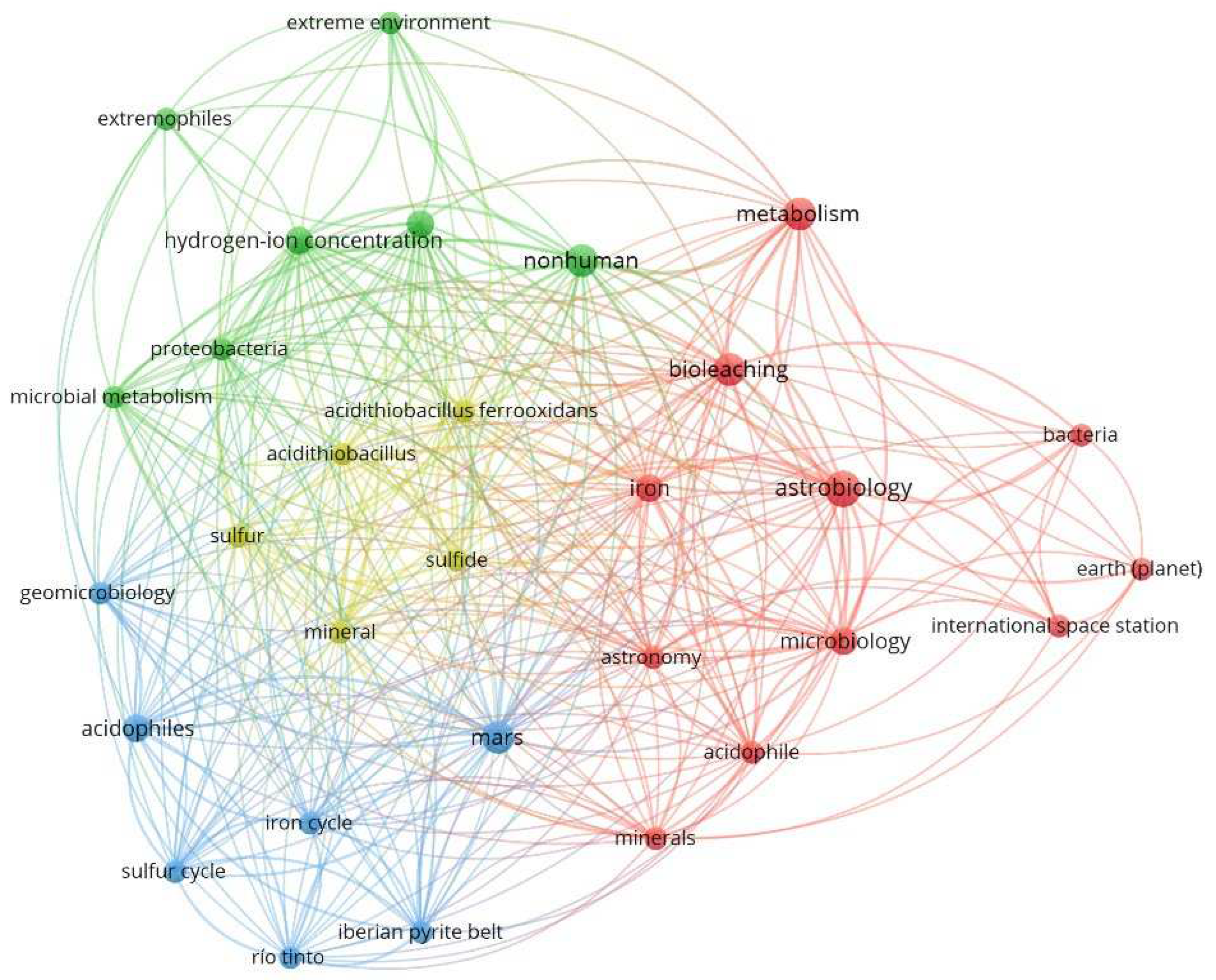
Figure 5.
Overlay visualization of the co-occurrence network map of keywords. Keywords are represented based on the average year of publication of documents they occur in, on a color gradient from blue (older publication), to green (publication equally distributed across the timespan), to yellow (more recent publications). The color is chosen automatically by the program.
Figure 5.
Overlay visualization of the co-occurrence network map of keywords. Keywords are represented based on the average year of publication of documents they occur in, on a color gradient from blue (older publication), to green (publication equally distributed across the timespan), to yellow (more recent publications). The color is chosen automatically by the program.
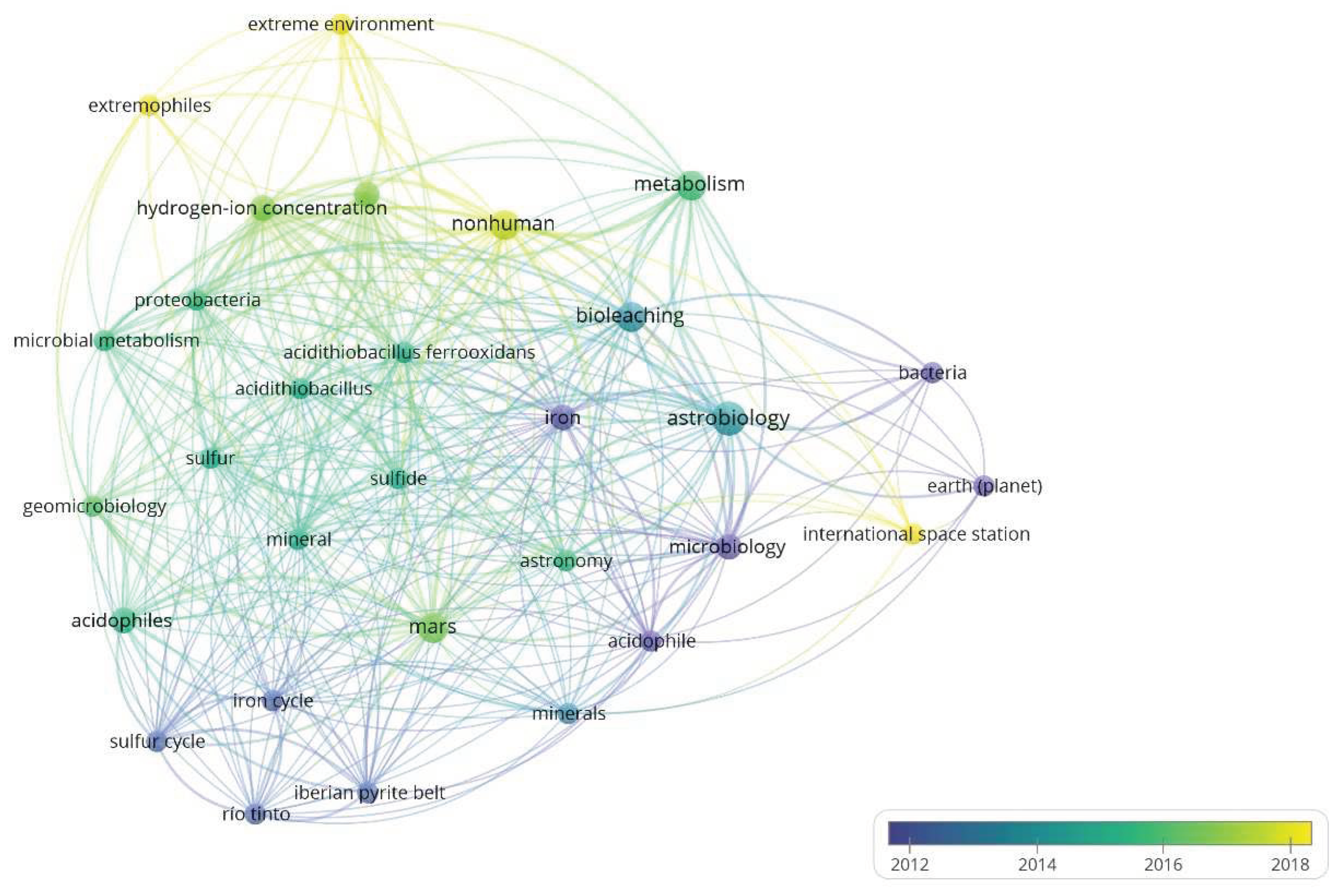

Table 1.
The terminology used in the bibliometric analyses performed in this study.
| Term | Description |
|---|---|
| Items | Objects of interest (i.e., publications, researchers, keywords, authors). |
| Link | Connection or relation between two items (e.g., co-occurrence of keyword). |
| Number of links | The number of links, expressed by a positive numerical value. |
| Link strength | Attribute of each link, expressed by a positive numerical value. In the case of co-authorship links, the higher the value, the higher the number of publications the two researchers have co-authored. |
| Total link strength | The cumulative strength of the links of an item with other items. |
| Network | Set of items connected by their links. |
| Cluster | Set of items included in a network map. |
| Co-occurrence analysis | The number of co-occurrences of two keywords is the number of publications in which both keywords occur together in the title, abstract, or keyword list. |
| Co-authorship analysis | The relatedness of items is determined based on the number of co-authored documents. |
| Overlay visualization | Network analysis feature depicting network items based on their average publication year. |
Disclaimer/Publisher’s Note: The statements, opinions and data contained in all publications are solely those of the individual author(s) and contributor(s) and not of MDPI and/or the editor(s). MDPI and/or the editor(s) disclaim responsibility for any injury to people or property resulting from any ideas, methods, instructions or products referred to in the content. |
© 2023 by the authors. Licensee MDPI, Basel, Switzerland. This article is an open access article distributed under the terms and conditions of the Creative Commons Attribution (CC BY) license (http://creativecommons.org/licenses/by/4.0/).
Copyright: This open access article is published under a Creative Commons CC BY 4.0 license, which permit the free download, distribution, and reuse, provided that the author and preprint are cited in any reuse.


