

Submitted:
06 May 2023
Posted:
08 May 2023
You are already at the latest version
Abstract
A substantial body of phenomenological and theoretical work over the last few years strengthens the possibility that the vacuum energy density (VED) of the universe is dynamical, and in particular that it adopts the `running vacuum model' (RVM) form, in which the VED evolves mildly as $\delta \rho_{\rm vac}(H)\sim \nu_{\rm eff} m_{\rm Pl}^2{\cal O}\left(H^2\right)$, where $H$ is the Hubble rate and $\nu_{\rm eff}$ is a (small) free parameter. This dynamical scenario is grounded on recent studies of quantum field theory (QFT) in curved spacetime and also on string theory. It turns out that what we call the `cosmological constant', $\Lambda$, is no longer a rigid parameter but the nearly sustained value of $8\pi G(H)\rho_{\rm vac}(H)$ around (any) given epoch $H(t)$, where $G(H)$ is the gravitational coupling, which can also be very mildly running (logarithmically). Of particular interest is the possibility suggested in past works that such a running may help to cure the cosmological tensions afflicting the $\Lambda$CDM. In the current study, we reanalyze it in full and we find it becomes further buttressed. Using the modern cosmological data, namely a compilation of the latest SNIa+BAO+$H(z)$+LSS+CMB observations, we probe to which extent the RVM provides a quality fit better than the concordance $\Lambda$CDM model, paying particular emphasis on its impact on the $\sigma_8$ and $H_0$ tensions. We utilize the Einstein-Boltzmann system solver \texttt{CLASS} and the Monte Carlo sampler \texttt{MontePython} for the statistical analysis, as well as the statistical DIC criterion to compare the running vacuum against the rigid vacuum ($\nu_{\rm eff} = 0$). On fundamental grounds, $\nu_{\rm eff}$ receives contributions from all the quantized matter fields in FLRW spacetime. We show that with a tiny amount of vacuum dynamics ($|\nu_{\rm eff}|\ll 1$) the global fit can improve significantly with respect to the $\CC$CDM and the mentioned tensions may subside to inconspicuous levels.
Keywords:
cosmology
; cosmological constant
; dark energy
1. Introduction
The vanilla concordance model of cosmology, or standard CDM model (the current standard model of cosmology with flat three-dimensional geometry), is based on the Friedmann-Lemaître-Robertson-Walker (FLRW) metric and has been a rather successful paradigm for the phenomenological description of the universe for more than three decades [1,2]. Its consolidation after a solid observational underpinning, however, was only possible in the late nineties [3]. The vanilla model has remained robust and unbeaten for a long time, as it is essentially consistent with a large body of observations. These have indeed provided strong support for a spatially flat and accelerating universe in the present time. The ultimate cause of such an acceleration is currently unknown, but it is attributed to an energy component in the universe popularly called “dark energy" (DE), which may adopt a large number of picturesque forms depending on the favorite theoretical preference of different cosmologists see e.g. [4] for a large variety of options. The DE constitutes of the total energy density of the universe and presumably possesses enough negative pressure as to produce the observed cosmic acceleration. Nevertheless, the nature of the DE remains still a complete mystery. The simplest candidate is the cosmological term in Einstein’s equations, , usually assumed to be constant, which is why it is usually called the cosmological constant (CC) [5,6]. Consistent observational measurements of (treating it as a mere fit parameter) made independently in the last quarter of a century using distant type Ia supernovae (SNIa), the baryonic acoustic oscillations (BAO) and the anisotropies of the cosmic microwave background (CMB), have put the very foundations of the concordance CDM model of cosmology [7,8,9,10,11,12,13,14,15].
Despite the vanilla CDM) model fares relatively well with the current observational data, it traditionally suffers from a variety of problems of different kinds which seriously challenge its credibility. For a long time people somehow decided to turn a blind eye on the deepest questions and also on different spots and wrinkles which perturb that flawless and immaculate condition. The profound theoretical problems (and the practical wrinkles as well) are nonetheless still there alive and kicking, whether we wish to look at them or not. First and foremost, the hypothetical existence of dark matter (DM) still lacks of direct observational evidence. On a deeper level of mystery, the nature and origin of the DE (the dominant component of the cosmic energy budget) still lies in the limbo of the most unfathomable cosmological riddles. Basically because if we admit the simplest proposal for the DE, that is to say, the cosmological constant , one has to cope with the ‘cosmological constant problem’[16], perhaps the most inscrutable of all problems in theoretical physics and cosmology ever [17]. It manifests itself in a dual manner, to wit: the fine-tuning problem associated with the large value of predicted by most theoretical approaches (“the old CC problem” [16]); and also what has become customary to call the ‘cosmic coincidence problem’ [18], see also [17,19,20] for a discussion of these enigmas, which lie in the interface between cosmology and quantum field theory (QFT).
The toughest conundrum of all is probably that of explaining the relation between and the vacuum energy density (VED): , where is Newton’s constant. The interrelationship between VED and in the general quantum theory context has been assessed by theoretical physicists since more than a century ago, as of the days of W. Nernst and W. Pauli. At that time the issue was already troublesome [17]. But the most severe implications in the cosmological arena took shape only with the development of the formal aspects of QFT. It is in this modern theoretical context where the notion of VED seems to cause a serious conflict with the cosmological measurements, the reason being that the typical contribution from the vacuum fluctuations of any quantum field of mass m is expected (on mere dimensional grounds) to be proportional to the quartic power of its mass: [21]. Such a prediction must be compared with the measured value of expressed in terms of the corresponding VED, which is GeV in natural units. This is extremely small in comparison with the energy density that one may estimate using any particle physics’ mass m from, say, the electronvolt scale to the mass scale of the weak gauge bosons in electroweak theory, and Z ( GeV), the Higgs mass ( GeV) and the top quark mass ( GeV). The exception would be, of course, a millielectronvolt neutrino [17], but for any typical standard model particle the value of is mind-bogglingly too large, being indeed dozens of orders of magnitude astrayed as compared to the measured value of , not to speak of the situation in the Grand Unified Theories (GUT’s), where the characteristic energy scale can reach GeV. It is because of the cosmological constant problem phrased on these grounds that the VED option became outcast as if were to be blamed of all evils. The aforesaid notwithstanding, the criticisms usually have nothing better to offer, except to defend tooth and nail particular forms of the DE without providing any explanation about the genuine subject involved in the original discussion of this problem, which is, of course, to understand the role played by the VED in QFT and its fundamental relation with . Most, if not all proposed forms of DE, are actually plagued with the same (purported) fine tuning illness that is attributed (in a way by fiat) to the vacuum option exclusively. This is certainly the case e.g. with the popular family of quintessence models, phantom fields and generalizations thereof, see e.g. [5,6,22,23] and references therein.
In recent years, however, new approaches to the notion of vacuum energy in QFT and its relation with the -term suggest that these problems can be smoothed out to a large extent. In fact, the VED can be properly renormalized in QFT in curved spacetime, thereby offering a better theoretical context for the traditional vacuum energy approach to fit in with the observations. In the light of these developments, the quantum vacuum energy could well be after all the most fundamental explanation for the DE in our universe. See e.g. [17,19] as well as the latest formal developments in [24,25,26,27], summarized in [20].
The vanilla CDM model, to which modern cosmological observations have converged in the last decades, is certainly an important triumph in our description of the main background features of the cosmic expansion and the large-scale structure formation processes in the universe. However, it is only a partial success. Its exceeding simplicity eventually turned into a perilous double-edge sword; in fact, the absence of any connection with fundamental physics is the literal expression of such a simplicity and is most likely at the root of its many shortages. In truth, the CDM does not possess enough theoretical structure to explain the successfulness of the observations (e.g. the measured value of ) on a fundamental context, and at the same time it cannot even provide an explanation for other measurements that are threatening its viability. If we pay attention to the existing conflicts on several active fronts, the observational situation of the CDM in the last decade or so does not seem to paint a fully rosy picture anymore. Beyond formal theoretical issues, a series of practical problems of more mundane nature than those mentioned above are piling up as well [28]. On a mere phenomenological perspective, it is particularly worrisome the situation with some “tensions” existing with the data. For example, it has long been known that there appear to exist potentially serious discrepancies between the CMB observations (based on the vanilla CDM), and the local direct (distance ladder) measurements of the Hubble parameter today[29]. The persisting mismatch between these measurements is what has been called the “-tension”. It is arguably the most puzzling open question within the current cosmological paradigm and it leads, if taken at face value, to a severe discrepancy of c.l. or more, between the mentioned observables. Many proposals have been put forward to shed some spark of light into that puzzling cosmological imbalance. Among the possibilities debated in the literature, it has been conjectured e.g. that it could stem from a possible intrinsic “running of with the redshift” presumably connected with the differences that may appear in the (total) effective equation of state (EoS) of the universe between the vanilla cosmology and the actual FLRW model underlying the observations [30,31]. While these are an interesting possibilities, we are probably still far away from understanding the resolution of this conundrum on fundamental grounds. At the same time, there exists a smaller but appreciable () tension in the realm of the large-scale structure (LSS) growth data, called the “-tension” [32]. It is concerned with the measurements of weak gravitational lensing at low redshifts (). Such a tension is usually evaluated with the help of the parameter or, alternatively, by means of ; recall that . It turns out that these measurements favor matter clustering weaker than that expected from the vanilla model using parameters determined by CMB measurements, see e.g. [33,34,35,36,37,38,39,40]. Recently, it has been claimed that values determined from increase with redshift in the CDM[41], which, according to these authors, provides additional support to the fact that such a discrepancy may be physical in origin and with a value in the enhanced range. In the constant pursue for a possible late-time solution to these tensions, it has been argued that within the large class of models where the DE is treated as a fluid with EoS , solving the tension demands the phantom condition at some z, while solving both the and tensions requires to cross the phantom divide and/or other sorts of transitions, see e.g. [42,43,44,45,46,47]. Specific realizations of the noticed double condition for the DE fluid can be found in the literature, e.g. in the context of the XCDM model [48,49], closely related to the idea of running vacuum to be discussed in the present work, see below. For detailed reviews on these tensions and other challenges afflicting the concordance CDM model, see e.g. [28,50,51] and the long list of references quoted there bearing relation to these matters.
The severity of some of these tensions and the huge number of proposals existing in the literature trying to explain them through a large disparity of ideas suggest that it is perhaps time to come to grips anew with the fundamentals of the theoretical formulations, such as quantum field theory and string theory. We have already pointed out to recent calculations claiming a more adequate renormalization prescription for the VED in quantum field theory in FLRW spacetime, and leading to the “running vacuum model” (RVM). It turns out that this QFT approach may have real impact not only on the more formal theoretical problems described in the beginning, but also on the practical issues concerning the aforementioned tensions. In fact, the resulting VED from the RVM leads to a time-varying vacuum energy density, and hence a time-varying (physical) as well, in which acquires a dynamical component through the quantum vacuum effects: . The shift is calculable in QFT since it depends on the contributions from the quantized matter fields (bosons and fermions). Upon appropriate renormalization one finds that depends on a term of order of the Hubble rate squared [24]: (). This is the typical form of the RVM. The connection of the latter with QFT can be motivated from semi-qualitative renormalization group arguments on scale-dependence, see the reviews [17,19]. In particular, we mention the old works [52,53] and also recent approaches along these lines, such as [54]. However, an explicit QFT calculation leading to that form of ‘running ’ (associated to the `running VED’) appeared only very recently [24,25,26,27].
A note of caution is in order here. Over time a large variety of cosmological models have been proposed to describe the DE and its possible dynamics. Apart from the aforesaid quintessence models and the like[5,6,22,23], there is a very populated habitat of models with generic time-dependent cosmological constant, the so-called “-cosmologies”. Many of these models, however, are of pure phenomenological nature since the time dependence of is parameterized in an ad hoc manner. They might have a connection with fundamental theory, but it is not implemented in an explicit way in the corresponding papers. The list of models of this type is large and we will cite here only a few of them [55,56,57,58,59,60,61,62,63,64,65,66,67,68,69,70,71,72,73,74]; see also the old review [75]. In some cases, the parameterization is performed through a direct function of the cosmic time or of the scale factor, and sometimes as a function of the Hubble parameter, or even an hybrid combination of these various possibilities. Be as it may, the general and rather nonspecific class of the “-cosmologies” should not be confused with the “running vacuum models” (RVMs) discussed above, in which the running of stems from the quantum effects on the effective action of QFT in curved (FLRW) spacetime. In other words, the RVMs are to be understood in a much more restricted sense; in fact, one that is closer to fundamental aspects of QFT, and only this precise type of time-evolving VED cosmologies will be dealt with here. Let us finally note that, apart from the QFT formulation, a ‘stringy’ version of the RVMs is also available which can be very promising too [76,77,78,79]. The potential dynamics of the cosmic vacuum is, therefore, well motivated from different theoretical perspectives, and this fact further enhances the interest for the current study, whose main purpose is to focus exclusively on the phenomenological implications of the class of RVM models.
We should mention that the running vacuum framework has already been tested with considerable success in previous works over the years. It has been known for quite some time that the RVM-type of cosmological models can help in improving the overall fit to the cosmological observations and also in smoothing out the mentioned tensions as compared to the CDM; see for instance [36,80,81,82,83,84,85,86,87,88], and [89,90] for a short summary. For this reason we believe it is worthwhile to keep on exploring the phenomenological consequences of the running vacuum in the light of the latest observations on all the main data sources: SNIa+BAO++LSS+CMB. The state-of-the-art-phenomenological performance of the RVM has been reported not too long ago in [80]. In the current work, however, we definitely enhance the scope of the results presented in that paper by considering an updated cosmological data set in combination with an extended analysis of the CMB part. In point of fact, the main focus in this paper is to delve into the practical ability of the RVM to tackle the and tensions versus the vanilla CDM model. It is reassuring to find that the global fit to the cosmological observations can be improved within the running vacuum framework with respect to the CDM. The optimal situation is when the VED presents a threshold in the recent past, where its dynamics becomes activated, and/or when the gravitational coupling is mildly running.
All in all, the dynamical DE models may offer a clue not only to relieve some high-brow aspects of the cosmological constant and coincidence problems, but also to straighten out some very practical ones, such as helping to modulate the processes of structure formation which may impinge positively on the -tension. Last but not least, they can help to explain the existing mismatch between the distinct values of derived from measurements of the local and the early universe.
The paper is organized as follows. In Section 2, we present the running vacuum model (RVM) from a phenomenological point of view and emphasize its connection with QFT in curved spacetime. For convenience, we introduce the model variant of the RVM which we call RRVM, as we did in [80]. In it, the VED can be expressed entirely in terms of the curvature scalar (which is of order ) at the background level and study two types of RRVMs: type I and type II, depending on whether the gravitational coupling G is fixed at its current local gravity value, , or evolving mildly with the expansion, , a feature which in our case is respectively linked to the interaction or not of the evolving vacuum energy with cold dark matter (CDM). Type I is studied at length in Section 3, where we describe the background cosmological equations and its solution under appropriate conditions. At the same time we discuss the corresponding perturbations equations. Type II, on the other hand, is studied in detail in Section 4, where again we provide the background solution and analyze the perturbations. In Section 5 we enumerate and briefly describe the different sources of observational data employed in this paper and the methodology used to constrain the free parameters of the models under discussion. We also define the four characteristic datasets (Baseline and Baseline+SH0ES with and without CMB polarization data) that will be used to test the running vacuum models and their comparison with the vanilla CDM model. The outcome of our analyses under the different datasets is presented and discussed in detail in Section 6. Finally, in Section 7 we summarize our findings and present the main conclusions of this study. In the Appendix A at the end of our work we include additional tables with a detailed breakdown of the different contributions from each observable.
2. Running Vacuum in the Universe
As indicated, throughout our study we will assume that the background spacetime is FLRW with flat three-dimensional hypersurfaces. The general low-energy form of the vacuum energy density (VED) within the running vacuum model (RVM) has been explored phenomenologically on several previous occasions and with a remarkable degree of success, in the sense that in all cases it has proven to be rather competitive with the CDM and even able to surpass the fitting performance of the latter, see e.g.[36,80,81,82,83,84,85,86,87,88]. Herein we shall test if it is still the case with the current wealth of observations and using the state-of-the-art methods of analysis of the cosmological data. The dynamical structure of the running VED adopts the perspicuous form[24,25]
Here the dot indicates derivative with respect to the cosmic time and is the Hubble function. As we can see, the two leading dynamical terms of in Eq. (1) are both of since , this being true both in the matter and radiation dominated epochs. Despite that the higher order terms in the above expression are predicted as well in the QFT context [25], they are unimportant for the current universe and will be hereafter ignored. The additive parameter is constrained to satisfy , where is the value of the VED today, and hence is connected with the physical value of the measured cosmological constant through . The bulk of this value is provided by as the two (dimensionless) coefficients and adjoined to the two dynamical terms in (1) are expected to be small () [91]. They encode the running character of the vacuum at low energy and can be computed in QFT in curved spacetime from the contributions from the quantized bosons and fermion fields. The explicit calculation was first presented in [24,25] and was recently completed in [27]. In these references, it is shown that the above VED structure can be formally derived from quantum effects on the effective action of QFT in FLRW spacetime. In practice, however, the values of must be fitted to the cosmological observations. Thus, in what follows we will focus exclusively on the phenomenological consequences of the RVM. What is important is that these coefficients are expected to be small and of order , where GeV is the Planck mass and GeV is of order of a typical GUT scale (or even a string scale slightly above it) times a multiplicity factor accounting for the number of heavy particles in the GUT [91]. For we recover the CDM smoothly. This is a very welcome property of the RVM since DE models having no smooth CDM limit, e.g. predicting a VED of the form or a combination of and (without any additive term), would be excluded owing to their absence of an inflexion point from deceleration into acceleration in the cosmic evolution, see [88,92,93]. The presence of the nonvanishing additive term is therefore crucial for the RVM to avoid this unwanted situation, something that other models (e.g. entropic and ghost models of the DE) cannot avoid and thereby get into trouble [94,95]. Holographic models with dynamical cutoff also lack of an additive term in the DE and are also unfavored already at a pure cosmographic level [96]. In stark contrast, the condition is always warranted within the class of the RVMs.
It is important to realize that the dynamics of the VED must preserve, of course, the Bianchi identity satisfied by the Einstein tensor. In practice this means that the total energy-momentum tensor (EMT), which receives the contributions from nonrelativistic matter, radiation and vacuum (assumed here to be ideal fluids), must be covariantly conserved, namely . The total EMT reads,
where is the 4-velocity vector of the cosmic fluid. We have defined , where denotes the contribution to the proper density of nonrelativistic matter from cold dark matter and baryons, (non-cold dark matter) corresponds to the energy density of neutrinos and designates the energy density associated with photons. Analogous notations apply to the pressures. We shall, however, be more specific in our treatment of the various contributions to the EMT in the next section. Notice that in the above expression we have used for the EoS of the vacuum fluid. Even though this condition may be violated slightly by quantum effects within a formal treatment of the subject in QFT [26], we shall nonetheless stick for now to the traditional EoS of the vacuum. We shall come back to this point later on. Upon expanding , it amounts to the local covariant conservation law in a FLRW universe
where, in general, not only but also G may be functions of the cosmic time. This will depend on the particular implementation assumed for the matter sector. If we assume that there is an interaction of the VED with matter, then G can stay fixed at the usual value (the local gravity value), whereas if matter is locally conserved, then G must vary accordingly in order to preserve the covariant conservation law (3).
In order to ease the comparison with previous results, we shall adhere to the approach of [97] and assume . In this way the RVM model is left with one single parameter and at the same time adopts the suggestive form
in which is the curvature scalar1. That particular implementation is called, for obvious reasons, the RRVM, since it is a version of the RVM which involves the scalar of curvature [97]. One additional advantage is that it is automatically well-behaved in the radiation dominated epoch since in it , and the standard BBN is not perturbed at all by the presence of vacuum energy. In the general case (1) such condition can also be fulfilled on assuming sufficiently small (absolute) values of [85].
Finally, despite the general structure of the running VED is of the form (1), for convenience we define two types of RRVM scenarios. In type-I scenario the vacuum is in interaction with matter, whereas in type-II matter is conserved at the expense of an exchange between the vacuum and a slowly evolving gravitational coupling . The combined cosmological ‘running’ of these quantities insures the accomplishment of the Bianchi identity (and the associated local conservation law). In the following sections we study these two cases separately.
3. Type I: Running Vacuum Interacting with Dark Matter
In this section, we consider the type-I RRVM scenario, in which the vacuum can be running at the expense of exchanging energy with matter. We will assume that only cold dark matter (CDM) is involved in such an exchange (therefore no baryons, neutrinos or photons are transferred to or from the vacuum). Whether it is the vacuum that generates new CDM or the CDM that disappears into the vacuum depends on the sign of the parameter in Eq. (4). For , the vacuum decays into tiny amounts of CDM, whilst for some dark matter disappears into the vacuum. We do not presume which of these situations hold, we will fit the value (and sign) of to the cosmological data. This requires to solve the background and linear perturbation equations of the type-I running vacuum model, which we do in Secs. Section 3.1 and Section 3.2.
3.1. Background Equations
The VED expression (4) can be cast more explicitly as follows,
The above energy component becomes now part of the Friedmann and the pressure equations written in terms of the energy densities and the pressures for the different species in game, which read
The following comment is in order. As it is well known there is a transfer of energy from the relativistic neutrinos to the nonrelativistic ones throughout the whole cosmic history. It is difficult to make a perfect separation of the relativistic and nonrelativistic phases and, strictly speaking, this splitting can be a little bit inaccurate at those epochs of the expansion history at which a neutrino species is in an intermediate step, between the ultra-relativistic and nonrelativistic regimes, since in this case one cannot classify such neutrino species in any of these two categories. Nevertheless, it is useful to obtain approximate formulas for the two components, as we shall see in a moment. We proceed as in the Einstein-Boltzmann solver CLASS2 [99,100], where we have implemented our model. CLASS solves the Einstein and Boltzmann differential equations at any value of the scale factor and, in particular, provides the functions and . CLASS performs then a rather artificial splitting of these quantities, as if they came from the sum of an ultra-relativistic fluid (denoted with a subscript ) and a nonrelativistic one (denoted with a subscript h),
At this point we can rewrite the combination appearing in (5) in terms of the energy densities and pressures using (6) and (),
In this expression, we can appreciate that the nonrelativistic contribution from massive neutrinos, namely is present. This is a problem if we want to solve the background equations, since it carries a complicated (non-analytic) dependence on the scale factor. In order to solve this problem we can consider a reasonable approximation, which is the following:
We have checked explicitly the validity of this approximation with CLASS, computing the ratio for the whole cosmic history. We have found that r varies smoothly from at redshift to at considering a massive neutrino with mass eV. In addition, r is multiplied by in Eq. (5), so the resulting quantity is of order at most. Therefore, we deem it natural and licit to drop this term to make things easier without any significant loss of accuracy in our calculation.
Under this very good approximation, we can express the vacuum energy density (5) as follows,
with and . We still need to find , though. The starting point is the equation (3) which yields the interaction law between vacuum and matter in the general case. Now since we assume that G is strictly constant for the type-I models, Eq. (3) boils down to
where we are neglecting the pressure of the matter components. Notice that the previous equation is entirely equivalent to the interaction law between CDM and vacuum,
owing to the fact that we are assuming that baryons do not interact at all with the vacuum, which entails the relation . In this way we have obtained the conservation equation of matter (baryons+CDM) for type-I models.
Combining the above equations, we arrive at the final result
where we have defined the dimensionless parameter
It is then straightforward to find out the expressions for the various energy densities:
In the limit () we recover the expected forms of these equations in the CDM. It is also possible to encode the deviations with respect to the standard cosmological model in terms of an effective parameter , defined as
We will report all our fitting results in terms of parameter . As with , positive values of lead to a decay of the vacuum into CDM, whereas negative values source an energy transfer from CDM to the vacuum.
3.2. Perturbation Equations
We have implemented the perturbation equations in CLASS, using the synchronous gauge. Denoting by the conformal time, the perturbed (flat three-dimensional) FLRW metric in the conformal frame reads [101],
with
and . The above formula represents the perturbation expressed as a Fourier integral on the two fields in k-space, and , which parameterize the non-traceless and traceless parts, respectively. The nonvanishing trace is the h function. The perturbed Einstein equations in Fourier space adopt the same form as in the CDM. They read as follows:
where , the sums run over the different matter components, the primes denote derivatives with respect to the conformal time, and
carries the information of the anisotropic stress, with the total energy-momentum tensor. The bars in these equations indicate background quantities and is the divergence of the perturbed velocity of the fluid l. Eqs. (23) and (24) are obtained from the 00 and components of Einstein’s equations, respectively, whereas Eqs. (25) and (26) are the trace and the part proportional to of the component.
All the perturbed conservation equations are also the same as in the standard model, except those that relate CDM and the vacuum, which take the following form,
with the CDM density contrast and the divergence of the perturbed CDM 3-velocity. We consider a vacuum–geodesic CDM interaction such that there is no net momentum transfer between the vacuum and cold dark matter [36,102,103]. Thus, we can fix the gauge by setting , as in the CDM. This automatically sets . In this setup, Eq. (29) simplifies,
This is actually the only perturbation equation that must be modified in CLASS in order to accommodate the dynamical character of the VED, i.e. the fact that . In this work, we consider adiabatic perturbations for the various matter and radiation species.
3.3. Type I with Threshold
Once we have obtained the background and the perturbation equations we are in position to study the cosmological evolution of the RVM in different situations. The conventional option would be to assume that the above equations are valid throughout the entire cosmic history (subsequent, of course, to the inflationary period, which will not be dealt with here at all). The phenomenological analyses of Refs.[83,84,85,86,87,88], for example, were based on that standard assumption. However, we may also entertain the intriguing possibility that the interaction between the vacuum and dark matter is only relatively recent. In that case we could have an scenario where the dynamics of the vacuum starts approximately at the time when it becomes dominant over matter (i.e. at about the outset of what is usually referred to as the DE epoch). Such a situation should be characterized by the presence of a ‘threshold point’ for the vacuum dynamics at some redshift value , where the transition occurs. The idea is to study the response of our fit to the overall cosmological data when we switch off the interaction between the VED and the CDM for most of the cosmic history, except when we approach the usual epoch of vacuum dominance. Since the conventional DE epoch in the late universe is usually assumed to commence at around a redshift value , we will assume that its evolution also gets kicked off at around that point (see below).
We will implement the simplest version of such a threshold scenario through a Heaviside -function, and for definiteness it will be restricted to type-I models only. Thus, let be the value of the scale factor where the activation of the vacuum dynamics occurs ( being the corresponding redshift value). Before reaching that point (that is, at earlier epochs ) the vacuum is rigid, whereas after that point (hence nearer to our present time) the vacuum evolves with the expansion following the type-I running vacuum behavior, see Eq. (). We have checked that the optimal value for this parameter is , which indeed corresponds to 3 It should be noted that while the VED function will remain continuous in our implementation of the step function procedure, its time derivative does not, and in fact it gets modified through a Heaviside function factor . Accordingly, the derivative of the CDM energy density must also change in a discontinuous way. In contradistinction, all the energy densities are continuous at . Consequently, we find that in order to fulfill these requirements we must implement the analytical expressions for the various density functions in the following way:
()
()
In the above expression, we have defined
It goes without saying that the same modifications have to be applied in the perturbation sector.We denote this version of the type-I RRVM with threshold as type-I RRVM.
We do not wish to speculate here on the possible origin of the threshold postulated above, it could be a manifestation of a late-time interaction in the dark sector. However, we mention that a fundamental microscopical explanation might come from the RVM framework emerging from QFT in curved spacetime[26], which indicates that the EoS of the quantum vacuum stays in the characteristic DE range () only below a redshift value (threshold) in our recent past . For , instead, one has and the vacuum does no longer behave as DE. This is of course impossible for the classical vacuum, for which all the time. Additional studies will obviously be necessary to gauge the impact of such EoS behavior on the global fits to the cosmological data and its potential relation with the type-I scenario with threshold that we have defined above. Finally, we mention that the behavior of the type-I RRVM with threshold should be essentially the same as that of the ‘canonical RVM’ with threshold, namely the original RVM form with the dynamical component , see[17,19] and references therein. The latter corresponds to (1) with only the single parameter (with ). At low z, the two models are expected to be indistinguishable from the phenomenological point of view.
4. Type II: Running Vacuum with Running
For type-II RRVM we have an entirely different sort of scenario, in which matter is strictly conserved, in particular dark matter, and hence no interaction of any sort is permitted between matter and vacuum. However, to switch off the energy exchange between matter and vacuum in a fully consistent way with the Bianchi identity, we must allow for the running of the gravitational coupling with the expansion, . Therefore, for type-II models we have both the running of the vacuum energy density and the running of G. Let us briefly see how it comes about. If matter is conserved we have . The subscript t refers to the sum of all the species in the universe excluding the vacuum, as in previous sections. Whereupon the general Bianchi identity (3) boils down to4
Since the running of is still fixed by (5), the previous equation is essential to determine the running of G. Being , the sign of determines the sign of , i.e. if () G increases (decreases) with the cosmic expansion. Of course, we have to make sure that G evolves in a very mild way, which in fact turns out to be the case as we shall verify explicitly.
In what follows we bring forth the relevant background and linear perturbation equations for the type-II RRVM in Secs. Section 4.1 and Section 4.2, respectively. As it will become clear, the solution of this model type is more complicated.
4.1. Background Equations
We come back to the following form of the vacuum energy density,
which is of course equivalent to our original RRVM expression (4), with and . The Friedmann and pressure equations read, respectively,
where here it is particularly convenient to recall that denotes the (fixed) local value of gravity whereas G stands for the running gravitational coupling. For type-II models G evolves with the expansion, and hence it is generally different from . At the same time, we remind the reader that for type-II models the background energy densities and pressures of the matter species evolve as a function of the scale factor exactly as in the CDM, since now there is no energy exchange between them and the vacuum.
A practical consideration is now in order which will make clear immediately why solving the type-II models is more difficult. Recall that for the numerical analysis we are using the CLASS system solver [99,100]. Now the point is that for the standard cosmological model, CLASS computes H and after computing the energy densities of the various components that fill the universe. In the model under consideration, though, we cannot proceed in the same way, just because we first need to compute G. Before explaining how it is still possible to solve the system in the CLASS platform, it is useful to rewrite the above equations in terms of the auxiliary variable5. One expects at present and one may even impose this condition (see, however, below). In terms of , the set of relevant equations read
where the last one, Eq. (42), is of course nothing but a rephrasing of Eq. (36). This equation is rather complicated since it is obvious from (5) that it involves not only H and , but also . In order to compute the latter it is possible, of course, to differentiate the pressure equation and use it together with (40) and (41). Unfortunately, in doing so one obtains as a function of the derivative of the neutrinos energy density and pressure, which should then be computed numerically. This approach looks too complicated, and therefore we opt for the following alternative and simpler method. We first obtain a differential equation for H. Dividing out equations (40) and (41) we can get rid of , and after some rearrangement we are led to the following differential equation:
The previous equation can be restated in the more convenient form
where we have defined the function
Equation (44) can be solved much more easily than (42), although we still need to employ a numerical procedure. We have all the necessary ingredients. As initial condition (at ) we can use
because the radiation energy density clearly dominates over the nonrelativistic matter and the vacuum. We can tell CLASS to apply the finite difference method to solve step by step the system. In each of these steps CLASS computes from and (44). For the latter it takes the various energy densities and pressures. Then we can employ the Friedmann equation to compute ,
and iterate the process till we have the complete expansion history to the necessary degree of accuracy.
Next we show what is the evolution of during the radiation-dominated (RDE) epoch. First, let us write in terms of the energy densities, pressures, and . Notice that using (40) and (41) we obtain:
Introducing these expressions into (37) we get:
Even though we have solved the type-II model in an exact way using the aforementioned numerical strategy, the following approximate analytical considerations may help to better understand the behaviour of the solution. In the RDE, we have
since only the nonrelativistic component contributes in the term proportional to in the numerator of (50) after the pressure and the radiation densities cancel in the difference . Finally, using (51) in (42) we can easily integrate the resulting equation since in the denominator we have in the radiation epoch. Integrating from the initial scale factor value (see above) up to an arbitrary value, we find the evolution of the gravitational coupling within this analytical approximation:
with and being the radiation density parameter computed assuming that the neutrinos are all massless. Similarly to what we have done for the type-I RRVM (cf. Sec. Section 3.1), we have defined
as in [97]. We actually report the fitting value of this parameter in our tables and contour plots, see the discussion in Section 6. The term in (52) is much smaller than 1, since (52) is valid for . Hence, the total variation of during the RDE is small and of order , , despite being linear with the scale factor. It is easy to see that the relation (51) still holds good in the MDE, but the denominator of (42) is now dominated by the term . Integration now gives
where C is a constant to be fixed by some initial condition in the MDE. It is easy to check that the total variation of in the MDE will be of the order of , i.e. ten times larger than in the RDE. In the vacuum-dominated epoch, the r.h.s. of Eq. (42) goes to zero and , so G stays constant as well.
Traditional limits on the relative time variation of G can be found e.g. in the review [111]. More recent determinations, e.g. those based on measurements on the double pulsar PSR J0737–3039A/B, yield rather tight bounds [112]:
where for weakly self-gravitating bodies. A previous limit from a binary pulsar (PSR J1713+0747) provided [113]
which is a bit weaker but essentially in the same ballpark. On the other hand, the best current limit on the relative variation of G obtained in the solar system is [114]
Assuming that (55)-(57) can be used to constrain the cosmological evolution of G, let us tentatively use these limits (in order of magnitude) in combination with our equation (54) to constrain the parameter . The last equation implies for yr around our time () The previous relation is equivalent to to order . It is then easy to check that in order to fulfill the above limits we must require , a condition which is satisfied by our fitting values of for the type-II models, even in the most restrictive case (see the fitting tables of Section 6) 6.
From the above considerations it is clear that changes very slowly (logarithmically) with the expansion and proportionally to the small parameter . The predicted variations of G within the type-II running vacuum models lie in fact within the most restrictive experimental limits existing in the literature. This demonstrates our contention, mentioned previously, that the running of G within these models is consistent with the observations.
Finally we mention that with the purpose of giving more freedom to the model, in this work we will not impose the condition or, equivalently, , as we did in the previous studies, such as [97] and also in [115,116,117] within the context of the Brans-Dicke model with a cosmological constant. We naturally expect , of course. The obtained fitting values for at present are indicated in our tables as . Let us finally note that cosmologies with variable G may have to rely on an efficient screening mechanism that allows to recover at the Solar System. We will not focus on this issue, which has been addressed in several places in the literature (see e.g. [4,118,119] and references therein), and more recently in [120], as it deserves a more devoted study which is certainly beyond the scope of this work. Let us however note that this situation affects mainly the Brans-Dicke type models [110], where the effective gravitational coupling is tied to a dynamical scalar field that could mediate long range interactions as a true degree of freedom of the underlying gravitational framework. As indicated before, this is not our case. These situations may have an impact only in the non-linear scales, which are anyway not strongly affected by the cosmological observables employed in this study. We close this section by noticing that while in this paper we have assumed that G may change with the cosmic time in type-II models, it could also evolve with a distance scale in a galactic domain, (). Such an extension of the running of the gravitational coupling was considered in [121] and could be helpful to connect the running of G between the galactic/astrophysical and cosmological domains.
4.2. Perturbation Equations
The actual implementation of the linear perturbation equations for type-II models in the CLASS computing platform is more difficult than the background part (which was already nontrivial), and certainly much more involved than the one carried out for the type-I variant (viz. the one with vacuum-CDM interaction). We use again the synchronous gauge, but in this case the gauge unfortunately does not fix , in contrast to the situation in Section 3.2, so we have to keep the contribution of the vacuum perturbation in our equations.
The 00, and components of the Einstein equations in Fourier space read, respectively,
where we have of course split also into a background contribution and a perturbation, . The equation coming from the part that is proportional to of the Einstein component reads,
The zero and spatial component of the covariant conservation equation of the vacuum are, respectively,
where in the last two equations
It is possible to isolate from (63) and substitute it in the other equations. The only difficulty is found when the substitution is performed in (62), since in order to do this we need to evaluate the quantity . CLASS computes but not its derivative. If we knew how to write in terms of , , g and other accessible quantities, then we could obtain the differential equation for from (62) and implement it in CLASS without defining explicitly , just incorporating the effect of the vacuum perturbation directly into the equations. This is actually possible. Let us start differentiating (63). We obtain:
Notice that the quantity , which we have defined previously, appears in this expression. As CLASS does not provide it to us we need to evaluate it by adding some supplementary piece in the code. It is possible to obtain upon differentiating (59) and combining it with (60). The result reads
where and its derivative, , are quantities that we can get from CLASS. Also is provided by CLASS. Now we only need to substitute from (66) in (65), and substitute the resulting expression for in (62). In doing so we finally get the equation for the perturbation:
The initial condition for is easy to find. Deep in the RDE we can neglect all the terms proportional to and , so we are left with the following simple equation:
where in the RDE we have used , of course. The background value of , i.e. , remains almost constant during the RDE. It only grows very mildly with a, with a constant of proportionality which is small. Hence we would expect the constant to be small as well. In any case, we expect at , which is the initial condition that we use for in our modified version of CLASS.

Table 1.
Published values of BAO data, see the quoted references for details and for the corresponding covariance matrices. The fiducial values of the comoving sound horizon appearing in the table are Mpc for [122] and Mpc for [124].
| Survey | z | Observable | Measurement | References |
|---|---|---|---|---|
| 6dFGS+SDSS MGS | [Mpc] | [Mpc] | [122] | |
| DR12 BOSS | [123] | |||
| WiggleZ | [Mpc] | [Mpc] | [124] | |
| [Mpc] | [Mpc] | |||
| [Mpc] | [Mpc] | |||
| DESY3 | [125] | |||
| eBOSS Quasar | [126] | |||
| Ly-Forests | [127] | |||
Table 2.
Values of from cosmic chronometers and their uncertainties, which include the contribution of statistical and systematic effects [137]. They are expressed in km/s/Mpc. We have considered the correlations between the data points marked with a , as discussed in [137]. In some of the quoted references, the authors provide measurements obtained with two different stellar population synthesis (SPS) models. In these cases, we have employed the mean of the two central values and statistical errors. The systematic uncertainty already accounts for the choice of SPS model.
Table 2.
Values of from cosmic chronometers and their uncertainties, which include the contribution of statistical and systematic effects [137]. They are expressed in km/s/Mpc. We have considered the correlations between the data points marked with a , as discussed in [137]. In some of the quoted references, the authors provide measurements obtained with two different stellar population synthesis (SPS) models. In these cases, we have employed the mean of the two central values and statistical errors. The systematic uncertainty already accounts for the choice of SPS model.
| z | [km/s/Mpc] | References |
|---|---|---|
| [128] | ||
| [129] | ||
| [128] | ||
| [130] | ||
| [131] | ||
| [131] | ||
| [128] | ||
| [130] | ||
| [128] | ||
| [131] | ||
| [132] | ||
| [130] | ||
| [132] | ||
| [132] | ||
| [132] | ||
| [133] | ||
| [132] | ||
| [134] | ||
| [131] | ||
| [131] | ||
| [135] | ||
| [131] | ||
| [131] | ||
| [134] | ||
| [130] | ||
| [131] | ||
| [130] | ||
| [136] | ||
| [130] | ||
| [130] | ||
| [130] | ||
| [136] |
Table 3.
Published values of , see the quoted references and text in Section 5.
5. Data and Methodology
We fit the CDM model, the running vacuum models under consideration (the type-I RRVM, the type-I RRVM and the type-II RRVM) and finally the XCDM [147] (also called wCDM), a generic parameterization of the dynamical DE whose dark energy EoS, , is constant and is one parameter of the fit (expected to lie near ). To test the response of the XCDM along with the relevant models under consideration can be useful, as it serves as a benchmark scenario for generic models of dynamical dark energy. We fit all these models to a large, robust and updated set of cosmological observations from all the main sources. Our data set involves observations from: i) distant type Ia Supernovae (SNIa); ii) baryonic acoustic oscillations (BAO); iii) a compilation of (differential age) measurements of the Hubble parameter at different redshifts (); iv) large-scale structure (LSS) formation data (specifically, an updated list of data points on the observable ), and, finally, v) CMB Planck 2018 data of different sorts. A brief description now follows of each of these datasets along with the corresponding references:
SNIa: We consider the data from the so-called ‘Pantheon+’ compilation [148], which contains the apparent magnitudes and redshifts associated to 1701 light curves obtained from 1550 SNIa in the redshift range . See Sec. 2.2 of [149] for details of the theoretical formulae employed to take into account these data points. Interestingly, the new Pantheon+ compilation also includes the 77 light curves from the 42 SNIa in the host galaxies employed by the SH0ES team in their analysis [150,151]. The distance to the host galaxies has been measured with calibrated Cepheids. The inclusion of these luminosity distances in our dataset will be made clear by adding the label “+SH0ES”. They break the existing full degeneracy between and the absolute magnitude of SNIa, M, when only SNIa are considered in the analysis. The SH0ES calibration of the supernovae in conjunction with the cosmic distance ladder leads to larger preferred values of the Hubble parameter of km/s/Mpc [150]. This large value as compared to Planck’s measurement ( km/s/Mpc, obtained from the TT,TE,EE+lowE+lensing data[152]), is at the root of the -tension.
BAO: We employ 13 data points on isotropic and anisotropic BAO estimators. See Table 1 to know the exact values and the corresponding references.
Cosmic chronometers: In our analyses we use 32 data points on the Hubble parameter measured with the differential age technique [153]. They span the redshift range . We provide the complete list of data points and the corresponding references in Table 2. We have considered the effect of the known correlations between the various data points, as explained in [137]. See also Table 2 and its caption. The covariance matrix has been computed using the script provided in the following link 7.
LSS: 15 large-scale structure (LSS) data points between embodied in the observable , which is known as the weighted linear growth rate, being the so-called growth factor and the root mean square mass fluctuations on the Mpc scale. See Table 3 for the complete list of data points and the corresponding references. We can take advantage of the relation to compute this quantity. The function involves the matter power spectrum, which is computed numerically by our modified version of the Einstein-Boltzmann code CLASS. It is important to note that this way of computing can only be used provided that we are in the linear regime, since in this case and in our models the matter density contrast can be written as , where the dependence on the scale factor and the comoving wave number k is factored out. The term is known as the growth function and encodes the initial conditions.
CMB: For the cosmic microwave background data, we utilize the full Planck 2018 TT,TE,EE+lowE likelihood [15]. It incorporates the information of the CMB temperature and polarization power spectra, and their cross-correlation. We refer to this dataset simply as “CMB”. We also test separately the Planck 2018 TT+lowE likelihood, which does not include the effect of the high-ℓ multipoles of the CMB polarization spectrum. This is done to check the impact of this particular dataset on our fitting results. It is also useful to compare with our previous analyses [80], in which only this type of CMB data were used. In our fitting scenarios, we indicate the removal of the high-ℓ CMB polarization data from the complete CMB likelihood with the label “CMB (No pol.)”.
As described in the preceding lines, for the SNIa we may or may not include the information provided by the SH0ES team whereas for the CMB we can consider the effect of the high-ℓ polarization data or not. An alternative calibration method of the absolute magnitude of SNIa based on the tip of the red giant branch [154,155] instead of Cepheids yields a measurement of somewhat in the middle of those provided by Planck [15] and SH0ES [150], km/s/Mpc 8. In addition, it is also convenient to test the impact of the CMB polarization data from Planck, since previous works in the literature have found a moderate inconsistency between them and the Planck CMB temperature data, both in the 2015 [35] and 2018 [37] releases. This inconsistency could be due to a deficiency of the CDM or the presence of unaccounted systematics in the data. Hence, these arguments motivate us to explore these four different datasets:
- Baseline: In our Baseline dataset we consider the string SNIa+BAO++LSS+CMB. Notice that here we do not include the SH0ES data.
- Baseline+SH0ES: The Baseline dataset is in this case complemented with the apparent magnitudes of the SNIa in the host galaxies and their distance moduli employed by SH0ES.
- Baseline (No pol.): The same as in the Baseline case, but now removing the high-ℓ polarization data from the CMB likelihood. That is to say, we have replaced the “CMB” dataset with “CMB (No pol.)”.
- Baseline (No pol.)+SH0ES: The same as in “Baseline (No pol.)”, but including also the data from SH0ES.
These are the four datasets that we employ to constrain our models. We present our fitting results in Table 4, Table 5, Table 6 and Table 7, Figure 1, Figure 2 and Figure 3, and also in the Table A1–Table A4 of Appendix A.
Table 4.
Mean values with confidence intervals obtained from our fitting analysis of our Baseline dataset, composed by the string SNIa+BAO++LSS+CMB. We display the values of the different cosmological parameters: the Hubble parameter (), the reduced baryon and CDM density parameters ( and , respectively, with ), the current nonrelativistic matter density parameter (), the equation of state of the vacuum/DE fluid (), the effective parameter of the running vacuum () (see (20) and (53)), the initial and current values of the variable , the optical depth to reionization (), the amplitude and spectral index of primordial power spectrum ( and , respectively), the absolute magnitude of SNIa (M), the rms mass fluctuations at Mpc scale at present time (), the derived parameter and the comoving sound horizon at the drag epoch (). We also show the incremental value of DIC with respect the CDM, denoted DIC.
Table 4.
Mean values with confidence intervals obtained from our fitting analysis of our Baseline dataset, composed by the string SNIa+BAO++LSS+CMB. We display the values of the different cosmological parameters: the Hubble parameter (), the reduced baryon and CDM density parameters ( and , respectively, with ), the current nonrelativistic matter density parameter (), the equation of state of the vacuum/DE fluid (), the effective parameter of the running vacuum () (see (20) and (53)), the initial and current values of the variable , the optical depth to reionization (), the amplitude and spectral index of primordial power spectrum ( and , respectively), the absolute magnitude of SNIa (M), the rms mass fluctuations at Mpc scale at present time (), the derived parameter and the comoving sound horizon at the drag epoch (). We also show the incremental value of DIC with respect the CDM, denoted DIC.
| Baseline | |||||
|---|---|---|---|---|---|
| Parameter | CDM | type-I RRVM | type-I RRVM | type-II RRVM | XCDM |
| (km/s/Mpc) | |||||
| - | - | ||||
| - | - | - | - | ||
| - | - | - | - | ||
| M | |||||
| (Mpc) | |||||
| DIC | - | -2.04 | +15.34 | -4.18 | |
In order to study the performance of the various models when they are confronted with the wealth of cosmological data, we define the joint -function as follows,
where and may include or not the contribution of the high-ℓ CMB polarization and SH0ES data, respectively, depending on the dataset that we consider.
To solve the background and perturbation equations of the type-I RRVM, type-I RRVM and type-II RRVM we make use of our own modified versions of the Einstein-Boltzmann system solver CLASS[99,100], which is now equipped with the additional features that we have briefly described in the previous sections. We explore and put constraints on the parameter spaces of our models with Markov chain Monte Carlo (MCMC) analyses. More specifically, we make use of the Metropolis-Hastings algorithm [161,162], which is already implemented in the Monte Carlo sampler MontePython9[163,164]. We stop the MCMC when the Gelman-Rubin convergence statistic is [165,166], and analyze the converged chains with the Python code GetDist10[167] to compute the mean values of the cosmological parameters, their confidence intervals and the posterior distributions.
We have set conservative flat priors for the input parameters in the MCMC, much wider than their marginalized posterior distributions. For the six primary cosmological parameters that are common in all the models, we use: , , , , , and . The type-I RRVM and type-I RRVM have one additional degree of freedom (d.o.f.) compared to the CDM, which is encoded in the parameter . We use the flat prior . On the other hand, the type-II RRVM is characterized by two extra parameters, and the initial value of , for which we use the priors and . Finally, for the constant dark energy EoS parameter of the XCDM model we employ the prior . In all our analyses we set the current temperature of the CMB to K [168], and consider three neutrinos species, approximated as two massless states and a massive neutrino of mass eV.
To compare the fitting performance of the various models under study from a Bayesian perspective, we utilize the deviance information criterion (DIC) [169], which takes into account the presence of extra d.o.f by duly penalizing the inclusion of additional parameters in the model. See e.g. the review [170] for a summarized discussion on how to use and interpret the information criteria in the cosmological context. The DIC value can be computed through the following recipe:
In it, represents the effective number of parameters and is the so-called ‘model complexity’. The latter is the quantity employed in the DIC criterion to penalize the presence of extra d.o.f. The term is the mean value of the -function, which is obtained from the Markov chains. In this sense the computation of the DIC is a more sophisticated procedure of model comparison than other information criteria as the Akaike information criterion [171]. Finally, in (70) represents the mean value of the fitting parameters.
Table 5.
Same as in Table 4, but adding the information from SH0ES to our Baseline dataset.
Table 5.
Same as in Table 4, but adding the information from SH0ES to our Baseline dataset.
| Baseline +SH0ES | |||||
|---|---|---|---|---|---|
| Parameter | CDM | type-I RRVM | type-I RRVM | type-II RRVM | XCDM |
| (km/s/Mpc) | |||||
| - | - | ||||
| - | - | - | - | ||
| - | - | - | - | ||
| M | |||||
| (Mpc) | |||||
| - | |||||
Given a model X, we define the DIC difference with respect to the vanilla model (or concordance CDM) in a way such that a positive difference of DIC implies that the new model (X) fares better than the vanilla model (and hence that X provides smaller values of DIC than the concordance model), whereas negative differences mean just the opposite, that is, that model X fares worse than the vanilla model. Therefore, the appropriate definition is
In our case, X represents either the type-I or type-II running vacuum models in their RRVM implementation; and also the XCDM, which, as indicated before, is used as a benchmark scenario for dynamical DE. In the usual argot of the information criteria, values are said to entail weak evidence in favor of the considered option beyond the standard model. However, if one then speaks of positive evidence, whilst if it is considered that there is strong evidence in favor of the non-standard model X. Finally, if it turns out that one may licitly claim (according to the rules of these information criteria) that there is very strong evidence supporting the model under study as compared to the vanilla cosmology. In contrast, if the statistical parameter (71) proves negative, it is an unmistakable sign that the vanilla cosmology is favored over model X by the observational data.
6. Discussion of the Results
The class of running vacuum models (RVMs) has proven to be theoretically sound and thus worth being studied phenomenologically. It emerges as a generic framework out of renormalizable QFT in curved spacetime; in fact, one which is capable of describing the expansion history of the universe from the early times to our days from first principles[17,19,20]. If we take the quantum vacuum seriously, the RVM framework is a natural consequence of it. The predicted changes are not dramatic, but can be crucial to fit the pieces together. Indeed, the phenomenological expectations from the running vacuum approach on the cosmological observables remain always very close to the CDM, as can be seen from the fitting results displayed in Table 4, Table 5, Table 6 and Table 7. Nevertheless, small departures are definitely predicted owing to the presence of vacuum fluctuations from the quantized matter fields in the FLRW background. These vacuum effects must be properly renormalized in the QFT context, and as a result they bring about small “radiative corrections” on top of the standard CDM predictions – recall their generic form in Eq. (1). They have been computed in detail in Refs. [24,25,26,27] and can help to fix the phenomenological hitches currently besetting the standard model of cosmology, which is strictly based on GR and no quantum effects at all. The generic RVM contains a few free parameters amenable to fitting from the cosmological data, but the formal structure of the quantum effects is unambiguous and well defined. In fact, the quantum corrections at low energy appear to be proportional to and , as shown in Eq. (1). These corrections induce a dynamics in the physical value of the VED and the corresponding physical value of the cosmological term, . In other words, in the RVM these quantities acquire a cosmological evolution rather than remaining strictly constant as in the CDM. This fact may have phenomenological consequences worth studying. In the present work, we have dwelled upon particular realizations of the RVM exhibiting a rich phenomenology and we have studied the conditions by which they may offer a helping hand to curb one or both tensions ( and ) under study.
In this section, we discuss in detail the results we have obtained for particular RVM realizations, which in all cases are sourced by the same formal QFT structure indicated in Eq. (1), and compare them with those obtained with the CDM and the popular XCDM parameterization of the dark energy EoS parameter[147]. Above all, we should remark at this point that the results obtained here are fully consistent with those reported in our last study confronting the RVMs against the overall cosmological observations[80]. In the present instance, however, we have updated our datasets and have extended significantly the reach of our considerations by displaying a much more comprehensive numerical study, see Table 4, Table 5, Table 6 and Table 7 and Figure 1, Figure 2, Figure 3 and Figure 4. Most significantly, the current presentation includes for the first time the effect of the CMB polarization data from Planck. In fact, we recall that the companion analysis of [80] focused exclusively on the Planck 2018 TT+lowE data, and hence without being sensitive to the influence from the high-ℓ polarizations. In contrast, in the current study we use the two full likelihoods from Planck, namely Planck 2018 TT+lowE and Planck 2018 TT,TE,EE+lowE (cf. Sec.Section 5) and compare their distinct impact on the fitting results of each of the RVM realizations under focus, viz. the type-I and type-II implementations.
Table 6.
Same as in Table 4, but without including the high-ℓ CMB polarization data from Planck in our combined dataset.
Table 6.
Same as in Table 4, but without including the high-ℓ CMB polarization data from Planck in our combined dataset.
| Baseline (No pol.) | |||||
|---|---|---|---|---|---|
| Parameter | CDM | type-I RRVM | type-I RRVM | type-II RRVM | XCDM |
| (km/s/Mpc) | |||||
| - | - | ||||
| - | - | - | - | ||
| - | - | - | - | ||
| M | |||||
| (Mpc) | |||||
| - | |||||
Let us start with the results obtained with the RRVM of type I, first under the assumption that the vacuum interacts with dark matter during the entire cosmic history. The CMB data from Planck put very tight constraints on the amount of dark energy at the decoupling time (see e.g. [172]) and, therefore, on the RVM parameter that controls the exchange of energy in the dark sector, . We obtain central values of with all our datasets, with associated error bars that make our measurements compatible with 0 at c.l., indicating no statistical preference for a non-null vacuum dynamics in the universe in the context of this model. Although the type-I RRVM is fundamentally different from the CDM, its phenomenology is in practice quite similar, due to the strong upper bounds on . This explains why the constraints obtained on the other cosmological parameters are so similar in the two models, and also the small impact the type-I RRVM has on the cosmological tensions. This is the conclusion that follows if we assume that the cosmological solution that we have found for the type-I models is valid all the way from the present time up to the point in the radiation-dominated epoch where we have placed our initial conditions following the standard setup of CLASS (see, however, below). We refer the reader to Table 4, Table 5, Table 6 and Table 7 for the detailed list of fitting results. In particular, we would like to mention that the results quoted in the last two tables (namely Table 6 and Table 7, where the CMB data are used without polarizations) are perfectly compatible within error bars (both in order of magnitude and sign) with the results obtained in our previous analysis [80].
Nevertheless, we cannot exclude the possibility that the vacuum dynamics undergoes a transition between two (or more) epochs of the expansion history, e.g. through a change in the value of or of the effective EoS parameter . As previously noted, the possibility of a tomographic behaviour of the DE throughout the cosmic expansion has been explored previously in the literature, see e.g. [104,105,106,107]. In the RVM case, we are further motivated to think of an scenario of this sort since it is actually suggested within the context of the QFT calculation supporting the RVM structure, see [26].
Table 7.
Same as in Table 4, but removing the high-ℓ polarization data from Planck and including the information provided by SH0ES.
Table 7.
Same as in Table 4, but removing the high-ℓ polarization data from Planck and including the information provided by SH0ES.
| Baseline (No pol.) +SH0ES | |||||
|---|---|---|---|---|---|
| Parameter | CDM | type-I RRVM | type-I RRVM | type-II RRVM | XCDM |
| (km/s/Mpc) | |||||
| - | - | ||||
| - | - | - | - | ||
| - | - | - | - | ||
| M | |||||
| (Mpc) | |||||
| - | |||||
Figure 1.
Contour plots at and c.l. in the , and planes and their corresponding one-dimensional posteriors, obtained from the fit of the various models to the Baseline dataset (cf. Section 5). The parameter can only differ from the standard in the type-II RRVM, see the main text of Section 6 and Refs. [97,116]. The type-I RRVM can explain a value of , much smaller than in the other models. This is accompanied by a evidence for a non-zero value of the RVM parameter , see Table 4. We find in all cases similar values of and to those found in CDM, but the type-II RRVM has a much wider posterior for this parameter, and hence this model can accommodate a larger Hubble constant. See also the comments in the main text.
Figure 1.
Contour plots at and c.l. in the , and planes and their corresponding one-dimensional posteriors, obtained from the fit of the various models to the Baseline dataset (cf. Section 5). The parameter can only differ from the standard in the type-II RRVM, see the main text of Section 6 and Refs. [97,116]. The type-I RRVM can explain a value of , much smaller than in the other models. This is accompanied by a evidence for a non-zero value of the RVM parameter , see Table 4. We find in all cases similar values of and to those found in CDM, but the type-II RRVM has a much wider posterior for this parameter, and hence this model can accommodate a larger Hubble constant. See also the comments in the main text.
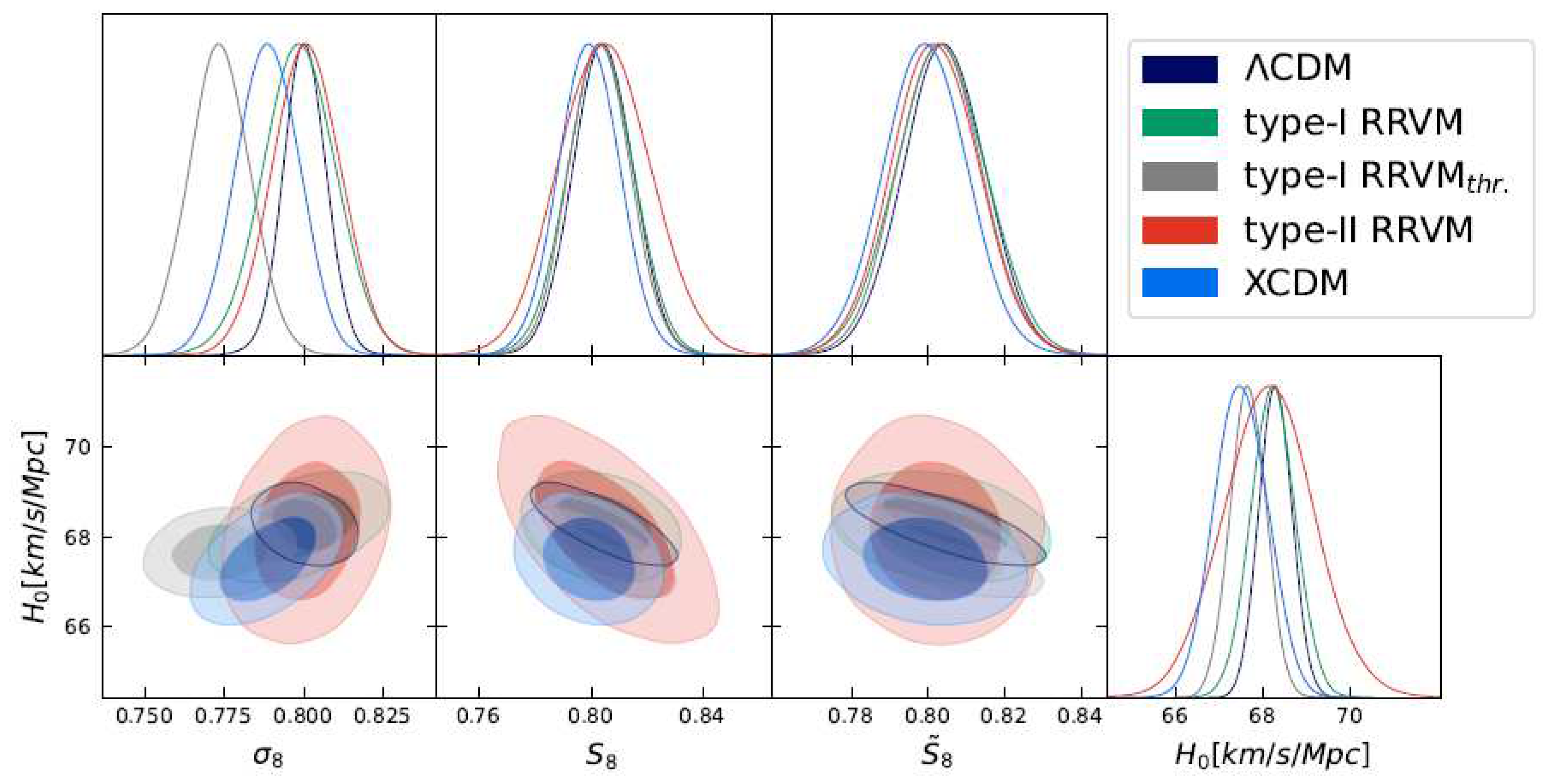
While we shall not go into theoretical details here, we have opted for mimicking such a (continuous, although quite abrupt) transition with a phenomenological -function approach. Thus, we have explored the simplest scenario (with just one transition) in the context of what we have called the type-I RRVM, i.e. the type-I model with a threshold. We thereby assume that the interaction between vacuum and dark matter is activated only at a threshold redshift lower than 11. We have chosen this transition redshift after performing a fitting analysis allowing to vary freely in the Monte Carlo process. The value turns out to maximize the posterior. When the Baseline dataset is employed, we find and, hence, a significant evidence for a late-time vacuum decay into dark matter at c.l. This allows to suppress the clustering in the universe at , as it is clear from the fitting value reported in Table 4 and the left-most plots in Figure 1. The small value of matter fluctuations at linear scales allows to essentially solve the tension with the data (see Figure 4 and [40]), decreasing the value of by units with respect to the standard model, while keeping the good description of the other datasets (cf. Table A1).
Figure 2.
Same as in Figure 1, but using the Baseline+SH0ES dataset (cf. Section 5). The inclusion of the data from SH0ES shifts the one-dimensional posterior of towards km/s/Mpc in the type-II RRVM, a region that is still allowed by the Baseline dataset, cf. Figure 1. Remarkably, the small values of found in the type-I RRVM remain stable, and no important differences between the models are found regarding the value of . The lower value of obtained in the type-II RRVM is due to the fact that this parameter does not account for the departure of from 1, , see the caption of Table 4.
Figure 2.
Same as in Figure 1, but using the Baseline+SH0ES dataset (cf. Section 5). The inclusion of the data from SH0ES shifts the one-dimensional posterior of towards km/s/Mpc in the type-II RRVM, a region that is still allowed by the Baseline dataset, cf. Figure 1. Remarkably, the small values of found in the type-I RRVM remain stable, and no important differences between the models are found regarding the value of . The lower value of obtained in the type-II RRVM is due to the fact that this parameter does not account for the departure of from 1, , see the caption of Table 4.
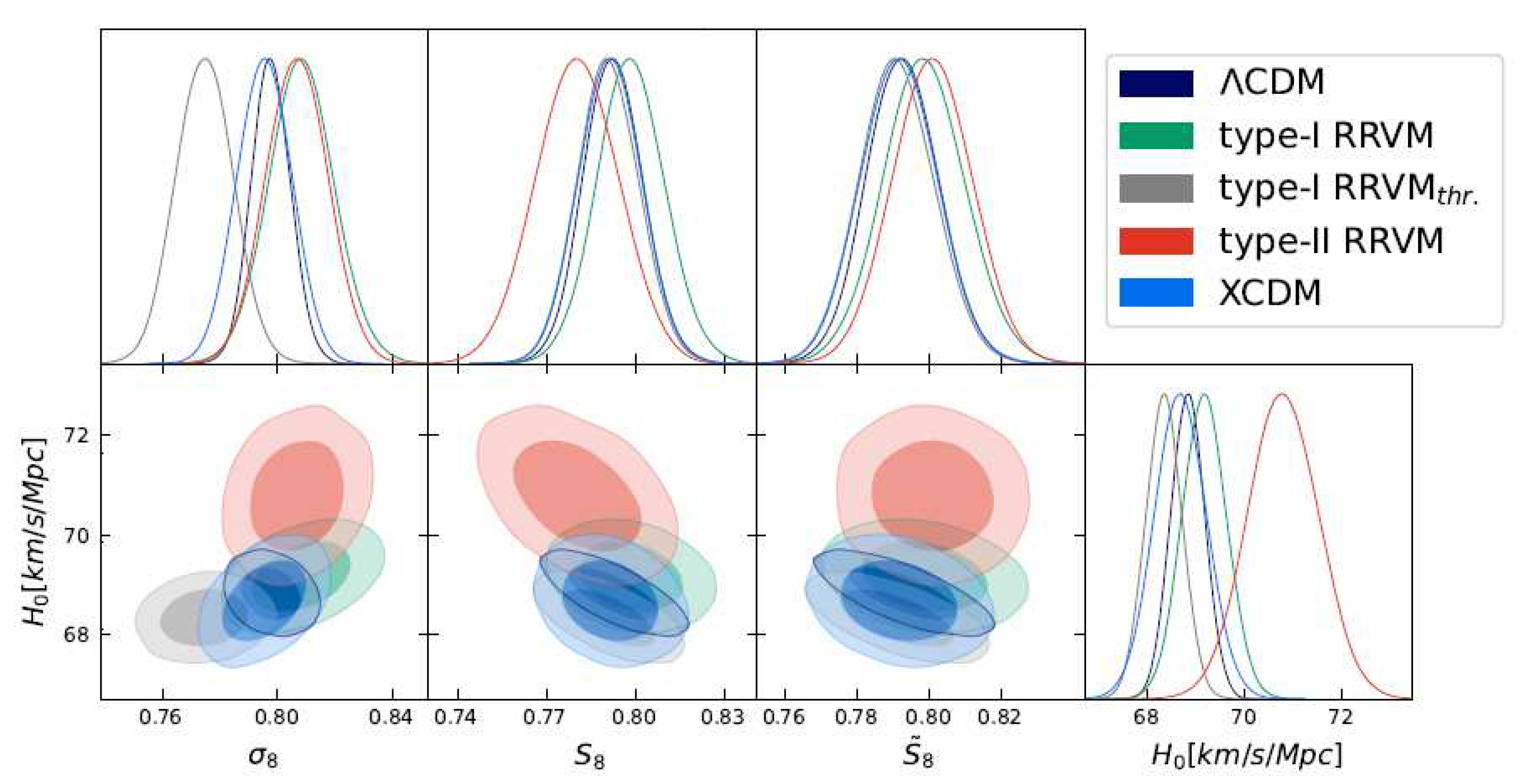
This is very remarkable and completely aligned with our previous results [97], in which we already showed the outstanding capability of our model for producing lesser growth in the late universe12. The vacuum decay leads to a decrease of the VED and an enhancement of at present. This produces larger values of the current , which somehow compensates the decrease of and gives rise to values of of the same order to those obtained in the CDM and the other models studied in this paper. The comparison of the results for the type-I RRVM reported in our Table 4, Table 5, Table 6 and Table 7 also demonstrates the robustness and stability of the fitting output under changes in the dataset. The values of DIC obtained with the Baseline configuration and also considering the SH0ES data with and without the use of the CMB polarization information from Planck are in the range . Therefore we find in all cases very strong evidence for this model from a Bayesian perspective, i.e. after penalizing the use of the extra parameter . The smallest values of DIC are obtained when the SH0ES data are also used in the analysis. This triggers a decrease of the evidence for non-zero vacuum dynamics, which still renders at the c.l. The model is able to solve the tension, but does not alleviate the Hubble tension, since the values of stay close to those found in the CDM.
Figure 3.
Same as in Figure 2, but removing the high-ℓ polarization data from Planck, i.e. considering the Baseline (No pol.)+SH0ES dataset (cf. Section 5). Again, as in the other fitting analyses, the value of is kept small in the type-I RRVM. The absence of CMB polarization data allows for even smaller values of in the type-II RRVM, , which is now below the GR value . This explains the large value of km/s/Mpc, which basically renders the Hubble tension insignificant, below the c.l.
Figure 3.
Same as in Figure 2, but removing the high-ℓ polarization data from Planck, i.e. considering the Baseline (No pol.)+SH0ES dataset (cf. Section 5). Again, as in the other fitting analyses, the value of is kept small in the type-I RRVM. The absence of CMB polarization data allows for even smaller values of in the type-II RRVM, , which is now below the GR value . This explains the large value of km/s/Mpc, which basically renders the Hubble tension insignificant, below the c.l.
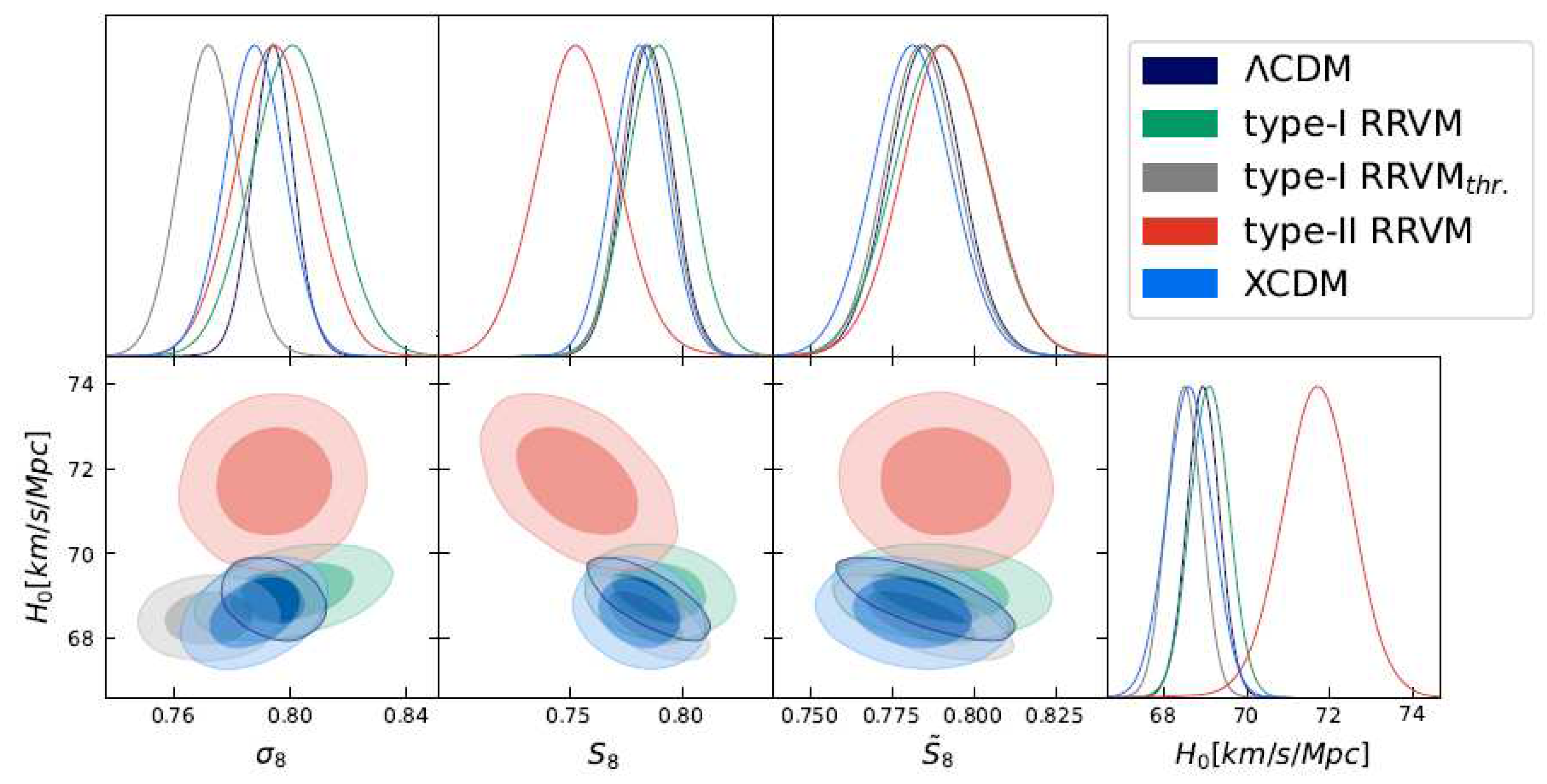
Let us now move on to the type-II RRVM. Here we switch off the exchange of energy between vacuum and the (dark) matter sector, but in compensation give allowance for a possible variation of G at cosmological scales, which is induced by the running of the vacuum in accordance with the Bianchi identity. In this type of model, therefore, the current value of the gravitational coupling may depart from . We have previously defined the auxiliary variable to parameterize such a departure. Let us also note that type-II models have two additional free parameters as compared to the CDM (one more than type-I models): and (the latter being the initial value of at high redshift in the radiation dominated epoch, before it starts evolving very slowly with the cosmic evolution). Since G can vary for these models, stringent constraints on type-II models should apply from the existing limits on the relative variation of the gravitational coupling, if one assumes that the cosmological value of G must satisfy them (cf. Section 4.1). These constraints are in fact satisfied by our fitting results for this type of running vacuum models. In fact, regardless of the dataset we use to fit the model, we obtain values of compatible with 0. There is no clear hint of vacuum dynamics in this case. However, in the limit we recover the CDM only if . This is actually the crucial ingredient that can make the type-II model a rather appealing framework for relieving the -tension, but only in the presence of the SH0ES data as we now explain. In its absence, we obtain values of compatible with 1 (the strict GR value) at c.l. Using the Baseline dataset we find , whereas we find with the Baseline (No pol.) alternative, which as we know is the same set but excluding the polarizations. It is obvious that the polarization data favor larger values of (closer to 1) or, equivalently, smaller values of G (closer to ) 13. The improvement in the description of the data compared to the CDM is in both cases only marginal within the Baseline scenario, with or without polarizations (cf. Table A1 and Table A3). This is indeed reflected in the negative DIC values gathered in both cases, viz. DIC, which point to a positive preference for the standard cosmological model (see Table 4 and Table 6). Now in stark contrast with the meager situation just described with the Baseline dataset, the inclusion of the SH0ES data produces a dramatic turnaround of the results in the desired direction. It shifts the posterior of towards a region of lower values, which is more prominent in the absence of the CMB polarization likelihoods, to wit: in the Baseline+SH0ES analysis and in the Baseline (No pol.)+SH0ES one. This produces a significant decrease of the comoving sound horizon at the baryon-drag epoch , which now lies in the ballpark Mpc rather than in the usual higher range Mpc usually preferred by the CDM model. This fact, together with a significant raise of the spectral index of the primordial power spectrum [116], generates a noticeable increase in , whose fitting constraints in the context of our analysis read now km/s/Mpc and km/s/Mpc, respectively14. The upshot is that the Hubble tension is basically washed out in this running vacuum model scenario15. The incremental DIC values with respect to the vanilla model corroborate in fact a strong, or even very strong, evidence in favor of running vacuum depending on whether the CMB polarization data are considered or not. As remarked, this happens only when we include the information from SH0ES and at the expense of worsening a bit the description of the CMB temperature spectrum – cf. the supplementary Table A2 and Table A4 in the appendix, in which we display the breakdown of the different contributions from each observable. Regarding the description of the LSS, the type-II RRVM is not able to improve the fit to the data with respect to the other models under study, as it is clear from Figure 4 and the tables in the appendix. The model allows to shift the posterior values of towards the region preferred by the weak lensing measurements, more conspicuously in the analysis with the Baseline (No pol.)+SH0ES dataset. However, might not be the most correct quantity to make contact with observations in models with a renormalized gravitational coupling at cosmological scales. Alternative estimators, as (see the caption of Figure 1 and also Figure 2 and Figure 3), might be more appropriate. The values of are larger than those of and similar to those found in the other models explored in this work, including the CDM.
Finally, we comment on the results obtained with the generic XCDM parameterization. It is well-known that a quintessence EoS parameter allows to suppress the amount of structure in the universe due to the increase of dark energy in the past, which fights against the aggregation of matter. It is also known, though, that quintessence cannot alleviate the Hubble tension because the decaying nature of the DE makes in this case the critical density and, hence, also to be smaller at low redshifts, see e.g. [81,178,179]. If we do not employ the SH0ES data, i.e. if we use the Baseline and Baseline (No pol.) datasets, we find a deviation of the EoS parameter from (a pure ), in the quintessence region. This is in accordance to what we have already mentioned. The LSS data, which points to a lower level of clustering than in the CDM, prefers quintessence. Actually, we obtain small values of . The XCDM is able to relieve the tension with the LSS data in the absence of SH0ES, but the decrease of is not as big as for the type-I RRVM, see e.g. Table A1. One can see in that table that the contribution to is significantly lesser (roughy a factor of two smaller) for the type-I model with threshold than in a generic XCDM parameterization. On the other hand, the improvement is less robust for the XCDM, this being corroborated by the fact that the hints of DE dynamics disappear when we include the data from SH0ES, since the latter favors a phantom dark energy EoS parameter. This shifts towards smaller values. For instance, in the analysis with Baseline+SH0ES we obtain . The phantom region, however, is not attained because we include LSS data in our analysis. In fact, the structure formation data do not favor the phantom region since in that case the amount of DE is smaller in the past, and this does not help to prevent the excess of structure formation, which is tantamount to saying that it does not help to relieve the -tension. Thus, a compromise is needed and in the presence of SH0ES data the XCDM just provides a value of the EoS closer to than in the absence of such data. If LSS data were not used, the SH0ES data would succeed in pushing the EoS of the XCDM to the phantom domain [172]. In contrast to this voluble behavior of the EoS for a generic DE fluid, the type-I RRVM provides a substantially better overall fit and its effective DE behavior is quintessence-like in the structure formation region up to our days. Indeed, we find (both with or without SH0ES data) at a large confidence level of . Hence the vacuum energy density associated to that model is indeed decreasing with the expansion within the relevant region of structure formation for both data sets, Baseline or Baseline+SH0ES, with or without polarizations, cf. Table 4, Table 5, Table 6 and Table 7.
7. Conclusions
In this work, we have put to the test a class of dynamical dark energy (DDE) models that go under the name of running vacuum models (RVMs). These have been discussed for a long time in the literature, see e.g.[17,19,20] as well as [180,181] and references therein. This kind of models have successfully withstood a number of litmus tests against all types of modern data, whence demonstrating its maturity and robustness as serious competitors to the concordance CDM model, this being true not only in regard to their fitting power but also, and indeed especially, in regard to improving the status of the CDM and generalizations thereof in the context of theoretical physics. The essential new feature of the RVM class is that it predicts the existence of DDE associated with the vacuum, a fundamental concept in QFT. Put another way: the running vacuum shows up here as if it were a form of DDE, but in truth is (quantum) vacuum after all – and not just another artifact extracted from the blackbox of the DE aimed at mimicking or supplanting the fundamental notion of vacuum energy in QFT. In the RVM paradigm, there is no rigid cosmological term, , owing to the fundamental need for renormalization of the VED in QFT. The scale of renormalization is dynamical and hence the computed quantum corrections produce a time-evolving VED with the expansion[20]. The general structure of the RVM has been recently buttressed by explicit calculations in the context of QFT in curved spacetime. We should mention that the smooth VED dynamics in the RVM was long suspected from semi-qualitative renormalization group arguments, see the aforesaid references and corresponding bibliography, but it was only recently that it was substantiated in a full-fledged QFT context, see the detailed works [24,25,26]. Within the RVM, the gravitational coupling, G, will also be running in general. From its dynamical interplay with the vacuum energy density (VED), , we find that G evolves very mildly as a logarithmic function of the Hubble rate, . As it turns out, what we call (as a physical quantity, not just as a formal parameter) in the RVM formulation, is actually nothing but the nearly sustained value of around (any) given epoch. There is no such thing as a true cosmological constant in the RVM framework, and as a matter of fact it is fair to say that a (physically measurable) rigid parameter of this sort is not to be expected in renormalizable QFT [20].
Figure 4.
Theoretical curves of for the various models together with the observational data points listed in Table 3. We have employed the central values of the Baseline fitting analysis (cf. Table 4). The type-I RRVM has the ability to solve the tension by suppressing the clustering at .
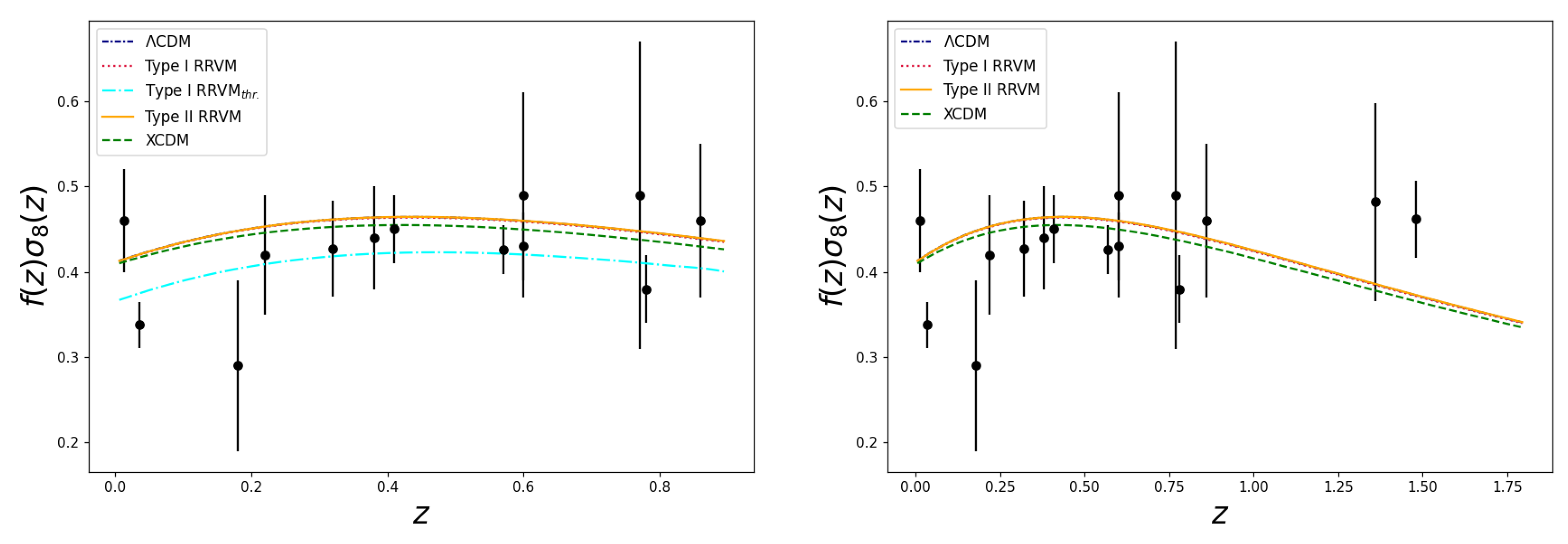
As for the specific details of the phenomenological analysis put forward in this work and for the sake of a better comparison with previous studies – particularly with the most recent one in Ref. [80] –, in the current presentation we have focused on an implementation of the RVM which we have denoted RRVM. It has one single (extra) parameter in the type-I formulation, , and two additional free parameters ( and ) in the type-II RRVM with respect to the CDM. The VED has a dynamical component proportional to the scalar of curvature, , being its coefficient, see Eq. (4). Such a coefficient can be accounted for analytically in QFT (see the above mentioned works) but it depends on the masses of all the quantized matter fields, so in practice it must be fitted to the overall cosmological data. This is actually the main task that we have undertaken in the present work. In doing it, we have found significant evidence that the VED is running with the cosmic expansion. In fact, upon performing a global fit to the cosmological observations from a wealth of data sources of all the main sorts, thus involving the full string SNIa+BAO++LSS+CMB of relevant cosmological observables, and comparing the rigid option (namely const. corresponding to the CDM model), with the running vacuum one () we find that a mild dynamics of the cosmic vacuum () is highly favored, depending on the model. For type-I RRVM with threshold we find very strong direct evidence of such vacuum dynamics through a nonvanshing value of at more than c.l. and an overall statistical score of DIC with respect to the vanilla model, whereas for type-II RRVM the evidence is also strong, but indirect, through the change of G, which leads to a favorable scenario when we consider the SH0ES data at the level of DIC depending on whether we use CMB polarization data or not. We have also checked that the improvement of the fit is not just caused by a generic form of the DDE, meaning that when we test if a simple XCDM (wCDM) parameterization[147] would do a similar job we meet a negative result, i.e. in the latter case we do not observe any significant amelioration with respect to the CDM fit.
This is in stark contrast to the fitting results from the running vacuum. As previously indicated, for type-I models the level of evidence turns out to be very strongly supported by the DIC criterion (according to the conventional parlance used within the information criteria), provided there exists a threshold redshift for the DDE near our time () where the vacuum evolution gets suddenly activated in the RRVM form. For the sake of simplicity, here we have mimicked it just through a -function. With a mild level of dynamics as that indicated above, the tension is rendered essentially nonexistent. The relieve of the tension, on the other hand, can be significantly accomplished only within the type-II model with variable G (the tension subsisting only at an inconspicuous level of ). Finally, let us note that even though the type-I model cannot deal with the tension, the overall fit quality that it offers in the presence of a DDE threshold is really outstanding. Specifically, the DIC difference with respect to the vanilla CDM is DIC, cf. Table 4. The type-I model with a threshold suppresses completely the tension and provides a determination of at a level of significance slightly more than . We note that this intriguing result would stay even if the tension would fade away or would suddenly disappear. If the data on are free from unaccounted systematic errors, our results suggest, first of all, that it is very likely that the DE is dynamical and that it takes the running vacuum form; and, second, that such a vacuum dynamics started relatively recently (). This fact could be motivated by the same calculations underpinning the general RVM structure of the vacuum energy in QFT. The potential significance of these considerations cannot be underemphasized and we will certainly return to them in future studies.
Acknowledgments
JSP and CMP are funded by projects PID2019-105614GB-C21 and FPA2016-76005-C2-1-P (MINE CO, Spain), 2021-SGR-249 (Generalitat de Catalunya) and CEX2019-000918-M (ICCUB). The work of JSP is also partially supported by the COST Association Action (European Cooperation in Science and Technology) CA18108 “Quantum Gravity Phenomenology in the Multimessenger Approach (QG-MM)”. AGV is funded by the Istituto Nazionale di Fisica Nucleare (INFN) through the project of the InDark INFN Special Initiative: “Dark Energy and Modified Gravity Models in the light of Low-Redshift Observations” (n. 22425/2020). JdCP is supported by the Margarita Salas fellowship funded by the European Union (NextGenerationEU). This article is also based upon work from COST Action CA21136 - Addressing observational tensions in cosmology with systematics and fundamental physics (CosmoVerse).
Appendix A. Additional Tables
In this appendix we present the Table A1–Table A4, with the individual contributions of each observable to the total for all the fitting analyses performed in this work, obtained from the mean values of the cosmological parameters. These results must be close to the true , since the underlying posteriors are Gaussian in very good approximation. We prefer not to use the latter, since the minimum found by MontePython is not always very precise, see the footnote 10 in [164].
Table A1.
Detailed breakdown of the different contributions from each observable in our Baseline dataset with the cosmological parameters reported in Table 4. We call BAO- (correl.) the contribution that contains the correlations between the BAO and LSS datasets (see the references of Table 1), whereas the uncorrelated contributions are simply called BAO and .
Table A1.
Detailed breakdown of the different contributions from each observable in our Baseline dataset with the cosmological parameters reported in Table 4. We call BAO- (correl.) the contribution that contains the correlations between the BAO and LSS datasets (see the references of Table 1), whereas the uncorrelated contributions are simply called BAO and .
| Baseline | |||||
|---|---|---|---|---|---|
| Experiment | CDM | type-I RRVM | type-I RRVM | type-II RRVM | XCDM |
| CMB | |||||
| SNIa | |||||
| BAO- (correl.) | |||||
| BAO | |||||
Table A2.
Same as Table A1 but for the Baseline+SH0ES dataset. We have employed the parameters from Table 5.
| Baseline+SH0ES | |||||
|---|---|---|---|---|---|
| Experiment | CDM | type-I RRVM | type-I RRVM | type-II RRVM | XCDM |
| CMB | |||||
| SNIa | |||||
| BAO- (correl.) | |||||
| BAO | |||||
Table A3.
Same as Table A1 but for the Baseline (No pol.) dataset and making use of the parameters provided in Table 6.
| Baseline (No pol.) | |||||
|---|---|---|---|---|---|
| Experiment | CDM | type-I RRVM | type-I RRVM | type-II RRVM | XCDM |
| CMB | |||||
| SNIa | |||||
| BAO- (correl.) | |||||
| BAO | |||||
References
- P. J. E. Peebles, Principles of physical cosmology. Princeton University Press, 1993.
- P. J. E. Peebles, “Tests of Cosmological Models Constrained by Inflation”, Astrophys. J., vol. 284, pp. 439–444, 1984.
- M. S. Turner, “The Road to Precision Cosmology”, 2201.04741 [astro-ph.CO] (to appear in Annu. Rev. Nucl. Part. Sci. 2022; arXiv:2201.04741.
- L. Amendola and S. Tsujikawa, Dark Energy: Theory and Observations. Cambridge University Press, 2015.
- P. J. E. Peebles and B. Ratra, “The Cosmological Constant and Dark Energy”, Rev. Mod. Phys., vol. 75, pp. 559–606, 2003, astro-ph/0207347.
- T. Padmanabhan, “Cosmological constant: The Weight of the vacuum”, Phys. Rept., vol. 380, pp. 235–320, 2003, hep-th/0212290.
- A. G. Riess et al., “Observational evidence from supernovae for an accelerating universe and a cosmological constant”, Astron. J., vol. 116, pp. 1009–1038, 1998, astro-ph/9805201.
- S. Perlmutter et al., “Measurements of Ω and Λ from 42 high redshift supernovae”, Astrophys. J., vol. 517, pp. 565–586, 1999, astro-ph/9812133.
- P. de Bernardis et al., “A Flat universe from high resolution maps of the cosmic microwave background radiation”, Nature, vol. 404, pp. 955–959, 2000, astro-ph/0004404.
- D. J. Eisenstein et al., “Detection of the Baryon Acoustic Peak in the Large-Scale Correlation Function of SDSS Luminous Red Galaxies”, Astrophys. J., vol. 633, pp. 560–574, 2005, astro-ph/0501171.
- M. Tegmark et al., “Cosmological Constraints from the SDSS Luminous Red Galaxies”, Phys. Rev. D, vol. 74, p. 123507, 2006, astro-ph/0608632.
- E. Komatsu et al., “Five-Year Wilkinson Microwave Anisotropy Probe (WMAP) Observations: Cosmological Interpretation”, Astrophys. J. Suppl., vol. 180, pp. 330–376, 2009. arXiv:0803.0547.
- A. G. Riess, L. Macri, S. Casertano, H. Lampeitl, H. C. Ferguson, A. V. Filippenko, S. W. Jha, W. Li, and R. Chornock, “A 3% Solution: Determination of the Hubble Constant with the Hubble Space Telescope and Wide Field Camera 3”, Astrophys. J., vol. 730, p. 119, 2011, arXiv:1103.2976 [Erratum: Astrophys. J., vol. 732, p. 129, 2011].
- P. A. R. Ade et al., “Planck 2015 results. XIII. Cosmological parameters”, Astron. Astrophys., vol. 594, p. A13, 2016. arXiv:1502.01589.
- N. Aghanim et al., “Planck 2018 results. VI. Cosmological parameters”, Astron. Astrophys., vol. 641, p. A6, 2020. arXiv:1807.06209.
- S. Weinberg, “The Cosmological Constant Problem”, Rev. Mod. Phys., vol. 61, pp. 1–23, 1989.
- J. Solà, “Cosmological constant and vacuum energy: old and new ideas”, J. Phys. Conf. Ser., vol. 453, p. 012015, 2013. arXiv:1306.1527.
- P. J. Steinhardt, “A quintessential introduction to dark energy”, Phil. Trans. Roy. Soc. Lond. A, vol. 361, pp. 2497–2513, 2003.
- J. Solà and A. Gómez-Valent, “The Λ¯CDM cosmology: From inflation to dark energy through running Λ”, Int. J. Mod. Phys. D, vol. 24, p. 1541003, 2015. arXiv:1501.03832.
- J. Solà Peracaula, “The cosmological constant problem and running vacuum in the expanding universe”, Phil. Trans. Roy. Soc. Lond. A, vol. 380, p. 20210182, 2022. arXiv:2203.13757.
- Y. Zel’dovich, “Cosmological constant and elementary particles”, Sov. Phys. JETP. Lett., vol. 6, p. 3167, 1967.
- E. J. Copeland, M. Sami, and S. Tsujikawa, “Dynamics of dark energy”, Int. J. Mod. Phys. D, vol. 15, pp. 1753–1936, 2006, hep-th/0603057.
- S. Tsujikawa, “Quintessence: A Review”, Class. Quant. Grav., vol. 30, p. 214003, 2013. arXiv:1304.1961.
- C. Moreno-Pulido and J. Solà, “Running vacuum in quantum field theory in curved spacetime: renormalizing ρvac without ∼m4 terms”, Eur. Phys. J. C, vol. 80, no. 8, p. 692, 2020. arXiv:2005.03164.
- C. Moreno-Pulido and J. Solà Peracaula, “Renormalizing the vacuum energy in cosmological spacetime: implications for the cosmological constant problem”, Eur. Phys. J. C, vol. 82, no. 6, p. 551, 2022. arXiv:2201.05827.
- C. Moreno-Pulido and J. Solà Peracaula, “Equation of state of the running vacuum”, Eur. Phys. J. C, vol. 82, no. 12, p. 1137, 2022. arXiv:2207.07111.
- C. Moreno-Pulido, J. Solà Peracaula, and S. Cheraghchi, “Running vacuum in QFT in FLRW spacetime: The dynamics of ρvac(H) from the quantized matter fields”, 2023. arXiv:2301.05205.
- L. Perivolaropoulos and F. Skara, “Challenges for ΛCDM: An update”, New Astron. Rev., vol. 95, p. 101659, 2022. arXiv:2105.05208.
- E. Di Valentino et al., “Snowmass2021 - Letter of interest cosmology intertwined II: The hubble constant tension”, Astropart. Phys., vol. 131, p. 102605, 2021. arXiv:2008.11284.
- C. Krishnan, E. O. Colgáin, M. M. Sheikh-Jabbari, and T. Yang, “Running Hubble Tension and a H0 Diagnostic”, Phys. Rev. D, vol. 103, no. 10, p. 103509, 2021. arXiv:2011.02858.
- M. G. Dainotti, B. De Simone, T. Schiavone, G. Montani, E. Rinaldi, and G. Lambiase, “On the Hubble constant tension in the SNe Ia Pantheon sample”, Astrophys. J., vol. 912, no. 2, p. 150, 2021. arXiv:2103.02117.
- E. Di Valentino et al., “Cosmology Intertwined III: fσ8 and S8”, Astropart. Phys., vol. 131, p. 102604, 2021. arXiv:2008.11285.
- E. Macaulay, I. K. Wehus, and H. K. Eriksen, “Lower Growth Rate from Recent Redshift Space Distortion Measurements than Expected from Planck”, Phys. Rev. Lett., vol. 111, no. 16, p. 161301, 2013. arXiv:1303.6583.
- S. Nesseris, G. Pantazis, and L. Perivolaropoulos, “Tension and constraints on modified gravity parametrizations of Geff(z) from growth rate and Planck data”, Phys. Rev. D, vol. 96, no. 2, p. 023542, 2017. arXiv:1703.10538.
- W. Lin and M. Ishak, “Cosmological discordances II: Hubble constant, Planck and large-scale-structure data sets”, Phys. Rev. D, vol. 96, no. 8, p. 083532, 2017. arXiv:1708.09813.
- A. Gómez-Valent and J. Solà Peracaula, “Density perturbations for running vacuum: a successful approach to structure formation and to the σ8-tension”, Mon. Not. Roy. Astron. Soc., vol. 478, no. 1, pp. 126–145, 2018. arXiv:1801.08501.
- C. Garcia-Quintero, M. Ishak, L. Fox, and W. Lin, “Cosmological discordances. III. More on measure properties, large-scale-structure constraints, the Hubble constant and Planck data”, Phys. Rev. D, vol. 100, no. 12, p. 123538, 2019. arXiv:1910.01608.
- M. Asgari et al., “KiDS-1000 Cosmology: Cosmic shear constraints and comparison between two point statistics”, Astron. Astrophys., vol. 645, p. A104, 2021. arXiv:2007.15633.
- T. M. C. Abbott et al., “Dark Energy Survey Year 3 results: Cosmological constraints from galaxy clustering and weak lensing”, Phys. Rev. D, vol. 105, no. 2, p. 023520, 2022. arXiv:2105.13549.
- N.-M. Nguyen, D. Huterer, and Y. Wen, “Evidence for suppression of structure growth in the concordance cosmological model”, 2023. arXiv:2302.01331.
- S. A. Adil, O. Akarsu, M. Malekjani, E. O. Colgáin, S. Pourojaghi, A. A. Sen, and M. M. Sheikh-Jabbari, “S8 increases with effective redshift in ΛCDM cosmology”, 2023. arXiv:2303.06928.
- L. Heisenberg, H. Villarrubia-Rojo, and J. Zosso, “Can late-time extensions solve the H0 and σ8 tensions?”, Phys. Rev. D, vol. 106, p. 043503, 2022. arXiv:2202.01202.
- V. Marra and L. Perivolaropoulos, “Rapid transition of Geff at zt≃0.01 as a possible solution of the Hubble and growth tensions”,Phys. Rev. D vol. 104 , no. 2, p. L021303, 2021. arXiv:2102.06012.
- G. Alestas, L. Kazantzidis and L. Perivolaropoulos, “w-M phantom transition at zt<0.1 as a resolution of the Hubble tension”, Phys. Rev. D vol. 103, no. 8, p. 083517, 2020. arXiv:2012.13932.
- L. Perivolaropoulos and F. Skara, “Hubble tension or a transition of the Cepheid SnIa calibrator parameters?”, Phys. Rev. D vol. 104, no. 12, p. 123511, 2021. arXiv:2109.04406.
- G. Alestas, D. G. Alestas, D. Camarena, E. Di Valentino, L. Kazantzidis, V. Marra, S. Nesseris and L. Perivolaropoulos, “Late-transition versus smooth H(z)-deformation models for the resolution of the Hubble crisis”, Phys. Rev. D, vol. 105, no. 6, p. 6. 2022; arXiv:2110.04336. [Google Scholar]
- L. Perivolaropoulos and F. Skara, “A Reanalysis of the Latest SH0ES Data for H0: Effects of New Degrees of Freedom on the Hubble Tension”, Universe, vol. 8, no. 10, p. 502, 2022. arXiv:2208.11169.
- J. Grande, J. J. Grande, J. Solà, and H. Stefancic, “LXCDM: A Cosmon model solution to the cosmological coincidence problem?”, JCAP, vol. 08, p. 011, 2006, gr-qc/0604057.
- J. Grande, A. Pelinson, and J. Solà, “Dark energy perturbations and cosmic coincidence”, Phys. Rev. D, vol. 79, p. 043006, 2009. arXiv:0809.3462.
- E. Abdalla et al., “Cosmology intertwined: A review of the particle physics, astrophysics, and cosmology associated with the cosmological tensions and anomalies”, JHEAp, vol. 34, pp. 49–211, 2022. arXiv:2203.06142.
- M. Dainotti, B. De Simone, G. Montani, T. Schiavone, and G. Lambiase, “The Hubble constant tension: current status and future perspectives through new cosmological probes”, 2023. arXiv:2301.10572.
- I. L. Shapiro and J. Solà, “Scaling behavior of the cosmological constant: Interface between quantum field theory and cosmology”, JHEP, vol. 02, p. 006, 2002, hep-th/0012227.
- A. Babic, B. Guberina, R. Horvat, and H. Stefancic, “Renormalization-group running cosmologies. A Scale-setting procedure”, Phys. Rev. D, vol. 71, p. 124041, 2005, astro-ph/0407572.
- P. D. Alvarez, B. P. D. Alvarez, B. Koch, C. Laporte, and A. Rincón, “Can scale-dependent cosmology alleviate the H0 tension?”, JCAP, vol. 06, p. 019, 2021. arXiv:2009.02311.
- M. Ozer and M. Taha, “A Solution to the Main Cosmological Problems”, Phys. Lett. B, vol. 171, pp. 363–365, 1986.
- O. Bertolami, “Time dependent cosmological term”, Nuovo Cim. B, vol. 93, pp. 36–42, 1986.
- K. Freese, F. C. K. Freese, F. C. Adams, J. A. Frieman, and E. Mottola, “Cosmology with Decaying Vacuum Energy”, Nucl. Phys. B, vol. 287, pp. 797–814, 1987.
- P. J. E. Peebles and B. Ratra, “Cosmology with a Time Variable Cosmological Constant”, Astrophys. J., vol. 325, p. L17, 1988.
- W. Chen and Y. S. Wu, “Implications of a cosmological constant varying as R-2”, Phys. Rev. D, vol. 41, pp. 695–698, 1990 [Erratum: Phys.Rev.D, vol. 45, p. 4728, 1992].
- A. M. M. Abdel-Rahman, “Singularity - free decaying vacuum cosmologies”, Phys. Rev. D, vol. 45, pp. 3497–3511, 1992.
- J. Carvalho, J. J. Carvalho, J. Lima, and I. Waga, “On the cosmological consequences of a time dependent lambda term”, Phys. Rev. D, vol. 46, pp. 2404–2407, 1992.
- R. C. Arcuri and I. Waga, “Growth of density inhomogeneities in Newtonian cosmological models with variable Lambda”, Phys. Rev. D, vol. 50, pp. 2928–2931, 1994.
- I. Waga, “Decaying vacuum flat cosmological models: Expressions for some observable quantities and their properties”, Astrophys. J., vol. 414, pp. 436–448, 1993.
- J. A. S. Lima and J. M. F. Maia, “Deflationary cosmology with decaying vacuum energy density”, Phys. Rev. D, vol. 49, pp. 5597–5600, 1994.
- J. A. S. Lima and M. Trodden, “Decaying vacuum energy and deflationary cosmology in open and closed universes”, Phys. Rev. D, vol. 53, pp. 4280–4286, 1996, astro-ph/9508049.
- A. I. Arbab, “Cosmological models with variable cosmological and gravitational constants and bulk viscous models”, Gen. Rel. Grav., vol. 29, pp. 61–74, 1997.
- C. Espana-Bonet et al, “Testing the running of the cosmological constant with type Ia supernovae at high z”, JCAP, vol. 02, p. 006, 2004, hep-ph/0311171.
- P. Wang and X.-H. Meng, “Can vacuum decay in our universe?”, Class. Quant. Grav., vol. 22, pp. 283–294, 2005, astro-ph/0408495.
- H. A. Borges and S. Carneiro, “Friedmann cosmology with decaying vacuum density”, Gen. Rel. Grav., vol. 37, pp. 1385–1394, 2005, gr-qc/0503037.
- J. S. Alcaniz and J. A. S. Lima, “Interpreting cosmological vacuum decay”, Phys. Rev. D, vol. 72, p. 063516, 2005, astro-ph/0507372.
- J. D. Barrow and T. Clifton, “Cosmologies with energy exchange”, Phys. Rev. D, vol. 73, p. 103520, 2006, astro-ph/0604063.
- F. E. M. Costa and J. S. Alcaniz, “Cosmological consequences of a possible Λ-dark matter interaction”, Phys. Rev. D, vol. 81, p. 043506, 2010. arXiv:0908.4251.
- D. Bessada and O. D. Miranda, “Probing a cosmological model with a Λ=Λ0+3βH2 decaying vacuum”, Phys. Rev. D, vol. 88, no. 8, p. 083530, 2013. arXiv:1310.8571.
- A. Gómez-Valent and J. Solà, “Vacuum models with a linear and a quadratic term in H: structure formation and number counts analysis”, Mon. Not. Roy. Astron. Soc., vol. 448, pp. 2810–2821, 2015. arXiv:1412.3785.
- J. Overduin and F. Cooperstock, “Evolution of the scale factor with a variable cosmological term”, Phys. Rev. D, vol. 58, p. 043506, 1998, astro-ph/9805260.
- S. Basilakos, N. E. Mavromatos, and J. Solà Peracaula, “Gravitational and Chiral Anomalies in the Running Vacuum Universe and Matter-Antimatter Asymmetry”, Phys. Rev. D, vol. 101, no. 4, p. 045001, 2020. arXiv:1907.04890.
- S. Basilakos, N. E. Mavromatos, and J. Solà Peracaula, “Quantum Anomalies in String-Inspired Running Vacuum Universe: Inflation and Axion Dark Matter”, Phys. Lett. B, vol. 803, p. 135342, 2020. arXiv:2001.03465.
- N. E. Mavromatos and J. Solà Peracaula, “Stringy-running-vacuum-model inflation: from primordial gravitational waves and stiff axion matter to dynamical dark energy”, Eur. Phys. J. ST, vol. 230, no. 9, pp. 2077–2110, 2021. arXiv:2012.07971.
- N. E. Mavromatos and J. Solà Peracaula, “Inflationary physics and trans-Planckian conjecture in the stringy running vacuum model: from the phantom vacuum to the true vacuum”, Eur. Phys. J. Plus, vol. 136, no. 11, p. 1152, 2021. arXiv:2105.02659.
- J. Solà Peracaula, A. Gómez-Valent, J. de Cruz Pérez, and C. Moreno-Pulido, “Running vacuum against the H0 and σ8 tensions”, EPL, vol. 134, no. 1, p. 19001, 2021. arXiv:2102.12758.
- J. Solà Peracaula, A. Gómez-Valent, and J. de Cruz Pérez, “The H0 tension in light of vacuum dynamics in the Universe”, Phys. Lett. B, vol. 774, pp. 317–324, 2017. arXiv:1705.06723.
- A. Gómez-Valent and J. Solà, “Relaxing the σ8-tension through running vacuum in the Universe”, EPL, vol. 120, no. 3, p. 39001, 2017. arXiv:1711.00692.
- J. Solà Peracaula, J. de Cruz Pérez, and A. Gómez-Valent, “Dynamical dark energy vs. Λ = const in light of observations”, EPL, vol. 121, no. 3, p. 39001, 2018. arXiv:1606.00450.
- J. Solà, “Cosmological constant vis-a-vis dynamical vacuum: bold challenging the ΛCDM”, Int. J. Mod. Phys. A, vol. 31, no. 23, p. 1630035, 2016. arXiv:1612.02449.
- J. Solà, A. J. Solà, A. Gómez-Valent, and J. de Cruz Pérez, “First evidence of running cosmic vacuum: challenging the concordance model”, Astrophys. J., vol. 836, no. 1, p. 43, 2017. arXiv:1602.02103.
- J. Solà Peracaula, J. de Cruz Pérez, and A. Gómez-Valent, “Possible signals of vacuum dynamics in the Universe”, Mon. Not. Roy. Astron. Soc., vol. 478, no. 4, pp. 4357–4373, 2018. arXiv:1703.08218.
- J. Solà, A. J. Solà, A. Gómez-Valent, and J. de Cruz Pérez, “Hints of dynamical vacuum energy in the expanding Universe”, Astrophys. J., vol. 811, p. L14, 2015. arXiv:1506.05793.
- A. Gómez-Valent, J. A. Gómez-Valent, J. Solà, and S. Basilakos, “Dynamical vacuum energy in the expanding Universe confronted with observations: a dedicated study”, JCAP, vol. 01, p. 004, 2015. arXiv:1409.7048.
- J. Solà Peracaula, “Running Vacuum and the ΛCDM tensions”, PoS, vol. CORFU2021, p. 106, 2022. [CrossRef]
- J. Solà Peracaula, “Tensions in the ΛCDM and vacuum dynamics”, Int. J. Mod. Phys. A, vol. 33, no. 31, p. 1844009, 2018.
- J. Solà, “Dark energy: A Quantum fossil from the inflationary Universe?”, J. Phys. A, vol. 41, p. 164066, 2008. arXiv:0710.4151.
- S. Basilakos, D. Polarski, and J. Solà, “Generalizing the running vacuum energy model and comparing with the entropic-force models”, Phys. Rev. D, vol. 86, p. 043010, 2012. arXiv:1204.4806.
- S. Basilakos and J. Solà, “Entropic-force dark energy reconsidered”, Phys. Rev. D, vol. 90, no. 2, p. 023008, 2014. arXiv:1402.6594.
- A. Gómez-Valent, E. Karimkhani, and J. Solà, “Background history and cosmic perturbations for a general system of self-conserved dynamical dark energy and matter”, JCAP, vol. 12, p. 048, 2015. arXiv:1509.03298.
- M. Rezaei, M. Malekjani, and J. Solà, “Can dark energy be expressed as a power series of the Hubble parameter?”, Phys. Rev. D, vol. 100, no. 2, p. 023539, 2019. arXiv:1905.00100.
- M. Rezaei and J. Solà Peracaula, “Running vacuum versus holographic dark energy: a cosmographic comparison”, Eur. Phys. J. C, vol. 82, p. 765, 2022. arXiv:2207.14250.
- J. Solà, A. Gómez-Valent, J. de Cruz Pérez, and C. Moreno-Pulido, “Running vacuum against the H0 and σ8 tensions”, EPL, vol. 134, no. 1, p. 19001, 2021. arXiv:2102.12758.
- C. W. Misner, K. S. C. W. Misner, K. S. Thorn, and J. A. Wheeler, Gravitation. San Francisco: Freeman, 1974.
- J. Lesgourgues, “The Cosmic Linear Anisotropy Solving System (CLASS) I: Overview”, 2011. arXiv:1104.2932.
- D. Blas, J. D. Blas, J. Lesgourgues, and T. Tram, “The Cosmic Linear Anisotropy Solving System (CLASS) II: Approximation schemes”, JCAP, vol. 1107, p. 034, 2011. arXiv:1104.2933.
- C.-P. Ma and E. Bertschinger, “Cosmological perturbation theory in the synchronous and conformal Newtonian gauges”, Astrophys. J., vol. 455, pp. 7–25, 1995, astro-ph/9506072.
- Y. Wang, D. Wands, L. Xu, J. De-Santiago, and A. Hojjati, “Cosmological constraints on a decomposed Chaplygin gas”, Phys. Rev. D, vol. 87, no. 8, p. 083503, 2013. arXiv:1301.5315.
- Y. Wang, D. Y. Wang, D. Wands, G.-B. Zhao, and L. Xu, “Post-Planck constraints on interacting vacuum energy”, Phys. Rev. D, vol. 90, no. 2, p. 023502, 2014. arXiv:1404.5706.
- V. Salvatelli, N. Said, M. Bruni, A. Melchiorri, and D. Wands, “Indications of a late-time interaction in the dark sector”, Phys. Rev. Lett., vol. 113, no. 18, p. 181301, 2014. arXiv:1406.7297.
- M. Martinelli, N. B. Hogg, S. Peirone, M. Bruni, and D. Wands, “Constraints on the interacting vacuum–geodesic CDM scenario”, Mon. Not. Roy. Astron. Soc., vol. 488, no. 3, pp. 3423–3438, 2019. arXiv:1902.10694.
- N. B. Hogg, M. Bruni, R. Crittenden, M. Martinelli, and S. Peirone, “Latest evidence for a late time vacuum–geodesic CDM interaction”, Phys. Dark Univ., vol. 29, p. 100583, 2020. arXiv:2002.10449.
- L. W. K. Goh, A. Gómez-Valent, V. Pettorino, and M. Kilbinger, “Constraining constant and tomographic coupled dark energy with low-redshift and high-redshift probes”, Phys. Rev. D, vol. 107, no. 8, p. 083503, 2023. arXiv:2211.13588.
- H. Fritzsch and J. Solà, “Matter Non-conservation in the Universe and Dynamical Dark Energy”, Class. Quant. Grav., vol. 29, p. 215002, 2012. arXiv:1202.5097.
- H. Fritzsch and J. Solà, “Fundamental constants and cosmic vacuum: the micro and macro connection”, Mod. Phys. Lett. A, vol. 30, no. 22, p. 1540034, 2015. arXiv:1502.01411.
- C. Brans and R. Dicke, “Mach’s principle and a relativistic theory of gravitation”, Phys. Rev, vol. 124, p. 925, 1961.
- J.-P. Uzan, “Varying Constants, Gravitation and Cosmology”, Living Rev. Rel., vol. 14, p. 2, 2011. arXiv:1009.5514.
- M. Kramer et al., “Strong-Field Gravity Tests with the Double Pulsar”, Phys. Rev. X, vol. 11, no. 4, p. 041050, 2021. arXiv:2112.06795.
- W. W. Zhu et al., “Tests of Gravitational Symmetries with Pulsar Binary J1713+0747”, Mon. Not. Roy. Astron. Soc., vol. 482, no. 3, pp. 3249–3260, 2018. arXiv:1802.09206.
- A. Genova et al., “Solar system expansion and strong equivalence principle as seen by the NASA MESSENGER mission”, Nat Commun 9, 289, 2018.
- J. Solà Peracaula, A. J. Solà Peracaula, A. Gómez-Valent, J. de Cruz Pérez, and C. Moreno-Pulido, “Brans–Dicke Gravity with a Cosmological Constant Smoothes Out ΛCDM Tensions”, Astrophys. J. Lett., vol. 886, no. 1, p. L6, 2019. arXiv:1909.02554.
- J. Solà Peracaula, A. Gómez-Valent, J. de Cruz Pérez, and C. Moreno-Pulido, “Brans–Dicke cosmology with a Λ-term: a possible solution to ΛCDM tensions”, Class. Quant. Grav., vol. 37, no. 24, p. 245003, 2020. arXiv:2006.04273.
- J. de Cruz Pérez, J. Solà Peracaula, and C. P. Singh, “Running vacuum in Brans-Dicke theory: a possible cure for the σ8 and H0 tensions”, 2023. arXiv:2302.04807.
- T. Clifton, P. G. T. Clifton, P. G. Ferreira, A. Padilla, and C. Skordis, “Modified Gravity and Cosmology”, Phys. Rept., vol. 513, pp. 1–189, 2012. arXiv:1106.2476.
- A. Avilez and C. Skordis, “Cosmological constraints on Brans-Dicke theory”, Phys. Rev. Lett., vol. 113, no. 1, p. 011101, 2014. arXiv:1303.4330.
- A. Gómez-Valent and P. Hassan Puttasiddappa, “Difficulties in reconciling non-negligible differences between the local and cosmological values of the gravitational coupling in extended Brans-Dicke theories”, JCAP, vol. 09, p. 040, 2021. arXiv:2105.14819.
- I. L. Shapiro, J. I. L. Shapiro, J. Sola, and H. Stefancic, “Running G and Lambda at low energies from physics at M(X): Possible cosmological and astrophysical implications”, JCAP, vol. 01, p. 012, 2004, hep-ph/0410095.
- P. Carter, F. Beutler, W. J. Percival, C. Blake, J. Koda, and A. J. Ross, “Low Redshift Baryon Acoustic Oscillation Measurement from the Reconstructed 6-degree Field Galaxy Survey”, Mon. Not. Roy. Astron. Soc., vol. 481, no. 2, pp. 2371–2383, 2018. arXiv:1803.01746.
- H. Gil-Marín, W. J. Percival, L. Verde, J. R. Brownstein, C.-H. Chuang, F.-S. Kitaura, S. A. Rodríguez-Torres, and M. D. Olmstead, “The clustering of galaxies in the SDSS-III Baryon Oscillation Spectroscopic Survey: RSD measurement from the power spectrum and bispectrum of the DR12 BOSS galaxies”, Mon. Not. Roy. Astron. Soc., vol. 465, no. 2, pp. 1757–1788, 2017. arXiv:1606.00439.
- E. A. Kazin et al., “The WiggleZ Dark Energy Survey: improved distance measurements to z = 1 with reconstruction of the baryonic acoustic feature”, Mon. Not. Roy. Astron. Soc., vol. 441, no. 4, pp. 3524–3542, 2014. arXiv:1401.0358.
- T. M. C. Abbott et al., “Dark Energy Survey Year 3 results: A 2.7% measurement of baryon acoustic oscillation distance scale at redshift 0.835”, Phys. Rev. D, vol. 105, no. 4, p. 043512, 2022. arXiv:2107.04646.
- J. Hou et al., “The Completed SDSS-IV extended Baryon Oscillation Spectroscopic Survey: BAO and RSD measurements from anisotropic clustering analysis of the Quasar Sample in configuration space between redshift 0.8 and 2.2”, Mon. Not. Roy. Astron. Soc., vol. 500, no. 1, pp. 1201–1221, 2020. arXiv:2007.08998.
- H. du Mas des Bourboux et al., “The Completed SDSS-IV Extended Baryon Oscillation Spectroscopic Survey: Baryon Acoustic Oscillations with Lyα Forests”, Astrophys. J., vol. 901, no. 2, p. 153, 2020. arXiv:2007.08995.
- C. Zhang, H. Zhang, S. Yuan, T.-J. Zhang, and Y.-C. Sun, “Four new observational H(z) data from luminous red galaxies in the Sloan Digital Sky Survey data release seven”, Res. Astron. Astrophys., vol. 14, no. 10, pp. 1221–1233, 2014. arXiv:1207.4541.
- R. Jiménez, L. R. Jiménez, L. Verde, T. Treu, and D. Stern, “Constraints on the equation of state of dark energy and the Hubble constant from stellar ages and the CMB”, Astrophys. J., vol. 593, pp. 622–629, 2003, astro-ph/0302560.
- J. Simon, L. Verde, and R. Jiménez, “Constraints on the redshift dependence of the dark energy potential”, Phys. Rev. D, vol. 71, p. 123001, 2005, astro-ph/0412269.
- M. Moresco et al., “Improved constraints on the expansion rate of the Universe up to z 1.1 from the spectroscopic evolution of cosmic chronometers”, JCAP, vol. 1208, p. 006, 2012. arXiv:1201.3609.
- M. Moresco, L. M. Moresco, L. Pozzetti, A. Cimatti, R. Jiménez, C. Maraston, L. Verde, D. Thomas, A. Citro, R. Tojeiro, and D. Wilkinson, “A 6% measurement of the Hubble parameter at z∼0.45: direct evidence of the epoch of cosmic re-acceleration”, JCAP, vol. 1605, no. 05, p. 014, 2016. arXiv:1601.01701.
- A. Ratsimbazafy, S. Loubser, S. Crawford, C. Cress, B. Bassett, R. Nichol, and P. Väisänen, “Age-dating Luminous Red Galaxies observed with the Southern African Large Telescope”, Mon. Not. Roy. Astron. Soc., vol. 467, no. 3, pp. 3239–3254, 2017. arXiv:1702.00418.
- D. Stern, R. Jiménez, L. Verde, M. Kamionkowski, and S. A. Stanford, “Cosmic Chronometers: Constraining the Equation of State of Dark Energy. I: H(z) Measurements”, JCAP, vol. 1002, p. 008, 2010. arXiv:0907.3149.
- N. Borghi, M. N. Borghi, M. Moresco, and A. Cimatti, “Toward a Better Understanding of Cosmic Chronometers: A New Measurement of H(z) at z ∼ 0.7”, Astrophys. J. Lett., vol. 928, no. 1, p. L4. arXiv:2110.04304.
- M. Moresco, “Raising the bar: new constraints on the Hubble parameter with cosmic chronometers at z∼2”, Mon. Not. Roy. Astron. Soc., vol. 450, no. 1, pp. L16–L20. 2015; arXiv:1503.01116.
- M. Moresco, R. Jimenez, L. Verde, A. Cimatti, and L. Pozzetti, “Setting the Stage for Cosmic Chronometers. II. Impact of Stellar Population Synthesis Models Systematics and Full Covariance Matrix”, Astrophys. J., vol. 898, no. 1, p. 82, 2020. arXiv:2003.07362.
- F. Avila, A. Bernui, E. de Carvalho, and C. P. Novaes, “The growth rate of cosmic structures in the local Universe with the ALFALFA survey”, Mon. Not. Roy. Astron. Soc., vol. 505, no. 3, pp. 3404–3413, 2021. arXiv:2105.10583.
- K. Said, M. Colless, C. Magoulas, J. R. Lucey, and M. J. Hudson, “Joint analysis of 6dFGS and SDSS peculiar velocities for the growth rate of cosmic structure and tests of gravity”, Mon. Not. Roy. Astron. Soc., vol. 497, no. 1, pp. 1275–1293, 2020. arXiv:2007.04993.
- F. Simpson, C. Blake, J. A. Peacock, I. Baldry, J. Bland-Hawthorn, A. Heavens, C. Heymans, J. Loveday, and P. Norberg, “Galaxy and mass assembly: Redshift space distortions from the clipped galaxy field”, Phys. Rev. D, vol. 93, no. 2, p. 023525, 2016. arXiv:1505.03865.
- C. Blake et al., “Galaxy And Mass Assembly (GAMA): improved cosmic growth measurements using multiple tracers of large-scale structure”, Mon. Not. Roy. Astron. Soc., vol. 436, p. 3089, 2013. arXiv:1309.5556.
- C. Blake et al., “The WiggleZ Dark Energy Survey: the growth rate of cosmic structure since redshift z=0.9”, Mon. Not. Roy. Astron. Soc., vol. 415, p. 2876, 2011. arXiv:1104.2948.
- F. G. Mohammad et al., “The VIMOS Public Extragalactic Redshift Survey (VIPERS): Unbiased clustering estimate with VIPERS slit assignment”, Astron. Astrophys., vol. 619, p. A17, 2018. arXiv:1807.05999.
- L. Guzzo et al., “A test of the nature of cosmic acceleration using galaxy redshift distortions”, Nature, vol. 451, pp. 541–545, 2008. arXiv:0802.1944.
- Y.-S. Song and W. J. Percival, “Reconstructing the history of structure formation using Redshift Distortions”, JCAP, vol. 0910, p. 004, 2009. arXiv:0807.0810.
- T. Okumura et al., “The Subaru FMOS galaxy redshift survey (FastSound). IV. New constraint on gravity theory from redshift space distortions at z∼1.4”, Publ. Astron. Soc. Jap., vol. 68, no. 3, p. 38, 2016. arXiv:1511.08083.
- M. S. Turner and M. J. White, “CDM models with a smooth component”, Phys. Rev. D, vol. 56, no. 8, p. R4439, 1997, astro-ph/9701138.
- D. Scolnic et al., “The Pantheon+ Analysis: The Full Data Set and Light-curve Release”, Astrophys. J., vol. 938, no. 2, p. 113, 2022. arXiv:2112.03863.
- A. Favale, A. Gómez-Valent, and M. Migliaccio, “Cosmic chronometers to calibrate the ladders and measure the curvature of the Universe. A model-independent study”, 2023. arXiv:2301.09591.
- A. G. Riess et al., “A Comprehensive Measurement of the Local Value of the Hubble Constant with 1 km/s/Mpc Uncertainty from the Hubble Space Telescope and the SH0ES Team”, Astrophys. J. Lett., vol. 934, no. 1, p. L7, 2022. arXiv:2112.04510.
- D. Brout et al., “The Pantheon+ Analysis: Cosmological Constraints”, Astrophys. J., vol. 938, no. 2, p. 110, 2022. arXiv:2202.04077.
- N. Aghanim et al., “Planck 2018 results. VIII. Gravitational lensing”, Astron. Astrophys., vol. 641, p. A8, 2020. arXiv:1807.06210.
- R. Jiménez and A. Loeb, “Constraining cosmological parameters based on relative galaxy ages”, Astrophys. J., vol. 573, pp. 37–42, 2002, astro-ph/0106145.
- W. L. Freedman et al., “The Carnegie-Chicago Hubble Program. VIII. An Independent Determination of the Hubble Constant Based on the Tip of the Red Giant Branch”, Astrophys. J., vol. 882, p. 34, 2019. arXiv:1907.05922.
- W. L. Freedman, “Measurements of the Hubble Constant: Tensions in Perspective”, Astrophys. J., vol. 919, no. 1, p. 16, 2021. arXiv:2106.15656.
- S. Cao and B. Ratra, “H0=69.8±1.3kms-1Mpc-1, Ωm0=0.288±0.017, and other constraints from lower-redshift, non-CMB and non-distance-ladder, expansion-rate data”, 2023. arXiv:2302.14203.
- W. Yuan, A. G. Riess, L. M. Macri, S. Casertano, and D. Scolnic, “Consistent Calibration of the Tip of the Red Giant Branch in the Large Magellanic Cloud on the Hubble Space Telescope Photometric System and a Re-determination of the Hubble Constant”, Astrophys. J., vol. 886, p. 61, 2019. arXiv:1908.00993.
- J. Soltis, S. Casertano, and A. G. Riess, “The Parallax of ω Centauri Measured from Gaia EDR3 and a Direct, Geometric Calibration of the Tip of the Red Giant Branch and the Hubble Constant”, Astrophys. J. Lett., vol. 908, no. 1, p. L5, 2021. arXiv:2012.09196.
- G. S. Anand, R. B. G. S. Anand, R. B. Tully, L. Rizzi, A. G. Riess, and W. Yuan, “Comparing Tip of the Red Giant Branch Distance Scales: An Independent Reduction of the Carnegie-Chicago Hubble Program and the Value of the Hubble Constant”, Astrophys. J., vol. 932, no. 1, p. 15, 2022. arXiv:2108.00007.
- D. Scolnic, A. G. Riess, J. Wu, S. Li, G. S. Anand, R. Beaton, S. Casertano, R. Anderson, S. Dhawan, and X. Ke, “CATS: The Hubble Constant from Standardized TRGB and Type Ia Supernova Measurements”, 2023. arXiv:2304.06693.
- N. Metropolis, A. W. N. Metropolis, A. W. Rosenbluth, M. N. Rosenbluth, A. H. Teller, and E. Teller, “Equation of state calculations by fast computing machines”, J. Chem. Phys., vol. 21, pp. 1087–1092, 1953.
- W. Hastings, “Monte Carlo Sampling Methods Using Markov Chains and Their Applications”, Biometrika, vol. 57, pp. 97–109, 1970.
- B. Audren, J. Lesgourgues, K. Benabed, and S. Prunet, “Conservative Constraints on Early Cosmology: an illustration of the Monte Python cosmological parameter inference code”, JCAP, vol. 02, p. 001, 2013. arXiv:1210.7183.
- T. Brinckmann and J. Lesgourgues, “MontePython 3: boosted MCMC sampler and other features”, Phys. Dark Univ., vol. 24, p. 100260, 2019, arXiv:1804.07261, "https://baudren.github.io/montepython.html".
- S. Brooks and A. Gelman, “General Methods for Monitoring Convergence of Iterative Simulations”, Journal of Computational and Graphical Statistics, vol. 7, p. 434, 1997.
- A. Gelman and D. Rubin, “Inference from Iterative Simulation Using Multiple Sequences”, Statistical Science, vol. 7, p. 457, 1992.
- A. Lewis, “GetDist: a Python package for analysing Monte Carlo samples”, 2019, arXiv:1910.13970,https://getdist.readthedocs.io.
- D. J. Fixsen, “The Temperature of the Cosmic Microwave Background”, Astrophys. J., vol. 707, pp. 916–920, 2009. arXiv:0911.1955.
- D. J. Spiegelhalter, N. G. D. J. Spiegelhalter, N. G. Best, B. P. Carlin, and A. van der Linde, “Bayesian measures of model complexity and fit”, J. Roy. Stat. Soc., vol. 64, p. 583, 2002.
- A. R. Liddle, “Information criteria for astrophysical model selection”, Mon. Not. Roy. Astron. Soc., vol. 377, pp. L74–L78, 2007, astro-ph/0701113.
- H. Akaike, “A new look at the statistical model identification”, IEEE Trans. Autom. Control, vol. 19, pp. 716–723, 1974.
- A. Gómez-Valent, Z. Zheng, L. Amendola, V. Pettorino, and C. Wetterich, “Early dark energy in the pre- and postrecombination epochs”, Phys. Rev. D, vol. 104, no. 8, p. 083536, 2021. arXiv:2107.11065.
- V. Poulin, J. L. Bernal, E. Kovetz, and M. Kamionkowski, “The Sigma-8 Tension is a Drag”, 2022. arXiv:2209.06217.
- A. Gómez-Valent, “Measuring the sound horizon and absolute magnitude of SNIa by maximizing the consistency between low-redshift data sets”, Phys. Rev. D, vol. 105, no. 4, p. 043528, 2022. arXiv:2111.15450.
- G. Benevento, J.A. G. Benevento, J.A. Kable, G. E. Addison and C. L. Bennett, “An Exploration of an Early Gravity Transition in Light of Cosmological Tensions”, Astrophys. J., vol. 935, p. 156, 2022. arXiv:2202.09356.
- G. Ballesteros, A. Notari and F. Rompineve, “The H0 tension: ΔGN vs. ΔNeff”, JCAP, vol. 11, p. 024, 2020. arXiv:2004.05049.
- M. Braglia et al., “Larger value for H0 by an evolving gravitational constant”, Phys.Rev. D vol. 102, p. 023529, 2020. arXiv:2004.11161.
- J. Solà Peracaula, A. Gómez-Valent, and J. de Cruz Pérez, “Dynamical dark energy: scalar fields and running vacuum”, Mod. Phys. Lett. A, vol. 32, no. 9, p. 1750054, 2017. arXiv:1610.08965.
- J. Solà Peracaula, A. Gómez-Valent, and J. de Cruz Pérez, “Signs of Dynamical Dark Energy in Current Observations”, Phys. Dark Univ., vol. 25, p. 100311, 2019. arXiv:1811.03505.
- J. Solà, “Cosmologies with a time dependent vacuum”, J. Phys. Conf. Ser., vol. 283, p. 012033, 2011. arXiv:1102.1815.
- J. Solà, “Vacuum energy and cosmological evolution”, AIP Conf. Proc., vol. 1606, no. 1, pp. 19–37, 2015. arXiv:1402.7049.
| 1 | We use the geometric sign convention (+, +, +) in the popular classification by Misner, Thorne and Wheeler [98]. |
| 2 | |
| 3 | In practice this means that we have first fitted the value of as one more free parameter in our analysis. Subsequently we have assumed that the threshold point remains fixed at that point. See also [104,105,106,107] for a binned/tomographic approach to the DE. In our case we have just one threshold whose existence might be motivated by QFT calculations [25,26]. |
| 4 | If (dark) matter is not conserved, but G remains constant, we retrieve of course our previous scenario (14). In general, we may expect a mixture of both situations, but we shall refrain from dealing with the general case since it would introduce extra parameters. See, however, [108,109] for additional discussions that can be relevant for studies on the possible variation of the fundamental constants of Nature. |
| 5 | It should be clear that is not a dynamical degree of freedom, in contradistinction to Brans-Dicke type theories of gravitation [110], and therefore does not mediate any sort of long-range interaction that should be subdued by screening mechanisms. |
| 6 | Let us emphasize that Eq. (54) is valid only in the MDE, and we have also pointed out that const. in the DE epoch. This means that G gets more and more rigid when it transits from the MDE to the DE epoch, and therefore the actual limits on are weaker than those that we have roughly estimated. This works on our benefit, of course. In fact, a detailed calculation would require computing in the DE epoch, but it proves unnecessary once we have shown that even in the most unfavorable case (i.e. when evolves more rapidly than it actually does in the DE epoch) the obtained limits on are nonetheless preserved by our fits. Notice that type-I models are totally unaffected by these limits since G is in this case constant, so can be, in principle, larger for them. |
| 7 | |
| 8 | This region is also preferred by late-time dynamical DE models when fitted to a very wide variety of background data that are independent from the direct cosmic distance ladder and CMB, km/s/Mpc [156]. See, however, [157,158,159,160] for measurements of more in accordance with SH0ES obtained also with the tip of the red giant branch method. |
| 9 | |
| 10 | |
| 11 | See Section 3.3 for the practical implementation. |
| 12 | |
| 13 | |
| 14 | Noticeably, the central values of , and the absolute magnitude of SNIa, M, obtained for the type-II RRVM when the CMB polarization data are excluded in the fitting analysis are in very good agreement with the model-independent measurements from low-z data reported in [149], which are also independent from the main drivers of the tension. For the Hubble constant these authors find km/s/Mpc. However, these measurements have still large uncertainties and cannot arbitrate the Hubble tension yet. See also [174]. |
| 15 |
Disclaimer/Publisher’s Note: The statements, opinions and data contained in all publications are solely those of the individual author(s) and contributor(s) and not of MDPI and/or the editor(s). MDPI and/or the editor(s) disclaim responsibility for any injury to people or property resulting from any ideas, methods, instructions or products referred to in the content. |
© 2023 by the authors. Licensee MDPI, Basel, Switzerland. This article is an open access article distributed under the terms and conditions of the Creative Commons Attribution (CC BY) license (http://creativecommons.org/licenses/by/4.0/).
Copyright: This open access article is published under a Creative Commons CC BY 4.0 license, which permit the free download, distribution, and reuse, provided that the author and preprint are cited in any reuse.


