

Submitted:
09 March 2026
Posted:
13 March 2026
You are already at the latest version
Abstract
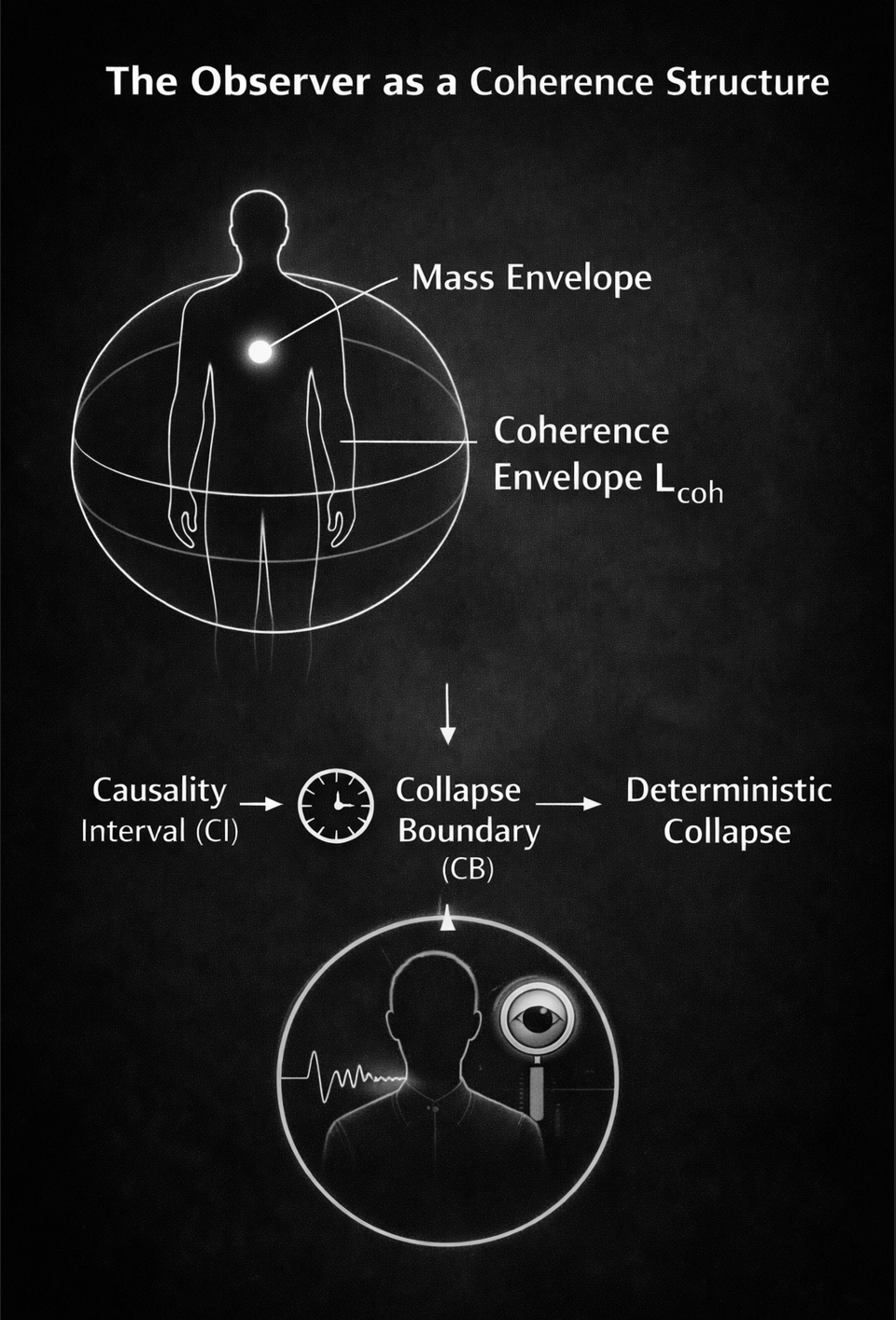
Quantum mechanics predicts measurement outcomes with remarkable accuracy, yet the physical mechanism responsible for measurement remains unspecified. Standard formulations treat collapse as an external postulate or informational update, leaving the origin of measurement outside the theory’s physical description. This paper proposes a mass-induced mechanism for quantum measurement within the framework of Quantum Substrate Dynamics (QSD), in which the observer is not a privileged entity but a coherence structure formed by stable matter interacting with propagating excitations. In QSD, stable matter forms mass-phase structures possessing finite coherence envelopes that evolve through discrete Causality Intervals (CIs) governing how the substrate can reconfigure. Massless excitations, such as photons, lack coherence envelopes and therefore cannot initiate collapse; they propagate only through geometric constraints imposed by nearby mass-phase structures. Measurement occurs when the coherence envelope of a mass-phase structure intersects a propagating excitation and enforces local CI pacing and curvature--compliance limits on the substrate. Collapse is therefore realized as a structural re-locking of the substrate, in which only configurations compatible with the local mass-phase environment can persist. This mechanism reproduces key empirical features of quantum experiments, including the material dependence of diffraction and detection, the emergence of interference patterns at mass-phase boundaries, and the absence of photon--photon interaction in free space. Within this framework, longstanding interpretational paradoxes---including Wigner's friend, Schr\"odinger's cat, contextuality, and delayed-choice interference---admit consistent physical explanations without invoking observer-dependent realities, global wavefunction collapse, or branching worlds. Quantum measurement therefore emerges as a mass-induced structural process, in which observation reflects the deterministic reconfiguration of the substrate under finite coherence and curvature constraints rather than an epistemic update or interpretational supplement.
Keywords:
quantum substrate dynamics (QSD)
; causality interval (CI)
; collapse boundary (CB)
; mass-induced measurement
; coherence envelope (Lcoh)
; deterministic quantum collapse
; substrate-conserved action
Copyright: This open access article is published under a Creative Commons CC BY 4.0 license, which permit the free download, distribution, and reuse, provided that the author and preprint are cited in any reuse.


