
Submitted:
09 August 2025
Posted:
11 August 2025
You are already at the latest version
Abstract
We propose the Generative Reality Hypothesis (GRH), a novel interpretation of quantum mechanics that reconceptualizes physical reality as an information-processing system analogous to generative artificial intelligence models. Under this framework, quantum superposition represents the latent space of possible states, wave function collapse corresponds to sampling from probability distributions during information queries (measurements), and the Born rule emerges as the fundamental sampling algorithm of reality. We present rigorous mathematical foundations establishing formal equivalences between quantum dynamics and specific generative models. Our framework recasts the measurement problem as a question of computational process, explains non-local correlations as the enforcement of consistency within a shared generative model, and provides a mechanistic explanation for wave-particle duality as a transition between two computational modes: continuous latent evolution (wave) and discrete sampling (particle). We propose five specific, falsifiable experimental tests using current quantum technologies that can distinguish GRH from standard quantum mechanics through quantitative predictions about complexity-dependent decoherence, measurement dynamics, and information flow. Statistical criteria for falsification are established with required experimental precision specified. The framework connects quantum mechanics to information theory and computational complexity, offering a computationally grounded foundation for quantum phenomena while making testable predictions that differ measurably from existing interpretations.
Keywords:
quantum mechanics interpretation
; quantum entanglement
; computational physics
; information theory
; measurement problem
; generative models
; quantum foundations
; wave-particle duality
1. Introduction
The measurement problem in quantum mechanics remains one of physics’ most profound challenges. Despite the theory’s extraordinary predictive success, the transition from quantum superposition to classical measurement outcomes, governed by the Born rule [1], lacks a mechanistic explanation. The Schrödinger equation describes deterministic, unitary evolution, yet measurements yield probabilistic, irreversible outcomes, prompting interpretations including Copenhagen [2], many-worlds [3], pilot wave [4], and objective collapse theories [5]. Each addresses specific issues but leaves fundamental questions unresolved.
Recent advances in quantum information theory suggest reality’s fundamentally informational nature, as proposed by Wheeler’s “it from bit” conjecture [6]. Rigorous derivations of quantum mechanics from information-theoretic principles [7,8] and the remarkable efficiency of quantum computers in simulating quantum systems [9] suggest deep connections between computation and physical reality. These developments, combined with advances in generative artificial intelligence [10], inspire a radically new approach.
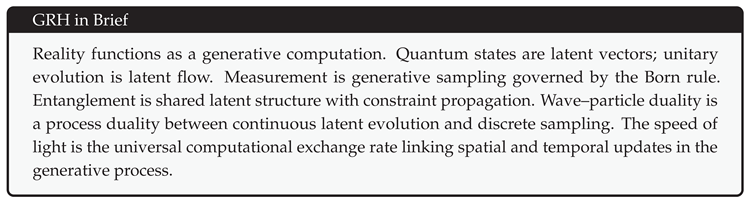
We propose the Generative Reality Hypothesis (GRH): physical reality operates as a generative information-processing system, where quantum mechanics represents the computational architecture underlying this process. Quantum superposition corresponds to latent representation spaces in generative models, measurements trigger generative sampling events, and the Born rule defines the fundamental sampling algorithm of reality. While mathematical equivalence can be established between different formalisms, the value of GRH lies in its potential to provide a mechanistic, ontological foundation for quantum processes, moving beyond abstract state spaces to a model of reality as an active computation.
This framework recasts the measurement problem by reinterpreting quantum superposition as computational potential rather than multiple co-existing physical realities. It provides a mechanistic explanation for quantum entanglement via shared latent representations and for wave-particle duality as a “process duality” between latent evolution and generative sampling. Most importantly, GRH makes specific, testable predictions about decoherence scaling, measurement dynamics, and information flow that can be experimentally verified with current quantum technologies.
These core predictions provide experimentally testable consequences that distinguish GRH from standard quantum mechanics:
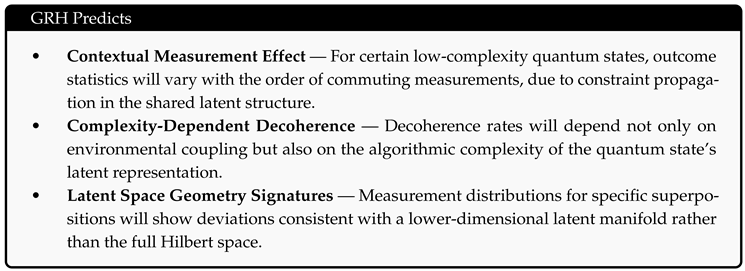
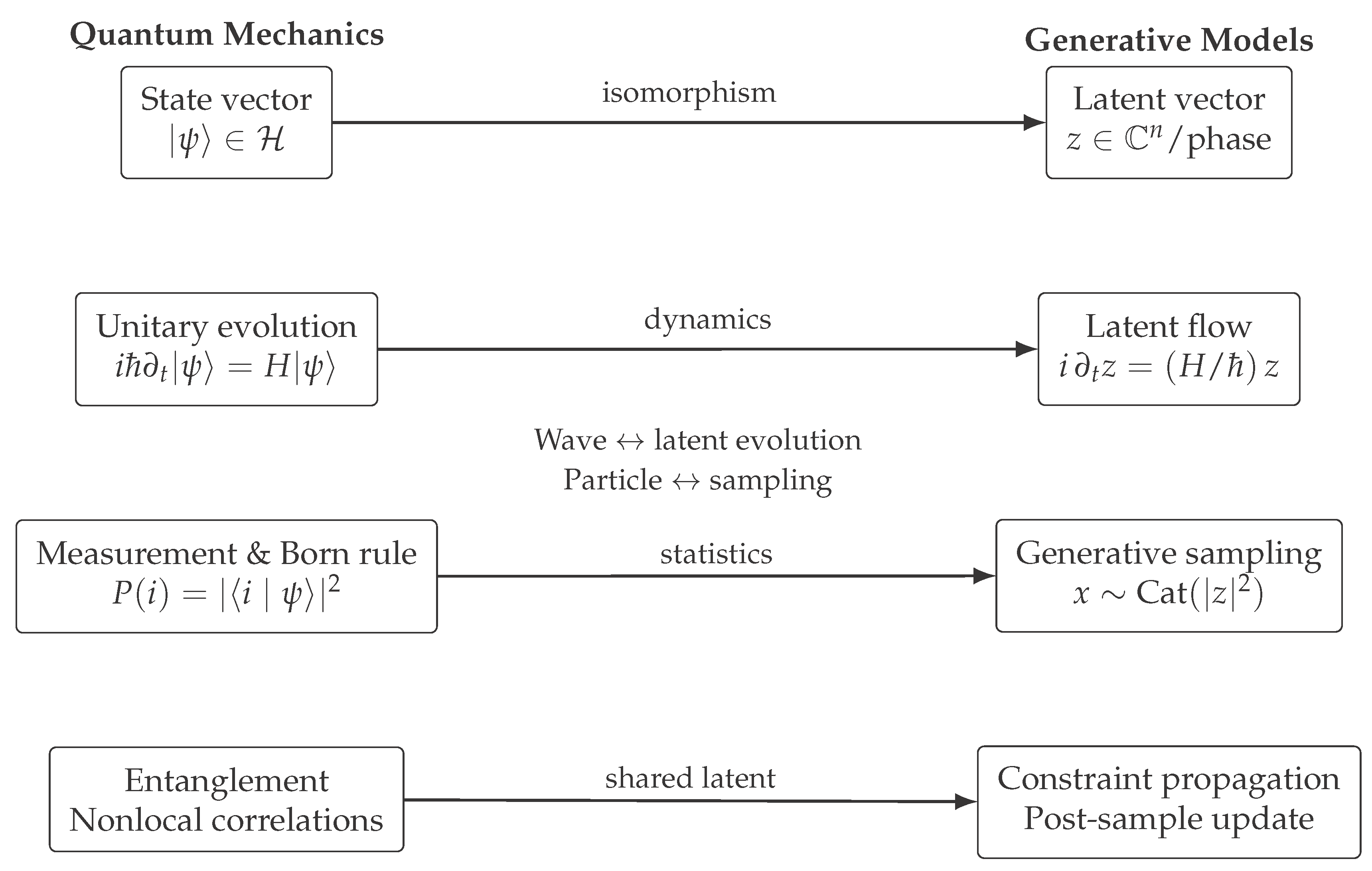
Figure 1.
High-level GRH mapping between quantum mechanics and generative models.
2. Mathematical Foundations
2.1. Exact Equivalence Framework
We begin by establishing precise mathematical equivalences between quantum mechanics and generative models, starting with the simplest possible systems and building toward more complex scenarios.
2.1.1. Single Qubit as Discrete Generative Model
Consider a qubit evolving under a time-independent Hamiltonian . The quantum state evolves as
We establish an exact equivalence with a temporal generative model by defining a latent variable where
The generative distribution is then
Theorem 1.
The quantum amplitude evolution is isomorphic to the latent space trajectory of this generative model.
Proof.
Let . Define the mapping . Up to global phase, this mapping is bijective because normalized complex coefficients uniquely specify , and vice versa. Probabilities are preserved: . Inner products are preserved: .
Quantum evolution obeys the Schrödinger equation
which in the basis reduces to
Equivalently,
which is the latent flow equation in the generative framework. Thus the mapping preserves dynamics, probabilities and geometry (both evolve on ), establishing the isomorphism. □
2.1.2. Measurement as Conditional Sampling
For observable with eigenstates , measurement probabilities are
In the generative framework define sampling operation that draws from the categorical distribution
The post-measurement latent update is
and is the k-th standard basis vector. Measurement statistics coincide exactly with generative sampling statistics.
2.2. Two-Qubit Entanglement as Correlated Generation
2.2.1. Mathematical Formulation
Consider the Bell state
This corresponds to the latent representation
Marginal sampling on qubit A yields
Upon observing outcome , the latent vector undergoes constraint propagation:
where projects onto the subspace consistent with k. Subsequent sampling uses as the generative source.
2.2.2. Non-Locality as Computational Consistency
Theorem 2.
The generative model reproduces Bell inequality violations exactly.
Proof sketch
For measurement settings at angles on the Bell state the quantum correlation is . The generative model samples A, applies a constraint to the shared latent z, and then samples B conditioned on the constrained latent. Because constraint propagation acts within the complex Hilbert geometry rather than a classical probability simplex, the model reproduces the quantum correlation functions, and thus violates CHSH with . A full derivation is presented in Appendix A. □
2.3. Dynamics: Hamiltonian Evolution as Latent Flow
2.3.1. Continuous Generative Dynamics
The Schrödinger equation
maps to the latent-space flow
so quantum evolution corresponds to geodesic flow on complex projective space , and generative evolution represents flow on an isomorphic latent manifold.
2.3.2. Decoherence as Stochastic Latent Diffusion
Environmental decoherence, described by the Lindblad master equation,
maps to a stochastic differential equation for the state vector,
where are independent Wiener processes. Environmental decoherence corresponds to noise in the latent space.
2.4. Complexity-Dependent Decoherence
We propose that decoherence rates depend on the computational complexity of maintaining quantum states. For a pure state , define a complexity ansatz
where is the von Neumann entropy across a chosen bipartite split and the second term captures descriptive amplitude complexity (coding cost). Rationale. The additive form reflects two orthogonal contributions: (i) entanglement structure (captured by ) and (ii) amplitude coding cost, which penalizes non-uniform superposition structure. We considered alternatives (e.g., Kolmogorov complexity of the wavefunction), but they are not experimentally accessible with current platforms; balances physical interpretability with measurability and supports regression-based tests across diverse state families.
Hypothesis:
where is a universal constant characterizing the computational cost of coherence. This implies that sufficiently complex states spontaneously decohere even absent environmental coupling.
2.5. Wave-Particle Duality as a Process Duality
In GRH, wave-particle duality is a duality of process modes.
Wave behavior (latent evolution)
When a system propagates unmeasured, its latent vector evolves continuously:
In a double-slit experiment the post-slit latent vector is a coherent superposition , and detection probabilities follow
which yields interference.
Particle behavior (generative sampling)
A which-path measurement triggers a discrete sampling event:
After sampling interference terms vanish and the distribution reduces to single-slit contributions.
3. Information-Theoretic Foundations
3.1. The Born Rule as Optimal Sampling Algorithm
Theorem 3.
Under assumptions of definite outcomes, probabilities depending only on state, and no-signaling for composites, the Born rule is uniquely determined as the optimal sampling algorithm for extracting classical information from quantum latent representations.
Sketch.
Following Masanes et al. [7] and Hardy [8], operational constraints on measurements imply the Born rule. From a computational perspective the Born rule minimizes extractable statistical bias while preserving consistency and no-signaling, making it the natural sampling prescription for an objective generative substrate. □
3.2. Wheeler’s “It from Bit” and Computational Reality
Wheeler’s conjecture that reality emerges from binary information [6] aligns with GRH’s informational ontology. The “it from bit” principle finds concrete expression in discrete sampling operations that extract classical “its” from quantum “bits”.
3.3. Quantum Error Correction and Computational Optimization
Quantum error correction thresholds highlighting[12] mirror GRH’s computational perspective: natural systems transition to classicality when the computational cost of maintaining coherence exceeds available resources.
4. Experimental Predictions and Falsifiability
GRH makes five specific, quantitative predictions that differ measurably from standard quantum mechanics (SQM).
4.1. Latent Space Geometry Test
Prediction
If quantum states are points in a generative latent space, pairwise distances must follow the Fubini–Study metric:
Protocol
Prepare states on superconducting qubits; use process tomography to measure transition probabilities; construct empirical distance matrix; test conformity to Fubini–Study with a analysis.
4.1.0.5. Falsifiability
Systematic deviations exceeding falsify GRH’s geometric foundations.
Required precision
State preparation fidelity >99%, tomography accuracy .
4.2. Complexity-Dependent Decoherence Scaling
Prediction
Decoherence rates scale with computational complexity, not just qubit number N and entanglement entropy S. One candidate scaling:
with universal constants .
Protocol
Prepare entangled states of varying complexity on trapped ions; measure via Ramsey interferometry while controlling environmental noise; perform multivariate regression.
Falsifiability
Absence of predicted scaling with confidence would falsify GRH.
Required precision
>100 distinct states; coherence measurements accurate to ; systematic errors <0.1% of predicted effect.
4.3. Temporal Structure of Measurement
Prediction
Collapse exhibits temporal structure rather than instantaneous transitions. GRH provides a model for collapse statistics.
Protocol
Continuous weak measurements on superconducting qubits; record measurement current with ns resolution; reconstruct quantum trajectories .
GRH prediction
Inter-collapse intervals follow an exponential distribution; collapse duration scales as .
Statistical test
Kolmogorov–Smirnov test comparing observed collapse statistics to GRH versus alternatives.
4.4. Contextual Measurement Effects
Prediction
Measurement outcomes exhibit weak dependence on global experimental context beyond the measured observable.
Protocol
Prepare a three-qubit system, vary operations on unmeasured qubit 3 while measuring correlation between qubits 1 and 2; control classical crosstalk and artifacts.
GRH prediction
shows detectable () dependence on qubit 3’s state even if unentangled.
SQM prediction
is independent of qubit 3 for unentangled systems.
Required precision
Correlation accuracy ; repetitions per configuration.
4.5. Information Recovery from Decoherence
Prediction
Information undergoes redistribution, not destruction, enabling recovery beyond standard thresholds.
Protocol
Implement a surface code on superconducting qubits; apply controlled decoherence; perform error correction.
GRH prediction
Recovery possible at error rates a factor 2– above standard threshold.
Falsifiability
Recovery fidelity at threshold with significance supports GRH.
Experimental Roadmap (practical order).
A feasible progression is: (1) Latent-space geometry (lowest complexity, quick tomography loops); (2) Contextual measurement effects on small registers with aggressive artifact controls; (3) Temporal structure of measurement using existing weak-measurement hardware; (4) Complexity-dependent decoherence via curated state families and regression; (5) Information recovery in surface codes at elevated noise rates.
5. Relationship to Existing Interpretations
Copenhagen
GRH provides a mechanistic foundation: collapse is generative sampling. The classical-quantum boundary becomes a computational interface.
Many-worlds
GRH avoids multiplicity by treating superposition as computational potential rather than literal branching universes.
Pilot-wave
GRH replaces hidden variables with computational processes; the guidance equation may emerge as an effective description of sampling dynamics.
Objective collapse
Spontaneous localization in GRW-like models can be reinterpreted as computationally triggered sampling when complexity becomes prohibitive.
QBism
Unlike QBism [23], GRH posits an observer-independent computational substrate.
6. Advanced Mathematical Connections
6.1. Quantum Information Geometry
The Fisher information metric maps to the Riemannian structure of the generative latent manifold.
6.2. Topological Quantum Computation
Topologically protected states correspond to generative models with topologically stable latent representations; braiding maps to homotopy-invariant transformations.
6.3. AdS/CFT and Holographic Information Storage
7. Quantum Field Theory Extension
7.1. Field Operators as Continuous Generative Functions
In QFT the field operator becomes a continuous generative mapping from latent codes to spatial configurations:
7.2. Path Integral as Generative Process Integral
The Feynman path integral
corresponds to an integration over generative process trajectories,
7.3. Spacetime Emergence
Note (speculative). The following subsection outlines conjectural structures intended as research directions rather than a completed formalism.
We conjecture that spacetime geometry emerges from the computational graph structure of the underlying generative model. The metric tensor may be expressed formally as
where S is the generative process “action”. This is speculative; achieving full Lorentz covariance is a primary challenge for future development.
Computational interpretation of Lorentz invariance. Within GRH, spacetime geometry may be understood as an emergent property of the computational graph underlying the generative process. A natural interpretation of special relativity arises when we treat the invariant speed of light, c, as the maximum spatial update rate the generative system can sustain per unit of proper time. The Minkowski metric
can then be reinterpreted as a computational resource constraint:
where represents the processing cost of updating spatial coordinates, and is the cost of temporal progression in the latent manifold. Increasing spatial velocity consumes more of the fixed budget for state evolution, leaving fewer computational steps available for temporal updates—observed phenomenologically as time dilation. This “spacetime exchange rate” perspective suggests that Lorentz invariance emerges naturally from a deeper invariance of computational bandwidth, with c as the universal exchange constant between spatial and temporal computation.
8. Statistical Framework for Experimental Validation
8.1. Bayesian Model Comparison
Define the Bayes factor
Decision criteria: strong evidence for GRH; GRH falsified; inconclusive.
8.2. Multiple Testing Corrections
With five independent tests we apply Bonferroni correction: require individual significance to keep family-wise .
8.3. Required Sample Sizes
Power analysis indicates: geometry test state pairs; complexity scaling states; measurement dynamics trajectories; contextuality repetitions; information recovery trials.
9. Technological Implications
9.1. Quantum Computing Applications
GRH suggests quantum computers access reality’s computational substrate, enabling quantum-inspired generative algorithms, novel error correction, and hybrid quantum-classical models.
9.2. Artificial Intelligence Enhancements
The mathematical equivalences suggest quantum-enhanced variational autoencoders, coherent generative sampling, and entanglement-based data correlations for AI improvements.
10. Cosmological Implications
Note (speculative). The discussions in this section are exploratory and are offered to indicate potential directions rather than settled claims.
10.1. Universal Computation and Its Substrate
GRH raises the “computational substrate problem”: what physical system executes the universal computation? GRH aims to describe the operational logic—the “software”—not the ultimate hardware, similar to cosmology’s questions about “before” the Big Bang.
10.2. Information, Thermodynamics, and Computational Limits
The framework connects to Landauer’s principle [25], suggesting that irreversible generative sampling (measurement) dissipates heat and contributes to the thermodynamic arrow of time. Furthermore, finite computational capacity implies constraints on evolution (e.g., Bekenstein bound [26]).
In this light, the speed of light c may be understood as the ultimate computational exchange rate between spatial and temporal updates within the universe’s generative process. Just as Landauer’s principle bounds the thermodynamic cost of irreversible computation, c bounds the rate at which spatial information can be updated without sacrificing temporal coherence. This reinforces the idea that spacetime itself is a manifestation of finite computational capacity.
11. Future Research Directions
11.1. Theoretical Development
Priorities: (1) develop a fully relativistic QFT formalization consistent with Lorentz invariance under the computational constraint, (2) derive emergent spacetime models from computational graphs, (3) refine complexity measures theoretically and empirically, (4) explore cosmological applications.
11.2. Experimental Program
The five tests in Section 4 form a validation program. Some tests may be feasible within 2–3 years; full program within 5–7 years given current technological trajectories.
11.3. Technological Development
Applications in quantum computing and AI represent immediate practical opportunities.
12. Conclusions
The Generative Reality Hypothesis provides a novel, mathematically rigorous framework for understanding quantum mechanics through the lens of computational generative processes. By establishing formal equivalences between quantum dynamics and specific generative models, we have developed a theory that: (1) recasts the measurement problem into computational sampling of latent spaces, (2) explains entanglement mechanistically via shared latent representations and constraint propagation, (3) resolves wave-particle duality as a process duality between latent evolution and generative sampling, (4) connects quantum mechanics to information theory and computational complexity, (5) makes precise, falsifiable predictions for experiment, and (6) suggests practical applications for QC and AI. The framework’s most significant contribution is its testability. If validated, GRH would indicate the universe operates as a vast generative information processor. If falsified, GRH will have provided precise, testable hypotheses that further our understanding of quantum foundations.
Appendix A. Full Proof of Theorem 2
Theorem A1.
The generative model for the Bell state with latent representation reproduces Bell inequality violations exactly, matching quantum mechanical predictions.
Proof.
We show the generative model’s conditional sampling reproduces the quantum correlation .
Quantum baseline:
For observables and on qubits A and B, for one finds and mixed terms vanish, so
With CHSH angles the quantum value violates the classical bound 2.
Generative model:
Measure A in basis where . Marginal probabilities . If A is , the post-measurement (constrained latent) state is . Measuring B in yields conditional probabilities
and similar expressions for other outcomes. Compute joint probabilities:
Hence
matching quantum mechanics. Thus the generative sampling reproduces the CHSH violation exactly. □
Glossary (ML ↔ QM)
- Latent space (ML) ↔ state vector / Hilbert space (QM)
- Generative sampling (ML) ↔ measurement / Born rule (QM)
- Latent flow (ML) ↔ unitary evolution / Schrödinger dynamics (QM)
- Constraint propagation (ML) ↔ post-measurement update / projection (QM)
References
- M. Born, “Zur Quantenmechanik der Stoßvorgänge,” Zeitschrift für Physik, 37(12):863–867 (1926).
- W. Heisenberg, Physics and Philosophy: The Revolution in Modern Science, Harper & Row (1958).
- H. Everett, “Relative state” formulation of quantum mechanics, Rev. Mod. Phys., 29(3):454–462 (1957).
- L. de Broglie, “La nouvelle dynamique des quanta,” in Electrons et Photons, Rapports et Discussions du Cinquième Conseil de Physique, 105–141 (1928).
- G. C. Ghirardi, A. Rimini, T. Weber, “Unified dynamics for microscopic and macroscopic systems,” Phys. Rev. D, 34(2):470–491 (1986).
- J. A. Wheeler, “Information, physics, quantum: The search for links,” Proc. 3rd Int. Symp. on Foundations of Quantum Mechanics, 354–368 (1989).
- L. Masanes, T. D. Galley, M. P. Müller, “The measurement postulates of quantum mechanics are operationally redundant,” Nat. Commun., 10:1361 (2019).
- L. Hardy, “Quantum theory from five reasonable axioms,” arXiv:quant-ph/0101012 (2001).
- S. Lloyd, “Universal quantum simulators,” Science, 273(5278):1073–1078 (1996).
- I. Goodfellow et al., “Generative adversarial nets,” Adv. in NIPS 27 (2014).
- M. A. Nielsen and I. L. Chuang, Quantum Computation and Quantum Information, Cambridge Univ. Press (2010).
- D. Aharonov and M. Ben-Or, “Fault-tolerant quantum computation with constant error rate,” SIAM J. Comput., 38(4):1207–1282 (2008).
- J. Maldacena, “The large-N limit of superconformal field theories and supergravity,” Int. J. Theor. Phys., 38(4):1113–1133 (1999).
- M. Van Raamsdonk, “Building up spacetime with quantum entanglement,” Gen. Relativ. Gravit., 42(10):2323–2329 (2010).
- S. Ryu, T. Takayanagi, “Holographic derivation of entanglement entropy,” Phys. Rev. Lett., 96(18):181602 (2006).
- M. Schlosshauer, J. Kofler, A. Zeilinger, “A snapshot of foundational attitudes toward quantum mechanics,” Stud. Hist. Phil. Sci. B, 44(3):222–230 (2013).
- W. H. Zurek, “Decoherence, einselection, and the quantum origins of the classical,” Rev. Mod. Phys., 75(3):715–775 (2003).
- A. M. Gleason, “Measures on the closed subspaces of a Hilbert space,” J. Math. Mech., 6(4):885–893 (1957).
- W. H. Zurek, “Pointer basis of quantum apparatus,” Phys. Rev. D, 24(6):1516–1525 (1981).
- M. Schlosshauer, Decoherence and the Quantum-to-Classical Transition, Springer (2007).
- J. S. Bell, “On the Einstein Podolsky Rosen paradox,” Physics (N.Y.), 1(3):195–200 (1964).
- A. Aspect, J. Dalibard, G. Roger, “Experimental test of Bell’s inequalities using time-varying analyzers,” Phys. Rev. Lett., 49(25):1804–1807 (1982).
- C. M. Caves, C. A. Fuchs, R. Schack, “Quantum probabilities as Bayesian probabilities,” Phys. Rev. A, 65(2):022305 (2002).
- E. Fredkin, “An introduction to digital philosophy,” Int. J. Theor. Phys., 42(2):189–247 (2003).
- R. Landauer, “Irreversibility and heat generation in the computing process,” IBM J. Res. Dev., 5(3):183–191 (1961).
- S. W. Hawking, “Breakdown of predictability in gravitational collapse,” Phys. Rev. D, 14(10):2460–2473 (1976).
- J. Preskill, “Quantum information and precision measurement,” J. Mod. Opt., 45(2):305–316 (1998).
- D. P. Kingma, M. Welling, “Auto-encoding variational Bayes,”. arXiv:1312.6114 (2013).
Disclaimer/Publisher’s Note: The statements, opinions and data contained in all publications are solely those of the individual author(s) and contributor(s) and not of MDPI and/or the editor(s). MDPI and/or the editor(s) disclaim responsibility for any injury to people or property resulting from any ideas, methods, instructions or products referred to in the content. |
© 2025 by the authors. Licensee MDPI, Basel, Switzerland. This article is an open access article distributed under the terms and conditions of the Creative Commons Attribution (CC BY) license (http://creativecommons.org/licenses/by/4.0/).
Copyright: This open access article is published under a Creative Commons CC BY 4.0 license, which permit the free download, distribution, and reuse, provided that the author and preprint are cited in any reuse.


