
Submitted:
04 March 2026
Posted:
06 March 2026
You are already at the latest version
Abstract
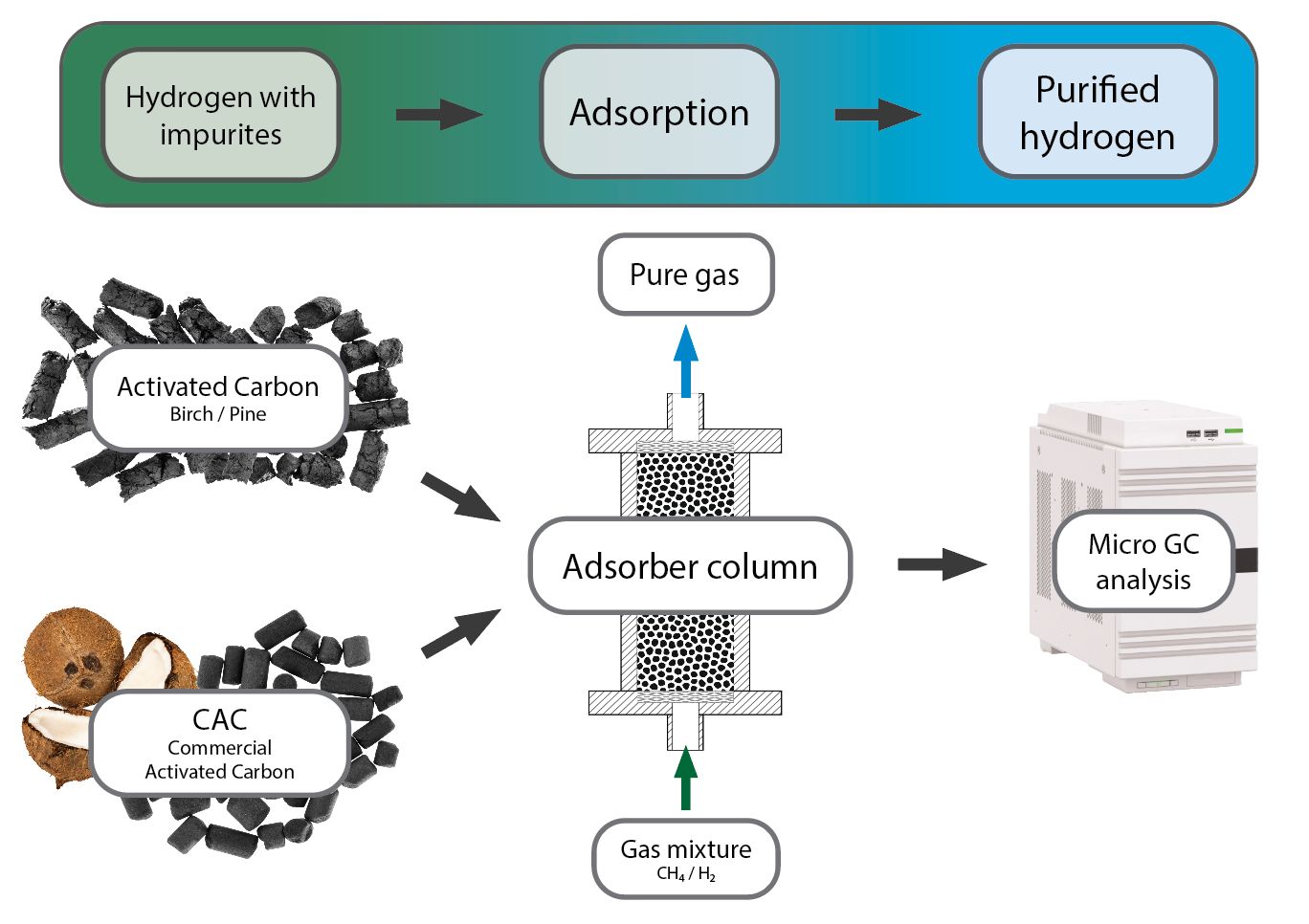
The environmental impacts from fossil fuel use have accelerated the global transition to sustainable energy sources. Hydrogen has become a promising alternative due to its high energy density and clean combustion. However, hydrogen production streams are frequently contaminated with methane, which needs efficient, durable, and cost-effective purification technologies such as Pressure Swing Adsorption (PSA). The present study provides a comparative evaluation of biomass-derived activated carbons and a commercial activated carbon for hydrogen–methane separation.
High surface-area activated carbons were synthesized from sustainable pine and birch precursors via chemical activation using potassium hydroxide (KOH, impregnation ra-tio 3:1) at 800 °C. Their adsorption performance was systematically assessed in a fixed-bed PSA system operating at pressures of 25, 35, and 50 bar, with a gas mixture of hydrogen-methane, where methane feed concentrations was ranging from 10 to 30 vol%.
The biomass-derived activated carbons showed well-developed textural characteristics, with specific surface areas up to 1416 m² g⁻¹, exceeding that of the commercial reference material (1023 m² g⁻¹). This improved pore structure was reflected in their adsorption behavior at an operating pressure of 50 bar, the birch-derived carbon achieved a me-thane uptake of 10.5 mol kg⁻¹, more than twice the capacity measured for the commercial adsorbent of 5.30 mol kg⁻¹.
Beyond initial adsorption capacity, the study emphasizes operational durability and reusability. Cyclic adsorption–desorption experiments, supported by Raman spectroscopy, revealed pronounced structural degradation in the commercial activated carbon under repeated operational stress, as indicated by an increase in the ID/IG ratio from 1.08 to 1.24. In contrast, the biomass-derived activated carbons preserved their morphological integrity and adsorp-tion efficiency over successive cycles. These findings demonstrate that pine- and birch-derived activated carbons are not only sustainable alternatives but also operationally stable adsorbents capable for hydrogen purification pro-cesses.
Keywords:
hydrogen purification
; activated carbons
; pressure swing adsorption
; desorption
; hydrogen-methane separation
Copyright: This open access article is published under a Creative Commons CC BY 4.0 license, which permit the free download, distribution, and reuse, provided that the author and preprint are cited in any reuse.


