Preprint
Article

This version is not peer-reviewed.

Candidate Gene Discovery for Rust Resistance Through Multi-Locus Genome-Wide Association Study in Groundnut

Submitted:

04 March 2026

Posted:

04 March 2026

You are already at the latest version

Abstract

Rust, caused by Puccinia arachidis, is one among the most destructive fungal diseases constraining global groundnut (Arachis hypogaea L.) production. While the development of disease-resistant varieties stands as the most effective approach to preventing substantial yield losses, the genetic mechanisms underlying resistance to rust is not yet well understood, emphasizing the necessity for further detailed research. In this study, 184 accessions from the ICRISAT groundnut mini-core collection were evaluated for rust resistance at Dharwad, India, across multiple seasons, as well as in Vietnam for one season. Whole-genome resequencing-based genome-wide association study (GWAS) identified five highly significant marker trait associations (MTAs) for rust resistance (p = 5.22 × 10⁻¹³ to 7.21 × 10-08). Among these, two robust rust-associated kompetitive allele specific PCR (KASP) markers, snpAH00607 at chromosome Ah01 and snpAH00609 at chromosome Ah17, were validated across diverse set of breeding and pre-breeding lines. These markers were linked to candidate genes encoding sterol C4-methyl oxidase 1-2, implicated in brassinosteroid-mediated salicylic acid signalling, and MYB transcription factor known to be associated with defense responses. The identified SNPs, validated markers, and candidate genes will serve as important resources for marker-assisted breeding of rust disease resistant groundnut varieties.

Keywords: 
;  ;  ;  ;  ;  

1. Introduction

Groundnut (Arachis hypogaea L.) is an important oilseed and food legume crop cultivated widely in tropical and subtropical regions. Groundnut genotypes are classified into two subspecies, hypogaea and fastigiata, comprising six botanical varieties: hypogaea, hirsuta, fastigiata, vulgaris, aequatoriana, and peruviana [1,2]. They are grouped into four agronomic types - Valencia bunch, Spanish bunch, Virginia runner and Virginia bunch, displaying considerable morphological diversity, each distinguished by characteristic growth habit, plant architecture, pod and seed traits, maturity period, and yield potential. Breeding programs exploit plant genetic resources primarily as sources of disease and pest resistance [3]. The groundnut minicore subset, representing the genetic diversity of the entire germplasm, allows breeders to screen for desirable traits more effectively. For instance, 39 accessions from Spanish, Valencia, and Virginia runner types were shown to be potentially resistant to Sclerotinia blight disease, according to molecular characterization investigations of the US groundnut small core collection [4]. Similarly, screening core collection revealed that groundnut have some resistance to the tomato spotted wilt virus [5]. Likewise, a study conducted at ICRISAT, identified six potential resistant sources to late leaf spot and rust from groundnut mini core collection [6].
Groundnut seeds are rich in protein and lipids, making them a globally valued health food. In recent years, demand for groundnut oil and its by-products has steadily increased [7] and is cultivated globally over an area of 30.9 million hectares, producing 49.23 million tons with an average productivity of 1,755.2 kg per hectare as per FAOSTAT, 2023. However, its productivity is severely constrained by foliar fungal diseases such as late leaf spot and rust, which not only reduce grain yield but also adversely affect fodder quality. Under severe epidemics, their combined effect can lead to yield losses of up to 70% [8,9,10]. The primary symptom of early-season infestation of rust can lead to symptoms such as premature pod maturity, smaller seed size, accelerated pod senescence, and lower oil content. In cases of severe infection, economic losses can reach as high as 57% [11]. Groundnut rust can be managed using a variety of approaches, including cultural practices, chemical fungicides, biological control agents, and the use of resistant plant varieties. Although each method has its own advantages and limitations when applied individually, host plant resistance emerges as the most cost-effective, practical, environmentally sustainable, and socially acceptable strategy for achieving integrated disease management in groundnut. Development of resistant varieties is an economically sound strategy for mitigating yield losses caused by foliar diseases, however, the pathogen's ability to evolve through mutation or somatic recombination necessitates a continuous search for novel resistance sources to overcome the ineffectiveness of existing resistance genes [12]. Complex genetic architecture of resistance traits, coupled with strong genotype × environment interactions, poses a challenge for rapid improvement through conventional methods [13].
Although progress has been made in developing rust-resistant groundnut varieties, genetic research on rust resistance has been limited to few sources. For example, Luo et al. [14] reported 12 QTLs associated with rust resistance using SSR markers, while Pandey et al. [15] identified 25 candidate genes on chromosome A03 through QTL-seq analysis where resistance source was from wild relative A. cardenasii. Likewise, Sujay et al. [16] developed three SNP markers linked to rust resistance using conventional QTL mapping in susceptible populations, resistant parental lines from RILs, and 11 introgression lines. Several QTLs associated with rust resistance have been identified; however, the genetic basis of this trait remains largely unresolved, as the reported loci account for only a limited portion of the phenotypic variation. To better elucidate the mechanisms underlying foliar disease resistance, researchers have employed diverse molecular marker approaches to map QTLs linked to rust resistance. Therefore, advancing breeding programs for rust-resistant groundnut through deeper genetic analysis, discovery of novel loci, identification of potential candidate genes, and development of new molecular markers is of significant importance.
GWAS is a useful method for identifying the genes responsible for a specific trait. The best way to achieve this is to evaluate the genomic areas where phenotypic and genotypic differences are associated. For identifying associations between molecular markers and desirable traits across a range of crops, GWAS provides higher mapping precision than normal biparental populations [17,18]. Therefore, for the groundnut sector to grow sustainably and produce high yields and outstanding quality, disease resistance research must be accelerated. Over the past decade, advancements in next-generation sequencing and the integration of high-throughput genotypic and phenotypic data have significantly enhanced the use of GWAS for identifying marker trait associations [19]. Unlike traditional linkage mapping, GWAS leverages linkage disequilibrium (LD) to associate single nucleotide polymorphisms (SNPs) with quantitative trait loci (QTL) influencing complex traits [8]. In spite of these advances, the potential of GWAS as a powerful tool for trait discovery, its application to disease resistance in groundnut remains relatively limited.
Given the complex genetic nature of these traits, it is crucial to identify and pyramid key major-effect resistance genes, leading to more robust and durable resistance. Additionally, there is limited information on the molecular pathways and candidate genes associated with rust that mediate resistance responses in groundnut. To bridge these gaps, we conducted GWAS to identify MTAs associated with resistance to rust in a diverse panel of groundnut accessions. This study aimed to identify novel SNPs significantly associated with rust resistance, validate key SNPs in independent populations to confirm their stability and reproducibility across environments, and conduct functional annotation to uncover candidate genes and biological pathways underlying disease resistance. Multi-locus GWAS models such as Bayesian-information and Linkage-disequilibrium Iteratively Nested Keyway (BLINK) and fixed and random model circulating probability unification (FarmCPU) and single locus general linear models like general linear model (GLM) and mixed linear model (MLM) were used to carry out the present study. These models have been developed and successfully applied in various crops [8,20,21,22,23].

2. Materials and Methods

2.1. Plant Material and Phenotyping for Rust

The groundnut minicore collection, consisting of 184 accessions, was developed at the ICRISAT genebank to represent the genetic diversity found whole groundnut germplasm collection of over 15,000 accessions [24]. It was developed based on taxonomic, morphologic and geographic descriptors, belonging to the six botanical varieties viz., hypogaea, fastigiata, hirsuta, peruviana, vulgaris and aequatoriana. The minicore lines evaluated in this study comprised of the agronomic types - Virginia runner (33), Virginia bunch (48), Valencia bunch (35), and Spanish bunch (57) (Supplementary Table 1). This diverse set was used for association mapping with an intention to identify the untapped regions contributing to resistance. These accessions were evaluated for rust resistance across multiple seasons and locations (Supplementary Table 2). Field evaluations for rust were conducted at Dharwad during the rainy seasons of 2007, 2008, and 2010, and in Vietnam for one season. Trials were established in a randomized complete block design (RCBD) under standard agronomic practices. The infector row technique was used, wherein one bed (four rows) of the susceptible checks TMV 2 (rust) was sown for every four beds of test entries to ensure uniform disease pressure. The disease scoring of mini core lines was taken at 90 days for rust [6] which was coinciding with highest incidence as evident by highest field disease score in susceptible checks using a modified 9-point scale proposed by [25]. The disease severities corresponding to the rust scores are 1 = 0%; 2 = 1–5%; 3 = 6–10%; 4 = 11–20%; 5 = 21–30%; 6 = 31–40%; 7 = 41–60%; 8 = 61–80%; and 9 = 81–100% [13].
Table 1. Pooled ANOVA (Analysis of Variance) for rust screened at different seasons and locations.
Trait Source of Variation Df Sum Sq Mean Sq F value Pr(>F)
Rust Replication 2 0.115 0.058 0.346 0.707
Genotype ** 156 243.033 1.558 9.358 0
Environment ** 3 2406.136 802.045 4817.742 0
Genotype x Environment ** 468 216.48 0.463 2.779 0
Error 1254 208.763 0.166
Significance codes: 0 ‘****’, 0.001 ‘***’, 0.01 ‘**’, 0.05 ‘*’.
Table 2. Significant SNPs and candidate genes associated with rust resistance.
SNP Type of variant Chr. No Position Allele (Ref/Alt) P - value Models PVE (%) Gene ID Annotation
Arahy.01_30014046 intergenic 1 30014046 C/T 5.22 x 10⁻¹³ FarmCPU, BLINK 19.7 P9U8RJ Ubiquitin family protein
N67QXJ Protein kinase superfamily protein
Arahy.01_48511619 intergenic 1 48511619 A/G 7.06 x 10-09 FarmCPU 17.6 696GFM Uncharacterized protein At4g22758-like
11UTVE Sterol C4-methyl oxidase 1-2
Arahy.08_28112898 upstream 8 28112898 T/G 4.57 x 10⁻¹¹ Blink 4.2 CC6MMP 40s ribosomal protein SA
Arahy.15_142635616 intergenic 15 142635616 G/A 7.08 x 10-08 FarmCPU 22.71 5E7A70 Winged-helix DNA-binding transcription factor family protein, putative isoform
V5GBYV Protein kinase superfamily protein
Arahy.17_133493906 intergenic 17 133493906 A/G 3.54 x 10-09 FarmCPU 0.53 ES2NTH Ferrochelatase 1
H8IXR5 MYB transcription factor MYB127 [Glycine max]

2.2. Statistical Analysis of Phenotypic Data

Phenotypic variability for rust disease resistance was assessed in the association panel using Windostat software. Year-wise and combined analyses of variance were performed, enabling the estimation of variance components attributable to year (environment), genotype, and genotype × environment (G × E) interactions. To evaluate the potential for genetic association mapping, we computed descriptive statistics, including mean, range, and standard error, as well as key genetic parameters genotypic and phenotypic coefficients of variation (GCV, PCV) [26] and genetic advance (GA) [27] using Windostat software version 9.50 (Indostat). These parameters are critical for determining the feasibility of association mapping, as they reveal the degree of genetically controlled variation available for linking traits to molecular markers.

2.3. DNA Isolation, Sequencing and SNP Calling for WGRS Data

Using a Nucleospin Plant II kit (Macherey-Nagel, Düren, Germany; https://guest.link/UM6), total genomic DNA was extracted from the young leaves of plants that were 25–30 days old and belonging to the 184 mini-core accessions. Thermo Scientific's NANODROP 8000 spectrophotometer and a 0.8% agarose gel were used to determine the concentration and purity of the isolated genomic DNA samples, respectively. The Hi-seq Illumina sequencing technology was used for genotyping. To guarantee high-quality sequencing data for additional analysis, the adapter sequences were first trimmed after sequencing, and then the low-quality reads—that is, those with > 20% low-quality bases (quality value ≤ 7) and > 5% "N" nucleotides—were filtered out using SOAP2. The same software was then used to map the clean sequence reads onto the reference genome of the cultivated tetraploid "Tifrunner" using the parameters "-m 300 -x 600 -s 35 -l 32 -v 5 -p 4." The likelihood of each possible genotype for each sample was then calculated using SOAPsnp3 in order to obtain the maximum likelihood estimation of the allele frequency in the population. The strict requirements for mapping times (>1.5), sequencing depth (>10000 and <400), and quality score (<20) were then used to filter the low-quality variants; finally, the SNP sites with estimated allele frequency ≠0 or 1 were found. Furthermore, the remaining high-quality SNPs were taken into consideration for additional analysis after SNPs with ≥50% missing among genotypes were further filtered out. SNP marker density and distribution across chromosomes were depicted using the R package CMplot (https://github.com/YinLiLin/R-CMplot).

2.4. Genome Wide Studies for Identifying MTAs with Rust Resistance

A minor allele frequency (MAF) threshold of 0.05 was used for the analysis of WGRS data from 184 mini-core accessions. Applying a heterozygosity cutoff of 0.25 yielded a filtered dataset of 561,099 SNPs with 0.2% heterozygosity and MAF ≥ 0.05. The filtered dataset was used for GWAS analysis with bonferroni correction at the 5% significance level. MTAs were further identified using the GAPIT package in R [28]. Phenotypic data collected across three seasons for rust and integrated with WGRS data of the mini-core set to identify the MTAs. Two multi-locus GWAS models BLINK and FarmCPU and single locus models- MLM, GLM from the Genome Association and Prediction Integrated Tool (GAPIT) R package (v3.0) were used to account for population structure and kinship. Manhattan and QQ plots were generated using the CMplot R package (https://github.com/YinLiLin/R-CMplot). The association threshold to determine significant marker-trait associations was computed with bonferroni correction by calculating a p-value of 8.91 × 10⁻⁸, derived from the negative log transformation of α/n, where n represents the total number of SNPs used for GWAS analysis.

2.5. Gene Predictions Within the Candidate Interval and Pathway Analysis

Based on the GWAS results, candidate genes associated with groundnut rust resistance were predicted using the Arachis hypogaea cv. Tifrunner genome annotation (version 1; https://groundnutbase.org/) and candidate genes were identified around significant MTAs (Table 2) [14]. The candidate genes were found using GBrowse (cultivated groundnut) version 1 with gene ID on groundnut base (https://Groundnutbase.org/). Based on available literature, genes previously associated with biotic stress resistance were identified as candidate genes for foliar disease resistance and the gene functions were retrieved from PeanutBase. Candidate genes significantly associated with disease resistance loci from our GWAS were subjected to KEGG pathway enrichment analysis using the KEGG pathway database [29].

2.6. Kompetitive Allele-Specific PCR (KASP) Marker Development and Validation

Based on the candidate genes identified and the potential of the identified SNPs in differentiating the resistant and susceptible lines, highly promising SNPs were identified. In order to develop user-friendly and cost-effective KASP markers 300bp upstream and downstream sequences were used from these SNPs. At Intertek Pvt. Ltd., Hyderabad, India, two allele-specific forward primers and a common reverse primer were used in the design of KASP assays for each SNP marker. Following development, the KASP markers were validated in an independent set of 51 genotypes.

3. Results

3.1. Phenotype Variation and Descriptive Statistics for Rust Across Environments
The phenotypic data for rust exhibited nearly normal distribution across different years and locations (Figure 1). Overall, the disease rankings of the phenotyped mini-core lines remained stable across different years and locations. Phenotyping of a groundnut mini-core set in field trials revealed substantial genetic variability for resistance to rust, which was significant at the 1% level of significance. The ANOVA results indicated high significant differences were observed across genotypes and seasons (years) at the 1% level of significance (LOS) but no significant differences among replications (Table 1). This highlights the crucial impact of both genetic parameters and environmental influences on rust. The standard error of mean is 11.8. The scores ranged from 4.8 to 7.07 with a mean of 6.3 (Supplementary Table 2), indicating the presence of substantial variability in disease response. The observed phenotypic and genotypic variance was 0.13 and 0.09, respectively. The minimal difference between these two values suggests a predominant role of genetic factors in the inheritance of rust resistance. Across individual environments and pooled analysis, the phenotypic coefficient of variation (PCV) was higher than the genotypic coefficient of variation (GCV). The difference between PCV and GCV values is low indicating the low influence of environment on rust resistance. Across environments, rust exhibited high (70%) broad-sense heritability, along with low genetic advance as a percentage of the mean (8.26%) (Supplementary Table 2). The pattern of resistance is not absolute. There are some overlap and variation within each plant type (for instance, a few Virginia types have decent scores, and a few Spanish types have poorer scores and the reverse is also observed). The genotypes showed scores of 5.1 (ICG 4389), 5.0 (ICG 10036), and 4.5 (ICG 6766) which are found to be moderately resistant.
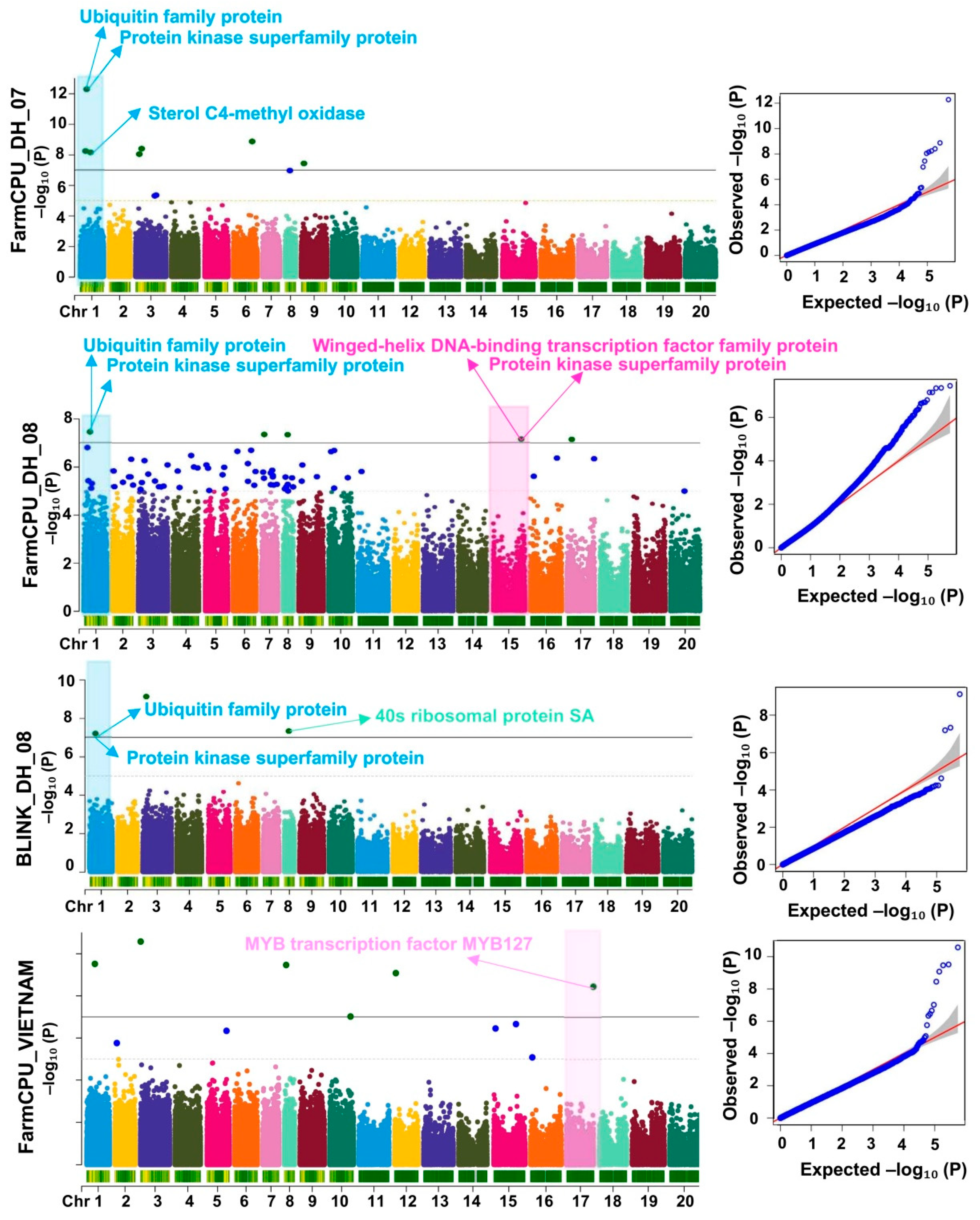
Figure 2. Manhattan plots show marker significance in a combination of FarmCPU and BLINK models by phenotypic data base across groundnut genome for rust. Horizontal black and dashed lines represent the LOD threshold according to the Bonferroni and FDR correction criteria, respectively. Green and red dots represent the significant marker-trait association (MTA) according to the bonferroni and false discovery rate (FDR) correction criteria, respectively.
Preprints 201427 g002

3.2. Genome- Wide Association Studies for Rust

3.2.1. Significant MTAs Associated with Rust

By utilizing phenotyping data of three locations from Dharwad and one season from Vietnam, combined with WGRS, a total of 21 significant MTAs for rust resistance were identified through BLINK and FarmCPU models. Of them 5 best MTAs were distributed across chromosomes Ah01, Ah08, Ah15, and Ah17 (Table 2), with p-values ranging from 5.22 × 10⁻¹³ to 7.08 × 10-08. Chromosome-wise, two MTAs were located on Ah01 and one each on Ah08, Ah15 and Ah17. The MTAs Arahy.01_30014046 and Arahy.01_48511619, on chromosome Ah01 exhibited 19.7% and 17.6% PVE, respectively. Other MTAs Arahy.08_28112898, Arahy.15_142635616 and Arahy.17_133493906 on chromosome Ah08, Ah15 and Ah17 correspondingly explained a PVE% of 4.2%, 22.5% and 0.53%, respectively.

3.2.3. Identification of Candidate Genes for Resistance to Rust

Around the vicinity of the identified five best significant MTAs by GWAS models, a total of 9 genes were retrieved for rust, among these, 8 genes carried intergenic variants and one gene contained upstream variant. Based on previous studies, 6 of these genes are potentially associated with plant disease resistance, primarily functioning through plant pathogen interaction and salicylic acid signalling pathways (Table 2). These MTAs Arahy.01_30014046, Arahy.01_48511619, Arahy.15_142635616 and Arahy.17_133493906 were identified by FarmCPU model explaining their significance as potential genomic regions. Based on the tetraploid genome (Tifrunner) annotation data, protein kinase superfamily protein and ubiquitin family protein identified adjacent to Arahy.01_30014046 are the potential genes known to be having functional relevance in rust resistance. Retrieved genome annotation data from Arahy.01_48511619 revealed Sterol C4-methyl oxidase 1-2, 40s ribosomal protein SA adjacent to Arahy.08_28112898, protein kinase superfamily protein from Arahy.15_142635616 have been reported to regulate resistance in many crops. Similarly, MYB transcription factor MYB127 from Arahy.17_133493906, is found to be among the most well-known genes for regulating rust resistance.

3.3. Development and Validation of KASP Markers Associated with Rust

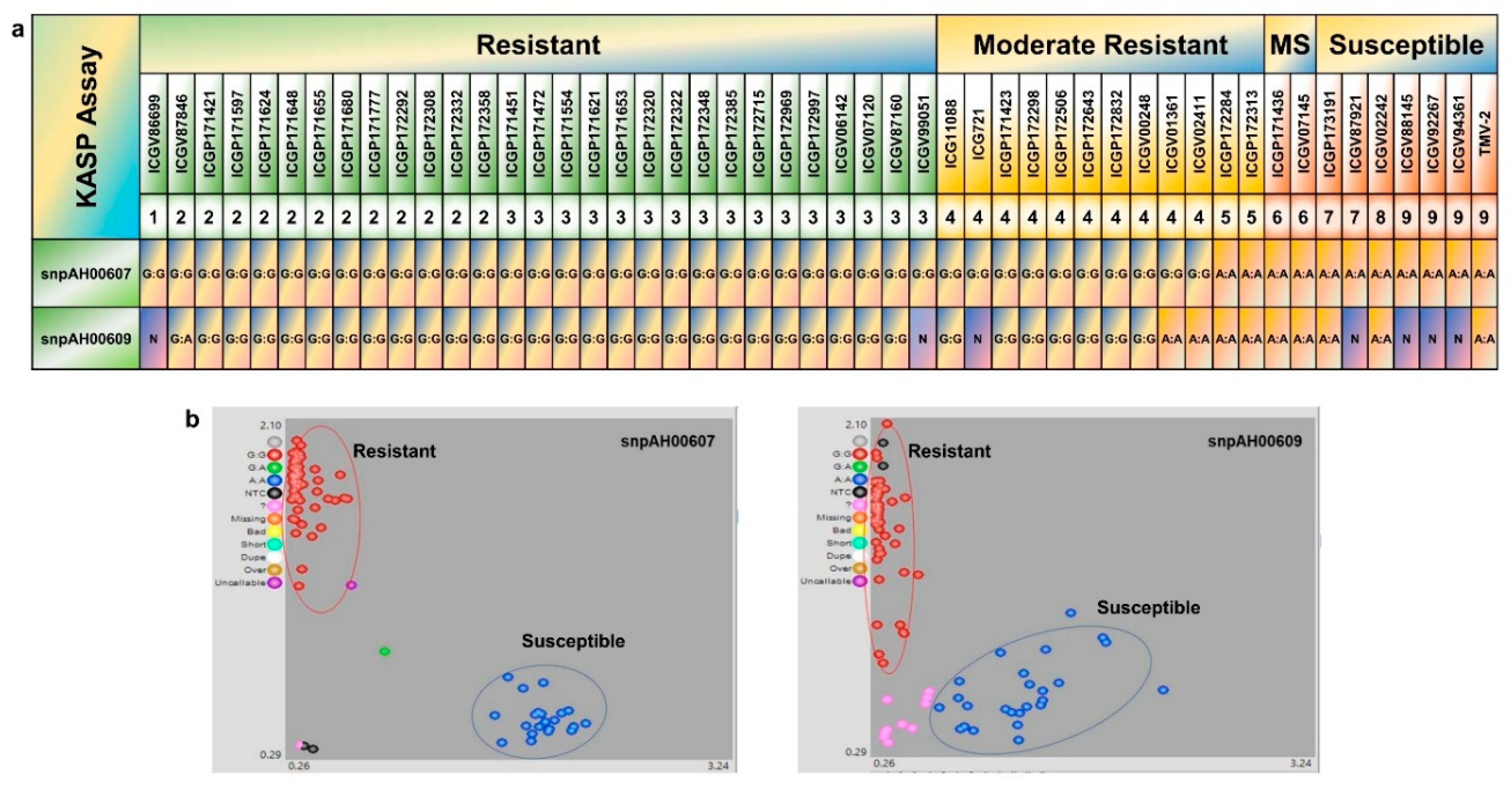
Of the 5 significant MTAs for rust, 4 were shortlisted based on their ability to differentiate between the resistant and susceptible lines. Four MTAs, two on chromosome Ah01 (Arahy.01_30014046, Arahy.01_48511619), one on chromosome Ah15 (Arahy.15_142635616), and one on chromosome Ah17 (Arahy.17_133493906), explaining a PVE of 19.7%, 17.6%, 22.7% and 0.53% respectively were selected for validation. To validate the selected markers, a panel of 51 lines was developed, including diverse set from the advanced breeding lines, reference set, and pre-breeding lines (carrying resistance from ICGV 87846). KASP markers (snpAH00606, snpAH00607, snpAH00608, and snpAH00609) were designed for the four SNPs (Arahy.01_30014046, Arahy.01_48511619, Arahy.15_142635616 and Arahy.17_133493906) to evaluate their association with rust resistance. Of these, Ah01_48511619 (snpAH00607) at chromosome Ah01 and Ah17_133493906 (snpAH00609) at chromosome Ah17 were successfully validated, effectively distinguishing rust resistant and susceptible lines (Figure 3, Supplementary Table 3). We could validate one major and one minor MTAs. These rust-associated markers, located near rust resistance-related genes, represent promising candidates for early-generation marker-assisted selection in groundnut breeding programs.

3.4. Gene Pathway for Rust Resistance

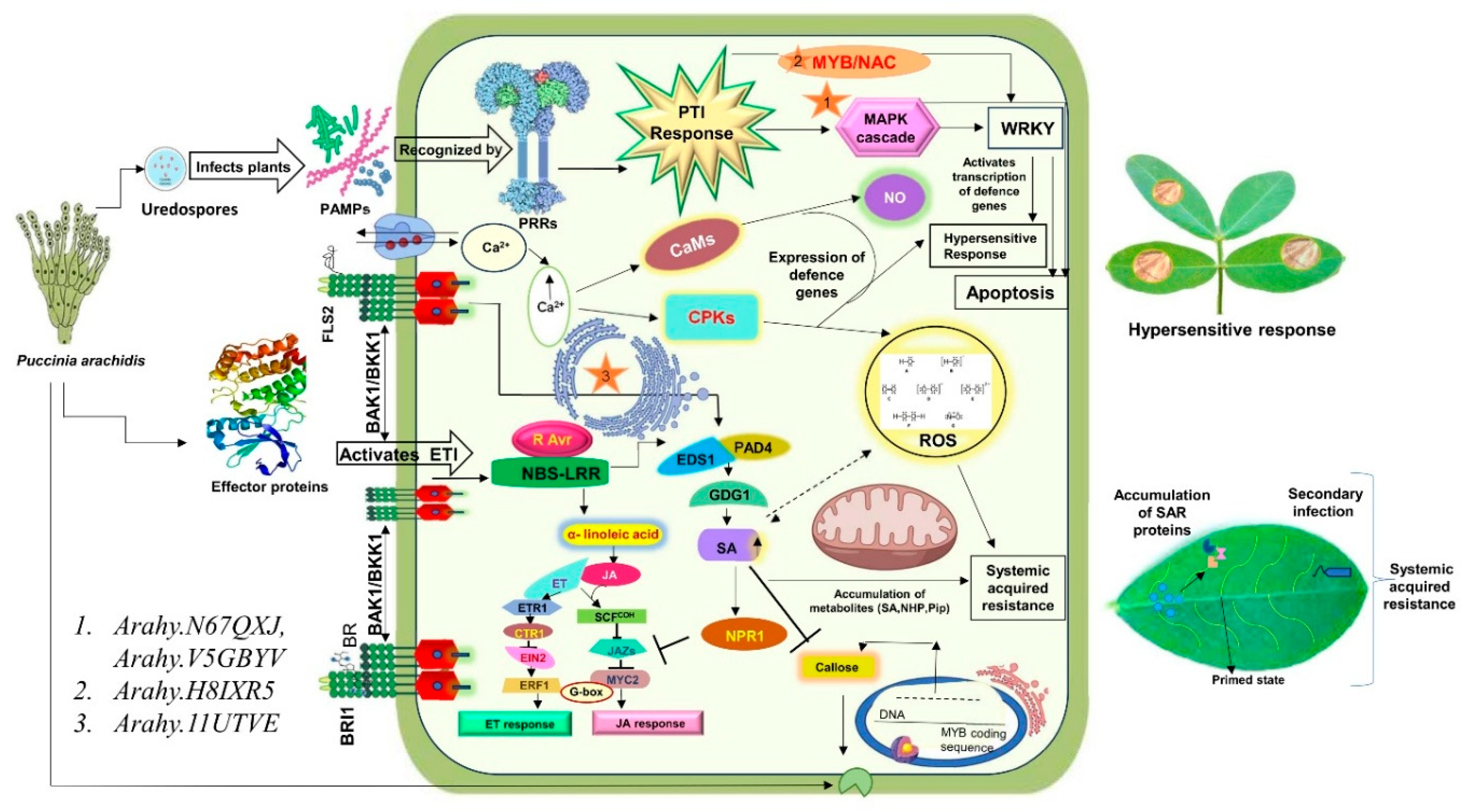
To elucidate the molecular mechanisms underlying rust resistance in groundnut, we conducted an investigation into the functional roles of identified candidate genes and their involvement in various pathways conferring resistance to foliar diseases. Integrating the KEGG pathways of these candidate genes, a hypothetical defense pathway for rust resistance in groundnut has been formulated (Figure 4). Among the identified candidate genes, the protein kinase superfamily protein (Arahy.N67QXJ, Arahy.V5GBYV) is implicated in the kinase activity by activating MAPK pathway for rust resistance. The MYB transcription factor MYB127 (Arahy.H8IXR5), detected as candidate genes for rust is associated with enhanced expression of defense-related proteins. 40s ribosomal protein SA (Arahy.CC6MMP) enhancing the production of salicylic acid thereby indirectly enhancing the rust resistance. Additionally, Sterol C4-methyl oxidase 1-2 (Arahy.11UTVE) participates in brassinosteroid biosynthesis, which modulates salicylic acid mediated defense signaling (Figure 4). Collectively, these genes may have been linked to resistance against rust, highlighting their significance in groundnut rust defense pathways.

4. Discussion

Rust is one among the most destructive foliar diseases affecting groundnut cultivation in various regions across Asia, Africa, and parts of the America [30]. Identification of suitable donors for resistance to rust is crucial for developing durable disease-resistant varieties. The results indicate that the mini-core lines exhibit substantial variability for rust, the resistance is more genetically determined, making it more responsive to direct selection. The rust resistance within these mini-core lines exhibits moderate variability, coupled with high heritability and low genetic advance, indicating that the trait is primarily influenced by additive genetic effects. The results confirm that the mini-core panel harbours sufficient genetic diversity for rust resistance and can serve as a valuable resource for identifying stable and heritable resistance alleles for breeding programs. The identification of significant MTAs through genome-wide association studies represents a critical step towards understanding the genetic architecture of complex traits, particularly disease resistance in crops such as groundnut [31]. To identify genomic regions associated with foliar disease resistance, the diploid reference genomes of A. ipaensis and A. duranensis were first utilized [32], which revealed a candidate region on chromosome A03. Subsequently, analyses were extended to the cultivated tetraploid reference genome (Shitouqi), providing further refinement of the genomic regions involved [33]. In the current study, mini-core lines were genotyped using the Tifrunner reference genome [34], and GWAS was conducted to identify genomic regions associated with rust resistance. The analysis revealed twenty-one MTAs for rust. These MTAs, identified through rigorous statistical modelling and validation, provide a foundation for marker-assisted selection and potentially for the development of novel foliar disease-resistant varieties.
A major quantitative trait locus on linkage group AhXV, explaining up to 82.62% of the phenotypic variation for rust resistance, has been validated and introgressed from the cultivar 'GPBD 4' into susceptible varieties through marker-assisted backcrossing [35]. Moreover, this quantitative trait locus harbors several candidate genes, including those encoding for nucleotide-binding site leucine-rich repeat proteins, receptor-like kinases, and transcription factors [15]. Furthermore, the findings of the present study suggest that rust resistance within this population exhibits moderate variability, coupled with high heritability and low genetic advance, indicating that the trait is primarily influenced by additive genetic effects.
Groundnut rust is a complex quantitative trait, and relatively few studies have been conducted on the genetics of groundnut rust resistance. 12 QTLs associated with rust resistance were identified by khedikar et. [36] located on LG01, LG02, LG03, LG06, LG07, LG08, LG09, and LG10, explaining 1.70% to 55.20% of the phenotypic variation. Similarly, our study detected multiple SNPs across several chromosomes of which Ah01 and Ah08 were coinciding. Notably, to date, only two GWAS studies on rust resistance in groundnut have been reported, by Pandey et al. [30] and Shi et al. [37]. The GWAS study focused on rust resistance in groundnut by Shi et al. [37], identified a total of 18 significant SNPs which were distributed across chromosomes A05 (5 SNPs), A08 (7 SNPs), and A12 (6 SNPs). In the present study, two significant MTAs one on chromosome Ah15 and other on Ah17 (Arahy.15_142635616 and Arahy.17_133493906), explaining up to 17.16% of the phenotypic variance, were identified as a novel genomic region linked to rust resistance. Notably, the MTA Arahy.17_133493906 was validated, and this locus is positioned near a MYB transcription factor which is known to regulate genes associated with rust resistance. When comparing the results of earlier research, it appears that family-based mapping studies predicted PV for rust resistance significantly higher than the current MTA analysis.
Rust epidemiology is dependent on the host’s genotype and its severity, which is subject to genotype × environment interaction effects [38]. This implies that rust resistance could be a complex trait that is influenced by numerous minor genes with additive genetic effect. This highlights the polygenic nature of disease resistance, requiring a specific combination of alleles to confer resistance [39]. However, slight variations may occur due to the significant influence of environmental factors on its expression. This information is very useful in breeding programs, as it provides the most reliable way to tackle rust through host-plant resistance. In our present study, each locus contributes to the cumulative effect of resistance, as the number of loci with favorable alleles (TGAG) increases the amount of resistance shown by the genotype also increases with respect to these 4 loci (Arahy.01_30014046, Arahy.01_48511619, Arahy.15_142635616, Arahy.17_133493906) respectively (Supplementary Table 4, Supplementary Table 5). The distribution shows the role of these favorable alleles in minimizing the susceptibility of a particular genotype. This specific combination of all these 4 loci is perfect complementation to the previously reported genes to enhance rust resistance on the genome. Adding to that there is clear allelic differences between rust resistant and susceptible lines in the mini-core set. These four MTAs showed clearcut variation between the moderately resistant lines ICG 11088 (Score 4), ICG 6766 (Score 4.5), ICG 10036 (Score 5.0), ICG 4389 (Score 5.1), ICG 2381 (Score 5.2) and susceptible lines ICG 10384 (Score 8), ICG 6703 (Score 7.5) ICG 3746 (Score 7.5), ICG 3343 (Score 7.5) ICG17474 (Score 7.5) (Supplementary Table 4.). The lines ICG 11088, ICG 4389, and ICG 6766, previously reported by Sudini et al. [6] as effective donors for rust and late leaf spot resistance, were also discovered in the current investigation. Additionally, these lines possessed the favorable allele of the validated markers employed in our investigation, further confirming resistance at the genotypic level and explaining its potential source as rust resistance donor. Their consistent performance across studies reinforces their reliability as stable and valuable resistance sources. This makes it an excellent candidate for incorporating favourable allelic combinations in breeding programmes. Four of the 5 loci identified through our GWAS contribute maximum to rust resistance encoding the ubiquitin family protein, sterol C4-methyl oxidase 1-2, two copies of protein kinase superfamily protein and MYB transcription factor genes.
Plants possess a sophisticated immune system that relies on a variety of receptor proteins and resistance (R) genes to detect and counter fungal pathogens. These defense mechanisms are categorized into different groups based on their molecular roles. Among them, receptor-like kinases (RLKs) play a central role in pathogen recognition. RLKs encompass a range of protein types, including serine/threonine kinases and protein kinases [40], which are distributed across chromosomes 1 and 15 in our study. Resistance (R) genes contribute to downstream defense responses by encoding proteins such as nucleotide-binding site leucine-rich repeat (NBS-LRR) proteins [15], LRR-domain proteins [30] and various enzymes involved in oxidative stress responses and cellular signalling. In addition, transcription factors (TFs) that regulate plant defense genes are crucial components of the immune response. Notable among these is MYB transcription factors, ATP-binding cassette (ABC) transporters, and CCHC-type zinc finger proteins, all of which modulate gene expression in response to fungal invasion.
The genes encoding Protein kinase superfamily protein and MYB transcription factor are found to be down regulated in the susceptible genotypes [41] supporting the relevance of these genes obtained in our study. Through pattern recognition receptors, plants identify pathogen-associated molecular patterns (PAMPs), which induce a signaling cascade known as PAMP-triggered immunity (PTI). The β-glucan molecules present in the cell wall of the pathogen act as PAMPs and are detected by the receptors thereafter the plant cell produces Glucan endo-1,3-beta-glucosidase-like protein 3-like encoded by the gene (aradu.V14167.gnm1.ann1.Aradu.T44NR) [42] which will breakdown the β-glucan making the pathogen weak and reducing the penetrance. This early defense response includes the activation of mitogen-activated protein kinases (MAPKs) where the protein kinase superfamily proteins encoded by the gene (arahy.Tifrunner.gnm1.ann1.N67QXJ, V5GBYV) has protein kinase activity like CDPK which play a role in defense thereby generating reactive oxygen species, ultimately leading to the expression of various defense-related genes [43] In Arabidopsis kinases have been known to produce innate immunity through MAPK signalling cascade [44].
Another important layer of plant defense is induced systemic resistance (ISR), in which a localized infection stimulates a whole-plant immune response, offering broad protection against future pathogen invasions [45]. This comprehensive defense system is characterized by transcriptional changes facilitated by MYB transcription factors [46] encoded by the gene (arahy.Tifrunner.gnm1.ann1.H8IXR5), ABC transporters, hormone-mediated signaling, and the buildup of antimicrobial substances [47]. Plants regulate their stress response mechanisms by balancing the levels of salicylic acid, jasmonic acid, ethylene, and brassinosteroids [48]. We retrived sterol C4-methyl oxidase 1-2 (arahy.Tifrunner.gnm1.ann1.11UTVE) involved in steroid biosynthesis ultimately producing brassinosteroids improving rust resistance. The endogenous brassinosteroids have been found to play a prominent role in regulating the stresses [49,50]. The phytohormonal interplay wherein brassinosteroid biosynthesis [51] potentiates fungal disease resistance to Pst DC3000 is increasingly attributed to salicylic acid (SA) signaling transduction in tomato [52,53]. To confirm the precise role of these genes in rust resistance, its expression analysis in both resistant and susceptible lines would be essential. This comparative expression profiling will definitively validate its contribution to the defense mechanism.

5. Conclusions

Rust is one of the major foliar diseases limiting groundnut (Arachis hypogaea L.) productivity worldwide. To dissect the genetic basis of rust resistance, a diverse panel of 184 mini-core accessions was evaluated for rust across three seasons in India and one season in Vietnam. Whole-genome resequencing (WGRS) generated 561,099 high-quality SNPs (MAF ≥ 0.05), which were used for GWAS employing multi-locus (BLINK, FarmCPU) models. The analysis identified 5 MTAs for rust, with several loci showing strong and consistent associations across environments. Functional annotation revealed candidate genes encoding MYB transcription factors, protein kinase superfamily proteins, Sterol C4-methyl oxidase 1-2, implicating salicylic acid signalling and MAPK cascades involved in disease resistance pathways. Four SNPs were converted into KASP markers, of which snpAH00607 (Ah01) and snpAH00609 (Ah17) were successfully validated in an independent panel, confirming their utility for marker-assisted breeding and pre-breeding. These findings provide novel genomic resources, validated markers and candidate genes to accelerate the development of groundnut varieties with durable rust resistance.

Supplementary Materials

The following supporting information can be downloaded at the website of this paper posted on Preprints.org.

Author Contributions

Manish K. Pandey: Conceived the idea, supervised and finalized the manuscript, funding acquisition. Ramesh S. Bhatt, Trinh Xuan Hoat: Provided the phenotypic data of minicore lines. H.V. Veerendra Kumar: Performed Analysis. Hima Bindu Bhadragiri: Performed the analysis and wrote the manuscript. Trinh Xuan Hoat, Ramesh S. Bhatt: investigation, methodology. Jayashree Kar, Madhvi Sharma, H.V. Veerendra Kumar, Digbijaya Swain, Arabinda Dal, Sukanta K. Pradhan, Ragavendran Abbai and Hari K. Sudini: Reviewed, edited and improved the manuscript. All authors have read and agreed to the published version of the manuscript.

Funding

This research is supported by Bill & Melinda Gates Foundation (BMGF), USA through Tropical Legumes III project (OPP1114827) and Indian Council of Agricultural Research (ICAR) through ICAR-ICRISAT.

Acknowledgments

Authors would like to thank ICRISAT-Genebank for providing minicore seed material for the experimentation and ICRISAT- Groundnut Breeding department for providing seed material for validation.

Conflicts of Interest

The authors declare no conflicts of interest.

References

  1. Stalker, H.T. Utilizing wild species for peanut improvement. Crop Science 2017, 57(3), 1102–1120. [Google Scholar] [CrossRef]
  2. Krapovickas, A.; Gregory, W.C.; Williams, D.E.; Simpson, C.E. Taxonomy of the genus Arachis (Leguminosae). Bonplandia 2007, 16, 7–205. [Google Scholar] [CrossRef]
  3. Knauft, D.A.; Gorbet, D.W. Genetic diversity among peanut cultivars. Crop Science 1989, 29(6), 1417–1422. [Google Scholar] [CrossRef]
  4. Chamberlin, K.D.C.; Melouk, H.A.; Payton, M.E. Evaluation of the US peanut mini core collection using a molecular marker for resistance to Sclerotinia minor Jagger. Euphytica 2010, 172(1), 109–115. [Google Scholar] [CrossRef]
  5. Anderson, W.F.; Holbrook, C.C.; Culbreath, A.K. Screening the peanut core collection for resistance to tomato spotted wilt virus. Peanut Science 1996, 23(1), 57–61. [Google Scholar] [CrossRef]
  6. Sudini, H.; Upadhyaya, H.D.; Reddy, S.V.; Mangala, U.N.; Rathore, A.; Kumar, K.V.K. Resistance to late leaf spot and rust diseases in ICRISAT’s mini core collection of peanut (Arachis hypogaea L.). Australasian Plant Pathology 2015, 44(5), 557–566. [Google Scholar] [CrossRef]
  7. Toomer, O.T. Nutritional chemistry of the peanut (Arachis hypogaea). Critical Reviews in Food Science and Nutrition 2018, 58(17), 3042–3053. [Google Scholar] [CrossRef]
  8. Zhang, H.; Chu, Y.; Dang, P.; Tang, Y.; Jiang, T.; Clevenger, J.P.; Ozias-Akins, P.; Holbrook, C.; Wang, M.L.; Campbell, H.; Hagan, A. Identification of QTLs for resistance to leaf spots in cultivated peanut (Arachis hypogaea L.) through GWAS analysis. Theoretical and Applied Genetics 2020, 133(7), 2051–2061. [Google Scholar] [CrossRef]
  9. Anco, D.J.; Thomas, J.S.; Jordan, D.L.; Shew, B.B.; Monfort, W.S.; Mehl, H.L.; Small, I.M.; Wright, D.L.; Tillman, B.L.; Dufault, N.S.; Hagan, A.K. Peanut yield loss in the presence of defoliation caused by late or early leaf spot. Plant Disease 2020, 104(5), 1390–1399. [Google Scholar] [CrossRef] [PubMed]
  10. Pandey, M.K.; Gangurde, S.S.; Shasidhar, Y.; Sharma, V.; Kale, S.M.; Khan, A.W.; Shah, P.; Joshi, P.; Bhat, R.S.; Janila, P.; Bera, S.K. High-throughput diagnostic markers for foliar fungal disease resistance and high oleic acid content in groundnut. BMC Plant Biology 2024, 24(1), pp.262. [Google Scholar] [PubMed]
  11. Mondal, S.; Badigannavar, A.M. Peanut rust (Puccinia arachidis Speg.) disease: its background and recent accomplishments towards disease resistance breeding. Protoplasma 2015, 252(6), 1409–1420. [Google Scholar] [CrossRef] [PubMed]
  12. Riley, R.; Chapman, V.; Johnson, R.O.Y. Introduction of yellow rust resistance of Aegilops comosa into wheat by genetically induced homoeologous recombination. Nature 1968, 217(5126), 383–384. [Google Scholar] [CrossRef]
  13. Chaudhari, S.; Khare, D.; Patil, S.C.; Sundravadana, S.; Variath, M.T.; Sudini, H.K.; Manohar, S.S.; Bhat, R.S.; Pasupuleti, J. Genotype × environment studies on resistance to late leaf spot and rust in genomic selection training population of peanut (Arachis hypogaea L.). Frontiers in Plant Science 2019, 10, 1–14. [Google Scholar] [CrossRef]
  14. Luo, D.; Shi, L.; Sun, Z.; Qi, F.; Liu, H.; Xue, L.; Li, X.; Liu, H.; Qu, P.; Zhao, H.; Dai, X. Genome-wide association studies of embryogenic callus induction rate in peanut (Arachis hypogaea L.). Genes 2024, 15(2), 1–12. [Google Scholar] [CrossRef]
  15. Pandey, M.K.; Khan, A.W.; Singh, V.K.; Vishwakarma, M.K.; Shasidhar, Y.; Kumar, V.; Garg, V.; Bhat, R.S.; Chitikineni, A.; Janila, P.; Guo, B. QTL-seq approach identified genomic regions and diagnostic markers for rust and late leaf spot resistance in groundnut (Arachis hypogaea L.). Plant Biotechnology Journal 2017, 15(8), 927–941. [Google Scholar] [CrossRef]
  16. Sujay, V.; Gowda, M.V.C.; Pandey, M.K.; Bhat, R.S.; Khedikar, Y.P.; Nadaf, H.L.; Gautami, B.; Sarvamangala, C.; Lingaraju, S.; Radhakrishan, T.; Knapp, S.J. Quantitative trait locus analysis and construction of consensus genetic map for foliar disease resistance based on two recombinant inbred line populations in cultivated groundnut (Arachis hypogaea L.). Molecular Breeding 2012, 30(2), 773–788. [Google Scholar] [CrossRef]
  17. Cui, C.; Mei, H.; Liu, Y.; Zhang, H.; Zheng, Y. Genetic diversity, population structure, and linkage disequilibrium of an association-mapping panel revealed by genome-wide SNP markers in sesame. Frontiers in Plant Science 2017, 8, 1189. [Google Scholar]
  18. Liu, X.; Huang, M.; Fan, B.; Buckler, E.S.; Zhang, Z. Iterative usage of fixed and random effect models for powerful and efficient genome-wide association studies. PLoS Genetics 2016, 12(2), e1005767. [Google Scholar] [CrossRef]
  19. Parmar, S.; Sharma, V.; Bomireddy, D.; Soni, P.; Joshi, P.; Gangurde, S.S.; Wang, J.; Bera, S.K.; Bhat, R.S.; Desmae, H.; Shirasawa, K. Recent advances in genetics, genomics, and breeding for nutritional quality in groundnut. Accelerated Plant Breeding 4 2022, 111–137. [Google Scholar]
  20. Berhe, M.; Dossa, K.; You, J.; Mboup, P.A.; Diallo, I.N.; Diouf, D.; Zhang, X.; Wang, L. Genome-wide association study and its applications in the non-model crop Sesamum indicum. BMC Plant Biology 2021, 21(1), 283. [Google Scholar] [CrossRef] [PubMed]
  21. Karikari, B.; Wang, Z.; Zhou, Y.; Yan, W.; Feng, J.; Zhao, T. Identification of quantitative trait nucleotides and candidate genes for soybean seed weight by multiple models of genome-wide association study. BMC Plant Biology 2020, 20(1), 404. [Google Scholar] [CrossRef] [PubMed]
  22. Osuna-Caballero, S.; Cobos, M.J.; Ruiz, C.M.; Wohor, O.Z.; Rispail, N.; Rubiales, D. Genome-wide association studies on resistance to pea weevil: identification of novel sources of resistance and associated markers. International Journal of Molecular Sciences 2024, 25(14), 7920. [Google Scholar] [CrossRef]
  23. Vikas, V.K.; Pradhan, A.K.; Budhlakoti, N.; Mishra, D.C.; Chandra, T.; Bhardwaj, S.C.; Kumar, S.; Sivasamy, M.; Jayaprakash, P.; Nisha, R.; Shajitha, P. Multi-locus genome-wide association studies (ML-GWAS) reveal novel genomic regions associated with seedling and adult plant stage leaf rust resistance in bread wheat (Triticum aestivum L.). Heredity 2022, 128(6), 434–449. [Google Scholar] [CrossRef]
  24. Upadhyaya, H.D.; Bramel, P.J.; Ortiz, R.; Singh, S. Developing a mini core of peanut for utilization of genetic resources. Crop Science 2002, 42(6), 2150–2156. [Google Scholar] [CrossRef]
  25. Subrahmanyam, P.; McDonald, D.; Waliyar, F.; Reddy, L.J.; Nigam, S.N.; Gibbons, R.W.; Rao, V.R.; Singh, A.K.; Pande, S.; Reddy, P.M.; Rao, P.S. Screening methods and sources of resistance to rust and late leaf spot of groundnut. In Information Bulletin no. 47; International Crops Research Institute for the Semi-Arid Tropics, 1995. [Google Scholar]
  26. Burton, G.W. Quantitative inheritance in grasses; 1952; pp. 277–283. [Google Scholar]
  27. Johnson, H.W.; Robinson, H.F.; Comstock, R. Estimates of genetic and environmental variability in soybeans. Agronomy Journal 1955, 47, 314–18. [Google Scholar] [CrossRef]
  28. Tang, Y.; Liu, X.; Wang, J.; Li, M.; Wang, Q.; Tian, F.; Su, Z.; Pan, Y.; Liu, D.; Lipka, A.E.; Buckler, E.S. GAPIT version 2: an enhanced integrated tool for genomic association and prediction. The Plant Genome 2016, 9(2), 1–9. [Google Scholar] [CrossRef] [PubMed]
  29. Kanehisa, M. Toward pathway engineering: a new database of genetic and molecular pathways. Sci. Technol. Jap. 1996, 59, 34–38. [Google Scholar]
  30. Pandey, M.K.; Upadhyaya, H.D.; Rathore, A.; Vadez, V.; Sheshshayee, M.S.; Sriswathi, M.; Govil, M.; Kumar, A.; Gowda, M.V.C.; Sharma, S.; Hamidou, F. Genome wide association studies for 50 agronomic traits in peanut using the ‘reference set’ comprising 300 genotypes from 48 countries of the semi-arid tropics of the world. PLoS One 2014, 9(8), e105228. [Google Scholar] [CrossRef]
  31. Clevenger, J.; Chu, Y.; Chavarro, C.; Botton, S.; Culbreath, A.; Isleib, T.G.; Holbrook, C.C.; Ozias-Akins, P. Mapping late leaf spot resistance in peanut (Arachis hypogaea L.) using QTL-seq reveals markers for marker-assisted selection. Frontiers in Plant Science 2018, 9, 83. [Google Scholar] [CrossRef]
  32. Pandey, M.K.; Agarwal, G.; Kale, S.M.; Clevenger, J.; Nayak, S.N.; Sriswathi, M.; Chitikineni, A.; Chavarro, C.; Chen, X.; Upadhyaya, H.D.; Vishwakarma, M.K. Development and evaluation of a high density genotyping ‘Axiom_ Arachis’ array with 58 K SNPs for accelerating genetics and breeding in groundnut. Scientific Reports 2017, 7(1), 40577. [Google Scholar] [CrossRef] [PubMed]
  33. Zhuang, W.; Chen, H.; Yang, M.; Wang, J.; Pandey, M.K.; Zhang, C.; Chang, W.C.; Zhang, L.; Zhang, X.; Tang, R.; Garg, V. The genome of cultivated peanut provides insight into legume karyotypes, polyploid evolution and crop domestication. Nature Genetics 2019, 51(5), 865–876. [Google Scholar] [CrossRef]
  34. Bertioli, D.J.; Jenkins, J.; Clevenger, J.; Dudchenko, O.; Gao, D.; Seijo, G.; Leal-Bertioli, S.C.; Ren, L.; Farmer, A.D.; Pandey, M.K.; Samoluk, S.S. The genome sequence of segmental allotetraploid peanut Arachis hypogaea. Nature Genetics 2019, 51(5), 877–884. [Google Scholar] [CrossRef] [PubMed]
  35. Varshney, R.K.; Pandey, M.K.; Janila, P.; Nigam, S.N.; Sudini, H.; Gowda, M.V.C.; Sriswathi, M.; Radhakrishnan, T.; Manohar, S.S.; Nagesh, P. Marker-assisted introgression of a QTL region to improve rust resistance in three elite and popular varieties of peanut (Arachis hypogaea L.). Theoretical and Applied Genetics 2014, 127(8), 1771–1781. [Google Scholar] [CrossRef]
  36. Khedikar, Y.P.; Gowda, M.V.C.; Sarvamangala, C.; Patgar, K.V.; Upadhyaya, H.D.; Varshney, R.K. A QTL study on late leaf spot and rust revealed one major QTL for molecular breeding for rust resistance in groundnut (Arachis hypogaea L.). Theoretical and Applied Genetics 2010, 121(5), 971–984. [Google Scholar] [CrossRef]
  37. Shi, X.; Sun, Z.; Qi, F.; Han, S.; Zheng, Y.; Dong, W.; Zhang, M.; Zhang, X. Identification of genomic regions associated with peanut rust resistance by genome-wide association studies. Plants 2025, 14(8), 1219. [Google Scholar] [CrossRef]
  38. Rao, A.S.; McDonald, D.; Reddy, K.R. Effect of temperature on rust and leaf spot disease development in groundnut. Journal of Oilseeds Research 1997, 14(2), 249–255. [Google Scholar]
  39. Daudi, H.; Shimelis, H.; Mwadzingeni, L.; Laing, M.; Okori, P. Breeding groundnut for rust resistance: A review. legume research (TSI) 2019, 42(3), 291–299. [Google Scholar] [CrossRef]
  40. Mondal, S.; Shafi, K.M.; Raizada, A.; Song, H.; Badigannavar, A.M.; Sowdhamini, R. Development of candidate gene-based markers and map-based cloning of a dominant rust resistance gene in cultivated groundnut (Arachis hypogaea L.). Gene 2022, 827, 146474. [Google Scholar] [CrossRef] [PubMed]
  41. Rathod, V.; Hamid, R.; Tomar, R.S.; Patel, R.; Padhiyar, S.; Kheni, J.; Thirumalaisamy, P.P.; Munshi, N.S. Comparative RNA-Seq profiling of a resistant and susceptible peanut (Arachis hypogaea) genotypes in response to leaf rust infection caused by Puccinia arachidis. 3 Biotech 2020, 10(6), 284. [Google Scholar] [CrossRef]
  42. Mondal, S.; Badigannavar, A.M. Mapping of a dominant rust resistance gene revealed two R genes around the major Rust_QTL in cultivated peanut (Arachis hypogaea L.). Theoretical and Applied Genetics 2018, 131(8), 1671–1681. [Google Scholar] [CrossRef]
  43. Gao, X.; Cox, K.L., Jr.; He, P. Functions of calcium-dependent protein kinases in plant innate immunity. Plants 2014, 3(1), 160–176. [Google Scholar] [CrossRef]
  44. Asai, T.; Tena, G.; Plotnikova, J.; Willmann, M.R.; Chiu, W.L.; Gomez-Gomez, L.; Boller, T.; Ausubel, F.M.; Sheen, J. MAP kinase signalling cascade in Arabidopsis innate immunity. Nature 2002, 415(6875), 977–983. [Google Scholar] [CrossRef]
  45. Heil, M.; Bostock, R.M. Induced systemic resistance (ISR) against pathogens in the context of induced plant defences. Annals of Botany 2002, 89(5), 503–512. [Google Scholar] [CrossRef] [PubMed]
  46. Zhang, D.; Zhou, H.; Zhang, Y.; Zhao, Y.; Zhang, Y.; Feng, X.; Lin, H. Diverse roles of MYB transcription factors in plants. Journal of Integrative Plant Biology 2025, 67(3), 539–562. [Google Scholar] [CrossRef] [PubMed]
  47. Zhang, H.; Jing, W.; Zheng, J.; Jin, Y.; Wu, D.; Cao, C.; Dong, Y.; Shi, X.; Zhang, W. The ATP-binding cassette transporter OsPDR1 regulates plant growth and pathogen resistance by affecting jasmonates biosynthesis in rice. Plant Science 2020, 298, 110582. [Google Scholar] [CrossRef]
  48. Yang, J.; Duan, G.; Li, C.; Liu, L.; Han, G.; Zhang, Y.; Wang, C. The crosstalks between jasmonic acid and other plant hormone signaling highlight the involvement of jasmonic acid as a core component in plant response to biotic and abiotic stresses. Frontiers in Plant Science 2019, 10, 1349. [Google Scholar] [CrossRef] [PubMed]
  49. Manghwar, H.; Hussain, A.; Ali, Q.; Liu, F. Brassinosteroids (BRs) role in plant development and coping with different stresses. International Journal of Molecular Sciences 2022, 23(3), 1012. [Google Scholar] [CrossRef]
  50. Miao, R.; Li, C.; Liu, Z.; Zhou, X.; Chen, S.; Zhang, D.; Luo, J.; Tang, W.; Wang, C.; Wu, J.; Chen, Z. The role of endogenous brassinosteroids in the mechanisms regulating plant reactions to various abiotic stresses. Agronomy 2024, 14(2), 356. [Google Scholar] [CrossRef]
  51. Fujioka, S.; Sakurai, A. Biosynthesis and metabolism of brassinosteroids. Physiologia Plantarum 1997, 100(3), 710–715. [Google Scholar] [CrossRef]
  52. Fujioka, S.; Yokota, T. Biosynthesis and metabolism of brassinosteroids. Annual Review of Plant Biology 2003, 54(1), 137–164. [Google Scholar] [CrossRef]
  53. Kim, Y.W.; Youn, J.H.; Roh, J.; Kim, J.M.; Kim, S.K.; Kim, T.W. Brassinosteroids enhance salicylic acid-mediated immune responses by inhibiting BIN2 phosphorylation of clade I TGA transcription factors in Arabidopsis. Molecular Plant 2022, 15(6), 991–1007. [Google Scholar] [CrossRef] [PubMed]
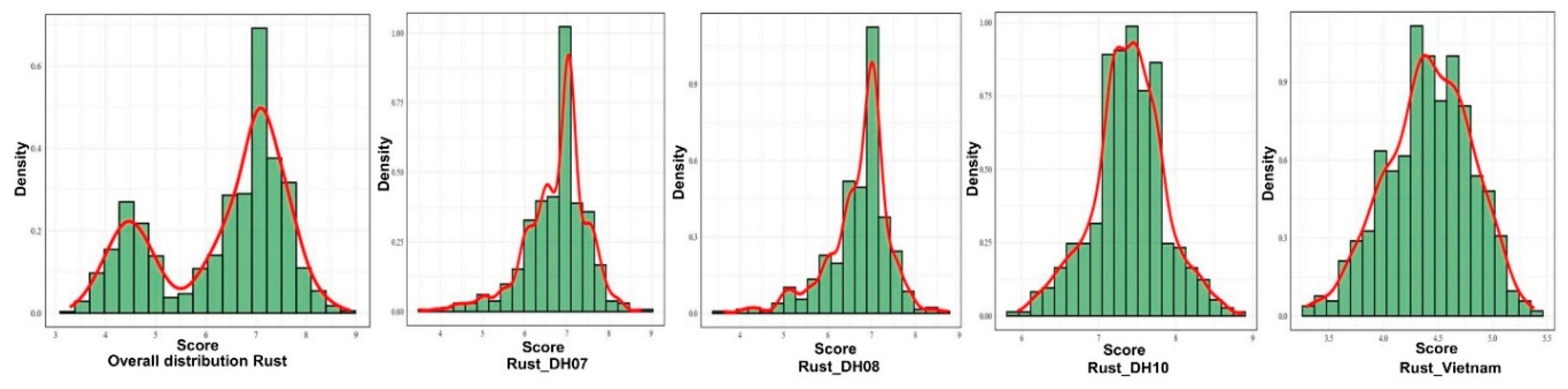
Figure 1. Phenotypic distribution of rust in groundnut across locations and seasons. Distribution of rust severity across seasons (Dharwad: 2007, 2008, and 2010) and location (Vietnam).
Preprints 201427 g001
Figure 3. Development and validation of Kompetitive allele specific polymerase chain reaction (KASP) markers from potential candidate genes identified for rust resistance. a) Validation panel includes 29 resistant lines (1 - 3), 14 moderately resistant (4 - 5), moderately susceptible (6) and susceptible lines (7 - 9). b) snpAH00607 and snpAH00609 markers from WGRS GWAS analysis were developed and validated for rust. *MS – Moderately Susceptible.
Preprints 201427 g003
Figure 4. A hypothetical pathway depicting the interaction of various genes and proteins involved in rust resistance in groundnut. (1) (Arahy.N67QXJ, Arahy.V5GBYV) encodes protein kinase family protein which acts as an enzyme in MAPK pathway of disease resistance. (2) (Arahy.11UTVE) encodes Sterol C4-methyl oxidase 1-2 involved in the production of brassinosteroids mediated salicylic acid signalling. (3) (Arahy.H8IXR5) encodes MYB transcription factor which is involved in transcription of disease resistance proteins.
Preprints 201427 g004
Disclaimer/Publisher’s Note: The statements, opinions and data contained in all publications are solely those of the individual author(s) and contributor(s) and not of MDPI and/or the editor(s). MDPI and/or the editor(s) disclaim responsibility for any injury to people or property resulting from any ideas, methods, instructions or products referred to in the content.
Copyright: This open access article is published under a Creative Commons CC BY 4.0 license, which permit the free download, distribution, and reuse, provided that the author and preprint are cited in any reuse.
Prerpints.org logo

Preprints.org is a free preprint server supported by MDPI in Basel, Switzerland.

Subscribe

Disclaimer

Terms of Use

Privacy Policy

Privacy Settings

© 2026 MDPI (Basel, Switzerland) unless otherwise stated