
Submitted:
02 March 2026
Posted:
03 March 2026
You are already at the latest version
Abstract
This study investigates the effect of progressive CaO/SrO substitution on the structure, crystallisation behaviour, and coordination chemistry of fluorapatite-forming glass-ceramics in the SiO₂–Al₂O₃–P₂O₅–CaO/SrO–CaF₂ system. Differential scanning calorimetry (DSC), X-ray diffraction (XRD), ATR-FTIR spectroscopy, ³¹P and ¹⁹F MAS-NMR, and transmission electron microscopy (TEM) were employed to probe both crystallisation and local structural environments. Increasing SrO content reduced the glass transition temperature and suppressed homogenous nucleation, promoting surface-nucleated fluorapatite (Ca5−xSrx(PO4)3F) formation. XRD confirmed fluorapatite as the primary crystalline phase and revealed systematic lattice expansion consistent with partial Sr²⁺ incorporation. ¹⁹F MAS-NMR indicated limited Sr substitution at Ca(II) sites (solid-solution), while ³¹P MAS-NMR demonstrated pronounced phosphorus deshielding, reflecting sensitivity of phosphate tetrahedra to local coordination distortion rather than extensive Sr occupancy. Integrating these findings provides a comprehensive framework for interpreting structural and coordination changes in Sr-fluorapatite glass-ceramics.
Keywords:
strontium substitution
; fluorapatite glass-ceramics
; crystallisation behaviour
; coordination chemistry
; MAS-NMR spectroscopy
; nucleation
1. Introduction
Fluorapatite (FAp) (Ca₅(PO₄)₃F) glass-ceramics are widely investigated for biomedical and dental applications due to their bioactivity, chemical similarity to mineralised tissues, and controllable crystallisation behaviour [1,2,3,4]. FAp crystallises in the hexagonal system with the space group P63/m. Crystallisation of apatite phases from a glass matrix allows fine control of microstructure, bioactivity and ion release, which is critical for restorative and remineralising materials [5,6,7].
Strontium has attracted considerable interest as a substituent in calcium phosphate systems because of its biological effects, including stimulation of osteoblasts and inhibition of bone resorption, as well as its ability to modify lattice chemistry and radiopacity [8,9,10,11,44]. Structurally, fluorapatite contains two crystallographically distinct calcium sites: Ca(I), nine-fold coordinated by oxygen atoms [CaO₉], and Ca(II), seven-fold coordinated by six oxygen atoms and one fluorine atom [CaO₆F] along the hexagonal channel [12] (Figure 1). Due to its larger ionic radius and lower field strength, Sr²⁺ preferentially substitutes at the more distorted Ca(II) site [13,14,15,16].
Although apatites produced by wet chemical and solid-state methods have been extensively reported [13,17,18,19,20,21], less attention has been given to Sr incorporation and coordination chemistry in fluorapatite formed within glass-ceramic systems [39,41]. Solid-state NMR studies indicate that phosphate tetrahedra are highly sensitive to local coordination distortions, which can induce significant chemical-shift variations even with modest cation substitution [22,23,24,25].
This study systematically examines the effect of increasing CaO/SrO substitution on glass structure, crystallisation behaviour, and fluorapatite coordination chemistry in the SiO₂–Al₂O₃–P₂O₅–CaO/SrO–CaF₂ system, integrating multi-nuclear MAS-NMR and TEM data to provide a detailed understanding of both local and bulk structural changes.
2. Materials and Methods
2.1. Glass Preparation and Heat Treatment
Glasses were prepared with progressive substitution of CaO by SrO (0–2 moles) (Table 1), maintaining constant network former and fluoride contents. Heat-treatment schedules were derived from DSC data to induce controlled fluorapatite crystallisation while minimising bulk devitrification [26].
The glasses were synthesised by melting the following reagents: SiO2 (Prince Minerals Ltd., Stoke-on-Trent, UK), Al2O3, P2O5, CaCO3, SrCO3 and CaF2 (>99.99% purity, Sigma-Aldrich, Gillingham, UK) in platinum crucibles at 1450 °C for one hour. The resulting melts were rapidly quenched into water to prevent phase separation and crystallisation. Glass frit was dried at 80 °C overnight in an electric dryer (Harvard LTE, UK). Subsequently, as-processed dried glass frit samples were used for DSC analysis and crystallisation experiments.
2.2. Characterisation
Thermal behaviour was assessed using DSC. Phase identification and lattice evolution were performed by XRD. ATR-FTIR spectroscopy monitored phosphate vibrational modes. ³¹P and ¹⁹F MAS-NMR probed local coordination environments. TEM examined microstructural features and lattice spacings.
2.2.1. Differential Scanning Calorimetry
The synthesised amorphous glasses were analysed by Differential Scanning Calorimetry (DSC) using a modified Stanton Redcroft DSC 1500 (Rheometric Scientific, Epsom, UK). The crucibles used were matched pairs made of platinum. Alpha alumina was used as the reference inert material. DSC analysis was performed in oxygen depleted (N2) environment at a heating rate of 20 °C min-1. Glass frit samples (50 mg) were subsequently analysed for each of the formulated compositions shown in Table 1. Glass transition temperature and crystallisation exotherms were determined using manufacturer’s software by evaluating slope changes (midpoint between baseline before Tg and baseline after Tg, taking midpoint; for onset Tg, baseline before Tg and fitting the tangent at the steepest slope of the transition).
To investigate the nucleation kinetics, a two-stage thermal analysis [42] was employed using the modified Stanton Redcroft DSC 1500. For each composition, 50 mg of glass frit was placed in matched platinum crucibles and analysed under a nitrogen atmosphere. The baseline crystallisation peak temperature (Tp) was first established by heating the untreated frit at a constant rate of 20 °C min−1.
To evaluate the nucleation rate as a function of temperature, a series of isothermal holds were performed. Samples were heated at 20 °C min−1 to a specified nucleation temperature (Tn), held isothermally for 1 hour, and then heated at the same rate to the crystallisation temperature. The resulting peak temperatures (Tp’) were compared to the baseline value to calculate the peak shift.
The theoretical framework for determining the temperature of the maximum nucleation rate was based on the Marotta approach [42]. According to this model, the number of nuclei (N) formed during an isothermal hold is related to the subsequent shift in the crystallisation peak temperature by the equation:
where N is the number of nuclei formed per unit volume, Ec is the activation energy for crystal growth, R is the ideal gas constant (8.314 J mol-1 K-1), Tp is the peak crystallisation temperature of the untreated glass, and Tp’ is the peak temperature after the nucleation hold. By calculating the peak shift (ΔTp = Tp - Tp’), the relative change in ln N was evaluated as a function of the nucleation temperature (Tn), with the maximum shift identifying the optimal temperature for nucleus formation.
The crystallisation kinetics were evaluated using Kissinger method [45] and the Augis-Bennett equation [46] to determine the Avrami exponent (n). The activation energy (Ea) for the crystallisation of the fluorapatite phase was first determined for the base glass (LG99) using the [45] method from DSC scans performed at multiple heating rates (5, 10, 20, 30 and 40 °C/min) and the Ea was derived from the slope of the linear plot of ln(ϕ) versus 1/Tp according to the Kissinger equation [45]:
The resulting activation energy was then used as a reference value to calculate the Avrami exponent n for all samples in the series.
The Avrami exponent was calculated using the equation:
where R is the universal gas constant, Tp is the peak crystallisation temperature (K), and ΔTFWHM is the full-width at half-maximum of the crystallisation exotherm. This parameter was calculated for the as-quenched (standard) glass frits (50 mg) for each of the composition. The resulting n values were used to identify the dimensionality of crystal growth according to [46].
2.2.2. ATR-FTIR Spectroscopy
Attenuated Total Reflectance–Fourier Transform Infrared Spectroscopy (Spectrum GX, Perkin-Elmer, USA) was also used to analyse heat-treated treated and non-treated glasses. The absorbance data were collected from 500 to 1500cm-1 at a resolution of 4 cm-1. Each spectrum presented is a sum of 10 scans.
2.2.3. X-Ray Powder Diffraction
In order to identify FAp phases in the developed glass-ceramics, X-ray powder diffraction (XRD) analyses were carried out. Glass-ceramic powders were analysed using X’Pert-PRO diffractometer (PANalytical D.V., Almelo, The Netherlands). Diffraction patterns were collected from 5° to 75° two-theta. The Cu Kα X-ray frequency was λ1=1.54059 Å.
2.2.4. 31P MAS-NMR Spectroscopy
Solid-state 31P MAS–NMR experiments were carried out on Bruker Avance NEO 600 MHz NMR instrument. A 30º pulse (the basic one-pulse program) with relaxation delays of 60 s were used to acquire 31P 1D spectra. Samples were contained in a 4 mm or 2.5 mm diameter zirconia rotor at spinning speeds of 12 kHz and 15 kHz to acquire 32 scans for each experiment. 31P spectra were referenced to 85% orthophosphoric acid solution at zero ppm. Spectrometer frequency: 242.941 MHz. Chemical shifts were estimated using manufacturer’s software Bruker TopSpin 4.0.7.
2.2.5. 19F MAS-NMR Spectroscopy
Solid-state 19F MAS–NMR experiments were carried out on Bruker Avance NEO 600 MHz NMR instrument. A 30º pulse (the basic one-pulse program) with relaxation delays of 60s were used to acquire 19F 1D spectra. Samples were contained in a 2.5 mm diameter zirconia rotor at spinning rate of 25 KHz to acquire 80 19F spectra. All spectra were referenced to 1M sodium fluoride solution at -120 ppm. Spectrometer frequency: 564.695 MHz. Chemical shifts were estimated using manufacturer’s software Bruker TopSpin 4.0.7.
2.2.6. Transmission Electron Microscopy
For the transmission electron microscopy (TEM) analysis one of the optically clear samples (QMTD3, heat-treated at 615ºC) containing FAp phases (based on 19F MAS-NMR analyses) was crushed in ethanol. A drop of this dispersion was put on a copper grid covered with a holey carbon film. The micrographs were captured using a Philips CM30 electron microscope operated at 200 kV.
3. Results
3.1. Thermal Behaviour, Nucleation and Crystallisation Tendency (DSC)
DSC traces (Figure 2(a)) of the as-quenched glasses show two observable thermodynamic events: glass transition (Tg) (endothermic) and glass crystallisation (Tc) (exothermic). (Figure 2(b)) show a linear correlation (R2=0.99) and gradual decrease in glass transition temperature with increasing SrO content [26,39], reflecting network depolymerisation due to replacement of Ca²⁺ by larger, lower-field-strength Sr²⁺ cation [27]. Crystallisation exotherms (Figure 2(a)) broaden and shift to higher temperatures (although FAp starts to crystallise via a surface mechanism at lower temperatures in the core glass), indicating gradual suppression of homogenous nucleation and increased surface-dominated nucleation [29].
Figure 2(c) shows the Kissinger analysis plot for the LG99 base glass, representing the relationship between the peak crystallisation temperature (Tp) and the heating rate (ϕ). A linear regression of ln(ϕ/Tp2) against the reciprocal of the absolute temperature (1/Tp) yielded a high degree of linearity (R2 = 0.98), with an absolute slope of -40212. According to the Kissinger equation, this slope corresponds to -Ea/R; consequently, the activation energy (Ea) for the crystallisation of the fluorapatite phase was calculated to be 334.3 kJ/mol. This substantial energy barrier indicates the relative stability of the base glass network, providing a baseline for assessing the impact of SrO substitution on the kinetics of crystal growth within the QMTD series.
The nucleation kinetics were evaluated by measuring the crystallisation peak temperature shift after a one-hour isothermal hold (Figure 3). For the reference glass LG99, the crystallisation peak (Tp = 749 °C) shifted consistently to lower temperatures following the nucleation hold (Table 2). The maximum peak shift (ΔTp) of 23 °C was achieved at a nucleation temperature (Tn) of 640 °C. This strong positive response across the tested range (595 °C to 670 °C) is indicative of a robust volume nucleation mechanism, where the isothermal hold successfully generates a high density of internal nuclei.
In marked contrast, the Sr-substituted glass QMTD1 exhibited a fundamentally different kinetic profile. At lower nucleation temperatures between 572 °C and 617 °C, the sample showed significant negative shifts, with the crystallisation peak moving to higher temperatures. The most prominent negative shift of -25 °C occurred at Tn = 587 °C. These negative values suggest a surface nucleation or structural relaxation effect.
QMTD1 only exhibited positive peak shifts at temperatures above 632 °C, reaching a maximum shift of only 6 °C at Tn = 647 °C. This maximum nucleation efficiency is nearly four times lower than that observed for LG99. Furthermore, despite QMTD1 having a lower baseline crystallisation temperature than LG99, its optimal nucleation temperature was shifted to a higher value (647 °C vs 640 °C). These results provide quantitative evidence that strontium substitution significantly inhibits the nucleation rate and increases the kinetic barrier for fluorapatite crystallisation, likely due to the structural effects of strontium within the glass network.
The plotted data (Figure 3) illustrates the dramatic impact of Sr substitution on the glass nucleation mechanism. The reference glass LG99 follows a standard bell-shaped curve associated with volume nucleation, where the formation of internal nuclei during the isothermal hold leads to a marked decrease in the subsequent crystallisation temperature.
For the Sr-substituted QMTD1, the curve initially drops into a significant negative regime, reaching a maximum retardation of -25 °C at a nucleation temperature of 587 °C. This negative peak shift indicates that the heat treatment is annihilating surface nucleation sites faster than new nuclei can form. QMTD1 only achieves a positive nucleation shift above 630 °C, and its maximum efficiency remains significantly lower than that of LG99, confirming that strontium acts as a network modifier that hinders the mobility of ions necessary for fluorapatite crystal formation.
The thermal parameters and crystallisation kinetics for the LG99 and QMTD series are summarised in Table 3. Substitution of SrO for CaO led to a linear decrease in Tg (Onset: 577° C to 559 °C), indicating a gradual expansion of the glass network. Despite this decrease in Tg, the crystallisation exotherms for FAp broadened and eventually become negligible at SrO concentrations higher than or equal to 1.5 moles.
For the base glass (LG99), the Avrami exponent (n) was calculated to be 3.01. These values indicate volume-nucleated, three-dimensional growth. With the addition of only 0.5 mol SrO (QMTD1), the n value decreased to 2.08, accompanied by a significant drop in nucleation efficiency (ΔTp from 23 to 6 °C). By 1.0 mol SrO (QMTD2), the exponent fell to 1.92, signalling a shift toward surface-dominated crystallisation and a loss of the internal nucleation mechanism.
3.2. Phase Formation and Lattice Expansion (XRD)
XRD patterns (Figure 4) confirm fluorapatite as the sole crystalline phase. Peaks shift to smaller diffraction angles with increasing SrO content, consistent with partial Sr²⁺ incorporation at Ca(II) sites rather than full substitution [12,28]. Lattice expansion corroborates previous Sr-fluorapatite studies [14,35,41]. It is also notable that overall, increasing strontium content results in amorphous composition showing slightly lower 2θ values (which shows evidence for an expanded glass network) (Figure 4(a)).
X-ray diffraction patterns of the as-synthesised glasses (Figure 4(a)) confirm that all compositions were fully amorphous, as evidenced by the absence of sharp Bragg reflections. Upon heat treatment, sharp reflections corresponding to fluorapatite (reference: calcium FAp, ICDD 00-034-0011) emerge with peak intensities increasing as a function of temperature, indicating progressive FAp crystallisation (Figure 4(b-e)).
Analysis of the (211) diffraction peak shows a systematic reduction in 2θ angles with increasing SrO content (R² = 0.98), corresponding to increasing d-spacings (Figure 4(g)). This demonstrates incorporation of Sr²⁺ into the FAp lattice, consistent with lattice expansion caused by the larger ionic radius of Sr²⁺ relative to Ca²⁺. The linear trend indicates that Sr incorporation occurs gradually within the fluorapatite structure rather than forming separate Sr-rich phases. This also demonstrated that the Vegard’s Law is being obeyed for the experimental condition employed.
The lattice expansion observed by XRD reflects average long-range order and is sensitive even to modest Sr incorporation due to the significant size difference between Ca²⁺ (1.00 Å) and Sr²⁺ (1.18 Å).
3.3. ATR-FTIR Spectroscopy
ATR-FTIR spectra (Figure 5) show sharpening of phosphate ν₃ and ν₄ bands after heat treatment, confirming fluorapatite crystallisation.
ATR-FTIR spectra of the developed glass-ceramics show the progressive development of apatitic phosphate bands with increasing heat-treatment temperature. The ν₁ and ν₃ phosphate stretching modes appear near 1095 and 1035 cm⁻¹, while the ν₄ bending modes are observed at approximately 600 and 565 cm⁻¹, consistent with fluorapatite formation [3].
All glasses also exhibit silicate network features: symmetric Si–O–Si stretching (Q⁴) between 1000–1100 cm⁻¹ and Si–O–NBO (Q³) vibrations near 950 cm⁻¹. With increasing SrO substitution, the apatitic phosphate bands broaden in heat-treated samples, indicating local lattice distortion of PO₄ tetrahedra, rather than the formation of new crystalline phases (Figure 5). It is also notable there is a significant change in Q4 and Q3 ratios between samples LG99 (Figure 5. (a)) and QMTD4 (Figure 5(e)). This confirms depolymerisation of the network due to SrO substitution and agrees with Sun et al. [27].
3.4. ³¹P MAS-NMR: Phosphate Coordination Environments
³¹P MAS-NMR spectra (Figure 6) of the as-synthesised glasses show a single broad resonance at between -7.04 and -7.69 ppm, corresponding to aluminium pyrophosphate (Al-O-P) (Q¹) environments. Upon heat treatment, a new resonance develops near 2.98 ppm (for Ca-only compositions) and rises to 3.48 ppm (For Sr-substituted compositions), corresponding to an orthophosphate in FAp.
A linear correlation (R² = 0.81) is observed between the nominal SrO content in the glass and the ³¹P chemical shift for FAp (Figure 6(b)) observed with glass-ceramic samples.
3.5. ¹⁹F MAS-NMR: Ca(II)/Sr(II) Site Occupancy
¹⁹F MAS-NMR spectra (Figure 7) show modest chemical shift changes, indicating limited Sr²⁺ substitution at Ca(II) sites. This confirms that ³¹P deshielding primarily reflects local tetrahedral distortion [23]. Optically clear samples have been labelled in in Figure 6 and indicate that these glass-ceramic samples treated under specified conditions contain nanocrystalline phases of FAp, with crystallites smaller than light in the visible spectrum.
- As-Quenched Glass Structure
The 19F MAS-NMR spectra (Figure 7) of the as-quenched glasses exhibit three distinct broad resonances, indicating a distribution of fluoride environments within the amorphous network. The first resonance, cantered at approximately -90 ppm, is assigned to fluorine in a calcium/strontium-rich environment (F-M(n)). The second resonance at around -125 ppm is attributed to a mixed silicon-fluorine coordination (Si-F-M(n)), while the third resonance at -150 ppm corresponds to fluorine coordinated by in Al-F-M(n) environment (Table 4).
- Evolution of Crystalline Phases
Upon heat treatment, the development of sharp resonant peaks indicates the progressive crystallisation of the glass matrix. In low-Sr compositions, the emergence of a peak at -104 ppm (assigned to F-Ca(3) sites in fluorapatite) and a shoulder at -90 ppm (F-Ca(2)Sr) (Figure 7) confirms the formation of a strontium-substituted fluorapatite lattice. Concurrently, a minor resonance at -139 ppm is observed, corresponding to a nanocrystalline Al-F-Ca(2) environment (Table 4).
As the SrO content increases (1.5 to 2.0 mol), the spectra reveal a more complex crystalline evolution. New resonances at approximately -70 ppm (F-Sr(2)Ca) and approximately -60 ppm (F-Sr(3)) appear, reflecting the systematic substitution of strontium into at the Ca(II) sites.
Most significantly, the transition from calcium-rich to strontium-rich compositions results in the complete disappearance of the -139 ppm (Al-F-Ca(2)) peak and the emergence of a sharp, well-defined resonance at -112 ppm. This +27 ppm downfield shift is consistent with the lower polarising power and higher coordination requirements of the larger Sr2+ cation relative to Ca2+. We assign this resonance to a Al-F-Sr(2) environment, likely existing as a nanocrystalline fluoroaluminate phase (SrAlF5-type) that is XRD-silent due to its restricted crystallite size. The simultaneous development of these peaks suggests a coupled crystallisation mechanism where fluoride is partitioned between the growing fluorapatite lattice and a secondary fluoroaluminate phase. It is also notable a negligible signal seen at -106 is attributed to nanocrystalline mixed fluorite-like environment, which arises from Sr²⁺-induced surface nucleation. Overall, peak development and increasing intensity with temperature indicate stepwise crystallisation and site-specific Sr substitution.
3.6. Nanostructure (TEM)
TEM micrographs (Figure 8) reveal nanoscale, needle-like crystallites in an amorphous matrix, consistent with surface-dominated nucleation. High-resolution lattice spacings (2.06–3.77 Å) align with fluorapatite and Sr-fluorapatite reference spacings [12,35]. Orientation-dependent spacing visibility also highlights anisotropic needle-like morphology. Scattering from the amorphous regions is also reported. Additionally, “droplet-like” phase separation via binodal decomposition can be observed on the 10 nm scale on a glass particle that has not been subjected to a heat-treatment regimen.
4. Discussion
4.1. Glass Structure and Nucleation Kinetics
All of the synthesised “as-quenched” glasses were found to be amorphous by XRD. The glass transition temperature (Tg) decreased linearly with increasing SrO content (Figure 2(b), R²=0.98), a trend consistent with network expansion. The larger ionic radius of Sr2+ relative to Ca2+ increases the molar volume, also reducing network polymerisation and enhancing glass reactivity [27,38]. This SrO-induced depolymerisation [27] increases local surface mobility, effectively lowering the nucleation barrier and favouring surface-dominated fluorapatite (FAp) formation. These structural modifications in network connectivity align with previously reported models of cation-induced shifts in glass stability [29,36,37].
The transition from volume to surface-dominated nucleation is physically quantified by the DSC optimum nucleation peak-shift analysis (Figure 3). In the reference glass LG99, a robust bulk nucleation mechanism is confirmed by a significant maximum positive peak shift (ΔTp = 23 °C). This indicates that Ca, P, and F clusters act as efficient internal seeds for FAp. In contrast, Sr-substituted QMTD1 exhibits a dramatic suppression of nucleation efficiency, with a maximum positive shift of only 6 °C. Notably, at lower temperatures (Tn < 620 °C), QMTD1 displays significant negative shifts, reaching -25 °C at 587 °C, further reinforcing the shift toward surface-driven nucleation.
This shift is mathematically validated by the evolution of the Avrami parameter (n). In LG99, n = 3.01 confirms 3D interface-controlled bulk growth [47]. As SrO content increases, the systematic reduction in n signifies a transition in both dimensionality and kinetic control. For QMTD2 (n = 1.92), the kinetics shift toward 2D interface-controlled growth, while the whole-sample mechanism follows a 1D surface-inward front [49]. The reduction in DSC exothermic enthalpy suggests that a significant volume of the glass crystallises via this “DSC-silent” 1D surface front before the bulk can react [47,49].
The subsequent drop to n = 1.63 (QMTD3) and n = 1.49 (QMTD4) marks a critical turn to diffusion-controlled growth, where n ≈ d/2 [50]. As the glass network becomes more viscous, ion mobility becomes the rate-limiting step, shifting the kinetics from 3D spheres (3/2 = 1.5) to 1D needles [48,50]. This “dimensional collapse” proves that Sr fundamentally alters system energetics by increasing the activation barrier for internal clustering [48].
Furthermore, the high number density of internal nuclei in LG99 provides a massive catalytic surface area that dramatically lowers the crystallisation peak temperature. The suppression of this shift in QMTD1 confirms that strontium does not merely slow down kinetics; it fundamentally alters the energetics of the system. This suggests that the degree and the composition of the phase separation required for FAp crystallisation may change as SrO content increases, bypassing the bulk clustering seen in the pure calcium system.
4.2. Structural Site Preference and NMR Sensitivity
While XRD confirms partial Sr incorporation, MAS-NMR provides a more nuanced distinction between substitution extent and local coordination. Sr2+ preferentially occupies Ca(II) sites, inducing lattice expansion and perturbing the symmetry of PO4 tetrahedra [16,28]. 31P MAS-NMR proved highly sensitive to these structural distortions, whereas 19F MAS-NMR served as a direct probe of site occupancy specifically at the Ca(II) sites [24,30,31].
The modest changes in 19F chemical shifts indicate that the majority of fluoride ions remain coordinated by calcium, with only a minority environment containing Sr neighbours. Thus, while Sr substitutes at Ca(II) sites, the overall occupancy remains low, consistent with a solid-solution model rather than the development of a discrete new phase. This is supported by ATR-FTIR spectra, which show characteristic apatite phosphate bands (ν₁/ ν₃ at ~1095/1035 cm-1 and ν₄ at ~600/565 cm-1) that broaden with SrO content, confirming Sr is entering the crystal lattice (Figure 5) [3].
4.3. Secondary Phases and Nanoscale Structure
TEM analyses of the optically clear sample revealed needle-like/nanoscale clusters of FAp crystallites preferentially oriented along the c-axis, contributing to strong diffraction intensities (Figure 8). The observation of droplet-like nanoclusters within the amorphous matrix suggests pre-existing binodal decomposition, providing a stoichiometry favourable for FAp formation [43].
A significant highlight of this study’s physical chemistry is the discovery of a secondary crystalline environment. In the pure calcium glass, a resonance at -139 ppm identifies a crystalline Al-F-Ca(2) environment, likely a CaAlF5-type phase. Upon strontium substitution, this signal is replaced by a sharp resonance at -112 ppm. This +27 ppm downfield shift is a direct consequence of the lower polarising power of Sr2+, which reduces the electronic shielding of the fluorine nucleus within the fluoroaluminate complex. The relative sharpness of this resonance, despite its relative silence in XRD (Figure 4), suggests that Sr-fluoroaluminate (SrAlF5-like) forms negligible nanocrystalline clusters, observable at higher heat-treatment temperatures.
4.4. The Kinetic Barrier to Sr Incorporation
The limited Sr2+ uptake into the FAp lattice, despite its thermodynamic permissibility, may be explained by the structural role of Sr in the parent glass. Previous 19F MAS-NMR investigations of analogous glasses [40] demonstrated that Sr2+ preferentially forms Si-F-Sr(n) species, while Ca2+ prefers F-Ca(n) environments. For Sr to integrate into FAp, these stable Si-F-Sr linkages must dissociate to allow ion migration to phosphate-rich regions. This structural rearrangement represents a significant kinetic barrier under the employed heat-treatment conditions. This is supported by experimental nucleation evidence presented in this study, demonstrating reduction in homogenous nucleation with increasing SrO content in the nominal glass compositions.
Consequently, the large deshielding observed in the 31P signals (Figure 6(b)) should not be misinterpreted as extensive Sr incorporation. Instead, it reflects the extreme sensitivity of the phosphate tetrahedra to local lattice perturbations. Even in QMTD4 (2 mol SrO), actual Sr occupancy remains minor (Figure 7), with the fluoride maintaining a predominantly F-Ca(3) and F-Ca(2)Sr coordination. These results demonstrate that while 19F NMR tracks actual chemical occupancy, 31P MAS-NMR acts as an ultrasensitive probe of the resulting structural strain.
5. Conclusions
- CaO/SrO substitution in the glass compositions studied reduces Tg, network polymerisation and suppresses homogeneous nucleation of fluorapatite.
- A mixed Ca5−xSrx(PO4)3F solid solution is the primary crystalline phase formed within the investigated temperature range, with minor contributions from fluorite, Al-F-Ca(2) and Al-F-Sr(2) crystalline environments.
- Sr2+ ions partially incorporate into Ca(II) sites, inducing a systematic expansion of the fluorapatite lattice.
- 31P MAS-NMR reveals significant phosphorus deshielding, reflecting local PO4 tetrahedral distortion, rather than the total extent of strontium substitution.
- Limited Sr incorporation into the fluorapatite is attributed to a kinetic barrier arising from Sr2+ preference for Si-F-Sr(n) speciation in the parent glass. This sequestering effect constrains Sr and F availability during nucleation and crystallisation mechanism, despite the thermodynamic favourability of Sr-substituted apatite formation.
Acknowledgments
The author thanks R. Wilson and H. Toms (QMUL) for assistance with XRD and NMR measurements. Acknowledged TEM support from N. V. Tarakina (QMUL). Also, advice on Vegard’s Law kindly acknowledged from R.G. Hill (QMUL). Cera Dynamics Limited acknowledged for funding. Also acknowledged N. Karpukhina and S. Shahid for supervision, proofreading and laboratory support.
CRediT Statement
Tomas Duminis: Conceptualisation, Methodology, Validation, Investigation, Data Curation, Writing - Original Draft, Review and Editing, Visualization.
References
- Hench, L.L.; Wilson, J. Surface-active biomaterials. Science 1984, 226, 630–636. [Google Scholar] [CrossRef] [PubMed]
- Hill, R.G. An alternative view of the degradation of bioglass. J Mater Sci Lett. 1996, 15, 1122–1125. [Google Scholar] [CrossRef]
- Rehman, I.; Bonfield, W. Characterization of hydroxyapatite and carbonated apatite by photoacoustic FTIR spectroscopy. J Mater Sci Mater Med. 1997, 8, 1–4. [Google Scholar] [CrossRef] [PubMed]
- Nicholson, J.W. Structural and chemical aspects of dental materials. Dent Mater. 2010, 26, 93–102. [Google Scholar]
- Hill, R.G. Structural aspects of bioactive glasses: influence on degradation and cell response. J Non-Cryst Solids 2011, 357, 388–394. [Google Scholar]
- Serra, J.; González, P.; Liste, S.; Chiussi, S.; León, B.; Pérez-Amor, M. Composition, microstructure, and bioactivity of novel bioactive glass-derived ceramics. J Eur Ceram Soc. 2014, 34, 3913–3923. [Google Scholar]
- Jones, J.R.; et al. Bioactive glasses: from concept to clinical applications. Acta Biomater. 2011, 7, 2214–2225. [Google Scholar]
- Marie, P.J. Role of osteoblasts and osteocytes in bone remodeling. Bone 2010, 46, 7–15. [Google Scholar]
- Christoffersen, J.; et al. Regulation of mineralization in calcified tissues. Calcif Tissue Int. 1997, 60, 59–63. [Google Scholar]
- Bigi, A.; Panzavolta, S.; Roveri, N.; Ripamonti, A.; Fassina, L. Synthetic hydroxyapatites: intrinsic crystals and composites. J Inorg Biochem. 2007, 101, 1749–1757. [Google Scholar]
- Vahabzadeh, S.; et al. Sr-substituted fluorapatite for dental and orthopedic applications. Mater Sci Eng C. 2015, 48, 237–246. [Google Scholar]
- Elliott, J.C. Structure and Chemistry of the Apatites; Elsevier: Amsterdam, 1994. [Google Scholar]
- Koutsopoulos, S. Synthesis and characterization of hydroxyapatite crystals: A review study on the analytical methods. J Biomed Mater Res. 2002, 62, 600–612. [Google Scholar] [CrossRef] [PubMed]
- Terra, J.; et al. Tailoring chemical composition and nanostructure of bioactive materials. Chem Mater. 2009, 21, 550–557. [Google Scholar]
- Bohner, M. Design of ceramic biomaterials and bone substitutes. Biomaterials 2000, 21, 1301–1309. [Google Scholar]
- Grover, L.M.; et al. Strontium substitution in hydroxyapatite: structural and biological effects. J Mater Sci Mater Med. 2012, 23, 2627–2637. [Google Scholar]
- Landi, E.; Tampieri, A.; Celotti, G.; Sprio, S.; Sandri, M. Hydroxyapatite for biomedical applications: tailoring microstructure and mechanical properties. Biomaterials 2007, 28, 3649–3657. [Google Scholar]
- Kim, H.W.; Song, S.H.; Suh, H.; Knowles, J.C. Bioactive glass ceramics for bone regeneration. Biomaterials 2004, 25, 2533–2539. [Google Scholar] [CrossRef]
- Tampieri, A.; Sprio, S.; Sandri, M.; Bronzini, I.; Gepi, A.; Bracci, B. Biomimetic hydroxyapatite scaffolds. Acta Biomater. 2008, 4, 1626–1633. [Google Scholar]
- Zhou, H.; Lee, J. Nanoscale hydroxyapatite particles for bone tissue engineering. Acta Biomater. 2011, 7, 2769–2778. [Google Scholar] [CrossRef]
- Landi, E.; Tampieri, A.; Celotti, G.; Sprio, S. Influence of synthesis and sintering parameters on the characteristics of carbonate apatite. Biomaterials 2004, 25, 1763–1770. [Google Scholar] [CrossRef]
- Yesinowski, J.P.; Eckert, H. Hydrogen environments in calcium phosphates: 1H MAS NMR at high spinning speeds. J Am Chem Soc. 1987, 109, 6274–6282. [Google Scholar] [CrossRef]
- Smith, M.E. Applications of nuclear magnetic resonance spectroscopy in materials chemistry. Prog Nucl Magn Reson Spectrosc. 1993, 25, 159–190. [Google Scholar]
- Wu, Y.; Michaelis, V.K.; Danielson, D.C.; Grandinetti, P.J. Solid-state NMR of calcium phosphates and bioactive glasses. Solid State Nucl Magn Reson. 2010, 38, 49–56. [Google Scholar]
- Chen, Q.; et al. MAS-NMR studies on phosphate environments in Sr-substituted apatites. Solid State Nucl Magn Reson. 2019, 98, 25–34. [Google Scholar]
- Shelby, J.E. Introduction to Glass Science and Technology; Royal Society of Chemistry: Cambridge, 2005. [Google Scholar]
- Sun, L.; et al. Strontium effects on glass network depolymerisation and crystallisation. J Non-Cryst Solids 2020, 534, 119996. [Google Scholar]
- Liu, Y.; et al. Lattice expansion and site-specific substitution in Sr-fluorapatites. J Mater Sci. 2015, 50, 12345–12355. [Google Scholar]
- Mao, J.; et al. Surface nucleation and growth of fluorapatite nanocrystals in bioactive glasses. J Non-Cryst Solids 2017, 463, 87–96. [Google Scholar]
- Kaur, H.; et al. Coordination chemistry and NMR characterisation of substituted apatites. J Phys Chem C. 2020, 124, 11245–11255. [Google Scholar]
- Shen, D.; et al. Effects of Sr substitution on MAS-NMR phosphate chemical shifts. Solid State Nucl Magn Reson. 2016, 78, 12–21. [Google Scholar]
- Zeng, Q.; Stebbins, J.F. Fluoride sites in aluminosilicate glasses: High-resolution 19F NMR results. Am Mineral. 2000, 85, 863–867. [Google Scholar] [CrossRef]
- Kiczenski, T.J.; Stebbins, J.F. Fluoride sites in calcium and barium oxyfluorides: 19F NMR on crystalline model compounds and glasses. J Non-Cryst Solids 2002, 306, 160–168. [Google Scholar]
- Stebbins, J.F.; Zeng, Q. Cation ordering at fluoride sites in silicate glasses: a high-resolution 19F NMR study. J Non-Cryst Solids 2000, 262, 1–5. [Google Scholar]
- Wang, X.; et al. Nanoscale lattice expansion in Sr-fluorapatite verified by TEM. J Mater Chem B 2017, 5, 2345–2354. [Google Scholar]
- Song, Y.; et al. Surface-dominated nucleation in Sr-fluorapatite glasses. Ceram Int. 2018, 44, 18203–18212. [Google Scholar]
- Yang, F.; et al. Surface vs bulk crystallisation in phosphate glasses containing SrO. J Non-Cryst Solids 2019, 517, 1–9. [Google Scholar]
- O’Donnell, M.D.; Hill, R.G. Influence of strontium and the importance of glass chemistry and structure when designing bioactive glasses for bone regeneration. Acta Biomater. 2010, 6, 2382–2385. [Google Scholar] [CrossRef] [PubMed]
- Hill, R.G.; Stamboulis, A.; Law, R.V.; Clifford, A.; Towler, M.R.; Crowley, C. The influence of strontium substitution in fluorapatite glasses and glass ceramics. J Non Cryst Solids 2004, 336, 223–229. [Google Scholar] [CrossRef]
- Duminis, T. Evidence for new fluoride coordination in SiO₂-Al₂O₃-P₂O₅-CaO/SrO-CaF₂ compositions used in ion-leachable ionomer-type cements: A ¹⁹F MAS-NMR investigation. Mater Lett. 2024, 359, 135919. [Google Scholar] [CrossRef]
- Hill, R.G.; Calver, A.; Skinner, S.; Stamboulis, A.; Law, R.V. A MAS-NMR and Combined Rietveldt Study of Mixed Calcium/Strontium Fluorapatite Glass-Ceramics. Key Engineering Materials 2006, 309, 305–308. [Google Scholar]
- Marotta, A.; Buri, A.; Branda, F. Nucleation in glass and differential thermal analysis. Journal of Materials Science 1981, 16, 341–344. [Google Scholar] [CrossRef]
- Duminis, T.; Shahid, S.; Hill, R.G. Apatite glass-ceramics: a review. Front Mater. 2016, 3, 59. [Google Scholar]
- Shahid, S.; Hassan, U.; Billington, R.W.; Hill, R.G.; Anderson, P. Glass ionomer cements: Effect of strontium substitution on esthetics, radiopacity and fluoride release. Dent Mater. 2014, 30, 308–313. [Google Scholar] [CrossRef]
- Kissinger, H.E. Reaction Kinetics in Differential Thermal Analysis. Anal. Chem. 1957, 29, 1702–1706. [Google Scholar] [CrossRef]
- Augis, J.A.; Bennett, J.E. Calculation of the Avrami parameters for heterogeneous solid state reactions using a linear heating rate. J. Therm. 1978, 13, 283–292. [Google Scholar]
- Hill, R.G.; Wood, D.J. The crystallization of bioactive glasses in the system SiO2-P2O5-CaO-Na2O-CaF2. J Mater Sci Mater Med. 1995, 6, 311–318. [Google Scholar]
- Fredholm, Y.C.; Brauer, D.S.; Hill, R.G.; Law, R.V. Influence of strontium substitution for calcium on the crystallization of bioactive glass. J Non-Cryst Solids 2010, 356, 2546–2551. [Google Scholar] [CrossRef]
- Matusita, K.; Sakka, S. Kinetic study of crystallization of glass by differential scanning calorimetry—criterion for crystallization mechanism. Phys Chem Glasses 1982, 23, 116–120. [Google Scholar]
- Donald, I.W. Crystallization kinetics of some silicate glasses. J Non-Cryst Solids 2004, 345, 120–126. [Google Scholar]
Figure 1.
Crystal structure of fluorapatite (Ca5(PO4)3F) showing the two distinct calcium environments. (A) Projection along the [001] direction (top view): The structure is characterised by hexagonal channels containing fluoride (F-) ions coordinated by triangular clusters of Ca(II) sites. In this study, these sites are the primary locations for Sr2+ substitution. The PO43- tetrahedra form the framework surrounding the channel. (B) Projection along the [100] direction (side view): The c-axis highlights the vertical stacking of the lattice. The Ca(I) sites (maroon squares) form continuous vertical columns, while the Ca(II) and F- ions are located at specific intervals along the channel. Sr2+ incorporation leads to the systematic lattice expansion and local phosphate distortions investigated in this work.
Figure 1.
Crystal structure of fluorapatite (Ca5(PO4)3F) showing the two distinct calcium environments. (A) Projection along the [001] direction (top view): The structure is characterised by hexagonal channels containing fluoride (F-) ions coordinated by triangular clusters of Ca(II) sites. In this study, these sites are the primary locations for Sr2+ substitution. The PO43- tetrahedra form the framework surrounding the channel. (B) Projection along the [100] direction (side view): The c-axis highlights the vertical stacking of the lattice. The Ca(I) sites (maroon squares) form continuous vertical columns, while the Ca(II) and F- ions are located at specific intervals along the channel. Sr2+ incorporation leads to the systematic lattice expansion and local phosphate distortions investigated in this work.
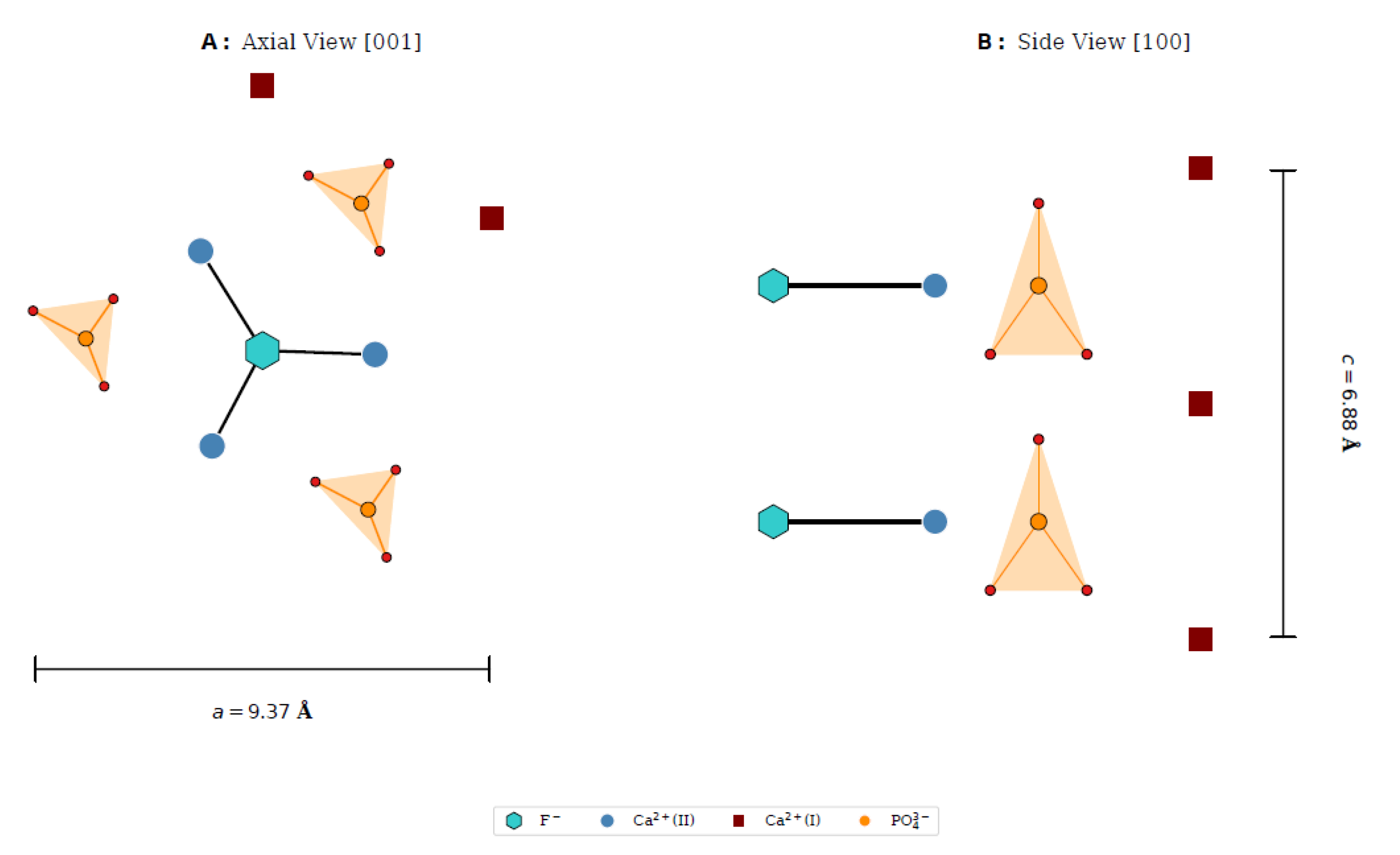
Figure 2.
(a) Differential scanning calorimetry (DSC) traces of the synthesised glasses illustrating the shift and suppression of crystallisation exotherms with increasing SrO content. (b) Glass transition temperature (Tg) as a function of SrO content, illustrating reduction in Tg with increasing strontium content in the nominal glass composition. Error bars: +/- 5ºC. (c) Kissinger [45] analysis plot for the LG99 base glass used to calculate the crystallisation activation energy Ea= 334.3 (kJ/mol) from the absolute slope of the regression line.
Figure 2.
(a) Differential scanning calorimetry (DSC) traces of the synthesised glasses illustrating the shift and suppression of crystallisation exotherms with increasing SrO content. (b) Glass transition temperature (Tg) as a function of SrO content, illustrating reduction in Tg with increasing strontium content in the nominal glass composition. Error bars: +/- 5ºC. (c) Kissinger [45] analysis plot for the LG99 base glass used to calculate the crystallisation activation energy Ea= 334.3 (kJ/mol) from the absolute slope of the regression line.
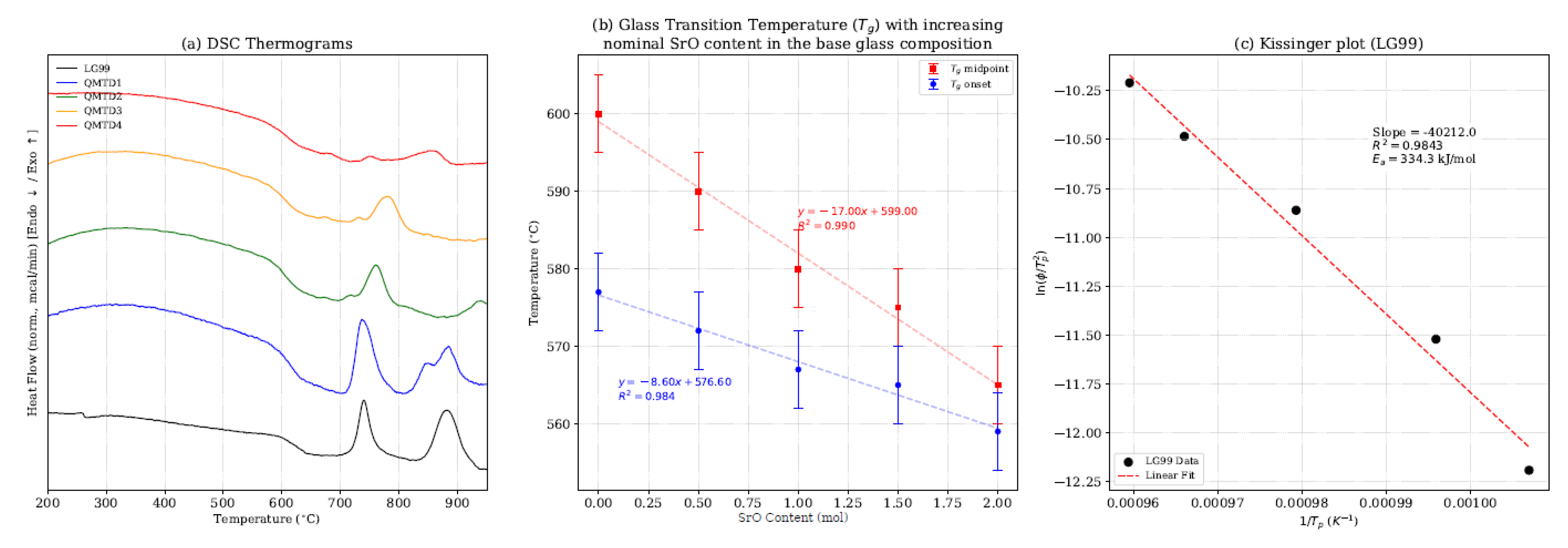
Figure 3.
Nucleation efficiency curves for LG99 and QMTD1 glasses determined by the DSC peak-shift method (20 °C min−1). The peak shift (ΔTp) is plotted as a function of the 1-hour isothermal nucleation temperature (Tn). LG99 exhibits characteristic bulk nucleation behaviour with a maximum shift of 23 °C at Tn = 640 °C. In contrast, QMTD1 displays significant negative shifts at lower temperatures, indicative of surface nucleation and structural relaxation, with a vastly suppressed maximum nucleation efficiency of only 6 °C at Tn = 647 °C.
Figure 3.
Nucleation efficiency curves for LG99 and QMTD1 glasses determined by the DSC peak-shift method (20 °C min−1). The peak shift (ΔTp) is plotted as a function of the 1-hour isothermal nucleation temperature (Tn). LG99 exhibits characteristic bulk nucleation behaviour with a maximum shift of 23 °C at Tn = 640 °C. In contrast, QMTD1 displays significant negative shifts at lower temperatures, indicative of surface nucleation and structural relaxation, with a vastly suppressed maximum nucleation efficiency of only 6 °C at Tn = 647 °C.
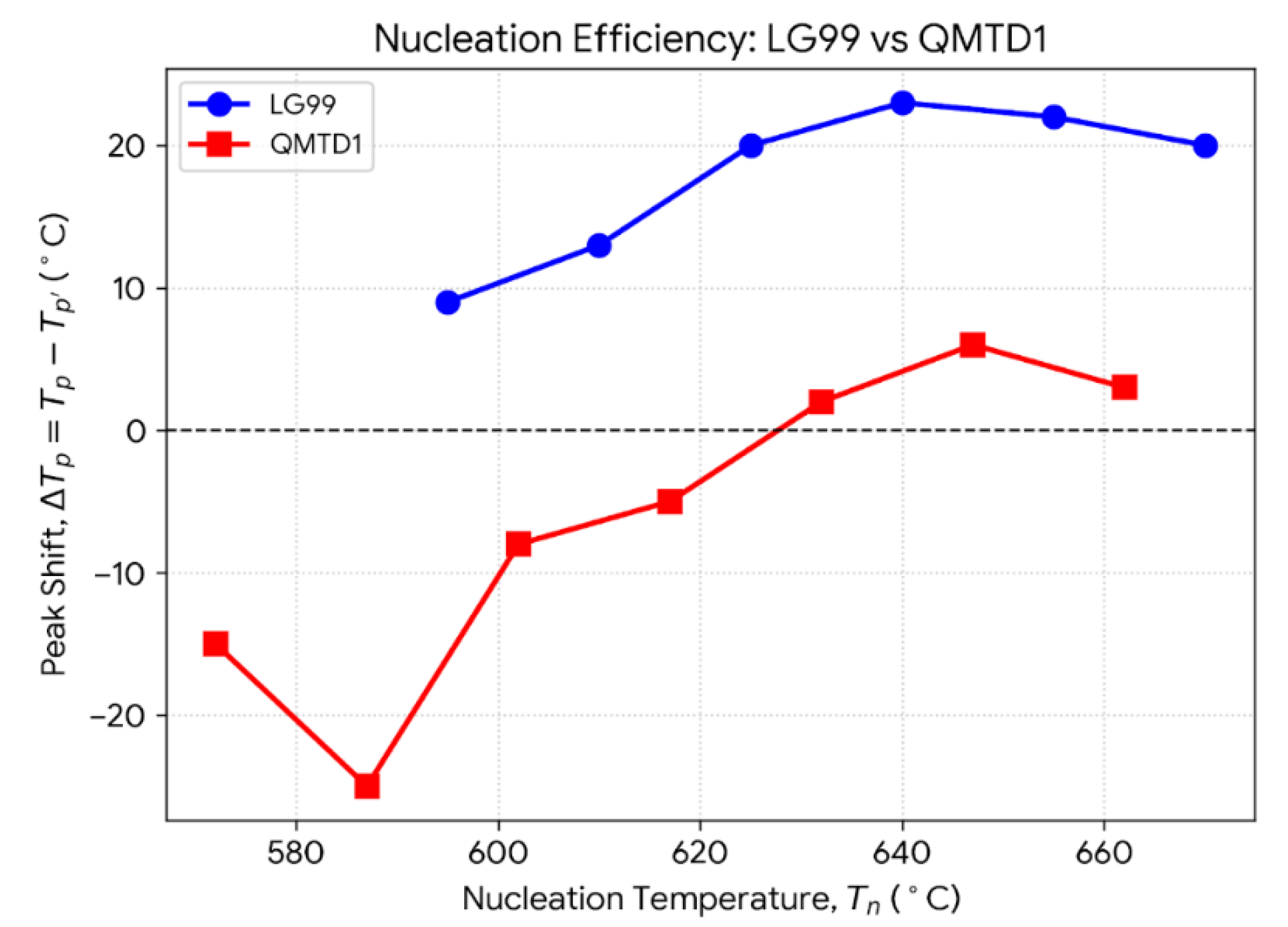
Figure 4.
X-ray diffraction (XRD) patterns of the synthesised glasses and glass-ceramics showing fluorapatite (FAp) crystallisation. (a) As-synthesised amorphous glasses with calcium FAp reference pattern at the bottom. (b) Unsubstituted FAp glass-ceramics (LG99). (c) 0.5 mol SrO FAp glass-ceramics (QMTD1). (d) 1 mol SrO FAp glass-ceramics (QMTD2). (e) 1.5 mol SrO FAp glass-ceramics (QMTD3). (f) 2 mol SrO FAp glass-ceramics (QMTD4). (g) Changes in d-spacings at crystallographic (211) plane with increasing SrO content. All patterns highlight progressive development of FAp reflections and shifts in lattice parameters with increasing SrO content in the composition.
Figure 4.
X-ray diffraction (XRD) patterns of the synthesised glasses and glass-ceramics showing fluorapatite (FAp) crystallisation. (a) As-synthesised amorphous glasses with calcium FAp reference pattern at the bottom. (b) Unsubstituted FAp glass-ceramics (LG99). (c) 0.5 mol SrO FAp glass-ceramics (QMTD1). (d) 1 mol SrO FAp glass-ceramics (QMTD2). (e) 1.5 mol SrO FAp glass-ceramics (QMTD3). (f) 2 mol SrO FAp glass-ceramics (QMTD4). (g) Changes in d-spacings at crystallographic (211) plane with increasing SrO content. All patterns highlight progressive development of FAp reflections and shifts in lattice parameters with increasing SrO content in the composition.
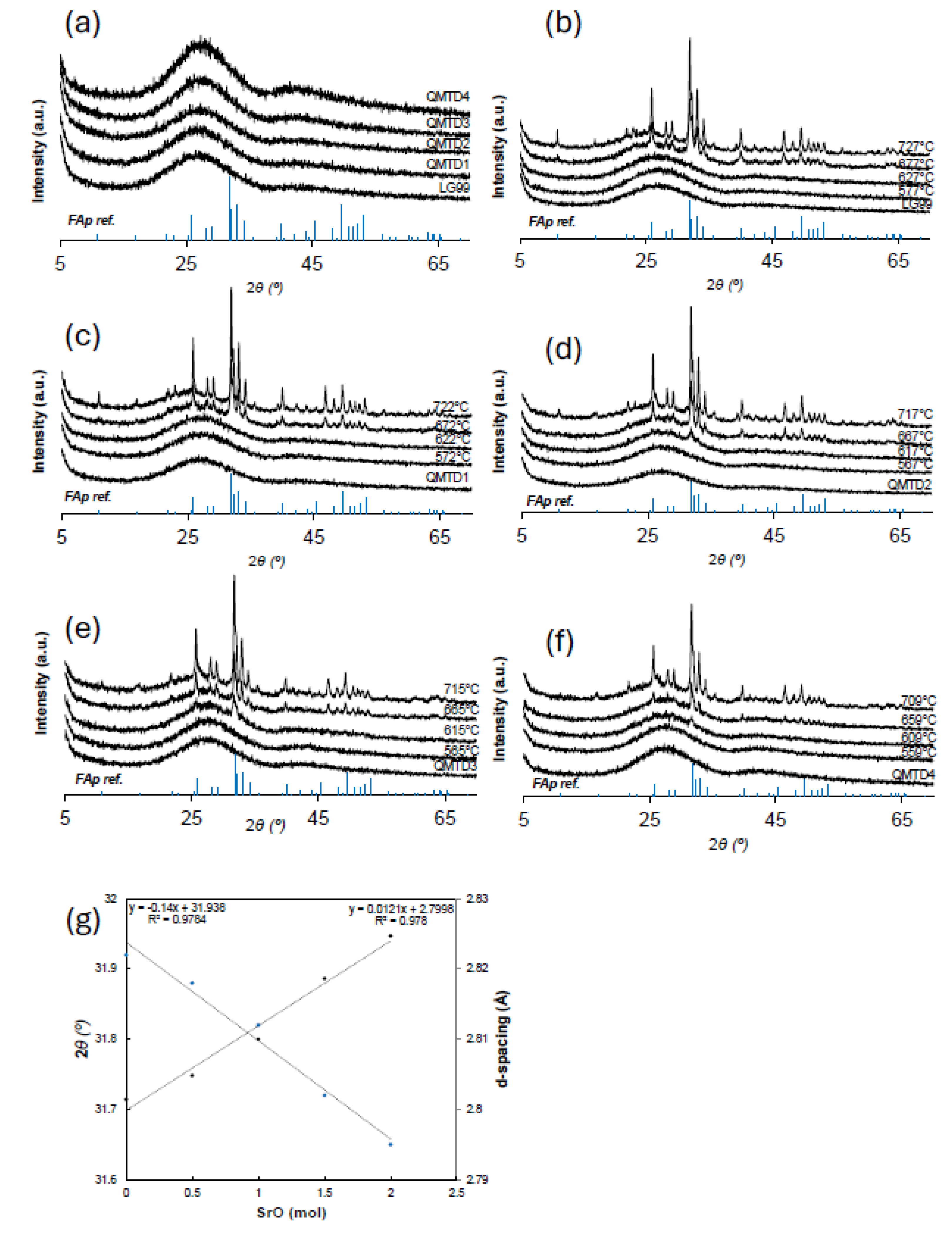
Figure 5.
ATR-FTIR spectra of the glass-ceramics showing phosphate and silicate vibrational modes. Heat treatment induces the development of apatitic PO₄³⁻ bands: ν₁/ν₃ at ~1095 and 1035 cm⁻¹ and ν₄ at ~600 and 565 cm⁻¹. Silicate network vibrations include Q⁴ Si–O–Si symmetric stretch (1000–1100 cm⁻¹) and Q³ Si–O–NBO stretch (~950 cm⁻¹). Phosphate bands broaden with increasing SrO content, reflecting local structural distortion of phosphate functional groups in FAp.
Figure 5.
ATR-FTIR spectra of the glass-ceramics showing phosphate and silicate vibrational modes. Heat treatment induces the development of apatitic PO₄³⁻ bands: ν₁/ν₃ at ~1095 and 1035 cm⁻¹ and ν₄ at ~600 and 565 cm⁻¹. Silicate network vibrations include Q⁴ Si–O–Si symmetric stretch (1000–1100 cm⁻¹) and Q³ Si–O–NBO stretch (~950 cm⁻¹). Phosphate bands broaden with increasing SrO content, reflecting local structural distortion of phosphate functional groups in FAp.
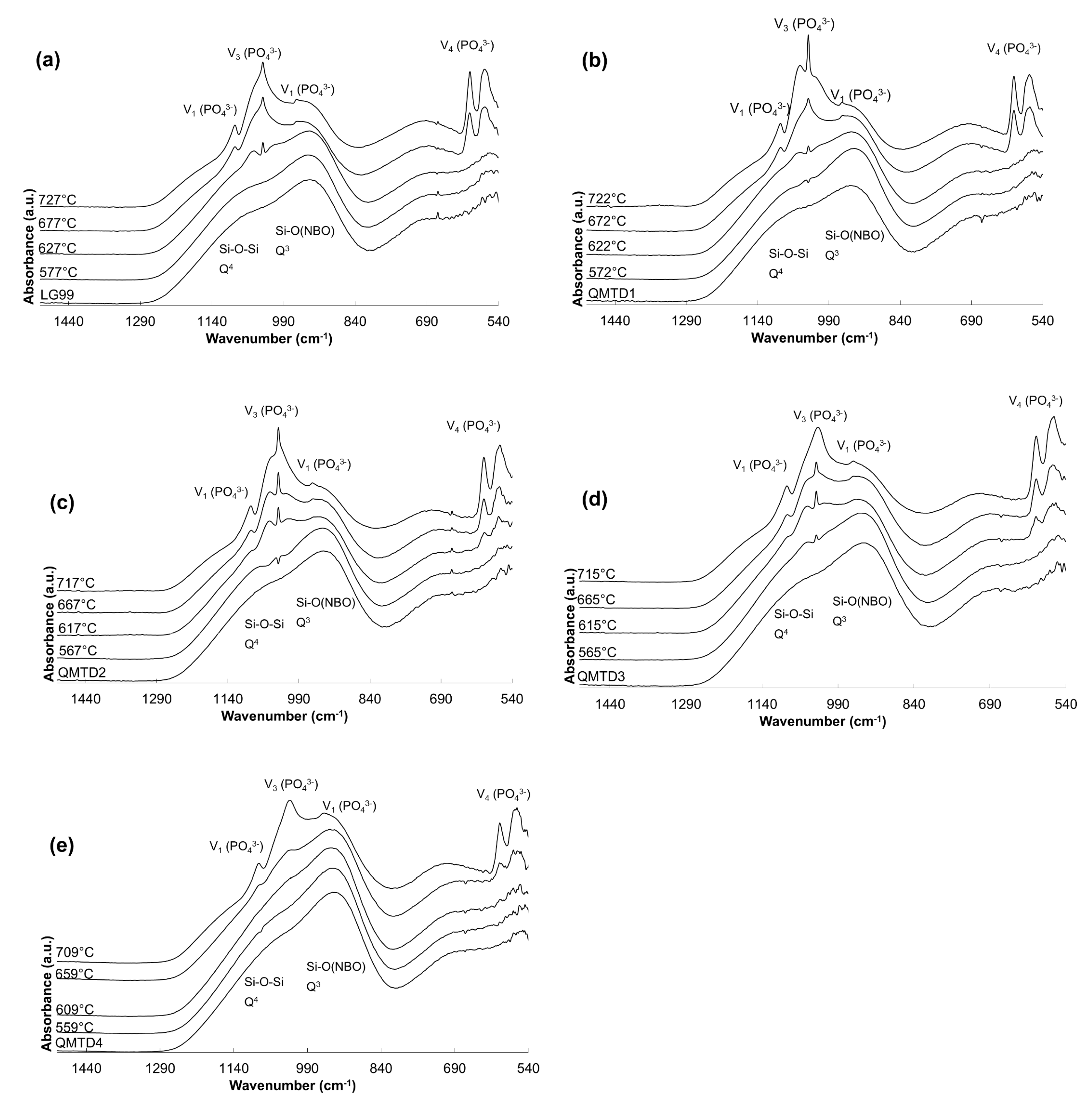
Figure 6.
(a) Evolution of the 31P MAS-NMR spectrum of the QMTD3 fluorapatite glass-ceramic (1.5 mol SrO substitution) as a function of temperature (bottom to top: untreated sample, 565 °C, 625 °C and 665 °C). The spectrum shows the evolution of phosphate environments with increasing heat-treatment temperature and the appearance of a pronounced resonance at approximately 3.48 ppm at 625 °C, corresponding to the phosphate environment in substituted fluorapatite (FAp). (b) 31P MAS-NMR chemical shifts for FAp with increasing SrO content in the nominal glass composition.
Figure 6.
(a) Evolution of the 31P MAS-NMR spectrum of the QMTD3 fluorapatite glass-ceramic (1.5 mol SrO substitution) as a function of temperature (bottom to top: untreated sample, 565 °C, 625 °C and 665 °C). The spectrum shows the evolution of phosphate environments with increasing heat-treatment temperature and the appearance of a pronounced resonance at approximately 3.48 ppm at 625 °C, corresponding to the phosphate environment in substituted fluorapatite (FAp). (b) 31P MAS-NMR chemical shifts for FAp with increasing SrO content in the nominal glass composition.
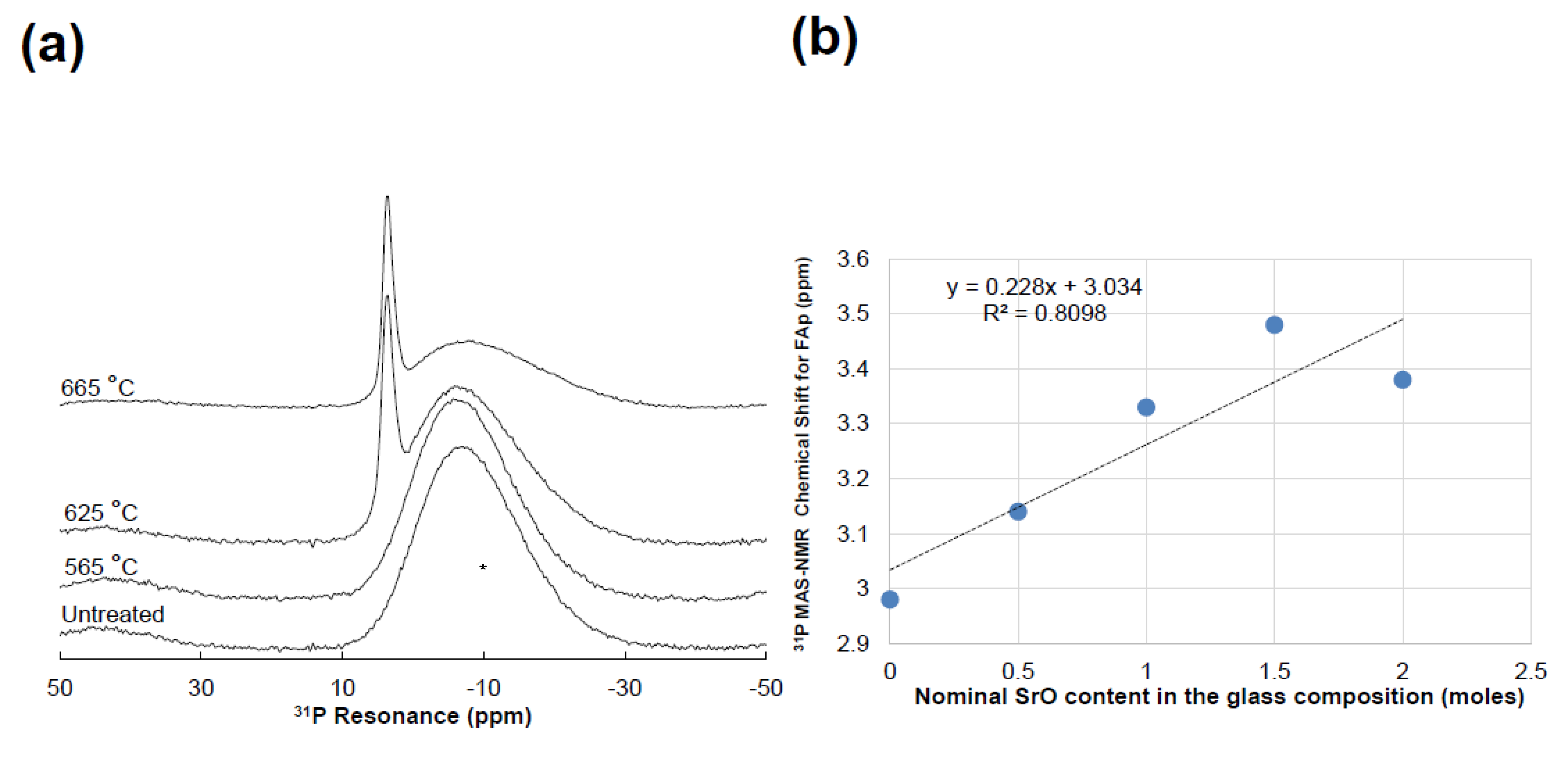
Figure 7.
¹⁹F MAS-NMR spectra of the developed glass-ceramics illustrating the evolution of fluoride environments with heat treatment and SrO substitution. (a) As-synthesised untreated amorphous glasses, showing three amorphous environments: F-Ca(n), Si-F-M(n) and Al-F-M(n) [32,33,40,41]. (b) Heat-treated unsubstituted glass-ceramics (LG99). (c) Heat-treated 0.5 mol SrO-substituted glass-ceramics (QMTD1). (d) Heat-treated 1 mol SrO-substituted glass-ceramics (QMTD2). (e) Heat-treated 1.5 mol SrO-substituted glass-ceramics (QMTD3). (f) Heat-treated 2 mol SrO-substituted glass-ceramics (QMTD4). Peaks at –104 ppm and –90 ppm correspond to F-Ca(3) and F-Ca(2)Sr in fluorapatite, respectively, while minor signals at lower and higher chemical shifts indicate additional fluoride environments arising from Sr substitution F-Sr(2)Ca and F-Sr(3), fluorite and Al–F-Ca(n) coordination [33,34,41]. Spinning sidebands marked by asterisks.
Figure 7.
¹⁹F MAS-NMR spectra of the developed glass-ceramics illustrating the evolution of fluoride environments with heat treatment and SrO substitution. (a) As-synthesised untreated amorphous glasses, showing three amorphous environments: F-Ca(n), Si-F-M(n) and Al-F-M(n) [32,33,40,41]. (b) Heat-treated unsubstituted glass-ceramics (LG99). (c) Heat-treated 0.5 mol SrO-substituted glass-ceramics (QMTD1). (d) Heat-treated 1 mol SrO-substituted glass-ceramics (QMTD2). (e) Heat-treated 1.5 mol SrO-substituted glass-ceramics (QMTD3). (f) Heat-treated 2 mol SrO-substituted glass-ceramics (QMTD4). Peaks at –104 ppm and –90 ppm correspond to F-Ca(3) and F-Ca(2)Sr in fluorapatite, respectively, while minor signals at lower and higher chemical shifts indicate additional fluoride environments arising from Sr substitution F-Sr(2)Ca and F-Sr(3), fluorite and Al–F-Ca(n) coordination [33,34,41]. Spinning sidebands marked by asterisks.
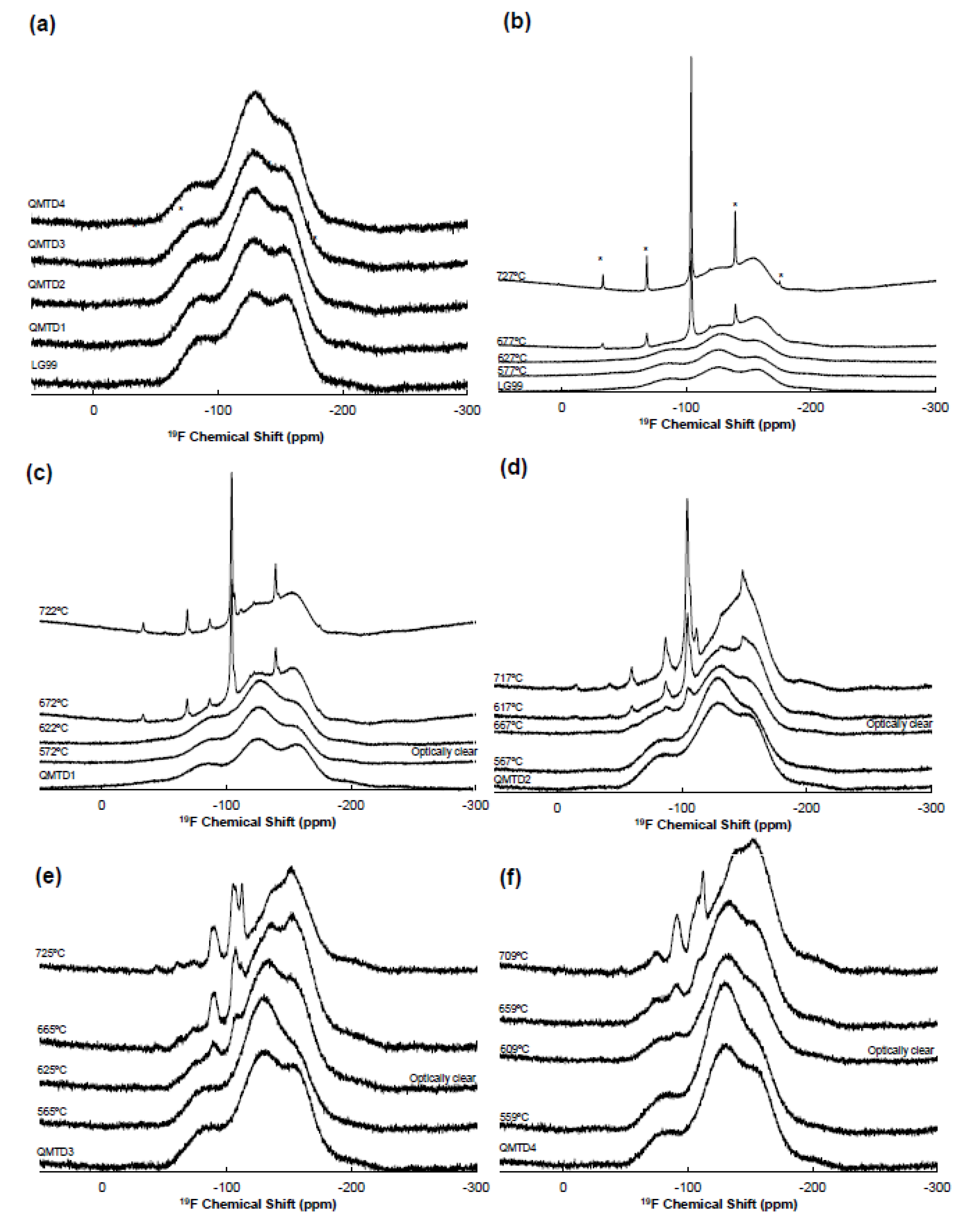
Figure 8.
Transmission electron micrographs of the developed glass-ceramics. Top: Thin section of a glass particle containing nanocrystalline inclusions; the corresponding selected area electron diffraction (SAED) pattern displays reflections characteristic of nanocrystalline fluorapatite. Bottom: Glass particle showing phase separation indicative of binodal decomposition, with features on the 10 nm scale.
Figure 8.
Transmission electron micrographs of the developed glass-ceramics. Top: Thin section of a glass particle containing nanocrystalline inclusions; the corresponding selected area electron diffraction (SAED) pattern displays reflections characteristic of nanocrystalline fluorapatite. Bottom: Glass particle showing phase separation indicative of binodal decomposition, with features on the 10 nm scale.
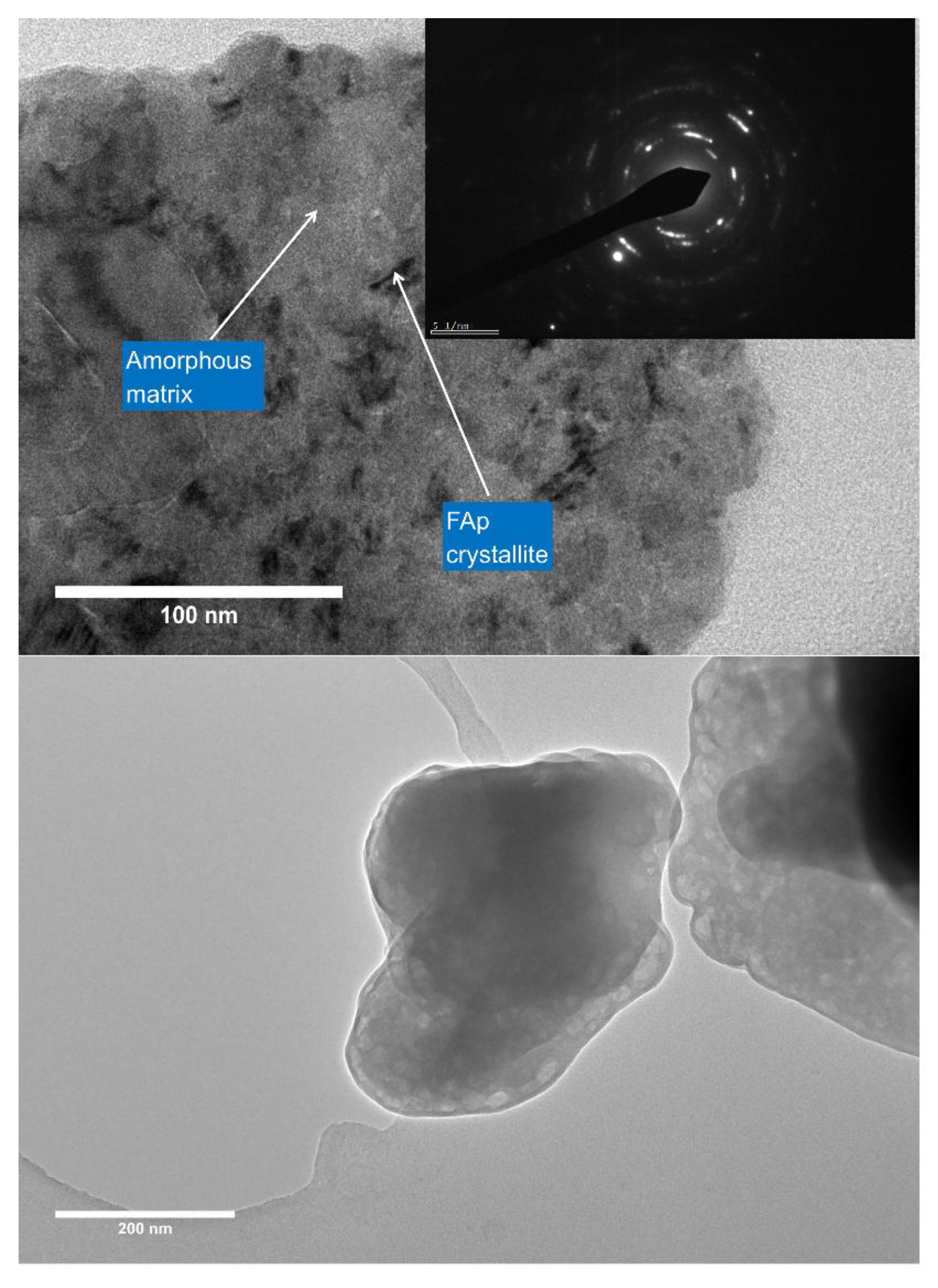

Table 1.
Nominal glass compositions in moles.
| Glass Code | SiO₂ | Al₂O₃ | P₂O₅ | CaO | SrO | CaF₂ |
| LG99 | 4.5 | 3 | 1.5 | 2 | 0 | 3 |
| QMTD1 | 4.5 | 3 | 1.5 | 1.5 | 0.5 | 3 |
| QMTD2 | 4.5 | 3 | 1.5 | 1 | 1 | 3 |
| QMTD3 | 4.5 | 3 | 1.5 | 0.5 | 1.5 | 3 |
| QMTD4 | 4.5 | 3 | 1.5 | 0 | 2 | 3 |
Table 2.
Comparative Nucleation Kinetics of LG99 and QMTD1.
| LG99 (Reference) | QMTD1 (Sr-Substituted) | ||||
|---|---|---|---|---|---|
| Tn (°C) | Tp′ (°C) | ΔTp (°C) | Tn (°C) | Tp′ (°C) | ΔTp (°C) |
| 595 | 740 | 9 | 572 | 744 | -15 |
| 610 | 736 | 13 | 587 | 754 | -25 |
| 625 | 729 | 20 | 602 | 737 | -8 |
| 640 | 726 | 23 (Max) | 617 | 734 | -5 |
| 655 | 727 | 22 | 632 | 727 | 2 |
| 670 | 729 | 20 | 647 | 723 | 6 (Max) |
| 662 | 726 | 3 |
Table 3.
Glass transition temperatures (Tg), peak crystallisation temperatures (Tp), and Avrami exponents (n) for the LG99 and Sr-substituted QMTD as-quenched glasses. *.
Table 3.
Glass transition temperatures (Tg), peak crystallisation temperatures (Tp), and Avrami exponents (n) for the LG99 and Sr-substituted QMTD as-quenched glasses. *.
| Sample | SrO (mol) | Tg Onset (°C) | Tg Midpoint (°C) | Tp (°C) | Avrami parameter, n | Core Mechanism | Residual Glass Mechanism |
|---|---|---|---|---|---|---|---|
| LG99 | 0.0 | 577 | 600 | 740 | 3.01 | 3D Volume (homogenous) nucleation | - |
| QMTD1 | 0.5 | 572 | 590 | 740 | 2.08 | 1D/3D Mixed (volume + surface) | 2D Interface-Controlled Growth |
| QMTD2 | 1.0 | 567 | 580 | 760 | 1.92 | 1D Surface-dominated | 2D Interface-Controlled Growth |
| QMTD3 | 1.5 | 565 | 575 | 780 | 1.63 | 1D Surface-exclusive | 3D Diffusion-Controlled Growth |
| QMTD4 | 2.0 | 559 | 565 | 850 | 1.49 | 1D Surface-exclusive | 1D Diffusion-Controlled Growth |
Table 4.
19F MAS-NMR Peak Assignments.
| Fluoride Environment | Peak Position (ppm) | Assignment | Reference |
|---|---|---|---|
| Amorphous (Glass) | |||
| Network Modifier | -90 | F-M(n) | [32,34] |
| Mixed Silicon | -125 | Si-F-M(n) | [33,40] |
| Mixed Aluminum | -150 | Al-F-M(n) | [32] |
| Crystalline | |||
| Ca-FAp | -104 | F-Ca(3) | [41] |
| Mixed FAp | -90 | F-Ca(2)Sr | [41] |
| Mixed FAp | -70 | F-Sr(2)Ca | [41] |
| Sr-FAp | -60 | F-Sr(3) | [41] |
| Ca-Fluoroaluminate | -139 | Al-F-Ca(2) | [33] |
| Sr-Fluoroaluminate | -112 | Al-F-Sr(2) | Present study |
| Mixed fluorite Ca(1-x)SrxF2 | -106 | - | Present study |
Disclaimer/Publisher’s Note: The statements, opinions and data contained in all publications are solely those of the individual author(s) and contributor(s) and not of MDPI and/or the editor(s). MDPI and/or the editor(s) disclaim responsibility for any injury to people or property resulting from any ideas, methods, instructions or products referred to in the content. |
© 2026 by the author. Licensee MDPI, Basel, Switzerland. This article is an open access article distributed under the terms and conditions of the Creative Commons Attribution (CC BY) license.
Copyright: This open access article is published under a Creative Commons CC BY 4.0 license, which permit the free download, distribution, and reuse, provided that the author and preprint are cited in any reuse.


