
Submitted:
02 March 2026
Posted:
03 March 2026
You are already at the latest version
Abstract
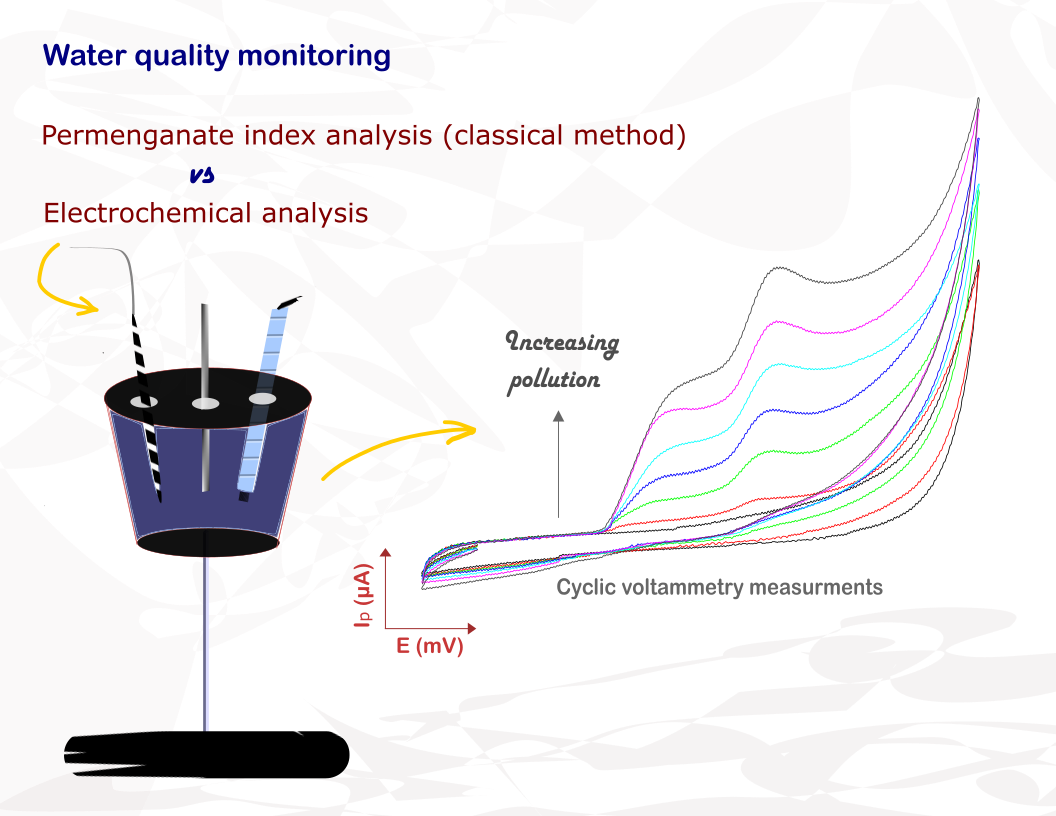
Water pollution is one of the most critical societal, environmental challenges and remains a persisting problem worldwide. The origin of this pollution is diverse while organic matter occupies a significant portion originating from different sources. This creates major environmental and health risks, requiring reliable and sensitive analytical tools for effective monitoring. The permanganate index stands as a conventional assessment method for organic pollution, but it demonstrates compound non-specificity toward compounds and limited sensitivity to various contaminant structures. This research introduces cyclic voltammetry as a standalone electrochemical method which provides sensitive detection and characterization of organic oxidizing compounds. Six organic compounds including gallic acid, phenol, oxalic acid, ascorbic acid, salicylic acid and p-benzoquinone were used as model compounds and studied in aqueous media. These compounds were analyzed individually, in single-compound mode, to characterize its redox behavior and to identify the voltammetric peaks. Subsequently, a multi-compound analysis was studied to check for the validity of the concept in a more complex matrix. Notably, a strong linear correlation was observed between the measured charge and the theoretical permanganate index, highlighting the quantitative reliability of the electrochemical method. Comparing the obtained results with the permanganate index method confirmed the superiority of cyclic voltammetry in terms of response time and detection capability. The outcomes demonstrate that cyclic voltammetry functions as a robust alternative to the classical chemical oxidation method for environmental water assessment.
Keywords:
permanganate index
; cyclic voltammetry
; environmental pollution
; organic matter
Copyright: This open access article is published under a Creative Commons CC BY 4.0 license, which permit the free download, distribution, and reuse, provided that the author and preprint are cited in any reuse.


