
Submitted:
10 February 2026
Posted:
26 February 2026
You are already at the latest version
Abstract
Emotion regulation and academic emotions play a key role in academic settings and should be explored in tandem. This study extends this context in two directions. Firstly, in terms of emotion regulation, by linking it to attachment and secondly, with academic emotions by associating them with approaches to learning. The purpose is to explore as-sociations among attachment, explicit emotion regulation, defense mechanisms, academ-ic emotions, and approaches to learning, to identify university students’ profiles. Moreo-ver, the impact of students' profiles on academic progress and mental health is investi-gated. Cluster analysis reveals four profiles that differ in terms of academic progress and mental health. It identifies “relaxed students with no interest in learning”, “secure stu-dents focused on learning”, “avoidants with expressive suppression” and “anxious with difficulties in learning and mental health”. Attachment seems to involve in areas beyond those being traditionally studied. Secure attachment style may prove to be both adaptive and maladaptive in relation to student's learning. Insecure attachment styles appear to maintain the same “environment” in learning as in their interpersonal relationships. By employing the profiles derived from this study, academic advisors can identify students facing challenges in areas such as learning, emotion regulation, and mental health.
Keywords:
attachment
; emotion regulation
; academic emotions
; learning
; cluster analysis
1. Introduction
Over the past decade, educational psychology literature emphasizes on the complexity of learning and explores factors that come from a variety of theoretical traditions (Rentzios et al., 2025; Fryer, 2017). In fact, Pekrun (2024a) suggests that, given the inherently complex nature of learning, drawing on and integrating constructs form distinct theoretical traditions is necessary to capture this complexity. Recently, Harley et al. (2019) positioned emotion regulation (ER) and academic emotions within a common theoretical framework for learning by integrating Gross’s (2015) model of explicit ER and Pekrun’s (2024b) control value theory of academic emotions. The present study addresses ER and academic emotions in the context of learning and mental health. It extends it in two directions: (a) it explores implicit ER, namely defense mechanisms (Prout et al., 2019; Rice & Hoffman, 2014) in relation to learning, and (b) it examines adult attachment styles as a personality trait that can co-occur with explicit and defense mechanisms, academic emotions, and approaches to learning. Within this conceptual framework, recent research on ER raises the importance of explicit ER and defense mechanisms suggesting that both types have roots in attachment (Laczkovics et al., 2018; Mikulincer & Shaver, 2016). Mental health research typically investigates these variables in tandem, positing their enduring significance throughout one's lifespan. Despite some examination of attachment in the context of Higher Education, this specific conceptual pathway remains relatively uncharted in the educational literature. Studies on university student profiles examine the combined influence of learning and emotional variables on academic performance, but do not consider academic progress and mental health together (Asikainen et al., 2020; Reindl et al., 2020). The present study examines the interplay of attachment, explicit ER, defense mechanisms, academic emotions, and approaches to learning in relation to academic progress and mental health in university students.
1.1. Attachment Style and Emotion Regulation: A Modern Integration in Educational Psychology
Adult attachment style refers to a constellation of behaviors and expectations an individual has about their important others and themselves (Fraley & Roisman, 2019). Research shows that attachment not only affects interpersonal functioning and mental health, but also self-regulation, exploration, and goal achievement (Hofmann et al., 2015; Orehek et al., 2017). Two continuous dimensions distinguish attachment styles: the anxious and the avoidant; low scores on these two dimensions reflect secure attachment. Avoidance dimension represents emotional distance from others and suppression of emotions. Anxiety dimension reflects a tendency to exaggerate negative emotion sand a constant fear of rejection by significant others; these individuals choose maladaptive ER strategies. Secure individuals can effectively use ER (Mikulincer & Shaver, 2016).
ER plays a central role in learning in HE. The importance of academic emotions and their regulation have implications for learning and well-being (Pekrun et al., 2018). A bulk of studies show the importance of students’ ER at an explicit level, but also at an implicit level (Gross, 2015; Rentzios et al., 2019). Explicit ER refers to strategies people use to influence their emotions; cognitive reappraisal and expressive suppression are among the most commonly used strategies (Gross & John, 2003). Explicit ER influences students’ learning strategies and their emotions (Ben-Eliyahu & Linnenbrink-Garcia, 2015). Defense mechanisms are viewed as unconscious mental processes that protect individuals from excessive stress and negative emotions (Cramer, 2015). Some studies link defense mechanisms to learning, showing that mature defense mechanisms are closely associated with adaptive learning outcomes, whereas immature defenses are mostly associated with maladaptive academic outcomes (Karagiannopoulou et al., 2018).
Given the importance of ER in learning, attachment comes as an antecedent facet that precedes ER. Attachment could influenceERmechanisms (Mikulincer & Shaver, 2016), which in turn could affect learning related factors such as academic emotions and approaches to learning. In this line of research, some studies point out a few associations on the way we relate to others and how this influences motivation and self-regulation (Blalock et al., 2015; Orehek et al., 2017). To our knowledge, only one study has examined the relationship between attachment and approaches to learning considering academic emotions as mediators (Rentzios & Karagiannopoulou, 2021).
1.2. Academic Emotions and Approaches to Learning
Over the past two decades, academic emotions have been integrated into students’ learning (Asikainen et al., 2017), while being associated with achievement, well-being and mental health (Pekrun, 2024b; Stockinger et al., 2025). Positive emotions such as enjoyment are usually associated with positive academic outcomes and deep approaches to learning, while negative emotions are often associated with maladaptive learning strategies and low achievement (Rentzios et al., 2019; Trigwell et al., 2012). Some researchers highlighted the complexity of the relationships between academic emotions and learning (Postareff et al., 2017) and that further research is needed.
Approaches to learning represent students’ learning processes that reflect different ways of studying (Asikainen & Gijbels, 2017). They relate to academic achievement and educational outcomes (de la Fuente et al., 2020). Literature discusses three different approaches to learning: the deep approach, the surface approach, and the organized studying (Entwistle, 2018). Students adopting the deep approach mainly study to seek scientific evidence in new and old information (Öhrstedt & Lindfors, 2018). Students who prefer the surface approach usually learn by rote and act under the influence of external motivation (Entwistle, 2018). Recently, the term ‘unreflective approach’ has been suggested to describe the surface approach, that is students’ inability to integrate the subject matter into a cohesive whole (Lindblom-Ylänne et al., 2018). The last approach, the organized one, is considered more as an approach to monitor time and effort during study (Entwistle, 2018). The deep and organized approaches correlate with high academic achievement, while the surface approach usually links to low grade point of average (GPA) and achievement (Herrmann et al., 2017). The association between approaches to learning and academic achievement is not always consistent (Haarala-Muhonen et al., 2017), likely because other factors intervene in this relationship. Some researchers argue that personality factors may involve in the above relationship (Sander & de la Fuente, 2022) or academic emotions and their regulation should play an important role (Harley et al., 2019).
1.3. Learning, Emotional Factors and University Students’ Profiles
There has been an increasing research interest in the study of different characteristics in the same groups of individuals. A range of studies show profiles of university students that correspond to adaptive, maladaptive, and dissonant groups of students (Karagiannopoulou et al., 2019; Parpala et al., 2010). These studies suggest that different factors may coexist contributing to students’ academic achievement and mental health. For example, Parpala et al. (2010) found four discrete profiles based on approaches to learning. One of these profiles consists of students who do not organise their studies but exhibit some characteristics of the deep approach. This profile is an example of a “dissonant” group of students whose variables do not theoretically match (Lindblom-Ylänne & Lonka, 2000; Parpala et al., 2022). On the same wavelength, Heikkilä et al. (2011) acknowledge the need to examine a combination of cognitive and emotional factors when researching the quality of learning.They found three groups of students: the “non-academic” students, the “self-directed” students, and the “helpless” students. The “non-academic”, was the most intriguing of all. This profile combines facets that theoretically do not match and are not usually associated with positive academic performance. Students in this group seem to be successful in their academic tasks, they make progress, but they do it in a "relaxed" way and without achieving a high GPA (Heikkilä et al. 2011). The same profile was also found in another study where students had low valence in their emotions but did well on their studies (Jarrell et al., 2017).
More recently, a few studies using cluster analysis have expanded the research to include factors from different theoretical fields (Karagiannopoulou et al., 2025; Rentzios et al., 2025). These studies attempt to bring together variables from the mental health field and learning domains (Milienos et al., 2021). In a recent person-oriented study (Rentzios et al., 2025) integrating emotion regulation, academic emotions, academic motivation (self-regulation), and approaches to learning, three discrete profiles emerged: (a) “Anxious, effectively-engaged, and organized learners”, (b) “Deep, happy, and intrinsically motivated learners” and (c) “Disengaged, Bored, and Suppressing Learners”. Importantly, this 3-cluster solution captured both theoretically consistent and “dissonant” patterns, with the dissonant profile combining increased anxiety with relatively adaptive learning behavior and motivational indicators. These profiles also differentiated academic performance, as students in the (c) profile demonstrated the lowest GPA while the (b) profile showed the highest (with the anxious one being also comparably high). These findings are in line with the view that emotions and emotion regulation in academic settings are not merely “learning-factors” but integral to students’ well-being and health (Pekrun, 2024b; Stockinger et al., 2025). This is precisely why the “Healthy Universities” agenda is needed.
“Healthy universities” create environments that promote mental health and well-being, enabling students to reach their full potential (Dooris et al., 2017). Mental health has not been sufficiently investigated in relation to academic success in HE (Willems et al., 2018) and can be related to educational psychology, as researchers consider health and learning as closely related concepts (Lutz, 2009).
1.4. The Present Study
Educational literature emphasizes the integration of variables that come from different theoretical traditions in order to understand the phenomenon of learning in depth (Fryer, 2017; Pekrun, 2024a). Attachment, explicit ER, defense mechanisms, academic emotions, and approaches to learning share some common facets and may be interrelated (Harley et al., 2019; Mikulincer & Shaver, 2016). Understanding the process of how emotions manifest and are regulated during learning is essential for establishing meaningful connections (Törmänen et al., 2021). Attachment influences a number of aspects of a person’s life and thus, through ER may be linked to academic emotions and learning.
Most studies on ER and academic emotions use variable-centered methods. By taking a person-oriented approach, researchers can develop a deeper and more comprehensive understanding of student profiles, especially in an academic setting where dissonant profiles have recently been found with increasing frequency (Parpala et al., 2022).
Based on previous studies, we expect to find three or four profiles with adaptive and maladaptive facets (Asikainen et al., 2020; Robinson et al., 2017).We anticipate finding one profile with adaptive characteristics, one with maladaptive characteristics and one or two dissonant profiles (Gardner et al., 2020). More specifically, low scores on both insecure attachment styles are expected to be associated with adaptive explicit ER strategies, mature defense mechanisms, enjoyment, and adaptive approaches. High scores for insecure attachment styles are expected to be related with suppression, immature defense mechanisms, anxiety, boredom, and with the surface approach to learning (Karagiannopoulou et al., 2019; Rentzios et al., 2025). In addition, it is anticipated that the adaptive characteristics will be associated with high scores on GPA, academic success (Reindl et al., 2020) and mental health; the association with the maladaptive characteristics is expected to be reversed. Based on the above, we have postulated the following research questions:
RQ1: Can the variables of this study be categorized in different profiles and be interpreted accordingly?
RQ2: How do the extracted profiles differ regarding GPA, academic success, and mental health?
2. Methodology
2.1. Participants and Procedure
The sample comprised 523 undergraduate students (Mage = 20.5 years, range = 18–22) enrolled in a four-year social sciences program at a Greek university. Of the participants, 13.7% were male and 86.3% female. Students were distributed across all years of study: 1st year (n = 136, 25.8%), 2nd year (n = 139, 26.4%), 3rd year (n = 95, 18.0%), and 4th year (n = 157, 29.8%). Data collection took place prior to the start of a scheduled lecture. Participation was voluntary and anonymous, and all students provided written informed consent. Ethical approval was granted by the university's Ethics Committee, and the study adhered to all relevant guidelines and regulations. Completion of the questionnaires required approximately 35 minutes.
2.2. Instruments
2.2.2. Experiences in Close Relationships- Relationship Structure Questionnaire (ECR-RS)
The ECR-RS (Fraley et al., 2011) measures adult attachment styles using a 7-point Likert scale (1= strongly disagree to 7 = strongly agree) comprising 9 items, assessing two insecure attachment dimensions: avoidance (6 items) and anxiety (3 items). Low scores on both dimensions indicate secure attachment. Cronbach's Alpha values for the two subscales were α = .85 for avoidant style and α = .86 for anxious style.
2.2.3. Emotion Regulation Questionnaire (ERQ)
Explicit ER is assessed using the ERQ (Gross & John, 2003), a 10-item instrument that measures two strategies: cognitive reappraisal (6 items) and expressive suppression (4 items). Responses are recorded on a 7-point Likert scale (1 = strongly disagree to 7 = strongly agree). Cronbach's Alpha values were α = .80 for cognitive reappraisal and α = .74 for expressive suppression.
2.2.4. Response Evaluation Measure-71 (REM-71)
The REM-71 (Steiner et al., 2001) measures defense mechanisms with 71 items, categorizing them into 21 defense mechanisms, divided mainly into two factors: mature and immature. Steiner et al. (2001) further distinguishes intrapsychic mature, interpersonal mature, intrapsychic immature, and interpersonal immature defense mechanisms. For the purposes of the study, both exploratory and confirmatory analyses were conducted, and three factors have emerged: immature defense mechanisms (α = .86), mature interpersonal defense mechanisms (α = .77), and mature intrapsychic defense mechanisms (α = .61).
2.2.5. Achievement Emotions Questionnaire (AEQ)
To measure discrete academic emotions, the learning related scales of enjoyment, anxiety and boredom have been used from the AEQ (Pekrun et al., 2011).The reasons for selecting these emotions were twofold. Firstly, university students frequently experience these emotions in achievement settings (Respondek et al., 2017). Secondly, are considered as the prime emotions related to academic achievement (Niculescu et al., 2015). Students rated their experiences on a 5-point Likert scale (1 = strongly disagree to 5 = strongly agree) in response to items related to emotions before, during, or after studying for a course. They provided ratings for enjoyment, anxiety, and boredom. The Cronbach's Alpha values were α = .79 for enjoyment, α = .82 for anxiety, and α = .92 for boredom.
2.2.6. Approaches to Learning and Studying Inventory (ALSI)
Approaches to learning were assessed using a modified short version of the ALSI developed by the Finnish research group in HE (Parpala et al., 2013). The questionnaire comprised 16 items measuring three distinct approaches to learning: deep (8 items), surface (4 items) and organized (4 items). In this study, Cronbach's Alpha values were α = .74 for the deep approach, α = .75 for the surface approach, and α = .82 for the organized approach. A high score on the 5-point Likert scale (1 = strongly disagree to 5 = strongly agree) indicated students’ adoption of each approach.
2.2.7. General Health Questionnaire (GHQ)
Mental health was assessed using the GHQ, which consists of 12 sentences measured on a 4-point Likert scale (1 = more than usual to 4 = much less than usual). These sentences assess an individual's mental and somatic stress levels and are a robust predictor of psychological morbidity and stress in university students (James et al., 2013). The GHQ is designed to measure mental health in non-clinical populations (Hystad et al., 2020) and results in a single score; with higher scores indicating a greater psychological burden. In this study, Cronbach's Alpha for the GHQ was α = .76.
2.2.8. Grade Point Average and Academic Success
To calculate GPA, students have answered a single self-report question in which they reported their average GPA in the courses they had passed up to the time they completed the questionnaire. Academic success corresponds to the ratio of declared courses to passed courses and is reported as a percentage. This variable calculates the rate of student success in coursed. Both GPA and academic success add to the maximum validity of students’ academic achievement.
2.3. Statistical Analysis
The analysis began with the exploration of the latent structure of the instruments through both exploratory and confirmatory factor analysis, followed by the examination of reliability coefficients (Cronbach’s Alpha). Exploratory Factor Analysis (EFA) was first conducted to determine the number of latent factors in each measure. The Kaiser-Meyer-Olkin (KMO) index and Bartlett’s test of sphericity were applied to assess the suitability of the data for factor analysis.
Subsequently, Confirmatory Factor Analysis (CFA) was conducted to validate the factor structures identified in EFA. The model fit was evaluated using the following indices: Comparative Fit Index (CFI), Tucker-Lewis Index (TLI), Root Mean Square Error of Approximation (RMSEA), and Standardized Root Mean Square Residual (SRMR). According to the guidelines provided by Kline (2016), acceptable model fit is indicated by CFI and TLI values between 0.90 and 0.95, RMSEA values below 0.06, and SRMR values below 0.05. The CFA results for each instrument are presented in Table 1. It should be noted that although most instruments demonstrated acceptable fit, some deviations were observed (e.g., the TLI and CFI values for REM-71, and RMSEA for ECR-RS), which are acknowledged as limitations.
Following CFA, Cronbach’s Alpha coefficients were calculated for each subscale to assess internal consistency and reliability. Additionally, correlation analysis was performed to examine the interrelationships and independence of the subscales. All analyses were based on the standardized z-scores of each variable.
To classify students into homogeneous groups, a hierarchical cluster analysis was first conducted using Ward’s linkage method and Euclidean distance. This method is suitable when no predefined group structure exists among the variables (Hastie et al., 2009). Based on the hierarchical clustering results and dendrogram, a two-step cluster analysis was then carried out using the log-likelihood distance measure. This procedure allowed for the evaluation of the most appropriate number of clusters using the silhouette score. Although the two-cluster solution had a higher silhouette score (0.42), the four-cluster solution (silhouette score = 0.31) was preferred, as it offered a more meaningful and interpretable classification consistent with the theoretical framework and prior literature (Postareff et al., 2017; Karagiannopoulou et al., 2020).
Descriptive statistics (mean values and standard deviations) were calculated for each variable within each profile. Group differences among the clusters were analyzed using one-way ANOVA with Bonferroni post-hoc comparisons, as well as a Multivariate Analysis of Variance (MANOVA). Given the intercorrelated nature of the dependent variables, MANOVA was selected over multiple univariate analyses. A subsequent discriminant analysis was also performed to assess the classification accuracy of the clusters. The analysis confirmed the validity of the four-cluster solution, with 91% of cases correctly classified.
Finally, another MANOVA was conducted to examine the effect of cluster membership on the outcome variables: GPA, academic success, and mental health. This analysis enabled both statistical and graphical comparison of these outcomes across the identified student profiles.
3. Results
The psychometric properties of the ERC-RS, ERQ, REM-71, AEQ, ALSI, and GHQ were examined, and most indices fell within acceptable thresholds, indicating overall satisfactory model fit. The parameter estimation was based on the weighted least squares method (Kline, 2016). The results from the Confirmatory Factor Analysis (CFA) are presented in Table 1. As shown, most instruments demonstrated strong fit indices (CFI, TLI, RMSEA, SRMR). However, it should be noted that the CFI (0.800) and TLI (0.786) values for REM-71, and the RMSEA (0.083) for ECR-RS, deviated from the classical cut-off values, representing a limitation that should be considered in the interpretation of the results.

Table 1.
Confirmatory factor analysis on the instruments used in our study.
| p | CFI | TLI | RMSEA | SRMR | |
|---|---|---|---|---|---|
| ECR-RS | 0.001 | 0.965 | 0.940 | 0.083 | 0.057 |
| ERQ | 0.001 | 0.972 | 0.961 | 0.050 | 0.036 |
| REM-71 | 0.001 | 0.800 | 0.786 | 0.046 | 0.068 |
| AEQ | 0.001 | 0.919 | 0.907 | 0.049 | 0.060 |
| ALSI | 0.001 | 0.956 | 0.945 | 0.044 | 0.047 |
| GHQ | 0.001 | 0.997 | 0.961 | 0.044 | 0.036 |
Pearson correlation coefficients among the study’s variables are presented in Table 2. As expected, several significant correlations were observed among key constructs such as emotion regulation, defense mechanisms, academic emotions, learning approaches, and outcome variables. These interrelations justified the use of multivariate statistical procedures.
To classify students into distinct profiles based on their emotional, cognitive, and academic characteristics, a hierarchical cluster analysis was initially performed using Ward’s linkage method and Euclidean distance. This approach is appropriate when no prior assumptions are made about the structure of the data (Hastie et al., 2009). Based on the resulting dendrogram, a two-step cluster analysis was subsequently conducted using the log-likelihood distance measure to determine the optimal number of clusters and validate the hierarchical results. The silhouette coefficient was used to assess cluster quality. The two-cluster solution produced a silhouette score of 0.42, while the four-cluster solution yielded a score of 0.31. Although the two-cluster solution showed a better silhouette value, it was considered too simplistic to capture the complexity of the variables under study. Therefore, the four-cluster solution was selected based on its greater theoretical relevance and better alignment with prior research that has adopted similar multidimensional frameworks (Karagiannopoulou et al., 2020; Postareff et al., 2017). Descriptive statistics (means and standard deviations) for each variable across the four clusters are presented in Table 3. These clusters represent meaningful student profiles characterized by distinct patterns in attachment, emotion regulation, defense mechanisms, academic emotions, learning strategies, and academic outcomes. Mental health, GPA, and academic success were treated as outcome variables across the identified profiles to assess their academic and psychological functioning.
Differences among the study variables were further examined using a Multivariate Analysis of Variance (MANOVA). This technique was selected over univariate methods (e.g., ANOVA) due to the significant intercorrelations among the dependent variables, as shown in Table 2. The MANOVA revealed a statistically significant effect of cluster membership on the combined vector of the 13 dependent variables, supporting the differentiation of the four student profiles.
To further interpret these differences, a post hoc descriptive discriminant analysis (DDA) was conducted. DDA provides insight into the specific functions that discriminate between groups and complements MANOVA results (Field, 2016). The analysis yielded three statistically significant discriminant functions (p < .001), all of which contributed meaningfully to the classification of individuals into the four clusters. The classification accuracy was high, with 91% of cases correctly classified, indicating strong support for the validity of the cluster solution. The separation of the four clusters based on the two primary discriminant functions is illustrated in Figure 1.
Finally, a second MANOVA was performed to examine the effect of cluster membership on the outcome variables: GPA, academic success, and mental health. The results of this analysis are presented in Table 6 and visualized in Figures 3A, 3B, and 3C (Supplementary File). The findings confirm that the clusters differ significantly in these key academic and psychological outcomes, further validating the distinctiveness and interpretive utility of the four-profile solution.
4. Discussion
The present study draws on contemporary research on ERand academic emotions (Harley et al., 2019). It seeks to explore university students’ profiles based on attachment, explicit ER, defense mechanisms, academic emotions, and approaches to learning to demonstrate the role of these variables in academic progress and mental health. It reveals adaptive and maladaptive emotional and learning patterns that differentiate in terms of attachment styles, explicit ER, defense mechanisms, academic emotions, and approaches to learning. The existence of four groups of university students illustrates the complexity of the learning process and the factors that may play a role. Students may experience a variety of emotional conditions at the same time during the learning process (Cheng et al., 2023).
Secure attachment style may prove to be both adaptive and non-adaptive, i.e., “dissonant”, in relation to a student's efforts to gain knowledge. Moreover, students with insecure attachment style, the avoidant and the anxious, appear to maintain the same “environment” in learning as they do in their interpersonal relationships. Insecure individuals are at high risk for poor mental health, verifying recent studies that attachment may act as a decisive factor in university students’ academic life (Zhang et al., 2022). It seems that attachment is involved in areas beyond those traditionally studied (Blalock et al., 2015).
These emotional and learning patterns are distinguished in relation to academic success and mental health. The study reveals four discrete students’ profiles: (1) “relaxed with no interest in learning”, (2) “secure and focused on learning”, (3) “avoidants with suppression”, and (4) “anxious with difficulties in learning and mental health”. In terms of academic progress and mental health, students in Cluster 2 had the best GPA, academic success, and mental health, while in contrast, students in Cluster 4 had the worst GPA, academic success, and mental health. Furthermore, Cluster 1, the "dissonant" profile, is something entirely new in the literature, confirming the existence of "dissonant" profiles that share adaptive and maladaptive patterns (Parpala et al., 2022; Postareff et al., 2017).
4.1. “Relaxed with no Interest in Learning”
The first profile, the “relaxed with no interest in learning”, denotes the “dissonant” profile of the study (Parpala et al., 2022), a combination of characteristics not expected in previous literature (Gardner et al., 2020). While these students showed no signs of psychological distress, their academic progress was not as high as expected compared to the second profile, which was the most adaptive of all.
Students in this group had the highest scores on the secure attachment dimension, moderate scores on academic emotions, low scores on explicit ER strategies and do not appear to engage in learning. It is possible, the moderate scores on all approaches to learning and the difficulties in reappraisal and suppression had a cost on GPA and academic success. This profile appears to match the profile defined in the international literature as “relaxed students” (Jarrell et al., 2016). Interestingly, this profile challenges the assumption that secure attachment is always associated with high academic performance.
Security in attachment does not always seem to provide the confidence and certainty necessary to maximize academic progress. Perhaps the security of attachment and lack of ER give students in this group a “relaxation” that results in them not being as motivated to achieve their academic goals. Their low scores on enjoyment during learning may indicate a lack of interest in making progress in their courses - simply “passing” them - without getting high grades (Heikkilä et al., 2011). The “overconfidence” in their attachment may be an indicator of a general overconfidence in themselves that leads them to not try as hard as their studies require (Donche et al., 2012; Robinson et al., 2017).This security in attachment and at the same time the absence of explicit ER strategies may drive individuals to believe “everyone”, creating an “atmosphere of credulity” and therefore not need to go deeper in learning because they do not doubt anyone. Regarding mental health, students in this group had the same score with the adaptive group. Their attachment security goes hand in hand with mature interpersonal defense mechanisms, which is consistent with current research on defense mechanisms (Laczkovics et al., 2018). Perhaps, this is the reason why their mental health does not appear to be compromised. This interpretation is supported by the simultaneous low score of immature defense mechanisms and high score use of mature interpersonal defense mechanisms.
Special attention should also be given to these students. Although they show no signs of psychological distress, academic advisors should support them in acknowledging their own learning strategies (Parpala et al., 2022). It is important for students who seem to lack motivation to be able to engage deeply in the learning process.
4.2. “Secure and Focused on Learning”
The second profile, “secure and focused on learning”, reflects a group of students who combine the positive and mature facets of the variables of study. Individuals in this group have a positive view of themselves and others, regulate their emotions effectively, use adaptive strategies in learning, and enjoy learning. They achieve high GPA and academic success and have the best scores in mental health. In contrast to the cluster 1, attachment security is associated with a set of mature defenses, both intrapsychic and interpersonal, while immature defenses are rarely used. This combination, together with enjoyment during learning, is likely to promote the more adaptive approaches to learning and thus the best academic achievement (Karagiannopoulou et al., 2019; Rentzios et al., 2025). Moreover, very low levels of negative emotions are likely to be associated with very effective ER, both through cognitive reappraisal and mature defense mechanisms. Explicit ER and defense mechanisms have been shown to contribute to the reduction of negative emotions (Ben-Eliyahu & Linnenbrink-Garcia, 2015; Cramer, 2015). According to Pekrun et al. (2002), the combination of high scores on positive emotions and concurrent low scores on negative emotions is a critical factor for success in academic context.
In the light of these findings, the research contributes to the ongoing discussion about “Healthy Universities” and the promotion of learning through psychological and cognitive factors. Effective ER by students and positive emotions improves their overall health, leading them to be both academically productive and mentally healthy, which is a goal of modern educational institutions (Dooris et al., 2017).
4.3. “Avoidants with Suppression”
The third profile, the “avoidants with suppression”, consists of university students dominated by the avoidance dimension and the expressive suppression of emotions. This profile is consistent with recent literature examining attachment-based profiles and ER (Gardner et al., 2020). Suppression of emotions is the most common deactivating ER strategy that individuals with avoidant attachment style use quite frequently (Winterheld, 2016). It is possible that students of this profile, due to their avoidant attachment style, do not express their emotions, especially the feeling of enjoyment, and are not in the mood to organise their studies or engage in depth in learning. Moreover, expressive suppression is positively related to low levels of adaptive learning strategies (Ben-Eliyahu & Linnenbrink-Garcia, 2015). This ER strategy, when used too frequently, depletes the individual's cognitive resources, and renders them unable to engage in other cognitive processes (John & Gross, 2004). Experimental studies have revealed that expressive suppression may have detrimental effects in memory use (Cameron & Overall, 2017). Τhis is likely to have an impact on academic grades for this particular group of students. In addition, high scores on expressive suppression indicate that individuals with this profile display an “inauthentic self” to others and conceal their true emotions and thoughts (John & Gross, 2004). The remarkably high scores on suppression may have a detrimental effect on the mental health of these individuals (John & Gross, 2004).
Students in this group struggle not to reveal their feelings to others, they do not feel enjoyment in their study which contributes to our suggestion about an “inauthentic/false self”; this “inauthentic/false self” possibly comes at a cost, since in trying to support it they “spend” cognitive resources, resulting in a decline in both their academic performance and their mental health.
“Anxious with Difficulties in Learning and Mental Health”
Finally, the fourth profile, the “anxious with difficulties in learning and mental health” consists of students who struggle the most during their studies compared to students in the other clusters. This profile indicates anxiety which possibly depicts in learning. These students face difficulties in regulating their emotions. They experience strong interpersonal anxiety and adopt a surface approach. Perhaps, to reduce stress, they are not deeply engaged in the learning process. Such a suggestion is supported by poor ER, both in terms of explicit and implicit strategies, and by their high score on anxious attachment dimension.
This profile reflects a vulnerable group of students, in terms of learning and mental health. It is consistent with previous studies that have revealed a similar maladaptive profile (Milienos et al., 2021; Rentzios et al., 2025), but the present study shows the contribution of attachment styles to these specific variables. Regarding learning, they have the highest score on the surface approach, the “unreflective one”, depicting their inability to form a coherent whole of the study material (Lindblom-Ylänne et al., 2018). This inability possibly reflects their incompetence to form emotionally mature relationships with significant others. To accept the other, you must acknowledge them, recognizing their flaws. Students in this group have high scores on the anxious dimension, followed by also high scores on immature defense mechanisms and negative emotions. The presence of immature defense mechanisms suggests that they are unconsciously trying to manage both their interpersonal anxiety and their negative emotions, as mature defense mechanisms and explicit regulation strategies are relatively low and do not appear to be effective. This combination is likely to have implications for both learning and mental health. Previous research has highlighted the positive relationship between immature defense mechanisms and surface approach (Karagiannopoulou et al., 2018) and mental health (Cramer, 2015).
Students in this profile seem to maintain the same 'stressful' environment in their interpersonal relationships and carry it over into the way they study, resulting in difficulties both in their studies and in their mental health.
4.4. Limitations
Regarding the study's sample, there was a gender imbalance in favour of women. However, it should be emphasized that this is typical for the population studying social sciences, at least in particular departments.
Extra caution should be taken regarding some fit indexes of the REM-71. This instrument is relatively new, and its use is more often limited to the clinical population; therefore, further validation and statistical refinement may be necessary when applying it in non-clinical educational contexts.
Finally, students' GPA and academic success were obtained from participants' responses; direct extraction of students' grades was not possible, as this would violate privacy on personal data protection. While self-reports are commonly used in educational research, they may introduce recall bias or social desirability effects.
4.5. Future Implications
Using the profiles that emerged from the current research, university counselling services will be able to identify students who are experiencing difficulties in learning, ER, and their mental health. Research has indicated that explicit ER in not always sufficient in altering unfavourable conditions during learning activities (Törmänen et al., 2021). Academic emotions can be regulated successfully deploying multiple strategies (Harley et al., 2019). Possibly, the significance of defense mechanisms, should be considered from university counselling advisors. Attention should also be paid to students belonging to the “dissonant” profile as they should receive support to identify their learning strategies (Rentzios et al., 2025; Parpala et al., 2022). In addition, they could inform online platforms already developed in several European countries to predict and monitor students' progress and emotional development by completing questionnaires related on current study’s variables. Nikulescu et al. (2015) stated that quality education should be about both the academic achievement of students and the emotions that students experience. Educational policy and practise should place more importance on affective factors related to learning and achievement (Camacho-Morles et al., 2021). Future work in HE should examine attachment jointly with other affective variables such as mentalizing and epistemic trust to clarify why some students follow adaptive, maladaptive or dissonant learning-emotional pathways (Karagiannopoulou et al., 2025).
5. Conclusions
The results illustrate the contribution of attachment styles and defense mechanisms to learning in HE through discrete students’ profiles. Attachment styles appear to extend to domains beyond close relationships and serve as important factors in distinguishing student profiles. Both attachment styles and defense mechanisms, as well as explicit ER and learning related factors, influence academic progress and mental health. The way students relate to important people in their lives and how they regulate their emotions are likely to affect their academic progress and mental health.
Author Contributions
For research articles with several authors, a short paragraph specifying their individual contributions must be provided. The following statements should be used “Conceptualization, X.X. and Y.Y.; methodology, X.X.; software, X.X.; validation, X.X., Y.Y. and Z.Z.; formal analysis, X.X.; investigation, X.X.; resources, X.X.; data curation, X.X.; writing—original draft preparation, X.X.; writing—review and editing, X.X.; visualization, X.X.; supervision, X.X.; project administration, X.X.; funding acquisition, Y.Y. All authors have read and agreed to the published version of the manuscript.” Please turn to the CRediT taxonomy for the term explanation. Authorship must be limited to those who have contributed substantially to the work reported.
Funding
This research received no external funding
Institutional Review Board Statement
The research fully complied with all applicable national and institutional ethical standards, including Law 4624/2019 (Greek implementation of the GDPR), and Regulation (EU) 2016/679 of the European Parliament and of the Council of 27 April 2016 on the protection of natural persons with regard to the processing of personal data and on the free movement of such data, point 26. At the time the study was carried out (2019), the Research Ethics Committee (REC) of the University of Ioannina had been formally established (Decision P.A.P. 13928/15.2.2019), but its official operating regulation had not yet been issued (approved in October 2022). Therefore, ethical review and approval were not applicable at that time.
Informed Consent Statement
Informed consent was obtained from all subjects involved in the study.
Data Availability Statement
The datasets used and/or analyzed during the current study are available from the corresponding author on reasonable request.
Conflicts of Interest
The authors declare that there are no conflicts of interest.
References
- Asikainen, H., Hailikari, T., & Mattsson, M. (2017). The interplay between academic emotions, psychological flexibility and self-regulation as predictors of academic achievement. Journal of Further and Higher Education, 42(4), 439–453. [CrossRef]
- Asikainen, H., Salmela-Aro, K., Parpala, A., & Katajavuori, N. (2020). Learning profiles and their relation to study-related burnout and academic achievement among university students. Learning and Individual Differences, 78, Article 101781. [CrossRef]
- Ben-Eliyahu, A., & Linnenbrink-Garcia, L. (2015). Integrating the regulation of affect, behaviour, and cognition into self-regulated learning paradigms among secondary and post-secondary students. Metacognition and Learning, 10(1), 15–42. [CrossRef]
- Blalock, D. V., Franzese, A. T., Machell, K. A., & Strauman, T. J. (2015). Attachment style and self-regulation: How our patterns in relationships reflect broader motivational styles. Personality and Individual Differences, 87, 90–98. [CrossRef]
- Camacho-Morles, J., Slemp, G. R., Pekrun, R., Loderer, K., Hou, H., & Oades, L. G. (2021). Activity achievement emotions and academic performance: A meta-analysis. Educational Psychology Review, 33(3), 1051–1095. [CrossRef]
- Cameron, L. D., & Overall, N. C. (2017). Suppression and expression as distinct emotion-regulation processes in daily interactions: Longitudinal and meta-analyses. Emotion, 18(4), 465–480. [CrossRef]
- Cheng, S., Huang, J., & Hebert, W. (2023). Profiles of vocational college students’ achievement emotions in online learning environments: Antecedents and outcomes. Computers in Human Behavior, 138, Article 107452. [CrossRef]
- Cramer, P. (2015). Understanding defense mechanisms. Psychodynamic Psychiatry, 43(4), 523–552. [CrossRef]
- de la Fuente, J., Sander, P., Kauffman, D. F., & Yilmaz Soylu, M. (2020). Differential effects of self- vs. external-regulation on learning approaches, academic achievement, and satisfaction in undergraduate students. Frontiers in Psychology, Article 11. [CrossRef]
- (Donche et al., 2012) Donche, V., Coertjens, L., Vanthournout, G., & Van Petegem, P. (2012). Providing constructive feedback on learning patterns: An individual learner’s perspective. Reflecting Education, 8(1), 114–131.
- (Dooris et al., 2017) Dooris, M., Doherty, S., & Orme, J. (2017). The application of salutogenesis in universities. In M. Mittelmark, S. Sagy, M. Eriksson, G. F. Bauer, J. M. Pelikan, B. Lindström, & G. A. Espnes (Eds.), The handbook of salutogenesis (pp. 237–245). Springer.
- Entwistle, N. J. (2018). Student learning and academic understanding: A research perspective and implications for teaching. Elsevier.
- Fraley, R. C., & Roisman, G. I. (2019). The development of adult attachment styles: Four lessons. Current Opinion in Psychology, 25, 26–30. [CrossRef]
- Fraley, R. C., Heffernan, M. E., Vicary, A. M., & Brumbaugh, C. C. (2011). The experiences in close relationships—Relationship Structures Questionnaire: A method for assessing attachment orientations across relationships. Psychological Assessment, 23(3), 615–625. [CrossRef]
- Fryer, L. K. (2017). Building bridges: Seeking structure and direction for higher education motivated learning strategy models. Educational Psychology Review, 29(2), 325–344. [CrossRef]
- Gardner, A. A., Zimmer-Gembeck, M. J., & Campbell, S. M. (2020). Attachment and emotion regulation: A person-centred examination and relations with coping with rejection, friendship closeness, and emotional adjustment. British Journal of Developmental Psychology, 38(1), 125–143. [CrossRef]
- Gross, J. J. (2015). Emotion regulation: Current status and future prospects. Psychological Inquiry, 26(1), 1–26. [CrossRef]
- Gross, J. J., & John, O. P. (2003). Individual differences in two emotion regulation processes: Implications for affect, relationships, and well-being. Journal of Personality and Social Psychology, 85(2), 348–362. [CrossRef]
- Haarala-Muhonen, A., Ruohoniemi, M., Parpala, A., Komulainen, E., & Lindblom-Ylänne, S. (2017). How do the different study profiles of first-year students predict their study success, study progress and the completion of degrees? Higher Education, 74(6), 949–962. [CrossRef]
- Harley, J. M., Pekrun, R., Taxer, J. L., & Gross, J. J. (2019). Emotion regulation in achievement situations: An integrated model. Educational Psychologist, 54(2), 106–126. [CrossRef]
- Hastie, T., Tibshirani, R., & Friedman, J. (2009). The elements of statistical learning (2nd ed.). Springer.
- Heikkilä, A., Niemivirta, M., Nieminen, J., & Lonka, K. (2011). Interrelations among university students’ approaches to learning, regulation of learning, and cognitive and attributional strategies: A person oriented approach. Higher Education, 61(5), 513–529. [CrossRef]
- Herrmann, K. J., McCune, V., & Bager-Elsborg, A. (2017). Approaches to learning as predictors of academic achievement: Results from a large scale, multi-level analysis. Högreutbildning, 7(1), 29–42.
- Hofmann, W., Finkel, E. J., & Fitzsimons, G. M. (2015). Close relationships and self-regulation: How relationship satisfaction facilitates momentary goal pursuit. Journal of Personality and Social Psychology, 109(3), 434. [CrossRef]
- Hystad, S. W., & Johnsen, B. H. (2020). The dimensionality of the 12-item General Health Questionnaire (GHQ-12): Comparisons of factor structures and invariance across samples and time. Frontiers in Psychology, 11, Article 1300. [CrossRef]
- James, D., Yates, J., & Ferguson, E. (2013). Can the 12-item general health questionnaire be used to identify medical students who might ‘struggle’ on the medical course? A prospective study on two cohorts. BMC Medical Education, 13(1), 1–8. [CrossRef]
- Jarrell, A., Harley, J. M., & Lajoie, S. P. (2016). The link between achievement emotions, appraisals, and task performance: Pedagogical considerations for emotions in CBLEs. Journal of Computers in Education, 3(3), 289–307. [CrossRef]
- Jarrell, A., Harley, J. M., Lajoie, S., & Naismith, L. (2017). Success, failure and emotions: Examining the relationship between performance feedback and emotions in diagnostic reasoning. Educational Technology Research and Development, 65(5), 1263–1284. [CrossRef]
- John, O. P., & Gross, J. J. (2004). Healthy and unhealthy emotion regulation: Personality processes, individual differences, and life span development. Journal of Personality, 72(6), 1301–1334. [CrossRef]
- Karagiannopoulou, E., Milienos, F. S., & Athanasopoulos, V. (2018). Associations between defense styles, approaches to learning, and achievement: Defense styles in SAL (Students Approaches to Learning) tradition. Frontiers in Education, 3, Article 53. [CrossRef]
- Karagiannopoulou, E., Milienos, F. S., Kamtsios, S., & Rentzios, C. (2019). Do defence styles and approaches to learning ‘fit together’ in students’ profiles? Differences between years of study. Educational Psychology, 40(5), 570–591. [CrossRef]
- Karagiannopoulou, E., Milienos, F. S., & Rentzios, C. (2020). Grouping learning approaches and emotional factors to predict students’ academic progress. International Journal of School & Educational Psychology, 9(1), 1–18. [CrossRef]
- Karagiannopoulou, E., Lianos, P., Andriopoulou, N., Rentzios, C., & Fonagy, P. (2025). Attachment, mentalizing, emotion regulation and epistemic trust. Differences between junior and senior students… who is at risk? PLoS ONE. 20(8), e0304749.
- Kline, R. B. (2016). Principles and practice of structural equation modelling (4th ed.). The Guilford Press.
- Laczkovics, C., Fonzo, G., Bendixsen, B., Shpigel, E., Lee, I., Skala, K., Prunas, A., Gross, J., Steiner, H., & Huemer, J. (2018). Defense mechanism is predicted by attachment and mediates the maladaptive influence of insecure attachment on adolescent mental health. Current Psychology, 39(4), 1388–1396. [CrossRef]
- Lindblom-Ylänne, S., & Lonka, K. (2000). Dissonant study orchestrations of high-achieving university students. European Journal of Psychology of Education, 15(1), 19–32. [CrossRef]
- Lindblom-Ylänne, S., Parpala, A., & Postareff, L. (2018). What constitutes the surface approach to learning in the light of new empirical evidence? Studies in Higher Education, 44(12), 2183–2195. [CrossRef]
- Mikulincer, M., & Shaver, P. R. (2016). Attachment in adulthood: Structure, dynamics, and change (2nd ed.). Guilford Press.
- Milienos, F. S., Rentzios, C., Catrysse, L., Gijbels, D., Mastrokoukou, S., Longobardi, C., & Karagiannopoulou, E. (2021). The contribution of learning and mental health variables in first-year students’ profiles. Frontiers in Psychology, 12, 1–12. [CrossRef]
- Niculescu, A. C., Tempelaar, D., Dailey-Hebert, A., Segers, M., & Gijselaers, W. (2015). Exploring the antecedents of learning-related emotions and their relations with achievement outcomes. Frontline Learning Research, 3(1), 1–17.
- Öhrstedt, M., & Lindfors, P. (2018). Linkages between approaches to learning, perceived stress and expected and actual academic outcomes among first-semester psychology students. Journal of Further and Higher Education, 42(1), 116–129. [CrossRef]
- Orehek, E., Vazeou-Nieuwenhuis, A., Quick, E., & Weaverling, G. C. (2017). Attachment and self-regulation. Personality and Social Psychology Bulletin, 43(3), 365–380. [CrossRef]
- Parpala, A., Lindblom-Ylänne, S., Komulainen, E., Litmanen, T., & Hirsto, L. (2010). Students’ approaches to learning and their experiences of the teaching-learning environment in different disciplines. British Journal of Educational Psychology, 80(2), 269–282. [CrossRef]
- Parpala, A., Lindblom-Ylänne, S., Komulainen, E., & Entwistle, N. (2013). Assessing students’ experiences of teaching–learning environments and approaches to learning: Validation of a questionnaire in different countries and varying contexts. Learning Environments Research, 16(2), 201–215. [CrossRef]
- Parpala, A., Mattsson, M., Herrmann, K. J., Bager-Elsborg, A., & Hailikari, T. (2022). Detecting the variability in student learning in different disciplines—A person-oriented approach. Scandinavian Journal of Educational Research, 1–18. [CrossRef]
- Pekrun, R. (2018). Control-value theory: A social-cognitive approach to achievement emotions. In G. A. D. Liem & D. M. McInerney (Eds.), Big theories revisited 2: A volume of research on sociocultural influences on motivation and learning (pp. 162–190). Information Age Publishing.
- Pekrun, R. (2024a). Overcoming fragmentation in motivation science: Why, when, and how should we integrate theories? Educational Psychology Review, 36(1), 27. [CrossRef]
- Pekrun, R. (2024b). Control-value theory: From achievement emotion to a general theory of human emotions. Educational Psychology Review, 36(3), 83. [CrossRef]
- Pekrun, R., Goetz, T., Titz, W., & Perry, R. P. (2002). Academic emotions in students' self-regulated learning and achievement: A program of qualitative and quantitative research. Educational Psychologist, 37(2), 91–105. [CrossRef]
- Pekrun, R., Goetz, T., Frenzel, A. C., Barchfeld, P., & Perry, R. P. (2011). Measuring emotions in students’ learning and performance: The Achievement Emotions Questionnaire (AEQ). Contemporary Educational Psychology, 36(1), 36–48. [CrossRef]
- Prout, T. A., Malone, A., Rice, T., & Hoffman, L. (2019). Resilience, defense mechanisms, and implicit emotion regulation in psychodynamic child psychotherapy. Journal of Contemporary Psychotherapy, 49(4), 235–244. [CrossRef]
- Prunas, A., Di Pierro, R., Huemer, J., & Tagini, A. (2019). Defense mechanisms, remembered parental caregiving, and adult attachment style. Psychoanalytic Psychology, 36(1), 64–72. [CrossRef]
- Reindl, M., Tulis, M., & Dresel, M. (2020). Profiles of emotional and motivational self-regulation following errors: Associations with learning. Learning and Individual Differences, 77, Article 101806. [CrossRef]
- Rentzios, C., & Karagiannopoulou, E. (2021). Rethinking associations between distal factors and learning: Attachment, approaches to learning and the mediating role of academic emotions. Psychology, 12(06), 899–924. [CrossRef]
- Rentzios, C., Kamtsios, S., & Karagiannopoulou, E. (2019). The mediating role of implicit and explicit emotion regulation in the relationship between academic emotions and approaches to learning. Journal of Nervous & Mental Disease, 207(8), 683–692. [CrossRef]
- Rentzios, C., Karagiannopoulou, E., & Ntritsos, G. (2025). Academic emotions, emotion regulation, academic motivation, and approaches to learning: A person-centered approach. Behavioral Sciences, 15(7), 900. [CrossRef]
- Respondek, L., Seufert, T., Stupnisky, R. H., & Nett, U. E. (2017). Perceived academic control and academic emotions predict undergraduate university student success: Examining effects on dropout intention and achievement. Frontiers in Psychology, 8, Article 243. [CrossRef]
- Rice, T. R., & Hoffman, L. (2014). Defense mechanisms and implicit emotion regulation. Journal of the American Psychoanalytic Association, 62(4), 693–708. [CrossRef]
- Robinson, K. A., Ranellucci, J., Lee, Y. K., Wormington, S. V., Roseth, C. J., & Linnenbrink-Garcia, L. (2017). Affective profiles and academic success in a college science course. Contemporary Educational Psychology, 51, 209–221. [CrossRef]
- Sander, P., & de la Fuente, J. (2022). Modelling students’ academic confidence, personality and academic emotions. Current Psychology, 41(7), 4329–4340. [CrossRef]
- Stockinger, K., Dresel, M., Marsh, H. W., & Pekrun, R. (2025). Strategies for regulating achievement emotions: Conceptualization and relations with university students’ emotions, well-being, and health. Learning and Instruction, 98, 102089. [CrossRef]
- Törmänen, T., Järvenoja, H., & Mänty, K. (2021). All for one and one for all – How are students’ affective states and group-level emotion regulation interconnected in collaborative learning? International Journal of Educational Research, 109, Article 101861. [CrossRef]
- Trigwell, K., Ellis, R. A., & Han, F. (2012). Relations between students' approaches to learning, experienced emotions and outcomes of learning. Studies in Higher Education, 37(7), 811–824. [CrossRef]
- Vlachopanou, P., & Karagiannopoulou, E. (2021). Defense styles, academic procrastination, psychological wellbeing, and approaches to learning. Journal of Nervous & Mental Disease, 210(3), 186–193. [CrossRef]
- Willems, J., Coertjens, L., Tambuyzer, B., & Donche, V. (2018). Identifying science students at risk in the first year of higher education: The incremental value of non-cognitive variables in predicting early academic achievement. European Journal of Psychology of Education, 34(4), 847–872. [CrossRef]
- Winterheld, H. A. (2016). Calibrating use of emotion regulation strategies to the relationship context: An attachment perspective. Journal of Personality, 84(3), 369–380. [CrossRef]
- Zhang, X., Li, J., Xie, F., Chen, X., Xu, W., & Hudson, N. W. (2022). The relationship between adult attachment and mental health: A meta-analysis. Journal of Personality and Social Psychology, 123(5), 1089–1137. [CrossRef]
Figure 1.
The scatter plot of the two canonical discriminant functions, with the information of the cluster membership.
Figure 1.
The scatter plot of the two canonical discriminant functions, with the information of the cluster membership.
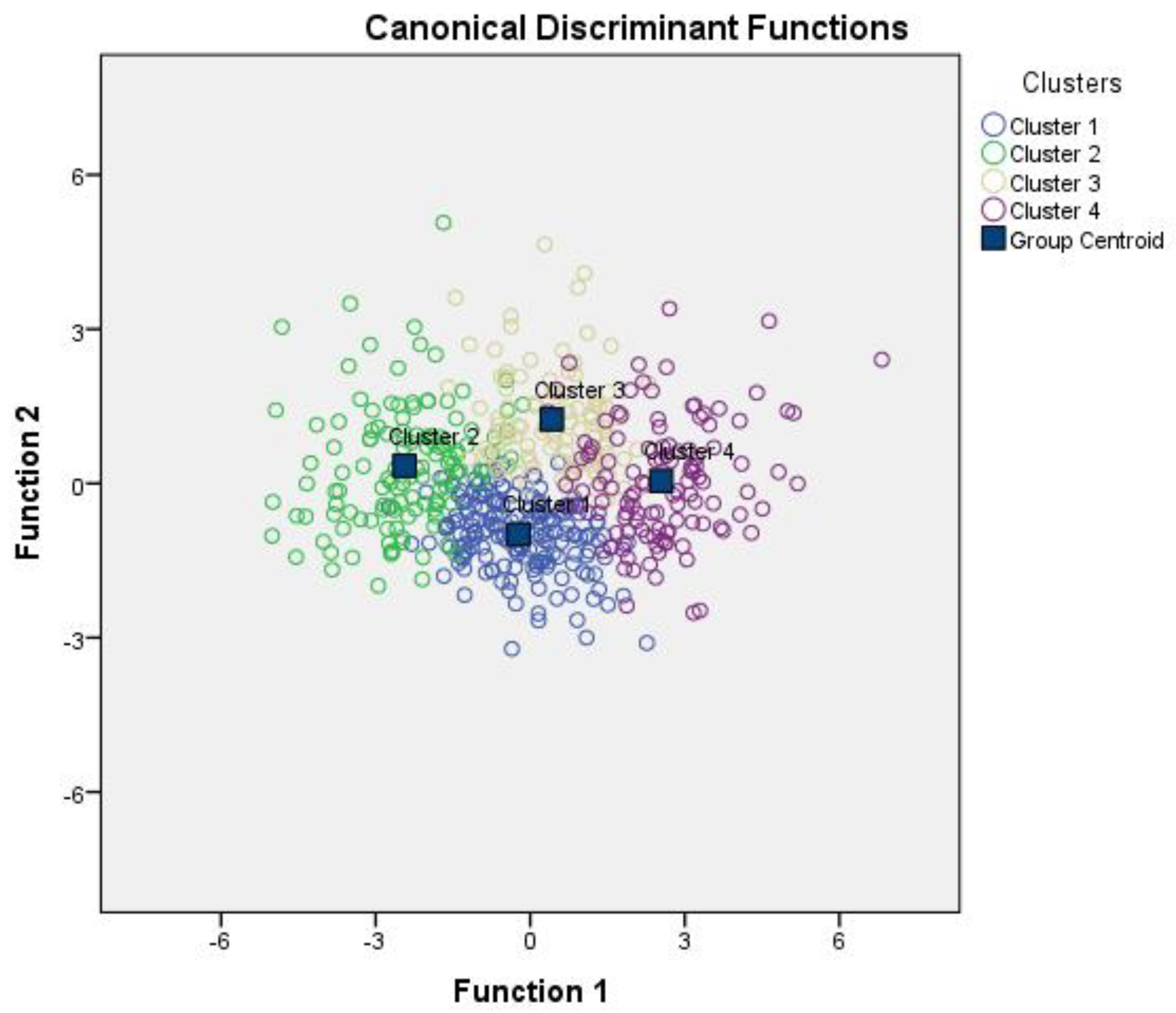
Table 2.
Pearson Correlation coefficient among study’s variables.
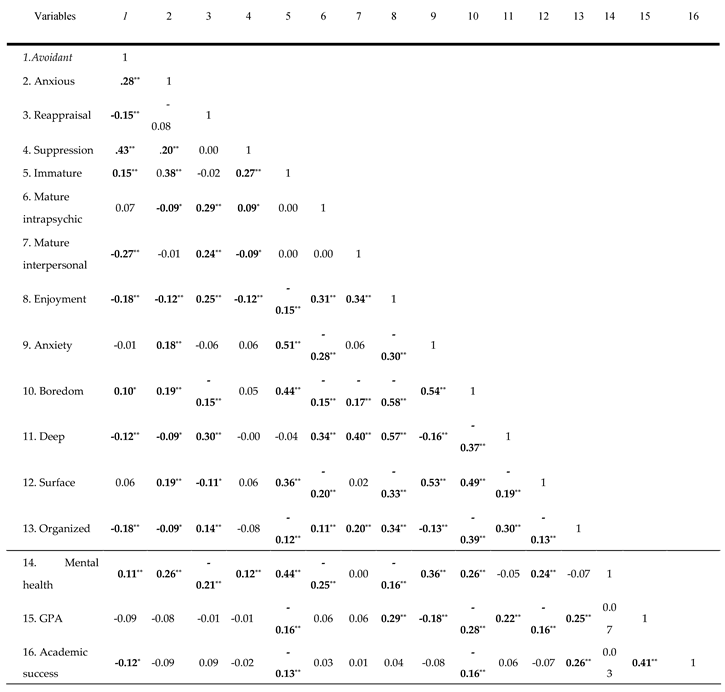 |
Note. * p <.05 ** p <.01.
Table 3.
The mean values of the four clusters with regard to study’s variables. Mental health, GPA and academic success
are presented as outcomes of the derived clusters.
Table 3.
The mean values of the four clusters with regard to study’s variables. Mental health, GPA and academic success
are presented as outcomes of the derived clusters.
| Clusters/Profiles | 1 | 2 | 3 | 4 | ||||
| Ν = 175 | SD | Ν = 127 | SD | Ν = 100 | SD | Ν = 121 | SD | |
| Μ | Μ | Μ | Μ | |||||
| Avoidant | -0.511 | 0.53 | -0.212 | 0.83 | 0.864 | 1.07 | 0.233 | 1.07 |
| Anxious | -0.411 | 0.72 | -0.321 | 0.78 | 0.242 | 0.96 | 0.703 | 1.14 |
| Immature | -0.401 | 0.68 | -0.451 | 0.95 | 0.112 | 0.65 | 0.973 | 0.99 |
| Mature intrapsychic |
-0.271 | 0.89 | 0.632 | 0.91 | 0.031 | 0.91 | -0.381 | 0.98 |
| Mature interpersonal |
0.132 | 0.89 | 0.292 | 0.82 | -0.301 | 0.93 | -0.231 | 1.24 |
| Enjoyment | -0.003 | 0.81 | 0.904 | 0.69 | -0.342 | 0.74 | -0.671 | 1.03 |
| Anxiety | 0.052 | 0.79 | -0.871 | 0.84 | -0.082 | 0.77 | 0.913 | 0.74 |
| Boredom | -0.062 | 0.66 | -0.991 | 0.53 | 0.102 | 0.76 | 1.093 | 0.83 |
| Reappraisal | 0.041 | 0.85 | 0.422 | 0.99 | -0.211 | 0.79 | -0.321 | 1.18 |
| Suppression | -0.641 | 0.60 | 0.002 | 1.0 | 0.883 | 0.82 | 0.162 | 0.96 |
| Deep | -0.102 | 0.75 | 0.773 | 0.76 | -0.212 | 0.72 | -0.491 | 1.27 |
| Surface | 0.062 | 0.81 | -0.911 | 0.80 | -0.042 | 0.68 | 0.923 | 0.77 |
| Organized | -0.012 | 0.90 | 0.673 | 0.73 | -0.311 | 0.90 | -0.411 | 1.11 |
| Mental health | -0.221,2 | 0.86 | -0.321 | 0.78 | .072 | 0.88 | 0.613 | 1.20 |
| GPA | 7.471 | 0.65 | 7.812 | 0.73 | 7.3371 | 0.66 | 7.271 | 0.74 |
| Academic Success |
.911 | .13 | .942 | .10 | .891 | .12 | .871 | .16 |
Note 1. 1the group with the statistically significant smallest mean, 2the group with the statistically significant second smallest mean, 3the group with the statistically significant third smallest mean, 4the group with the statistically significant highest mean.
Disclaimer/Publisher’s Note: The statements, opinions and data contained in all publications are solely those of the individual author(s) and contributor(s) and not of MDPI and/or the editor(s). MDPI and/or the editor(s) disclaim responsibility for any injury to people or property resulting from any ideas, methods, instructions or products referred to in the content. |
© 2026 by the authors. Licensee MDPI, Basel, Switzerland. This article is an open access article distributed under the terms and conditions of the Creative Commons Attribution (CC BY) license.
Copyright: This open access article is published under a Creative Commons CC BY 4.0 license, which permit the free download, distribution, and reuse, provided that the author and preprint are cited in any reuse.


