

Submitted:
27 December 2023
Posted:
28 December 2023
You are already at the latest version
Abstract
Trait anxiety, emotion regulation strategies, and metacognitive beliefs influence executive functions (EF) and academic achievement. This study examines their interplay and impact on academic success. In total, 275 adolescents (10-17 years) and parents completed an online questionnaire assessing trait anxiety, emotion regulation strategies, metacognition, parent-reported behaviors related to executive functioning, and overall school average. Preliminary analyses confirmed consistency with existing literature for each variable and their interaction. Furthermore, we conducted a network analysis among the main variables. This analysis supports the need to pay more attention to reflective variables - maladaptive emotion regulation strategies and metacognitive beliefs about worry - when studying trait anxiety. These variables were linked to problematic executive functioning in adolescents. These latter had a negative link to academic achievement. This study offers innovative insights by investigating less-explored relationships in the scientific literature. It reveals high and significant correlations between metacognitive beliefs, maladaptive emotion regulation strategies and trait anxiety (r > .500, p < .001) but also between these variables and both executive functioning and academic achievement. These findings offer new perspectives for research and underscore the importance of holistically examining psychological factors related to academic success.
Keywords:
trait anxiety
; emotion regulation strategies
; metacognitive beliefs
; academic success
; executive functioning
; attentional control theory
; adolescents
1. Introduction
For decades, the influence of anxiety on academic performance has been extensively studied. Numerous theories attempted to explain how anxiety affects performance, but consensus remains elusive. Nonetheless, identifying anxiety's essential mechanisms is crucial for early prevention and mitigation, especially in education. Etiological studies show that individuals with anxiety disorders have a 1.4 times higher risk of high school dropout and encounter difficulties in obtaining diplomas [1,2]. Anxiety's negative effects extend beyond clinical populations to subclinical ones in various academic subjects and can impact long-term academic achievement [3,4]. The school environment imposes constraints leading to anxiety, hindering goal achievement. Situational anxiety, a transient state triggered by perceived threats [5], depends on the situation and predisposition to anxiety [6]. Trait anxiety, a dispositional form, involves intrusive thoughts, worry, difficulty disengaging from negativity, and physiological manifestations [7]. It heightens sensitivity to threats or negative information, impeding cognitive abilities for knowledge integration and retrieval. Distracting thoughts during the learning process stages (acquisition, processing, and retrieval) can be attributed to anxiety [8].
1.1. Executive functions and academic achievements
Concerning the link between executive functions (EF) and academic achievement, the cognitive functions primarily affected by trait anxiety are executive functions (EF). EFs are responsible for controlling and coordinating specific cognitive processes [9], particularly in learning, to direct students' behaviors toward specific goals and facilitate the integration of new knowledge. In this regard, the literature has shown that EFs play a crucial role in academic achievement [10,11]. Best et al. (2011) studied the link between complex executive function (EF) tasks, requiring coordination of multiple EF components, and academic performance in 1,395 children and adolescents (5-17 years) using the Cognitive Assessment System [12]. They found significant and positive correlations between these tasks and performance in both math and reading, suggesting a broad relationship between complex EFs and academic success. This finding applies to both performance-based and rating-based EF measures. For example, a study by McAuley et al. [12], which utilized the Behavior Rating Inventory of Executive Function (BRIEF) [13], a parent-reported questionnaire assessing problematic behaviors related to executive functioning in children and adolescents in daily life, showed significant negative correlations between EFs and mathematical and reading abilities in a sample of 97 children aged 6 to 15 years. Similar results were later replicated in a larger study [14]. However, these two studies found differences between performance-based and rating-based EF measures.
Concerning performance-based EFs vs. and questionnaire-based EFs, although the BRIEF is one of the most commonly used scales with reliable psychometrics for adolescents [15], it, like other questionnaire-based EF measures, has been subject to extensive discussions regarding what they actually assess. Indeed, out of 20 studies that examined the association between performance-based EF measures and rating-based measures, only 24% of correlation comparisons were found to be significant, with correlations being relatively weak in magnitude (median r = .19) [16]. Drawing from Stanovich's [17,18] framework, different measures of executive functioning can be categorized into two distinct levels: reflective analysis and algorithmic analysis. Reflective analysis, as reflected in rating-based EF measures, involves considering an individual's goals and beliefs related to those goals. This level of analysis focuses on the conscious reflection and evaluation of one's own cognitive processes and decision-making strategies. It involves introspection and self-Consciousness regarding the alignment of actions with goals and beliefs, leading to the selection of rational actions based on these reflections. On the other hand, algorithmic analysis, as indicated by performance-based EF measures, encompasses the efficiency of information processing mechanisms in the brain. This level of analysis involves cognitive processes such as information encoding, perceptual registration, working memory, and other cognitive abilities. Ultimately, performance-based and rating-based EF measures refer to the same construct but assess different components of that construct [16]. Nevertheless, both measures remain relevant for use in the educational context, as demonstrated by the previously discussed studies.
1.2. Executive functions and trait anxiety
Concerning the link between EFs and trait anxiety, the Theory of Processing Efficiency (TPE) [19] and the Attention Control Theory (ACT) [20] posit that trait anxiety impairs the efficiency of at least three core EFs [9] through attentional control: inhibition, shifting, and updating [20,21]. Performance itself may not necessarily be affected, unlike processing efficiency. In other words, the cognitive cost of a task is greater for individuals with high trait anxiety [22]. This distinction is explained by the orientation of attention toward irrelevant stimuli for task completion among anxious individuals and the implementation of compensatory strategies that rebalance performance quality compared to individuals with lower anxiety levels. This postulate clarifies the occasional absence of a negative relationship between anxiety and measured performance, or even the observation of a positive relationship. Advocates of the ACT recently concluded that cognitive neuroscience provides strong evidence for the involvement of several factors in the alteration of processing efficiency associated with high trait anxiety [7]. They propose that global conceptualizations of processing efficiency be abandoned as overly simplistic. According to them, researchers should focus on more specific conceptualizations by distinguishing between relevant and irrelevant processing efficiency in anxious individuals. Non-relevant processing interventions would occur more rapidly in highly anxious individuals compared to those with low anxiety levels. These interventions would then fade away, giving rise to more task-relevant processing through the use of compensatory strategies aimed at redirecting processing resources toward tasks requiring the utilization of EFs, such as academic learning.
1.3. Emotion regulation strategies
The process of emotion regulation (ER) could be one of the compensatory mechanisms that redirect resources toward a specific goal. On the one hand, emotions themselves are considered to lead to expressive, goal-oriented, and adaptive behaviors [23]. On the other hand, the general conception of emotion regulation encompasses "Emotion regulation consists of the extrinsic and intrinsic processes responsible for monitoring, evaluating, and modifying emotional reactions, especially their intensive and temporal features, to accomplish one's goals." [24]. ER would intervene to reduce emotional interference and allow cognitive resources to be deployed toward the ongoing task. A portion of the literature on emotion regulation has focused on conscious regulation strategies to cope with unpleasant emotions, such the Cognitive Emotion Regulation Questionnaire (CERQ) [25]. Concerning ERS and anxiety, in a meta-analysis focusing on adolescents aged 13 to 18 [26], significant associations were found between both adaptive and maladaptive Emotion Regulation Strategies (ERS) and symptoms of anxiety and depression. This is consistent with previous research, such as Aldao et al. [27], which observed similar patterns in adults, linking maladaptive ERS like rumination, avoidance, and suppression with greater psychopathology. In adolescents, strategies like reappraisal, suppression, problem-solving, acceptance, avoidance, and rumination showed varying degrees of effect sizes, indicating their different impacts on anxiety and depression. Both adaptive and maladaptive ERS were equally important in these disorders. Regarding the CERQ specifically, a Japanese meta-analysis investigating these strategies using the CERQ and their relationship to anxiety (8 studies) and depression (16 studies) confirmed previous findings (blaming others was significantly linked to anxiety and depression but had the smallest absolute value) and highlighted a positive link between acceptance and anxiety and depression [28]. As Garnefski and Kraaij [29] emphasize, drawing on Wilson's [30] work, acceptance can be applied actively as a form of self-assertion or passively as a form of resignation. Therefore, the questionnaire is sensitive, particularly for this strategy, to how each individual conceptualizes acceptance. Despite the limitations of this tool and the binary conceptualization of ERS, ERS could be a promising candidate for explaining the impact of anxiety on executive functions. However, research has shown that emotional dysregulation predicts psychopathology, but the reverse is not true [31], suggesting that ERS may act upstream of trait anxiety.
About the link between ERS and EF, Lantrip et al. [32] linked ERS and EF, noting that maladaptive ERS correlate with poor executive functioning in adolescents, while adaptive ERS indicate better functioning. However, their study, using self-reported ERQ-CA [33,34] and BRIEF, had a modest sample (70 adolescents) and limitations. Other research suggests that cognitive abilities, particularly working memory, are crucial for emotion regulation [35,36,37], but the relationship between EF and ERS development is complex, as shown by mixed results in working memory training [38] and Veloso and Ty's study [39], which did not find a change in ERS despite reduced trait anxiety through EF training. Ultimately, while cognitive abilities certainly play a role and facilitate our way of regulating emotions [35,36], the question of why individuals choose maladaptive ERS over adaptive ones to diminish the impact of emotion on information processing remains unanswered.
1.4. Metacognitive beliefs
Wells [40] suggested that metacognition, representing the knowledge or cognitive activities that regulate and organize mental functioning [41,42], not only allows us to pay attention to what enters our consciousness but also to evaluate and influence the types of strategies we use to regulate thoughts and feelings. It plays a central role in how individuals experience unpleasant emotions and negative self-evaluations. Wells and Matthews developed the Self-Regulatory Executive Function model (S-REF) [43], which posits that similarities in emotional disorders are due to a negative and persevering thinking style called the cognitive attentional syndrome (CAS) [40]. Conceptualized in terms of traits, this thinking pattern is regulated by metacognitive knowledge (i.e., metacognitive beliefs) that is measured by five subcomponents in the reference questionnaire (MCQ-65) [44]: (1) Positive Beliefs about Worry (MCpos), (2) Negative Beliefs about Worry's Uncontrollability and Danger (MCneg), (3) Beliefs on the Need to Control Thoughts (Control), (4) Beliefs about Cognitive Competence (Lack of Confidence), and (5) Cognitive Self-Consciousness (Consciousness). A recent study reported that this scale could explain 83% of the variance in anxiety propensity in adults [45]. The same study found that negative beliefs contributed significantly to anxiety. However, the researchers emphasize that metacognitions can both predict anxiety and be predicted by anxiety. This bidirectional link highlights the interplay between traits (metacognitive beliefs/anxiety dispositions) and states (metacognitive strategies used/situational anxiety), making it challenging to separate these concepts temporally. However, the theory posits that this thinking style leads to worry, heightened threat monitoring, and the development of maladaptive coping strategies such as rumination, which impairs self-regulation [40]. It is therefore believed to act primarily and significantly increase trait anxiety. Furthermore, this model suggests that cognitive abilities are not the cause of performance difficulties in individuals with this thinking style but rather the individual's relationship with their own thoughts and the choice of strategies used to regulate their emotions.
1.5. Present study
The ACT has thus far considered the relationship between anxiety and EF at an algorithmic level (treatment effectiveness), rather than at a reflective level (decisions made based on individuals' beliefs and goals). In this study, we examined the influence of this reflective level through metacognitive beliefs and ERS. We believe that metacognitive beliefs play a crucial role in trait anxiety through the orientation they provide to employed ERS. Consistent with ACT predictions, we postulate that emotion regulation strategies could act as compensatory factors that limit anxiety and its impact on executive functioning. Therefore, we expect that the choice of maladaptive ERS will explain the deleterious effect of trait anxiety on EF. Furthermore, we anticipate that adolescents exhibiting problematic behavior, reflecting poor executive functioning, will have lower academic achievement compared to adolescents with more directed and controlled behaviors.
This study is primarily correlational and relies on questionnaires filled out by adolescents and a referring parent. Initially, it was important to verify the consistency of our data with the existing literature and to expand the links between EF and ERS, as well as between metacognitive beliefs and ERS. We expect to find (1) a strong correlation between maladaptive ERS and trait anxiety, and a weaker correlation for adaptive ERS, (2) a strong link between ERS and EF, (3) a link between metacognitive beliefs and ERS, and (4) a significant association between EF and academic achievement. Subsequently, we tested our hypotheses in a comprehensive model. We hypothesized that the impact of trait anxiety on EF could be mediated by the choice of employed ERS. This relationship between trait anxiety and ERS would be moderated by adolescents' metacognitive beliefs.
2. Materials and Methods
2.1. Sample
The sample consisted of 292 adolescents aged 10 to 17 years (M = 12.47; SD = 1.79), including 53.08% girls and 1 "other" gender category. Regarding educational level, the majority of participants were in middle school (80.82%), followed by high school (15.75%). Only 10 participants (3.42%) were in elementary school. At the time of questionnaire completion, 288 participants reported that the decision made for them the previous year was to progress to the next grade. Another decision was made for 4 participants (3 for reorientation or changing schools, and 1 reporting a "very bad year"). Overall, 86.98% of the sample attended public schools, 11.98% attended private schools, and 1.02% were in completely private institutions (without contract with the government). The overall mean grade of the sample was 15.22 (SD = 2.25), with 4 missing data points. The distribution of class averages was homogeneous. The largest difference was observed between the first-grade class and the CM2 (last year of primary school) and sixth-grade classes (differences of 3.55 and 2.77, respectively) (Table 1).
Regarding the sample, 83 participants reported having received one or more diagnoses from a medical doctor, psychiatrist, or psychologist (Table 2). The two largest represented categories were "DYS disorders" (dyslexia, dyscalculia, dyspraxia, dysphasia, etc.), which accounted for 11.30% of the participants in relation to the overall sample, and high intellectual potential, which constituted 9.93% of the sample.
The ethics committee of the University of Grenoble-Alpes (CERGA-2022-25) approved this study, and all consents, both from minors and parents, were obtained and validated.
2.2. Procedure
The online questionnaire was distributed between June 2022 and January 2023 primarily through social media platforms. Participants were voluntary, and the data collected were anonymous. Several educational institutions assisted in the dissemination, including two public middle schools (169 participants) located in the suburb of Lyon. The questionnaire included two consent forms (one for minors and one for parents) that had to be signed before proceeding to answer the other questions. A lottery reward was offered to participants who completed the entire questionnaire. The three randomly selected participants received €50 each.
Due to the length of the questionnaires for adolescents (estimated at around twenty minutes), the administration of the three questionnaires was randomized to avoid the potential fatigue effect that could lead adolescents to respond more quickly.
2.3. Materials
The online questionnaire included consent forms for minors and adults, as well as questions regarding age, gender, the most recent overall grade average, the decision made in the previous year during an educational council (grade repetition, promotion to the next grade, grade skipping, or other), and whether they had received a diagnosis established by a healthcare professional (none, a neurodevelopmental disorder - dyslexia, dysphasia, dyspraxia, attention deficit disorder, autism spectrum disorder - or an affective disorder - depression, generalized anxiety, or other). The adolescents completed three questionnaires, and one questionnaire was filled out by a parent.
Trait anxiety: Assessed using the Revised Children's Manifest Anxiety Scale (R-CMAS) [46] in its validated French version [47]. Although a more recent French validation by Turgeon and Chartrand [48] was available, it was not chosen due to its Canadian origin and the narrower age range of 8 to 13 years, as compared to the 6 to 19 years age range of the version used in this study. This facilitates its use for similar experiments targeting adolescents and allows for comparisons between different samples. This self-report scale consists of 37 items, and participants indicate "yes" or "no" for each statement. A "yes" response is circled if the child believes the statement is true for them, and "no" if they believe it does not apply to them. The 37 items are divided into three subscales related to anxiety: Physiological anxiety (10 items; e.g., "I wake up scared some of the time"), Worry-Oversensitivity (11 items; e.g., "I worry a lot of the time"), and Concentration-Social worries (7 items; e.g., "I feel that others do not like the way I do things" or "It is hard for me to keep my mind on my schoolwork"). Additionally, the remaining 9 items constitute the Lie scale, which assesses social desirability or may represent inaccuracies in self-perception. The questionnaire demonstrates good internal consistency for the total anxiety score (α = .84), as well as for the Worry/Sensitivity and Deception scale (.76), the Social Concern/Concentration scale (.69), and to a lesser extent, the Physiological Anxiety scale (.59). However, the subscale index for physiological anxiety has somewhat lower sensitivity [49].
Emotion regulation strategies: Assessed using the Cognitive Emotion Regulation Questionnaire (CERQ) [25] in its validated French version [50]. The CERQ is a self-report measure that evaluates nine cognitive strategies used to regulate emotions in response to negative or unpleasant events [25]. A total of 36 items are rated on a Likert scale ranging from "almost never" (1) to "almost always" (5) and are distributed among the following nine strategies: Acceptance (A; e.g., "I think that I have to accept the situation"), Positive Refocusing (PRef; e.g., "I think about pleasant experiences"), Refocus on Planning (RP; e.g., "I think about a plan of what I can do best"), Positive Reappraisal (PRea; e.g., "I think I can learn something from the situation"), Putting into Perspective (PP; e.g., "I think that other people go through much worse experiences"), Self-Blame (SB; e.g., "I feel that I am the one to blame for it"), Rumination (R; e.g., "I am preoccupied with what I think and feel about what I have experienced"), Catastrophizing (C; e.g., "I continually think how horrible the situation has been"), and Blaming Others (BO; e.g., "I feel that others are responsible for what has happened"). This questionnaire is suitable for adolescents aged 13 to 19 years. The participants are instructed to reflect on their thoughts when experiencing negative or unpleasant events. An adaptation of this questionnaire has been developed to make it accessible to children aged 10 to 12 years. In the French version, Cronbach's alphas range from .68 to .87 for all factors.
Metacognitive beliefs: Assessed using the MetaCognition Questionnaire for Adolescents (MCQ-A) [51] validated in French by Shakeshaft, Lecerf, Morosan, Badoud & Debbané (MCQ-Af) [52]. Originally developed to support Wells' metacognitive model of generalized anxiety, this questionnaire has shown its relevance in various emotional disorders. The questionnaire consists of 30 items evenly distributed across five factors: Positive Metacognitive Beliefs (factor MCpos; e.g., "I need to worry in order to work well"), Negative Metacognitive Beliefs (factor MCneg; e.g., "When I start worrying, I cannot stop"), Cognitive Confidence (factor Confidence; e.g., "I have a poor memory"), Negative Beliefs about Thoughts in General linked to superstitions, punishment, and responsibility (factor Control; e.g., "I will be punished for not controlling certain thoughts"), and Cognitive Self-Consciousness (factor Consciousness; e.g., "I monitor my thoughts"). However, it is important to consider items 2 (MCneg factor), 12 (Consciousness), and 14 (Confidence) cautiously, as they presented issues in the French confirmatory analysis. This problem is not new and has been observed in the German sample as well [53]. In this questionnaire, participants rate the statements on a 4-point Likert scale ranging from "Strongly disagree" to "Strongly agree." For each factor, scores can range from 6 to 24, and the total score ranges from 30 to 120. The MCQ-Af is suitable for adolescents aged 13 to 17 years. An adaptation of this questionnaire has also been developed to make it accessible to children aged 10 to 12 years. In the French version, Cronbach's alphas range from .684 to .852 for all five factors and the total score.
Executive functioning: assessed using the Behavior Rating Inventory of Executive Function (BRIEF) [13,54] in its French version [55]. The BRIEF is a standardized assessment scale designed for parents to provide useful information about a child's executive functioning in their daily environment. Executive functioning is evaluated based on various behavioral manifestations in children and adolescents aged 5 to 18 years. The questionnaire consists of items that form nine clinical scales [56]: Inhibit (ability to control impulses and stop one's own behavior at the appropriate time, including stopping actions and thoughts), Shift (ability to move freely from one situation to another and think flexibly in order to respond appropriately), Emotional Control (ability to modulate emotional responses), Initiate (ability to start activities and generate ideas, answers, and problem-solving strategies), Working Memory (capacity to hold information in mind for task completion), Plan/Organize (planning: ability to anticipate events, establish goals, and develop steps for achievement; organization: ability to evaluate and order key information), Organization of Materials (ability to impose order on work, play, and storage spaces), Self-monitoring (monitor the effects of their behavior on others and observe their own behavior in a social context) and Task monitoring (the ability to check work, evaluate performance during or after task completion to ensure goal attainment). These theoretically and statistically derived scales form two broader indices: Behavioral Regulation Index (BRI; comprising inhibition, shift, and emotional control) and Metacognition Index (MI; comprising initiate, working memory, plan/organize, organization of materials, and monitor). A global score (Global Executive Composite [GEC] Index) is also calculable. The questionnaire consists of 86 items, with the last 14 (for the parent form) not used for score calculation (filler items). Parents are asked to evaluate their child's behavior over the past 6 months using a 3-point Likert scale, indicating whether the behavior has "never," "sometimes," or "often" been problematic. These responses are then coded as ordinal variables (1 = never, 2 = sometimes, 3 = often). The BRIEF typically yields eight scale scores and three index scores. In the French version, Cronbach's alphas range from .73 to .86 for all factors in the parent form [56].
3. Results
3.1. Data Exclusion
For the analysis of our data, certain participants were not included to obtain a more homogeneous sample. Thus, the participant who responded "other" to the gender question was not included in the analyses. The 4 participants whose decisions did not involve advancing to the next grade were also excluded, as they may not have experienced a similar emotional year compared to the others. Based on the questionnaires, we applied strict eligibility criteria to select participants for inclusion in our analysis. Two participants were excluded due to high scores on the Lie scale of the RCMAS, while two others were retained despite slightly elevated scores on the Negativity scale of the BRIEF. Additionally, ten participants were excluded due to high inconsistency scores on the Inconsistency scale of the BRIEF (for more details, see Supplementary materials). These exclusions ensured the reliability and validity of our results, resulting in a final sample that is representative for our analyses. In conclusion, our sample consists of 275 adolescents, including 77 with a diagnosis, after implementing these exclusion criteria (17 participants excluded).
3.2. Preliminary Analysis
In accordance with our pre-registration on the Open Science Framework [57], we conducted several analyses to verify if our data behaved as expected based on the literature before testing our hypotheses. Since we primarily used self-reported questionnaires (RCMAS, CERQ, and MCQ), this verification aimed to ensure the reliability of our data. Some of these analyses were not pre-specified, which we have clarified for each of them, and we have justified their relevance in the respective sections based on their connection to the literature. The complete dataset, with supplementary materials, is available on the Mendeley website, see references for access [58].
We conducted several gender difference analyses on our variables, detailed in supplementary material. All tests controlled for participants' age and sex. Correlations include confidence intervals based on 1000 bootstrap replicates.
3.3. Anxiety
3.3.1. Lying
We conducted this unplanned conformity analysis on the RCMAS lie scale to determine if our choice to exclude the two participants was justified. A Pearson correlation revealed a significant negative correlation between the lie subscale and participants' trait anxiety (r = -.26, p < .001).
3.3.2. Emotion regulation strategies
A linear regression analysis was conducted to determine if ERSs were predicted by trait anxiety. The regression analysis showed that trait anxiety significantly predicted the variance in maladaptive ERSs (ß = .896, SE = .082, p < .001, t = 10.96, 95% CI [.73, 1.06]). However, although trait anxiety was negatively associated with adaptive ERSs, the significance threshold was not reached (p = .062). Thus, adolescents with a predisposition for experiencing anxiety are more likely to use maladaptive ERSs. A new regression analysis was conducted to distinguish which maladaptive ERSs were likely to be activated based on adolescents' trait anxiety. Three out of four maladaptive strategies were significantly and positively predicted by adolescents' trait anxiety: Self-Blame (ß = .290, SE = .032, p < .001, t = 10.06, 95% CI [.23, .35]), Rumination (ß = .249, SE = .037, p < .001, t = 6.801, 95% CI [.18, .32]) and Catastrophizing (ß = .293, SE = .028, p < .001, t = 9.819, 95% CI [.23, .35]).
3.3.3. Metacognitive beliefs
This linear regression analysis allowed us to examine the influence of metacognitive beliefs on participants' total anxiety. It revealed that a high metacognition score (total MCQ) predicted significantly the variance in total anxiety (ß = .303, SE = .029, p < .001, t = 10.589, 95% CI [.25, .36]). Another linear regression showed that the MCneg factor largely accounted for this prediction (ß = .607, SE = .084, p < .001, t = 7.222, 95% CI [.44, .77]), followed by the Control factor (ß = .356, SE = .101, p < .001, t = 3.544, 95% CI [.16, .55]) and Lack of Confidence (ß = .254, SE = .093, p = .007, t = 2.717, 95% CI [.07, .44]). The MCpos (ß = .133, SE = .093, t = 1.433, 95% CI [-.05, .31]) and Consciousness factors (ß = .022, SE = .085, t = .260, 95% CI [-.14, .19]) weakly and non-significantly predicted trait anxiety in a positive direction.
3.4. Metacognitive beliefs and emotion regulation strategies
This analysis was not declared in OSF but provided insights into the relationships between these two variables that have been poorly studied. A Pearson correlation matrix was conducted to determine the strength of the relationships between metacognitive beliefs and ERSs. Maladaptive ERSs showed positive and significative correlations with all subscales of the MCQ (MCpos, r = .28, 95% CI [.19, .39]; MCneg, r = .40, 95% CI [.29, .50]; Lack of Confidence, r = .20, 95% CI [.08, .31]; Control, r = .42, 95% CI [.32, .51]; Consciousness, r = .25, 95% CI [.14, .37], p < .001). Adaptive ERS were positively correlated with the MCpos and Consciousness factors. Thus, these subscales were found to be related to both adaptive and maladaptive strategies. The Consciousness subscale was significantly and more strongly correlated with adaptive ER strategies (r = .36, p < .001, 95% CI [.25, .48]) than the MCpos subscale (r = .11, p = .065, 95% CI [-.02, .25]). This finding may explain why these two subscales did not predict participants' anxiety, as they have equally strong associations with both adaptive and maladaptive ERSs.
3.5. Executive functioning and emotion regulation strategies
A Pearson correlation matrix was conducted to explore the relationships between the Global Executive Composite (GEC) and various emotion regulation strategies. All adaptive ERSs were found to be negatively correlated with the GEC of the BRIEF. Only Positive Refocusing and Positive Reappraisal strategies showed non-significant associations with EF. Conversely, Acceptance (r = -.15, p = .013, 95% CI [-.27, -.03]), Refocus on Planning (r = -.194, p = .001, 95% CI [-.30, -.08]) and Putting into Perspective (r = -.17, p = .006, 95% CI [-.29, -.05]) showed significant relationships with EF. Maladaptive ERSs were positively correlated with the GEC. Only the Blaming Others strategy did not show a significant correlation with EF. Self-Blame (r = .22, p < .001, 95% CI [.10, .33]), Rumination (r = .19, p < .001, 95% CI [.07, .29]) and Catastrophizing (r = .27, p < .001, 95% CI [.16, .39]) showed significant relationships with EF.
3.6. Analysis of the relationships between our main variables
We chose to consider our variables of interest through the overall scores of the scales. Indeed, we have so far described the relationships between each of the variables in pairs to verify the conformity of our data with that of the literature. This allowed us to observe the inconsistency of the MCQ's consciousness subscale with emotion regulation strategies and anxiety. We present all analyses (correlation and network analysis) including the consciousness factor in the supplementary material.
3.6.1. Pearson correlation
Using a Pearson correlation matrix controlling for age and sex, we found significant associations in our adolescent sample (Table 3). School average was negatively correlated with EF (r = -.36, 95% CI [-.46, -.24]), trait anxiety (r = -.18, 95% CI [-.30, -.06]) and metacognitive beliefs (r = -.12, 95% CI [-.26, .01]). Trait anxiety positively correlated with maladaptive ERSs (r = .57, 95% CI [.48, .64]) and metacognitive beliefs (MCQtot, r = .59, 95% CI [.50, .66]). EF also showed a positive correlation with trait anxiety (r = .47, 95% CI [.36, .56]) and metacognitive beliefs (r = .31, 95% CI [.19, .43]). Maladaptive ERSs correlated with metacognitive beliefs (r = .49, 95% CI [.40, .58]) and EF difficulties (r = .27, 95% CI [.16, .38]). Adaptive ERSs negatively correlated with EF (r = -.16, 95% CI [-.27, -.05]) and positively with School average (r = .12, 95% CI [-.00, .25]).
3.6.2. Network analysis
3.6.2.1. Data analytic plan
In accordance with our hypotheses and OSF statement (available in supplemental materials), we initially performed a moderation with mediation analysis, which did not yield significant results. To better understand the link between trait anxiety and executive functioning, we then conducted a Network Analysis, not originally planned. This approach aimed to develop a comprehensive model integrating emotion regulation strategies and metacognitive beliefs with anxiety and executive functioning. Given the complex interrelationships among our variables and cross-sectional collection, a network analysis was deemed more suitable than a single structural equation model for capturing the dynamics of the relationships between our variables.
3.6.2.2. Network visualization and treatment
In accordance with our hypotheses and OSF statement (available in supplemental materials), we initially to conduct our network analysis, we relied on rigorously conducted published articles that used the same procedure, such as Heeren and McNally [59]. We employed the JASP software for both analysis and visualization of the network. JASP utilizes the R Bootnet package, following the work of Epskamp et al. [60], and for visualization, it is based on the R qgraph package [61]. Networks are visualized using Fruchterman and Reingold’s [62] algorithm, which organizes nodes according to the strength of their connections, placing nodes with stronger connections near the center and those with weaker connections near the periphery. Solid lines represent positive links, while dotted lines indicate negative correlations. The ticker the line, the stronger the relationship between the two variables. These edges among nodes depict the partial correlations between each pair of variables, allowing for the representation of relationships between two specific variables while eliminating potential influences from other variables [63]. However, the network does not elucidate the causal dynamics among the variables. We selected the EBICglasso Estimator in JASP, which is used to create more interpretable and accurate networks by limiting spurious edges and optimizing the model to best reflect the underlying real structure of the data [64]. In this function, γ is automatically set to 0.5, favoring caution and reducing the likelihood of obtaining spurious edges.
The JASP software enables the acquisition of network centrality indices. Betweenness centrality quantifies how often a node appears on the shortest paths between pairs of other nodes, signifying its key role as a conduit within the network. Closeness centrality measures the mean distance of a node to all other nodes, showcasing its proximity or accessibility relative to others. Node strength represents the aggregate weight of edges connected to a node, denoting its interaction level. The total weight of incoming edges from other network nodes reflects how much a node is influenced by others, while expected influence is the aggregate weight of outgoing edges from a specific node to others, assessing the extent to which a node affects the network. Higher values for each index suggest greater centrality in the network.
Finally, to increase the stability and accuracy of our network parameters, we employed a non-parametric bootstrapping method with 1000 iterations. The advantage of this technique is that it is exclusively data-driven [60], making it particularly suitable for exploratory work.
3.6.2.3. Standard network analysis
We conducted an initial network analysis including all our main variables, see supplementary material, and then a second network analysis after removing the "consciousness" subscale (Figure 1). We have compiled the centrality indices in supplementary materials and illustrated them with graphs (Figure 2).
The characteristics of our network are immediately apparent. Trait anxiety and executive functioning are at the center of our network and have a key role within it. However, strength and expected influence are significantly higher for anxiety than for executive functioning. In contrast, metacognitive beliefs and maladaptive ERS show more moderate centrality values, suggesting a less central role in the network. The beliefs have higher values compared to ERSm on several indices, suggesting a slightly more influential position in the network. More notably, School Average and adaptive ERS display negative scores on all measures, reflecting a peripheral position and limited influence within the network.
4. Discussion
The aim of the current study was to elucidate how emotion regulation strategies and metacognitive beliefs might impact executive functioning and academic achievement in children and adolescents through the mediation of trait anxiety. The examination of these variables was pertinent due to their closely intertwined interconnections. The initial model we had considered did not adequately explain the mechanisms through which emotion regulation strategies and metacognitive beliefs influenced the relationship between trait anxiety and executive functioning (refer to supplementary material). Rather than further pursuing theoretical predictions with a singular model, we conducted a network analysis of our primary variables. This approach enhanced our understanding of the relationships and provided a robust and broader analysis. It revealed the centrality of trait anxiety in our study. Adolescents who report frequent and varied manifestations of anxiety in their daily lives are likely to struggle in mobilizing functional reflective processes, as represented by metacognitive beliefs and maladaptive emotion regulation strategies. This anxiety is also linked to problematic executive functioning in daily life as reported by parents. Lastly, academic performance was found to be negatively related to executive functioning and, to a lesser extent, emotion regulation strategies (ERSa). Indeed, ERSa emerged as the most distal, least influential, and least interconnected variable in our network. We discuss the implications of our research by revisiting the comprehensive analyses performed on each variable, comparing these findings to existing literature.
4.1. Anxiety
The various links between our variables and anxiety are generally consistent with the literature. Regarding executive functioning (EF), anxiety was found to be strongly and positively correlated with parent-reported executive functioning problems. While these findings might appear inconsistent with ACT, it is crucial to note that we did not assess executive functioning performance per se, but rather the behavioral manifestation of executive functioning. The additional cost associated with the use of compensatory strategies to adjust performance in tasks requiring renewed executive functioning in anxious adolescents directly affects their daily lives through their behaviors. Our results indirectly corroborate certain aspects of the ACT. However, we remain cautious as evaluations based on questionnaires and tasks are conceptually overlapping but provide two different levels of analysis (algorithmic vs. reflective) concerning information processing as per Stanovich [17,18]. Studies that combine these two levels of analysis could be beneficial to verify and refine the ACT. This was our aim in a recent study [65]. Although we did not use mediation to explore the links between trait anxiety and academic success, our results suggest that trait anxiety plays a negative role in academic achievement, with EF also contributing. These findings align with those of Owens et al [66], who demonstrated a relationship between trait anxiety and academic success mediated by working memory performance in a sample of 50 adolescents with an average age similar to our sample, see also [67,68]. However, these results do not align with those of Alfonso and Lonigan [69]. In their study, trait anxiety was positively linked to EF performance and academic success, with working memory serving as the mediator between trait anxiety and academic outcomes. The authors noted that their sample exhibited low to moderate anxiety scores and that the negative effects of anxiety on performance are more pronounced when stimuli are associated with high threat. Nonetheless, our additional analyses indicated a linear, rather than curvilinear, relationship between anxiety and all our variables, suggesting that anxiety's impact on adolescent problematic behaviors does not vary with its intensity. As we propose, this discrepancy in results could be attributed to the measure of executive functions.
Regarding emotion regulation strategies (ERSs), maladaptive ERSs were predicted by trait anxiety in adolescents, except for the Blaming others strategy. This result is not surprising and has been found in other studies involving both adolescents and adults [70]. This suggests that this strategy may not necessarily be maladaptive, at least in the short term, for reducing the unpleasant effect of an emotion. We note that this strategy is the only one among the other ERSs that seeks an external causality for emotional events. Although the relationship between adaptive ERSs and anxiety did not reach the threshold of significance, this finding is consistent with meta-analyses on the subject, which consistently show weaker associations between adaptive ERSs and anxiety [26,27,28]. Sakakibara and Kitahara [28] provide an interpretation by questioning the reliability of adaptive ERSs and highlighting their lack of conceptual clarity. They suggest revising the items to make them more capable of representing adaptive strategies in the face of unpleasant events. Another approach would be to adapt the questionnaire based on more recent theories by adding or removing strategies. For example, Garnefski et al. [25] used a theoretical approach to create the Cognitive Emotion Regulation Questionnaire (CERQ). This approach involved building on existing tools by removing, transforming, or adding new strategies based on rationality. Therefore, updating the questionnaire is justified in order to enhance its validity and applicability. Incorporating research findings from the field to modify our way of representing, theorizing, or fundamentally conceptualizing emotion regulation in a virtuous cycle could be done by drawing on existing models in intervention sciences [71]. Based on current evidence, emotion regulation strategies as assessed through the CERQ do not appear to be efficacious targets for intervention with the aim of diminishing anxiety levels, facilitating the adoption of functional behaviors in adolescents, or enhancing academic performance. In our study, we chose to analyze the influence of anxiety on ERS, while McLaughlin et al. [31] found the opposite relationship using two separate measurement points. In their study, emotional expression and regulation problems predicted psychopathologies in adolescents, but not vice versa. However, their measures of emotional dysregulation partially differ from our focus on the use of cognitive and conscious strategies to regulate unpleasant emotions. Their questionnaires primarily assessed the understanding of emotions, regulation of specific emotions (anger and sadness) from a behavioral perspective, and one maladaptive ERS: rumination. Therefore, caution must be exercised in directly applying their conclusions to our study. Consistent with the ACT model, we believe that the development of cognitive strategies in response to unpleasant emotions depends on one's state, situation, and psychological traits. Numerous studies have shown that trait anxiety leads to major cognitive biases that make it difficult to disengage attention from threatening information, e.g., [72]. The cognitive functioning of an anxious person can differ significantly from that of a non-anxious person, e.g., [73,74], suggesting an influence of anxiety on the development of specific strategies.
This indicates that the alignment between a person's feelings (anxiety) and their actions (ERS) in response to unpleasant emotions is not always complete and difficult to superimpose in a single model. As Borkovec [73] suggested, "The reasons an individual generates to explain his or her behavior are often post hoc and unrelated to true causative relationships. But they do provide a view of how chronic worriers and GAD clients perceive their worrying, [...]" (p. 17). In other words, there is a mismatch between one's feelings (anxiety) and the way they act upon them (ERS), as the former is based on concrete evidence while the latter attempts to explain the nature of thoughts driving regulation strategies.
Regarding the MCQ, the total scale and the subscales of Negative Metacognitive Beliefs (MCneg), Confidence, and Control all predicted anxiety. However, MCneg were significantly more strongly associated with anxiety than the other subscales and the total scale. In contrast, Positive Metacognitive Beliefs (MCpos) and the Consciousness scale did not predict anxiety. These findings may initially seem surprising. However, MCpos and the Consciousness scale consistently show weaker effects on anxiety compared to the other subscales [75,76,77], and may even be absent in certain clinical populations [78]. Conversely, MCneg are more consistently linked to various symptoms, including anxiety, in both clinical and non-clinical populations [45,79,80]. This is consistent with the S-REF model, which highlights the central role of beliefs about uncontrollability and the danger of worry thoughts in maintaining or exacerbating psychological difficulties [43]. Similar results were found in a non-clinical population of 214 French-speaking Swiss adolescents with an average age of 15 years for negative metacognitive beliefs. This study found no influence of the Consciousness variable on anxiety, and the effect of the Lack of Confidence variable became marginally significant (p = .076) in a stepwise regression. Finally, MCpos were implicated in anxiety. The analysis was based on a version of the MCQ with 27 items, as three items were found to be inconsistent (items 2, 12, and 14), and four items were included in multiple subscales (items 3, 9, 11, and 23). This version of the scale likely needs refinement by rephrasing these items to improve robustness and reliability. A recent meta-analysis examining healthy adults and adults with psychopathology showed reliable combined effects for all four scales of the MCQ, but the subscale of MCpos was found to be unstable or non-significant [81]. Benedetto et al. [76] proposed that MCpos could be considered an adaptive coping strategy. Our study specifically examined the correlations between ERS and the MCQ. The correlations of all MCQ scales were positive and significant with maladaptive strategies. They were stronger for negative beliefs and the need for Thought Control. Positive beliefs are not adaptive, contrary to what Benedetto et al. [76] suggested. Furthermore, the Consciousness scale was also correlated with adaptive strategies, but negatively. This has been observed in healthy subjects [82]. In other words, being conscious of one's thoughts may be a determining factor in choosing to use an adaptive or maladaptive ERSs. This observation reinforces the specificity of the CERQ in measuring conscious cognitive processes, i.e., explicit ERS [25]. These findings are important to consider when using the MCQ to interpret results in future studies with healthy samples. We hypothesize that the Consciousness subscale might mitigate the outcomes of studies employing the full range of subscales of the MCQ, potentially leading to an increased incidence of Type II errors. Like Sica et al. [82], we believe that rephrasing items in this scale to highlight a more negative aspect of excessive and rigid consciousness could make the questionnaire more discriminating. This confluence of evidence substantiates the rationale for omitting this subscale from our correlation analysis and subsequent network analysis.
4.2. Executive functioning
Our results allowed us to establish a strong link between EF and academic achievement. Poor executive functioning reported by parents can be a good predictor of an adolescent's academic success. These findings are consistent with those of Ten Eycke and Dewey [14], who, like us, used the parent version of the BRIEF. They observed correlations between the GEC and standardized tests of reading and mathematics. Samuels et al. [83] also demonstrated strong correlations in a 4-year longitudinal study of adolescents aged 12 to 15 years, between various school subjects (science, language, mathematics, social studies, etc.) and the GEC. The fundamental difference is that the assessment of problematic behaviors was conducted by teachers or teacher assistants, not parents. Their correlations were much higher than ours. The lowest correlation was -0.40 (average correlation between teacher and teacher assistant), and the highest was -0.54, whereas it was -0.35 for our study. Several reasons can explain this difference. Samuels et al. [83] conducted their correlations across multiple subjects, whereas we used the students' overall average. It is likely that subjects such as physical education may not necessarily be related to the GEC or may even have a negative relationship (beneficial for behaviors). Furthermore, teachers report on adolescents' behaviors in the classroom, not at home. This assessment is therefore closer to the school reality and more likely to reflect executive functioning relevant to learning rather than family life. Although weaker, our results suggest that the BRIEF can be considered a relevant tool for assessing EF in the school environment, whether used by teachers or parents. For a French population, Fournet et al. [56] demonstrated that the BRIEF exhibited greater reliability in its parent-report version compared to the teacher-report version.
Overall, maladaptive emotion regulation strategies (ERSs) were more strongly related to all our variables than adaptive ERS. They predicted anxiety more strongly, were associated with problematic executive functioning, and also had closer links with metacognitive beliefs than adaptive ERSs. On one hand, these results expand on those of Lantrip et al. [32] to other ERSs in a similar population and using the same scale for EF assessment (BRIEF). Indeed, they used the Emotion Regulation Questionnaire, which only assesses reappraisal for adaptive ERSs and behavioral suppression for maladaptive ERSs. The CERQ did not allow us to assess behavioral suppression, but dramatization, rumination, and self-blame were positively correlated with EF. However, although the relationship was also positive, maladaptive ERSs of blaming others was not correlated with EF. This finding aligns with the lack of predictive value of anxiety for this subscale and underscores the centrality of anxiety within our network analysis. Furthermore, several adaptive ERSs, such as putting things into perspective, acceptance, and focusing on action, were negatively correlated with problematic EF. On the other hand, these results contradict those of Lantrip et al. [32] regarding reappraisal, as there was no correlation. One argument could have been that the two types of reappraisal differ conceptually, but strong correlations were found in studies with young adults in American, r = .59 [84], and Italian samples, r = .409 [85]. The differences are likely due to characteristics of our sample compared to their study and to the reflective aspect of the ERS. Our sample size is substantial, and the data have proven to be reliable, which supports the perspective that ERSa as assessed in the CERQ, when viewed from a reflective standpoint, are of limited interest for intervention.
4.3. Limitations and Future Directions
One limitation of our study concerns the characteristics of our sample, which may influence the strategies used to regulate emotions, the level of anxiety, and parents' evaluation of executive functioning. For example, it would be important to have information on the parents' socioeconomic status as it could directly impact the adolescents' living conditions. However, the overall academic averages of our sample were high with a moderate standard deviation. This suggests that the parents' socioeconomic status was good, as several meta-analyses [86,87] have found significant correlations between socioeconomic status and students' academic performance. A parallel study conducted in one of the middle schools that contributed significantly to our sample suggests a high socioeconomic status, predominantly characterized by parents in executive or skilled employee positions [88]. Despite this, the lack of such data could have occasionally explained certain behaviors, anxiety levels, strategies employed, problematic behaviors, etc. Indeed, Schäfer et al. [26] suggest that parental support in emotion regulation should play an essential role in a child's development and provide them with the means to adapt more serenely to daily life. Furthermore, adaptive strategies require a certain cognitive maturity that may be more easily stimulated depending on the parenting style.
Another potential limitation is that, given that we used questionnaires, it is always challenging to draw definite conclusions about the measured concepts and how each question may have been understood and interpreted by adolescents. We attempted to limit biases by assessing the comprehensibility of the questionnaires and reformulating certain questions (CERQ and MCQ). Although this reformulation remained very close to the original question's meaning, it is possible that it had an impact on the consistency of the questionnaires or certain scales. As previously highlighted, the CERQ is a questionnaire that focuses on a limited number of strategies that are not all of the same nature. For example, internal or external causality varies for maladaptive ERS such as self-blame and blaming others, which can make the scale less consistent. Nevertheless, this questionnaire remains valuable in providing insights into an adolescent's cognitive style and enabling the development of appropriate interventions in schools or psychological settings. We suggest drawing on more recent work to modify and improve this scale, such as the studies by McRae and Gross [89] and the five families of ERS. To address these biases, the evaluation of children's behavior by parents and the participant's school average provided new perspectives and additional sources of information on students' behavioral reality to increase objectivity in our data. The fact that our data converged, for example, the self-reported anxiety of participants was correlated with both the average and the executive functioning reported by parents, is reassuring regarding the internal validity of our study. These converging data also explain why our correlations rarely exceeded the .50 threshold.
This study identified the involvement of ERS and metacognitive beliefs in students' predispositions to experience anxiety, which has a direct and indirect impact on their executive functioning and academic success. Targeted interventions focusing on metacognitive beliefs and ERS could be beneficial for both the well-being and success of adolescents. Mindfulness and Acceptance and Commitment Therapies are ideal candidates as they have shown promising effects on emotion regulation, executive functions, and anxiety [90,91,92]. However, prior to implementation, the acceptability of such interventions should be evaluated in a large population to enhance adherence to these programs and further enhance their beneficial effects.
5. Conclusion
This study aimed to identify the underlying mechanisms of trait anxiety to explain its detrimental effect on the effectiveness of treatment in mobilizing EF and achieving academic success. The Attentional Control Theory (ACT) postulates that compensatory strategies employed by individuals with high anxiety allow them to achieve comparable performance but at a higher cognitive cost. Given the literature linking ERS with trait anxiety and EF, it was conceivable that these compensatory strategies could be partly represented by ERS. Although strong links between anxiety, ERS, and EF have been independently established, the initial comprehensive model predicting ERS as a mediator between trait anxiety and EF, with metacognitive beliefs moderating the link between trait anxiety and ERS, was not supported. Apparently, ERSm in healthy adolescents are not ideal candidates to represent these compensatory strategies. However, our network analysis has highlighted the significance of these reflective variables through the trait anxiety of our participants. These conclusions are based on questionnaire-based evaluations, reflecting a reflective level within Stanovich's theoretical framework [17,18]. The ACT has been constructed and appears to primarily rely on an algorithmic level, with EF evaluation primarily based on specific tasks. The compensatory strategies mentioned in the ACT may be found at this level rather than the one we assessed. In this regard, ACT theorists [7,93] have proposed that downward attentional networks and reactive attention networks [94], as well as an error correction process called Error-Related Negativity [95], are compensatory mechanisms that could explain lower treatment effectiveness in individuals with high trait anxiety. They thus appear to be moving towards more objective, tangible, and algorithmic evidence to strengthen their theory. In our study, ERS and metacognitive beliefs contribute to individual predispositions to experience anxiety. This trait anxiety leads to behavioral issues related to EF, which are the expression of a more costly information processing (algorithmic level). In other words, highly anxious adolescents must exert additional effort to adapt to different situations and mobilize their cognitive resources, which has repercussions on their daily behavior. Thus, we believe that the ACT would benefit from considering this reflective level since, in our view, and in line with Stanovich's theory, the algorithmic level is dependent on the reflective level. Parallel assessments of these levels, combining performance-based and questionnaire-based evaluations, should be systematically integrated to understand how resources are allocated based on task demands. Measures of executive functions, whether performance-based or questionnaire-based, provide important and non-redundant information about an individual's effectiveness and success in achieving their goals [16]. Our research shows that the reflective level impacts the behavior of anxious adolescents. It is reasonable to assume that anxious adolescents experience a form of exhaustion that makes it more difficult to mobilize their cognitive capacity for a task and could lead to diminished performance.
Supplementary Materials
The following supporting information can be downloaded at: CECILLON, François-Xavier (2023), “Correlational Study in French Adolescents”, Mendeley Data, V3, doi: 10.17632/29mbb556dp.3.
Author Contributions
Conceptualization, F.-X.C.; methodology, F.-X.C.; validation, R.S. and M.M; formal analysis, C.L. and S.L.V. and F.-X.C.; investigation, F.-X.C.; data curation, C.L. and S.L.V. and F.-X.C.; writing—original draft preparation, F.-X.C.; writing—review and editing, R.S. and M.M. and F.-X.C.; visualization, F.-X.C.; supervision, R.S. and M.M. and J.-P.L.; All authors have read and agreed to the published version of the manuscript.
Funding
This work was supported by a doctoral grant from the National Association for Research and Technology (ANRT) through the CIFRE (Industrial Agreements for Training through Research) program, in collaboration with Cogito'Z. We acknowledge their financial support, which was instrumental in the completion of this thesis.
Institutional Review Board Statement
The study was conducted in accordance with the Declaration of Helsinki, and approved by the Institutional Review Board of CERGA, Université Grenoble Alpes (protocol code 2022-25, 13 november 2022).
Informed Consent Statement
Informed consent was obtained from all subjects involved in the study.
Data Availability Statement
The entirety of the data and statistical analysis can be accessed by following this reference: CECILLON, François-Xavier (2023), “Correlational Study in French Adolescents”, Mendeley Data, V3, doi: 10.17632/29mbb556dp.3.
Acknowledgments
We thank all the participants for generously giving their time for this study.
Conflicts of Interest
The authors declare no conflict of interest.
References
- Kessler, R.C.; Foster, C.L.; Saunders, W.B.; Stang, P.E. Social Consequences of Psychiatric Disorders, I: Educational Attainment. American journal of psychiatry 1995, 152, 1026–1032. [Google Scholar] [CrossRef]
- Van Ameringen, M.; Mancini, C.; Farvolden, P. The Impact of Anxiety Disorders on Educational Achievement. Journal of anxiety disorders 2003, 17, 561–571. [Google Scholar] [CrossRef]
- Mazzone, L.; Ducci, F.; Scoto, M.C.; Passaniti, E.; D’Arrigo, V.G.; Vitiello, B. The Role of Anxiety Symptoms in School Performance in a Community Sample of Children and Adolescents. BMC Public Health 2007, 7, 347. [Google Scholar] [CrossRef] [PubMed]
- Robson, D.A.; Johnstone, S.J.; Putwain, D.W.; Howard, S. Test Anxiety in Primary School Children: A 20-Year Systematic Review and Meta-Analysis. Journal of School Psychology 2023, 98, 39–60. [Google Scholar] [CrossRef] [PubMed]
- Spielberger, C.D. State-Trait Anxiety Inventory for Adults. 1983. [Google Scholar]
- William Li, H.C.; Lopez, V. Do Trait Anxiety and Age Predict State Anxiety of School-Age Children? Journal of Clinical Nursing 2005, 14, 1083–1089. [Google Scholar] [CrossRef] [PubMed]
- Eysenck, M.W.; Moser, J.S.; Derakshan, N.; Hepsomali, P.; Allen, P. A Neurocognitive Account of Attentional Control Theory: How Does Trait Anxiety Affect the Brain’s Attentional Networks? Cognition and Emotion 2022, 1–18. [Google Scholar] [CrossRef] [PubMed]
- Tobias, S. The Impact of Test Anxiety on Cognition in School Learning. Advances in test anxiety research 1992, 7, 18–31. [Google Scholar]
- Miyake, A.; Friedman, N.P.; Emerson, M.J.; Witzki, A.H.; Howerter, A.; Wager, T.D. The Unity and Diversity of Executive Functions and Their Contributions to Complex “Frontal Lobe” Tasks: A Latent Variable Analysis. Cognitive psychology 2000, 41, 49–100. [Google Scholar] [CrossRef]
- Best, J.R.; Miller, P.H.; Naglieri, J.A. Relations between Executive Function and Academic Achievement from Ages 5 to 17 in a Large, Representative National Sample. Learning and individual differences 2011, 21, 327–336. [Google Scholar] [CrossRef] [PubMed]
- Blair, C.; Diamond, A. Biological Processes in Prevention and Intervention: The Promotion of Self-Regulation as a Means of Preventing School Failure. Development and psychopathology 2008, 20, 899–911. [Google Scholar] [CrossRef]
- Mcauley, T.; Chen, S.; Goos, L.; Schachar, R.; Crosbie, J. Is the Behavior Rating Inventory of Executive Function More Strongly Associated with Measures of Impairment or Executive Function? Journal of the International Neuropsychological Society 2010, 16, 495–505. [Google Scholar] [CrossRef] [PubMed]
- Gioia, G.A.; Isquith, P.K.; Guy, S.C.; Kenworthy, L. Behavior Rating Inventory of Executive Function: BRIEF; Psychological Assessment Resources: Odessa, FL, 2000b. [Google Scholar]
- Ten Eycke, K.D.; Dewey, D. Parent-Report and Performance-Based Measures of Executive Function Assess Different Constructs. Child Neuropsychology 2016, 22, 889–906. [Google Scholar] [CrossRef] [PubMed]
- Nyongesa, M.K.; Ssewanyana, D.; Mutua, A.M.; Chongwo, E.; Scerif, G.; Newton, C.R.; Abubakar, A. Assessing Executive Function in Adolescence: A Scoping Review of Existing Measures and Their Psychometric Robustness. Frontiers in psychology 2019, 10, 311. [Google Scholar] [CrossRef] [PubMed]
- Toplak, M.E.; West, R.F.; Stanovich, K.E. Practitioner Review: Do Performance-Based Measures and Ratings of Executive Function Assess the Same Construct? Journal of Child Psychology and Psychiatry 2013, 54, 131–143. [Google Scholar] [CrossRef]
- Stanovich, K. Rationality and the Reflective Mind; Oxford University Press, 2011. [Google Scholar]
- Stanovich, K.E. Distinguishing the Reflective, Algorithmic, and Autonomous Minds: Is It Time for a Tri-Process Theory? 2009b. [Google Scholar]
- Eysenck, M.W.; Calvo, M.G. Anxiety and Performance: The Processing Efficiency Theory. Cognition & emotion 1992, 6, 409–434. [Google Scholar] [CrossRef]
- Eysenck, M.W.; Derakshan, N.; Santos, R.; Calvo, M.G. Anxiety and Cognitive Performance: Attentional Control Theory. Emotion 2007, 7, 336. [Google Scholar] [CrossRef]
- Eysenck, M.W.; Derakshan, N. New Perspectives in Attentional Control Theory. Personality and Individual Differences 2011, 50, 955–960. [Google Scholar] [CrossRef]
- Eysenck, M.W. Attention and Arousal; Springer Berlin Heidelberg: Berlin, Heidelberg, 1982; ISBN 978-3-642-68392-3. [Google Scholar]
- Kleinginna, P.R.; Kleinginna, A.M. A Categorized List of Emotion Definitions, with Suggestions for a Consensual Definition. Motivation and emotion 1981, 5, 345–379. [Google Scholar] [CrossRef]
- Thompson, R.A. Emotion Regulation: A Theme in Search of Definition. Monographs of the society for research in child development 1994, 25–52. [Google Scholar] [CrossRef]
- Garnefski, N.; Kraaij, V.; Spinhoven, P. Negative Life Events, Cognitive Emotion Regulation and Emotional Problems. Personality and Individual differences 2001, 30, 1311–1327. [Google Scholar] [CrossRef]
- Schäfer, J.Ö.; Naumann, E.; Holmes, E.A.; Tuschen-Caffier, B.; Samson, A.C. Emotion Regulation Strategies in Depressive and Anxiety Symptoms in Youth: A Meta-Analytic Review. Journal of youth and adolescence 2016, 46, 261–276. [Google Scholar] [CrossRef]
- Aldao, A.; Nolen-Hoeksema, S.; Schweizer, S. Emotion-Regulation Strategies across Psychopathology: A Meta-Analytic Review. Clinical psychology review 2010, 30, 217–237. [Google Scholar] [CrossRef]
- Sakakibara, R.; Kitahara, M. The relationship between Cognitive Emotion Regulation Questionnaire (CERQ) and depression, anxiety: Meta-analysis. Shinrigaku Kenkyu 2016, 87, 179–185. [Google Scholar] [CrossRef]
- Garnefski, N.; Kraaij, V. Cognitive Emotion Regulation Questionnaire–Development of a Short 18-Item Version (CERQ-Short). Personality and individual differences 2006, 41, 1045–1053. [Google Scholar] [CrossRef]
- Wilson, G.T. Acceptance and Change in the Treatment of Eating Disorders and Obesity. Behavior Therapy 1996, 27, 417–439. [Google Scholar] [CrossRef]
- McLaughlin, K.A.; Hatzenbuehler, M.L.; Mennin, D.S.; Nolen-Hoeksema, S. Emotion Dysregulation and Adolescent Psychopathology: A Prospective Study. Behaviour Research and Therapy 2011, 49, 544–554. [Google Scholar] [CrossRef] [PubMed]
- Lantrip, C.; Isquith, P.K.; Koven, N.S.; Welsh, K.; Roth, R.M. Executive Function and Emotion Regulation Strategy Use in Adolescents. Applied Neuropsychology: Child 2016, 5, 50–55. [Google Scholar] [CrossRef] [PubMed]
- Gullone, E.; Taffe, J. The Emotion Regulation Questionnaire for Children and Adolescents (ERQ–CA): A Psychometric Evaluation. Psychological assessment 2012, 24, 409. [Google Scholar] [CrossRef] [PubMed]
- MacDermott, S.T.; Gullone, E.; Allen, J.S.; King, N.J.; Tonge, B. The Emotion Regulation Index for Children and Adolescents (ERICA): A Psychometric Investigation. Journal of Psychopathology and Behavioral Assessment 2010, 32, 301–314. [Google Scholar] [CrossRef]
- Pe, M.L.; Koval, P.; Kuppens, P. Executive Well-Being: Updating of Positive Stimuli in Working Memory Is Associated with Subjective Well-Being. Cognition 2013, 126, 335–340. [Google Scholar] [CrossRef] [PubMed]
- Schmeichel, B.J.; Volokhov, R.N.; Demaree, H.A. Working Memory Capacity and the Self-Regulation of Emotional Expression and Experience. Journal of personality and social psychology 2008, 95, 1526. [Google Scholar] [CrossRef] [PubMed]
- Schmeichel, B.J.; Demaree, H.A. Working Memory Capacity and Spontaneous Emotion Regulation: High Capacity Predicts Self-Enhancement in Response to Negative Feedback. Emotion 2010, 10, 739–744. [Google Scholar] [CrossRef]
- Barkus, E. Effects of Working Memory Training on Emotion Regulation: Transdiagnostic Review. PsyCh Journal 2020, 9, 258–279. [Google Scholar] [CrossRef]
- Veloso, G.C.; Ty, W.E.G. The Effects of Emotional Working Memory Training on Trait Anxiety. Frontiers in Psychology 2021, 11. [Google Scholar] [CrossRef]
- Wells, A. Metacognitive Therapy for Anxiety and Depression; Guilford press, 2009. [Google Scholar]
- Flavell, J.H.; Miller, P.H.; Miller, S.A. Cognitive Development; Prentice-Hall: Englewood Cliffs, NJ, 1985; Vol. 338. [Google Scholar]
- Pennequin, V.; Lunais, M. La Métacognition Chez Les Adolescents Présentant Des Troubles de La Conduite et Du Comportement: Humeurs et Expériences Métacognitives. Enfance 2013, 303–322. [Google Scholar] [CrossRef]
- Wells, A.; Matthews, G. Modelling Cognition in Emotional Disorder: The S-REF Model. Behaviour research and therapy 1996, 34, 881–888. [Google Scholar] [CrossRef]
- Cartwright-Hatton, S.; Wells, A. Beliefs about Worry and Intrusions: The Meta-Cognitions Questionnaire and Its Correlates. Journal of Anxiety Disorders 1997, 11, 279–296. [Google Scholar] [CrossRef]
- Nordahl, H.; Hjemdal, O.; Hagen, R.; Nordahl, H.M.; Wells, A. What Lies beneath Trait-Anxiety? Testing the Self-Regulatory Executive Function Model of Vulnerability. Frontiers in psychology 2019, 10, 122. [Google Scholar] [CrossRef] [PubMed]
- Reynolds, C.R.; Richmond, B.O. What I Think and Feel: A Revised Measure of Children’s Manifest Anxiety. Journal of abnormal child psychology 1978, 6, 271–280. [Google Scholar] [CrossRef] [PubMed]
- Reynolds, C.R.; Richmond, B.O. Échelle Révisée d’anxiété Manifeste Pour Enfant (R-CMAS); ECPA, Les Editions du centre de pschologie appliquée, 1999. [Google Scholar]
- Turgeon, L.; Chartrand, É. Reliability and Validity of the Revised Children’s Manifest Anxiety Scale in a French-Canadian Sample. Psychological assessment 2003, 15, 378. [Google Scholar] [CrossRef]
- Vannetzel, L.; Zebdi, R. La R-CMAS Échelle d’anxiété Manifeste Pour Enfants-Révisée. ANAE, Approch. neuropsychol. apprentiss. enfant 2011, 103–107. [Google Scholar]
- d’Acremont, M.; Van der Linden, M. How Is Impulsivity Related to Depression in Adolescence? Evidence from a French Validation of the Cognitive Emotion Regulation Questionnaire. Journal of adolescence 2007, 30, 271–282. [Google Scholar] [CrossRef] [PubMed]
- Cartwright-Hatton, S.; Mather, A.; Illingworth, V.; Brocki, J.; Harrington, R.; Wells, A. Development and Preliminary Validation of the Meta-Cognitions Questionnaire—Adolescent Version. Journal of Anxiety Disorders 2004, 18, 411–422. [Google Scholar] [CrossRef] [PubMed]
- Shakeshaft, Y.L.; Lecerf, T.; Morosan, L.; Badoud, D.M.; Debbané, M. Validation of the French Version of the « Meta-Cognition Questionnaire » for Adolescents (MCQ-Af): Evolution of Metacognitive Beliefs with Age and Their Links with Anxiety during Adolescence. PLOS ONE 2020, 15, e0230171. [Google Scholar] [CrossRef] [PubMed]
- Wolters, L.H.; Hogendoorn, S.M.; Oudega, M.; Vervoort, L.; de Haan, E.; Prins, P.J.M.; Boer, F. Psychometric Properties of the Dutch Version of the Meta-Cognitions Questionnaire-Adolescent Version (MCQ-A) in Non-Clinical Adolescents and Adolescents with Obsessive-Compulsive Disorder. Journal of Anxiety Disorders 2012, 26, 343–351. [Google Scholar] [CrossRef] [PubMed]
- Gioia, G.A.; Isquith, P.K.; Guy, S.C.; Kenworthy, L. Test Review Behavior Rating Inventory of Executive Function. Child Neuropsychology 2000a, 6, 235–238. [Google Scholar] [CrossRef] [PubMed]
- Roy, A.; Fournet, N.; Le Gall, D.; Roulin, J.-L. BRIEF: Inventaire d’évaluation Comportementale Des Fonctions Exécutives, Adaptation Française. Paris: Hogrefe France Editions 2013. [Google Scholar]
- Fournet, N.; Roulin, J.-L.; Monnier, C.; Atzeni, T.; Cosnefroy, O.; Le Gall, D.; Roy, A. Multigroup Confirmatory Factor Analysis and Structural Invariance with Age of the Behavior Rating Inventory of Executive Function (BRIEF)—French Version. Child Neuropsychology 2015, 21, 379–398. [Google Scholar] [CrossRef]
- Cécillon, F.-X.; Mermillod, M.; Shankland, R. Anxiety, Emotional Regulation, Executives Functions and School Achievement 2022, OSF. [CrossRef]
- [Datasets] Cécillon, F.-X. Correlational Study in French Adolescents 2023, Mendeley Data, V3, 2023.
- Heeren, A.; McNally, R.J. An Integrative Network Approach to Social Anxiety Disorder: The Complex Dynamic Interplay among Attentional Bias for Threat, Attentional Control, and Symptoms. Journal of Anxiety Disorders 2016, 42, 95–104. [Google Scholar] [CrossRef]
- Epskamp, S.; Borsboom, D.; Fried, E.I. Estimating Psychological Networks and Their Accuracy: A Tutorial Paper. Behav Res 2018, 50, 195–212. [Google Scholar] [CrossRef]
- Epskamp, S.; Cramer, A.O.; Waldorp, L.J.; Schmittmann, V.D.; Borsboom, D. Qgraph: Network Visualizations of Relationships in Psychometric Data. Journal of statistical software 2012, 48, 1–18. [Google Scholar] [CrossRef]
- Fruchterman, T.M.J.; Reingold, E.M. Graph Drawing by Force-directed Placement. Softw Pract Exp 1991, 21, 1129–1164. [Google Scholar] [CrossRef]
- Cox, D.R.; Wermuth, N. Linear Dependencies Represented by Chain Graphs. Statistical science 1993, 204–218. [Google Scholar] [CrossRef]
- Epskamp, S.; Fried, E.I. A Tutorial on Regularized Partial Correlation Networks. Psychological methods 2018, 23, 617. [Google Scholar] [CrossRef] [PubMed]
- Cécillon, F.-X.; Mermillod, M.; Leys, C.; Bastin, H.; Lachaux, J.-P.; Shankland, R. The Reflective Mind of the Anxious in Action: Metacognitive Beliefs and Maladaptive Emotional Regulation Strategies ConStrain Working Memory Efficacity. Eur. J. Investig. Health Psychol. Educ. (Submitted).
- Owens, M.; Stevenson, J.; Norgate, R.; Hadwin, J.A. Processing Efficiency Theory in Children: Working Memory as a Mediator between Trait Anxiety and Academic Performance. Anxiety, Stress, & Coping 2008, 21, 417–430. [Google Scholar] [CrossRef]
- Aronen, E.T.; Vuontela, V.; Steenari, M.-R.; Salmi, J.; Carlson, S. Working Memory, Psychiatric Symptoms, and Academic Performance at School. Neurobiology of Learning and Memory 2005, 83, 33–42. [Google Scholar] [CrossRef] [PubMed]
- Owens, M.; Stevenson, J.; Hadwin, J.A.; Norgate, R. Anxiety and Depression in Academic Performance: An Exploration of the Mediating Factors of Worry and Working Memory. School Psychology International 2012, 33, 433–449. [Google Scholar] [CrossRef]
- Alfonso, S.V.; Lonigan, C.J. Trait Anxiety and Adolescent’s Academic Achievement: The Role of Executive Function. Learning and Individual Differences 2021, 85, 101941. [Google Scholar] [CrossRef]
- Garnefski, N.; Legerstee, J.; Kraaij, V.; van Den Kommer, T.; Teerds, J.A.N. Cognitive Coping Strategies and Symptoms of Depression and Anxiety: A Comparison between Adolescents and Adults. Journal of adolescence 2002, 25, 603–611. [Google Scholar] [CrossRef]
- Onken, L.S.; Carroll, K.M.; Shoham, V.; Cuthbert, B.N.; Riddle, M. Reenvisioning Clinical Science: Unifying the Discipline to Improve the Public Health. Clinical Psychological Science 2014, 2, 22–34. [Google Scholar] [CrossRef]
- Mathews, A.; MacLeod, C. Cognitive Vulnerability to Emotional Disorders. Annu. Rev. Clin. Psychol. 2005, 1, 167–195. [Google Scholar] [CrossRef]
- Borkovec, T.D. The Nature, Functions, and Origins of Worry. In Worrying: Perspectives on theory, assessment and treatment; Wiley series in clinical psychology; John Wiley & Sons: Oxford, England, 1994; pp. 5–33. ISBN 978-0-471-94114-9. [Google Scholar]
- MacLeod, C.; Mathews, A.; Tata, P. Attentional Bias in Emotional Disorders. Journal of abnormal psychology 1986, 95, 15. [Google Scholar] [CrossRef]
- Bacow, T.L.; Pincus, D.B.; Ehrenreich, J.T.; Brody, L.R. The Metacognitions Questionnaire for Children: Development and Validation in a Clinical Sample of Children and Adolescents with Anxiety Disorders. Journal of anxiety disorders 2009, 23, 727–736. [Google Scholar] [CrossRef] [PubMed]
- Benedetto, L.; Di Blasi, D.; Pacicca, P. Worry and Meta-Cognitive Beliefs in Childhood Anxiety Disorders. Mediterranean Journal of Clinical Psychology 2013, 1. [Google Scholar] [CrossRef]
- Irak, P.M. Standardization of Turkish Form of Metacognition Questionnaire for Children and Adolescents: The Relationships with Anxiety and Obsessive-Compulsive Symptoms. Turk Psikiyatri Dergisi 2012, 23, 46. [Google Scholar] [PubMed]
- Campbell, B.; Curran, M.; Inkpen, R.; Katsikitis, M.; Kannis-Dymand, L. A Preliminary Evaluation of Metacognitive Beliefs in High Functioning Children with Autism Spectrum Disorder. Advances in Autism 2018. [Google Scholar] [CrossRef]
- Myers, S.G.; Solem, S.; Wells, A. The Metacognitions Questionnaire and Its Derivatives in Children and Adolescents: A Systematic Review of Psychometric Properties. Frontiers in psychology 2019, 10, 1871. [Google Scholar] [CrossRef] [PubMed]
- Spada, M.M.; Mohiyeddini, C.; Wells, A. Measuring Metacognitions Associated with Emotional Distress: Factor Structure and Predictive Validity of the Metacognitions Questionnaire 30. Personality and Individual Differences 2008, 45, 238–242. [Google Scholar] [CrossRef]
- Sun, X.; Zhu, C.; So, S.H.W. Dysfunctional Metacognition across Psychopathologies: A Meta-Analytic Review. Eur. psychiatr. 2017, 45, 139–153. [Google Scholar] [CrossRef]
- Sica, C.; Steketee, G.; Ghisi, M.; Chiri, L.R.; Franceschini, S. Metacognitive Beliefs and Strategies Predict Worry, Obsessive–Compulsive Symptoms and Coping Styles: A Preliminary Prospective Study on an Italian Non-Clinical Sample. Clinical Psychology & Psychotherapy 2007, 14, 258–268. [Google Scholar] [CrossRef]
- Samuels, W.E.; Tournaki, N.; Blackman, S.; Zilinski, C. Executive Functioning Predicts Academic Achievement in Middle School: A Four-Year Longitudinal Study. The Journal of Educational Research 2016, 109, 478–490. [Google Scholar] [CrossRef]
- Pellegrino, A. Associations Between Emotional Regulation, Risk Taking, and College Adaptation. Undergraduate Honors Theses 2019. [Google Scholar]
- Cerolini, S.; Zagaria, A.; Vacca, M.; Spinhoven, P.; Violani, C.; Lombardo, C. Cognitive Emotion Regulation Questionnaire—Short: Reliability, Validity, and Measurement Invariance of the Italian Version. Behavioral Sciences 2022, 12, 474. [Google Scholar] [CrossRef] [PubMed]
- Sirin, S.R. Socioeconomic Status and Academic Achievement: A Meta-Analytic Review of Research. Review of Educational Research 2005, 75, 417–453. [Google Scholar] [CrossRef]
- White, K.R. The Relation between Socioeconomic Status and Academic Achievement. Psychological Bulletin 1982, 91, 461–481. [Google Scholar] [CrossRef]
- Cécillon, F.-X.; Mermillod, M.; Lachaux, J.-P.; Bastin, H.; Shankland, R. Assessing the Effectiveness of Mindful’Up and ADOLE Programs on Academic Success-Related Variables: A Mixed-Methods Study. J. Sch. Psychol. (Submitted).
- McRae, K.; Gross, J.J. Emotion Regulation. Emotion 2020, 20, 1. [Google Scholar] [CrossRef] [PubMed]
- Cécillon, F.-X.; Mermillod, M.; Lachaux, J.-P.; Lutz, A.; Shankland, R. Mindfulness et Apprentissage. In Enseigner et apprendre: concilier neurosciences et expérience; 2023. [Google Scholar]
- Fang, S.; Ding, D. The Efficacy of Group-Based Acceptance and Commitment Therapy on Psychological Capital and School Engagement: A Pilot Study among Chinese Adolescents. Journal of Contextual Behavioral Science 2020, 16, 134–143. [Google Scholar] [CrossRef]
- Michel, G.; Meyer, E.; Grabé, M.; Meriau, V.; Cuadrado, J.; Poujade, S.H.; Garcia, M.; Salla, J. Effets de La «Mindfulness» Sur l’anxiété, Le Bien-Être et Les Aptitudes de Pleine Conscience Chez Des Élèves Scolarisés Du CE2 Au CM2. Annales Médico-psychologiques, revue psychiatrique 2019, 177, 981–986. [Google Scholar] [CrossRef]
- Berggren, N.; Derakshan, N. Attentional Control Deficits in Trait Anxiety: Why You See Them and Why You Don’t. Biological psychology 2013, 92, 440–446. [Google Scholar] [CrossRef]
- Barker, H.; Munro, J.; Orlov, N.; Morgenroth, E.; Moser, J.; Eysenck, M.W.; Allen, P. Worry Is Associated with Inefficient Functional Activity and Connectivity in Prefrontal and Cingulate Cortices during Emotional Interference. Brain and Behavior 2018, 8, e01137. [Google Scholar] [CrossRef] [PubMed]
- Hsieh, M.-T.; Lu, H.; Lin, C.-I.; Sun, T.-H.; Chen, Y.-R.; Cheng, C.-H. Effects of Trait Anxiety on Error Processing and Post-Error Adjustments: An Event-Related Potential Study With Stop-Signal Task. Frontiers in Human Neuroscience 2021, 15. [Google Scholar] [CrossRef] [PubMed]
Figure 1.
Network analysis of our main variables without the consciousness factor. Each node represents a variable of interest, and each edge represents the zero-order correlation between two variables. The thickness of an edge reflects the magnitude of the association. Solid lines indicate positive correlations, while dotted lines represent negative correlations. MCQ = Meta-Cognition Questionnaire without Consciousness factor; ERSm = Emotion Regulation Strategies maladaptive; ERSa = Emotion Regulation Strategies adaptive; EF = Executive Functioning; Anx = Trait Anxiety; SchA = School Average.
Figure 1.
Network analysis of our main variables without the consciousness factor. Each node represents a variable of interest, and each edge represents the zero-order correlation between two variables. The thickness of an edge reflects the magnitude of the association. Solid lines indicate positive correlations, while dotted lines represent negative correlations. MCQ = Meta-Cognition Questionnaire without Consciousness factor; ERSm = Emotion Regulation Strategies maladaptive; ERSa = Emotion Regulation Strategies adaptive; EF = Executive Functioning; Anx = Trait Anxiety; SchA = School Average.
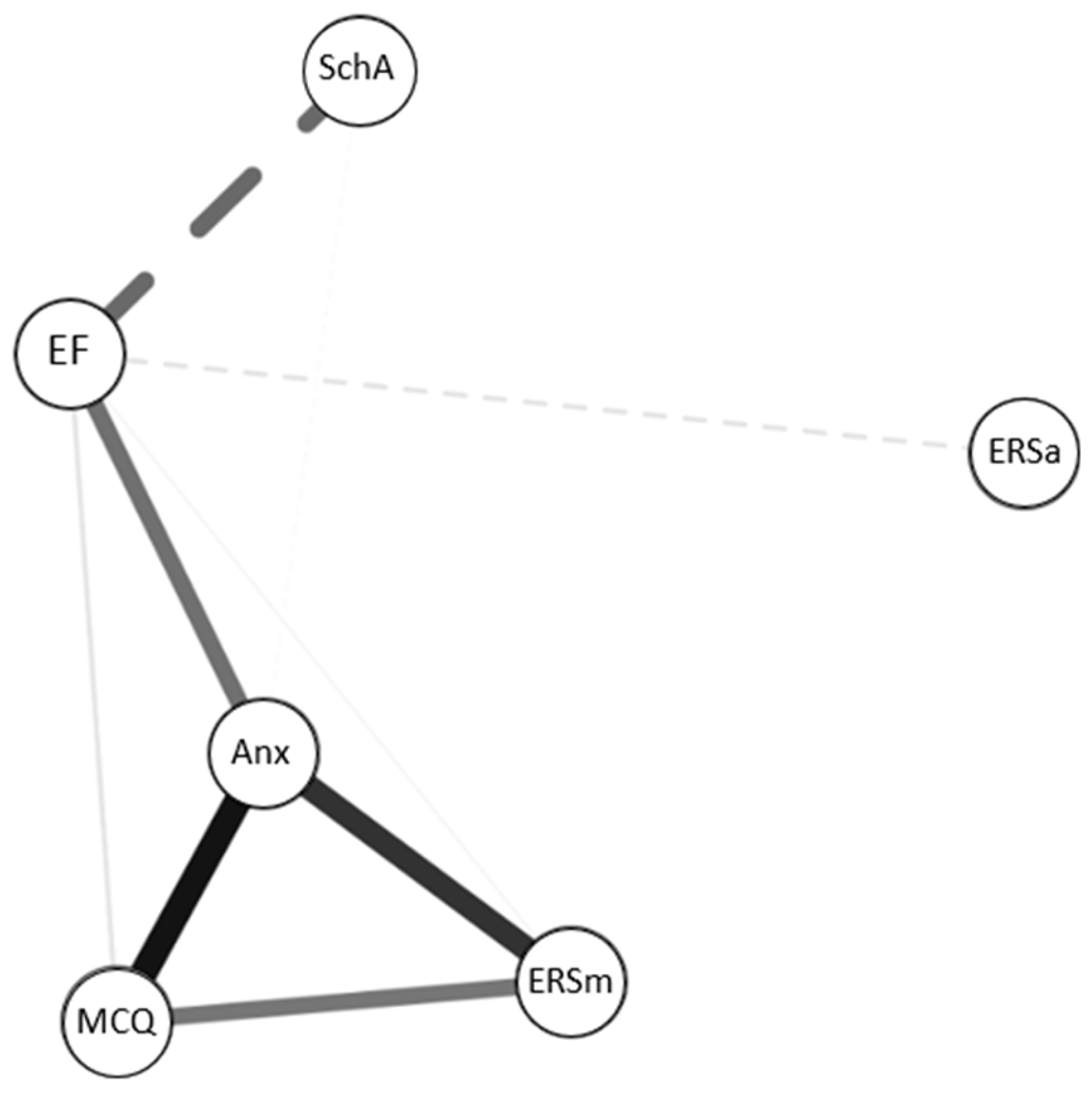
Figure 2.
Centrality index graphs. ERSm = Emotion Regulation Strategies maladaptives; ERSa = Emotion Regulation Strategies adaptives; EF = Executive Functioning; MCQ = MetaCognition Questionnaire.
Figure 2.
Centrality index graphs. ERSm = Emotion Regulation Strategies maladaptives; ERSa = Emotion Regulation Strategies adaptives; EF = Executive Functioning; MCQ = MetaCognition Questionnaire.
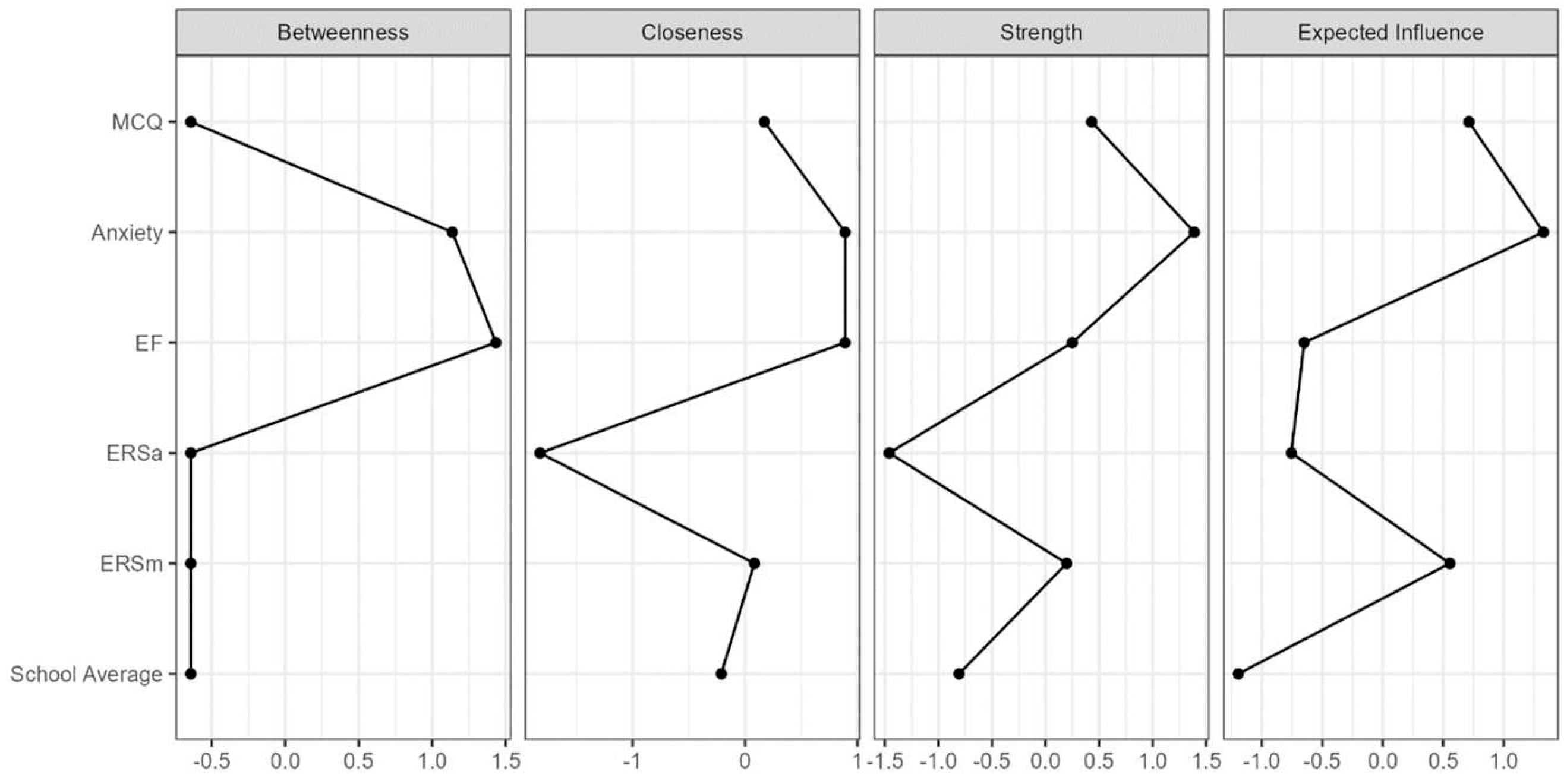

Table 1.
Mean and Distribution of Sample across Educational Levels.
| 4th | 5th * | 6th | 7th * | 8th ** | 9th | 10th | 11th | 12th | |
|---|---|---|---|---|---|---|---|---|---|
| Mean | 15.750 | 16.500 | 15.722 | 15.455 | 14.627 | 14.747 | 14.679 | 12.950 | 14.727 |
| SD | 1.500 | 3.162 | 1.973 | 1.990 | 2.611 | 2.264 | 2.524 | 2.712 | 2.190 |
| n | 4 | 5 | 107 | 67 | 32 | 27 | 17 | 12 | 17 |
* One missing data ** Two missing data.
Table 2.
Mean and Distribution of Sample across Diagnoses.
| DYS Troubles | HIP | Anxiety disorders | Multiple diagnoses | ADHD | ASD | Total | |
|---|---|---|---|---|---|---|---|
| n (%) | 33 (11.30) | 29 (9.93) | 7 (2.39) | 10 (3.42) | 3 (1.02) | 1 (.34) | 83 (100) |
HPI = High Intellectual Potential; ADHD = Attention Deficit Hyperactivity Disorder; ASD = Autism Spectrum Disorder; DYS = all neurodevelopmental disorders such as dyslexia, dysphasia, dyspraxia, etc.
Table 3.
Pearson correlations between main factors and descriptive statistics.
| Variable | n | M | SD | 1 | 2 | 3 | 4 | 5 | 6 |
|---|---|---|---|---|---|---|---|---|---|
| 1. School average | 272 | 15.26 | 2.25 | — | |||||
| 2. Trait Anxiety | 275 | 11.24 | 6.38 | -.184*** | — | ||||
| 3. ERS Maladaptive | 275 | 36.45 | 9.79 | -.040 | .570*** | — | |||
| 4. ERS Adaptive | 275 | 53.53 | 15.67 | .123* | -.087 | .083 | — | ||
| 5. Metacognitive beliefs | 275 | 59.99 | 11.15 | -.124* | .586*** | .495*** | .016 | — | |
| 6. Executive functioning | 275 | 119.85 | 25.49 | -.359*** | .468*** | .274*** | -.161** | .314*** | — |
ERS = Emotion Regulation Strategies; * p < .05; ** p < .01; *** p < .001.
Disclaimer/Publisher’s Note: The statements, opinions and data contained in all publications are solely those of the individual author(s) and contributor(s) and not of MDPI and/or the editor(s). MDPI and/or the editor(s) disclaim responsibility for any injury to people or property resulting from any ideas, methods, instructions or products referred to in the content. |
© 2023 by the authors. Licensee MDPI, Basel, Switzerland. This article is an open access article distributed under the terms and conditions of the Creative Commons Attribution (CC BY) license (https://creativecommons.org/licenses/by/4.0/).
Copyright: This open access article is published under a Creative Commons CC BY 4.0 license, which permit the free download, distribution, and reuse, provided that the author and preprint are cited in any reuse.


