
Submitted:
23 February 2026
Posted:
25 February 2026
You are already at the latest version
Abstract
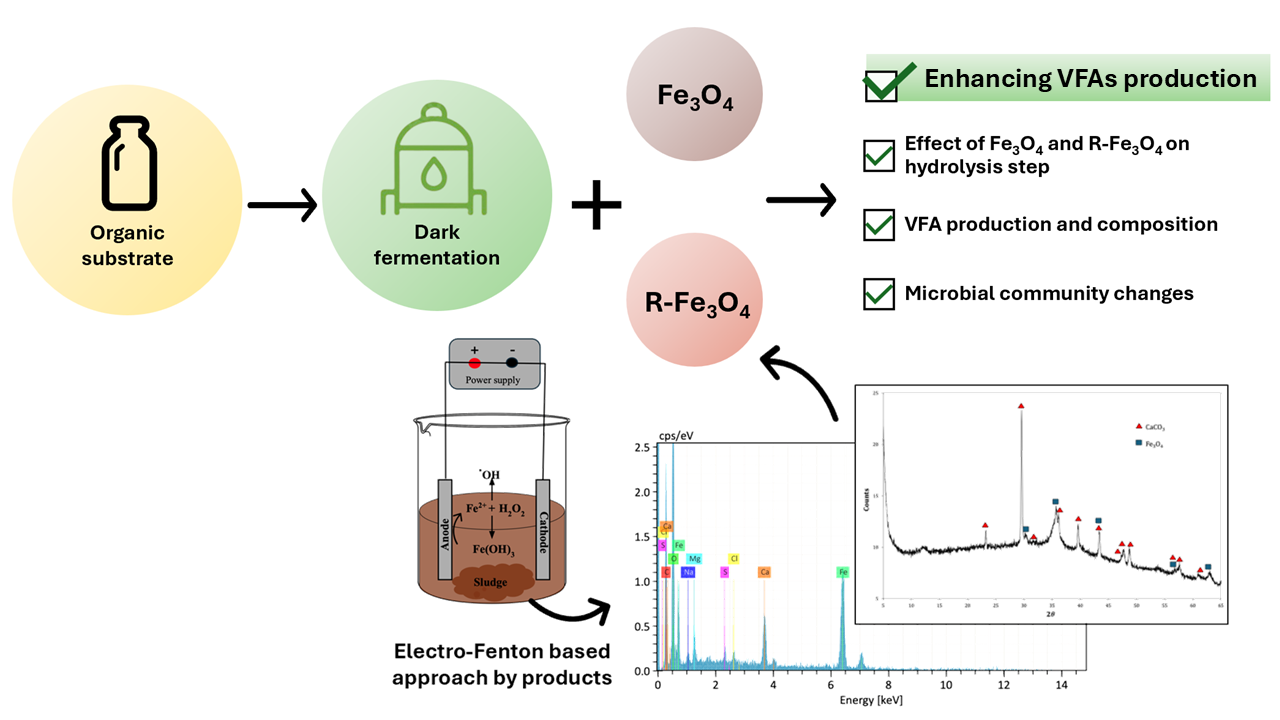
Fenton-based processes are widely used advanced oxidation methods known for degrading persistent pollutants. However, these techniques often generate significant amounts of iron-containing sludge, which poses environmental disposal challenges due to its complex composition. Furthermore, the sludge produced by the Fenton process contains high content of Fe(III) compounds, which can serve as an iron source to stimulate dissimilatory iron reduction (DIR), enhancing the performance of anaerobic digestion. Based on the characterization results from a previous study, this work investigated the use of the ferrous precipitate generated by the electrochemical peroxidation process applied to tannery wastewater treatment as an additive to enhance volatile fatty acids (VFAs) production during dark fermentation. The performance of ferrous precipitate (R-Fe3O4) was compared to that of conventional magnetite (Fe3O4) during dark fermentation under high organic loading conditions, emphasizing their potential to enhance hydrolysis efficiency and VFAs production yields, while promoting sustainable resource recovery and reuse within a circular bioeconomy framework. The results showed that the addition of both Fe3O4 and R- Fe3O4 significantly increased VFAs yields, with a predominance of long-chain fatty acids. The presence of CaCO3 in the ferrous precipitate contributed to maintaining a stable pH environment, supporting microbial activity and enhancing the hydrolysis of soluble compounds. Moreover, the availability of essential micronutrients within the ferrous precipitate favoured greater microbial diversity. Consequently, the addition of R-Fe3O4 promoted VFAs production even at higher organic loading rates, suggesting a promising application of Fenton-based by-products as functional additives to improve the economic and environmental performance of the dark fermentation process.
Keywords:
dark fermentation
; volatile fatty acids
; VFAs
; resource recovery
; wastewater
; tannery
; iron sludge
; microbial community
Copyright: This open access article is published under a Creative Commons CC BY 4.0 license, which permit the free download, distribution, and reuse, provided that the author and preprint are cited in any reuse.


