

Submitted:
18 February 2026
Posted:
25 February 2026
You are already at the latest version
Abstract
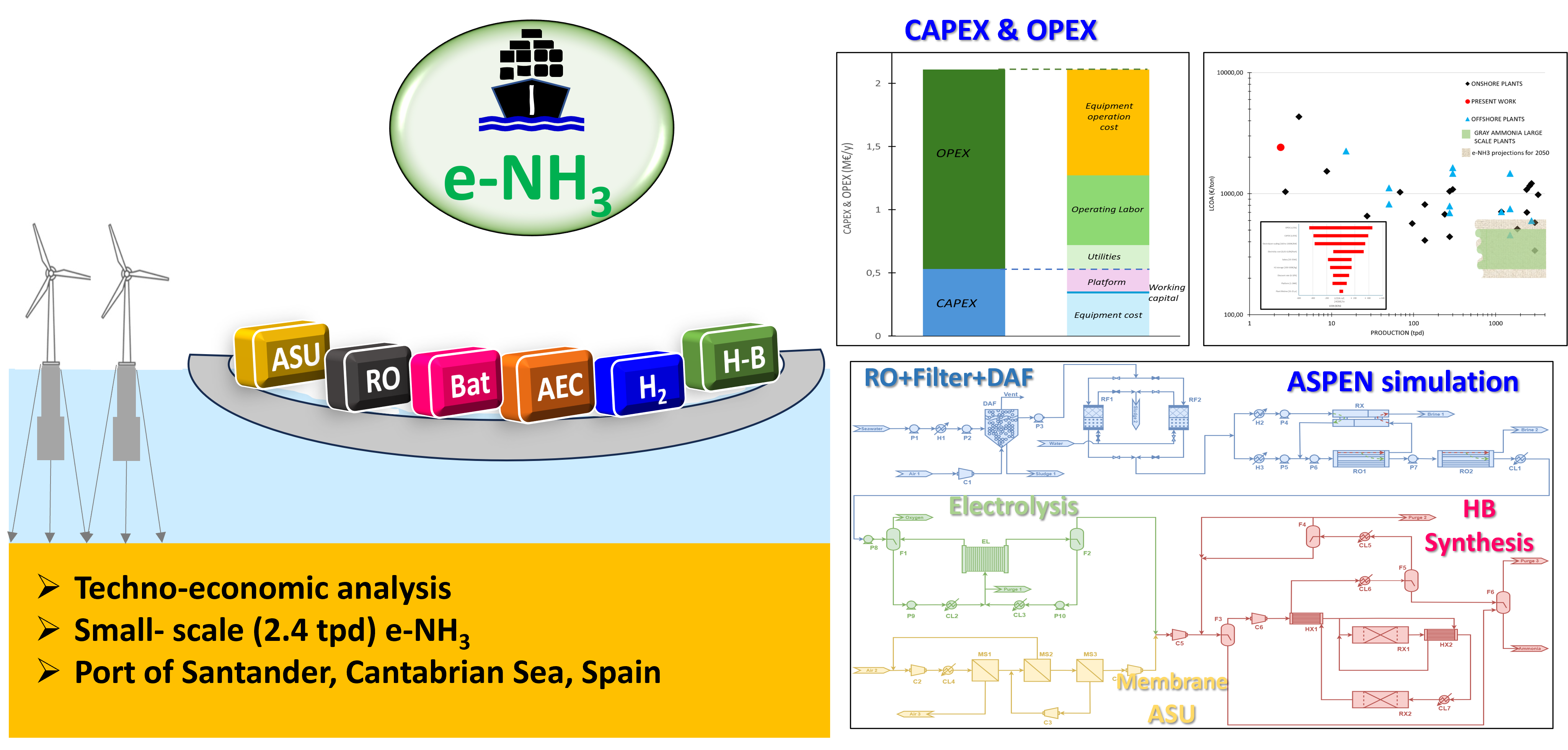
Maritime transport is energy-efficient but remains heavily dependent on fossil fuels. Renewable electricity–based ammonia (e-NH₃) has emerged as a promising alternative, particularly through small-scale, modular production. Assessing its economic viability is essential for future adoption, and techno-economic analysis offers a structured way to evaluate its feasibility. This study investigates the cost performance of a small-scale offshore e-NH₃ plant of 2.4 tpd at the Port of Santander, Spain, based on nitrogen obtained via membrane separation and hydrogen from electrolysis of pretreated seawater. The results include process simulation outcomes obtained with ASPEN v14, a detailed cost breakdown based on modular costing methodologies applied to preliminary process designs, and sensitivity analyses of the levelized cost of e-NH₃ (LCOA) with respect to the variables that have the strongest influence on overall costs. A comparative review of LCOA values reported in the literature for offshore and onshore e-NH₃ plants is provided. An estimated CAPEX of 5.99 M€ (equivalent to 0.53 M€/y), OPEX of 1.58 M€/y, and a LCOA of 2408 €/tNH₃ are obtained, with equipment investment and operating costs identified as the most influential parameters. The results highlight the need for supraregional techno-economic studies, considering optimal offshore wind availability within a collaborative interregional framework.
Keywords:
ammonia
; e-NH3
; small scale
; green hydrogen
; renewable energy
; techno-economic assessment
; offshore
; LCOA
Copyright: This open access article is published under a Creative Commons CC BY 4.0 license, which permit the free download, distribution, and reuse, provided that the author and preprint are cited in any reuse.


