

Submitted:
12 February 2026
Posted:
13 February 2026
You are already at the latest version
Abstract
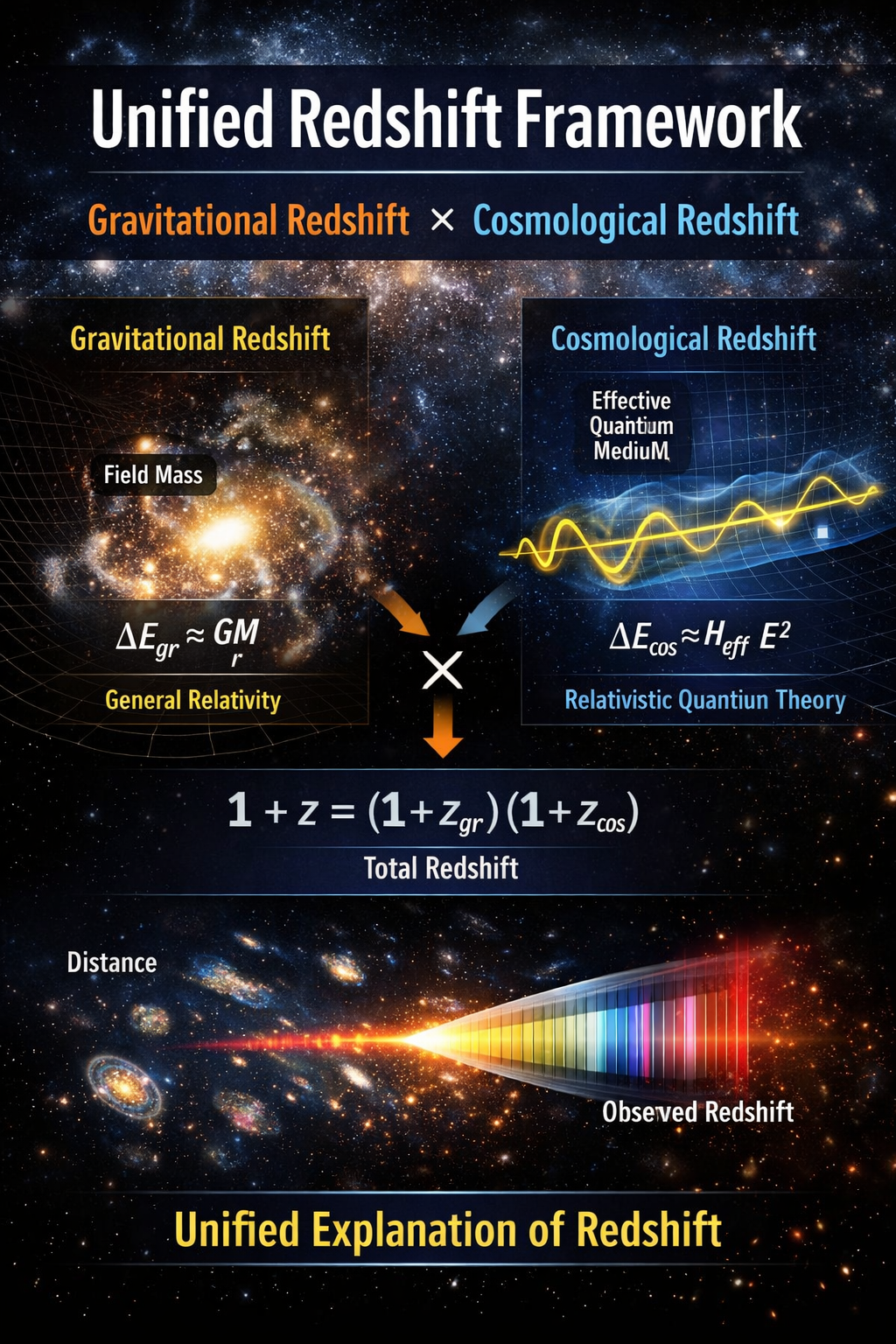
We propose a unified theoretical framework for observed redshift phenomena in astrophysics, in which gravitational and cosmological contributions arise from distinct but coexisting physical mechanisms. In this model, the gravitational field itself carries an effective mass, leading to a nontrivial field–mass structure that naturally identifies halo mass with the gravitational field mass outside baryonic sources. Independently, a cosmological redshift mechanism is derived from a relativistic quantum treatment of coherent photon propagation through an effective medium, resulting in a nonlinear closed-form energy-loss law characterized by a single effective parameter with units of Hubble’s constant. Through the definition of redshift, these two mechanisms combine multiplicatively, yielding a mathematically consistent total-redshift expression. The framework provides a unified mapping between distance and redshift for both galaxies and quasars without assuming a single dominant redshift cause. The model is constructed from explicit assumptions grounded in relativistic field dynamics and quantum coherence, and its internal consistency is demonstrated through analytic solutions and calibrated examples. Although parameter calibration is used for illustration, it does not constitute empirical validation; the focus is on formal structure, logical coherence, and theoretical plausibility. The proposed framework serves as a basis for future observational tests and theoretical refinement, illustrating how alternative physical interpretations of redshift can be formulated within a consistent relativistic setting.
Keywords:
general relativity
; gravitational redshift
; relativistic quantum theory
; cosmological redshift
Copyright: This open access article is published under a Creative Commons CC BY 4.0 license, which permit the free download, distribution, and reuse, provided that the author and preprint are cited in any reuse.


