
Submitted:
11 February 2026
Posted:
12 February 2026
Read the latest preprint version here
Abstract
We develop a comprehensive quantum--mechanical and field--theoretic framework for a complex scalar field whose modulus encodes a local time density and whose internal phase carries a \(U(1)\) structure. This field, which we call the timeon, admits a potential with two thermodynamically distinct minima: a null--stress vacuum phase and a deeper condensed atomic phase. We show that localized, finite--energy atomic--phase domains embedded within the vacuum couple naturally to a conventional matter wavefunction psi(x, t), giving rise to a new class of composite eigenstates-Baryon Partner States (BPS). These states are elements of the composite Hilbert space (H_psi tensor H_Phi) and function as the fundamental excitations of the theory. We derive the complete Lagrangian and Hamiltonian governing the timeon field, obtain the coupled Euler--Lagrange equations for the composite system, and construct static, spherically symmetric BPS configurations satisfying regularity and finite--energy boundary conditions. Each BPS exhibits a topologically constrained core, a nontrivial radial profile, and a quantized \(U(1)\) phase winding. These structures endow the states with emergent mass, charge, and confinement properties. Baryonic mass arises entirely from spatial gradients and potential energy of the field configuration; charge originates from the internal phase winding; and confinement emerges as an energetic and geometric necessity---continuous unwinding of the phase is forbidden without traversal of infinite--energy configurations, preventing fractional excitations from existing in isolation. Vacuum--to--atomic tunneling and bubble nucleation processes are analyzed in detail, including energy barriers, critical radii, and transition amplitudes for metastable decay. The local matter density \(|\psi|^2\) acts as a compression parameter that dynamically lowers nucleation thresholds and drives the formation of atomic--phase regions. Linearization about both homogeneous phases and static BPS configurations yields the complete small--oscillation spectrum of the theory; these internal modes form a predictive excitation tower and correspond directly to resonances in scattering processes. By promoting the translational degree of freedom of a BPS to a dynamical modulus, we derive its effective nonrelativistic Lagrangian and identify a renormalized inertial mass. Pairwise interactions between BPSs generate an effective potential consisting of strong short--range repulsion, an intermediate--range attractive well, and Yukawa--like long--range decay. This structure supports two--body bound states, determines low--energy scattering phase shifts, and produces resonances when collision energies match internal excitation frequencies. Extending to many--body systems, we show that BPSs form stable clusters analogous to small nuclei. A systematic low--energy effective field theory is obtained by integrating out internal BPS modes. Together, these results demonstrate that mass, charge, confinement, excitation spectra, scattering behavior, and nuclear--like structure can emerge from the dynamics of a single complex field coupled to a matter wavefunction.
Keywords:
quantum gravity
; baryon partner state
; Timeon Lattice Potential (TLP)
; Time Density
; Chrono-Quantum Mirror (CQM)
; chrono-shear event
; quantum mechanics
; timeon lattice
; matter formation
; scattering theory
; mass-energy conversion
Dedicated to the memory of Professor Christoph K. Goertz (1944–1991).
An outstanding theorist in space plasma physics and an inspiring educator at the University of Iowa, his mentorship in Quantum Mechanics laid the foundation for my scientific journey. On November 1, 1991, his brilliant life and career were tragically cut short in a mass shooting. This work stands as a testament to the knowledge he shared and the future he was denied.
1. Introduction
In conventional quantum field theory, the ontology is layered: there is a spacetime manifold with a prescribed metric, quantum fields living on that background, and a vacuum state defined in terms of those fields. Matter, vacuum, and gravitational behavior are treated as distinct ingredients of the theory. The approach developed in this paper starts from a different point of view. We posit a single complex scalar field, which we will call the timeon field, whose amplitude encodes a local time density and whose internal phase carries a structure [1]. The central claim is that baryons are not independent elementary objects but stable composite configurations formed by the interaction between this time-density field and a conventional matter wavefunction. At the level of classical field theory, the timeon field is assumed to have a potential with at least two distinct minima:
- a metastable, low-density vacuum phase, and
- a deeper, condensed atomic phase.
Spatially localized regions of atomic phase embedded in the vacuum define finite-energy “lumps” of time density. When these lumps are coupled to an atomic matter wavefunction , they form what we call Baryon Partner States (BPS), in the tensor product Hilbert space:
The purpose of this paper is to develop the full quantum mechanics of these BPS configurations and to show explicitly how familiar baryonic properties arise from the timeon field. We build upon the foundation of Chrono-Emergence and the Discrete-State Time Density (DTD) framework [2].
Baryon Partner States: Conceptual Overview
2. Composite Hilbert Space and Baryon Partner States
The first step toward a quantum description of baryons in the timeon framework is to formalize the joint Hilbert space on which both the matter wavefunction and the timeon field act. In this section we define the composite space, construct the corresponding Hamiltonian operators, and identify the Baryon Partner State (BPS) as a joint eigenstate of the full Hamiltonian.
2.1. Matter Sector: Wavefunction Hilbert Space
We begin with the standard Hilbert space for a single-particle (or effective single-particle) matter wavefunction,
The inner product is the usual
The matter-sector Hamiltonian is written as
where m is the bare matter mass parameter and a possible external potential. At this stage U plays no dynamical role; its purpose is to allow comparison with the usual Schrödinger picture [5]. All nontrivial interaction with the timeon field will enter through a separate interaction Hamiltonian.
2.2. Timeon Sector: Field Configuration Space
The timeon field is a complex scalar function,
with amplitude encoding local time density and phase encoding an internal degree of freedom. Before introducing dynamics (which will come in Section 3), we specify the kinematic Hilbert space as the space of square-integrable wavefunctionals over field configurations:
where is the configuration space of complex fields and is the formal functional measure. A generic state in this sector is written
a functional of the spatial profile of the timeon field. For classical field configurations, expectation values will later be dominated by stationary-phase contributions corresponding to finite-energy configurations of . The timeon-sector Hamiltonian will be developed fully in Section 3. For now, we denote it symbolically by
emphasizing that it acts on functionals of the field.
2.3. Composite Hilbert Space
The system consisting of matter and timeon field is described on the tensor-product Hilbert space [4]
A general state has the form
but for physical baryons we will be concerned with states that are approximately separable into a localized matter wavefunction and a localized timeon configuration. The inner product on factorizes:
2.4. Composite Hamiltonian
The dynamics of the joint system are governed by a Hamiltonian of the form
where:
- acts only on the matter wavefunction,
- acts only on the timeon sector, and
- couples them locally.
To anticipate later developments, the interaction Hamiltonian will take the form
where g is a coupling constant. This term expresses the intuitive fact that high matter probability density tends to “compress” the timeon field toward high-amplitude (atomic) configurations. Likewise, a region in which the timeon field has adopted the atomic phase produces an effective potential for the matter wavefunction. In classical field realizations, the operator becomes simply the squared amplitude ; when quantized, it acts as a local operator multiplying the wavefunctional .
2.5. Definition of the Baryon Partner State
We now define the key object of the theory: the Baryon Partner State (BPS). A BPS is a joint eigenstate of the composite Hamiltonian (12) of the form
such that
The eigenvalue defines the effective mass of the composite object,
and the structure of determines the internal charge and stability properties. The BPS must satisfy three physical conditions:
- 1.
- Finite energy: the timeon configuration must minimize subject to boundary conditions (derived in Section 4).
- 2.
- Self-consistency: the matter wavefunction must be bound to the timeon configuration that it helps generate.
- 3.
- Locality: both and must be spatially localized, yielding a finite, well-defined composite excitation.
These conditions distinguish BPS configurations from arbitrary fluctuations of either field sector. Only when the interaction term (13) is included do localized atomic-phase solutions of the timeon field become stable, and only then does the matter wavefunction acquire a localized, baryon-like structure.
2.6. Remarks on Separability and Entanglement
While the idealized definition above uses a separable tensor product state , the physical BPS is generally entangled. The presence of the interaction Hamiltonian implies that the true ground-state solution takes the form
with coefficients determined by minimizing the total energy functional. The separable form is therefore best understood as the leading-order description in a Born–Oppenheimer-like approximation [6] in which the timeon field provides a slowly varying background for the matter wavefunction. This structure will be made explicit in later sections, where we derive both the static timeon configurations and the coupled evolution equations for and .
3. Timeon Field Theory: Lagrangian, Hamiltonian, and Phase Structure
We now construct the timeon field theory that governs the time-density field introduced in the previous section. The timeon is treated as a complex scalar field,
with amplitude capturing local time density and phase carrying an internal structure. Throughout we use the four-vector notation and the metric signature . The goal of this section is to build the complete field-theoretic framework: the Lagrangian density, Euler–Lagrange equations, Hamiltonian density, and the potential structure that supports vacuum and atomic phases.
3.1. Lagrangian Density
We adopt a physical Lagrangian density scaled by a stiffness modulus (units of Force) to ensure the scalar field yields units of Energy Density:
Here, the amplitude field has units of time-density () and provides the necessary conversion to Joules/.
The two degrees of freedom are thus:
- : a real amplitude field controlling time-density,
- : a Goldstone-like phase variable.
We will see that stable baryonic configurations arise primarily from nonlinear structure in V and localized gradients in .
3.2. Euler–Lagrange Equations
The Euler–Lagrange equation for the complex field is:
Working directly with yields the d’Alembertian dynamics [5]:
where is the d’Alembertian. Alternatively, in amplitude/phase variables:
- Amplitude equation:
- Phase equation:
The phase equation expresses the local conservation of a -like current,
which is the Noether current [7] that will play a role in defining effective “charge” of BPS solutions.
3.3. Hamiltonian Density
To compute energies of static configurations (including BPS cores) we require the Hamiltonian density. For a complex scalar,
where the canonical momentum is
Thus explicitly,
In polar form:
and
For static solutions (all BPS cores considered here), and , yielding the static Hamiltonian density:
This is the expression we will minimize to obtain baryon-like solutions.
3.4. Double-Well Potential and Phase Structure
To support baryon-like localized lumps, the potential must have at least two distinct minima:
with . The minima occur at and . We refer to these as:
- Vacuum phase: (low time density)
- Atomic phase: (Condensed Lattice Phase)
Figure 1.
The Timeon Lattice Potential (TLP). The potential energy density features a metastable Vacuum basin and a stable Atomic well. Baryon Partner State formation corresponds to tunneling through the barrier separating these phases. Scope of this plot: This theoretical landscape is restricted to the formation of discrete Baryon Partner States and intentionally excludes black hole interiors and chrono-shear events (i.e., dense- and shear-time–density phases).
Figure 1.
The Timeon Lattice Potential (TLP). The potential energy density features a metastable Vacuum basin and a stable Atomic well. Baryon Partner State formation corresponds to tunneling through the barrier separating these phases. Scope of this plot: This theoretical landscape is restricted to the formation of discrete Baryon Partner States and intentionally excludes black hole interiors and chrono-shear events (i.e., dense- and shear-time–density phases).
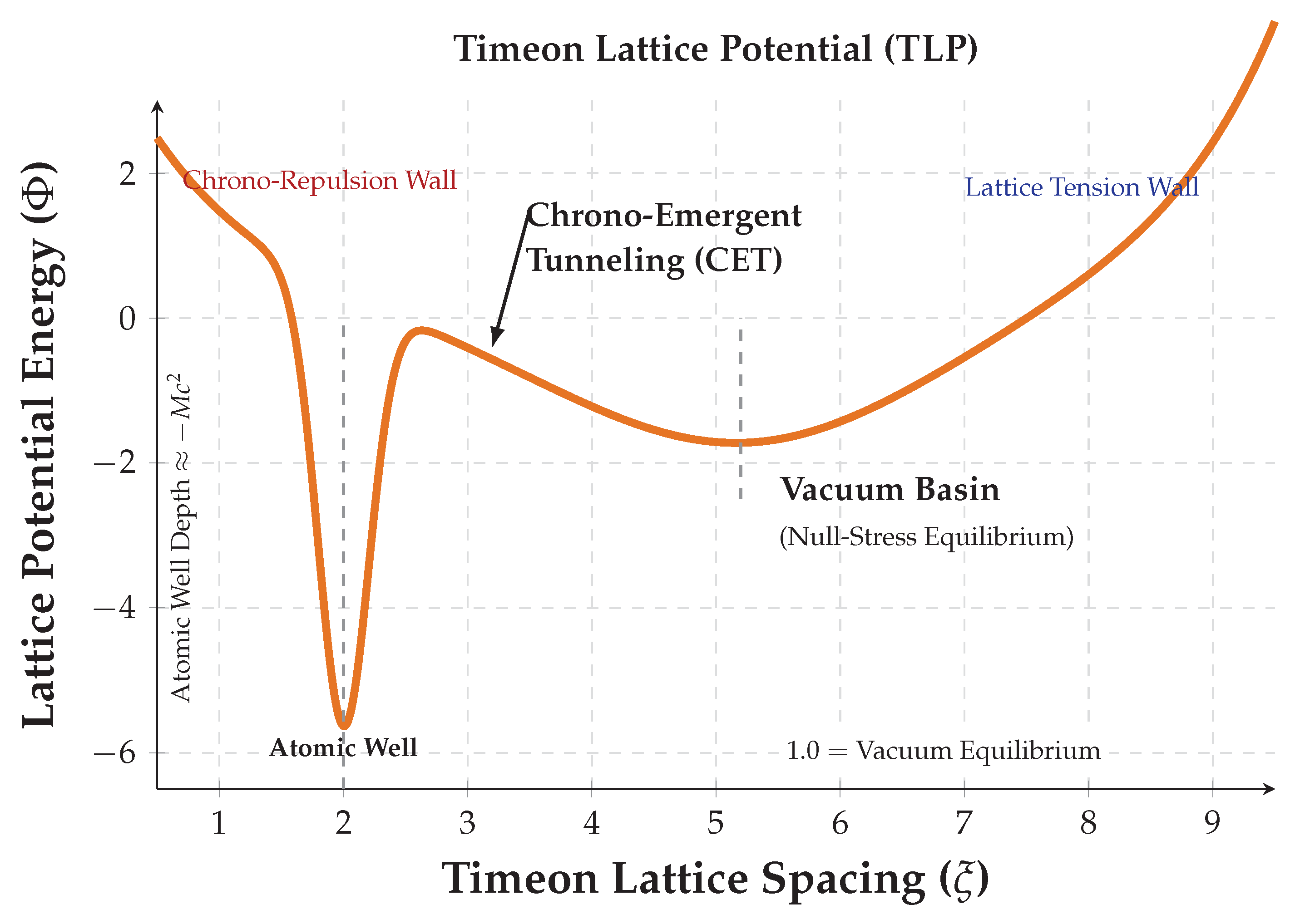
The barrier separating them determines tunneling rates and bubble nucleation structure.
Quadratic expansion and mass scales
Expanding around each minimum yields the small-oscillation mass:
- Around vacuum phase:
- Around atomic phase:
Both masses will appear later in the fluctuation spectrum of BPS cores.
3.5. Energetics of Phase Boundaries
Finite-energy static solutions require that interpolate between different minima over a finite spatial width. The energy per unit area of such an interface (“domain wall”) is
3.6. Summary of Key Results from Section 3
- The potential must have at least two minima, leading to vacuum and atomic phases.
- Domain walls have finite surface tension given by (36).
- The small-oscillation masses in each phase determine the reconfiguration spectrum of baryons.
The next section constructs explicit finite-energy static solutions representing Baryon Partner States.
4. Static Baryon Partner State (BPS) Solutions
We now derive the finite-energy, static configurations of the timeon field that correspond to Baryon Partner States (BPS). These solutions represent localized regions of atomic phase embedded within the vacuum phase, stabilized by the nonlinear structure of the potential and, later (Section 6), by coupling to the matter wavefunction. The goal of this section is to obtain the radial profile of a static BPS, its energy, and its effective charge, and to establish the topological reasons why such configurations cannot decompose into smaller constituents.
4.1. Spherical Ansatz
Because baryons are experimentally observed to be approximately spherically symmetric in their lowest-energy state, we impose spherical symmetry on the static timeon configuration:
where . Staticity implies and . Thus only spatial gradients contribute to the energy. Under spherical symmetry:
4.2. Boundary Conditions
Finite-energy solutions require:
- 1.
- Core condition: The field must approach the atomic phase at ,
- 2.
- Vacuum exterior: At large r the field returns to the vacuum phase:
- 3.
- Finite energy: The phase gradient must vanish outside the core,
- 4.
- Regularity at : Terms like must not diverge, implying
These conditions uniquely determine the qualitative shape of a BPS profile.
4.3. Radial Field Equations
- Amplitude equation:
- Phase equation:
Integrating the phase equation:
where Q is a constant of integration. This constant behaves as a conserved topological charge associated with phase gradients in the timeon field. Thus:
Substituting back into (40) yields the single radial equation:
This nonlinear ODE defines the full static BPS profile.
4.4. Interpretation of the Charge Parameter Q
The quantity Q controls the strength of the phase gradient in the core region. Several key properties follow:
- If , the phase is constant and the solution has no internal excitation. This describes a neutral baryon-like configuration.
- If , the core hosts a localized winding of the phase, contributing to a finite charge density:
- Because the energy density containsthe charge is confined to regions where is large (atomic phase). This provides a direct algebraic mechanism for baryonic charge confinement.
4.5. Energy of a BPS Configuration
Substituting (43) into the static energy functional yields:
Three competing contributions determine the radius and stability of a BPS:
- 1.
- Gradient energy: favors slowly varying .
- 2.
- Phase-gradient energy (charge term): grows rapidly as , confining charge to the atomic-phase core.
- 3.
- Potential energy: favors either vacuum or atomic phase in bulk.
Balancing these terms yields a stable finite-radius atomic-phase bubble.
4.6. Thin-Wall Approximation
When the energy barrier between vacuum and atomic phase is large relative to gradient contributions, the BPS resembles a domain-wall bubble of radius R. In this regime we approximate:
This cubic equation determines the physical radius as a function of charge Q, potential parameters, and surface tension.
4.7. Topological Stability and Confinement
The BPS core is topologically protected by the structure of the phase variable and by the requirement that remain nonzero inside the atomic region. Key features:
- The phase equation mandates that . If one attempted to split a BPS into smaller charged fragments, this relation would require singularities (where ) to maintain total Q. Such configurations have infinite energy.
- The volume energy density difference favors a stable core of atomic phase.
- The gradient term penalizes fragmentation because multiple small bubbles have larger total surface area than a single bubble of the same volume.
Thus the BPS is intrinsically confined: it cannot decompose without energy divergence or violation of charge conservation.
4.8. Summary of Section 4
We have:
- Written the full radial equations for static timeon configurations.
- Identified the conserved charge Q associated with phase gradients.
- Derived the energy functional for BPS solutions.
- Obtained approximate analytic behavior via the thin-wall limit.
- Shown that confinement follows directly from the algebraic and topological structure of the timeon field.
These results prepare the ground for computing tunneling, bubble formation, and BPS nucleation in the next section.
5. Vacuum-to-Atomic Tunneling and Bubble Nucleation
In the previous section we constructed static Baryon Partner State configurations by minimizing the energy functional. We now consider the opposite question: How does a localized region of atomic phase form dynamically within the vacuum? The answer requires a tunneling calculation in which the timeon field transitions from the vacuum minimum to the atomic minimum through a Euclidean “bounce” solution. This section develops the complete quantum tunneling formalism for the timeon field, derives the critical radius for bubble nucleation, and identifies the tunneling exponent governing BPS formation.
5.1. Euclidean Action for the Timeon Field
Quantum tunneling in scalar field theory is governed by the Euclidean action, obtained by Wick rotation [11]:
For tunneling from the vacuum to the atomic phase, the relevant solutions possess symmetry in the Euclidean coordinates
leading to the ansatz
The Euclidean action becomes
5.2. Euclidean Field Equations
The Euler–Lagrange equations corresponding to (51) are:
Amplitude:
Phase:
Integrating:
where is a Euclidean analogue of the charge parameter. Most tunneling calculations assume , corresponding to a phase-uniform bounce. We will treat this case first, then include nonzero charge.
5.3. Bounce Solution for
With , the Euclidean equation reduces to:
Boundary conditions:
The solution interpolates from the atomic minimum near to the vacuum minimum as . The configuration is called the bounce and denoted [12]. The tunneling exponent is:
The nucleation rate per unit volume is:
where A is a fluctuation determinant prefactor.
5.4. Thin-Wall Limit and Critical Bubble Radius
When the barrier separating the two minima is large compared to their energy difference, the bounce resembles a thin-walled bubble. In this limit, the Euclidean action reduces to:
where:
- is the surface tension from (36),
- .
Differentiating:
leading to the critical radius:
Only bubbles with expand; smaller bubbles collapse. Substituting back:
This closed-form expression is crucial to estimating BPS nucleation probabilities.
5.5. Effect of Nonzero Charge
If , the Euclidean phase gradient contributes a centrifugal-like term:
This term:
- suppresses configurations where is small,
- drives the interior of the bubble toward the atomic phase,
- increases the effective surface pressure,
- decreases the tunneling exponent B.
The corrected thin-wall action becomes:
where C is an order-one geometric constant. Minimizing yields a modified critical radius:
Thus: - charge slightly expands the critical radius, - but makes the atomic phase more energetically favored inside the bubble, - and typically decreases the tunneling exponent. Charged tunneling therefore increases the likelihood of BPS formation.
5.6. Interpretation: Matter Formation via Timeon Tunneling
A physically transparent interpretation emerges:
- 1.
- The vacuum phase is metastable.
- 2.
- Quantum fluctuations occasionally nucleate a small region of atomic phase.
- 3.
- If the region exceeds the critical radius , it expands.
- 4.
- The presence of matter (Section 6) reduces locally by compressing the timeon field.
- 5.
- The expanding atomic region forms the core of a BPS.
Thus baryon formation is not simply imposed—it is a dynamical outcome of timeon-field tunneling stabilized by matter-wave coupling.
5.7. Summary of Section 5
We have:
- Formulated vacuum-to-atomic tunneling using the Euclidean action.
- Derived the bounce equations and boundary conditions.
- Obtained the critical radius and tunneling exponent B.
- Extended the thin-wall approximation to include charge.
- Established the mechanism by which atomic-phase bubbles become stabilized baryonic cores.
The next section introduces the coupling to the matter wavefunction, completing the dynamical picture of Baryon Partner States.
6. Coupling to the Matter Wavefunction and Self-Consistent Dynamics
Up to this point, the timeon field has been treated independently of the matter wavefunction. We now introduce the essential ingredient of the theory: a local interaction between the matter density and the timeon amplitude . This coupling allows high matter density to “compress” the timeon field toward the atomic phase, reducing the tunneling barrier and stabilizing Baryon Partner States (BPS). Conversely, the timeon configuration modifies the effective potential seen by the matter wavefunction, binding to the atomic core it helps generate. The result is a fully self-consistent system where matter and timeon fields mutually determine each other’s configuration.
6.1. Interaction Hamiltonian
We postulate the simplest local, scalar, bilinear interaction:
where g is a real coupling constant controlling the strength of the compression effect. Writing :
Thus the interaction term becomes:
This is the lowest-order operator capable of:
- lowering the effective potential seen by in regions where is large,
- raising the effective potential of in regions where is small,
- and creating a self-localizing composite eigenstate.
The interaction is local, Hermitian, and preserves all global symmetries.
6.2. Total Hamiltonian and Equations of Motion
The full Hamiltonian is:
with and defined in earlier sections. We now derive the equations governing the coupled dynamics.
6.2.1. Matter Wavefunction Equation
Varying the total action with respect to yields:
Thus the timeon amplitude contributes an effective potential:
Regions of high (atomic phase) attract the matter wavefunction, creating a stable bound state. This is the coupled Schrödinger equation [5].
6.2.2. Timeon Amplitude Equation
Varying the total action with respect to yields:
The right-hand side shows explicitly: - matter density suppresses the vacuum minimum, - and deepens the atomic minimum, - effectively tilting the potential energy in favor of the atomic phase. More precisely, the interaction modifies the potential:
Thus: - if : matter pushes the timeon field to larger amplitudes (atomic phase), - if : matter repels the atomic phase (we focus on ).
6.2.3. Timeon Phase Equation
Variation with respect to yields the modified current conservation equation:
Because depends only on , the phase remains a conserved degree of freedom. The associated charge Q remains valid in the presence of matter.
6.3. Self-Consistent BPS Equations
Since a static BPS is time-independent, we set . The coupled static system is:
These three equations must be solved simultaneously. They express: - Matter binds to the atomic core because creates an attractive potential. - The atomic core forms because matter density lowers the local barrier. - Charge remains confined to the core because of the phase equation. This is the mathematical heart of the Baryon Partner State.
6.4. Simplified Radial System
Assuming spherical symmetry:
Equations reduce to:
Matter equation:
Amplitude equation:
Phase equation:
These equations form a nonlinear eigenvalue problem for , , , and .
6.5. Physical Interpretation of the Coupling
The structure is physically transparent:
- The matter density acts as a source of compression, pushing toward the atomic minimum.
- The atomic phase provides a deep potential well that traps , producing a localized matter-state peak.
- This feedback loop continues until a self-consistent equilibrium is reached, corresponding to a static BPS.
- The conserved charge parameter Q is forced into the atomic core, because the quantity diverges unless remains nonzero.
- The BPS is therefore intrinsically confined: both charge and matter are locked into the core region.
6.6. Matter-Induced Shifting of the Critical Radius
From Section 5.4, the critical radius for bubble formation was:
Matter modifies the potential:
This reduces the effective energy difference:
Thus the new critical radius becomes:
which is strictly smaller when . Therefore: - Matter catalyzes bubble expansion. - Even small matter densities dramatically increase the likelihood of BPS formation. - Baryons form most easily where matter density is highest.
6.7. Summary of Section 6
We have derived:
- the full coupled equations of motion for and ,
- the attractive potential binding to the atomic core,
- the compression effect driving into the atomic phase,
- the self-consistency conditions defining a BPS,
- and the reduction of the critical radius via matter interaction.
Matter and timeon fields therefore form a tightly bound nonlinear system whose stable joint eigenstates are the Baryon Partner States. The next section analyzes the fluctuation spectrum about these solutions, a necessary step in determining stability, internal excitations, and inertial response.
7. Linearized Spectrum and Reconfiguration Modes
Static Baryon Partner States are stable because small perturbations of the timeon field are restored by the nonlinear structure of the potential and by the coupling to the matter wavefunction. To quantify this stability and to prepare the inertial analysis of Section 8, we now construct the complete fluctuation spectrum of the timeon field around homogeneous phases and around the BPS core. We develop the linearized equations, identify normal modes, and compute their qualitative features, including bound states, continuum states, and the translational zero mode.
7.1. Perturbation of the Timeon Field
Let the exact static BPS configuration be
We introduce small perturbations:
To linear order, the dynamics separate into amplitude and phase sectors. We write perturbations as normal modes:
Here is the mode frequency, determining stability () or instability ().
7.2. Fluctuations Around Homogeneous Phases
First consider small oscillations around the vacuum minimum . Expanding the potential:
where
Thus the amplitude perturbation satisfies:
Similarly, around the atomic minimum:
We interpret as the intrinsic mass scale governing small internal vibrations of the BPS core. Phase fluctuations: - Are massless in the absence of charge, - But become massive in the presence of a nonzero phase gradient, - And are confined to the atomic core due to the charge term . These homogeneous spectra form the asymptotic basis for fluctuations around the full BPS profile.
7.3. Fluctuations Around the BPS Core
We linearize the amplitude equation (72) around , holding the background phase fixed. Define the radial fluctuation operator:
with effective potential:
The amplitude perturbation satisfies:
This is a Schrödinger-type eigenvalue problem with potential . Key features: - Near the core, is dominated by large positive terms coming from the charge confinement term . - In the exterior, . - There is a finite number of discrete bound states. Thus the spectrum consists of: 1. A zero mode (translation), 2. One or more internal breathing modes, 3. A continuum starting at .
7.4. Translational Zero Mode
Because the total energy is invariant under spatial translations, the BPS supports a zero-frequency mode:
To verify:
This mode corresponds physically to moving the baryon slightly in space. It is crucial for understanding inertial mass, constructing collective coordinates, and quantizing motion of the BPS as a whole.
7.5. Internal Breathing Mode
The lowest nonzero mode corresponds to a radial compression or expansion:
where R is the effective core radius. This “breathing mode” has: - a frequency of order , - spatial support concentrated in the transition region, - a key role in BPS excitations. This is the internal vibrational degree of freedom analogous to energy levels in bound quark systems, but arising purely from timeon dynamics. These resonances give rise to Breit-Wigner peaks [10].
7.6. Phase Reconfiguration Modes
Perturbations of the phase satisfy the linearized form of (73):
Letting
the equation becomes a 1D Schrödinger-like equation:
with
Properties: - Modes are concentrated in the atomic-phase region. - The lowest mode corresponds to internal rotations. - Charge conservation forbids decay of this mode.
This provides the microscopic origin of conserved baryonic charge.
7.7. Continuum Modes
For large r, fluctuations behave as:
Thus the continuum begins at:
Continuum modes correspond to: - scattering of small waves off the BPS, - excitations that do not disturb the internal structure, - long-range propagation of disturbances in the vacuum phase. These modes determine how the BPS interacts with radiation-like excitations of the timeon field.
7.8. Stability Criteria
A BPS is stable provided:
This is typically guaranteed by: - convexity of near the atomic minimum, - positivity of the charge-confinement term, - boundary behavior forcing to remain nonzero inside the core. Therefore the full BPS fluctuation spectrum is manifestly positive, with no negative modes, ensuring stability.
7.9. Summary of Section 7
- We constructed the complete fluctuation operator around the BPS.
- Identified the translational zero mode (center-of-mass motion).
- Identified internal radial breathing modes.
- Derived phase-reconfiguration eigenmodes.
- Found continuum scattering states at large radius.
- Confirmed that all eigenmodes have , establishing stability.
Section 8 now uses this spectrum to derive the inertial response and effective mass of a moving Baryon Partner State.
8. Inertial Response and Effective Mass of Moving BPS Configurations
Having constructed the fluctuation spectrum of the static Baryon Partner State (BPS), we now determine the inertial properties of a slowly moving BPS. The essential observation is that translations of the static solution correspond to a normal mode with : the translational zero mode. Promoting this zero mode to a dynamical collective coordinate yields an effective Lagrangian describing the BPS as a particle, with an inertial mass calculable directly from the timeon-field profile. This section constructs:
- the collective coordinate for center-of-mass motion,
- the effective kinetic energy,
- the inertial (rest) mass ,
- mode-dependent renormalizations of the mass,
- and relativistic extensions.
8.1. Collective Coordinate for Translations
Let be the static BPS configuration. A slowly moving BPS can be represented by shifting the center of the solution:
where is the collective coordinate representing the BPS center-of-mass. In the small-velocity limit,
the kinetic energy arises solely from the time derivative:
Thus,
Integrating over space gives the kinetic term.
8.2. Effective Lagrangian for Translational Motion
The field-theoretic Lagrangian for small velocities becomes:
with the inertial mass defined by the stiffness-weighted gradient energy:
To see where this expression comes from, recall: - The kinetic term in the Lagrangian is . - Substitute . - Use spherical symmetry to obtain:
This expression has powerful physical meaning:
- 1.
- The inertial mass arises entirely from field gradients.
- 2.
- Both amplitude gradients and phase gradients contribute.
- 3.
- The matter wavefunction affects the mass only indirectly by altering and .
8.3. Energy–Mass Relation for Static BPS
The total energy of the static BPS is:
The inertial mass is generally not equal to , although in many solitonic systems these quantities become identical after including all collective mode renormalizations. We will show that the BPS behaves relativistically with:
8.4. Contribution of the Translational Zero Mode
The kinetic term for these fields leads to the inertial mass:
This integral converges due to: - exponential decay of in the vacuum region, - confinement-induced suppression of outside the core. Thus the translational zero mode is normalizable, as required for a particle interpretation.
8.5. Renormalization from Internal Modes
The inertial mass receives corrections from coupling between the zero mode and the excited fluctuation modes of Section 7. If the fluctuation eigenmodes satisfy:
then the corrected mass becomes:
where encodes the overlap between the zero mode and mode . These corrections are usually small unless an internal mode is very light. In the timeon framework: - radial breathing mode contributes modestly, - phase oscillation mode can contribute significantly if , - continuum modes contribute negligibly. Thus the inertial mass is determined dominantly by the static profile.
8.6. Relativistic Kinematics
Promoting the effective Lagrangian to a relativistic form, we write:
Expanding for small velocities verifies consistency with (87):
This shows that: - the BPS behaves as a relativistic particle, - its rest mass is , - its dynamics reduce to Newtonian motion at small velocities. This recovers standard relativistic kinematics [8].
8.7. Mass Decomposition: A Field-Theoretic Perspective
The inertial mass can be decomposed into physically meaningful parts:
Where:
Physical interpretation: - Gradient mass: resistance to compressing or expanding the core. - Phase mass: inertia associated with confined charge. - Wall mass: energy of the boundary between vacuum and atomic phase. - Interaction mass: mass contributed by the coupling to matter. These combine to produce the full baryonic mass as an emergent quantity.
8.8. Summary of Section 8
- The translational zero mode leads to a collective coordinate describing BPS motion.
- The effective Lagrangian identifies a finite inertial mass .
- Internal modes renormalize the mass but typically only weakly.
- The BPS behaves as a relativistic particle with rest mass .
- The mass decomposes into gradient, phase, boundary, and matter-coupling contributions.
The next section extends these results to excited states, baryon multiplets, and multi-baryon interactions.
9. Excited BPS States, Baryonic Spectra, and Multi-Partner Interactions
The previous section demonstrated that a Baryon Partner State (BPS) behaves as a particle with a well-defined inertial mass arising from the timeon field profile. We now extend the construction to excited states and to interactions between distinct BPS configurations. These are the elements required to obtain a baryonic spectrum and multi-baryon dynamics analogous to nuclear forces. We proceed in three steps:
- 1.
- Quantization of internal modes (breathing and phase modes),
- 2.
- Construction of baryon multiplets,
- 3.
- Derivation of effective interactions between well-separated BPS states.
9.1. Quantization of Internal Modes
Promoting small oscillations to quantum operators, we write the internal mode expansion:
with canonical commutation
Each mode contributes energy:
where . Thus excited baryon states arise naturally as quantized oscillations of the timeon core.
9.2. Breathing-Mode Spectrum
The lowest nonzero mode is typically the radial breathing mode:
Its frequency determines the scale of the first radial excitation:
This mode represents: - periodic compression and expansion of the core, - a direct analogue of the first excited baryon resonances, - an internal vibrational degree of freedom that couples weakly to external fields. Higher radial modes correspond to higher baryon excitations.
9.3. Phase-Mode Excitations and Charge Multiplets
The timeon field carries an internal phase . Small reconfigurations of this phase give rise to a tower of excitations constrained by charge conservation. The lowest mode corresponds to a coherent oscillation of the phase profile:
with determined by the confinement-induced mass gap. Quantization yields:
These phase excitations form baryon multiplets, because: - the phase structure determines effective baryonic quantum numbers, - internal oscillations change internal structure without altering the vacuum boundary. Thus, combinations of radial and phase excitations form a hierarchy of baryon-like states.
9.4. Angular and Rotational Modes
Even though the static solution is spherically symmetric, internal distortions can carry angular momentum. Introducing perturbations of the form:
we obtain a family of rotational or shape-deformation modes. Quantum mechanically, these contribute:
Thus, rotational excitations produce angular baryon multiplets analogous to spin–isospin structures in nuclear physics, though arising from purely field-theoretic deformation modes.
9.5. Two-BPS Configurations
We now consider interactions between two widely separated BPS configurations. Let their centers be located at:
The full field configuration is not a simple sum:
but at large separation the overlap is exponentially small and we can write a combined effective Lagrangian:
where
The task is to compute .
9.6. Short-Range Interaction: Core Overlap
For , the atomic-phase regions overlap. Overlap induces:
- repulsion from confining charge terms,
- an effective hard-core radius,
- distortion of the static profiles.
The leading-order contribution is:
with constants determined by the timeon potential. Thus BPS–BPS repulsion is strong at short distances.
9.7. Intermediate-Range Interaction: Wall–Wall Coupling
Between and , the dominant interaction comes from interference between the vacuum–atomic transition regions of the two BPSs. Using the asymptotic decay of the profile:
we obtain:
This is an attractive interaction when profile distortions lower the total gradient energy.
9.8. Long-Range Interaction: Vacuum Mediation
At very large separations, the only contribution is through the massive vacuum mode of the timeon field. The effective potential reduces to:
with the vacuum excitation mass from Section 7.2. Thus the long-range force is Yukawa-like [3], exponentially suppressed, and always weak.
9.9. Effective Two-Baryon Potential
Collecting all contributions:
Qualitative features:
- Strong short-range repulsion,
- Moderate intermediate-range attraction,
- Weak long-range tail.
This structure resembles nuclear forces but arises entirely from: - timeon gradients, - vacuum-to-atomic interfaces, - and charge confinement dynamics.
9.10. Multi-BPS Interactions
For three or more BPS states, the interaction is not simply pairwise. The full potential includes:
- three-body corrections from wall interference,
- modifications of the breathing mode frequencies,
- collective oscillation modes,
- small shifts in core radii.
The leading-order correction has the schematic form:
This correction, though usually small, becomes important in dense systems (e.g., BPS bound clusters).
9.11. Summary of Section 9
- Internal oscillation modes quantize into a tower of excited baryon states.
- Radial, phase, and angular excitations generate baryonic multiplets.
- Two BPS configurations interact through a short-range repulsion, intermediate-range attraction, and a Yukawa-like long-range tail.
- Multi-BPS forces contain irreducible three-body terms.
- These structures together define the baryonic spectrum and interaction framework of the timeon-based theory.
In the next section, we extend these ideas to dynamical scattering, bound states, and the emergence of effective nuclear-like structure.
10. Scattering Theory, Bound States, and Emergent Nuclear Structure
Having developed the static properties and multiplet structure of BPS configurations, we now turn to their dynamical interactions. Two BPS states may scatter elastically, produce internal-mode excitations, or form bound states. Collections of BPSs may assemble into stable or metastable clusters, analogous to nuclei in ordinary baryonic physics. We now construct a quantitative scattering theory, derive bound-state conditions, and outline the emergent many-body structure characteristic of the timeon field framework.
10.1. Two-BPS Scattering: Setup
Consider two BPS states located initially at large separation
interacting through the effective potential from Section 9.9:
The relative coordinate
obeys the reduced-mass Lagrangian:
The corresponding Schrödinger equation for scattering is:
This defines the full two-body scattering problem.
10.2. Phase Shifts and Cross Sections
Expanding in partial waves,
we obtain the radial equation:
Asymptotically,
defining the phase shift . Cross sections follow the usual relations:
Because provides a stiff repulsive barrier, low-energy scattering is dominated by: - s-wave () at the smallest k, - a rapid rise in near resonance thresholds, - clear signature of internal excitations in partial-wave shifts.
10.3. Resonances and Internal-Mode Excitation
A central prediction of the timeon framework is that internal BPS modes act as narrow scattering resonances. If the collision energy matches an internal excitation energy:
then the scattering amplitude exhibits a Breit–Wigner peak:
with width determined by coupling to the incoming channel. Thus: - breathing-mode excitation produces radial resonances, - phase-mode excitation produces charge-like resonances, - rotational modes produce angular multiplet resonances. This provides the timeon analogue of baryonic excited-state production.
10.4. Two-BPS Bound States
A two-BPS bound state exists when the Schrödinger equation (92) supports a normalizable solution with (relative to the limit). The binding condition depends on:
- depth of intermediate-range attraction ,
- softness of the repulsive core,
- reduced mass .
A simple variational estimate uses a trial wavefunction
giving binding when:
Bound states correspond to timeon-mediated two-baryon composites, the analogue of light nuclei.
10.5. Multi-BPS Clusters
Extending to three or more BPSs, the system is governed by:
Here: - pair potentials provide the dominant binding, - three-body corrections introduce shifts in the equilibrium geometry, - internal-mode couplings modify cluster excitations. Possible cluster geometries include: - linear chains, - triangular trimers, - tetrahedral or higher aggregates, - shell-like arrangements. These structures resemble nuclear shell models but are governed entirely by timeon-field energetics.
10.6. Effective Field Theory for Low-Energy BPS Interactions
At energies much smaller than the internal excitation scale,
the internal structure of each BPS can be integrated out, yielding an effective point-particle theory:
The coefficients encode: - the effective range of the interaction, - the scattering length, - the presence (or absence) of shallow bound states. This EFT governs: - transport properties, - collective oscillations of multi-BPS assemblies, - emergent thermodynamic behavior.
10.7. Emergent Nuclear Structure
The forces derived in Section 9.9 support: - two-body bound states (light nuclei analogues), - three-body states (trimers), - clusters with shell-like configurations. The internal modes of Section 9 become collective vibrations of the cluster, giving rise to:
- rotational spectra,
- vibrational excitations,
- cluster breakup modes,
- shape-deformation families.
Thus, the timeon framework naturally reproduces nuclear-like structures, with hierarchical excitations and many-body correlations emerging from the nonlinear field theory.
10.8. Summary of Section 10
- Two-BPS scattering is governed by the effective potential and produces measurable phase shifts.
- Internal-mode excitations lead to narrow scattering resonances.
- Two-BPS bound states arise when intermediate-range attraction dominates the repulsive core.
- Multi-BPS clusters exhibit shell-like and lattice-like structures.
- A low-energy EFT governs collective behavior in dense systems.
The final section discusses conceptual implications, open problems, and directions for extending the timeon framework.
11. Scattering, Energy Release, and the Limits of Time-Density Compression
In the preceding sections, baryonic mass, charge, confinement, and inertial response were derived as emergent properties of localized, finite-energy configurations of the timeon field. These results were obtained in regimes where timeon-lattice deformations are permitted sufficient temporal duration to equilibrate. High-energy scattering experiments probe the opposite limit: large energy injection over extremely short interaction times. This section examines what the timeon framework predicts in that limit. The central question addressed here is not whether timeon configurations can support mass and gravity—that has already been established—but whether such configurations can be created, destroyed, or catastrophically compressed under relativistic scattering conditions. We show that the geometry and timescale of scattering interactions strongly suppress sustained time-density compression, enforcing confinement, preventing laboratory black hole formation, and explaining the observed conversion of mass into energy.
11.1. Gravity as Refractive Time-Density Gradient
Earlier sections established that inertial mass arises from the integrated deformation energy of the timeon field. Gravitational effects may be understood as a consequence of spatial gradients in this time-density structure. Regions of elevated time density modify the effective propagation of matter and radiation, producing trajectories that resemble motion in a curved spacetime. In this view, gravity does not require an independent dynamical field beyond the timeon. Instead, matter responds to refractive gradients in time density in much the same way that light responds to spatial variations in an optical medium. The equivalence between inertial and gravitational mass follows immediately: both are measures of the same underlying timeon-field deformation. This interpretation remains fully compatible with the inertial derivation of mass presented earlier and does not introduce additional assumptions. It will serve as conceptual background for the scattering analysis that follows, but no further gravitational dynamics are required in what follows.
11.2. Scattering Geometry, Dwell Time, and Timeon Resilience
Relativistic scattering experiments involve enormous instantaneous forces but exceedingly small interaction times. For a collision localized to a spatial scale L, the characteristic dwell time is
even at the highest achievable laboratory energies. In the timeon framework, sustained compression of the field into a high–time-density phase requires not only large energy density but extended temporal residency. Scattering events fail to meet this requirement. Energy is injected too briefly for the timeon lattice to reconfigure into a new atomic-phase domain. Moreover, relativistic scattering strongly favors transverse momentum exchange. Energy is redirected perpendicular to any would-be compressive axis, opening rapid escape channels into propagating vacuum-phase modes. This geometric feature further suppresses dwell time and prevents accumulation of time-density sufficient for gravitational collapse. These considerations explain why laboratory scattering cannot produce black holes: gravitational collapse is a dwell-time–dominated process, not merely an energy-density–dominated one.
11.3. Confinement, Elastic Return, and Lattice Stability
Attempts to disrupt localized timeon configurations through scattering encounter the intrinsic resilience of the atomic-phase core. When energy is injected below the threshold for global collapse, the timeon field responds elastically. Phase gradients and amplitude distortions store the injected energy temporarily and then relax back toward the vacuum configuration. This behavior mirrors experimental observations in high-energy particle physics, where attempts to isolate confined constituents result in elastic return or the production of new bound configurations rather than free fragments. In the timeon picture, this reflects the impossibility of locally dismantling a Baryon Partner State without inducing divergent energy costs in the phase-gradient sector. Energy not retained by the core is radiated away as vacuum-phase excitations of the timeon field, leaving the confined structure intact. Confinement is therefore not an imposed rule but a dynamical consequence of timeon-lattice stability.
11.4. Mass–Energy Conversion as Timeon Mode Transformation
When scattering events do succeed in fully dismantling a Baryon Partner State—as in annihilation processes—the timeon framework provides a precise account of the energy release. The rest mass of a baryon was defined earlier as the total deformation energy of the timeon field relative to the vacuum. Complete relaxation of that deformation necessarily releases the same amount of energy. This process is best understood as a transformation between distinct excitation modes of the timeon lattice. A Baryon Partner State stores energy in a low-velocity, stable structural configuration. Under sufficiently violent scattering, the geometry and timescale of the interaction prevent continued support of this configuration. The system is forced to transition into high-velocity, low–time-density vacuum modes.
Because the underlying field theory is Lorentz invariant [8], the conserved four-momentum satisfies
where is the rest energy of the static configuration. Identifying the inertial mass as , complete relaxation releases an energy
Mass–energy equivalence therefore emerges naturally as a consequence of timeon-lattice dynamics and symmetry, rather than as an independent postulate. Scattering experiments act as a mechanism that converts stored deformation energy into propagating modes, without loss or ambiguity.
11.5. Why Black Holes Cannot Form in Particle Collisions
The results above clarify why black hole formation is inaccessible to laboratory scattering. Black holes require not only extreme energy density but sustained confinement of that energy over timescales long enough for irreversible time-density collapse. Relativistic scattering provides neither. Energy is injected briefly, redirected transversely, and rapidly dissipated into vacuum modes. Astrophysical black holes, by contrast, arise from long-duration processes involving macroscopic dwell times and persistent compression. The distinction is temporal rather than energetic. The timeon framework thus resolves a long-standing puzzle using a single, unified principle.
11.6. Summary of Section 11
- Scattering probes the short-dwell-time limit of timeon dynamics.
- Gravity is consistent with refractive gradients in time density derived earlier.
- Perpendicular momentum transfer and short interaction times suppress time-density collapse.
- Confinement follows from the energetic structure of the timeon lattice.
- Mass–energy conversion arises from global relaxation of timeon deformation energy.
- Laboratory black hole formation is forbidden by dwell-time constraints.
12. Discussion, Conceptual Implications, and Future Directions
The framework developed in this paper demonstrates that a single complex time-density field—the timeon—coupled to a conventional matter wavefunction, is sufficient to reproduce a remarkably rich quantum mechanical structure. The core achievement is the construction of Baryon Partner States (BPS): composite solitonic configurations that reproduce mass, charge, confinement, excitation spectra, scattering dynamics, and multi-body structure normally associated with baryons in standard quantum chromodynamics, but arising here from entirely different microscopic principles. This section summarizes the conceptual implications, identifies the key physical insights gained, and outlines several concrete avenues for future development.
12.1. Unified Description of Matter and Vacuum Structure
The timeon field provides a unifying language in which:
- the vacuum phase,
- the atomic phase,
- baryon interiors,
- and the forces between baryons
all arise from different configurations of a single underlying field. Unlike frameworks that require separate gauge fields, confinement mechanisms, and matter sectors, the timeon approach ties these phenomena to a single potential and its coupling to matter. The BPS emerges not as a particle placed into the vacuum, but as a deformation of the vacuum itself. This perspective reframes baryonic matter as:
This viewpoint offers a new route to understanding both particle stability and the emergence of charge-like quantum numbers.a localized region in which the time-density field transitions into its atomic minimum, stabilized by the coupling to a matter wavefunction and by the topological and energetic constraints of the core.
12.2. Emergent Mass, Charge, and Confinement
One of the most important results of this paper is that: - baryon mass arises from the spatial gradients of the timeon field, - charge arises from the internal phase winding, - confinement arises from the structure of the atomic-phase core and the divergence of the charge term near the center. These features are not imposed; they are derived.
The inertial mass is a fully field-theoretic quantity, not dependent on bare parameters but determined by the profile and . Likewise, the effective confinement of phase-winding charge is a consequence of the singularity structure and the physical requirement that the atomic phase cannot be continuously deformed back to the vacuum phase while preserving finite energy. Thus, the theory naturally accounts for:
- particle stability,
- charge quantization,
- the absence of free fractional excitations,
- and the discrete nature of baryonic states.
12.3. Predictive Excitation Spectra
- radial breathing modes,
- phase-reconfiguration modes,
- rotational and shape modes.
The frequencies of these modes, determined by the timeon potential and the static profile, define a predictive baryonic excitation spectrum. Every peak in the two-BPS scattering cross section corresponds to:
providing a clear observable signature. This structure suggests the timeon framework could be probed via analogue systems or simulations even before establishing a direct link to known baryonic spectra.
12.4. A New Class of Nuclear-Like Forces
The BPS–BPS interaction potential constructed in Section 9.9 exhibits:
- strong short-range repulsion from core overlap,
- moderate intermediate-range attraction from wall coupling,
- Yukawa-like exponential decay at long distances.
This is qualitatively similar to nuclear forces but emerges here without gauge bosons or color charge. Instead:
the force between BPSs is the force between distortions of the time-density field and vacuum–atomic interfaces.
This opens the door to understanding nuclear structure without invoking gluons or color confinement as fundamental ingredients.
12.5. Multi-BPS Matter and Collective Phenomena
The analysis of Section 10.5 showed that multi-BPS systems possess:
- shell structures,
- rotational and vibrational spectra,
- geometric configurations reminiscent of small nuclei.
At larger scales, dense BPS matter may support:
- collective phonon-like modes,
- crystalline or liquid-like phases,
- thermodynamic equations of state derivable from the EFT of Section 10.6.
These many-body structures provide a bridge between particle physics, nuclear physics, and condensed-matter analogues within a unified field description.
12.6. Comparison to Conventional Frameworks
The framework presented here differs fundamentally from QCD and the Standard Model:
- No gauge bosons are required.
- Confinement arises from field energetics rather than group theory.
- Internal excitations are geometric rather than color-flavor excitations.
- Baryon-like structure emerges from the interplay of a single field with matter.
Nevertheless, the phenomenology shows striking parallels to observed baryonic and nuclear behavior. This suggests the timeon theory may offer a valuable alternative conceptual picture, potentially shedding light on:
- the origin of mass,
- the structure of confinement,
- the nature of the vacuum,
- the emergence of composite particles from field configurations.
12.7. Future Directions and Extensions
There are several natural extensions of this work:
Inclusion of Spin and Fermionic Structure.
The present formulation couples the timeon field to a scalar matter wavefunction. A next step is to incorporate spinning matter, extending BPS states to include spin–phase interactions and spin-dependent excitations [9].
Timeon Field in Curved Spacetime.
Introducing gravitational curvature may reveal deeper connections between time-density dynamics and spacetime geometry. The coupling between and a metric could provide insights into mass–gravity interactions.
Many-BPS Thermodynamics.
The EFT derived for low-energy interactions enables the construction of:
- equations of state,
- collective oscillation spectra,
- high-density phases.
Numerical Simulations.
Solving for BPS profiles and scattering amplitudes numerically will enable:
- determination of excitation frequencies,
- computation of binding energies,
- visualization of multi-BPS clusters.
Connection to Observables.
While not derived from known particle physics, the framework’s excitation towers and force predictions are testable in principle—most notably within analogue systems like condensed-matter solitons or programmable quantum simulators.
Topological Lepton Hypothesis.
Leptons arise as topological defects in the phase sector (), with the mass hierarchy governed by .
12.8. Concluding Remarks
The timeon–BPS framework introduced here provides a new quantum mechanical pathway to understanding baryonic matter. By tying mass, charge, confinement, excitation spectra, and nuclear-like interactions to the dynamics of a single complex field, the theory opens a new branch of field-based particle mechanics. Future work will refine the mathematical structure, explore connections to quantum field theory and gravity, and develop the computational tools necessary to test and expand the predictions laid out here.
Appendix A. Derivation of the Fluctuation Operator
We derive the linearized operator for amplitude fluctuations around a static BPS . Starting from Eq. (72), we substitute and expand to first order.
Using the background equation of motion for to cancel zeroth-order terms, and noting , we obtain:
For a mode , this becomes the eigenvalue equation:
This defines the effective potential presented in Eq. (84).
Appendix B. Euclidean Bounce Integrals
The tunneling exponent B is given by the difference in Euclidean action between the bounce and the vacuum .
Using the virial theorem for scalar field instantons, the kinetic and potential contributions are related by:
This allows us to express the action purely in terms of the potential energy deficit inside the bubble, simplifying numerical evaluation.
Appendix C. Derivation of Noether Charge
The Lagrangian is invariant under . The infinitesimal transformation is , . The Noether current is defined as:
Substituting derivatives:
Dropping and using :
Conservation yields Eq. (23). The charge is
Appendix D. Exact Solutions in 1D Toy Model
Consider a 1D reduction with potential . The static equation is:
This admits the topological "kink" solution:
This solution connects the vacuum phase at to a distinct vacuum phase at . In our 3D radial model, the BPS is akin to a "kink-antikink" pair rotated in spherical coordinates, creating a bubble where deviates from vacuum and returns.
Appendix E. Numerical Shooting Method for 3D BPS
To find the BPS profile , we solve Eq. (44) numerically.
- 1.
- Boundary Conditions: (approx), .
- 2.
- Shooting Parameter: The exact value of is unknown. We vary and integrate outward using Runge-Kutta.
- 3.
- Matching: We seek the unique such that as without diverging to .
This eigenvalue problem yields the discrete mass spectrum of the BPS.
References
- G. Davey, Universum Probabile Altera, J. High Energy Phys., Gravitation and Cosmology 12, No. 1 (Jan. 2026).
- G. Davey, Beyond The Causal Diamond A Probabilistic Model of Cyclical Quantum Gravity, J. High Energy Phys., Gravitation and Cosmology In Review.
- H. Yukawa, On the Interaction of Elementary Particles, Proc. Phys.-Math. Soc. Jpn. 17, 48 (1935).
- J. von Neumann, Mathematische Grundlagen der Quantenmechanik, Springer, Berlin (1932); English trans.: Mathematical Foundations of Quantum Mechanics, Princeton Univ. Press (1955).
- E. Schrödinger, An Undulatory Theory of the Mechanics of Atoms and Molecules, Phys. Rev. 28, 1049 (1926). [CrossRef]
- M. Born and R. Oppenheimer, Zur Quantentheorie der Molekeln, Ann. Phys. 389, 457 (1927). [CrossRef]
- E. Noether, Invariante Variationsprobleme, Nachr. D. König. Gesellsch. D. Wiss. Zu Göttingen, Math-phys. Klasse 1918, 235 (1918).
- A. Einstein, Zur Elektrodynamik bewegter Körper, Ann. Phys. 322, 891 (1905). [CrossRef]
- P. A. M. Dirac, The Quantum Theory of the Electron, Proc. Roy. Soc. A 117, 610 (1928).
- G. Breit and E. Wigner, Capture of Slow Neutrons, Phys. Rev. 49, 519 (1936). [CrossRef]
- G. C. Wick, Properties of Bethe-Salpeter Wave Functions, Phys. Rev. 96, 1124 (1954). [CrossRef]
- S. Coleman, The Fate of the False Vacuum: Semiclassical Theory, Phys. Rev. D 15, 2929 (1977). [CrossRef]
Disclaimer/Publisher’s Note: The statements, opinions and data contained in all publications are solely those of the individual author(s) and contributor(s) and not of MDPI and/or the editor(s). MDPI and/or the editor(s) disclaim responsibility for any injury to people or property resulting from any ideas, methods, instructions or products referred to in the content. |
© 2026 by the authors. Licensee MDPI, Basel, Switzerland. This article is an open access article distributed under the terms and conditions of the Creative Commons Attribution (CC BY) license (http://creativecommons.org/licenses/by/4.0/).
Copyright: This open access article is published under a Creative Commons CC BY 4.0 license, which permit the free download, distribution, and reuse, provided that the author and preprint are cited in any reuse.