

Submitted:
08 February 2026
Posted:
09 February 2026
You are already at the latest version
Abstract
Central Asian countries share a common Soviet educational heritage, yet their higher education systems have diverged considerably since independence in 1991. Efforts to construct a unified educational space through Bologna-style reforms have yielded limited results owing to institutional barriers, linguistic diversity, data sovereignty concerns, and administrative inefficiency in credential recognition. This paper proposes a technology-enabled framework for educational integration in Central Asia, leveraging three emerging technologies: blockchain for credential verification and credit transfer, federated learning for privacy-preserving cross-border data collaboration, and neural machine translation for overcoming language barriers. Unlike conventional approaches that demand institutional harmonization, the proposed framework prioritizes functional interoperability while respecting national sovereignty. From a Chinese perspective, the framework embodies principles of South–South cooperation and technological enablement through the Belt and Road Initiative. We describe the architecture of each technological layer, propose a phased implementation strategy with concrete pilot projects, and validate the framework through semi-structured interviews with eight educational administrators and IT specialists across three Central Asian countries. The expert validation confirms the framework's practical relevance while highlighting infrastructure readiness and regulatory adaptation as critical preconditions. This study contributes to debates on alternative models of educational regionalization beyond Western-centric frameworks and offers practical guidance for policymakers, educational institutions, and technology developers.
Keywords:
educational integration
; Central Asia
; blockchain
; federated learning
; neural machine translation
; expert validation
; South–South cooperation
1. Introduction
The pursuit of educational integration across national borders has become a defining feature of contemporary higher education policy. In Europe, the Bologna Process has constructed a unified higher education area spanning 49 countries, facilitating student mobility, credential recognition, and quality assurance harmonization (Isaacs, 2014). However, attempts to replicate this model in other regions have encountered serious difficulties. Central Asia—comprising Kazakhstan, Kyrgyzstan, Tajikistan, Turkmenistan, and Uzbekistan—presents a particularly instructive case. Although these countries share a common Soviet educational heritage and have participated in initiatives such as the Tuning Central Asian Higher Education Area (TuCAHEA), the region has not achieved meaningful educational integration (Nikolaev et al., 2023).
The obstacles confronting Central Asian educational integration are multifaceted. First, adapting Bologna-style reforms to local conditions has proven difficult; policy borrowing has frequently failed to produce expected outcomes because of institutional and cultural differences (Anafinova, 2024; Lodhi & Ilyassova-Schoenfeld, 2023). Second, credential recognition remains slow and cumbersome, with manual verification processes vulnerable to fraud and administrative delays (Biloshchytskyi et al., 2025). Third, the region’s linguistic landscape—encompassing Turkic languages (Kazakh, Kyrgyz, Uzbek, Turkmen), an Iranian language (Tajik), and Russian—creates tangible barriers to academic exchange (Ranathunga et al., 2023). Fourth, concerns about data sovereignty and privacy have impeded the cross-border information sharing necessary for quality assurance and student mobility (Kairouz & McMahan, 2021).
Against this backdrop, China’s growing engagement with Central Asia through the Belt and Road Initiative (BRI) has opened new avenues for educational cooperation. Since 2013, China has expanded investment in educational infrastructure, student exchange programs, and digital connectivity across the region. The Digital Silk Road, a component of the BRI, specifically targets technological cooperation in areas such as artificial intelligence, blockchain, and digital education platforms. China’s own experience with large-scale educational digitalization—including the National Smart Education Platform serving over 100 million users and blockchain-based credential pilots in Zhejiang and Guangdong provinces—provides a practical foundation for technology transfer and collaborative development. This engagement supplies both the motivation and the opportunity to explore new pathways for educational integration that harness emerging technologies rather than relying solely on institutional harmonization.
This paper advances a technology-enabled framework for constructing a unified educational space in Central Asia. The framework draws on three technological innovations: blockchain for credential verification and credit transfer, federated learning for privacy-preserving data sharing, and neural machine translation for bridging language barriers. Blockchain technology enables the creation of immutable credential records verifiable instantly without intermediaries (Turkanović et al., 2018). Federated learning allows universities to collaborate on quality assurance models and share insights while retaining sensitive student data within their own systems (Li et al., 2020). Neural machine translation can bridge linguistic gaps by providing automated translation of academic materials and administrative documents (Stahlberg, 2020). Together, these technologies offer a suite of solutions that address the technical barriers to integration without requiring wholesale institutional reform.
The contribution of this paper is fourfold. First, it provides a comprehensive analysis of why traditional educational integration models have struggled in Central Asia, synthesizing findings from policy studies, comparative education, and institutional theory. Second, it demonstrates how emerging technologies can address specific technical barriers to integration, drawing on recent advances in blockchain, federated learning, and neural machine translation. Third, it validates the proposed framework through semi-structured expert interviews with educational administrators and IT specialists in three Central Asian countries, grounding the conceptual design in practitioner perspectives. Fourth, it articulates a Chinese perspective on educational regionalization that emphasizes technological enablement and mutual benefit rather than normative convergence, contributing to broader discussions about South–South cooperation and alternative models of educational internationalization.
The remainder of this paper is organized as follows. Section 2 reviews existing literature. Section 3 presents the proposed technology-enabled framework. Section 4 describes the expert validation methodology and findings. Section 5 discusses advantages, challenges, and policy implications. Section 6 concludes with recommendations for future research.
2. Literature Review
This section reviews four bodies of literature relevant to technology-enabled educational integration in Central Asia: the Bologna Process and its challenges in post-Soviet settings, blockchain applications in higher education, federated learning and privacy-preserving techniques for cross-border data collaboration, and neural machine translation for low-resource languages. We identify gaps in existing research and explain how our proposed framework attempts to fill them.
2.1. Educational Integration in Central Asia: The Bologna Process and Beyond
The Bologna Process, launched in 1999, represents the most ambitious attempt at regional educational integration in recent history. By establishing common degree structures, credit transfer mechanisms (ECTS), and quality assurance standards, it has substantially facilitated student mobility and credential recognition across Europe (Isaacs, 2014). The success of Bologna has inspired similar efforts elsewhere. In Central Asia, the TuCAHEA project (2011–2014) sought to adapt Bologna principles to the regional context.
However, research has consistently demonstrated that policy borrowing in education is fraught with complications, particularly when transferring models across markedly different institutional and cultural settings (Phillips & Ochs, 2003; Steiner-Khamsi, 2004). Anafinova (2024) applies Acharya’s (2004) norm localization theory to examine Bologna implementation in Kazakhstan, finding that domestic factors impose strong constraints on convergence with European models. The study reveals that while Kazakhstan adopted Bologna’s structural elements (three-cycle degree system, ECTS-compatible credits), actual teaching and quality assurance practices remained largely unchanged. This pattern of adopting form without substance has been observed across Central Asia (Lodhi & Ilyassova-Schoenfeld, 2023).
Several factors account for the limited success of Bologna-style reforms in Central Asia. First, universities in the region inherited Soviet-era governance structures characterized by centralized control and minimal institutional autonomy, which conflicts with Bologna’s emphasis on university self-governance (Sabzalieva, 2018). Second, economic constraints have restricted investment in the infrastructure and capacity building required for effective implementation (Nikolaev et al., 2023). Third, linguistic diversity and the continued dominance of Russian as the primary academic language create barriers to integration with the broader European Higher Education Area (Beimenbetov, 2022). Fourth, geopolitical sensitivities and concerns about Western influence have generated resistance to full adoption of European models (Heyneman & Skinner, 2014).
Recent scholarship has begun to question whether Bologna-style institutional harmonization constitutes the only—or even the optimal—path to educational integration. Tight (2022) argues that internationalization outside the West requires approaches that respect regional specificities rather than imposing uniform standards. Silova and Niyozov (2020) emphasize the importance of understanding Central Asian educational transformations as processes of negotiation between global pressures and local realities, not merely as instances of policy transfer. This emerging perspective points to the need for alternative integration models that prioritize functional interoperability over institutional convergence.
2.2. Blockchain Technology in Higher Education
Blockchain technology has attracted considerable attention in higher education research owing to its potential to resolve long-standing problems in credential verification, academic record management, and quality assurance (Chen et al., 2018). A blockchain is a distributed ledger system in which records are maintained across multiple nodes in a network, with cryptographic mechanisms ensuring data immutability and transparency (Raimundo & Rosário, 2021). These properties render blockchain particularly well suited for educational applications where trust, security, and verifiability are paramount.
The most extensively studied application of blockchain in education is credential verification. Traditional credential verification is slow, costly, and susceptible to fraud. Turkanović et al. (2018) proposed EduCTX, a blockchain-based platform for managing higher education credits modeled on ECTS. The system enables students to accumulate credits from multiple institutions in a tamper-proof digital wallet, while employers and other institutions can verify these credentials without intermediary services. Subsequent research has refined this approach; Cardenas-Quispe and Pacheco (2025) demonstrated a prototype capable of verifying credentials in under three seconds using QR codes and Byzantine consensus.
Privacy concerns have driven research toward more sophisticated blockchain architectures for education. Berrios Moya et al. (2025) developed ZKBAR-V, a system employing zero-knowledge proofs to verify credentials without exposing underlying student data. This approach reconciles data protection regulations such as GDPR with the verification benefits of blockchain. Similarly, Ayub Khan et al. (2021) proposed an architecture using Hyperledger Fabric, a permissioned blockchain platform, to separate public verification data from private student records.
Beyond credential verification, blockchain has been investigated for micro-credentialing and lifelong learning. Alsobhi et al. (2023) conducted a systematic review of blockchain-based micro-credentialing systems, concluding that they could support flexible learning pathways transcending traditional degree structures. This application holds particular relevance for Central Asia, where economic pressures are generating demand for shorter, more targeted educational programs (Nakata & Fasih, 2025).
Despite these promising developments, several challenges constrain blockchain adoption in education. Steiu (2020) identifies scalability limitations, as most blockchain platforms struggle to handle the transaction volumes required by large educational systems. Regulatory uncertainty, particularly regarding data protection legislation, creates implementation barriers (Bhaskar et al., 2020). Moreover, most blockchain research in education has examined technical feasibility rather than organizational adoption dynamics (Raimundo & Rosário, 2021). Very few studies have investigated blockchain in cross-border contexts, where questions of governance, interoperability, and legal jurisdiction become especially complex.
2.3. Federated Learning and Privacy-Preserving Data Collaboration
Cross-border educational integration necessitates data sharing for quality assurance, learning analytics, and policy evaluation. Yet data sovereignty concerns and privacy regulations increasingly constrain international data flows. Federated learning offers a potential resolution by enabling collaborative machine learning without centralizing data (Kairouz & McMahan, 2021).
Federated learning is a distributed machine learning paradigm in which multiple parties jointly train a shared model while keeping their data local (Li et al., 2020). In a typical configuration, each participating institution trains a local model on its own data, then shares only model parameters—not raw data—with a central server that aggregates these parameters into a global model. This approach confers several advantages for cross-border educational collaboration. First, it respects data sovereignty by ensuring that sensitive student data never crosses national borders. Second, it enables smaller institutions to benefit from collective intelligence without requiring large local datasets. Third, it can accommodate heterogeneous data distributions across institutions (Zhang et al., 2021).
Research on federated learning has concentrated primarily on technical challenges such as communication efficiency, model convergence with non-IID data, and robustness against adversarial participants (Kairouz & McMahan, 2021). Zhao et al. (2018) demonstrated that federated learning performance degrades substantially when data distributions diverge significantly across participants—a likely scenario in Central Asian educational settings given differences in student populations and institutional practices. Several strategies have been proposed to mitigate this, including personalized federated learning that allows each institution to retain local model customization (Li et al., 2021).
Privacy-preserving machine learning extends beyond federated learning to encompass techniques such as differential privacy, secure multi-party computation, and homomorphic encryption (Xu et al., 2021). Differential privacy introduces calibrated noise to data or model outputs to prevent identification of individual records while preserving aggregate statistical properties (Zhu et al., 2022). Odilova et al. (2025) recently demonstrated how differential privacy can be applied to online language education, finding that privacy guarantees can be maintained without substantial degradation in learning outcomes. Secure multi-party computation enables multiple parties to jointly compute functions over their combined data without revealing individual inputs (Mohassel & Zhang, 2017).
Despite these technical advances, federated learning and privacy-preserving machine learning remain understudied in educational contexts. Most research has concentrated on healthcare and finance, with limited attention to the specific requirements of educational data (Xu et al., 2021). The organizational and governance challenges of operating federated learning across multiple institutions and national jurisdictions have also received insufficient scholarly attention.
2.4. Neural Machine Translation for Low-Resource Languages
Linguistic diversity constitutes a fundamental barrier to educational integration in Central Asia. The region encompasses multiple language families, including Turkic languages (Kazakh, Kyrgyz, Uzbek, Turkmen), an Iranian language (Tajik), and Russian, which remains widely used in higher education. While Russian has historically served as a lingua franca, language policies in several Central Asian countries now prioritize national languages, complicating cross-border academic communication (Murzaeva, 2014).
Neural machine translation (NMT) has achieved remarkable progress in recent years, with systems approaching human-level quality for high-resource language pairs (Stahlberg, 2020). However, Central Asian languages remain low-resource in NMT research, with limited parallel corpora and few specialized translation systems (Ranathunga et al., 2023). Low-resource NMT confronts several technical challenges, including data scarcity, morphological complexity, and limited evaluation resources (Koehn & Knowles, 2017).
Several strategies have been developed to improve NMT for low-resource languages. Transfer learning, whereby models trained on high-resource language pairs are subsequently fine-tuned for low-resource pairs, has demonstrated promising results (Zoph et al., 2016). Multilingual NMT, which trains a single model on multiple language pairs simultaneously, enables knowledge sharing across languages and can benefit low-resource languages through cross-lingual transfer (Aharoni et al., 2019). Arivazhagan et al. (2019) demonstrated a system handling 103 languages, finding that low-resource languages benefit substantially from joint training with related high-resource languages.
Language clustering represents another promising approach for Central Asian contexts. Tan et al. (2019) proposed grouping languages by typological similarity and training separate multilingual models for each cluster. This strategy could prove particularly effective for Central Asian Turkic languages, which share substantial lexical and grammatical features. Kumar et al. (2021) investigated machine translation into language varieties and dialects, demonstrating methods to adapt models to closely related language variants without requiring large parallel corpora.
Recent research has begun exploring large language models (LLMs) for low-resource translation. However, Sindhujan et al. (2025) found that even advanced LLMs struggle with low-resource language pairs, particularly when translating into these languages. The study identified problems with tokenization, transliteration errors, and difficulties with proper nouns. These findings suggest that specialized approaches tailored to Central Asian languages remain necessary despite advances in general-purpose language models.
Few studies have examined NMT specifically for Central Asian educational contexts. Most research focuses on general-domain translation rather than the specialized terminology of academic discourse. The integration of NMT into educational workflows and platforms also remains underexplored.
2.5. Research Gaps and Contributions
This literature review reveals several significant gaps that our proposed framework seeks to address. First, while research on educational integration in Central Asia has identified the limitations of Bologna-style reforms, alternative integration models have not been adequately specified. Our framework delineates a technology-enabled approach that prioritizes functional interoperability over institutional harmonization.
Second, although blockchain, federated learning, and NMT have been studied individually in educational settings, no research has examined how they can be deployed synergistically for regional educational integration. Our framework demonstrates how these technologies can operate in concert to address multiple barriers simultaneously.
Third, existing research on educational technology in Central Asia has predominantly examined individual countries rather than regional integration challenges. Studies have investigated digitalization in Kazakhstan (Amirbekova et al., 2025), quality assurance systems in Kyrgyzstan (Amerkulova et al., 2024), and educational reforms in Uzbekistan (Ubaydullaeva, 2025), but cross-border technological cooperation remains underexplored.
Fourth, the Chinese perspective on educational regionalization in Central Asia has received scant scholarly attention. While research has examined Turkey’s educational influence (Murzaeva, 2014) and European engagement through Bologna and Erasmus+ programs, China’s role as a technological partner remains understudied. Our framework contributes to emerging discussions about alternative pathways to educational internationalization beyond Western-centered models (Tight, 2022).
3. A Technology-Enabled Framework for Central Asian Educational Integration
This section presents our proposed framework for constructing a unified educational space in Central Asia through technology. We first describe the overall architecture, then elaborate on each technological component, and finally propose implementation pathways with pilot projects and governance mechanisms.
3.1. Framework Architecture
Our framework comprises three interconnected technological layers, each targeting specific integration challenges identified in Section 2.
Figure 1.
Architecture of the Technology-Enabled Framework for Central Asian Educational Integration. The framework consists of three modular layers: (1) a Credential Layer built on blockchain for tamper-proof credential verification and credit transfer; (2) a Data Collaboration Layer employing federated learning for privacy-preserving cross-border quality assurance analytics; and (3) a Communication Layer utilizing neural machine translation for multilingual academic exchange. Each layer operates independently but achieves maximum synergy when integrated. National nodes in each of the five Central Asian countries connect to a regional coordination hub, with governance oversight provided by a consortium of participating universities and education ministries.
Figure 1.
Architecture of the Technology-Enabled Framework for Central Asian Educational Integration. The framework consists of three modular layers: (1) a Credential Layer built on blockchain for tamper-proof credential verification and credit transfer; (2) a Data Collaboration Layer employing federated learning for privacy-preserving cross-border quality assurance analytics; and (3) a Communication Layer utilizing neural machine translation for multilingual academic exchange. Each layer operates independently but achieves maximum synergy when integrated. National nodes in each of the five Central Asian countries connect to a regional coordination hub, with governance oversight provided by a consortium of participating universities and education ministries.
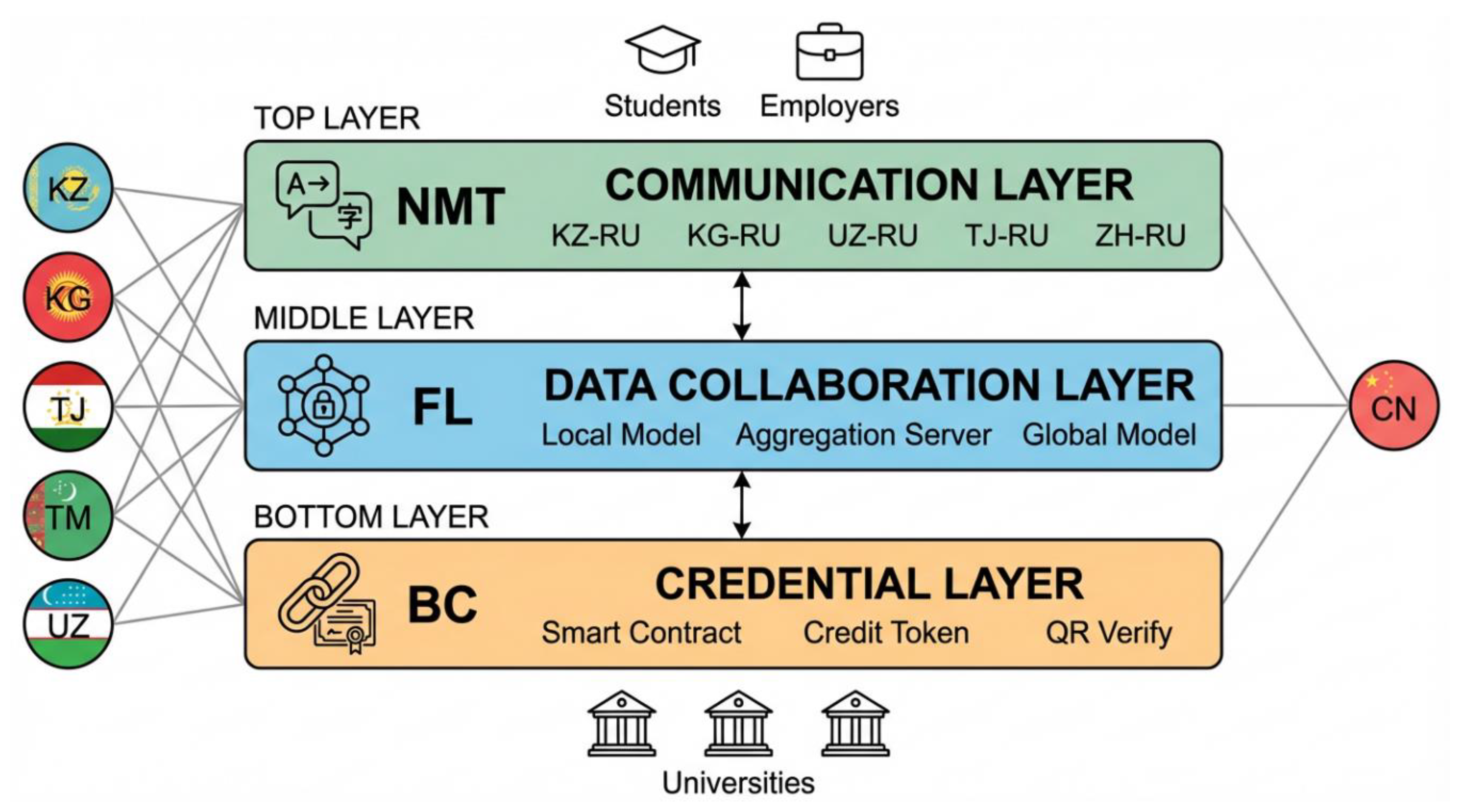
The Credential Layer employs blockchain technology to create a distributed, tamper-proof system for academic credential verification and credit transfer. This layer tackles the problems of manual verification, fraud, and lack of interoperability across national credential systems. Unlike centralized databases that require trust in a single authority, the blockchain-based credential layer distributes trust across network participants, rendering it suitable for cross-border settings where no single institution commands universal confidence.
The Data Collaboration Layer leverages federated learning and privacy-preserving machine learning to enable universities to collaborate on quality assurance models, learning analytics tools, and policy analysis without centralizing sensitive student data. This layer addresses data sovereignty concerns while enabling data-driven decision-making. By retaining raw data locally and sharing only model parameters, the approach respects national regulations while facilitating regional cooperation.
The Communication Layer utilizes neural machine translation to provide automated translation of academic materials, administrative documents, and communication platforms. This layer confronts language barriers that impede student mobility, faculty collaboration, and administrative coordination. Rather than mandating a single lingua franca, the communication layer enables multilingual interaction while preserving linguistic diversity.
These three layers are designed to be modular. Institutions can adopt individual components based on their specific needs and capacities, with full integration yielding the greatest benefits. This modularity honors the principle of variable geometry in regional integration, allowing different countries and institutions to participate at varying levels of depth.
3.2. Blockchain-Based Credential and Credit System
Building on the EduCTX model (Turkanović et al., 2018) and recent advances in privacy-preserving blockchain design (Berrios Moya et al., 2025), we propose a Central Asian Educational Blockchain (CAEB) for credential verification and credit transfer.
Technical Architecture. CAEB employs a hybrid blockchain design combining a public verification layer with private institutional ledgers. The public layer, built on a permissioned blockchain platform such as Hyperledger Fabric, stores cryptographic hashes of credentials and credit records. These hashes permit verification without exposing sensitive student information. Private institutional ledgers, maintained by individual universities, store complete student records with granular access controls. This dual-layer architecture balances the need for transparency in verification against the imperative of privacy in sensitive data management (Ayub Khan et al., 2021).
Credit Transfer Mechanism. CAEB implements a credit token system compatible with both ECTS and traditional Central Asian credit frameworks. Each completed course generates a credit token containing metadata about the course (institution, subject area, learning outcomes, assessment methods) and the student’s performance. Smart contracts automatically evaluate credit transfers against pre-agreed equivalency rules, eliminating the need for manual review in routine transfers while routing exceptional cases to human evaluators. This mechanism directly addresses the finding by Lodhi and Ilyassova-Schoenfeld (2023) that Bologna credit transfer mechanisms frequently fail in practice owing to administrative burden.
Credential Verification. Employers, universities, and other stakeholders can verify credentials by scanning QR codes on digital or physical diplomas. The verification process queries the blockchain to confirm that the credential hash matches the stored record and that the issuing institution is authorized. Zero-knowledge proofs enable selective disclosure, allowing students to demonstrate specific attributes (e.g., degree completion, GPA above a threshold) without revealing complete transcripts (Berrios Moya et al., 2025). Verification completes in seconds rather than the weeks or months required by traditional processes.
Governance Structure. CAEB operates under a consortium governance model in which participating universities and national education ministries jointly administer the network. Each country designates a national node operator responsible for maintaining blockchain infrastructure and enforcing national regulations. A regional governance council, comprising representatives from all participating countries, establishes technical standards, equivalency rules, and dispute resolution procedures.
3.3. Federated Learning for Quality Assurance and Learning Analytics
The data collaboration layer addresses the challenge of improving educational quality through data-driven insights while respecting data sovereignty and privacy regulations. We propose a Central Asian Federated Learning Network (CAFLN) for collaborative quality assurance and learning analytics.
Quality Assurance Applications. CAFLN enables universities to collaboratively train machine learning models for predicting student success, identifying at-risk students, and evaluating teaching effectiveness. For instance, universities could jointly develop early warning systems that flag students likely to drop out based on engagement patterns, academic performance, and demographic factors. Each university trains a local model on its own student data, then shares model parameters (not raw data) with a regional aggregation server. The resulting global model benefits from the collective experience of all participating institutions while keeping sensitive student data local (Kairouz & McMahan, 2021).
This approach directly responds to a key challenge identified by Biloshchytskyi et al. (2025): smaller universities often lack sufficient data to train robust predictive models. Through federated learning, a small university in Tajikistan can leverage patterns learned across the entire Central Asian network without compromising its students’ privacy. The approach also accommodates differences in student populations through personalized federated learning techniques that allow each institution to retain local model adaptations (Li et al., 2021).
Technical Implementation. CAFLN adopts a hierarchical federated learning architecture with three tiers: institutional, national, and regional. At the institutional level, individual universities train local models on their data. At the national level, national aggregation servers combine models from universities within each country. At the regional level, a Central Asian server synthesizes national models to produce region-wide insights. This hierarchical structure respects national data governance frameworks while enabling regional knowledge sharing.
Privacy and Security. CAFLN incorporates multiple privacy-preserving mechanisms. Differential privacy introduces calibrated noise to model parameters before sharing, preventing reconstruction of individual records (Zhu et al., 2022). Secure aggregation protocols ensure that the central server learns only the combined model, not individual institutional contributions (Bonawitz et al., 2019). These safeguards address the privacy concerns that have historically obstructed cross-border educational data sharing.
3.4. Neural Machine Translation for Multilingual Communication
The communication layer confronts language barriers through a Central Asian Multilingual Translation System (CAMTS) designed for educational contexts and low-resource Central Asian languages.
Technical Approach. CAMTS employs a multilingual neural machine translation architecture that trains on multiple Central Asian language pairs jointly (Aharoni et al., 2019). Rather than training separate models for each language pair, multilingual NMT enables knowledge sharing across related languages, improving performance for data-scarce pairs. Given the typological similarities among Turkic languages (Kazakh, Kyrgyz, Uzbek, Turkmen), language clustering methods (Tan et al., 2019) group these languages for joint training while treating Tajik and Russian as separate branches.
Domain Adaptation. CAMTS is specifically fine-tuned for educational discourse using parallel corpora of academic texts, course materials, and administrative documents. This addresses the limitation noted by Stahlberg (2020) that general-purpose translation systems often falter on specialized vocabulary. Transfer learning from high-resource language pairs (e.g., English–Russian) provides initial model parameters, which are subsequently refined using available Central Asian language data (Zoph et al., 2016).
Low-Resource Language Strategies. For language pairs with limited parallel data, CAMTS employs several augmentation techniques. Back-translation generates synthetic parallel data by translating monolingual text into the source language and using the original as the target reference (Kumar et al., 2021). Multilingual pre-training on large monolingual corpora provides language representations that bolster translation quality even with limited parallel data (Arivazhagan et al., 2019).
Quality Assurance and Human-in-the-Loop. Because machine translation remains imperfect, particularly for low-resource languages (Sindhujan et al., 2025), CAMTS incorporates human quality oversight. Professional translators review and correct machine translations of high-stakes documents such as diplomas, transcripts, and legal agreements. User feedback mechanisms allow students and faculty to report translation errors, with corrections feeding back into continuous system improvement.
3.5. Implementation Pathways and Pilot Projects
Successful implementation requires a phased approach that builds technical capacity, establishes governance structures, and demonstrates value through concrete pilot projects. We propose a three-phase strategy.

Table 1.
Three-Phase Implementation Strategy.
| Dimension | Phase 1: Foundation (Year 1–2) | Phase 2: Expansion (Year 3–4) | Phase 3: Institutionalization (Year 5+) |
|---|---|---|---|
| Objective | Build infrastructure and test feasibility | Scale pilots and integrate layers | Embed into governance and ensure sustainability |
| Credential Layer (BC) | Deploy nodes in 2 countries; bilateral credential pilot | Extend to all 5 countries; implement credit transfer in STEM | Full integration with national student information systems |
| Data Layer (FL) | Federated dropout prediction among 5–10 universities | Add curriculum analysis and teaching evaluation models | Region-wide quality benchmarks and policy analytics |
| Communication Layer (NMT) | Build models for KZ-RU, KG-RU, UZ-RU pairs | Cover all major Central Asian language pairs | Specialized models for academic and legal domains |
| Governance | Sign MoUs; form regional council and ethics board | Harmonize technical standards; update national laws | Permanent funding; connect with EHEA and Asian networks |
| Capacity Building | Train IT staff at pilot institutions | Faculty development for multilingual teaching | Regional centers of excellence; scholarship programs |
| Pilot Projects | (a) Bilateral credential verification; (b) Federated dropout prediction | (c) Virtual exchange program with translation support | (d) Full cross-border degree program |
| Key Partners | 2–3 governments, 5–10 universities, China (tech support) | All 5 governments, 20+ universities, World Bank, UNESCO | Regional organizations (SCO, EAEU), EU, ADB |
| Success Metrics | Verification time < 10 sec; FL model accuracy > 75% | 1,000+ verified credentials; 5+ language pairs online | 10,000+ annual users; legal recognition in all 5 countries |
Note. BC = Blockchain; FL = Federated Learning; NMT = Neural Machine Translation; MoU = Memorandum of Understanding; EHEA = European Higher Education Area; SCO = Shanghai Cooperation Organization; EAEU = Eurasian Economic Union; ADB = Asian Development Bank; STEM = Science, Technology, Engineering, and Mathematics. Success metrics are based on pilot project targets derived from existing blockchain verification systems (Cardenas-Quispe & Pacheco, 2025) and federated learning benchmarks (Li et al., 2020).
Phase 1: Foundation Building (Year 1–2). The first phase concentrates on establishing technical infrastructure, governance structures, and initial pilot projects. Key activities include deploying blockchain nodes in each participating country, configuring federated learning servers, and constructing initial CAMTS models for high-priority language pairs (Kazakh–Russian, Kyrgyz–Russian, Uzbek–Russian). Two pilot projects are proposed: (a) bilateral blockchain-based credential verification between two countries with existing recognition agreements, building on treaties such as the China–Kyrgyzstan mutual recognition agreement of 2002; and (b) a federated learning project among 5–10 universities across three countries to develop early warning systems for student dropout.
Phase 2: Expansion and Integration (Year 3–4). The second phase scales successful pilots and connects the three technological layers. The credential system expands to all participating countries. Federated learning applications broaden to encompass curriculum analysis and teaching quality evaluation. The translation system extends to cover all major Central Asian language pairs. A virtual exchange program is launched, enabling students from different countries to enroll in joint online courses with real-time translation support, thereby demonstrating the combined value of all three layers.
Phase 3: Institutionalization (Year 5+). The third phase embeds the framework into regional educational governance and ensures long-term sustainability. The framework is codified in regional educational agreements and national education strategies. Training programs are developed for university staff. Regional centers of excellence are established for blockchain, federated learning, and NMT research. Linkages are forged with other regional educational systems, particularly the European Higher Education Area.
3.6. The Chinese Perspective: South–South Cooperation and Technological Enablement
The proposed framework reflects a distinctly Chinese approach to educational regionalization that emphasizes technological enablement, mutual benefit, and respect for sovereignty. This approach diverges from traditional Western models in several important respects.
First, rather than requiring convergence around a single educational model, the framework privileges functional interoperability. Countries retain full control over curriculum design, pedagogical methods, and quality standards while gaining the capacity to recognize credentials, share data-driven insights, and communicate across language barriers. This philosophy aligns with China’s broader diplomatic principle of non-interference in internal affairs, applied here to the educational domain.
Second, the framework emphasizes technological leapfrogging rather than incremental institutional reform. By deploying technologies such as blockchain and federated learning, Central Asian countries can construct modern educational infrastructure without replicating the protracted institutional development trajectories of Europe or North America. China’s own experience illustrates this possibility: the National Smart Education Platform, launched in 2022, rapidly digitalized educational resource sharing across Chinese provinces, while blockchain-based credential verification pilots in Zhejiang and Guangdong have demonstrated the feasibility of decentralized academic record management at scale.
Third, the framework embodies principles of South–South cooperation by positioning China as a collaborative partner rather than a donor or normative model. China contributes technological expertise, infrastructure investment through the Digital Silk Road, and practical experience with large-scale educational digitalization. Crucially, however, the framework is designed and governed by Central Asian countries themselves, ensuring regional ownership and agency (Steiner-Khamsi, 2004).
Fourth, the framework generates reciprocal benefits. Central Asian countries gain access to advanced educational technologies and expanded educational opportunities for their citizens. China benefits from deepened educational ties with strategically important neighbors, enhanced people-to-people connectivity, and strengthened cooperation through educational exchange—outcomes that serve both developmental and diplomatic objectives.
4. Expert Validation
To ground the proposed framework in practitioner perspectives and assess its practical feasibility, we conducted semi-structured interviews with educational administrators and information technology specialists across three Central Asian countries. This section describes the methodology, presents the findings, and discusses how expert feedback informed refinements to the framework.
4.1. Methodology
Participant Selection. We employed purposive sampling to recruit eight experts from Kazakhstan, Kyrgyzstan, and Uzbekistan—the three countries with the most developed higher education digitalization infrastructure in the region. Participants were selected based on two criteria: (a) at least five years of professional experience in higher education administration or educational technology, and (b) direct involvement in cross-border educational cooperation or institutional digitalization initiatives. Table 2 summarizes participant profiles.
Interview Protocol. Semi-structured interviews were conducted between September and November 2025 via video conferencing (Zoom), with each session lasting 45–60 minutes. The interview guide comprised four thematic blocks: (1) current challenges in cross-border credential recognition and data sharing; (2) perceived feasibility and utility of blockchain-based credential verification; (3) attitudes toward federated learning for collaborative quality assurance; and (4) assessment of neural machine translation for multilingual academic communication. Interviews were conducted in Russian, the common professional language among participants, and audio-recorded with informed consent. Recordings were transcribed verbatim and analyzed using thematic analysis following Braun and Clarke’s (2006) six-phase approach.
Ethical Considerations. The study received ethical approval from the Research Ethics Committee of Kyrgyz Economic University Named After M. Ryskulbekov (Protocol No. 2025-09-03). All participants provided written informed consent. Identifying information has been anonymized, and participants are referred to by alphanumeric codes (E1–E8).
4.2. Findings
Thematic analysis yielded four overarching themes: (1) validation of the problem diagnosis, (2) differentiated technology acceptance, (3) infrastructure and capacity concerns, and (4) governance and trust considerations.
4.2.1. Validation of the Problem Diagnosis
All eight participants confirmed that the barriers identified in our literature review—credential recognition delays, data sovereignty concerns, and language barriers—accurately reflect their professional experience. E3 (Kyrgyzstan, International Cooperation Director) noted: “We spend three to four months verifying a single diploma from Uzbekistan. The process involves multiple ministries, notarized translations, and sometimes physical document inspection. Students lose an entire semester waiting.” E7 (Kazakhstan, Quality Assurance Director) corroborated this observation: “Our accreditation agency processes over 2,000 foreign credential verification requests annually. The manual system is unsustainable.”
Participants also emphasized a barrier that our initial framework had underweighted: the lack of standardized digital student records across institutions within the same country. E2 (Kazakhstan, IT Department Head) observed: “Before we can share credentials across borders, many universities need to digitize their own records. Some institutions in our country still rely on paper-based transcript systems.” This finding prompted us to add an institutional digitalization readiness assessment as a prerequisite step in Phase 1 of the implementation strategy.
4.2.2. Differentiated Technology Acceptance
Participants expressed varying levels of enthusiasm for the three technological components. Blockchain-based credential verification received the strongest endorsement. Six of eight participants rated it as “highly feasible” within a two-year horizon. E6 (Uzbekistan, Blockchain Research Lead) stated: “Blockchain for credentials is the lowest-hanging fruit. The technology is mature, the use case is clear, and the pain point is acute. We could pilot this between two universities within six months.”
Federated learning elicited more cautious responses. While participants recognized its theoretical value, five of eight expressed concerns about implementation complexity. E1 (Kazakhstan, Vice-Rector for Digitalization) remarked: “The concept of training models without sharing data is appealing, but our universities lack the machine learning expertise to participate meaningfully. We would need substantial capacity building before this becomes realistic.” E4 (Kyrgyzstan, Educational Technology Specialist) added: “The Ministry is interested in data-driven quality assurance, but we first need standardized data collection practices across universities.”
Neural machine translation generated the most polarized responses. Participants from Kazakhstan and Uzbekistan, where national language policies are actively promoting Kazakh and Uzbek respectively, viewed NMT as highly valuable. E5 (Uzbekistan, Dean of Distance Education) noted: “We are transitioning our curriculum from Russian to Uzbek, but we lack textbooks in many specialized fields. Machine translation of Russian-language materials could accelerate this transition enormously.” However, E3 (Kyrgyzstan) expressed skepticism about translation quality: “Academic texts require precision. A mistranslated term in engineering or medicine could have serious consequences. I would not trust machine translation for anything beyond administrative documents without expert review.”
4.2.3. Infrastructure and Capacity Concerns
Infrastructure readiness emerged as the most frequently cited implementation barrier. Seven of eight participants identified internet connectivity, server infrastructure, and technical staffing as critical constraints. E8 (Kyrgyzstan, IT Infrastructure Manager) provided a concrete assessment: “Our university has a 100 Mbps connection shared among 8,000 students. Running blockchain nodes or federated learning servers would require dedicated infrastructure that we currently cannot afford.”
Participants from Kazakhstan reported more favorable conditions. E1 noted: “Kazakhstan has invested heavily in digital infrastructure through the Digital Kazakhstan program. Our university already operates cloud-based student information systems. We could host blockchain nodes with relatively modest additional investment.” This disparity underscores the importance of the framework’s modular design, which allows countries to adopt components at different paces.
Human capacity was identified as equally critical. E4 (Kyrgyzstan) emphasized: “We have fewer than ten specialists in the entire country who understand blockchain at a technical level. Federated learning expertise is essentially nonexistent. Any implementation plan must include serious investment in training.” Participants unanimously endorsed the framework’s capacity-building provisions but recommended that training programs begin before, not concurrent with, technology deployment.
4.2.4. Governance and Trust Considerations
Governance arrangements provoked extensive discussion. Participants broadly supported the consortium governance model but raised concerns about power asymmetries. E7 (Kazakhstan) cautioned: “Kazakhstan’s universities are larger and better resourced. We must ensure that governance structures give equal voice to smaller countries, or the initiative will be perceived as Kazakh-dominated.” E3 (Kyrgyzstan) echoed this concern and extended it to China’s role: “Chinese technological support is welcome, but governance must remain firmly in Central Asian hands. If this is perceived as a Chinese project, political resistance will be inevitable.”
Trust in data integrity and institutional honesty also surfaced as a theme. E5 (Uzbekistan) noted: “Blockchain can verify that a credential was issued, but it cannot verify that the credential was earned honestly. Grade inflation and diploma mills are real problems in our region. Technology alone cannot solve institutional integrity issues.” This observation highlights the complementary relationship between technological solutions and institutional reform—a point we have incorporated into the discussion section.
4.3. Framework Refinements Based on Expert Feedback
Expert interviews prompted several refinements to the proposed framework. First, we added an institutional digitalization readiness assessment as a prerequisite activity in Phase 1, addressing the finding that many universities lack standardized digital records. Second, we strengthened the capacity-building timeline, recommending that training programs commence 6–12 months before technology deployment rather than running concurrently. Third, we incorporated explicit provisions for governance equity, including weighted voting mechanisms that prevent domination by larger or wealthier institutions. Fourth, we added a human-in-the-loop quality threshold for NMT, specifying that machine translation of high-stakes documents (diplomas, transcripts, legal agreements) must undergo mandatory professional review. These refinements are reflected in the framework description in Section 3 and the implementation strategy in Table 1.
5. Discussion and Implications
5.1. Advantages of the Technology-Enabled Approach
The proposed framework, as refined through expert validation, offers several advantages over traditional approaches to educational integration.
Respecting Sovereignty While Enabling Cooperation. By retaining sensitive data locally through federated learning and allowing countries to maintain their own educational systems while achieving credential interoperability through blockchain, the framework addresses the sovereignty concerns that have historically obstructed regional integration. This is particularly salient because Central Asian countries, having gained independence relatively recently, are especially vigilant about initiatives that might diminish national autonomy (Silova & Niyozov, 2020). Expert interviews confirmed that this sovereignty-preserving design is a decisive factor in stakeholder acceptance.
Reducing Implementation Barriers. Traditional educational integration demands extensive institutional reforms, legal harmonization, and capacity building before benefits materialize. The technological approach permits faster implementation by targeting technical interoperability rather than institutional convergence. Blockchain-based credential verification can become operational as soon as participating institutions issue digital credentials, without requiring comprehensive reform of national education systems. Expert E6’s assessment that a bilateral credential pilot could launch within six months supports this advantage.
Scalability and Flexibility. The modular architecture allows countries and institutions to adopt components based on their specific needs and capacities. A country might begin with blockchain-based credential verification, subsequently add federated learning as technical capacity develops, and eventually incorporate translation services. This flexibility accommodates the significant disparities in technological readiness across Central Asian countries documented by Nikolaev et al. (2023) and confirmed by our expert interviews.
Creating Network Effects. As more institutions join the network, the value to all participants increases. Each additional university on the blockchain network expands credential recognition possibilities. Each additional institution in the federated learning network improves model quality. Each additional language pair in the translation system enhances communication reach. These network effects generate positive feedback loops that incentivize participation.
5.2. Challenges and Limitations
Despite these advantages, the proposed framework confronts real challenges that emerged both from the literature and from expert validation.
Technical Complexity. Operating blockchain, federated learning, and neural machine translation requires substantial technical expertise that may be scarce in Central Asian universities. While the framework incorporates capacity building, the technical learning curve remains steep. Maintaining and updating these systems also demands ongoing technical support that may strain institutional resources (Steiu, 2020). Expert interviews underscored this concern, with participants unanimously identifying human capacity as a critical bottleneck.
Regulatory and Legal Barriers. Current legal frameworks in Central Asian countries were designed for paper-based credential systems and centralized data management. Granting blockchain-based credentials legal validity requires legislative amendments. Kazakhstan’s education law (Law No. 319-III, 2007, amended 2024), Kyrgyzstan’s Education Law (No. 179, 2023), and Uzbekistan’s Education Law (No. ZRU-637, 2020) all require specific provisions for blockchain-based systems. Data protection regulations may also need revision to accommodate federated learning (Bhaskar et al., 2020).
Translation Quality Limitations. While neural machine translation has improved dramatically, it remains imperfect, particularly for low-resource languages and specialized academic writing. Sindhujan et al. (2025) documented persistent difficulties in translating into low-resource languages, including grammatical errors, mistranslation of technical terminology, and semantic loss. Expert E3’s concern about the consequences of mistranslated terms in specialized fields reinforces the necessity of the framework’s human-in-the-loop quality safeguards.
Geopolitical Sensitivities. The framework’s association with Chinese technological investment and the Belt and Road Initiative may provoke concerns about technological dependency and geopolitical influence. Central Asian countries have historically balanced competing influences from Russia, China, the West, and regional powers such as Turkey (Murzaeva, 2014). A framework perceived as primarily serving Chinese strategic interests could encounter resistance. Expert E3’s insistence that “governance must remain firmly in Central Asian hands” encapsulates this sensitivity. Addressing this concern requires genuine regional ownership, transparent governance, and demonstrable mutual benefit.
Digital Divide. Central Asian countries differ markedly in digital infrastructure, internet connectivity, and technological literacy. While Kazakhstan has invested substantially in digital infrastructure through its Digital Kazakhstan initiative (Amirbekova et al., 2025), other countries—particularly Tajikistan and Turkmenistan—face more severe connectivity constraints (Gaynor, 2017). The framework could exacerbate existing inequalities if technologically advanced countries capture disproportionate benefits. Targeted investment in digital infrastructure for less-connected countries is essential to ensure equitable participation.
Sustainability and Funding. The framework requires sustained financial investment for infrastructure maintenance, system upgrades, capacity building, and governance operations. Amerkulova and Albanbayeva (2025) document the financial constraints facing Central Asian universities, suggesting that diversified funding through public-private partnerships, user fees, and regional pooled funding mechanisms may be necessary.
5.3. Policy Implications
For Central Asian Governments. Governments should update legal frameworks to recognize blockchain-based credentials as legally valid. They should invest in digital infrastructure and technical capacity building at universities, with priority given to institutions in less-connected regions. Governments should establish data governance frameworks that balance privacy protection with the data sharing required for federated learning. National education development programs, such as Kazakhstan’s State Program for Education Development 2020–2025 (Government of Kazakhstan, 2019) and Kyrgyzstan’s Education Development Program 2021–2040 (Government of Kyrgyzstan, 2021), should incorporate technology-enabled integration as a strategic priority. The Kyrgyz Republic’s recent establishment of the Department for Education Quality Development (Cabinet of Ministers Resolution No. 568, 2024) provides an institutional foundation for quality assurance data governance.
For Educational Institutions. Universities should commence digitizing academic records and building institutional capacity for blockchain-based credential issuance. Early adopters will gain competitive advantages in attracting internationally mobile students. Biloshchytskyi et al. (2024) demonstrate that integrated information systems can enhance quality management at the institutional level, providing a foundation for participation in regional networks. Universities should also invest in faculty development for multilingual teaching supported by machine translation tools.
For China and International Partners. China should approach its role as a technological partner with sensitivity to regional concerns regarding dependency and influence. Transparent governance structures, open-source technology components, and genuine knowledge transfer are essential for building trust and ensuring sustainability. The framework should be positioned as a regional initiative supported by Chinese technology rather than a Chinese initiative imposed on the region. International organizations such as the World Bank, UNESCO, and the Asian Development Bank should support the framework through technical assistance, capacity building, and pilot project funding. The European Union should view the framework as complementary to its own educational cooperation programs in Central Asia, including Erasmus+ and Bologna Process engagement. Ensuring interoperability between the Central Asian framework and the European Higher Education Area would benefit all parties by expanding educational opportunities and facilitating global mobility.
6. Conclusion
This paper has proposed a technology-enabled framework for constructing a unified educational space in Central Asia, integrating blockchain, federated learning, and neural machine translation. The framework targets specific barriers to educational integration that traditional approaches grounded in institutional harmonization have struggled to overcome.
Our review of existing literature demonstrates that Bologna-style reforms in Central Asia have achieved limited success owing to institutional resistance, economic constraints, linguistic diversity, and data sovereignty concerns. While these obstacles are well documented, alternative integration models have not been adequately articulated. The proposed framework fills this gap by presenting a technology-enabled approach that prioritizes functional interoperability over normative convergence.
The framework’s three technological layers address distinct but interconnected challenges. The blockchain-based credential layer enables secure, rapid verification and credit transfer without requiring centralized trust authorities. The federated learning layer facilitates collaborative quality improvement while retaining sensitive data locally. The neural machine translation layer helps overcome language barriers while preserving linguistic diversity. Together, these layers constitute a comprehensive infrastructure for educational integration that respects national sovereignty and institutional autonomy.
The expert validation conducted with eight educational administrators and IT specialists across Kazakhstan, Kyrgyzstan, and Uzbekistan confirms the framework’s practical relevance while identifying critical preconditions for successful implementation. Participants endorsed blockchain-based credential verification as the most immediately feasible component, highlighted infrastructure readiness and human capacity as primary constraints, and emphasized the importance of governance equity and regional ownership. These practitioner insights have informed concrete refinements to the framework, including the addition of institutional digitalization readiness assessments, strengthened capacity-building timelines, and mandatory human review for high-stakes translated documents.
From a Chinese perspective, the framework reflects principles of South–South cooperation and technological enablement through the Belt and Road Initiative. China’s experience with large-scale educational digitalization, together with its expertise in blockchain, artificial intelligence, and machine translation, positions it as a valuable partner for Central Asian educational development. However, the framework’s success hinges on genuine regional ownership, transparent governance, and demonstrable mutual benefit rather than unilateral dependency.
Several limitations of this study warrant acknowledgment. First, the expert validation, while informative, is limited to eight participants from three countries; future research should expand the sample to include Tajikistan and Turkmenistan and incorporate perspectives from students and faculty. Second, the technical components require further development and testing in Central Asian contexts, particularly neural machine translation for low-resource Central Asian languages. Third, the governance and institutional arrangements proposed here require negotiation among diverse stakeholders with potentially divergent interests.
Future research should proceed in several directions. Empirical studies should test the technical feasibility and user acceptance of each framework component through prototype implementations in Central Asian educational settings. Comparative research should examine how similar technology-enabled integration approaches function in other regions facing comparable challenges. Longitudinal studies should track the effects of technological interventions on student mobility, credential recognition, and educational quality over time. Research should also explore how emerging technologies such as large language models, decentralized identity systems, and quantum-resistant cryptography might extend or enhance the proposed framework.
Educational integration in Central Asia represents both a formidable challenge and a genuine opportunity. The region’s shared historical legacy, geographic proximity, and deepening economic ties provide a robust foundation for cooperation. By harnessing emerging technologies and embracing diverse pathways to integration, Central Asian countries can construct an educational space that serves their students, institutions, and societies while contributing to broader global educational development.
Funding
This research received no external funding.
Ethics Approval
This study received ethical approval from the Research Ethics Committee of Kyrgyz Economic University Named After M. Ryskulbekov (Protocol No. 2025-09-03).
Data Availability Statement
Interview transcripts are not publicly available due to participant confidentiality agreements. Summary data supporting the findings are available from the corresponding author upon reasonable request.
Conflicts of Interest
The authors declare no conflict of interest.
References
- Acharya, A. How ideas spread: Whose norms matter? Norm localization and institutional change in Asian regionalism. International Organization 2004, 58(2), 239–275. [Google Scholar] [CrossRef]
- Aharoni, R.; Johnson, M.; Firat, O. Massively multilingual neural machine translation. Proceedings of the 2019 Conference of the North American Chapter of the Association for Computational Linguistics: Human Language Technologies 2019, 1, 3874–3884. [Google Scholar] [CrossRef]
- Alsobhi, H. A.; Alakhtar, R. A.; Ubaid, A.; Hussain, O. K.; Hussain, F. K. Blockchain-based micro-credentialing system in higher education institutions: Systematic literature review. Knowledge-Based Systems 2023, 265, 110238. [Google Scholar] [CrossRef]
- Amirbekova, D.; Makhanova, A.; Kussaiyn, M. Aligning higher education toward the development of an educational hub: The case of Kazakhstan. Education Sciences 2025, 15(12), 1597. [Google Scholar] [CrossRef]
- Anafinova, S. Localization of the Bologna Process in post-Soviet context: The case of Kazakhstan. Journal of Comparative & International Higher Education 2024, 16(3). [Google Scholar] [CrossRef]
- Arivazhagan, N.; Bapna, A.; Firat, O.; Lepikhin, D.; Johnson, M.; Krikun, M.; Chen, M. X.; Cao, Y.; Foster, G.; Cherry, C.; Macherey, W.; Chen, Z.; Wu, Y. Massively multilingual neural machine translation in the wild: Findings and challenges. arXiv 2019. [Google Scholar] [CrossRef]
- Ayub Khan, A.; Laghari, A. A.; Shaikh, A. A.; Bourouis, S.; Mamlouk, A. M.; Alshazly, H. Educational blockchain: A secure degree attestation and verification traceability architecture for higher education commission. Applied Sciences 2021, 11(22), 10917. [Google Scholar] [CrossRef]
- Beimenbetov, S. Bologna Process implementation in Central Asia. In Conference Proceedings (p. 125); 2022; Available online: https://kazconf.com/files/archive/884899.pdf#page=124.
- Berrios Moya, J. A.; Ayoade, J.; Uddin, M. A. A zero-knowledge proof-enabled blockchain-based academic record verification system. Sensors 2025, 25(11), 3450. [Google Scholar] [CrossRef]
- Bhaskar, P.; Tiwari, C. K.; Joshi, A. Blockchain in education management: Present and future applications. Interactive Technology and Smart Education 2020, 18(1), 1–17. [Google Scholar] [CrossRef]
- Biloshchytskyi, A.; Mukhatayev, A.; Kuchanskyi, O.; Omirbayev, S.; Andrashko, Y.; Biloshchytska, S. Method for assessing quality assurance in higher education institutions. TEM Journal 2025, 14(1), 372–386. [Google Scholar] [CrossRef]
- Biloshchytskyi, A.; Omirbayev, S.; Mukhatayev, A.; Kuchanskyi, O.; Hlebena, M.; Andrashko, Y.; Mussabayev, N.; Faizullin, A. Structural models of forming an integrated information and educational system quality management of higher and postgraduate education. Frontiers in Education 2024, 9, 1291831. [Google Scholar] [CrossRef]
- Bonawitz, K.; Eichner, H.; Grieskamp, W.; Huba, D.; Ingerman, A.; Ivanov, V.; Kiddon, C.; Konečný, J.; Mazzocchi, S.; McMahan, B.; Van Overveldt, T.; Petrou, D.; Ramage, D.; Roselander, J. Towards federated learning at scale: System design. Proceedings of Machine Learning and Systems 2019, 1, 374–388. [Google Scholar]
- Braun, V.; Clarke, V. Using thematic analysis in psychology. Qualitative Research in Psychology 2006, 3(2), 77–101. [Google Scholar] [CrossRef]
- Cardenas-Quispe, M. A.; Pacheco, A. Blockchain ensuring academic integrity with a degree verification prototype. Scientific Reports 2025, 15(1), 9281. [Google Scholar] [CrossRef]
- Chen, G.; Xu, B.; Lu, M.; Chen, N.-S. Exploring blockchain technology and its potential applications for education. Smart Learning Environments 2018, 5(1), 1. [Google Scholar] [CrossRef]
- Gaynor, K. L. Transformations in Turkmen higher education: Current opportunities and challenges at a new university. Central Asian Survey 2017, 36(4), 473–492. [Google Scholar] [CrossRef]
- Heyneman, S. P.; Skinner, B. T. The Bologna Process in the countries of the former Soviet Union: An outsider’s perspective. In The European higher education area: Between critical reflections and future policies; Curaj, A., Matei, L., Pricopie, R., Salmi, J., Scott, P., Eds.; Springer, 2014; pp. 635–655. [Google Scholar] [CrossRef]
- Isaacs, A. K. Building a higher education area in Central Asia: Challenges and prospects. Tuning Journal for Higher Education 2014, 2(1), 31–58. [Google Scholar] [CrossRef]
- Kairouz, P.; McMahan, H. B. Advances and open problems in federated learning. Foundations and Trends in Machine Learning 2021, 14(1–2), 1–210. [Google Scholar] [CrossRef]
- Koehn, P.; Knowles, R. Six challenges for neural machine translation; Proceedings of the First Workshop on Neural Machine Translation, 2017; pp. 28–39. [Google Scholar] [CrossRef]
- Kumar, S.; Anastasopoulos, A.; Wintner, S.; Tsvetkov, Y. Machine translation into low-resource language varieties; Proceedings of the 59th Annual Meeting of the Association for Computational Linguistics, 2021; pp. 110–121. [Google Scholar] [CrossRef]
- Li, Q.; He, B.; Song, D. Model-contrastive federated learning. In Proceedings of the IEEE/CVF Conference on Computer Vision and Pattern Recognition (CVPR); 2021; pp. 10713–10722. [Google Scholar]
- Li, T.; Sahu, A. K.; Talwalkar, A.; Smith, V. Federated learning: Challenges, methods, and future directions. IEEE Signal Processing Magazine 2020, 37(3), 50–60. [Google Scholar] [CrossRef]
- Lodhi, I.; Ilyassova-Schoenfeld, A. The Bologna process and its impact on the higher education reforms in Kazakhstan: A case of policy transfer and translations. Studies in Higher Education 2023, 48(1), 204–219. [Google Scholar] [CrossRef]
- Mohassel, P.; Zhang, Y. SecureML: A system for scalable privacy-preserving machine learning; 2017 IEEE Symposium on Security and Privacy (SP), 2017; pp. 19–38. [Google Scholar] [CrossRef]
- Murzaeva, D. Kyrgyzstan-Turkey relations: Cooperation in political and educational spheres. Review of European Studies 2014, 6(3), 39. [Google Scholar] [CrossRef]
- Nakata, S.; Fasih, T. The road home and abroad: Enhancing TVET for youths and migration in Central Asia; World Bank, 2025. [Google Scholar]
- Nikolaev, D.; Ambasz, D.; Malinovskiy, S.; Olszak-Olszewski, A.; Zavalina, P.; Botero Álvarez, J. Towards higher education excellence in Central Asia: A roadmap for improving the quality of education and research through regional integration; World Bank, 2023. [Google Scholar] [CrossRef]
- Odilova, G.; Zaripova, M.; Jabbarova, A.; Urinova, N.; Davlatova, M.; Sapaev, I.; Allashev, A.; Akhrorova, M. Information security framework for online language education using differential privacy and secure multi-party computation algorithm. Journal of Internet Services and Information Security 2025, 15(1). [Google Scholar] [CrossRef]
- Phillips, D.; Ochs, K. Processes of policy borrowing in education: Some explanatory and analytical devices. Comparative Education 2003, 39(4), 451–461. [Google Scholar] [CrossRef]
- Raimundo, R.; Rosário, A. Blockchain system in the higher education. European Journal of Investigation in Health, Psychology and Education 2021, 11(1), 276–293. [Google Scholar] [CrossRef] [PubMed]
- Ranathunga, S.; Lee, E.-S. A.; Prifti Skenduli, M.; Shekhar, R.; Alam, M.; Kaur, R. Neural machine translation for low-resource languages: A survey. ACM Computing Surveys 2023, 55(11), 229:1–229:37. [Google Scholar] [CrossRef]
- Sabzalieva, E. Higher education policy in Central Asia and Afghanistan. In Handbook on higher education policy and governance; Huisman, J., Naidoo, A., Jongbloed, B., Eds.; Edward Elgar, 2018. [Google Scholar]
- Silova, I.; Niyozov, S. Globalization on the margins: Education and post-socialist transformations in Central Asia, 2nd ed.; Information Age Publishing, 2020. [Google Scholar]
- Sindhujan, A.; Kanojia, D.; Orasan, C.; Qian, S. When LLMs struggle: Reference-less translation evaluation for low-resource languages. arXiv 2025. [Google Scholar] [CrossRef]
- Stahlberg, F. Neural machine translation: A review. Journal of Artificial Intelligence Research 2020, 69, 343–418. [Google Scholar] [CrossRef]
- Steiner-Khamsi, G. The global politics of educational borrowing and lending; Teachers College Press, 2004. [Google Scholar]
- Steiu, M.-F. Blockchain in education: Opportunities, applications, and challenges. First Monday 2020, 25(9). [Google Scholar] [CrossRef]
- Tan, X.; Chen, J.; He, D.; Xia, Y.; Qin, T.; Liu, T.-Y. Multilingual neural machine translation with language clustering. In Proceedings of the 2019 Conference on Empirical Methods in Natural Language Processing (EMNLP); 2019. [Google Scholar] [CrossRef]
- Tight, M. Internationalisation of higher education beyond the West: Challenges and opportunities — the research evidence. Educational Research and Evaluation 2022, 27(3–4), 239–259. [Google Scholar] [CrossRef]
- Turkanović, M.; Hölbl, M.; Košič, K.; Heričko, M.; Kamišalić, A. EduCTX: A blockchain-based higher education credit platform. IEEE Access 2018, 6, 5112–5127. [Google Scholar] [CrossRef]
- Ubaydullaeva, D. The state of higher education sector in Soviet and post-Soviet Uzbekistan. In Higher Education in Uzbekistan; Springer, 2025. [Google Scholar] [CrossRef]
- Xu, R.; Baracaldo, N.; Joshi, J. Privacy-preserving machine learning: Methods, challenges and directions; arXiv, 2021. [Google Scholar] [CrossRef]
- Zhang, C.; Xie, Y.; Bai, H.; Yu, B.; Li, W.; Gao, Y. A survey on federated learning. Knowledge-Based Systems 2021, 216, 106775. [Google Scholar] [CrossRef]
- Zhao, Y.; Li, M.; Lai, L.; Suda, N.; Civin, D.; Chandra, V. Federated learning with non-IID data. arXiv 2018. [Google Scholar] [CrossRef]
- Zhu, T.; Ye, D.; Wang, W.; Zhou, W.; Yu, P. S. More than privacy: Applying differential privacy in key areas of artificial intelligence. IEEE Transactions on Knowledge and Data Engineering 2022, 34(6), 2824–2843. [Google Scholar] [CrossRef]
- Zoph, B.; Yuret, D.; May, J.; Knight, K. Transfer learning for low-resource neural machine translation; Proceedings of the 2016 Conference on Empirical Methods in Natural Language Processing, 2016; pp. 1568–1575. [Google Scholar] [CrossRef]
- Amerkulova, Zh.; Albanbayeva, D.; Sharsheeva, A. Effective strategic management of Kyrgyzstan universities through monitoring and quality assurance systems. Bulletin of Science and Practice 2024, 10(12), 565–577. [Google Scholar] [CrossRef]
- Amerkulova, Zh. D.; Albanbayeva, D. O. Improving the efficiency of financial resource utilization in higher education institutions (evidence from Kyrgyzstan, Kazakhstan, and Uzbekistan). International Journal of Humanities and Natural Sciences 2025. [Google Scholar] [CrossRef]
- Government of Kazakhstan. State program for the development of education and science of the Republic of Kazakhstan for 2020–2025. 2019. Available online: https://adilet.zan.kz/rus/docs/P1900000988.
- Government of Kyrgyzstan. Education development program of the Kyrgyz Republic for 2021–2040. 2021. Available online: http://cbd.minjust.gov.kg/act/view/ru-ru/12558.
- Republic of Kazakhstan. Law of the Republic of Kazakhstan on education (No. 319-III). 2007, amended 2024. Available online: https://adilet.zan.kz/eng/docs/Z070000319_.
- Kyrgyz Republic. Law of the Kyrgyz Republic on education (No. 179). 2023. Available online: http://cbd.minjust.gov.kg/act/view/ru-ru/112213.
- Republic of Uzbekistan. Law of the Republic of Uzbekistan on education (No. ZRU-637). 2020. Available online: https://lex.uz/docs/5013007.
Table 2.
Expert Interview Participant Profiles.
| ID | Country | Role | Experience (Years) | Institutional Type |
|---|---|---|---|---|
| E1 | Kazakhstan | Vice-Rector for Digitalization | 12 | National research university |
| E2 | Kazakhstan | Head of IT Department | 8 | Private university |
| E3 | Kyrgyzstan | Director of International Cooperation | 15 | Public university |
| E4 | Kyrgyzstan | Educational Technology Specialist | 6 | Ministry of Education |
| E5 | Uzbekistan | Dean of Distance Education | 10 | State university |
| E6 | Uzbekistan | Blockchain Research Lead | 7 | Technology institute |
| E7 | Kazakhstan | Quality Assurance Director | 11 | Accreditation agency |
| E8 | Kyrgyzstan | IT Infrastructure Manager | 9 | Public university |
Disclaimer/Publisher’s Note: The statements, opinions and data contained in all publications are solely those of the individual author(s) and contributor(s) and not of MDPI and/or the editor(s). MDPI and/or the editor(s) disclaim responsibility for any injury to people or property resulting from any ideas, methods, instructions or products referred to in the content. |
© 2026 by the authors. Licensee MDPI, Basel, Switzerland. This article is an open access article distributed under the terms and conditions of the Creative Commons Attribution (CC BY) license (http://creativecommons.org/licenses/by/4.0/).
Copyright: This open access article is published under a Creative Commons CC BY 4.0 license, which permit the free download, distribution, and reuse, provided that the author and preprint are cited in any reuse.


