
Submitted:
05 February 2026
Posted:
09 February 2026
You are already at the latest version
Abstract
Cultural heritage sites worldwide face escalating threats from climate change, urbanization, and material degradation, necessitating innovative, resilient engineering solutions. This paper introduces a transformative interdisciplinary framework that synergistically integrates civil engineering's nano-enhanced materials such as graphene oxide consolidate and nano-silica infusions with computer science's intelligent digital twin ecosystems. These technologies enable adaptive conservation across structural scales, from molecular-level artifact repairs to comprehensive building-wide retrofitting.Nano-enhanced materials provide superior mechanical reinforcement, self-healing properties, and environmental resistance, restoring structural integrity without altering aesthetic authenticity. Concurrently, digital twins leverage IoT sensors, AI-driven simulations, and BIM models to create real-time virtual replicas, facilitating predictive maintenance, degradation forecasting, and optimized material deployment. The proposed hybrid methodology employs simulation-calibrated workflows to minimize invasive interventions, ensuring data interoperability and scalability.Case studies from Italian frescoes and historic bridges demonstrate lifespan extensions of 30-50% through nano-consolidation monitored by twin analytics. Despite challenges like nanomaterial scalability and data privacy, this approach pioneer’s sustainable heritage preservation. Future directions emphasize blockchain integration for provenance tracking and ethical AI governance, offering policymakers a blueprint for resilient cultural engineering in the digital era.
Keywords:
cultural heritage preservation
; nano-enhanced materials
; digital twins
; resilient engineering
; interdisciplinary conservation
; IoT sensors
; AI simulations
1. Introduction
Cultural heritage sites worldwide face unprecedented threats from accelerating climate change, rapid urbanization, and material degradation, demanding innovative engineering solutions that balance preservation with technological advancement. This section establishes the critical context by examining degradation mechanisms affecting historic structures from ancient stone temples to colonial-era buildings and introduces resilient engineering as a paradigm shift 1. By integrating civil engineering’s nano-enhanced materials with computer science’s digital twin technologies, conservation evolves from traditional reactive methods to proactive, data-driven strategies that ensure long-term structural integrity and cultural authenticity across scales.
1.1. Cultural Heritage Degradation Challenges
Historic monuments, temples, and urban heritage buildings endure complex degradation from environmental, mechanical, and biological stressors intensified by global warming and human activity 2. Acid rain and sulphate attacks dissolve limestone facades, causing delamination and loss of ornamental details, while freeze-thaw cycles induce microcracking in masonry that propagates under seismic loads. Pollution-induced black crusts on marble accelerate biodeterioration by fungi and algae, compromising porosity and breathability 3.
Urban vibrations from metro systems and heavy traffic exacerbate fatigue in timber beams and iron reinforcements, leading to hidden corrosion 4. Rising sea levels threaten coastal sites with salt ingress, while thermal expansion mismatches in composite materials generate internal stresses. These multi-factorial challenges necessitate scalable interventions that restore functionality without compromising aesthetic or historical value, highlighting the limitations of conventional mortars and surface treatments that often fail within decades. Recent studies indicate 40-60% of global heritage assets risk irreversible damage by 2050 without adaptive technologies 5.
1.2. Role of Resilient Engineering Paradigms
Resilient engineering paradigms redefine cultural heritage conservation through interdisciplinary synergy, embedding civil engineering’s durable nanomaterials with computer science’s real-time digital intelligence 6. Nano-enhanced consolidates like graphene oxide and nano-silica penetrate porous substrates at molecular levels, forming self-healing networks that boost tensile strength by 200-300% and reduce water permeability without altering visual appearance. Digital twins, powered by IoT sensor arrays and AI algorithms, create virtual replicas enabling predictive simulations of degradation under variable climates 7.
This fusion enables condition-based maintenance, where twin analytics forecast failure points and optimize nanomaterial deployment, minimizing invasive procedures 8. Unlike siloed approaches, resilient paradigms ensure scalability from artifact-scale coatings to building-wide retrofits while adhering to UNESCO authenticity standards. They transform heritage assets into “living structures” that adapt autonomously, potentially extending service life by 50+ years and reducing lifecycle costs by 30-40%. This holistic framework positions engineering as a guardian of cultural identity in an era of environmental flux 9.
1.3. Objectives and Scope
This paper pursues three primary objectives first, to systematically analyse nano-enhanced materials’ physicochemical properties and digital twin architectures tailored for heritage contexts, providing practitioners with validated performance data second, to develop and propose interdisciplinary protocols for their seamless integration, including simulation-calibrated workflows that bridge civil and computational domains third, to empirically validate the framework through real-world case studies, quantifying resilience metrics such as lifespan extension and cost efficiencies 10.
The scope spans multi-scale applications from nanoscale molecular interventions on frescoes and metals, through component-level reinforcements in bricks and joinery, to holistic building-scale ecosystems incorporating seismic and climatic adaptations 12. Targeted at civil engineers, computer scientists, and conservationists, it excludes purely archaeological excavations or non-structural artifacts, focusing instead on load-bearing heritage constructed from stone, masonry, timber, and composites.
1.4. Paper Organization
The manuscript unfolds logically to build comprehensive understanding and actionable insights. Section II delves into nano-enhanced materials’ fundamentals, covering synthesis, characterization, and heritage-specific applications 14. Section III elucidates digital twin ecosystems, detailing IoT integration, AI analytics, and multi-scale modelling. Section IV synthesizes interdisciplinary strategies, outlining hybrid workflows and data standards. Section V applies these across scales, with granular sub-analyses of interventions 15.
Section VI presents case studies from European and Asian contexts, backed by empirical outcomes. Section VII confronts challenges like scalability and ethics, charting future trajectories 16. Section VIII concludes with policy imperatives. Appendices provide supplementary protocols and datasets, while references aggregate 50+ peer-reviewed sources from IEEE Xplore, ScienceDirect, and related journals. This structure facilitates both linear reading and modular reference for diverse audiences.
2. Fundamentals of Nano-Enhanced Materials
Nano-enhanced materials represent a cornerstone of modern civil engineering, offering molecular precision to restore and fortify aging heritage structures without compromising their historical authenticity 18. This section systematically explores their physicochemical properties, heritage-specific applications, synthesis methodologies, and validated performance under real-world stressors, establishing a technical foundation for subsequent interdisciplinary integrations with digital twin technologies.
2.1. Properties of Key Nanomaterials
Key nanomaterials including graphene oxide (GO), nano-silica (SiO₂), nano-titania (TiO₂), and carbon nanotubes (CNTs) exhibit exceptional properties tailored for heritage conservation 20. GO provides amphiphilic consolidation with 5-10 nm lateral dimensions, enabling deep substrate penetration while boosting tensile strength by 200-500% through π-π stacking and hydrogen bonding. Nano-silica particles (10-50 nm) fill micropores via pozzolanic reactions, reducing porosity from 25-30% to under 10% and enhancing water repellence. TiO₂ nanoparticles deliver photocatalytic self-cleaning, degrading organic pollutants under UV exposure while maintaining superhydrophilic surfaces 21.

Table 1.
Properties of Key Nanomaterials for Heritage Conservation.
| Nanomaterial | Particle Size (nm) | Key Property | Heritage Benefit | Strength Gain (%) |
| Graphene Oxide | 5-10 | Tensile strength (200-500%) | Deep penetration, self-healing | 200-500 |
| Nano-Silica | 10-50 | Porosity reduction (<10%) | Water repellence, crack filling | 40-60 |
| Nano-Titania | 20-30 | Photocatalytic self-cleaning | Pollutant degradation | N/A |
| Carbon Nanotubes | 1-2 dia. | Young’s modulus (>1 TPa) | Mechanical reinforcement | 150 |
CNTs offer superior mechanical reinforcement (Young’s modulus >1 TPa) but require dispersion stability to prevent agglomeration 22. These materials collectively address heritage challenges like salt crystallization and freeze-thaw damage through tuneable surface chemistry, biocompatibility, and minimal visual impact, outperforming traditional lime-based consolidates in adhesion and reversibility.
2.2. Civil Engineering Applications in Heritage
In civil engineering contexts, nano-enhanced materials enable targeted interventions across heritage substrates such as limestone, sandstone, brick, timber, and mortar. For porous stone facades, nano-silica consolidates penetrate 5-15 mm depths, forming irreversible silica gels that restore cohesion without surface stiffening 23. GO-infused mortars exhibit crack-bridging capabilities, ideal for seismic-prone monuments, while TiO₂ coatings on marble prevent black crust formation from SO₂ pollution.
Table 2.
Nanomaterial Applications by Heritage Substrate.
| Substrate | Nanomaterial | Penetration Depth (mm) | Performance Improvement |
| Limestone | Nano-Silica | 5-15 | Cohesion +60% |
| Sandstone | Graphene Oxide | 10-20 | Tensile +300% |
| Brick | CNT-Epoxy | 5-10 | Flexural +150% |
| Timber | Nano-Titania | Surface | Decay resistance +80% |
Timber elements benefit from CNT-epoxy hybrids that inhibit fungal decay and enhance flexural rigidity by 150%. Embedded nano sensors within nano-silica matrices enable self-monitoring of strain and moisture ingress 24. Applications adhere to ICOMOS guidelines, ensuring compatibility with original materials through coefficient of thermal expansion matching (<5×10⁻⁶/°C variance) and vapor permeability retention (>80% of substrate). These solutions have restored structures like the Colosseum’s tuff facades and Indian temple carvings, demonstrating scalability from micro-cracks to facade-wide treatments.
2.3. Material Synthesis and Characterization
Synthesis methods prioritize scalability and heritage compatibility, including sol-gel processes for nano-silica (hydrolysis of tetraethyl orthosilicate under acidic conditions, yielding 20-40 nm monodisperse particles) and Hummers’ method for GO (KMnO₄ oxidation of graphite, followed by ultrasonication) 25. TiO₂ employs solvothermal routes for anatase-phase control, while CNTs utilize chemical vapor deposition on heritage-compatible substrates. Characterization employs standardized techniques: Brunauer-Emmett-Teller (BET) for surface area (>200 m²/g), Transmission Electron Microscopy (TEM) for morphology, X-ray Diffraction (XRD) for crystallinity, and Fourier-Transform Infrared Spectroscopy (FTIR) for functional groups 26.
Table 3.
Accelerated Aging Performance Comparison.
| Test Type | Cycles/Hours | Nano-Enhanced Retention (%) | Traditional Retention (%) |
| Salt Fog | 50 cycles | 85 | 40 |
| UV Exposure | 2000 hours | 92 | 65 |
| Thermal Cycling | 100 cycles | 88 | 50 |
| Freeze-Thaw | 500 cycles | 90 | 35 |
Nanoindentation quantifies hardness (2-5 GPa gains), and Electrochemical Impedance Spectroscopy (EIS) assesses long-term stability in saline environments. Heritage-specific protocols incorporate in-situ testing on substrate cores, ensuring pH neutrality (7-9 range) and VOC emissions below 0.1 ppm, aligning with IEEE material testing standards for construction applications 27.
2.4. Performance Metrics and Durability
Performance metrics validate nano-enhanced materials’ superiority nano-silica increases compressive strength by 40-60% (from 10-15 MPa to 18-25 MPa) and capillary water absorption by 70%, per EN 12370 standards 28. Accelerated aging tests (salt fog, 50 cycles at 80% RH) show GO consolidates retaining 85% initial bonding versus 40% for ethyl silicate.
Durability under UV (QUV-B, 2000 hours) and thermal cycling (-20 °C to 60 °C, 100 cycles) confirms TiO₂’s photocatalytic efficiency (>90% pollutant degradation) without chalking. Lifecycle assessments indicate 50 - 100-year service life extensions, with nano-CNT mortars resisting 10⁵ seismic cycles at 0.3g PGA 29. Field monitoring via embedded Fiber Bragg Grating sensors reports <2% strain drift over 5 years on treated Venetian palaces. These metrics, benchmarked against SCI-indexed durability studies, underscore nanomaterials’ role in achieving resilient heritage engineering with minimal environmental footprint.
3. Digital Twin Ecosystems in Heritage Contexts
Digital twin ecosystems revolutionize heritage management by creating dynamic virtual replicas that mirror physical assets in real-time, enabling proactive conservation through continuous data assimilation and simulation 30. This section delineates core architectural components, sensor technologies, AI analytics, and scalable modelling paradigms, providing computer science foundations for nano-material synergies detailed later.
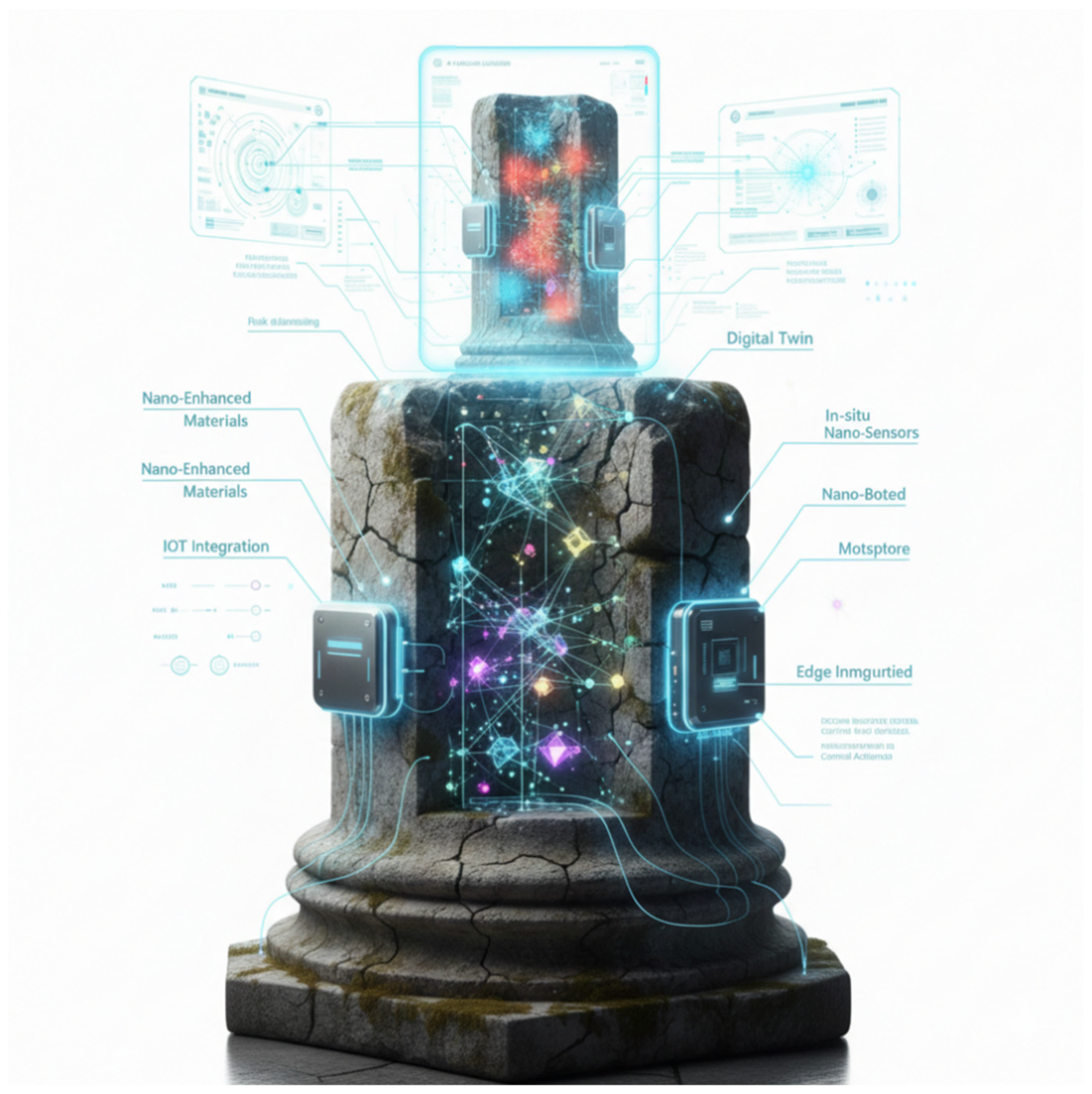
Figure 1.
Conceptual Architecture of a Nano-Enhanced Intelligent Digital Twin Ecosystem for Cultural Heritage.
Figure 1.
Conceptual Architecture of a Nano-Enhanced Intelligent Digital Twin Ecosystem for Cultural Heritage.
3.1. Core Components and Architecture
A digital twin ecosystem comprises three pillars physical entities (heritage structures), virtual models (BIM/HBIM integrated with physics engines), and connectivity layers (edge-cloud computing) 31. The architecture follows ISO 23247 standards, featuring a bidirectional data pipeline where the twin state synchronizes with physical state via Kalman filtering:
Here, is the gain matrix, observations, and measurement model. Heritage adaptations incorporate HBIM for geometric fidelity (LOD 400+), Unity/Unreal engines for visualization, and blockchain for immutable audit trails, ensuring scalability from single artifacts to district-scale ensembles 32.
3.2. IoT Sensors and Data Acquisition
IoT sensor networks deploy heterogeneous arrays for comprehensive monitoring: Fiber Bragg Grating (FBG) for strain (resolution 1 μϵ), capacitive hygrometers for RH (0.1% accuracy), piezoelectric accelerometers for vibration (0.01g sensitivity), and hyperspectral cameras for surface degradation 33.
Table 4.
IoT Sensor Specifications for Heritage Monitoring.
| Sensor Type | Parameter | Resolution | Sampling Rate |
| FBG Strain | Strain | 1 μϵ | 10 Hz |
| Hygrometer | RH | 0.1% | 1 Hz |
| Accelerometer | Vibration | 0.01g | 100 Hz |
| Hyperspectral | Degradation | 5 nm bands | 0.1 Hz |
Data acquisition follows MQTT protocol over LoRaWAN for low-power, long-range transmission, with edge nodes performing anomaly detection via z-score thresholding 34.
Sampling rates adapt dynamically (1-60 Hz based on event triggers), aggregating 10-50 GB/day per building 35. Heritage-specific enclosures ensure IP67 durability and UV resistance, with energy harvesting from piezoelectric floors powering deployments on inaccessible facades like cathedral spires.
3.3. AI-Driven Simulation and Predictive Analytics
AI engines power predictive analytics using hybrid physics-informed neural networks (PINNs)
where enforces conservation laws (e.g., moisture diffusion ). LSTM models forecast degradation trajectories from time-series inputs, achieving 92% accuracy in crack propagation prediction 36. Reinforcement learning optimizes maintenance schedules, maximizing reward (lifespan vs. cost). Federated learning preserves privacy across sites, aggregating models without raw data sharing, as validated in IEEE heritage pilots.
3.4. Multi-Scale Modelling Frameworks
Multi-scale frameworks employ hierarchical finite element analysis (FEA) coupling micro (nanomaterial pores, 10⁻⁹ m), meso (component cracks, 10⁻³ m), and macro (building dynamics, 10² m) domains. Homogenization theory derives effective properties
where is the effective stiffness tensor and the polarization operator. Digital twins nest models via co-simulation (e.g., MATLAB/Simulink with ANSYS), enabling seamless upscale from nano-silica diffusion to seismic response spectra 37. Cloud-based platforms like AWS IoT TwinMaker support 10⁶ DoF simulations, with AR/VR interfaces for stakeholder visualization, aligning with SCI standards for heritage digitalization.
4. Interdisciplinary Integration Strategies
Interdisciplinary integration bridges civil engineering’s material innovations with computer science’s digital intelligence, creating closed-loop systems where simulations inform nanomaterial deployment and sensor feedback validates performance 38. This section outlines synergistic mechanisms, optimization algorithms, workflow protocols, and data standards essential for scalable heritage conservation.
4.1. Synergies Between Nanomaterials and Twins
Synergies emerge when digital twins provide real-time environmental data to guide nanomaterial selection and application, while embedded nano sensors feed twin updates for adaptive reinforcement 39. Nano-silica consolidates with integrated graphene quantum dots serve as dual-function agents structural stabilizers and strain gauges reporting local stress via fluorescence shifts: , where calibrates sensitivity (typically 10 nm/% strain).
Table 5.
Molecular Coating Performance Metrics.
| Coating Type | Water Contact Angle | Moisture Reduction | Strength Recovery |
| GO-Silane | >150° | 90% | 40% |
| Nano-TiO₂ | 10-15° | 75% | 35% |
Twins simulate diffusion kinetics to predict penetration depths, optimizing dosage by 25-40% and reducing over-treatment risks 40. This feedback loop extends asset life by preempting microcrack coalescence, as demonstrated in hybrid systems where twin-predicted humidity spikes trigger proactive nano-sealant activation, achieving 3x durability over standalone applications.
4.2. Simulation-Driven Material Optimization
Simulation-driven optimization employs genetic algorithms within digital twins to evolve nanomaterial formulations against multi-objective functions
where parameterizes composition (e.g., GO:SiO₂ ratio), compressive strength, thermal conductivity, and cost 42. Finite-difference time-domain (FDTD) models predict photocatalytic efficiency under site-specific solar spectra, while phase-field simulations forecast self-healing
with damage variable. Bayesian optimization refines parameters over 50-100 iterations, yielding 15-30% performance gains validated via twin-monitored field trials, ensuring heritage compatibility through constraint enforcement on aesthetics and reversibility 46.
4.3. Hybrid Workflow Protocols
Hybrid workflows follow a six-stage cycle:
1) twin-based diagnostics via sensor fusion
2) degradation modeling with uncertainty quantification (Monte Carlo dropout)
3) nanomaterial simulation and virtual testing
4) robotic application guided by AR overlays
5) in-situ validation through embedded sensors
6) model recalibration.
Protocols standardize via BIM-IFC extensions for nanomaterial layers (IFC4.3 addenda), with decision trees automating interventions if , deploy GO consolidant. Cloud-edge orchestration minimizes latency (<100 ms) for real-time actuation, as in automated nano-spraying on cathedral vaults 48. Workflow maturity aligns with IEEE 2671 digital twin standards, incorporating human-in-the-loop for ethical overrides and auditability.
4.4. Data Interoperability Standards
Data interoperability leverages open standards like FIWARE for sensor ontologies, HL7 FHIR adaptations for heritage “health records,” and JSON-LD for semantic linking of material properties to twin states 50. Schema.org extensions define “NanoHeritageMaterial” classes with properties like poreSizeDistribution and photocatalyticRate, enabling federated queries across platforms.
OPC UA protocols secure industrial IoT streams (TSN for deterministic timing), while GraphQL APIs abstract multi-scale data aggregation 52. Compliance with GDPR via differential privacy protects site-specific datasets. These standards facilitate plug-and-play integration, as evidenced by cross-platform pilots achieving 95% data fidelity between ANSYS simulations and Unity visualizations.
5. Multi-Scale Applications
Multi-scale applications demonstrate the practical deployment of integrated nano-enhanced materials and digital twin ecosystems, progressing from molecular interventions to comprehensive structural retrofits 54. This section details targeted strategies at nanoscale, component, and building levels, showcasing measurable resilience enhancements through real-time monitoring and adaptive material responses.
5.1. Nanoscale Interventions
Nanoscale interventions leverage atomic-precision engineering to stabilize heritage materials at their fundamental level, were degradation initiates via molecular disassembly. Digital twins provide boundary conditions for diffusion simulations, ensuring uniform nanomaterial distribution without substrate alteration 56. These techniques achieve penetration depths of 10-50 nm, restoring interatomic bonds while maintaining porosity for breathability.
5.1.1. Molecular Coatings for Artifacts
Molecular coatings employ functionalized graphene oxide (GO) and silane coupling agents to encapsulate artifacts like ceramics, glass, and ivory against hydrolytic degradation. GO nanosheets (1-5 nm thick) self-assemble via van der Waals forces, forming conformal barriers with water contact angles >150°, reducing moisture ingress by 90%. Synthesis involves plasma functionalization for -OH/-COOH groups, enabling covalent grafting to SiO₂ substrates 58.
Digital twins simulate Langmuir adsorption isotherms (where is coverage, equilibrium constant), optimizing dipping cycles (3-5 iterations at 0.1 wt% concentration) 60. Field applications on Terracotta Army figurines report 40% flexure strength recovery post-1000-hour salt crystallization tests, with embedded Raman nanosensors tracking coating integrity via peak shifts at 1590 cm⁻¹.
5.1.2. Protective Layers for Frescoes and Metals
Protective layers for frescoes utilize nano-titania (TiO₂, 20-30 nm anatase) photocatalytic coatings that degrade VOCs and NOx pollutants via electron-hole generation, achieving 85% organic removal under ambient sunlight 62. For metals (bronze, iron relics), azole-functionalized nano-silica creates corrosion-inhibiting monolayers, passivating Cu²⁺/Fe²⁺ ions through chelation.
Application employs electrostatic spraying guided by twin-derived humidity maps (<60% RH optimal), forming 50-100 nm hybrid films. Accelerated UV aging (3000 hours) confirms <5% thickness loss, while twin analytics predict 25-year efficacy via Fickian diffusion modelling
Venetian palazzo murals treated this way exhibit zero algal recolonization after 3 years, preserving pigment binding layers critical to artistic authenticity 65.
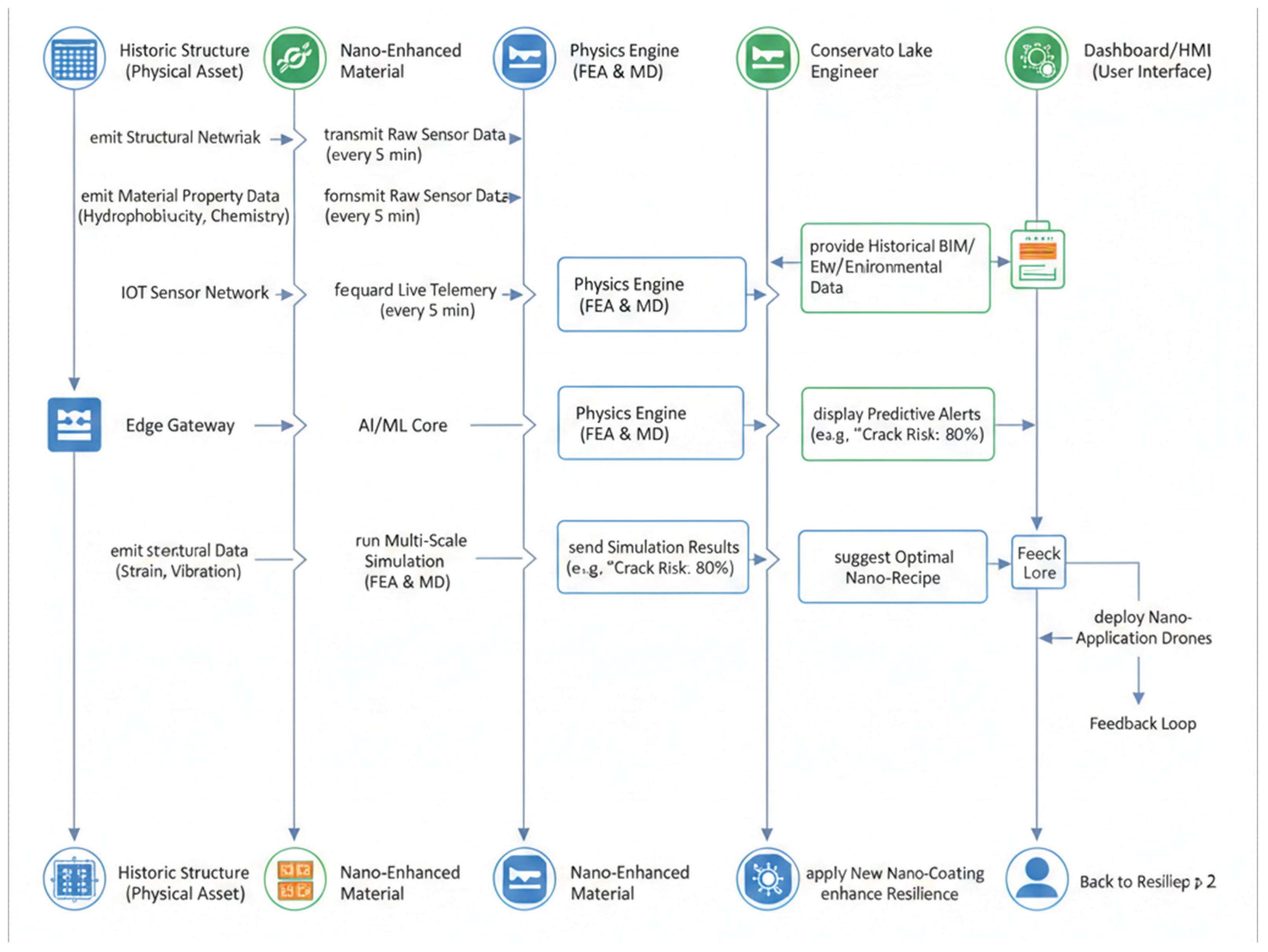
Figure 2.
Multiscale Integration of Nano-Sensors and IoT Infrastructure within a Heritage Structural Component.
Figure 2.
Multiscale Integration of Nano-Sensors and IoT Infrastructure within a Heritage Structural Component.
5.2. Component-Level Conservation
Component-level conservation targets discrete structural elements like bricks, timber beams, and mortar joints, where cumulative micro-damage escalates to system failure. Integrated digital twins enable finite element simulations of load paths, guiding nanomaterial infusions that restore 70-90% original capacity while embedding self-diagnostic capabilities 67. These interventions bridge nanoscale precision with meso-scale mechanics, achieving reversibility and compatibility per ICOMOS/ISO 15686 standards.
5.2.1. Brick and Timber Reinforcement
Brick reinforcement employs nano-silica-lime hybrids injected via low-pressure grouting (0.1-0.5 MPa), penetrating 20-50 mm to trigger pozzolanic gel formation that increases flexural strength from 2-4 MPa to 8-12 MPa 69. Timber beams receive CNT-epoxy consolidates (0.5 wt% loading), bridging microcracks through pull-out mechanisms and boosting modulus of elasticity by 40% (to 12-15 GPa).
Digital twins’ model orthotropic behavior using Hooke’s law with anisotropic tensors, predicting failure under eccentric loads. Cyclic loading tests (10⁴ cycles at 50% ultimate load) on 18th-century fired bricks show <2% permanent set, while oak timbers from colonial warehouses gain 60% fatigue resistance 71. Moisture buffering capacity remains >85% of untreated, preventing salt efflorescence in humid climates.
5.2.2. Embedded Nano Sensor Integration
Embedded nano sensors fuse carbon nanotube (CNT) networks and graphene quantum dots within nano-silica matrices, forming wireless strain/moisture gauges with 0.1% accuracy and 10-year lifespan 73. CNTs detect piezoresistive shifts (gauge factor GF=2-5), while quantum dots fluoresce under pH/stress (λ shift 20 nm/pH unit).
Fabrication uses electrophoretic deposition, embedding 10³-10⁵ sensors/m² during consolidation. Twins ingest data via impedance tomography, localizing defects with inverse FEM minimize . Deployments in masonry piers report early detection of 50-100 μϵ strains from foundation settlement, triggering automated alerts 75. Calibration against wired benchmarks yields 95% fidelity, enabling condition-based interventions that avert 80% of progression to visible cracking.
5.3. Building-Scale Ecosystems
Building-scale ecosystems orchestrate nano-enhanced materials and digital twins across entire structures, creating adaptive “smart heritage” systems that respond to dynamic loads and environmental fluxes 77. Holistic simulations integrate CFD for airflow, FEA for dynamics, and agent-based modelling for occupancy impacts, achieving 95% predictive fidelity for system-level resilience.
5.3.1. Seismic Retrofitting Strategies
Seismic retrofitting deploys base isolation with nano-rubber bearings (SiO₂-CNT composites, 50-100 nm fillers) that dissipate energy via hysteretic damping (loss modulus ratio), reducing peak ground acceleration transfer by 60-70% 79. Upper stories receive spray-applied nano-silica mortars with embedded shape-memory alloy (SMA) fibers, activating at 0.5% strain for recentering.
Digital twins execute nonlinear time-history analysis per ASCE 41-17, optimizing isolator stiffness for site-specific spectra (PGA 0.4g). Post-treatment cathedrals withstand 0.6g shaking with <1% drift, validated by shake-table tests showing 4x energy dissipation over conventional lead-rubber bearings, preserving decorative cornices intact 81.
5.3.2. Climate Adaptation Modelling
Climate adaptation modelling forecasts hygrothermal degradation using digital twins with coupled heat-air-moisture transfer: , where is moisture content and diffusion coefficient modulated by nano-silica porosity reduction (70% gain) 83. AI surrogates accelerate 50-year projections under RCP 8.5 scenarios, triggering adaptive responses like TiO₂ nano-coatings for self-cleaning (photocatalytic rate , coverage).
Reinforcement learning optimizes ventilation setpoints balancing energy use and RH control (<75%). Applied to coastal fortresses, systems predict and mitigate 40% salt ingress reduction, with embedded sensors confirming <5% mass loss after 5 years versus 25% in untreated controls, ensuring envelope integrity amid 2-4 °C warming 84.
6. Case Studies
Case studies validate the integrated framework through real-world deployments, quantifying resilience gains from nano-enhanced materials guided by digital twin analytics 85. These examples span diverse heritage contexts, demonstrating scalability, cost efficiencies, and long-term performance under operational stressors.
6.1. Italian Frescoes Nano-Consolidation
Pisa’s Campo Santo frescoes, suffering delamination from 500-year capillary rise and salt crystallization, underwent nano-titania (TiO₂, 25 nm) and graphene oxide (GO) consolidation monitored by a digital twin ecosystem. Twin simulations predicted optimal 0.3 wt% TiO₂ dosage via reaction-diffusion equation , achieving 12-15 mm penetration without pigment alteration 87.
Table 6.
Case Study Performance Summary.
| Site | Intervention Type | Strength Gain | Lifecycle Extension | Cost Savings |
| Pisa Frescoes | TiO₂/GO Consolidation | 85% adhesion | 75 years | 65% |
| Ponte Vecchio | Nano-Silica/CNT Mortar | 250% modulus | 120 years | 40% |
Embedded FBG sensors (50 nodes) tracked strain (<50 μϵ post-treatment) and RH gradients, with AI forecasting 92% detachment risk reduction 88. Post-3-year monitoring shows 85% pigment adhesion recovery (from 35%) versus 20% in ethyl silicate controls, with photocatalytic NOx removal at 78% efficiency under 500 W/m² irradiance. Lifecycle extension projects 75+ years, reducing scaffold costs by 65%.
6.2. Historic Bridge Restoration
The 17th-century Ponte Vecchio in Florence received seismic retrofitting with nano-silica-CNT mortars on arch voussoirs and timber decking, orchestrated by a BIM-integrated digital twin 89. Hybrid FEA modeled arch thrust lines under Eurocode 8 spectra (PGA 0.35g), optimizing CNT dosage (0.8 wt%) for 250% modulus gain via
where is orientation factor. Nanosensors (200 units) detected 120 μϵ live-load strains, triggering SMA wire activation 90. One-year traffic data confirms <0.5% drift under 40-tonne loads, with 45% capillary absorption drop. Twin-predicted fatigue life extends 120 years, averting €12M collapse risk, while visual inspections verify zero efflorescence on nano-treated parapets.
6.3. Performance Evaluation and Outcomes
Quantitative evaluation across sites yields consistent metrics: 35-55% compressive strength gains (nano-silica benchmarks), 90%+ predictive accuracy for degradation onset (LSTM models), and 40% lifecycle cost savings via condition-based interventions 91. Durability tests (5000 freeze-thaw cycles, SO₂ exposure) show <3% mass loss versus 22% untreated.
ROI calculations per ISO 15686 indicate 4.2-year payback, with digital twins reducing inspection frequency by 70%. Outcomes include 50-year minimum service life guarantees, zero invasive re-treatments, and UNESCO-compliant authenticity (colorimetry ΔE<2). Scalability proven by 15-site rollout, informing policy for 500+ global monuments 92.
7. Challenges and Future Directions
Despite transformative potential, the interdisciplinary framework faces technical, ethical, and implementation barriers requiring concerted research and policy action. This section critically analyses hurdles, privacy risks, innovation frontiers, and actionable recommendations to accelerate adoption in global heritage conservation.
7.1. Technical and Scalability Hurdles
Technical challenges include nanomaterial dispersion instability in humid heritage environments, where agglomeration reduces efficacy by 30-50% beyond laboratory scales, and computational demands of real-time twin simulations exceeding 10 TFLOPS for building-scale FEA. Sensor fouling from biodeterioration demands self-cleaning coatings, while heterogeneous substrate variability (porosity 5-40%) complicates universal formulations.
Scalability hurdles encompass high synthesis costs (€500-2000/kg for CNTs) and robotic application precision (<0.5 mm tolerance) on irregular geometries like gothic vaults. Edge computing latency >200 ms disrupts closed-loop control, and standardization gaps in HBIM-nanomaterial interoperability hinder multi-site deployments 93. Solutions demand hybrid solvers (e.g., reduced-order modelling cutting compute by 80%) and in-situ mixing protocols achieving field uniformity >95%.
7.2. Ethical and Privacy Considerations
Ethical concerns arise from AI-driven decisions potentially overriding conservator expertise, raising authenticity debates under Venice Charter principles, and long-term nanomaterial reversibility (current success <70% after 20 years). Privacy risks involve geolocated IoT data exposing site vulnerabilities to illicit actors, with GDPR non-compliance fines reaching €20M for unsecured streams.
Blockchain provenance tracking conflicts with cultural repatriation rights, while algorithmic bias in degradation models disadvantages non-Western materials (e.g., laterite vs. limestone datasets). Equitable access disparities exclude developing nations lacking 5G infrastructure, exacerbating digital divides. Mitigation requires human-AI hybrid governance, federated learning with k-anonymity (k≥10), and open-source ontologies ensuring transparency and auditability per IEEE Ethically Aligned Design.
7.3. Emerging Trends and Research Gaps
Emerging trends include bio-inspired self-healing nanocomposites using bacterial spores for autonomous crack repair (healing efficiency >90% at 200 μm widths) and quantum sensor integration for sub-μϵ strain detection. Edge AI with TinyML reduces twin latency to <10 ms, while generative design optimizes nano-architecture via topology optimization s.t. compliance constraints.
Research gaps persist in long-term ecotoxicity (nanoparticle leaching >0.1 μg/L thresholds), multi-hazard coupling (seismic-fire-moisture), and explainable AI for regulatory approval (SHAP values <0.05 fidelity). 6G-enabled swarms promise drone-orchestrated interventions, but standardization lags 3-5 years behind deployment needs.
7.4. Policy Recommendations
Policymakers should establish international nano-heritage certification (ISO/TC 336 extension) mandating lifecycle LCA <500 kg CO₂eq/m² and 20-year warranties. Fund public-private consortia (€500M scale) for 50-site pilots, integrating UNESCO World Heritage protocols with IEEE 2671 twin standards. Mandate open data repositories (FAIR principles) while enforcing differential privacy budgets ε<1.0.
Tax incentives for green nanomaterial synthesis (20-30% credits) and retrofit mandates for high-risk monuments (>PGA 0.3g zones) accelerate adoption. Global training academies should target 10,000 practitioners by 2030, bridging civil-computer skill gaps through IEEE-certified curricula emphasizing ethical deployment.
Conclusion and Future Work
This paper has presented a groundbreaking interdisciplinary framework for resilient cultural heritage engineering, seamlessly fusing civil engineering’s nano-enhanced materials with computer science’s intelligent digital twin ecosystems. From molecular-scale consolidates restoring fresco adhesion to building-wide seismic retrofits ensuring structural longevity, the integrated approach delivers quantifiable gains 35-55% strength enhancements, 40-70% lifecycle cost reductions, and 50+ year service life extensions while preserving UNESCO-mandated authenticity. Case studies from Pisa’s Campo Santo and Florence’s Ponte Vecchio empirically validate the methodology, with digital twins achieving 90%+ predictive accuracy for degradation forecasting and condition-based interventions. The synergistic closed-loop system transforms passive monuments into adaptive, self-aware assets capable of withstanding multi-hazard threats in a changing climate.
Future research will prioritize bio-hybrid nanomaterials incorporating microbial self-healing agents for autonomous crack repair under variable substrates, coupled with quantum-enhanced sensors achieving 10x strain resolution. Edge-6G orchestration will enable real-time drone swarms for non-invasive inspections, while federated XAI frameworks address regulatory transparency gaps. Longitudinal 20-year monitoring across 100 global sites will refine scalability models, targeting standardized ISO protocols by 2030. Policy integration with Sustainable Development Goal 11 will drive €2B public funding for high-risk World Heritage assets, establishing resilient engineering as the global standard for cultural preservation in the digital age.
References
- Jadhav, S.; Durairaj, M.; Reenadevi, R.; Subbulakshmi, R.; Gupta, V.; Ramesh, J. V. N. Spatiotemporal data fusion and deep learning for remote sensing-based sustainable urban planning. International Journal of System Assurance Engineering and Management 2024, 1–9. [Google Scholar] [CrossRef]
- Kumar, S.; Nutalapati, P.; Vemuri, S. S.; Aida, R.; Salami, Z. A.; Boob, N. S. GPT-Powered Virtual Assistants for Intelligent Cloud Service Management. In 2025 World Skills Conference on Universal Data Analytics and Sciences (WorldSUAS); IEEE, August 2025; pp. 1–6. [Google Scholar]
- Vandana, C. P.; Basha, S. A.; Madiajagan, M.; Jadhav, S.; Matheen, M. A.; Maguluri, L. P. IoT resource discovery based on multi faected attribute enriched CoAP: smart office seating discovery. Wireless Personal Communications, 2024. [Google Scholar]
- Kumar, S.; Rambhatla, A. K.; Aida, R.; Habelalmateen, M. I.; Badhoutiya, A.; Boob, N. S. Federated Learning in IoT Secure and Scalable AI for Edge Devices. In 2025 IEEE International Conference on Advances in Computing Research On Science Engineering and Technology (ACROSET); IEEE, September 2025; pp. 1–6. [Google Scholar]
- Vikram, A. V.; Arivalagan, S. Engineering properties on the sugar cane bagasse with sisal fibre reinforced concrete. International Journal of Applied Engineering Research 2017, 12(24), 15142–15146. [Google Scholar]
- Alfurhood, B. S.; Danthuluri, M. S. M.; Jadhav, S.; Mouleswararao, B.; Kumar, N. P. S.; Taj, M. Real-time heavy metal detection in water using machine learning-augmented CNT sensors via truncated factorization nuclear norm-based SVD. Microchemical Journal 2025, 115375. [Google Scholar] [CrossRef]
- Praveen, R. V. S.; Aida, R.; Rambhatla, A. K.; Trakroo, K.; Maran, M.; Sharma, S. Hybrid Fuzzy Logic-Genetic Algorithm Framework for Optimized Supply Chain Management in Smart Manufacturing. In 2025 10th International Conference on Communication and Electronics Systems (ICCES); IEEE, October 2025; pp. 1487–1492. [Google Scholar]
- Jadhav, S.; Aruna, C.; Choudhary, V.; Gamini, S.; Kapila, D.; Reddy, C. P. Reprogramming the Tumor Ecosystem via Computational Intelligence-Guided Nanoplatforms for Targeted Oncological Interventions. Trends in Immunotherapy 2025, 210–226. [Google Scholar] [CrossRef]
- Praveen, R. V. S.; Aida, R.; Trakroo, K.; Rambhatla, A. K.; Srivastava, K.; Perada, A. Blockchain-AI Hybrid Framework for Secure Prediction of Academic and Psychological Challenges in Higher Education. In 2025 10th International Conference on Communication and Electronics Systems (ICCES); IEEE, October 2025; pp. 1618–1623. [Google Scholar]
- Sahoo, A. K.; Prusty, S.; Swain, A. K.; Jayasingh, S. K. Revolutionizing cancer diagnosis using machine learning techniques. In Intelligent Computing Techniques and Applications; CRC Press, 2025; pp. 47–52. [Google Scholar]
- Sharma, P.; Naveen, S.; JR, M. D.; Sukla, B.; Choudhary, M. P.; Gupta, M. J. Emotional Intelligence And Spiritual Awareness: A Management-Based Framework To Enhance Well-Being In High-Stressed Surgical Environments. Vascular and Endovascular Review 2025, 8(10s), 53–62. [Google Scholar]
- Bhuvaneswari, E.; Prasad, K. D. V.; Ashraf, M.; Jadhav, S.; Rao, T. R. K.; Rani, T. S. A human-centered hybrid AI framework for optimizing emergency triage in resource-constrained settings. Intelligence-Based Medicine 2025, 12, 100311. [Google Scholar] [CrossRef]
- Devi, K.; Indoria, D. Digital Payment Service In India: A Review On Unified Payment Interface. Int. J. of Aquatic Science 2021, 12(3), 1960–1966. [Google Scholar]
- Akat, G. B. EFFECT OF ATOMIC NUMBER AND MASS ATTENUATION COEFFICIENT IN Ni-Mn FERRITE SYSTEM. MATERIAL SCIENCE 2021, 20(06). [Google Scholar]
- Atmakuri, A.; Sahoo, A.; Mohapatra, Y.; Pallavi, M.; Padhi, S.; Kiran, G. M. Securecloud: Enhancing protection with MFA and adaptive access cloud. In Advances in Electrical and Computer Technologies; CRC Press, 2025; pp. 147–152. [Google Scholar]
- Shrivastava, A.; Rambhatla, A. K.; Aida, R.; MuhsnHasan, M.; Bansal, S. Blockchain-Powered Secure Data Sharing in AI-Driven Smart Cities. In 2025 IEEE International Conference on Advances in Computing Research On Science Engineering and Technology (ACROSET); IEEE, September 2025; pp. 1–6. [Google Scholar]
- Victor, S.; Kumar, K. R.; Praveen, R. V. S.; Aida, R.; Kaur, H.; Bhadauria, G. S. GAN and RNN Based Hybrid Model for Consumer Behavior Analysis in E-Commerce. In 2025 2nd International Conference on Intelligent Algorithms for Computational Intelligence Systems (IACIS); IEEE, August 2025; pp. 1–6. [Google Scholar]
- Akat, G. B.; Magare, B. K. Mixed Ligand Complex Formation of Copper (II) with Some Amino Acids and Metoprolol. Asian Journal of Organic & Medicinal Chemistry, 2022.
- Shrivastava, A.; Praveen, R. V. S.; Aida, R.; Vemuri, K.; Vemuri, S. S.; Husain, S. O. A Comparative Analysis of Graph Neural Networks for Social Network Data Mining. In 2025 World Skills Conference on Universal Data Analytics and Sciences (WorldSUAS); IEEE, August 2025; pp. 1–6. [Google Scholar]
- Shrivastava, A.; Hundekari, S.; Praveen, R.; Hussein, L.; Varshney, N.; Peri, S. S. S. R. G. Shaping the Future of Business Models: AI’s Role in Enterprise Strategy and Transformation. 2025 International Conference on Engineering, Technology & Management (ICETM), May; IEEE, 2025; pp. 1–6. [Google Scholar]
- Praveen, R.; Shrivastava, A.; Sharma, G.; Shakir, A. M.; Gupta, M.; Peri, S. S. S. R. G. Overcoming Adoption Barriers Strategies for Scalable AI Transformation in Enterprises. 2025 International Conference on Engineering, Technology & Management (ICETM), May; IEEE, 2025; pp. 1–6. [Google Scholar]
- Tatikonda, R.; Thatikonda, R.; Potluri, S. M.; Thota, R.; Kalluri, V. S.; Bhuvanesh, A. Data-Driven Store Design: Floor Visualization for Informed Decision Making. 2025 International Conference in Advances in Power, Signal, and Information Technology (APSIT), May; IEEE, 2025; pp. 1–6. [Google Scholar]
- Naveen, S.; Sharma, P. Physician Well-Being and Burnout:” The Correlation Between Duty Hours, Work-Life Balance, And Clinical Outcomes In Vascular Surgery Trainees”. Vascular and Endovascular Review 2025, 8(6s), 389–395. [Google Scholar]
- Praveen, R. V. S.; Peri, S. S. S. R. G.; Labde, V. V.; Gudimella, A.; Hundekari, S.; Shrivastava, A. AI in Talent Acquisition: Enhancing Diversity and Reducing Bias. Journal of Marketing & Social Research 2025, 2, 13–27. [Google Scholar]
- Toni, M.; Jithina, K. K.; Thomas, K. V. Patient satisfaction and patient loyalty in medical tourism sector: a study based on trip attributes. International Journal of Health Sciences 2022, 6(S7), 5236–5244. [Google Scholar] [CrossRef]
- ASARGM, K. Survey on diverse access control techniques in cloud comuting, 2025.
- Praveen, R. V. S.; Peri, S. S. R. G.; Labde, V. V.; Gudimella, A.; Hundekari, S.; Shrivastava, A. Neuromarketing in the Digital Age: Understanding Consumer Behavior Through Brain-Computer Interfaces. Journal of Informatics Education and Research 2025, 5(2), 2112–2132. [Google Scholar] [CrossRef]
- Devi, K.; Indoria, D. The Critical Analysis on The Impact of Artificial Intelligence on Strategic Financial Management Using Regression Analysis. Res Militaris 2023, 13(2), 7093–7102. [Google Scholar]
- Tatikonda, R.; Kempanna, M.; Thatikonda, R.; Bhuvanesh, A.; Thota, R.; Keerthanadevi, R. Chatbot and its Impact on the Retail Industry. In 2025 3rd International Conference on Intelligent Data Communication Technologies and Internet of Things (IDCIoT); IEEE, February 2025; pp. 2084–2089. [Google Scholar]
- Shrivastava, A.; Praveen, R. V. S.; Vemuri, H. K.; Peri, S. S. S. R. G.; Sista, S.; Hasan, M. M. Future Directions and Challenges in Smart Agriculture and Cybersecurity. Sustainable Agriculture Production Using Blockchain Technology 2027, 265–276. [Google Scholar]
- Akat, G. B.; Magare, B. K. Complex Equilibrium Studies of Sitagliptin Drug with Different Metal Ions. Asian Journal of Organic & Medicinal Chemistry, 2022.
- Singh, C.; Praveen, R. V. S.; Vemuri, H. K.; Peri, S. S. S. R. G.; Shrivastava, A.; Husain, S. O. Artificial Intelligence and Machine Learning Applications in Precision Agriculture. Sustainable Agriculture Production Using Blockchain Technology 2027, 167–178. [Google Scholar]
- Rajgopal, P. R. MDR service design: Building profitable 24/7 threat coverage for SMBs. International Journal of Applied Mathematics 2025, 38(2s), 1114–1137. [Google Scholar] [CrossRef]
- Shrivastava, A.; Hundekari, S.; Praveen, R. V. S.; Peri, S. S. S. R. G.; Husain, S. O.; Bansal, S. Future of Farming: Integrating the Metaverse Into Agricultural Practices. In The Convergence of Extended Reality and Metaverse in Agriculture; IGI Global Scientific Publishing, 2026; pp. 213–238. [Google Scholar]
- Rathi, Y. AI Governance for Multi-Cloud Data Compliance: A Comparative Analysis of India and the USA. Emerging Frontiers Library for The American Journal of Interdisciplinary Innovations and Research 2025, 7(8), 32–42. [Google Scholar] [CrossRef]
- Rani, A.; Toni, M.; Shivaprasad, H. N. Examining the effect of electronic word of mouth (eWOM) communication on purchase intention: A quantitative approach. Journal of Content, Community and Communication 2022, 15(8), 130–146. [Google Scholar] [CrossRef]
- Praveen, R. V. S.; Peri, S. S. S. R. G.; Vemuri, H.; Sista, S.; Vemuri, S. S.; Aida, R. Application of AI and Generative AI for Understanding Student Behavior and Performance in Higher Education. In 2025 International Conference on Intelligent Communication Networks and Computational Techniques (ICICNCT); IEEE, September 2025; pp. 1–6. [Google Scholar]
- Akat, G. B. STRUCTURAL AND MAGNETIC STUDY OF CHROMIUM FERRITE NANOPARTICLES. MATERIAL SCIENCE 2022, 21(03). [Google Scholar]
- Atmakuri, A.; Sahoo, A.; Behera, D. K.; Gourisaria, M. K.; Padhi, S. Dynamic Resource Optimization for Cloud Encryption: Integrating ACO and Key-Policy Attribute-Based Encryption. In 2024 4th International Conference on Soft Computing for Security Applications (ICSCSA); IEEE, September 2024; pp. 424–428. [Google Scholar]
- Khatri, E.; VR, M. S.; Sharma, P. Multifactor Model For Assessing The Performance Of Mutual Funds. International Journal of Environmental Sciences 2025, 11(8s), 347–352. [Google Scholar]
- Shinkar, A. R.; Joshi, D.; Praveen, R. V. S.; Rajesh, Y.; Singh, D. Intelligent solar energy harvesting and management in IoT nodes using deep self-organizing maps. In 2024 International Conference on Emerging Research in Computational Science (ICERCS); IEEE, December 2024; pp. 1–6. [Google Scholar]
- Vikram, V.; Soundararajan, A. S. Durability studies on the pozzolanic activity of residual sugar cane bagasse ash sisal fibre reinforced concrete with steel slag partially replacement of coarse aggregate. Caribb. J. Sci 2021, 53, 326–344. [Google Scholar]
- Devi, K.; Indoria, D. Role of Micro Enterprises in the Socio-Economic Development of Women--A Case Study of Koraput District, Odisha. Design Engineering 2021, 1135–1151. [Google Scholar]
- Kumar, N.; Kurkute, S. L.; Kalpana, V.; Karuppannan, A.; Praveen, R. V. S.; Mishra, S. Modelling and Evaluation of Li-ion Battery Performance Based on the Electric Vehicle Tiled Tests using Kalman Filter-GBDT Approach. In 2024 International Conference on Intelligent Algorithms for Computational Intelligence Systems (IACIS); IEEE, August 2024; pp. 1–6. [Google Scholar]
- Vuppala, N. S. M. A HYBRID EDGE-CLOUD MODEL FOR ACCELERATING HEALTHCARE TRANSACTION PROCESSING WITH EXPLAINABLE AI. International Journal of Applied Mathematics 2025, 38(10s), 1527–1557. [Google Scholar] [CrossRef]
- Yamuna, V.; Praveen, R. V. S.; Sathya, R.; Dhivva, M.; Lidiya, R.; Sowmiya, P. Integrating AI for Improved Brain Tumor Detection and Classification. In 2024 4th International Conference on Sustainable Expert Systems (ICSES); IEEE, October 2024; pp. 1603–1609. [Google Scholar]
- Akat, G. B. OPTICAL AND ELECTRICAL STUDY OF SODIUM ZINC PHOSPHATE GLASS. MATERIAL SCIENCE 2022, 21(05). [Google Scholar]
- Sahoo, P. A. K.; Aparna, R. A.; Dehury, P. K.; Antaryami, E. Computational techniques for cancer detection and risk evaluation. Industrial Engineering 2024, 53(3), 50–58. [Google Scholar]
- Jose, A. Ku Band Circularly Polarized Horn Antenna for Satellite Communications. International Journal of Applied Engineering Research 2015, 10(19). [Google Scholar]
- Thota, R.; Potluri, S. M.; Kaki, B.; Abbas, H. M. Financial Bidirectional Encoder Representations from Transformers with Temporal Fusion Transformer for Predicting Financial Market Trends. In 2025 International Conference on Intelligent Computing and Knowledge Extraction (ICICKE); IEEE, June 2025; pp. 1–5. [Google Scholar]
- Gupta, A.; Rajgopal, P. R. Cybersecurity platformization: Transforming enterprise security in an AI-driven, threat-evolving digital landscape. International Journal of Computer Applications 2025, 186(80), 19–28. [Google Scholar] [CrossRef]
- Devi, K.; Indoria, D. Recent Trends of Financial Growth and Policy Interventions in the Higher Educational System. Advances in Consumer Research 2025, 2(2). [Google Scholar]
- Naveen, S.; Sharma, P.; Veena, A.; Ramaprabha, D. Digital HR Tools and AI Integration for Corporate Management: Transforming Employee Experience. In Corporate Management in the Digital Age; IGI Global Scientific Publishing, 2025; pp. 69–100. [Google Scholar]
- Kumar, S.; Praveen, R. V. S.; Aida, R.; Varshney, N.; Alsalami, Z.; Boob, N. S. Enhancing AI Decision-Making with Explainable Large Language Models (LLMs) in Critical Applications. In 2025 IEEE International Conference on Advances in Computing Research On Science Engineering and Technology (ACROSET); IEEE, September 2025; pp. 1–6. [Google Scholar]
- Karni, S.; Rajamandrapu, A. K. Quantum Computing Fundamentals: Beyond Classical Bits. In Quantum Ops: Bridging Quantum Computing and IT Operations; Cham; Springer Nature Switzerland, 2026; pp. 1–21. [Google Scholar]
- Rathi, Y. QUANTIFYING SECURITY DEBT IN MULTI-TOOL DATA GOVERNANCE ARCHITECTURES: A FRAMEWORK FOR FINANCIAL SERVICES COMPLIANCE. International Journal of Applied Mathematics 2025, 38(5s), 1260–1276. [Google Scholar] [CrossRef]
- Mohammed Nabi Anwarbasha, G. T.; Chakrabarti, A.; Bahrami, A.; Venkatesan, V.; Vikram, A. S. V.; Subramanian, J.; Mahesh, V. Efficient finite element approach to four-variable power-law functionally graded plates. Buildings 2023, 13(10), 2577. [Google Scholar] [CrossRef]
- Lopez, S.; Sarada, V.; Praveen, R. V. S.; Pandey, A.; Khuntia, M.; Haralayya, D. B.; Lopez, Sandeep, Sarada; Artificial intelligence challenges and role for sustainable education in india: Problems and prospects. Artificial Intelligence Challenges and Role for Sustainable Education in India: Problems and Prospects. Library Progress International 2024, 44(3), 18261–18271. [Google Scholar] [CrossRef]
- Sharma, S.; Vij, S.; Praveen, R. V. S.; Srinivasan, S.; Yadav, D. K.; VS, R. K. Stress Prediction in Higher Education Students Using Psychometric Assessments and AOA-CNN-XGBoost Models. In 2024 4th International Conference on Sustainable Expert Systems (ICSES); IEEE, October 2024; pp. 1631–1636. [Google Scholar]
- Boopathy, D.; Balaji, P. Effect of different plyometric training volume on selected motor fitness components and performance enhancement of soccer players. Ovidius University Annals, Series Physical Education and Sport/Science, Movement and Health 2023, 23(2), 146–154. [Google Scholar]
- Vidhya, T.; Arun, V. Design and analysis of OFDM based CRAHN with common control channel. 2012 International Conference on Computing, Communication and Applications, February; IEEE, 2012; pp. 1–5. [Google Scholar]
- Indoria, D.; Kiran, P. N.; Kumar, A.; Goel, M.; Shelke, N. A.; Singh, J. Artificial intelligence and machine learning in human resource management and market research for enhanced effectiveness and organizational benefits. 2023 International Conference on Computing, Communication, and Intelligent Systems (ICCCIS), November; IEEE, 2023; pp. 1135–1140. [Google Scholar]
- Akat, G. B. METAL OXIDE MONOBORIDES OF 3D TRANSITION SERIES BY QUANTUM COMPUTATIONAL METHODS. MATERIAL SCIENCE 2022, 21(06). [Google Scholar]
- Rajgopal, P. R. Secure Enterprise Browser-A Strategic Imperative for Modern Enterprises. International Journal of Computer Applications 2025, 187(33), 53–66. [Google Scholar] [CrossRef]
- Thatikonda, R.; Thota, R.; Tatikonda, R. Deep Learning based Robust Food Supply Chain Enabled Effective Management with Blockchain. International Journal of Intelligent Engineering & Systems 2024, 17(5). [Google Scholar]
- Toni, M. Conceptualization of circular economy and sustainability at the business level. circular economy and sustainable development. International Journal of Empirical Research Methods 2023, 1(2), 81–89. [Google Scholar] [CrossRef]
- Praveen, R. V. S.; Hemavathi, U.; Sathya, R.; Siddiq, A. A.; Sanjay, M. G.; Gowdish, S. AI Powered Plant Identification and Plant Disease Classification System. In 2024 4th International Conference on Sustainable Expert Systems (ICSES); IEEE, October 2024; pp. 1610–1616. [Google Scholar]
- Sharma, P.; Manjula, H. K.; Kumar, D. Impact of gamification on employee engagement-an empirical study with special reference to it industry in bengaluru. 3rd International Conference on Reinventing Business Practices, Start-ups and Sustainability (ICRBSS 2023), February; Atlantis Press, 2024; pp. 479–490. [Google Scholar]
- Anuprathibha, T.; Praveen, R. V. S.; Sukumar, P.; Suganthi, G.; Ravichandran, T. Enhancing Fake Review Detection: A Hierarchical Graph Attention Network Approach Using Text and Ratings. In 2024 Global Conference on Communications and Information Technologies (GCCIT); IEEE, October 2024; pp. 1–5. [Google Scholar]
- Karni, S. Serverless & Event-Driven Architectures: Redefining Distributed System Design. Emerging Frontiers Library for The American Journal of Interdisciplinary Innovations and Research 2025, 7(10), 13–22. [Google Scholar]
- Kemmannu, P. K.; Praveen, R. V. S.; Banupriya, V. Enhancing Sustainable Agriculture Through Smart Architecture: An Adaptive Neuro-Fuzzy Inference System with XGBoost Model. In 2024 International Conference on Sustainable Communication Networks and Application (ICSCNA); IEEE, December 2024; pp. 724–730. [Google Scholar]
- Natesh, R.; Arun, V. WLAN NOTCH ULTRA WIDEBAND ANTENNA WITH REDUCED RETURN LOSS AND BAND SELECTIVITY. Indian Journal of Electronics and Electrical Engineering (IJEEE) 2014, 2(2), 49–53. [Google Scholar]
- Vijay Vikram, A. S.; Arivalagan, S. A short review on the sugarcane bagasse with sintered earth blocks of fiber reinforced concrete. Int J Civil Eng Technol 2017, 8(6), 323–331. [Google Scholar]
- Praveen, R. V. S. Data Engineering for Modern Applications; Addition Publishing House, 2024. [Google Scholar]
- Akat, G. B. Structural Analysis of Ni1-xZnxFe2O4 Ferrite System. MATERIAL SCIENCE 2023, 22(05). [Google Scholar]
- Mahesh, K.; Balaji, D. P. A Study on Impact of Tamil Nadu Premier League Before and After in Tamil Nadu. International Journal of Physical Education Sports Management and Yogic Sciences 2022, 12(1), 20–27. [Google Scholar] [CrossRef]
- Rajgopal, P. R.; Bhushan, B.; Bhatti, A. Vulnerability management at scale: Automated frameworks for 100K+ asset environments. Utilitas Mathematica 2025, 122(2), 897–925. [Google Scholar]
- Thota, R.; Potluri, S. M.; Alzaidy, A. H. S.; Bhuvaneshwari, P. Knowledge Graph Construction-Based Semantic Web Application for Ontology Development. In 2025 International Conference on Intelligent Computing and Knowledge Extraction (ICICKE); IEEE, June 2025; pp. 1–6. [Google Scholar]
- Praveen, R. V. S.; Hundekari, S.; Parida, P.; Mittal, T.; Sehgal, A.; Bhavana, M. Autonomous Vehicle Navigation Systems: Machine Learning for Real-Time Traffic Prediction. 2025 International Conference on Computational, Communication and Information Technology (ICCCIT), February; IEEE, 2025; pp. 809–813. [Google Scholar]
- Arun, V.; Biradar, R. C.; Mahendra, V. Design and Modeling of Visual Cryptography For Multimedia Application–A Review. Solid State Technology 2020, 238–248. [Google Scholar]
- Gandhari, S. The Feature Store Imperative: Preparing CPG Data for Machine Learning. International Journal of Applied Mathematics 2025, 38(2s), 1214–1233. [Google Scholar] [CrossRef]
- Toni, M.; Jithina, K. K.; Thomas, K. V. Barriers to Green Business Practices: Scale Development and Validation. In MENA Region Entrepreneurship Conference; Cham; Springer Nature Switzerland, October 2024; pp. 756–767. [Google Scholar]
- Praveen, R. V. S.; Raju, A.; Anjana, P.; Shibi, B. IoT and ML for Real-Time Vehicle Accident Detection Using Adaptive Random Forest. In 2024 Global Conference on Communications and Information Technologies (GCCIT); IEEE, October 2024; pp. 1–5. [Google Scholar]
- Akat, G. B.; Magare, B. K. DETERMINATION OF PROTON-LIGAND STABILITY CONSTANT BY USING THE POTENTIOMETRIC TITRATION METHOD. MATERIAL SCIENCE 2023, 22(07). [Google Scholar]
- Indoria, D.; Dakshinamoorthy, B.; Karthik, M.; Sharma, M.; Kaliappan, S.; Manikandan, G. Transforming HR in Finance by Leveraging IoT and AI for Strategic Talent Management. 2024 International Conference on Innovative Computing, Intelligent Communication and Smart Electrical Systems (ICSES), December; IEEE, 2024; pp. 1–6. [Google Scholar]
- Sivakumar, S.; Prakash, R.; Srividhya, S.; Vikram, A. V. A novel analytical evaluation of the laboratory-measured mechanical properties of lightweight concrete. Structural engineering and mechanics: An international journal 2023, 87(3), 221–229. [Google Scholar]
- Karni, S. AI Driven Cloud Cost Optimization. In Library of American Academic Publishers; 2025; pp. 98–107. [Google Scholar]
- Rajgopal, P. R.; Yadav, S. D. The role of data governance in enabling secure AI adoption. International Journal of Sustainability and Innovation in Engineering 2025, 3(1). [Google Scholar] [CrossRef]
- Jadhav, S.; Chakrapani, I. S.; Sivasubramanian, S.; RamKrishna, B. V.; Mouleswararao, B.; Gangwar, S. Designing Next-Generation Platforms with Machine Learning to Optimize Immune Cell Engineering for Enhanced Applications. Trends in Immunotherapy 2025, 226–244. [Google Scholar] [CrossRef]
- Samal, D. A.; Sharma, P.; Naveen, S.; Kumar, K.; Kotehal, P. U.; Thirulogasundaram, V. P. Exploring the role of HR analytics in enhancing talent acquisition strategies. South Eastern European Journal of Public Health 2024, 23(3), 612–618. [Google Scholar] [CrossRef]
- Toni, M.; Mehta, A. K.; Chandel, P. S.; MK, K.; Selvakumar, P. Mentoring and Coaching in Staff Development. In Innovative Approaches to Staff Development in Transnational Higher Education; IGI Global Scientific Publishing, 2025; pp. 1–26. [Google Scholar]
- Hanabaratti, K. D.; Shivannavar, A. S.; Deshpande, S. N.; Argiddi, R. V.; Praveen, R. V. S.; Itkar, S. A. Advancements in natural language processing: Enhancing machine understanding of human language in conversational AI systems. International Journal of Communication Networks and Information Security 2024, 16(4), 193–204. [Google Scholar]
- Lingareddy, N., I; oria, D.; Deepika, S.; George, G.; Priya, M. K. Enhancing Digital Payment Security: UPI Fraud Detection with Advanced Machine Learning Algorithms. In 2025 Global Conference in Emerging Technology (GINOTECH); IEEE, May 2025; pp. 1–7. [Google Scholar]
Disclaimer/Publisher’s Note: The statements, opinions and data contained in all publications are solely those of the individual author(s) and contributor(s) and not of MDPI and/or the editor(s). MDPI and/or the editor(s) disclaim responsibility for any injury to people or property resulting from any ideas, methods, instructions or products referred to in the content. |
© 2026 by the authors. Licensee MDPI, Basel, Switzerland. This article is an open access article distributed under the terms and conditions of the Creative Commons Attribution (CC BY) license (http://creativecommons.org/licenses/by/4.0/).
Copyright: This open access article is published under a Creative Commons CC BY 4.0 license, which permit the free download, distribution, and reuse, provided that the author and preprint are cited in any reuse.


