

Submitted:
05 February 2026
Posted:
09 February 2026
You are already at the latest version
Abstract
For two decades, Central Asian nations have tried to integrate their higher education systems by copying European institutions. This approach has largely stalled due to bureaucratic inertia and limited resources. This article proposes a different path: building a "Digital Trust Infrastructure" (DTI) instead of expanding bureaucracy. Based on the theoretical framework of cryptographic governance and empirical feasibility studies, we present a ten-year strategic roadmap (2025–2035). We outline three phases: creating a regulatory sandbox for pilot universities, establishing national sovereign blockchains, and finally, moving toward algorithmic automation of credit recognition. We argue that technology can allow Central Asia to "leapfrog" traditional institutional development, provided governments shift their role from gatekeepers to digital architects.
Keywords:
higher education regionalization
; digital governance
; central Asia
; blockchain
; policy roadmap
1. Introduction
The dream of a unified “Central Asian Higher Education Area” (CAHEA) is not new. Since the collapse of the Soviet Union, Kazakhstan, Kyrgyzstan, Tajikistan, and Uzbekistan have signed numerous treaties promising to recognize each other’s diplomas and facilitate student mobility. The goal is clear: to create a seamless educational space similar to the European Higher Education Area (EHEA).
However, the reality on the ground is different. A student moving from Bishkek to Almaty still faces a mountain of paperwork. “Nostrification” (the official recognition of foreign degrees) takes months. Quality assurance (QA) agencies struggle to monitor standards across borders. The current strategy relies on “institutional isomorphism”—the idea that if Central Asian countries build agencies that *look* like European ones, integration will follow. But as recent studies show, this process is slow, expensive, and often superficial.
This article argues that we are trying to solve 21st-century problems with 20th-century tools. We do not need more committees; we need better infrastructure.
In previous works, we conceptualized a “Digital Trust Infrastructure” (DTI) that uses blockchain for verification, federated learning for quality monitoring, and neural machine translation (NMT) for communication. We also tested this model against real-world legal and technical constraints. Now, we turn to the practical question: How do we build it?
This paper provides a strategic roadmap for policymakers. It moves beyond the “why” and focuses on the “how.” We propose a phased approach to transition Central Asia from a paper-based bureaucracy to a digital ecosystem over the next decade.
2. The Strategic Vision: CAHEA 2.0
Before discussing the steps, we must define the destination. What does a digitally integrated Central Asia look like?
We envision CAHEA 2.0 not as a political treaty, but as a functioning digital ecosystem. In this system:
1. Trust is Automated: A degree issued in Tashkent is instantly verifiable in Astana without a notary stamp. The trust comes from the cryptographic signature, not a bureaucrat’s seal.
2. Data is Sovereign: Student data stays in its home country. Only the necessary proofs (verification codes) cross borders. This respects national security and privacy laws.
3. Language is Fluid: A syllabus written in Kyrgyz is automatically and accurately translated for a reviewer in Uzbekistan, removing the language barrier.
This vision requires a fundamental shift in governance. Ministries of Education must stop trying to micro-manage every transaction. Instead, they must become architects. Their job is to set the standards (the “rules of the road”) and let the digital infrastructure handle the traffic.
3. Phase 1: The Digital Sandbox (2025–2027)
We cannot simply switch off the old system and switch on the new one. That would cause chaos. The legal risks are too high, and the technology is too new for many administrators.
Therefore, the first phase is about experimentation in a safe environment.
3.1. Creating the “Regulatory Sandbox”
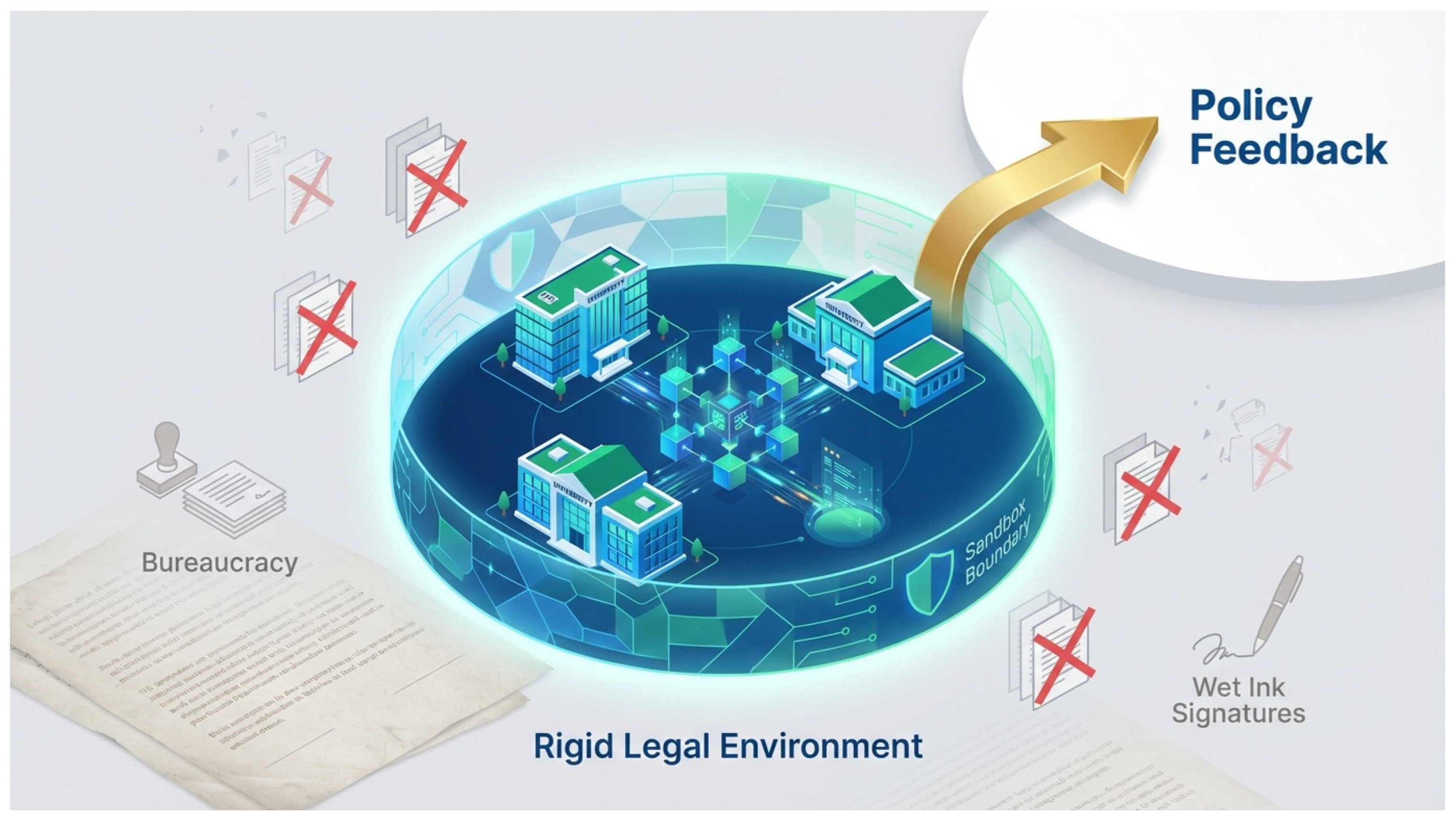
In many Central Asian countries, the law is rigid. A diploma is often defined strictly as a paper document with specific watermarks. To bypass this without waiting years for parliament to change the law, Ministries of Education should issue a special Decree (Приказ) to establish a “Regulatory Sandbox.”
Figure 1.
Diagram of the Regulatory Sandbox Structure. Note: This figure would show a protected legal space where specific rules are suspended for a limited time.
Figure 1.
Diagram of the Regulatory Sandbox Structure. Note: This figure would show a protected legal space where specific rules are suspended for a limited time.
Inside this sandbox:
- Selected universities are allowed to issue digital-only credentials.
- These digital credentials are given temporary legal validity for specific purposes (e.g., admission to partner universities).
- The strict requirement for “wet ink” signatures is waived for participants.
3.2. The “Coalition of the Willing”
We should not try to include every university immediately. Many lack the IT capacity. Phase 1 should focus on a “Coalition of the Willing”—a small group of elite, high-capacity institutions.
Likely candidates include:
- Kazakhstan: Nazarbayev University, Narxoz University.
- Kyrgyzstan: American University of Central Asia (AUCA), University of Central Asia (UCA).
- Uzbekistan: Westminster International University in Tashkent (WIUT).
These universities already have strong IT departments and international partnerships. They will act as the “Validator Nodes” for the pilot blockchain network.
3.3. Defining the Data Schema
Before writing any code, the Coalition must agree on a language for the data. Currently, a “credit” in one system might not mean the same as a “credit” in another.
The Coalition must adopt a standard, such as the W3C Verifiable Credentials model. They need to agree on:
- Identity: How do we uniquely identify a student? (e.g., Passport number vs. Student ID).
- Grading: How do we map a 5-point scale to a 4.0 GPA scale digitally?
- Metadata: What information must be included in the digital file? (Course names, learning outcomes, hours).
3.4. The “Shadow Run”
During Phase 1, the system runs in “Shadow Mode.” Students graduating from pilot universities receive both a paper diploma and a digital key.
When they apply to another partner university, the admissions office tries to verify the digital key first.
- If it works: Great. The process is recorded as a success.
- If it fails: They fall back to the paper diploma.
This allows us to test the system without risking the student’s future. The goal of Phase 1 is to achieve a 99.9% technical success rate.
4. Phase 2: The Hybrid Infrastructure (2028–2030)
Once the Sandbox proves that the technology works, we move to Phase 2. The goal here is scale and legalization. We move from a university experiment to a national standard.
4.1. Legal Harmonization
With data from Phase 1, Ministries can now go to their Parliaments with evidence. The goal is to amend the Law on Education and the Law on Electronic Signatures.
The key amendment is the “Digital Equivalence Clause.” This clause must state clearly: *A record signed cryptographically on the National Education Ledger has equal or superior legal weight to a paper document.*
This is a critical psychological shift. Paper becomes a ceremonial copy—something to hang on the wall—while the digital record becomes the “legal original.”
4.2. The “Hub-and-Spoke” Model
We cannot expect a small provincial university in a rural area to run a complex blockchain server. They lack the budget and the cyber-security expertise.
To solve this, we propose a Hub-and-Spoke model.
- The Hub: The Ministry of Education operates the “National Node.” This is a secure, government-managed server that connects to the regional blockchain.
- The Spokes: Small universities connect to the Ministry via a simple web API (Application Programming Interface).
Figure 2.
The Hub-and-Spoke Network Architecture. Note: This figure would show the Ministry as the central connector, with small universities feeding data into it, and the Ministry connecting to other countries.
Figure 2.
The Hub-and-Spoke Network Architecture. Note: This figure would show the Ministry as the central connector, with small universities feeding data into it, and the Ministry connecting to other countries.
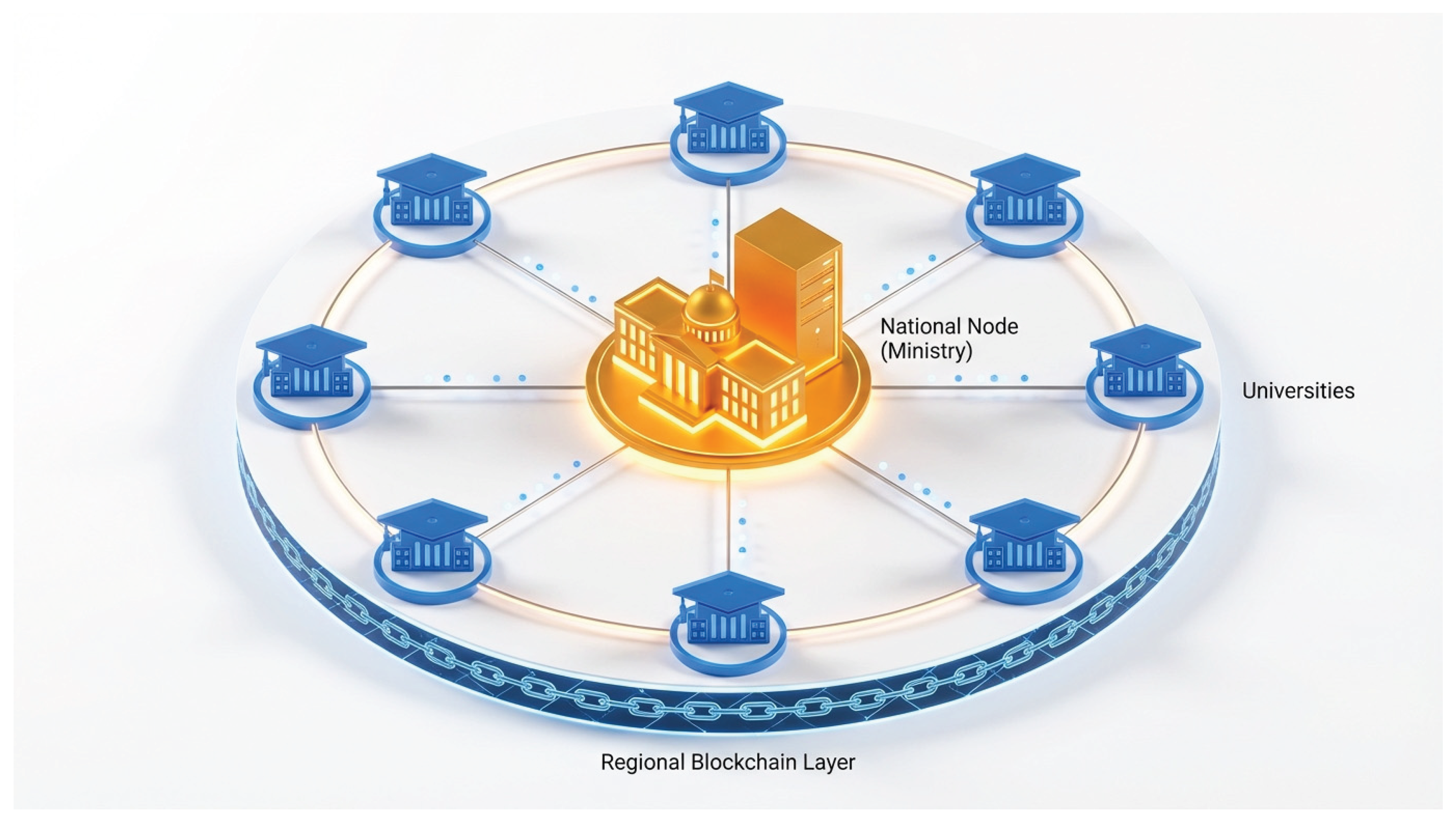
When a rural university issues a degree, they upload the data to the Ministry’s portal. The Ministry’s node then “anchors” the hash to the blockchain. This democratizes access. A small college gets the same high-tech security as a flagship university, without the cost.
4.3. Solving Data Sovereignty
As discussed in our feasibility study, countries like Kazakhstan have strict laws about data staying inside the country.
To respect this, Phase 2 implements a “Sovereign Consortium Chain.”
- Full Data (PII): The student’s name, address, and detailed grades are stored in the National Database (off-chain). This data never leaves the country automatically.
- The Hash: Only the cryptographic “fingerprint” of the data is put on the shared regional blockchain.
If a university in Uzbekistan wants to verify a Kazakh degree, they check the fingerprint on the blockchain. If it matches, they know the degree is real. They can then request the full data through a secure, authorized channel. This satisfies the law: the data is local, but the trust is global.
5. Phase 3: Algorithmic Governance (2031–2035)
By Phase 3, the infrastructure is stable, and the laws are in place. Now we can unlock the true power of the system: Automation.
5.1. Smart Contracts for Recognition
Currently, recognizing a foreign degree is a manual process. A human looks at a transcript, compares it to a table, and makes a decision. This is slow and subjective.
In Phase 3, we deploy Smart Contracts. These are simple programs that execute automatically when conditions are met.
- Example: A Smart Contract contains the rule: “If a student completes ‘Macroeconomics’ at University A with a grade above B, grant credit for ‘Econ 101’ at University B.”
When a student transfers, the contract checks the blockchain. If the condition is met, the credit is granted instantly. The student’s digital wallet is updated in seconds, not months. Humans only need to get involved for complex cases or appeals.
5.2. The “Digital Watchdog”
Quality Assurance (QA) today is reactive. Agencies visit a university once every five years. They look at old reports. It is like driving a car by looking in the rearview mirror.
With Federated Learning (FL), we can move to real-time monitoring.
- The FL model runs across the National Nodes.
- It analyzes trends without stealing private data.
- Scenario: If a university suddenly starts giving “A” grades to 90% of its students (grade inflation), the algorithm detects the anomaly immediately.
It flags the issue for the QA agency. The agency can then investigate. This turns QA into a continuous, proactive system. It is a “Digital Watchdog” that never sleeps.
5.3. The Academic “Babel Fish”
By Phase 3, the Neural Machine Translation (NMT) engines will be mature. Ministries will have fed them millions of official academic documents during Phase 2.
This creates a specialized “Academic Central Asian Model.” It understands the specific nuances of the region’s education systems. It knows that a “Candidate of Sciences” degree in Kyrgyzstan is not exactly the same as a PhD in the West, and translates it with the correct context.
This removes the language tax. A scholar in Dushanbe can publish in Tajik, and a researcher in Astana can read it in Russian or English instantly. The region becomes intellectually integrated, even if it remains linguistically diverse.
6. Stakeholder Action Plan
To make this happen, different actors need to move in sync.
6.1. For Ministries of Education
- Stop trying to build massive centralized databases that are hard to secure.
- Start defining standards. Your job is to define the JSON schema, not to store every file.
- Action: Establish a “Digital Transformation Office” led by a Chief Digital Officer (CDO), not a traditional bureaucrat.
6.2. For Universities
- Stop treating IT as a utility like electricity. IT is now your core business.
- Start digitizing historical archives. A blockchain is useless if the data from 2020 is still in a paper folder in the basement.
- Action: Join the “Coalition of the Willing” if you have the capacity. If not, prepare your internal systems to connect to the Ministry’s API.
6.3. For International Donors (World Bank, EU, ADB)
- Stop funding “study tours” and endless conferences on the Bologna Process.
- Start funding servers, fiber optic cables, and coding bootcamps for university staff.
- Action: Create a “Digital Infrastructure Fund” specifically to help poorer, rural universities upgrade their hardware so they are not left behind.
7. Risk Mitigation
We must be realistic. Things can go wrong.
Risk 1: The Digital Divide.
There is a danger that this system will benefit only the rich universities in capital cities.
- Mitigation: The “Hub-and-Spoke” model (Phase 2) is designed specifically for this. The government must subsidize the connection costs for rural colleges.
Risk 2: The “Oracle Problem.”
Blockchain guarantees that the data hasn’t been changed. It does not guarantee that the data was true in the first place. If a corrupt rector enters a fake grade, the blockchain will securely record a fake grade.
- Mitigation: We still need human accreditation. We must audit the *source* of the data (the university), not just the data itself. The “Digital Watchdog” (Phase 3) helps detect patterns of fraud, but human oversight remains essential.
Risk 3: Vendor Lock-in.
If the region buys a proprietary system from a single foreign company, they lose their digital sovereignty.
- Mitigation: The entire infrastructure must be built on Open Source standards (e.g., Hyperledger, Linux). The code should be owned by the consortium of Ministries, not a private vendor.
8. Conclusion
The “Central Asian Higher Education Area” has been a goal for thirty years. It has not happened because we tried to build it with paper. Paper is slow, paper is easy to forge, and paper stops at the border.
The roadmap presented here offers a different way. It is not a magic bullet. It requires hard work, legal reform, and significant investment. But it aligns with the reality of the 21st century.
By building a Digital Trust Infrastructure, Central Asia can do more than just catch up to Europe. It can become a pioneer. It can show the world how to run a modern, efficient, and transparent regional education system. The technology is ready. The question is: are the leaders?

Table 1.
Summary of the Roadmap Phases.
| Phase | Timeline | Strategic Focus | Legal Status | Technology Architecture |
|---|---|---|---|---|
| 1. Digital Sandbox | 2025–2027 | Experimentation: Testing the system with a small “Coalition of the Willing” (3-5 elite universities). | Ministry Decree: A temporary exemption creating a “legal safe harbor” for pilot participants. | Private Pilot Chain: A closed network run by the universities themselves. |
| 2. Hybrid Infrastructure | 2028–2030 | Scaling: Expanding to national coverage using the “Hub-and-Spoke” model for smaller institutions. | Statutory Amendment: Revising the Law on Education to give digital hashes equal legal weight to paper. | Sovereign Consortium Chain: Ministries operate “Super Nodes”; data stays local (off-chain). |
| 3. Algorithmic Governance | 2031–2035 | Automation: Moving from manual verification to automatic credit recognition and real-time quality monitoring. | Smart Contracts as Law: Automated code execution is recognized as a valid administrative act. | Federated Learning & AI: Real-time “Digital Watchdog” for quality assurance. |
References
- Acharya, A. How ideas spread: Whose norms matter? Norm localization and institutional change in Asian regionalism. International Organization 2004, 58(2), 239–275. [Google Scholar] [CrossRef]
- Aharoni, R.; Johnson, M.; Firat, O. Massively multilingual neural machine translation. In Proceedings of the 2019 Conference of the North American Chapter of the Association for Computational Linguistics; 2019; pp. 3874–3884. [Google Scholar] [CrossRef]
- Anafinova, S. Localization of the Bologna Process in post-Soviet context: The case of Kazakhstan. Journal of Comparative & International Higher Education 2024, 16(3), 155–172. [Google Scholar] [CrossRef]
- Cardenas-Quispe, M. A.; Pacheco, A. Blockchain ensuring academic integrity with a degree verification prototype. Scientific Reports 2025, 15, 9281. [Google Scholar] [CrossRef] [PubMed]
- Fukuyama, F. What is governance? Governance 2013, 26(3), 347–368. [Google Scholar] [CrossRef]
- Gaikwad, H.; D’Souza, N.; Gupta, R.; Tripathy, A. K. A blockchain-based verification system for academic certificates. In 2021 International Conference on System, Computation, Automation and Networking (ICSCAN); 2021; pp. 1–6. [Google Scholar] [CrossRef]
- Heeks, R. Health information systems: Failure, success and improvisation. International Journal of Medical Informatics 2006, 75(2), 125–137. [Google Scholar] [CrossRef] [PubMed]
- Hou, A. Y. C.; Tao, C. H.-Y.; Zhou, K. Z.-W.; Lin, A. F. Y.; Su, E. H. C.; Chen, Y. Evolution of quality assurance in higher education from INQAAHE GGP to ISGs: Are quality assurance agencies in Asia ready to the emerging modules? Journal of International Cooperation in Education 2024, 26(1), 85–100. [Google Scholar] [CrossRef]
- Isaacs, A. K. Building a higher education area in Central Asia: Challenges and prospects. Tuning Journal for Higher Education 2014, 2(1), 31–58. [Google Scholar] [CrossRef]
- Kairouz, P.; McMahan, H. B.; Avent, B.; Bellet, A.; Bennis, M.; Bhagoji, A. N.; Bonawitz, K.; Charles, Z.; Cormode, G.; Cummings, R.; et al. Advances and open problems in federated learning. Foundations and Trends® in Machine Learning 2021, 14(1–2), 1–210. [Google Scholar] [CrossRef]
- Li, T.; Sahu, A. K.; Talwalkar, A.; Smith, V. Federated learning: Challenges, methods, and future directions. IEEE Signal Processing Magazine 2020, 37(3), 50–60. [Google Scholar] [CrossRef]
- McMahan, B.; Moore, E.; Ramage, D.; Hampson, S.; Arcas, B. A. Communication-efficient learning of deep networks from decentralized data. In Proceedings of the 20th International Conference on Artificial Intelligence and Statistics; 2017; Volume 54, pp. 1273–1282. [Google Scholar]
- Sabzalieva, E. The policy of higher education in Central Asia. In The Palgrave Handbook of Asia Pacific Higher Education; Palgrave Macmillan, 2019; pp. 163–178. [Google Scholar] [CrossRef]
- Stahlberg, F. Neural machine translation: A review. Journal of Artificial Intelligence Research 2020, 69, 343–418. [Google Scholar] [CrossRef]
- Tan, X.; Ren, Y.; He, D.; Qin, T.; Zhao, Z.; Liu, T.-Y. Multilingual neural machine translation with knowledge distillation. International Conference on Learning Representations (ICLR) 2019. [Google Scholar] [CrossRef]
- Turkanović, M.; Hölbl, M.; Košič, K.; Heričko, M.; Kamišalić, A. EduCTX: A blockchain-based higher education credit platform. IEEE Access 2018, 6, 5112–5127. [Google Scholar] [CrossRef]
- Wu, Y.; Schuster, M.; Chen, Z.; Le, Q. V.; Norouzi, M.; Macherey, W.; Krikun, M.; Cao, Y.; Gao, Q.; Macherey, K.; et al. Google’s neural machine translation system: Bridging the gap between human and machine translation. arXiv 2016. [Google Scholar] [CrossRef]
- Zhao, Y.; Li, M.; Lai, L.; Suda, N.; Civin, D.; Chandra, V. Federated learning with non-IID data. arXiv 2018. [Google Scholar] [CrossRef]
Disclaimer/Publisher’s Note: The statements, opinions and data contained in all publications are solely those of the individual author(s) and contributor(s) and not of MDPI and/or the editor(s). MDPI and/or the editor(s) disclaim responsibility for any injury to people or property resulting from any ideas, methods, instructions or products referred to in the content. |
© 2026 by the authors. Licensee MDPI, Basel, Switzerland. This article is an open access article distributed under the terms and conditions of the Creative Commons Attribution (CC BY) license (http://creativecommons.org/licenses/by/4.0/).
Copyright: This open access article is published under a Creative Commons CC BY 4.0 license, which permit the free download, distribution, and reuse, provided that the author and preprint are cited in any reuse.


