

Submitted:
31 January 2026
Posted:
02 February 2026
You are already at the latest version
Abstract
This study examines how an outdoor mobile augmented reality game, the Art Nouveau Path, changes when a bounded park deployment is scaled to a distributed city path within the EduCITY digital teaching and learning ecosystem, prioritizing adoption and transfer rather than additional learning effect inference. Methods combined design artefact profiling of 36 tasks across eight points of interest with feasibility evidence from group session logs (N = 118) and teacher-facing datasets from validation (T1-VAL), specialists curriculum review (T1-R), and in situ observation (T2-OBS). Results show that city-path scaling reconfigures feasibility around orchestration and public-space risk, while selective AR dependency and point-of-interest modularity support robustness under mobility, interruptions, and heterogeneous urban conditions. A determinant-based synthesis identified the implementation levers most associated with enactment quality, including first use legibility, marker robustness and recovery, curriculum framing, consolidation supports, differentiation and accessibility, and safety routines. These determinants were translated into an evidence-linked transfer kit and a governance specification defining roles, prerequisites, and maintainable routines across schools and local partners. The study aims to contribute with adoption-ready specifications for scaling place-based augmented reality learning from prototypes to repeatable city-scale services.
Keywords:
smart cities
; smart learning ecosystems
; mobile augmented reality
; place-based learning
; outdoor learning
; cultural heritage
; implementation outcomes
; orchestration
; transferability
1. Introduction
Smart cities are increasingly conceptualized as socio-technical configurations in which public value is produced through coordinated digital services, data infrastructures, and governance arrangements, rather than through technological employment alone [1]. From this viewpoint, education may be interpreted as an effort that ties together concrete, enriched, or virtual realms, transit, multicultural richness, civic participation, and welcoming attitudes. Such a shift aligns with governance-focused accounts of smart urban development that emphasize institutional capacity, accountability, and cross-sector coordination as prerequisites for sustainable digital transformation [1,2,3]
Smart education and teaching and learning ecosystem’s research converge on a shared claim: city-scale learning emerges from coordinated actors, places, artefacts, and routines rather than from a standalone application [4,5,6]. In this regard, sustainability within these ecosystems signifies a socio-organizational paradigm that requires persistent maintenance driven by feedback loops and participatory governance, instead of being merely based on technological developments [7].
Simultaneously, Education for Sustainable Development (ESD) has been conceptualized as a skills-based approach to address current environmental and societal issues, demanding educational frameworks that cultivate knowledge, skills, values, and attitudes conducive to responsible behavior in various contexts. In response to continuous innovations in the field, competence frameworks have arisen as a pragmatic and crucial link that adeptly connects the frequently high-minded aspirations outlined in educational policies with the actual circumstances of their implementation in various educational contexts, thereby bolstering the coherence between theoretical aspirations and practical results. Consequently, the development of competence frameworks has come to the forefront as a potentially effective mediating instrument that serves to bridge the often-disparate gap that exists between formal policy documents and the practical implementation of educational strategies within various learning environments [8].
Cultural heritage offers a concrete entry point for competence-oriented learning in cities because the built environment makes narratives, values, and contested decisions visible in everyday public space. When heritage is mobilized as learning infrastructure, place-based inquiry can link observation to civic participation and stewardship in locally meaningful contexts [4,9].
Outdoor Mobile Augmented Reality Games (MARGs) constitute a promising modality for operationalizing this agenda in smart learning ecosystems. Reviews of Augmented Reality (AR) in education indicate recurring affordances related to situated inquiry, multimodal scaffolding, and engagement, while also highlighting that effectiveness depends strongly on placed and contextual conditions and orchestration [10,11,12] Frameworks pertaining to place-based mobile learning serve to further underscore the notion that the efficacy of learning outcomes, as well as the overall practicality and feasibility of such educational endeavors, are significantly influenced and molded by the intricate balance that exists amongst the key elements of authenticity, collaboration, and structural organization within the specific context in which the learning takes place [13,14,15]. In classroom and field-based contexts, AR design research has therefore emphasized integration with activity flow, minimalism to reduce interactional friction, and support for teacher management [16,17]. Field-trip studies similarly show that the technical layer must be designed to coexist with the practical realities of movement, attention switching, and supervision [18].
A persistent challenge is moving from experimental pilots to standardized urban deployments. Distributed city paths embed navigation and public-space contingencies into the activity, amplifying orchestration demands and making safety, pacing, and recovery routines central to feasibility [19,20,21,22,23].
The present study examines this implementation problem through the EduPARK to EduCITY transition in Aveiro, Portugal. EduPARK project [24] provided a park-bounded, marker-based AR quiz organized as a treasure hunt, supporting interdisciplinary and collaborative exploration under a stable spatial topology [25,26]. EduCITY [27] extends this approach into an urban, path-based learning environment by combining a mobile app with a web-based authoring platform and training, enabling location-based games across multiple urban settings and positioning the municipality as an active partner in sustaining the ecosystem [28,29]. To stabilize continuity while marking the shift in scale, the Art Nouveau’s style bandstand in Infante D. Pedro Park is treated as an anchor artefact (Figure 1). Also, as a boundary object, it provides a shared reference point that supports translation and coordination between a bounded park setting and a multi-Points of Interest (POIs) urban heritage path [30].
Accordingly, this article positions the Art Nouveau Path, a heritage-based MARG embedded in EduCITY, as a smart-city learning project whose primary contribution is implementation and transfer knowledge rather than additional learning-outcome reporting. The analysis focuses on the socio-technical requirements for scaling an outdoor mobile AR game from a bounded park to distributed city paths, and on the packaging of transferable artefacts that support adoption beyond the originating context.
To guide this study, three research questions (RQs) were formulated:
- RQ1: Which design and architecture characteristics support scaling an outdoor mobile AR game from a bounded park setting to an urban, multi-location path within a smart learning ecosystem?
- RQ2: Which orchestration requirements and feasibility conditions enable safe and stable enactment in open urban space?
- RQ3: Which transferability artefacts are required to support replication beyond the originating city?
By answering these questions, the study contributes an empirically grounded account of scaling conditions for smart learning ecosystems and a reusable adoption package for municipalities and schools seeking to replicate outdoor AR heritage learning under realistic governance, safety, and accessibility constraints.
The remainder of the article is organized as follows. Section 2 positions the study within smart city governance and smart learning ecosystem scholarship, with particular attention to outdoor mobile AR learning and transfer. Section 3 describes research design, context, datasets and analytical safeguards. Section 4 reports the results aligned with the three research questions. Section 5 discusses the findings through an adoption-oriented lens, and Section 6 concludes with limitations and future paths.
2. Related Work
This section frames the Art Nouveau Path, a heritage-based MARG implemented across multiple urban locations as part of a smart city learning implementation. It synthesizes smart city research that conceptualizes “smartness” as the governance of digital public services, learning ecosystem research that treats the city as learning infrastructure, and mobile and outdoor learning studies that foreground orchestration, safety, pacing, and contingency management in public space [31]. It also draws on AR and heritage learning literature to balance interpretive affordances with robustness, usability, and equity constraints that shape routine school enactment.
Against this backdrop, the review treats scaling as an implementation problem, informed by multidimensional accounts of educational scale and implementation science distinctions between intervention outcomes and implementation outcomes. This framing motivates the paper’s emphasis on adoption-ready knowledge: the governance conditions, orchestration routines, and transfer artefacts required to move from bounded deployments to repeatable operation at local scale.
2.1. Smart Cities as Governance of Digital Public Services
Research about smart cities has progressively transitioned from perceiving ‘smartness’ predominantly as the implementation of technological solutions to conceptualizing it as a governance milestone, influenced by the generation of public value and the enduring collaboration among various stakeholders and infrastructures. In this sense, “smartness” is not primarily an intrinsic characteristic of the technologies employed, but a property of how urban services are conceptualized, sustained, and directed over time through the coordination of stakeholders and infrastructures [2].
Reviews of smart urban governance converge on the need to clarify decision rights, responsibilities, and cross-sector coordination mechanisms, because these elements largely determine whether initiatives remain pilots or become durable services [1,3]. In parallel, standards and indicator frameworks [32], encourage municipalities to treat “smart” interventions as measurable service portfolios that require ongoing operational ownership rather than one-off deployments [33].
For smart city education initiatives, learning activities increasingly operate in public space rather than as school-bounded innovations. Under this perspective, such interventions can be specified as municipal-scale services whose repeatability depends on governance, maintenance, and clearly assigned responsibilities. This framing becomes particularly relevant when the intervention depends on public-space conditions (for example, path safety and accessibility) and on municipal assets (for example, cultural content stewardship, heritage maintenance coordination, and licensing).
The Art Nouveau Path is framed as a city-scale operationalization within the EduCITY Digital Teaching and Learning Ecosystem (DTLE), with governance requirements specified as prerequisites for safe and repeatable enactment across cohorts and schools.
2.2. Smart Learning Ecosystems and the City as Learning Infrastructure
Educational technology research provides complementary vocabulary through smart learning environments and smart education. Koper’s pivotal work stated that the conditions for smart learning environments foreground the integration of physical and digital resources, context awareness, and support mechanisms that remain usable under real constraints, rather than under laboratory assumptions [5,34]. At a systems level, smart education frameworks distinguish technical and pedagogical layers, linking infrastructures to enactable practices across individual, group, and class processes [6].
Learning ecosystem perspectives further emphasize sustainability and resilience as system properties shaped by coordination among stakeholders and by the ability to absorb disruptions without losing core function [7]. In this conceptual EduPARK to EduCITY transition, this ecosystem broader view motivates an adoption-oriented scope: the central question is not only whether a MARG-based path can be experienced, but whether it can be enacted safely, repeatedly, and with predictable quality once ownership extends beyond the originating research team.
2.3. ESD and Competence Frameworks
ESD regards sustainability transitions as a pedagogical challenge in their own right: learners must comprehend intricate issues, evaluate conflicting assertions, and substantiate actions when evidence is insufficient and values are in conflict [35]. United Nations Educational, Scientific and Cultural Organization’s (UNESCO) conceptualization extends beyond perceiving sustainability as merely a matter of “enhancing awareness” and instead concentrates on what facilitates responsible judgment and engagement: pertinent knowledge, practical competencies, and the values and inclinations that direct action when trade-offs are inevitable [36]. Pivotal competence-based inquiry has converged on a recurrent set of sustainability competencies, most frequently designated as systems thinking, futures thinking, normative, strategic, and interpersonal competence [37,38]. Their primary contribution is operational: they transform broad policy terminology into implementable design choices, by elucidating what should be elicited through tasks and narrative, and what can justifiably be scrutinized through assessment and evaluation.
More recently, and in the European context, the European Framework for Sustainability Competences, also known as GreenComp, consolidates sustainability as a multidimensional competence construct that spans values, systems thinking, futures literacy, and collective action [39]. GreenComp can be particularly relevant for design-based interventions because it supports traceable alignment between tasks, scaffolds, and reflection prompts and explicit competence targets.
In the Art Nouveau Path broader research program, this competence alignment motivates the educational design and narrows its core contribution to the implementation and transfer layer required for city-scale enactment, referencing competence impacts as background rather than as the main analytical focus.
2.4. Cultural Heritage as Learning Infrastructure and Smart Heritage Perspectives
Cultural heritage is increasingly understood as a lived public resource, not a static backdrop, with relevance for civic learning, participation, and stewardship, especially when learners work directly with the built environment. Streets, facades, and everyday urban artefacts make history and culture tangible, while also opening a path into contemporary questions about materials, maintenance, access, and environmental change. This place-based grounding helps abstract sustainability issues become discussable in local, observable terms, strengthening relevance and identity and supporting inquiry and civic sense-making [40,41]. From a heritage studies standpoint, this is consistent with the idea that heritage is produced through practices of interpretation and care and therefore provides an entry point for participation and stewardship rather than only appreciation [42,43,44].
Within smart city contexts, heritage is also discussed under “smart heritage” and data-informed heritage governance, where interpretive assets, documentation systems, and monitoring practices are treated as part of urban service ecosystems. In the EduCITY framing, specifically in the Art Nouveau Path’s case, heritage path generates lightweight but actionable traces (for example, structured tasks, observational routines, and log data) that can support proportionate evaluation and maintenance decisions without requiring heavy digital twin infrastructures [45]. This provides a key premise for the present paper: a heritage-based path embedded into a local, municipal learning ecosystem should be specified not only as an educational design, but also as a governable civic asset, including content stewardship, safety procedures, and privacy-aware data governance.
2.5. Mobile Learning and Orchestration in Outdoor Contexts
Mobile and outdoor learning research consistently indicates that learning outcomes depend strongly on context conditions and on the orchestration work required to manage time, attention, tools, and contingencies. Pedagogical discourses concerning mobile learning emphasize the integrative function of authenticity, personalization, and collaborative engagement, illustrating that the concept of “place” transcends mere locational context to become a significant factor influencing learners' attentional focus, their collaborative coordination, and the interpretations they develop [13,14].
Orchestration research conceptualizes teachers as coordinators of dynamic learning systems; even in classroom settings, orchestration entails aligning tasks, pacing, transitions, and material resources under constraints [46,19,20,22,23,31]. When learning activities move into public space, orchestration is amplified by mobility topology and risk distribution. Navigation becomes an inherent activity component, interruptions become structurally likely, as crossings or regrouping, and supervision shifts toward safety management, pacing control, and contingency handling, like alternative paths or low or no-tech solutions. This amplification is central to the EduPARK to EduCITY transition scheme: bounded park topology reduces orchestration variability, whereas distributed city paths increase the number and severity of plausible failure modes, requiring explicit routines and artefacts that stabilize enactment.
2.6. Mobile AR for Education and Heritage Learning
AR in education is associated with affordances for situated inquiry, multimodal scaffolding, and engagement, but systematic reviews also document recurring challenges such as usability frictions, cognitive overload risks, and strong dependence on instructional integration [11,12,47]. Within educational design, AR efforts underscore the vital requirement to match the proper AR interface with the development of tasks and instructional techniques used by teachers [16,17]. In fieldtrips and outdoor contexts, AR must accommodate attention switching between device and environment, environmental variability (for example, glare and weather), and connectivity constraints, reinforcing the importance of robustness and safe interaction pacing [18,31].
Heritage rich contexts are exceptionally conducive to AR-enhanced educational experiences, as digital overlays can render architectural features, historical strata, and comparative data comprehensible on-site, all while maintaining an embodied sense of co-presence within the urban landscape, as presented in Figure 2.
In routine school enactment, overlays must remain usable under attention switching, environmental variability (for example, glare and weather), device heterogeneity, and connectivity constraints, which foregrounds robustness and safe interaction pacing as design requirements.
2.7. Scaling and Transferability as Implementation Problems
The phenomenon of scaling within the educational domain is inherently multidimensional and cannot be merely quantified by the number of participants involved. Coburn’s account of scale emphasizes depth, sustainability, spread, and shifts in ownership and routine, implying that durable scale depends on institutionalization and on the ability of a design to function under diverse conditions [48,49]. Implementation science provides an adjacent set of constructs, distinguishing intervention outcomes (for example, learning effects) from implementation outcomes such as feasibility, adoption, fidelity, and sustainability, which require dedicated measurement and design attention [50].
Competence impacts and psychometric analyses are addressed in prior outputs; the present manuscript prioritizes adoption-ready knowledge about city-scale enactment: how mobility topology changes orchestration and risk, how robustness and contingency strategies shape feasibility, and which artefacts constitute a minimal transfer kit for municipalities and schools.
2.8. Boundary Objects and Anchor Artefacts in Cross-Sector Coordination
Smart city learning services typically involve multiple communities with different accountability regimes and interpretive frames, including teachers, municipal cultural services, and public-space management units. Boundary object theory explains how coordination can occur without full interpretive consensus by stabilizing shared references that remain recognizable across communities while allowing local adaptation [30,51]. In this manuscript, boundary objects are used as a functional lens for describing how a city-scale learning service can remain enactable when responsibilities and meanings are distributed across institutions.
In the EduPARK to EduCITY transition, the Art Nouveau bandstand is treated as an anchor artefact that performs this mediating function. Concerning this study aims, it provides continuity between the bounded park-based predecessor (EduPARK) and the distributed city path (EduCITY), while supporting operational uses such as meeting and briefing, narrative framing, and municipal communication. This anchoring role is not merely symbolic: it enables explanation costs reductions, stabilizes shared references for orchestration planning, and supports governance alignment across stakeholders.
2.9. Aveiro’s Art Nouveau as a Place-Based Heritage Infrastructure for City-Scale Learning
Aveiro’s Art Nouveau heritage, locally designated as ‘Arte Nova’, constitutes a dispersed and publicly legible urban layer that is amenable to location-based learning designs. Rather than being concentrated in a single monumental ensemble, Art Nouveau expressions in Aveiro are distributed across the historic center as facades, corner buildings, and small-scale civic artefacts that can be encountered sequentially through short walking paths. The institutionalization of this “distributed collection” logic is visible in Aveiro’s museum and path strategy, where the Art Nouveau “collection” is explicitly understood as the network of buildings in the streetscape, with the museum functioning as an interpretive gateway and starting point.
A salient specificity of Aveiro’s Art Nouveau is the coupling between decorative language and local construction practices and environmental conditions [52]. In the Art Nouveau Path multimodal contents, facade tiles (‘azulejos’) are framed not only as ornaments but also as material responses linked to durability and moisture protection, particularly relevant in contexts historically associated with adobe construction. This linkage supports a direct pedagogical pathway from stylistic observation to functional reasoning and, by extension, to sustainability-oriented discussions about materials, maintenance, and adaptation to environmental constraints.
At an institutional level, Aveiro’s Arte Nova dissemination strategy relies on a path-based model. The Art Nouveau Museum opened in 2012 in the ‘Casa do Major Pessoa’ (constructed 1907 to 1909) (Figure 3) and frames the collection as materially distributed across the city’s streetscape, with the museum functioning as an interpretive gateway and path anchor. This approach provides a strong precedent for educational interventions that treat the city as an open-air interface, because it legitimizes path-based exploration as a primary mode of heritage access and public engagement.
Aveiro’s integration, since 2008 [53], in the Réseau Art Nouveau Network (RANN) further reinforces the city’s positioning within local heritage governance and exchange practices, which is relevant for cross-city transfer arguments in smart learning ecosystems.
The civic and educational anchoring role played by emblematic Arte Nova artefacts is also operationally relevant for outdoor learning. The Art Nouveau bandstand in the Infante D. Pedro Park exemplifies this duality, combining architectural distinctiveness with pragmatic value as a meeting and briefing anchor for bounded orchestration routines and as a narrative hinge to the distributed city path. Within the Smart Cities framing, this specificity strengthens the argument for the bandstand as an anchor artefact and boundary object supporting continuity and coordination in the park-to-city transition.
Finally, Aveiro-specific content affords curricular and interpretive task design that treats architectural detail as the interaction substrate, not as scenery [54,55]. The Art Nouveau Path is structured around eight geolocated POIs, and tasks explicitly invite learners to observe decorative elements that reveal Art Nouveau features, supported by multimedia resources and AR contents. In combination with evidence that baseline understandings of Art Nouveau and associated sustainability themes can be fragmented or weakly anchored without situated experiences, this strengthens the rationale for place-based, visually anchored interventions that connect local urban identity to stewardship, maintenance, and sustainability-relevant dilemmas.
2.10. Synthesis and Gap Addressed by this Study
Across these strands, a specific gap becomes visible: outdoor mobile AR heritage learning is well motivated pedagogically, yet the knowledge required to scale such interventions from bounded prototypes to city-distributed services remains under-specified. Smart cities research calls for governance-ready service specifications, mobile learning research foregrounds orchestration constraints, and AR research highlights robustness and usability demands.
The present study synthesizes these requirements through an adoption-oriented analysis of the EduPARK to EduCITY transition, deriving transfer-focused outputs such as design rules, orchestration checklists, and a municipal-ready governance stack. In this framing, the governance stack is specified through four operational layers that recur across municipal implementations: (i) service ownership and support, (ii) content stewardship and rights management, (iii) safety and path-risk procedures, and (iv) data governance for privacy-compliant monitoring and proportionate analytics.
3. Materials and Methods
3.1. Research Design and Analytical Scope
A design-based research (DBR) approach underpinned the broader research program, combining iterative design, field enactment, and evidence-informed refinement under authentic school and public-space constraints. The present manuscript reports implementation and transfer evidence, focusing on (i) feasibility under distributed path conditions, (ii) orchestration requirements for school groups moving through public space, and (iii) the specification of transfer artefacts that stabilize repeatable enactment beyond the originating team.
To preserve empirical distinctiveness from competence-focused publications within the same project, the analytical scope is intentionally restricted. Therefore, in this study, competency outcomes, psychometric evaluations, and any inferences regarding learning outcomes derived from the accuracy of task performance are not subjected to re-analysis. Quantitative reporting is limited to feasibility descriptors and operational envelopes, and log data are used only for completion and timing descriptors rather than correctness-based performance analyses.
3.2. EduCITY Delivery Platform and Logging Instrumentation
The intervention is delivered through the EduCITY ecosystem, comprising a mobile application and a web-based authoring and management workflow that supports paths deployment across multiple city settings [28,56]. The EduCITY mobile app (version 1.3) is an offline-first Android and iOS application. It leverages the device’s GPS and compass for location-aware functionality and integrates the Vuforia Augmented Reality SDK to enable image-based recognition for marker-driven AR. The interface couples a 2D map view with an AR camera view, as shown in Figure 4.
Gameplay data are captured through offline-first logging and stored at the group-session level, reflecting the orchestration model in which students play collaboratively using one device per group. Logs are captured offline on the device and retrieved after each session for upload to a secure university server. Records are group-level only and contain no personal identifiers. Although the logging schema includes fields such as selected option and correctness, the present manuscript uses log data exclusively for feasibility descriptors such as response presence, POI-level completion traces, and duration envelopes.
3.3. Participants
3.3.1. Students’ Cohorts and Field Sessions
Student recruitment occurred through the Municipal Educational Action Program of Aveiro (PAEMA), 2024/2025 edition [57], yielding a local convenience sample. The field cohort comprised 439 lower and upper secondary students aged 13 to 18, distributed across 19 classes from six grades (7th: N = 19; 8th: N = 135; 9th: N = 156; 10th: N = 37; 11th: N = 20; 12th: N = 72), from urban and peri-urban schools. To support data minimization in an ecologically valid municipal deployment, no socio-economic background or gender data were collected.
Field enactment was conducted across 18 sessions, yielding 118 valid collaborative group sessions in the app logs. Students typically played in groups of two to four, sharing one project’s mobile device per group. A derived learners-per-device indicator was computed by aligning post-path participation (N = 439) with valid group sessions (118), yielding an average of 3.72 students per group device. This indicator is treated as an enactment descriptor rather than a precise group-size measure.
3.3.2. Teachers and Specialists’ Cohorts
Teacher-facing evidence includes: (i) teachers’ validation (T1-VAL) workshop data (N = 30), (ii) specialist teachers’ curriculum review (T1-R) narratives (N = 3), and (iii) in situ teachers’ observations (T2-OBS) records from accompanying teachers supervising logistics and safety during field sessions (N = 24). In this work, these streams are used to characterize enactment constraints, orchestration requirements, and transfer rules, rather than to support learning-outcome inference.
3.4. The Art Nouveau Path Outdoor MARG Intervention
3.4.1. Students’ Cohorts and Field Sessions
The Art Nouveau Path is implemented as a circular city path comprising eight heritage POIs in Aveiro and a total of 36 quiz-type tasks distributed across these POIs. Each POI operates as a compact challenge block in which teams complete multiple-choice questions supported by authored multimodal resources (for example, augmented reality overlays, historical photographs, short videos, and audio prompts) before proceeding to the next location. Operationally, the path starts at ‘Joaquim de Melo Freitas Square’ and returns to the same location, which also functions as a regrouping and closure point.
To characterize implementation risk and contingency requirements at city scale, task dependencies were profiled using three analytically distinct constructs. AR overlay tasks denote tasks that include an authored AR overlay as a learning resource (consistent with the established media typology used in this project). Marker-triggered question tasks denote tasks whose Question stage requires marker-based triggering (image recognition) to access the question interaction layer. Low-tech tasks Observation (OBS) and Knowledge (KNOW) denote tasks whose solution demand can be met primarily through direct observation and prior knowledge. This third label is not mutually exclusive with marker triggering, because access to the question may still require a marker even when solving relies mainly on observation and prior knowledge. Table 1 reports the resulting POI-level dependency profile.
This table is reported for feasibility and contingency planning rather than as a path-specification or media-typology table.
The profile indicates selective provision of authored AR overlays alongside substantial marker-trigger dependency at the question stage. Across the 36 tasks, 11 include AR overlays (30.56%), whereas 26 require marker triggering at the question stage (72.22%), leaving 10 tasks whose question stage can be accessed without marker triggering. In parallel, 21 tasks were classified as low-tech in solution demand (58.33%), indicating that many tasks can be solved through observation and prior knowledge even when the interaction layer is accessed through marker recognition. Reporting this dependency structure by POI supports feasibility and contingency planning by identifying where marker-based interaction is structurally concentrated and where low-tech solution demands may provide resilience under variable urban conditions.
In addition to POI-level profiling, task architecture was modelled as a four-stage sequence (Intro, N = 36; Question, N = 36; Correct feedback, N = 36; Incorrect feedback, N = 36) consistent with the app logic. For each stage, the dominant modality was coded from the authoring assets and aggregated across the 36 tasks to produce stage-level modality distributions reported in the Results section.
3.5. Instruments and Evidence Streams
Multiple Art Nouveau Path’s research project datasets were mobilized as bounded evidence streams, each with an explicitly restricted analytical role to avoid overlap with competence-impact reporting. Units of analysis are defined to support operational specification and transfer packaging, rather than learner performance inference (Table 2).
As specified in Table 2, the manuscript’s evidence architecture partitions the broader project datasets into bounded streams with explicit analytical units and non-overlap safeguards. This partitioning is a methodological control that ensures empirical distinctiveness from competence-focused outputs by restricting each stream to an implementation or transfer role. Teachers’ streams (T1-VAL and T2-OBS) provide the primary qualitative basis for identifying and quantifying implementation determinants through meaning units, while the specialist stream (T1-R) is used only for triangulation and scaling heuristics rather than frequency-based quantification. Post-path student survey data are retained as feasibility and integrity evidence for instrument administration and as non-inferential acceptability and transfer-constraint descriptors that bound adoption conditions at city scale. No competence-outcome inference is derived from these survey items. Design documentation provides the task and POI structure required for architecture profiling, enabling counts and dependency descriptors without outcome inference. In combination, these streams support the three research questions by linking artefact architecture (RQ1), orchestration feasibility (RQ2), and transferring packaging logic (RQ3) to distinct, auditable sources.
3.6. Field Procedures and Data Collection
The field sessions followed a standardized enactment routine. A short safety and interface briefing preceded path initiation. Student groups then navigated between POIs using the in-app map and in situ cues, completing tasks at each location. After path completion, the S2-POST questionnaire was administered immediately. Students completed this questionnaire, and accompanying teachers completed the observation protocol (T2-OBS). In a prior phase, teacher validation (T1-VAL) captured feasibility and transferability feedback from a practitioner perspective, and specialist reviewers provided curriculum-alignment and enactment heuristics through structured narratives (T1-R) [55,58].
3.7. Data Analysis
3.7.1. Qualitative Coding of Implementation Determinants
Implementation determinant quantification used teacher open-text evidence that directly reflects feasibility, adoption constraints, and transfer requirements. Two corpora were included in the frequency descriptors reported later in the manuscript: (i) T1-VAL open fields (N = 30 teachers’ records; Gaming Experience, Graphic Quality, AR Contents, General Comments) and (ii) T2-OBS open fields (N = 24 teachers’ records; A4, Suggestions, A4, Training usefulness). Specialists’ narratives (T1-R, N = 3) were analyzed qualitatively for scaling-relevant heuristics and triangulation but were excluded from determinant frequency counts to maintain comparability of respondent type and to avoid disproportionate weighting of longer narrative records.
The unit of analysis was the meaning unit, operationalized as a sentence or clause expressing a single actionable claim about implementation, adoption, feasibility, or transfer. Segmentation rules were applied consistently across corpora: (i) if a response contained multiple independent actionable claims, it was segmented into multiple meaning units; (ii) if multiple sentences expressed a single claim through elaboration or justification, they were retained as a single meaning unit; (iii) short list-like responses were segmented at punctuation or conjunctions only when distinct determinants were clearly present; and (iv) non-substantive text such as greetings or acknowledgements without a claim was excluded and recorded as non-codeable.
Qualitative coding was conducted by three investigators: the two manuscript authors and an external researcher affiliated with the EduCITY project who had previously conducted a comparable analysis on related corpora. Role allocation followed a reproducible workflow: an initial segmentation pass was performed once to establish the meaning-unit corpus; coding was then conducted independently by all three researchers on a shared calibration subset and by at least two investigators on the full corpus, with the third investigator serving as adjudicator for unresolved disagreements.
Coding followed a staged workflow designed for transparency and traceability from raw evidence to manuscript artefacts: (i) corpus extraction from T1-VAL and T2-OBS response spreadsheets and compilation of T1-R narratives; (ii) preprocessing with normalization while preserving spelling variants and flagging of non-codeable entries; (iii) segmentation into meaning units and assignment of stable identifiers encoding corpus, respondent, and unit number; (iv) calibration through independent coding of a shared pilot subset to refine boundary rules and stabilize tie-break decisions; (v) full coding and memoing of borderline cases; (vi) consensus resolution with adjudication by the external EduCITY researcher when needed; and (vii) archiving of the final codebook, coding memos, and coded meaning-unit table to enable auditability.
A focused implementation determinant codebook was applied. Each meaning unit received one and only one primary code (single label). When a meaning unit plausibly matched multiple determinants, assignment followed deterministic precedence rules privileging implementation-critical constraints: safety and supervision cues (D6) over other codes when public-space risk or supervision was implicated; device heterogeneity and low-tech fallback (D8) over usability (D3) when device capability dominated feasibility; AR marker robustness and recovery (D2) over usability (D3) when trigger reliability or recovery was limiting; differentiation and accessibility (D5) over usability (D3) when accessibility needs drove the requirement; and post-activity consolidation and follow-up (D4) over curriculum alignment and framing (D1) when the core requirement was a debrief, consolidation, or follow-up pack. Table 3 presents a synthesis of this codebook and its operational coding cues.
As defined in Table 3, the implementation determinant taxonomy is an eight-code, single-label scheme designed to transform heterogeneous teacher open-text evidence into an adoption-oriented determinant profile that can be quantified and mapped to transfer artefacts. The codebook is intentionally implementation-facing: codes represent actionable constraints or enablers for safe, repeatable enactment in public space, rather than pedagogical quality judgements or learning outcomes. The eight categories balance coverage and parsimony, separating (i) governance and legitimacy constraints (D1), (ii) technical reliability at the civic interface (D2), (iii) interaction legibility (D3), (iv) consolidation routines beyond the path (D4), (v) inclusion requirements (D5), and (vi) public-space orchestration constraints (D6–D8). This structure reduces double coding by assigning each meaning unit to a primary determinant and supports later quantification and traceability to transfer-kit components.
Intercoder agreement was evaluated on a stratified subset sampled to represent both corpora (T1-VAL and T2-OBS) and to ensure coverage of lower-frequency determinants. Agreement was assessed for nominal multi-category primary code assignment using Krippendorff’s alpha and exact-match percent agreement (three-coder and pairwise). Agreement statistics, sampling parameters, and coder-by-unit contingency tables were retained in the internal audit record.
Two descriptive indicators were computed from the final consensus-coded corpus and reported as implementation envelope descriptors: meaning-unit distribution per determinant (overall and by corpus) and teacher-record mention rate (teacher records mentioning a determinant at least once within their respective corpus). Computation followed deterministic rules: a teacher record was counted once per determinant within a corpus irrespective of the number of meaning units contributed; meaning-unit totals were computed as simple frequency counts of consensus codes. These descriptors were treated as implementation signals and were not interpreted as evidence of effectiveness. All textual information was originally collected in Portuguese and translated by the authors for publication using proper software as stated in Acknowledgments
3.7.2. Quantitative Descriptors for Feasibility and Operational Envelopes
Quantitative reporting was restricted to descriptive feasibility indicators. Logs were cleaned to retain valid group sessions with non-missing start time and duration, yielding 118 sessions. Feasibility indicators were computed at the session level, including response presence, POI-level completion traces, and duration envelopes. POI completion was operationalized as a group session submitting at least one response for each task associated with a POI, enabling POI-level completion counts and whole-path completion descriptors. Duration was defined using the app-recorded session timing fields (start time and total duration) and summarized as an operational envelope. Correctness fields were not analyzed in this study.
Regarding the S2-POST instrument, the dataset contains 439 students’ records. Feasibility reporting comprised item-level missingness for Q1 to Q25 and complete-case rates for the GCQuest block, reported as dataset integrity indicators for post-path administration at city scale. In addition, selected Yes/No items were used as non-inferential acceptability constraints to bound transfer assumptions (for example, interest and perceived relevance), without any competence-outcome inference.
3.7.3. Traceability from Determinants to Transfer Artefacts
To ensure that implementation evidence produces actionable outputs, each determinant was mapped to a corresponding transfer-kit component and minimum implementation condition. This traceability layer links qualitative constraints to checkable deliverables such as marker deployment protocols, pacing and regrouping routines, differentiation variants, safety scripts, and post-path consolidation packs. The mapping is reported in the Results as a determinant-to-component specification and reorganized as a traceability matrix to support auditable transfer packaging decisions.
3.8. Field Procedures and Data Collection
Participation was voluntary. Informed consent was obtained from teachers and from students with supplementary parental or legal guardian authorization. Data handling followed data-minimization principles aligned with General Data Protection Regulation (GDPR) dated 27 November 2024, and in accordance with ethical guidelines of the University of Aveiro (protocol code 1-CE/2025, 5 February 2025). Gameplay traces were generated per groups sessions rather than per identifiable student, and reporting was maintained at teachers’ records, specialists’ records, students’ records (feasibility only), and groups sessions levels. Raw open-text evidence was retained in an internal project repository with access restrictions consistent with project governance [59].
3.9. Methodological Boundaries and Safeguards Against Outcome Overlap
Considering that this study is framed in a broader research doctoral thesis program, analyses were intentionally separated from competence-impact reporting (reported in other related study [60]. Therefore, excluded analyses include competence gains, psychometrics, any timepoint-to-timepoint competence comparisons, learning analytics models, individual-level profiling, and item-level correctness reporting as learning outcomes. Included analyses were limited to implementation determinants derived from teacher and specialist evidence, architecture profiling from design documentation, and descriptive feasibility indicators that bound operational deployment under distributed path conditions.
4. Results
This section reports implementation and service-readiness evidence for city-scale enactment, including task-architecture profiling, feasibility under distributed-path constraints, orchestration requirements, and transfer artefacts.
4.1. Design-Artefact Architecture Profiling for Park-To-City Scaling (RQ1)
RQ1 examines what changes, at the level of artefact architecture, when a bounded park-based outdoor deployment is extended into a distributed city path. Evidence is derived from the 36-task architecture implemented across eight POIs, complemented by operational corroboration from group-session logs (N = 118). Three architecture-relevant patterns characterize park-to-city scaling: (i) selective dependency (authored AR overlays as optional value add, combined with marker-based access concentrated at the Question stage), (ii) POI modularity with local context and in-context closure, and (iii) disruption tolerance under mobility constraints.
Selective dependency is evidenced by the separation between (i) limited authored AR overlays, and (ii) marker-based access concentrated in interaction-critical moments (particularly the Question stage), which bounds the technically sensitive conditions and clarifies where contingencies and low-tech fallbacks must be prioritized. POI modularity with local closure is reflected in the packaging of tasks into POI-bounded micro-sequences that can be completed on-site before mobility to the next location, supporting predictable enactment in public space. Disruption tolerance under mobility constraints is supported by the combination of limited AR reliance in closure stages and complete task completion at class scale, indicating that the path remains executable even under interruptions typical of distributed city movement.
In this manuscript, the bounded park deployment functions as the reference topology for an implementation contrast, while the empirical evidence reported operationalizes the city-path architecture properties that address distributed-path constraints, rather than providing a pre-post comparative effectiveness analysis across deployments.
A stage-level modality distribution provides a compact robustness signal for this architecture. The task structure follows a four-stage sequence (Intro cue, Question, Correct feedback, Incorrect feedback), with each stage classified by its dominant modality. In this manuscript, Table 1 counts tasks that contain authored AR overlays, whereas Table 4 classifies the dominant modality and access mechanism used at each task stage; these constructs are analytically complementary and are not numerically comparable as a single ‘AR intensity’ measure.
As summarized in Table 4, marker-triggered access (ARBook or AR Marker) is concentrated in the Question stage and is also frequent in the Intro cue, whereas both feedback stages are predominantly delivered through lightweight media and, in most cases, do not impose a hard marker-triggered access dependency. This separation is analytically relevant for city-scale scaling because it indicates that authored AR overlays are not required for task closure, while the most technically sensitive dependency is concentrated at access to the question layer. In operational terms, the most technically sensitive moment is access to the question layer, while closure is designed to remain stable under variable lighting, crowds, navigation interruptions, and brief connectivity disruptions that characterize city paths.
Group-session logs (N = 118) further corroborate executability at class scale under distributed-path conditions. Across the path, task response presence indicates full completion of all POI task bundles under real mobility and public-space constraints. This pattern supports the interpretation that POI-bounded sequencing remains enactable in situ and that the architecture’s selective AR dependency does not introduce brittle failure points that compromise completion at class scale. Collectively, the evidence indicates that park-to-city scaling is operationalized less as an increase in authored overlay intensity and more as an architectural rebalancing: optional overlays are deployed where they add situated value, while completion and closure remain robust through low-dependency stages that tolerate disruption.
4.2. City-Scale Orchestration Requirements and the Orchestration Checklist (RQ2)
RQ2 addresses orchestration as a first-order implementation layer in distributed paths. Evidence is derived from in situ teacher field observations (T2-OBS; N = 24), triangulated with group logs (N = 118) and post-path feasibility checks (S2-POST; N = 439). Across sources, orchestration requirements cluster around teacher-facing legibility, pacing and buffering, safety and supervision distribution, technical contingencies, and collaborative role organization.
4.2.1. Orchestration-Relevant Feasibility Indicators (T2-OBS)
Teacher ratings indicate high perceived viability for integration and repetition, with instruction clarity exhibiting the greatest variability under mobility conditions, as reported in Table 5.
Across T2-OBS feasibility indicators, teachers reported uniformly high endorsement for repeat participation and curricular integration (all MDN = 5–6; M = 4.88–5.75 with low dispersion, SD ≤ 0.61), while instruction clarity was the only item showing comparatively greater variability under mobility conditions (M = 4.67, SD = 0.96; range = 3–6).
4.2.2. Enactment Signals Relevant to Supervision Stability (T2-OBS)
Binary observation indicators suggest that the activity is perceived as conducive to collaboration and problem solving, and that it frequently supports discussion of sustainability and care for public space. The proportion of teachers observing explicit exploration of other locations indicates that transfer beyond the planned path is not automatic and may require explicit prompting and mediation. This analysis is presented in Table 6.
Across T2-OBS enactment signals, teachers most frequently observed care for public space and problem solving (both 83.33%), alongside strong group collaboration (75.00%) and curriculum linkage (70.83%), with sustainability-related discussion also common (66.67%); in contrast, exploration beyond the planned path was less consistently observed (62.50%), indicating that transfer to other locations is plausible but not self-initiating and may require explicit orchestration prompts.
4.2.3. Improvement Suggestions as Actionable Orchestration Requirements (T2-OBS Open Fields)
In the T2-OBS open fields’ analysis, a recurring emphasis concerns strengthening the experience through additional cooperative challenges between groups and through curricular consolidation resources that support follow-up, as reported in Table 7.
Open-field feedback in T2-OBS concentrates on pragmatic orchestration requirements, prioritizing technical robustness under BYOD and connectivity constraints (14/24) as the dominant improvement lever, followed by calls for stronger group-management supports through inter-group cooperative challenges and pacing guidance (5/24), and clearer teacher-facing scripts for instruction, assessment, and follow-up (4/24); differentiation and accessibility emerged as a secondary refinement (3/24).
4.2.4. Feasibility Envelope for Pacing and Grouping (Logs; S2-POST Questionnaire)
Group-session timing indicates that the path is typically completable within school activity schedules, while displaying a variable duration envelope across enactments consistent with differences in class characteristics and public-space conditions (for example, crossings and regrouping frequency) [60]. Across valid logs (N = 118), total duration ranged from 26 to 55 min (MDN = 42; M = 42.4; Interquartile Range (IQR) = 38.0 to 45.8). Aligning S2-POST questionnaire participants (N = 439) with group sessions (118) yields an average of 3.72 learners per shared device.
4.2.5. Orchestration Checklist as a Transfer-Facing Output
The orchestration checklist distilled from teacher evidence is summarized in Table 8. It specifies a minimal set of routines and contingencies to accompany transfer attempts, including safety briefings, regrouping scripts, pacing buffers, device-readiness checks, and low-tech fallback options. Synthesized requirements are organized around four domains: pacing buffers, technical contingencies, group-management routines, and standardized start and end scripts. Positioned as a fidelity support, the checklist intends to reduce enactment uncertainty under distributed, city-path conditions.
Table 8 condenses teacher-derived orchestration requirements into a four-part, transfer-facing checklist, specifying concrete routines for pacing buffers, technical recovery paths, group-management accountability, and standardized start and closure scripts. These cues operationalize fidelity supports that mitigate enactment uncertainty in distributed city-paths deployments.
Across in situ teachers’ observations, group logs, and post-path feasibility checks, recurring orchestration requirements converge on four operational domains, with teacher-facing guidance as a cross-cutting enabler. Specifically, enactment stability depends on (i) pacing and buffering scripts, (ii) safety and supervision distribution through regrouping and crossing protocols, (iii) technical contingency handling via device-readiness checks and low-tech fallback paths, and (iv) collaborative role organization to maintain accountability in public space. These minimum conditions are operationalized in Table 8 as transferable routines that standardize launch and closure while reducing uncertainty in distributed city-path deployments.
4.3. Transferability Constraints and Adoption Artefacts (RQ3)
RQ3 distinguishes place-specific anchors from reusable mechanisms and documentation artefacts required for adoption beyond the originating context. Evidence is derived from teachers’ validation records (T1-VAL; N = 30), triangulated with S2-POST acceptability signals (N = 439) used strictly as feasibility constraints, plus dataset integrity indicators.
4.3.1. Teacher Signals for Adoption Potential (T1-VAL)
Teachers expressed strong willingness to recommend and reuse the experience, while reporting feasible curricular integration and task understandability without prior AR training. These signals support adoption potential, conditional on explicit orchestration supports and curriculum-facing documentation, as stated in Table 9.
As presented in Table 9, teachers indicated that the experience would be recommended to other teachers (28/30; 93.33%) and that it would be used in future activities (28/30; 93.33%). Similarly, feasibility for curricular integration was reported by 27 teachers (90.00%), and task understandability without prior AR training was also reported by 27 teachers (90.00%). Together, these responses document strong willingness to recommend and reuse the experience, alongside reported feasibility of curricular integration and perceived clarity of tasks without prior AR-specific training.
Teachers from multiple curricular backgrounds participated in the validation stream, supporting the claim that the intervention can function as an interdisciplinary artefact, as presented in Table 10.
Table 10 indicates broad curricular dispersion, with near-even representation across Arts, Geography, and Mathematics (16.67% each) and a slightly higher share in Civic Education (20.00%), supporting the intervention’s positioning as an interdisciplinary artefact rather than a single-subject resource.
4.3.2. Student-Facing Acceptability Signals Used as Transfer Constraints (S2-POST)
Student survey indicators are used to bound acceptability and transfer-constraint assumptions relevant to adoption at city scale. These elements are construed as self-reported engagement, perceived significance, and constraints of metalinguistic expression, rather than as indicators of competence development or educational results. High endorsement rates support adoption feasibility under routine school conditions, while the lower endorsement for “being able to name competences” indicates that transfer should not assume uniform conceptual articulation without teacher mediation and post-activity consolidation. The analysis of these indicators is presented in Table 11.
Table 11 shows, although self-perceived, very high student acceptability and perceived relevance, with near-ceiling endorsement for heritage-based sustainability learning (98.41%), recognition that the game addresses sustainability competences (98.86%), and the perceived importance of these competences (97.27%), alongside strong interest in further learning about Art Nouveau heritage (94.31%). Interest in learning more about sustainability competences remains high but less universal (84.05%), while the markedly lower rate for self-reported ability to name competences (60.36%) functions as a transfer constraint, indicating that adoption at city scale should not presume consistent conceptual articulation without teacher mediation and post-activity consolidation.
4.3.3. Dataset Integrity as a Transfer-Ready Evidence Condition (S2-POST, GCQuest Block)
The feasibility of administering a structured questionnaire immediately after a city path is evidenced by near-complete completion of the item block. Missingness is negligible and confined to three item cells within a single student record, supporting the claim that post-path questionnaire administration is feasible at scale when procedures are standardized, as reported in Table 12.
Table 12 presents high dataset integrity for the S2-POST GCQuest block under city-path conditions, with full completion of qualitative and Yes/No items (439/439, 100.00%) and near-complete completion of the 25-item block (438/439, 99.77%). Item-level missingness is negligible (3/10,975 item cells, 0.03%) and concentrated in a single respondent (0.23% of cases), indicating that immediate post-path questionnaire administration is operationally feasible at scale when procedures are standardized, with minimal risk of systematic nonresponse bias.
4.3.4. Implementation Determinants Prioritized for Transfer Packaging (Qualitative Synthesis)
To ensure auditability and avoid double counting across data streams, the frequency analysis reported in Table 13 is restricted to teacher corpora only (T1-VAL = 30 teachers’ records; T2-OBS = 24 teachers’ records), yielding 54 teachers’ records across the two datasets. A total of 131 codeable meaning units were extracted for single-label coding (T1-VAL = 93; T2-OBS = 38). Specialist narratives (T1-R) were not included in frequency counts to avoid disproportionate weighting of longer narrative records and to preserve comparability across the two teacher corpora.
The distribution foregrounds usability and design clarity (22.1% of meaning units; 46.3% of teacher records), AR marker robustness and recovery (19.1%; 40.7%), and curriculum alignment and framing (18.3%; 38.9%) as the most recurrent transfer levers. These determinants are mapped to transfer-kit components and minimum implementation conditions (Table 13).
As summarized in Table 13, the quantitative descriptor layer for the qualitative determinant taxonomy reports, for each determinant, both the distribution of coded MU (N = 131) and the breadth of endorsement across teachers’ records (N = 54). Two complementary signals are therefore visible: intensity of evidence in the open-text corpus (share of meaning units) and cross-record salience (teacher records mentioning). These descriptors indicate that transfer packaging should prioritize determinants that are simultaneously frequent in meaning-unit evidence and widely distributed across teacher records.
Three determinants constitute the core transfer levers. Usability and design clarity shows the highest share of MU (29/131; 22.14%) and the highest teacher-record mention rate (25/54; 46.30%), indicating that first-use legibility and interaction clarity are the most recurrent adoption bottlenecks. AR marker robustness and recovery is comparably salient (25/131; 19.08%; 22/54; 40.74%), signaling that city-path deployment hinges on reliable triggers and explicit recovery paths. Curriculum alignment and framing also shows high recurrence (24/131; 18.32%; 21/54; 38.89%), supporting the claim that adoption depends on making the path legible as curricular work rather than as an isolated activity.
A second tier of determinants specifies what must be stabilized for repeatability beyond the path itself. Post-activity consolidation and follow-up (14/131; 10.69%; 13/54; 24.07%) and differentiation and accessibility (14/131; 10.69%; 12/54; 22.22%) indicate that transfer packages must include structured consolidation routines and explicit variants for learner heterogeneity, rather than assuming that transfer success is driven by in-path engagement alone.
Finally, determinants with lower frequency still identify non-negotiable constraints for public-space enactment. Device heterogeneity and low-tech fallback (10/131; 7.63%; 9/54; 16.67%) highlights the need for device preparation and fallback procedures under heterogeneous school ecologies. Safety and supervision cues (8/131; 6.11%; 7/54; 12.96%) and collaboration and role organization (7/131; 5.34%; 6/54; 11.11%) point to supervision routines, regroup protocols, pacing buffers, and role accountability as necessary orchestration conditions, even if less frequently articulated in open-text evidence.
To illustrate how the determinant categories in Table 13 surface in teacher language and motivate specific transfer components, followed are presented teachers’ illustrative quotes: [T1-VAL, Teacher_5, Gaming Experience] “The interface and interactions are accessible, facilitating use by different student profiles.”; [T2-OBS, Teacher_23, Suggestions “Improve the visibility of some AR markers.” ; [T2-OBS, Teacher_5, Suggestions] “Strengthen the explicit link to the Science curriculum.” ; [T2-OBS, Teacher_1, Suggestions] “Provide a teacher’s guide with formative assessment suggestions.”; [T2-OBS, Teacher_4, Suggestions] “Provide support worksheets differentiated by age.”; and, [T2-OBS, Teacher_8, Suggestions] “Create a version of the game for primary school without mobile phones.”.
To make the transfer kit operational and auditable, the eight implementation determinants are next traced to the specific kit components they motivate, so that each component can be justified by at least one empirical signal and its intended function in transfer is explicit. This determinant-to-component linkage is presented as a traceability matrix in Table 14 (absolute evidence counts and associated component lists), which is then used to ground the interpretive implications in the following section.
Table 14 operationalizes the transfer kit as an auditable, determinant-driven design response, linking each of the eight implementation determinants to a specific component cluster and thereby making the rationale for inclusion explicit. The strongest evidence concentrations map to front-end usability and legibility supports (D3: MU n = 29; teachers’ records n = 25/54), technical robustness for marker recovery (D2: MU n = 25; teachers’ records n = 22/54), and curriculum framing (D1: MU n = 24; teachers’ records n = 21/54), indicating that transfer feasibility is primarily conditioned by onboarding clarity, resilient AR operation, and curricular positioning. Lower-frequency but enactment-critical determinants are nonetheless translated into concrete routines, namely safety and supervision scripts (D6), collaboration and accountability protocols (D7), and BYOD and low-tech fallback provisions (D8), reinforcing that city-path transfer requires both high-salience usability provisions and minimal stability safeguards under mobility constraints.
5. Discussion
In this section the findings are interpreted through an adoption-oriented smart city lens, treating an outdoor MARG not as a standalone classroom innovation but as a form of city-scale learning service. The results are therefore read primarily in terms of service-readiness, orchestration feasibility, and transfer packaging, consistent with implementation science distinctions between intervention outcomes and implementation outcomes such as feasibility, adoption, and sustainability [50]. In addition, the discussion follows multidimensional accounts of educational scale that emphasize depth, sustainability, spread, and shifts in ownership, rather than participant counts alone [48].
5.1. Park-to-City Scaling Reframes the Design Problem as Governance of a Distributed Public-Space Service
Scaling from a bounded park topology to distributed city paths is not equivalent to adding points of interest. It reconfigures the mobility topology, redistributes risk, and expands the service envelope within which enactment must be orchestrated in public space.
This shift is consequential for municipalities: once the learning activity is embedded in city space, service governance becomes a prerequisite for repeatability. Concerning smart city terms, the intervention requires an operational specification of decision rights, responsibilities, and maintenance routines that sustain enactability across cohorts and schools [1,3]. Accordingly, although distributed enactment is feasible, its feasibility remains conditional on explicit transfer supports that are typically outside the scope of competence-impact reporting.
5.2. Robustness by Design, not Maximal AR Use, Supports Reliability Under Outdoor Constraints
A recurrent pattern in AR education research is that learning benefits and user experience are highly sensitive to usability frictions, context variability, and instructional integration, with heightened risks in outdoor field-trip settings where attention is split between device and environment [11,12,47]. The Art Nouveau Path MARG architecture profiling provides a service-readiness interpretation of these concerns. Because marker-based access via the AR camera view is concentrated in the Question stage, whereas feedback is predominantly delivered through lightweight media that do not impose a marker-based access requirement, progression remains recoverable under common outdoor disruptions, supporting reliability under routine field conditions. This design stance aligns with classroom and field-trip AR design principles that recommend integration into pedagogical flow while maintaining flexibility and recoverability [16,17,18].
From a smart city perspective, the transfer kit functions as a lightweight governance interface between schools and municipal partners: it translates the intervention into assignable responsibilities (path preparation, marker maintenance, supervision distribution, and post-activity consolidation) and checkable prerequisites that support auditable repeatability. This service specification logic operationalizes the manuscript’s artefact-centered contribution by reducing enactment uncertainty and by shifting critical dependencies from tacit teacher know-how to shared, maintainable municipal routines.
However, the qualitative determinant profile indicates that robustness is not fully achieved by architecture distribution alone. The prominence of “AR marker robustness and recovery” among teacher-identified implementation determinants indicates that marker visibility, stability, and recovery paths remain central risk points in city-scale enactment. Regarding governance terms, marker reliability should be treated as a maintained civic interface, as a heritage interpretive sign (Figure 5), not as a one-time deployment, implying periodic inspection, replacement protocols, and clear recovery scripts in the teacher-facing transfer kit.
5.3. Orchestration is the First-Order Implementation Layer in Distributed Paths
Mobile learning frameworks emphasize that authenticity and collaboration are mediated by contextual constraints, with orchestration demands rising as learning activities move across physical settings [13]. Orchestration scholarship further formalizes this as a design problem that links task structures to feasible enactment routines under real constraints [19,20,22,23,46,61]. The MARG’s results support a strong version of this claim. Consistent with the evidence on these determinants, instruction clarity shows the greatest variability, while willingness to repeat is high, indicating an optimization focus on legibility and orchestration supports rather than fundamental redesign. The duration envelope and average learners-per-device ratio further characterize enactment as inherently collaborative, making pacing buffers, regroup routines, and role distribution necessary conditions for safe and stable deliver [31].
Crucially, the determinant taxonomy shows that “usability and design clarity” and “curriculum alignment and framing” co-occur with “post-activity consolidation and follow-up”. This pattern indicates that orchestration in public space is not limited to in-path management. It extends into pre-briefing (launch scripts, safety briefing, device preparation), and post-briefing (debrief templates, classroom consolidation), consistent with claims that orchestration spans within and beyond classroom boundaries and benefits from structured scripts and reusable artefacts [20,22,23,62]
5.4. Transfer Readiness Depends on Boundary Objects and a Minimal Governance Stack
Cross-sector smart city services typically involve multiple communities with different accountability regimes. Boundary objects provide an established mechanism for coordination without requiring full consensus, by stabilizing shared references while permitting local adaptation [30].
More broadly, the evidence supports treating the transfer kit as a set of boundary objects spanning school and municipality. In aggregate, the determinant profile motivates a minimal governance stack for adoption beyond the originating team, specifying onboarding supports, marker maintenance and recovery procedures, curriculum framing and debriefing resources, differentiation and accessibility variants, and safety scripts with regroup routines. This packaging is aligned with smart city governance perspectives that treat durability as a function of clarified responsibilities and service maintenance, not solely of technological deployment [1,2,3]. This traceability logic is visualized in Figure 6.
Figure 6 supports the central transfer claim of the manuscript: the transfer kit is not an aspirational checklist, but an evidence-linked specification in which each component is justified by a recurrent implementation determinant. The strongest evidence anchors cluster around legibility and recoverability, supporting the interpretation that adoption hinges on reducing first-use friction and ensuring recovery paths when outdoor contingencies disrupt AR interaction. In addition, the scheme makes visible that curriculum framing and post-activity consolidation are structurally coupled to transfer readiness, indicating that repeatable city-scale enactment depends on pre-briefing and post-briefing routines as much as on in-path task execution.
5.5. Aveiro’s Art Nouveau Strengthens Place-Based Legitimacy While Remaining Compatible with Transfer Logic
Place-based education theory argues that local environments can increase relevance, identity, and civic sense-making when learning is anchored in publicly legible artefacts [40]. Aveiro’s Art Nouveau provides an unusually suitable substrate because it is distributed across the city’s streetscape and institutionally framed through path-based heritage dissemination, enabling short walking paths with multiple visually distinctive POIs. This distributed heritage layer supports modular task design and local closure at each POI, which is advantageous for executability under mobility constraints.
At the same time, the adoption-oriented findings indicate that transferability is not secured by heritage uniqueness. Transfer requires separation between place-specific anchors (local narratives and artefacts) and reusable mechanisms (orchestration routines, governance procedures, and robust multimodal task architecture). This distinction enables the model to remain compatible with other cities that possess different heritage layers but face similar implementation conditions: device heterogeneity, public-space safety, attention switching, and the need for repeatable teacher scripts.
5.6. Synthesis: The Contribution is an Adoption-Ready Specification for City-Scale Enactment
These results support a clear interpretive synthesis. The most decisive barriers and enablers for scaling are implementation determinants that specify what must be governed and stabilized to transform a research-led prototype into a repeatable municipal learning service. The contribution is therefore best characterized as adoption-ready knowledge for park-to-city scaling: a service specification grounded in task-architecture profiling, feasibility envelopes, orchestration-related implementation determinants, and transfer artefacts that reduce enactment uncertainty under realistic school and municipal conditions.
This synthesis is summarized in Figure 7 as a minimal governance stack that specifies the operational layers that must be stabilized for city-scale enactment beyond the originating research team.
As presented in Figure 7u, scaling may be considered as a governance problem rather than an additive content problem. The stack foregrounds that stability at city scale depends on clarified responsibilities and maintained routines across layers that sit partly in schools and partly in municipal space. By placing marker reliability, safety scripts, and regroup routines alongside curriculum framing and consolidation templates, the scheme supports the manuscript’s core claim: successful scaling is driven by implementation determinants that enable repeatable delivery, rather than by outcome inference. This stack therefore functions as an adoption-ready specification that can be transferred across cities with different heritage substrates but comparable public-space constraints.
6. Conclusions, Limitations, and Future Paths
6.1. Conclusions
This study positioned an outdoor MARG as a city-scale learning service and examined what changes when a bounded park-based deployment is extended into distributed urban paths. Framed through an adoption-oriented smart city lens, the analysis prioritized implementation and transfer knowledge rather than additional learning outcome reporting, aligning scaling with governable service conditions and maintained routines rather than with technological deployment alone.
Regarding RQ1, the park-to-city transition highlighted architecture characteristics that stabilize enactment under distributed-path constraints. The path’s POI modularity, combined with task designs that can tolerate interruptions and attention switching, enables local closure at each location and reduces fragility under mobility. A mixed modality approach, in which AR is selectively used rather than treated as a universal dependency, also supports robustness by preserving meaningful progression even when civic or device conditions disrupt marker-based interaction.
Regarding RQ2, feasibility at city scale depends primarily on orchestration routines that stabilize supervision under mobility and public-space constraints. The determinant profile and checklist specify minimum scripts for regrouping, device readiness, and interruption recovery, integrating navigation and crossings into the enactment plan rather than treating them as externalities.
Regarding RQ3, the study distilled a determinant-driven transfer logic and translated it into a minimal transfer kit designed for replication beyond the originating context. Teacher evidence emphasized legibility and recoverability, curriculum alignment and framing, and complementary support for consolidation, differentiation, safety routines, and device-heterogeneity fallbacks. Student post-path indicators were used only to bound acceptability and transfer constraints and to confirm post-path instrument feasibility, without any competence-outcome inference. The resulting transfer kit is conceptualized as a lightweight governance interface between schools and municipal partners, making responsibilities assignable and prerequisites auditable, and reducing dependence on tacit know-how held by the originating team.
Two cross-cutting contributions strengthen this adoption-oriented account. First, the use of an anchor artefact (as example, the bandstand) illustrates how boundary objects can reduce explanation costs and stabilize shared orientation points that support both narrative continuity and operational briefing routines during scale transitions. Second, the explicit traceability between recurrent determinants and transfer components reframes “transferability” as a designable property, supported by evidence-linked artefacts that can be inspected, maintained, and adapted across contexts.
Within the broader research program, this article contributes the scaling and transfer specifications that complements companion outputs on learning outcomes, heritage valuing, spatial evidence, learning analytics, and longer-term retention, while isolating the service-readiness layer required for durable city-scale enactment.
6.2. Limitations
Several limitations delimit interpretation and generalization. First, the study is anchored in a single-city implementation within a specific cultural heritage substrate, municipal ecosystem, and school collaboration context. While the transfer logic is intended to be reusable, some determinants and solutions may be conditioned by local urban morphology, institutional routines, and path legibility characteristics.
Second, the determinant profile is derived primarily from teacher-generated open-text evidence and structured instruments. Such evidence is highly relevant for adoption and orchestration, but it remains a perception-based and practice-oriented lens. It does not substitute for direct measurement of longer-run adoption outcomes such as sustained use across years, fidelity under independent ownership, or municipal maintenance performance.
Third, the qualitative coding approach intentionally enforced single-label assignment to support traceability and quantification. This improves auditability but can compress multi-faceted statements in which technical, curricular, and safety constraints co-occur. While the implementation of precedence rules mitigates ambiguity, it simultaneously engenders an analytical simplification that may inadequately depict the interdependence of determinants.
Fourth, the manuscript’s scope boundaries intentionally exclude learning-analytics modelling and competence inference to prevent analytical overlap with outcome-focused publications. This protects empirical distinctiveness but also limits the capacity to link implementation determinants to differential learning trajectories, subgroup patterns, or effectiveness conditions within this paper.
Finally, several adoption-relevant dimensions remain only partially characterized, including cost and work implications of marker inspection and replacement cycles, municipality-side governance arrangements, and accessibility considerations that extend beyond SEN-related differentiation (for example, paths accessibility under varied mobility conditions, weather variability, and seasonal constraints).
6.3. Future Paths
Subsequent research endeavors ought to emphasize the importance of replication, the assessment of governance frameworks, and research into the sustainability of services that transcend the initial contextual boundaries. First, the transfer kit and its determinant-to-artefact traceability logic should be tested through cross-city replications in cities with different heritage layers and different public-space constraints. Such replications should explicitly track implementation outcomes, including feasibility, fidelity, adoption, and sustainability, and should compare enactment quality under independent ownership.
Second, the governance layer should be empirically elaborated by studying municipality-side roles and routines, including marker maintenance cycles, public-space risk coordination, and responsibility allocation across cultural services, education units, and school leadership. This line of work would make the “learning service” framing operational by specifying minimum viable municipal stewardship and by identifying failure modes that emerge after pilot phases.
Third, technical robustness should be advanced through monitoring-ready interfaces and recovery designs. Practical pathways include marker redundancy strategies, alternative triggers, and systematic inspection protocols, complemented by low-tech or no-phone variants for contexts where device policies restrict mobile use in primary education.
Fourth, orchestration research would benefit from richer observation of enactment micro-dynamics across heterogeneous teacher practices and class profiles, including how regrouping routines, role cards, and pacing buffers interact with attention switching and safety constraints. This can support refinement of the “minimal governance stack” into a more granular repertoire of path scripts and contingency playbooks.
Finally, integrative synthesis across the broader research program can support a more complete causal account of city-scale learning services by connecting adoption determinants to learning evidence streams already developed in companion papers, including learning analytics indicators, spatial trajectory evidence, and longitudinal competence retention. This would enable a structured evaluation agenda in which implementation and outcome evidence co-inform design iteration without collapsing their distinct inferential roles.
Author Contributions
Conceptualization, J.F.-S.; methodology, J.F.-S.; validation, J.F.-S. and L.P.; formal analysis, J.F.-S.; investigation, J.F.-S.; resources, J.F.-S.; data curation, J.F.-S.; writing—original draft, J.F.-S.; writing—review and editing J.F.-S. and L.P.; visualization, J.F.-S.; supervision, L.P.; project administration, J.F.-S. and L.P. All authors have read and agreed to the published version of the manuscript.
Funding
This work was funded by National Funds through the FCT—Fundação para a Ciência e a Tecnologia, I.P., under Grant Number 2023.00257.BD., with the following DOI: https://doi.org/10.54499/2023.00257.BD. The EduCITY project is funded by National Funds through the FCT—Fundação para a Ciência e a Tecnologia, I.P., under the project PTDC/CED-EDG/0197/2021.
Data Availability Statement
Data Availability Statement: The datasets supporting the findings of this study are derived from the implementation of the Art Nouveau Path MARG in Aveiro, Portugal. The research datasets (student questionnaires S1-PRE, S2-POST, and S3-FU) contain sensitive information and are therefore not publicly available due to participant privacy, GDPR constraints, and ethical restrictions. These anonymized datasets can be made available from the corresponding author upon reasonable request, subject to institutional approval and data protection requirements. Non-sensitive instruments, templates, and aggregated resources (for example, questionnaires, observation templates, and documentation of the GreenComp mapping) are openly available via the Art Nouveau Path Zenodo’s community page (https://zenodo.org/communities/artnouveaupath/records/, accessed on 30 January 2026). Publicly shared files omit sensitive fields; item-level logs and any additional restricted outputs remain available on reasonable request under the same ethical and institutional conditions.
Acknowledgments
The authors acknowledge the support of the EduCITY project research team, including assistance during field implementations, as well as the voluntary support provided for data validation. The authors also appreciate the willingness of the participants to contribute to this study. During the preparation of this manuscript, the authors used Microsoft Word, Excel, and PowerPoint (Microsoft 365) for writing and preparing tables and figures; DeepL (DeepL Translator) (version released 5 November 2025) and ChatGPT (OpenAI) (GPT-5, version released 7 August 2025) for translation and language polishing, including redundancy checking; and Julius.ai for an auxiliary plausibility check of selected descriptive summaries. Quantitative data were initially coded, screened, and preprocessed in Excel and were subsequently analyzed and visualized in R (version 4.4.1) using the tidyverse ecosystem and ggplot2 to generate publication-quality figures. Numerical data outputs and score computations were independently cross-checked in MATLAB (version R2025b) by an external researcher as a computational verification step. The authors reviewed and edited all tool outputs and take full responsibility for the content of this publication.
Conflicts of Interest
The authors declare no conflicts of interest. The funders had no role in the design of this study; in the collection, analyses, or interpretation of data; in the writing of the manuscript; or in the decision to publish the results.:
Abbreviations
The following abbreviations are used in this manuscript:
| ESD | Education for Sustainable Development |
| MARG | Mobile Augmented Reality Game |
| AR | Augmented Reality |
| POI | Point of Interest |
| RQ | Research Question |
| DTLE | Digital Teaching and Learning Ecosystem |
| UNESCO | United Nations Educational, Scientific and Cultural Organization |
| OBS | Observation |
| KNOW | Knowledge |
| RANN | Réseau Art Nouveau Network |
| T1-VAL | Teachers’s Validation |
| T1-R | Specialist teachers’ curriculum review |
| T2-OBS | Teachers’ observations |
| GCQuest | GreenComp-based Questionnaire |
| S2-POST | Students’ Post-Intervention Questionnaire |
| SEN | Special Educational Need |
| BYOD | Bring Your Own Device |
| GDPR | General Data Protection Regulation |
| M | Mean |
| SD | Standard Deviation |
| MDN | Median |
| IQR | Interquartile Range |
| MU | Meaning Unit |
| n/a | Non-applicable |
References
- Meijer, A.; Bolívar, M.P.R. Governing the Smart City: A Review of the Literature on Smart Urban Governance. Int. Rev. Adm. Sci. 2016, 82, 392–408. [Google Scholar] [CrossRef]
- Caragliu, A.; Del Bo, C.; Nijkamp, P. Smart Cities in Europe. J. Urban Technol. 2011, 18, 65–82. [Google Scholar] [CrossRef]
- Ruhlandt, R.W.S. The Governance of Smart Cities: A Systematic Literature Review. Cities 2018, 81, 1–23. [Google Scholar] [CrossRef]
- Facer, K.; Buchczyk, M. Understanding Learning Cities as Discursive, Material and Affective Infrastructures. Oxford Rev. Educ. 2019, 45, 168–187. [Google Scholar] [CrossRef]
- Koper, R. Conditions for Effective Smart Learning Environments. Smart Learn. Environ. 2014, 1, 5. [Google Scholar] [CrossRef]
- Zhu, Z.-T.; Yu, M.-H.; Riezebos, P. A Research Framework of Smart Education. Smart Learn. Environ. 2016, 3, 4. [Google Scholar] [CrossRef]
- Jeladze, E.; Pata, K. Smart, Digitally Enhanced Learning Ecosystems: Bottlenecks to Sustainability in Georgia. Sustainability 2018, 10, 2672. [Google Scholar] [CrossRef]
- Chaaban, Y.; Du, X.; Lundberg, A.; Abu-Tineh, A. Education Stakeholders’ Viewpoints about an ESD Competency Framework: Q Methodology Research. Sustainability 2023, 15, 1787. [Google Scholar] [CrossRef]
- Achille, C.; Fiorillo, F. Teaching and Learning of Cultural Heritage: Engaging Education, Professional Training, and Experimental Activities. Heritage 2022, 5, 2565–2593. [Google Scholar] [CrossRef]
- Dunlop, L.; Rushton, E.A.C. Education for Environmental Sustainability and the Emotions: Implications for Educational Practice. Sustainability 2022, 14, 1–17. [Google Scholar] [CrossRef]
- Chang, H.-Y.; Binali, T.; Liang, J.-C.; Chiou, G.-L.; Cheng, K.-H.; Lee, S.W.-Y.; Tsai, C.-C. Ten Years of Augmented Reality in Education: A Meta-Analysis of (Quasi-) Experimental Studies to Investigate the Impact. Comput. Educ. 2022, 191, 104641. [Google Scholar] [CrossRef]
- Radu, I. Augmented Reality in Education: A Meta-Review and Cross-Media Analysis. Pers Ubiquit Comput 2014, 18, 1533–1543. [Google Scholar] [CrossRef]
- Kearney, M.; Schuck, S.; Burden, K.; Aubusson, P. Viewing Mobile Learning from a Pedagogical Perspective. Res. Learn. Technol. 2012, 20, 14406. [Google Scholar] [CrossRef]
- van Kraalingen, I. Theorizing Technological Mediation in the Outdoor Classroom. Postdigital Sci. Educ. 2023, 5, 754–776. [Google Scholar] [CrossRef]
- Mohamed, A.L.; Al-Hidabi, D.A.Y. Mobile Device-Based Authentic Learning in Educational Environments: A Systematic Review. IIUM J. Educ. Stud. 2020, 7, 40–55. [Google Scholar] [CrossRef]
- Cuendet, S.; Bonnard, Q.; Do-Lenh, S.; Dillenbourg, P. Designing Augmented Reality for the Classroom. Comput. Educ. 2013, 68, 557–569. [Google Scholar] [CrossRef]
- Garzón, J.; Pavón, J.; Baldiris, S. Systematic Review and Meta-Analysis of Augmented Reality in Educational Settings. Virtual Real. 2019, 23, 447–459. [Google Scholar] [CrossRef]
- Kamarainen, A.M.; Metcalf, S.; Grotzer, T.; Browne, A.; Mazzuca, D.; Tutwiler, M.S.; Dede, C. EcoMOBILE: Integrating Augmented Reality and Probeware with Environmental Education Field Trips. Comput. Educ. 2013, 68, 545–556. [Google Scholar] [CrossRef]
- Dillenbourg, P. Design for Classroom Orchestration. Comput. Educ. 2013, 69, 485–492. [Google Scholar] [CrossRef]
- Roschelle, J.; Dimitriadis, Y.; Hoppe, U. Classroom Orchestration: Synthesis. Comput. Educ. 2013, 69, 523–526. [Google Scholar] [CrossRef]
- Mickelsson, M.; Kronlid, D.O.; Lotz-Sisitka, H. Consider the Unexpected: Scaling ESD as a Matter of Learning. Environ. Educ. Res. 2019, 25, 135–150. [Google Scholar] [CrossRef]
- Prieto, L.P.; Dimitriadis, Y.; Asensio-Pérez, J.I.; Looi, C.-K. Orchestration in Learning Technology Research: Evaluation of a Conceptual Framework. Res. Learn. Technol. 2015, 23. [Google Scholar] [CrossRef]
- Song, Y. A Review of How Class Orchestration with Technology Has Been Conducted for Pedagogical Practices. Educ. Technol. Res. Dev. 2021, 69, 1477–1503. [Google Scholar] [CrossRef]
- EduPARK Website. Available online: http://edupark.web.ua.pt/ (accessed on 30 January 2026).
- Pombo, L.; Marques, M.M. Improving Students’ Learning with a Mobile Augmented Reality Approach – the EduPARK Game. Interact. Technol. Smart Educ. 2019, 16, 392–406. [Google Scholar] [CrossRef]
- Pombo, L.; Marques, M.M.; Afonso, L.; Dias, P.; Madeira, J. Evaluation of a Mobile Augmented Reality Game Application as an Outdoor Learning Tool. Int. J. Mob. Blended Learn. 2019, 11, 59–78. [Google Scholar] [CrossRef]
- EduCITY Website. Available online: https://educity.web.ua.pt/ (accessed on 30 January 2026).
- Marques, M.M.; Pombo, L. User Experience of a Mobile App in a City Tour Game for International Doctoral Students. Educ. Sci. 2023, 13, 1221. [Google Scholar] [CrossRef]
- Rodrigues, R.; Pombo, L. The Potential of a Mobile Augmented Reality Game in Education for Sustainability: Report and Analysis of an Activity with the EduCITY App. Sustainability 2024, 16, 1–24. [Google Scholar] [CrossRef]
- Star, S.L.; Griesemer, J.R. Institutional Ecology, `Translations’ and Boundary Objects: Amateurs and Professionals in Berkeley’s Museum of Vertebrate Zoology, 1907-39. Soc. Stud. Sci. 1989, 19, 387–420. [Google Scholar] [CrossRef]
- Kasznar, A.; Hammad, A.; Najjar, M.; Linhares Qualharini, E.; Figueiredo, K.; Soares, C.; Haddad, A. Multiple Dimensions of Smart Cities’ Infrastructure: A Review. Buildings 2021, 11, 73. [Google Scholar] [CrossRef]
- Kristiningrum, E.; Kusumo, H. Indicators of Smart City Using SNI ISO 37122:2019. IOP Conf. Ser. Mater. Sci. Eng. 2021, 1096, 012013. [Google Scholar] [CrossRef]
- Sustainable cities and communities - Indicators for smart cities. Available online: https://www.iso.org/standard/69050.html (accessed on 30 January 2026).
- Demir, K.A. Smart Education Framework. Smart Learn. Environ. 2021, 8, 29. [Google Scholar] [CrossRef]
- Shulla, K.; Filho, W.L.; Lardjane, S.; Sommer, J.H.; Borgemeister, C. Sustainable Development Education in the Context of the 2030 Agenda for Sustainable Development. Int. J. Sustain. Dev. World Ecol. 2020, 27, 458–468. [Google Scholar] [CrossRef]
- UNESCO Education for Sustainable Development: A Roadmap; UNESCO, 2020; ISBN 978-92-3-100394-3.
- Wiek, A.; Withycombe, L.; Redman, C. Key Competencies in Sustainability: A Reference Framework for Academic Program Development. Sustain. Sci. 2011, 6, 203–218. [Google Scholar] [CrossRef]
- Redman, A.; Wiek, A. Competencies for Advancing Transformations Towards Sustainability. Front. Educ. 2021, 6, 1–11. [Google Scholar] [CrossRef]
- Bianchi, G.; Pisiotis, U.; Cabrera, M.; Punie, Y.; Bacigalupo, M. The European Sustainability Competence Framework; 2022; ISBN 9789276464853. [Google Scholar]
- Gruenewald, D.A. The Best of Both Worlds: A Critical Pedagogy of Place. Educ. Res. 2003, 32, 3–12. [Google Scholar] [CrossRef]
- Sobel, D. Place-Based Education, Connecting Classrooms and Communities Closing the Achievement Gap: The SEER Report. NAMTA J. 2014, 39, 61–78. [Google Scholar]
- Smith, L. Uses of Heritage; Routledge, 2006; ISBN 978-0-415-31831-0. [Google Scholar]
- Harrison, R. Heritage, 1st ed.; Routledge: London, 2012; ISBN 9781136267673. [Google Scholar]
- Choay, F. Alegoria Do Património. In Edições 70, 3rd ed.; 2019; ISBN 978-972-44-1274-0. [Google Scholar]
- Ferreira-Santos, J.; Pombo, L. The Art Nouveau Path: Trajectory Analysis and Spatial Storytelling Through a Location-Based Augmented Reality Game in Urban Heritage. ISPRS Int. J. Geo-Information 2025, 14, 33. [Google Scholar] [CrossRef]
- Feng, S.; Zhang, L.; Wang, S.; Cai, Z. Effectiveness of the Functions of Classroom Orchestration Systems: A Systematic Review and Meta-Analysis. Comput. Educ. 2023, 203, 104864. [Google Scholar] [CrossRef]
- Akçayır, M.; Akçayır, G. Advantages and Challenges Associated with Augmented Reality for Education: A Systematic Review of the Literature. Educ. Res. Rev. 2017, 20, 1–11. [Google Scholar] [CrossRef]
- Coburn, C.E. Rethinking Scale: Moving Beyond Numbers to Deep and Lasting Change. Educ. Res. 2003, 32, 3–12. [Google Scholar] [CrossRef]
- Holst, J. Towards Coherence on Sustainability in Education: A Systematic Review of Whole Institution Approaches. Sustain. Sci. 2023, 18, 1015–1030. [Google Scholar] [CrossRef]
- Proctor, E.; Silmere, H.; Raghavan, R.; Hovmand, P.; Aarons, G.; Bunger, A.; Griffey, R.; Hensley, M. Outcomes for Implementation Research: Conceptual Distinctions, Measurement Challenges, and Research Agenda. Adm. Policy Ment. Heal. Ment. Heal. Serv. Res. 2011, 38, 65–76. [Google Scholar] [CrossRef]
- Tillement, S.; Hayes, J. Maintenance Schedules as Boundary Objects for Improved Organizational Reliability. Cogn. Technol. Work 2019, 21, 497–515. [Google Scholar] [CrossRef]
- Neves, A. A Arte Nova Em Aveiro e Seu Distrito; Câmara Municipal de Aveiro: Aveiro, 1997; ISBN 972-9137-39-0. [Google Scholar]
- Aveiro Municipal Museum, Cultural Routes of the Council of Europe. Available online: https://www.coe.int/en/web/cultural-routes/-/aveiro-municipal-museum (accessed on 30 January 2026).
- Ferreira-Santos, J.; Pombo, L. The. Art Nouveau Path: Valuing Urban Heritage Through Mobile Augmented Reality and Sustainability Education 2025, 44. [Google Scholar] [CrossRef]
- Ferreira-Santos, J.; Pombo, L. The. Art Nouveau Path: Curriculum-Aligned Heritage Learning for Urban Resilience and Sustainability Competences 2026.
- Pombo, L.; Marques, M.M. EduCITY as a Smart Learning City Environment towards Education for Sustainability - Work in Progress. Proc. EdMedia + Innov. Learn., 2023; pp. 133–139. [Google Scholar]
- Municipal Educational Action Program of Aveiro 2024–2025 (PAEMA). Available online: https://tinyurl.com/PAEMAveiro (accessed on 30 January 2026).
- Ferreira-Santos, J.; Pombo, L. The Art Nouveau Path: Promoting Sustainability Competences Through a Mobile Augmented Reality Game. Multimodal Technol. Interact. 2025, 9, 77. [Google Scholar] [CrossRef]
- Art Nouveau Path Zenodo’s community page. Available online: https://zenodo.org/communities/artnouveaupath/records/ (accessed on 30 January 2026).
- Ferreira-Santos, J.; Pombo, L. The Art Nouveau Path: From Gameplay Logs to Learning Analytics in a Mobile Augmented Reality Game for Sustainability Education. Information 2026, 17(1). [Google Scholar] [CrossRef]
- Dimitriadis, Y.; Prieto, L.P.; Asensio-Pérez, J.I. The Role of Design and Enactment Patterns in Orchestration: Helping to Integrate Technology in Blended Classroom Ecosystems. Comput. Educ. 2013, 69, 496–499. [Google Scholar] [CrossRef]
- Sharples, M. Shared Orchestration within and beyond the Classroom. Comput. Educ. 2013, 69, 504–506. [Google Scholar] [CrossRef]
Figure 1.
Art Nouveau bandstand in the Infante D. Pedro Park (Aveiro, Portugal).
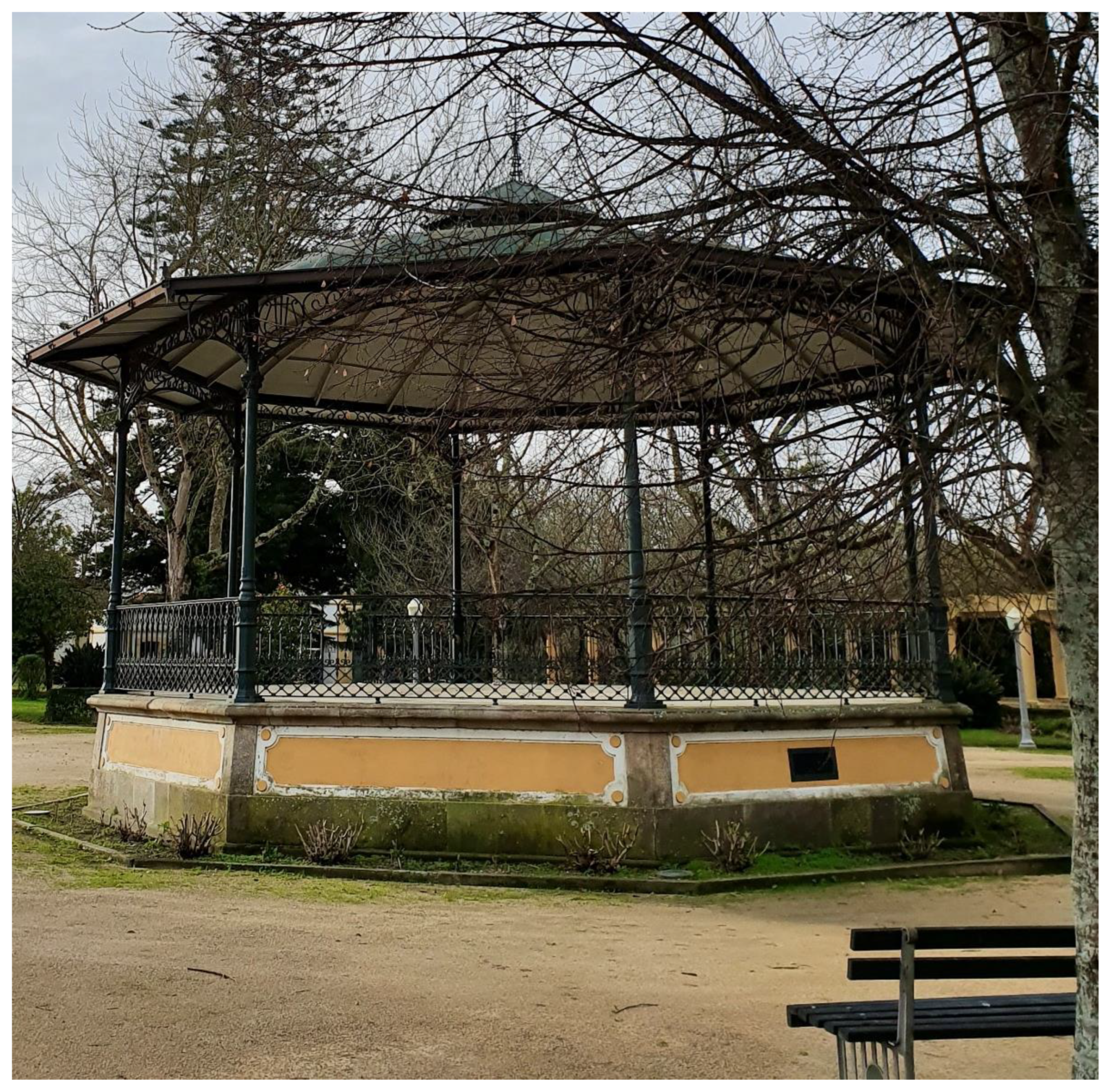
Figure 2.
AR-example contents (3D model, AR Marker, AR trigger example, and bellow, an ARBook page).
Figure 2.
AR-example contents (3D model, AR Marker, AR trigger example, and bellow, an ARBook page).
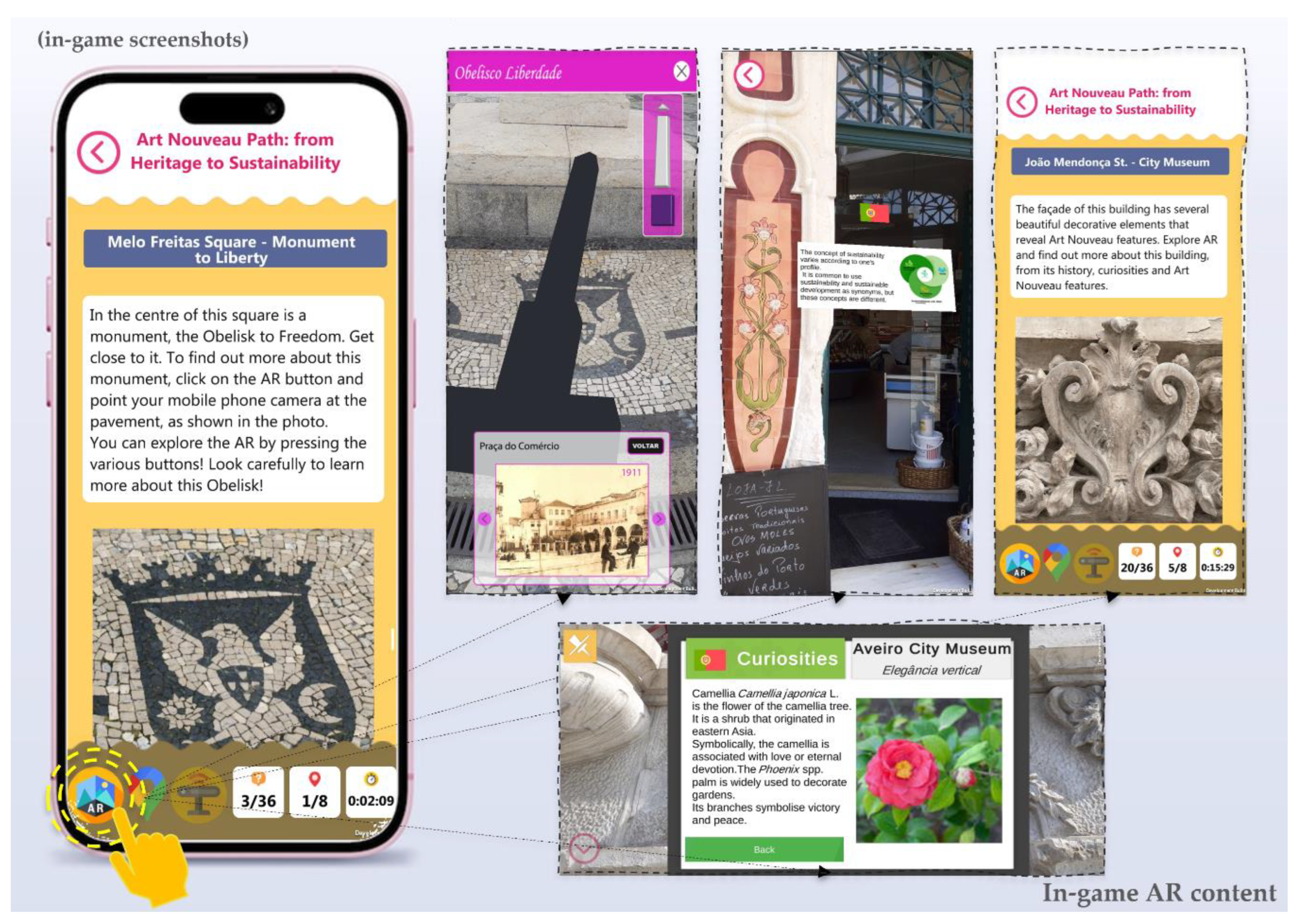
Figure 3.
Art Nouveau Museum in Aveiro, Portugal and in-app POI 6 marker (AR-Trigger).
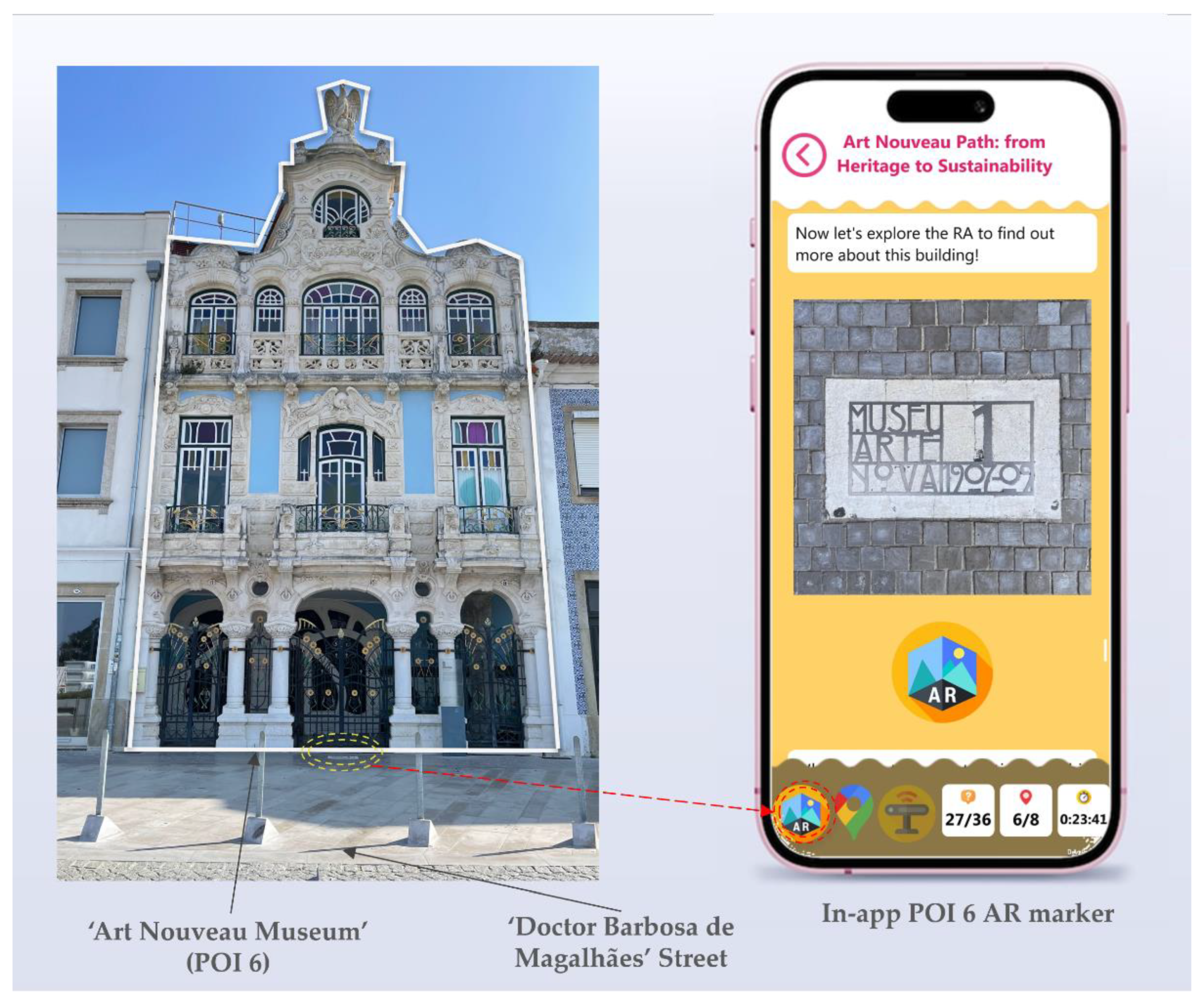
Figure 4.
In-app (version 1.3) map, buttons and information panel.
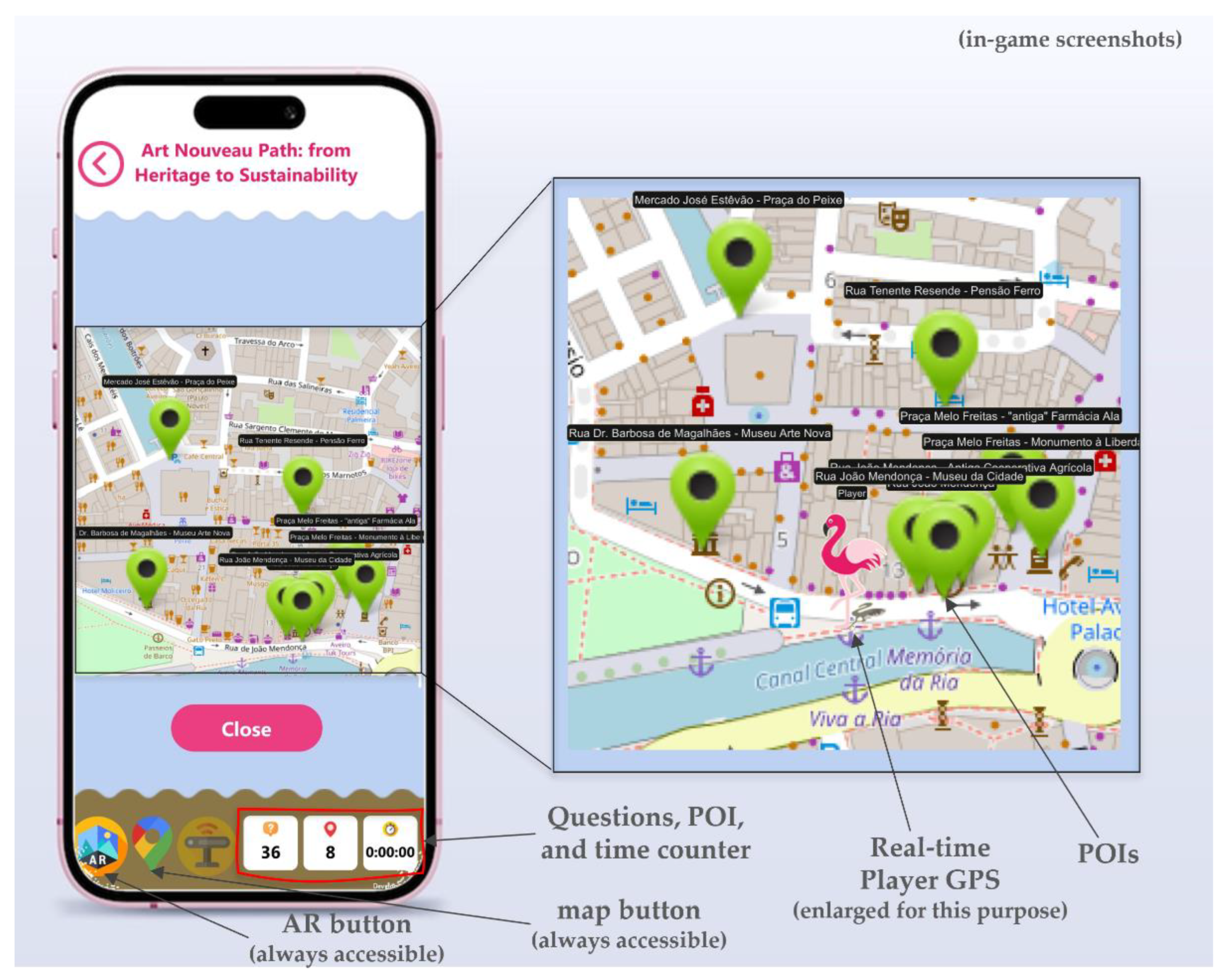
Figure 5.
Heritage interpretive sign of ‘Ala Pharmacy (old)’ (used as AR-marker).
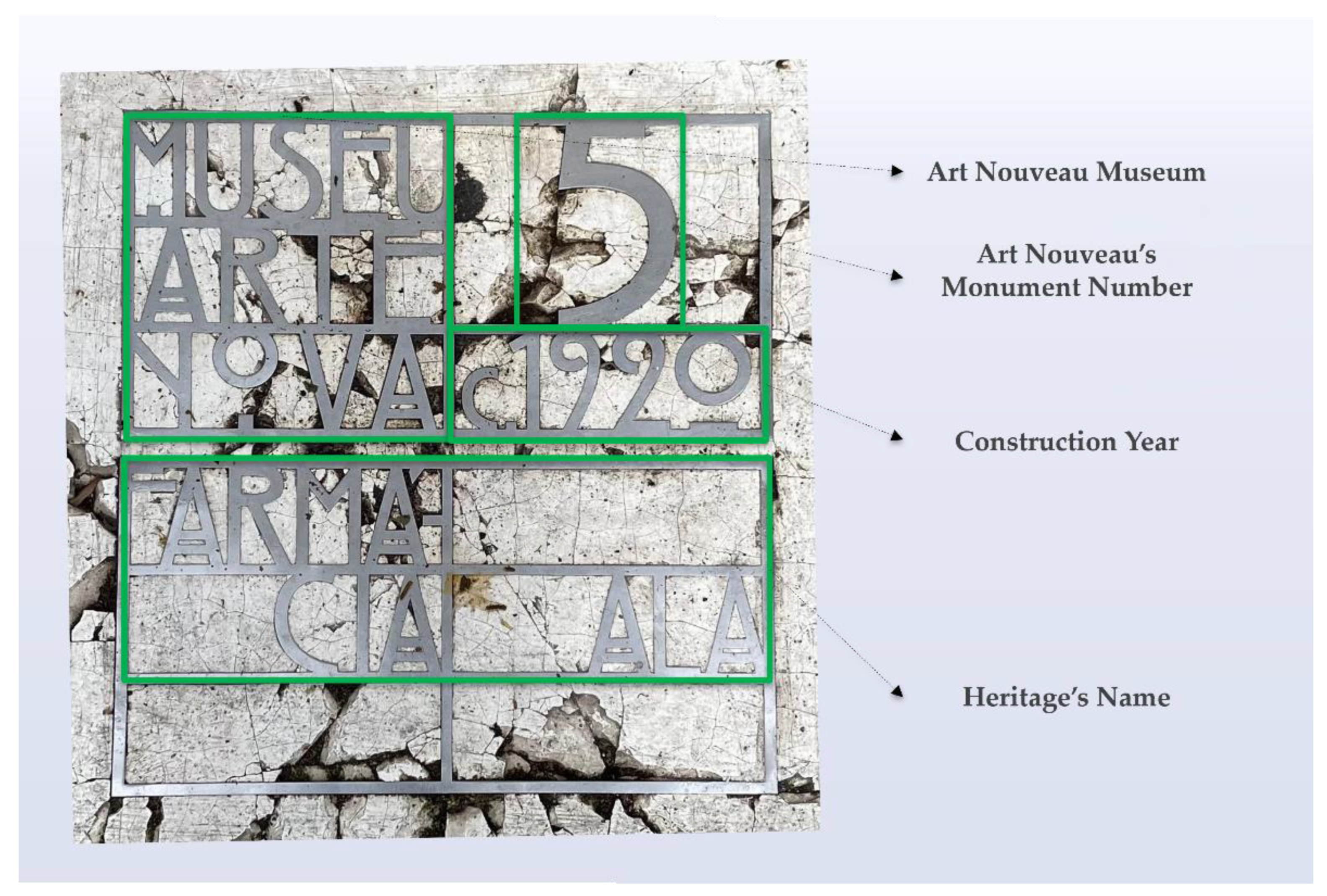
Figure 6.
Determinant-to-transfer kit traceability view.
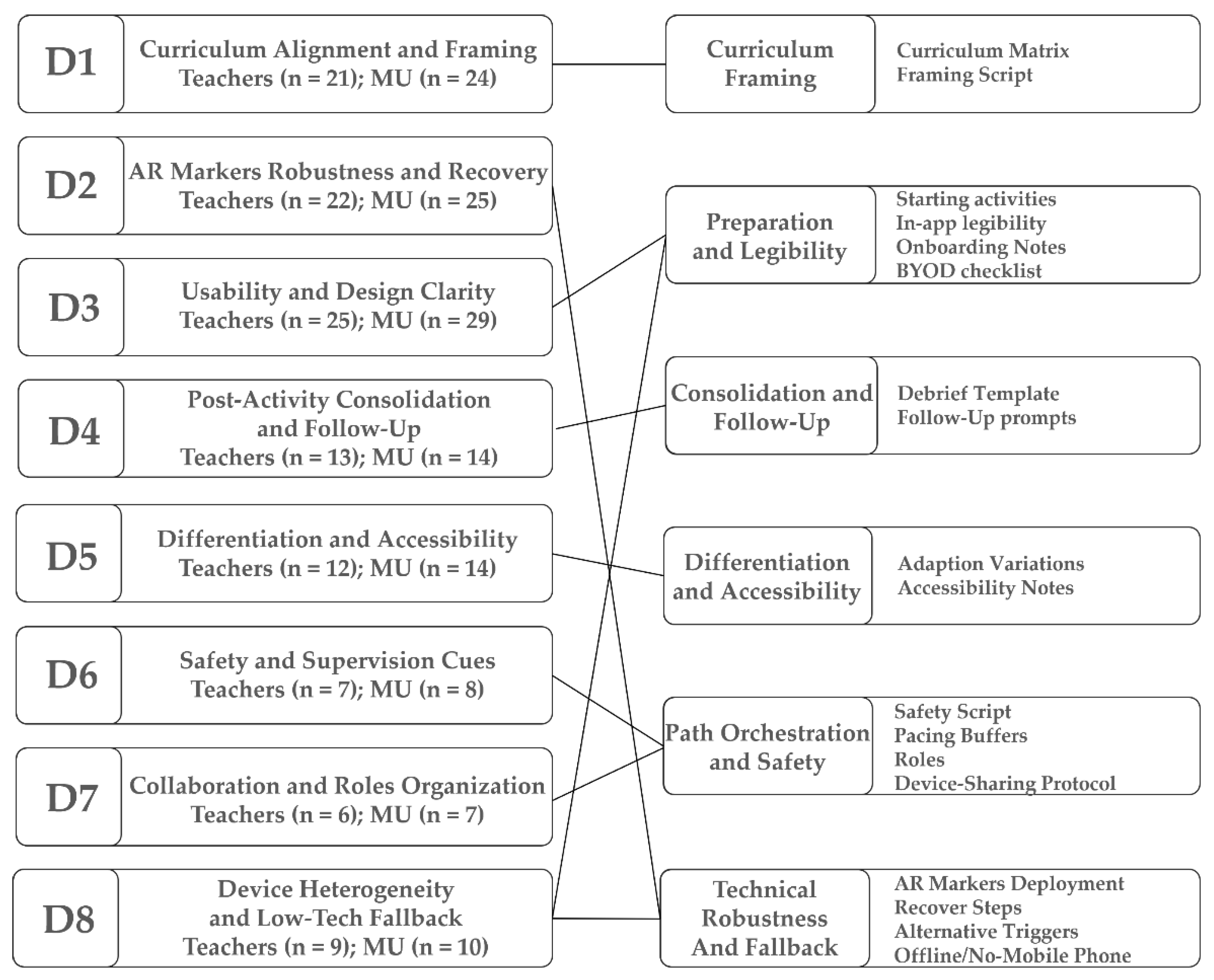
Figure 7.
Minimal governance stack for city-scale enactment of an outdoor MARG as a municipal learning service.
Figure 7.
Minimal governance stack for city-scale enactment of an outdoor MARG as a municipal learning service.
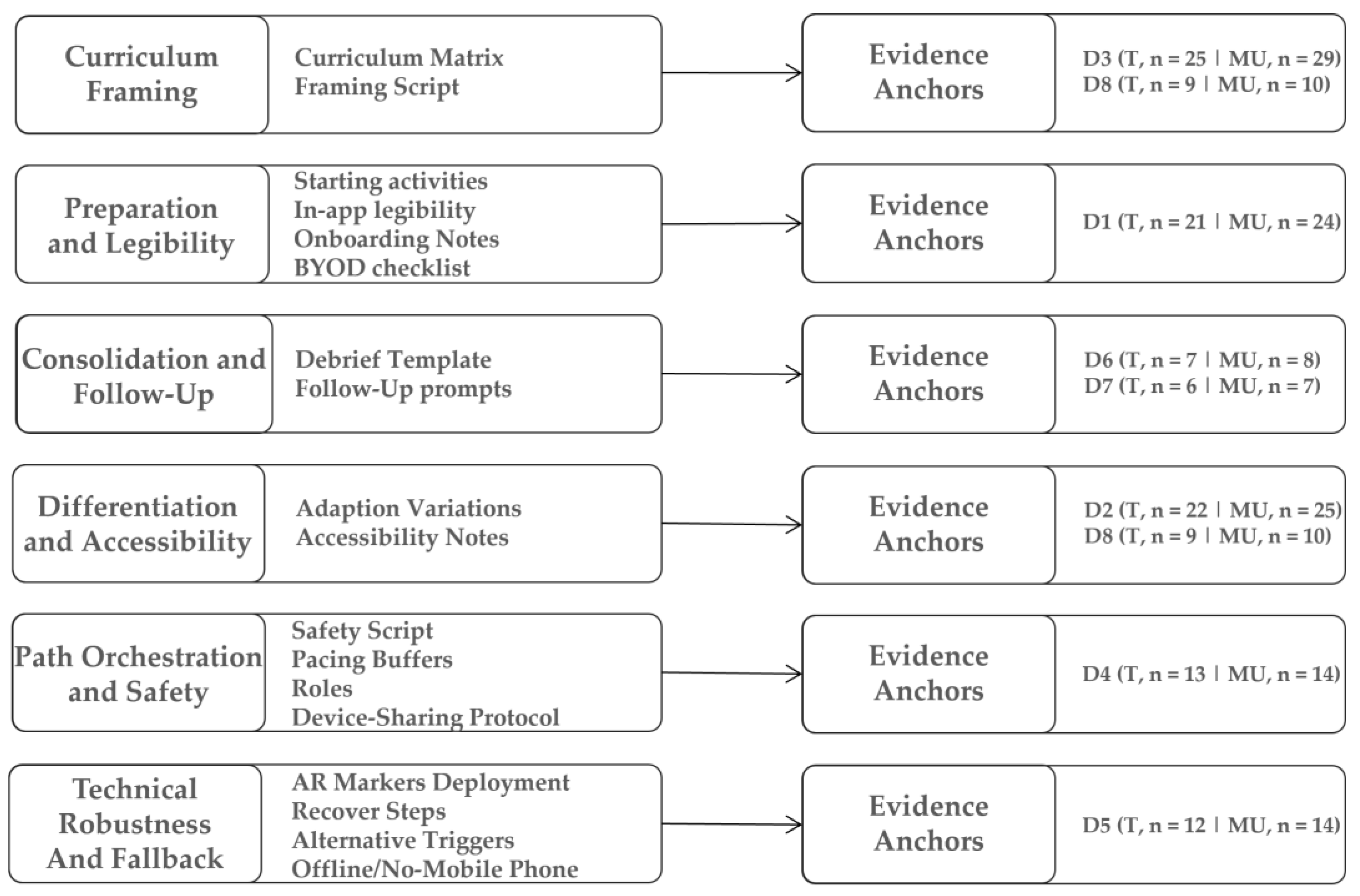

Table 1.
POI-level task dependency profile across the eight-points path (N = 36 tasks): AR overlay tasks, marker-triggered question access, and low-tech solution demand (OBS and KNOW).
Table 1.
POI-level task dependency profile across the eight-points path (N = 36 tasks): AR overlay tasks, marker-triggered question access, and low-tech solution demand (OBS and KNOW).
| POI | Location | Total tasks (n) | AR overlay tasks (n) | AR overlay (%) | AR Marker-triggered question tasks (n) | Marker-triggered question (%) | Low-tech tasks (OBS and KNOW) (n) | Low-tech (OBS and KNOW) (%) |
|---|---|---|---|---|---|---|---|---|
| 1 |
Melo Freitas Square ‘Obelisk to Liberty’ |
5 | 1 | 20.00 | 1 | 20.00 | 0 | 0.00 |
| 2 |
Melo Freitas Square ‘Ala Pharmacy (old)’ |
4 | 2 | 50.00 | 1 | 25.00 | 2 | 50.00 |
| 3 | João Mendonça Street | 5 | 0 | 0.00 | 4 | 80.00 | 5 | 100.00 |
| 4 |
João Mendonça Street ‘Old Agricultural Cooperative’ |
5 | 1 | 20.00 | 4 | 80.00 | 4 | 80.00 |
| 5 |
João Mendonça Street ‘Aveiro City Museum’ |
6 | 3 | 50.00 | 6 | 100.00 | 4 | 66.67 |
| 6 | ‘Art Nouveau Museum’ | 6 | 3 | 50.00 | 5 | 83.33 | 1 | 16.67 |
| 7 |
‘José Estêvão Market’ (Fish Market) |
3 | 1 | 33.33 | 3 | 100.00 | 3 | 100.00 |
| 8 | ‘Ferro Guesthouse’ | 2 | 0 | 0.00 | 2 | 100.00 | 2 | 100.00 |
| Total | 36 | 11 | 30.56 | 26 | 72.22 | 21 | 58.33 | |
1 Note: “AR overlay tasks” refer to tasks that include an authored AR overlay as a resource. “AR Marker-triggered question tasks” refer to tasks whose Question stage requires marker-based triggering (image recognition) to access the question interaction layer. “Low-tech tasks (OBS and KNOW)” refer to tasks whose solution demand can be met through direct observation and or prior knowledge; this label is not mutually exclusive with marker triggering, since access may require a marker even when solving relies primarily on observation and or prior knowledge.
Table 2.
Data streams, analytical units, and restricted analytical role in this manuscript.
| Data stream | Instrument/source | N (records) | Analytical unit | Primary use in this manuscript |
|---|---|---|---|---|
| Teacher validation workshop | T1-VAL (open and closed fields) | 30 | Teachers’ records; meaning units (open fields) |
Adoption constraints; transferability criteria; determinant quantification |
|
Specialist curriculum review |
T1-R (expert narratives and heuristics) | 3 | Specialists’ records; meaning units | Scaling heuristics and transfer rules; triangulation |
| In situ teacher field observations | T2-OBS (open suggestions, notes, structured fields) | 24 | Teachers’ records; meaning units (open fields) |
Orchestration requirements; logistics and contingencies; determinant quantification |
| Student post-path survey (S2-POST) | S2-POST students questionnaire (open prompts; GreenComp-Based Questionnaire (GCQuest) block Q1–Q25) | 439 | Students’ records | Feasibility and integrity checks for post-path instrument administration; acceptability and transfer-constraint descriptors (non-inferential) to bound adoption conditions at city scale |
| Gameplay traces | App logs (group-level sessions) |
118 valid sessions | Group sessions | Operational feasibility envelope (response presence, completion traces, duration envelope) |
|
Design documentation |
Task and path documentation | 36 tasks; 8 POIs | Tasks; POIs; script segment |
Architecture profiling and service specification (dependencies, redundancy, fallback design) |
Table 3.
Implementation determinant codebook (single-label primary codes) with operational cues.
| Code | Determinant (primary focus) |
Operational coding cues (inclusion criteria) |
|---|---|---|
| D1 | Curriculum alignment and framing |
Mentions of curricular fit, disciplinary linkage, lesson framing, learning aims, “how to integrate in class”, legitimacy for school practice. |
| D2 | Marker robustness and recovery |
Mentions of marker recognition failures, AR trigger reliability, scanning issues, glare, positioning, recovery steps, alternative triggers, “what to do when AR fails”. |
| D3 | Usability and design clarity | Mentions of interface clarity, instructions, wording, navigation inside the app, task clarity, readability, cognitive load from design, and onboarding needs. |
| D4 | Post-activity consolidation and follow-up |
Mentions of debriefing, follow-up activities, classroom consolidation, reflection prompts, assessment support, “after the path” learning closure. |
| D5 | Differentiation and accessibility |
Mentions of Special Educational Needs (SENs), accessibility adaptations, differentiated variants by age/ability, mobility constraints, inclusive design requirements. |
| D6 | Safety and supervision cues |
Mentions of public-space safety, crossings, supervision positioning, risk cues, regrouping for safety, teacher oversight constraints. |
| D7 | Collaboration and role organization |
Mentions of roles in groups, cooperation, device-sharing organization, accountability within groups, participation balance, teamwork routines. |
| D8 | Device heterogeneity and low-tech fallback |
Mentions of Bring Your Own Device (BYOD) variability, device capability differences, battery/connectivity constraints, offline/no-phone alternatives, low-tech fallbacks. |
Table 4.
Primary modality by task stage (dominant modality per stage (n) across the full task set; N = 36 tasks per stage).
Table 4.
Primary modality by task stage (dominant modality per stage (n) across the full task set; N = 36 tasks per stage).
| Stage | ARBook (n) | AR Marker (n) | Audio (n) | Image (n) | Video (n) | Text (n) |
|---|---|---|---|---|---|---|
| Intro | 19 | 1 | 1 | 7 | 3 | 5 |
| Questions | 25 | 1 | 0 | 1 | 0 | 9 |
| Correct feedback | 0 | 1 | 1 | 10 | 1 | 23 |
| Incorrect feedback | 0 | 1 | 1 | 12 | 1 | 21 |
2 Note: ARBook and AR Marker denote marker-triggered access mechanisms (image recognition) used to open a stage in the app. In the Question stage, ARBook and AR Marker corresponds to the “marker-triggered question tasks” construct reported in Table 1 (N = 26, as 25 + 1). These labels do not denote the presence of authored AR overlay assets, which are reported separately as ‘AR overlay tasks’ in Table 1.
Table 5.
Key T2-OBS feasibility-related Likert indicators (1 to 6 scale; N = 24).
| Item | Mean (M) |
Standard Deviation (SD) |
Median (MDN) |
Min. | Max. |
|---|---|---|---|---|---|
| Instructions were clear | 4.67 | 0.96 | 5 | 3 | 6 |
| Would participate again | 5.75 | 0.44 | 6 | 5 | 6 |
| Feasible to integrate in school practice | 5.08 | 0.58 | 5 | 4 | 6 |
| Appropriate across multiple grade levels | 4.88 | 0.61 | 5 | 4 | 6 |
| Perceived innovativeness of the resource | 5.62 | 0.49 | 6 | 5 | 6 |
Table 6.
Observed enactment indicators (Yes/No) (T2-OBS; N = 24).
| Observation indicator | Yes (n) | Yes (%) | No (n) |
|---|---|---|---|
|
Activity supports exploring other places or paths |
15 | 62.50 | 9 |
|
Activity supported discussion about sustainability |
16 | 66.67 | 8 |
|
Activity supported care for public space |
20 | 83.33 | 4 |
|
Activity supported relation to classroom content |
17 | 70.83 | 7 |
|
Activity supported problem solving |
20 | 83.33 | 4 |
|
Activity supported group collaboration |
18 | 75.00 | 6 |
Table 7.
Open-field improvement foci derived from T2-OBS suggestions (T2-OBS; N = 24).
| Category | Example improvement focus | Count (n/N) |
|---|---|---|
|
Technical robustness and device constraints |
BYOD preparation, connectivity planning, low-tech alternative |
14/24 |
|
Orchestration and Group Management |
Cooperative inter-group challenges, time and pacing guidance |
5/24 |
|
Instruction legibility and teacher-facing scripts |
Teacher’s guide, scripts for assessment and follow-up |
4/24 |
|
Differentiation and Accessibility |
Adaptations by age, Scaffolding | 3/24 |
| Content Enrichment | More contextual information, and additional heritage facts |
3/24 |
3 Note: Categories are not mutually exclusive; a single record may contribute to multiple categories.
Table 8.
Orchestration checklist excerpts (transfer-facing).
| Checklist area | Purpose | Operational cue |
|---|---|---|
| Pacing buffers | Allocate time buffers for interruptions |
Use a buffer of 5 to 10 minutes for crossings and regrouping |
|
Technical contingencies |
Ensure recovery paths if AR or connectivity fails |
Provide fallback prompts and non-AR progression cues |
| Group management | Maintain visibility and accountability in public space |
Use headcounts and role rotation at each POI |
|
Start and end routines |
Reduce friction at launch and closure | Standardize a start script and debrief closure questions |
Table 9.
Teachers’ validation signals (T1-VAL; N = 30).
| Indicator | Yes (n) | Yes (%) | No (n) |
|---|---|---|---|
|
Would recommend to other teachers |
28 | 93.33 | 2 |
|
Consider it feasible to integrate in curricular practice |
27 | 90.00 | 3 |
|
Consider the tasks understandable without prior AR training |
27 | 90.00 | 3 |
|
Intend to use the resource in future activities |
28 | 93.33 | 2 |
Table 10.
Teachers’ curricular/subject areas (T1-VAL; N = 30).
| Curricular Area/Subject | n | % |
|---|---|---|
| Civic Education | 6 | 20.00 |
| Arts | 5 | 16.67 |
| Geography | 5 | 16.67 |
| Mathematics | 5 | 16.67 |
| Multidisciplinary | 4 | 13.33 |
| History | 3 | 10.00 |
| Science | 2 | 6.67 |
Table 11.
Student acceptability and feasibility indicators (post-path student survey; N = 439).
| Indicator | Yes (n) | Yes (%) | No (n) |
|---|---|---|---|
| Interest in learning about sustainability through Arte Nova heritage | 432 | 98.41 | 7 |
|
Interest in learning more about Aveiro’s Art Nouveau heritage |
414 | 94.31 | 25 |
|
Self-reported ability to name sustainability competences |
265 | 60.36 | 174 |
|
Perception that the game addresses sustainability competences |
434 | 98.86 | 5 |
|
Perception that sustainability competences are important |
427 | 97.27 | 12 |
|
Interest in learning more about sustainability competences |
369 | 84.05 | 70 |
Table 12.
Post-path student questionnaire (S2-POST) GCQuest block completeness (Q1 to Q25; N = 439).
Table 12.
Post-path student questionnaire (S2-POST) GCQuest block completeness (Q1 to Q25; N = 439).
| Indicator | Value (N/n and %) |
|---|---|
| Complete-case records (all qualitative and Yes/No items) | 439/439 (100.00) |
| Complete-case records (all Q1 to Q25 present) | 438/439 (99.77) |
| Total missing item cells (Q1 to Q25) | 3/10,975 (0.03) |
4 Note: These 3 missing cells concern one single respondent.
Table 13.
Implementation determinants and quantitative descriptors (single-label coding; N = 131 Meaning Units (MU); teacher records, T1-VAL (N = 30) and T2-OBS (N = 24) = 54).
Table 13.
Implementation determinants and quantitative descriptors (single-label coding; N = 131 Meaning Units (MU); teacher records, T1-VAL (N = 30) and T2-OBS (N = 24) = 54).
| Implementation determinant |
Total MU (N) |
T1-VAL MU (n) |
T2-OBS MU (n) |
Teacher records mentioning (n/N) |
Teachers mention (%) |
MU (%) |
Transfer kit component |
|---|---|---|---|---|---|---|---|
|
Usability and design clarity |
29 | 22 | 7 | 25/54 | 46.30 | 22.14 | Teacher-facing quick start; in-app legibility supports; onboarding notes |
| Post-activity consolidation and follow-up | 14 | 9 | 5 | 13/54 | 24.07 | 10.69 | Structured debrief template; classroom follow-up prompts |
|
Curriculum alignment and framing |
24 | 19 | 5 | 21/54 | 38.89 | 18.32 | Curriculum mapping matrix; facilitation and framing script |
|
Differentiation and accessibility |
14 | 5 | 9 | 12/54 | 22.22 | 10.69 | Adaptation variants by age/ability; accessibility notes |
|
Collaboration and Organizational roles |
7 | 4 | 3 | 6/54 | 11.11 | 5.34 | Role cards; device-sharing and accountability protocol |
|
Device heterogeneity and low-tech fallback |
10 | 6 | 4 | 9/54 | 16.67 | 7.63 | BYOD preparation checklist; offline or no-phone alternative |
|
AR marker robustness and recovery |
25 | 24 | 1 | 22/54 | 40.74 | 19.08 | Marker deployment guidance; recovery steps; alternative triggers |
| Safety and supervision cues | 8 | 4 | 4 | 7/54 | 12.96 | 6.11 | Safety briefing script; crossing and regrouping routines; pacing buffers |
| Total | 131 | 93 | 38 | 54/54 | 100.00 | 100.00 |
Table 14.
Determinant to transfer kit traceability matrix (absolute counts and component lists; teacher records N = 54).
Table 14.
Determinant to transfer kit traceability matrix (absolute counts and component lists; teacher records N = 54).
| Determinant | Evidence (absolute) |
Preparation and legibility | Curriculum framing | Path orchestration and safety |
Technical robustness and fallback |
Consolidation and follow-up | Differentiation and accessibility |
|---|---|---|---|---|---|---|---|
| D1: Curriculum alignment and framing | MU n = 24; Teachers’ records n = 21/54 | Not applicable (n/a) | Curriculum mapping matrix; facilitation and framing script | n/a | n/a | n/a | n/a |
| D2: AR marker robustness and recovery | MU n = 25; Teachers’ records n = 22/54 | n/a | n/a | n/a | Marker deployment guidance; recovery steps; alternative triggers | n/a | n/a |
| D3: Usability and design clarity | MU n =29; Teachers’ records n = 25/54 | Teachers-facing quick start; in-app legibility supports; onboarding notes | n/a | n/a | n/a | n/a | n/a |
| D4: Post-activity consolidation and follow-up | MU n = 14; Teachers’ records n = 13/54 | n/a | n/a | n/a | n/a | Structured debrief template; classroom follow-up prompts | n/a |
| D5: Differentiation and accessibility | MU n = 14; Teachers’ records n = 12/54 | n/a | n/a | n/a | n/a | n/a | Adaptation variants by age/ability; accessibility notes |
| D6: Safety and supervision cues | MU n = 8; Teachers n = 7/54 | n/a | n/a | Safety briefing script; crossing and regrouping routines; pacing buffers | n/a | n/a | n/a |
| D7: Collaboration and role organization | MU n=7; Teachers’ records n=6/54 | n/a | n/a | Role cards; device-sharing and accountability protocol | n/a | n/a | n/a |
| D8: Device heterogeneity and low-tech fallback | MU n=10; Teachers’ records n=9/54 | BYOD preparation checklist | n/a | n/a | Offline or no-phone alternative | n/a | n/a |
Disclaimer/Publisher’s Note: The statements, opinions and data contained in all publications are solely those of the individual author(s) and contributor(s) and not of MDPI and/or the editor(s). MDPI and/or the editor(s) disclaim responsibility for any injury to people or property resulting from any ideas, methods, instructions or products referred to in the content. |
© 2026 by the authors. Licensee MDPI, Basel, Switzerland. This article is an open access article distributed under the terms and conditions of the Creative Commons Attribution (CC BY) license (http://creativecommons.org/licenses/by/4.0/).
Copyright: This open access article is published under a Creative Commons CC BY 4.0 license, which permit the free download, distribution, and reuse, provided that the author and preprint are cited in any reuse.


