

Submitted:
21 January 2026
Posted:
23 January 2026
You are already at the latest version
Abstract
Coastal regions concentrate livestock and fisheries activities that generate large volumes of organic residues, often managed inadequately and contributing to nutrient loading, soil degradation, and marine pollution. At the same time, these territories face increasing pressure to decarbonise energy systems and restore degraded soils under climate change. This article proposes a process-oriented conceptual framework for the integrated valorisation of livestock and fisheries residues through hydrogen-centred energy recovery and biochar-based soil regeneration, with a focus on coastal regions of Colombia. The framework integrates biological and thermochemical conversion pathways, including anaerobic digestion, fermentation, gasification, and pyrolysis, within a unified system boundary that treats organic residues as secondary resources rather than environmental burdens. Hydrogen is conceptualised as a short-term energy carrier, while biochar is positioned as a key co-product enabling long-term carbon stabilisation and soil regeneration. By explicitly integrating material and energy flows, territorial scale considerations, and governance dimensions, the proposed framework provides a process-level basis for designing decentralised residue-to-energy and soil-regeneration systems capable of delivering simultaneous benefits in renewable energy supply, waste management, soil restoration, and climate mitigation in environmentally vulnerable coastal regions.
Keywords:
contribution analysis
; environmental footprint
; laboratory-scale processes
; organic matrices
; process-based environmental assessment
1. Introduction
Global coastal regions are hubs of biological diversity and intense economic activities, including livestock farming, aquaculture, and urban development. This convergence, combined with climate change, creates increasing pressure on marine and lagoon ecosystems, resulting in habitat loss and the accumulation of organic effluents In countries like China, rapid marine economic growth has led to excessive resource consumption, necessitating a shift towards sustainable efficiency. Similarly, West African lagoons face threats from overfishing and industrial pollution, jeopardising the livelihoods of local fishing communities Land-use changes, particularly the expansion of settlements near coastlines, are consistently linked to natural resource degradation, eutrophication, and mangrove loss [2,3].
In the Colombian context, the Caribbean and Pacific regions are vital, yet ecologically fragile. The Colombian Caribbean, occupying 11% of the national surface, acts as a funnel for pollutants from the Magdalena River basin. Agriculture and livestock are the primary theoretical sources of nitrogen and phosphorus in coastal water bodies, while industrial wastewater contributes high biochemical oxygen demand (BOD) and faecal coliform loads Furthermore, inadequate urban solid waste management in coastal municipalities is a recognised public health crisis, where informal disposal practices negatively impact the environment and tourism National sustainability studies highlight a persistent tension between economic extraction and environmental preservation, often undermined by institutional incoherence [6,7].
The intensification of aquaculture and livestock sectors produces massive volumes of organic waste. In aquaculture, only approximately 30% of nutrients provided via feed are converted into the final product; the remainder is discharged as solid and dissolved waste Globally, fish processing generates nutrient-rich waste streams, such as guts and sludge, which are frequently discarded without recovery [9].
At a local level, Colombia possesses an abundant but underutilised supply of residual biomass. Counties in the Caribbean region show high availability of palm oil mill effluent (POME), rice straw, and pig manure, suitable for decentralised biogas production The palm oil industry alone produced 2.76 million tonnes of waste in 2023, offering significant potential to replace coal in energy production Despite this, poor management leads to nutrient loading in sensitive areas like the Magdalena Delta and coastal marshes near Cartagena and Santa Marta [4].
Coastal territories such as La Guajira can be understood as “natural laboratories” for integrated low-carbon development because they concentrate strong solar radiation, coastal winds, and diverse marine biomass streams (e.g., seaweed, sargassum, and fishing residues). A multi-criteria sustainability perspective shows that the technical potential for hybrid renewable configurations is typically high, while the limiting factors often shift towards logistics and pre-treatment requirements (collection, conditioning and drying of wet biomass), as well as the institutional and socio-economic conditions needed to build inclusive coastal bioeconomy initiatives. In this sense, valorisation pathways that simultaneously address waste reduction, ecosystem restoration, and local livelihoods provide a robust rationale for coupling energy carriers and circular bio-products in coastal regions [12].
Conventional management has historically relied on landfills and sea dumping. These approaches are increasingly risky due to rising sea levels, which enhance the danger of erosion and leachate release into marine environments Urban waste disposal via incineration or landfills is unsustainable, contributing significantly to greenhouse gas emissions and air pollution. In Colombia, waste management remains trapped in a linear "extract-produce-dispose" model, suffering from technical weaknesses and a lack of coordination with Comprehensive Solid Waste Management Plans (PGIRS) While regulations are moving towards a circular economy, rural and medium-sized cities still lack the infrastructure for effective organic waste valorisation [14].
Implementation constraints in remote and vulnerable communities are not limited to technology availability; they also include strong socio-cultural diversity, territorial rootedness, and practical limitations that shape acceptance and long-term operation of energy solutions. Evidence from Colombian off-grid contexts shows that limited access to electricity restricts opportunities in education, productivity, health services, and local technological development, while dependence on diesel for basic energy needs increases both costs and environmental burdens. Therefore, energy and resource-valorisation projects in these territories benefit from participatory and community-centred design logics that anticipate cultural barriers, governance dynamics, and the conditions required for adoption and continuity [15].
Scientific literature underscores the potential of agricultural and fishery waste for nutrient recovery. These residues are excellent substrates for anaerobic digestion, producing biogas for heat and electricity, and digestates for soil amendment Fishery by-products, such as shells and sludge, can be converted into bio-based fertilisers or biochar, effectively replacing synthetic minerals In coastal zones, this integrated approach closes nutrient cycles between land and sea, improving food security Colombia’s Caribbean coast is ideally suited for these technologies, boasting world-class wind speeds in La Guajira (9-10 m/s) and high photovoltaic suitability [17,18].
Despite biochar's potential as a climate mitigation tool [19], there is a critical disconnect regarding its integrated application in Colombian tropical coasts. Existing research has focused on inland agricultural residues, overlooking pyrolysis's ability to address diffuse pollution in mangroves and estuaries Furthermore, circular models using biochar to mitigate soil salinisation or nutrient leaching in marine ecosystems remain under-explored [20,21]. This study fills this gap by proposing a polygeneration model (bioenergy and hydrogen) tailored to the socio-ecological dynamics of the coast. The objective is to assess the potential of an integrated model that converts livestock and fishing waste into clean energy and biochar, providing environmental benefits such as carbon sequestration and the recovery of saline-degraded soils in the Caribbean and Pacific basins [4].
2. Residue Streams in Coastal Livestock and Fisheries Systems
The Colombian coasts (Caribbean and Pacific) are home to a wealth of ecological diversity, large river basins (Magdalena, Canal del Dique, Sinú, Atrato, etc.) and livestock, fishing, industrial and port activities that discharge pollutants into the sea. In this context, livestock and fishing waste are a key component of the pressure on coastal ecosystems (see Figure 1).
2.1. Livestock Residues
In the dry Caribbean region of Colombia (Córdoba, Sucre, Bolívar, Atlántico, Cesar and Magdalena), extensive cattle farming systems predominate on soils showing signs of degradation, compaction (apparent density greater than 1.4 g/cm³) and organic matter content often below 2%, except in Córdoba and Bolívar where it exceeds 3% This indicates significant manure loads on soils with limited infiltration capacity, with a higher risk of runoff into swamps, mangroves and the Caribbean Sea.
At the mouth of the Magdalena River and adjacent coastal basins, livestock and agriculture are the main sources of nitrogen and phosphorus to coastal areas: for one of the basins (“western edge of the lower Magdalena”), an estimated 48.99 t/day of N and 19.46 t/day of P come from livestock farming These nutrients come mainly from solid and liquid manure (urine) deposited in pastures and from leachate from corrals, stables and small rural slaughterhouses. Although studies do not separate “Caribbean vs. Pacific” for coastal livestock farming, the concentration of cattle herds in the Caribbean counties indicates that the Caribbean coast is the main source of livestock waste with an impact on the marine environment [4].
2.1.1. Solid and Liquid Manure
The available literature has focused mainly on the analysis of soil indicators, but these studies clearly reveal the characteristics of manure that is continuously incorporated into soils in coastal areas. In livestock systems in Córdoba and Bolívar, soils with organic matter contents greater than 3% and cation exchange capacities greater than 20 cmol/kg have been reported, conditions associated with the sustained input of manure and the accumulation of nutrients such as Ca, Mg, K and P in the soil profile However, these systems also present problems of compaction and low porosity, which favour surface runoff of liquid fractions of manure, mainly urine and leachates with high nitrogen and phosphorus loads [22].
These local processes are amplified at the watershed scale. Estimates of loads associated with livestock activity in territories that drain directly into the Caribbean Sea indicate nitrogen and phosphorus flows in the order of tens of tonnes per day, originating from both organic and inorganic fractions of manure This shows that manure constitutes a diffuse but quantitatively significant flow of nutrients into aquatic and coastal systems.
The biological component of manure, particularly faecal coliforms and other pathogens, has not been specifically quantified in Colombian coastal areas. However, studies conducted in the lower Magdalena River basin show that untreated domestic wastewater discharges exceed coliform loads from other sources by more than four orders of magnitude, reaching values close to 10¹⁶ NMP/day In this context, it is reasonable to assume that livestock systems without excreta treatment also contribute significantly to the transport of microorganisms to coastal water bodies.
The magnitude of these impacts is closely linked to the structural importance of cattle farming in Colombia. This sector constitutes one of the main land uses at the national level and is a central component of the country's climate goals. In dual-purpose systems in the Caribbean region, life cycle analyses show significant carbon footprints, dominated by enteric emissions, but with an additional significant contribution associated with manure management in pastures and corrals [23].
In the Caribbean strip, a considerable proportion of the nitrogen and phosphorus loads generated by livestock farming drain into the Magdalena River delta and into coastal systems such as the Ciénaga de Mallorquín and the basin known as “Directa al Caribe”. In these areas, livestock farming is identified as one of the main theoretical sources of nutrients, with estimated contributions of around 49 t/d of N and 19 t/d of P, confirming that manure, both in its solid and liquid fractions, represents a diffuse but massive flow of nutrients into coastal ecosystems [4].
2.1.2. System Boundary
The system includes the processes of sampling and collection of biomass in the field, transport of samples to the laboratory, preparation and separation of the biofilm, chemical digestion when applicable, filtration, concentration, drying or preservation, analytical analysis, data recording, as well as the handling of reagents, waste, and consumables. Energy consumption is also considered associated with drying, filtration, and analysis, as well as material inputs (filters, membranes, reagents, containers).
The production of the vegetation (seagrass or sargassum), its natural cycle in the ecosystem, the original production of microplastics, their previous use in the marine environment, and subsequent management stages (use, final disposal outside the laboratory) are intentionally excluded, except for the immediate treatment of waste generated during the analysis. The “cradle-to-grave” phase of the microplastic as a pollutant is also not included, given that the objective is the quantification of retention.
The spatial boundary is limited to the coordinates and conditions of the sampling sites defined for each scenario (vegetation density, hydrodynamics, depth, etc.). The temporal horizon considers the time of sampling, transport, processing, and analysis. If the environmental fate of the retained microplastics is estimated (sedimentation, remobilisation, etc.), the fate horizon and the associated assumptions must be clearly defined. The input flows considered include reagents, energy, sampling and filtration materials. The outputs are solid and liquid laboratory waste, retained microplastics, possible remobilised ones, and emissions or discharges derived from the use of energy or reagents.
2.1.2. Current Management Practices
Recent assessments of integrated coastal management in Colombia identify a critical disconnect between coastal zone planning and productive activities carried out in river basins. Although the significant impact of agriculture and livestock farming on marine pollution from nutrients and sediments is recognised, the absence of coordinated management linking these activities to the health of marine ecosystems remains a cross-cutting problem Socio-ecological studies in the Magdalena River delta reinforce this view, pointing out that terrestrial pollutant loads, including those derived from agribusiness, exert constant pressure on water quality in estuaries In practice, three different approaches predominate:
2.2. Fisheries Residues
2.2.1. Fish Waste
On the Caribbean and Pacific coasts of Colombia, fishing activity, ranging from artisanal to semi-industrial fleets, generates constant flows of residual biomass that lack adequate management. In Latin American artisanal ports, the massive generation of gutting waste (heads, gills, viscera, bones, skin and trimmings) has been documented, representing a significant fraction of the total catch. A benchmark study in the artisanal fishing port of Coquimbo (Chile) quantified the generation of 31,699 kg of fish waste in a period of only 31 days, with a daily average of 1,022.6 kg. The problem is exacerbated by storage conditions: uncovered plastic containers exposed to solar radiation, which accelerates biological decomposition, promotes the emission of offensive odours and attracts vectors such as flies and birds Although this case is external, it illustrates the operational dynamics present in Colombian ports on the Caribbean coast (Bahía de Cartagena, Golfo de Morrosquillo, La Guajira) and the Pacific coast (Buenaventura, Tumaco), where high landing volumes converge with poor infrastructure for primary processing. In these scenarios, the final disposal is usually direct discharge into water bodies or abandonment on beaches, creating sources of organic pollution.
The environmental risk posed by this waste is magnified in industrialised areas such as Cartagena Bay. Recent research warns of the bioaccumulation of heavy metals (arsenic, cadmium, mercury) and persistent organic pollutants in the local biota This implies that discarded viscera and bone remains are not just harmless organic matter, but potential vectors for the reintroduction of toxins into the food web and into vulnerable communities that, in the absence of basic sanitation, live in direct contact with this waste.
2.2.2. Seasonality and Coastal Location
The generation and accumulation of fishing and marine waste varies greatly in terms of time and place, depending on the ecology of the target species and the pressure of seasonal human activities.
- Biological seasonality and waste composition: The composition of organic waste changes dramatically depending on the target species. In the Caribbean, artisanal fleets alternate their catches according to resource availability. Trophic studies in Cartagena identify key species such as the macabí (Elops smithi), corvina (Cynoscion jamaicensis) and sea bass (Centropomus ensiferus). Each has different meat yields and bone structures, which alters the volume and type of seasonal waste. A critical factor is the trophic level: carnivorous species with higher bioaccumulation generate waste with a higher potential toxic load compared to basal species [27].
- The “Ecological Trap” Effect (Coastal Location): Coastal geomorphology determines the destination of this waste. While waves can redisperse waste on sandy beaches, mangrove ecosystems function as physical traps with high retention rates.
As shown in Figure 2, there is an alarming disparity in the San Andrés and Providencia Archipelago. The mangroves of Providencia retain up to 10.38 items/m² (marine debris and fishing debris caught in the roots), a figure significantly higher than the 0.42 items/m² recorded on open tourist beaches [28,29]. This accumulation creates localised anoxic zones that compromise the function of these ecosystems as fish nurseries.
Seasonal Dynamics and Synergy of Pressures This spatial vulnerability is exacerbated by complex temporal dynamics. Waste generation is not constant but rather responds to the interaction between the biological cycles of fishing and the socio-economic flows of tourism.
The conceptual model presented in Figure 3 illustrates how these two pressure vectors overlap at critical times of the year. While fishing activity fluctuates according to resource availability such as the upswings or migrations of key trophic species [27] tourism exerts massive pressure peaks during holiday seasons (December-January, Easter, mid-year). Analysis of the graph reveals areas of “pressure synergy” (shaded areas), where local sanitation infrastructure collapses. During these periods, the increase in tourist plastic waste coincides with the generation of fish guts and discards, creating a scenario of acute pollution that exceeds the resilience capacity of coastal ecosystems [28].
The problem transcends the Caribbean islands. In the Colombian Pacific, rural beaches have critical densities of microplastics in sediments (up to 1,387 items/m²) and macroplastics. These pollutants are strongly associated not only with tourism, but specifically with the abandonment of fishing gear (nets, buoys, lines) and packaging materials, perpetuating a cycle of degradation that affects the long-term sustainability of artisanal fishing [30].
2.2.3. Associated Environmental Problems
Organic fishing waste and solid waste linked to fishing (plastics, fishing gear, Styrofoam boxes) generate multiple impacts, as explained in detail in Table 1.
2.3. Challenges of Residue Management in Coastal Regions
- Environmental and ecosystem vulnerability
Colombia's coastal areas are fragile ecosystems (mangroves, reefs, seagrass beds, coastal lagoons) that support high biodiversity and key ecosystem services The main problems identified for the coastal strip include pollution from solid waste (particularly plastics), wastewater, oil spills and toxic substances [26]; deforestation and destruction of mangroves, loss of wildlife, coastal erosion [24]; and accumulation of marine litter in mangroves and backdune vegetation, which act as waste “traps”, especially for plastics In Colombia, the Caribbean coast and the Magdalena Delta receive large loads of nutrients, sediments (2.3 Mt/year in Cartagena) and pollutants, making the river the country's ‘main sewer system’ This increases the vulnerability of estuaries, tourist bays and fishing communities to algal blooms, habitat loss and declining water quality.
- Emissions and soil and water pollution
The combination of livestock, fishing and urban waste generates chronic nutrient inputs (N, P) from livestock and agriculture to coastal areas, with daily loads of tens of tonnes in some basins Also, it generates high densities of microplastics in coastal sediments, especially in the Caribbean (up to 1,387 particles/m) [31]; besides of the chemical pollution from heavy metals (e.g., mercury up to 18.8 µg/g in sediments in Cartagena Bay), hydrocarbons, pesticides and persistent organic pollutants, which bioaccumulate in biota Finally, it generates poorly managed solid waste (plastic, glass, scrap metal, electrical and electronic equipment) in Caribbean municipalities, with negative impacts on public health and the environment The beaches of San Andrés, for example, are classified as ‘dirty’ to ‘very dirty’ by the Clean Coast Index, with a predominance of plastic (59.5% of the weight of the waste) and glass (20.4%). In the continental Caribbean, 6–7 items of waste per square metre of beach are reported. This waste affects tourism, fishing and navigation, as well as marine fauna [28].
- Governance and integrated management
The diagnosis of coastal management in Colombia shows the absence of strong specific regulations on integrated coastal management that coordinate institutional competences and sectors such as livestock, fishing and tourism; there are scattered policies, but no centralised framework Also, deficits in financial resources, planning and instruments to control diffuse sources such as livestock farming and artisanal fishing And very low waste recovery (recycling, composting, bioenergy) in municipalities, even though up to 61% of urban waste in a tropical Colombian city was technically recyclable and that circular economy models in rural municipalities show potential for improving organic and solid waste management [32].
For fisheries, the Chilean experience in Coquimbo suggests replicable solutions: designing fish waste management plans that include separation at source, covered storage, adequate transport and recovery through composting or fishmeal, avoiding dumping at sea In this context, Figure 4 synthesizes the main pathways linking livestock and fisheries residue generation with coastal impacts and highlights circular biochar-based solutions that enable nutrient recovery and pollution reduction.
Beyond regulatory gaps, operational governance requires data visibility to prioritise interventions and verify performance. In Colombia’s Non-Interconnected Zones, open governmental datasets combined with business-intelligence workflows have been used to analyse energy service provision using variables reported through national monitoring and telemetry schemes (e.g., active/reactive energy, peak power, service hours and location). Such analyses indicate that consumption can be highly concentrated in a small subset of municipalities, supporting the need for targeted strategies and for monitoring architectures that enable evidence-based management in dispersed territories. These insights are transferable to coastal residue-valorisation systems, where multi-actor coordination and performance tracking are necessary for implementation at scale [33].
Smart and decentralised energy solutions in isolated regions require not only generation assets but also a data layer that is feasible under connectivity constraints. A Colombian case on smart microgrids for Non-Interconnected Zones highlights that functional and non-functional requirements must explicitly account for isolation, intermittent communications, and technology appropriation, while leveraging opportunities such as low demand profiles, abundant local renewable resources and public policy interest. From a systems perspective, this supports integrating sensing, data storage/processing, and decision support into decentralised configurations—an approach that can be adapted to monitor hybrid schemes where bioenergy carriers and co-products (e.g., biochar) are produced from local residues under variable operational conditions [34].
Remote monitoring is also a practical enabler for reliability and efficiency in distributed systems operating far from conventional infrastructure. Conceptual designs for IoT-based monitoring in Colombian remote contexts emphasise that instrumentation and communications should track the key variables that determine performance and energy efficiency of off-grid generation, particularly where limited connectivity and complex geography undermine routine supervision. Embedding monitoring and control capabilities becomes relevant for residue-to-energy value chains as well, because feedstock variability, pre-treatment requirements and conversion stability (biological or thermochemical) benefit from continuous operational feedback and early detection of inefficiencies [35].
3. Thermo- and Bio-Conversion Pathways for Hydrogen and Biochar Production
The conversion of organic residues into hydrogen and biochar can be achieved through a range of biological and thermochemical pathways. In coastal regions such as La Guajira in Colombia, where livestock manure and fisheries residues are generated in significant quantities and often under limited waste management infrastructure, these conversion routes offer opportunities to simultaneously address environmental pressures and support renewable energy production. Previous studies have highlighted that both biological and thermochemical processes are particularly well suited for the valorisation of wet and heterogeneous organic residues, such as animal manure and fish processing by-products, which are otherwise challenging to manage through conventional disposal practices.
From a systems perspective, the relevance of these pathways lies not only in their capacity to produce hydrogen as a clean energy carrier, but also in their ability to generate valuable co-products, particularly biochar, which can be used for soil regeneration and carbon sequestration. Biological routes such as anaerobic digestion and fermentation primarily focus on the conversion of biodegradable organic matter into gaseous products, whereas thermochemical routes such as gasification and pyrolysis enable the transformation of residual solids into hydrogen-rich gases and stable carbonaceous materials. Understanding the characteristics, advantages, and limitations of these pathways is essential for designing integrated residue valorisation frameworks adapted to the environmental and socio-economic conditions of coastal regions.
3.1. Anaerobic Digestion
Anaerobic digestion (AD) is a well-established biochemical process in which a consortium of microorganisms degrades organic matter under strictly anaerobic conditions, resulting in the generation of a mixture of gases predominantly composed of methane and carbon dioxide (biogas). The AD process involves a sequence of microbial-mediated stages (hydrolysis, acidogenesis, acetogenesis, and methanogenesis) that progressively decompose complex polymers into simpler molecules and gaseous end-products While conventional AD systems are primarily designed for biogas (CH₄) production, recent research has increasingly focused on their potential to contribute to biohydrogen generation, especially when operational parameters and microbial consortia are optimized to favour hydrogen-producing pathways over methanogenesis [36].
Feedstocks for AD commonly include livestock manures, agricultural residues, and organic fraction wastes; their composition significantly influences both gas yields and process stability. Manure from ruminant and non-ruminant livestock provides readily biodegradable substrates that support microbial activity, albeit with variations in volatile solid content, nutrient balance, and inhibitory compounds such as ammonia. The co-digestion of multiple organic residues, such as combining livestock manure with high-carbohydrate substrates like fish waste or food processing by-products, has been shown to enhance overall degradability and biogas production by improving microbial synergy and balancing carbon-to-nitrogen ratios Certain operational strategies can promote increased hydrogen fractions in the gaseous outputs, including manipulation of hydraulic retention time, pH, and temperature profiles within the digester [38].
Although hydrogen yields from conventional AD are generally lower relative to methane due to the downstream consumption of hydrogen by methanogenic archaea, emerging approaches including two-phase systems, controlled inhibition of methanogenesis, and the integration of exogenous hydrogen into the digestate have demonstrated that hydrogen production can be enhanced under specific conditions Furthermore, the digestate itself represents a potential substrate for downstream thermochemical conversion processes, such as pyrolysis or gasification, to produce more hydrogen-rich syngas or stable carbon-rich materials, thereby extending the valorisation potential of the AD process beyond traditional biogas recovery
3.2. Fermentation
Fermentation-based pathways have been widely investigated for the biological production of hydrogen from organic residues, particularly through processes known as dark fermentation. In this route, fermentative microorganisms metabolise carbohydrates, proteins, and other biodegradable compounds under anaerobic conditions, releasing hydrogen as a metabolic by-product along with organic acids and alcohols. Unlike photo-fermentation, dark fermentation does not require light energy, which makes it especially suitable for treating complex and heterogeneous substrates such as livestock manure and fish processing residues in non-controlled environments [41,42]. The suitability of fermentation processes for residue valorisation is strongly dependent on substrate composition and operational conditions. Livestock manure and fisheries residues provide abundant organic matter, but also present challenges related to high nitrogen content, protein degradation, and the potential accumulation of ammonia and volatile fatty acids, which can inhibit hydrogen-producing bacteria. Previous studies have shown that process parameters such as pH, hydraulic retention time, and temperature play a critical role in directing microbial metabolism towards hydrogen production rather than competing pathways Additionally, pretreatment strategies and substrate blending have been proposed to improve fermentability and hydrogen yields when using nitrogen-rich residues.
Despite its conceptual attractiveness, fermentative hydrogen production is generally characterised by relatively low hydrogen yields compared to thermochemical routes, due to intrinsic metabolic limitations and hydrogen consumption by homoacetogenic and methanogenic microorganisms. As a result, fermentation is often considered a complementary pathway within integrated residue valorisation systems, rather than a standalone solution. In this context, the solid and liquid residues remaining after fermentation retain a significant fraction of the original carbon content and can be further processed through thermochemical conversion routes, such as pyrolysis or gasification, to enhance overall hydrogen recovery and generate stable carbon-rich co-products suitable for soil regeneration [44,45].
3.3. Gasification
Gasification is a thermochemical conversion process in which carbonaceous materials are partially oxidised at high temperatures, typically between 700 and 1,200 °C, to produce a combustible gas mixture commonly referred to as synthesis gas or syngas. This gas is primarily composed of hydrogen, carbon monoxide, carbon dioxide, and light hydrocarbons, and can be further processed to increase hydrogen concentration through gas cleaning and upgrading steps. Biomass gasification has been extensively studied as a flexible route for renewable hydrogen production, particularly due to its ability to process heterogeneous and low-value feedstocks that are unsuitable for conventional fuel applications [46,47].
From a feedstock perspective, livestock manure and fisheries residues present both opportunities and challenges for gasification-based hydrogen production. These residues are typically characterised by high moisture content, variable ash composition, and elevated concentrations of nitrogen- and sulphur-containing compounds. While such characteristics can negatively affect thermal efficiency and syngas quality, several studies have demonstrated that gasification can still be effectively applied when appropriate pretreatment strategies—such as drying, blending with lignocellulosic biomass, or staged conversion—are implemented Co-gasification approaches have been shown to improve process stability and enhance hydrogen yields by balancing feedstock properties.
A key advantage of gasification within integrated residue valorisation systems is its capacity to recover hydrogen from both the volatile and solid fractions of biomass, including digestates or fermentation residues generated by biological processes. This enables gasification to function as a downstream or complementary pathway that maximises overall hydrogen recovery from organic residues. Additionally, depending on reactor design and operating conditions, a solid carbon-rich fraction may remain after gasification, which can be further stabilised or conditioned for use as biochar, thereby linking energy production with carbon management and soil regeneration strategies [49,50]. Despite its high hydrogen potential, gasification requires relatively complex infrastructure, precise control of operating parameters, and effective gas cleaning systems to remove particulates, tar, and contaminants. These requirements may limit its immediate applicability in small-scale or resource-constrained coastal contexts. Nevertheless, at appropriate scales and when integrated with upstream biological conversion routes, gasification represents a robust and versatile option for hydrogen-centred energy recovery from livestock and fisheries residues, particularly within circular bioeconomy frameworks.
3.4. Pyrolysis
Pyrolysis is a thermochemical conversion process in which organic materials are thermally decomposed in the absence of oxygen, producing three main product streams: a solid carbon-rich fraction (biochar), condensable liquids (bio-oil), and non-condensable gases. In contrast to gasification, pyrolysis is primarily designed to maximise the recovery of solid carbon rather than complete conversion to syngas, making it particularly relevant for integrated systems where energy production is coupled with carbon management and soil regeneration objectives [49,50,51]. There are a few types of pyrolysis processes, that can be seen in Table 2.
The application of pyrolysis to livestock manure and fisheries residues has received increasing attention due to its capacity to stabilise organic matter, immobilise nutrients, and reduce the environmental risks associated with raw residue disposal. Although the relatively high moisture and ash content of these residues can negatively affect thermal efficiency, several studies have demonstrated that appropriate feedstock conditioning (such as drying, blending, or the use of slow pyrolysis configurations) can yield biochar with physicochemical properties suitable for agricultural and environmental applications Importantly, the gaseous fraction generated during pyrolysis contains hydrogen and other light gases that can be recovered or upgraded, positioning pyrolysis as a complementary hydrogen-producing route within residue valorisation systems.
From a systems perspective, pyrolysis plays a strategic role in hydrogen-centred frameworks by enabling the valorisation of solid residues remaining after biological processes, such as anaerobic digestion or fermentation. While hydrogen yields from pyrolysis alone are generally lower than those obtained from gasification, the process offers the advantage of producing a stable biochar fraction that can be directly applied to soils, contributing to carbon sequestration, improved soil structure, and enhanced nutrient retention. This dual functionality supports the integration of energy recovery and soil regeneration, particularly in coastal regions where soils are often degraded and exposed to salinity stress [50].
4. Soil Regeneration in Coastal Environments
4.1. Soil Regeneration Mechanisms
At the El Cerrejón mining complex (La Guajira, Caribbean region), studies based on a chronosequence of 7, 10 and 21 years of revegetation show substantial improvements in soil quality compared to non-rehabilitated areas. A significant increase in total soil nitrogen (≈ +32%) and phosphorus in solution (≈ +71%) has been documented in just seven years of restoration, compared to sites without intervention Consistently, soil organic matter in rehabilitated areas reaches between 63 and 89% of the values recorded in a mature dry forest reference, indicating a progressive recovery of key soil functions. The authors attribute these changes to a central mechanism associated with the establishment of vegetation, which increases the input of fine litter, roots and exudates into the soil. This process favours an increase in soil organic carbon, improves aggregation, porosity and water retention capacity, and promotes the development of microbial communities and edaphic macrofauna, which are essential for the stability and functionality of the edaphic ecosystem [53].
Convergent results have been observed in the Andean region, where active and passive restoration has led to significant improvements in the physical, chemical and biological properties of the soil. In these systems, there has been a decrease in bulk density and exchangeable aluminium, an increase in porosity and macroinvertebrate abundance, as well as an improvement in pH and an increase in organic carbon and potassium content, progressively bringing these soils closer to the conditions of natural reference forests Although these studies were conducted in different ecological contexts in the Caribbean and Andes regions, together they illustrate soil regeneration mechanisms that are widely applicable to watersheds that drain into the Caribbean and Pacific coasts. Revegetation, proper vegetation cover management, and disturbance reduction emerge as key strategies for the recovery of soil functions, the regulation of nutrient flows, and the improvement of ecosystem resilience at the landscape scale.
Soil regeneration in coastal environments involves a set of interconnected physical, chemical and biological processes that are strongly constrained by low organic matter content, compaction and nutrient losses. In this context, biochar has been identified as a multifunctional amendment capable of modifying soil structure, enhancing nutrient retention and stimulating biological activity. Figure 5 provides a conceptual comparison between degraded coastal soils and soils regenerated through biochar application, highlighting the main mechanisms involved.
4.1.1. Increase in Soil Organic Carbon
The carbon capture strategy in coastal areas must be approached from a dual perspective: the conservation of existing natural sinks (blue carbon) and the implementation of negative emission technologies (NETs) in degraded agricultural soils in watersheds. Mangrove ecosystems in the Colombian Pacific represent critical reservoirs of Soil Organic Carbon (SOC). Recent research in the South Pacific (Nariño) estimated an average stock of 270.3 ± 52.8 t C/ha in the first two metres of depth, totalling a reserve of approximately 25.46 million tonnes of carbon in the study area This storage is not random; Random Forest models indicate that variables such as cation exchange capacity (CEC), pH, and soil texture are determining predictors. Specifically, high CEC and anaerobic conditions facilitate the stabilisation of organic matter, preventing its mineralisation. Therefore, the conservation and restoration of these ecosystems is not only an ecological measure, but also a direct climate mitigation strategy to protect a carbon pool that has taken centuries to accumulate. While mangroves protect coastal carbon, agricultural soils in upper and middle watersheds require active intervention to restore their COS levels. The application of biochar (pyrolysed biomass) is emerging as a robust solution backed by global evidence:
- Increased Carbon Pools: A global meta-analysis shows that adding biochar significantly increases all fractions of soil carbon. Average increases of 64.3% in total carbon and 84.3% in organic carbon are reported. More importantly for soil health, a 20.1% increase in microbial biomass carbon is observed, suggesting that biochar is not only an inert store but also improves the habitat for edaphic microbiota by increasing porosity and water retention [54].
- Long-Term Sustainability: The benefits of biochar are not short-lived. Longitudinal studies indicate that, with sustained annual applications over more than 4 years, SOC increases by 52.5%. Simultaneously, a productive and environmental co-benefit is generated: crop yields increase by 10.8% (food security), while emissions of potent greenhouse gases such as methane (CH₄) and nitrous oxide (N₂O) are reduced by 13.5% and 21.4%, respectively [56].
The implementation of this technology in Colombia is technically feasible and economically promising. According to [19], the country has theoretical potential to convert approximately 10% of its agricultural waste biomass into biochar. The techno-economic analysis reveals that: Each tonne of biochar applied to the soil has the potential to sequester between 1.0 and 2.2 t CO₂eq over a 100-year horizon (permanence). This strategy classifies as a NETs, capable of transforming agro-industrial waste (such as palm, coffee or cane, abundant in coastal and Andean regions) into stable soil improvers.
4.1.2. Improved Nutrient Retention
The regeneration of degraded soils is not limited to the recovery of vegetation cover; it fundamentally involves the restoration of biogeochemical cycles and the soil's capacity to retain and exchange essential nutrients (nitrogen, phosphorus and potassium). In strategic ecosystems, such as restoration areas in the Colombian Andes, the recovery of soil structure and the increase in organic carbon have been shown to be indispensable precursors for reactivating nutrient recirculation through roots and litter However, in sandy or heavily leached coastal soils, these natural processes can be slow.
The incorporation of biochar acts as a catalyst that reinforces these retention processes. Its effectiveness lies in its surface properties: biochar significantly increases the CEC and specific surface area of the soil. The presence of oxygenated functional groups on its porous surface allows for the electrostatic adsorption of cations and anions, transforming the soil into a “storehouse” that gradually releases nutrients and prevents their loss through leaching [20].
This adsorption capacity is critical in coastal plains where agricultural runoff threatens water quality. A 38-day experimental study conducted with estuarine soils (wetland and agricultural areas) demonstrated the effectiveness of biochar modified or “loaded” with minerals (calcium, magnesium, and shells). The results indicated a notable decrease in phosphate (P-PO4) leaching and, to a lesser extent, nitrate (N-NO3) leaching, thanks to precipitation and adsorption mechanisms in the material's micropores This suggests that biochar not only improves fertility but also acts as a chemical barrier that mitigates eutrophication in adjacent water bodies.
To maximise these benefits, the co-composting strategy (mixing biochar with decomposing organic waste) is superior to individual application. According to [55], this technique reduces gaseous nitrogen losses (NH3 and N2O emissions) and optimises nutrient availability for plants. Furthermore, in the context of coastal soils, which tend to have sandy textures and low moisture retention, biochar improves physical structure and water retention capacity, increasing the system's resilience to periods of drought and reducing the need for synthetic fertilisation. These mechanisms are particularly relevant in coastal plains and soils near estuaries, where losses of N and P to the sea contribute to eutrophication.
4.1.3. Potential Salinity Mitigation
Many coastal areas face progressive degradation due to soil salinisation, a phenomenon exacerbated by the intrusion of marine salt wedges, the use of brackish irrigation water and poor drainage in low-lying areas. Although specific literature on biochar in Colombia is still limited, international evidence provides a clear roadmap on how this technology can reverse salinisation processes in Caribbean alluvial valleys or Pacific delta plains The application of biochar, especially when integrated into co-composting processes, acts directly on the physical structure of the soil. According to [55], this amendment reduces bulk density and increases porosity, facilitating hydraulic movement. This physical change is critical in saline soils, as it promotes the leaching of salts (Na, Cl) out of the root zone, preventing toxic levels from accumulating and inhibiting plant growth. Biochar functions here as a ‘conditioner’ that breaks up compaction and allows water to wash away excess salinity.
Beyond soil structure, biochar induces physiological responses in crops that increase their tolerance to salt stress.
- Sodium sorption: Biochar's high adsorption capacity immobilises sodium (Na) ions, reducing their availability and absorption by plants. This decreases the accumulation of toxic minerals in plant tissues [55].
- Hormonal Regulation: Biochar has been shown to help regulate stomatal conductance and phytohormone synthesis (such as abscisic acid) under stress conditions, allowing the plant to maintain its turgidity and photosynthesis even in saline environments [55].
In sandy soil contexts, common in Colombian coastal areas, biochar (especially that derived from agricultural residues such as rice straw) has proven effective in simultaneously alleviating salinity and drought stress By retaining moisture and essential nutrients that would otherwise be lost through rapid leaching, biochar creates a buffered edaphic microenvironment that protects crops from the osmotic fluctuations typical of coastal areas.
The effectiveness of these physicochemical interactions can be visualised by comparing key performance indicators. As illustrated in Figure 6, the incorporation of biochar not only mitigates direct sodium toxicity but also reconfigures the water and respiratory capacity of the soil-plant system, enabling productive recovery in high-salinity environments.
4.2. Role of Biochar in Climate Mitigation
Biochar is technically defined as a porous carbonaceous material produced by the thermochemical conversion (pyrolysis) of organic biomass in an environment with limited or no oxygen Beyond its traditional use as a soil amendment, biochar is positioned in recent literature as a NETs that is fundamental to climate action Its relevance for coastal soils and Colombia's decarbonisation strategy is structured around three synergistic axes: recalcitrant carbon sequestration capacity, active greenhouse gas mitigation, and integration with energy systems.
4.2.1. Carbon Sequestration
Biochar's ability to mitigate climate change lies in its chemical stability. By transforming labile biomass (which would quickly decompose, releasing CO₂) into stable aromatic carbon, the return of this carbon to the atmosphere is delayed for hundreds or thousands of years. In the national context, the analysis by [19] suggests that Colombia has significant potential if its agricultural waste is valorised. It is estimated that by transforming just 10% of the country's available residual biomass, each tonne of biochar incorporated into the soil would prevent the emission of 1.0 to 2.2 tonnes of CO₂ equivalent over a 100-year time horizon. To illustrate the magnitude of this impact: if the country were to scale up production to 1 million tonnes of biochar per year, it would generate a theoretical sink of 1 to 2.2 million CO2eq/year. This figure represents a direct contribution to Nationally Determined Contributions (NDCs), achieved solely through carbon storage, without counting the additional benefits of fossil fuel displacement [19].
Carbon sequestration is not the only climate mechanism. A recent meta-analysis on the long-term application of biochar (≥ 4 years) reveals that this amendment favourably alters the biogeochemical dynamics of the soil. According to [56], sustained application generates an average reduction of 13.5% in methane (CH₄) emissions and 21.4% in nitrous oxide (N₂O) emissions, two gases with a global warming potential much higher than that of CO₂. Simultaneously, this intervention strengthens food security, with an average increase of 10.8% in crop yields and a 52.5% increase in SOC content. These data confirm that biochar in Colombia would not only act as a passive sink, but also as an active tool for decarbonising agriculture [56].
4.2.2. Synergies with Energy Systems
For biochar implementation to be sustainable, it must be integrated into production systems that generate economic and energy value. Modern pyrolysis is conceived under a polygeneration scheme: the thermal processing of biomass simultaneously produces a solid fraction (biochar) for the soil and volatile fractions (bio-oil and synthesis gas) for energy use Reviews of integrated biochar-energy systems indicate that the greatest net climate benefits do not come from total combustion, but from combined heat and power (CHP) systems. In this scheme, volatile gases drive electrical or thermal power generation, displacing the use of fossil fuels, while fixed carbon is preserved in biochar for soil sequestration. This duality allows the system to be “carbon negative” in its overall balance, unlike conventional bioenergy, which is merely “carbon neutral” [57].
In the case of rice husks, the applicability of this model in Colombia has been validated through feasibility studies in rice-growing areas, such as the county of Tolima. The physicochemical characterisation of local rice husks reveals a profile that is ideal for pyrolysis: high organic carbon content (38.04%) and a significant silica matrix (18.39%), with manageable levels of moisture (7.68%) and ash (19.4%). Modelling using System Advisor Model (SAM) software for a plant to recover this waste yielded promising results:
- Energy Efficiency: The plant achieved a thermal power of 3,180 kW with operating efficiencies of 50 to 52% throughout the year, demonstrating stability in base generation.
- Financial Viability: From an economic perspective, the project had an internal rate of return (IRR) 6% higher than the market reference interest rate, confirming that rice waste transformation is a profitable business.
Although the case study is located inland, its conclusions are highly transferable to the deltaic valleys of the Caribbean (Córdoba, Sucre) and the Pacific (Nariño, Valle del Cauca), where rice cultivation is extensive. A pyrolysis plant in these coastal areas would serve a dual strategic purpose: providing decentralised bioenergy to rural communities and supplying silica-rich biochar to regenerate saline or degraded soils, closing the nutrient cycle in the basins that drain into mangroves and estuaries. Although this case is not on the coast, it is transferable to coastal rice-growing areas (Caribbean and Pacific delta valleys): a plant of this type could: Produce bioenergy (electricity and heat) for coastal communities; Supply biochar to regenerate coastal agricultural soils and watersheds that drain into mangroves and estuaries; Simultaneously contribute to climate mitigation through carbon sequestration and fossil fuel substitution.
The integration of organic residue management, biochar production and soil application can be understood as a system-level pathway linking waste valorisation, soil regeneration and climate mitigation. Figure 7 presents a conceptual framework summarizing these interactions and their relevance for coastal environments.
5. Conceptual Framework for Integrated Hydrogen Production and Soil Regeneration
5.1. Scope and System Definition
The conceptual framework proposed in this study is designed to integrate hydrogen production and biochar-based soil regeneration through the valorisation of livestock and fisheries residues in coastal regions. The scope of the framework is intentionally defined at a systems level, focusing on residue management and conversion pathways rather than on upstream primary production activities. Livestock farming and fisheries operations are therefore considered as exogenous sources of organic residues, and their associated environmental burdens are not included within the system boundaries. This approach allows the framework to concentrate on the transformation and utilisation of residues that would otherwise represent environmental liabilities.
The system boundaries encompass four main components (see Figure 8): (i) residue generation and collection, including livestock manure and fish processing by-products; (ii) conversion pathways for energy recovery, covering biological and thermochemical routes for hydrogen production; (iii) generation of solid co-products, particularly biochar; and (iv) application of biochar to coastal soils for regeneration purposes. Downstream uses of hydrogen, such as final energy conversion or distribution infrastructures, are excluded from the scope, as the framework aims to assess the potential of residue valorisation rather than end-use performance. Similarly, detailed technological configurations and process-level optimisation are outside the scope of this conceptual framework.
From a life-cycle perspective, the framework adopts a cradle-to-use boundary focused on residues, in which organic waste streams are treated as secondary resources entering the system at the point of collection. This perspective is consistent with life cycle–oriented approaches commonly applied in circular bioeconomy studies, where waste valorisation systems are analysed independently from primary production to highlight their contribution to resource efficiency and environmental mitigation. By framing residues as inputs rather than burdens, the system definition emphasises the role of integrated energy–soil strategies in closing material and carbon loops within coastal territories.
The spatial scale of the framework is defined at the territorial or regional level, reflecting the distributed nature of livestock and fisheries activities in coastal zones and the local relevance of soil regeneration practices. Temporal dynamics, such as seasonal variability in residue availability or long-term soil improvement processes, are acknowledged but not explicitly modelled within this section. Instead, the framework provides a structural basis for subsequent qualitative and decision-support analyses, ensuring flexibility and adaptability to different coastal contexts while maintaining a coherent system definition.
5.2. Material and Energy Flow Integration
The integration of material and energy flows constitutes the core functional element of the proposed conceptual framework, enabling the simultaneous valorisation of livestock and fisheries residues for hydrogen production and soil regeneration. Rather than treating biological and thermochemical conversion routes as isolated processes, the framework conceptualises them as interconnected pathways within a unified residue management system. This integrated perspective is consistent with circular bioeconomy approaches that emphasise cascading use of biomass and the recovery of multiple value streams from heterogeneous organic residues.
Material flows within the system are structured to prioritise the progressive stabilisation and transformation of organic matter. Livestock manure and fisheries residues enter the system as heterogeneous feedstocks characterised by high moisture content and variable biochemical composition. Biological conversion pathways, such as anaerobic digestion and dark fermentation, are conceptually positioned as first-stage processes that enable partial stabilisation of the organic matter while recovering energy in the form of biogas or hydrogen-rich gas streams. The residual solid and liquid fractions generated in these processes remain within the system and are not treated as wastes, but rather as intermediate material streams suitable for further valorisation. Thermochemical conversion pathways, particularly gasification and pyrolysis, are integrated as downstream or parallel processes capable of processing solid-rich residues, including digestate or fermentation residues. In this framework, gasification is primarily associated with maximising hydrogen-rich syngas production, whereas pyrolysis is conceptualised as a route for stabilising carbon and generating biochar as a functional co-product. The integration of these pathways allows material flows to be redirected according to their physical and chemical characteristics, reinforcing system flexibility and reducing reliance on a single conversion route.
Energy flows within the framework are represented at a qualitative level, focusing on the recovery and internal use of energy rather than on detailed efficiency metrics. Hydrogen-rich gas streams produced through biological or thermochemical routes are conceptualised as the main energetic outputs of the system. At the same time, part of the thermal energy generated during thermochemical processes may be internally recirculated to support feedstock conditioning steps, such as drying, thereby reinforcing internal energy integration. This qualitative treatment of energy flows aligns with the conceptual nature of the framework and avoids assumptions regarding specific technological configurations.
Importantly, the integration of material and energy flows is designed to minimise residual streams leaving the system boundary. By coupling biological and thermochemical processes, the framework supports a cascading use of residues in which organic matter is progressively transformed, energy is recovered at multiple stages, and stable carbon fractions are retained for soil application This integrated configuration strengthens the role of residue valorisation systems as multifunctional infrastructures that simultaneously address renewable energy production, waste management, and soil restoration objectives in coastal regions.
5.3. Coupling Energy Production with Soil Regeneration
A defining feature of the proposed conceptual framework is the explicit coupling of energy production with soil regeneration, moving beyond single-output residue valorisation strategies. In this framework, biochar is not treated as a secondary or residual by-product of thermochemical conversion, but as a central functional component that links energy recovery with long-term soil and carbon management objectives. This coupling responds to increasing recognition that sustainable bioenergy systems should deliver multiple ecosystem services, particularly in environmentally vulnerable coastal regions [50,59].
The integration of hydrogen production pathways with biochar application establishes a functional bridge between short-term energy recovery and long-term environmental benefits. While hydrogen represents a transient energy carrier whose benefits are realised upon use, biochar embodies a persistent carbon form that can remain in soils for extended periods. This temporal complementarity allows the framework to simultaneously address immediate energy needs and longer-term soil quality improvement and carbon sequestration goals, aligning with system-level sustainability perspectives discussed in the biochar and circular bioeconomy literature Biochar derived from livestock manure and fisheries residues is conceptually positioned as a soil amendment capable of enhancing soil physical, chemical, and biological properties. Numerous studies have shown that biochar application can improve soil structure, water retention, nutrient availability, and microbial activity, particularly in degraded or marginal soils In coastal contexts, where soils are often characterised by low organic matter content, salinity stress, or erosion susceptibility, biochar application has been identified as a promising strategy to support soil regeneration and resilience [59].
Importantly, the framework emphasises that the coupling between energy production and soil regeneration does not rely on maximising a single output, but on optimising system functionality. The stabilisation of carbon through pyrolysis complements hydrogen-oriented energy recovery routes by retaining a fraction of the original biomass carbon within the terrestrial system. This approach aligns with emerging perspectives that highlight the role of biochar-based systems in climate mitigation strategies, particularly when integrated with renewable energy production from residues rather than purpose-grown biomass [50,59].
From a conceptual standpoint, the coupling of hydrogen production and biochar application reinforces the role of residue valorisation systems as multifunctional infrastructures. Rather than addressing energy generation and soil management as separate challenges, the framework integrates them within a single system boundary, enhancing coherence and policy relevance This integrated vision is particularly relevant for coastal regions, where environmental pressures and resource constraints demand solutions capable of delivering synergistic benefits across energy, soil, and climate domains.
5.4. Territorial and Governance Dimensions
The implementation of integrated residue valorisation systems for hydrogen production and soil regeneration is inherently shaped by territorial and governance conditions. Coastal regions are characterised by complex socio-environmental dynamics, where livestock activities, fisheries, land use pressures, and environmental vulnerabilities coexist within relatively constrained spatial boundaries. In this context, technological feasibility alone is insufficient to ensure the effectiveness of integrated bioenergy–soil frameworks; governance arrangements and territorial coordination play a decisive role in determining system viability and long-term sustainability [60].
From a territorial perspective, the proposed framework is conceived as a decentralised system embedded within local or regional contexts rather than as a centralised infrastructure. The spatial proximity between residue sources, conversion facilities, and soil application sites is a critical enabling condition, as it reduces logistical burdens and reinforces the local circulation of materials and benefits. Such place-based approaches are consistent with circular bioeconomy perspectives that emphasise territorial embeddedness, stakeholder proximity, and the alignment of resource flows with local environmental needs [58,61].
Governance dimensions are particularly relevant given the multi-actor nature of residue valorisation systems. Livestock producers, fisheries operators, local authorities, energy stakeholders, and land managers all interact across different stages of the system. The framework therefore implicitly relies on collaborative governance arrangements capable of coordinating these actors, managing shared resources, and aligning incentives across sectors. Polycentric governance structures, which distribute decision-making authority across multiple interacting actors and scales, have been identified as particularly suitable for managing complex socio-ecological systems such as coastal territories [60].
Policy coherence also emerges as a key enabling factor for the coupling of energy production and soil regeneration. Residue valorisation systems often intersect with regulatory domains related to waste management, renewable energy, agriculture, and soil protection. Misalignment between these policy areas can create barriers to implementation, whereas integrated policy frameworks can facilitate synergistic outcomes. In this sense, the proposed conceptual framework aligns with broader sustainability governance narratives that advocate for cross-sectoral coordination and systems thinking in the design of circular and bio-based solutions [58,61].
Finally, the territorial and governance dimensions of the framework reinforce its relevance as a strategic planning tool rather than a prescriptive technological model. By remaining adaptable to different institutional contexts and governance capacities, the framework can support exploratory assessments, stakeholder dialogue, and decision-support processes tailored to specific coastal regions. This flexibility is essential for addressing the heterogeneous environmental conditions and governance structures that characterise coastal zones, while maintaining a coherent vision for integrated energy and soil regeneration strategies.
6. Discussion
This section discusses the main contributions, advantages, and limitations of the proposed conceptual framework for the integrated valorisation of livestock and fisheries residues through hydrogen production and biochar-based soil regeneration (see Table 3).
6.1. Contributions of the Framework
The primary contribution of the proposed framework lies in its integrative perspective, which explicitly links hydrogen production pathways with soil regeneration strategies within a single residue valorisation system. While previous studies have extensively addressed bioenergy production from animal residues or the agronomic benefits of biochar independently, fewer frameworks have conceptually articulated these elements as interdependent components of a unified system. By positioning biochar as a central functional output rather than a secondary by-product, the framework advances a more holistic understanding of residue-based energy systems [50,59].
A second key contribution is the explicit focus on livestock and fisheries residues as strategic inputs for hydrogen-oriented systems in coastal regions. These residues are often treated as environmental liabilities due to their management challenges, yet they represent a significant and underutilised source of organic matter. By framing such residues as secondary resources entering the system at the collection stage, the framework aligns with circular bioeconomy principles that emphasise waste valorisation and resource efficiency [58,61].
Finally, the framework contributes to the literature by integrating technological, environmental, and governance dimensions without privileging a specific conversion pathway. The combination of biological and thermochemical routes is presented as a flexible system configuration rather than a fixed technological sequence, allowing adaptation to diverse territorial contexts. This openness enhances the framework’s relevance as a conceptual tool for exploratory analysis, policy dialogue, and early-stage decision support, particularly in regions characterised by heterogeneous resource availability and institutional conditions.
6.2. Advantages of the Integrated Energy–Soil Approach
The integrated energy–soil approach proposed in this study offers several conceptual advantages over single-output residue valorisation strategies. One of the most significant advantages is the temporal complementarity between energy recovery and soil regeneration. Hydrogen production delivers short-term energy benefits, whereas biochar application supports long-term soil quality improvement and carbon stabilisation. This dual temporal perspective strengthens the sustainability rationale of residue-based energy systems by addressing both immediate and persistent environmental challenges [58].
Another advantage lies in the multifunctionality of the system. By coupling hydrogen production with biochar-based soil amendment, the framework enables the simultaneous delivery of energy services, waste management solutions, and ecosystem benefits. Such multifunctionality is particularly relevant in coastal regions, where soils are often degraded and exposed to salinity, erosion, or low organic matter content. In these contexts, the application of biochar derived from local residues can enhance soil resilience without competing for land or freshwater resources [50].
The integrated approach also enhances system robustness by reducing dependence on a single conversion route or output. The coexistence of biological and thermochemical pathways allows material flows to be redirected according to feedstock characteristics and local conditions. This flexibility is consistent with systems-based approaches to bioeconomy development, which emphasise adaptability and resilience in the face of resource variability and environmental uncertainty [61].
6.3. Conceptual Limitations, Scalability, and Replicability
Despite its integrative strengths, the proposed framework is subject to several conceptual limitations that should be acknowledged. First, the framework is intentionally non-quantitative and does not address process efficiencies, hydrogen yields, or soil response metrics. While this abstraction is appropriate for a conceptual study, it limits direct comparison with technology-specific assessments and highlights the need for future work incorporating modelling, life cycle assessment, or multi-criteria decision analysis.
Scalability represents another important consideration. The framework is primarily conceived for decentralised or territorial-scale applications, where residue sources, conversion facilities, and soil application sites are spatially proximate. Scaling such systems to larger or more centralised configurations may introduce logistical, institutional, and environmental challenges that fall outside the scope of the current framework. As such, scalability should be evaluated contextually rather than assumed as a general system property.
Regarding replicability, the framework is designed to be adaptable across different coastal regions, provided that sufficient residue availability, governance capacity, and land management needs exist. However, successful replication depends on local institutional arrangements, policy coherence, and stakeholder engagement. The governance dimension discussed in Section 5.4 is therefore not ancillary, but fundamental to determining whether integrated energy–soil systems can be effectively implemented beyond their conceptual formulation [60].
7. Conclusion
This study develops a conceptual framework for the integrated valorisation of livestock and fisheries residues, explicitly linking hydrogen-oriented energy recovery with biochar-based soil regeneration in coastal regions. By framing organic residues as secondary resources entering the system at the collection stage, the framework shifts the perspective from waste management to circular resource utilisation, aligning with broader circular bioeconomy and climate mitigation strategies.
A central conclusion is that the coupling of hydrogen production and biochar application enables temporal complementarity within residue-based systems. Hydrogen provides short-term energy benefits, while biochar offers long-term soil quality improvement and carbon stabilisation. This dual temporal logic strengthens the sustainability rationale of bioenergy systems, particularly in coastal environments where soils are often degraded, salinised, or exposed to erosion and nutrient losses. The integration of biological and thermochemical conversion pathways within a single system boundary enhances flexibility and robustness. Rather than privileging a specific technology, the framework conceptualises anaerobic digestion, fermentation, gasification, and pyrolysis as complementary routes that can be combined or sequenced according to feedstock characteristics, local conditions, and territorial needs. This systems-level integration supports cascading use of residues, maximises overall resource recovery, and minimises residual streams leaving the system.
Importantly, the framework underscores that technological integration alone is insufficient. Territorial scale, governance arrangements, and stakeholder coordination are decisive factors shaping the feasibility and sustainability of integrated energy–soil systems in coastal regions. Decentralised, place-based and polycentric governance approaches emerge as particularly relevant for managing heterogeneous residues and fragmented institutional contexts. Finally, the conceptual nature of the framework entails inherent limitations. The absence of quantitative performance indicators, hydrogen yields, or soil response metrics restricts direct comparison with technology-specific assessments. Future research should therefore complement this framework with life cycle assessment, techno-economic analysis, and empirical case studies to evaluate environmental, economic, and social performance under specific coastal conditions. Nonetheless, the framework provides a coherent and adaptable foundation for exploratory analysis, policy dialogue, and strategic planning aimed at advancing integrated energy and soil regeneration pathways in vulnerable coastal territories.
Author Contributions
S.P.-R. participated in the construction of the original draft, specifically in the sections 3, 5 and 6. L.S.C.-M. participated in the construction of the original draft, specifically in sections 1, 2, and 4. J.C.C.-Q. and A.C. contributed to the overall supervision of the draft, and R.F.C.-Q. participated in the review of the resources used and of the manuscript and supervised the original draft. All authors have read and agreed to the published version of the manuscript.
Funding
The authors express their gratitude for the support given by the research call 951- Fortalecimiento del Conocimiento Geocientífico y Tecnológico de las Fuentes No Convencionales de Energía y la Captura, Almacenamiento y Uso de CO2, sponsored by the Agencia Nacional de Hidrocarburos and Minciencias, within the research Project “Fomentando el Desarrollo de Comunidades Energéticas a través de Gemelos Digitales para la Optimización de la Producción sostenible de Hidrógeno en La Guajira.” Code: 111725; Also, the authors highlight the support given by the National Science Centre (NCN) of Poland within the project “Surface-Interface engineering in constructing multi-dimensional functional hybrid piezophotocatalysts for redox selective organic synthesis in flow”, project OPUS-26 (Project No. 2023/51/B/ST5/00752); and the supported given by CELISE project “Sustainable production of Cellulose-based products and additives to be used in SMEs and rural areas” funded by European Union’s Horizon 2020 research and innovation programme, with grant agreement No 101007733.
Data Availability Statement
The original contributions presented in this study are included in the article. Further inquiries can be directed at the corresponding authors.
Acknowledgments
The authors express their gratitude for the support given by the research call 951- Fortalecimiento del Conocimiento Geocientífico y Tecnológico de las Fuentes No Convencionales de Energía y la Captura, Almacenamiento y Uso de CO2, sponsored by the Agencia Nacional de Hidrocarburos and Minciencias, within the research Project “Fomentando el Desarrollo de Comunidades Energéticas a través de Gemelos Digitales para la Optimización de la Producción sostenible de Hidrógeno en La Guajira.” Code: 111725; Also, the authors highlight the support given by the National Science Centre (NCN) of Poland within the project “Surface-Interface engineering in constructing multi-dimensional functional hybrid piezophotocatalysts for redox selective organic synthesis in flow”, project OPUS-26 (Project No. 2023/51/B/ST5/00752); and the supported given by CELISE project “Sustainable production of Cellulose-based products and additives to be used in SMEs and rural areas” funded by European Union’s Horizon 2020 research and innovation programme, with grant agreement No 101007733
Conflicts of Interest
The authors declare no conflicts of interest.
Abbreviations
The following abbreviations are used in this manuscript:
| BOD | Biochemical Oxygen Demand |
| POME | Palm Oil Mill Effluent |
| PGIRS | Comprehensive Solid Waste Management Plans |
| ICM | Integrated Coastal Management |
| AD | Anaerobic Digestion |
| NETs | negative emission technologies |
| SOC | Soil Organic Carbon |
| CEC | cation exchange capacity |
| NDCs | Nationally Determined Contributions |
| CHP | combined heat and power |
| SAM | System Advisor Model |
References
- Davies-Vollum, K.S.; Koomson, D.; Raha, D. Coastal lagoons of West Africa: a scoping study of environmental status and management challenges. Anthropocene Coasts 2024, 7, 7. [Google Scholar] [CrossRef]
- Yang, F.; Yang, X.; Wang, Z.; Sun, Y.; Zhang, Y.; Xing, H.; Wang, Q. Spatiotemporal Evolution of Production–Living–Ecological Land and Its Eco-Environmental Response in China’s Coastal Zone. Remote Sens. 2023, 15, 3039. [Google Scholar] [CrossRef]
- Nicholls, R.J.; Beaven, R.P.; Stringfellow, A.; Monfort, D.; Le Cozannet, G.; Wahl, T.; Gebert, J.; Wadey, M.; Arns, A.; Spencer, K.L.; Reinhart, D.; Heimovaara, T.; Santos, V.M.; Enríquez, A.R.; Cope, S. Coastal Landfills and Rising Sea Levels: A Challenge for the 21st Century. Frontiers in Marine Science 2021, 8, 710342. [Google Scholar] [CrossRef]
- Gallo-Velez, D.; Restrepo, J.C.; Newton, A. A socio-ecological assessment of land-based contamination and pollution: The Magdalena delta, Colombia. Frontiers in Marine Science 2022, 9, 1057426. [Google Scholar] [CrossRef]
- Díaz-Vanegasa, D.; Ulloa-Mosquera, J.; Díaz-Mendoza, C. Diseño del Plan de Manejo Integral de Residuos Sólidos (PMIRS) en el sector Caño Luisa (corregimiento de La Boquilla) distrito de Cartagena de Indias – Colombia. Ciencia, Ingenierías y Aplicaciones 2020, 3, 55–83. [Google Scholar] [CrossRef]
- Guillén de Romero, J.; Calle, J.; Gavidia, A.M.; Vélez, A.G. Desarrollo sostenible: Desde la mirada de preservación del medio ambiente colombiano. Revista de Ciencias Sociales 2020, 26, 293–307. [Google Scholar] [CrossRef]
- Lozano Rodríguez, M.A. El Desarrollo Sostenible en Colombia y su aplicación en el sector agropecuario. El caso de la región de la Orinoquía Colombiana. Observatorio Medioambiental 2020, 23, 131–148. Available online: https://revistas.ucm.es/index.php/OBMD/article/view/73173/4564456555259. [CrossRef]
- Chiquito-Contreras, R.G.; Hernandez-Adame, L.; AlvaradoCastillo, G.; Martínez-Hernández, M.d.J.; Sánchez-Viveros, G.; Chiquito-Contreras, C.J.; Hernandez-Montiel, L.G. Aquaculture—Production System and Waste Management for Agriculture Fertilization—A Review. Sustainability 2022, 14, 7257. [Google Scholar] [CrossRef]
- Zhang, J.; Akyol, Ç.; Meers, E. Nutrient recovery and recycling from fishery waste and by-products. Journal of Environmental Management 2023, 348, 119266. [Google Scholar] [CrossRef]
- García Álvaro, A.; Vides Herrera, C.A.; Moreno-Amat, E.; Ruiz Palomar, C.; García, A.P.; Ospino, A.J.; de Godos, I. Optimization of Biogas Production from Agricultural Residues Through Anaerobic CoDigestion and GIS Tools in Colombia. Processes 2025, 13. [Google Scholar] [CrossRef]
- Alean, J.; Bastidas, M.; Boom-Cárcamo, E.; Maya, J.C.; Chejne, F.; Ramírez, S.; Nieto, D.; Ceballos, C.; Saurith, A.; Córdoba-Ramirez, M. Design of a Technical Decision-Making Strategy to Collect Biomass Waste from the Palm Oil Industry as a Renewable Energy Source: Case Study in Colombia. Environments 2025, 12, 165. [Google Scholar] [CrossRef]
- Colmenares-Quintero, R.F.; Corredor-Muñoz, L.S.; Piedrahita-Rodriguez, S. Valorisation Pathways Analysis of Marine and Coastal Resources for Renewable Energy Carriers and High Value Bioproducts in La Guajira, Colombia. Energies 2025, 18, 6459. [Google Scholar] [CrossRef]
- Benítez Camargo, A.P.; Vergara Rada Pedro, L.J.; Fragoso Castilla, J. Alternativas para el manejo de los residuos sólidos generados en un municipio de la región Caribe Colombiana. In Escuela Internacional de Negocios y Desarrollo Empresarial de Colombia - EIDEC S.A.S - editorial EIDEC; 2020. [Google Scholar] [CrossRef]
- Calderón Márquez, A.J.; Rutkowski, E.W. Waste management drivers towards a circular economy in the global south – The Colombian case. Waste Management 2020, 110, 53–65. [Google Scholar] [CrossRef] [PubMed]
- Benavides-Castillo, J.M.; Carmona-Parra, J.A.; Rojas, N.; Stansfield, K.E.; Colmenares-Quintero, J.C.; Colmenares-Quintero, R.F. Framework to design water-energy solutions based on community perceptions: Case study from a Caribbean coast community in Colombia. Cogent Engineering 2021, 8. [Google Scholar] [CrossRef]
- Argyropoulos, C.; Petrakis, T.; Roditi, L.-A.; Kavga, A. Opportunities and Potential for Energy Utilization from Agricultural and Livestock Residues in the Region of Thessaly. Sustainability 2023, 15, 4429. [Google Scholar] [CrossRef]
- Ropero Santiago, S.A. Energía renovable en Colombia: resolver el trilema energético. Departamento nacional de planeación y territorio 2024. Available online: https://www.dnp.gov.co/publicaciones/Planeacion/Paginas/energia-renovable-en-colombia-resolver-el-trilema-energetico.aspx.
- Bonilla Prado, G.A.; Ruiz Mendoza, B.J.; Salazar Gil, L.J. Energy correlation between global solar radiation and wind speed in the Colombian Caribbean. Inge CuC 2021, 17, 256–284. [Google Scholar] [CrossRef]
- Torres-Morales, E.; Khatiwada, D.; Xylia, M.; Johnson, F.X. Investigating biochar as a net-negative emissions strategy in Colombia: Potentials, costs, and barriers. Current Research in Environmental Sustainability 2023, 6, 100229. [Google Scholar] [CrossRef]
- Elkhlifi, Z.; Iftikhar, J.; Sarraf, M.; Ali, B.; Saleem, M.H.; Ibranshahib, I.; Bispo, M.D.; Meili, L.; Ercisli, S.; Torun Kayabasi, E.; Alemzadeh Ansari, N.; Hegedűsová, A.; Chen, Z. Potential Role of Biochar on Capturing Soil Nutrients, Carbon Sequestration and Managing Environmental Challenges: A Review. Sustainability 2023, 15, 2527. [Google Scholar] [CrossRef]
- Cui, S.; Kong, F.; Li, Y.; Jiang, Z.; Xi, M. Effect of mineral loaded biochar on the leaching performances of nitrate and phosphate in two contrasting soils from the coastal estuary area. Science of The Total Environment 2021, 779, 146346. [Google Scholar] [CrossRef] [PubMed]
- Contreras Santos, J.L.; Martinez Atencia, J.D.C.; Falla Guzman, C.K.; Garrido Pineda, J.F.; Rodriguez Vitola, J.L. Caracterización de sistemas ganaderos del caribe seco para cuantificación de índices de calidad de suelo. Agronomía Costarricense 2021, 45, 71–109. Available online: http://hdl.handle.net/20.500.12324/38959.
- González-Quintero, R.; Kristensen, T.; Sánchez-Pinzón, M.S.; Bolívar-Vergara, D.M.; Chirinda, N.; Arango, J.; Pantevez, H.; Barahona-Rosales, R.; Knudsen, M.T. Carbon footprint, non-renewable energy and land use of dual-purpose cattle systems in Colombia using a life cycle assessment approach. Livestock Science 2021, 244, 104330. [Google Scholar] [CrossRef]
- Avila Ortega, Y.; Posada Vanegas, G.; Vega Serratos, B.E. Preliminary Diagnosis of Integrated Coastal Management in Colombia. JAINA Costas y Mares Ante El Cambio Climático 2024, 141–150. [Google Scholar] [CrossRef]
- Banegas, G.A.; Cortés Pizarro, E.; Fosado Téllez, O. Plan de manejo de residuos de pescado para el Puerto Pesquero Artesanal de Coquimbo. La Técnica: Revista de Las Agrociencias 2018, 19, 91. [Google Scholar] [CrossRef]
- Romero-Murillo, P.; Gallego, J.L.; Leignel, V. Marine Pollution and Advances in Biomonitoring in Cartagena Bay in the Colombian Caribbean. Toxics 2023, 11, 631. [Google Scholar] [CrossRef] [PubMed]
- Cogua, P.; Reyes, M.F.; Duque, G. Relaciones tróficas de cinco especies de peces de interés comercial en la Bahía de Cartagena, Caribe Colombiano. Bulletin of Marine and Coastal Research 2016, 42. [Google Scholar] [CrossRef]
- Gavio, B.; Vargas-Llanos, J.P.; Mancera-Pineda, J.E. Basura en el paraíso: desechos marinos en las playas de la isla de San Andrés, Reserva de Biosfera Seaflower, Caribe colombiano. Boletín de Investigaciones Marinas y Costeras 2022, 51, 37–52. [Google Scholar] [CrossRef]
- Portz, L.; Manzolli, R.P.; Villate-Daza, D.A.; Fontán-Bouzas, Á. Where does marine litter hide? The Providencia and Santa Catalina Island problem, SEAFLOWER Reserve (Colombia). Science of The Total Environment 2022, 813, 151878. [Google Scholar] [CrossRef]
- Galindo Montero, A.A.; Costa-Redondo, L.C.; Vasco-Echeverri, O.; Arana, V.A. Microplastic pollution in coastal areas of Colombia: Review. Marine Environmental Research 2023, 190, 106027. [Google Scholar] [CrossRef] [PubMed]
- Garcés-Ordóñez, O.; Espinosa, L.F.; Cardoso, R.P.; Issa Cardozo, B.B.; Meigikos dos Anjos, R. Plastic litter pollution along sandy beaches in the Caribbean and Pacific coast of Colombia. Environmental Pollution 2020, 267, 115495. [Google Scholar] [CrossRef]
- Rodrigo-Ilarri, J.; Vargas-Terranova, C.-A; Rodrigo-Clavero, M.-E.; Bustos-Castro, P. -A Advances on the Implementation of Circular Economy Techniques in Rural Areas in Colombia under a Sustainable Development Framework. Sustainability 2021, 13, 3816. [Google Scholar] [CrossRef]
- Colmenares-Quintero, R.F.; Maestre-Gongora, G.P.; Pacheco-Moreno, L.J.; Rojas, N.; Stansfield, K.E.; Colmenares-Quintero, J.C. Analysis of the energy service in non-interconnected zones of Colombia using business intelligence. Cogent Engineering 2021, 8. [Google Scholar] [CrossRef]
- Colmenares-Quintero, R.F.; Maestre-Gongora, G.; Valderrama-Riveros, O.C.; Baquero-Almazo, M.; Stansfield, K.E. A Data-Driven Architecture for Smart Renewable Energy Microgrids in Non-Interconnected Zones: A Colombian Case Study. Energies 2023, 16, 7900. [Google Scholar] [CrossRef]
- Colmenares-Quintero, R.F.; Baquero-Almazo, M.; Kasperczyk, D.; Stansfield, K.E.; Colmenares-Quintero, J.C. Analysis of IoT technologies suitable for remote areas in Colombia: Conceptual design of an IoT system for monitoring and managing distributed energy systems. Cleaner Engineering and Technology 2024, 21, 100783. [Google Scholar] [CrossRef]
- DelaVega-Quintero, J.C.; Nuñez-Pérez, J.; Lara-Fiallos, M.; Barba, P.; Burbano-García, J.L.; Espín-Valladares, R. Advances and Challenges in Anaerobic Digestion for Biogas Production: Policy, Technological, and Microbial Perspectives. Processes 2025, 13, 3648. [Google Scholar] [CrossRef]
- Ingabire, H.; M’arimi, M.M.; Kiriamiti, K.H.; et al. Optimization of biogas production from anaerobic co-digestion of fish waste and water hyacinth. Biotechnol Biofuels 2023, 16, 110. [Google Scholar] [CrossRef]
- Parra, R.; Chicaiza-Ortiz, C.; Herrera-Feijoo, R.J.; Arellano-Yasaca, D.V.; Lee, L.-C.; Supe-Tulcan, R.X.; Marti-Herrero, J. Advancements of Biohydrogen Production Based on Anaerobic Digestion: Technologies, Substrates, and Future Prospects. Sci 2025, 7, 52. [Google Scholar] [CrossRef]
- Li, Y.; Kobayashi, T. Impacts of biochar addition on anaerobic digestion of food waste with hydrogen. Bioresource Technology 2025, 438, 133245. [Google Scholar] [CrossRef]
- Cavali, M.; Libardi Junior, N.; Mohedano, R.deA.; Belli Filho, P.; da Costa, R.H.R.; de Castilhos Junior, A.B. Biochar and hydrochar in the context of anaerobic digestion for a circular approach: An overview. Science of The Total Environment 2022, 822, 153614. [Google Scholar] [CrossRef]
- Hawkes, F.; Dinsdale, R.; Hawkes, D.; Hussy, I. Sustainable fermentative hydrogen production: challenges for process optimisation. International Journal of Hydrogen Energy 2002, 27, 1339–1347. [Google Scholar] [CrossRef]
- Levin, D.; Pitt, L.; Love, M. Biohydrogen production: prospects and limitations to practical application. International Journal of Hydrogen Energy 2004, 29, 173–185. [Google Scholar] [CrossRef]
- Hawkes, F.; Hussy, I.; Kyazze, G.; Dinsdale, R.; Hawkes, D. Continuous dark fermentative hydrogen production by mesophilic microflora: Principles and progress. International Journal of Hydrogen Energy 2007, 32, 172–184. [Google Scholar] [CrossRef]
- Kapdan, I.K.; Kargi, F. Bio-hydrogen production from waste materials. Enzyme and Microbial Technology 2006, 38, 569–582. [Google Scholar] [CrossRef]
- Guo, X.M.; Trably, E.; Latrille, E.; Carrère, H.; Steyer, J.-P. Hydrogen production from agricultural waste by dark fermentation: A review. International Journal of Hydrogen Energy 2010, 35, 10660–10673. [Google Scholar] [CrossRef]
- Bridgwater, A.V. Renewable fuels and chemicals by thermal processing of biomass. Chemical Engineering Journal 2003, 91, 87–102. [Google Scholar] [CrossRef]
- Molino, A.; Chianese, S.; Musmarra, D. Biomass gasification technology: The state of the art overview. Journal of Energy Chemistry 2016, 25, 10–25. [Google Scholar] [CrossRef]
- Molino, A.; Larocca, V.; Chianese, S.; Musmarra, D. Biofuels Production by Biomass Gasification: A Review. Energies 2018, 11, 811. [Google Scholar] [CrossRef]
- Basu, P. Biomass gasification and pyrolysis: practical design and theory; Academic Press, 2010. [Google Scholar]
- Lehmann, J.; Joseph, S. Biochar for environmental management: science, technology and implementation; Taylor and Francis Ltd, 2015. [Google Scholar]
- Bridgwater, A.V. Review of fast pyrolysis of biomass and product upgrading. Biomass and Bioenergy 2012, 38, 68–94. [Google Scholar] [CrossRef]
- Cantrell, K.B.; Hunt, P.G.; Uchimiya, M.; Novak, J.M.; Ro, K.S. Impact of pyrolysis temperature and manure source on physicochemical characteristics of biochar. Bioresource Technology 2012, 107, 419–428. [Google Scholar] [CrossRef] [PubMed]
- Castellanos-Barliza, J.; León-Peláez, J.D. Soil recovery in a chronosequence of revegetated coal mine spoils in Colombian drylands: a view from the assessment of physical-chemical and biological properties. Geoderma Regional 2023, 33, e00652. [Google Scholar] [CrossRef]
- González, O.F.; Baquero-Echeverri, S.; Caicedo-García, J.P.; Loaiza-Usuga, J.C.; Polanía, J. Soil quality: an indicator of recovery in a nature reserve in the Colombian Andes. Agroforestry Systems 2024, 98, 1153–1166. [Google Scholar] [CrossRef]
- Osman, A.I.; Fawzy, S.; Farghali, M.; El-Azazy, M.; Elgarahy, A.M.; Fahim, R.A.; Maksoud, M.I.A.A.; Ajlan, A.A.; Yousry, M.; Saleem, Y.; Rooney, D.W. Biochar for agronomy, animal farming, anaerobic digestion, composting, water treatment, soil remediation, construction, energy storage, and carbon sequestration: a review. Environmental Chemistry Letters 2022, 20, 2385–2485. [Google Scholar] [CrossRef]
- Yang, J.; Xia, L.; van Groenigen, K.J.; Zhao, X.; Ti, C.; Wang, W.; Du, Z.; Fan, M.; Zhuang, M.; Smith, P.; et al. Sustained benefits of long-term biochar application for food security and climate change mitigation. Proceedings of the National Academy of Sciences 2025, 122. [Google Scholar] [CrossRef]
- Mengshan, L.; Yi-Li, L.; Pei-Te, C.; Walter, D. Environmental and energy assessment of biomass residues to biochar as fuel: A brief review with recommendations for future bioenergy systems. Journal of Cleaner Production 2020, 251, 119714. [Google Scholar] [CrossRef]
- Geissdoerfer, M.; Savaget, P.; Bocken, N.M.P.; Hultink, E.J. The Circular Economy – A new sustainability paradigm? Journal of Cleaner Production 2017, 143, 757–768. [Google Scholar] [CrossRef]
- Woolf, D.; Amonette, J.E.; Street-Perrott, F.A.; Lehmann, J.; Joseph, S. Sustainable biochar to mitigate global climate change. Nature Communications 2010, 1, 56. [Google Scholar] [CrossRef] [PubMed]
- Ostrom, E. Beyond Markets and States: Polycentric Governance of Complex Economic Systems. American Economic Review 2010, 100, 641–672. [Google Scholar] [CrossRef]
- D’Amato, D.; Droste, N.; Allen, B.; Kettunen, M.; Lähtinen, K.; Korhonen, J.; Leskinen, P.; Matthies, B.D.; Toppinen, A. Green, circular, bio economy: A comparative analysis of sustainability avenues. Journal of Cleaner Production 2017, 168, 716–734. [Google Scholar] [CrossRef]
Figure 1.
Georeferencing of coastal river basins (discussed in this article). Source: Authors using QGIS software.
Figure 1.
Georeferencing of coastal river basins (discussed in this article). Source: Authors using QGIS software.
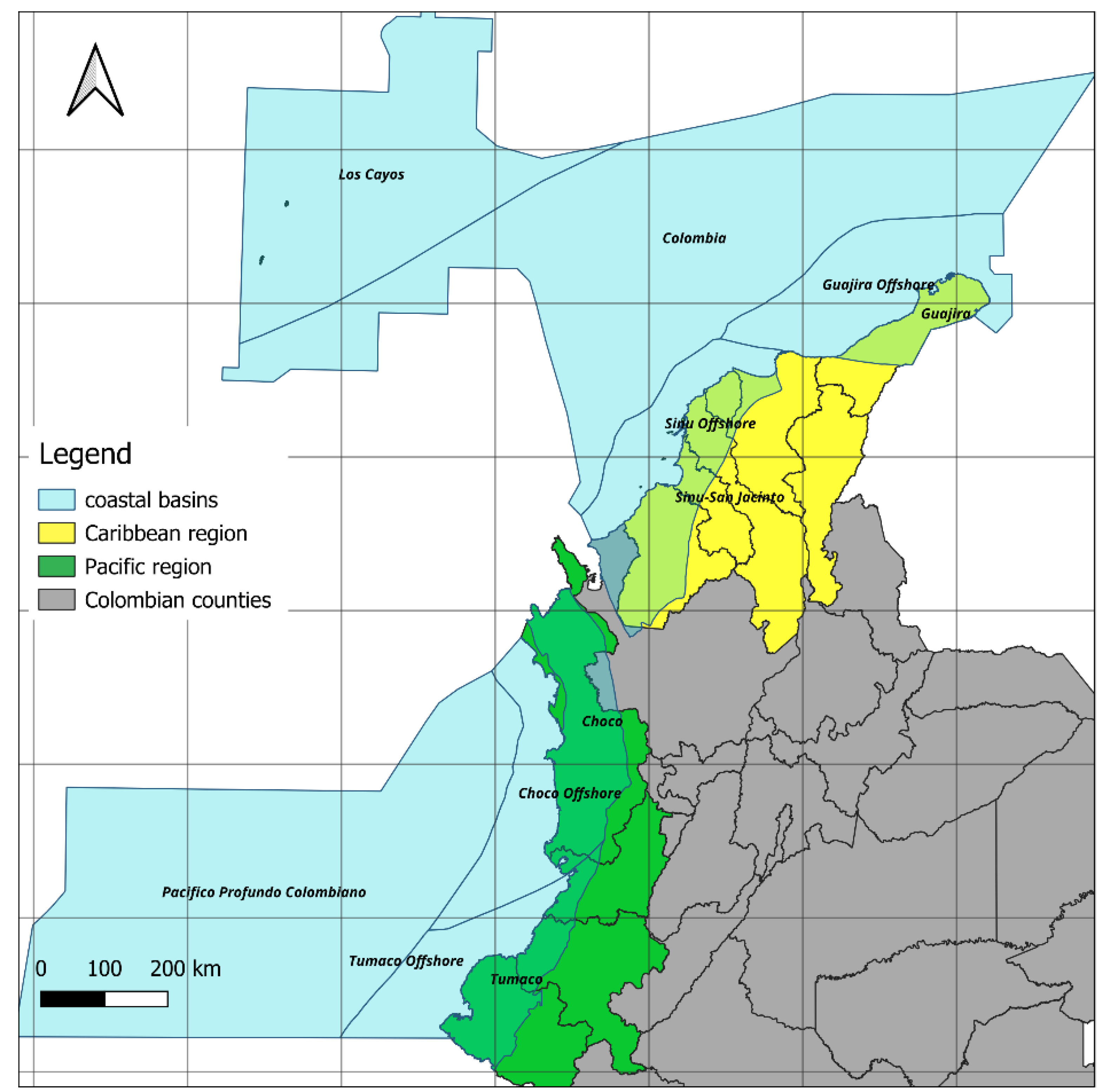
Figure 2.
Comparison of macro-litter accumulation density in coastal ecosystems. Source: Own elaboration with data from [28] and [29].
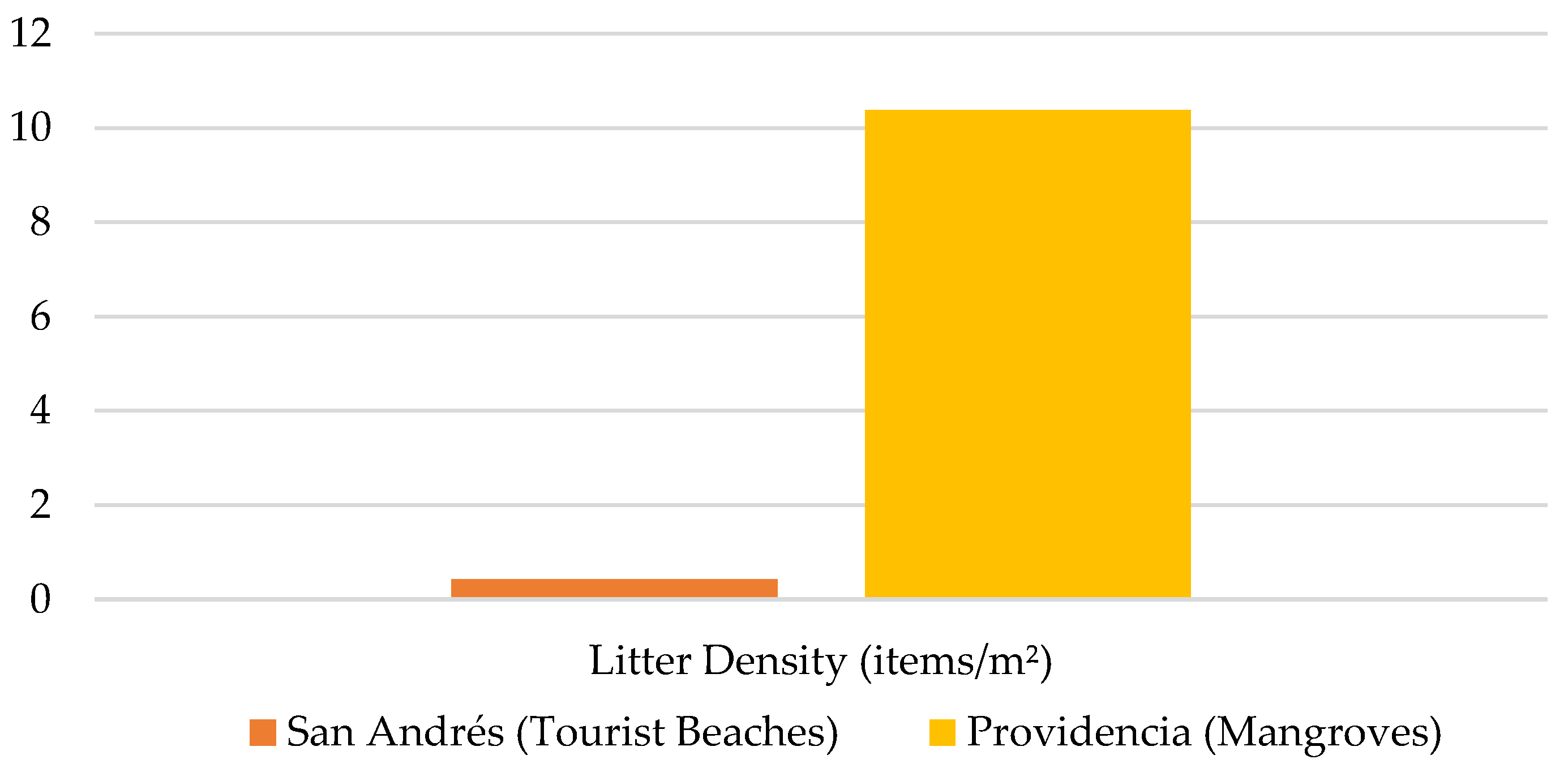
Figure 3.
Conceptual model of the seasonal interaction between tourist pressure and fishing activity. The shaded areas indicate periods of temporal convergence where the risk of collapse in waste management is maximised. Source: Own elaboration based on [27] and [28].
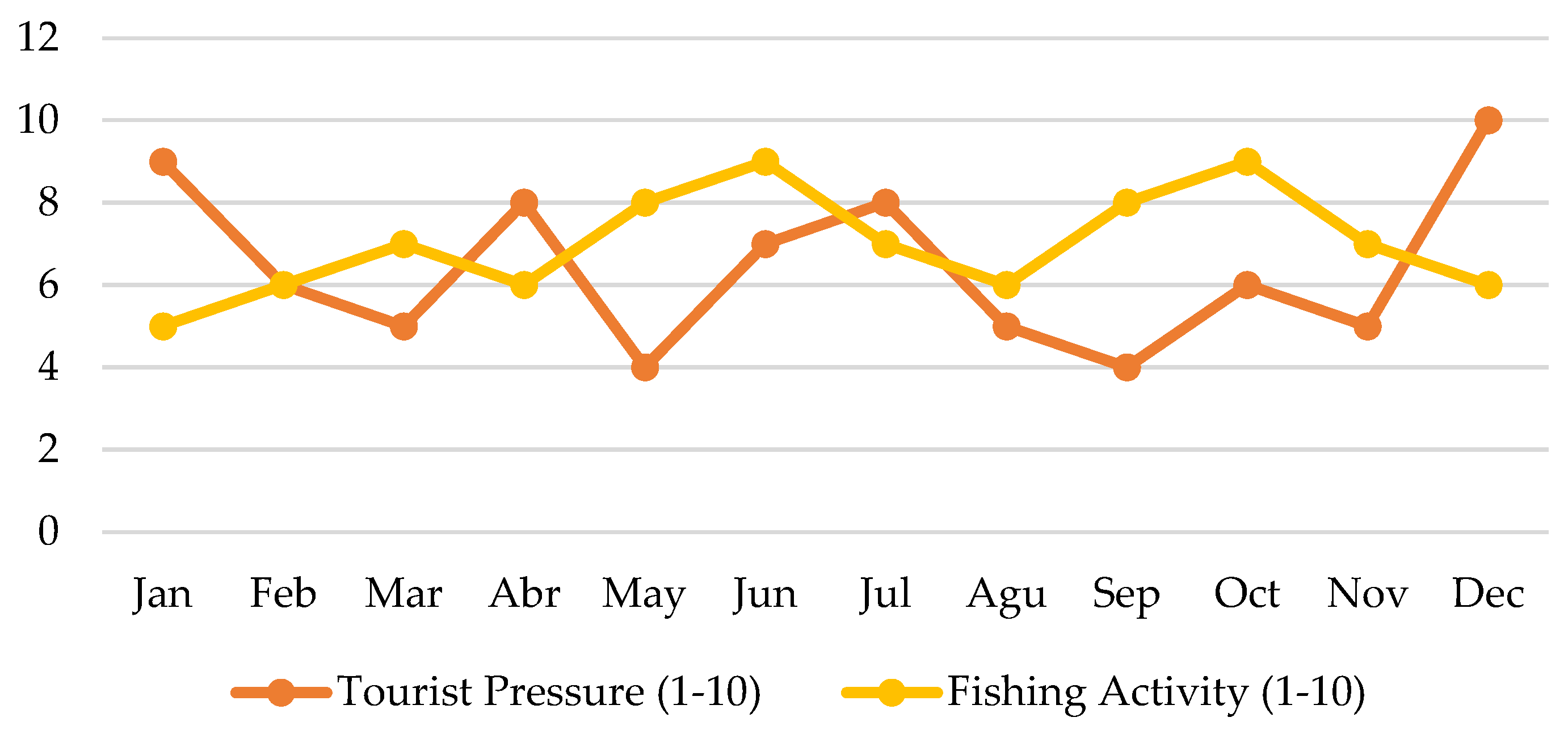
Figure 4.
Simplified conceptual diagram showing how livestock and fisheries residues contribute to coastal pollution and how circular biochar-based solutions enable nutrient recovery, soil regeneration and pollution reduction in coastal basins. Source: Authors.
Figure 4.
Simplified conceptual diagram showing how livestock and fisheries residues contribute to coastal pollution and how circular biochar-based solutions enable nutrient recovery, soil regeneration and pollution reduction in coastal basins. Source: Authors.
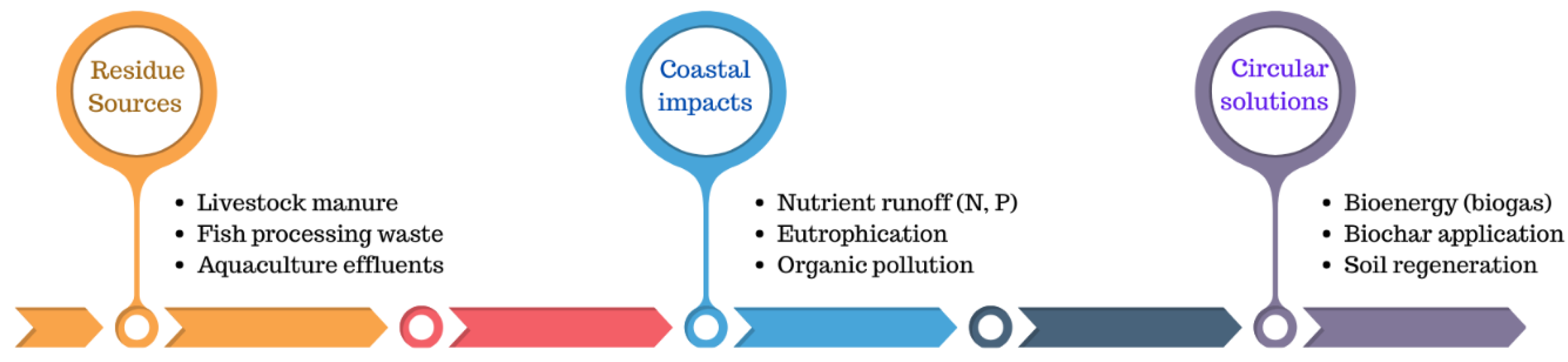
Figure 5.
Conceptual diagram illustrating key changes in soil properties following biochar application in coastal environments, including increases in organic carbon, aggregation, nutrient retention and biological activity. Source: Authors.
Figure 5.
Conceptual diagram illustrating key changes in soil properties following biochar application in coastal environments, including increases in organic carbon, aggregation, nutrient retention and biological activity. Source: Authors.
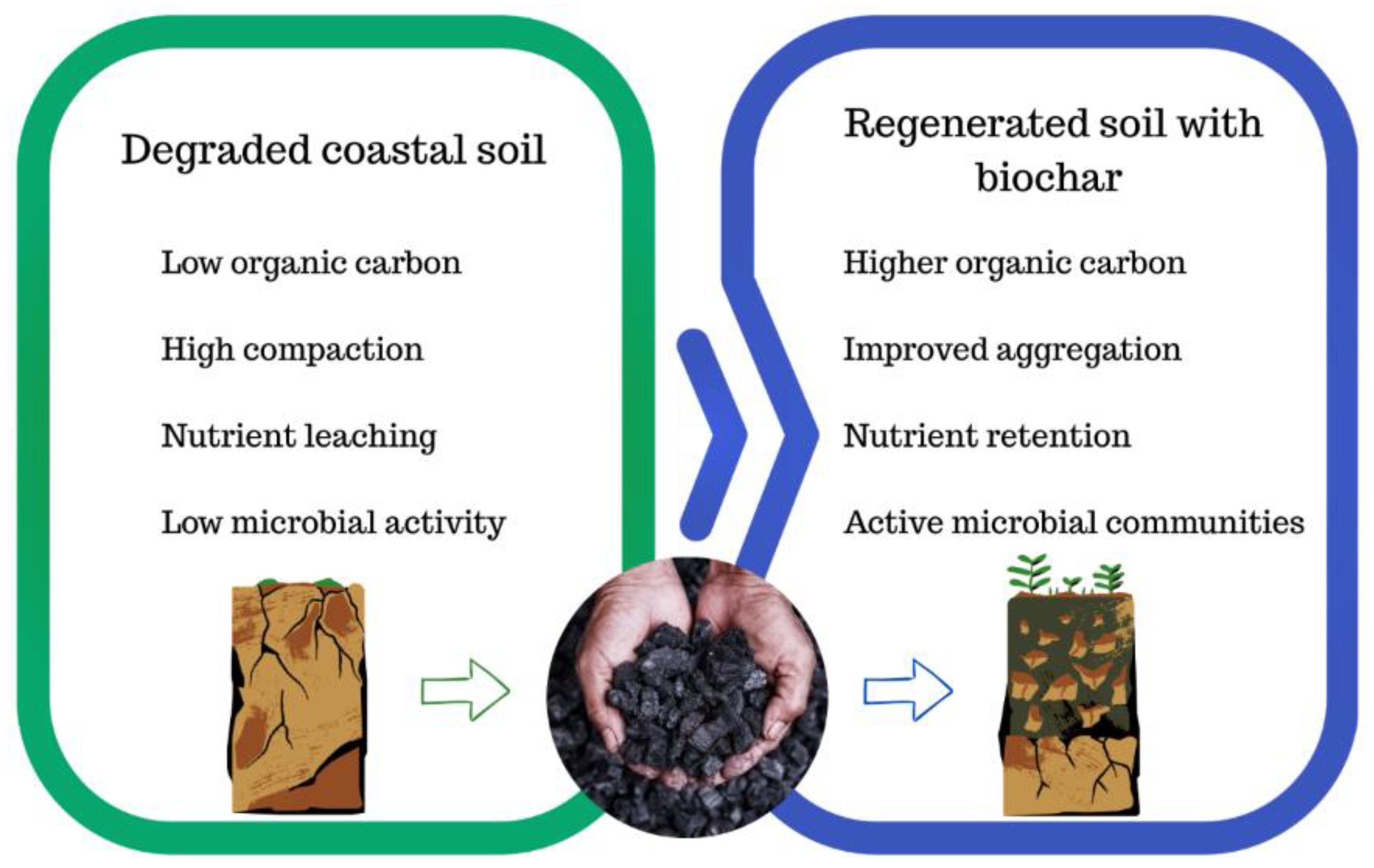
Figure 6.
Relative impact of biochar on salinity mitigation. A reduction in sodium stress and an improvement in porosity and moisture retention can be observed. Source: Own elaboration based on mechanisms described by [20] and [55].
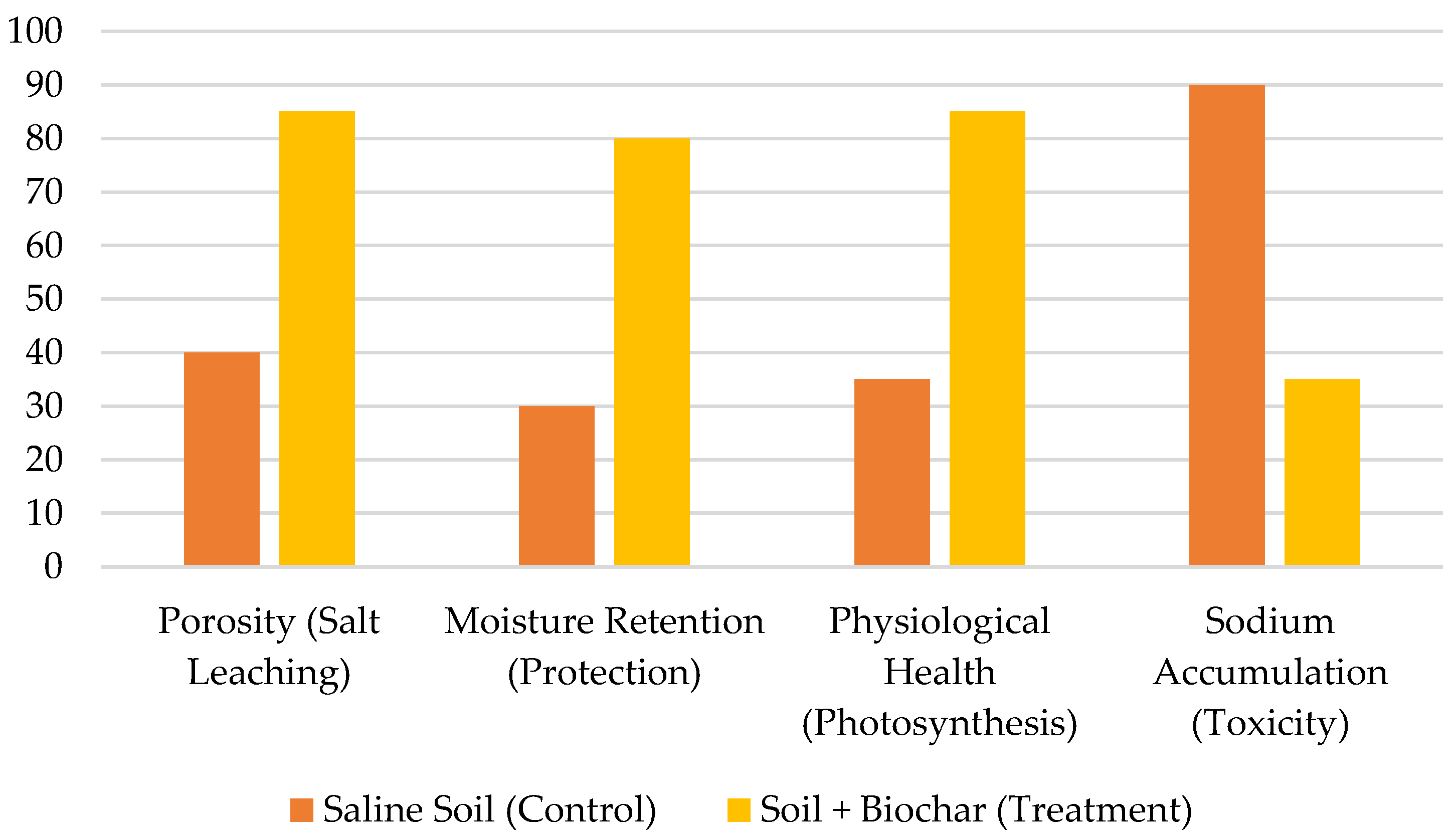
Figure 7.
Integrated conceptual framework illustrating how the conversion of organic residues into biochar and its application to soils can contribute to soil regeneration, reduced nutrient losses to coastal environments and climate change mitigation.
Figure 7.
Integrated conceptual framework illustrating how the conversion of organic residues into biochar and its application to soils can contribute to soil regeneration, reduced nutrient losses to coastal environments and climate change mitigation.
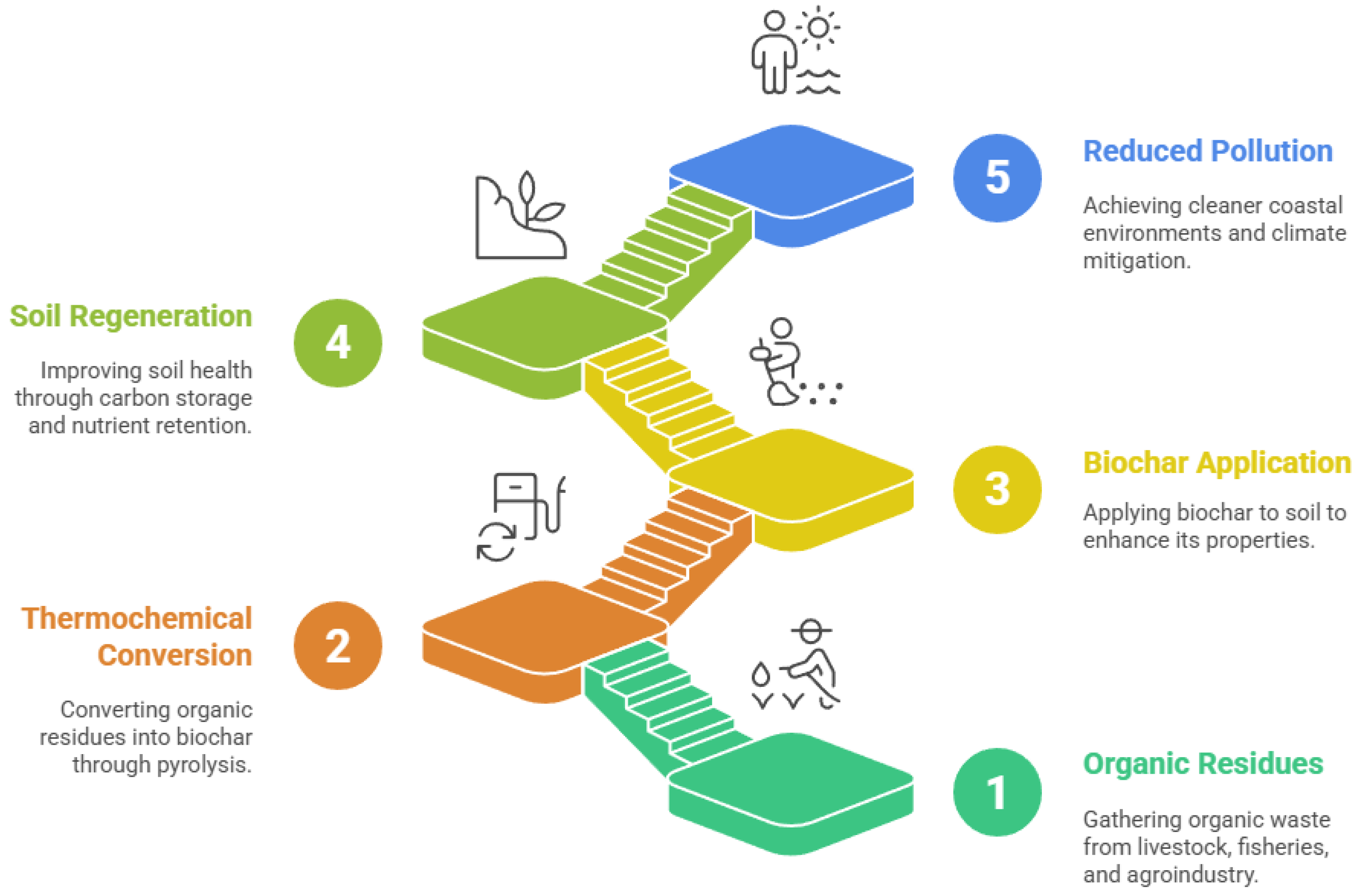
Figure 8.
System boundary considered for conceptual framework for integrated hydrogen production and soil generation. Source: Authors.
Figure 8.
System boundary considered for conceptual framework for integrated hydrogen production and soil generation. Source: Authors.
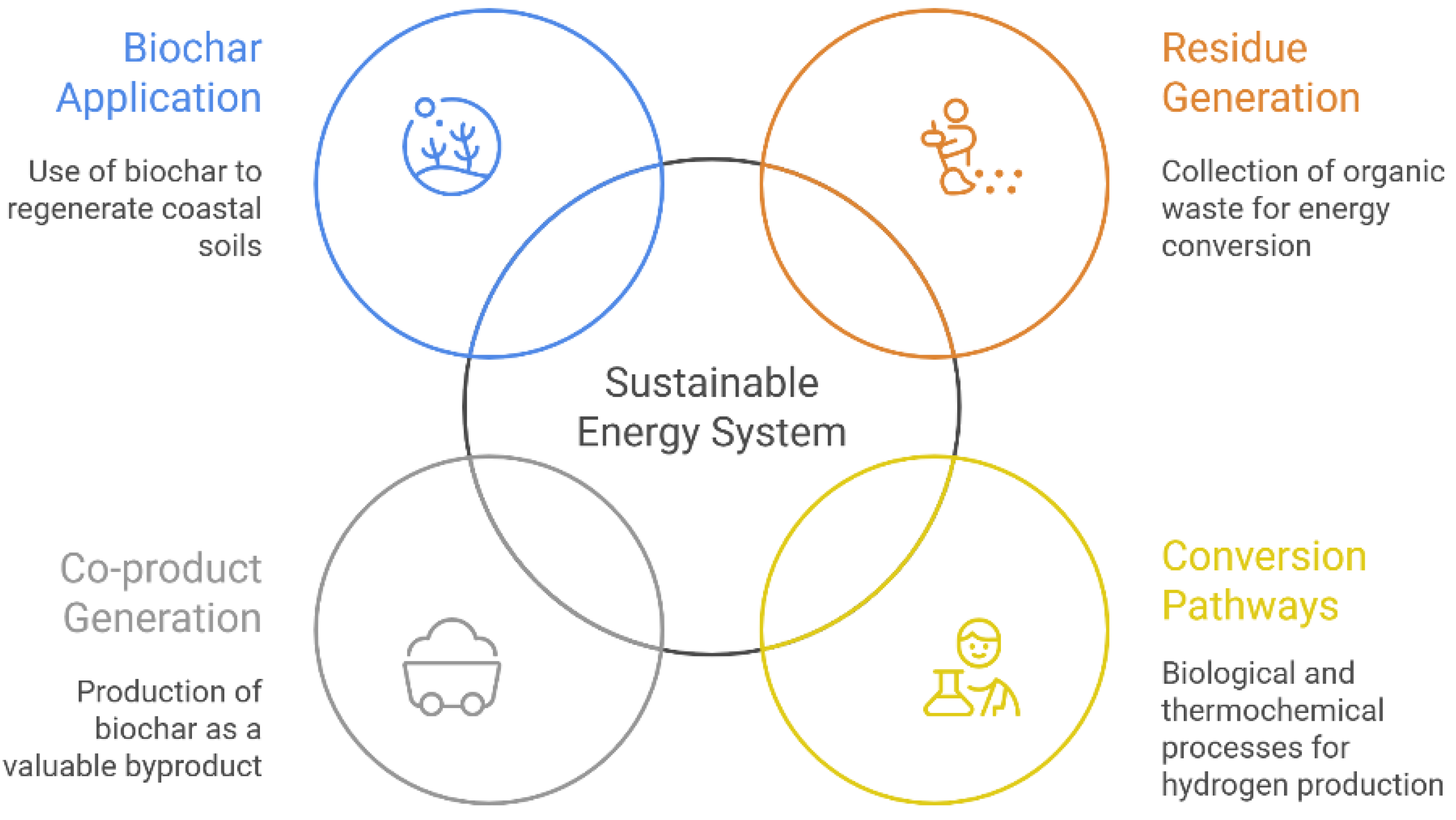

Table 1.
Associated environmental problems explained.
| Associated environmental problems | Reference | |
|---|---|---|
| Eutrophication and odours | Direct discharge of viscera and blood into the sea or its accumulation on docks causes areas with high BOD, bacterial proliferation and foul odours, as observed in overloaded artisanal ports in other Latin American contexts | [25] |
| Attraction of opportunistic wildlife | (birds, dogs, rodents), with risks of disease transmission and ecological imbalances. | [25] |
| Plastic pollution | In Colombia, plastic pollution on beaches is intense: 35–81 items of macroplastics/100 m of beach and up to 1,387 items/m of microplastics, with product packaging being the most common type. In the Caribbean, plastic accounts for up to 88.9% of items on mainland beaches | [4,28] |
| Microplastics and the food chain | The Caribbean coast is the area with the most microplastics in sediments, especially Cartagena (249–1387 particles/m) and Santa Marta (144–791 particles/m). Of 302 fish species studied, 7% contained microplastics in the Ciénaga Grande de Santa Marta. Polypropylene and polyethylene are the dominant polymers. | [30] |
| Bioaccumulation of pollutants | Concentrations of metals and organic pollutants exceeding quality guidelines have been detected in sediments in Cartagena Bay, with bioaccumulation in marine biota. The discarding of contaminated fish entrails and remains can vectorise these toxins into coastal food webs and human communities that consume discards or by-products. | [26] |
Table 2.
Associated environmental problems explained.
| Pyrolysis type | Typical operating conditions | Main target products | Relevance for H₂ production | Relevance for biochar application |
|---|---|---|---|---|
| Slow pyrolysis | Low heating rate, long residence time (minutes–hours) | Biochar (dominant), limited gas and bio-oil | Low to moderate; gas fraction can be recovered | High: produces stable, carbon-rich biochar suitable for soil amendment |
| Fast pyrolysis | High heating rate, short residence time (seconds) | Bio-oil (dominant), limited char and gas | Low; hydrogen is a minor fraction | Low to moderate: char yield is limited and less stable |
| Intermediate pyrolysis | Moderate heating rate and residence time | Balanced yields of char, gas, and oil | Moderate; gas stream may be upgraded | Moderate to high: char properties can be tailored |
| Pyrolysis of digestate | Feedstock pre-stabilised via AD | Char-rich solid, reduced volatiles | Moderate; complements upstream biological H₂ routes | High: enhanced nutrient retention and reduced phytotoxicity |
Table 4.
Dimensions considered for discussion of the main contributions of the proposed conceptual framework.
Table 4.
Dimensions considered for discussion of the main contributions of the proposed conceptual framework.
| Dimension | Key aspects | Relevance for coastal regions |
|---|---|---|
| Conceptual contribution | Integration of hydrogen production and biochar-based soil regeneration within a single residue valorisation framework | Addresses multiple environmental challenges simultaneously using locally available residues |
| System advantages | Multifunctionality, temporal complementarity (energy vs. carbon), pathway flexibility | Enhances resilience in regions with heterogeneous residues and degraded soils |
| Governance relevance | Emphasis on decentralised, place-based and polycentric arrangements | Aligns with fragmented institutional settings typical of coastal territories |
| Conceptual limitations | Non-quantitative nature; absence of performance metrics | Requires complementary modelling or empirical assessment |
| Scalability and replicability | Adaptable to local contexts; not technology-prescriptive | Facilitates transferability across coastal regions with similar constraints |
Disclaimer/Publisher’s Note: The statements, opinions and data contained in all publications are solely those of the individual author(s) and contributor(s) and not of MDPI and/or the editor(s). MDPI and/or the editor(s) disclaim responsibility for any injury to people or property resulting from any ideas, methods, instructions or products referred to in the content. |
© 2026 by the authors. Licensee MDPI, Basel, Switzerland. This article is an open access article distributed under the terms and conditions of the Creative Commons Attribution (CC BY) license (http://creativecommons.org/licenses/by/4.0/).
Copyright: This open access article is published under a Creative Commons CC BY 4.0 license, which permit the free download, distribution, and reuse, provided that the author and preprint are cited in any reuse.


