
Submitted:
21 January 2026
Posted:
23 January 2026
You are already at the latest version
Abstract
A survey was conducted involving 2,137 university students from over 10 universities in Zhejiang Province, Jiangsu Province, and other regions. The data were analyzed using correlation analysis and moderated mediation model testing. This study found that group psychological factors, such as emotional infection, depersonalization, the spiral of silence, relative deprivation, group polarization, and action mobilization, positively predicted network cluster behavior. The action mobilization of opinion leaders mediated the relationship between emotional infection and network cluster behavior. Group polarization mediated the relationship between the spiral of silence and network cluster behavior. Additionally, group efficacy moderated the latter part of the mediation process between group polarization and network cluster behavior.
Keywords:
group psychology
; opinion leaders
; group polarization
; network cluster behavior
1. Introduction
Currently, complex social contradictions often underpin various social hot spots or sensitive events. When these latent contradictions and conflicts manifest as explicit social events, they can readily precipitate actual network cluster behavior. The advent of new media has transformed people’s living habits and methods of information exchange, while also altering and expanding the scope and media range of network cluster behavior, potentially resulting in large-scale network cluster behavior (Ellison, Steinfield, & Lampe, 2007). Young students, as a significant demographic within the network society, are increasingly aware of their role in democratic participation in public affairs due to the rapid development of new media platforms and information technology (Ferreira & Menezes, 2021). By engaging with national political and social developments, these students discuss socially sensitive events through online group interactions, articulate reasonable suggestions and interests, and thereby contribute to the formation of network public opinion and the occurrence of network cluster behavior (Literat & Kligler-Vilenchik, 2019). Robert Park, an American scholar, first proposed the concept of cluster behavior in 1921 and, from a sociological perspective, believed that cluster behavior was an individual behavior under the influence of collective impulse (Park & Burgess, 1921, p. 865). Network cluster behavior refers to the gathering behavior of a large number of netizens who participate in interactive group discussions, express and gather opinions on a large scale, shape online public opinion, and influence real-life events related to social phenomena or hot issues of common concern, often for specific purposes or interests, within the online space (Loader, Vromen, & Xenos, 2014).
In the governance of cyberspace and the construction of cyberspace culture, it is necessary to cultivate a positive and healthy cyberspace culture so as to create a clean and positive cyberspace for the majority of Internet users, especially teenagers. Network clustering behavior has both positive and negative effects. With the rapid development and application of new media platforms, sensitive issues and conflicts in real society can easily trigger negative online public opinion. Compared to others, some negative views, attitudes, and emotions are more likely to ferment and spread on social media platforms, affecting social stability and requiring the attention of the government and universities. (Bu,2020). The positioning and focus of this study are the negative network cluster behavior caused by social conflicts or sensitive events. We suggest the following based on our results: study the impact and mechanism of these group psychological factors (mainly negative attributes) on network cluster behavior; strengthen education guidance and psychological counseling for young students; reduce or lower the influence of negative psychological factors on the formation and development of network cluster behavior; guide students to construct positive and constructive network behavior; and propose effective measures for the government to strengthen cyberspace governance and universities to respond to young students’ participation in negative network cluster behavior. Young students represent a primary participant group in network cluster behavior. Negative online public opinion events can adversely impact their healthy development and disrupt both the order of cyberspace and the harmony and stability of campuses. Methods for enhancing the governance capabilities and modernization of governance systems in cyberspace are also a critical issue that the current government and universities need to address (Bu, 2020). This study has three important implications for the current literature. The first is to develop a measurement tool for studying the social and psychological motivations and mechanisms of network cluster behavior through questionnaire surveys and data analysis. Secondly, from the perspective of social psychology, we explore the group psychological characteristics and social psychological mechanisms of young students’ participation in online cluster behavior. Third, we provide decision-making ideas for the government to strengthen network public crisis management, which can provide theoretical reference and practical guidance for universities to enhance their early warning and disposal capabilities for network cluster behavior.
2. Literature Review and Research Hypotheses
2.1. Theoretical Background
With the rapid development of network new media and social platforms, the “Internet+” mode has changed the thinking habits and lifestyle of young college students (Zhao, 2021). In particular, some issues related to the interests of students (such as emotions, examinations, employment, etc.), once published and disseminated on the Internet, will easily attract the attention of college students. Through WeChat, dithering, and other channels, they make comments and express their demands, which can quickly accumulate, spread, and trigger online public opinion, and this may even lead to network cluster behavior in colleges and universities, affecting the safety and stability of campuses. The psychological state of online groups, characterized by anonymity, contagion, suggestibility, and polarization, represents a collective mental condition among members in cyberspace, which is highly prone to triggering irrational collective behaviors (Ran & Zeng, 2023).
American sociologist Neil Smersey proposed the theory of value accumulation in 1963. He believed that the occurrence of cluster behavior needed six conditions: environmental conditions; structural tension; the generation of general emotions and the formation of common beliefs; inducing factors; the action mobilization of participants; and social control (Smelser, 1963). French psychologist Gustave Le Bon, in his book The Rabble, deeply studied the phenomenon of group psychology. He believed that when individuals gathered together, their psychological state would change, their personality would gradually disappear, and group ideas would converge in the same direction, forming a collective psychology (Le Bon, 1895). Ran Lian and other researchers believe that, with the application of big data algorithm technology, information is screened and pushed according to users’ personal preferences, which leads to the deviation of individuals’ understanding of information, resulting in the “information cocoon room” effect. The dissemination of information through a single channel reinforces the original views of network group members and continuously strengthens the sense of group identity through the spiral of silence and the influence of conformity psychology, ultimately leading to group polarization and irrational behavior within network groups (Ran & Zeng, 2023). Lijinze and other researchers believe that the evolution process of network cluster behavior is generally manifested in the spread of public opinion, which is also in line with the life cycle theory, proceeding through a formation period, growth period, and stability period (Li et al., 2022). Xiang Qingping and other researchers believe that, in the new media era, network actors have broken the traditional mainstream media’s right to construct social information through personalized narratives. Network public opinion is the public expression of social emotions, values, and interest demands in cyberspace. The governance of public opinion in the formation of network cluster behavior is related to the modernization of the national security system and governance system (Weng et al., 2021). Yan, Ono, Watanabe, and Wang (2024) found that the perceptual cognition of Internet users is an important emotional factor in the formation of network cluster behavior, which promotes the development trend of public opinion (Yan et al., 2024). Wang, Li, & Chen (2024) found that opinion leaders play an important role in the formation and development of network cluster behavior and the diffusion of public opinion (Wang, Li, & Chen, 2024). American scholar Kasperson and others put forward the system framework theory of social risk dynamic process, and they analyzed risk perception from the perspectives of psychology, culture, and sociology (Kasperson et al., 1988). Wanglinping and other researchers believe that the collision and conflict of diverse social cultures and values can easily result in social contradictions. Improper handling may lead to network cluster behavior and greater public opinion risk (Wang & Gao, 2022).
To summarize, academic research on network cluster behavior exhibits a multidisciplinary trend, and it has formed a certain theoretical basis and produced research results, but there are also some deficiencies. From the analysis of the literature, most existing studies use traditional communication theory to analyze network cluster behavior and related network public opinion, and most studies are limited to the perspectives of sociology, politics, management, journalism, and communication, while empirical studies from the perspective of social psychology number relatively few (Nie & Lü, 2021). There are a few existing studies that use group psychological factors (such as the spiral of silence, relative deprivation, depersonalization, emotional contagion, group polarization, and group efficacy) as research variables to analyze network cluster behavior. In particular, research on group psychological characteristics, social psychological mechanisms, and evolutionary mechanisms in the formation process of network cluster behavior is not sufficiently advanced (Wang et al., 2025).
This study is based on the social identity theory (SIT) (Tajfel & Turner, 1979) proposed by social psychologist Henri Tajfel as the supporting theory. Social identity theory is one of the most representative theories for studying group relationships, and it aims to explain the psychological processes and behavioral patterns of individuals in a group context. Social identity theory holds that the emergence and development of cluster behavior are related to group identity. When an individual’s social identity is threatened, based on the motivation to maintain self-esteem, they will use various methods to regain social recognition. At this time point, vulnerable groups may generally resist threats and oppose social injustice through group behavior (van Zomeren et al., 2008). This study combines Gustave Le Bon’s relevant characteristics of group psychology, focusing on analyzing the reasons and social psychological mechanisms behind network cluster behavior (collective action based on common social identity) from the perspectives of group psychology, which include the following: the spiral of silence (group comparison and pressure); relative deprivation (negative social comparison); depersonalization (personal identity turning to group identity); emotional contagion (shared emotional formation); action mobilization (framing identity of opinion leaders); group polarization (identity extremism and position strengthening); and group efficacy (collective action belief) (Drury & Reicher, 2005). This study integrates relevant variables into a coherent logical chain from “psychological identification” to “overt behavior” through social identity theory, providing a profound theoretical explanation for network cluster behavior.
2.2. Spiral of Silence and Network Cluster Behavior
The spiral of silence was first introduced by German scholar Elisabeth Noelle-Neumann in the 1970s. The spiral of silence explains that in discussions of controversial topics or hot, sensitive events, individuals who perceive their views and attitudes to be aligned with the majority opinion are likely to express their ideas more boldly and positively (Noelle-Neumann, 1984). Conversely, when individuals realize that their views and attitudes diverge from or even conflict with the majority opinion, they tend to adopt a more cautious stance, succumbing to group pressure and psychological anxiety to avoid isolation or verbal attacks (Noelle-Neumann, 1974). As a result, they may alter their original opinions or choose to remain silent. This dynamic results in the reinforcement of dominant viewpoints and the suppression of less favored perspectives, thereby creating a spiraling downward trend in the development of opinions (Noelle-Neumann, 1984). In the context of group discussions, participants often assess the “opinion climate” among other members of the network group before taking a stance; this is driven by the desire to avoid isolation and alleviate group pressure (Scheufele, 2008). During individual participation in network cluster discussions, the emergence of the spiral of silence causes individuals with weaker opinions to experience group pressure, leading them to adopt a stance of “deafness” and engage in convergent behavior to avoid isolation. This results in the dominance of stronger opinions in the final outcomes of group discussions (Sohn & Geidner, 2016). Consequently, internal opinions within the group become more homogeneous, potentially resulting in group polarization. As a result, group members may undertake bold or risky behaviors, which can trigger network cluster behavior (Wallach, Kogan, & Bem, 1962).
H1:
The spiral of silence has a positive effect on the occurrence of network clustering behavior.
2.3. Relative Deprivation and Network Cluster Behavior
Relative deprivation can result in cognitive biases and negative emotional experiences in individuals (Sablonnière & Tougas, 2008). This is evident in the subjective psychological experience of feeling “deprived” when comparing oneself to a reference group. When individuals perceive themselves as deprived, they may exhibit negative emotions and psychological states, such as low self-esteem, depression, resentment, dissatisfaction, and anger, potentially culminating in radical speech or violent behavior (Smith et al., 2012). The use of algorithmic technologies by social media creates the negative effect of “information cocoons,” which intensifies the experience of relative deprivation and increases the tendency to engage in irrational network cluster behavior. Young students with a heightened sense of relative deprivation often compare their academic and personal circumstances with those of their peers, which can result in low self-esteem, feelings of loss, and negative emotions such as dissatisfaction and resentment, sometimes leading to aggressive behavior (Chen & Xiong, 2023). In response to trending and sensitive topics or negative online events, these students may more readily experience empathy and anger during online group discussions, particularly when witnessing individuals or groups with similar backgrounds facing perceived injustices or deprivations. This may prompt them to engage in online solidarity and the collective defense of rights or even participate in tangible collective actions (Foster, 1995).
H2:
The sense of relative deprivation has a positive effect on the occurrence of network clustering behavior.
2.4. Depersonalization and Network Cluster Behavior
Depersonalization—a concept first introduced by French social psychologist Gustave Le Bon—refers to the phenomenon where individuals experience psychological anxiety and a diminished sense of self-awareness in group contexts. This is specifically characterized by the disappearance of personal identity markers, such as gender, age, occupation, and social status, during group activities, resulting in a loss of individuality and self-consciousness (Chen, Wang, & Liu, 2019; Valkenburg & Peter, 2010). In the context of online environments, the relative anonymity of virtual spaces further reduces individuals’ sense of identity and self-perception (Baumeister & Vohs, 2007). As a result, individuals experience reduced psychological anxiety, group psychological pressure, and a sense of social responsibility when participating in online cluster behaviors compared to real-world situations (Lambert et al., 2000). Consequently, young students are more prone to making emotional statements or expressing critical opinions during online group discussions. They are also more likely to engage in network cluster behavior due to factors such as the perceived lawlessness and diffusion of responsibility in online groups (Van Kleef & Côté, 2021).
H3:
Depersonalization has a positive effect on the occurrence of network clustering behavior.
2.5. Emotional Infection and Network Cluster Behavior
The concept of emotional infection, first introduced by American psychologist William McDougall in 1923, describes the phenomenon of emotional aggregation. Emotional infection enhances individuals’ sense of belonging to a group and their psychological suggestibility. Specifically, in similar situations, individuals with aligned value orientations, statuses, life experiences, professional values, and personality traits experience emotional resonance, psychological identification, and emotional transmission regarding certain events under non-coercive or unconscious conditions (Le Bon, 1895). Young students with a high degree of emotional infection are particularly susceptible to adopting and imitating the attitudes and behaviors of other members within their network group (Coviello et al., 2014). Individual emotions diffuse through information dissemination, facilitating the convergence and resonance of group emotions, thereby propelling the emergence of network cluster behavior. When confronted with trending and sensitive topics or negative events discussed on new media platforms such as WeChat, Weibo, and QQ—especially when they perceive that individuals with similar life experiences or values are having their interests compromised—they are more likely to empathize, become emotionally engaged, and experience psychological resonance (Wang, 2021). Emotional infection acts as a “catalyst” (Reimerti, Bolhuisje, & Kemp, 2013), making them more inclined to actively express their grievances and interests online and participate in network cluster behavior (Wróbel & Imbir, 2019).
H4:
Emotional infection has a positive effect on the occurrence of online clustering behavior.
2.6. Group Polarization and Network Cluster Behavior
Group polarization, first introduced by American scholar James A.F. Stoner in 1961, examines how group discussions impact individual and group decision-making (Sunstein, 2009). Group polarization refers to the psychological perception of individuals with respect to the extreme views, attitudes, and decision-making judgments of group members. In network cluster behavior, group viewpoints become more biased and provocative through opinion exchange and emotional infection. This phenomenon can lead to responsibility dispersion and risk transfer (Myers & Bishop, 1970). It manifests in group discussions and decision-making processes where an initially inclined viewpoint is reinforced through interactive discussions among group members. Consequently, the originally supported opinion becomes more strongly endorsed, emerging as the dominant or majority viewpoint, while opposing viewpoints are increasingly resisted and marginalized, eventually resulting in opinion polarization among group members (Ni, 2018). In the context of young students participating in group discussions on trending and sensitive topics or negative public opinion events on the Internet, the influence of group pressure and fear of isolation prompts them to observe and assess the opinions and attitudes of those around them. When their views align with the majority of the group, they are more likely to express their opinions boldly. Conversely, when their views differ from those of the majority, they may adopt a more cautious stance or choose to remain silent (Smith, González, & Frigolett, 2021). As the spiral of silence intensifies, the dominant majority view becomes more pronounced while the minority view weakens, resulting in polarized group discussions (Wang et al., 2024). Due to the closed nature of their social circles, preference for exclusivity, and centrality in communication, young students are susceptible to the phenomenon of online group polarization (Liu, 2023). Under the influence of group polarization, young students are more prone to making bold and risky judgments and decisions after group discussions, which can contribute to network cluster behavior and even participation in real-world collective actions (Wei, 2021).
H5:
Group polarization mediates the relation between the spiral of silence and network cluster behavior.
Hypothesis 5 (H5) consists of two components: H5(a): the spiral of silence positively predicts group polarization; H5(b): group polarization positively predicts network cluster behavior.
2.7. Group Efficacy and Network Cluster Behavior
Group efficacy refers to the individual members’ judgment of the collective ability of the group they belong to or their evaluation of the ability to complete a certain task, specifically manifested in their psychological perception of the group’s ability to unite and solve practical problems. When group members assess that the group’s capability has the potential to alter unfavorable circumstances, they are more inclined to participate in network cluster behavior (Bandura, 2000). A high sense of group efficacy indicates that individuals believe that they can significantly influence or facilitate the effective resolution of issues through their participation in online group discussions and collective solidarity. This belief enhances their willingness to engage in online cluster behavior to advance group-related interests (Kelloway et al., 2007). When groups discuss hot and sensitive topics or negative public opinion events on the Internet, the influence of the spiral of silence can result in the polarization of opinions and views within the group (Meyer, Richter, & Hartung-Beck, 2022). This polarization often results in more risky and bold judgments and decisions, prompting individuals to express their interests and demands online. The shared solidarity and focused expression of interests contribute to the occurrence of network cluster behavior. Group efficacy is closely related to collective actions and evolves in response to intermember relationships and external influences within the group. During this process, group efficacy plays a crucial role. Young students with a high sense of group efficacy are more likely to believe in and participate in collective actions through online groups (Drury & Reicher, 2000). Their belief in the efficacy of their group can effectively facilitate the development and resolution of events to achieve the interests of their network groups (Zhang, 2013).
H6:
Group efficacy moderates the relationship between group polarization and network cluster behavior.
2.8. Mobilization Actions of Opinion Leaders and Network Cluster Behavior
Opinion leaders, a term introduced by American communication scholar Paul F. Lazarsfeld in the 1940s, refer to individuals who significantly influence the flow of information within mass communication processes (Jain, 2022). Lazarsfeld proposed that information reaches the audience through intermediary opinion leaders (Park, 2013). In the context of network cluster behavior, opinion leaders are pivotal, particularly in the role of action mobilization during the development of public opinion. Action mobilization involves the deliberate efforts of online opinion leaders and others to guide or organize Internet users into participating in network cluster behavior. This process typically manifests in the form of propaganda and organizational strategies aimed at encouraging young students to voice their grievances and interests online. Opinion leaders facilitate the mobilization of a broader group of Internet users to engage in collective solidarity and steer public opinion toward specific objectives (Wen et al., 2022). During group discussions on trending and sensitive topics or negative public opinion events on the Internet, young students who exhibit a strong sense of group belonging and psychological suggestibility are more prone to emotional resonance and empathy. They may experience dissatisfaction and anger when they perceive that the interests of their online group are being threatened, especially if they have similar experiences or scenarios. Opinion leaders serve as communication hubs in network cluster behavior, playing a pivotal role in the development of online public opinion and the emotional evolution of netizens (Turcotte et al., 2015). Students who are emotionally influenced are more likely to adopt or mimic the attitudes and behaviors of other online group members. Opinion leaders typically possess significant influence and authority within online communities (Tobon & García-Madariaga, 2021), making them crucial in shaping online public opinion (Park, 2013). Under the guidance and organizational mobilization of these opinion leaders, emotionally infected young students are more inclined to engage actively in network cluster behaviors, participate in collective online solidarity, and focus on expressing discontent. This collective action aims to garner social support and advance group interest claims (Podsakoff, MacKenzie, Lee, & Podsakoff, 2003).
H7:
The mobilization actions of opinion leaders mediate the relationship between emotional infection and network cluster behavior.
Hypothesis 7 (H7) consists of two components: H7(a): emotional infection positively predicts action mobilization; H7(b): action mobilization positively predicts network cluster behavior.
Overall, based on the previous theoretical analysis and inference, this study hypothesizes that factors such as the spiral of silence, relative deprivation, depersonalization, and emotional contagion in group psychology have a positive impact on the occurrence of network cluster behavior. Group polarization mediates the relation between the spiral of silence and network cluster behavior. Group efficacy moderates the relationship between group polarization and network cluster behavior. The mobilization actions of opinion leaders are a mediating variable between emotional contagion and network cluster behavior. Based on this, we construct a moderated mediation model, as shown in Figure 1. This study investigates the psychological characteristics and psychosocial mechanisms underlying young students’ participation in network cluster behavior groups.
3. Research Methods and Design
3.1. Participants and Data Collection
The sample for this study comprises college students across more than 10 institutions both within and outside the province. This included 985 project universities, general undergraduate institutions, and higher vocational colleges, spanning various disciplinary backgrounds such as teacher training, science and technology, finance, medicine, agriculture and forestry, and media and art. The data were collected through online questionnaires. A total of 2,391 questionnaires were returned; 254 were excluded due to invalid responses, leaving 2,137 valid responses, resulting in an effective response rate of 89.4%. The survey was conducted from May 1, 2023, to May 7, 2023.
The characteristics and distribution of the questionnaire sample are as follows: 760 male students (35.6%) and 1,377 female students (64.4%); 1,657 members of the Communist Youth League (77.5%), 286 members of the general populace (13.4%), and 194 members of the Communist Party of China (9.1%); 1,020 students majoring in science and engineering (47.7%), 441 in literature and history (20.6%), 174 in medicine (8.1%), and 327 in other fields (15.3%); 633 students from large and medium-sized cities (29.6%) and 1,504 from rural areas or small towns (70.4%). This distribution indicates a broad and representative sample.
3.2. Measurements
3.2.1. Questionnaire Design and Development
The questionnaire comprised two sections: basic information and question items. The first section gathered basic demographic data, including gender, political affiliation, ethnicity, academic year, major, educational background, family origin, and whether the respondent held a student leadership position. The second section contained question items focusing on conceptual dimensions such as emotional infection, depersonalization, relative deprivation, group polarization, spiral of silence, action mobilization, network cluster behavior, and group efficacy. It should be noted that group efficacy is a psychological perception and subjective judgment that reflects an individual’s ability to solve practical problems in their group. By observing the individual’s psychological perception state, group efficacy and collective ability are analyzed and evaluated. Group polarization is a psychological phenomenon in which individuals tend to adopt more extreme views, attitudes, and emotions in relation to the group to which they belong. By observing the individual’s psychological perception state, the phenomenon of group polarization can be judged and evaluated.
The questionnaire items were rated on a Likert 5-point scale, with higher scores indicating greater alignment with the content of the questions. To ensure content validity during the scale design process, the following methods were employed: (1) semantic correction and (2) environmental applicability correction. Experts in psychology, sociology, and ideological and political education, both within and outside the university, in addition to representatives from relevant faculty and students, were consulted to review and refine the content of the question items. A preliminary version of the questionnaire titled “Psychosocial Motivation of University Participation in Online Cluster Behavior” (comprising 44 questions, including reverse-scored items 11, 39, and 40) was used in a small-scale pre-survey. Based on the preliminary data, the questionnaire was revised and improved.
3.2.2. Exploratory Factor Analysis
In this study, the questionnaire was revised using SPSS 26.0 and Amos 23.0. Initially, a suitability test was performed, revealing a KMO test value of 0.912 and a Bartlett’s test of sphericity chi-square coefficient that reached significance, indicating that the data were appropriate for factor analysis. Subsequently, questions with standardized factor loading coefficients below 0.5 were removed, and the attribution of questions across different dimensions was revised and adjusted to finalize the questionnaire. Thirdly, the final scale retained 20 items, with all item factor loadings above 0.7, and the communalities of the common factors are essentially above 0.75.
3.2.3. Confirmatory Factor Analysis
A confirmatory factor analysis was conducted on the sample data from the second survey, with the model fit indicators presented in Table 1. The confirmatory factor analysis model is depicted in Figure 2. The χ²/df ratio was 2.050, and the values for GFI, AGFI, IFI, CFI, and NFI were all above 0.9. The RMSEA value was 0.031, and the RMR value was 0.023, both of which are below 0.05, indicating a good model fit. Additionally, the factor loadings are generally above 0.7, indicating that the scale possesses good reliability and validity.
3.2.4. Reliability Analysis
This study utilized a self-administered questionnaire, and the reliability analysis showed that the Cronbach’s alpha coefficient for each dimension exceeded 0.7, with the overall reliability of the scale reaching 0.843. These results indicate that the questionnaire has strong overall reliability and that the items possess good internal consistency.
3.2.5. Common Method Bias
Due to the use of questionnaire survey methodology in this study, potential common method bias (CMB) issues were addressed through unrotated principal component factor analysis. The results revealed five factors with eigenvalues greater than 1, among which the first factor accounted for 26.063% of variance—a value below the 40% critical threshold (Wen & Ye, 2014). This indicates no significant CMB effect in the current research.
3.2.6. Ethics Statement
The full name of the ethics committee is as follows: Medical Ethics Committee of the Department of Psychology and Behavioral Sciences, Zhejiang University. Informed written consent was obtained for this study. During the data collection process, consent forms were provided together with the survey questionnaire, detailing the research objectives, content, and target population and ensuring that participants are aware that they have the right to withdraw from the study at any time. This survey was completely anonymous, did not require any personal information (such as name), and was voluntary.
4. Results
4.1. Descriptive Statistics and Correlation Analysis
The descriptive statistics and correlation matrix for each study variable are presented in Table 2. The analysis indicates that the spiral of silence, depersonalization, emotional infection, relative deprivation, group polarization, and action mobilization were all significantly and positively associated with network cluster behavior.
4.2. Testing the Mediating Effect of Opinion Leaders
Opinion leaders are key drivers of online cluster behavior and play a mobilizing role in the development of public opinion (mediating effect). The mediating effect is analyzed according to the process suggested by Zhonglin Wen and Baojuan Ye et al.: (1) regression of the dependent variable on the independent variable, coefficient c. If c is significant, it is treated as a mediating effect; otherwise, it is considered inconsistent mediation (Wen, Liu, & Hou, 2012). Regardless of whether c is significant or not, a subsequent test is performed: (2) the regression of the mediating variable on the independent variable, coefficient a; and the regression of the dependent variable on the independent variable, coefficient c’, and the mediating variable, coefficient b. If both a and b are significant, the indirect effect holds. If c’ is significant, the direct effect holds; otherwise, it does not hold, and only the mediating effect holds. (3) If at least one of a and b is insignificant, the bootstrap test is used, and if it is still insignificant, the analysis is stopped. (4) If both indirect and direct effects hold, the signs of a*b and c’ are compared. If the sign is the same, a partial mediating effect is present; if the sign is different, an inconsistent mediating effect is present.
The results of the mediation effect test are presented in Table 3. There was a significant positive effect of emotional infection on network clustering behavior in model 1 (b=0.100, SE=0.022, p0.000); a significant positive effect of emotional infection on action mobilization in model 2 (b=0.301, SE=0.031, p=0.000); and a significant positive effect of action mobilization on network clustering behavior in model 3 (b=0.392, SE=0.014, p=0.000), indicating that the mediating effect holds, and hypothesis 7 is supported. The direct effect of emotional infection on network cluster behavior was b = 0.094 (SE = 0.019, p = 0.000), while the mediation effect was 0.118, 95% CI [0.097, 0.142]. The consistent direction of both effects indicates that action mobilization plays a partial mediating role between emotional infection and network cluster behavior.
4.3. Effect Test with Moderation
First, group polarization and group efficacy are centralized, and then, they are multiplied together to form a product term. Second, the mediated model with moderation was tested, i.e., the mediating effect of group polarization and the moderating effect of group efficacy were analyzed (Walter & Bruch, 2008). We refer the reader to Table 4 for the results of the analysis. In model 1, the spiral of silence significantly and positively affects network cluster behavior (b=0.169, SE=0.018, p=0.000), and hypothesis 1 is supported. Relative deprivation significantly and positively affects network cluster behavior (b=0.098, SE=0.023, p=0.000), and hypothesis 2 is supported. Depersonalization significantly and positively affects network cluster behavior (b=0.216, SE=0.022, p=0.000), and hypothesis 3 is supported. Emotional infection significantly and positively influenced network cluster behavior (b=0.082, SE=0.022, p=0.000), and hypothesis 4 is supported. The spiral of silence in model 2 significantly and positively influenced group polarization (b=0.325, SE=0.016, p=0.000); group polarization in model 3 significantly and positively influenced network clustering behavior (b=0.156, SE=0.025, p=0.000), indicating that group polarization played a mediating effect between the spiral of silence and network clustering behavior, and hypothesis 5 is supported.
In model 4, the interaction term of group efficacy and group polarization significantly and negatively affected network clustering behavior (b=-0.019, SE=-0.007, p=0.007), and hypothesis 6 is supported. Group efficacy was the moderating variable between group polarization and network cluster behavior, i.e., the second half of the pathway—the spiral of silence → group polarization → network cluster behavior—was moderated by group efficacy.
The relationship between group polarization and network clustering under different group efficacy was further analyzed via simple slope analyses according to the mean plus or minus one standard deviation (M±SD) difference. The mean (M) is the medium-efficacy group, the mean minus one standard deviation (M-SD) is the low-efficacy group, and the mean plus one standard deviation (M+SD) is the high-efficacy group. As observed in Table 5 and Figure 3, when the level of group efficacy is low (-2.6002), the impact of group polarization on network clustering behavior (b=0.4371, SE=0.028, p=0.000) is higher than when the level of group efficacy is high (2.6002), where the effect of group polarization on network clustering (b=0.3448, SE=0.027, p=0.000) is comparatively lower.
5. Discussion
Emotional infection, depersonalization, relative deprivation, group polarization, spiral of silence, and action mobilization were all found to be significantly and positively associated with network cluster behavior. Additionally, these factors were identified as positive predictors of network clustering behavior. In the 1960s, Neil Smelser introduced the “six conditions theory” of cluster behavior, which posits that network cluster behavior evolves through stages including gestation, formation, development, diffusion, conflict, and fading. These stages are influenced not only by social environmental factors but also by the psychological states of Internet users. The interplay among group psychological factors—such as emotional infection, depersonalization, sense of relative deprivation, group polarization, spiral of silence, action mobilization, and group efficacy—plays a crucial role in the participation of young students in online discussions of hot and sensitive topics or negative public opinion events. These factors interact, correlate, and influence each other, collectively driving the formation and development of online cluster behavior. These findings support further exploration of the relationships among these variables, including the analysis and testing of the mediating effects of opinion leaders and group polarization, as well as the moderating effects of group efficacy. This study observed that emotional infection, depersonalization, relative deprivation, group polarization, the spiral of silence, action mobilization, and other dimensions are also related to each other, but they will not be analyzed here due to space constraints.
This study found that the action mobilization of opinion leaders plays a mediating role in the relationship between emotional infection and network cluster behavior. This indicates that, when young students participate in discussions about trending and sensitive topics or negative public opinion events online, they are prone to emotional infection when they encounter similar experiences or scenarios. This results in emotional resonance, psychological identification, and emotional transfer regarding specific online opinion events. In particular, some students with relatively difficult economic conditions are more likely to have a sense of relative deprivation than other students. When they see negative online events where the interests of disadvantaged groups are harmed, they may feel indignant or even angry (Xu, 2021). Emotional infection enhances individuals’ sense of belonging to a group and psychological suggestibility, rendering them more susceptible to adopting and imitating the attitudes and behaviors of other members of the online group. Emotional infection is also affected by different social and cultural differences. Under the influence of traditional Chinese culture, students in the north are relatively resolute, independent, and assertive, while students in the south are more perceptual and easygoing. These cultural differences and personality characteristics will also affect the value judgment of emergencies. When young students perceive that their group’s interests are being infringed upon, they are more likely to proactively post their grievances and interests online to seek support. As these negative emotions accumulate, they can easily result in large-scale network cluster behavior. In the formation and development of online public opinion, opinion leaders, including online vloggers, scholars, and experts, play a significant role. Their expertise, active engagement, and unique perspectives can influence the opinions of other young students. Opinion leaders strategically guide or organize young students into network cluster behavior by mobilizing them to express their grievances and interests online, encouraging collective solidarity, and steering public opinion toward specific objectives. In response to negative online events, opinion leaders monitor the situation, actively post their views and analyses, and stimulate discussions among students. They may even mobilize a larger group of young students to participate in collective actions, thereby fostering online public opinion to ensure fair treatment and the effective resolution of issues (Smith, 2007). Regarding social conflicts or sensitive issues, larger groups of Internet users will actively engage in group discussions and express dissatisfaction in achieving specific goals or satisfying interest demands (Bi & Huang, 2020). When the emotional intensity among young student groups reaches a certain level, opinion leaders, through analyzing and commenting on events and expressing their distinctive opinions, play a crucial mediating role in action mobilization. They are more likely to organize and mobilize students to express and consolidate their opinions on a large scale in the online public sphere, thereby influencing or advancing the development of online public opinion in the desired direction and potentially organizing and participating in real-world clustering behaviors (Wu, 2021).
The findings of this study on the “social media mobilization mechanism” are consistent with Castells’ (2012) “Network Social Movement Theory”. This theory emphasizes that social media is a “resistance space” for which its core function is to break through the limitations of time and space and integrate fragmented social demands. However, this study further examined the applicability boundaries of this theory in non-Western contexts: Compared to the common Western “decentralized-issue-driven” mobilization model, local contexts tend to present am “issue-focused” model guided by core opinion leaders. There is an inherent logical consistency between this difference and the decision dependency characteristics of digital communities due to a lack of professional knowledge (Schradie, 2018).
This study found that group polarization mediates the relationship between the spiral of silence and network cluster behavior. This indicates that, when participating in online cluster behavior, young students often observe, identify, and assess the prevailing attitudes and opinions of other Internet users, termed as the “opinion climate,” when discussing trending and sensitive topics or participating in negative online opinion events. If they perceive their views to be aligned with the majority or are widely accepted by the group, they are more likely to engage actively and boldly in discussions. Conversely, if their views diverge from those of the majority, they may opt to remain silent or conform to avoid social isolation. This results in a scenario where dominant viewpoints within the online group become more pronounced, while opposing viewpoints are marginalized and weakened, resulting in a downward spiral of opinion development. Ultimately, during group discussions and decision-making processes, certain opinions become amplified through interactive dialog among group members. Supportive views become more entrenched, while opposing views become more resistant, resulting in the phenomenon of group polarization. Group polarization causes the majority of young students’ views to become more dominant, while minority views are weakened. Additionally, the fragmentation of responsibility in online groups can result in risk transfer, whereby young students, motivated by specific objectives and interest demands, express and consolidate their opinions on a large scale in cyberspace. This can create online public opinion that influences or steers the development and resolution of events in their desired direction and may even lead to participation in excessive collective actions.
Further studies found that the interaction between group efficacy and group polarization significantly and negatively affected network cluster behavior. Group efficacy thus functions as a moderating variable in the relationship between group polarization and network cluster behavior, meaning that the latter part of the mediation path—spiral of silence → group polarization → network cluster behavior—is moderated by group efficacy. Specifically, when group efficacy is low, group polarization has a significant positive predictive effect on network clustering behavior. Conversely, when group efficacy is high, although group polarization still positively predicts network clustering behavior, the effect is less pronounced compared to the effect observed at low levels of group efficacy. This indicates that the spiral of silence occurring during young students’ discussions of trending and sensitive online topics or negative online opinion events leads to network clustering behavior, and varying levels of group efficacy modulate this process. In addition, students from different nationalities and cultural backgrounds, due to customs and social and cultural differences, may also influence individual thinking characteristics and ways of acting, thus affecting self-efficacy. Specifically, the effect is more pronounced in groups with low group efficacy compared to those with high group efficacy. This discrepancy may arise because groups of young students with low group efficacy are more likely to perceive their collective ability to express interests and demands, engage in joint solidarity, and influence or resolve events through online discussions and monitoring as limited. Consequently, when group polarization occurs in these groups, it is more likely to result in extreme opinions, responsibility dispersion, risk transfer, and even the emergence of real-world group actions (Katz & Lazarsfeld, 1955).
6. Limitations and Future Directions
However, this study still has the following deficiencies and limitations: First, we used cross-sectional questionnaire data, and the explanation of causality is weak. Future studies can consider using longitudinal research to explore group psychological characteristics and the social–psychological mechanism of network cluster behavior. Second, the participants in network cluster behavior are relatively diverse, encompassing groups of different ages and educational and social backgrounds. However, this study takes young students as the subject group. Due to the particularity of our sample, its representativeness is limited, and the research results may affect the objectivity and authenticity of the conclusions when they are introduced to other network social groups, which should be further improved in future research. At the same time, the number of lower-grade students in the sampling survey of this study is too large, which has the problem of over-representation, while the proportion of some graduates participating in the questionnaire survey due to academic pressure, graduation defense, and other factors is relatively small. Third, this study is mainly conducted through a questionnaire survey to obtain sample data for empirical analysis and research. In future research, we will analyze and verify the theoretical results combined with some typical cases of network cluster behavior or recent public opinion incidents. Fourth, in this study, emotional contagion and other group psychology are also influenced by traditional customs of different ethnic groups and cultural differences in different regions. However, the questionnaire’s design and quantitative analysis did not account for the factors of “cultural differences” or the applicability to other populations. Moreover, the subjects of this study are mainly Chinese college students; no national and cultural differences were investigated, and other non-group psychological factors—such as non-reaction bias, social expectation bias, socio-economic factors, and Internet usage habits—were not included in this study. These problems and shortcomings require further research and improvement.
7. Conclusions
There are significant differences between male and female individuals in dimensions such as depersonalization, emotional contagion, relative deprivation, group polarization, action mobilization, and group efficacy. There are no differences among students of different ethnic groups in various dimensions, and there are significant differences in dimensions such as depersonalization, relative deprivation, and group polarization among students with different political orientations. There are significant differences only in the dimension of emotional contagion among students from different majors. There are differences in dimensions such as depersonalization, group polarization, and the spiral of silence between students who have served as student leaders and those who have not. There are significant differences in the dimension of emotional contagion among students from different family backgrounds, and there are significant differences in dimensions such as group polarization and group efficacy among students with different educational backgrounds. There are significant differences in the spiral dimension of silence among undergraduate students of different grades, but there are no significant differences in various dimensions between vocational and graduate students of different grades.
Emotional contagion, depersonalization, spiral of silence, relative deprivation, group polarization, action mobilization, and other group psychological factors can positively predict network cluster behavior. The action mobilization of opinion leaders plays a mediating role in the impact of emotional contagion on network cluster behavior. Group polarization plays a mediating role between the spiral of silence and network clustering behavior. Group efficacy regulates the spiral of silence through the mediating process of group polarization, affecting network cluster behavior in the latter half of the process. The impact of group polarization on network cluster behavior is stronger when group efficacy is low.
References
- Ellison, N. B., Steinfield, C., & Lampe, C. (2007). The benefits of Facebook “friends:“ Social capital and college students’ use of online social network sites. Journal of Computer-Mediated Communication, 12(4), 1143–1168. [CrossRef]
- Ferreira, P. D., & Menezes, I. (2021). Editorial: The civic and political participation of young people: Current changes and educational consequences. Frontiers in Political Science, 3, 751589. [CrossRef]
- Literat I, Kligler-Vilenchik N. Youth collective political expression on social media: The role of affordances and memetic dimensions for voicing political views. New Media Soc. 2019. [CrossRef]
- Park RE, Burgess EW. Introduction to the science of sociology. Chicago: University of Chicago Press; 1921. p.865.
- Loader, B. D., Vromen, A., & Xenos, M. A. (2014). The networked young citizen: Social media, political participation and civic engagement. Information, Communication & Society, 17(2), 143–150. [CrossRef]
- Bu RH. Intergroup interaction and intergroup threat: A dynamic analysis of youth network cluster behavior. J Shandong Youth Univ Polit Sci. 2020;36(1):45-53. (Chinese literature). [CrossRef]
- Zhao, L. (2021). The impact of social media use types and social media addiction on subjective well-being of college students: A comparative analysis of addicted and non-addicted students. Computers in Human Behavior Reports, 4(Suppl C), 100122. [CrossRef]
- Ran, L., & Zeng, T. Y. (2023). Research on the generation mechanism of online collective behavior in the context of big data. Journal of Intelligence, 42(5), 129–136.( Chinese literature).
- Smelser NJ. Theory of collective behavior. New York: Free Press; 1963. p.8.
- Le Bon, G. (1895). The crowd: A study of the popular mind. F. Alcan.
- Li JZ, Zhang P, Wang J, et al. Research on dynamic identification model and coping strategies of network group events based on public opinion big data. Inf Sci. 2022;5:73-83. (Chinese literature). [CrossRef]
- Weng, S., Schwarz, G., Schwarz, S., & Hardy, B. (2021). A framework for government response to social media participation in public policy making: Evidence from China. International Journal of Public Administration, 44(16), 1424–1434. [CrossRef]
- Yan, L., Ono, K., Watanabe, M., & Wang, W. J. (2024). Why do people gather? A study on factors affecting emotion and participation in group chats. Informatics-Basel, 11(4), 75. [CrossRef]
- Wang, H. M., Li, Y. Y., & Chen, J. (2024). Three-stage cascade information attenuation for opinion dynamics in social networks. Entropy, 26(10), 851. [CrossRef]
- Kasperson, R. E., Renn, O., Slovic, P., Brown, H. S., Emel, J., Goble, R., Kasperson, J. X., & Ratick, S. (1988). The social amplification of risk: A conceptual framework. Risk Analysis, 8(2), 177–187. [CrossRef]
- Wang LP, Gao Y. Evolution law and prevention and control strategy of network public opinion risk in emergencies. J Jishou Univ (Soc Sci Ed). 2022;4:96-107. (Chinese literature). [CrossRef]
- Nie H, Lü J. Research on the coping mechanisms and strategies for sudden public opinion incidents among college students: An analysis based on the spiral of silence theory. Jiangsu High Educ. 2021;2:49-53. (Chinese literature). [CrossRef]
- Wang TT, Liu TZ, Li CC. The propagation model of negative emotions on the internet during sudden public crisis events under the dual mechanisms of “social reinforcement - individual regulation”. J Tsinghua Univ (Sci Technol). 2025:1-10. (Chinese literature). [CrossRef]
- Drury J, Reicher SD. Explaining enduring empowerment: A comparative study of collective action and psychological outcomes. Eur J Soc Psychol. 2005;35(2):35-38. [CrossRef]
- Noelle-Neumann E. The spiral of silence: Public opinion—our social skin. 1st ed. Chicago: University of Chicago Press; 1984.
- Noelle-Neumann, E. (1974). The spiral of silence: A theory of public opinion. Journal of Communication, 24(2), 43–51. [CrossRef]
- Scheufele D. Spiral of silence theory. In: Donsbach W, Traugott MW, eds. The SAGE handbook of public opinion research. 1st ed. London: SAGE Publication Ltd.; 2008.
- Sohn D, Geidner N. Collective dynamics of the spiral of silence: The role of ego-network size. Int J Public Opin Res. 2016;1:25-45. [CrossRef]
- Wallach, M. A., Kogan, N., & Bem, D. J. (1962). Group influence on individual risk taking. Journal of Abnormal and Social Psychology, 65(2), 75–86. [CrossRef]
- Sablonnière RD, Tougas F. Relative deprivation and social identity in times of dramatic social change: The case of nurses. J Appl Soc Psychol. 2008;9:2293-2314. [CrossRef]
- Smith, H. J., Pettigrew, T. F., Pippin, G. M., & Bialosiewicz, S. (2012). Relative deprivation: A theoretical and meta-analytic review. Personality and Social Psychology Review, 16(3), 203–232. [CrossRef]
- Chen J, Xiong M. The relationship between relative deprivation and social anxiety in college students: A moderated mediation model. Stud Psychol Behav. 2023;21(01):65-71. (Chinese literature).
- Foster MD. Double relative deprivation: Combining the personal and political. Pers Soc Psychol Bull. 1995;11:1167-1177. [CrossRef]
- Chen YX, Wang SJ, Liu XP. Adolescent attributional need satisfaction and depersonalized online behavior: A mediated model with moderation. Chin J Clin Psychol. 2019;6:1256-1259. (Chinese literature). [CrossRef]
- Valkenburg PM, Peter J. Online communication among adolescents: An integrated model of its attraction, opportunities, and risks. J Adolesc Health. 2010;2:121-127. [CrossRef]
- Baumeister RF, Vohs KD. Encyclopedia of social psychology. 1st ed. London: Sage; 2007.
- Lambert MV, Senior C, Phillips ML, et al. Depersonalization in cyberspace. J Nerv Ment Dis. 2000;11:764-771. [CrossRef]
- Van Kleef GA, Côté S. The social effects of emotions. Annu Rev Psychol. 2021. [CrossRef]
- Coviello, L., Sohn, Y., Kramer, A. D. I., Marlow, C., Franceschetti, M., Christakis, N. A., & Fowler, J. H. (2014). Detecting emotional contagion in massive social networks. PLOS ONE, 9(3), e90315. [CrossRef]
- Wang N. Research on the formation mechanism and dissemination path of group polarization of online public opinion. Thought Educ Res. 2021;9:99-103. (Chinese literature).
- Wróbel M, Imbir KK. Broadening the perspective on emotional contagion and emotional mimicry: The correction hypothesis. Perspect Psychol Sci. 2019;14(3):437-451. [CrossRef]
- Sunstein, C. R. (2009). Going to Extremes: How Like Minds Unite and Divide. Oxford University Press.
- Myers, D. G., & Bishop, G. D. (1970). Discussion effects on racial attitudes. Science, 169(3947), 778–779. [CrossRef]
- Ni JJ. Psychosocial mechanisms and risk control of young students’ participation in online cluster behavior. Contemp Youth Stud. 2018;5:80-86. (Chinese literature).
- Smith EM, González R, Frigolett C. Understanding change in social-movement participation: The roles of social norms and group efficacy. Polit Psychol. 2021;42(6):1037-1051. [CrossRef]
- Wang, G., Wang, Y., Liu, K., & Sun, S. (2024). A classification and recognition algorithm of key figures in public opinion integrating multidimensional similarity and K-shell based on supernetwork. Humanities and Social Sciences Communications, 11(1), Article 262. [CrossRef]
- Liu L. The causes, negative effects and guiding strategies of college students’ network group polarization. Adv Educ Technol Psychol. 2023;4. (Chinese literature). [CrossRef]
- Wei L. Returning to dialogue: A study on the resolution paths of online group polarization phenomena. Journalism Bimon. 2021;10:30-43+118. (Chinese literature). [CrossRef]
- Bandura A. Exercise of human agency through collective efficacy. Curr Dir Psychol Sci. 2000;9(3):75-78. [CrossRef]
- Kelloway K, Francis L, Catano VM, et al. Predicting protest. Basic Appl Soc Psychol. 2007;1:13-22.
- Meyer A, Richter D, Hartung-Beck V. The relationship between principal leadership and teacher collaboration: Investigating the mediating effect of teachers’ collective efficacy. Educ Manag Adm Leadersh. 2022;50(4):593-612. [CrossRef]
- Drury J, Reicher S. Collective action and psychological change: The emergence of new social identities. Br J Soc Psychol. 2000;15:579-604.
- Zhang SW. Intergroup threat and cluster behavioral intention: A two-path model of group events. J Psychol. 2013;12:1410-1430. (Chinese literature).
- Jain L. An entropy-based method to control COVID-19 rumors in online social networks using opinion leaders. Technol Soc. 2022;70:102048. [CrossRef]
- Katz, E., & Lazarsfeld, P. F. (1955). Personal influence: The part played by people in the flow of mass communications. Free Press.51. Park CS. Does Twitter motivate involvement in politics? Tweeting, opinion leadership, and political engagement. Comput Human Behav. 2013;4:1641-1648. [CrossRef]
- Wen Z, Xia Y, Liu M, et al. The transfer model and guidance strategy of netizens’ emotions. Front Psychol. 2022;13:880322.
- Turcotte, J., York, C., Irving, J., Scholl, R. M., & Pingree, R. J. (2015). News recommendations from social media opinion leaders: Effects on media trust and information seeking. Journal of Computer-Mediated Communication, 20(5), 520–535. [CrossRef]
- Tobon S, García-Madariaga J. The influence of opinion leaders’ ewom on online consumer decisions: A study on social influence. J Theor Appl Electron Commer Res. 2021;16(4):748–767. [CrossRef]
- Podsakoff, P. M., MacKenzie, S. B., Lee, J.-Y., & Podsakoff, N. P. (2003). Common method biases in behavioral research: A critical review of the literature and recommended remedies. Journal of Applied Psychology, 88(5), 879–903. [CrossRef]
- Wen ZL, Ye BJ. Testing methods for moderated mediation models: Competition or substitution? Acta Psychol Sin. 2014;46(5):714-726. (Chinese literature).
- Wen ZL, Liu HY, Hou JT. Analysis of moderating and mediating effects. 1st ed. Beijing: Education Science Press; 2012. (Chinese literature).
- Walter F, Bruch H. The positive group affect spiral: A dynamic model of the emergence of positive affective similarity in work groups. J Organ Behav. 2008;2:239-261.
- Xu X. The influence of content characteristics of social network opinion leaders and their convergence in communication. J Shanghai Jiaotong Univ (Philosophy Soc Sci Ed). 2021;2:89-104. (Chinese literature). [CrossRef]
- Smith ER. Agent-based modeling: A new approach for theory building in social psychology. Pers Soc Psychol Rev. 2007;1:87-104. [CrossRef]
- Bi HM, Huang YL. Misbehavior of online opinion leaders in major emergencies and its governance. Theor Guide. 2020;10:98-102. (Chinese literature).
- Wu H. The ideological effect of network group polarization and its governance. Qinghai Soc Sci. 2021;6:71-81. (Chinese literature). [CrossRef]
- Castells, M. (2012). Networks of outrage and hope: Social movements in the Internet age. Wiley-Blackwell.
- Schradie, J. (2018). The digital activism gap: How class and costs shape online collective action. Social Problems, 65(1), 51-74. [CrossRef]
- Tajfel, H., & Turner, J. C. (1979). An integrative theory of intergroup conflict. In W. G. Austin & S. Worchel (Eds.), The social psychology of intergroup relations (pp. 33-47). Monterey, CA: Brooks/Cole.
- van Zomeren, M., Spears, R., & Leach, C. W.(2008).Exploring psychological mechanisms of collective action: does relevance of group identity influence how people cope with collective disadvantage? British Journal of Social Psychology,47,353-372.
Figure 1.
The hypothesized model.
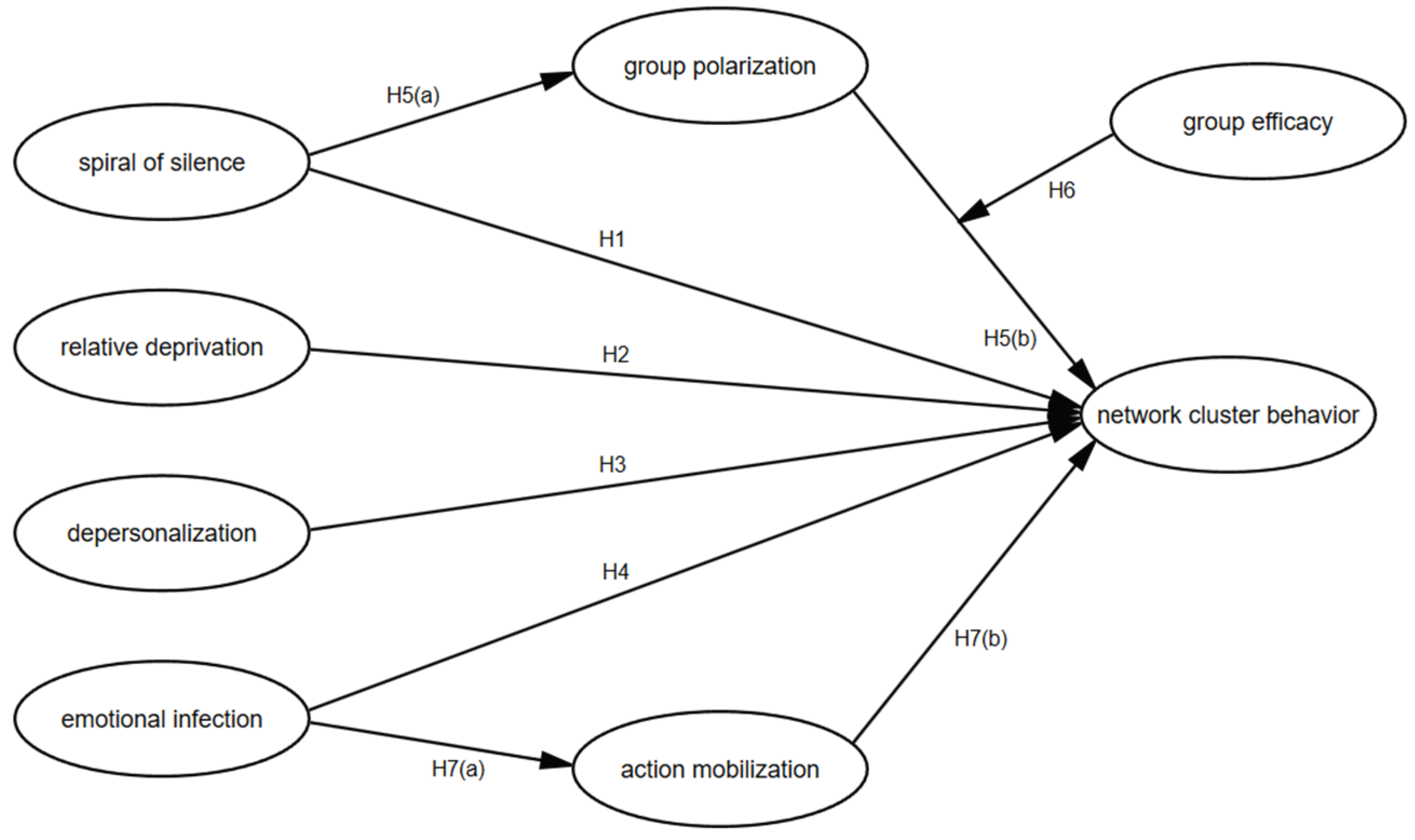
Figure 2.
Confirmatory factor analysis (standardized parameter estimates).
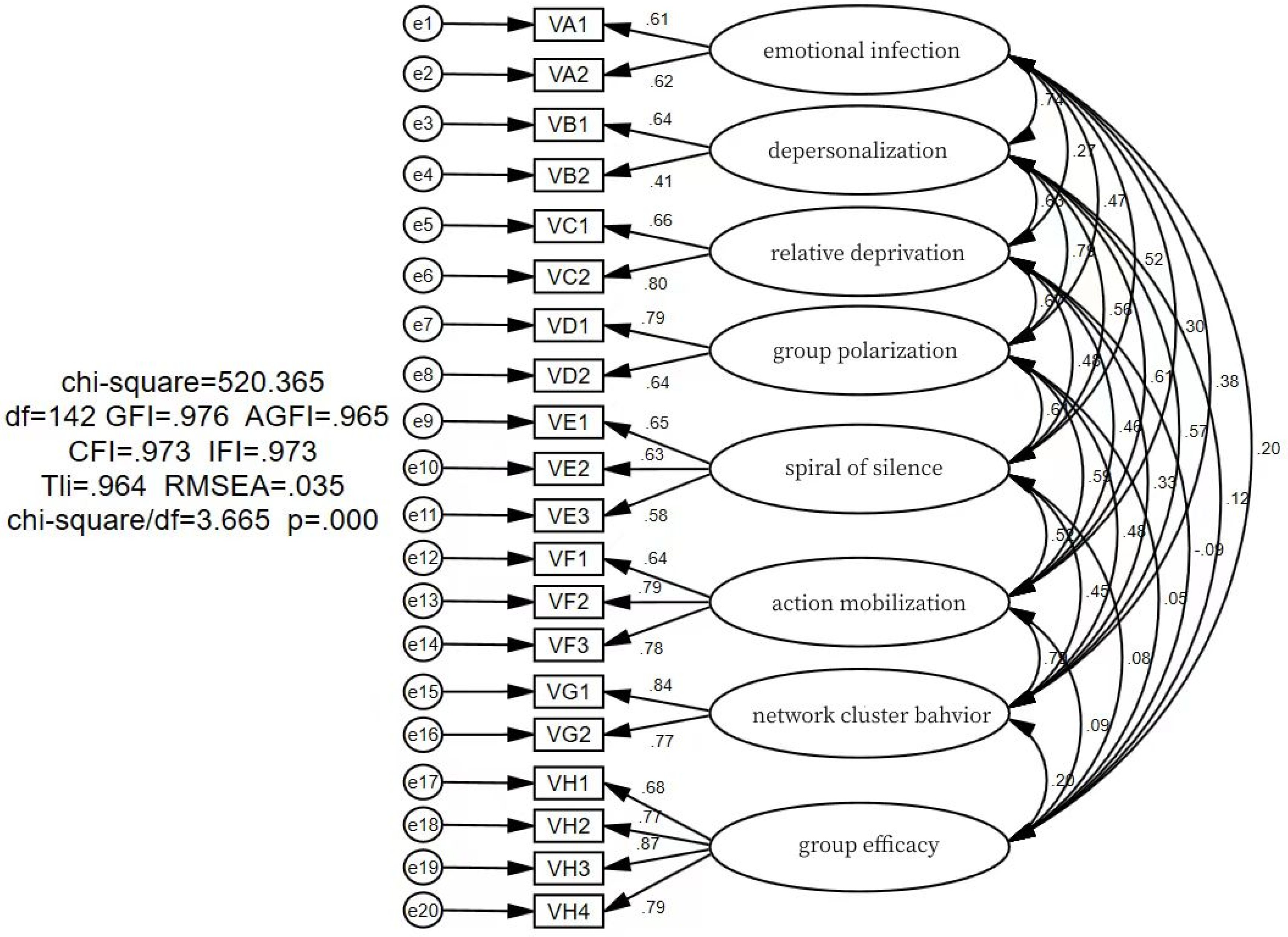
Figure 3.
The moderating effect of group effectiveness on the relationship between group polarization and network cluster behavior.
Figure 3.
The moderating effect of group effectiveness on the relationship between group polarization and network cluster behavior.
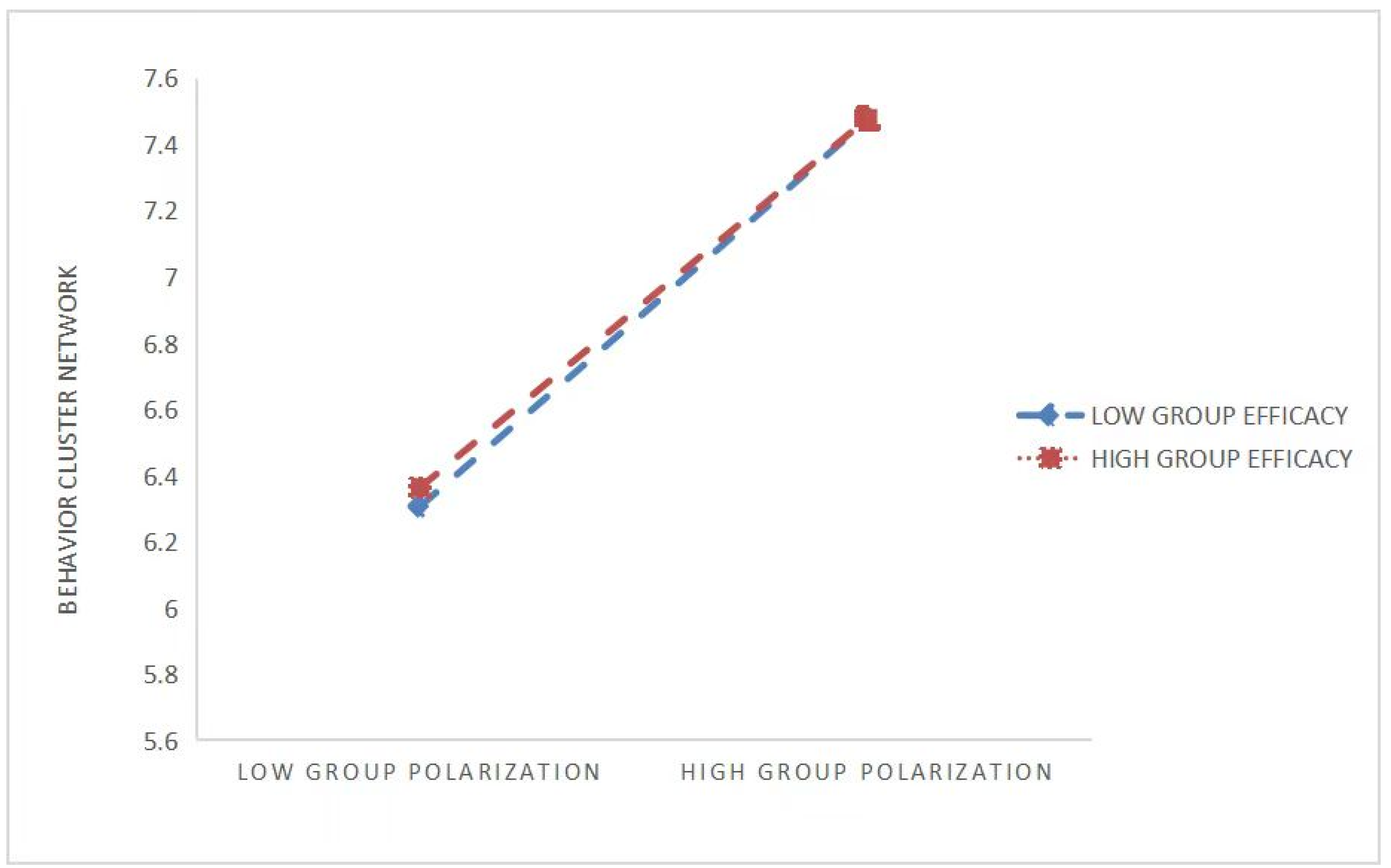

Table 1.
The goodness of fit of the measurement model.
| χ2/df | GFI | AGFI | IFI | CFI | NFI | RMSEA | RMR |
| 2.050 | 0.974 | 0.962 | 0.980 | 0.980 | 0.962 | 0.031 | 0.023 |
Table 2.
Descriptive statistics and correlations between variables.
| Variables | M±SD | 1 | 2 | 3 | 4 | 5 | 6 | 7 | 8 |
| 1. Emotional infection | 2.82±0.75 | 1 | |||||||
| 2. Depersonalization | 2.63±0.77 | .369** | 1 | ||||||
| 3. Relative deprivation | 2.18±0.73 | .166** | .342** | 1 | |||||
| 4. Group polarization | 2.39±0.74 | .295** | .465** | .497** | 1 | ||||
| 5. Spiral of silence | 2.56±0.62 | .312** | .311** | .327** | .473** | 1 | |||
| 6. Action mobilization | 2.40±0.73 | .205** | .376** | .341** | .474** | .390** | 1 | ||
| 7. Network clustering behavior | 2.57±0.78 | .257** | .351** | .235** | .373** | .334** | .626** | 1 | |
| 8. Group efficacy | 3.32±0.65 | .142** | .102** | -.064** | -0.01 | .074** | .101** | .188** | 1 |
N=2391; **p<0.01.
Table 3.
Testing the pathways of the mediation model.
| Model 1 | Model 2 | Model 3 | ||||
| b(SE) | p | b(SE) | p | b | p | |
| Relative deprivation | 0.078(0.023) | 0.001 | -0.026(0.020) | 0.192 | ||
| Depersonalization | 0.229(0.023) | 0.000 | 0.099(0.020) | 0.000 | ||
| Spiral of silence | 0.176(0.018) | 0.000 | 0.057(0.016) | 0.000 | ||
| Emotional infection | 0.100(0.022) | 0.000 | 0.301(0.031) | 0.000 | 0.094(0.019) | 0.000 |
| Action mobilization | 0.392(0.014) | 0.000 | ||||
| R2 | 0.191 | 0.042 | 0.420 | |||
| F | 125.801*** | 93.756*** | 308.330*** | |||
Table 4.
Testing the pathways of the mediation model with moderation.
| Model 1 | Model 2 | Model 3 | Model 4 | |||||
| b(SE) | p | b(SE) | p | b(SE) | p | b(SE) | p | |
| Relative deprivation | 0.098(0.023) | 0.000 | 0.054(0.024) | 0.022 | 0.049(0.024) | 0.038 | ||
| Depersonalization | 0.216(0.022) | 0.000 | 0.180(0.023) | 0.000 | 0.180(0.023) | 0.000 | ||
| Emotional infection | 0.082(0.022) | 0.000 | 0.070(0.022) | 0.002 | 0.071(0.022) | 0.001 | ||
| Spiral of silence | 0.169(0.018) | 0.000 | 0.325(0.016) | 0.000 | 0.142(0.018) | 0.000 | 0.139(0.018) | 0.000 |
| Group efficacy | 0.087(0.012) | 0.000 | 0.028(0.011) | 0.013 | 0.083(0.012) | 7.965*** | 0.167(0.033) | 0.000 |
| Group polarization | 0.156(0.025) | 7.676*** | 0.408(0.094) | 0.000 | ||||
| Group efficacy*group polarization | 0.019(0.007) | 0.006 | ||||||
| R2 | 0.211 | 0.225 | 0.233 | 0.235 | ||||
| F | 114.193*** | 310.555*** | 107.568*** | 93.432*** | ||||
Table 5.
Moderating effects at different levels of group efficacy.
| Group efficacy level | β | Se | t | p | LLCI | ULCI | |
| Group polarization→network clustering behavior | -2.6002 | 0.4371 | 0.0275 | 15.8780 | 0.000 | 0.3831 | 0.4910 |
| 0 | 0.3909 | 0.0205 | 19.1005 | 0.000 | 0.3508 | 0.4311 | |
| 2.6002 | 0.3448 | 0.0274 | 12.5668 | 0.000 | 0.2910 | 0.3986 |
Disclaimer/Publisher’s Note: The statements, opinions and data contained in all publications are solely those of the individual author(s) and contributor(s) and not of MDPI and/or the editor(s). MDPI and/or the editor(s) disclaim responsibility for any injury to people or property resulting from any ideas, methods, instructions or products referred to in the content. |
© 2026 by the authors. Licensee MDPI, Basel, Switzerland. This article is an open access article distributed under the terms and conditions of the Creative Commons Attribution (CC BY) license.
Copyright: This open access article is published under a Creative Commons CC BY 4.0 license, which permit the free download, distribution, and reuse, provided that the author and preprint are cited in any reuse.


