

Submitted:
12 June 2025
Posted:
13 June 2025
You are already at the latest version
Abstract
SST an adapted version from Lord Gidden's Structuration Theory aids the understanding of the recursive relationships between agents and structures.
Keywords:
strong structuration theory (SST)
; university business incubator
; university business incubation
; dynamic social network analysis
1. Introduction
It has been established in entrepreneurship and cluster based studies that the dynamisms of entrepreneurial ecosystem are due to the continual interaction of different actors or agents forming a ‘complex adaptive structure’ (Harris, 2021). These dynamic structure formed could aid the reason for the diverse entrepreneurial climate seen across the globe and why some regions are more entrepreneurially favorable than others. The need for these EE (Entrepreneurial Ecosystem) structural transformation has also stimulated the dire need for the emergence of more structure based approaches to entrepreneurial ecosystem studies overtime. The Structuration Theory (ST) as postulated by Lord Giddens has unraveled the structural perspectives of underlying ecosystem via enhancing our understanding of the recursive relationships between agents and structures.
The application of ST has evolved from the earlier abstract based premonition to an abstract-meso ontology as advanced by SST. SST is used as an investigative analysis into the cognitive, structural relationship and responses of agents within a socio human structure (Taiwo, 2022, 2023). The evolution of SST based on the earlier proposed ST by Lord Giddens, has evolved as a methodology in Socio-human structural interactions research in investigating the cognitive, structures, relationships and responses of agents within a socio-human structural network based on their hermeneutics on an abstract level. The ST although with its criticisms has evolved with several adapted forms with SST being prevalent. SST could be used to determine the behavior of active agents or actants within a socio-human structure (Greenhalgh and Stones, 2010) using the QNS a quadripartite framework (Jack, 2017; Makrygiannakis and Jack, 2018) for examining the external conditions or structures, internal hermeneutics of Conjectures, Habitus and the active agents’ involved in taking decisions either to align, oppose or adjust to the corresponding structural effects. Based on the earlier Gidden’s abstract level, SST postulates a meso level with an internal structure of normative expressions, dominance, significance and transposable skills to further expatiate on how agents within the structures exercise their dominance and power in influencing or aligning to the ensuing structures based on different triggers around the system, environment or structure. While several applications of SST exist in Accounting, Business Management, Medicine, Nursing, Information Technology using the QNS, context and conduct analyses, discourse analysis (Greenhalgh and Stones, 2010) and methodological bracketing as proposed lately where a temporality perspective of SST was introduced which investigates the concept of structural changes and agents responses overtime (Makrygiannakis and Jack, 2018) the possibility of a quantitative data based measurement as part of the QNS framework or SST behavioral pattern analysis is still missing. The concept of temporality in SST, brings in a new dimension and perspective of ‘time’, ‘structure’, ‘triggers’ or structural changes’ and responses within the recursive interplays of agents and the system (or structure). This dimension institutes the notion that agents could (or would) behave differently using their conjectures and habitus due to their external conditions of action at different time intervals. How they respond overtime could be studied and the dynamism of the agents and the network could be assessed. In lieu of this, this study proposes a network dynamism approach with SST (using Dynamic Social Network Analysis) and also a mixed method SST (MMSST) which suggests the possibility of combining qualitative studies (e.g., different cases of recursive structural relationships in UBI forms, including QNS, Context, Conduct and Discourse Analysis) with quantitative analyses (statistical agents network dynamism studies, agents’ behavioral patterns and constructs) in SST building on an earlier study on SST application in UBIs (Taiwo, 2022, 2024b). This instantiates the possibilities of conducting In-depth interview with temporality measure, context and conduct analyses of agents, behavioral patterns, agents’ adaptation and response to external condition overtime in different scenarios and time intervals. A quantitative technique could be further used based on the earlier collected qualitative data to predict future actions of agents and possible external conditions that could affect the structure. To further aid this proposed new SST study, SST could be combined with behavioral, sociological and psychological theories such as Theory of Planned behavior and personal construct to unravel the dichotomy of agents-in-focus, their behavioral, control, normative and perceived beliefs, responses, power assertion and limitations. The conduct and context analyses could also be adapted using predictive ML and ethical AI analyses overtime.
Due to the concept of temporality in SST, the Dynamic Social Network Analysis (DSNA) would aid further understanding of the network dynamism involving nodes (actors) and adjacencies (relationships and linkages) overtime and the continual recursive relationships between agents and the structure. The DSNA proposed by Scott (2012) and Mixed Method Dynamic Social Networks Analysis) aids the understanding of network dynamism and evolution overtime (Froehlich, Rehm and Rienties, 2020; Froehlich, Van Waes and Schäfer, 2020). DSNA techniques such as ERGM (Exponential Random Based Graphical Modelling), its sub-categories (TERGM, STERGM) and SAOM (Stochastic Actor Oriented Modelling) could be used for (agents)nodal attribute and network evolution modelling overtime (agents relationships) (Steglich and Snijders, 2022). Nodal Attributes and relationships characteristics can be determined using ERGM and SAOM as the network evolve at different time intervals.
MMDSNA with the proposed MM-SST is applied to UBIs and their clusters across different industrial sectors while taking cognizance of their embedded EE and RIS. In achieving this, extant SST based studies across several industries was used in the thematic analysis to develop the integrated framework for the application of SST in UBIs, their embedded Entrepreneurial Ecosystem (EE), Regional Innovation Systems and Clusters. Based on these, the following Research Questions serve as a guide for the study:
- (i)
- What structures and actors exist based on the recursive interactions on the levels of analysis for different UBI forms and how do they adapt to such changes overtime?
- (ii)
- How can MMSST and other adjoining theories or concept (such as MMDSNA) enhance further application of SST to Business Management studies (UBI studies) in general.
This study will facilitate further use of SST in UBI, their clusters and spinoffs studies across different industries (MedTech, Biotech, Space (ESABICs) and Networked of UBIs. The next sections discuss the methodology and thematic analysis.
2. Materials and Methods
To facilitate this study, a Sequential Exploratory Mixed Method is proposed. Extant literatures with SST concepts and applications in Management, Accounting, Organizational Strategy, Healthcare (Medicine and Nursing) and IT were used and thematic analysis was applied to discover the ensuing themes and patterns. Several studies and articles across UBIs, and their selected clusters (MedTech, Biotech), Space, Fintech and Network UBIs were integrated into the thematic analysis.
Open coding was then applied across all these studies and integrated to discover patterns and themes. Figure 1 shows the procedure for the thematic analysis and the selected articles and criteria used. The selected articles for SST extant literatures are shown in Table 1 while the selected articles for Medtech clusters, Biotech Clusters, ESABIC, RISs and EE are shown in the Appendix A. Based on the thematic analysis via coding selected articles on SST across different disciplines such as: Accounting, Nursing, Medicine, Strategic Management, Entrepreneurship and Business Management. Themes, patterns and categories that ensued are discussed below. The major categories are SST Socio triggers, changes and structures, SST concepts and Analyses, SST and Resilience. The categories are further highlighted into sub-categories and types across UBI forms (Traditional UBI, MedTech, Biotech, Networked UBI, ESABIC (European Space Business Incubation Centers) while also taking cognizance of the embedded RIS and EE of these UBIs and their clusters. Figure 5 and Table 6 illustrates the thematic analysis breakdown into categories and sub-categories.
The categories, sub-categories are further discussed below:
Results and categories:
(Ai) SST Socio-Structural Triggers and Changes: This category depicts how changes occur within a socio structural system and what could trigger changes. This was classified as ‘’SST specifics socio-structural triggers’’ (i.e., generalized sources of condition of action triggers or sources of changes. Further classifications are then made for SST triggers in: UBIs’ Entrepreneurial Ecosystem (EE), Regional Innovation System (RIS), MedTech, Biotech, ESABICs and UBIs (traditional) Clusters.
Triggers within Socio-structural systems include: Uncertainties, Risks, Disruptions, Threats, Risks and Constraints. These could arise as a result of Market uncertainties, market disruptions in the Entrepreneurial Ecosystem (EE) due to technological trends, risks in late adoption of technology within a Region or Cluster, changes due to regulation or impact of new regulations or industrial policies and compliances, threats of new market entrants and startups, Internal challenges arising from Regional Economic Socio-Political stir ups. All these typify specific regional changes that trigger a shift of the once stable Socio-Structures and could serve as a condition of action for external structures to or within the QNS (Quadripartite Network Structure or System). Once these SST specific triggers occur, active agents or agencies usually position themselves to adjust, align or cause tensions to the structure depending on the initial structural form (Jack and Kholief, 2011) i.e., Normative, based on norms or guiding policies, figurative (shaping structure) due to the consistent nodes and relationships or such structural outcomes could be preserved or irresistible to changes.
The dynamism of such structure would depend on the power of influence and positioning of the agents in focus and contexts. It’s also pertinent to note that changes in structure are relevant on MLA (multi-level-analysis) i.e., cluster or regional, organizational (UBI) or SME, MNCs and individual student Entrepreneurs. In such levels, there could be impact on a cluster due to Regional competition which stimulates RISs, NIS sub-systems rivalry. One of such was seen in Germany 2009 during the Bio regional and MedTech Clusters competitions (Cooke, 2001a; Cooke et al., 2011) such competitions drew up collaborations and partnerships within these levels of analysis including clusters and regions while also dispossessing clusters with lower ability to shape their structures towards attaining better competitive edge. Such studies were also conducted using SST and Dynamic Capabilities Framework (DCF) (Taiwo, 2024b). The study facilitated the transformation of a typical cluster overtime (in this case a MedTech Cluster (in Central Europe) understudying the transformation over a period of 18 years and representing the socio-structural changes via the QNS. The study showed that typical clusters utilize different socio-structural conjectures and transposable skills of normative schemas in adjusting, adapting or aligning to the uncertainties, challenges and disruptions of these structures based on their internal and external diametric threats and disruptions. In this vein, regional structural changes and transformation overtime, analyses and measurements are essential throughout the value chain of these UBIs and their clusters. During the value chain processes and development, the emergence of incubators, parks or technopoles are also sources of changes or triggers of socio-structural changes that stimulate changes within an EE and RIS clusters due to the generative and transformative roles engaged by the UBIs and Clusters, their TTOs and startups. Their incubation and business venturing activities also cause different idea commercialization approaches e.g., Tech transfers, IP licensing, academic spinoffs via business incubation or research project development. Each of these processes and approaches involve specific strategies such as IP licensing agreements, venture capital fund sourcing and generation which could have caused a structural shift with UBIs and REE. A typical example could be seen in the study highlighted in the application of SST to UBI studies (Rasmussen and Borch, 2010; Somsuk, Punnakitikashem and Laosirihongthong, 2010; McAdam, Miller and McAdam, 2016; Taiwo, 2022) in these studies, cases of Venture Capital fund sourcing and generation caused a tension and a shift within a UBI and its stakeholders causing the UBI managers and executives to internally develop ideas for fund generation rather than the over dependence on Governmental funds. Taiwo (2024a) study on typical UBI forms also buttressed these points as UBI funding caused a structural shift internally and externally thereby causing an adjustment among the agents (in focus and contexts) involved.
UBI commercialization approaches within a cluster and among stakeholders which could also impact successful project results and outcomes throughout the UBIs or Clusters’ value chain. A typical Medtech value chain includes: Research or Idea generation and development via Innovation, Clinical trials phases, Approvals, Validation, Reimbursements and Time-to-Market (T2M) and End User Involvement and Acceptance.
At the upper end of the value chain (especially for Life Science Clusters), T2M (Time to Market) and End-User Acceptance impact the successful outcome of product development. These could also cause tension or trigger within a structure due to the high expectations for product or research success and speed of product development which is important in life science clusters (MedTech, Biotech) compared to Traditional UBIs or digital based UBIs that focus on digital products, Software development and webapps where MVPs could be rolled out in 1-2 months, while Life Science product development could be up to 10 years or more especially in the case of drug discovery and development. The rigors of compliance, validation and approval during the development cause a high end of expectations of outcomes. The high expectations of the stakeholders and the business and economic logic components causes or triggers changes as producers must develop products that are both fit for use and purpose, and suppliers are required to meet the stringent standards and compliances of the life science industry (Taheri and van Geenhuizen, 2011). Overall, the value chain of life science UBIs, Clusters and their spinoffs from Innovation, R&D, Validation, Reimbursements and Approval to T2M are subject to both internal and external tension triggers due to the heavy complexities in the value chain. Other challenges which could arise within the value chain include insufficient available funding for startups and spinoffs, IP Licensing Strategies, Students’ Entrepreneurial Level or competencies), Regulation impact and policies effect, lack of collaboration and partnerships during drug development, end-user customer impact, transaction costs during patenting and licensing.
For the Biotech Clusters, long term stage or phases approval, tolerance to failure of Products, licensing complexities pose threats, constraints and challenges during the value chain process. In addition to this, the need for resilience development and configuration across the value chain by Clusters and Regional stakeholders at all levels of analyses to combat the threat or mitigate the risks are important.
(Aii) SST Triggers and Changes in RIS and EE:
Due to the differing EE attributes (Meyer and Mason,2016) and variability in the absorption of these EE attributes across different UBI forms (Taiwo, 2024), EE undergo transformation and lifecycle changes overtime due to these effects and variabilities. EE attributes such as social, cultural, economic, legal and commercial play important roles in the survivability and sustainability of UBI startups and it also defines why some EEs are fond of or notable for successful industrial clusters and spinoffs. e.g., London and Frankfurt for Fintech, Boston Massachusetts, Cambridge, Munich and Bayern Metropolitan Regions, Zurich, Geneva and Uppsala (Sweden) are notable for Life science spinoffs (Biotech and Medtech) (Cooke, 2001b; Trippl and Tödtling, 2007; Alvedalen and Boschma, 2017; Spigel, 2017; Harris, 2021; Taiwo, 2024a).
It’s also worthy to note that Regional and Economic factors influence EE lifecycle and shifts based on the attributes present and also how the elements with the EE interact in absorbing and renewing these attributes based on the understanding (or premise) that less interaction could cause an EE system failure or lower RIS attractiveness.
RISs are buoyed by the levels of needs, attraction and knowledge exchange (Baraldi and Waluszewski, 2011; Baraldi, Ingemansson and Launberg, 2014). The sub-system components of an RIS based on the Diamond Model as suggested by Potter interact with Socio commercial elements based on government rules and policies. These interactions within these elements cause RIS structural changes. The quest for Regional development also poses a shift in the RIS development strategies due to their RIS modes or types i.e., Old industrial, Peripheral or CBRIS and Metropolitan or Municipal). The need to increase attractiveness and exchange for knowledge (tacit or codified) integrates a constant continual shift or change exemplified by industrial revolution and labor mobility. Technology absorption and renewal within RISs have also caused shifts or triggered changes due to the fast-paced technological trends and evolution. RISs are posed to compete for innovations in all ramifications and adjust to the continual consumer behavior and technology adoption for continual value creation. Cities and regions (Nice, Montpellier, Barcelona) have adopted concepts like Smart City as supported by the SIS projects such as Horizon 2020 and also Smart People project in Finland for further RIS innovation development. (Center of Excellence) in Europe, UBI executives, SIS Project Leads must continually be aware of the triggers for structural shifts and EE life-cycle changes overtime. So also is the inherent shifts caused by UBI transformative roles within the EE and the need for adoption of transformative mechanisms for disfavored entrepreneurial regions in Peripheral and Cross Border regions of Europe (due to harsh climatic conditions) to adjust to these socio structural triggers and shifts.
(Bi) SST Structural types and Framework: this category depicts the SST socio-structural types which could be: functional, foundational, irresistible or independent and normative structures. Other sub-category also includes: SST Emergent structures and influence, SST QNS (Quadripartite Framework) with External Structures, Internal Structures, Active Agents or Actants and Outcomes.
(Bii)SST Mode of Analysis: This category depicts SST Multi-Level Analysis i.e., meso, macro and micro, Behavioral Response & Temporality Analyses with Context and Conduct Analysis, Temporality and Methodological Bracketing, SST Concepts and Applications which elucidates on SST’ Hermeneutics and Structural Analysis, memo, ontic and Abstract layers’ definition, position practice, identities obligations and hierarchical levels of relations between structures and agencies, researchers position of practice to examine the networks and relationships between clusters of agents.
SST evolved from the understanding of the recursive relationships between agents and structures forming a continual dynamic network of active agents interactions with their structures based on influence, power exertion, legitimation and normative expressions. Stones (2017) while proposing the SST suggested a framework called the QNS (Quadripartite structure) for the analysis of SST, the recursive relationships, the external condition of actions, influence of value and knowledge of Agents and the internal structure of agents’ transposable skills and normative expressions. The internal structure which exemplifies the power exertion, how individuals perceive their socio world action and terrain, how agents via their knowledge develop interpretative schemas overtime (Jack and Kholeif, 2007; Greenhalgh and Stones, 2010) and their dominance, legitimation and significance.
The active agents or actants influence their actions using their transposable skills, general disposition, their perspectives or interpretative schemas, their belief system, in summary the internal structures’ Conjectures and Habitus to impose, adjust or align to structural changes thereby bringing about modified or stable structures as outcomes or results.
The results of active agency could be types of technology adoption and process changes or impact and influence interplay between multi-levels socio-human structure.
The QNS has been applied across several industries: Medicine and Nursing (Greenhalgh and Stones, 2010), Accounting for Strategic Decision Making (Jack and Kholeif, 2007; Jack, 2017), Entrepreneurship and Management Studies. These studies all show the different elements of how uncertainties, business threats enable agents in focus and contexts to make (strategic) decisions that impacted the once stable structure. QNS can also show how agents use power influence to respond to external normative expressions and conditions. QNS could be further applied to the organizational level of analysis in UBI studies to further understand how UBI managers and stakeholders adapt, align or adjust to the varying tensions across their EE, RIS and Clusters overtime. QNS could also be used to understand the various adaptation, power exertion and external condition possibilities across several UBI forms and industrial sectors.
Taiwo (2024b) introduced SST to traditional UBIs based on cases of structural changes in earlier studies and further expanded SST approach to other industrial sectors (MedTech, Biotech, Space (ESABICs) and Networked UBIs). Table 2 shows the QNS in each industrial sector.
(Biii) SST Actants: Active agents and actants play an important role in maintaining or causing tensions within the structure leading to tear down, alignment or adjustment based on the external condition and their own internal structures of dominance, legitimation and significance and normative expressions with the transposable skills, schemas, perception, habits, traits, belief system to respond to the external condition of action, their tendency to exert power influences on the structural outcome i.e., the structure remains stable or irresistible to change or chaotic due to tension generated by the agents.
In these cases, SST further proffers context and conduct analyses of agentic actions of why and how to perceive the changes around the agents based on their internal hermeneutics and disposition and how they would conduct themselves in varying situation and circumstance. Conduct and Context Analyses aids the focus on the participants’ actions and dispositions, influence and practice within or outside the cluster and their influence on the structural disposition.
Furthermore, discourse analyses aid the interpretation in time and space of agentic actions providing cultural meanings, values and shapes actions and legitimation. Makrygiannakis and Jack (2018) further introduced the concept of temporality and methodological bracketing to the QNS proposing that the actions and influence of agents could be understudied from the varying levels of analysis: meso, ontic and abstract or macro, micro and meso systems levels at different time intervals e.g., t1, t2, t3…tn.
The author further suggested QNS could be viewed as sets of strategic activities of ongoing structuration process evolving overtime or observation and control practices overtime. This makes it possible for the notion of temporality to be applied and analyzed.
It is also pertinent to note that SST mode of analysis could be macro, meso and micro levels of organization and systems giving rise to the possibilities of structural level analyses and impacts overtime, multi-level layered response to norms and rules, SST ontology and in-situ.
In general, SST aids the hermeneutics and structural analyses on meso, ontic and abstract layers, using position practice from the researcher’s perspectives to understand levels of relations between structures and agencies, researchers’ position of practice and the understanding of change and stability within different cases and interaction of agents and structures based on norms and rules overtime.
(Biv) SST’s Possible Outcomes: This include an unmovable or irresistible structure, a changed or persevered structure and a depicting impact on external and internal structures due to active agents’ responses and influence. Outcomes could also result in successful technology adoption which further strengthens the initial weak structure with intended or unintended consequences or further influence of the interplay between multi-level socio-human structures (changed or persevered) with intended or unintended consequences i.e., agents facilitated or frustrated outcomes.
(C) SST and Resilience in UBIs: While SST enhances the need to analyze socio human structures and agents’ responses, the concept of resilience instantiates the need to develop disaster recovery mechanisms, risk and crisis management thereby ensuring stable UBIs and clusters in the midst of challenges and disasters. The sub-categories include: Resilience Multi-Level Analysis overtime based on individual, organizational, business units and stakeholders level of analyses, Resilience and Entrepreneurship, Threats, Challenges, Disruptions, Risks and Resilience.
It has already been established in previous sections that uncertainties, challenges, constraints, threats and crises pervades the structural boundaries, value chain and life-cycles of UBIs’ clusters and spinoffs.
In this vein, the need to develop resilience in combating the once stable UBI structures is indispensable. Resilience depicts the ability to come back from adversity or to prevent the reoccurrence of disasters and harmful events and in the case of reoccurrence to swiftly adapt and adjust the system or structure against the disaster.
For UBI, resilience development should occur on a multi-dimensional level of analysis i.e., individual, organizational and networks (for partnerships and collaborations) or on a multi-governance level (local, regional (cluster) and national). Resilience must be configured and developed across the value chain from a multi-level analysis perspective: entrepreneurs (or individuals) for the development of their cognitive, motivation, perseverance and self-efficacy i.e., ‘the can do’ mentality in face of opposition in their incubation process and psychological capabilities in developing a strong mental power to come back from adversity or marketplace challenges. This also involve the UBI (or organizational level) including the BUs (business units) in developing a robust entrepreneurial ecosystem and business incubation processes overtime both on the network levels in forming partnerships and collaborations that fosters strong alliance in developing projects, venture funding, idea commercialization and joint research projects facilitation.
In the case of a typical UBI lifecycle as shown in the Figure 4 below, there are capabilities required at different stages of the UBI and their startups evolution: at the inception stage, capabilities such as risk taking, entrepreneurial motivation, opportunity identification and recognition are required by both entrepreneurs and the UBI as an organization to survive the earlier uphill task of attracting VCs, understanding their markets and industries and surviving the business incubation processes thereby attaining sustainability. As seen in the Figure 2 below, UBIs and their entrepreneurs require a great need of adaptation and resilience development during the incubation process, the value chain, EE and RIS life cycles as these are sources of triggers or changes that could impact the UBI and their clusters. Figure 2 further highlights the resilience and adaptability framework and levels require by the different UBI forms, their clusters across both UBI (traditional), life sciences and Space (ESABIC) value chains.
For Traditional UBIs, as seen in Figure 3a based on a study by the author, adaptation is required during idea commercialization, regional economic transfer, market disruption and changes, regional entrepreneurial climate, managerial proclivity and competencies, while in Life science clusters e.g., MedTech, adaptation is required in continuous individual and organizational adaptive and cognitive capabilities development, risk management initiatives and planning, crisis management, government liaison and technological initiatives adaptive measurements.
For Biotech UBBI and their clusters as shown in Figure 3b, adaptation is required for ‘Tolerance to research project failures’, complexities in phases or stages of product development and IP licensing and agreement. Resilience and Perseverance are also needed on a multi-level analysis in ESABICs, while adaptation is required in research project collaborations for the upper segments of the ESABIC value chain. Resilience during trans-regional collaboration would also be needed to leverage on the infrastructure required in the Upper segment of the Space Value chain. ESABICs (Universities based Space Incubators) also need to adapt to the Open Innovation (OI) initiatives during the University-Industry collaboration and information leakages across the value chain segments from downstream to Upstream and other cross-industry applications e.g., Navigational Observations and Telemedicine.
On a governance level of analysis for all the UBI forms, the regional entrepreneurial climate and ecosystem are important for adaptation due to the continual transformation and development, as well as the EE which requires adaptation because of systemic failures that could occur due to non-interacting elements within the EE. Based on these discussions, the following propositions can be made:
Proposition I:
UBIs structures differ across different industrial forms and configurations so also their structural outcomes.
Proposition II:
A combined multiple research methodology (e.g., MM SST) would enhance further understanding of how agents respond based on the several external conditions.
Proposition III:
Different socio triggers and external conditions would occur for the different UBI forms and this requires independent responses adaptation and resilience overtime.
Based on the observation encountered within earlier Structuration application to UBI studies (Taiwo, 2022) through which this study emanated from, the QNS structural forms of UBIs Life Science: Biotech and MedTech, Space, Traditional UBI) can be classified as shown in Table 2.
3. Results
Cluster based UBIs and their spinoffs tend to exemplify a ‘normative structural form’ guided by strict regulations and standards as well as being extensively embedded in the regional innovation system and development. Examples of such include the life science clusters (MedTech and Biotech). In such normative structures, socio-triggers are more regional and national than internal (organizational level) as seen from the QNS. For example, the quest for the formation and expansion of the MedTech cluster was triggered by a major regional contest in the central part of Europe which spurred a co-facilitation by all elements of the RIS: (researchers (CRO). industry experts, MNCs presence of Universities and entrepreneurs). So also the Biotech Cluster (Cooke,2011) in this part of Europe. The presence of a MedTech Cluster organization (serving as agent-in-focus) that co-ordinates the cluster activities on meso and macro levels ensures a cohesive and yet easily dissociative (when needed) network dynamics as shown by the DSNA (dynamic social network analysis). The historical heritage and process of the municipal region with a pedigree in MedTech discoveries since the 1800s (e.g., X-rays usage) also gave the cluster a hedge in MedTech spinoffs. So also the constant recursive relationships between the MedTech Cluster (agents-in-focus) and the Universities around the Region with the presence of a major University with sound pedigree in MedTech Technology transfer and Patenting in Europe (Innovation Leader) enabled a constant exchange of knowledge and interactions thereby forming a cohesive cluster network overtime as shown below in Figure 4a (network dynamism) and 4b (nodes and adjacencies). Figure4b shows the various actors (nodes) and their relationships at time T1. DSNA combination with SST aids a more visual explanation of the recursive relationships and how the agents involved in interactions within the clusters or network are wholly meshed or dispersed. As shown in the figure above, at time T1 (at inception of the cluster) the network was less dense with the MedTech Cluster organization being the central body attracting other actors to the network. At time T2, i.e., next 6 years the cluster was buoyed and meshed due to the regional competition serving as a socio-trigger or condition of action for a change, thereby bringing together other actors to the clusters. This is shown in the denser network at time T2 and based on using their conjectures of collaboration, presence of experts and mutual understanding to be named the best cluster in the country. The QNS for the MedTech Cluster is also shown in the Appendix Table A1. Compared to a traditional UBI cases taken, the emergence and evolution of the UBI was based on a major venture champion, a University Professor (agent in focus) who spearheaded the need for an incubator and spinoffs within the University. Triggered by the need for incubator and startups funding, the Professor used his personal and business networks to generate fund source from the National venture funding body. While this UBI is younger (4 years as at time of the study) compared to the second case (UBI) about 20 years, the structure was similar as the formation of the UBI was due to the University’s (academic) pedigree for research and location in a thriving and buoyant entrepreneurial ecosystem.
The structures of these UBIs could be termed ‘figurational’ as they didn’t emanate from a structure of norms, legitimation or dominance as seen in the MedTech cluster description. It is also relevant to understand that the two UBIs studied were in the same region, however the first UBI case is situated at the Cross Border RIS which could necessitated a different more aggressive approach to ‘getting things done’ compared to the second UBI situated at one of the most buoyant Entrepreneurial Ecosystem in Europe. As seen from the study, the UBI case A get things done based on Conjectures like self-development and an aggressive attitude or mentality of’ Just-do-it’ (habitus).
For the two UBI cases, the socio triggers and changes were from the need for the UBI evolution and the quest for funding, so also the need for internal work flow process as the UBI developed, while the initial performance indices were not met at inception), the internal workflow process (Conjectures) instituted a re-organization of the team including resource management which has resulted in the continuous growth of the UBI.
For ESABIC the structure could be termed both Normative and yet Figurational due to firstly the presence of a governing body ESA (European Space Agency) as the institutional body regulating space based ventures and businesses in Europe thereby developing a level of significance, dominance and legislation with normative expressions. However, there is a member level agreement with ESA per region and country. The structure also differs from country to country within Europe as some ESABIC are University based (coordinated from Universities) while some are Industry based. The cases in the study were two University based ESABIC.
The quest for a country or regional ESABIC is triggered by a country based competition. Different regions within the country compete for a stake as the sole representative or representatives of ESABIC within that country. For some countries there are up to five (5) ESABICs e.g., Germany (Industry based), Finland (University coordinated). The variation in the number within a country depicts the level of collaboration involved regionally. For a sole ESABIC representative, other regions collaborate across the space segments to form spinoffs bounded by the sole representative who reports directly to the ESA. There is also space for negotiation with ESA by each member country based on the leverage within their ecosystem. The ESABICs cases researched showed a leverage in academic pedigree and a structured and robust Space Entrepreneurial Ecosystem across the Space value chain segment. These caused the initial trigger for the formation of a structure between the academic and industry. In the first ESABIC case, the presence of industry experts with focus in the space segment enabled a co-facilitation of joint research projects. The ESABICs regional location also poised for an advantage in the cause for Space ventures. One of the ESABIC is located in the Peripheral Region and also Cross Border RIS so it could interact and form partnerships and alliance with other Trans-regional partners for research projects ideas and spinoffs in the Upper Segment of the Space Business. The open innovation (OI) practiced by the ESABIC has fostered a cohesive network of academia and industry overtime. Using its conjectures of leverage on academic research and a longstanding partnership with a central country based ESABIC, this ESABIC though young (3 years old) as at the time of study has been able to emerge. The various categories and sub-categories are further highlighted in Appendix B with Table B2.
Figure 1.
Shows procedure for articles selection and thematic analysis.

Figure 2.
UBI, their Clusters and Entrepreneurs Resilience Framework.
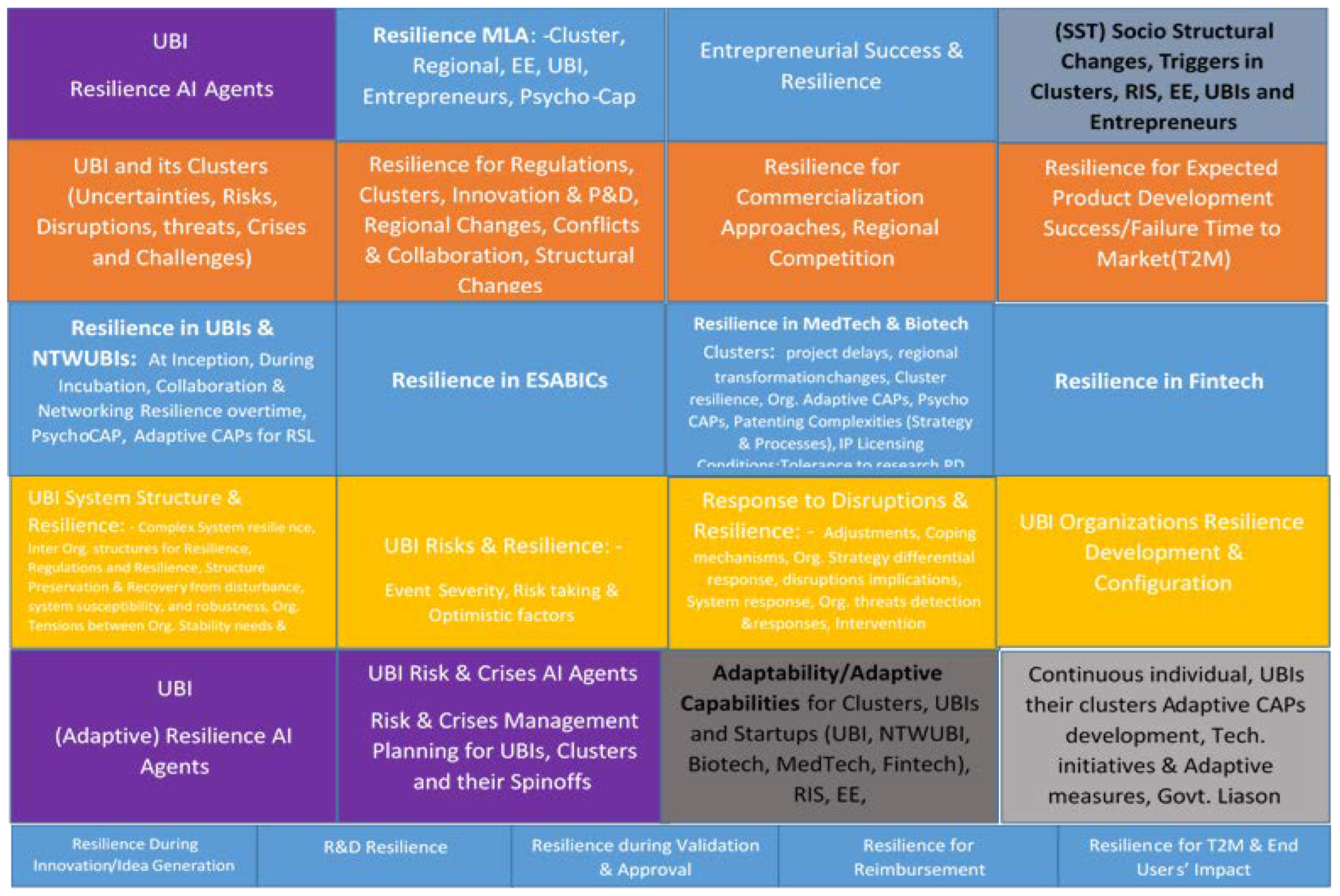
Figure 3a.
UBI Capabilities Life Cycle showing inception, during innovation, adaptive and biz sustainability capabilities
Figure 3a.
UBI Capabilities Life Cycle showing inception, during innovation, adaptive and biz sustainability capabilities
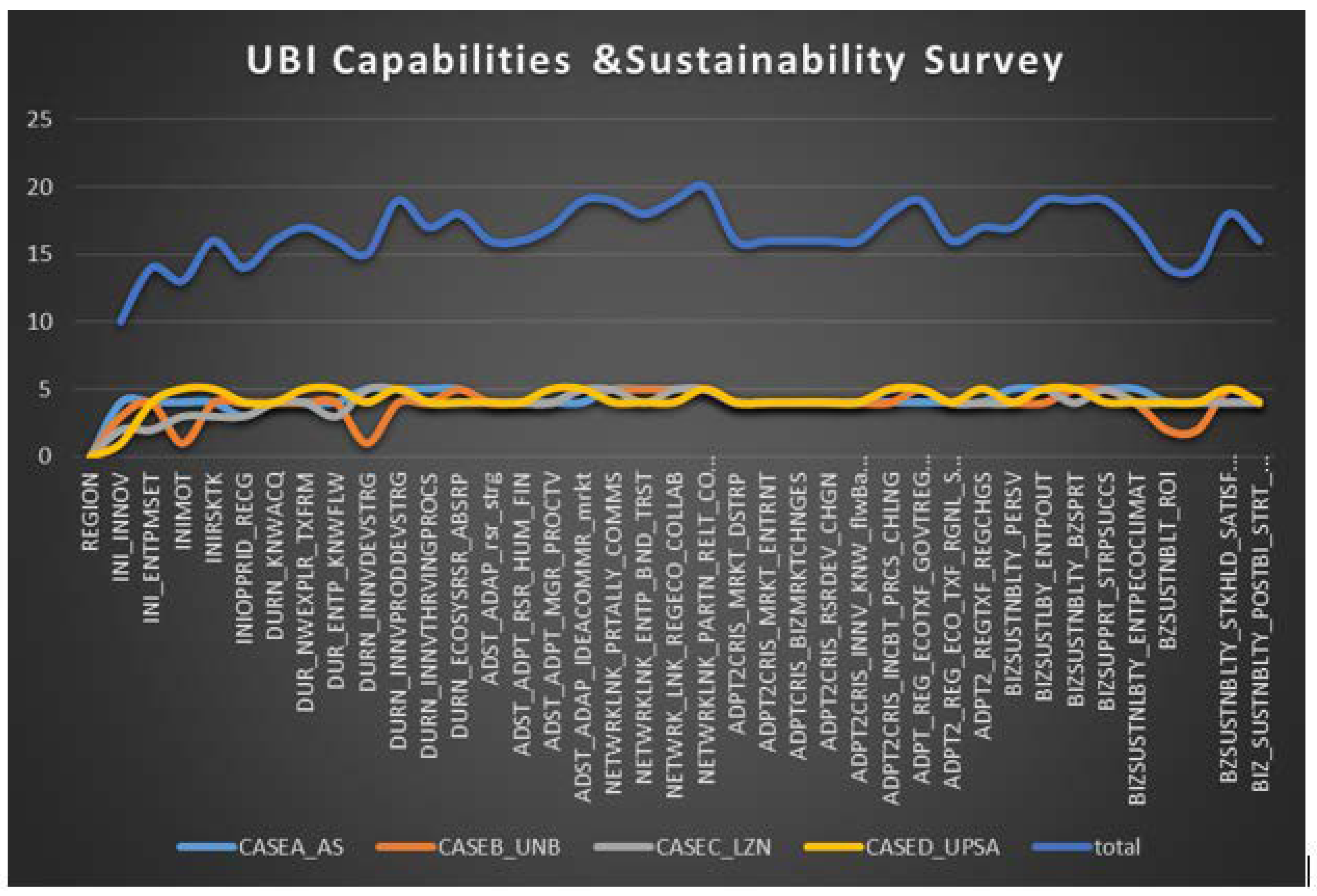
Figure 3b.
UBBI (Biotech Clusters and their Universities Business Incubators) Capabilities Life Cycle Successful UBI, Entrepreneurship Activities, Early and Maturity phases, Resilience and Perseverance, Regional Biotech Capabilities.
Figure 3b.
UBBI (Biotech Clusters and their Universities Business Incubators) Capabilities Life Cycle Successful UBI, Entrepreneurship Activities, Early and Maturity phases, Resilience and Perseverance, Regional Biotech Capabilities.
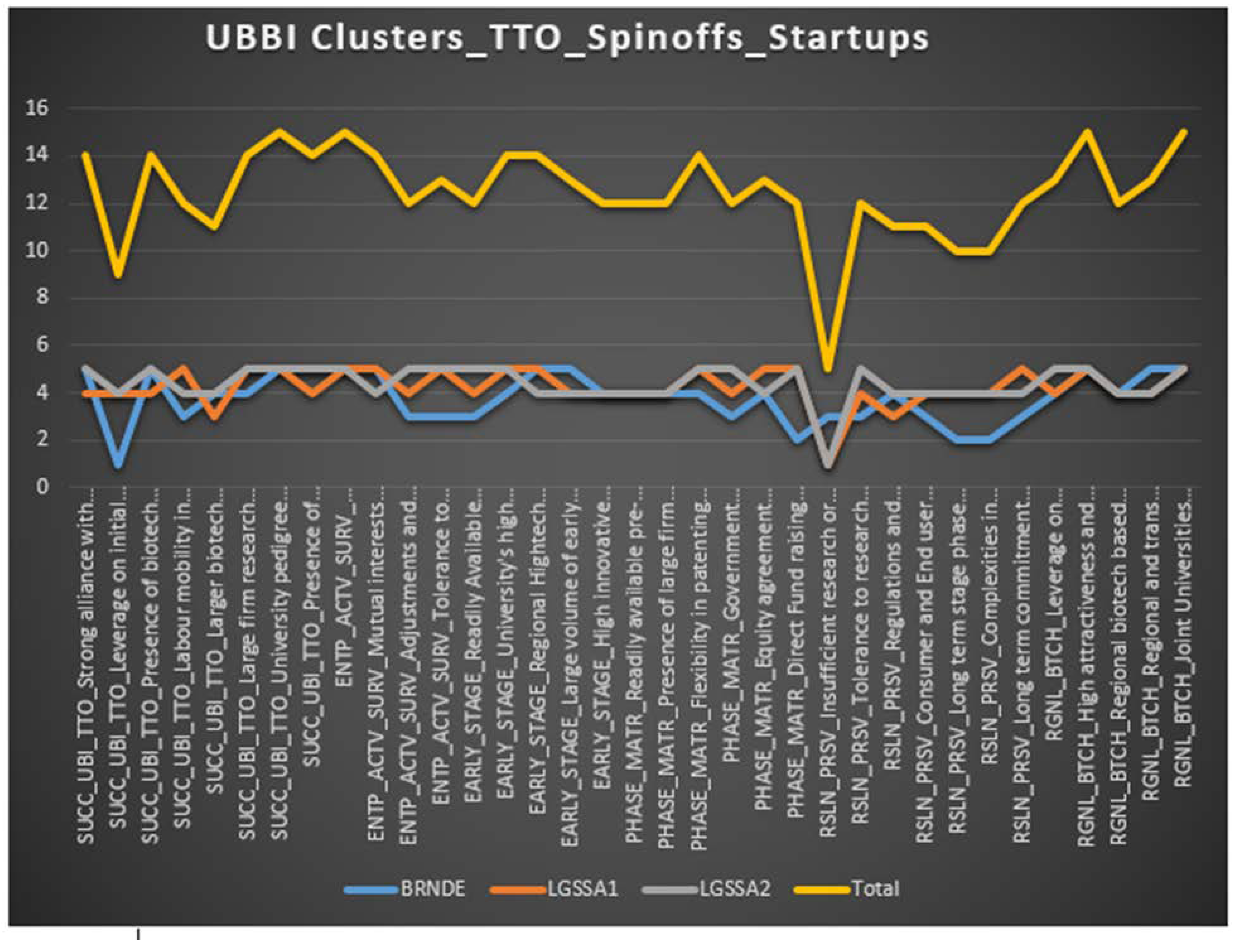
Figure 4a.
Dynamic Social Network Analysis (DSNA) of MedTech Cluster Overtime
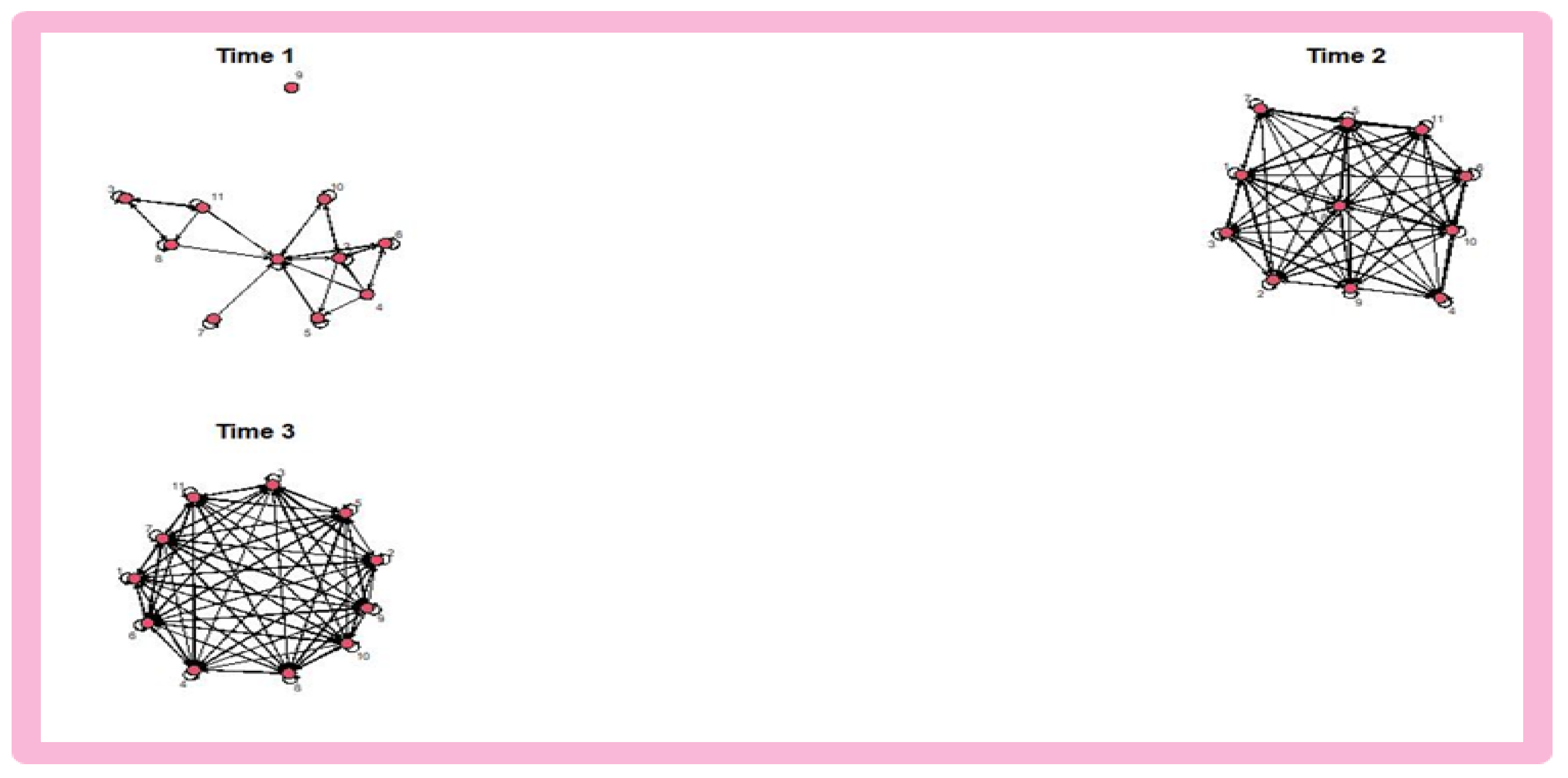
Figure 4b.
Node and Adjacencies for the MedTech Cluster (shows actors and relationships) at time T1.
Figure 4b.
Node and Adjacencies for the MedTech Cluster (shows actors and relationships) at time T1.
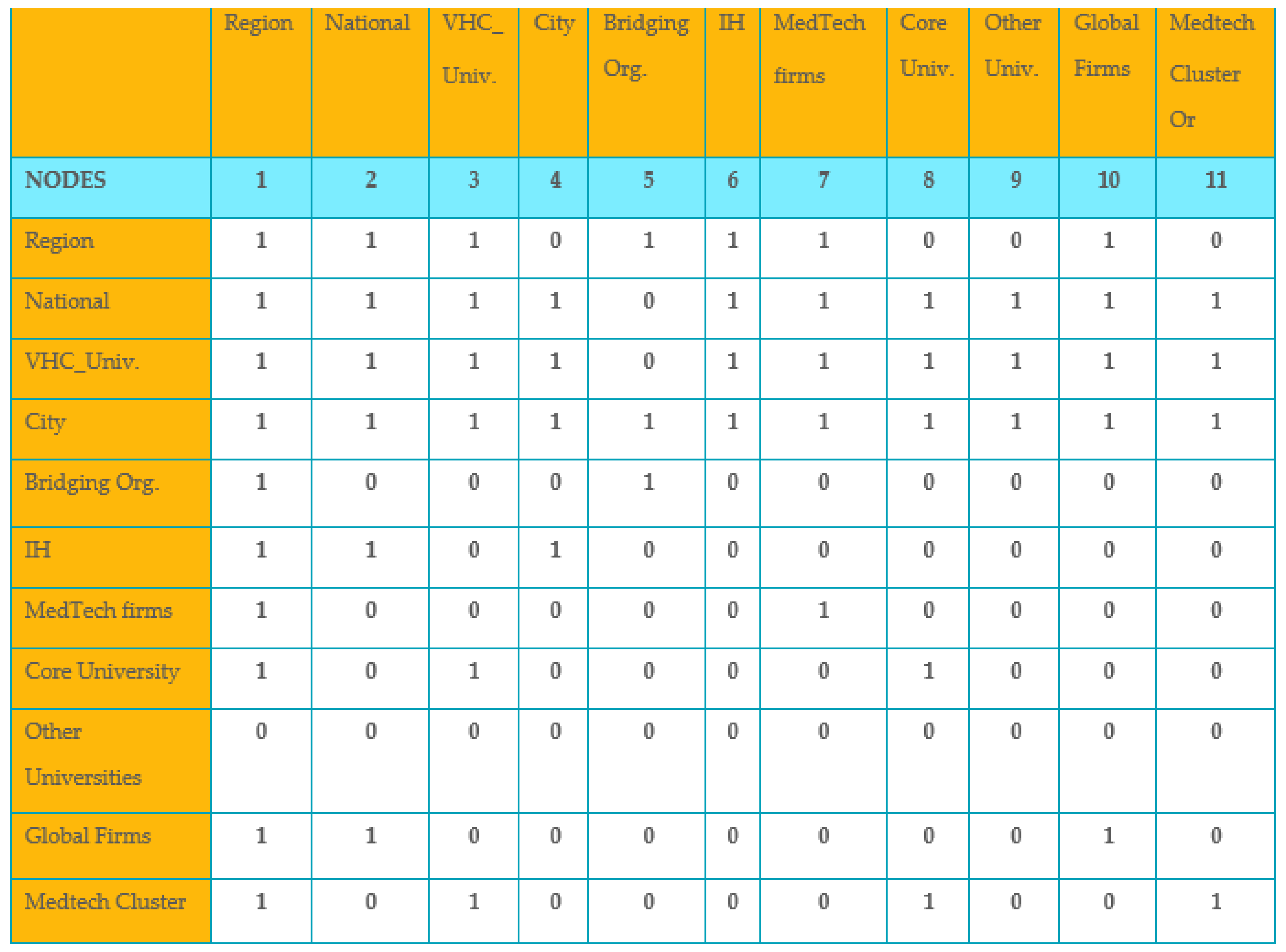
Figure 5.
Showing the Categories, sub-categories and descriptions from thematic analysis.
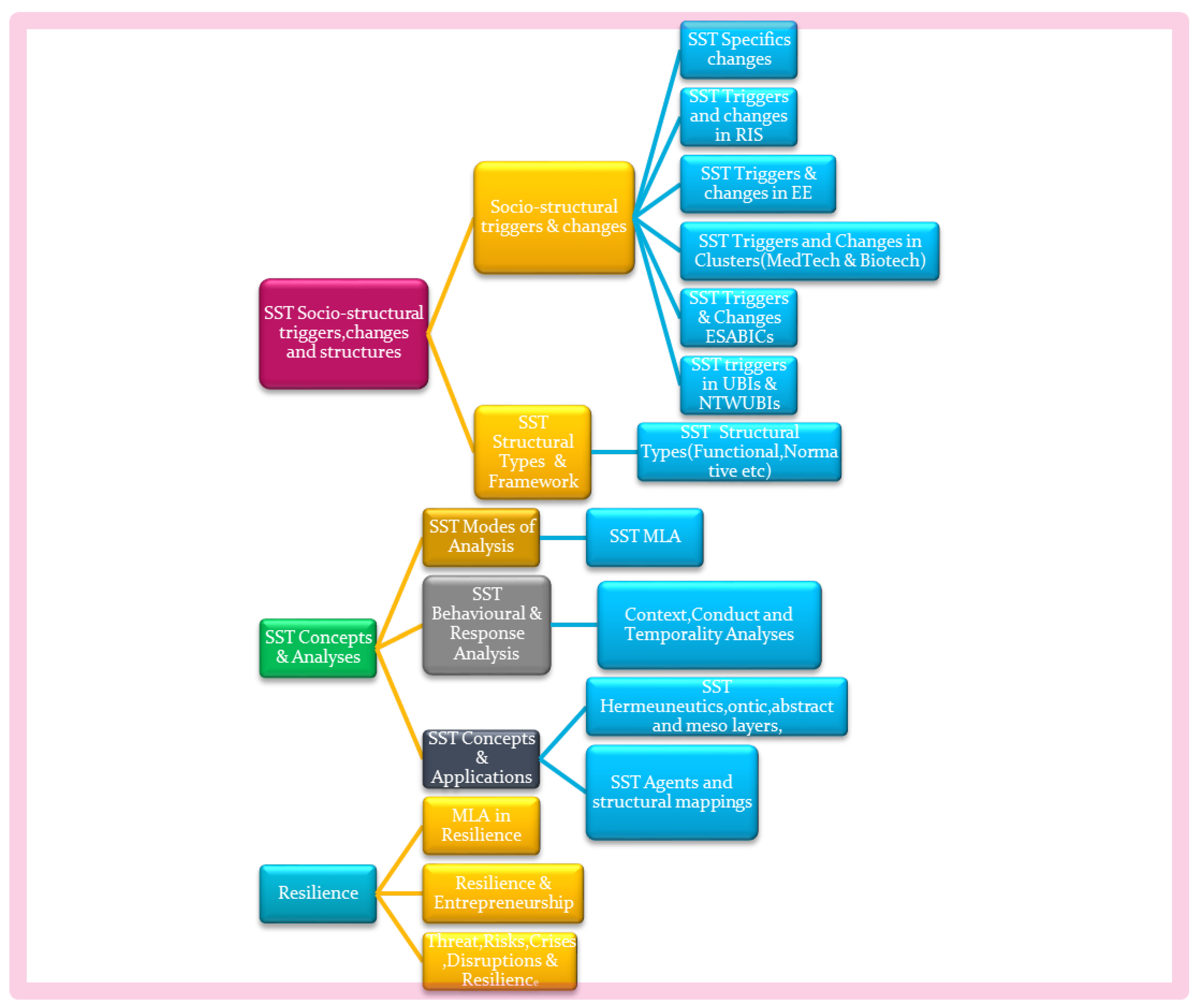
Figure 6.
The proposed MMSST-MMDSNA framework
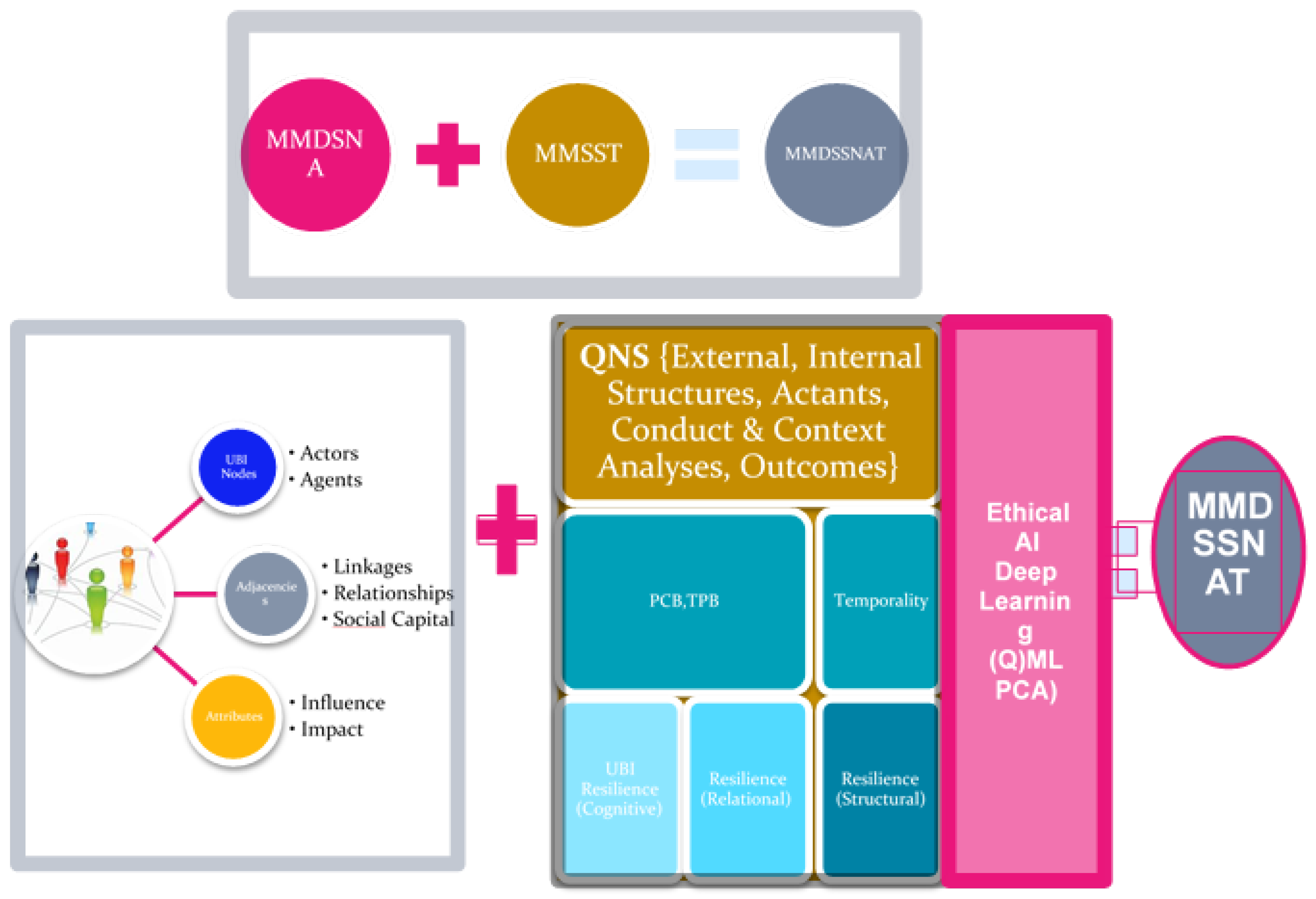
Figure 7.
Network Dynamism Configuration for UBI
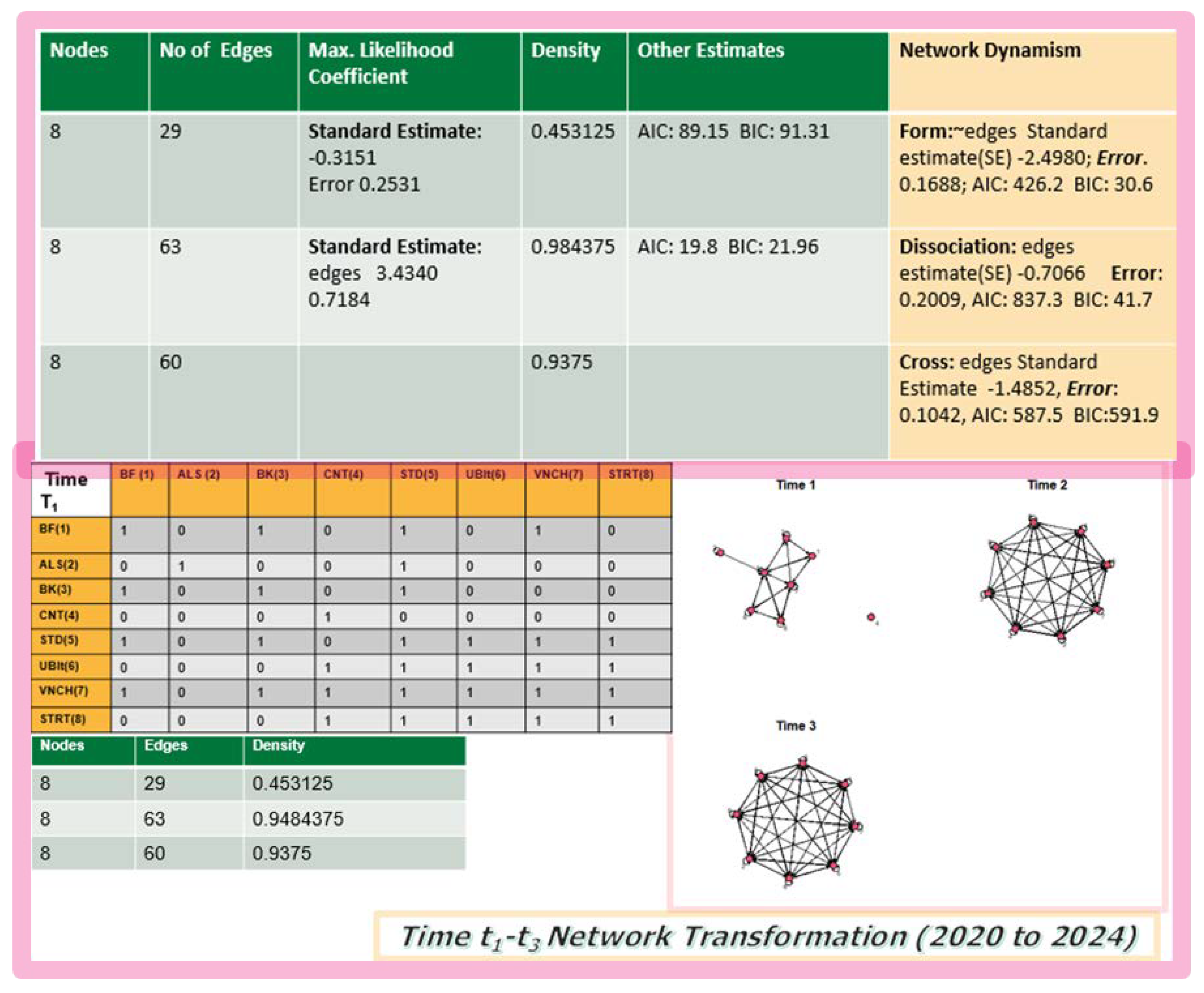
Figure 8.
Network Dynamism for ESABIC
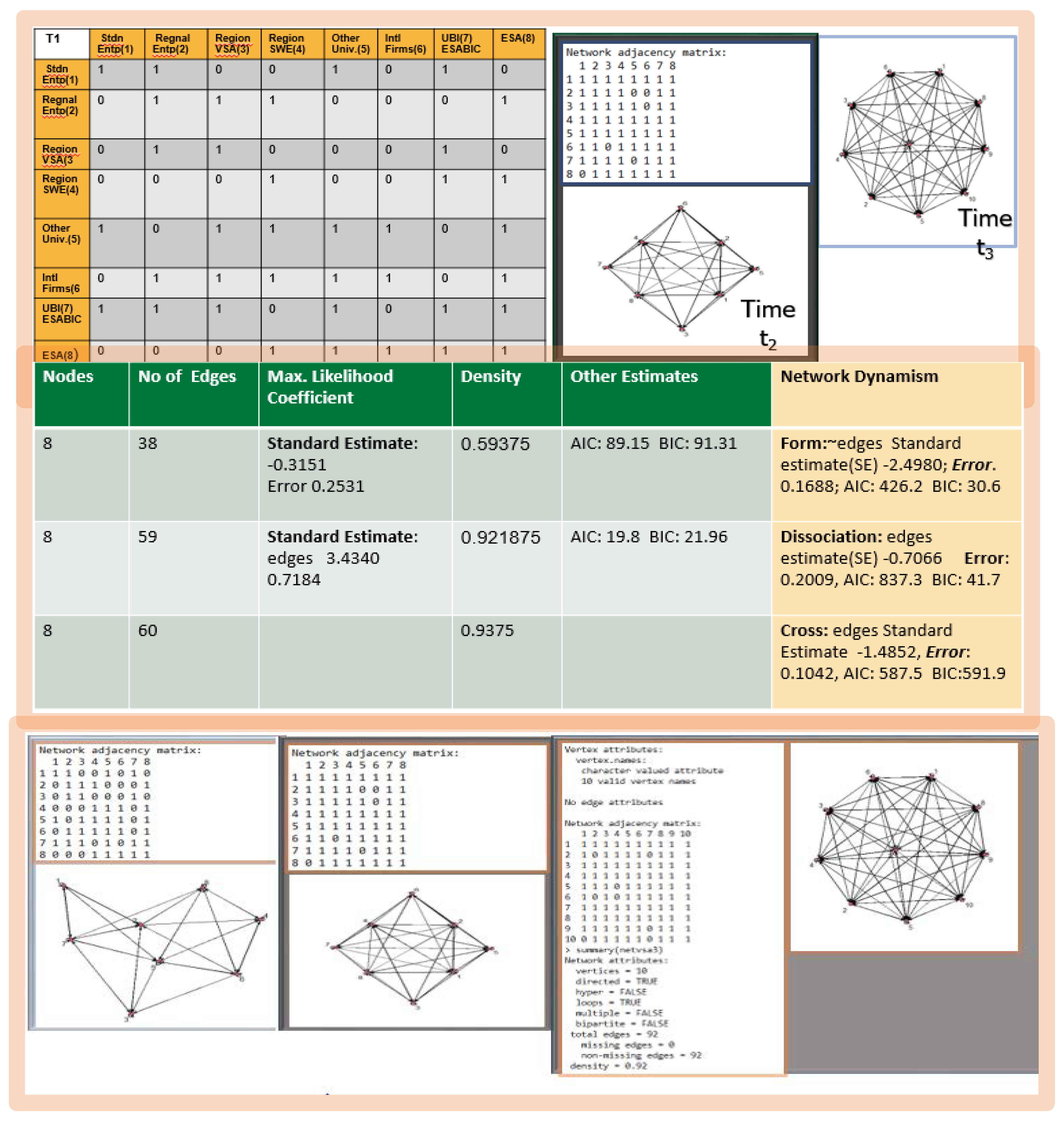
Figure 9.
Network Dynamism for ESABIC
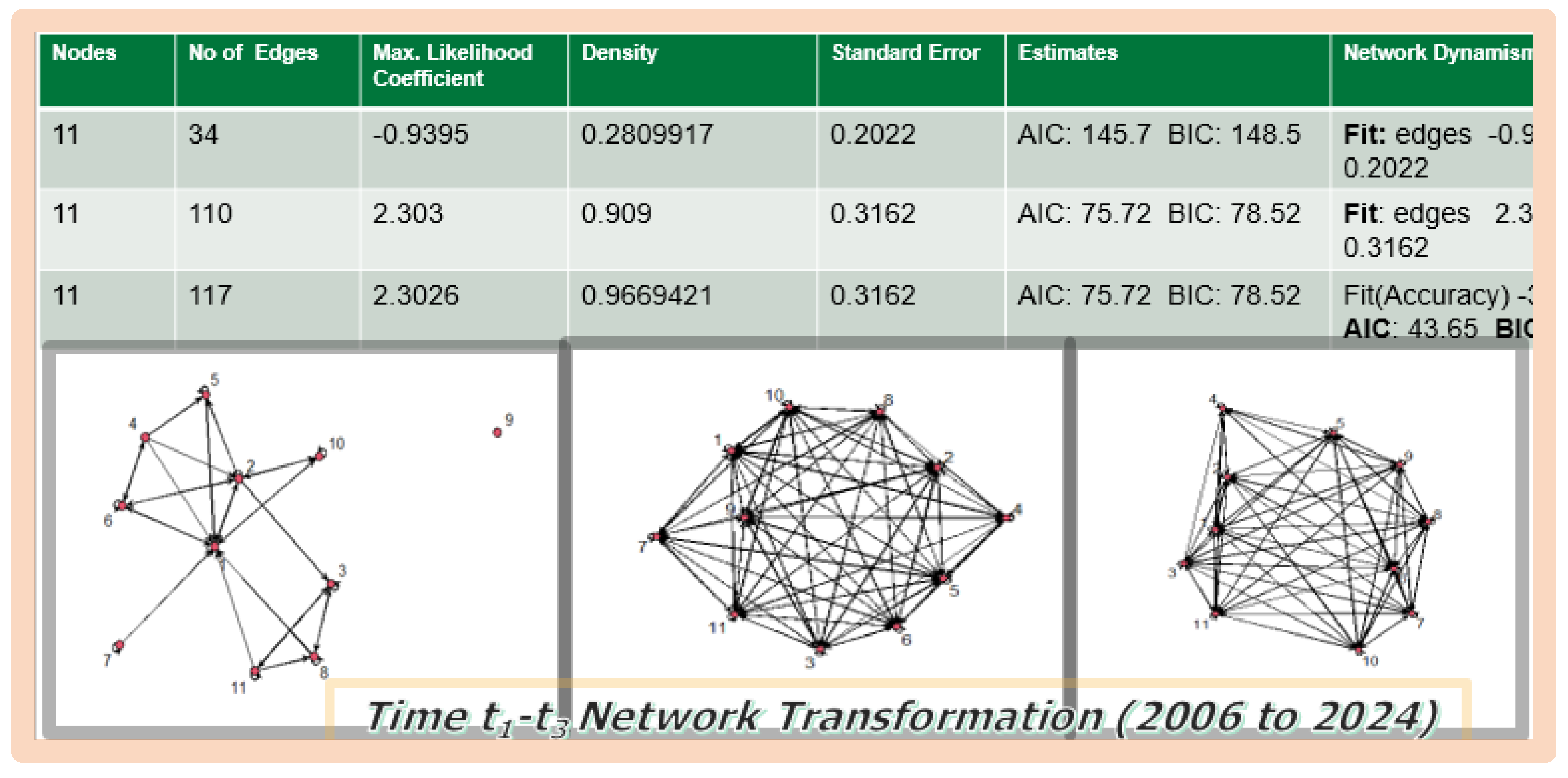

Table 1.
shows the breakdown of SST studies across Management, Accounting & ICT
| Article Description & Author | Branch |
|---|---|
| 1. Theorizing Strategic Investment Decision-Making using Strong Structuration Theory | Management |
| 2. Reconciling structure and agency in strategy-as-practice research: Towards a strong structuration theory approach. (Tamim Elbasha, Alex Wright) | Management |
| 3. Qualitative methodologies for determining the skills and competencies required of the hybrid information professional of the 21st century (Dr. Judith Broady-Preston) | Management |
| 4. Introducing Strong Structuration Theory for case studies in Organization, Management and Accounting Research (Lisa Jack and Kholeif,2007) | Management |
| 5. Entrepreneurial opportunity discovered or created? A Strong Structuration Theory perspective (Nizar Ghamgui and Richard Soparnot) | Management |
| 6. Strong structuration theory and management accounting research (Lisa Jack 2017) | Management |
| 7. Theorizing Management accounting practices in Less Developed Countries (Chandana Alawattage, Danture Wickramasinghe,Shazhad Uddin) | Accounting |
| 8. Auditing and Accountability Journal Strong Structuration Theory in Accounting Research Manuscript ID AAAJ-07-2016-2625 | Accounting |
| 9. Making sense of foreign direct investment: Towards a strong structuration model of MNE decision-making (Ziad Elsahn) | Accounting |
| 10. The paradox of embedded agency from a strong structuration perspective: An illustrative case study of resistance to change in budgeting processes (Ahmed Kholeif and Lisa Jack) | Accounting |
| 11. Introducing strong structuration theory for informing qualitative case studies in organization, management and accounting (Ahmed Kholeif; Qualitative Research in Organizations and Management: An International Journal) | Accounting |
| 12. Understanding management accounting change using strong structuration frameworks Georgios Makrygiannikis (TEI Crete) and Lisa Jack (University of Portsmouth) | Accounting |
| 13. Accounting for strategic investment decision-making under extreme uncertainty | Accounting |
| 14. ‘Agents-in-Focus’ and ‘Agents-in-Context’: The Strong Structuration Analysis of Central Government Accounting Practices and Reforms in Nepal (Pawan Adhikari and Kelum Jayasinghe) | Accounting |
| 15. Rethinking resistance to ‘Big IT’: a sociological study of why and when healthcare staff do not use nationally mandated information and communication technologies (Trisha Greenhalgh, Deborah Swinglehurst and Rob Stones 2014) | HealthCare |
| 16. Twenty-five years of national health IT: exploring strategy, structure, and systems in the English NHS (Colin Price, William Green, and Olga Suhomlinova 2018) | HealthCare |
| 17. Old and afraid of new communication technologies? Re-conceptualizing and contesting the ‘age-based Barbara Barbosa Neves Jenny Waycott, Victoria, Australia, Sue Malta (Journal of Sociology 2018) |
HealthCare |
| 18. Participant Use of Digital Diaries in Qualitative Research: A Strong Structuration Analysis. (Maureen Senguin et al.,2022) | HealthCare |
| 19. Why doesn’t integrated care work? Using strong structuration theory to explain the limitations of an English case (Gemma Hughes, Sara E. Shaw, Trisha Greenhalgh,2021) | HealthCare |
| 20. The_Capital_Budgeting_Process_and_the_Energy_Trilemma_2018.pdf | HealthCare |
| 21. Multilevel structures and human agency in relation to email consultations: A strong structuration theory analysis of the Danish general practice setting. (Elisabeth Assing Hvidt et al. 2021) Social Science & Medicine Elsevier 2021 https://doi.org/10.1016/j.socscimed.2021.114155 |
HealthCare |
| 22. Virtual online consultations: advantages and limitations (VOCAL) study BMJ Open 2016;6: e009388. doi:10.1136/bmjopen-2015-009388 Trisha Greenhalgh, et al. 2016 | HealthCare |
| 23. Theorizing big IT programmes in healthcare: strong structuration theory meets actor-network theory | Information Technology |
Table 2.
Shows QNS application to all UBI forms
| QNS Components | Traditional UBI | ESABIC | MedTech & Biotech |
|---|---|---|---|
| External Structure | Need for Fund Generation | Need for Co-production and co-facilitation via Open Innovation Adjustment in Incubation Process due to Disruption |
Cluster Development and liason for project collaboration with Universities Cluster Regional Competition Tolerance to failure, failed R&D, RIS changes, Regulations, Govt. Policies |
| Quest for Internal Workflow and Process transformation | Upstream segment venturing via collaboration with other Regional Partners | Strategic Project- Digitalization | |
| Internal structure |
‘Just do it mentality’ Self-development capacities Capable Human Resource Entrepreneurial mind-set development among students |
Motivation & Entrepreneurial Mindset development for student entrepreneurs Perseverance in the quest for Business and Start-ups’ Sustainability (H) ESA Agreements and Policies on venture formation (C) Experience in Space Based Business (C, H) Leverage on Robust Space Based Ecosystem |
Synergy development for innovation platform, Agreement for joint projects creation Process Development Mutual interest, experience, behavioral patterns |
| Actants or active agents | Venture Champion (Prof.), Regional (BMWK, BMBF) |
VCs, ESA, Regional Collaborations, other Univ. | Cluster Venture Champion Univ. Professors, Regional Entrepreneurs, Local Cluster Entrepreneurs, TBIs, EDIH, MNCs |
| Outcomes | Discussions for funding sourcing Quest for UBI re-organization Quest for UBI team knowledge development and process improvement Performance indices not met Human capital restructuring- need for staffing and resourcing |
Venture creations & Spinoffs Partnership with Trans-regional |
Universities Project Collaboration, Formal Cluster Formation, Data Digitalization successful spinoffs, collaborations |
4. Discussion
This study has shown the broader application of SST to different UBI forms. The initial thematic analysis created showed the different triggers across UBI’s clusters socio-human structures. The respective QNS application to each UBI form also shows the possible outcomes from differential external conditions and the application of temporality at time intervals showed that SST behavioral patterns and responses by the agents could be studied on a time differential basis. The DSNA combined with SST would also improve the visualization of the temporality and the impact of the active agents on the human structural network at the different time intervals. This study would further apply behavioral theories e.g., (Ajzen Theory of Planned Behavior and the Personal Construct theory (TPB, PCT)) to further understand why and how human agents behave (based on behavioral, normative, control beliefs and intention and construct their responses to different external conditions. Together with Context and Conduct analysis, TPB and PCT is proposed for the MMSST and MMDSNA framework (as shown in figures 6 and in Appendixes B, figures B1-B10) would give a greater feedback and analysis to agentic responses and conducts overtime during external condition in SST. Collection of data for TPB and TPC would be based on ethical guide for data collection and training with Machine Learning. The survey data would be based on a longitudinal study on how the agents in focus and contexts adapt and respond to the differing social triggers and external conditions overtime. Further hypotheses can be made based on the purpose of the mixed method. For this case, a Sequential exploratory was applied to the UBI clusters and the quantitative phase would be applied on a longitudinal study to the Ajzen theory of Planned behavior (TPB) and TPC to further substantiate or develop the Qualitative part.
The MMSST and MMDSNA as shown with QNS would be combined with Resilience and Adaptability across the UBI forms. The impact on social capital forms of relational, cognitive and structural could also be analyzed overtime based on the structural changes. The proposed MMSST-MMDSNA framework shown in figures 6,10,11,14a-14c brings the tendency of a deeper analysis and the inclusion of trending technologies AI and ML. The adaptive and resilience framework shown in Figure 3 could be built and integrated into UBI’ clusters and enterprise networks using AI Agentic Automation. Specific agents can be created for Socio Triggers and Changes for each UBI forms based on foundational models and Retrieval Augmented Generation via knowledge graphs. UBIs can develop their risk, crisis management and adaptability processes which are created as part of the knowledge base or database to develop the Knowledge Graph which is made up of chunks of nodes and relationships extracted from several documents in the knowledge base. Based on the Generative AI framework and the vector based embedding, Users can use prompts to query the data base for information using established GenAI frameworks (e.g., Langchain) and Large Language Models such as OpenAIGPT-4, Mistral, Deepseek, Grok, Claude Anthropic, Haiku or Sonnet etc.
Customized Foundational models can also be developed based on UBIs processes and specific workflow. UBI processes can also be automated and measured by the specific agents based on set organization’s KPIs which are then orchestrated or supervised for control and coordination. Escalations are made in the process flow where necessary once a threshold or baseline for UBI risk or crisis management has been set or once there are Socio-structural triggers within each process flow. A typical workflow process with an Agentic AI integration is shown in Figure 13.
In this case, the Agentic AI uses RAG (Retrieval Augmented Generation) to retrieve information from the UBI database or repository. The workflow is used to determine the level of knowledge acquisition and exploitation within the UBI or organization. The Autonomous Agentic AI performs the given task as instructed and sends output via the dashboard or by mail. Agentic automation is an upgrade on Robotic Process Automation (RPA) based on agents’ autonomous orchestration of tasks via analyzing, reasoning and performing enterprise processes autonomously. Agentic Automation necessitates the possibilities of Ro (bots), Agents and Human collaborating and corroborating to implement complex business processes.
UBIs, clusters and entrepreneurs can take a clue from this example as Agentic Automation is the future of business process automation. Prompt engineering and GenAI can also be easily introduced into daily UBI tasks and activities using RAG with the knowledge Graph as shown in figures B9 and B10 in the Appendix.
A compounded research on the application of Agentic AI in UBI is already being done by the author and would be further published for the UBI and their clusters’ community. Further research agenda could be the collection of larger volume of data from different UBI forms for the thematic analysis categories e.g., social triggers and changes, structural types resilience and applying clustering or configuration theories to see if there are specific patterns or categorization of the QNS resilience development and adaptability in UBI and their clusters. Figure 14a and 14b shows a proposed aggregated output framework combining QNS, DSNA with Resilience and Adaptability to UBI RIS, EE and Clusters’ dynamics at different time intervals.
This research has been able to expand the use of SST with Mixed Method and combination with other adjoining theories such as MMDSNA and Planned Behavioral Constructs. The thematic analysis and frameworks in this research would provide the UBI community and clusters a structured outline for the application and use of SST as both an investigatory and applicative theory to structural transformation and dynamism. The research would also aid Clusters of Excellence Executives, Regional Innovation Systems Planners and UBI Executives to understand the various responses to structural triggers and also how they can gradually develop resilience and adaptability on a multi-level overtime. The introductory application of Agentic AI serves as a precursor to imbibing new technologies in UBI processes.
The author is available for further forum, discussions, comment and implementation of the proposed theory and frameworks.
Funding
This research received no external funding.
Conflicts of Interest
The authors declare no conflicts of interest.
Abbreviations
The following abbreviations are used in this manuscript:
| RAG | Retrieval Augmented Generation |
| SST | Strong Structuration Theory |
| UBI | University Business Incubation |
Appendix A
Appendix A.1
Table A1.
QNS for a MedTech Cluster Overtime.
|
SST Application to the MedTech 18 years’ transformation –PHASE I (2005/6) |
|---|
|
EXTERNAL STRUCTURE: MedTech Valley Cluster Development and liason for project collaboration with the FAU |
|
INTERNAL STRUCTURES: Synergy development for innovation platform, agreement for joint projects creation |
| ACTANT: agents in focus- MedValley Venture Champion, University Professor (s) |
| OUTCOME:Joint Small Project creation/ development |
|
SST Application to the MedTech 18 years’ transformation –PHASE II (2009/10) |
|
EXTERNAL STRUCTURE: Quest for National Cluster Development via Regional Competition (BioReg) |
|
INTERNAL STRUCTURES: Entrepreneurship process development Signed agreement for Cluster competition application-policies, norms for competing Regional pedigree in medtech venture creation via University research, Regional Infrastructures |
| ACTANT/agents in focus: MedValley Venture Champion & Team, FAU,Med Research Institutes, MedTech Firs and MNCs |
| OUTCOME: Joint collaboration initiatives with firms, MNC for cluster formation and projects development |
|
SST Application to the MedTech 18 years’ transformation –PHASE III (2010–till date) |
|
EXTERNAL STRUCTURE: Vital Developmental Projects for Cluster Transformation |
|
INTERNAL STRUCTURE: Process development (Funding) Database Projects |
|
ACTANT: -agents in focus: MedValley Cluster, FAU, VCs, Angel Investors Firms (Startups, MNCs) |
| OUTCOME: Data Control Processes |
Table A2.
MedTech Journals.
| MedTech Journals | |
|---|---|
| Description | Journal |
| Performance of university spinoffs firms in commercialization of medical technology (Taheri Mozhdeh and Marina van Geenhuizen,2018) | Elgar online |
| Two sides of the same coin? Local and global knowledge flows in Medicon Valley (Jerker Moodysson, Lars Coenen, Björn Asheim, 2010) | Business Network in Clusters and Industrial Districts: Routledge |
| From Technopoles to Regional Innovation Systems: The Evolution of Localized Technology Development Policy (Philip Cooke, 2001) | Canadian Journal of Regional Science |
| You are a Cluster: Now what? The future of MedTech Cluster (D McKernan, 2024) | Science Direct |
| Understanding the roles and involvement of technology transfer offices in the commercialization of university research (A Brantnell and Baraldi Enrico, 2022) | Science Direct (RepeC) |
| New economic impulses in Old industrial Regions: The Case of the University of Twente (Paul Benneworth,Ben Jongbloed and Gert-Jan Hospers, 2006) | Research Gate |
| The role of new firms for the development of clusters in Germany (Stefan Köhler and Anne Otto, 2006) | Econstor ZBW |
| Commercialization of Medical Technology: How medtech startups companies build-up collaborative network relationships (Jens Laage Heliman, 2012) | Proceedings of the 28th IMP Conference, Rome |
Table A3.
EE Journals.
| Entrepreneurial Ecosystems (EE) Journals | |
|---|---|
| The evolutionary dynamics of the entrepreneurial ecosystems (EE) (Elizabeth Mason and Meyer, 2016) | Urban Source (SAGE) |
| The Relational Organization of Entrepreneurial Ecosystems (Ben Spigel, 2017) | SAGE Journals |
| Entrepreneurial Ecosystems Erik Stam and Ben Spigel | EconPapers (Working Paper Utrecht School of Economics |
| A critical review of Entrepreneurial Ecosystem research: towards a future research agenda Janna Alvedalen and Ron Boschma | European Planning Studies (Taylor and Francis Online) Volume 25, 2017 |
| Entrepreneurship and entrepreneurial ecosystems (Malecki J, Edward) | Geography Compass 2018 |
| The lineages of the entrepreneurial ecosystem approach Zoltan Acs, David Audtresch, Erik Stam, Allan O’ Connor | Small Business Economics June 2017 |
| University and Innovation Ecosystem: A dynamic capabilities perspective – Heaton Sohvi, Donald Siegel and David Teece, 2019 | Industrial and Corporate Change |
Appendix B
Figure B1.
QNS for traditional UBI.
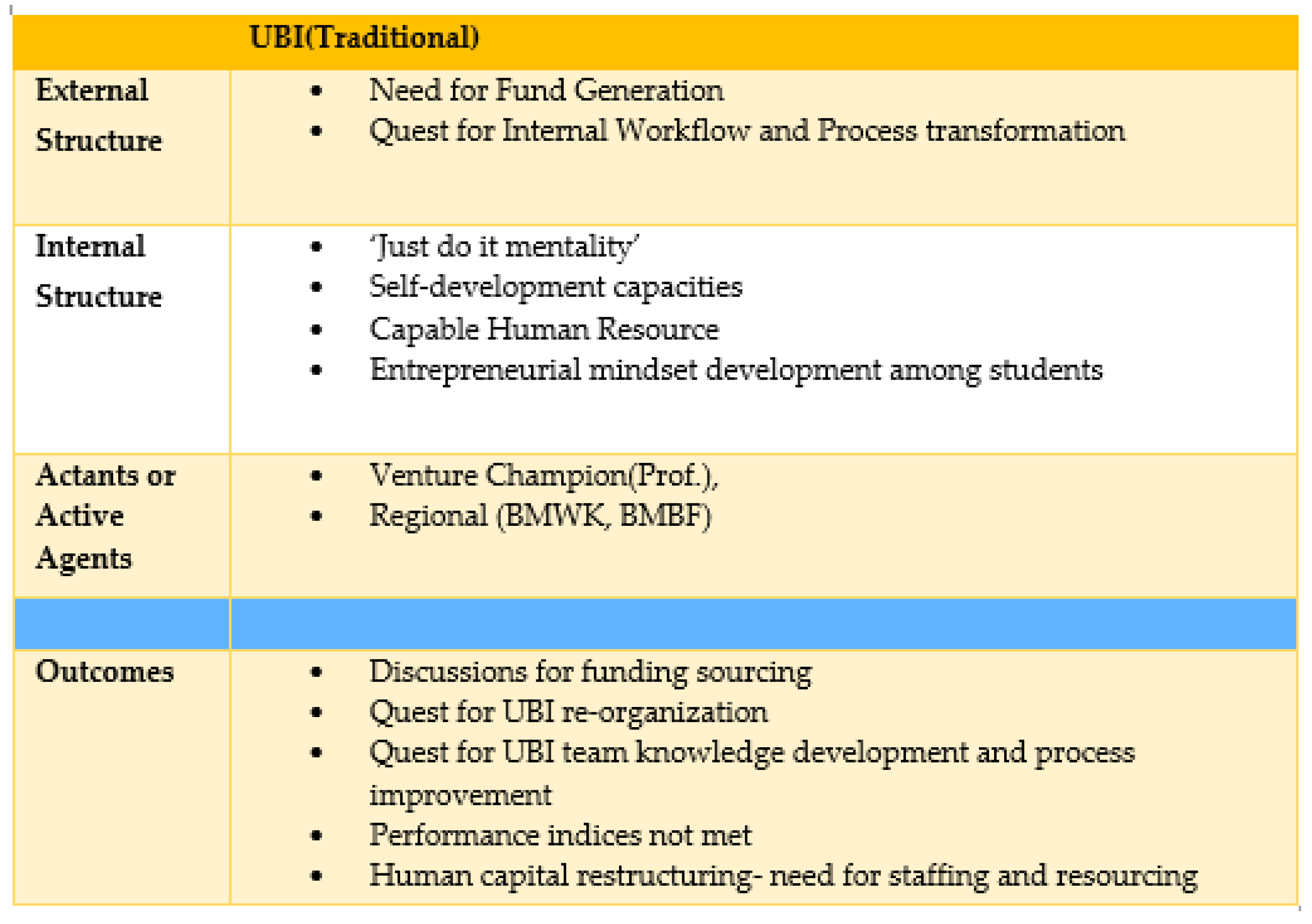
Figure B2.
Proposed Integrated Framework for MMSST-MMDSNA with socio triggers and temporality.
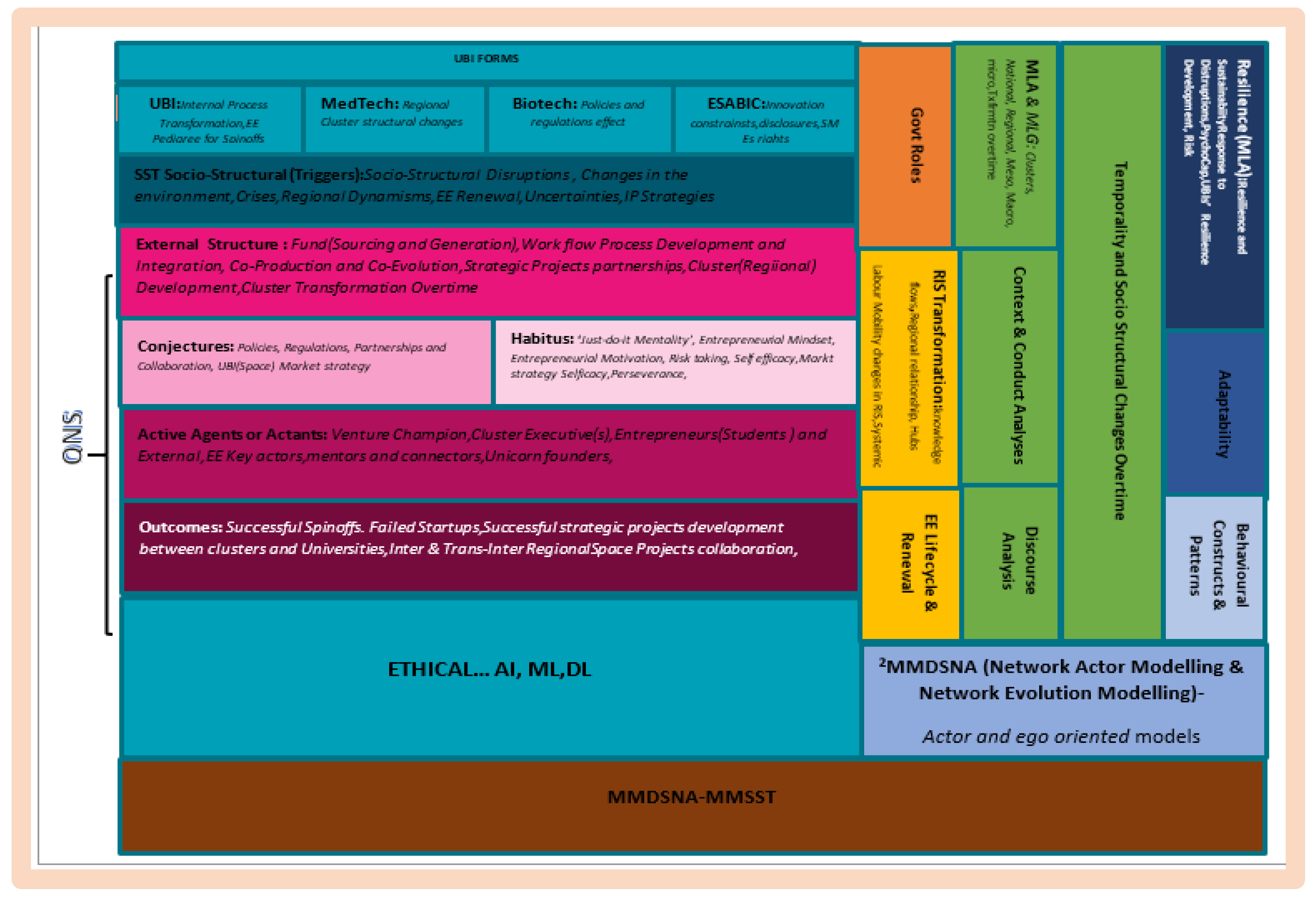
Figure B3.
MMDSNA Framework.
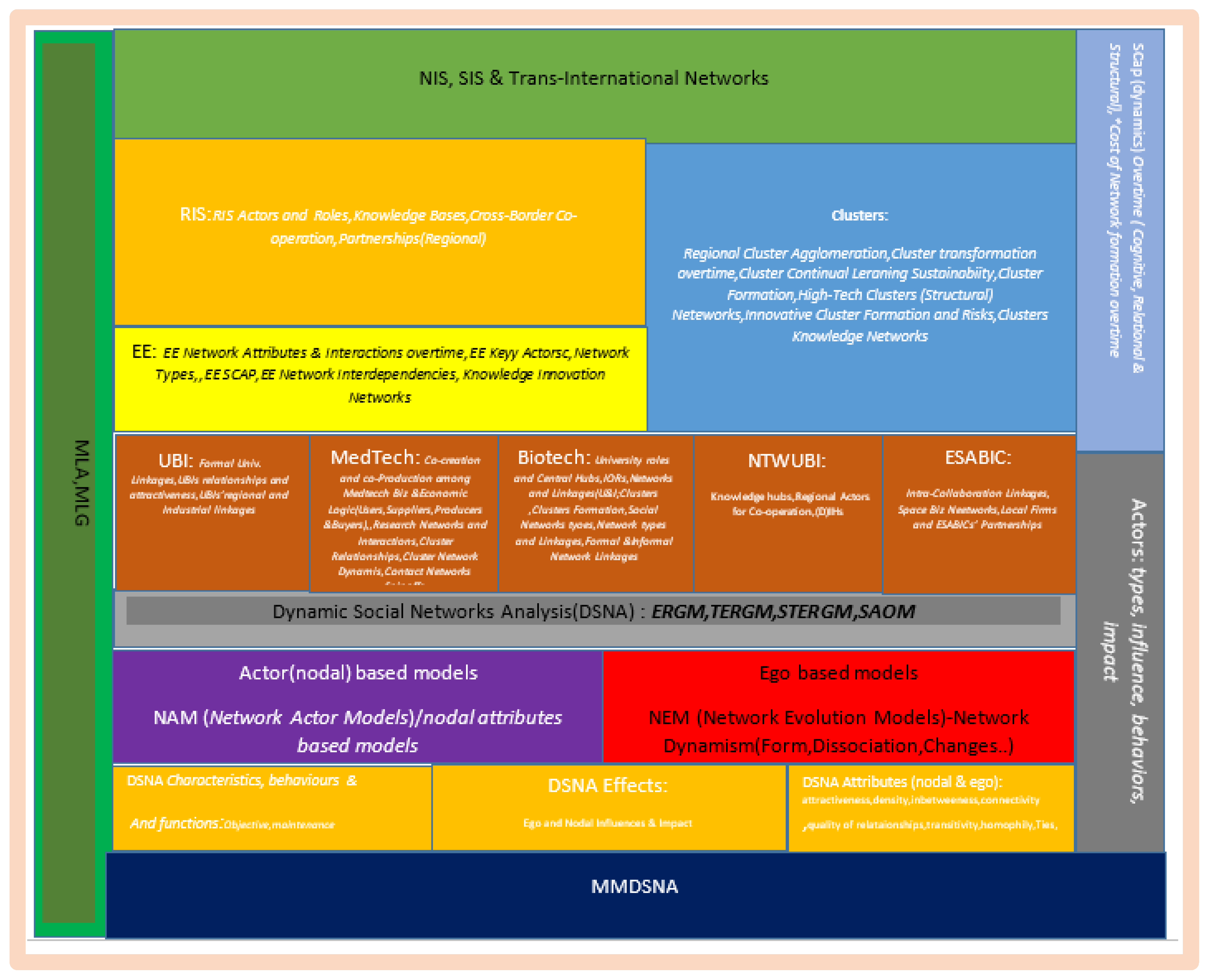
Figure B4.
Application of MMSST and MMDSNA to UBIs.
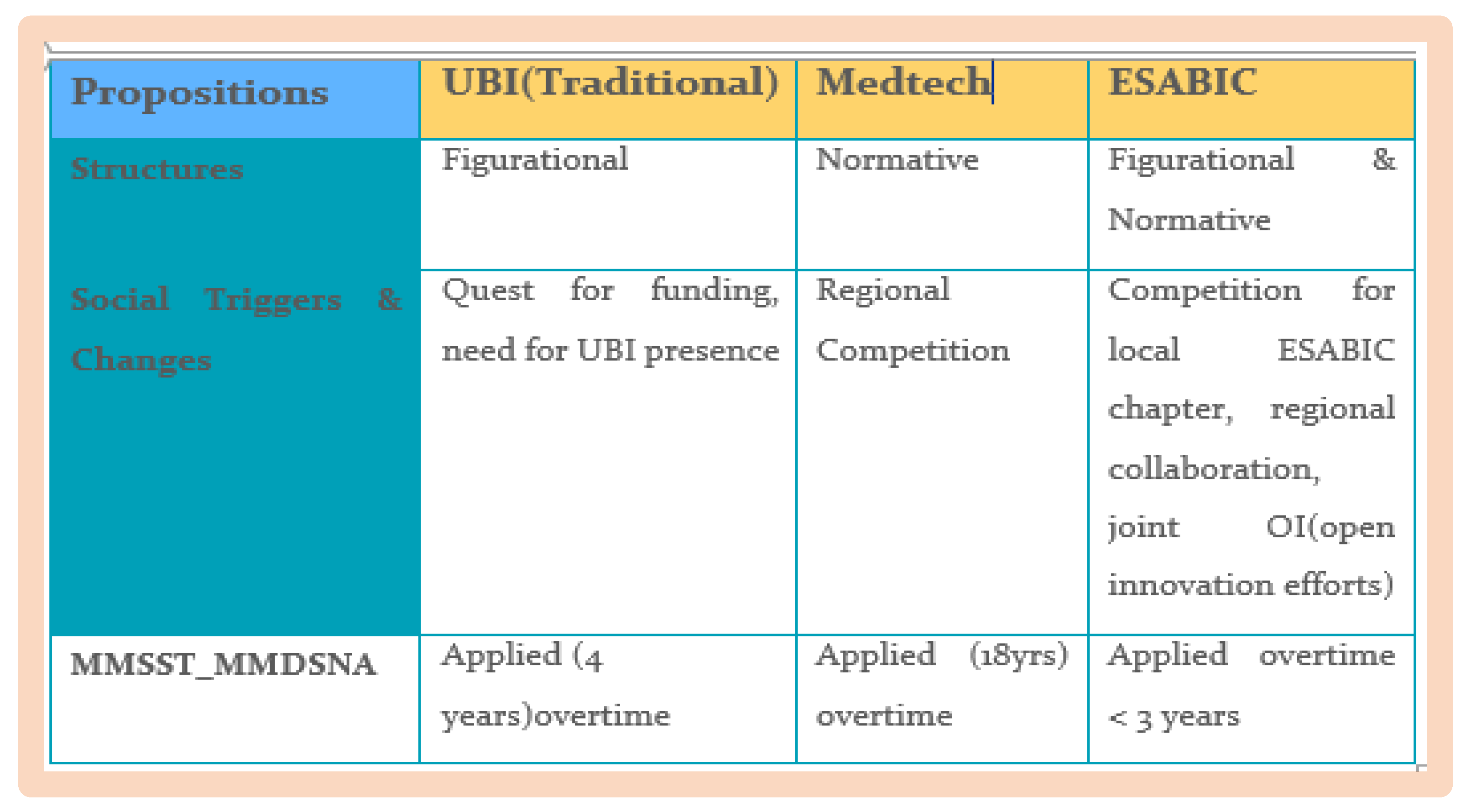
Figure B5.
A typical UBI workflow process with Agentic AI tasks using RAG (Retrieval Augmented Generation) for the UBI knowledge flow assessment.
Figure B5.
A typical UBI workflow process with Agentic AI tasks using RAG (Retrieval Augmented Generation) for the UBI knowledge flow assessment.
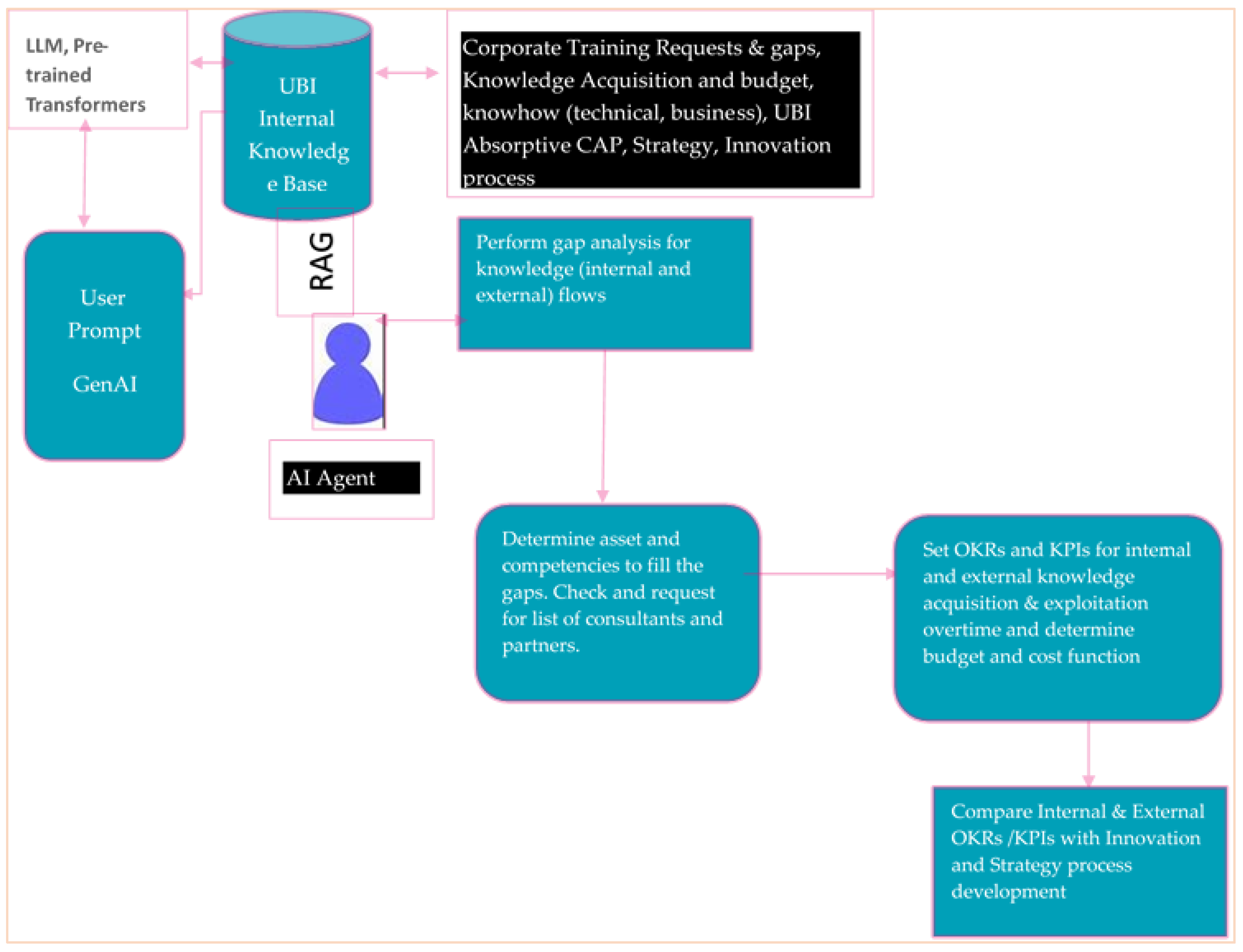
Figure B6.
A proposed output for MMSST-MMDSNA.
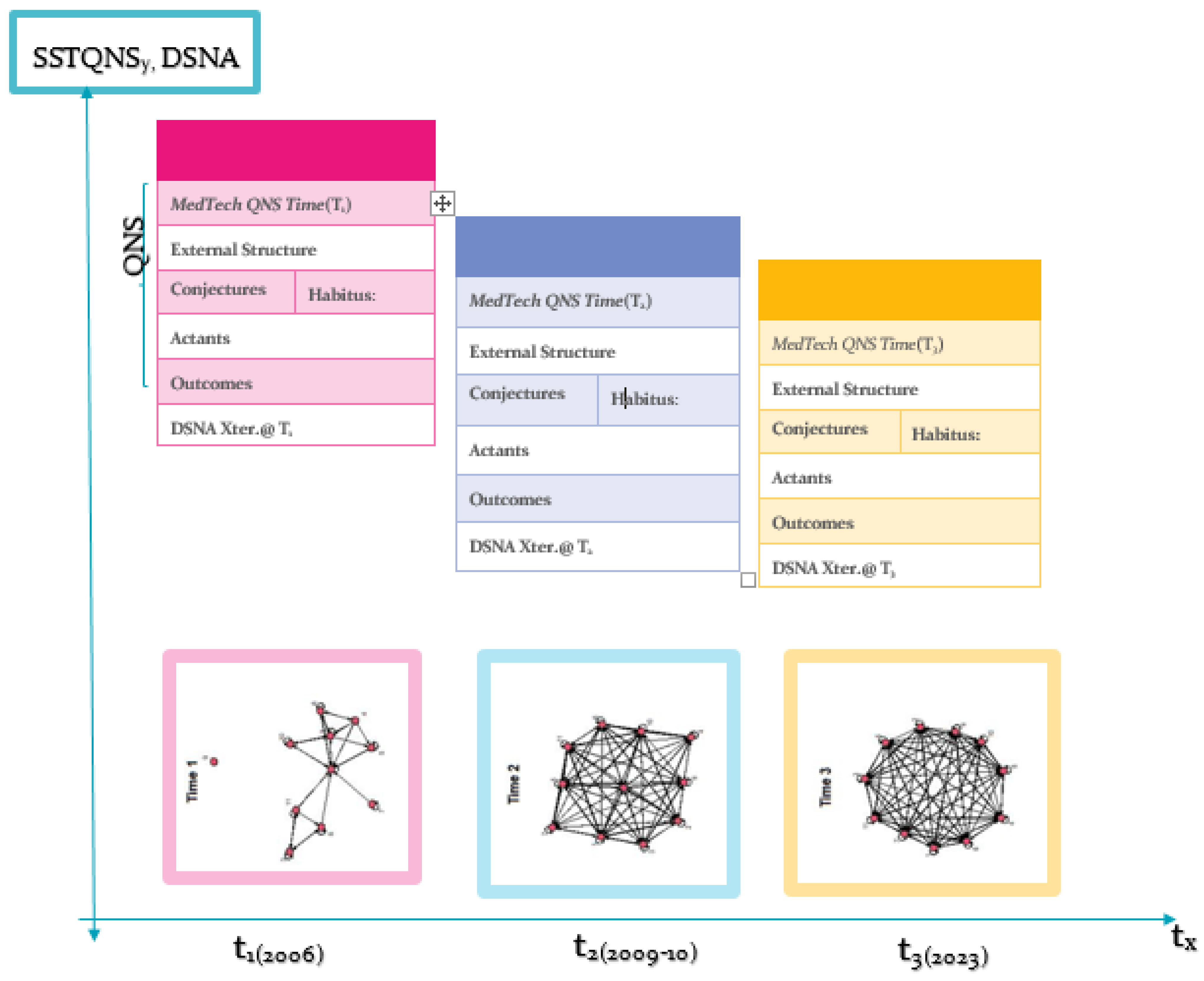
Figure B7.
A proposed output for MMSST-MMDSNA (with Resilience and Adaptability) to EE, RIS, Cluster dynamics.
Figure B7.
A proposed output for MMSST-MMDSNA (with Resilience and Adaptability) to EE, RIS, Cluster dynamics.
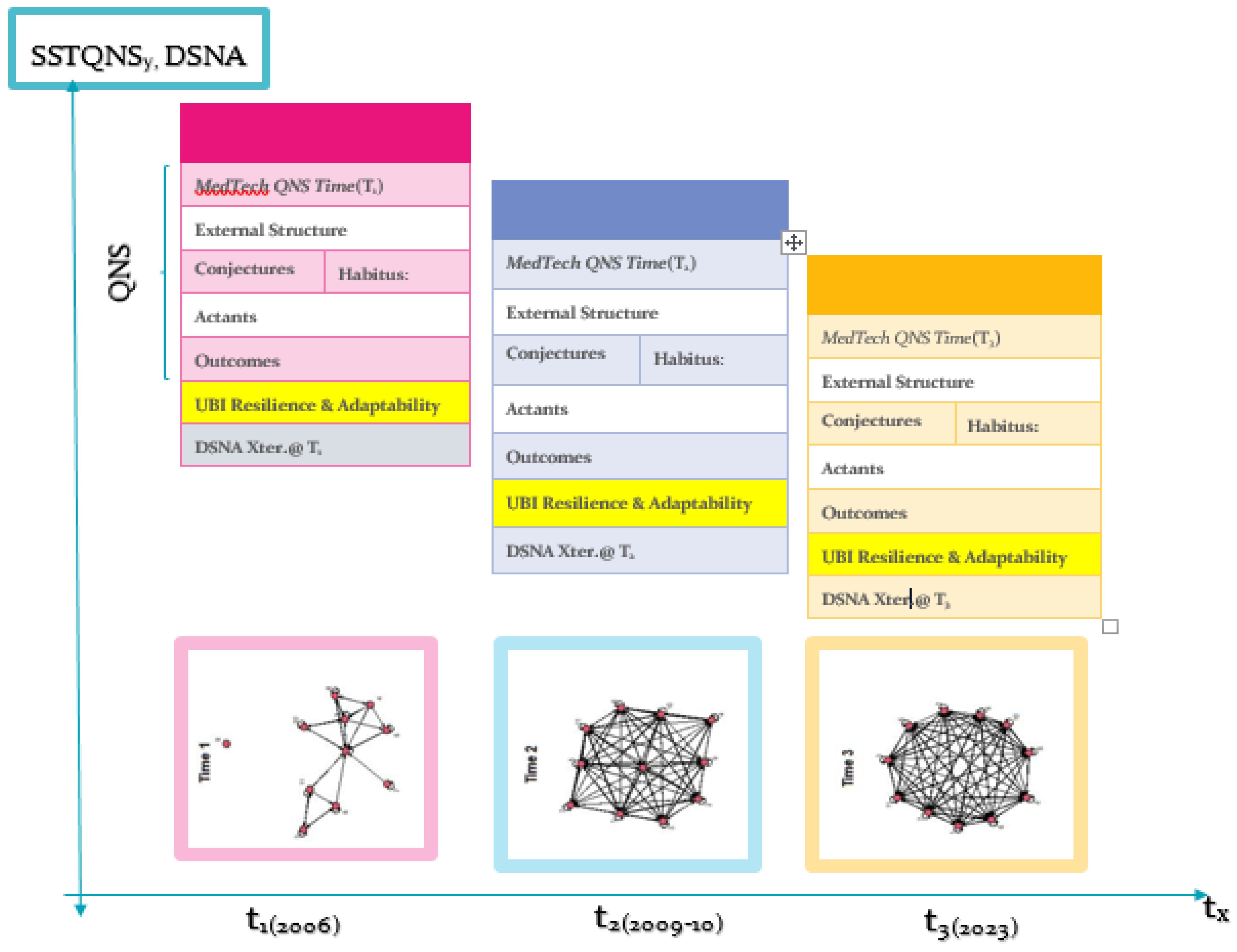
Figure B8.
A proposed output for MMSST-MMDSNA (with Resilience and Adaptability, Personal Behavioral Theories (Ajzen’s TPB and PCT)) to EE, RIS, Cluster dynamics.
Figure B8.
A proposed output for MMSST-MMDSNA (with Resilience and Adaptability, Personal Behavioral Theories (Ajzen’s TPB and PCT)) to EE, RIS, Cluster dynamics.
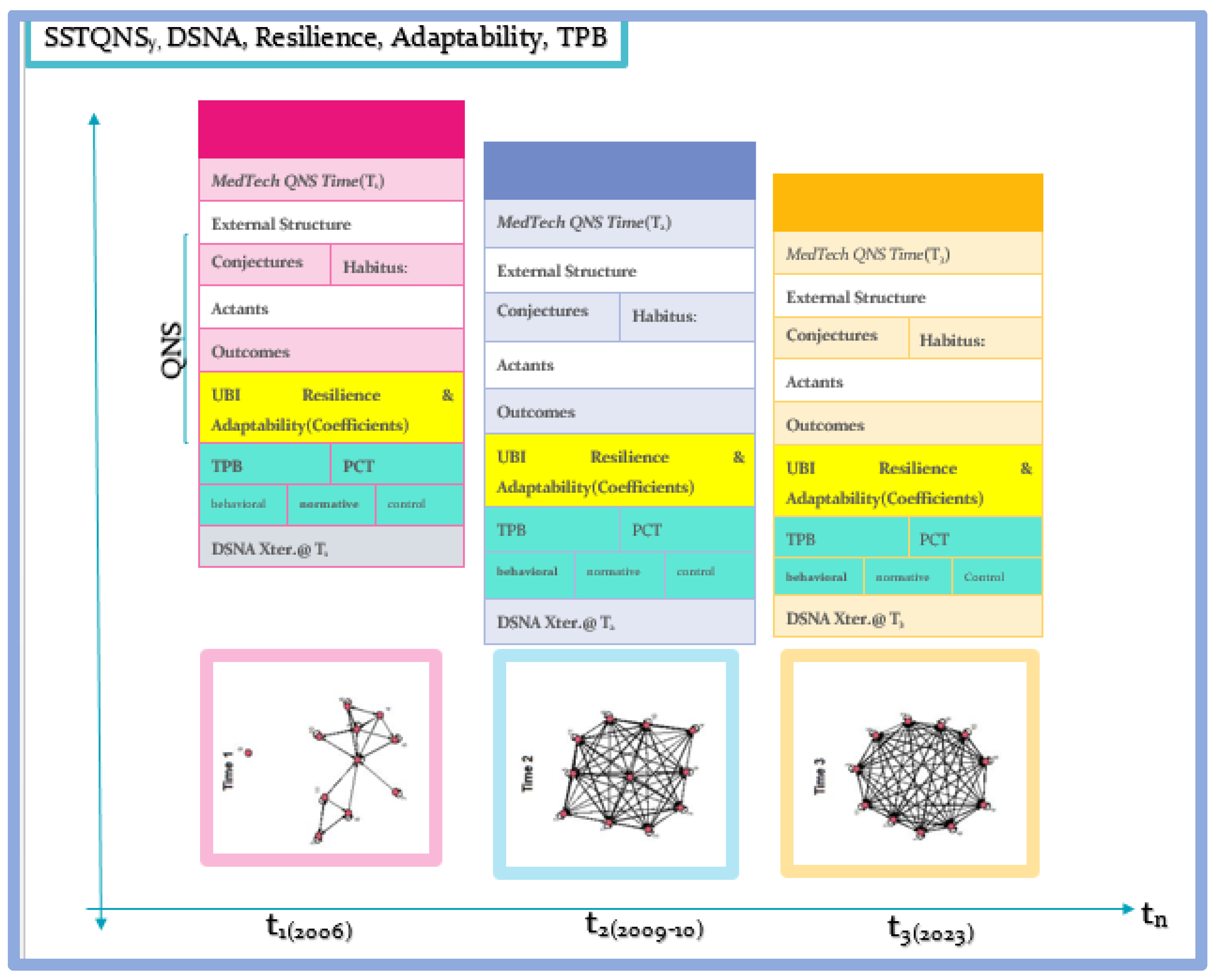
Figure B9.
A GenAI based RAG that creates SSTQNS created using H2o.ai.
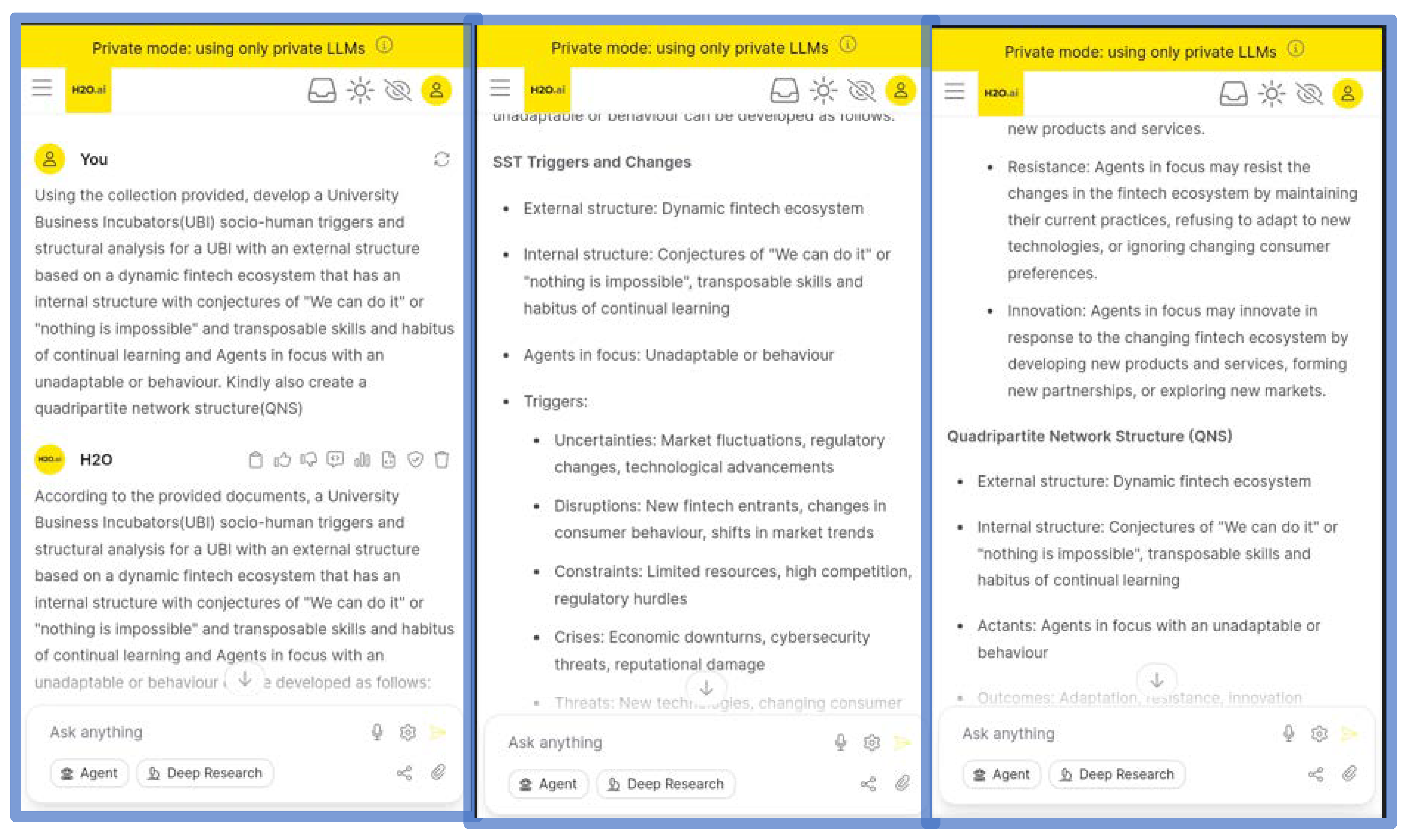
Figure B10.
A GenAI knowledge base for RAG created from private documents by the author using H2o.ai.
Figure B10.
A GenAI knowledge base for RAG created from private documents by the author using H2o.ai.
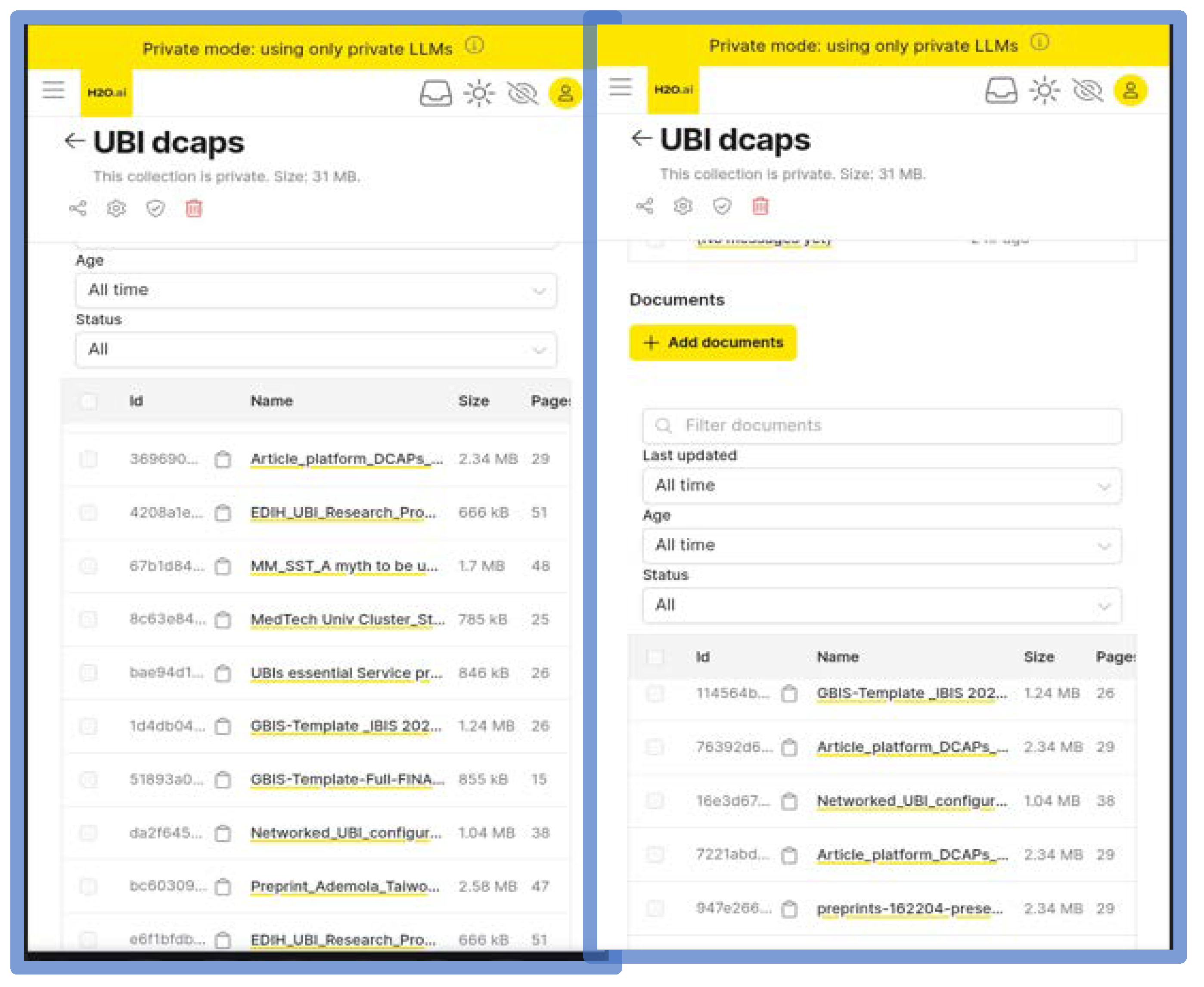
Table B2.
SST Thematic Analysis with Categories and Sub-Categories.
| Categories | Sub-categories | Sub Categories description types | |
|---|---|---|---|
| 1. | Socio Structural Triggers and Changes | SST Socio triggers and changes (generalized) | Uncertainties, Disruptions, Constraints, Crises, Threats, Challenges, Risks and Response Variability. |
| SST triggers and changes in RIS | Regional structural changes, structural crises, Developmental shift & value creation, Regional Tech Renewals (Clusters), Social & Institutional Contexts, Regional Strategic Focus, Regional Operating Model, & Process Changes, Regional Situational Structural Analysis & Changes (e.g., Labour Mobility), Regional Strategy Re-focus, Political, Economic & Consumer Orientation changes, System Adjustments for Operational Innovation | ||
| SST triggers and changes in MedTech |
SST triggers and changes in UBIs & their Clusters: (MedTech): - Regional Network Policy Changes & Impact on Firms, Regional Structural Changes & Implementation, Regulations & Impact, Risks in Drug Development, Developing collaborative relationships with Suppliers in the production value chain, Clinical users’ roles and collaborations in MedTech product development, Crucial VC relationship building for firm growth and development, Diminishing pattern in Startups relationships with their research units’ overtime, Resolving difficulty in relationship building via expert recruitment; Variation in multi-level governance nature, Project termination due to unsatisfied results in pre-clinical and early stage trials, Startups lack of resources to support clinical research, Startups resource and competence issues from startups in developing suppliers’ collaborative relationships, Risk in bearing costs in early drug stages of product development without global firm collaboration, Risk in collaboration with global firms for drug development and evaluation due to timeline of sale and drug portfolio |
||
| SST triggers and changes in Biotech |
Environmental & Political Changes (Globalization), Variations in UBIs commercialization approaches, Univ. Impact on R&D, Policies, Strategies and Regulations in Clusters, University-Industry Structural Changes overtime, Bottlenecks (Lack of Entrepreneurial Encouragement), Cluster transformation and Growth Overtime, Historical Process Effect overtime on Social and Tech. Structures, Controversies in University-Industry Changes, Presence of Parks and Incubators, Regional Competition, RIS transformation process IP related, Cultural Changes in Management, Regional High-Tech Development Patterns, Proximity to Large Customers and Funding Partners, Technology Failure, Expectation on Results (Speed), Issues, Policies Effects and Bio-Regional Differences |
||
| SST triggers and changes in EE |
Regional Economic factor influence on Entrepreneurial Process, EE Attributes & Ontological Layers, EE System Failure, EE Evolution and Dynamic Buildup overtime, EE Social |
||
| SST triggers and changes in UBIs (Traditional) |
University and Regional Transformation, Challenges in CBRIS activities and integration, University Based Innovation Support Challenges and Knowledge Modes |
||
| SST triggers and changes in ESABICs |
Commercial Influence in Space Markets, Crises and Impacts on Space Sector Markets, Tension in Open Innovation, Threats of Competition, Value Creation and Impact on Innovation, Uncontrolled Knowledge Leakage |
||
| 2. |
SST Structural types, Framework & Applications |
(2a) SST Structural Types |
Formative, Functional, Figurational, Independent & Irresistible structures & Normative |
| (2b) SST in QNS: External Structures |
Conditions of Actions, Basis of Unintended Consequences of Action, Causal Influence Based on Agents’ Actions, Influence on Values and Knowledge of Human Agents, Recursive relationships changes between structures and agency, physical, social and economic contexts for actions enactment, social norms, law, policies, rules and instructions |
||
| SST in QNS: Internal Structures |
Defines Power Exertion, Individual Perception of the Social World-Action Terrain, Agents Response via Disposition, Influence and Impact of External Structures and Interplay with Agents & Structures, Agents in Focus interpretation of actions of others i.e., signification, power capacities (dominance, normative actions (legitimation), |
||
|
Components (internal structures): -Conjectures specific, general disposition, transposable skills, views, schemas, classifications, perspectives, habits and gestures, structures of legitimation, norms and significance, knowledge of interpretative schemes, normative expressions |
|||
| SST QNS: Actants |
Actions and Responses of agents in Focus, agent’s structural perception and effects: reproduced, modified or changed (structure), Capacity to resist or align with external influence, Structural constraints, possibilities and adjustment, strategic conduct, dialectic control & positional practice; Actants or Active Agency: - response to impact of emergent structures for decision making (strategic), actors’ legitimation and power influence, agents influence on environment based on actions and reactions, actants actions -reflexive (critical or unreflexively), actants multi-level interactions (e.g., on meso and micro levels, agents power exertion, response to institutional pressure, influence on situated structural relationships, workaround in response to external structures and regulations) |
||
| SST Outcomes |
Impact on External and Internal structures, results of active agency, interplay between multi-level socio-human structures, Technology Adoption and Process change, Changes or persevered structural outcomes with intended or unintended consequences (Outcomes facilitated by Agents or agents become frustrated) |
||
| (2c) SST Mode of Analysis |
SST_MLA: -macro level (structures & discourses), micro and meso levels (organization & systems), (Areas): - multi-level recursive relationships, structural inter-agent impact, structural adjustments overtime, structural interplay on multi-levels (micro, macro and meso), multi-level response to normative rules, multi-level structural outcomes (e.g., tensions),SST Ontology-In-Situ, Tensions in level of analysis based on agents’ actions and requests. |
||
|
(2d) Behavioral (Response)Conduct & Temporality Analyses |
Context & Conduct Analyses: - Focus on the participants, their actions and dispositions, actor’s influence & practice within or outside the cluster; Concentrate on general dispositional frames of an agent in focus, focus on influence of particular clusters of agents on structural disposition |
||
|
Discourse Analysis: Provides understanding of time and spaces shaping the space for activities, (macro level)-provides cultural meaning and values, shapes actions and legitimation |
|||
| (2e)Temporality | Strategic activities as an ongoing structuration process evolving overtime; Practice observation & Control Overtime,SST Temporal Distancing, duality and external structures, Methodological Bracketing | ||
| SST Concepts & Applications |
SST aids: Hermeneutics & Structural Analysis, meso, ontic & Abstract layers’ definition, position practice, identities obligations and hierarchical levels of relations between structures and agencies, researchers position of practice to examine the networks and relationships between clusters of agents, understanding of change and stability within cases, building blocks for examining interaction of agents and structures based on norms and rules, aids understanding of actors situation (al) analysis & involvement |
||
| 3. | SST and Resilience in UBIs | (3a) Resilience MLA | Multi-actor longitudinal studies overtime, Individual and organizational (including BUs) resilience |
| (3b) Resilience & Entrepreneurship |
Entrepreneurship Competencies, Biz Success Development & Resilience Entrepreneurship & Enterprise Resilience in Uncertainties & Conflicted Regions |
||
|
(3c) Disruption, disturbance, Threats, Challenges and Resilience |
Threats dimensions, detection response and activation, dealing and addressing sudden events onset address Changing environmental threats and effects on Organizational Performance |
||
References
- Alvedalen, J.; Boschma, R. A critical review of entrepreneurial ecosystems research: towards a future research agenda. Eur. Plan. Stud. 2017, 25, 887–903. [Google Scholar] [CrossRef]
- Baraldi, E.; Ingemansson, M.; Launberg, A. Controlling the commercialisation of science across inter-organisational borders: Four cases from two major Swedish universities. Ind. Mark. Manag. 2014, 43, 382–391. [Google Scholar] [CrossRef]
- Baraldi, E.; Waluszewski, A. Betting on science or muddling through the network: Two universities and one innovation commission. The IMP Journal 2011, 5, 172–192. [Google Scholar]
- Cooke, P. New economy innovation systems: biotechnology in Europe and the USA. Industry and Innovation 2001a, 8, 267–289. [Google Scholar] [CrossRef]
- Cooke, P. Regional innovation systems, clusters, and the knowledge economy. Industrial and corporate change 2001b, 10, 945–974. [Google Scholar] [CrossRef]
- Cooke, P.; et al. Handbook of regional innovation and growth; Edward Elgar Publishing, 2011. [Google Scholar]
- Froehlich, D.E.; Rehm, M.; Rienties, B.C. Mixed methods social network analysis. In Mixed methods social network analysis: Theories and methodologies in learning and education; 2020; pp. 1–10. [Google Scholar]
- Froehlich, D.E.; Van Waes, S.; Schäfer, H. Linking quantitative and qualitative network approaches: A review of mixed methods social network analysis in education research. Review of research in education 2020, 44, 244–268. [Google Scholar] [CrossRef]
- Greenhalgh, T.; Stones, R. Theorising big IT programmes in healthcare: strong structuration theory meets actor-network theory. Social science & medicine 2010, 70, 1285–1294. [Google Scholar]
- Harris, J.L. Bridging the gap between ‘Fin’and “Tech”: The role of accelerator networks in emerging FinTech entrepreneurial ecosystems. Geoforum 2021, 122, 174–182. [Google Scholar] [CrossRef]
- Jack, L. Strong structuration theory and management accounting research. Advances in Scientific and Applied Accounting 2017, 211–223. [Google Scholar] [CrossRef]
- Jack, L.; Kholeif, A. Introducing strong structuration theory for informing qualitative case studies in organization, management and accounting research. Qualitative Research in Organizations and Management: An International Journal 2007. [Preprint]. [Google Scholar] [CrossRef]
- Makrygiannakis, G.; Jack, L. Designing a conceptual methodology for structuration research. Meditari Accountancy Research 2018. [Preprint]. [Google Scholar] [CrossRef]
- McAdam, M.; Miller, K.; McAdam, R. Situated regional university incubation: A multi-level stakeholder perspective. Technovation 2016, 50, 69–78. [Google Scholar] [CrossRef]
- Rasmussen, E.; Borch, O.J. University capabilities in facilitating entrepreneurship: A longitudinal study of spin-off ventures at mid-range universities. Research policy 2010, 39, 602–612. [Google Scholar] [CrossRef]
- Scott, J. What is social network analysis? Bloomsbury Academic, 2012. [Google Scholar]
- Somsuk, N.; Punnakitikashem, P.; Laosirihongthong, T. Determining enabling factors of university technology business incubation program: Resource-based view theory. In In Proceedings of the 2010 IEEE International Conference on Industrial Engineering and Engineering Management; 2010; pp. 1032–1037. [Google Scholar]
- Spigel, B. The relational organization of entrepreneurial ecosystems. Entrepreneurship theory and practice 2017, 41, 49–72. [Google Scholar] [CrossRef]
- Steglich, C.E.; Snijders, T.A. Stochastic network modeling as generative social science. In Handbook of Sociological Science; Edward Elgar Publishing, 2022; pp. 73–99. [Google Scholar]
- Stones, R. Structuration theory; Bloomsbury Publishing, 2017. [Google Scholar]
- Taheri, M.; van Geenhuizen, M. How human capital and social networks may influence the patterns of international learning among academic spin-off firms. Papers in Regional Science 2011, 90, 287–311. [Google Scholar] [CrossRef]
- Taiwo, A. Strong Structuration Theory Applied To University Business Incubators And A Multi-Level Analysis Using Integrative Review. Global journal of Business and Integral Security 2022. [Preprint]. [Google Scholar]
- Taiwo, A. University Business Incubators (UBIs) Based Projects in Collaboration with the Academia, Regional Governments, and Digital Innovation Hubs (A Spin-off from DBA Research 2022/23). Global journal of Business and Integral Security. 18 February 2023. [Preprint]. Available online: https://gbis.ch/index.php/gbis/article/view/256 (accessed on 18 February 2024).
- Taiwo, A. A Mixed Method Grounded Theory (Mm-Gt) With Intelligent Gis And Machine Learning Approach To University Based Biotech Business Incubators (Ubbi) Clusters: A Strong Structuration And Spatial Agglomeration View. Global journal of Business and Integral Security 2024a, 1. [Google Scholar]
- Taiwo, A. Machine And Deep Learning Modeling Of University Business Incubators (Ubi) Dynamic Capabilities With Their Entrepreneurial Activities And Value Creation: A Mixed Method Study. Global journal of Business and Integral Security 2024b, 1. [Google Scholar]
- Trippl, M.; Tödtling, F. Developing Biotechnology Clusters in Non-high Technology Regions—The Case of Austria. Industry and innovation 2007, 14, 47–67. [Google Scholar] [CrossRef]
Disclaimer/Publisher’s Note: The statements, opinions and data contained in all publications are solely those of the individual author(s) and contributor(s) and not of MDPI and/or the editor(s). MDPI and/or the editor(s) disclaim responsibility for any injury to people or property resulting from any ideas, methods, instructions or products referred to in the content. |
© 2025 by the authors. Licensee MDPI, Basel, Switzerland. This article is an open access article distributed under the terms and conditions of the Creative Commons Attribution (CC BY) license (http://creativecommons.org/licenses/by/4.0/).
Copyright: This open access article is published under a Creative Commons CC BY 4.0 license, which permit the free download, distribution, and reuse, provided that the author and preprint are cited in any reuse.


