

Submitted:
16 January 2026
Posted:
19 January 2026
You are already at the latest version
Abstract
Cultural heritage can contribute to urban resilience by supporting education that builds stewardship and civic agency. This study evaluates whether the Art Nouveau Path, an outdoor mobile augmented reality heritage game in Aveiro, Portugal, can serve as a curriculum-aligned pathway for urban resilience and sustainability competences in formal education. A curriculum translation matrix mapped eight points of interest and 36 tasks to Portugal’s curricular frameworks, Education for Sustainability themes, and GreenComp competences, and was examined as a design artefact to support adoption and scalability. Empirical evidence comprised accompanying teachers’ in-field observations (T2-OBS; N = 24 across 18 sessions) and students’ post-activity survey data (S2-POST; N = 439), including open-ended narratives. Narratives were analyzed using a directed resilience-mechanism codebook, with high intercoder agreement (Krippendorff’s alpha = 0.91). Teachers reported very high willingness to participate again (M = 5.75/6, SD = 0.44) and perceived contribution to sustainability competences (M = 5.08/6, SD = 0.72), while observing frequent care for public space and heritage (83.33%). Students strongly endorsed learning Education for Sustainability through local heritage (98.41%). By foregrounding curriculum translation and mechanism-based narrative analysis, the study contributes an adoption-oriented model for scaling heritage-based mobile learning within urban resilience agendas.
Keywords:
cultural heritage
; urban resilience
; community education
; curriculum alignment
; mobile augmented reality
; sustainability competences
; GreenComp
1. Introduction
Urban resilience debates increasingly intersect with cultural heritage as climate-related hazards intensify in cities and place historic areas under compounded stress. Resilience is defined by infrastructure, governance, and risk-reduction, but also by community interpretations of vulnerability, place attachment, and stewardship [1,2]. In this framing, cultural heritage is not only exposed to climate impacts and accelerated material decay but is also positioned as a civic resource that can support continuity, social cohesion, and adaptive capacity through shared meanings and collective responsibility [3]. This perspective is further strengthened by conceptualizing cultural heritage as a learning space that enables experiential and cross-cultural collaborative learning, fosters critical thinking and cultural identity, and, when mediated through digital cultural heritage, can enhance learners’ resilience by developing competences for digital transformation within a sustainable education framework [4,5,6].
This work, part of a broader research project, advances an educational pathway within the heritage and resilience nexus by examining a curriculum-aligned Mobile Augmented Reality Game (MARG), the Art Nouveau Path, implemented in Aveiro, Portugal, with 439 students. The intervention is based on eight Art Nouveau heritage points of interest (POIs) as situated learning contexts, connecting architectural narratives and urban environmental themes to competence-oriented tasks based on the European Sustainability Competences Framework, GreenComp [7] within the EduCITY Digital Teaching and Learning Ecosystem (DTLE). This MARG and its design and dynamics reflect the proposition that resilience capacity-building can be supported through structured learning experiences that activate values, systems thinking, futures orientation, and civic agency [7], rather than being addressed exclusively through technical risk communication.
International and European policy papers and frameworks reinforce the urgency of integrating heritage conservation with broader sustainability and climate adaptation agendas. The Intergovernmental Panel on Climate Change (IPCC) has emphasized growing climate risks in urban settlements and infrastructure, including increasing exposure of people and assets [2]. The Historic Urban Landscape (HUL) approach by United Nations Educational, Scientific and Cultural Organization (UNESCO) emphasizes a comprehensive understanding of urban change that integrates heritage conservation with development, governance, and environmental management [8]. At the European level, the Council of the Europe (CE) frames cultural heritage as both a unique and non-replaceable resource and a strategic resource for a sustainable Europe, calling for integrated, evidence-based and long-term stewardship approaches that mainstream heritage across domains such as urban planning, education, environment and climate action, while connecting cultural, social, environmental and economic value [9]. More recently, through the European’s Open Method of Coordination (OMC) [10] expert’s reported on strengthening cultural heritage resilience for climate change, explicitly positioned at the intersection between cultural heritage and the European neutral-climate policy framework, known as the European Green Deal [11], advances policy recommendations and good practice examples to support risk-informed, adaptive and cross-sectoral action to enhance the climate resilience of heritage assets and practices [11,12]. These orientations are consistent with the view that conservation strategies should be adaptive and socially embedded, particularly when heritage assets are expected to remain functional as public resources in rapidly changing cities. However, integrated approaches that connect heritage conservation to urban resilience remain uneven, especially regarding how resilience capacities are cultivated through education. Heritage is frequently treated as an object of risk management, while its role as an educational infrastructure for resilience is less often operationalized in ways that schools can adopt and scale. This gap is consequential because resilience is partly learned through place-based interpretation, intergenerational memory, and everyday practices of care that can be strengthened when formal learning outcomes are linked to local urban contexts [14].
Education for Sustainability (EfS) provides a competence-oriented vocabulary for this operationalization. Frameworks such as GreenComp consolidate sustainability competences that can be embedded across curricula, supporting educational designs that combine values, critical thinking, systems thinking, and agency [7]. When these competences are translated into place-based heritage tasks, conservation and resilience can be approached not only as content to be known, but also as dispositions and practices to be developed.
Digital cultural heritage technologies, including Augmented Reality (AR), are particularly relevant for this translation because they can layer interpretation onto urban space and structure collaborative outdoor learning. Research concerning extended reality in cultural heritage indicates sustained growth of educational applications, especially when immersive and situated experiences are aligned with clear learning goals and assessment strategies [15,16]. In this perspective, MARGs can function as mediated “fieldwork” environments, linking, when proper designed, curriculum targets to authentic urban settings while supporting inquiry, discussion, and collective decision-making. Despite this potential, school-adoptable approaches that translate heritage and resilience aims into auditable curriculum entry points and assessable competence outcomes remain limited.
To assess the Art Nouveau Path as a curriculum-aligned, scalable heritage-based learning pathway for urban resilience and sustainability competences, combining an auditable curriculum translation artefact with in-situ teachers’ and students’ evidence, the study is guided by the following research questions (RQs):
RQ1. Which sustainability competences are most directly supported by heritage-based learning?
RQ2. How can a curriculum-aligned matrix act as a mechanism for adoption and scalability in educational contexts?
RQ3. How do teachers’ and students’ narratives articulate urban resilience motifs (like, nature–city relations, stewardship, risk awareness, governance) through heritage?
Accordingly, this study examines how a heritage-based MARG can support urban resilience narratives and sustainability-oriented conservation in school contexts. Two design mechanisms are foregrounded: first, a curriculum translation matrix that aligns heritage Points of Interest with formal learning outcomes and competence targets; second, narrative and task structures that elicit resilience-relevant motifs in teachers’ and students’ accounts, including stewardship, risk awareness, nature–city relations, governance, and civic responsibility. By linking these mechanisms to in situ teachers’ and students’ evidence, the article advances an adoption-oriented model for scaling heritage-based mobile learning within urban resilience agendas. Specifically, it (i) operationalizes curriculum translation as an explicit adoption and scalability mechanism, (ii) introduces a resilience-mechanism codebook with high reliability for short in situ narratives, and (iii) reports school-scale evidence from both students and teachers connecting heritage encounters to stewardship- and resilience-oriented sense-making.
The remainder of this article is organized as follows. Section 2 establishes the theoretical and policy context linking urban resilience, sustainable conservation, heritage governance, and competence-based sustainability education. Section 3 describes the case study, the MARG design and curriculum alignment procedure, and the data sources and analysis approach. Section 4 presents the findings, focusing on curriculum alignment as an adoption mechanism and on the resilience motifs expressed in teachers and students’ narratives. Section 5 discusses implications for cultural heritage, urban resilience, and the design of educational interventions. Section 6 concludes with key contributions, limitations, and future research directions.
2. Theoretical Framework
This section positions the study at the intersection of urban resilience scholarship, climate-aware and values-based heritage conservation, competence-oriented sustainability education, and policy environments that make heritage-focused learning legible, assessable, and adoptable in schools. Cultural heritage is treated simultaneously as a vulnerable urban asset requiring adaptive conservation under climate stress and as a civic resource that can support resilience through place identity, social cohesion, and stewardship practices [3,17]. The framework is organized into six strands: climate risk and urban resilience imperative; values-based stewardship, adaptive reuse, and social resilience; competence-oriented sustainability education and civic agency; digital mediation through mobile AR; curriculum translation as an adoption and scalability mechanism; and a synthesis model connecting design mechanisms and evidence.
2.1. Cultural Heritage Under Climate Risk and the Urban Resilience Imperative
Urban resilience is widely framed as the capacity of an urban system to sustain essential functions during disturbance and to restore them as conditions stabilize, a conceptual core consistently identified in recent synthesis work on the field [18]. This understanding is further reinforced by conceptual clarifications that position resilience not as a single outcome but as a multidimensional construct whose meaning depends on the system, the disturbance, and the normative assumptions embedded in “bouncing back” versus “adapting” [19]. Building on this baseline, resilience van be understood as a dynamic process of adaptation and reorganization as environmental and socio-institutional conditions change [1]. This framing shifts the focus from definitions to what cities operate in practice: how they prepare for disruption, respond when it occurs, recover afterwards, and build the longer-term capacity to adapt across communities, institutions, and the infrastructures that support everyday life [20,21].
Climate change reinforces the urgency of this framing for heritage in cities. The IPCC reports increasing climate-related risks in urban settlements and infrastructure, with rising exposure of people and assets and increasing losses and damages shaped by the interaction of hazard, exposure, and vulnerability [2]. In parallel, evidence syntheses in the heritage and climate literature document escalating threats to built heritage, including heat stress, intense precipitation, flooding, storms, and accelerated material decay [22,23]. This produces a dual implication. First, heritage requires climate-aware conservation strategies that anticipate changing hazard regimes rather than assuming stable environmental baselines [3]. Second, heritage places can support resilience by anchoring identity, memory, and attachment, thereby strengthening dispositions for stewardship and adaptation, particularly when governance and participation mechanisms enable collective responsibility [17].
International frameworks support this shift from protecting heritage from change to governing change with heritage. UNESCO’s HUL approach calls for integrated management of urban heritage within broader development and sustainability agendas, emphasizing multi-stakeholder governance and change management [8]. UNESCO’s climate guidance for World Heritage makes the point clearly: climate risk needs to be built into day-to-day governance, monitoring routines, and the decisions that shape how sites are managed over time [24]. At the European level, cultural heritage is framed as both a unique and non-replaceable resource and a strategic resource for a sustainable Europe, with explicit calls to mainstream heritage across domains such as urban planning, education, environment, and climate action [9,25]. More recently, EU expert guidance on strengthening cultural heritage resilience for climate change, positioned at the intersection between cultural heritage and the European Green Deal, advances risk-informed and cross-sectoral directions for enhancing heritage resilience under climate pressures [12]. Together, these orientations arise spaces for educational approaches that support learners notice and understand concepts as risk, develop a sense of stewardship, and feel able to act as citizens, framing these as place-based capacities that matter for resilience.
2.2. Values-Based Stewardship, Adaptive Reuse, and Social Resilience
Values-based stewardship shifts the center of gravity of conservation. The issue is not only how to repair fabric, but what is being sustained, for whom, and what is being traded off when priorities collide. Avrami et al. [26] make this point by referring that conservation choices need to be justified in public terms, considering various topics, as what counts as significant, how a place is used, and who is responsible for it.
The values-led management literature pushes in the same direction: place-based values function as operative criteria for long-term relationships with environments, shaping what continuity looks like in practice across generations [27]. This becomes hard to ignore in living heritage sites, where “conservation” is carried out alongside daily use, maintenance, and social life, and where material protection is constantly balanced against function, access, and local routines of care [28]. Read through a resilience lens, the point is that continuity under change depends on shared judgments about what matters, and on the ability to mobilize and coordinate responsibility over time [1,20].
European governance texts translate this stance into policy language. Regarding the European Convention on the Value of Cultural Heritage for Society, better known as Faro’s Convention, heritage is approached as a shared good, and communities connected to it are expected to participate in how it is understood, cared for, and governed [29]. More recently, the European recommendation regarding the European Cultural Heritage Strategy for the 21st century, commonly acknowledge as Strategy 21 drives for the same integration, explicitly linking heritage to participation, social cohesion, territorial development, and knowledge creation and exchange [30]. For resilience, this is not decorative. Preparedness and adaptive capacity are shaped not only by plans and infrastructures, but by civic networks, trust, and the social capital that allows information to travel, action to be organized, and support to hold when disruption hits [1,20,21].
Adaptive reuse is where these ideas become testable in the real context. Keeping a heritage building in active use, while retaining its significance, often avoids demolition and the impacts of replacement construction. This preserves embodied environmental-aimed investment and maintains heritage as part of urban life routine rather than an isolated object of visitation [31,32]. Recent practice-oriented research also shows that reuse decisions tend to follow staged reasoning, moving between value assessment, stakeholder priorities, and technical constraints to arrive at feasible, context-sensitive solutions [33]. In educational terms, adaptive reuse is a strong bridge concept precisely because it makes conservation legible as decision-making: it exposes governance, trade-offs, and competing priorities, and it links those choices to sustainability consequences that connect preservation rationales with future-oriented urban transitions [26,34].
2.3. Education for Sustainability Competences and Civic Agency
Across resilience-oriented heritage practice, education is repeatedly treated as a concrete path for linking cultural heritage to urban resilience, by building place-based awareness, stewardship, and readiness to act [14]. In educational contexts, that promise becomes convincing when it is translated into curriculum entry points and assessable outcomes, and when teachers have practical materials that make enactment feasible within everyday routines. Without that infrastructure, interventions tend to remain episodic and dependent on unusually motivated individuals rather than becoming routine practice [35,36,37,38,39].
EfS frameworks are helpful here because they treat sustainability as competence development, not as an add-on topic. GreenComp, organizes this work around four interlinked areas, values, complexity, futures, and action, and it supports designs where valuing sustainability, systems thinking, futures literacy, and agency are developed together rather than taught in isolation [7].
Place-based education adds an important didactic argument: local environments can function as a living curriculum because they give students something concrete to interpret and respond to, making civic responsibility and sustainability concerns visible in everyday settings [5,6,40]. Heritage sites, approached as public resources rather than as static objects, are therefore well suited to competence-focused designs. They invite situated interpretation, draw on intergenerational memory, and foreground practices of care that students recognize in ordinary urban life [17]. Therefore, from this perspective, civic agency is not built through slogans; it is built through structured opportunities to ask questions, discuss evidence, work with others, and consider what responsible action could look like at student scale. For that reason, pedagogical guidance on sustainability education consistently stresses intentional design, progression over time, and pedagogies that create space for inquiry, dialogue, collaboration, and action, particularly in basic education [41].
In Portugal, this competence-oriented rationale is reinforced by a policy framework that explicitly legitimizes citizenship and sustainability as educational priorities and supports cross-curricular learning outcomes within formal education. The “Profile of Students Leaving Compulsory Education” establishes a national reference emphasizing critical thinking, responsibility, and active citizenship across compulsory education [42]. More recently, Portuguese “National Strategy for Citizenship Education” positions citizenship education as a coherent, nationally endorsed priority, with clearer expectations for how it is addressed across education [43]. Crucially for adoption and assessment, curriculum guidance for “Citizenship and Development” school subject was formally established, strengthening the legibility of competence-oriented learning goals and offering clearer entry points for schools to justify structured interventions [37,38,42,43]. These instruments make adoption easier: they allow heritage-based activities to be framed as curriculum-relevant, assessable learning pathways, rather than as optional enrichment.
2.4. Digital Mediation and the Role of Mobile AR in Heritage-Based Learning
Digital tools are increasingly transforming on-site heritage interpretation and field learning. This matters because heritage is not encountered as “raw” fabric alone: what counts as a historic monument, and how it is understood, is mediated through interpretive frames, categories, and practices that have evolved with modern heritage regimes [44]. In practice, interpretation and field learning are often organized through phones and location-based media that can guide what to look at, when to stop, and what to do next in front of a building or place. Research syntheses suggest that augmented reality is most useful when it is doing clear pedagogical work, for example helping learners connect what they see to historical context, supporting multimodal meaning-making, and sustaining engagement. The same reviews also warn that AR frequently underdelivers when basic conditions are not met, including usable interfaces, manageable cognitive load, and realistic classroom and field implementation [45,46]. In cultural heritage settings specifically, mappings of AR and extended reality show a wide range of interpretive and educational uses, but learning gains are more convincing when immersive layers are designed to deepen interpretation and interaction on site, rather than simply adding a novelty effect [15].
Within this perspective, MARGs can be conceptualized as structured fieldwork environments that layer interpretation onto urban space and scaffold inquiry, collaboration, and reflection at the point of encounter with built heritage [15]. When competence targets and curriculum constraints are considered in the design, such mediation can improve repeatability and teacher planning by externalizing prompts, tasks, and interpretive cues into an organized path that can be enacted within school constraints [41,45]. This logic supports the positioning of the Art Nouveau Path as an educational resource within a DTLE, rather than as a one-off technology demonstration. This emphasis on repeatability and planning legibility directly motivates the curriculum translation mechanism following presented.
2.5. Curriculum Translation as an Adoption and Scalability Mechanism
Many heritage and resilience initiatives are designed around a specific site and a specific local arrangement, which makes them strong in context but difficult to reproduce as regular practice in formal education. Schools continue organizing its activities by fixed academic standards, assessment demands, and limited instructional time [47]. When a heritage activity cannot be clearly connected to those requirements, it is typically implemented as an occasional enrichment opportunity. In these cases, the drive of teachers and the local-specific factors involved significantly influence the adoption process, instead of it being integrated into typical educational frameworks [16,48].
Research on the diffusion of innovations points to a complementary set of conditions that shape adoption. Innovations are more likely to be taken up when practitioners can see a clear advantage, when the approach fits existing routines and values, when it is not perceived as overly complex, when it can be tried in manageable ways, and when benefits are visible in practice [36]. The importance of these criteria in educational settings is noteworthy, given that the financial consequences of their execution frequently rest on teachers in what concerns planning and classroom management activities.
Curriculum translation directly targets this adoption problem by reshaping a situated heritage experience into a form that teachers can recognize as “schoolwork”: something that can be justified against curriculum entry points, scheduled within available time, and evaluated using familiar assessment language. A POI-to-curriculum matrix operationalizes this translation by mapping each site to curriculum links, citizenship education dimensions, sustainability themes, competence targets, and inquiry prompts. As a planning artefact, it reduces friction for adoption while keeping the learning anchored in place, especially where curriculum guidance makes citizenship and sustainability outcomes explicit and assessable [37,38,42,43].
2.6. Conceptual Framework Linking design Mechanisms and Evidence
Bringing these strands together, this framework is captured in a two-layer model that links design mechanisms to evidence. The first layer specifies the transferable design logic of the intervention: curriculum translation at POI level, combined with competence-oriented tasks delivered through a mobile, place-based path, and supported by prompts that connect built-heritage interpretation with sustainability competences and resilience-relevant mechanisms [7,15,35]. The second layer specifies how those mechanisms are traced empirically: teacher observation records and student and teacher narratives that capture how participants interpret place, position values, and articulate responsibility, across themes such as stewardship, nature–city relations, vulnerability and care, shared responsibility, and identity and belonging [20,21].
This modelling choice reflects an understanding of resilience in sustainability research as more than post-disturbance performance. Resilience is also expressed in how change is interpreted, how trade-offs are justified, and whether people see themselves as able to act within a place and a community [49]. Measurement syntheses similarly caution that these dimensions are often weakly represented when evaluation relies primarily on engagement indicators, which may describe participation but not the formation of resilience-relevant capacities [20,21,50].
In summary, the framework argues that cultural heritage, when bridged with competence-oriented sustainability education and supported by curriculum translation and digitally mediated field learning, can function as a practical pathway for reminders of place-based responsibility and civic agency that are relevant to urban resilience within formal schooling [8,12,25].
3. Materials and Methods
3.1. Research Design and Analytical Scope
This study followed a mixed-methods design embedded in a design-based research (DBR) approach [51,52] and is reported as an embedded case of a city-scale, place-based educational intervention delivered through the EduCITY DTLE. Multiple cohorts and instruments were deployed within the broader Art Nouveau Path project.
Methodological emphasis was placed on two questions: (i) how a heritage-based outdoor intervention can be operationalized as a transferable curricular design, and (ii) how participants articulate resilience-relevant meanings when engaging with heritage places in situ. To maintain conceptual and empirical distinctiveness from prior outputs of the broader project, the analytical scope was restricted to evidence most directly aligned with resilience-oriented meanings expressed in short narratives and the curriculum-facing translation work that supports adoption in schools. Advanced learning analytics, fine-grained gameplay performance modelling, and inferential group comparisons based on log traces were treated as out of scope.
For the present article, empirical analyses were restricted to (i) the curriculum translation matrix as a design artefact (document analysis), (ii) students’ in situ post-activity survey evidence (S2-POST), including selected closed items and open-ended narratives, and (iii) accompanying teachers’ field observation protocols (T2-OBS), including structured ratings and open-ended notes. App log summaries were used only to describe implementation characteristics (like group counts, task coverage, and session pacing) and were not subjected to inferential learning analytics. Teacher validation and curricular review materials (T1-VAL; T1-R) and student baseline and follow-up questionnaires (S1-PRE; S3-FU) were treated as contextual inputs that informed design and refinement but were not analyzed as empirical evidence in this paper.
3.2. Setting and Intervention
The study was conducted in Aveiro (Portugal) using the Art Nouveau Path, a location-based MARG developed within the EduCITY DTLE. The intervention consisted of an outdoor, path-based experience in the historic center, structured around eight POIs. At each POI, the MARG presented brief interpretive content, task prompts designed to link observed built-heritage features to sustainability and resilience-relevant themes, and feedback.
Developed between 2023 and 2024 as part of a doctoral research program, the MARG was implemented with schools between February and June 2025. Implementation was supported by the EduCITY DTLE and its mobile app (version 1.3) (available at: https://educity.web.ua.pt/project.php, accessed on 8 January 2026; https://educity.web.ua.pt/app.php, accessed on 8 January 2026). The EduCITY project was developed by a multidisciplinary research team and research units from the University of Aveiro.
The gameplay was organized collaboratively. Students explored the MARG in small groups (typically two to four), sharing one smartphone per group. Smartphones were provided and managed by the EduCITY project to standardize the technical conditions of play across groups and classes and to avoid reliance on personal devices. This approach also supported personal data protection measures: devices were used communally, gameplay was independent of internet access, and participation was not associated with individual accounts. Consequently, any digital traces generated during play were not attributable to individual students and reflected group-level activity on project devices.
Implementation required around 90 to 120 minutes, contingent upon group pace, weather conditions, and teacher support. Across deployments, app logs recorded 118 collaborative groups and 4,248 group-item submissions, corresponding to complete coverage across the 36 tasks. App-recorded active gameplay time averaged 42.38 minutes per group (min = 26, max = 55), and the mean number of participants per smartphone was 3.72. Correct-response counts per task ranged from 69 to 113 (mean = 100.69). These log descriptors were used only to characterize implementation scale, group organization, completion coverage, and task-level variation, and were not interpreted as learning outcomes. These analyses are presented in other-related studies [53,54].
3.3. The Art Nouveau Path Structure and Tasks Design
The Art Nouveau Path MARG was structured as a POI-sequenced path with 36 in-app tasks (coded P1.1 to P8.2). Tasks combined short interpretive prompts with multiple-choice responses and media-supported observation in situ (as heritage photographs, short contextual narratives, and AR-triggered overlays).
The task set was designed to (i) direct attention to specific built-heritage cues, (ii) encourage discussion of conservation under use pressures, and (iii) activate place-based reasoning about urban environmental externalities and stewardship responsibilities.
Group-level submissions were recorded anonymously per task code (with timestamps and response status), providing implementation evidence at the level of task coverage and engagement duration under field conditions. Table 1 summarizes the MARG’s structure.
Table 1 provides an auditable POI-level specification of the intervention path and the associated task blocks deployed in the field (P-codes). This enables direct traceability from the designed POI sequence to the task coding scheme used in implementation records, supporting reproducible alignment between intervention components and subsequent analyses.
To complement this analysis, supporting non-sensitive materials are available via the Zenodo community “Art Nouveau Path MARG - PhD Project” (https://zenodo.org/communities/artnouveaupath/records, accessed on 8 January 2026).
3.4. Participants
The broader study comprised four cohorts: in-service teachers who participated in the validation of the MARG (T1-VAL, N = 30); in-service teachers who conducted a structured curricular review (T1-R, N = 3); accompanying teachers who supervised fieldwork and completed structured observations (T2-OBS, N = 24 across 18 field sessions); and students who completed an adapted-version of the GreenComp-Based Questionnaire (GCQuest) [55] at three time points, namely baseline S1-PRE (N = 221) [56], immediate post-intervention in situ S2-POST (N = 439) [57], and follow-up S3-FU (N = 434) [58].
3.4.1. Teachers’ Validation (T1-VAL) and Curricular Review (T1-R)
Thirty in-service teachers from Portugal voluntarily participated in a validation workshop (T1-VAL; 17 female and 13 male), assessing clarity, relevance, and appropriateness of the Art Nouveau Path materials and tasks. In addition, three in-service teachers with expertise in History, Natural Sciences, and Visual Arts and Citizenship carried out a structured curricular review (T1-R). These activities supported pedagogical coherence, curricular alignment, and iterative refinement of the Art Nouveau Path prior to field implementation [59,60] and corresponded to a DBR cycle oriented to design improvement and adoption feasibility [51,52].
3.4.2. Students: Implementation Cohort
A total of 439 lower and upper secondary school students (aged 13–18) participated in the field study during regular school hours. Students were recruited through the Municipal Educational Action Program of Aveiro 2024–2025 (PAEMA) [61]. The sample comprised 19 classes spanning six grade levels: seventh (N = 19), eighth (N = 135), ninth (N = 156), tenth (N = 37), eleventh (N = 20), and twelfth (N = 72). Students played in collaborative groups of two to four.
Adapted version of the GCQuest instrument [55] was administered at three points in time: before the intervention (S1-PRE, N = 221) [56], immediately after gameplay in situ (S2-POST, N = 439) [57], and six to eight weeks later (S3-FU, N = 434) [58]. Because participation depended on school timetables and consent procedures, the three waves constituted partially overlapping cohorts rather than a strictly longitudinal panel; analyses therefore adopt a repeated cross-sectional framing. As such, the students cohort should be understood as a convenience sample within PAEMA [83] rather than as a statistically representative sample of all students in the region.
The MARG was implemented across 18 field sessions, forming 118 groups. Group responses were recorded in anonymized app logs and subsequently downloaded through university infrastructure for secure storage and descriptive summarization.
3.4.3. Accompanying Teachers’ Field Observations (T2-OBS)
Across the 18 on-site sessions, 24 accompanying teachers were co-responsible for logistics and safety and completed the T2-OBS questionnaire [62]. Their ecological observations provided complementary evidence on how students engaged with the MARG, the POIs, and the sustainability-related tasks under authentic field conditions.
3.5. Data Sources and Analytical Units
A mixed-methods strategy combined student self-report questionnaires, structured field observations [63,64], automated gameplay logs [53], and a curriculum translation artefact. Table 2 summarizes the data sources, instruments, and analytical units used in this article, supporting methodological triangulation consistent with the process orientation of DBR [51,52] while maintaining an analytic focus on in situ evidence generated during implementation. The separation between narrative evidence (interpreted via coding) and implementation logs (contextual descriptives only) was maintained to avoid construct contamination and to prevent conflating coverage confirmation with learning inference.
3.6. Document Analysis of the Curriculum Translation Matrix
A structured document analysis was conducted on the curriculum translation matrix to characterize the intervention as a transferable design artefact. The matrix specifies, for each POI, a concise heritage description, nature-city cues, curriculum content anchors (by subject and topic, aligned with official Student’s Profile [42] and Citizenship Education themes) [37,38,43], sustainability themes and targeted sustainability competences [7], and a guiding questions intended to prompt place-based reflection.
Each POI entry served as the unit of analysis. The matrix was reviewed to identify the intended sustainability and resilience-relevant emphases embedded in the design. This design reading was then used as an interpretive scaffold for the narrative analysis, supporting mechanism-oriented interpretation without attributing any given student reflection to a specific POI unless the POI was explicitly named.
3.7. Resilience Mechanism Codebook
A deductive codebook was developed to analyze resilience-oriented meanings in student and teacher narratives at the heritage-resilience nexus. Eight mechanism criteria (coded R1 to R8) were defined, alongside three exclusion criteria (coded X1 to X3) used to set aside responses not aligned with the analytical focus.
Table 3 consolidates the deductive coding framework used to identify resilience-oriented meanings expressed in student reflections and teacher observation narratives at the heritage–resilience nexus. Codes R1 to R8 represent analytically distinct mechanisms that operationalize the study’s analytical scope, including climate-related vulnerability and adaptation, sustainable conservation under use pressures, governance and civic agency, environmental externalities, blue-space stewardship, and nature-city identity linkages. Exclusion codes X1 to X3 were applied as screening criteria to protect construct validity of the thematic dataset. Meaning units classified as technology-only (X1), generic sustainability claims lacking place specificity (X2), or purely aesthetic appreciation without conservation or responsibility content (X3) were set aside from mechanism-based interpretation and frequency reporting.
For reporting at the response level, meaning-unit mechanism codes were synthesized into broader motifs that can be more transparently communicated in short student reflections. References to the app or AR were treated as an ancillary learning-context theme and are reported descriptively, rather than interpreted as a resilience mechanism.
Table 3 specifies the deductive resilience mechanism codebook and exclusion criteria that structured the directed thematic analysis, supporting transparency and reproducibility of the coding procedure.
3.8. Qualitative Coding Procedure and Intercoder Agreement
A directed thematic analysis was applied to open-ended student and teacher narratives using the deductive codebook (as presented in Table 3). The narrative corpus included three student open-ended prompts (A.1.1, A.1.2, A.2.1; 439 responses each, totaling 1,317 raw student narratives) and two teacher open-ended fields (24 responses each, totaling 48 raw teacher narratives), for 1,365 raw narrative records. The S2-POST questionnaire is available via the Zenodo community “Art Nouveau Path MARG - PhD Project” (https://zenodo.org/communities/artnouveaupath/records, accessed on 8 January 2026). Narratives were segmented into meaning units (typically one sentence or clause) only when multiple mechanisms were substantively present in a single response. Segmentation yielded 1,369 meaning units across the full corpus, preserving local context while enabling consistent mechanism assignment at the unit level. Coding was conducted by three independent coders (the work authors and one external researcher, from the EduCITY project). A calibration phase was completed on a pilot subset to refine boundary rules and stabilize interpretations of closely related mechanisms (for example, distinguishing blue-space stewardship from urban environmental comfort). Intercoder agreement was estimated on a subset of 378 meaning units, designed to ensure representation of both student and teacher records and coverage across prompts, while increasing the likelihood of capturing less frequent mechanisms through purposive inclusion during calibration and independently coded by all three coders. Reliability for primary mechanism assignment (R1–R8) was assessed using Krippendorff’s alpha (nominal). Alpha estimation was restricted to meaning units that (i) received a primary mechanism code (R1–R8) from all three coders and (ii) were not screened out by exclusion criteria (X1–X3), compromising 153 meaning units included in the coefficient computation. Agreement was high (Krippendorff’s alpha = 0.9135). All reliability and agreement statistics were computed in R (version 4.4.1) under a nominal specification for multi-coder, multi-category primary mechanism assignment. Three-coder percent agreement was computed as the proportion of eligible meaning units for which all three coders assigned the same primary mechanism code. Pairwise percent agreements were computed as exact-match proportions for each coder pairing on the same eligible set (Coder1 vs Coder2 = 93.46%; Coder1 vs Coder3 = 96.08%; Coder2 vs Coder3 = 89.54%), yielding an overall pairwise agreement range of 89.54% to 96.08%.
3.9. Quantitative Analysis of Closed Items
Closed items from students (S2-POST) and teachers (T2-OBS) instruments were used to characterize acceptability, perceived relevance, and observed engagement. Student closed items comprised (i) binary responses to items A.2.2 to A.3.4 and (ii) Likert-type responses to Q1 to Q25 on a 1 to 6 scale (not analyzed in this work). Teacher closed items comprised Likert-type items (1 to 6), checklist items, perceived impact items, and basic demographic descriptors.
Data preparation applied consistent recoding rules to ensure auditability: binary responses were standardized to a single representation (Yes/No), and Likert responses outside the valid range were treated as missing. Descriptive statistics were computed per item, including N (total participants/data), n (partial participants/data), Mean (M), Standard Deviation (SD), and distribution-aware summaries (median and quartiles). For binary items and checklist fields, frequencies and percentages were computed using valid-response denominators. Quantitative outputs are reported as descriptive evidence to contextualize participant perceptions and teacher observations and are not used for causal inference.
3.10. Integration and Triangulation Across Components
Findings were integrated by comparing (i) the design intents encoded in the curriculum translation matrix (document analysis) with (ii) the mechanism distribution and illustrative excerpts derived from narrative coding and (iii) descriptive patterns in closed-item responses. Interpretation prioritized mechanism-level convergence across evidence sources and avoided over-attribution of general reflections to specific POIs unless explicitly named by participants. This integration supports a transparent link between intervention design, implementation context, and resilience-relevant meanings expressed by students (S2-POST) and teachers (T2-OBS).
3.11. Ethical Considerations
The study was conducted in accordance with the ethical protocols established by the University of Aveiro and in compliance with the University of Aveiro’s General Data Protection Regulation (GDPR) and was approved by the Ethics Committee of the same institution.
Participation was voluntary. Informed consent was obtained from all participants. Regarding students, parental or legal-guardian consent was additionally secured in line with school-based procedures for research involving minors. Questionnaire administration was anonymous, and no personally identifiable information was collected.
Given that the datasets were collected in educational contexts involving minors and under GDPR constraints, participant-level questionnaire datasets are not publicly released.
4. Results
This section reports the study results in a sequence that links the intervention’s transferable design output to implementation evidence and participants responses.
4.1. The Transferable Curriculum-Resilience Matrix
A core result of this study is the Art Nouveau Path curriculum translation matrix, which operationalizes the heritage path as a transferable educational instrument linking eight POIs to formal curriculum anchors and sustainability competence targets. Table 4 maps each POI to (i) its heritage or nature–city focus, (ii) curriculum anchors within Portuguese Student Profile [42] and Citizenship Education [37,38,43], (iii) main EfS themes, with (iv) GreenComp competences [7], and (v) aligned with Sustainable Development Goals (SDGs) [65]. The matrix is reported as a design output considering that it may support adoption and scalability without requiring analytics-intensive replication, making learning outcomes explicit and assessable.
Table 4 consolidates the curriculum aligned design logic of the Art Nouveau Path MARG by showing that all eight POIs are anchored in core AEs across History, Geography, Sciences, Citizenship and the Arts, while site specific EfS themes converge on SDG 11 and recurrent GreenComp competence areas, particularly valuing sustainability (1.1), systems thinking and problem framing (2.1 to 2.3), futures literacy (3.1), and civic agency and collective action (4.1 and 4.2) [7], complemented by SDGs 12, 13, 14 and 16 [65] depending on the POI focus.
4.2. Teachers’ Reflections on Curricular Adoption and Conditions for Scalability
To evaluate adoption and scalability (RQ2), teachers’ open-ended fields from the observation protocol (T2-OBS; N = 24) were analyzed, focusing on perceived curricular fit and conditions for sustained use. Teachers converged on two overarching adoption conditions. First, they framed Aveiro’s Art Nouveau heritage as a dynamic learning interface connecting urban change, civic responsibility, and environmental pressures, supporting resilience-oriented place literacy. Second, they emphasized the need for curriculum-ready supports to maximize adoption, including clearer disciplinary anchors, differentiation by grade level, and assessment-ready artefacts (e.g., worksheets, rubrics) to integrate the activity into schemes of work without extensive ad hoc adaptation.
The most frequent improvement proposals in T2-OBS were requests for differentiation and level adaptation (13/24, 54.17%), followed by teachers’ guidance and assessment support (6/24, 25.00%) and clearer curriculum anchors (6/24, 25.00%). Less frequent proposals included strengthening cooperative challenges (3/24, 12.50%), supplementary pre- and post- resources (2/24, 8.33%), time and pacing adjustments (2/24, 8.33%), and single-mentioned items (4.17% each) related to historical details, inclusion strategies, and technical usability improvements.
These findings specify practical conditions for scaling that complement the curriculum-resilience matrix.
4.3. Field Teachers’ Observations (T2-OBS) of Engagement and Resilience Signals
During the 18 field sessions, accompanying teachers recorded observations using a structured checklist and open comment form (T2-OBS). Care for public space and heritage, belonging and pride, and creative problem solving were the most frequent indicators (20/24; 83.33% each), followed by collaboration and teamwork (18/24; 75.00%) and explicit connections to classroom content (17/24; 70.83%). Additional indicators, including discussion of sustainability topics beyond prompts and links between heritage, sustainability, and citizenship, were reported by roughly two thirds of teachers (66.67% to 70.83%), while willingness to explore other places similarly and critical thinking about sustainability appeared in 62.50% of reports. Figure 1 summarizes these engagement and resilience-related signals.
Beyond these frequencies, teachers’ notes suggest that the observed “care” and “belonging” indicators were often expressed through situated behaviors and comments typical of field-based learning, such as noticing damage or neglect in the surrounding public space, expressing concern about preservation, or linking visible urban features (like canals, facades, nature-inspired motifs) to everyday sustainability issues. These observations reinforce the interpretation that the path can activate stewardship and place attachment mechanisms in authentic city settings, rather than only eliciting declarative responses.
Teachers’ quantitative ratings of intervention value and feasibility corroborate these observations. As summarized in Figure 2, teachers gave very high ratings for willingness to participate again (M = 5.75, SD = 0.44) and perceived innovativeness (M = 5.63, SD = 0.49), alongside high scores for perceived contribution to sustainability competences (M = 5.08, SD = 0.72) and heritage valorization and appreciation by students (M = 5.13, SD = 0.80). The comparatively lower rating for clarity of instructions and game flow (M = 4.67, SD = 0.96) points to a concrete usability target relevant for scaling.
Overall, T2-OBS indicates that the activity is both highly engaging and feasible for school-led field sessions, with a clear concentration of positive indicators in the 66.67%-83.33% range and consistently high perceived value across the rating items. Together, these results support the interpretation that the intervention can function as an implementable heritage-based learning format that activates resilience-relevant mechanisms (like stewardship, place attachment, collaborative problem solving) under typical conditions of school-led field sessions.
4.4. Students’ Post-Activity (S2-POST) Agreement with Heritage and Sustainability Competence Items
Student post-activity responses (S2-POST; N = 439) were overwhelmingly positive regarding learning through heritage and its relevance to sustainability competences (RQ1). As shown in Figure 3, 98.41% of students agreed that learning Education for Sustainability through Art Nouveau heritage is interesting (A.2.2), and 94.31% indicated they would like to know more about Art Nouveau heritage in Aveiro (A.2.3). Regarding sustainability competences, 98.86% agreed that the MARG addresses sustainability competences (A.3.2) and 97.27% agreed that such competences are important (A.3.3). The most moderate outcome concerned declarative competence naming: 60.36% agreed that they can name sustainability competences (A.3.1), although 84.05% expressed interest in learning more about sustainability competences (A.3.4). This pattern suggests strong values-oriented endorsement and perceived relevance, while competence terminology may require additional scaffolding during classroom follow-up.
Together, the scale and consistency of these responses (N = 439) support the interpretation that curriculum-aligned heritage paths can be received not as niche enrichment activities but as a potentially mainstreamable format for sustainability competence development in basic education.
4.5. Students’ Narratives as Evidence of Resilience Thinking (Open-Ended Responses) (S2-POST)
To address RQ3, students’ open-ended reflections were analyzed using a directed, deductive coding scheme based on the resilience mechanism codebook (R1 to R8) at the meaning-unit level, as presented in Table 3 (Section 3.7). For reporting, meaning-unit codes were aggregated to the student-record level to support interpretability in short reflections. In student-level prevalence (Table 5), the most frequent resilience mechanisms were sustainable conservation under pressure (R3; 161/439, 36.67%) and nature-city interconnections and identity (R8; 135/439, 30.75%), followed by blue infrastructure and ecosystem stewardship (R6; 51/439, 11.62%) and adaptive reuse and circularity (R4; 24/439, 5.47%). Lower-prevalence mechanisms included climate risk and environmental memory (R1), urban environmental comfort (R7), tourism and livability trade-offs (R5), and heritage governance and collective rules (R2), which remain analytically informative despite their lower frequency.
Overall, the distribution indicates that students most often articulated resilience thinking through mechanisms related to conservation pressures (R3) and nature-city interconnections and identity (R8), with a smaller but substantive contribution from blue infrastructure stewardship (R6). Mechanisms explicitly centered on hazard memory and vulnerability (R1) appeared less frequently in spontaneous narratives, supporting the interpretation that risk-focused reflections were more situationally cued within specific moments of the path.
Student open-ended reflections (A.1.1; N = 439) were screened for explicit POI name mentions using a conservative scan based on POI names. Explicit POI naming occurred in 15 student responses, generating 19 total POI mentions, and was concentrated in four sites: POI7 (‘Old Fish Market’; n = 10), POI6 (‘Art Nouveau Museum’; n = 4), POI1 (‘Obelisk of Liberty’; n = 4), and POI2 (‘Old Ala Pharmacy’; n = 1) (Figure 4). Considering that explicit POI naming is uncommon and limited to a small subset of sites, resilience mechanisms are reported at the corpus level, rather than attributed to individual POIs based on on-site names in short reflections.
Illustrative explicit POI naming includes POI7: ‘the fish market was built in 1904’ [S2-POST]; POI6 and POI1: ‘Learning about the Art Nouveau Museum and the monument to José Estêvão’ [S2-POST]; and POI2: ‘gaining knowledge about Aveiro’s heritage, such as the old Ala pharmacy’ [S2-POST].
The observed distribution is consistent with the content emphasis of the path: most POIs and prompts foreground everyday sustainability concerns (stewardship, urban liveability, consumption, and civic practices), which plausibly supports the higher prevalence of R3 and R8 (and, to a lesser extent, R6) in students’ spontaneous reflections. By contrast, hazard memory and climate vulnerability (R1) were more explicitly foregrounded in a smaller portion of the experience, which may account for its lower frequency in open-ended narratives.
4.6. Illustrative Students’ Quotations Aligned with Resilience Mechanisms
To illustrate the qualitative findings, Table 6 presents an illustrative student’s quote for each resilience mechanism (R1 to R8). The quotes were reported in Portuguese (PT) and translated into English (EN). These brief excerpts complement the prevalence patterns by illustrating how students articulated resilience-relevant ideas in their own terms.
Collectively, the excerpts span hazard memory, collective responsibility, climate-related threats to heritage, adaptive reuse and circularity, sustainable tourism, stewardship of blue infrastructure, urban environmental comfort, and nature-inspired identity cues embedded in the built environment.
5. Discussion
This study examined whether built heritage can operate not only as an object of climate-related risk, but also as an educational infrastructure through which urban resilience capacities are cultivated in formal schooling. The evidence indicates that a curriculum-aligned mobile AR path may mobilize resilience-relevant dispositions and meanings at scale, while remaining legible to teachers as a planned and assessable learning resource. This discussion interprets the findings through the lenses established in the theoretical framework, namely urban resilience as a capacity shaped by social learning and collective action, values-based heritage stewardship, competence-oriented sustainability education, and curriculum translation as a mechanism for adoption and scalability [1,7,20,26,29,35,36].
5.1. Heritage Places as Educational Infrastructure for Resilience Capacities
A central implication of the findings is that built heritage can serve as a practical interface between resilience theory and educational-relevant learning processes. Resilience is commonly framed as the capacity of an urban system to sustain essential functions during disturbance and to recover them as conditions stabilize, while adapting as circumstances change. Recent syntheses also emphasize that resilience is not a single outcome, but a multidimensional construct shaped by the system in question, the disturbance, and the normative assumptions embedded in “bouncing back” versus “adapting” [1,18]–[20]. Within this perspective, heritage matters not only because it is vulnerable to climate stressors, but because it can anchor shared meanings and attachment that motivate stewardship and civic responsibility, thereby strengthening adaptive capacity over time [3,17,22].
The empirical pattern supports this interpretation. In teachers’ field observations (N = 24) (T2-OBS), caring for public space and heritage was recorded in 20 cases (83.33%), and expressions of belonging and pride were recorded at the same level, indicating that stewardship and place attachment were not marginal reactions but dominant enacted orientations during the path. Students’ narratives converge with this pathway. In the post-activity corpus (N = 439), the most frequent resilience mechanisms were sustainable conservation under pressure (R3; 161/439, 36.67%) and nature-city interconnections and identity (R8; 135/439, 30.75%), followed by blue infrastructure and ecosystem stewardship (R6; 51/439, 11.62%). Together, these convergent signals suggest that in situ heritage encounters were processed not only as historical content, but as a living civic environment that invites judgements about care, responsibility, and the relationship between the built city and its ecological substrates.
This analysis is consistent with people-centered heritage governance. The European Faro’s Convention frames heritage as a common value and good and recognizes “heritage communities” as legitimate actors in interpretation and care [29]. More recently, the European’s Strategy 21 extends this orientation by encouraging integrated approaches that connect heritage to participation, social cohesion, territorial development, and knowledge exchange [30]. In that light, students’ references to responsibility, pride, and care can be read as an early formation of a civic “heritage community” logic: heritage is framed as shared, and therefore as something that invites responsibility rather than passive appreciation. This is resilience-relevant because preparedness and adaptive capacity depend not only on plans and infrastructures, but also on the social capital through which communities value places, coordinate action, and mobilize responsibility under change [20,21,26].
5.2. Curriculum Translation as the Core Adoption and Scaling Mechanism
A second contribution concerns the mechanism through which a heritage-based innovation becomes adoptable at scale in formal schooling. In educational systems, scalability does not only concern participation volume. It also regards depth of enactment, sustainability over time, and ownership within institutional routines [35]. By also considering this, diffusion scholarship similarly predicts stronger adoption when an innovation is compatible with existing constraints, reduces planning costs, and yields observable advantages for practitioners [36]. For heritage and resilience initiatives, the recurring barrier is that promising experiences remain site-specific and dependent on motivated individuals, with limited replication beyond isolated events.
The design logic tested here directly targets that barrier by treating curriculum translation as the principal scaling device. A POI-to-curriculum translation matrix transforms the path into a planning artifact that teachers can justify, schedule, and evaluate within formal requirements, while preserving the authenticity of place-based engagement. This matters because competence-oriented goals such as systems thinking, futures literacy, and civic agency are more likely to be enacted repeatedly when they are mapped to explicit curriculum entry points and when assessment expectations are anticipated rather than appended.
The empirical results support this institutional reading. Student responses at scale indicate exceptionally high acceptance of the heritage-based sustainability framing, with 98.41% reporting that learning EfS through local heritage was interesting and 94.31% indicating interest in learning more about local heritage (N = 439). At the teacher level, adoption feasibility is reflected in very high willingness to repeat participation, rated at a mean of 5.75 (SD = 0.44) on a 1 to 6 scale, alongside strong perceived innovativeness, rated at 5.63 (SD = 0.49) (N = 24). Importantly, the friction points are concentrated in implementation support rather than in perceived value. Clarity of instructions and game flow received the lowest feasibility rating (M = 4.67, SD = 0.96), and improvement proposals most often asked for differentiation by level (13/24; 54.17%). Requests for teacher-facing guidance and assessment support, as well as clearer curriculum anchoring, each appeared in 6/24 records (25.00%). This profile matches recurring findings in AR education research: learning value is most reliable when the experience is pedagogically intentional, but usability, cognitive load, and classroom and field implementation conditions frequently become decisive constraints [4,45,46].
In heritage contexts, the same point applies immersive layers support learning most reliably when they deepen interpretation and are explored through interaction rather than functioning as a novelty overlay, which increases the importance of clear scaffolds and teacher-facing supports for routine adoption [15]. The concentration of barriers in design and support requirements, rather than in willingness to repeat, is a concrete indicator of scaling potential under a depth and sustainability lens, provided that the planning and assessment ecology is strengthened.
5.3. What Resilience May Look Like in Short Students’ Narratives
A third implication concerns how resilience is expressed when students are asked to reflect briefly after a field-based MARG experience. The narrative evidence suggests that students most readily articulated resilience through mechanisms related to conservation pressures (R3) and nature-city interconnections and identity (R8), whereas explicit reference to hazard memory and climate vulnerability (R1) appeared less frequently in spontaneous responses.
This distribution is informative rather than problematic. In this context, hazard awareness and vulnerability knowledge are only one layer of adaptive capacity. Students’ short reflections more readily capture the social and normative dimensions of resilience, including shared meanings, trust, responsibility, and willingness to participate, which are central mechanisms in community resilience frameworks [20,21]. This also speaks to a broader measurement issue: resilience constructs are multidimensional and are often weakly represented when evidence is reduced to engagement indicators or other single-domain metrics [49,50]. The importance of conservation- and identity-related mechanisms (R3 and R8), along with the evidence of ecosystem stewardship (R6), indicates that the intervention has instigated resilience-relevant orientations that are crucial to community-level resilience, especially among lower-secondary cohorts who may find it challenging to verbalize abstract risk reasoning without structured prompts.
The results also align with competence-oriented sustainability education frameworks. GreenComp emphasizes the integration of values, complexity, futures orientation, and action, framing competence development as more than knowledge acquisition and explicitly including judgement, responsibility, and agency [7]. The present data suggest that this competence logic becomes visible in two complementary ways. First, students reported near-universal endorsement that the experience addressed sustainability competences, with 98.86% agreeing on competence relevance and 97.27% agreeing that such competences are important (N = 439). Second, competence vocabulary lags competence endorsement: only 60.36% reported being able to name sustainability competences, while 84.05% expressed interest in learning more about them. This split indicates that competence uptake may be occurring primarily at the level of orientation and meaning-making in the field experience, rather than as terminological mastery. The narratives provide convergent qualitative support for this interpretation, with students linking observed urban conditions to normative claims about care and fairness and to action repertoire meaningful at their scale. Under this analysis, the intervention’s contribution is not a narrow “climate change lesson”, but the cultivation of resilience-relevant competence orientations that can later be consolidated into more explicit risk reasoning when pedagogically scaffolded.
5.4. Interpreting POI-Level Learning Signals Without Overclaiming Specificity
Place-based interventions often raise the expectation that learning can be attributed to specific sites. However, student reflections after a path-based experience typically synthesize across encounters, producing thematic rather than site-indexed accounts. The low frequency of explicit site naming in student narratives is consistent with this tendency: the reflection captures the meaning of the experience, not a location-by-location log.
For reporting and interpretation, this has two consequences. First, it reinforces the importance of treating the POI-to-curriculum matrix as a design and planning instrument rather than as a claim of direct site-level causality. The matrix specifies intended curricular and competence links at each POI, but student narratives should be expected to confirm mechanisms at an aggregate path level unless data collection is intentionally structured for site-level attribution. Second, it highlights the value of triangulation: teacher observations and implementation notes provide additional evidence about where particular discussions and reactions emerged during the path, supporting cautious interpretation of POI contributions without relying on student naming.
From a learning theory standpoint, this synthesis tendency can be treated as an educational strength. Place-based education aims, among others, to promote the competence to extrapolate from localized or contextualized experiences to overarching civic and sustainability concepts [40]. In that sense, the absence of frequent POI naming does not imply shallow learning; it may indicate that the experience was processed as a coherent civic-contextualized narrative about the city [33], rather than as eight disconnected POIs.
5.5. Implications for Urban Resilience Strategies and Heritage Governance
The results suggest practical applications for urban areas aiming to enhance resilience via educational and cultural governance strategies. Urban resilience strategies often prioritize physical interventions and technical planning instruments, yet resilience is also produced by civic capacity, legitimacy, and the everyday practices through which communities sustain shared resources [1,21,34]. Heritage-based learning paths can contribute to that capacity through three connected pathways.
Three governance-relevant implications follow from the empirical profile. First, the evidence indicates a strong potential for strengthening place attachment and stewardship orientations among youth. These orientations were enacted during implementation, with caring for public space and heritage and belonging and pride each recorded in 20 of 24 teacher observations (83.33%). Student narratives provide convergent support, with nature-city interconnections and identity (R8) present in 135 of 439 student records (30.75%) and blue infrastructure and ecosystem stewardship (R6) present in 51 of 439 records (11.62%). Such dispositions are relevant for resilience governance because adaptation and conservation depend on public legitimacy and on everyday stewardship practices. A values-led lens helps clarify why: what is sustained over time reflects place-based values and the social agreements that guide care and management, not only technical prescriptions [27]. This is particularly salient in living heritage contexts, where conservation is embedded in ongoing use and where responsibility is enacted through routine practices and relationships, not only through formal interventions [28]. Second, the intervention demonstrates how global sustainability and conservation challenges can be translated into local, actionable learning anchored in tangible urban places. This translation is governance-relevant because it renders policy themes intelligible at citizen scale and links them to actionable repertoires, evidenced in student narratives through mechanisms such as sustainable conservation under pressure (R3; 161/439, 36.67%) and adaptive reuse and circularity (R4; 24/439, 5.47%). Third, the curriculum translation mechanism provides a replicable framework for embedding heritage-based education within resilience strategies. The combination of high student acceptance at scale and very high teacher willingness to repeat participation, paired with improvement needs concentrated in differentiation and implementation supports, indicates that investment in curriculum-aligned learning artefacts and teacher-facing scaffolds can function as a repeatable capacity-building infrastructure enacted across cohorts and transferable to other heritage ensembles.
Finally, the findings align with integrated heritage governance orientations such as the HUL approach, which calls for managing urban change through multi-stakeholder processes that connect heritage conservation with development and sustainability agenda [8]. In this sense, an educational intervention can be interpreted as a governance-supportive component: it cultivates the human capacities and public meanings that enable technical conservation and adaptation measures to be socially sustained over time.
6. Conclusions, Limitations, and Future Paths
6.1. Main Conclusions
This study examined whether built heritage may function as an educational infrastructure for urban resilience when operationalized through a curriculum-aligned mobile AR heritage path. In Aveiro, the Art Nouveau Path was implemented with 439 students and 24 teachers, combining a transferable curriculum translation matrix with competence-oriented, place-based tasks delivered in situ.
The first conclusion is that heritage encountered in place can elicit resilience-relevant orientations that are observable and educationally legible, particularly those linked to stewardship and affective attachment. Teacher observations indicated high visibility of caring for public space and heritage (83.33%) and expressions of belonging and pride (83.33%). Student narratives reinforced this civic and socio-ecological framing, with the most prevalent mechanisms reflecting sustainable conservation under pressure (R3; 36.67%) and nature-city interconnections and identity (R8; 30.75%), alongside evidence of ecosystem stewardship (R6; 11.62%). This framework reconceptualizes heritage as a dynamic civic space, thereby fostering discourse on governance, accountability, and the interrelations among urban planning, ecological frameworks, and urban resilience.
A second conclusion concerns institutionalization and scalability. The results indicate that scaling potential is primarily produced by curriculum legibility and reduced transaction costs for teachers, rather than by the novelty of the technology itself. Teachers reported very high willingness to participate again (M = 5.75/6, SD = 0.44) and rated innovativeness highly (M = 5.63/6, SD = 0.49), while also specifying adoption-critical refinements that concentrate on actionable supports. Differentiation by level was the most frequent improvement proposal (54.17% of teacher records), followed by requests for guidance and assessment support (25.00%) and clearer curriculum anchors (25.00%). The comparatively lower rating for clarity of instructions and game flow (M = 4.67/6, SD = 0.96) provides a concrete usability target. Together, this configuration suggests that the principal barriers are design- and support-related, rather than value-related or feasibility-related, which is a favorable profile for institutional uptake.
A third conclusion is that competence-oriented sustainability education frameworks provide a coherent explanatory lens for the observed learning traces. GreenComp emphasizes that competence development involves values, systems thinking, futures orientation, and agency, not only knowledge acquisition [7]. In this study, the heritage context appears to have supported precisely that competence logic by making sustainability claims tangible and discussable at student scale. Student responses indicated near-ceiling acceptance of learning sustainability through heritage and a strong interest in extending heritage learning (approximately 98% and 94%, respectively). The contribution is therefore not that the intervention “taught climate change” narrowly, but that it cultivated resilience-relevant orientations, including care, responsibility, and socio-ecological noticing, which can serve as prerequisites for more explicit risk reasoning when pedagogically scaffolded.
Finally, the study contributes methodologically by demonstrating that resilience mechanisms can be analyzed at scale through a directed, construct-valid coding approach with strong reliability. Intercoder agreement was high, with Krippendorff’s alpha of 0.9135 on a three-coder subset and pairwise exact-match agreement ranging from 89.54% to 96.08%. These results support mechanism prevalence as an empirical signal and position the codebook and the curriculum translation matrix as reusable, adoption-oriented artefacts for school-scale heritage and resilience education research.
6.2. Limitations of This Study
Interpretation is bounded by several limitations that also delineate the most salient directions for future research.
First, qualitative evidence relies on short post activity reflections. This format tends to privilege proximal mechanisms and orientations that are easier to express briefly, such as conservation pressures and identity-related sense-making, and may underrepresent more distal constructs such as vulnerability reasoning, cascading hazards, and explicit governance trade-offs. Future research should expand elicitation protocols through POI triggered micro prompts and teacher mediated reflection prompts that directly target risk governance, interdependences, and adaptation choices, while preserving the ecological validity of outdoor activities.
Second, POI level attribution is constrained by the low frequency of explicit site naming (15 of 439 student responses, 3.42%). This supports conservative claims regarding site specific learning and limits the strength of inferences about which heritage features systematically elicit resilience mechanisms. Future work should strengthen place attribution by embedding context aware prompts at each POI and by linking responses to interaction traces (for example, POI dwell time, media viewed, and task completion patterns), enabling more defensible POI by POI comparisons.
Third, the implementation activity was context dependent. Transferability to other cities and school systems is expected to depend on local curriculum structures, teacher capacity, and the availability of institutional supports. Comparative deployments across cities should therefore test the robustness of the curriculum translation mechanism under varied governance conditions, urban risk profiles, and heritage typologies, and identify the implementation capacities that predict sustained adoption.
Fourth, the present paper prioritizes a curriculum translation mechanism and an interpretive resilience lens, while treating gameplay logs descriptively. Subsequent research ought to utilize learning analytics frameworks to analyze gameplay data, encompassing performance metrics at the item level, temporal involvement, collaborative behaviors at the group level, and structural trajectories. These indicators should then be related to competence measures and to resilience relevant meaning making, clarifying when trace based evidence converges with narrative evidence and when it diverges.
Fifth, spatially explicit analyses remain underdeveloped in the present contribution. Future work should examine how path choice, POI sequencing, and urban form shape both competence indicators and the distribution of resilience mechanisms, thereby clarifying the role of situated storytelling and place-based affordances in heritage learning.
Sixth, longitudinal inference is constrained when participant level linkage across waves might be unclear, and when gameplay traces are generated at group level rather than individually. Future studies should implement privacy preserving linkage strategies and planned panel subsamples where feasible, and should test persistence, decay, and transfer of self-perceived sustainability competences beyond immediate post activity effects.
These directions extend the contribution of the present paper from a curriculum aligned, adoption-oriented resilience framing toward a multi-method evidence approach that integrates narrative mechanisms, learning analytics, spatial behavior, and longitudinal competence development.
6.3. Future Paths
Future work can strengthen explanatory power and practical uptake in three directions. One direction is pedagogical: introduce structured consolidation routines, including debriefing and risk-focused prompts, to increase explicit articulation of hazard and vulnerability mechanisms while preserving stewardship gains. A second direction is evaluative: test optional reflection designs that enable POI-level attribution without disrupting field flow, for example, micro-prompts at selected stops or lightweight journaling variants. A third direction is implementation-oriented: examine adoption across heterogeneous school contexts and document the support resources required for sustained institutionalization, including teacher-facing materials, differentiation pathways, and assessment scaffolds, alongside time and cost parameters relevant for routine delivery.
6.4. Final Reflection
The Art Nouveau Path integrates curriculum translation, place-based task design, and mechanism-oriented evaluation to make resilience-relevant learning legible to schools and scalable across cohorts. By conceptualizing built heritage as an effective educational resource, this study may set a concrete example of cross-sector collaboration among schools, municipal authorities, and heritage and civic institutions. The contribution is an adoption-oriented model that links curriculum translation with mechanism-based narrative evidence, enabling scalable heritage learning within urban resilience contexts.
Author Contributions
Conceptualization, J.F.-S.; methodology, J.F.-S.; validation, J.F.-S. and L.P.; formal analysis, J.F.-S.; investigation, J.F.-S.; resources, J.F.-S.; data curation, J.F.-S.; writing–original draft, J.F.-S.; writing–review and editing J.F.-S. and L.P.; visualization, J.F.-S.; supervision, L.P.; project administration, J.F.-S. and L.P. All authors have read and agreed to the published version of the manuscript.
Funding
This work was funded by National Funds through the FCT – Fundação para a Ciência e a Tecnologia, I.P., under Grant Number 2023.00257.BD., with the following DOI: https://doi.org/10.54499/2023.00257.BD. The EduCITY project is funded by National Funds through the FCT – Fundação para a Ciência e a Tecnologia, I.P., under the project PTDC/CED-EDG/0197/2021.
Institutional Review Board Statement
This study was conducted in accordance with the Declaration of Helsinki, approved by the GDPR (27 November 2024), and approved by the Ethics Committee of University of Aveiro (protocol code 1-CE/2025 on 5 February 2025).
Informed Consent Statement
Informed consent was obtained from all participants involved in the study.
Data Availability Statement
The datasets supporting the findings of this study were generated during the implementation of the Art Nouveau Path mobile augmented reality game in Aveiro, Portugal. The raw research datasets (student questionnaires S1-PRE, S2-POST, and S3-FU; teacher reflection forms T1-R; and teacher observation records T2-OBS) are not publicly available due to GDPR and ethical restrictions. Versions of these datasets may be made available by the corresponding authors upon reasonable request, subject to institutional approval and applicable data-sharing conditions. To support transparency, non-sensitive instruments and aggregated resources are openly available in the project’s Zenodo community “Art Nouveau Path”, including: the complete Art Nouveau Path MARG and its mapping to the GreenComp framework (DOI: 10.5281/zenodo.16981236), and the automated gameplay logs summary (DOI: 10.5281/zenodo.17507328). All publicly shared files omit sensitive fields, and full item-level gameplay logs are available upon reasonable request under the same ethical and institutional conditions.
Acknowledgments
The authors acknowledge the support of the research team of the EduCITY project. The authors also appreciate the willingness of the participants to contribute to this study. During the preparation of this manuscript, the authors used Microsoft Word, Excel and PowerPoint (Microsoft 365), DeepL (DeepL Free Translator), ChatGPT (GPT-5, released 7 August 2025), R (version 4.4.1) and Julius.AI for the respective purposes of writing and editing text, cleaning and organizing data, designing schemes and tables, translation and language improvement, statistical analysis and data visualization, and cross checking descriptive statistics, clustering procedures and wording consistency. Quantitative data were initially cleaned and preprocessed in Excel and subsequently analyzed and visualized in R (version 4.4.1) using the tidyverse ecosystem and ggplot2 to generate publication quality figures. The authors have reviewed and edited all outputs and take full responsibility for the content of this publication.
Conflicts of Interest
The authors declare no conflicts of interest. The funders had no role in the design of the study; in the collection, analyses, or interpretation of data; in the writing of the manuscript; or in the decision to publish the results.
Abbreviations
The following abbreviations are used in this manuscript:
| MARG | Mobile Augmented Reality Game |
| POI | Point of Interest |
| DTLE | Digital Teaching and Learning Environment |
| IPCC | Intergovernmental Panel on Climate Change |
| HUL | Historic Urban Landscape |
| UNESCO | United Nations Educational, Scientific and Cultural Organization |
| CE | Council of Europe |
| OMC | Open Method of Coordination |
| EfS | Education for Sustainability |
| AR | Augmented Reality |
| RQ | Research Question |
| DBR | Design-Based Research |
| GCQuest | GreenComp-Based Questionnaire |
| T1-VAL | Teachers’ Validation Questionnaire |
| T1-R | Teachers’ Curricular Review |
| S1-PRE | Students’ Pre-activity Questionnaire |
| S2-POST | Students’ Post-activity Questionnaire |
| S3-FU | Students’ Follow-up Questionnaire |
| T2-OBS | Teachers’ Observation Questionnaire |
| R1, … R8 | Resilience Mechanism Code |
| X1,… X3 | Exclusion Code |
| N | Total participants/data |
| n | Partial participants/data |
| M | Mean |
| SD | Standard Deviation |
| GDPR | General Data Protection Regulation |
| SDG | Sustainability Development Goals |
References
- Meerow, S.; Newell, J. P.; Stults, M. Defining urban resilience: A review. Landsc. Urban Plan. 2016, 147, 38–49. [Google Scholar] [CrossRef]
- IPCC, Climate Change 2022 - Impacts, Adaptation and Vulnerability; Cambridge University Press: Cambridge, 2023.
- Fatorić, S.; Seekamp, E. Securing the Future of Cultural Heritage by Identifying Barriers to and Strategizing Solutions for Preservation under Changing Climate Conditions. Sustainability 2017, 9, 2143. [Google Scholar] [CrossRef]
- Orphanidou, Y.; Efthymiou, L.; Panayiotou, G. Cultural Heritage for Sustainable Education Amidst Digitalisation. Sustainability 2024, 16, 1540. [Google Scholar] [CrossRef]
- Council of Europe. European Charter of the Architectural Heritage; 1975. [Google Scholar]
- ICOMOS. The Charter of Krakow 2000: principles for conservation and restoration of built heritage. 2000. Available online: http://hdl.handle.net/1854/LU-128776.
- Bianchi, G.; Pisiotis, U.; Cabrera, M.; Punie, Y.; Bacigalupo, M. The European sustainability competence framework 2022.
- UNESCO. Recommendation on the Historic Urban Landscape. Paris, 2011. Available online: https://korumakurullari.ktb.gov.tr/TR-133320/arkeolojik-mirasin-korunmasina-iliskin-avrupa-sozlesmes-.html%0Ahttps://whc.unesco.org/uploads/activities/documents/activity-638-98.pdf.
- Council of Europe. Council conclusions of 21 May 2014 on cultural heritage as a strategic resource for a sustainable Europe. Off. J. Eur. Union 2014, 57, 36–38. [Google Scholar]
- European Commission. Open Method of Coordination (OMC). Available online: https://eur-lex.europa.eu/EN/legal-content/glossary/open-method-of-coordination.html (accessed on 7 January 2026).
- Commision, European. The European Green Deal. 2019. Available online: https://commission.europa.eu/strategy-and-policy/priorities-2019-2024/european-green-deal_en (accessed on 8 January 2026).
- Leissner, J.; Grady, A.; Maraña, M.; Baeke, F.; van Cutsem, A. Strengthening cultural heritage resilience for climate change . In Where the European Green Deal meets cultural heritage; Publications Office of the European Union: Luxemburg, February.
- European Commission. Culture and Creativity. Cultural Heritage Is Threatened by Climate Change but Has Sustainable Solutions to Fight It. 6 September 2022. Available online: https://culture.ec.europa.eu/news/cultural-heritage-is-threatened-by-climate-change-but-has-sustainable-solutions-to-fight-it (accessed on 8 January 2026).
- Santangelo; Melandri, E.; Marzani, G.; Tondelli, S.; Ugolini, A. Enhancing Resilience of Cultural Heritage in Historical Areas: A Collection of Good Practices. Sustainability 2022, 14, 5171. [Google Scholar] [CrossRef]
- Bekele, M. K.; Pierdicca, R.; Frontoni, E.; Malinverni, E. S.; Gain, J. A Survey of Augmented, Virtual, and Mixed Reality for Cultural Heritage. J. Comput. Cult. Herit. 2018, 11, 1–36. [Google Scholar] [CrossRef]
- Achille, C.; Fiorillo, F. Teaching and Learning of Cultural Heritage: Engaging Education, Professional Training, and Experimental Activities. Heritage 2022, 5, 2565–2593. [Google Scholar] [CrossRef]
- Urban Heritage, Development and Sustainability; Labadi, S., Logan, W., Eds.; Routledge, 2015. [Google Scholar]
- Bueno, S.; Bañuls, V. A.; Gallego, M. D. Is urban resilience a phenomenon on the rise? A systematic literature review for the years 2019 and 2020 using textometry. Int. J. Disaster Risk Reduct. 2021, 66, 102588. [Google Scholar] [CrossRef]
- Cañizares, J. C.; Copeland, S. M.; Doorn, N. Making Sense of Resilience. Sustainability 2021, 13, 8538. [Google Scholar] [CrossRef]
- Norris, F. H.; Stevens, S. P.; Pfefferbaum, B.; Wyche, K. F.; Pfefferbaum, R. L. Community Resilience as a Metaphor, Theory, Set of Capacities, and Strategy for Disaster Readiness. Am. J. Community Psychol. 2008, 41, 127–150. [Google Scholar] [CrossRef]
- Cutter, S. L. A place-based model for understanding community resilience to natural disasters. Glob. Environ. Chang. 2008, 18, 598–606. [Google Scholar] [CrossRef]
- Sesana, E.; Gagnon, A. S.; Ciantelli, C.; Cassar, J.; Hughes, J. J. Climate change impacts on cultural heritage: A literature review. WIREs Clim. Chang. 2021, 12. [Google Scholar] [CrossRef]
- Orr, S. A.; Richards, J.; Fatorić, S. Climate Change and Cultural Heritage: A Systematic Literature Review (2016–2020). Hist. Environ. Policy Pract. 2021, 12, 434–477. [Google Scholar] [CrossRef]
- UNESCO World Heritage Centre. Updated Policy Document on Climate Action for World Heritage (WHC/21/23.GA/INF.11). Available online: https://whc.unesco.org/en/documents/190260 (accessed on 13 January 2026).
- Council of the Europe. Council Conclusions of 21 May 2014 on Cultural Heritage as a Strategic Resource for a Sustainable Europe (2014/C 183/08). Official Journal of the European Union 2014, C 183, 36–38. Available online: https://eur-lex.europa.eu/legal-content/EN/TXT/PDF/?uri=CELEX:52014XG0614(08) (accessed on 8 January 2026).
- Avrami, E.; Macdonald, S.; Mason, R.; Myers, D. Values in Heritage Management; The Getty Conservation Institute: Los Angeles, 2019; vol. 1, no. 1. [Google Scholar]
- Artelle, K. A. Values-led management: the guidance of place-based values in environmental relationships of the past, present, and future. Ecol. Soc. 2018, 23, art35. [Google Scholar] [CrossRef]
- Haselberger, M.; Krist, G. Applied Conservation Practice Within a Living Heritage Site. Stud. Conserv. 2022, 67, 96–104. [Google Scholar] [CrossRef]
- Council of Europe. Council of Europe Framework Convention on the Value of Cultural Heritage for Society; 2005. [Google Scholar] [CrossRef]
- Council of Europe. Committee of Ministers. Recommendation CM/Rec(2017)1 to member States on the European Cultural Heritage Strategy for the 21st century . Adopted 22 February 2017 (1278th meeting of the Ministers’ Deputies). Available online: https://rm.coe.int/16806f6a03 (accessed on 8 January 2026).
- L. Smith, Uses of Heritage; Routledge, 2006.
- Bullen, P. A.; Love, P. E. D. Adaptive reuse of heritage buildings. Struct. Surv. 2011, 29, 411–421. [Google Scholar] [CrossRef]
- Arfa, F. H.; Zijlstra, H.; Lubelli, B.; Quist, W. Adaptive Reuse of Heritage Buildings: From a Literature Review to a Model of Practice. Hist. Environ. Policy Pract. 2022, 13, 148–170. [Google Scholar] [CrossRef]
- Lerario. The Role of Built Heritage for Sustainable Development Goals : From Statement to Action. Heritage 2022, 5, 2444–2463. [Google Scholar] [CrossRef]
- Coburn, E. Rethinking Scale: Moving Beyond Numbers to Deep and Lasting Change. Educ. Res. 2003, 32, 3–12. [Google Scholar] [CrossRef]
- Rogers, E. M. Diffusion of Innovations, 5th ed.; Simon & Schuster, 2003. [Google Scholar]
- Order No. 10637-A/2025, of September 9 (Approves the Essential Learning Outcomes for the Citizenship and Development curriculum component/subject). Official Gazette, 2nd series, No. 173/2025, Supplement. 8 January 2026. Available online: https://diariodarepublica.pt/dr/detalhe/despacho/10637-a-2025-934747018.
- Essential Learning | Curriculum Component (Primary and Secondary Education) | Citizenship and Development. 8 January 2026. Available online: https://www.dge.mec.pt/sites/default/files/Curriculo/Aprendizagens_Essenciais/cidadania-desenvolvimento.pdf.
- Creative Translation in the Classroom: Research (The Queen’s College, University of Oxford, n.d.). Available online: https://www.queens.ox.ac.uk/creative-translation-in-the-classroom-research/ (accessed on 8 January 2026).
- Gruenewald, D. A. The Best of Both Worlds: A Critical Pedagogy of Place. Educ. Res. 2003, 32, 3–12. [Google Scholar] [CrossRef]
- Sustainability Education: A Classroom Guide; Scoffham, S., Rawlinson, S., Eds.; Bloomsbury Academic, 2022. [Google Scholar]
- “Profile of Students Leaving Compulsory Education”. Available online: https://www.dge.mec.pt/sites/default/files/Curriculo/Projeto_Autonomia_e_Flexibilidade/students_profile_en.pdf (accessed on 8 January 2026).
- “National Strategy for Citizenship Education”. Available online: https://www.dge.mec.pt/sites/default/files/Curriculo/enec-2025.pdf (accessed on 8 January 2026).
- F. Choay, Alegoria do Património. In Edições 70, 3rd ed.; 2019.
- Akçayır, M.; Akçayır, G. Advantages and challenges associated with augmented reality for education: A systematic review of the literature. Educ. Res. Rev. 2017, 20, 1–11. [Google Scholar] [CrossRef]
- Garzón, J.; Acevedo, J. Meta-analysis of the impact of Augmented Reality on students ’ learning gains. Educ. Res. Rev. 2019, 27, 244–260. [Google Scholar] [CrossRef]
- Watterston, J.; Zhao, Y. Rethinking the time spent at school: Could flexibility improve engagement and performance for students and teachers? Prospects 2024, 54, 7–14. [Google Scholar] [CrossRef]
- Van Doorsselaere, J. Connecting sustainable development and heritage education? An analysis of the curriculum reform in Flemish public secondary schools. Sustainability 2021, 13, 1–17. [Google Scholar] [CrossRef]
- Nüchter, V.; Abson, D. J.; von Wehrden, H.; Engler, J.-O. The Concept of Resilience in Recent Sustainability Research. Sustainability 2021, 13, 2735. [Google Scholar] [CrossRef]
- Nguyen, H. L.; Akerkar, R. Modelling, Measuring, and Visualising Community Resilience: A Systematic Review. Sustainability 2020, 12, 7896. [Google Scholar] [CrossRef]
- Mckenney, S.; Reeves, T. Education Design Research. Handbook of Research on Educational Communications and Technology: Fourth Edition 2014, 29. [Google Scholar]
- Anderson, T.; Shattuck, J. Design-Based Research: A Decade of Progress in Education Research? Educ. Res. 2012, 41, 16–25. [Google Scholar] [CrossRef]
- Ferreira-Santos, J.; Pombo, L. The Art Nouveau Path: From Gameplay Logs to Learning Analytics in a Mobile Augmented Reality Game for Sustainability Education. Information 2026, 17. [Google Scholar] [CrossRef]
- Ferreira-Santos, J.; Pombo, L. The. Art Nouveau Path: Longitudinal Analysis of Students’ Perceptions of Sustainability Competence Development through a Mobile Augmented Reality Game 2025. [Google Scholar] [CrossRef]
- “GreenComp-based Questionnaire (GCQuest) – ENG”. Available online: https://zenodo.org/records/14524933 (accessed on 14 January 2014).
- “S1-PRE Questionnaire”. Available online: https://zenodo.org/records/16540741 (accessed on 12 January 2026).
- “S2-POST Questionnaire”. Available online: https://zenodo.org/records/17738943 (accessed on 12 January 2026).
- “S3-FU Questionnaire”. Available online: https://zenodo.org/records/17739015 (accessed on 12 January 2026).
- Ferreira-Santos, J.; Pombo, L. The Art Nouveau Path: Integrating Cultural Heritage into a Mobile Augmented Reality Game to Promote Sustainability Competences Within a Digital Learning Ecosystem. Sustainability 2025, 17, 8150. [Google Scholar] [CrossRef]
- Ferreira-Santos, J.; Pombo, L. The Art Nouveau Path: Promoting Sustainability Competences Through a Mobile Augmented Reality Game. Multimodal Technol. Interact. 2025, 9, 77. [Google Scholar] [CrossRef]
- Municipal Educational Action Program of Aveiro 2024–2025 (PAEMA). Available online: https://tinyurl.com/PAEMAveiro (accessed on 12 January 2026).
- “T2-OBS Questionnaire”. Available online: https://zenodo.org/records/16540603 (accessed on 12 January 2026).
- Fetters, M. D.; Curry, L. A.; Creswell, J. W. Achieving Integration in Mixed Methods Designs—Principles and Practices. Health Serv. Res. 2013, 48, 2134–2156. [Google Scholar] [CrossRef] [PubMed]
- Johnson, R. B.; Onwuegbuzie, A. J. Mixed Methods Research: A Research Paradigm Whose Time Has Come. Educ. Res. 2004, 33, 14–26. [Google Scholar] [CrossRef]
- UNESCO, Education for Sustainable Development Goals: learning objectives; UNESCO: Paris, 2017.
Figure 1.
Teacher-observed engagement and resilience signals during field sessions (T2-OBS checklist; N = 24). Percent of teacher reports marking each indicator as observed (Yes).
Figure 1.
Teacher-observed engagement and resilience signals during field sessions (T2-OBS checklist; N = 24). Percent of teacher reports marking each indicator as observed (Yes).
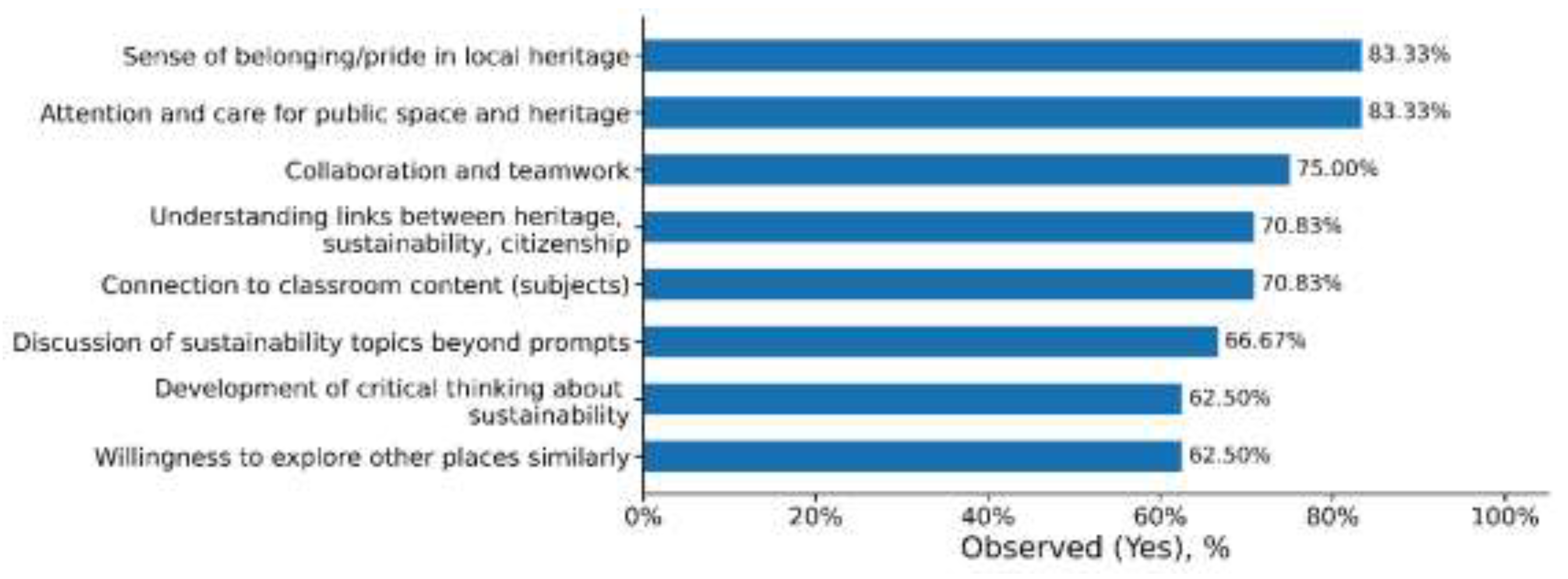
Figure 2.
Teacher ratings of intervention value and feasibility (T2-OBS; N = 24). Mean scores on a 1-6 scale with SD error bars.
Figure 2.
Teacher ratings of intervention value and feasibility (T2-OBS; N = 24). Mean scores on a 1-6 scale with SD error bars.
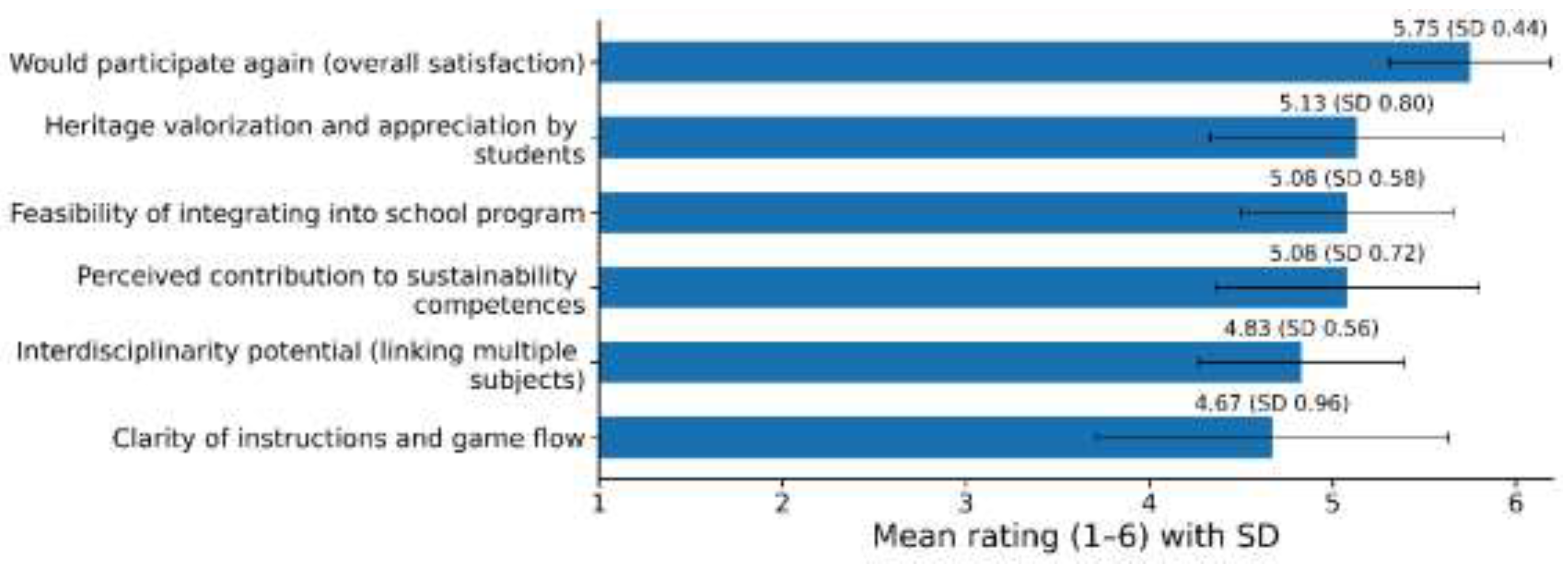
Figure 3.
Student agreement with post-activity items on heritage learning and sustainability competences (S2-POST; N = 439). Percentage of Yes for each item (A.2.2–A.3.4).
Figure 3.
Student agreement with post-activity items on heritage learning and sustainability competences (S2-POST; N = 439). Percentage of Yes for each item (A.2.2–A.3.4).
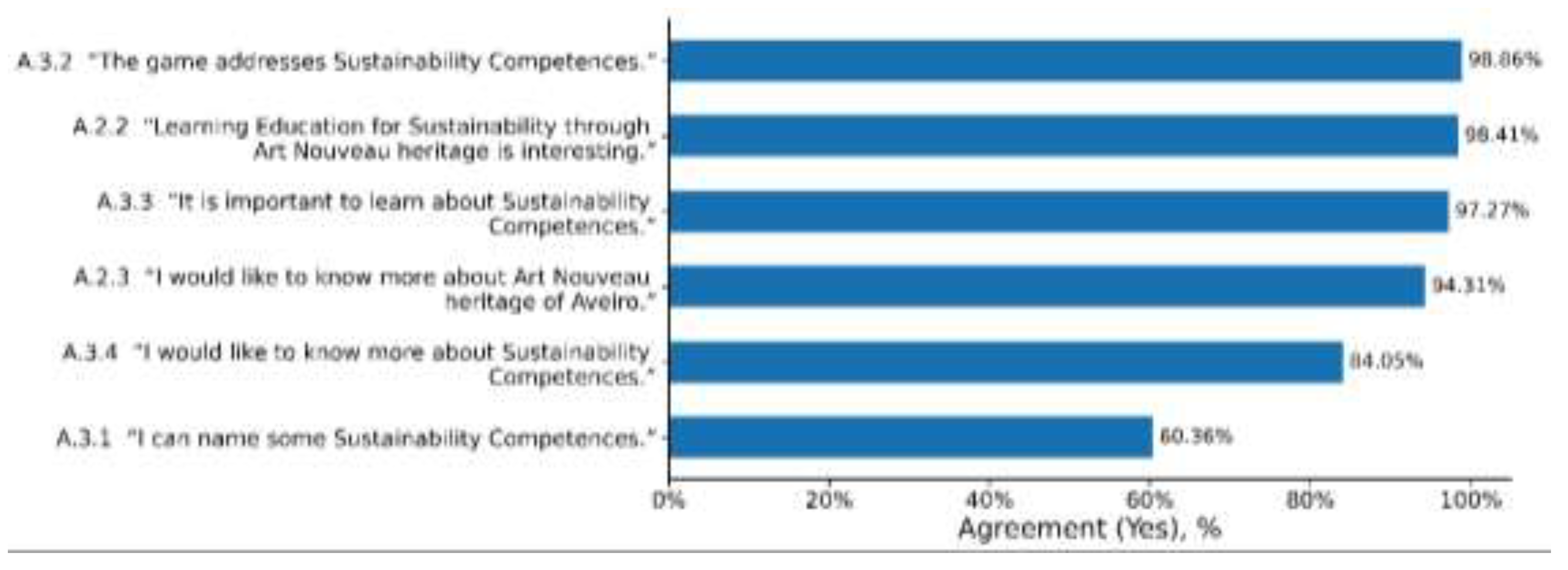
Figure 4.
Explicit POI name mentions detected in student open-ended reflections (A.1.1; N = 439), reported as absolute counts (only POIs with at least one explicit mention are presented).
Figure 4.
Explicit POI name mentions detected in student open-ended reflections (A.1.1; N = 439), reported as absolute counts (only POIs with at least one explicit mention are presented).
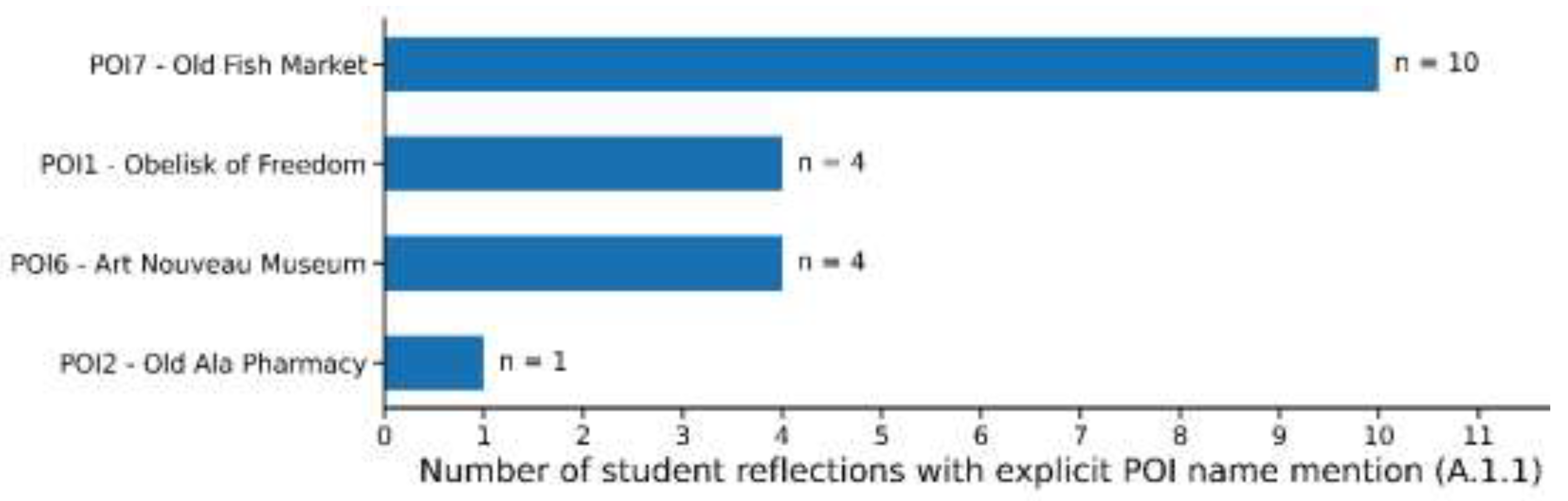

Table 1.
POIs included in the Art Nouveau Path and associated task blocks (P-codes).
| POI | POI labels | Place-based focus (heritage and urban context) |
Tasks per POI (n; P-codes) |
|---|---|---|---|
| 1 |
Melo Freitas Square ‘Obelisk to Liberty’ |
Civic space and heritage memory in the historic center | 5; P1.1-P1.5 |
| 2 |
Melo Freitas Square ‘Ala Pharmacy (old)’ |
Commercial heritage facade and conservation under everyday use | 4; P2.1-P2.4 |
| 3 | João Mendonça Street | Historic streetscape, Aveiro’s lagoon canal adjacency, and urban-environment relations | 5; P3.1-P3.5 |
| 4 |
João Mendonça Street ‘Old Agricultural Cooperative’ |
Adaptive heritage functions and maintenance, reuse, and longevity | 5; P4.1-P4.5 |
| 5 |
João Mendonça Street ‘Aveiro City Museum’ |
Local heritage narratives, risk memory references, and civic learning | 6; P5.1-P5.6 |
| 6 | ‘Art Nouveau Museum’ | Art Nouveau identity, symbolic heritage, and public stewardship norms | 6; P6.1-P6.6 |
| 7 |
‘José Estêvão Market’ (Fish Market) |
Everyday heritage and blue-space externalities (waste, pollution, behavior norms) | 3; P7.1-P7.3 |
| 8 | ‘Ferro Guesthouse’ | Heritage use pressures, visitor economy cues, and liveability considerations | 2; P8.1-P8.2 |
Table 2.
Data sources, instruments, and analytical units included in this study.
| Data source | Instrument/ artefact |
Primary purpose |
Records | Analytical unit | Treatment in this paper |
|---|---|---|---|---|---|
|
Curriculum translation matrix |
POI by task mapping to Portuguese Curricular and Competence Goals | Specify curricular legibility and competence alignment as a design artefact | 8 POIs; 36 tasks |
POI, task, mapped competence / theme | Analyzed (documental analysis) |
| Student post activity survey | S2-POST questionnaire (closed items and open-ended prompts) |
Capture immediate post activity perceptions and narratives linked to urban sustainability and resilience themes | N = 439 | Student record; narrative response; meaning unit (for qualitative analysis) | Analyzed (quantitative descriptives; qualitative coding) |
| Teacher field observations | T2-OBS questionnaire (structured ratings and open notes) |
Document in situ engagement, navigation, interaction, and contextual contingencies | N = 24 (across 18 sessions) |
Teacher record; observation note; rating item | Analyzed (quantitative descriptives; qualitative coding) |
| Gameplay traces (implementation) | App logs (group level) |
Describe implementation characteristics (coverage, task completion, group counts) | 118 groups; 4,248 group item responses |
Group session; item attempt | Descriptive only (not analyzed as empirical evidence) |
| Contextual inputs (design and refinement) | T1-VAL; T1-R; S1-PRE; S3-FU |
Inform design refinement and broader project continuity | T1-VAL (N= 30); T1-R (N= 3); S1-PRE (N= 221); and, S3-FU (N= 334) |
Not applicable | Not analyzed as empirical evidence |
Table 3.
Deductive resilience mechanism codebook and exclusion criteria codes used in the directed thematic analysis of students’ and teachers’ narratives.
Table 3.
Deductive resilience mechanism codebook and exclusion criteria codes used in the directed thematic analysis of students’ and teachers’ narratives.
| Category | Code | Label | Operational definition (what was analyzed) |
|---|---|---|---|
|
Resilience Mechanism |
R1 | Climate risk and environmental memory | References to past hazard events (e.g., flooding), climate-related risk awareness, or environmental memory in the city context. |
| R2 | Heritage governance and collective rules | Mentions of regulations, shared responsibilities, institutional roles, or community norms concerning heritage and urban space stewardship. | |
| R3 | Sustainable conservation under pressure | Recognition of tensions between heritage preservation and use pressures (as commercialization, redevelopment), including authenticity and place identity concerns. | |
| R4 | Adaptive reuse and circularity | Ideas about repurposing heritage buildings, material longevity, maintenance practices, and resource-conscious reuse framed as waste reduction or sustainability. | |
| R5 | Tourism, gentrification, and livability trade-offs | Mentions of visitor impacts, resident-visitor tensions, housing pressure, or sustainable tourism practices in historic areas. | |
| R6 | Blue infrastructure and ecosystem stewardship | References to canals, lagoon-related ecosystems, water quality, pollution, and collective responsibilities toward aquatic heritage and nature. | |
| R7 | Urban environmental comfort | References to environmental quality and comfort in the historic center (as noise, light, litter, thermal comfort) and implications for everyday urban life. | |
| R8 | Nature-city interconnections and identity | Mentions of nature represented in architecture, urban nature integration, local pride and identity, or cultural-natural linkages in heritage places. | |
| Exclusion Code | X1 | Technology-only | Responses focused only on the app/AR experience without heritage, sustainability, or resilience content. |
| X2 | Generic sustainability | Vague sustainability claims lacking urban, heritage, or place-based specificity. | |
| X3 | Aesthetic-only | Purely aesthetic admiration of buildings without linkage to conservation, responsibility, or urban-environmental issues. |
Table 4.
Curriculum-aligned mapping of Art Nouveau POIs to curriculum anchors (EL), EfS themes, GreenComp competences, and SDGs.
Table 4.
Curriculum-aligned mapping of Art Nouveau POIs to curriculum anchors (EL), EfS themes, GreenComp competences, and SDGs.
| POI | Heritage/ nature-city focus |
Curriculum anchors (main EL) | Key EfS themes | GreenComp competences (main) |
SDGs (main) |
|---|---|---|---|---|---|
|
Melo Freitas Square, ‘Obelisk to Liberty’ |
Civic square, public space, memory of floods and urban change |
History; Geography; Citizenship Education |
Civic space and democracy; environmental comfort; climate adaptation | 1.1; 1.2; 2.1; 4.1; 4.2 | 11; 13; 16 |
|
Melo Freitas Square, ‘Ala Pharmacy (old)’ |
Heritage facade under commercial pressure, lighting and signage impacts | History/Geography; Citizenship Education; Visual Arts/Science |
Conservation versus commerce; sustainable consumption; light and noise impacts | 1.1; 1.3; 2.2; 2.3; 4.3 | 11; 12 |
| João Mendonça Street | Waterfront landscape, canals as infrastructure, pollution and stewardship | Geography; Natural Sciences; Citizenship Education | Water systems and stewardship; trade and impacts; blue public spaces | 2.3; 1.1; 3.1; 4.2 | 6; 11; 14 |
|
João Mendonça Street, ‘Old Agricultural Cooperative’ |
Rural-urban links, food systems, cooperativism, lagoon ecosystems | Natural Sciences; Geography/History; Citizenship Education | Sustainable food systems; social economy; lagoon ecosystems | 2.1; 2.2; 1.2; 3.1; 4.2 | 2; 12; 14 |
|
João Mendonça Street, ‘Aveiro City Museum’ |
Learning from past floods, risk areas, adaptation pathways | History; Geography; Natural Sciences | Flood risk; resilience and planning; memory and futures | 2.1; 2.3; 3.1; 3.2; 3.3 | 11; 13 |
| ‘Art Nouveau Museum’ | Nature motifs in architecture, materials, adaptive reuse | Visual Arts; History; Citizenship Education/Science | Nature in design; materials and impacts; sustainable visitation | 1.1; 1.3; 2.2; 3.3; 4.3 | 4; 11; 12 |
|
‘José Estêvão Market’ (Fish Market) |
Marine resources, tourism, waste and noise, market as public space | Natural Sciences; Geography; Citizenship Education | Sustainable fisheries; tourism pressure; waste management | 2.1; 1.1; 3.1; 4.2; 4.1 | 11; 12; 14 |
| ‘Ferro Guesthouse’ | Adaptive reuse, tourism-residents interface, energy and noise | Geography/History; Citizenship Education; Science | Sustainable tourism; energy and comfort; urban liveability | 1.1; 2.2; 3.1; 4.1; 4.2 | 11; 7; 8 |
Table 5.
Student-level prevalence of resilience mechanisms in open-ended reflections (S2-POST; N = 439)1.
Table 5.
Student-level prevalence of resilience mechanisms in open-ended reflections (S2-POST; N = 439)1.
| Resilience mechanism (codebook) | Students with ≥1 coded meaning unit (n) | Percentage of students (N = 439) |
|---|---|---|
| R3. Sustainable conservation under pressure | 161 | 36.67% |
| R8. Nature-city interconnections and identity | 135 | 30.75% |
| R6. Blue infrastructure and ecosystem stewardship | 51 | 11.62% |
| R4. Adaptive reuse and circularity | 24 | 5.47% |
| R1. Climate risk and environmental memory | 20 | 4.56% |
| R7. Urban environmental comfort | 6 | 1.37% |
| R5. Tourism, gentrification, and livability trade-offs | 4 | 0.91% |
| R2. Heritage governance and collective rules | 3 | 0.68% |
1 Coding was performed deductively at the meaning-unit level using the R1 to R8 codebook. This table reports student-level prevalence, counted as present when at least one meaning unit from any of the three S2-POST open-ended prompts was assigned that mechanism as the primary code. Mechanisms may co-occur within the same student record; therefore, percentages represent marginal prevalences across the cohort.
Table 6.
Illustrative students’ quotes (PT original and EN translation) concerning resilience mechanisms (R1 to R8).
Table 6.
Illustrative students’ quotes (PT original and EN translation) concerning resilience mechanisms (R1 to R8).
| Resilience mechanism | Illustrative Quotation (PT) | Translation (EN) (S2-POST) |
|---|---|---|
|
R1. Climate risk and environmental memory |
“Percebi como as cheias de 1938 afetaram Aveiro.” | “I realized how the 1938 floods affected Aveiro.” |
|
R2. Heritage governance and collective rules |
“Aprendi que devemos proteger mais a nossa cultura; aprendi sobre a Arte Nova” | “I learned that our culture should be better protected; I learned about Art Nouveau.” |
|
R3. Sustainable conservation under pressure |
“Aprendi que o aquecimento global e as alterações climáticas podem pôr em risco monumentos.” | “I learned that global warming and climate change can put monuments at risk.” |
|
R4. Adaptive reuse and circularity |
“O jogo ensinou-me que a economia circular pode aplicar-se à arquitetura.” | “The game taught me that the circular economy can be applied to architecture.” |
|
R5. Tourism, gentrification, and livability trade-offs |
“Aprendi que o turismo sustentável pode proteger o património.” | “I learned that sustainable tourism can protect heritage.” |
|
R6. Blue infrastructure and ecosystem stewardship |
“Percebi que proteger rios e canais também é preservar a história da cidade.” | “I realized that protecting rivers and canals also preserves the city’s history.” |
|
R7. Urban environmental comfort |
“Aprendi que reduzir a poluição sonora melhora o bem-estar nas cidades.” | “I learned that reducing noise pollution improves well-being in cities.” |
|
R8. Nature city interconnections and identity |
“Aprendi que muitos prédios Arte Nova usam elementos inspirados na natureza, como flores e animais.” | “I learned that many Art Nouveau buildings use elements inspired by nature, such as flowers and animals.” |
Disclaimer/Publisher’s Note: The statements, opinions and data contained in all publications are solely those of the individual author(s) and contributor(s) and not of MDPI and/or the editor(s). MDPI and/or the editor(s) disclaim responsibility for any injury to people or property resulting from any ideas, methods, instructions or products referred to in the content. |
© 2026 by the authors. Licensee MDPI, Basel, Switzerland. This article is an open access article distributed under the terms and conditions of the Creative Commons Attribution (CC BY) license (http://creativecommons.org/licenses/by/4.0/).
Copyright: This open access article is published under a Creative Commons CC BY 4.0 license, which permit the free download, distribution, and reuse, provided that the author and preprint are cited in any reuse.


