

Submitted:
06 January 2026
Posted:
07 January 2026
You are already at the latest version
Abstract
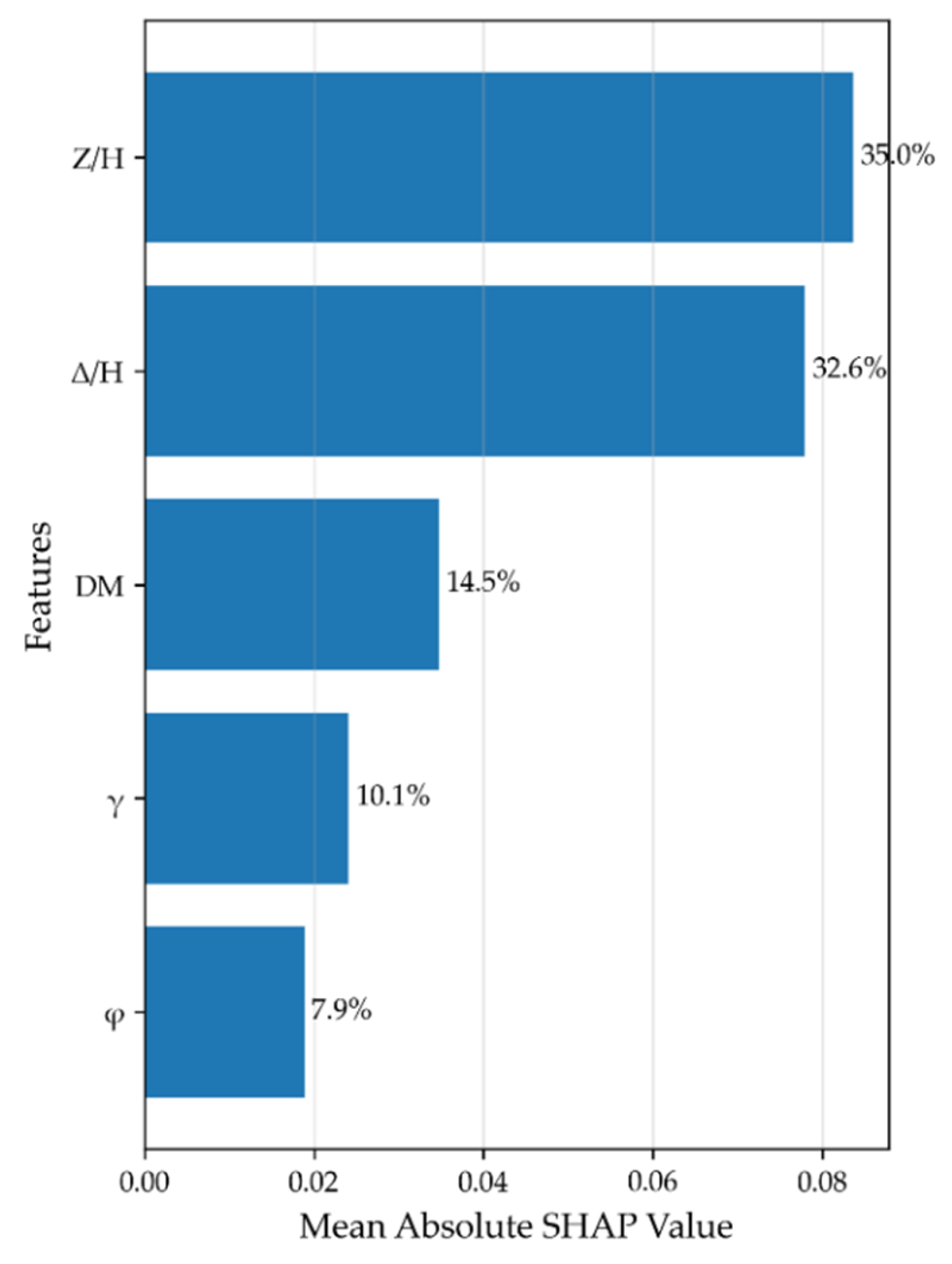
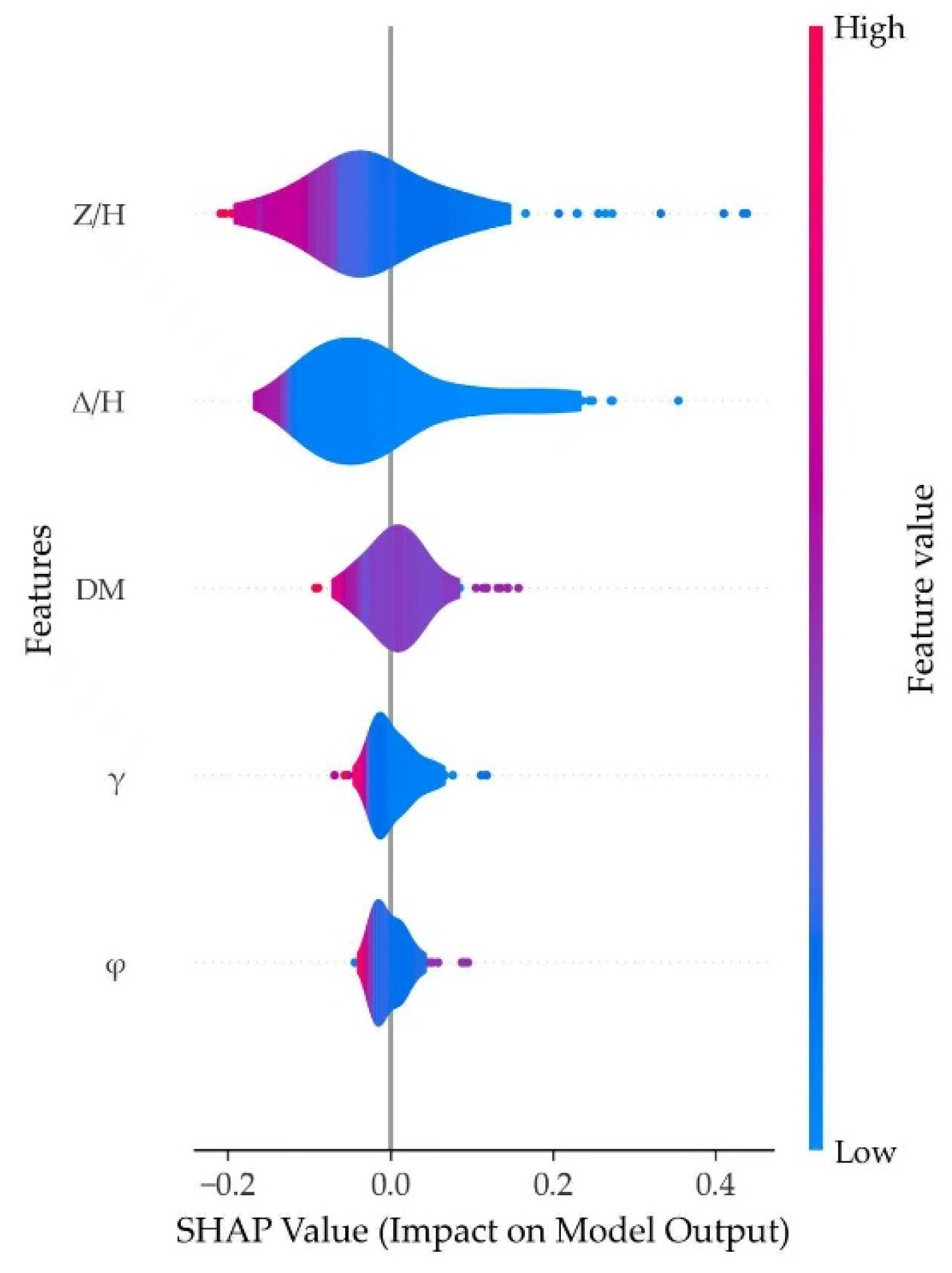
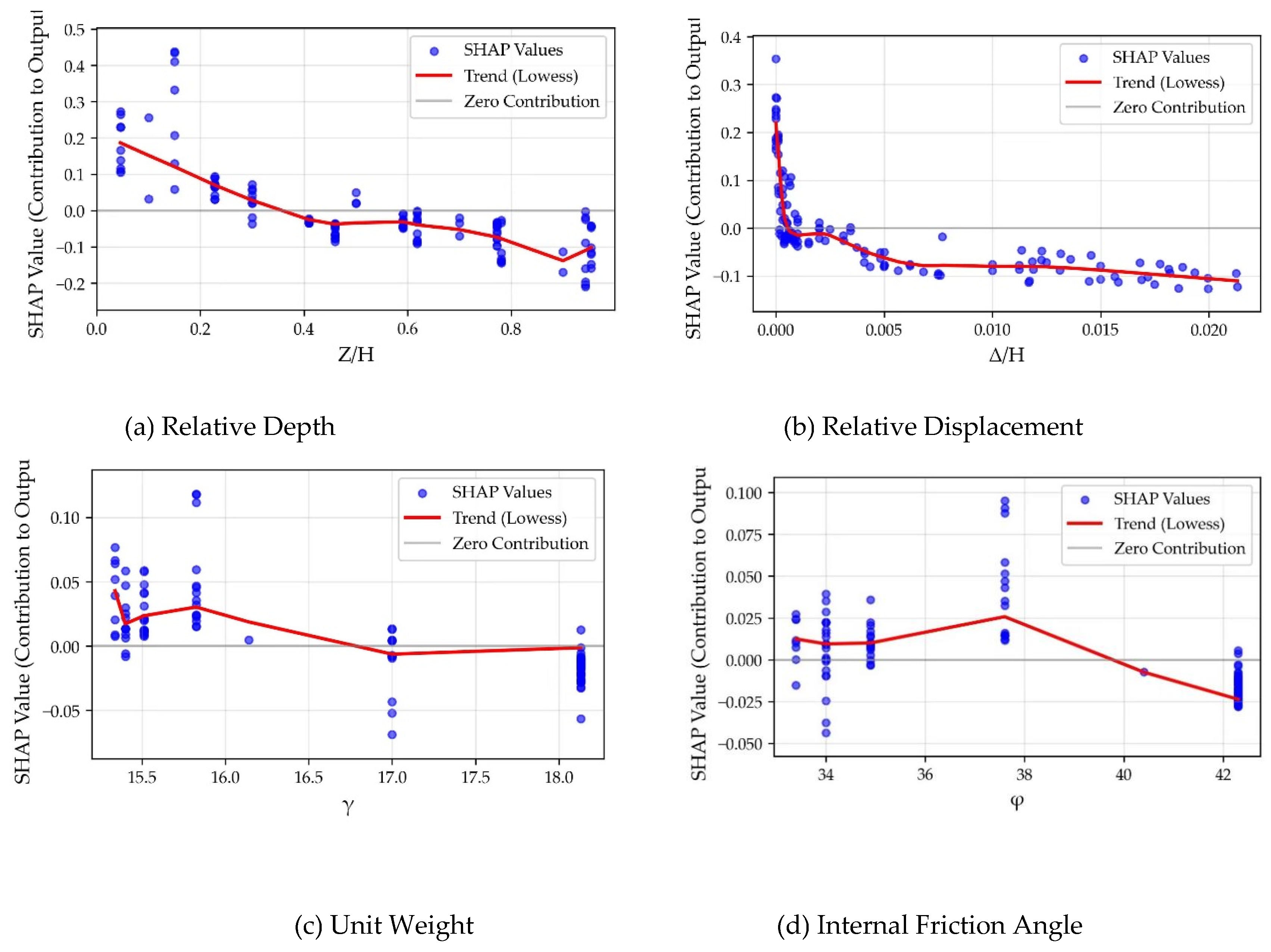
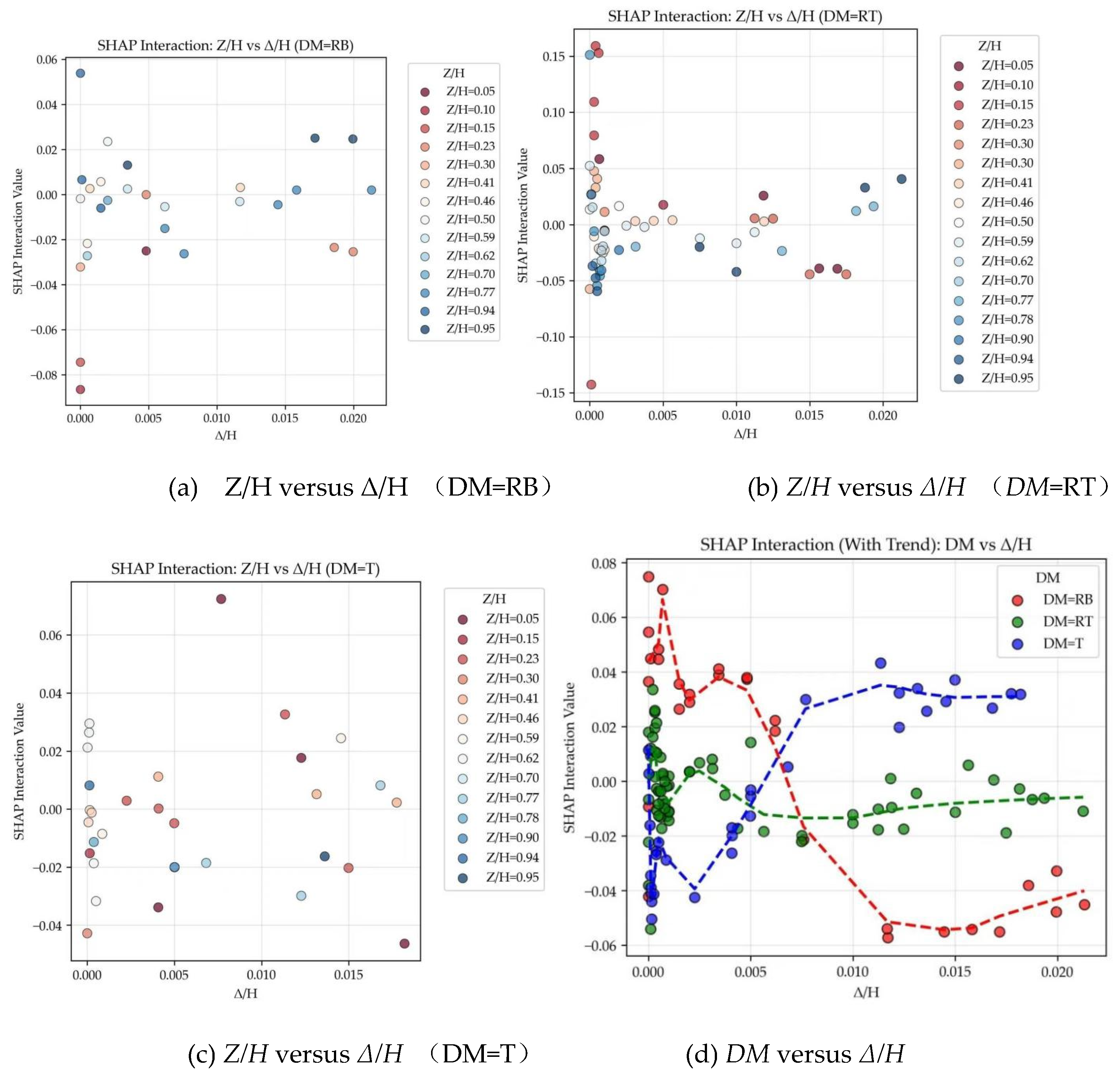
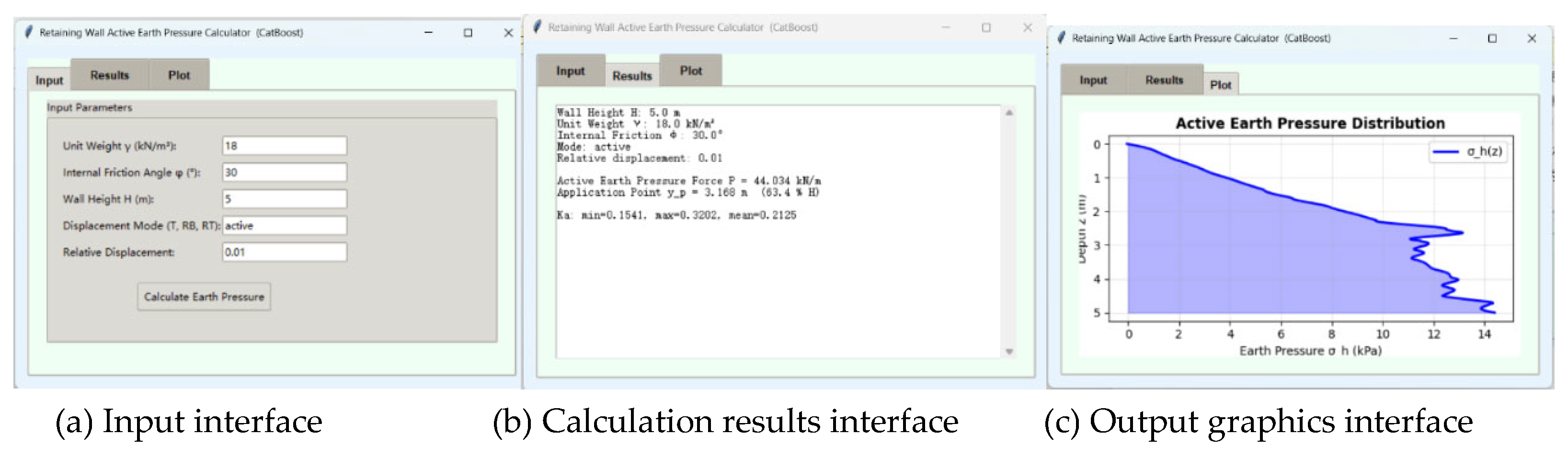
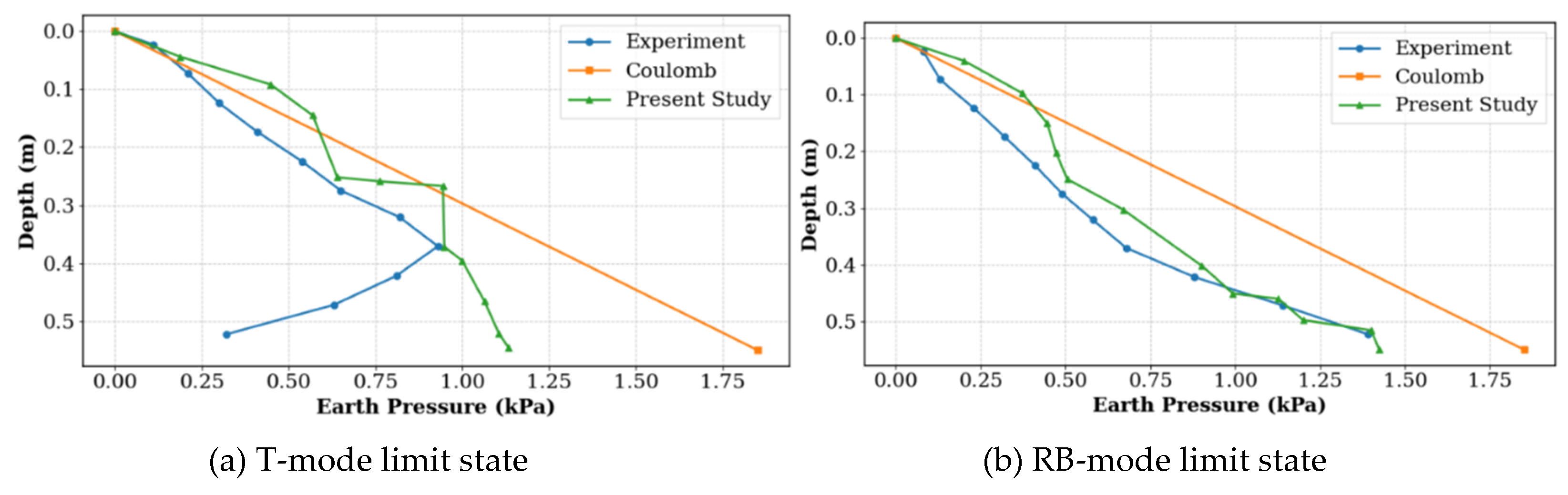
The classical Rankine and Coulomb theories frequently encounter difficulties in accurately modeling the complex, nonlinear, and displacement-coupled behavior of earth pressure on retaining walls under non-limit states. The present study proposes a “key feature refinement strategy based on collinearity analysis” and employs the said strategy by applying it to model test data. The strategy identified an optimum set of five physical parameters, namely displacement mode (DM), relative displacement (Δ/H), relative depth (Z/H), unit weight (γ), and internal friction angle (φ). A machine learning (ML) model has been developed that integrates Categorical Boosting with SHapley Additive exPlanations (CatBoost-SHAP). This model has been found to exhibit a marked enhancement in accuracy (R² = 0.917) when compared to classical theories, while concurrently offering the distinct advantage of explicit interpretability. SHAP analysis has been demonstrated to elucidate the nonlinear influence of each parameter. It is confirmed that displacement mode is identified as the governing factor for spatial pressure distribution, and classical mechanisms such as top‑down stress relaxation in the rotation-about-the-base (RB) mode and soil arching in the rotation-about-the-base (RT) mode are visualized. Furthermore, a displacement‑dependent mechanical threshold (Δ/H ≈ 0.006) has been identified, which marks the transition from a mode‑dominated to displacement‑driven pressure evolution. In addition, the proposed approach is integrated into a graphical user interface (GUI) that is designed to be user‑friendly, thereby furnishing practitioners with a precise tool for designing retaining walls. The validation of the model's performance against independent experimental results has demonstrated its superior agreement and practical utility under displacement-controlled conditions in comparison to conventional methods.
Keywords:
1. Introduction
2. Materials and Methods
2.1. Data Integration and Fundamental Features
2.1.1. Data Sources
2.1.2. Data Cleaning
2.1.3. Basic Features and Target Variable
2.2. Justification for CatBoost Selection
2.3. Cross-Validation and Independent Testing
2.4. Model Evaluation Metrics
2.5. Model Interpretation Strategy
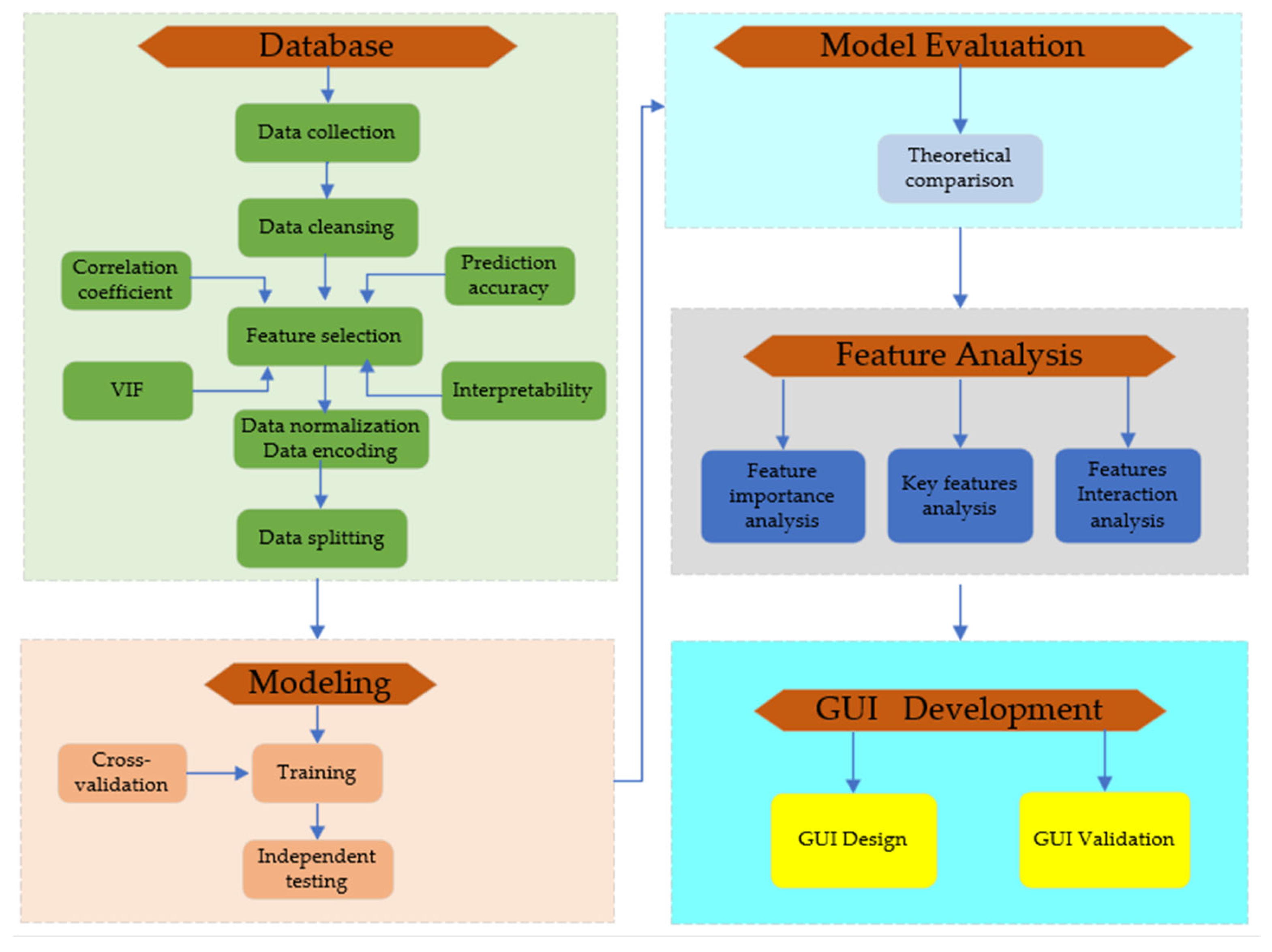
2.6. Research Framework
3. Key Feature Selection and Refinement
3.1. Attempts at Expanding Feature Sets
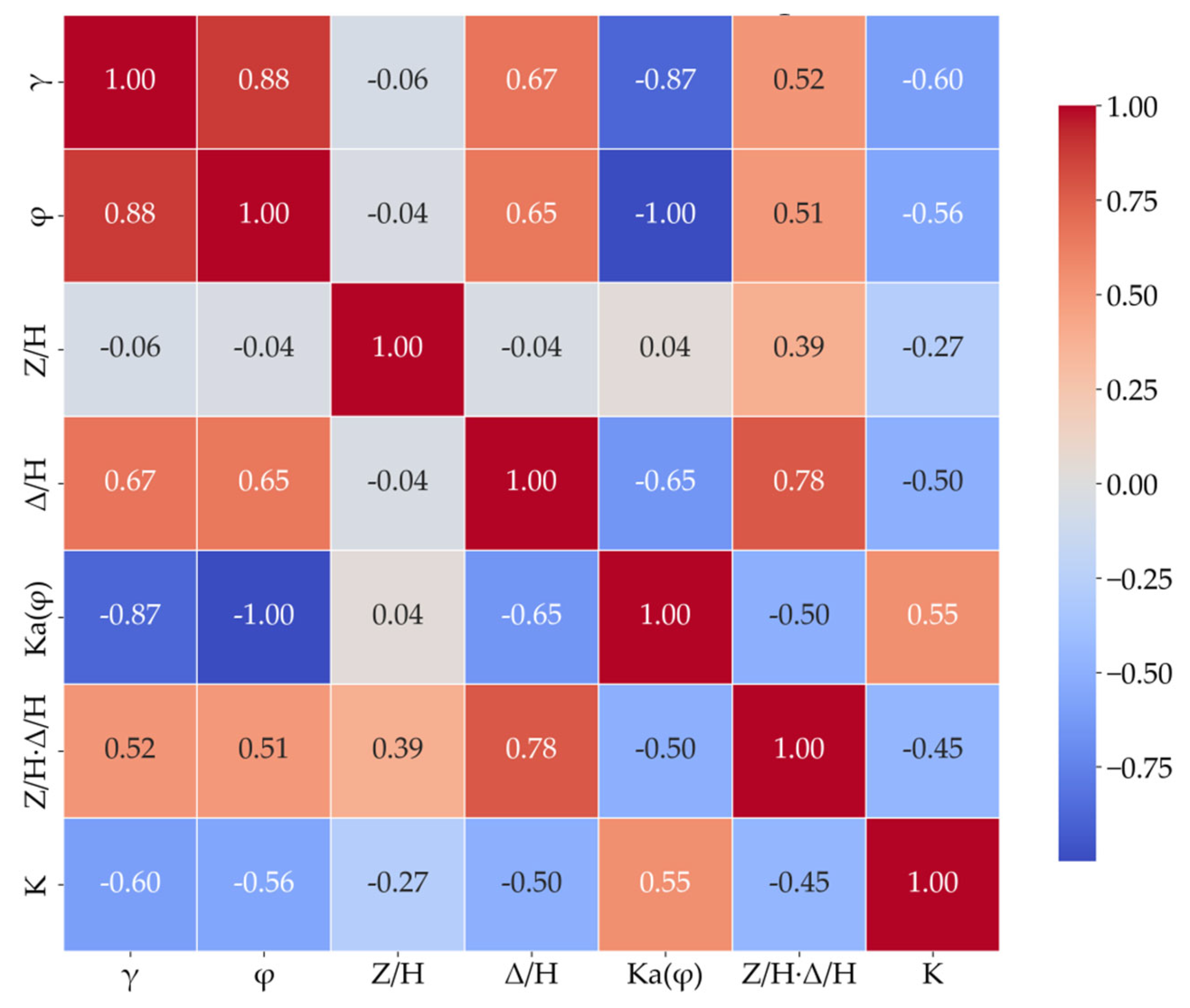
3.2. Multicollinearity Analysis and Quantification
4. Results and Mechanism Analysis
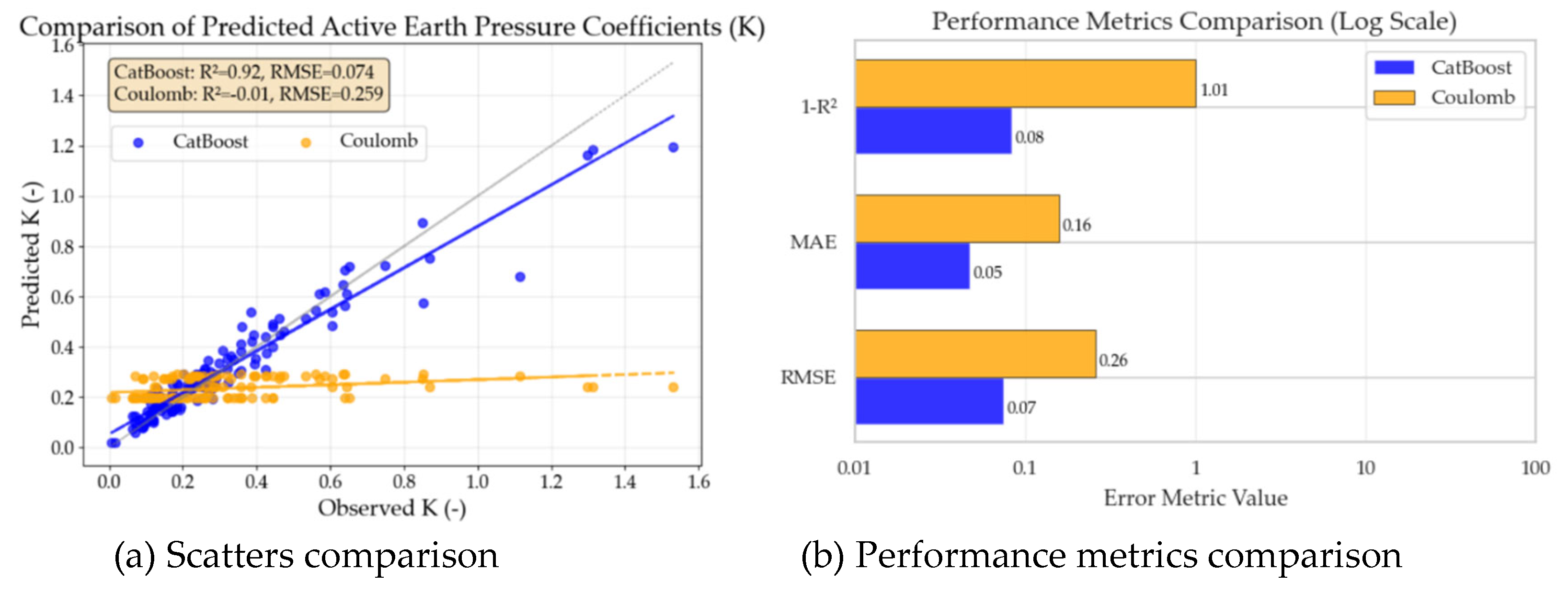
4.1. Model Performance Evaluation and Theoretical Comparison
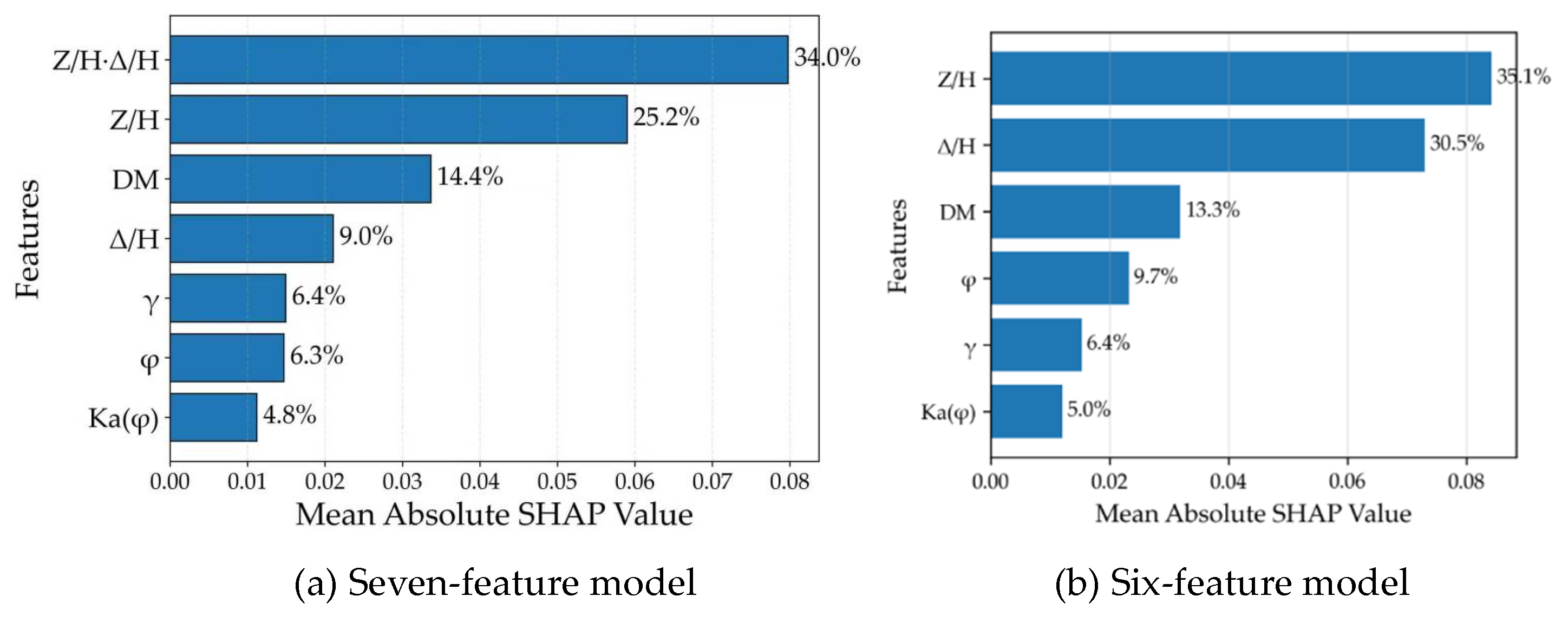
4.2. Feature Importance Analysis
4.3. Nonlinear Analysis of Earth Pressure Mechanism
4.4. Analysis of Feature Interactions in Earth Pressure
4.4.1. Interaction between Relative Displacement (Δ/H) and Relative Depth (Z/H)
4.4.2. Interaction between Relative Displacement (Δ/H) and Displacement Mode (DM)
5. Development and Validation of the GUI Tool
5.1. GUI Tool Design
5.2. Validation with Independent Test Data
6. Conclusions and Prospects
Author Contributions
Funding
Data Availability Statement
Conflicts of Interest
References
- Nguyen, T. An Exact Solution of Active Earth Pressure Based on a Statically Admissible Stress Field. Comput. Geotech. 2023, 153, 1-24. [CrossRef]
- Qian, J.; Zhou, C.; Li, W.; Gu, X.; Qin, Y.; Xie, L. Investigation on the Influencing Factors of K0 of Granular Materials Using Discrete Element Modelling. Appl. Sci. 2022, 12(6). [CrossRef]
- Ma, K.; Wang, L.; Long, L.; Peng, Y.; He, G. Discrete Element Analysis of Structural Characteristics of Stepped Reinforced Soil Retaining Wall. Geomatics. Nat. Hazards Risk, 2020, 11(1): 1447–1465. doi: 10.1080/19475705.2020.1797907.
- Yang, M.; Deng, B. Simplified Method for Calculating the Active Earth Pressure on Retaining Walls of Narrow Backfill Width Based on DEM Analysis. Adv. Civ. Eng. 2019. doi: 10. 1155/2019/1507825.
- Li, T.; Huo, J.; He, P.; Liu, X.; Fang, X. Comprehensive Review of Earth Pressures on Retaining Structure[J]. J. Guilin Univ. Technol. 2017, 37, 94-102. doi: 10.3969/j.issn.1674-9057.2017.01.013.
- Patsevich, A.; El Shamy, U. Discrete-element Method Study of the Seismic Response of Gravity Retaining Walls. Int. J. Geomech. 2020, 20(11). doi: 10.1061/(asce)gm.19435622.0001837.
- Wang, Y.; Mora, P.; Liang, Y. Calibration of Discrete Element Modeling: Scaling Laws and Dimensionless Analysis. Particuology 2022, 62: 55–62. doi: 10.1016/j.partic.2021.03.020.
- Li, Z.; Yang, X. Three-dimensional Active Earth Pressure for Retaining Structures in Soils Subjected to Steady Unsaturated Seepage Effects. Acta Geotech. 2019, 15(7): 2017-2029. [CrossRef]
- Peng S.; Li X.; Fan L. Meso-scale of Soil Arching for Rigid Retaining Wall Active Failure. J. Cent. South Univ. (Sci. Technol.) 2011, 42(4): 1099-1104.
- Handy R. L. The Arch in Soil Arching. J. Geotech. Eng. 1985, 111(3): 302—318. [CrossRef]
- Liu Y.; Yu P. Analysis of Soil Arch and Active Earth Pressure on Translating Rigid Retaining Walls. Rock Soil Mech. 2019, 40(2): 506-528. [CrossRef]
- Lu W.; Wang X.; Yang P.; Cui L.; Ren Y.; Jin K. Analysis of Soil Arching Effect of Active Earth Pressure on Rigid Retaining Wall with Translation Mode. J. Lanzhou Univ. Technol. 2017, 43(1): 132-136.
- Zhou Y.; Yang D. Calculation and Analysis of Active Earth Pressure on Retaining Walls Considering Soil Arching Effects. J. Hohai Univ. (Nat. Sci.) 2016, 44(2): 149-154. [CrossRef]
- Wang M.; Li J. New Method for Active Earth Pressure of Rigid Retaining Walls Considering Arching Effect. Chin. J. Geotech. Eng. 2013, 35(5): 865-870. [CrossRef]
- Chang, M. Lateral earth pressures behind rotating walls. Can. Geotech. J. 1997, 34: 498–509. [CrossRef]
- Fang, Y.; lshibashi, I. Static Earth Pressure with Various Wall Movements. J. Geotech. Eng. 1986, 112 (3): 317-333. [CrossRef]
- Zhou, Y.; Ren, M. An Experimental Study on Active Earth Pressure behind Rigid Retaining Wall. Chin. J. Geotech. Eng. 1990, 12 (2): 19-26. [CrossRef]
- Rui, R.; Jiang, W.; Xu, Y.; Xia, R.; Edo, E. E.; Ding, R. Experimental Study of the Earth Pressure on a Rigid Retaining Wall for Various Patterns of Movements. Chin. J. Rock Mech. Eng. 2023, 42 (6): 1534-1545. doi: 10.13722/j.cnki.jrme.2022.0808.
- Shi, W. Model Test and Analytical Research on the Active Earth Pressure Acting on a Rigid Retaining Wall. Master, Chang’an University, Xi’an, China, April 2019.
- Gong, H. Calculation Method and Experimental Verification of Unsaturated Soil Pressure Considering Displacement Effect. Master, Hunan University, Changsha, China, April 2023.
- Yang, X.; Chen, H. Seismic Active Earth Pressure of Unsaturated Soils with a Crack Using Pseudo-dynamic Approach. Comput. Geotech. 2020, 125: 103684.1-103684.12. [CrossRef]
- Patel, S.; Deb, K. Study of Active Earth Pressure Behind a Vertical Retaining Wall Subjected to Rotation about the Base. Int. J. Geomech. 2020, 20 (4). [CrossRef]
- Qian, Z.-H.; Zou, J.-F.; Tian, J.; Pan, Q. J. Estimations of Active and Passive Earth Thrusts of Non-homogeneous Frictional Soils Using a Discretisation Technique. Comput. Geotech. 119, 103366. [CrossRef]
- Nguyen, T. Passive Earth Pressures with Sloping Backfill Based on a Statically Admissible Stress Field. Comput. Geotech. 2022,149, 104857. [CrossRef]
- Zhang, F.; Yin, M.; Sun, F.; et al. Non-limit Active Earth Pressure Under Different Retaining Wall Displacement Modes Based on Discrete Element Simulation. Sci. Technol. Eng. 2024, 24(11): 4658-4668. [CrossRef]
- Shi, F.; Lu, K.; Yin, Z. Determination of Three-dimensional Passive Slip Surface of Rigid Retaining Walls in Translational Failure Mode and Calculation of Earth Pressures. Rock Soil Mech. 2021, 42(3): 735-745. [CrossRef]
- Wan, L.; Zhang, X.; Wang, Y.; Xu, L.; Xu, C. Study on Active Failure and earth Pressure of Cohesionless Soil with Limited Width behind Retaining Wall. J. Civ. Environ. Eng. 2019, 41 (3): 19-26. [CrossRef]
- Singh, P.; Chakraborty, T.; Mahajan, P. Discrete Element Study of Stresses and Deformation on Gravity Retaining Wall under Static Loading. Granu. Matter 2024, 26 (48):1-14. [CrossRef]
- Zhang, H.; Xu, C.; He, Z.; Huang, Z.; He, X. Study of Active Earth Pressure of Finite Soils under Different Retaining Wall Movement Modes Based on Discrete Element Method. Rock Soil Mech. 2022, 43(1): 257-267. [CrossRef]
- Chen, H.; Chen, F.; Chen, C.; Lai, D. Failure Mechanism and Active Earth Pressure of Narrow Backfills behind Retaining Structures Rotating about the Base. Int. J. Geomech. 2024, 24(5):04024068-1-13. [CrossRef]
- Xiong, C.; Tang, W.; Xing, Z.; Zheng, J.; Liu, Y.; Jiang, X.; Li, X.; Chen, Y. Active Earth Pressure of Narrow Cohesionless Backfill on Balance Weight Retaining Walls Rotating about the Bottom. Structures 2024, 67 (2024):1-12. [CrossRef]
- Hang, L.; H.; Dang, F.; Wang, X.; Ding, J.; Gao, J. Calculation and Analysis of Earth Pressure under Limited Displacement Considering Influences of Internal Friction Angle. Chin. J. Geotech. Eng. 2021, 43 (1):81-86.
- Shin, J.; Han, H. Analysis of the Impact on Prediction Models Based on Data Scaling and Data Splitting Methods - For Retaining Walls with Ground Anchors Installed. J. Eng. Geol. 2023, 33 (4): 639-655. [CrossRef]
- Zhang, W. G.; Gou, A. T. C. Multivariate Adaptive Regression Splines for Analysis of Geotechnical Engineering Systems. Comput. Geotech. 2013, 48: 82-95. [CrossRef]
- Mishra, P.; Samui, P.; Mahmoudi, E. Probabilistic Design of Retaining Wall Using Machine Learning Methods. Appl. Sci. 2021, 11(12). [CrossRef]
- Aydın, Y.; Bekdaş, G.; Nigdeli, S. Dimensioning of the Retaining Wall Using Linear Regression, Ridge Regression and Lasso Regresion. In Proceedings of the conference on New Technologies, Development and Application (NT-2025), Sarajevo, Bosnia and Herzego, June 2025. doi: org/10.1007/978-3-031-95200-5_53.
- Bekdaş, G.; Cakiroglu, C.; Kim, S.; Geem, Z. Optimal Dimensioning of Retaining Walls Using Explainable Ensemble Learning Algorithms. Materials 2022, 15, (14). [CrossRef]
- Lundberg, S.; Lee, S. A Unified Approach to Interpreting Model Predictions. Neural Information Processing Systems Conference, Long Beach, CA, USA, 2017, 30. [CrossRef]
- Minoru, M.; Satoru, K.; Hiderki, Y. Experimental Study on Earth Pressure of Retaining Wall by Field Tests. Japanese Society of Soil Mechanics and Foundation Engineering 1978, 18 (3):27-41. [CrossRef]
- Ke, G.; Meng, Q.; Finley, T.; Wang, T.; Chen, W.; Ma, W.; Ye, Q.; Liu, T.-Y. LightGBM: A highly efficient gradient boosting decision tree. Adv. Neural Inf. Process. Syst. 2017, 30, 3146–3154.
- Uddin, M.N.; Ye, J.; Deng, B.; Li, L.; Yu, K. Interpretable Machine Learning for Predicting the Strength of 3D Printed Fiber Reinforced Concrete (3DP-FRC). J. Build. Eng. 2023, 72, 106648. [CrossRef]
- Rahman, J.; Ahmed, K.S.; Khan, N.I.; Islam, K.; Mangalathu, S. Data-Driven Shear Strength Prediction of Steel Fiber Reinforced Concrete Beams Using Machine Learning Approach. Eng. Struct. 2021, 233, 111743. [CrossRef]
- Song, Y.; Wang, F.; Yang, W.; Liang, R.; Zhan, D.; Xiang, M.; Yang, X.; Xu, R.; Lu, M. High-Performance Prediction of Soil Organic Carbon Using Automatic Hyperparameter Optimization Method in the Yellow River Delta of China. Comput. Electron. Agric. 2025, 236, 110490. [CrossRef]
- Boser, B.E.; Guyon, I.M.; Vapnik, V.N. A Training Algorithm for Optimal Margin Classifiers. In Proceedings of the Fifth Annual Workshop on Computational Learning Theory; ACM: Pittsburgh, PA, USA, 1992; pp. 144–152. [CrossRef]
- Solhmirzaei, R.; Salehi, H.; Kodur, V. Predicting flexural capacity of ultrahigh-performance concrete beams: Machine learning based approach. J. Struct. Eng. 2022, 148, 04022031. [CrossRef]
- Yang, Y.; Yang, Y. Hybrid Prediction Method for Wind Speed Combining Ensemble Empirical Mode Decomposition and Bayesian Ridge Regression. IEEE Access 2020, 8, 71206–71218. [CrossRef]
- Ye, M.; Li, L.; Yoo, D.-Y.; Li, H.; Zhou, C.; Shao, X. Prediction of Shear Strength in UHPC Beams Using Machine Learning-Based Models and SHAP Interpretation. Constr. Build. Mater. 2023, 408, 133752. [CrossRef]
- Zhang, Z.; Zeng, T.; Zeng, Y.; Zhu, P. Explainable Prediction of UHPC Tensile Strength Using Machine Learning with Engineered Features and Multi- Algorithm Comparative Evaluation. Buildings 2025, 15, 3217. [CrossRef]
- Ke, L.; Qiu, M.; Chen, Z.; Zhou, J.; Feng, Z.; Long, J. An Interpretable Machine Learning Model for Predicting of CFRP-Steel Epoxybonded Interface. Compos. Struct. 2023, 326, 117639. doi: 10.1016/j.compstruct.2023.117639.
- Zhang, Z.; Zhou, X.; Zhu, P.; Li, Z.; Wang, Y. Prediction of Flexural Ultimate Capacity for Reinforced UHPC Beams Using Ensemble Learning and SHAP Method. Buildings 2025, 15, 969. [CrossRef]
- Lundberg, S.; Lee, S.-I. A Unified Approach to Interpreting Model Predictions. In Proceedings of the conference on Neural Information Proceedings Systems (NIPS 2017), Long Beach, CA, USA, 25 November 2017; pp.4765-4774.
- Arslan, Y.; Lebichot, B.; Kevin Allix, K.; Veiber, L.; Lefebvre, C; Boytsov, A; Goujon, A.; Bissyandé, T.; Klein, J. Towards Refined Classifications driven by SHAP Explanations. International Cross-Domain Conference for Machine Learning and Knowledge Extraction; IFIP, Vienna, Austria, 2022, 4: 68-81. [CrossRef]
- Antwarg, L.; Shapira, B.; Rokach, L. Explaining Anomalies Detected by Autoencoders Using Shapley Additive Explanations. Expert Syst. Appl. 2021, 186. [CrossRef]
- Gramegna, A.; Giudici, P. SHAP and LIME: An Evaluation of Discriminative Power in Credit Risk. Front. Artif. Intell. 2021, 4. [CrossRef]
- Lu k.; Zhu D.;‚Yang Y. Calculation Method of Active Earth Pressure Under Non-limit State Considering Soil Arching Effects. China J. Highw. Transp. 2010, 23 (1): 19-25.

| Category | No. | Name | Symbol | Unit | Data Type and Range |
|---|---|---|---|---|---|
| Input features | 1 | Unit weight | γ | kN/m3 | N (15.1~18.13) |
| 2 | Iner friction angle | φ | ° | N (31.5~42.3) | |
| 3 | Relative depth | - | N (0.04~0.96) | ||
| 4 | Displacement mode | DM | - | C (RT, RB, T) | |
| 5 | Relative displacement | - | N (0~0.072) | ||
| Target variable | 6 | Earth pressure coefficient | K | MPa | N (0.00142~1.59) |
| Feature Set | γ | φ | Z/H | Δ/H, | Ka(φ) | I |
|---|---|---|---|---|---|---|
| Five basic features | 4.80 | 4.58 | 1.00 | 2.09 | ||
| Basic features +Ka(φ) | 6.20 | 2105.15 | 1.00 | 2.17 | 1989.92 | |
| Basic features +Ka(φ)+I | 6.21 | 2105.22 | 1.87 | 5.00 | 1990.01 | 4.67 |
| Feature Set | R2 | RMSE | MAE |
|---|---|---|---|
| Five basic features | 0.9170 | 0.0744 | 0.0471 |
| Basic features +Ka(φ) | 0.9120 | 0.0766 | 0.0468 |
| Basic features +Ka(φ)+I | 0.9229 | 0.0717 | 0.0445 |
Disclaimer/Publisher’s Note: The statements, opinions and data contained in all publications are solely those of the individual author(s) and contributor(s) and not of MDPI and/or the editor(s). MDPI and/or the editor(s) disclaim responsibility for any injury to people or property resulting from any ideas, methods, instructions or products referred to in the content. |
© 2026 by the authors. Licensee MDPI, Basel, Switzerland. This article is an open access article distributed under the terms and conditions of the Creative Commons Attribution (CC BY) license (http://creativecommons.org/licenses/by/4.0/).