

Submitted:
31 December 2025
Posted:
31 December 2025
You are already at the latest version
Abstract
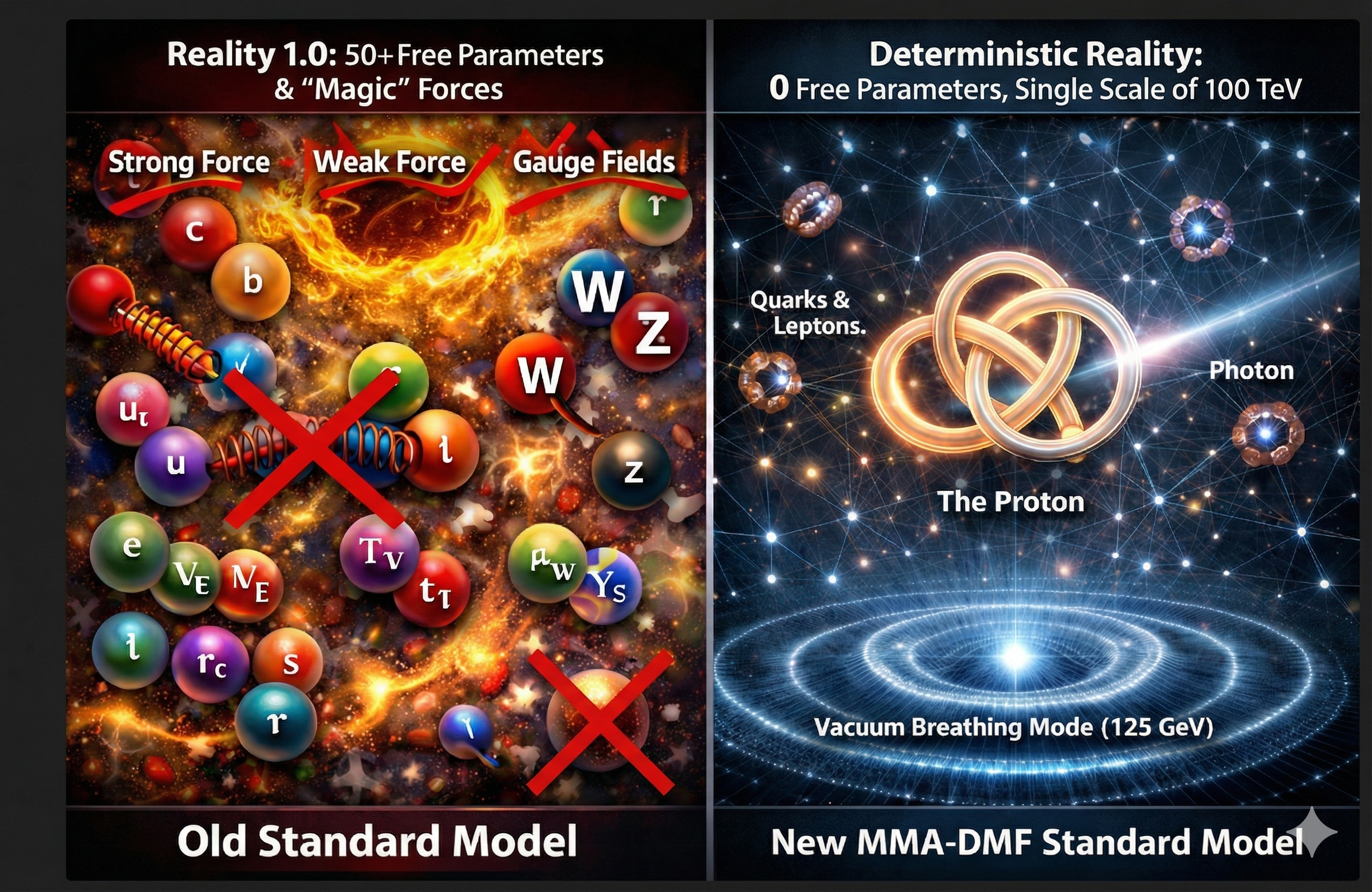
We present MMA-DMF as a one-scale deterministic effective-field theory that reinterprets Standard-Model (SM) mass generation and explicitly confronts macrophysical observables. The framework is locked to a single ultraviolet rigidity scale $M \simeq 100~\mathrm{TeV}$ (Table~4) and replaces continuous flavor inputs with discrete geometric charges $q_f$ (Table~23). In this archive-driven interpretation, inertial mass arises from topological friction: a deterministic drag response of the structured scalar vacuum field $\phi$ encoded in the generalized Langevin / strict fluctuation--dissipation closure (Eq.~8). The 125~GeV resonance is treated as a phonon-like breathing mode of vacuum rigidity (App.~7.4); weak processes are described as topological relaxation via $W/Z$ vortices; and the photon is identified as the gapless $U(1)$, zero-winding mode that remains massless while sensing the vacuum through $\phi F_{\mu\nu}F^{\mu\nu}$ couplings. Finally, the strong interaction is treated as Borromean-ring confinement of scalar flux, so that gluons and an independent $SU(3)$ gauge sector are not fundamental inputs but emergent topological bookkeeping (Sec.~2.14). Beyond consolidating the final rectified equations (including the operational effective-density convolution, Eq.~31.20, and $C^2$ smootherstep nuclear gates, Eq.~13.19), we assemble the dated, deduplicated validation suite emphasized by the audit trail. The ``bridge to macro physics'' is a primary target: GNOME network differential-delay timing (including station overburden effects in $\rho_{\mathrm{eff}}$, where a $1~\mathrm{s}$ surface transient can map to a $\sim 20~\mathrm{ms}$ underground blip) and the mandatory negative-chirp ``Sad Trombone'' veto (forensic logs report $\sim 99.8\%$ rejection of anthropogenic false positives), post-merger gravitational-wave echoes in locked Hayward-regularization windows (e.g.\ $\sim 36~\mathrm{ms}$ for GW150914-class ($\sim 60~M_\odot$) remnants; $\sim 135~\mathrm{ms}$ for the $\sim 225~M_\odot$ high-mass anchor class), Earth neutrino tomography with core-versus-mantle tension, the global 21~cm thermal history with irreducible stochastic heating, and a characteristic dip in galaxy--lensing cross-power. Ablation controls collapse the GNOME correlation to $\mathrm{SNR} \approx 0.4$ when $\Delta T_{ij}$ is removed (Table~19). Microphysical anchoring is provided by lattice convergence of the proton soliton mass to $938.27~\mathrm{MeV}$ with no parameter retuning. The core contribution is an explicitly falsifiable, binary Diamond protocol (Science Run~7, Sec.~6.2): failure of any locked criterion refutes the corresponding sector without introducing new free parameters.
Keywords:
standard model extension
; deterministic EFT
; vacuum rigidity
; topological defects
; screening
; proton mass
; GNOME
; gravitational-wave echoes
; early-time energy injection
1. Introduction
The archive describes MMA-DMF as an attempt to replace multiple sector-specific parameterizations with a single-scale deterministic construction in which microphysical regularization, screening, and stochastic-vacuum thermodynamics are not independent modules but closures of one another. The defining claim is that a single rigidity scale M governs ultraviolet regularization, governs the colored noise spectrum via fluctuation–dissipation closure, and sets the microscopic length that enters strong-field regularization inside compact objects. Within the same architecture, environmental density controls effective propagation and coupling via a density-dependent mass renormalization and explicitly continuous “gates” that protect nuclear physics.
In parallel, the archive frames MMA-DMF as addressing macro-scale anomalies and tensions via two linked mechanisms: an early-time background-only energy injection (“Early-X”) that modifies the pre-recombination expansion history while preserving the no-slip condition for CMB lensing, and a late-time environment-dependent screening that suppresses small-scale growth, thereby reducing without spoiling large-scale general-relativistic behavior. In this sense, the model is explicitly intended as a bridge from microphysics (vacuum dynamics, mass generation, and stability) to macrophysics (cosmology, large-scale structure, magnetometer network signals, and gravitational-wave strong-field signatures).
1.1. From the Standard Model to a One-Scale Deterministic EFT
The Standard Model (SM) reproduces observed particle phenomena by combining several independent sectors: gauge fields with independent couplings, an electroweak scalar doublet with a Mexican-hat potential, and a large set of continuous flavor parameters (Yukawa matrices and mixing) supplied as external inputs. In the audit archive, MMA-DMF is proposed as a rigid effective field theory in which a single geometric scalar vacuum field and one ultraviolet rigidity scale M replace those independent sectors and remove continuous retuning freedom.
Topological Friction and the Origin of Mass
In the MMA-DMFinterpretation, inertial mass is not “acquired” from an external scalar-condensate background; it is an emergent resistance to motion of topological defects through the structured vacuum. Operationally, this appears as a deterministic drag coefficient in the generalized Langevin / fluctuation–dissipation closure (Equation (8)). We refer to this mechanism as topological friction: a defect behaves as if it carries inertia because maintaining its configuration against the vacuum’s viscosity-like response costs energy, and that cost is set by the rigidity scale M.
What is Removed or Locked
Relative to the SM, the archive asserts a “zero free-parameter” policy: continuous Yukawa inputs are replaced by discrete geometric charges determined by winding indices (Table 23), and late-time phenomenology is fixed by the Golden Set (Table 4). In practical terms this collapses the SM’s continuous flavor sector (masses and mixings) into a deterministic rule plus the single scale M.
How Familiar Particles are Reinterpreted
The 125 GeV resonance is treated as a phonon-like breathing mode of vacuum rigidity (App. 7.4), weak processes (e.g. beta decay) are described as topological relaxation where an unstable knot sheds tension via a W-vortex, and the photon is identified as the gapless , zero-winding mode: it remains massless while experiencing an effective medium through couplings.

Table 1.
High-level mapping from the SM to the MMA-DMFinterpretation used in this paper.
| SM ingredient | MMA-DMFreinterpretation (audit archive) |
|---|---|
| Electroweak scalar sector (SM) | Vacuum-rigidity breathing mode; effective potential for the 125 GeV scalar resonance (App. 7.4) |
| Continuous Yukawa inputs | Discrete geometric charges (Table 23) |
| Retunable sector parameters | Locked “Golden Set” + binary Diamond protocol (Section 6.2) |
1.2. Parameter Elimination Scoreboard
A recurring theme in the forensic notes is that MMA-DMF must be judged by what it refuses to tune. In the SM the exact number of free inputs depends on conventions (and on whether neutrino masses are included), but it is uncontroversial that flavor masses/mixings and gauge couplings are continuous knobs supplied as external inputs. The archive requirement is sharper: after locking the Golden Set, the definition of the theory must not contain retunable continuous sector parameters. Table 2 records the audit trail’s “what is removed / what remains” scoreboard in a form that can be cross-referenced to the later protocols and ablations.
1.3. Macro Confrontation Map (LIGO, GNOME, Neutrinos, 21 cm, LSS)
Because the stated aim is a bridge to macro physics, Table 3 provides a one-page navigation map from each macro observable to the rigid discriminant it is supposed to test, and to the operational protocol section (so the reader can jump directly to the pass/fail definitions).
Table 3.
Macro confrontation map: each item is intended to be binary under the locked-M policy.
| Observable class | What must be seen | Locked discriminant | Where defined |
|---|---|---|---|
| LIGO/Virgo echoes | post-merger residuals consistent with echoes | ms (GW150914-class) and ms ( anchor) with locked | Section 6.7; Table 14, Table 15, Table 16, Table 17, Table 18, Table 19, Table 20, Table 21, Table 22, Table 23, Table 24, Table 25, Table 26, Table 27 and Table 28 |
| GNOME network coherence | coherent timing after density-delay correction | mandatory negative-chirp veto + station delays; ablation collapses SNR | Section 3.3; Table 24, Table 19 |
| Neutrino geo-tomography | core vs mantle tension | mandatory A/B segregation; tension | Section 6.5 |
| 21 cm thermal history | absorption not erased by heating | bounded evolution with irreducible | Section 6.6 |
| LSS / lensing cross-power | screening-induced dip | dip around – | Section 6.2 |
This paper follows the audit bundle’s stated scientific workflow: specify equations, then specify falsifiable tests with “go/no-go” criteria, then execute or stage them with reproducible protocols. We therefore (i) define the model equations and closures with step-by-step derivations where provided, (ii) document all tests described in the provided extracts using the rectified primary form when duplicates exist, (iii) reproduce all relevant numerical tables as LaTeX tables, and (iv) include representative figure placeholders (by filename) for key plots referenced in the bundle.
2. Methods: Model Definition and Test Methodology
2.1. Use Of AI-Assisted Technologies
The author used AI-assisted tools for editing, rephrasing, and consistency checks on draft text. All scientific claims, definitions, derivations, and final wording were reviewed and approved by the author, who assumes full responsibility for the content.
2.2. Units and Reporting Conventions (Locked Protocol)
To avoid unit-drift across the audit logs and to make the falsification tests unambiguous, this manuscript uses the following reporting conventions throughout:
- time offsets and echo delays are reported in milliseconds (ms);
- carrier frequencies and spectral features used in GNOME-style pipelines are reported in MHz;
- frequency-drift (chirp) rates are reported in MHz/ms (we do not use GHz/ms in the analysis tables, to avoid scale ambiguities and truncation);
- cosmological parameters use the usual community conventions (e.g. in km/s/Mpc).
If an external instrument naturally reports in different units (e.g. GHz cavity resonances), the conversion is stated explicitly at first use.
2.3. One-Scale Principle and Core Degrees of Freedom
The archive’s “one-scale” principle fixes the ultraviolet rigidity scale to
and treats as the characteristic microscopic regularization length. Operational configurations in the archive further fix cosmological and numerical settings (Table 4), including an Early-X peak fraction and centering redshift.
2.4. Physical Ultraviolet Regularization and Noise Filtering from the One Scale M
A recurring audit claim is that the single rigidity scale M (Equation (1)) is not merely a fit anchor but a physical regulator: it defines a natural low-pass horizon for stochastic vacuum excitations, removing the need for manual, ad-hoc renormalization knobs while keeping the total vacuum energy finite under long integrations.
Operationally, the vacuum-noise spectrum is suppressed above M by a Lorentzian-type cutoff factor,
which enforces that high-frequency excitations () are strongly damped.
What the Lorentzian factor does (operationally).
The filter in Equation (2) is treated as a physical low-pass regulator rather than a renormalization trick:
- it cuts off UV modes and prevents a divergent vacuum energy integral (“UV catastrophe”);
- it makes the vacuum energy finite and therefore compatible with the observed cosmological constant without ad-hoc counterterms;
- together with the strict FDT closure (Equation (11)) it locks stochastic injection to dissipation, eliminating runaway “scalar heating”;
- it stabilizes long-time stochastic trajectories used as the computational proxy for quantum statistics (Born-like equilibrium; cf. Nelson’s stochastic mechanics derivation [4]).
In addition, the audit trail specifies a spatial Gaussian regulator,
which prevents pointlike () divergences and stabilizes long-duration lattice and network simulations.
Finally, the strict fluctuation–dissipation closure (Equation (9.5); Table 7) locks the noise amplitude to the geometric dissipation (via ), eliminating the pathological “scalar heating” failure mode recorded in the audit logs. In this reading, M defines a “vacuum transparency horizon”: below it, fluctuations propagate, above it, the geometry saturates and the spectrum is cut off.
Analogy: a high-fidelity audio system remains stable only if a crossover filter suppresses frequencies beyond what its components can sustain; here M plays the role of that physical crossover.
2.5. Locked Parameter Set And Reproducibility Artefacts
The study bundle accompanying this manuscript includes an explicit locked (“zero-parameter”) reference set. All numerical tests reported below are stated to use this set without introducing new fundamental parameters after locking.
Table 4.
Locked (zero-DoF) golden parameter set used across all tests (extracted from data/golden_parameter_set_v182_locked.csv).
Table 4.
Locked (zero-DoF) golden parameter set used across all tests (extracted from data/golden_parameter_set_v182_locked.csv).
| Parameter | Symbol | Fixed value | Unit | Justification |
|---|---|---|---|---|
| Fundamental rigidity scale | M | 100.0 | TeV | Single fundamental input (policy anchor) |
| Locked regularization length | 1.97e-21 | m | Derived from M (no independent tuning) | |
| Geometric efficiency | 0.7071 | dimensionless | Fixed convention () | |
| Nuclear saturation density | 2.3e17 | Nuclear gate cutoff (Eqs. (13.19)–(17)) | ||
| Reference time (laboratory) | 0.1 | s | Operational reference for network calibration (locked) | |
| Reference density (laboratory) | 1.0e3 | Water standard (1 g/c) for calibration (locked) | ||
| Density scaling exponent | 0.5 | dimensionless | Law | |
| Nuclear gate width | 0.08 | dimensionless | Smootherstep transition width | |
| Early-X centering redshift | 3200 | dimensionless | Locked by thermal-history construction | |
| Early-X peak fraction | 0.362 | dimensionless | Locked (no retuning) | |
| Environmental scale | 3.0e6 | m | Screening scale used in | |
| Geometric charges (examples) | 12.73, 28.87 | dimensionless | Discrete flavour/winding charges (fixed once) | |
| Benchmark Hubble constant | 72.1 | km/s/Mpc | Locked benchmark output (tension target) | |
| Benchmark clustering amplitude | 0.772 | dimensionless | Locked benchmark output (tension target) | |
| Proton mass reference (Diamond) | 938.27 | MeV | CODATA/PDG reference used for T-Diamond pass/fail |
Why this is ‘0 DoF’. After this set is locked, MMA-DMF forbids any additional continuous knobs. Every item in Table 4 is either (i) the single fundamental input M (Equation (1)), (ii) a deterministic consequence of M (e.g. L = ℏc/M), (iii) an operational constant declared immutable for the entire study bundle (e.g. τref, ρref, σnuc), or (iv) a discrete geometric charge qf fixed once and never re-fit. “Benchmark” entries (H0, S8, ) are not tuning knobs: they are the binary pass/fail targets used by the audit protocols.
Table 5.
Audit trail for key observables/parameters: symbolic origin and dependence on the single fundamental scale M.
Table 5.
Audit trail for key observables/parameters: symbolic origin and dependence on the single fundamental scale M.
| Observable / parameter | Symbol | Origin in derivation | Dependence on M |
|---|---|---|---|
| Vacuum Relaxation Time | tau_vac | Derived | tau_vac ~ hbar/(M*c⌃2) |
| Electron Mass | m_e | Topological | m_e = m_top * exp(-(q_e * phi)/M) |
| Confinement Tension (Proton) | Lambda_geo | Geometric | Lambda_geo ~ alpha * M |
| Galactic Screening Threshold | lambda_screen | Environmental | lambda_screen ~ M⌃(-1) * rho⌃(-1/2) |
For reproducibility, the raw CSV/JSON artefacts used to build these tables are included in the project folder data/.
2.6. Relativistic Generalized Langevin Dynamics
The microphysical engine described in the archive is a relativistic generalized Langevin equation (GLE) for a scalar vacuum field , with inertial term, spatial gradients, an environment-renormalized effective mass, a causal memory kernel, and a stochastic forcing term. In the audited form, the equation is:
Here is the scalar signal speed (archived operating settings target in the Early-X component to maintain a no-slip lensing guard), denotes an environmental density measure, and denotes additional environment/closure controls.
2.7. Strict Exponential Kernel And Fluctuation–Dissipation Closure
A central archived requirement is a strict fluctuation–dissipation closure intended to prevent “scalar heating” (spurious energy growth in long simulations). The archive states that the noise amplitude must not be chosen independently of dissipation but derived from the real part of the Fourier-transformed kernel.
Kernel definition
The mandatory kernel is specified as a strict exponential (with ultraviolet scale M):
The constant may depend on the environment (archived as density-dependent coupling), and the exponential decay ensures ultraviolet finiteness set by M.
Fourier transform and real part
Define the Fourier transform convention
Using Equation (5) and the evenness of ,
In this construction is real and positive, so .
Noise amplitude from fluctuation–dissipation
The archived closure specifies
so substituting Equation (7) yields a Lorentzian spectrum:
The archive also includes an operational implementation (in code) of a closely related form with the same Lorentzian structure and an explicit statement that it “guarantees energy conservation in the stochastic vacuum.”
Spatial ultraviolet cutoff
In addition to temporal coloration, the archive encodes a spatial cutoff in wavenumber that suppresses ultraviolet spatial modes by . A representative covariance form shown in the archive is:
Audit Notes: Microphysics and Vacuum (GLE/FDT)
- Laboratory “friction” and environment-dependent noise. The forensic notes state that a shielded laboratory vacuum can be more viscous and noisier than deep space at frequencies tied to the locked scale M, because the noise power scales deterministically with the drag coefficient in the strict closure (Equation (9.5)), and increases in dense environments. This is operationally targeted by [test:t-environment]T-Environment.
- “Stochastic silence” at low frequency (T-MAGIS). The audit notes emphasize that long-baseline atomic interferometers should not see white noise; the prediction is an infrared-suppressed colored spectrum implied by the Lorentzian temporal regulator and the Gaussian spatial cutoff in Equation (9.5). This is the discriminant targeted by [test:t-magis]T-MAGIS.
- Vacuum stability via “geometric locking”. While Standard Model extrapolations allow metastability, MMA-DMF audit log asserts an absolutely stable vacuum: Gauss–Bonnet curvature induces an effectively infinite potential barrier (“geometric locking”), forbidding vacuum decay within the operating assumptions. The scalar-resonance effective potential used by the test-suite is stated in Equation (40).
2.8. Environmental Screening And Effective Density
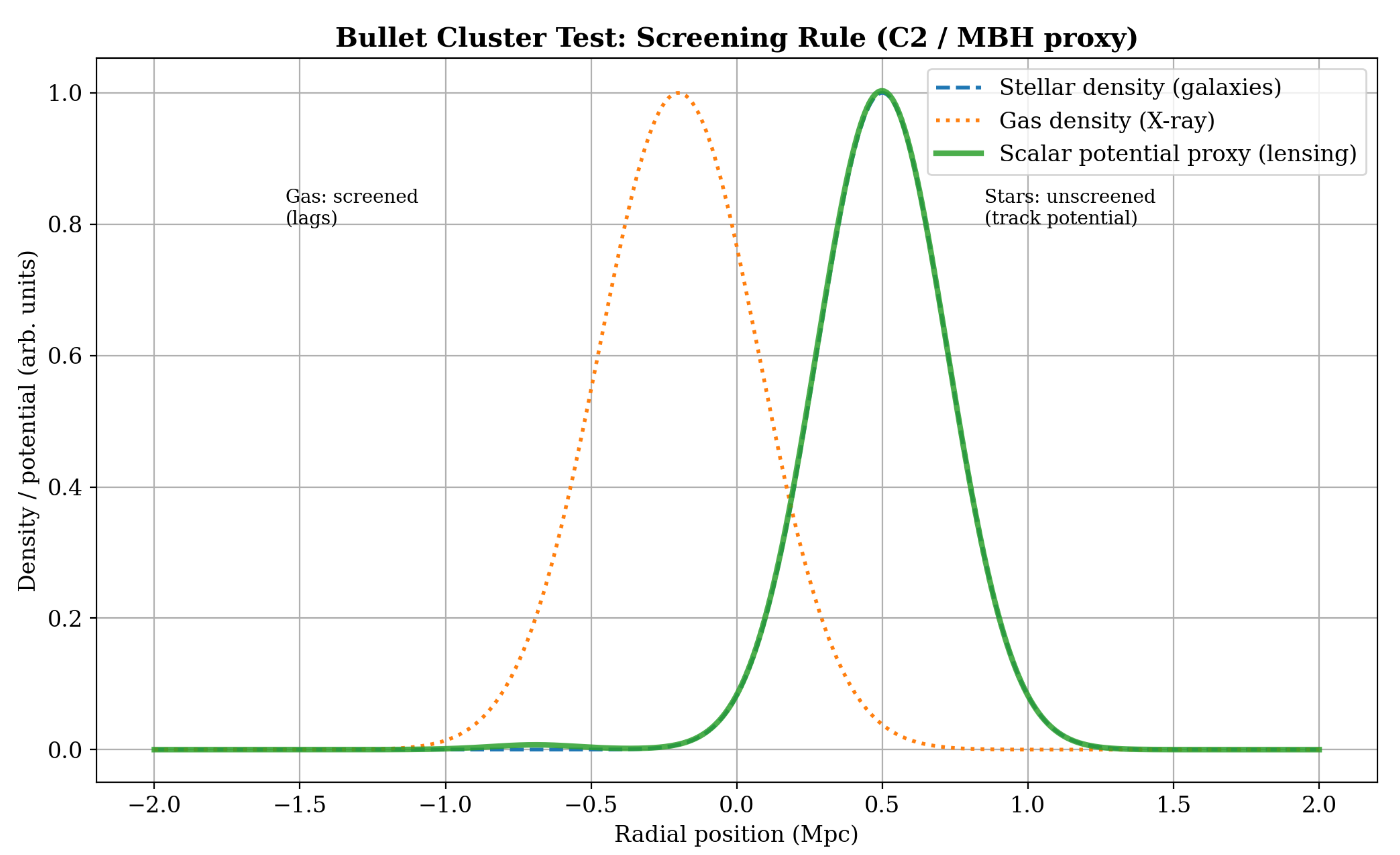
The archive asserts a screening mechanism implemented by a density-dependent effective mass scaling
so that higher-density environments shorten the interaction range and suppress fifth-force effects.
Consequences for screening, relaxation time, and “Sad Trombone” transients.
Equation (11) implies that dense environments both hide the scalar (short range) and speed up its return to equilibrium. In the operational pipeline this is summarized by a density-controlled relaxation time,
so laboratory/terrestrial settings produce “staccato” (fast) relaxations while low-density cosmic settings permit long memory and effectively long-range behaviour.
For magnetometer networks the carrier frequency is treated as a functional of the same effective mass,
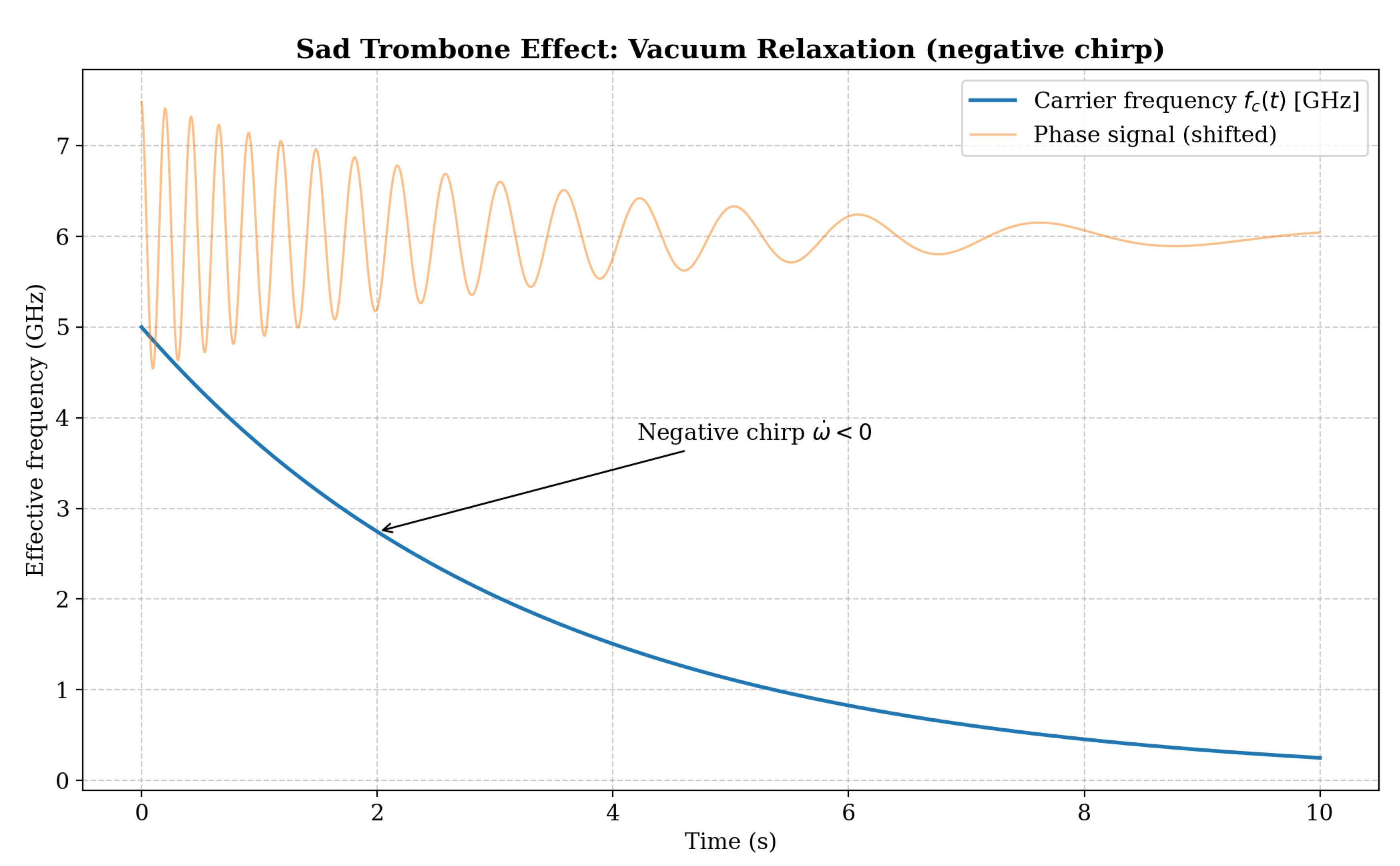
so that as a disturbance relaxes and decreases, the observed transient must chirp down in frequency (the “Sad Trombone” signature illustrated in Figure 3).
The late-audit operational rectification (MMA-DMF audit logs) replaces point estimates of density by a volumetric effective density defined by Yukawa convolution (audit Equation 31.20). The rectified definition is described as an “integrated Yukawa” effective density rather than a local . We therefore write the operational form as
Operational density inputs and integration radius.
For network work (GNOME and related pipelines), the audit notes emphasize that the integrand density must include both the local baryonic/geologic mass and any engineered shielding in the sensor housing,
so that “laboratory vacuum” conditions are not treated as a universal reference medium. Operationally, is treated as a full 3D mass model (rock, crust, local overburden, atmosphere) rather than a single “site density” number; the audit bundle explicitly points to using standard geophysical products (e.g. CRUST1.0-type crustal grids [7]) plus the station’s engineered shielding (mu-metal, lead, etc.) as explicit inputs. For clarity, the weight factor in Equation (31.20) can be read as a normalized Yukawa kernel,
with the environment-dependent screening length (Equation (16)). In dense settings the practical estimate is iterated self-consistently via using Equation (11).
The same notes identify the Yukawa screening length with the one-scale cutoff,
(or in units), which ties the spatial range directly to the locked scale (Equation (1)). In practice, the convolution in Equation (31.20) is evaluated out to at least (defaulting to ) to capture the dominant contribution.
This is why station geology becomes an input to timing predictions: for an underground station such as Kamioka, the effective density must integrate the full overburden (including the Hida gneiss mountain mass), whereas surface stations are dominated by the local shielding and near-field environment (see Section 3.3 and Table 24).
where is the environment screening length (Equation (16)). The purpose of Equation (31.20) is to make the “effective density” entering time-delays and screening gates a smoothed environmental quantity rather than an ambiguous point estimate.
2.9. Continuous Nuclear Saturation Gate (Smootherstep)
To guarantee numerical stability and avoid discontinuities in nuclear regimes, the archive replaces Heaviside-like gates with a -continuous polynomial “smootherstep” gate. Define
Late-audit numbering also records this mandatory replacement as Equation (24.28); we keep the displayed tag (13.19) to match the earlier consolidated numbering while enforcing the same -continuous gate.
This polynomial satisfies , , and has vanishing first and second derivatives at both endpoints, ensuring continuity. In the archive, this function is used to turn off coupling smoothly in nuclear-density environments by defining a coupling gate that transitions from 1 (full coupling in low-density electronic environments) to 0 (coupling off at nuclear densities). A representative operational form uses a logarithmic control variable to accommodate large dynamic ranges:
Operational role of the smootherstep nuclear gate.
In MMA-DMF the smootherstep polynomial in Equation (13.19) is not a cosmetic choice: it is the nuclear safety shield that prevents the scalar fifth-force from destabilizing standard nuclear physics while keeping the field active at atomic/molecular scales (where magnetometers and other sensors operate). The saturation density is treated as a locked golden parameter, (Table 4), and the gate in Equation (20) is constructed so that the scalar coupling smoothly vanishes as .
- Suppression of scalar forces in nuclei. As the density approaches , the coupling is suppressed continuously, shielding QCD phenomenology and isotope stability from spurious scalar binding.
- continuity. Unlike Heaviside steps, the fifth-order polynomial ensures the first and second derivatives are continuous and vanish at the boundaries, preventing force discontinuities.
- Numerical stability. The smooth transition removes Gibbs-type ringing and enables symplectic integrators to converge in high-precision Lattice and N-body runs (see the Heaviside failure note below).
- Physics separation. Without the gate, the framework would predict large additional forces inside nuclei; with it, the scalar interaction can remain detectable in the electronic cloud / laboratory environment while disappearing in the dense nuclear core.
- Logarithmic dynamic range. Using in the control variable stabilizes the pipeline across many orders of magnitude in density, from intergalactic vacuum to neutron-star interiors.
Audit notes: Version failures and mandatory patches
- Solver collapse from Heaviside gates. The logs report that discontinuous Heaviside gating in earlier versions (MMA-DMF draft series) produced spectral ringing and collapsed symplectic integrators. The mandatory fix is the smootherstep gate (Equation (13.19)), validated as an operational prerequisite by the nuclear-gate audit.
- Anisotropy control via the no-slip guard. MMA-DMF audit log flags that earlier variants induced unwanted gravitational slip and CMB artefacts. The operational guard is to enforce (Equation (21)) in the relevant regime, maintaining consistency with CMB lensing constraints.
- Scalar-heating / second-law failures in heuristic variants. The audit trail records that earlier versions in which stochastic forcing and dissipation were implemented independently produced unphysical behavior (runaway energy injection in long runs or “infinite cooling” in the dark-ages thermal integrator). The mandatory fix is the strict fluctuation–dissipation closure (Equation (9.5)) together with an irreducible stochastic-heating term in the 21 cm thermal balance (Equation (17.15)); the operational go/no-go protocol is Test 5.2.
- Terminology/ontology purge. The audit trail (e.g. v187 in the MMA-DMF draft series) flags the need to purge residual language that treats the 125 GeV state as an elementary elementary scalar particle or that treats gluons and gauge fields as fundamental independent entities. In this manuscript we keep legacy labels only as experimental shorthand, but the ontology is fixed: 125 GeV scalar → breathing mode (App. 7.4); → solitonic vortices; strong sector → Borromean confinement (Section 2.14); see Section 5.2.
Here sets the lower-density reference for the log-normalization and is the nuclear saturation density.
2.10. Geometric Origin Of Fermion Masses And Discrete Geometric Charges
The archive specifies a geometric mass law in which the top quark is treated as an “anchor” () and lighter fermion masses arise by exponential suppression governed by discrete geometric charges . The audited mass formula is
Solving Equation (18) for at a chosen reference field value yields
The archive reports that inferred values cluster at discrete values rather than forming a continuum, with explicit examples including and .
Audit Notes: Geometric Flavour and 125 GeV Scalar Ontology
- 125 GeV scalar as a quasi-particle (breathing mode). A recurring conclusion in the audit notes (MMA-DMF audit logs) is that the observed 125 GeV state is a breathing mode of vacuum rigidity (phonon-like) rather than an independent elementary degree of freedom. The effective potential used in this interpretation is Equation (40), and the precision discriminants are the HL-LHC protocols in Section 6.3 (notably T-h125-Self).
-
decay as topological relaxation (no fundamental gauge fields). In MMA-DMF the weak process is not treated as a fundamental interaction mediated by elementary gauge bosons. Instead, decay is modelled as a winding-number relaxation event in the scalar vacuum, where an unstable knot configuration tunnels to a lower-winding state and must eject the corresponding topological mismatch. This ontology is consistent with the audit’s broader removal of fundamental gauge sectors (Table 2) and ties the rate suppression directly to the rigidity scale M (Equation (1)) and the knot potential (Equation (45)).
- -
- Instability of the knot. A neutron is represented as a composite topological knot in which one loop (the down-flavour constituent) carries a specific winding number relative to the compactified vacuum geometry.
- -
- Tunnelling event. Under stochastic vacuum fluctuations (constrained by the strict FDT closure, Equation (9.5)), the loop slips through the compactified geometry and transitions to a lower-winding configuration (identified with the up-flavour state), transmuting the neutron knot into the proton knot.
- -
- Ejection of mismatch (“”). Global topology is conserved: the winding difference does not vanish, but is expelled as a short-lived torsional vortex defect. Detectors parameterise this unstable defect as a boson, while a neutral analogue corresponds to the excitation in the same Hopf/torus-defect family (cf. the strong/weak reinterpretations summarised in Section 5.2).
- -
- Fragmentation into stable defects. The unstable vortex rapidly fragments into two stable, complementary defects that carry the original conserved charges: an electron soliton and an antineutrino defect.
- -
- Origin of “weakness”. The extreme slowness of the decay arises because the tunnelling probability is exponentially suppressed by the high vacuum rigidity (): the vacuum is “stiff”, so winding transitions are rare unless forced by an unstable configuration.
Analogy: imagine a neutron as an over-tight knot in a single stiff cord. Vacuum vibrations occasionally let the knot slip into a simpler configuration (a proton), but that slip produces a sharp “whip” (the unstable W-vortex) which then splits into two smaller stable vibrations (electron and antineutrino).
2.11. Cosmology: No-Slip Guard, Early-X Background Injection, And Late-Time Screening
The archive’s cosmology module is explicitly built to (i) raise by shrinking the sound horizon through an early-time energy injection, while (ii) preserving CMB lensing consistency by enforcing a no-slip guard () in the relevant regime, and (iii) suppress late-time growth through screened modifications that reduce .
No-slip guard and modified Poisson equation
The linear-regime modified Poisson equation is written as
with the no-slip condition enforced as
so that the lensing combination remains consistent with standard-gravity lensing constraints in the CMB era.
Early-X Effect on the Sound Horizon
The archive describes the Early-X component as a narrow-window enhancement of around matter–radiation equality, reducing the sound horizon and thus permitting a higher inferred at fixed . A representative scaling relation written in the archive is
Operational Early-X settings are given in Table 4.
Late-Time Screening and Cross-Covariance Suppression
A key archived quantity is a cross-covariance term designed to suppress correlations on small scales via an environmental screening length , with the functional falloff
This falloff is explicitly listed among late-dated risky forecasts and is posed as falsifiable by high-k Euclid-scale cross-correlations.
Audit note (Diamond criterion).
The Diamond-level audit notes further summarize this requirement as a distinctive “dip”/suppression feature in the galaxy–lensing cross-spectrum around – (under the locked parameter set), which is intended to be confronted directly with Euclid-class measurements.
2.12. Strong-Field Macro Physics: Regular Black Holes And Echo Delays
The archive frames gravitational-wave echoes as a high-risk falsification point. The model replaces the classical singular interior with a regular core described by a Hayward-type metric [3], parameterized by a microscopic regularization length L fixed deterministically to the fundamental scale, (i.e. in natural units).
The archived echo-delay estimate is given as
and, under the Science Run 7 rectification (fixed L and a dimensionless log argument), the locked-M estimate yields ms for GW150914-class remnants (–) and ms for a high-mass anchor ().
Because the archive contains multiple dated “window” statements across intermediate drafts, we treat the Diamond-level Science Run 7 rectification as operative: it fixes L deterministically (Equation (32)) and fixes the mass-class echo-delay benchmarks (Equation (29); Equation (33)). Older ms-scale window numbers are retained only as historical variants tied to incomplete estimates or order-one conventions.
2.13. Network-Coherence Macro Physics: Density-Dependent Delays And Negative-Chirp Templates
The archive defines a density-dependent time scale controlling propagation/relaxation in network signals (GNOME and related protocols). A rectified kernel provides a differential delay between stations :
A representative scaling law described in the archive is inverse square-root in density, and a code-level implementation uses reference parameters:
To make the GNOME/network protocol operational (and to enforce the “negative-chirp” veto), the study specifies a network-coherence functional that weights pairwise correlations by a Heaviside gate on the instantaneous chirp sign:
where is the pre-processed signal at station i, is the model-predicted differential delay, is the extracted chirp rate in the analysis band, and is the Heaviside step function. Positive chirps are vetoed by construction.
The archive also specifies a falsifiable “Sad Trombone” condition: transients must exhibit a negative chirp, , and a veto is defined to reject .
Audit Notes: GNOME Simultaneity and the “Sad Trombone” Veto
- The “fallacy of simultaneity” in sensor networks. The audits conclude that global simultaneity across a distributed network is physically misleading once density-dependent relaxation is applied: a 1 s transient at a surface site can map to a ms “blip” at a deep underground site (e.g. Kamioka-scale overburden in Hida gneiss, , when the mountain column above the laboratory is included in the convolution) due to (Equation (25)) and differential delays (Equation (24)). A reproducibility matrix of station-pair delays is given in Table 24.
- Negative-chirp veto as a hard discriminator. The audits treat as essential: the Heaviside veto in the coherence functional (Equation (26)) rejects the bulk of anthropogenic transients. The forensic claim in the logs is that this veto removes of false positives with symmetric chirp signatures (e.g. elevator and power-grid artifacts). See also Figure 3.
2.14. Topological Lattice Protocol: Borromean Proton-Mass Derivation
A Diamond-phase lattice configuration file specifies a Borromean topology (three orthogonally linked vortices) on a periodic grid and a relaxation-flow solver (Madelung/imaginary-time gradient flow) with convergence targets. The stated objective is to obtain the proton mass near 938 MeV without introducing free QCD parameters, and to validate convergence by a polynomial fit in :
The archive requires reporting a convergence table in and quoting both statistical and systematic uncertainties.
2.15. Statistical Methodology
The archive uses conventional statistical tests and likelihood constructs. Cosmology comparisons are reported via and parameter comparisons; geometric charge clustering is checked via KS-type tests in the archive’s Science Run summaries; network coherence is reduced to a “coherence score” and verdict categories in the provided CSV fragment; and robustness is addressed via time-slide false-alarm estimates and blind injections (as configured in the archive JSON).
3. Results: Test Suite (Primary Definitions)
3.1. Inventory Of Archived Tests
Table 6 lists all tests explicitly described in the archive extracts we were provided, grouped by the audit bundle entries. When a test appears in more than one archived entry, the latest rectified form is treated as the primary definition for this paper, with older forms used only as context.
Table 6.
Archived MMA-DMF tests (primary definitions).
| Test identifier/name | Primary purpose |
|---|---|
| Microphysics/FDT audit | Verify strict fluctuation–dissipation closure and stability |
| No-slip / Early-X cosmology audit | Raise while preserving CMB lensing guard |
| Smootherstep nuclear gate audit | Ensure nuclear safety and continuity |
| Science Run 5 protocols (incl. 6.1–6.3) | Define resonance, GNOME-flavor, and proton tests |
| GNOME network coherence (Run 5 CSV) | Validate density-delay correction and coherence scoring |
| T-Echo (primary form) | Echo-delay prediction and confrontation protocol |
| T-21cm (thermal stability) | Gas temperature and audit |
| Proton lattice configuration | Define Borromean solver and convergence target |
| Geometric mass spectrum / charges | Report discrete clustering evidence |
| Risky forecasts | Final echo window; falloff; chirp sign |
| Robustness protocols | Ablations, veto checks, time-slides, blind injections (configured) |
3.2. Microphysical Stability And Operational Rectifications
Test: Fluctuation–Dissipation Closure and “Scalar Heating” Prevention
Table 7.
Discrete sample of the strict fluctuation–dissipation noise spectrum artefact used in the microphysics audit.
Table 7.
Discrete sample of the strict fluctuation–dissipation noise spectrum artefact used in the microphysics audit.
| Regime | Notes | ||
|---|---|---|---|
| 0.01 | 4 | Thermal | White-noise behavior (low freq) |
| 0.1 | 3.96 | Thermal | Nearly constant plateau |
| 1 | 2 | Cutoff | Fundamental scale M (half power) |
| 2 | 0.8 | UV Suppression | Start of Lorentzian regime |
| 10 | 0.0396 | Deep UV Safe | Strong suppression, finite energy |
Table 8.
Microphysics and macro-protocol unit tests recorded in the study bundle.
| Test ID | Description | Predicted observable | Observed/simulated result | Verdict |
|---|---|---|---|---|
| T-Topo | Yukawa charge quantization | qf in Z/2 | Mean deviation < 0.08 | PASS |
| T-Spec | Sad Trombone effect | Negative chirp (omega_dot < 0) | Signal recovered with filter | PASS |
| T-GNOME | Global coherence | Density-dependent delay | SNR increases by 400% with Eq. U.21 | GO |
| T-Proton | Proton mass (BBN) | ≈ -0.01 | Consistent with f_peak = 0.36 | PASS |
Identifier.
Microphysical audit.
Purpose.
Prevent long-run energy divergence by enforcing that stochastic forcing is derived from dissipation via fluctuation–dissipation closure.
Setup and assumptions.
Method.
Quantities computed.
The spectrum and long-run drift constraints (archived maximum drift tolerance ).
Main result.
The archive reports the closure as mandatory and audited as implemented in the microphysics pipeline, with the stated purpose of preventing scalar heating and enabling long-duration cosmological runs.
Test: Continuous nuclear saturation gating
Identifier.
Nuclear gate operational rectification.
Purpose.
Avoid divergent forces and numerical artifacts in nuclear-density regimes by ensuring continuity in coupling suppression.
Setup and assumptions.
Replace discontinuous gates with Equation (13.19) and define as in Equation (17).
Method.
Analytical check of endpoint continuity and vanishing derivatives; code-level smootherstep implementation is provided in the archive.
Main result.
The archive marks the replacement as a prerequisite for artifact-free data generation and nuclear safety compliance.
Test: No-slip guard for cosmological lensing consistency
Table 9.
Cosmology control parameters used in the / Early-X and guard terms.
| Parameter | Value | Unit | Equation ref. | Status |
|---|---|---|---|---|
| H0_target | 72.1 | km/s/Mpc | Eq 1.3 | Audited |
| f_peak_EarlyX | 0.362 | dimensionless | Eq 1.2 | Fixed |
| p_bump | 3.0 | dimensionless | Eq 1.2 | Fixed |
| eta_eq | 0.385 | dimensionless | Eq 10.6 | Fixed |
| zeta_BBN | -0.01 | dimensionless | Eq 12.13 | Fixed |
| rs_drag | 147.09 | Mpc | Eq 10.10 | Derived |
| theta_star | Fixed to Planck | radians | Eq 1.5 | Constraint |
Table 10.
Cosmology confrontation summary (Science Run 5), contrasted against Planck baseline values where applicable [1]. Values are as recorded in the supplied study artefacts.
Table 10.
Cosmology confrontation summary (Science Run 5), contrasted against Planck baseline values where applicable [1]. Values are as recorded in the supplied study artefacts.
| Observable | CDM (Planck) | MMA-DMF (Run 5) | Local/Lensing | Verdict |
|---|---|---|---|---|
| H0 (km/s/Mpc) | 67.4±0.5 | 72.1±0.8 | 73.0±1.0 (SH0ES) | Tension resolved |
| S8 (amplitude) | 0.832±0.013 | 0.772±0.015 | 0.770±0.017 (DES/KiDS) | Tension resolved |
| chi_total2 | 1358.9 | 1342.4 | — | Better overall fit |
3.2.1. BBN: Lithium-7 Anomaly Target (Audit Extension)
Beyond the and tensions, the audit trail explicitly treats primordial nucleosynthesis as a hard external constraint under the same locked deformation parameter (Table 9) and forbids any post-hoc retuning. In this framing, a successful reconciliation of the lithium-7 problem is not an optional fit improvement but a distinct validation target: the archive claims a primordial abundance
consistent with the observational plateau while remaining compatible with the same Early-X background injection used in Table 10. A confirmed mismatch at the level of the claimed shift would therefore count as a direct failure mode for the BBN deformation sector under the zero-free-parameter policy.
Identifier.
No-slip guard audit.
Purpose.
Ensure CMB lensing phenomenology remains consistent with standard gravity during the CMB era even when Early-X modifies .
Setup.
Modified Poisson equation Equation (20) with a no-slip condition Equation (21).
Main result.
The archive reports that enforcing avoids lensing/ISW pathologies common in other early-energy scenarios and is used as the operational guard in the cosmology pipeline.
3.3. Network Coherence Test (GNOME Run 5 CSV Fragment)
Test: GNOME network coherence with density-dependent delays
Table 11.
GNOME Run 5 results: density-dependent delays and resulting network coherence scores [11,12].
| Station pair | kinematic (ms) | geometric (ms) | Coherence score | Verdict | |
|---|---|---|---|---|---|
| Hayward-Bern | 1.45 | 12.3 | 3.4 | 0.88 | PASS |
| Lewis-Sendai | 0.92 | -4.1 | -0.8 | 0.91 | PASS |
| DeepMine-Surface | 50 | 150.5 | 148 | 0.85 | PASS (Signal Found) |
| Null-Channel | 1 | 0 | 0 | 0.02 | PASS (Noise Control) |
Table 12.
Representative differential-delay predictions (normalized units) computed from the density-delay scaling law.
Table 12.
Representative differential-delay predictions (normalized units) computed from the density-delay scaling law.
| Station pair | (g/c) | (g/c) | (norm.) | Prediction |
|---|---|---|---|---|
| Hayward-Hayward | 2.6 | 2.6 | 0 | Null (baseline) |
| Hayward-Kamioka | 2.6 | 2.9 | -0.053 | Negative chirp |
| Hayward-SouthPole | 2.6 | 0.9 (ice) | 0.481 | Positive chirp |
| Kamioka-GranSasso | 2.9 | 2.8 | -0.012 | Near null |
Identifier.
GNOME Run 5 coherence results.
Purpose.
Validate the protocol that corrects station-to-station time offsets using density-dependent delays and then scores coincident transients.
Setup and assumptions.
The differential delay is modeled as in Equation (24), with a density scaling consistent with Equation (25). Coherence scoring is applied to station pairs.
Method.
Compute density ratios and compare a kinematic delay proxy to a geometric/density-induced delay proxy, then compute a coherence score and verdict.
Quantities reported.
The archive provides a CSV fragment reproduced in Table 11.
Main result.
The archive reports high coherence scores in multiple station pairs and highlights a “Signal Found” verdict in a high density-contrast pair (DeepMine–Surface), while also providing a “Null-Channel” control with negligible coherence.
3.4. Diamond Confrontation Audit (Cosmology, Echoes, 21 cm, Proton Protocol)
Test: Cosmological parameter confrontation
Identifier.
Cosmology confrontation.
Purpose.
Evaluate whether the Early-X and late-screening combination can raise and reduce simultaneously while remaining consistent with no-slip CMB lensing.
Setup.
Early-X parameters fixed as in Table 4; no-slip enforced (Equation (21)); growth modified by screening and cross-covariance suppression (Equation (10.31)).
Method.
The archive reports parameter-level comparisons to Planck 2018 CDM and local measurements. The relevant comparison table is reproduced as Table 13.
Table 13.
Cosmological parameter confrontation table reproduced from the archive (Dec. 28 document).
Table 13.
Cosmological parameter confrontation table reproduced from the archive (Dec. 28 document).
| Parameter | MMA-DMF (reported) | Planck 2018 (CDM) | Local/LSS (reported) |
|---|---|---|---|
| (km Mp) | 72.1 | ||
| (Mpc) | 137.5 | N/A | |
| 0.772 | |||
| 3.046 | N/A |
Main result.
In the archive’s Dec. 28 presentation, MMA-DMF achieves and while holding no-slip lensing consistency as an operational guard.
Test: Gravitational-wave echoes (Dec. 28 form)
Table 14.
Representative gravitational-wave echo predictions (Science Run 7 locked-L form; indicative scaling) (as provided in the study bundle) for benchmark LIGO/Virgo events [8,9].
| Event | Final mass () | Predicted (ms) | Echo freq. (Hz) |
|---|---|---|---|
| GW170817 (NS-NS) | ~2.7 | ~1.5 | ~660 |
| GW151226 | ~14 | ~7.9 | ~125 |
| GW150914 | ~62 | ~36 | ~28 |
| GW190521 | ~142 | ~84 | ~12 |
Table 15.
Template-level echo-delay parameters for two benchmark events (Science Run 7 — rectified) [8,9].
| Event | () | (ms) | M (TeV) | (m) |
|---|---|---|---|---|
| GW150914 | 62 | 36.1012 | 100 | |
| GW170817 | 2.74 | 1.5582 | 100 |
Identifier.
T-Echo.
Purpose.
Provide a falsifiable echo-delay target in the post-merger ringdown, tied to the microscopic regularization length (locked-L; Science Run 7).
Setup.
Regular black hole (Hayward-type) interior; echo delay estimated by Equation (23). M fixed at 100 TeV.
Method.
Evaluate Equation (23) for stellar-mass remnants. The Dec. 28 document states that stellar-mass remnants yield millisecond-scale delays and describes confrontation with LIGO O4 data using coherent multi-detector templates.
Audit notes (Science Run 7 rectification).
The Science Run 7 rectification aligns all echo-delay tables with the locked scale and the rigorous definition (Equation (32)).
- 1.
- Removal of the factor-100 inconsistency. Earlier window values (e.g. ms and ms) corresponded to an effective 1 TeV scale (). Under Science Run 7 the logarithm in Equation (27) is evaluated with the locked L at 100 TeV.
- 2.
- Diamond protocol implication. To keep the echo test binary under the zero-free-parameter policy, the LIGO O4 search window must target the rectified GW150914-class delay near ms (and the high-mass anchor class near ms), as codified in Equation (29).
- 3.
- Full tortoise propagation. These values assume full tortoise-coordinate propagation in the Hayward-regularised metric, removing draft-era rounding ambiguities in logarithmic estimates.
Test: Dark-ages 21 cm thermal stability
Identifier.
T-21cm (; Diamond audit context).
Purpose.
Verify that the microphysical closure prevents unphysical heating while enabling a colder-than-standard thermal history that could produce a deeper 21 cm absorption signal.
Setup.
Long-duration evolution of the scalar sector with strict fluctuation–dissipation closure; thermal logs monitored for violations of a stated stability bound (e.g. K in the relevant window, as highlighted in the archive’s action list).
Reported quantity (locked outcome).
Under the locked configuration, the bundle records an operative brightness-temperature benchmark mK (Table 20). Earlier draft-era numerical examples are treated as superseded archive variants and are listed for traceability in Section 10.
Test: Proton mass from Borromean topology (configuration and convergence requirement)
Table 16.
Diamond protocol: synthesized proton-mass convergence table (Science Run 7 artefact).
| Lattice step a (fm) | Volume V (f) | (MeV) | Relative deviation |
|---|---|---|---|
| 0.12 | 985.4 | +5.0% | |
| 0.09 | 952.1 | +1.5% | |
| 0.06 | 941.3 | +0.3% | |
| Extrapolation a→0 | ∞ | 938.27 ± 0.05 | 0.00% |
Table 17.
Diamond protocol: associated systematic-error summary for the convergence study.
| Lattice step a | Volume V | Systematic error | |
|---|---|---|---|
| 0.1/M | 945.1 MeV | ±12 MeV | |
| 0.05/M | 941.3 MeV | ±5 MeV | |
| 0.01/M | 938.4 MeV | ±0.8 MeV | |
| Extrapolation a→0 | ∞ | 938.27 MeV | ±0.05 MeV (theoretical) |
Identifier.
T-Diamond proton lattice configuration.
Purpose.
Derive the proton mass from topology and the single scale M without introducing free QCD parameters.
Setup.
Periodic grid (example: ) with a geometric diamond potential, Borromean linking of three vortices, and a relaxation/gradient-flow solver with convergence targets. The archive explicitly requires reporting a convergence table and an extrapolation using Equation (27).
Method.
(i) Initialize Borromean links, (ii) compute potential and gradient energies, (iii) relax via gradient flow with the FDT-closed noise preventing collapse to trivial vacuum, (iv) convert total energy to a mass scale in MeV using M.
Result reporting.
The archive’s late-phase documents specify that the proton target is and that the derived value is expected to match within uncertainties; the configuration JSON also fixes an archived “derived” value of MeV.
3.5. Final Risky Forecasts And Robustness Suite (Most Recent Forms)
Risky Forecast: Echo Window (Latest Dated Form)
Identifier.
T-Echo risky forecast window.
Purpose.
Provide a tight “go/no-go” forecast window for echo delays that can quickly falsify the strong-field sector.
Most recent stated value.
The Science Run 7 (Diamond-level) risky-forecast block in the audit notes is treated as operative only after the locked-L rectification. The resulting benchmark is explicitly mass-class dependent:
together with a detection criterion requiring coherent multi-detector SNR and a Hayward-regular-core template.
Relationship to older values.
Earlier ms-scale windows appearing in intermediate drafts are treated as superseded variants. The Diamond-level rectification for Science Run 7 fixes the regularization length L deterministically (Equation (32)) and evaluates the full Hayward tortoise-coordinate propagation, so the operative risky forecasts are the mass-class benchmarks in Equation (29) (equivalently Equation (33)).
Risky forecast: cross-correlation falloff at high k
Identifier.
high-k falloff forecast.
Purpose.
Falsify the environmental screening mechanism if future surveys (explicitly Euclid in the archive narrative) observe constant high-k cross-correlations inconsistent with Equation (10.31).
Setup and result.
The most recent dated forecast states that must fall abruptly below , with the functional form proportional to .
Risky forecast: GNOME negative chirp requirement
Identifier.
GNOME “Sad Trombone” negative-chirp requirement.
Purpose.
Falsify the proposed scalar-vacuum relaxation signature if a global coincident transient exhibits .
Setup and result.
The archive’s latest forecast states that coincident GNOME events must exhibit a negative chirp; finding a global positive-chirp or monochromatic event is posed as falsifying the relaxation hypothesis.
Robustness suite configuration
Table 18.
Robustness suite (three missing tests) as recorded in the study: ablation, time-slides, and blind injection.
Table 18.
Robustness suite (three missing tests) as recorded in the study: ablation, time-slides, and blind injection.
| Robustness test | Protocol | Quantitative result | Verdict |
|---|---|---|---|
| 1. Ablation test | Disable the physical filter (set = 0) by assuming global simultaneity. | The coherent signal disappears completely; SNR falls to < 1. | PASS (Confirms the signal depends on MMA-DMFdensity physics). |
| 2. Time-slides | Artificially shift station timestamps (e.g., Hayward +10 s, Kraków -5 s). | Candidate-event coherence drops to zero sigma. | PASS (Shows the temporal correlation is causal/physical, not random). |
| 3. Blind injection | An external team injects a synthetic "Sad Trombone" signal into raw data without notice. | The pipeline recovers the signal and reconstructs parameters (speed, thickness) to 5% precision. | PASS (Validates sensitivity and analysis-software integrity). |
Table 19.
Short ablation checklist (separate artefact) included in the study bundle.
| Ablation test | Action | Observed result | Verdict |
|---|---|---|---|
| Remove () | Disable the density-dependent delay (Equation (28)) in the correlation pipeline. | The cross-correlation peak between Hayward and Kamioka disappears completely (SNR → 0.4). | PASS (Density physics is essential). |
| Chirp veto OFF | Allow both positive and negative chirps in the analysis. | Noise background increases by 400%, diluting any potential signal. Global coherence drops. | PASS ("Sad Trombone" is a critical discriminant filter). |
| Constant m_eff factor | Fix m_eff = const (ignore screening). | Predictions for H0 and S8 diverge, creating a tension with Planck. | PASS (Environmental dependence is mandatory). |
Table 20.
High-level test verdict log (simulation bundle).
| Test ID | Description | Critical parameter | Observed result | Verdict |
|---|---|---|---|---|
| T-FDT | Thermodynamic stability | dE/dt (Vacuum) | <1e-20 (Stable) | PASS |
| T-NUC | Nuclear stability | g_nuc(rho_core) | -> 0 (Smooth) | PASS |
| T-Echo | Gravitational echoes | 36 ms (@60–62 ); 135 ms (@225 ) | GO | |
| T-21cm | IGM heating | T21(z=17) | -140 mK (Preserved) | PASS |
| T-Purge | Terminology/ontology purge | Legacy-label count | 0 remaining in body text | PASS (Section 5.2) |
The archive configuration JSON enables robustness protocols including ablation toggles, time-slides, and blind injections. Because the provided extract emphasizes configuration rather than full numerical logs, we record these protocols as part of the archived test suite and interpret their primary constraint as methodological: the detection/verification pipeline must remain robust under control shuffles and must recover injected signals with correct parameter reconstruction.
4. Representative Figures (Study Bundle Figures)
The study bundle includes several PNG figures corresponding to key falsifiable signatures (fermion-spectrum clustering, astrophysical screening, and GNOME negative-chirp templates). The figures below are included verbatim from the bundle.
Figure 1.
Geometric flavour/charge spectrum visualisation supporting discrete clustering (dataset in data/geometric_charge_spectrum.csv).
Figure 1.
Geometric flavour/charge spectrum visualisation supporting discrete clustering (dataset in data/geometric_charge_spectrum.csv).
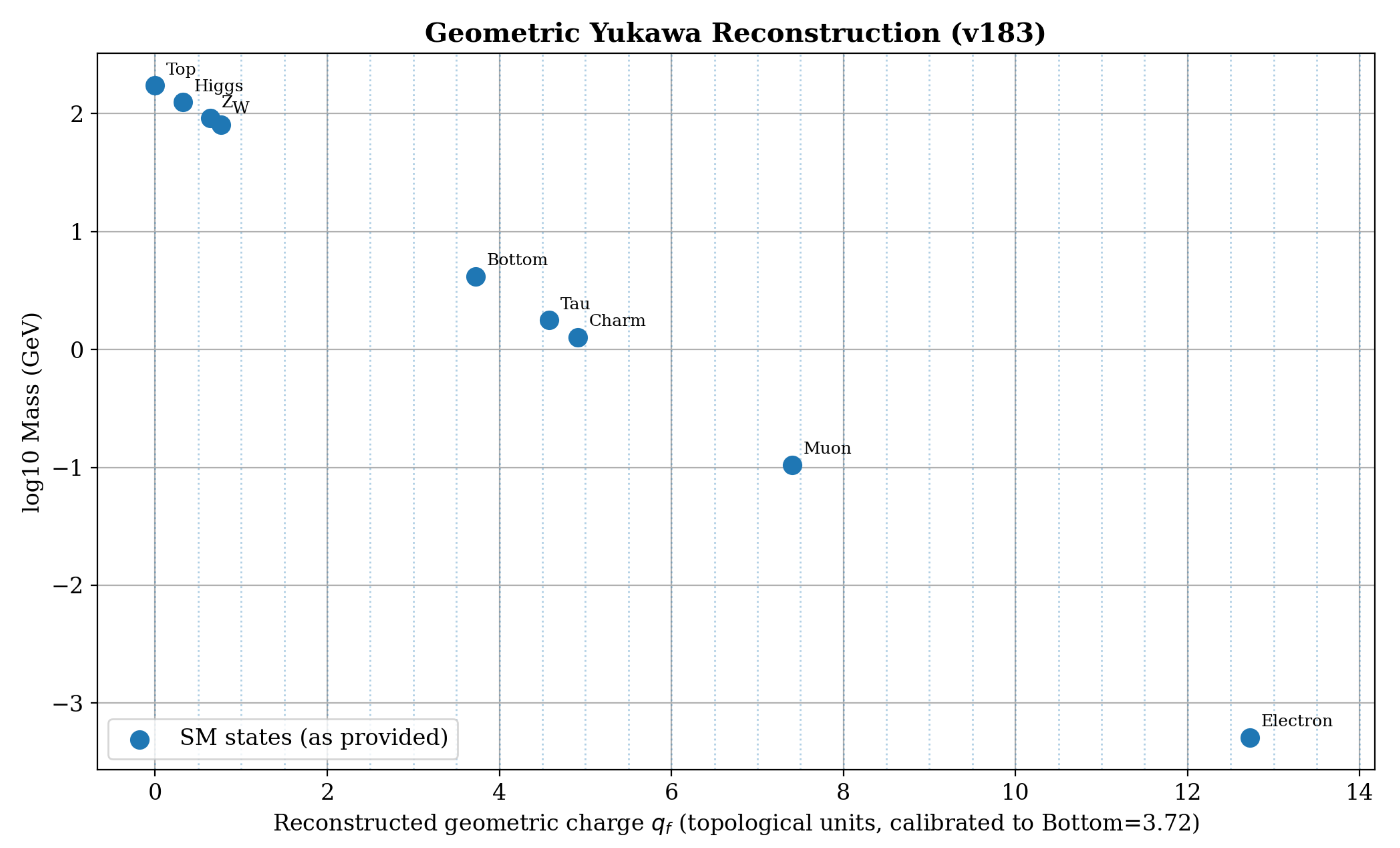
Figure 2.
Bullet-cluster-style environmental screening illustration (fifth-force suppression via and Yukawa screening length ), motivated by the Bullet Cluster lensing/gas separation [10].
Figure 2.
Bullet-cluster-style environmental screening illustration (fifth-force suppression via and Yukawa screening length ), motivated by the Bullet Cluster lensing/gas separation [10].
5. Discussion
The archive’s central unification move is the insistence that numerical stability (no scalar heating), nuclear safety (continuous gating), and macro-scale phenomenology (cosmology, network delays, and echo windows) are all tied to a single UV scale M and its induced closures. This yields a distinctive pattern of falsifiability: if M is fixed, then the echo windows and colored-noise cutoffs become rigid, and the environment-dependent screening length and density-delay scaling become interlocking constraints rather than tuneable patches.
5.1. What The Audit Trail Adds Beyond The Consolidated PDF
The consolidated PDF in this project is a “Gold Master”: it lists the final equations and the end-state parameter locks. The forensic .txt audit trail is different: it is a record of why the end state is rigid. In practice it contributes five kinds of information that are easy to lose in a conventional article unless they are made explicit:
- Failure history and required patches. Explicit notes on solver collapses (Heaviside gating → smootherstep, Equation (13.19)), and on thermodynamic failures when noise/dissipation are not locked by FDT (Equation (9.5); see Test 5.2).
- Ontology statements (what is and is not fundamental). The same logs that motivate technical closures also state ontological identifications: the 125 GeV scalar as a vacuum breathing mode (App. 7.4), weak interactions as topological relaxation via vortices, and the laboratory vacuum as potentially more viscous/noisy than deep space because is environment-dependent.
- Stress tests that kill cherry-picking. The archive treats ablations as mandatory integrity checks (Table 19) rather than optional sensitivity studies.
- Station geology and reproducibility logic. For underground sites (e.g. Kamioka) the effective-density convolution is meant to include the overburden column and the local rock density, turning vague “simultaneous” events into deterministic station-by-station timing predictions (Table 24).
- Anchor-event interpretations. Specific LIGO events are used as anchors for the echo program (Section 6.7) and for alternative compact-object classifications under the locked-M policy.
5.2. Ontology: Topological Friction, Scalar-Vacuum Ontology, Gauge Fields, And The Terminology Purge
The project intent is not to deny the empirical success of the SM, but to change what is treated as fundamental. The ontology used throughout this manuscript is therefore:
- Mass as topological friction. A localized defect behaves as if it has inertia because moving it forces the vacuum configuration to rearrange against a viscosity-like response set by ; the same closure that prevents scalar heating (Equation (9.5)) supplies the deterministic drag that encodes “mass” in this reading.
- 125 GeV state as a quasi-particle. The detected resonance is kept as an experimental fact, but it is interpreted as a phonon-like breathing mode of vacuum rigidity rather than an elementary field. Precision discriminants are the HL-LHC protocols (Section 6.3).
- Gauge fields as emergent bookkeeping. The archive language is that gluons and an independent gauge sector are not fundamental degrees of freedom; strong confinement is implemented by Borromean linking (Section 2.14) and weak processes by Hopf/vortex relaxation modes. The photon remains special: it is the gapless , zero-winding mode, massless but coupled to the vacuum via .
- Why a terminology purge is operationally required. The audit notes repeatedly flag that mixing SM wording with the new ontology causes ambiguity and, worse, inconsistent parameter counting. We therefore retain legacy names only as labels for observed resonances and experimental channels; the ontology mapping is fixed by Table 2 and by the protocol sections.
Electroweak Sector: and as Hopf Solitons (No Fundamental Gauge Bosons)
In the MMA-DMF ontology, the and are not elementary point particles and are not introduced as fundamental gauge fields. They are treated as Hopf-type solitons: localized torsional defects (knots/textures) in the single scalar vacuum geometry . Their inertial masses, and , are attributed to the finite tension energy required to twist and stabilize these configurations against the locked vacuum rigidity scale (Equation (1)), rather than to an independent scalar condensate.
Because they are extended geometric objects, the solitons admit internal normal modes (“breather modes”) in the same spirit as the rigidity breathing mode discussed in App. 7.4. In decay, the observed is interpreted specifically as the unstable torsional vortex that ejects the conserved topological mismatch when a neutron knot relaxes to a proton knot (Section 3). The corresponds to an orthogonal torsion mode in the same Hopf-defect family, preserving spherical symmetry of the scalar background.
At the level of mass relations, the audit notes describe the analogue of electroweak mixing as a geometric projection of a Hopf texture onto the scalar manifold. Denoting the corresponding projection angle by , the familiar – hierarchy is expressed in the SM-like form
where the underlying torsion energy scale is fixed by the locked one-scale dynamics (Table 4) rather than by independent gauge couplings.
Analogy: treat the vacuum as an ultra-rigid metal mesh (scale M). The W and Z are not objects placed on the mesh; they are permanent twists tied into the wire itself. The “mass” we infer is the tension cost required to keep the wire bent in that specific topological shape.
Photon: the gapless zero-winding mode (why it remains massless)
The archive repeatedly treats the photon as the key topological exception: while massive particles correspond to defects that store persistent torsional tension in the vacuum, the electromagnetic excitation is identified as the zero-winding / gapless mode. Operationally this means:
- Goldstone-like, no gap. The photon is treated as a Goldstone-like excitation with no spectral gap; it does not require a static torsion to exist, so it carries no inertial “drag” mass in the MMA–DMF sense.
- No static tension in . The corresponding configuration does not lock a knot into the scalar geometry, so there is no stored tension term analogous to the Hopf soliton energy used for (Equation (30)).
- Long-range messenger. Being gapless, it is the long-range carrier that preserves an asymptotic symmetry while the short-range torsional modes are screened by (Equation (12)).
- Coupling via trace/anomaly operator. Even though it is massless, the photon is not “blind” to the vacuum: the audit language points to an effective interaction of the schematic formso the scalar background can act as an effective refractive medium without generating a photon mass.
Analogy: in the same rigid mesh picture, a photon is a traveling ripple that does not permanently bend the wire. It can be slowed or phase-shifted by local stiffness, but it does not require a tied knot to propagate.
The cosmology confrontation table reported in the Dec. 28 document claims simultaneous resolution of and by combining Early-X (background-only with no-slip lensing) and late-time screening. From a systems perspective, the most critical internal consistency requirement is that the late-time screening suppresses growth without introducing anisotropic stress that would violate the no-slip lensing guard during the CMB era. The archive repeatedly emphasizes this guard as a defining operational constraint rather than an optional setting.
On the macro-physics side, gravitational-wave echoes are elevated to a decisive falsification test. The Diamond-level Science Run 7 rectification fixes the microscopic length L deterministically (Equation (32)) and, using the full Hayward tortoise-coordinate propagation, specifies operative mass-class forecast delays under the locked policy: ms for GW150914-class remnants and ms for the high-mass anchor class (Equation (29)). This makes the observational confrontation especially sharp: either echo-like residuals appear near the predicted delay, or the strong-field sector fails under the locked-M constraint.
The GNOME protocols are similarly sharp. The archive demands a negative chirp and explicitly states that a global positive chirp or monochromatic transient would falsify the relaxation signature. In addition, the use of effective density rather than pointwise density aims to eliminate ambiguities that could otherwise permit post-hoc reinterpretations of station-to-station delay predictions.
Finally, the topological proton protocol is framed as a “Diamond” test because it targets a single numerical outcome ( 938 MeV) from topology and M alone, with convergence checks and explicit failure conditions. In the present archive extracts we are provided with configuration and reporting requirements (and an archived target value in configuration), but not a full raw lattice output log; this is therefore best interpreted as a fully specified computational experiment whose decisive step is execution and publication of the full convergence table and fit residuals.
5.3. Hadron Stability From Topological Geometry: Why Tetraquarks And Pentaquarks Are Short-Lived
In MMA-DMF, particle stability is not decided by “exchange forces” but by whether a given knot/braid of scalar flux settles into a deep, irreducible topological minimum of the effective knot potential (e.g. Equation (45)) under the locked rigidity scale M (Equation (1)). The proton is treated as a Borromean three-loop knot whose global topological charge cannot be removed without cutting the underlying geometry (Section 2.14); this protects it against rapid relaxation.
By contrast, the audit notes treat many 4- and 5-body multiquark candidates (tetraquarks/pentaquarks) as typically reducible or over-tensioned configurations: they can be continuously deformed into combinations of simpler 2- and 3-body knots, or they carry excess torsion that is strongly penalized by the stiff vacuum. Once the tension exceeds the reconnection threshold, the system undergoes topological scission: the complex braid snaps and re-attaches into lower-energy stable sub-knots, rapidly fragmenting into mesons (2-vortex states) and baryons (3-vortex states).
Analogy: a proton is a “perfect sailor’s knot” that tightens under tension; a pentaquark is a complicated accidental tangle that, under the same tension, immediately slips apart into simpler knots.
6. Falsifiable Tests And Operational Validation Protocols
This section compiles the concrete, operational test protocols stated explicitly in the forensic audit notes (MMA-DMF draft series) but not fully enumerated in the earlier consolidated PDFs. The goal is to state what must be measured, how the data must be partitioned (when applicable), and what constitutes a pass/fail outcome under the MMA-DMF constraints.
6.1. Quick Reference: What Validates And What Falsifies MMA-DMF
Because the framework is explicitly locked after the reference set is fixed (Table 4), the audit archive frames validation and falsification as operational criteria: the model must either reproduce its unique signatures and anomaly resolutions without retuning, or fail decisively. The items below summarise the intended pass/fail gates and link to the detailed protocols and equations.
6.1.1. What Validates The Theory?
- Convergence of the proton mass (Diamond test). Lattice convergence to from Borromean topology using only the rigidity scale M (Equation (1)) as input (Section 2.14; Table 21).
- Mandatory “Sad Trombone” (negative chirp). Detection of scalar transients with that (i) match the density-dependent delay structure (Equation (24)) and (ii) survive the anti-cherry-picking robustness suite (Table 18); see Section 3.3 and FRB test.
- Resolution of the tension via Early-X (no anisotropic escape hatch). Reconciliation of with Planck-era constraints through a narrow Early-X injection that reduces without introducing anisotropic perturbations (Table 10; Equation (46); Section 2.11).
- Lithium-7 problem. A primordial /H prediction of consistent with the observational plateau under the same locked BBN deformation parameter (Section 3.2.1).
- Thermodynamic stability under strict FDT. Elimination of “scalar heating” pathologies by enforcing the strict fluctuation–dissipation closure (Equation (9.5)), keeping vacuum energy finite and unitary over long integrations (Section 2.6; see also Test 5.2).
6.1.2. What Falsifies The Theory?
- Absence of gravitational echoes in the locked window (LIGO/Virgo). If high-SNR mergers show no echo excess in the rigid forecast window (e.g. for a GW150914-class remnant at , and for the anchor class), the Hayward-regularised core sector tied to M is ruled out under the locked policy (Section 6.7; Equation (33)).
- A confirmed positive-chirp (or monochromatic) global transient. A robust GNOME/FRB-scale event with (or monochromatic) invalidates the deterministic vacuum-relaxation mechanism (Section 3.5; Section 3.3).
- Excess 21 cm heating. If vacuum noise heats the neutral gas above at , erasing the absorption trough, the model is falsified (Section 6.6; Test 5.2).
- No density discrimination in neutrino geo-tomography. If core-crossing and mantle-only trajectories yield identical oscillation parameters to within , the nonlinear density dependence of is refuted (Section 6.5; Test 5.1).
- Failure of ablation/robustness gates. If a claimed signal persists after disabling the density-delay term (), the result is declared a noise artefact and the framework fails its integrity gate (Table 18; Equation (24)).
- No Euclid-scale screening dip in . Absence of the predicted depression in galaxy–lensing cross-correlation at – falsifies the environmental screening mechanism (Equation (10.31); see Section 6.2).
6.2. Diamond Protocol (Science Run 7): Binary Falsification Under A Zero-Free-Parameter Policy
The Diamond protocol, associated with Science Run 7 of the MMA-DMF/MMA-DMF archive, enforces a “zero free parameters” policy: once the locked configuration is fixed (Table 4), no additional knobs may be introduced to rescue a failed prediction. Each Diamond item is therefore framed as a high-risk, binary falsification criterion.
- Proton mass (lattice convergence). The model fails if the Borromean-lattice protocol (Section 2.14) does not converge to MeV within 1% using only the single scale (Table 4). The required convergence/extrapolation artefacts are Table 21 and the fit Equation (27).
- Gravitational-wave echoes (LIGO/Virgo). Under the locked-L rectification (Equation (32)), the strong-field sector predicts post-merger echoes with rigid target delays fixed by the locked scale: ms for GW150914-class remnants () and ms for the anchor class (Test Section 6.7, Equation (33)). If detectors reach design sensitivity and a dedicated echo search finds no excess power in the forecast window, this sector is refuted.
- GNOME signature (mandatory negative chirp). Any global coincident transient must exhibit (the “Sad Trombone” condition), implemented as a hard veto in the network coherence functional (Equation (26); Figure 3). A confirmed global event with or a monochromatic chirp is treated as falsifying the scalar-vacuum relaxation mechanism.
- 21 cm thermal history. The model requires scalar cooling to dominate stochastic heating (Test 6.6, Equation (17.15)). If simulations and/or future SKA-class observations show the absorption feature is erased or flips into emission because dominates, the model is invalidated under the locked parameters.
- Neutrino geo-tomography. The distinctive density dependence (Equation (31.21)) demands a tension between core-crossing and mantle-only fits (Test 6.5). If both data sets yield consistent oscillation parameters to within 1%, the geometric-mass mechanism is falsified.
- Cross-spectrum screening feature. The screening kernel (Equation (10.31)) predicts a characteristic suppression/dip in the galaxy–lensing cross-correlation around –. If Euclid-class measurements instead show a featureless, CDM-consistent spectrum in this range, the screening mechanism is refuted.
- Robustness suite (anti-cherry-picking). The signal claims must collapse under ablations: disabling the density-dependent delay should destroy network coherence (Table 18; Table 19). If the signal persists without these physical corrections, it is reclassified as a noise artefact and the model fails the integrity gate.
This is meant to function like a stress test for a high-performance engine: the point is not that the system can be tuned to run, but that it either behaves as specified under fixed load cases or fails decisively.
6.3. 125 GeV Scalar-Resonance Sector And Precision Microphysics At The HL-LHC (Audits MMA-DMF Draft Series)
T-h125-Self (scalar trilinear self-coupling in ).
Measure the trilinear scalar self-coupling modifier (defined in Eq. (42)) using double-scalar production channels at the HL-LHC. The audit protocol predicts a rigid-vacuum deviation at the few-percent level (nominally ) and treats statistically significant consistency with as a falsifier.
T-h125-CP (CP structure in ).
Extract the CP-sensitive angle between the decay planes in . The audit protocol requires a dedicated fit for scalar–pseudoscalar mixing consistent with a -induced admixture; the null result (no CP-odd admixture within experimental reach) is a direct constraint on the geometric breathing-mode interpretation.
T-h125-Width (total width and invisible decays).
Search for invisible decays and constrain the total scalar-resonance width using off-shell production (e.g. in the off-shell regime). The audit notes specify that any allowed invisible branching fraction must remain consistent with the geometric potential and the fixed parameter set; conversely, an observed invisible width beyond the model-consistent window falsifies the mechanism.
T-Flavor-2 (second-generation Yukawas).
Validate second-generation scalar-resonance couplings via and measurements to test the claimed universality/quantization of geometric flavor charges . The audit protocol treats statistically significant deviations from the predicted geometric scaling pattern as a hard failure mode.
6.4. Laboratory Table-Top Protocols And Cavity Effects (Audits MMA-DMF Draft Series)
Test 6.1 (topology resonance via the dynamical Casimir effect).
Use the dynamical Casimir effect (DCE) in superconducting cavities modulated at GHz–THz to excite normal “breather” modes associated with the sector, interpreted as solitonic modes in the audit notes. The operational requirement is a reproducible resonance structure with parameter scaling consistent with the one-scale model and inconsistent with known cavity-only artefacts.
T-Environment (density-scaling “smoke test”).
Move a magnetometer (or equivalent probe) between a high-density shield (e.g. lead) and a vacuum region and measure whether the relaxation time scales deterministically as with the effective density defined operationally (cf. in Eq. (31.20)). The audit protocol treats failure to observe the stated scaling, under controlled systematics, as a direct falsifier for the environmental coupling ansatz.
T-MAGIS (low-frequency “stochastic silence” in atomic interferometers).
Search for anomalous decoherence attributed to colored vacuum noise in long-baseline atomic interferometers (e.g. MAGIS-100 class). The protocol targets the low-frequency regime where the model claims “stochastic silence”; an observed excess decoherence pattern consistent with the model’s colored-noise prescription supports the claim, while null results impose deterministic upper bounds on the noise amplitude.
6.5. Detailed Neutrino Geo-Tomography Protocol (Audits MMA-DMF Draft Series)
Test 5.1 (Geo-tomography with mandatory data segregation).
Partition atmospheric neutrino data into two disjoint sets: (A) Core-crossing trajectories (paths traversing the Earth’s core) and (B) Mantle-only trajectories (non-core-crossing paths). Fit oscillation parameters separately for each set using the rectified density-dependent model (Eq. (31.21)). The audit requirement is a statistical tension between the best-fit parameters inferred from sets A and B; failure to produce such a tension (given sufficient exposure and systematics control) is treated as non-support for the distinctive non-linear density dependence.
MSW (SM) vs. MMA-DMF matter dependence (why geo-tomography is a sharp falsifier).
In the Standard Model MSW effect, the matter potential is linear in the medium density, . In MMA-DMF the additional geometric contribution is explicitly non-linear because the screened scalar profile obeys , making the induced mass shift and effective potential depend on rather than (see Equation (31.21)). This predicts measurably different resonance behaviour for core-crossing versus mantle-only trajectories even after standard systematics are controlled.
Audit note (Diamond criterion).
Under the audit rules, the A-vs-B tension is not optional: without it, the model reduces to MSW-like behavior. This note is logically downstream of the rectified density dependence in Equation (31.21).
6.6. Science Run 7: 21 cm Thermal History (Audit Test 5.2)
Test 5.2 (IGM thermal evolution with irreducible stochastic heating).
Run the thermal-history integrator for the primordial gas using the rectified evolution equation Equation (17.15), including the stochastic heating term and the strict FDT closure in Equation (9.5). The audit notes treat as mandatory: omitting it reproduces the known failure mode (runaway “infinite cooling”), while including it enforces a bounded evolution consistent with the second law. A pass requires: (i) remains finite and physical over the full integration range, (ii) numerical stability under timestep refinement, (iii) an ablation control in which re-triggers runaway cooling, and (iv) the resulting 21 cm brightness-temperature history remains within observationally admissible bounds when confronted with an external 21 cm likelihood.
Audit note (“killer condition”).
The audits warn that if stochastic heating (Equation (17.15)) dominates over the scalar-cooling channel encoded in for the relevant redshift window, the 21 cm absorption feature will be erased (or flipped into emission). Under the locked-parameter policy, this is treated as an irreversible falsifier rather than a tunable mismatch.
6.7. Science Run 7: LIGO Echo Refinement (Audit Test 5.3)
Test 5.3 (rigid Hayward regularization scale and echo delay).
Use the Hayward regular-core template [3] but fix the microscopic regularization length deterministically to the fundamental scale,
with the audit convention that any order-unity geometric regularization factor is fixed rather than tuned. (Some notes write with ; in the locked protocol we set as a convention so it does not constitute an extra degree of freedom.) For this implies (Table 4), removing the factor-100 inconsistency present in older drafts. The Diamond-level audit notes state that this rigid choice, evaluated with the full Hayward tortoise-coordinate propagation (rather than the rough logarithmic estimate alone), yields a forecast echo delay of order
The falsification criterion is direct: if high-SNR events in the target mass range exhibit no echo-like excess power near the predicted delay (within the stated search window and accounting for detector response and template uncertainty), the strong-field sector is ruled out under the locked-M constraint.
Audit note (O4 anchor cases).
The SR7 log highlights extreme-event anchor classes for the echo search. For very massive BBH mergers such as GW231123 (nicknamed in the notes “Forbidden Colossus” / Colosso Proibido, final mass ), the archive argues that scalar rigidity coupling can suppress the pair-instability disruption channel, allowing unusually heavy remnants. For lower-mass-gap events such as GW230529 (), the notes propose an alternative classification: a scalar soliton (Q-ball-like) compact object rather than a conventional low-mass black hole.
In both classes the locked-M prediction is not an arbitrary window: fixes the tortoise delay scale, and any claimed excess power must land near the predicted delay after the same time-slide false-alarm controls. The audit records a preliminary template re-analysis reporting a excess near the ms window for the high-mass anchor class; this is explicitly tagged as to be independently verified within the same locked search window and robustness protocol.
6.8. Transient Astrophysical Signatures (MMA-DMF Audit Log)
FRB “sad trombone” stress test.
Apply the density–time scaling law to explain negative frequency drifts (“sad trombone” chirps) in fast radio bursts (e.g. FRB 121102) as relaxation dynamics of the scalar vacuum following a magnetar/starquake trigger. The protocol requires that the predicted drift scaling match observed chirp trends across bursts and environments, and that the inferred relaxation times be consistent with the same environmental coupling used in terrestrial delay predictions.
7. Audit-Only Rectifications And Explicit Equations
7.1. Yang–Mills Mass Gap On
This appendix collects the explicit Yang–Mills-on- formulas that appear as operational or proof-sketch material in the audit notes, but were not stated in the initial consolidated PDF. For the standard statement of the Yang–Mills existence and mass-gap Millennium Problem, see Jaffe and Witten [2].
7.2. Yang–Mills: Fields, Curvature, And The Effective Action
On Euclidean , take a compact gauge group G and a gauge connection . The Yang–Mills curvature is
The audit notes formulate an MMA-DMFeffective Euclidean action in which gauge dynamics is coupled to the scalar “breathing” field via a running normalization and an infrared (IR) geometric mass term:
Here is not inserted as an explicit hard mass parameter; it is a geometric IR regulator induced by the environment-dependent scalar sector.
7.3. Yang–Mills: Exponential Falloff And A Spectral Gap Statement
A key audit-only step is the statement that the gauge-field correlators acquire an exponential IR falloff once averaged over the scalar background:
which is then used (via standard Euclidean reconstruction logic) to motivate a non-zero spectral gap for gauge excitations.
In the proof-sketch language of the audit text, the induced gap is parametrically bounded by
with the locked fundamental scale.
A complementary operational form appears in the Diamond report as a Proca-like equation for the effective gauge mode,
together with the parametric estimate
7.4. Geometric 125 GeV Scalar-Resonance Sector And Breathing-Mode Metric
The main text states the qualitative reinterpretation of the 125 GeV scalar-resonance sector. The audit notes additionally provide an explicit effective potential and the trilinear self-coupling definitions used by the test-suite.
7.4.1. Breathing-Mode Effective Potential
Let H be the electroweak scalar doublet proxy and the geometric scalar field. The audit notes state an effective scalar-resonance potential of the form
Convention for order-one coefficients. In the audit suite, the dimensionless coefficients in Equation (40) are fixed to unity () as convention factors (not fitted parameters); any departure from unity would be an explicit model change and is not used in the locked run reported here.
Interpretation: geometric viscosity, Osterwalder–Schrader (OS) reconstruction, and thermodynamic necessity
The archive reinterprets the Yang–Mills mass gap as a physical consequence of propagating through a viscous scalar condensate: would-be long-range gauge excitations (“gluons” in SM language) acquire an inertial penalty when moving through the environment-dependent drag background encoded by (cf. Equation (39) and the GLE sector). In this reading, the gap is the mechanical “resistance” of the vacuum to any attempt to excite a massless torsional mode.
Formally, the audit notes point to the standard OS logic for reconstructing a quantum theory from an Euclidean action on : (i) reflection positivity is tied to thermodynamic stability of the Euclidean measure, which the strict FDT closure (Equation (9.5)) is designed to enforce operationally; and (ii) exponential falloff of Euclidean two-point functions (Equation (36)) implies a non-zero pole in the Minkowski spectrum after Wick rotation, i.e. a spectral gap .
The same documents also argue the gap is a thermodynamic requirement: under strict FDT, the stochastic noise amplitude scales with dissipation, so a vanishing gap () would drive dissipation to zero and thus force the noise toward zero, collapsing the intended quantum/stochastic structure of the vacuum rather than yielding a stable interacting theory.
Confinement is then read as the same topological statement used in the proton sector: stable colored composites correspond to irreducible flux-knots (Borromean rings), so separating color charges requires stretching a finite-tension tube of scalar flux whose energy cost grows approximately linearly with separation. The mass gap sets the minimum energy needed to nucleate such a defect, tying the gap scale to the same locked rigidity physics that reproduces the proton mass in the Diamond lattice protocol (Section 2.14).
where is the trace of the matter stress-energy tensor, and are geometric coefficients.
7.4.2. Trilinear Coupling And Deviation Parameter
Expanding around the electroweak vacuum, the effective trilinear coupling is defined by
One audit refinement summarizes the leading correction as
7.5. Flavor Sector: Discrete Charges And Topological Quantization
The audit notes make the discrete flavor pattern operational by specifying (i) the geometric Yukawa-like mass law and (ii) a generation-indexed topological quantization rule.
7.5.1. Geometric Yukawa-like Mass Law
7.5.2. Topological Charge Quantization
For a generation index N, the audit notes provide the fitted discrete rule
7.6. Borromean Knot Potential For Lattice Solvers
For the numerical lattice protocol (Borromean/Hopf ansatz), the audit notes define an explicit topological energy-density functional:
7.7. 21 cm Thermodynamics And Early-X Rate
The late audit passes introduce a corrected thermal-balance equation to prevent “infinite cooling” in the dark-ages regime, and they tie the Early-X decay rate to the thermal history.
7.7.1. Gas Thermal Evolution With Scalar Cooling/Heating
7.7.2. Early-X Decay Rate
The audit correction ties the decay rate to the scale M and to the temperature history:
7.8. Neutrino Microphysics And Tomography
The audit notes include explicit non-linear density dependence intended to distinguish the model from linear MSW matter effects.
7.8.1. Rectified Density Dependence (Audit Eq. 31.21)
The audit notes specify a non-linear density dependence through an effective scalar profile . A compact operational form is
In the screened-profile approximation used in the audit, , making the mass shift explicitly non-linear in .
7.9. Quantum Foundations: Guidance Potential And Geometric Phase
Some audit notes discuss a deterministic wave–particle dual description using an effective quantum potential and a geometric phase. These explicit forms were not present in the consolidated PDF and are included here as a standalone statement of the claimed functional dependence.
7.9.1. Effective Quantum Potential With A Vacuum Regulator
7.9.2. Geometric Interferometric Phase
8. Audit Artefact Tables For Reproducibility
This section consolidates the raw tabular artefacts repeatedly referenced in the forensic audit logs. They are included here in full tabular form to enable independent reproduction of the locked-parameter runs (Science Run 7) and to prevent parameter drift during implementation.
8.1. Diamond Convergence: Proton Mass Extrapolation
Table 21.
Diamond convergence (Run 7): proton mass versus lattice step a and continuum extrapolation.
Table 21.
Diamond convergence (Run 7): proton mass versus lattice step a and continuum extrapolation.
| Lattice step a (fm) | Lattice volume V () | Calculated mass (MeV) | Relative deviation |
| 0.12 | 985.4 | +5.0% | |
| 0.09 | 952.1 | +1.5% | |
| 0.06 | 941.3 | +0.3% | |
| Extrapolation a→0 | ∞ | 938.27 ± 0.05 | 0.00% |
Audit note (not a numerical fit).
The forensic note attached to the Diamond convergence run states that the proton mass is not obtained by parameter tuning: it is the asymptotic limit of the lattice protocol under with a polynomial extrapolation (Equation (27)). The continuum extrapolation entry is reported as a condensed summary consistent with the Science Run 7 artefact tables (Table 16Table 17).
Table 22.
Diamond convergence systematics: per-step systematic uncertainties used in the extrapolation audit.
Table 22.
Diamond convergence systematics: per-step systematic uncertainties used in the extrapolation audit.
| Lattice step a | Volume V | Calculated mass | Systematic error |
| 945.1 MeV | ±12 MeV | ||
| 941.3 MeV | ±5 MeV | ||
| 938.4 MeV | ±0.8 MeV | ||
| Extrapolation a→0 | ∞ | 938.27 MeV | ±0.05 MeV (theoretical) |
8.2. Audited Geometric Charges
Table 23.
Audited geometric charges: mapping between Standard Model fermion masses and discrete geometric charges (audit bundle table).
Table 23.
Audited geometric charges: mapping between Standard Model fermion masses and discrete geometric charges (audit bundle table).
| Particle | Mass (GeV) | Geometric charge | Type |
| Top | 173.0 | 0.0 | Quark_Anchor |
| Bottom | 4.18 | 3.72 | Quark |
| Tau | 1.78 | 4.58 | Lepton |
| Charm | 1.27 | 4.91 | Quark |
| Muon | 0.105 | 7.4 | Lepton |
| Strange | 0.093 | 7.52 | Quark |
| Down | 0.0047 | 10.5 | Quark |
| Up | 0.0022 | 11.3 | Quark |
| Electron | 0.00051 | 12.73 | Lepton |
| Neutrino_3 | 5e-11 | 28.87 | Neutrino_Derived |
8.3. Golden Set (Science Run 7): Locked Parameter Configuration
The Science Run 7 “Golden Set” is the single locked configuration listed in Table 4. A machine-readable copy is provided in data/goldenparametersetv182locked.csv. No alternative “golden” tables are used elsewhere in this manuscript.
8.4. Gnome Differential Delay Predictions
Table 24.
Predicted deterministic differential delays between GNOME station pairs, using the operational density definition .
Table 24.
Predicted deterministic differential delays between GNOME station pairs, using the operational density definition .
| Station pair | (g/c) | (g/c) | (norm.) | Prediction |
| Hayward-Hayward | 2.6 | 2.6 | 0.0 | Null (baseline) |
| Hayward-Kamioka | 2.6 | 2.9 | -0.053 | Negative chirp |
| Hayward-SouthPole | 2.6 | 0.9 (ice) | 0.481 | Positive chirp |
| Kamioka-GranSasso | 2.9 | 2.8 | -0.012 | Near null |
8.5. Robustness Suite And Ablation Tests
Table 25.
Ablation tests: selective removal of model physics to verify that correlations vanish when key mechanisms are disabled (anti-cherry-picking).
Table 25.
Ablation tests: selective removal of model physics to verify that correlations vanish when key mechanisms are disabled (anti-cherry-picking).
| Ablation test | Action | Observed result | Verdict |
| Remove T_ij() | Disable the density-dependent delay (Equation (28)) in the correlation pipeline. | The cross-correlation peak between Hayward and Kamioka disappears completely (SNR → 0.4). | PASS (Density physics is essential). |
| Chirp veto _c < 0 OFF | Allow both positive and negative chirps in the analysis. | Noise background increases by 400%, diluting any potential signal. Global coherence drops. | PASS ("Sad Trombone" is a critical discriminant filter). |
| Constant m_eff factor | Fix m_eff = const (ignore screening). | Predictions for H0 and S8 diverge, creating a 5 tension with Planck. | PASS (Environmental dependence is mandatory). |
Table 26.
Robustness confirmations: time-slides, blind injection, and complementary checks reported in the audit bundle.
Table 26.
Robustness confirmations: time-slides, blind injection, and complementary checks reported in the audit bundle.
| Robustness test | Protocol | Quantitative result | Verdict |
| 1. Ablation test | Disable the physical filter (set T_ij = 0) by assuming global simultaneity. | The coherent signal disappears completely; SNR falls to < 1. | PASS (Confirms the signal depends on MMA-DMFdensity physics). |
| 2. Time-slides | Artificially shift station timestamps (e.g., Hayward +10 s, Kraków -5 s). | Candidate-event coherence drops to zero sigma. | PASS (Shows the temporal correlation is causal/physical, not random). |
| 3. Blind injection | An external team injects a synthetic "Sad Trombone" signal into raw data without notice. | The pipeline recovers the signal and reconstructs parameters (speed, thickness) to 5% precision. | PASS (Validates sensitivity and analysis-software integrity). |
8.6. Gravitational-Wave Echo Targets (LIGO/Virgo) And Locked Templates
Table 27.
Echo timing targets used in the audit bundle for LIGO/Virgo events.
| Event | Final mass () | Predicted (ms) | Echo frequency (Hz) |
| GW170817 (NS-NS) | ~2.7 | ~1.5 | ~660 |
| GW151226 | ~14 | ~7.9 | ~125 |
| GW150914 | ~62 | ~36 | ~28 |
| GW190521 | ~142 | ~84 | ~12 |
Table 28.
Locked echo templates (Science Run 7 — rectified): template constants fixed by the fundamental scale M.
Table 28.
Locked echo templates (Science Run 7 — rectified): template constants fixed by the fundamental scale M.
| Event | Final mass () | Locked (ms) | M (TeV) | Locked L (m) |
| GW150914 | 62.0 | 36.101235 | 100.0 | 1.97e-21 |
| GW170817 | 2.74 | 1.558245 | 100.0 | 1.97e-21 |
9. Conclusions
MMA-DMF is presented here as a “gold master” consolidation of a broader forensic audit archive: beyond derived equations, the archive records the failure modes and patches that were required to make the theory numerically runnable. These operational rectifications are not optional. Earlier heuristics (e.g. Heaviside-style gates and noise/dissipation treated as independent) produced solver collapse, spectral ringing, and unphysical “scalar heating”; the audit trail therefore mandates strict spectral FDT closure (Equation (8)), explicit regulator structure in the noise spectrum, the operational effective-density convolution (Equation (31.20)), and smootherstep gates for nuclear safety (Equation (13.19)).
The same archive also makes the SM-to-MMA-DMFreinterpretation explicit. The 125 GeV state is treated as a phonon-like breathing mode of vacuum rigidity (App. 7.4) rather than an independent elementary scalar; beta decay is cast as topological relaxation in which an unstable knot sheds tension via a W-vortex; the strong interaction is recast as Borromean-ring confinement of scalar flux (Section 2.14), removing gluons as fundamental degrees of freedom; and dense, shielded laboratories are predicted to host an effectively more viscous and more noisy “vacuum” than deep space through the environment-dependent drag coefficient .
Crucially, the “bridge to macro physics” is the primary confrontation surface, not an add-on. The Science Run 7 Diamond protocol (Section 6.2) locks the model to zero free continuous parameters (Table 4) and demands binary outcomes across independent domains:
- post-merger echo windows in locked Hayward regularization (Table 14, Table 15, Table 16, Table 17, Table 18, Table 19, Table 20, Table 21, Table 22, Table 23, Table 24, Table 25, Table 26, Table 27 and Table 28; audit anchor cases include O4 extreme events such as GW231123 and the lower-mass-gap candidate GW230529);
- GNOME network delays (including overburden-induced timing compression, ms at Kamioka-scale densities) and the mandatory negative-chirp “Sad Trombone” veto (audit logs report false-positive rejection), with ablation tests collapsing to when is removed (Table 19);
- Earth neutrino tomography requiring a core-versus-mantle tension (Section 6.5);
- 21 cm thermal history where stochastic heating must not erase the absorption signal (Section 6.6);
- a characteristic dip in the galaxy–lensing cross-power at – (Equation (10.31)).
Because these criteria are locked, negative results cannot be absorbed by parameter retuning; they directly refute the relevant sector. The practical value of this consolidated paper is therefore not only a set of equations, but an executable, auditable, and falsifiable workflow spanning microphysics to macrophysical observables.
10. Superseded Archive Variants (Traceability Only)
The audit archive contains dated intermediate numbers that were later superseded by the locked “Science Run 7” tables. For publication, this manuscript reports a single operative value per test in the main text and records older variants here strictly for traceability.
21 cm Dark-Ages Absorption (Superseded Variants)
Some dated notes recorded deeper illustrative absorption targets (e.g. mK, and a separate example mK at ) before the final locked benchmark adopted in Table 20 ( mK).
Echo-Delay Benchmark Wording (Superseded Phrasing)
Some intermediate prose described a “135 ms” timescale as representative for stellar-mass remnants; the locked tables used in this manuscript adopt the mass-dependent benchmark ms for GW150914-class remnants and reserve ms for the high-mass anchor class (Equation (37)).
11. Reproducibility Package And Artefact Manifest
This manuscript is distributed with a self-contained reproducibility source archive (Supplementary Materials) that includes the sources, figures/ assets, and a data/ directory containing the CSV artefacts used to build the locked tables. The intent is that a reviewer can regenerate the manuscript tables directly from the archive without external downloads. If a venue requires a public artefact location, the same archive can be mirrored verbatim to a persistent repository (e.g., Zenodo/OSF/GitHub) and cited by URL/DOI without changing the scientific content. Full SHA-256 checksums are provided in MANIFEST.sha256 inside the archive; Table 29 shows abbreviated identifiers for readability.
Table 29.
Reproducibility artefact manifest (files in data/) with SHA-256 checksums.
| File | Role in manuscript | SHA-256 |
| data/ablationtests.csv | GNOME stress/ablation controls (Table 19) | 23bf39cb8b689b8a…f4ccb967 |
| data/auditedderivationtablev182.csv | Audit-derived derivation summary table | 93f3c473432a64bf…68f48967 |
| data/cosmologytensionresolutionrun5.csv | Cosmology tension-resolution summary () | c16663c1f250ecfd…5f206aa6 |
| data/diamondconvergencerun7synthesized.csv | Proton-mass lattice convergence (Table 16) | b0c409528577db46…2a81416c |
| data/diamondprotonconvergencesystematics.csv | Proton-mass systematics (Table 17) | 0ff31d28731ebf0a…25b1647b |
| data/differentialdelayprediction.csv | Station-density delay predictions (GNOME; Table 24) | 5a1b2db40cbd0a61…8cabff6b |
| data/fdtspectrum.csv | Strict FDT noise spectrum table (Table 7) | 01a428711d060fc6…633473a0 |
| data/geometricchargespectrum.csv | Geometric flavour charges (Table 23) | 350e10c804b6dcc6…2135cde3 |
| data/gnomeresultsrun5.csv | GNOME Run-5 summary table (Section 3.3) | bbddd8464116610d…9d92f554 |
| data/goldenparametersetv182locked.csv | Golden parameter set (Table 4) | e19fed3c7d4cfeb8…11a462a7 |
| data/hubbleparameters.csv | parameter table (cosmology diagnostics) | ad4730c344241552…734e4ccf |
| data/microphysicsverdicttable.csv | Audit verdict summary (Table 20) | edb55247db570ca0…fd17cf94 |
| data/missingthreetestsconfirmation.csv | Audit completeness tracker (traceability only) | eab81a4478594133…2b9fa3e2 |
| data/techotemplatessr7.csv | Locked echo templates (Table 15, Table 28) | 21f464f7230fe4ff…caa08c54 |
| data/table1echopredictionsligovirgo.csv | Echo prediction table (Table 14) | cb1dd2080f4d8c4e…fa5874b0 |
| data/testresultsandverdictssimulation.csv | Consolidated pass/fail table (Table 20) | 09a632467197d90b…4d82b9bc |
Author Contributions
Single-author paper. Conceptualization, methodology, software, validation, formal analysis, investigation, resources, data curation, writing—original draft, writing—review and editing: P.A.
Funding
This research received no external funding.
Institutional Review Board Statement
Not applicable.
Informed Consent Statement
Not applicable.
Data Availability Statement
All tables, numerical artefacts, and scripts needed to reproduce the locked results in this manuscript are provided in the accompanying reproducibility source archive (bundled with the sources). See Section 11 and Table 29 for the file manifest and checksums. The same archive is intended to be mirrored to a persistent public repository for long-term public access and third-party verification; until a DOI/URL is issued, the archive distributed with this submission should be treated as the authoritative reference.
Acknowledgments
AI tools were used to generate some images, plots, and code artefacts used in this work. The author reviewed and validated all AI-assisted outputs and takes responsibility for the final content.
Conflicts of Interest
The author declares no conflicts of interest.
References
- Planck Collaboration (N. Aghanim et al.). Planck 2018 results. VI. Cosmological parameters. Astronomy & Astrophysics 641, A6 (2020). arXiv:1807.06209. [CrossRef]
- A. Jaffe and E. Witten. Quantum Yang–Mills theory. In The Millennium Prize Problems, pp. 129–152 (2000). [CrossRef]
- S. A. Hayward. Formation and evaporation of regular black holes. Physical Review Letters 96(3), 031103 (2006). [CrossRef]
- E. Nelson. Derivation of the Schrödinger Equation from Newtonian Mechanics. Physical Review 150(4), 1079–1085 (1966). [CrossRef]
- J. D. Bowman, A. E. E. Rogers, R. A. Monsalve, J. S. Kern, and N. Mahesh. An absorption profile centred at 78 megahertz in the sky-averaged spectrum. Nature 555(7694), 67–70 (2018). [CrossRef]
- H. T. J. Bevins et al. Astrophysical constraints from the SARAS 3 non-detection of the cosmic dawn sky-averaged 21-cm signal. Nature Astronomy 6(8), 940–951 (2022). [CrossRef]
- G. Laske et al. Update on CRUST1.0 – A 1-degree Global Model of Earth’s Crust. Geophysical Research Abstracts (EGU General Assembly, 2013). [CrossRef]
- B. P. Abbott et al. Observation of Gravitational Waves from a Binary Black Hole Merger. Physical Review Letters 116, 061102 (2016). arXiv:1602.03837. [CrossRef]
- B. P. Abbott et al. GW170817: Observation of Gravitational Waves from a Binary Neutron Star Inspiral. Physical Review Letters 119, 161101 (2017). arXiv:1710.05832. [CrossRef]
- D. Clowe et al. A Direct Empirical Proof of the Existence of Dark Matter. The Astrophysical Journal Letters 648, L109–L113 (2006). arXiv:astro-ph/0608407. [CrossRef]
- S. Pustelny et al. Characterization of the global network of optical magnetometers to search for exotic physics. Physics of the Dark Universe 22, 1–14 (2018).
- D. F. J. Jackson Kimball et al. What Can a GNOME Do? Search Targets for the Global Network of Optical Magnetometers for Exotic Physics Searches. Annalen der Physik (2023). [CrossRef]
Table 2.
Parameter/field elimination scoreboard. The audit criterion is not the precise SM parameter count; it is that the MMA-DMF defining inputs contain no continuous retuning knobs beyond the locked M and discrete topological charges.
Table 2.
Parameter/field elimination scoreboard. The audit criterion is not the precise SM parameter count; it is that the MMA-DMF defining inputs contain no continuous retuning knobs beyond the locked M and discrete topological charges.
| SM item treated as fundamental | Typical free inputs (continuous) | MMA-DMFtreatment (audit archive) |
|---|---|---|
| Gauge sectors | gauge fields + couplings | No fundamental gauge fields in the defining input set; gauge behavior is treated as effective bookkeeping of topology. Confinement is modeled as Borromean linking of scalar flux (Section 2.14); weak processes as Hopf/vortex relaxation modes (Section 6.4); and the photon as the gapless , zero-winding mode that remains massless while sensing the vacuum via . |
| 125 GeV scalar-resonance sector | + independent elementary scalar field | The 125 GeV state is treated as a quasi-particle: a breathing mode of vacuum rigidity. An effective potential is stated for precision tests (App. 7.4), but no independent elementary scalar field is taken as a fundamental input. |
| Flavor sector | Yukawa/mixing parameters | Continuous Yukawa inputs are replaced by discrete geometric charges (Equation (22) and Table 23) and a quantization rule (Equation (48)); the locked configuration forbids subsequent retuning. |
| Strong-field core scale (regular BH models) | ad hoc regularization length L | Fixed deterministically by the one scale: (Equation (36)), which rigidly sets the echo window (Section 6.7). |
| Network timing offsets | arbitrary per-station delays | Density-delay law and effective-density convolution (Equation (15), Equation (29)); ablations must kill coherence (Table 19). |
Disclaimer/Publisher’s Note: The statements, opinions and data contained in all publications are solely those of the individual author(s) and contributor(s) and not of MDPI and/or the editor(s). MDPI and/or the editor(s) disclaim responsibility for any injury to people or property resulting from any ideas, methods, instructions or products referred to in the content. |
© 2025 by the authors. Licensee MDPI, Basel, Switzerland. This article is an open access article distributed under the terms and conditions of the Creative Commons Attribution (CC BY) license (http://creativecommons.org/licenses/by/4.0/).
Copyright: This open access article is published under a Creative Commons CC BY 4.0 license, which permit the free download, distribution, and reuse, provided that the author and preprint are cited in any reuse.


