Preprint
Article

This version is not peer-reviewed.

Selective Capture and Continuous Recovery of Sulfur-Containing Molecules from Flowing Wastewater Using a Capillary Ag2Mo3O10·1.8H2O/Carbon Fiber Membrane System

Submitted:

29 December 2025

Posted:

30 December 2025

You are already at the latest version

Abstract

This study presents a novel membrane-inspired Ag₂Mo₃O₁₀·1.8H₂O/carbon fiber cloth (CFC) hybrid framework designed for the continuous and selective recovery of high-value sulfur-containing molecules from organic wastewater. The framework was fabricated by uniformly growing Ag₂Mo₃O₁₀·1.8H₂O nanowires on CFC membrane, forming a hierarchical porous network with abundant micro-nano channels that facilitate efficient, capillary-driven water transport. Owing to its mesoporous structure and specific Ag-S coordination affinity, the material exhibits excellent selectivity for sulfur-containing dyes, achieving rapid adsorption (>94% removal of methylene blue within 10 minutes) and high specificity in mixed solutions. Moreover, the hybrid framework demonstrates outstanding reusability, retaining high recovery efficiency over multiple cycles. A continuous-flow system based on this framework operates without external pressure and achieves a water transport rate of 1875 mL·h-1·m-2. These results underscore the potential of the Ag₂Mo₃O₁₀·1.8H₂O/CFC system as an efficient, scalable, and sustainable platform for industrial wastewater resource recovery.
Keywords: 
;  ;  ;  

1. Introduction

Water resources are vital for sustaining human life and societal development. However, significant pressures on aquatic ecosystems—including structural challenges, root causes, and persistent trends—continue to intensify, with nutrient pollution (e.g., from nitrogen and phosphorus) becoming increasingly prominent [1,2]. Beyond mere purification, resource-oriented treatment of organic wastewater holds greater long-term significance, transforming pollutants into recoverable materials. This approach, often termed wastewater resource recovery, involves directing industrial, agricultural, and domestic effluents through tailored purification systems that employ physical, chemical, or biological methods to meet reuse standards [2]. For example, integrated treatment strategies combining membrane separation, adsorption, and Fenton oxidation have been developed for the remediation of printing and dyeing wastewater [3].
Adsorption is a simple, flexible, and economical approach for treating dye wastewater, making it one of the most effective and practical methods for removing toxic substances [4]. Physical adsorption works well for low-concentration soluble dyes, but conventional adsorbents often suffer from limited capacity, poor selectivity, lack of resource recovery, regeneration challenges, and low reuse rates. Membrane technology has advanced significantly due to its high efficiency, cost-effectiveness, eco-friendliness, and potential for achieve "Zero Liquid Discharge"[5,6]. However, membrane processes are often hampered by high operation and maintenance costs, energy consumption, and fouling. Other chemical processes such as photocatalytic oxidation, are limited by insufficient purification capacity and complex operational requirements [7,8]. From a practical standpoint, an ideal organic wastewater resource recovery system should be simple, efficient, economical, durable, and environmentally friendly, while also enabling (1) resource utilization; (2) continuous operation; and (3) selective separation capability. Therefore, developing new materials and technologies for water purification and resource recovery remains a critical research focus [9].
In recent years, micro/nano-structured layered oxide composites have garnered significant attention in the fields of adsorption and membrane separation owing to their hierarchical architecture [10,11,12,13,14], facile functionalizability, well-defined transport channels, high specific surface area, fully accessible active sites, and excellent stability. Their selective adsorption performance can be precisely tailored through various synthetic strategies-including hydrothermal/solvothermal, co-precipitation, templating, and polymerization methods-as well as via selective mechanisms such as molecular/ion imprinting, surface charge modulation, hard–soft acid–base interactions, synergistic effects, and specific surface functionalization [15]. This versatility supports the hypothesis that integrating layered oxides with complementary composite components can yield materials with enhanced and tunable selective adsorption functionality.
The crystal structure of Ag₂Mo₃O₁₀·1.8H₂O consists of a layered structure composed of zigzag chains of edge-sharing molybdenum-oxygen hexagonal octahedra, interconnected via interlayer silver ions. Since silver ions readily form Ag-S bonds, the interlayer silver ions in Ag₂Mo₃O₁₀·1.8H₂O nanowires can selectively adsorb sulfur-containing organic dyes via coordination bonds, enabling selective separation of mixed dyes without complex surface modification[16,17]. Inspired by the principles of membrane separation processes, we propose to grow Ag₂Mo₃O₁₀·1.8H₂O nanowires directly on a flexible and porous membrane substrate, thereby constructing a continuous, integrated separation system. This approach effectively combines the selective adsorption capability of layered oxide composites with the structural and functional advantages of membrane technology, enabling simultaneous molecular recognition and continuous fluid transport. Such a design not only enhances separation efficiency but also aligns with the scalable and modular nature of modern membrane systems, offering a promising pathway toward advanced functional membranes for targeted resource recovery.
In this work, we developed a membrane-inspired continuous-flow resource recovery system based on an Ag₂Mo₃O₁₀·1.8H₂O/carbon fiber cloth (CFC) hybrid framework. By growing Ag₂Mo₃O₁₀·1.8H₂O nanowires uniformly on a large-area CFC substrate, we constructed an integrated porous network that mimics the structural and functional principles of separation membranes. This framework combines molecular-level selectivity through Ag-S coordination bonds with passive, capillary-driven transport analogous to membrane permeation, enabling energy-efficient and continuous operation. The system not only achieves rapid and specific adsorption of methylene blue from mixed dye solutions but also demonstrates excellent reusability, maintaining ~97% recovery efficiency over multiple cycles. Thus, this work presents a membrane-inspired platform for selective, continuous, and sustainable recovery of high-value molecules from wastewater streams.

2. Materials and Methods

2.1. Experimental Details Materials

Carbon fiber cloth (CFC) was commercially available (purchased from Yixing Xingtan Composite Material Co., Ltd.). AgNO₃( Sinopharm Chemical Reagent Co., Ltd., AR, ≥99.8%), (NH₄)₆Mo₇O₂₄·4H₂O, (Shandong Keyuan Biochemical Co., Ltd., AR, ≥99%), HNO₃(Shanghai Lingfeng Chemical Reagent Co., Ltd., 65%), Methylene Blue (MB, Sinopharm Chemical Reagent Co., Ltd., 98%), Rhodamine B (RhB, Sinopharm Chemical Reagent Co., Ltd., 98%), Ethanol (Sinopharm Chemical Reagent Co., Ltd., AR, ≥99.7%), n-Propanol (Shanghai Macklin Biochemical Technology Co., Ltd., AR, ≥99%). The water used was deionized water.

2.2. Preparation of a Ag₂Mo₃O₁₀·1.8H₂O /Carbon Framework

0.24 g of AgNO3 was added to 12 mL of water to prepare a AgNO3 solution; 0.465 g of (NH₄)₆Mo₇O₂₄·4H₂O was dissolved in 18 mL of water to prepare an (NH₄)₆Mo₇O₂₄·4H₂O solution. The AgNO3 solution was poured into the (NH₄)₆Mo₇O₂₄·4H₂O solution, and the mixture was stirred uniformly under ultrasonic conditions. Then, the pH of the resulting precursor solution was adjusted to 2 using 1 mol•L-1 HNO3. A piece of CFC (4 cm × 20 cm) was curled and placed in a Teflon-lined autoclave, into which the precursor solution was poured. The hydrothermal reaction was conducted at 110 °C for 1 hour. To increase the loading amount of Ag₂Mo₃O₁₀·1.8H₂O, the hydrothermal growth process was repeated twice. After cooling to room temperature, the modified CFC was rinsed with deionized water until neutral and dried under vacuum at 80 °C.

2.3. Characterization

The morphology and structure of the samples were examined using a Hitachi S-4800 field emission scanning electron microscope (SEM). Transmission electron microscopy (TEM) and high-angle annular dark-field scanning transmission electron microscopy (HAADF-STEM) tests were performed using an FEI Tecnai G20 electron microscope. For TEM samples, Ag₂Mo₃O₁₀·1.8H₂O was dispersed in ethanol via ultrasonic treatment, and the TEM samples were prepared by dropping the diluted suspension onto carbon-coated copper grids. UV-Vis-NIR reflectance spectra were recorded using an Agilent Australia Carry-5000 spectrophotometer. Raman spectra were measured using a HORIBA Scientific LabRAM Aramis Raman spectrometer (model HORIBA Scientific LabRAM HR Evolution, wavenumber range 50-4000 cm⁻¹, excitation wavelength 532 nm). UV-Vis absorption spectra were recorded using a Shimadzu UV-2550 spectrophotometer.

2.4. Water Purification and Resource Utilization Test

To demonstrate the application of the hybrid framework in water purification and resource utilization, we used Methylene Blue (MB) solution with a concentration of 10 mg•L⁻¹ as model wastewater. First, we studied the adsorption performance of Ag₂Mo₃O₁₀·1.8H₂O. The Ag₂Mo₃O₁₀·1.8H₂O obtained after the hydrothermal reaction was placed in a suction filtration device, rinsed, and then dried at low temperature in a vacuum oven. After 24 hours, it was taken out from the vacuum oven, ground into a powder form using a mortar, 0.05 g of the powder was immersed in 30 mL of MB solution and stirred. Every 5 minutes, 3 mL of the supernatant was taken, centrifuged, and the absorbance was detected at a wavelength of 664 nm using a UV-Vis spectrophotometer (Shimadzu UV-2550) to measure the concentration change of the MB solution. The specific adsorption capacity of the 0.05 g Ag₂Mo₃O₁₀·1.8H₂O powder at corresponding times was calculated.
Secondly, we studied the selective adsorption performance of the hybrid framework. A piece of Ag₂Mo₃O₁₀·1.8H₂O/carbon hybrid framework (5 cm × 3 cm) was placed in a 200 mL glass beaker containing 50 mL of MB and Rhodamine B (RhB) mixed solution. The solution was left standing in the dark for 12 hours, and then the mixed pollutant concentration was monitored using a UV-Vis spectrophotometer.
The continuous flow water transport and resource recovery system consisted of a piece of Ag₂Mo₃O₁₀·1.8H₂O/carbon hybrid framework (4 cm × 12 cm) and two beakers (200 mL and 100 mL). One end of the Ag₂Mo₃O₁₀·1.8H₂O/carbon hybrid framework was immersed in a large beaker (200 mL) containing the MB/RhB mixed solution, and the other end was attached to the inner wall of an empty small beaker (100 mL). Driven by capillary force, the mixed solution continuously flows along the Ag₂Mo₃O₁₀·1.8H₂O/carbon hybrid framework. During the water transport process, Rhodamine B molecules are continuously transported, while Methylene Blue molecules are continuously captured. Thus, high-value molecules are continuously recovered during the water transport process. The concentration of the mixed solution was monitored using a UV-Vis spectrophotometer.

3. Results and Discussion

3.1. Formation of the Ag₂Mo₃O₁₀·1.8H₂O /CFC Framework

CFC exhibits a robust skeletal framework characterized by high mechanical strength, exceptional thermal stability, and notable corrosion resistance [18,19]. The alignment of its fiber bundles creates well-defined linear nanochannels between adjacent carbon fibers, forming an ordered network of nanofluidic pathways. The pronounced capillary forces within these channels, coupled with the intrinsic hydrophobicity of the carbon fiber matrix, establish an effective platform for the generation and sustained transport of continuous water columns [20,29]. Experimental water transport measurements reveal that a CFC sample measuring 4 cm × 12 cm achieves a transport rate of up to 2188 mL•h⁻¹•m⁻², confirming its high efficiency in fluid conveyance. Based on these structural and functional advantages, CFC was selected as the scaffold material for the construction of the Ag₂Mo₃O₁₀·1.8H₂O/carbon hybrid system.
As depicted schematically in Figure 1a, the Ag₂Mo₃O₁₀·1.8H₂O/CFC composite was fabricated via a one-step hydrothermal process (step i, Figure 1a), in which Ag₂Mo₃O₁₀·1.8H₂O nanowires were directly grown on the CFC substrate. To enhance the nanowire loading density, the hydrothermal treatment was performed twice-a critical step for achieving uniform, high-density, and large-area coverage of nanowires on the CFC support, thereby ensuring optimal functional performance of the resulting hybrid material. A representative sample of the Ag₂Mo₃O₁₀·1.8H₂O/carbon fiber composite, with an area of 80 cm², is presented in Figure 1b. The dimensions and geometry of this composite can be readily tailored to meet specific application requirements, while the Ag₂Mo₃O₁₀·1.8H₂O phase demonstrates the ability to nucleate and grow uniformly over large areas of the CFC substrate with high density. After two successive hydrothermal treatments, the mass loading of Ag₂Mo₃O₁₀·1.8H₂O reached 20 mg•cm⁻², suggesting its feasibility for scalable industrial implementation.
Structural analysis via XRD further confirms the successful formation of the hybrid system (Figure 1c). Prior to nanowire growth, the diffraction peak observed at 25.2° corresponds to the characteristic (002) reflection of the carbon fiber substrate, in agreement with previously reported data [19]. Following the hydrothermal synthesis, a series of distinct new diffraction peaks emerge at 11.4°, 13.3°, 16.1°, 17.7°, 28.5°, 31°, and 35°, in addition to the residual CFC signal. These additional peaks align well with the reference diffraction patterns of crystalline Ag₂Mo₃O₁₀·1.8H₂O [21,22,23], confirming the successful integration of Ag₂Mo₃O₁₀·1.8H₂O with the carbon fiber matrix and the establishment of a well-defined binary composite system.
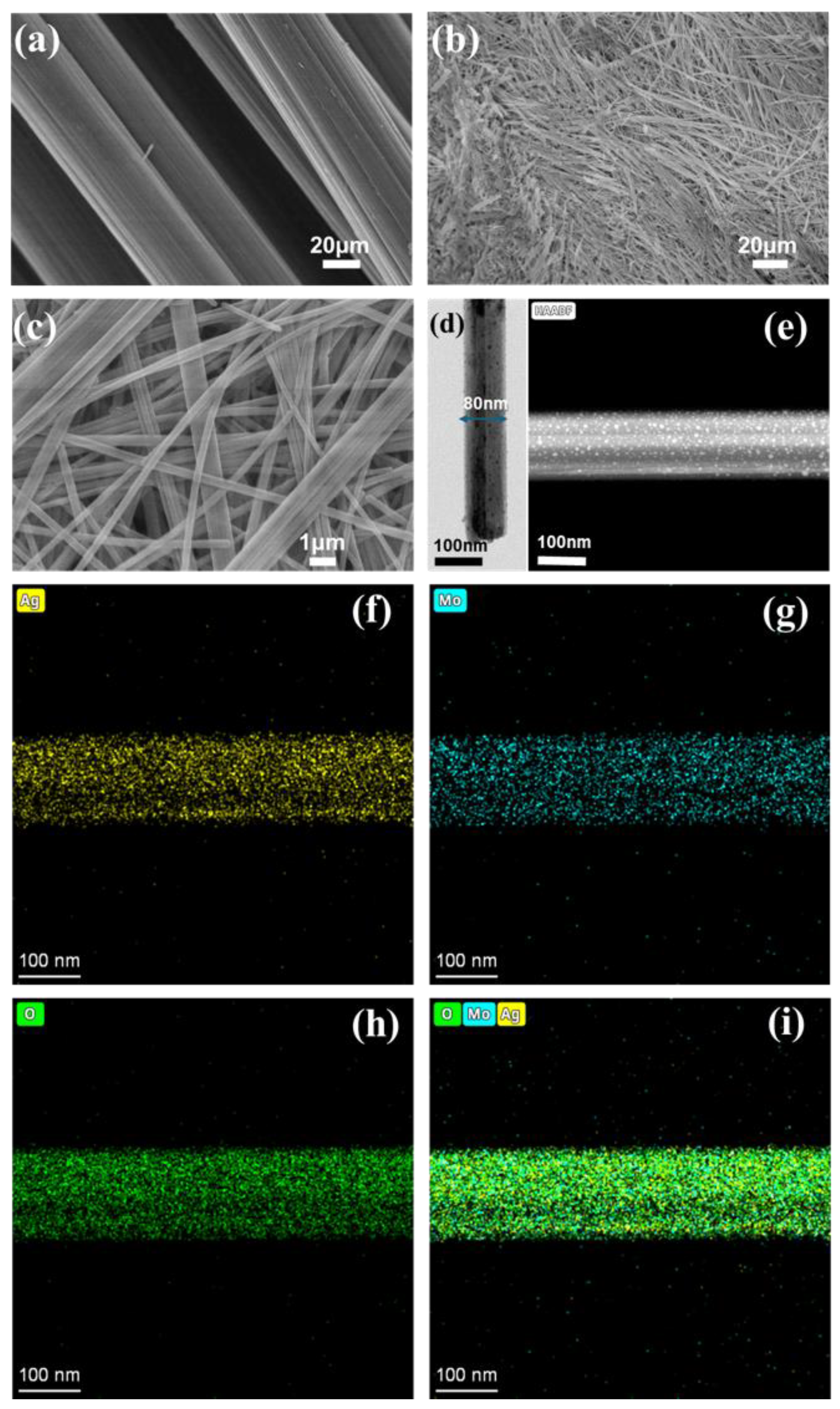
The SEM image in Figure 2a illustrates the surface morphology of the CFC cloth, revealing an interwoven network of ultralong carbon fiber bundles. With an approximate thickness of 60 µm, these bundles provide a robust and scalable scaffold for the extensive deposition of Ag₂Mo₃O₁₀·1.8H₂O. Figure 2b-c further present the surface morphology of the Ag₂Mo₃O₁₀·1.8H₂O/CFC composite, demonstrating that the grown nanowires not only cover the outer surface of the CFC but also penetrate deeply into its interior, forming an interlocking network with the underlying carbon fibers [24,25]. As shown in the TEM image (Figure 2d), individual nanowires exhibit a uniform width of approximately 80 nm. These one-dimensional nanostructures interpenetrate and overlap, creating an integrated porous architecture with abundant interconnected micro- and nano-scale channels, which serve as effective pathways for capillary-driven fluid transport. Water transport measurements conducted on a 4 cm × 12 cm Ag₂Mo₃O₁₀·1.8H₂O/CFC sample revealed a water transport rate of 1875 mL·h⁻¹·m⁻², reflecting a reduction of 313 mL·h⁻¹·m⁻² compared to pristine CFC, likely due to the partial occupation of pores by the nanowire network.
To further confirm the composition and structure of the nanowires, HAADF-STEM and elemental mapping analyses were performed. As demonstrated in Figure 2e–i, these techniques provide atomic-scale visualization of elemental distribution, with image contrast approximately scaling with the square of the atomic number Z. Within the Ag₂Mo₃O₁₀·1.8H₂O nanowires, regions corresponding to silver (Z=47) appear distinctly brighter compared to those of molybdenum (Z=42) and oxygen (Z=8), consistent with the expected compositional variation [9,26]. Combined with XRD results, these observations confirm that the nanowires consist of crystalline silver trimolybdate hydrate (Ag₂Mo₃O₁₀·1.8H₂O).
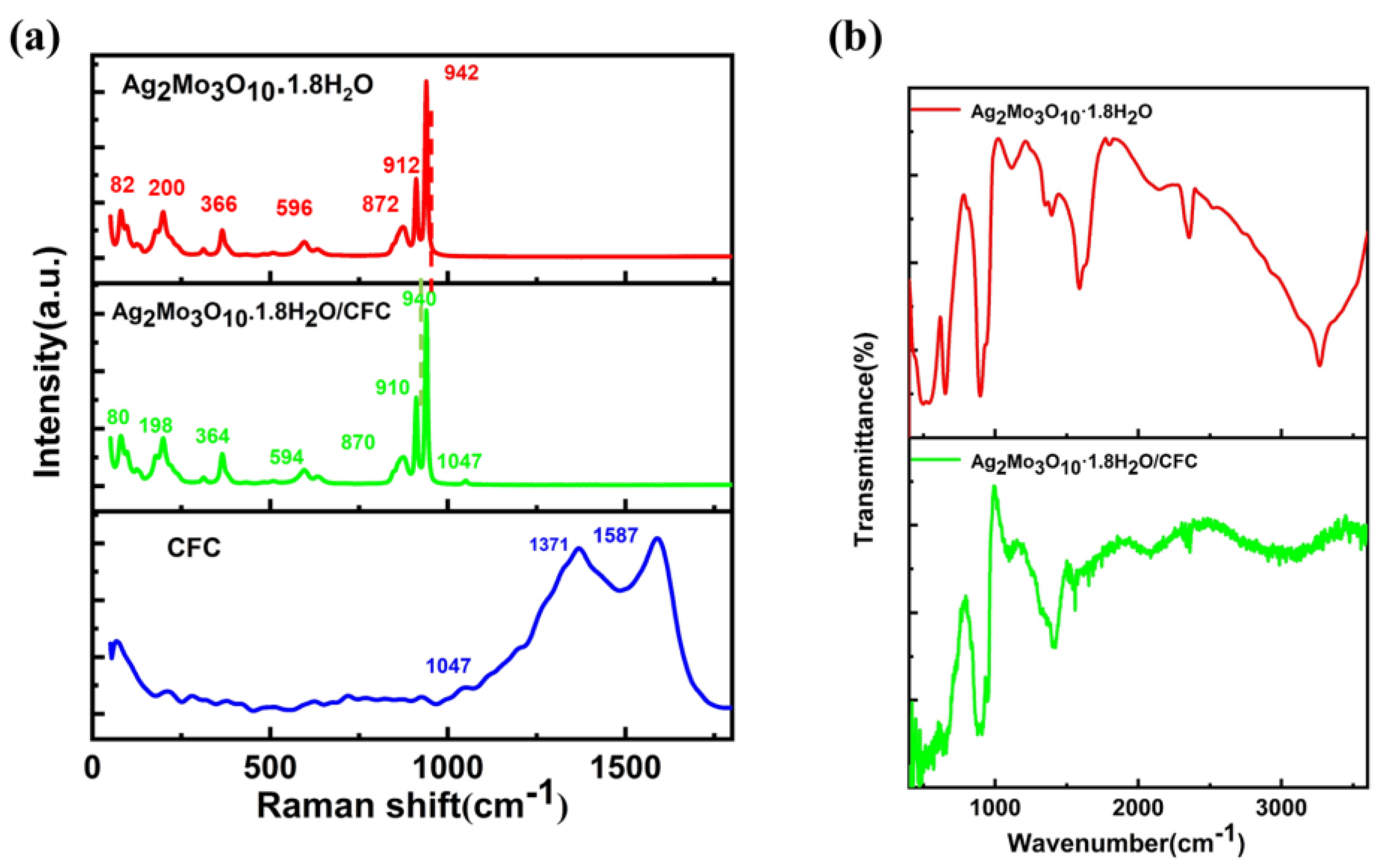
Figure 3a displays the corresponding Raman spectra. The peaks at 1371 and 1587 cm-1 correspond to the D and G bands of carbon fibers, respectively. Characteristic peaks of Ag₂Mo₃O₁₀·1.8H₂O are observed at 940, 910, 870, 364, and 198 cm-1, assigned to the stretching vibrations of MoO42- units and bending modes of O-Mo-O bonds [30]. The high intensity of these peaks suggests a well-crystallized and densely grown nanowire phase. In the Ag₂Mo₃O₁₀·1.8H2O/CFC composite, subtle but consistent shifts in the Mo-O related Raman peaks suggest interfacial interaction between the two components.Complementary IR spectra (Figure 3b) further support this interaction. The O-H stretching band shifts from around 3300 cm-1 in pure Ag₂Mo₃O₁₀·1.8H2O to approximately 3000 cm-1 in the composite. This shift, along with retained characteristic vibrational features between 500–1000 cm-1, indicates structural integration likely mediated by hydrogen bonding between surface hydroxyl/carboxyl groups on the carbon fiber cloth and the crystalline water in Ag₂Mo₃O₁₀·1.8H2O. Together, the Raman and IR analyses confirm a clear interfacial interaction, most probably through hydrogen bonding, facilitating structural coupling in the hybrid material.
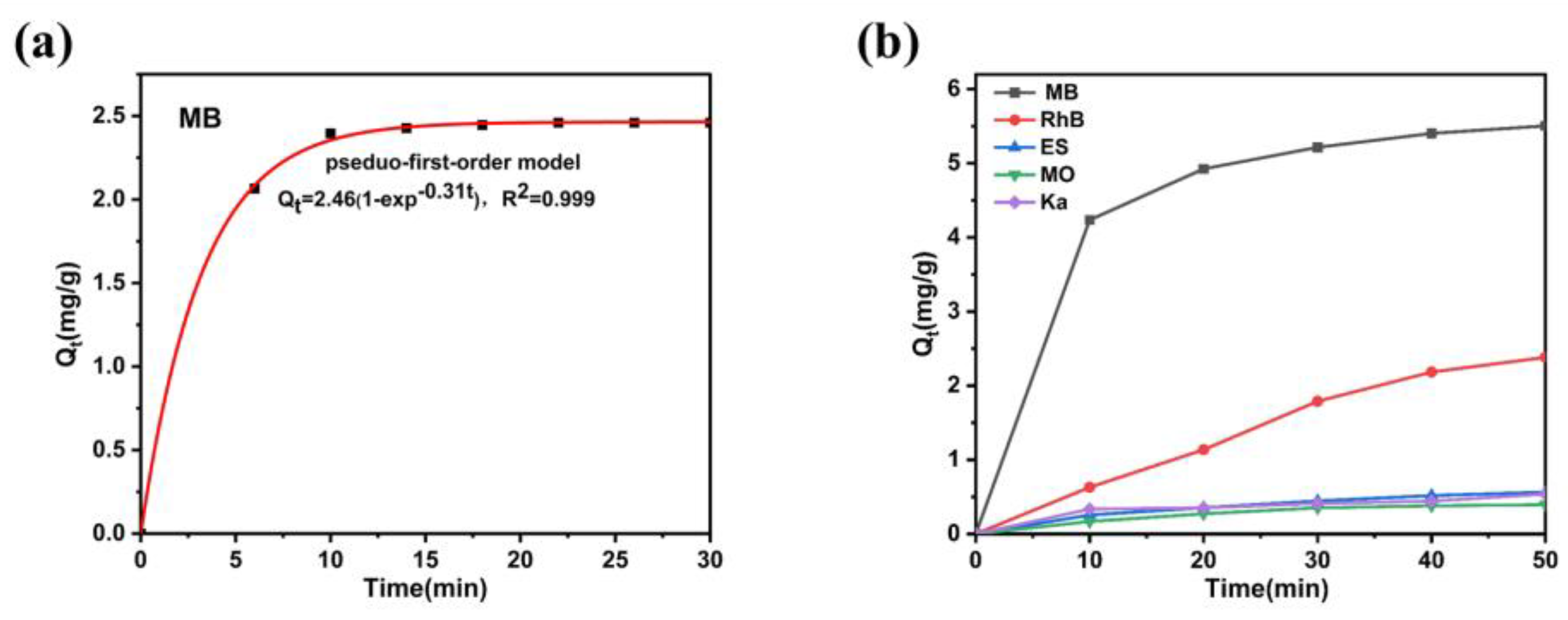
The adsorption performance of Ag₂Mo₃O₁₀·1.8H₂O was evaluated using 10 mg/L methylene blue (MB) as a model contaminant (Figure 4a). Rapid initial uptake occurred on the external nanowire surfaces, followed by slower diffusion into the mesoporous interior. The adsorption kinetics fit pseudo-first-order model, achieving 94% MB removal within 10 minutes , indicating efficient and fast adsorption. To assess selectivity, the Ag₂Mo₃O₁₀·1.8H₂O/CFC composite was tested against a series of dyes including Methylene Blue (MB), Rhodamine B (RhB), Evans Blue (EB), Methyl Orange (MO), and Acidic K (Ka), each at 10 mg/L (Figure 4b). While strong and rapid adsorption was observed for MB, only minimal uptake occurred for the other dyes, including RhB, which showed only weak physical adsorption likely attributed to the carbon fiber substrate. This result clearly demonstrates the high and selective adsorption capability of Ag₂Mo₃O₁₀·1.8H₂O toward methylene blue.
The hybrid framework was further applied in a continuous water transport configuration using mixed MB/RhB solutions. Under varying pH conditions (Figure 5a–c), the MB absorption peak at 663 nm was completely absent in the filtrate, indicating near-quantitative removal (>99%). In contrast, only about 10% of RhB was retained, consistent with weak physical adsorption within the mesoporous network. The composite also demonstrated high MB capture efficiency (>99%) in both aqueous and ethanolic MB/RhB mixtures (Figure 5d–f), whereas in n-propanol, the capture rate dropped to 32%, likely due to competitive dehydrogenation reactions catalyzed by surface Ag sites. Moreover, the material maintained stable separation performance across a range of temperatures (Figure 5g–i), confirming its thermal robustness and consistent selectivity under different environmental conditions.
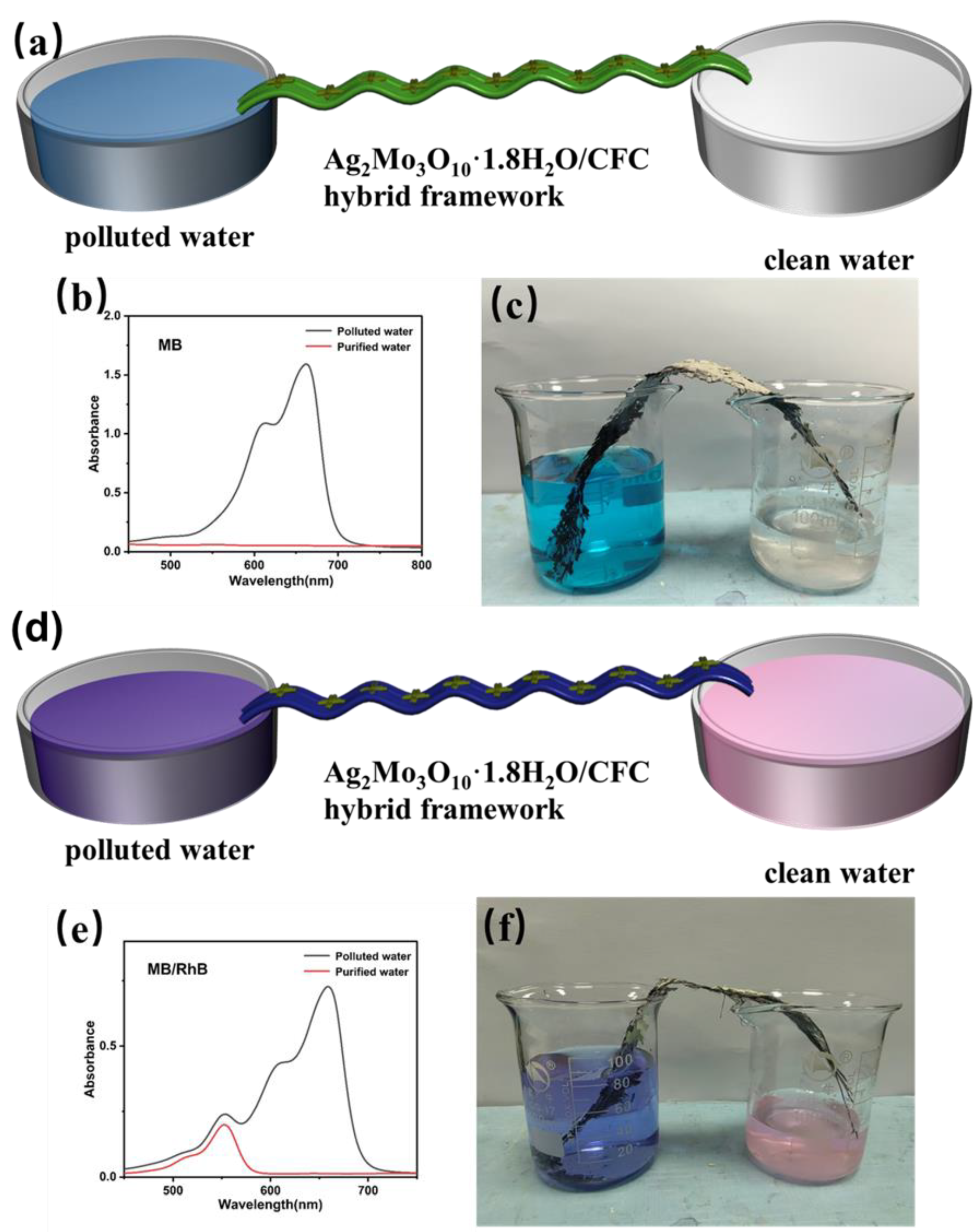
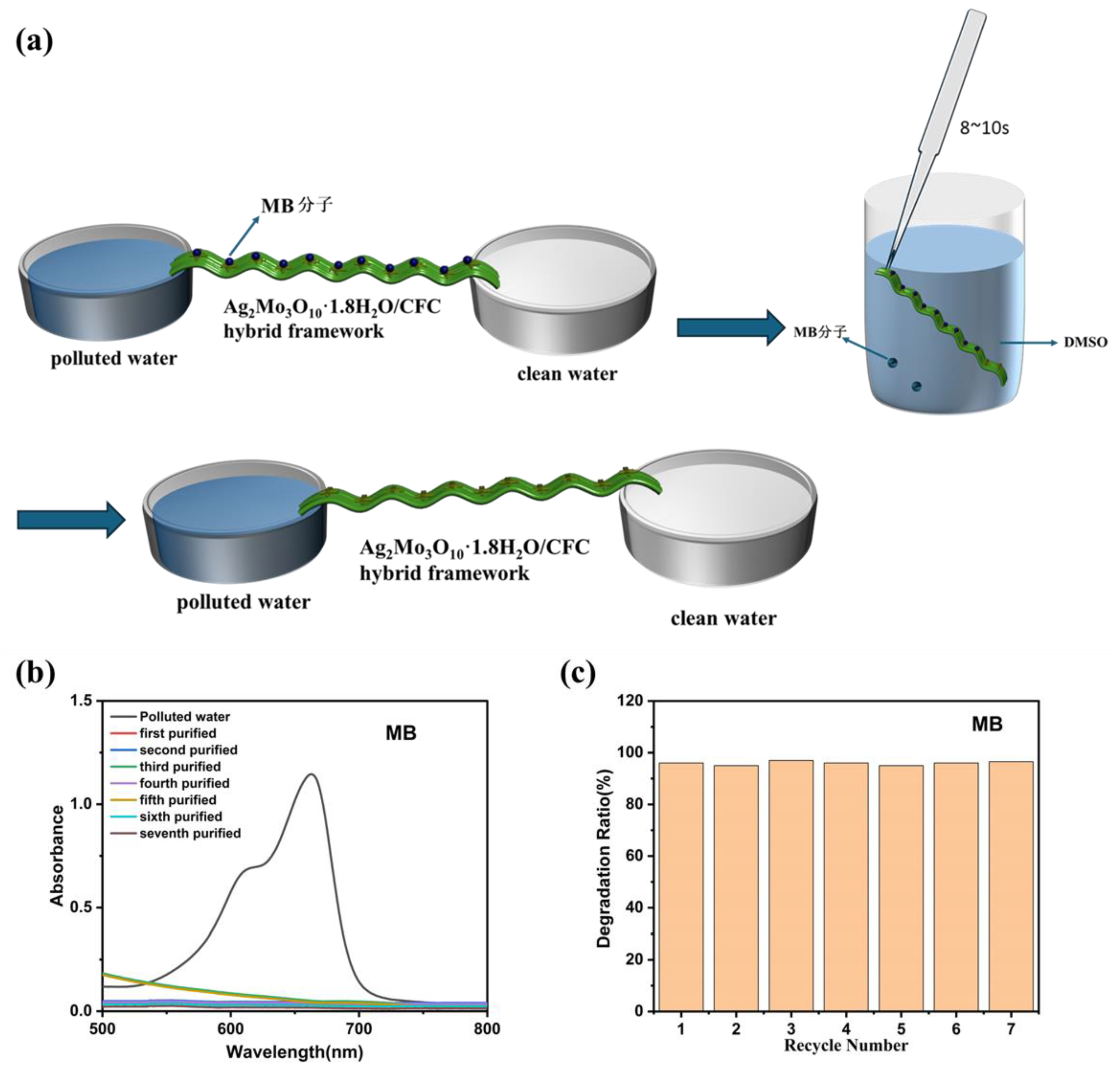
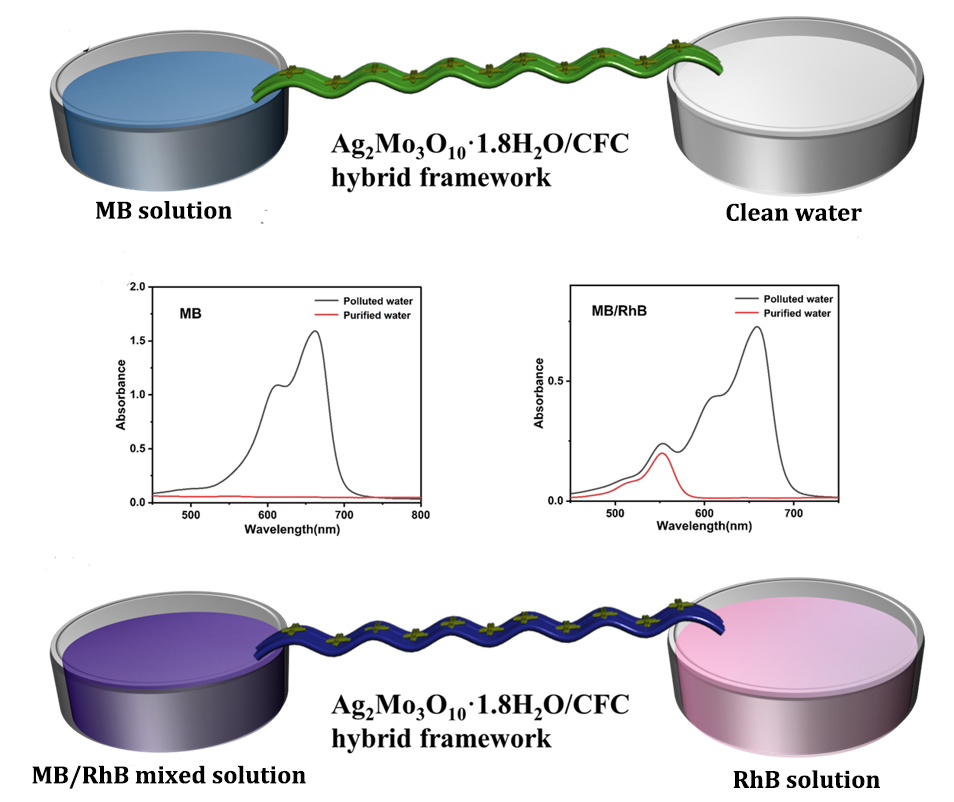
The above findings demonstrate that the Ag2Mo3O10·1.8H2O/CFC hybrid framework combines rapid selective adsorption, structural stability, and scalability, underscoring its strong potential as a functional material for water resource recovery. The interconnected porous network and well-defined capillary channels inherent to the hybrid architecture provide efficient nanofluidic pathways for continuous, capillary-driven water transport. Figure 6a illustrates a continuous-flow water purification system based on the Ag2Mo3O10·1.8H2O/CFC hybrid framework. One end of the framework is immersed in a methylene blue (MB) solution, while the other end is connected to an empty collection vessel. Driven solely by capillary forces, the dye solution is drawn upward through the material. During transport, MB molecules are rapidly and selectively captured by the Ag2Mo3O10·1.8H2O nanowires, resulting in only clean water reaching the collection vessel. This effective purification is confirmed by both visual observation and UV-Vis absorption spectra, which show the complete disappearance of the MB characteristic peak in the collected water (Figure 6b,c). Remarkably, when an MB/Rhodamine B (RhB) mixed solution is used as the feed, the system demonstrates selective molecular separation under capillary action alone, without any external energy input. As shown in Figure 6f, the collected solution exhibits a clear red color, and its UV-Vis spectrum (Figure 6e) reveals nearly complete retention of the RhB absorption peakalongside the total absence of the MB peak. This indicates that MB is efficiently captured during transport, while RhB passes freely through the framework. These results highlight the capability of the Ag2Mo3O10·1.8H2O/CFC hybrid to achieve continuous, selective separation of dissolved molecules in a flow-through configuration, leveraging its intrinsic capillary-driven transport and specific affinity for methylene blue.
Figure 7a-c demonstrate the reusability of the Ag₂Mo₃O₁₀·1.8H₂O/CFC hybrid framework, a crucial feature for practical application. The high selectivity toward methylene blue (MB) originates from the specific Ag–S coordination between Ag sites in the nanowires and MB molecules [16]. Importantly, this interaction is reversible under mild conditions. A 6 × 4 cm hybrid framework was tested over multiple cycles. After each adsorption of MB, the material was regenerated by simply immersing it in dimethyl sulfoxide (DMSO) for only 8–10 seconds, during which the MB molecules readily desorbed. The framework was then reused in a fresh MB-containing solution. As shown in Figure 7b, the UV-Vis spectra of the purified water remain nearly identical across seven consecutive cycles, with the MB peak consistently absent. Correspondingly, the calculated removal efficiency remained above 97% throughout all cycles (Figure 7c). These results confirm that the Ag₂Mo₃O₁₀·1.8H₂O/CFC hybrid can be rapidly and effectively regenerated without losing its structural integrity or adsorption performance. The combination of high selectivity, capillary-driven operation, and excellent recyclability underscores the strong potential of this material for sustainable, energy-efficient separation and recovery of sulfur-containing molecules in continuous-flow systems.

4. Conclusions

In summary, we successfully developed a novel Ag₂Mo₃O₁₀·1.8H₂O/carbon fiber cloth (CFC) hybrid framework through the dense and uniform growth of Ag₂Mo₃O₁₀·1.8H₂O nanowires over a large-area CFC substrate. The interwoven nanowire-carbon fiber architecture forms a hierarchical porous network rich in micro-/nano-channels, which functions as an efficient capillary-driven water transport platform, achieving a flow rate of 1875 mL·h⁻¹·m⁻². Owing to the specific Ag-S coordination interaction, the hybrid framework exhibits rapid and selective adsorption toward sulfur-containing molecules, removing 94% of methylene blue (10 mg/L) within 10 min. The material also demonstrates excellent selectivity in mixed-dye systems, along with outstanding reusability (∼97% recovery after multiple cycles) and stability under varying environmental conditions. Furthermore, a continuous-flow resource recovery system based on this framework was implemented, enabling simultaneous water purification and targeted molecule recovery without external energy input. Collectively, these attributes position the Ag₂Mo₃O₁₀·1.8H₂O/CFC hybrid as a highly promising and scalable material for advanced water resource recovery applications.

Funding

This research was funded by Major Humanities and Social Sciences Research Projects in Zhejiang higher education institutions, Grant Number: 2024QN020.

Author contributions

Lei-Yang Xue and Chu-Ya Luo prepared the composite materials. Lei-Yang Xue conducted the powder adsorption experiments, hybrid framework molecule selective separation tests, and flowing water velocity tests. Lei-Yang Xue, Han-Mei Xu, Jia-Xin Hua and Xue Zhang performed the composite material characterization. Jun Wu and Lian-Wen Zhu was responsible for initiating the research and supervising the project. Lian-Wen Zhu wrote the paper. Lian-Wen Zhu reviewed the entire manuscript.

Institutional Review Board Statement

Not applicable.

Informed Consent Statement

Not applicable.

Data Availability Statement

The original contributions presented in this study are included in the article. Further inquiries can be directed to the corresponding authors.

Conflicts of Interest

The authors declare no conflicts of interest.

References

  1. Zhang, W.; Zhang, Z.; et al. Laccase immobilized on nanocomposites for wastewater pollutants degradation: current status and future prospects. Bioprocess and Biosystems Engineering 2023, 46, 1513–1531. [Google Scholar] [CrossRef]
  2. Chan- Shih, S.; Wu- Jung, H. Improving the Performance of the Reverse Osmosis Process with Fiber filter and Ultrafiltration: Promoting Municipal Sewage Reclamation and reuse for Industrial Processes. Sustainability 2022, 14, 5443–5443. [Google Scholar] [CrossRef]
  3. Wu-Chun, D.; Zhu-Kai, D.; Hu-Xin, K.; et al. Ozone microbubbles treatment with different gas-liquid mixing conditions and its application on printing and dyeing wastewater and Escherichia coli. Desalination and Water Treatment 2022, 252, 400–407. [Google Scholar]
  4. Aleksandra, K.; Izabela, K. From Environmental Threat to Control: A Review of Technologies for Removal of Quaternary Ammonium Compounds from Wastewater. Membranes 2025, 16, 1. [Google Scholar] [CrossRef]
  5. Yang, F.; Wang-Xing, B. Research recap of membrane technology for tannery wastewater treatment: a review. Collagen and Leather 2023, 5. [Google Scholar] [CrossRef]
  6. Wang, F.; Hou- Xin, Y. Preparation of Cu-MnO2/GO/PVDF Catalytic Membranes via Phase Inversion Method and Application for Separation Removal of Dyes. Membranes 2025, 15, 384. [Google Scholar] [CrossRef] [PubMed]
  7. Xie- Ya, W.; Liu- Ze, W.; et al. Water Purification Efficiency and Membrane Fouling Behavior of Ceramic Membrane-Nanofiltration in Treating Water Treatment Plant Production Wastewater. Membranes 2025, 15, 387. [Google Scholar] [CrossRef]
  8. Saheli, R. Carbon Nanotube and Graphene Oxide-Based Polymer Nanocomposite Membranes for Oil–Water Separation—Recent Advances and Future Prospects. ChemistrySelect 2025, 10. [Google Scholar]
  9. Mei, Y.; Su-Yan, H.; Li, Z.; Bai- Shi, Q.; Yuan- Meng, Y.; Li, L.; Yan, Z.; Wu, J.; Zhu- Lian, W. BiOBr nanoplates@TiO2 nanowires/carbon fiber cloth as a functional water transport network for continuous flow water purification. Dalton Transactions 2017, 46, 347. [Google Scholar] [CrossRef]
  10. Eoin, P.M.; Alexa, E.; et al. Polymer/iron-oxide nanocomposite adsorbents for cycled magnetically-enabled extraction of aqueous micropollutants. RSC Sustainability 2025. [Google Scholar]
  11. Ahmah, R.; Saeedeh, H.; et al. Retraction notice to "Preparation and characterization of nano composites from metal oxides and activated carbon from banana peel (MO@BPAC, MO=NiO, CuO and ZnO) for 2 nitrophenol removal from aqueous solutions. Heliyon 2025, 11, e41245. [Google Scholar]
  12. Muni, R.; Sumalatha, B. A prototype integrated approach for sustainable treatment of organic dyes system using ZnO–CuO–AgO heterostructure as photocatalyst. In Scientific Reports; 2025. [Google Scholar]
  13. Vahid, H.; Gholamreza, K.; Dariush, M. High-efficiency removal of methyl orange from wastewaters using polyimide/chitosan-MoS2-UiO-66 nanofiber adsorbents. In Scientific Reports; 2025. [Google Scholar]
  14. Tu, C.; Le, T. g-C3N4 Nanosheet/ZnO Nanosponge Heterojunctions for Efficient Visible-Light Photocatalytic Degradation of Methylene Blue. ChemNanoMat 2025. [Google Scholar]
  15. Tu-Wen, J.; Cai-Wei, Q. Selective adsorption of hazardous substances from wastewater by hierarchical oxide composites: A review. Toxics 2024, 12, 447. [Google Scholar] [CrossRef] [PubMed]
  16. Xu-Ke, Y.; Wang, L.; Zhang-Yu, X.; et al. Graphene oxide enabled self-assembly of silver trimolybdate nanowires into robust membranes for nanosolid capture and molecular separation. Nanoscale 2023, 15, 6607–6618. [Google Scholar] [CrossRef]
  17. Jing, Z.; Victoria, S.C. Adsorption of octahedral mono-molybdate and poly-molybdate onto hematite: A multi-technique approach. Journal of Hazardous Materials 2022, 431, 128564. [Google Scholar]
  18. Yang, L.; Hong, Z.H.; Wu, J.; Singh, H.K.; Yeole, K.V.; Mhaske, S.T.; et al. RSC Advances 2014, 4, 25556. H.K. Singh, K.V. Yeole, S.T. Mhaske. Synthesis and characterization of layer-by-layer assembled magnesium zinc molybdate nanocontainer for anticorrosive application. Chemical Engineering Journal. 2016,7: 414-426.
  19. Young-Jung, H.; Mira, P.; Woo-Seok, K.; Kyong-Yop, R.; Soo-Jin, P. Preparation and characterization of carbon black/pitch-based carbon fiber paper composites for gas diffusion layers. Composites Part B 2019, 159, 362–368. [Google Scholar]
  20. Huang- Shan, C.; Ye, J.; Su- Mi, M.; Zhang, Y.; Meng, Y.; Meng, X.; Xia- Xin, X. Efficient preparation and characterization of carbon fiber paper using phenolic resin in-pulp addition method. International Journal of Hydrogen Energy 2024, 71, 506–514. [Google Scholar] [CrossRef]
  21. Vipin, K.; Sebastian, M.; et al. Design of Mixed-Metal Silver Decamolybdate Nanostructures for High Specific Energies at High Power Density. Advanced Materials 2016, 8, 6966–6975. [Google Scholar]
  22. Pennycook, SJ; Nellist, P. D. Scanning transmission electron microscopy: imaging and analysis; Springer: Berlin, 2011. [Google Scholar]
  23. Yang- Xiang, L.; Wang, Y.; Xu, X.; Qu, Y.; Ding, X.; Chen, H. Surface plasmon resonance-induced visible-light photocatalytic performance of silver/silver molybdate composites. Chinese Journal of Catalysis 2017, 38, 260–269. [Google Scholar] [CrossRef]
  24. Moura, JVB; Ferreira, W.C.; da Silva-Filho, J.G.; Alabarse, F.G.; Freire, P.T.C.; Luz-Lima, C. Ag2Mo3O10 nanorods under high pressure: In situ Raman spectroscopy. Spectrochimica Acta Part A: Molecular and Biomolecular Spectroscopy 2023, 299, 122871. [Google Scholar] [CrossRef]
  25. Nagaraju, G; Chandrappa, G.T.; Livage, J. Synthesis and characterization of silver molybdate nanowires, nanorods and multipods. Bulletin of Materials Science 2008, 31, 367–371. [Google Scholar] [CrossRef]
  26. Jiang- De, M.; Chen- Hui, N.; Xie, H.; Cheng, K.; Li, L.; Xie, K.; Wang- Yu, Q. Fe, N, S co-doped cellulose paper carbon fibers as an air-cathode catalyst for microbial fuel cells. Environmental Research 2023, 221, 115308. [Google Scholar] [CrossRef]
  27. Joel- Marcos, S.; Assad, U. K.; Liu- Tian, Y; Xu, Z; Alan, R. E.; Liu- Guo, L. Capacitive Organic Dye Removal by Block Copolymer Based Porous Carbon Fibers. In Advanced Materials Interfaces.; 2020. [Google Scholar]
  28. Zhang- Shou, W.; Yang- Hong, C.; Huang- Hui, Y.; Gao- Hui, H.; Wang- Xiang, X.; Cao- Ru, Y.; Li- Jia, X.; Xu- Xi, J.; Wang- Xiang, K. Unexpected ultrafast and high adsorption capacity of oxygen vacancy-rich WOx/C nanowire networks for aqueous Pb2+ and methylene blue removal Journal of Materials. Chemistry A 2017, 1–11. [Google Scholar]
  29. Qu- Tong, Q.; Huang- Xi, Y.; Wang, B. Effects of the Surface Structure on the Water Transport Behavior in PEMFC Carbon Fiber Papers. ACS Omega 2022, 7, 5992−5997. [Google Scholar] [CrossRef] [PubMed]
  30. Ferreira, ANC; Ferreira, W.C.; Duarte, A.V. In situ high-temperature Raman scattering study of monoclinic Ag2Mo2O7 microrods. Spectrochimica Acta Part A: Molecular and Biomolecular Spectroscopy 2023, 295, 122632. [Google Scholar] [CrossRef] [PubMed]
  31. Maria Kdo Nascimento- Silva, L.; João, V.B.M. Silver Trimolybdate (Ag2Mo3O10.2H2O) Nanorods: Synthesis, Characterization, and Photo-Induced Antibacterial Activity under Visible-Light Irradiation. Bioinorganic Chemistry and Applications 2024. [Google Scholar]
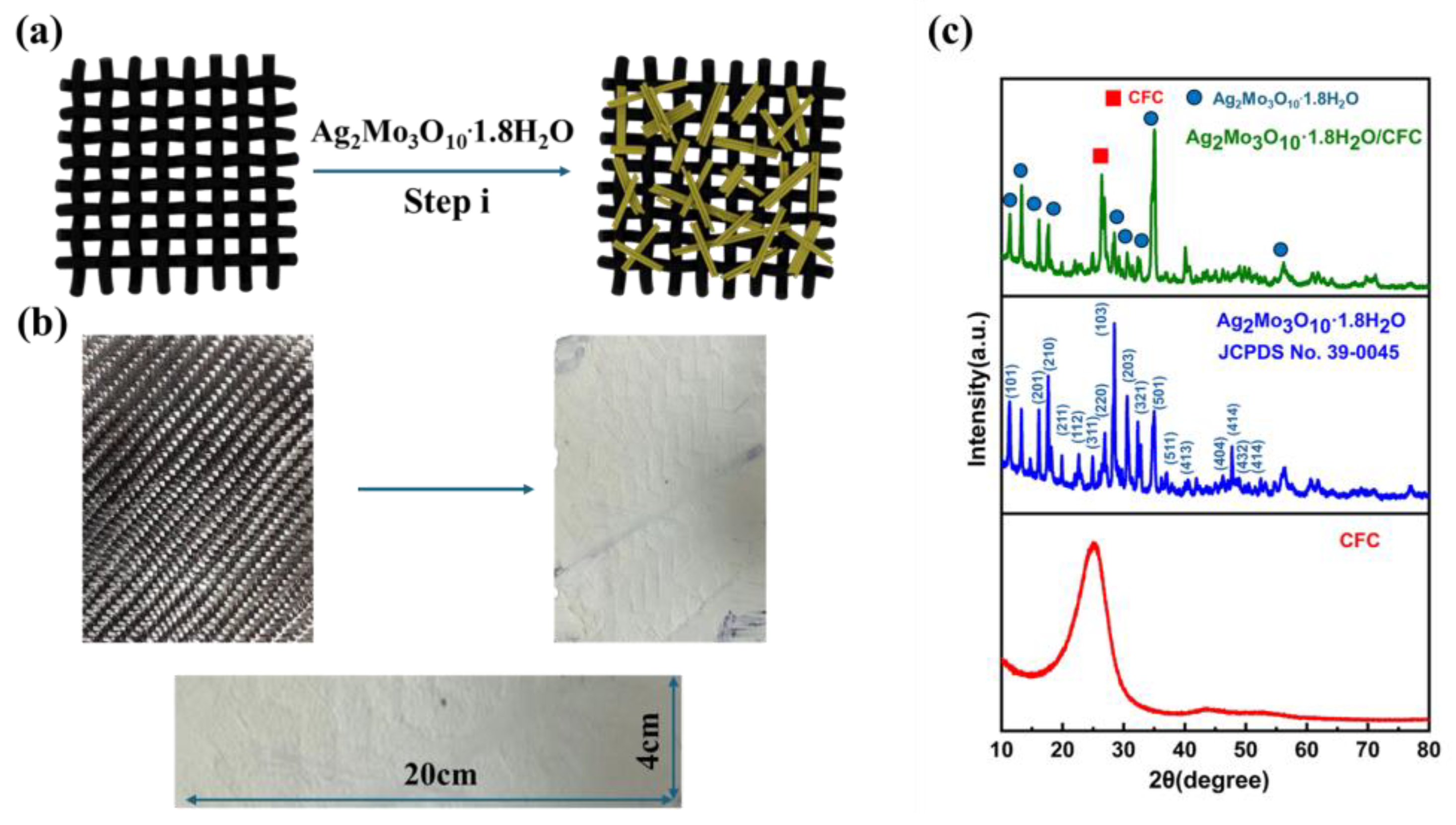
Figure 1. (a) Schematic illustration of the fabrication of Ag₂Mo₃O₁₀·1.8H₂O/CFC. (b) Photographs of pristine CFC and Ag₂Mo₃O₁₀·1.8H₂O/CFC. (c) XRD patterns of the products.
Preprints 191905 g001
Figure 2. (a) SEM images of CFC. (b–c) SEM images of Ag2Mo3O10·1.8H2O/CFC. (d) TEM image of an individual Ag2Mo3O10·1.8H2O nanowire. (e–i) HAADF-STEM images of the Ag2Mo3O10·1.8H2O nanofiber (left column) and element-sensitive mapping.
Preprints 191905 g002
Figure 3. (a) Raman spectra of pristine carbon framework, Ag2Mo3O10·1.8H2O and Ag2Mo3O10·1.8H2O/carbon hybrid framework. (b) Diffuse reflectance spectra for Ag2Mo3O10·1.8H2O and Ag2Mo3O10·1.8H2O/carbon hybrid framework.
Preprints 191905 g003
Figure 4. (a) Adsorption isotherm of pristine Ag2Mo3O10·1.8H2O adsorption of MB. (b) The adsorption of Ag2Mo3O10·1.8H2O/carbon hybrid framework of five different organic dyes.
Preprints 191905 g004
Figure 5. (a-i) UV-Vis absorption spectra of Ag2Mo3O10·1.8H2O/CFC for flow water resource recovery testing of mixed dyes (MB and RhB) in different environments (pH, solvent, and temperature). (i) Curve of the recovery ratio of MB/RhB versus reuse times of Ag2Mo3O10·1.8H2O/CFC.
Preprints 191905 g005
Figure 6. (a,d) Schematic diagram of the continuous flow water resource recovery system. (b, e) UV-Vis absorption spectra of polluted water and purified water. (c, f) Digital photograph of the continuous flow water resource recovery system.
Preprints 191905 g006
Figure 7. (a) Schematic diagram of material recycling and reuse. (b) UV-Vis absorption spectra of several recycle of MB. (c) Recovery of MB efficiency for seven times use.
Preprints 191905 g007
Disclaimer/Publisher’s Note: The statements, opinions and data contained in all publications are solely those of the individual author(s) and contributor(s) and not of MDPI and/or the editor(s). MDPI and/or the editor(s) disclaim responsibility for any injury to people or property resulting from any ideas, methods, instructions or products referred to in the content.
Copyright: This open access article is published under a Creative Commons CC BY 4.0 license, which permit the free download, distribution, and reuse, provided that the author and preprint are cited in any reuse.
Prerpints.org logo

Preprints.org is a free preprint server supported by MDPI in Basel, Switzerland.

Subscribe

Disclaimer

Terms of Use

Privacy Policy

Privacy Settings

© 2026 MDPI (Basel, Switzerland) unless otherwise stated