
Submitted:
15 December 2025
Posted:
26 December 2025
You are already at the latest version
Abstract
Coal and gas outbursts constitute a major hazard for mining safety, which is critical for the sustainable development of China’s energy industry. Rapid, accurate and reliable prediction is pivotal for preventing and controlling outburst incidents. Nevertheless, the mechanisms driving coal and gas outbursts involve highly complex influencing factors. By examining the attributes of these factors and their association to outburst intensity, four major geological and environmental indicators were identified. This study developed a machine learning-based prediction model for outburst risk. Five algorithms were evaluated: K-Nearest Neighbors (KNN), Back Propagation Neural Network (BPNN), Random Forest (RF), Support Vector Machine (SVM), eXtreme Gradient Boosting (XGBoost). Model optimization was performed via Bayesian hyperparameter (BO) tuning. Model performance was assessed by the Receiver Operating Characteristic (ROC) curve; the optimized XGBoost model demonstrated strong predictive performance. To enhance model transparency and interpretability, the SHapley Additive exPlanations (SHAP) method was implemented. The SHAP analysis identified geological structure was the most important predictive feature, providing a practical decision-support tool for mine executives to prevent and control outburst incidents.
Keywords:
1. Introduction
2. Materials and Methods
2.1. Analysis of Outburst Influencing Factors
2.1.1. Geological Structure
2.1.2. Geological Structure
2.1.3. Coal Structure
2.1.4. Coal Seam Gas
2.2. Model Selection
2.3. Bayesian Optimization (BO)
2.4. Interpretability
2.5. Evaluation Index
3. Results
3.1. Data Description and Pre-Processing
3.2. Comparative Analysis of Model Accuracy
3.3. Interpretability Analysis
4. Discussion
5. Conclusions
Author Contributions
Funding
Institutional Review Board Statement
Informed Consent Statement
Data Availability Statement
Conflicts of Interest
References
- Kong, X.; Zhao, T.; Cai, Y.; He, D. Numerical multifield coupling model of stress evolution and gas migration: Application of disaster prediction and mining sustainability development. Sustainability 2024, 16(9), 3667. [CrossRef]
- Li, X.; Hao, S.; Wu, T.; Zhou, W.; Zhang, J. Data mining technology and its applications in coal and gas outburst prediction. Sustainability 2023, 15(15), 11523. [CrossRef]
- Ma, Y.; Nie, B.; He, X.; Li, X.; Meng, J.; Song, D. Mechanism investigation on coal and gas outburst: An overview. Int. J. Miner., Metall. Mater. 2020, 27(7), 872-887. [CrossRef]
- Fan, C.; Li, S.; Luo, M.; Du, W.; Yang, Z. Coal and gas outburst dynamic system. Int. J. Min. Sci. Technol. 2017, 27(1), 49-55. [CrossRef]
- Fan, C.; Zhang, X.; Yang, L.; Fu, X.; Yang, Z.; Li, S. Spatial and temporal distribution of coal and gas outburst accidents in China from1950 to 2022. J. Liaoning Tech. Univ., Nat. Sci. Ed. 2024, 43(3), 279-28. http://doi:10.11956/j.issn.1008-0562.20230235.
- Nie, Y.; Wang Y.; Wang, R. Coal and gas outburst risk prediction based on the F-SPA model. Energy Sources, Part A 2023, 45(1), 2717-2739. [CrossRef]
- Zheng, X.; Lai, W.; Zhang, L.; Xue, S. Quantitative evaluation of the indexes contribution to coal and gas outburst prediction based on machine learning. Fuel 2023, 338, 127389. [CrossRef]
- Xue, S.; Zhang, X.; Yuan, L.; Lai, W.; Zhang, Y. A review on coal and gas outburst prediction based on machine learning. J. China Coal Soc. 2024, 49(2), 664-694. [CrossRef]
- Wang, N. Research on coal and gas outburst risk prediction based on improved search algorithm optimized deep learning network. Sci. Rep. 2025, 15(1), 40976. [CrossRef]
- Liu, Y.; Su, P.; Sasaki, J.; Lei, M.; Xiao D.; Liu, J. Prediction of gas hazard in coal stratum tunnels based on improved snake optimizer and support vector machine. Bull. Eng. Geol. Environ. 2015, 84(10), 1-28. [CrossRef]
- Pantelis, L.; Vasilis, P.; Sotiris, K. Explainable ai: A review of machine learning interpretability methods. Entropy 2020, 23(1), 18. [CrossRef]
- Lei, D.; Li, H.; Meng, H. Geological division of gas in the Pingdingshan mine area based on its tectonic dynamics characteristics. Int. J. Min. Sci. Technol. 2015, 25(5), 827-833. [CrossRef]
- Cheng, Z.; Xiang, X.; Xu, J.; Wu, S. The characteristics and main influencing factors affecting coal and gas outbursts in Chinese Pingdingshan mining region. Nat. Hazards 2016, 82(1), 507-530. [CrossRef]
- Kang, H.; Zhang, X.; Si, L.; Wu, Y.; Gao, F. In-situ stress measurements and stress distribution characteristics in underground coal mines in China. Eng. Geol. 2010, 116(3-4), 333-345. [CrossRef]
- Sun, M. (2014). Study on in situ stress distribution law and its application in Pingdingshan mining Area. Master's Dissertation, University of Mining and Technology Beijing, Xuzhou, China, 2014.
- Yan J. Study on controlling effect of tectonic structures on coal and gas outburst in the Pingdingshan mining area. Ph. D. Dissertation, Henan Polytechnic Univ, Jiaozuo, China, 2016.
- Guo, D.; Chuai, X; Zhang, T.; Guo, M. Distribution pattern and influencing factors of insitu stress for deep levels in Shoushan No.1 Coal Mine. J. China Coal Soc. 2024, 49(5), 2360−2375. https://doi:10.13225/j.cnki.jccs.2023.1646.
- Cheng, Y.; Pan, Z. Reservoir properties of Chinese tectonic coal: A review. Fuel 2020, 260, 116350. [CrossRef]
- Tu, Q.; Xue, S.; Cheng, Y.; Zhang, W.; Shi, G.; Zhang G. Experimental study on the guiding effect of tectonic coal for coal and gas outburst. Fuel 2022, 309, 122087. [CrossRef]
- Zhang, K.; Zou, A.; Wang, L.; Cheng, Y.; Li, W.; Liu, C. Multiscale morphological and topological characterization of coal microstructure: Insights into the intrinsic structural difference between original and tectonic coals. Fuel 2022, 321, 124076. [CrossRef]
- Guo, H.; Yu, Y.; Wang, K.; Yang, Z.; Wang, L.; Xu, C. Kinetic characteristics of desorption and diffusion in raw coal and tectonic coal and their influence on coal and gas outburst. Fuel 2023, 343, 127883. [CrossRef]
- Song, W.; Yu, S.; Rong, H. Study on the mechanism of structural coal permeability law on coal and gas outburst under multi-field coupling. Phys. Fluids 2025, 37(7). [CrossRef]
- Meng, H.; Yang, Y; Hou, W.; An, Z.; G, H.; L, X.; W, F. P, L.; Z, R.; C, L.; C, L. The role of coal strength in coal and gas outbursts. Phys. Fluids 2025, 37(3). [CrossRef]
- Tu, Q.; Cheng, Y.; Ren, T.; Wang, Z.; Jia, T.; Yang, L. Role of tectonic coal in coal and gas outburst behavior during coal mining. Rock Mech. Rock Eng. 2019, 52, 4619-4635. [CrossRef]
- Zhang, Y.; Zhang, Z.; Cao, Y. Deformed-coal structure and control to coal-gas outburst. J. China Coal Soc. 2007, 32(03), 281-284. https://doi:10.13225/j.cnki.jccs.2007.03.04.
- Peng, S.; Xu, J.; Yang, H.; Liu, D. Experimental study on the influence mechanism of gas seepage on coal and gas outburst disaster. Saf. Sci. 2012, 50(4), 816-821. [CrossRef]
- Sa, Z.; Liu, J.; Li, J.; Zhang, Y. Research on effect of gas pressure in the development process of gassy coal extrusion. Saf. Sci. 2019, 115, 28-35. [CrossRef]
- Han, J.; Zhang, H.; Li, S.; Song, W. The characteristic of in situ stress in outburst area of China. Saf. Sci. 2012, 50(4), 878-884. [CrossRef]
- Guo, D.; Chuai, X.; Zhang, J.; Zhang, G. “Controlling effect of tectonic stress field on coal and gas outburst,” J. China Coal Soc. 2023, 48(8), 3076-3090. https://doi:10.13225/j.cnki.jccs.2022.1435.
- Shepherd, J.; Rixon, L.; Griffiths, L. Outbursts and geological structures in coal mines: a review. Int. J. Rock Mech. Min. Sci. 1981, 18(4), 267–283. [CrossRef]
- Guo, D.; Han, D.; Wang, X. Outburst-prone tectonophysical environment and its applications. Chin. J. Eng. 2002, 24(06), 581-584+592. https://doi:10.13374/j.issn1001-053x.2002.06.001.
- Yan, J.; Feng, X.; Guo, Y.; Jia, T.; Tan, Z. Discussion on the main control effect of geological structures on coal and gas outburst. ACS omega 2025, 8(1), 835-845. [CrossRef]
- Ju, Y.; Luxbacher, K.; Li, X.; Wang, G.; Yan, Z.; Wei, M.; Yu, L. Micro-structural evolution and their effects on physical properties in different types of tectonically deformed coals. Int. J. Coal Sci. Technol. 2014, 1, 364-375. [CrossRef]
- Yan, J. Zhang, X.; Zhang, Z. Research on geological control mechanism of coal-gas outburst. J. China Coal Soc. 2013, 38(7), 1174-1178. [CrossRef]
- Feng, C.; Li, X.; Yang, R.; Cai, J.; Sui, H.; Xie, H.; Wang, Z. The geological factors affecting gas content and permeability of coal seam and reservoir characteristics in Wenjiaba block, Guizhou province. Sci. Rep. 2023, 13(1), 18992. [CrossRef]
- Wang, G.; Cheng, W.; Xie, J.; Chen, J. Study on the effect of gas in the coal and gas outburst. China Saf. Sci. J. 2010, 20(9), 116–20. [CrossRef]
- Zhang, S. Challenges in KNN classification. IEEE Trans. Knowl. Data Eng. 2021, 34(10), 4663-4675. [CrossRef]
- Buscema, M. Back propagation neural networks. Subst. UseMisuse 1998, 33(2), 233-270. [CrossRef]
- Biau, G.; Scornet, E. A random forest guided tour. Test 2016, 25(2), 197-227. [CrossRef]
- Jair, C.; Farid, G.; Lisbeth, R.; Asdrubal, L. A comprehensive survey on support vector machine classification: Applications, challenges and trends. Neurocomputing 2020, 408, 189-215. [CrossRef]
- Chen, T.; Guestrin, C. XGBoost: A scalable tree boosting system. In Proc. 22nd ACM SIGKDD International Conference on Knowledge Discovery and Data Mining (eds Krishnapuram, B et al.) 2016, 785–794. [CrossRef]
- Bischl, B.; Binder, M.; Lang, M.; Pielok, T.; Richter, J.; Coors, S.; Thomas, J.; Ullmann, T.; Becker, M.; Boulesteix, A.; Deng, D.; Lindauer, M. Hyperparameter optimization: Foundations, algorithms, best practices, and open challenges. Wiley Interdiscip. Rev.-Data Mining Knowl. Discov. 2013, 13(2), e1484. [CrossRef]
- Wang, X.; Jin, Y.; Schmitt, S.; Olhofer, M. Recent advances in Bayesian optimization. ACM Comput. Surv. 2023, 55(13s), 1-36. [CrossRef]
- Guy, V.; Anton, L.; Maximilian, S.; Dan, S. On the tractability of SHAP explanations. J. Artif. Intell. Res. 2022, 74, 851-886. [CrossRef]
- Bradley, A. The use of the area under the ROC curve in the evaluation of machine learning algorithms. Pattern Recognit. 1997, 30(7), 1145-1159. [CrossRef]
- Huang, J.; Ling, C. Using AUC and accuracy in evaluating learning algorithms. IEEE Trans. Knowl. Data Eng. 2005, 17(3), 299-310. [CrossRef]
- Xie, X.; G.; Fu, Xue, Y.; Zhao, Z.; Chen, P.; Lu, B.; Jiang, S. Risk prediction and factors risk analysis based on IFOA-GRNN and apriori algorithms: Application of artificial intelligence in accident prevention. Process Saf. Environ. Prot. 2019, 122, 169-184. [CrossRef]
- Aguado, M.; Nicieza, C. Control and prevention of gas outbursts in coal mines, Riosa–Olloniego coalfield, Spain. Int J Coal Geol. 2007, 69(4), 253-266. [CrossRef]
- Fisne, A.; Esen, O. Coal and gas outburst hazard in Zonguldak Coal Basin of Turkey, and association with geological parameters. Nat. Hazards 2014, 74(5), 1363-1390. [CrossRef]
- Black, D. Review of coal and gas outburst in Australian underground coal mines. Int. J. Min. Sci. Technol. 2019, 29(6), 815-824. [CrossRef]

| Tectonic Stress Field | Western | Central | Eastern |
|---|---|---|---|
| σtH (Max) | 18.54 | 25.91 | 56.83 |
| σtH (Min) | 5.02 | 9.86 | 9.28 |
| σtH (Avg) | 10.6 | 17.72 | 27.4 |
| Number of accidents | 15 | 16 | 125 |
| Coal Mine | Distribution Patterns of Tectonic Coal |
|---|---|
| Mine No.11 | Tectonic coal is generally not well-developed, with localized occurrences of type III-IV tectonic coal. |
| Mine No.9, No.5 | Wrinkle structures are commonly observed, with the thickness of the tectonic coal is stable. |
| Mine No.8 | The coal seam exhibits significant structural damage, with well-developed tectonic coal extensively present. |
| Mine No.12, No.10 | Tectonic coal is most pronounced, exhibiting distinct layering, and is locally developed throughout the entire seam. |
| Western Part of Mine No.13 | Tectonic coal is not well-developed, and type III-IV tectonic coal is developed near faults. |
| Eastern Part of Mine No.13 and Shoushan No.1 | The coal seam shows substantial damage, with thick, distinctly layered tectonic coal present. |
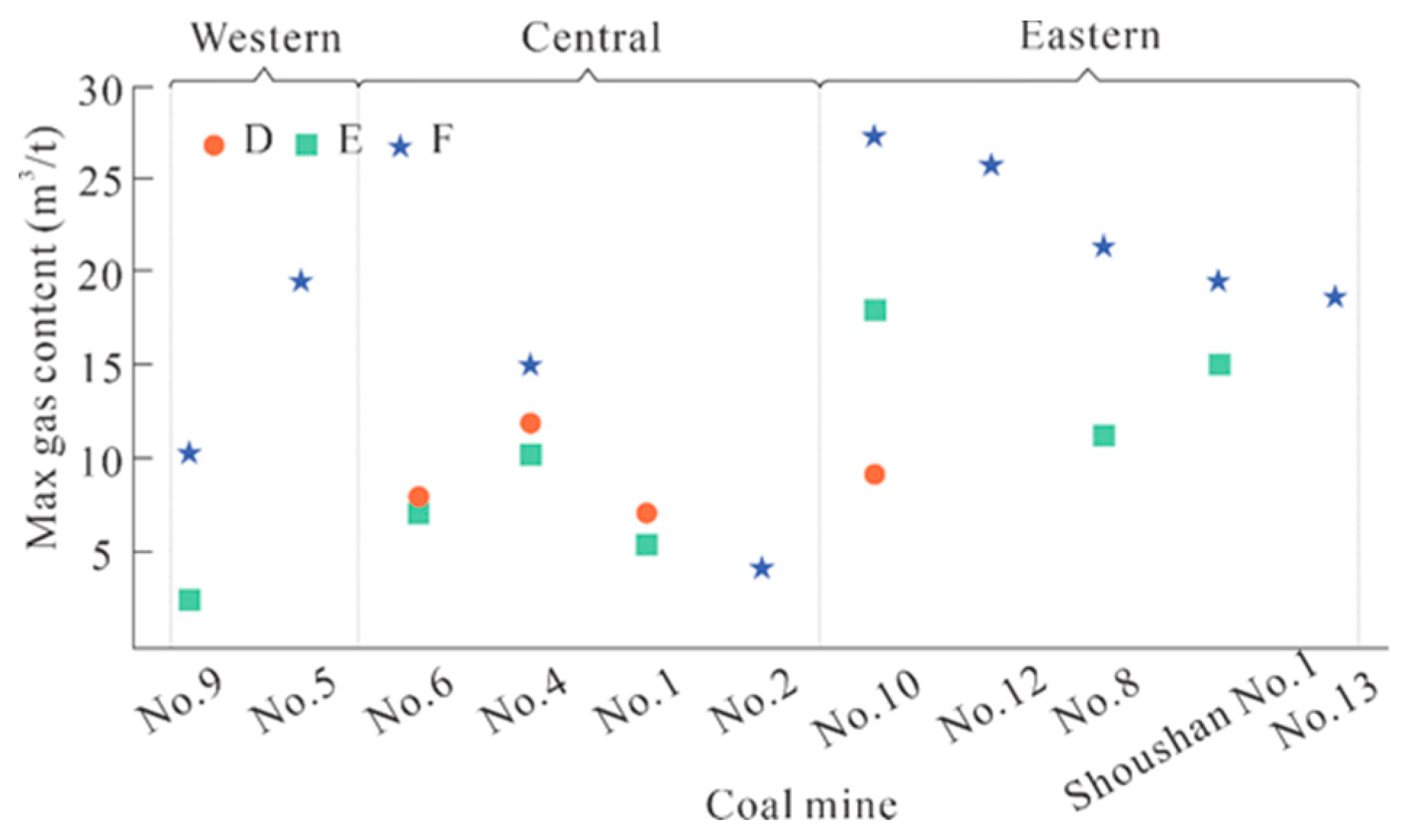
| Coal mines | No.9 | No.5 | No.6 | No.4 | No.1 | No.10 | No.12 | No.8 | Shoushan No.1 | No.13 | Avg Gas Emission per Incident/(m3) |
|---|---|---|---|---|---|---|---|---|---|---|---|
| D | — | — | 3 | 11 | 1 | 25 | — | — | — | — | 567.8 |
| E | — | — | — | — | — | 17 | — | 23 | 1 | — | 3784.4 |
| F | 2 | 13 | — | 1 | — | 8 | 28 | 17 | 1 | 4 | 10869.5 |
| Number | X1 | X2 | X3 | X4 | X5 | X6 | X7 | X8 | X9 | X10 | X11 | Q | Y |
|---|---|---|---|---|---|---|---|---|---|---|---|---|---|
| 1 | 535 | 3 | 3 | 1 | 1 | 5.4 | 1 | 0.32 | 0.66 | 0.4 | 11.23 | 19.7 | 2 |
| 2 | 522 | 3 | 1 | 3 | 1 | 4.8 | 1 | 0.35 | 1.93 | 0.5 | 10.17 | 16 | 2 |
| 3 | 584 | 3 | 1 | 1 | 5 | 3.2 | 3 | 0.2 | 2.38 | 0.53 | 12.06 | 132 | 3 |
| 4 | 484 | 3 | 3 | 1 | 3 | 4.81 | 1 | 0.53 | 5.25 | 0.5 | 4.75 | 12 | 2 |
| 5 | 566 | 5 | 1 | 1 | 1 | 3.5 | 1 | 0.51 | 0.36 | 0.2 | 9 | 30 | 2 |
| 6 | 463 | 1 | 1 | 3 | 1 | 4.81 | 3 | 0.26 | 6.24 | 0.6 | 4.8 | 46 | 2 |
| 7 | 490 | 3 | 1 | 1 | 1 | 4.81 | 1 | 0.49 | 6.24 | 0.6 | 7.81 | 28 | 2 |
| 8 | 424 | 1 | 1 | 1 | 1 | 3.65 | 3 | 0.51 | 0.47 | 0.27 | 8.53 | 6 | 2 |
| 9 | 535 | 3 | 1 | 1 | 1 | 5.2 | 3 | 0.29 | 3.68 | 0.49 | 17.14 | 62 | 3 |
| 10 | 566 | 5 | 3 | 3 | 3 | 3.5 | 1 | 0.38 | 1.04 | 0.75 | 8.57 | 144.6 | 3 |
| 11 | 563.4 | 5 | 1 | 1 | 1 | 3.7 | 1 | 0.57 | 0.76 | 0.4 | 8.76 | 53 | 3 |
| 12 | 564 | 5 | 1 | 1 | 1 | 3.7 | 1 | 0.57 | 0.7 | 0.38 | 7.24 | 0 | 1 |
| 13 | 485 | 5 | 3 | 5 | 3 | 3.3 | 1 | 0.11 | 7.8 | 1.2 | 19.65 | 450 | 3 |
| 14 | 482 | 3 | 1 | 1 | 1 | 3.4 | 1 | 0.14 | 7.6 | 1.3 | 18.64 | 0 | 1 |
| 15 | 623 | 3 | 3 | 1 | 3 | 4.5 | 1 | 0.35 | 0.44 | 0.3 | 14.27 | 22 | 2 |
| 16 | 584 | 3 | 1 | 1 | 3 | 3.2 | 1 | 0.24 | 2.32 | 0.5 | 11.86 | 0 | 1 |
| 17 | 557.6 | 1 | 1 | 1 | 1 | 3.1 | 3 | 0.54 | 0.52 | 0.4 | 11.38 | 43 | 2 |
| 18 | 557.6 | 1 | 3 | 1 | 1 | 3.4 | 3 | 0.15 | 0.78 | 0.6 | 18.85 | 240 | 3 |
| 19 | 557.6 | 1 | 1 | 1 | 1 | 3.2 | 3 | 0.46 | 0.36 | 0.5 | 9.48 | 0 | 1 |
| 20 | 486 | 1 | 1 | 1 | 1 | 3.5 | 3 | 0.29 | 0.33 | 0.38 | 12.56 | 22 | 2 |
| 21 | 529.8 | 3 | 1 | 3 | 1 | 4.3 | 3 | 0.67 | 0.42 | 0.32 | 11.48 | 5 | 2 |
| 22 | 583 | 1 | 1 | 1 | 1 | 4.5 | 3 | 0.43 | 1.15 | 0.7 | 9.18 | 10 | 2 |
| 23 | 583 | 1 | 1 | 1 | 1 | 4.7 | 1 | 0.46 | 1.05 | 0.66 | 9.24 | 0 | 1 |
| 24 | 533 | 5 | 3 | 3 | 3 | 4.1 | 3 | 0.23 | 0.34 | 0.2 | 12.57 | 440 | 3 |
| 25 | 530 | 5 | 1 | 1 | 1 | 4.1 | 1 | 0.36 | 0.32 | 0.18 | 12.38 | 0 | 1 |
| 26 | 622 | 3 | 1 | 1 | 1 | 3 | 1 | 0.32 | 2.31 | 0.5 | 20.19 | 64 | 3 |
| 27 | 573 | 1 | 1 | 1 | 1 | 4.1 | 3 | 0.5 | 0.79 | 0.34 | 7.33 | 16 | 2 |
| 28 | 537.9 | 3 | 1 | 1 | 3 | 5.3 | 1 | 0.19 | 0.22 | 0.8 | 23.91 | 138 | 3 |
| 29 | 562 | 3 | 1 | 1 | 1 | 5.25 | 1 | 0.47 | 4.5 | 0.5 | 14.28 | 12.5 | 2 |
| 30 | 540 | 1 | 1 | 1 | 1 | 4.8 | 1 | 0.31 | 0.62 | 0.32 | 12.33 | 0 | 1 |
| 31 | 540 | 1 | 1 | 3 | 1 | 4.8 | 3 | 0.27 | 0.52 | 0.3 | 12.05 | 8 | 2 |
| 32 | 457 | 1 | 1 | 1 | 3 | 3.5 | 3 | 0.15 | 1.95 | 0.6 | 5.09 | 478 | 3 |
| 33 | 460 | 1 | 1 | 1 | 1 | 3.5 | 1 | 0.38 | 1.38 | 0.52 | 4.68 | 0 | 1 |
| 34 | 589 | 3 | 1 | 1 | 1 | 3.2 | 3 | 0.24 | 2.1 | 0.6 | 11.05 | 4.6 | 2 |
| 35 | 636.4 | 5 | 3 | 3 | 5 | 3.2 | 3 | 0.15 | 3.08 | 0.46 | 18.25 | 396 | 3 |
| 36 | 584 | 3 | 1 | 1 | 5 | 3.2 | 3 | 0.25 | 2.94 | 0.7 | 14.18 | 215 | 3 |
| 37 | 564.6 | 5 | 1 | 1 | 1 | 3.5 | 1 | 0.48 | 0.78 | 0.6 | 9.27 | 44 | 2 |
| 38 | 480 | 1 | 1 | 1 | 1 | 4.81 | 1 | 0.53 | 5.25 | 0.5 | 4.75 | 0 | 1 |
| 39 | 840 | 7 | 3 | 3 | 5 | 4.5 | 3 | 0.17 | 1.15 | 0.25 | 23.52 | 551 | 3 |
| 40 | 838 | 5 | 1 | 1 | 1 | 4.5 | 1 | 0.26 | 1.03 | 0.25 | 20.86 | 0 | 1 |
| 41 | 566 | 5 | 1 | 3 | 1 | 3.5 | 1 | 0.51 | 0.48 | 0.6 | 7.93 | 55 | 3 |
| 42 | 620 | 1 | 1 | 1 | 1 | 3 | 1 | 0.34 | 1.83 | 0.46 | 18.75 | 0 | 1 |
| 43 | 800 | 5 | 1 | 3 | 1 | 3.3 | 3 | 0.18 | 0.42 | 0.22 | 15.89 | 190 | 3 |
| 44 | 820 | 5 | 1 | 1 | 1 | 4.5 | 1 | 0.21 | 1.22 | 0.28 | 20.31 | 0 | 1 |
| 45 | 614 | 1 | 1 | 1 | 1 | 4.5 | 1 | 0.55 | 5.4 | 0.3 | 9.87 | 7 | 2 |
| 46 | 697 | 1 | 1 | 1 | 1 | 4.1 | 1 | 0.35 | 0.58 | 0.12 | 15.91 | 14 | 2 |
| 47 | 629 | 3 | 1 | 1 | 1 | 4.5 | 1 | 0.34 | 0.99 | 0.18 | 15.67 | 32 | 2 |
| 48 | 490 | 3 | 1 | 1 | 1 | 3.2 | 1 | 0.51 | 0.85 | 0.15 | 14.32 | 34 | 2 |
| 49 | 652 | 1 | 1 | 1 | 1 | 4 | 1 | 0.54 | 0.5 | 0.52 | 12.03 | 5 | 2 |
| 50 | 820 | 7 | 1 | 1 | 1 | 4.5 | 1 | 0.19 | 1.22 | 0.3 | 24.71 | 115 | 3 |
| 51 | 554 | 1 | 3 | 3 | 1 | 5.4 | 1 | 0.28 | 0.35 | 0.3 | 15.47 | 27 | 2 |
| 52 | 482 | 3 | 3 | 1 | 3 | 4.81 | 1 | 0.53 | 6.24 | 0.6 | 4.75 | 20 | 2 |
| 53 | 550 | 1 | 1 | 1 | 1 | 5.4 | 1 | 0.4 | 0.28 | 0.25 | 10.48 | 0 | 1 |
| 54 | 606 | 1 | 3 | 1 | 1 | 2 | 1 | 0.41 | 0.34 | 0.45 | 7.99 | 16 | 2 |
| 55 | 557.6 | 3 | 3 | 1 | 3 | 3 | 3 | 0.24 | 1.5 | 0.5 | 21.06 | 180 | 3 |
| 56 | 563 | 1 | 1 | 1 | 1 | 3.5 | 1 | 0.55 | 0.42 | 0.35 | 6.21 | 0 | 1 |
| 57 | 487 | 3 | 3 | 1 | 3 | 4.81 | 1 | 0.53 | 5.25 | 0.5 | 4.75 | 10 | 2 |
| 58 | 583 | 1 | 3 | 1 | 1 | 4.8 | 1 | 0.34 | 1.24 | 0.75 | 10.34 | 20 | 2 |
| 59 | 580 | 1 | 1 | 1 | 1 | 3.4 | 1 | 0.26 | 2.7 | 0.52 | 12.27 | 0 | 1 |
| 60 | 520 | 3 | 1 | 3 | 1 | 4.5 | 1 | 0.26 | 1.38 | 0.4 | 12.74 | 45.5 | 2 |
| Models | AUC | Accuracy | Precision | Recall | F1 score |
|---|---|---|---|---|---|
| KNN | 0.80 | 0.88 | 0.84 | 0.8 | 0.82 |
| BPNN | 0.88 | 0.88 | 0.97 | 0.84 | 0.85 |
| RT | 0.74 | 0.54 | 0.69 | 0.59 | 0.51 |
| SVM | 0.94 | 0.91 | 0.89 | 0.89 | 0.89 |
| XGBoost | 0.97 | 0.90 | 0.93 | 0.97 | 0.95 |
Disclaimer/Publisher’s Note: The statements, opinions and data contained in all publications are solely those of the individual author(s) and contributor(s) and not of MDPI and/or the editor(s). MDPI and/or the editor(s) disclaim responsibility for any injury to people or property resulting from any ideas, methods, instructions or products referred to in the content. |
© 2025 by the authors. Licensee MDPI, Basel, Switzerland. This article is an open access article distributed under the terms and conditions of the Creative Commons Attribution (CC BY) license (http://creativecommons.org/licenses/by/4.0/).


