

Submitted:
26 December 2025
Posted:
26 December 2025
You are already at the latest version
Abstract
The conventional framework for quantum statistics is built upon gauge theory, where particle exchanges generate path-dependent phases. However, the apparent consistency of this approach masks a deeper question: is gauge invariance truly sufficient to satisfy the physical requirement of indistinguishability? We demonstrate that gauge transformations, while preserving probabilities in a formal sense, are inadequate to capture the full constraints of identical particles, thereby allowing for unphysical statistical outcomes. This critical limitation necessitates a reconstruction of the theory by strictly enforcing indistinguishability as the foundational principle, thus moving beyond the conventional topological paradigm. This shift yields a radically simplified framework in which the statistical phase emerges as a path-independent quantity, \( \alpha = e^{\pm i\theta} \), unifying bosons, fermions, and anyons within a single consistent description. Building upon the operator-based formalism of Series I and the dual-phase theory of Series II, we further present an exact and computationally tractable approach for solving N-anyon systems.
Keywords:
identical particles
; quantum statistics
; probability invariance
; gauge invariance
1. Introduction
This is the third installment in our series on the theory of identical particles. In Series I [1], we developed an operator-based framework to address symmetry challenges in systems of identical particles, providing a more efficient alternative to conventional wave function methods. In Series II [2], we established the fundamental dual-phase theory, demonstrating the intrinsic relationship between the exchange phase and the relative phase. However, the relationship between the statistical phase and these two fundamental phases has remained an open question to date. The present work therefore aims to determine the statistical phase and to clarify its distinct role alongside the relative, exchange, and global phases. Drawing on the principles of indistinguishability, we further provide a comprehensive account of the statistical phase, wave function, probability density, and energy eigenvalues for all classes of identical particles.
The statistical behavior of identical particles constitutes one of the most profound pillars of quantum mechanics, shaping our understanding across a vast range of physics. This spans phenomena such as superconductivity [3,4,5] and the fractional quantum Hall effect [6,7,8,9], and extends to the foundational aspects of quantum field theory [10,11,12]. For decades, this behavior has been interpreted almost exclusively through a topological lens, with conventional quantum statistics grounded in principles of gauge invariance and the representation of particle trajectories via the braid group [12,13,14,15,16,17]. This topological framework underpins the two dominant formulations of modern statistical theory. For Abelian statistics [18,19,20,21,22,23,24,25,26], the exchange of two particles induces a phase transformation,
where the phase depends on the braiding trajectory. This describes the continuous interpolation between bosons and fermions in two dimensions, characterizing Abelian anyons. Non-Abelian statistics [27,28,29,30,31], by contrast, entail a more profound generalization: particle exchange is represented by a unitary matrix M acting on the wave function:
where the matrices for successive exchanges generally do not commute, . This non-commutativity under braiding operations provides the foundational structure for topological quantum computation [32,33,34,35]. Historically, the transformations in Eqs. (1) and (2) have been regarded as defining quantum statistics, under the assumption that the global phase transformations preserves probability invariance [36,37,38,39]. This perception, however, is fundamentally incomplete. The core issue lies in the fact that global gauge invariance and probability invariance represent two distinct physical principles. Gauge invariance requires the Lagrangian to remain unchanged under gauge transformations, ensuring that observable quantities are preserved [11,17]. It imposes no specific constraints on the form of the wave function , which may describe either identical or distinguishable particles. In contrast, for a system of identical particles, probability invariance demands that the wave function itself satisfy a specific symmetry constraint, namely, for all a, b, in order to uphold the requirement of indistinguishability [40,41,42]. Consequently, when enforcing gauge invariance in a general field theory [11,16,36], the primary concern is the invariance of the Lagrangian. One need not concern oneself with whether describes identical particles. However, when considering probability invariance for identical particles, the construction of must adhere to the indistinguishability criterion. If does not originally describe identical particles, attaching a global phase, while mathematically feasible, is physically meaningless; it merely decorates an invalid wave function with an irrelevant phase factor.
The transformations in Eqs. (1) and (2) commit precisely this error: they impose topological or group-theoretic phase changes on generic wave functions, without verifying whether those functions respect the probabilistic symmetry required by the principle of indistinguishability. For instance, the valid wave functions for bosons and fermions take the symmetrized form , not the simple products or . Physically, what matters is the relative phase of inherent to this symmetric structure, rather than an arbitrary global phase factor prefacing . Thus, applying a transformation such as is physically unjustified. This fundamental oversight permeates the topological framework built upon Eqs. (1) and (2). It operates at the level of gauge equivalence classes of the Lagrangian, not on the indistinguishability criterion that the physically admissible wave function and probability density must respect exchange symmetry [43,44,45,46,47,48,49,50,51]. While this topological procedure appears to satisfy the mathematical statement that a global phase leaves probabilities unchanged, it is fundamentally inconsistent with the physical principles governing identical-particle systems. To concretely reveal this flaw, one can examine the corresponding probability distribution based on Eqs. (1) and (2), as distribution plots provide a direct visualization of whether the probability expression satisfies exchange symmetry. In any valid theory of identical particles, the structure of the distribution plot must be symmetric, as selecting any two points and should yield identical probability density.
These considerations reveal a fundamental issue in the conventional topological approach to quantum statistics, wherein the statistical phase is considered to depend essentially on the exchange path. This path-dependence, however, may not align with physical reality. For instance, the findings presented in Series II have demonstrated that clockwise and counter-clockwise rotation paths, despite their topological distinctness, are physically equivalent [2]. This equivalence originates from the fact that a clockwise rotation yields and , whereas a counter-clockwise rotation gives and . Note that both paths correspond to the same conserved quantity . This conclusion stands in stark contrast to the predictions derived from the topological approach. It is precisely this critical shortcoming that the present work aims to address. We therefore abandon the conventional paradigm of relying on gauge invariance and topological paths, instead rigorously deriving the statistical phase of identical particles directly from the principle of indistinguishability. This derivation entails constructing the physically admissible forms of the wave function and probability density, in accordance with the constraints imposed by indistinguishability.
2. The Indistinguishability of Identical Particles
The principle of indistinguishability imposes stringent constraints on the mathematical structure of quantum many-body theory [40,41,42]. For identical particles, the core requirement is that the description of the configuration space, wave function, and probability density must inherently satisfy the fundamental demands of indistinguishability, rather than conform to gauge invariance. This requirement manifests in two essential conditions:
- Singularity Constraint: The behavior at coincidence points must be physically well-regulated, as quantum mechanics forbids identical particles from coinciding spatially.
- Exchange Invariance: The probability distribution of identical particles must be invariant under particle exchange.
Both constraints follow directly from the principle of indistinguishability. The first constraint arises from the quantum mechanical prohibition against two identical particles simultaneously occupying the same position [52,53]. This singularity condition imposes rigorous regularity requirements on the configuration space of identical particles, while also constraining the permissible forms of the probability density. The second constitutes a foundational requirement for identical particles, imposing severe constraints on the allowable forms of wave functions and probability densities. Together, these constraints uniquely determine the permissible functional forms of the configuration space, wave function, and probability density—whether for bosons, fermions, or anyons.
2.1. Configuration Space and Equivalent Domains
The construction of the configuration space for identical particles is fundamentally dictated by the singularity constraint, which excludes the coincidence points [51,52]. For identical particles, one cannot determine a priori whether it resides in the configuration or . Assigning distinct labels to identical particles conveys no physically meaningful information [42,54]. Thus, the representations and are physically entirely equivalent. We refer to these as the two equivalent domains of the system, emphasizing that while mathematically distinct, they describe one and the same physical reality. This equivalence finds its rigorous mathematical formulation in the configuration space , which is constructed via the exclusion of coincidence points and the identification of all permutations via the symmetric group [52,55]. This quotient space, with its specific connectivity [46,52], provides the fundamental arena for describing identical particles. It is precisely from the nontrivial connectivity of this space that the possibility of different statistical types (bosons, fermions, and anyons) and their corresponding quantum phases arises [18,31,46,52]. Another key characteristic of the two equivalent domains is that they admit a global phase difference between the corresponding wave functions and probability density expressions. Multiplying the wave function or probability density by a phase factor leaves the equivalence of the two domains unaltered and does not affect the system’s physical properties, a behavior that aligns with the defining features of global gauge transformations [16,37,56]. We now analyze this scenario for identical particles; the potential energy can be expressed as:
The Hamiltonian of indistinguishable particles is invariant under position exchange, that is, . For an eigenfunction of , the eigenvalue equation satisfies:
Operating on both sides with the exchange operator , we obtain . Given the Hamiltonian symmetry , it follows that:
This demonstrates that the exchanged state is also an eigenfunction of with the same energy eigenvalue E. This symmetry extends to global phase transformations: the eigenfunction transformed by a global phase factor (e.g., for ), retains the same energy eigenvalue E. Furthermore, for arbitrary phase factors and , the states and also possess identical eigenvalues of . However, neither of these states constitutes a valid physical expression. They are two mathematically equivalent representations (see Table 1) of the same physical domain of the indistinguishable particles. In conventional quantum statistics, this equivalence of the domains is often conflated with the physical requirement of constructing properly symmetrized wave functions, which is liable to cause conceptual confusion. In the following subsection, we will demonstrate how to construct physically admissible wave functions and probability densities by appropriately combining these two equivalent domains.
2.2. Allowable Wave Function and Probability Density
In quantum mechanics, the allowable forms of wave functions and probability densities for identical particles have not been fully defined from first principles. With the development of two-dimensional physics, the complete set of allowable forms has become an even more pressing open question[57,58,59,60,61,62,63,64,65,66,67]. Conventionally, one begins by determining the statistical phase and subsequently constructs the wave function, precisely because the form of a wave function depends essentially on this phase. However, within the conventional topological framework, the statistical phase can be path-dependent [12,13], admitting infinitely many possible forms, making it impossible to construct definitive wave functions and probability densities [47,52]. Here, we reverse this procedure by directly employing the principle of indistinguishability to construct physically admissible wave functions and probability densities, rather than requiring prior determination of the statistical phase. This approach is possible because the two fundamental constraints arising from indistinguishability severely limit the allowable forms of wave functions and probability densities. We first turn our attention to the singularity constraint, which not only imposes restrictive conditions on the structure of the configuration space but also constrains the mathematically permissible forms of the probability density for identical particles. A key consequence of this constraint for the topology of configuration space is that two consecutive exchanges may not act as the identity operation, a condition expressed by the relation:
For bosons and fermions in three dimensions, particle motion is not bound by this condition. However, this relation becomes essential for particles in two-dimensional systems, where motion is constrained to a plane. In such systems, two consecutive exchanges do not necessarily return the particles to their original configuration [35,52]. This fundamental distinction plays a critical role in determining how probability expressions must be constructed for identical particles. Historically, several formalisms have been proposed to describe the probability of identical particle states, expressed as:
where is defined in the following way:
These forms of probability expressions are frequently encountered in quantum physics. However, for identical particles, the physical constraints of exchange invariance and the singularity condition imply that most of these forms are not valid. Let us first examine Eq. (7). For a long time, this equation has been regarded as a fundamental probability expression for identical particles and is widely recognized as a core principle of quantum mechanics [40,42]. Yet, its applicability is not as universal as often assumed: beyond the special cases of bosons and fermions, it fails to accommodate the broader possibilities mandated by the singularity requirement in two dimensions. This limitation arises because Eq. (7) implicitly assumes that the state returns to itself after two successive exchanges—a condition that does not hold for particles in two dimensions. Therefore, Eq. (7) is strictly valid only for bosons and fermions. This can be verified using the following general wave function:
where and are complex coefficients. For indistinguishable particles, the two components of the wave function describe the same physical reality; thus, the coefficients must satisfy , which implies . Substituting it into Eq. (11) gives , where the phase factor is applicable to all identical particles. Performing particle exchange in Eq. (11) yields
Substituting Eqs. (11) and (12) into Eq. (7) yields the constraint , admitting only two solutions. The wave function then reduces to the familiar symmetric or antisymmetric form: , where the phase factors correspond to bosons and fermions, respectively. Physically, Eq. (7) inherently excludes the possibility of anyons, as it is predicated on the implicit assumption of the identity operation . In Eq. (11), the term inherently encodes a single exchange event. As such, Eq. (11) is not subject to the constraint imposed by Eq. (6), and thus gives rise to an infinite set of physically valid solutions for identical particles. However, Eq. (12) involves two successive exchange operations, that is, . Being subject to the constraint specified in Eq. (6), this relation can only hold for the cases of bosons and fermions. This reveals that the conventional probability condition is strictly valid only for bosons and fermions.
We now examine how the second constraint shapes the form of the wave function and its corresponding probability density. In Table 1, we list two equivalent domains of the wave function and probability density, corresponding to Eqs. (8) and (9). It is straightforward to verify that these expressions are not, by themselves, valid wave functions or probability densities for identical particles. This highlights a key distinction in the construction of wave functions for distinguishable versus identical particles: for distinguishable particles, the wave function does not require exchange invariance, whereas for identical particles, it must be constructed as a linear combination of the two equivalent domains to uphold this fundamental principle. This exchange invariance for identical particles can be intuitively illustrated through probability distribution plots. As a universal principle, we consider a simple system of two non-interacting identical particles in an infinite square well of length L to illustratively elaborate on Eqs. (8) and (9). The single-particle eigenfunctions take the form: , leading to the two-particle states (, ):
The probability distributions and are presented in Figure 1, revealing two fundamental physical inconsistencies. First, a direct implication of and is that all particle types—bosons, fermions, or anyons—would yield identical probability distributions, as these expressions are completely independent of global phases. This leads to the unphysical conclusion that the probability patterns of identical particles are identical, contradicting well-established quantum principles [41,42,68]. Second, exchanging and in these states produces visibly distinct probability densities, directly violating the requirement that particle exchange should produce no observable physical differences [41,54,69]. As illustrated in of Figure 1, whereas , clearly demonstrating . A similar inconsistency emerges in of Figure 1. Together, these results demonstrate that Eqs. (7), (8), and (9) are all inadequate as probability expressions for identical particles: Eq. (7) fails to satisfy the singularity constraint, while Eqs. (8) and (9) merely describe two equivalent domains of the system and do not meet the basic requirement of exchange symmetry.
Therefore, exchange invariance dictates that the wave function must take a superposition form, and the probability density must exhibit a symmetric structure to ensure exchange symmetry. However, the singularity constraint imposes restrictive conditions on such superposition forms and symmetric structures. This implies that the probability density must necessarily assume a highly specific mathematical form to satisfy all these requirements simultaneously. We find that the mathematical form given in Eq. (10) is the unique construction that satisfies both requirements concurrently. To establish its physical validity, we select the corresponding wave function that fulfills these fundamental constraints. The wave function given in Eq. (11) naturally conforms to the basic requirements of Eq. (10). Substituting and into Eq. (11), we get the generalized wave function:
where C is the normalization constant. This construction represents a linear superposition of the two equivalent domains listed in Table 1, the initial configuration and its exchanged counterpart, incorporating a physically meaningful relative phase. The corresponding probability density is given by:
This formalism, which corresponds to Eq. (10), uniquely satisfies both fundamental constraints and is applicable to all identical particles. Its structure exhibits several fundamental characteristics: the first two terms represent the two equivalent domains of the system, consistent with Eqs. (8)–(9) ( and ), while the last two terms embody quantum interference effects, where the phase factor governs the specific interference pattern [42,68]. Crucially, it is precisely these interference terms that ensure probability invariance under particle exchange. The phase factor enables continuous interpolation between bosonic and fermionic behaviors, while rigorously maintaining exchange symmetry. For identical particles, the requirement that probability densities must be real-valued ensures that Eq. (16) simplifies to:
which explicitly displays the exchange symmetry [54,69]. For specific positions and , we get
Given that , a direct consequence of real-valued probability densities, we can obtain
We now demonstrate the probability invariance under particle exchange. It is important to emphasize that although Eqs. (20) and (7) are mathematically similar in form, they originate from fundamentally different constructions. Eq. (7) is based on an implicit topological assumption , a constraint that excludes anyons by construction. In contrast, Eq. (20) emerges naturally from the wave function (15) and automatically bypasses the restrictive , thereby accommodating all particle statistics including anyons. Consequently, Eq. (20) yields a probability distribution with symmetric structure for all identical particles. To visualize this property and facilitate comparison, we again consider the bosonic and fermionic cases within the infinite square well model (, ), with the wave function
The probability density , corresponding to two special cases of Eq. (17), is shown in Figure 2. These distributions differ fundamentally from those in Figure 1. Owing to their distinct constructions, the distributions in Figure 1 cannot correspond to any physical particle type. Such probability constructions lack inherent symmetric properties, relying solely on the initial or exchanged state in isolation. In contrast, the distributions in Figure 2 exhibit a well-defined symmetric structure. This symmetry ensures that the probability remains invariant under coordinate exchange. The explicit dependence on the relative phase makes the shape of the probability distribution sensitive to particle statistics. Different phase values yield distinct probability patterns: the bosonic case () exhibits positive interference, while the fermionic case () shows negative interference. These are but two special cases within a continuous family of distributions governed by the interference term in Eq. (17). As varies continuously from 0 to , all resulting distributions maintain the essential symmetric structure satisfying for arbitrary positions, thereby fulfilling both exchange invariance and the singularity constraint. Probability distributions offer a direct visual criterion for validating wave functions and probability densities. The exchange invariance of the probability density relies on the incorporation of both the initial and exchanged configurations together with relative phase to construct symmetric structures. This symmetric structure is fundamentally distinct from that of a global phase transformation, where the resulting probability distribution generally lacks exchange symmetry and fails to satisfy the essential constraint of indistinguishability.
3. The Statistical Behavior of Identical Particles
The prevailing topological approach derives quantum statistics from the global phase accumulated during adiabatic particle exchange [70,71], operating on the implicit assumption that gauge invariance inherently fulfills the core requirements of indistinguishability. However, our analysis reveals that the physically permissible forms of wave functions, probability densities, interference patterns, and probability distribution plots for identical particles are governed by the relative phase, not the global phase. Crucially, gauge invariance does not even address the exchange symmetry of the probability density, directly contradicting that assumption. Therefore, the statistical phase obtained within this topological framework generally differs from the physically admissible statistical phase constrained by the principle of indistinguishability. Here, we provide a fundamental reassessment by constructing a complete physical framework that grounds quantum statistics directly in the principle of indistinguishability and its inherent probability symmetry. The following subsections will critically examine the topological approach, present our alternative derivation, and clarify the genuine role of topology in particle exchange.
3.1. The Limitations of the Topological Approach
The topological approach to quantum statistics constitutes an influential and widely studied framework that characterizes particle statistics through topological invariants arising from particle exchanges. This theoretical description is grounded in the topology of the configuration space, where the exclusion of particle coincidence points leads to a multiply-connected space, permitting distinct topological classes of exchange paths. Through this mechanism, identical particles moving in three-dimensional versus two-dimensional spaces can be rigorously classified. The statistical properties are encoded in a global phase factor acquired by the wave function under adiabatic exchange, where corresponds to bosons, to fermions, and intermediate values describe anyonic statistics in low-dimensional systems [19,52,72,73]. The core mechanism is frequently implemented through Chern-Simons field theory [74,75,76]. The corresponding wave function undergoes a multivalued transformation, exemplified in its complex-coordinate representation by:
Here, the multivalued phase factor is path-dependent, with its specific form dictated by the braiding trajectory of the particles [12,13,46]. Conventionally, this multivaluedness is considered physically admissible on the grounds that the probability density remains single-valued, while the phase factors are further interpreted as capturing topological effects analogous to the Aharonov-Bohm effect [77,78,79].
However, this topological treatment merely accounts for the constraint that the principle of indistinguishability imposes on the configuration space. The crucial shortcoming of this approach is its failure to incorporate the additional, equally vital constraints that indistinguishability places directly on the admissible forms of the wave function and probability density. Consequently, while the topological framework classifies particles through multivalued wave functions such as Eq. (22), where the statistical angle appears as a free parameter in the factor , it allows to take arbitrary values precisely because it lacks the physical constraints on probability symmetry. As a result, the statistical phases derived within this framework differ substantially from their physically realistic counterparts. From the standpoint of the statistical mechanism, the global phase transformation , under which the Lagrangian remains invariant, also implies that the probability distribution of identical particles becomes independent of the statistical phase . This leads to an irreconcilable contradiction with physical reality: bosons and fermions, for instance, exhibit fundamentally distinct probability distribution patterns precisely due to their different statistical phases. From the perspective of probability distribution plots, the statistical phases and exchange symmetry characteristics of identical particles can both be directly visualized in such plots, which take distinct shapes for different particle types. For any type of identical particle, the relation must hold for arbitrarily selected pairs of points and on the plot. However, within the topological framework, these essential symmetries and statistical characteristics fail to emerge, as visually evidenced in Figure 1. This deficiency originates from the fact that a global phase transformation does not affect the shape or symmetry of the probability distribution. At the foundational level, it shall be emphasized that probability expressions Eqs. (7)– (9) are physically invalid. These invalid probability expressions cannot serve as a valid foundation for constructing a rigorous statistical theory. Physically speaking, a rigorous statistical theory should not be confined to constraints on the configuration space alone, but must also be grounded in the establishment of valid wave functions and probability densities. Thus, the topological framework provides an incomplete dynamical foundation for quantum statistics. This fundamental limitation necessitates moving beyond a purely topological description and motivates the adoption of a rigorous theoretical foundation firmly rooted in the full satisfaction of the principle of indistinguishability.
3.2. Quantum Statistics from the Principle of Indistinguishability
The foundation of quantum statistics developed here rests fundamentally on the relative phase, not the global phase. The determination of the statistical phase involves two key issues: rigorously enforcing the principle of indistinguishability, and clearly differentiating among the distinct types of quantum phases involved. First, the admissible forms of the configuration space, wave function, and probability density must be strictly derived from the principle of indistinguishability, a requirement that directly influences the determination of the resulting statistical phase. Second, the conceptual ambiguities among different quantum phases—particularly the intricate phase relationships in two-dimensional systems [37,56,80,81,82,83,84,85,86,87,88], also exert an influence on our determination of statistical phases and the establishment of consistent statistical theories. In quantum mechanics, several distinct types of quantum phases are recognized, including global phases, relative phases, exchange phases, and statistical phases. Yet their precise physical definitions and interrelationships have not been rigorously established or systematically clarified, leading to pervasive conceptual conflation, such as the erroneous equivalence of global phases with relative phases, exchange phases with statistical phases, or even the lumping of all these distinct quantities into a single vague notion. Within the topological framework, for instance, the exchange phase induced by particle interchange may be ambiguously interpreted as a global phase, a statistical phase, or a relative phase. Such conflation fundamentally hinders our understanding of quantum statistics, as it remains unclear which phase truly governs statistical behavior and within which theoretical framework it should be derived. To address these phase relationships, we specifically focused on distinguishing the interconnections among these phases in Series II, where we demonstrated that the relative phase and the exchange phase are distinct. We provided their rigorous definitions and established their relationship through . Recognizing this distinction is key to understanding why clockwise and counter-clockwise particle exchanges are physically equivalent.
Moving forward, we will continue to clarify the relationships between these phases, ultimately enabling a comprehensive understanding of quantum phases and the unique identification of the statistical phase. The wave functions and probability densities of identical particles are strongly dependent on the statistical phase. Conversely, knowing the physically admissible forms allows us to deduce the permissible statistical phases. To date, we have established the physically allowed wave function (Eq. (15)) and probability density (Eq. (17)). From the perspective of quantum phases, these expressions involve both a global phase and a relative phase. The global phase is straightforward: attaching such a phase to any wave function via a gauge transformation leaves all probabilities and observables unchanged. Notably, Eq. (15) satisfies the requirement of gauge invariance, a property that is inherently inherited by the probability density in Eq. (17). In contrast, the explicit inclusion of the relative phase enables the description to coherently incorporate the two equivalent configurations, thereby giving rise to interference effects. Such a structure is necessary to preserve exchange symmetry, ensuring probability invariance as shown in Eq. (20). Thus, Eqs. (15) and (17) also fulfill exchange invariance. Gauge transformations applied to such wave functions and probability densities do not alter their physical essence and, in fact, hold no physical significance. Within this framework, the relationships among the global, relative, and statistical phases become clear. In Eq. (17), the global phase has no effect on the probability distribution, while the relative phase directly shapes the interference pattern and is not arbitrary. To maintain exchange invariance, must take specific values for each type of identical particle. For a given statistical parameter , only two values are physically admissible: and . These choices preserve the invariance of under exchange in Eq. (17); other phase factors such as , , etc., would violate this fundamental condition. This shows that the relative phase uniquely determines the particle type, serving the same role as the statistical phase—they are one and the same.
Thus, under the strict constraints imposed by the principle of indistinguishability, the statistical phase is neither arbitrary nor path-dependent. It is uniquely determined by the particle type via the statistical parameter , and is independent of any specific particle exchange trajectory. Specifically, corresponds to bosons, while characterizes fermions. For anyons, the permissible phase values are for a given statistical parameter . As established in Series II, the interchange of two identical particles yields both an exchange phase and a statistical phase , and these two quantities satisfy the relation [2]. The statistical properties and phase relations of bosons, fermions, and anyons are summarized in Table 2. It is therefore evident that the wave function, probability density, and energy eigenvalues of an identical particle system depend solely on the statistical phase . This gives rise to a double-valued wave function while maintaining a single-valued probability density. The two branches of the wave function correspond to the two linearly independent solutions, and , of the Schrödinger equation. The existence of this double-valued structure is an inherent requirement of the quantum theoretical framework, ensuring the consistency of the probability interpretation [41,42]. The fundamental distinction between the topological approach and the framework developed in this work lies in their underlying theoretical foundations. A comparative summary of the two frameworks is presented in Table 3.
3.3. Topological Paths and Dynamical Phase Evolution
The evolution of quantum phases offers new insights into the understanding of statistical theory. Topology provides the appropriate language for describing the paths and evolution of quantum phases through the construction of the configuration space . The braiding of particle trajectories within constitutes the physical mechanism through which quantum phases including exchange phases, statistical phases, and geometric phases, are generated and accumulated. During particle exchange, the exchange and statistical phases are linked through the relation , while both of these phases are related to the global phase via the relation [2]. For n consecutive interchanges along a given orientation, two accumulated phases are obtained, which are expressed as
a relation that directly reflects the topological structure of the braiding operations. Given that the wave function and its corresponding probability density depend on , they evolve dynamically as particles traverse this topological space. Building on this relation, we can gain insight into how the wave function evolves with the angle . The wave function for identical particles is constructed as a linear superposition of states corresponding to the two equivalent domains, so as to satisfy exchange symmetry. Two completely equivalent approaches exist for constructing such wave functions. Conventionally, a valid wave function is obtained via the linear superposition of the original state and its swapped counterpart . Alternatively, we may adopt a formulation that incorporates evolution with respect to n, in which case the wave function is built from the state and its swapped form . For the former approach, the wave function is directly given by . For any , the latter approach yields the expression:
Noting that , where denotes the particle exchange operator corresponding to a -rotation of the system, the operator power satisfies the following relation:
Substituting Eq. (25) into Eq. (24) yields the transformed wave function:
which explicitly characterizes the evolution of the wave function with respect to the number of exchanges n. In comparison to the former approach, these two wave function representations differ only by a global phase factor , as evidenced by the normalization coefficient in Eq. (26), demonstrating that the overall physical properties of the system remain invariant under such n-driven evolution. Figure 3 illustrates the concurrent evolution of the global phase , statistical phase , exchange phase , and wave function over n exchanges. As time evolves, the integer parameter n changes continuously, with a global phase accumulating throughout the process. This continuous deformation ensures evolves smoothly, which in turn enforces and to evolve continuously with n as shown in Figure 3. The evolution of the wave function involves both the global phase and the statistical phase: the global phase component evolves in tandem with variations in n, while the statistical phase toggles between for clockwise exchanges and for counter-clockwise exchanges. This toggling behavior reflects the double-valued nature of the wave function for identical particles. Nevertheless, the probability density remains single-valued: as the statistical phase switches between and , the wave function alternates between and its complex conjugate , leaving the product completely unchanged. Throughout the temporal evolution, all observable quantities and probabilities are invariant, independent of how the braiding count n changes.
4. The Solution of N-Anyon System
4.1. Fundamental Concepts and Assumptions
The exact theoretical treatment of N-anyon systems remains a longstanding challenge in quantum many-body physics [89,90,91,92,93,94,95,96,97,98]. With the foundational issues addressed in Series I–III, this task becomes tractable. The current series demonstrates that the statistical phase is path-independent, taking only two discrete values, and that the anyon wave function is consequently double-valued. Although the path-independence of the statistical phase simplifies the problem, the double-valued nature itself remains difficult to handle directly. Fortunately, as established in Series II, this double-valued wave function can be represented by the conserved quantity , an operator constructed from the statistical phase and exchange operator. We then leverage the operator method developed in Series I to resolve the symmetry problem of the system. This strategy dramatically simplifies the treatment of many-particle systems and opens a path to exact solutions for N-anyon systems. As we are dealing with identical particles, the system must satisfy the fundamental condition of indistinguishability. This requires the Hamiltonian to possess exchange invariance, meaning its structure remains unchanged under the exchange of any two particles:
This equation represents a fundamental condition ensuring the indistinguishability of particles, implying that there are two equivalent domains in the system’s configuration space. For any two particles, if is an eigenfunction of the system, then must also be an eigenfunction of the system. Furthermore, the system Hamiltonian can be decomposed into single-particle components and pairwise interactions. For any two particles, separates into single-particle components , , and the pairwise interaction :
To make the N-anyon problem tractable, we employ a simplified wave function ansatz suitable for multi-particle treatment. Specifically, we assume the system’s wave function can be constructed from a set of N single-particle functions: .
4.2. Wave Function, Probability Density, and Energy Eigenvalues for N-Anyon System
First, we need to construct physically admissible wave functions and probability densities for an N-anyon system. In the operator approach, all symmetry and statistical information of the system are directly incorporated into the operator formalism, thereby freeing the wave function from these intricate constraints. This implies that the core challenge in solving the N-anyon problem no longer lies in the construction of the wave function itself. Given that the particles are identical, it suffices to construct a universal wave function for any pair of anyons that encapsulates their symmetry properties [1]. This construction then allows us to encode the full symmetry information of the entire N-particle system. Specifically, a physically admissible wave function for any two anyons, which satisfies the requirements of indistinguishability, can be constructed as
where is the normalization constant and is the statistical angle for the pair. Here, we focus on spinless systems [39,56] such as spin-polarized quantum Hall fluids, where the spin degree of freedom is frozen; thus, the wave function above describes the spatial part, with the statistical phase pertaining solely to the exchange symmetry of spatial coordinates. Considering that represents the wave function for an arbitrary pair, the full N-particle system is described by the set of all such analogous pairs: , , …, , …, totaling unique pairs. Each pair individually satisfies the fundamental postulate of indistinguishability. The corresponding probability density for any pair is given by:
Similarly, the probability density for the entire system comprises contributions from all pairs. This construction explicitly ensures that the probability remains invariant under the exchange of any two particles, thereby fulfilling the fundamental requirement of the indistinguishability principle. According to Series II, the statistical and exchange information of identical particles is governed by the relation:
where the statistical phase is given by . The exchange operator acts as . Accordingly, the wave function in Eq. (29) can be elegantly rewritten as:
We define as the symmetric component of the system, and . Eq. (32) can then be simplified to . Given that the eigenvalue of is 1, the eigenvalue of the operator becomes [2], a positive real number. This ensures that is Hermitian, satisfying . For any two-body Hamiltonian , applying , its expectation value can be written as: . Defining the operator , we obtain:
We thus obtain two physically equivalent descriptions of the system. In the first approach, the system’s symmetry is encoded in the wave function , while in the second approach, the symmetry is incorporated into the operator . Since all symmetry information and normalization coefficients are embedded within the operator , the corresponding wave function takes the simple direct product form . For an N-particle system, we can construct analogous pairs as follows:
The left-hand side of this equation yields such pairwise operators, where all symmetry information of the system is encoded into these operators. Here, incorporates the normalization coefficients and statistical parameters for each pair of anyons, while denotes the original Hamiltonian for the corresponding pair. Summing over all two-body operators yields the total system operator:
which encapsulates all necessary information for the N-anyon system, including normalization, statistical parameters, and Hamiltonian components. The right-hand side of Eq. (34) corresponds to pairwise wave functions. This approach liberates the wave function from explicit symmetry constraints, allowing the total wave function of the N-body system to be expressed in the simple product form:
This formulation represents a significant simplification in the treatment of N-anyon systems, effectively decoupling the complex symmetry requirements from wave function construction while maintaining full consistency with the principles of quantum statistics and indistinguishability. As established in Eq. (33) for any pair of identical particles, we have two equivalent representations of the system; this conclusion extends naturally to systems of N identical particles. Based on Eqs. (35) and (36), these two representations for N particles yield identical energy expectation values:
where the latter two terms correspond to the operator-based and wave function-based treatments of the N-particle system, respectively. When describing the system’s symmetry, we employ the operator method to encapsulate all symmetry information within , allowing the wave function to be expressed in the simplest direct product form. Conversely, when solving for the system’s energy, we transfer the symmetry information contained in back to the wave functions. From Eq. (37), we obtain a set of unique two-body wave functions: , , …, , …, constructed in a manner analogous to Eq. (29). From these wave functions, we derive corresponding probability expressions similar to Eq. (30). As a result, the construction of the wave function and probability density for any particle pair inherently satisfies the requirement of indistinguishability. The derivation follows the same mathematical structure presented in Series I, allowing us to directly apply its results to obtain the energy eigenvalue E in Eq. (37). The total energy of the N-anyon system is therefore given by the general expression [1]:
where are single-particle energies, are direct interaction terms, and are exchange integrals. The fundamental difference from bosonic and fermionic cases is encoded in the relative phase . For anyons, this phase is defined by the statistical parameter , with two equally valid configurations: or . These choices satisfy the relation:
This identity conclusively addresses the question of exchange orientation. It demonstrates explicitly that the clockwise exchange () and counterclockwise exchange () are physically indistinguishable, as both choices yield identical contributions to the exchange energy. This mathematical result confirms a fundamental physical principle: the direction of exchange is not an observable quantity in anyon systems. Substituting Eq. (39) into Eq. (38) yields the physically transparent expression for the N-anyon energy:
This formulation demonstrates that the entire effect of fractional statistics on the energy spectrum is encapsulated in the modulation of the exchange integral . As shown in Figure 4, the energy eigenvalues exhibit periodic behavior and remain invariant under the transformation (). From this characteristic spectrum, we identify three significant cases: the statistical angle corresponds to bosons, while corresponds to fermions. Beyond these conventional statistics, there exists a special class of identical particles with the statistical angle . This particular case, with potential relevance to high-temperature superconductivity, has been studied by Laughlin [99,100], Wen et al. [47], Chen et al. [101], Halperin et al. [102], Fetter et al. [103], and Lee et al. [104]. Remarkably, this represents an exceptionally unique case where exchange effects completely vanish, resulting in for all particle pairs.
The energy expression (40), derived from the wave function (29), provides a description for the paradigmatic case of spin-polarized anyon systems. In this physical context, the fractional statistics are entirely encoded in the spatial relative phase . It is important to recognize that the theory itself allows for the treatment of more general spin configurations. Mathematically, the Hermitian operator , which encapsulates both the exchange statistics and the normalization of identical particles, readily accommodates more general physical situations. Here, the eigenvalue of remains unity regardless of the specific values of the spatial () and spin () phases. Consequently, the eigenvalue of is always a positive real number, , allowing and to take generalized values. Based on the operator approach, the spin components of the many-body wave function are naturally orthonormalized. The system energy depends solely on the spatial part and can be expressed as , where is the angle associated with . This resembles Eq. (40) but with the understanding that the statistics here depend not only on the spatial component but also on the spin component. Specifically, setting or reduces to the scenario of three-dimensional space. For instance, when (), a spin phase of corresponds to bosons, whereas corresponds to fermions. Therefore, the mathematical structure of this theory naturally extends to scenarios with non-trivial spin configurations, without introducing additional complexity into the wave function ansatz or the energy functional.
5. Discussion
5.1. From Gauge Invariance to Indistinguishability
The present work accomplishes a fundamental shift in the foundation of quantum statistics, moving the theoretical basis from gauge invariance to the principle of indistinguishability. This shift is necessitated by a critical reevaluation of the physical meaning of the invariance itself. A gauge transformation is a symmetry operation under which the values of all physical observables remain invariant. Its strength and its fundamental limitation for quantum theory lie in this very property. On the one hand, the global phase transformation allows for flexible gauge choices without altering any measurable quantity, a feature that greatly simplifies the formulation of quantum theories and underscores the profound role of gauge symmetry in modern physics. On the other hand, this invariance property renders such transformations physically irrelevant for identical particle systems: they cannot induce any physical effects on these systems, nor do they impose any constraints on the system. For instance, gauge transformations cannot alter interference patterns of identical particles, nor can they affect the morphology of probability distributions, given that valid probability densities are independent of global phases. In contrast, exchange invariance imposes stringent constraints on the construction of wave functions and probability densities for identical particles: a physically admissible wave function must be constructed as a linear superposition of the two equivalent configurations, incorporating the statistical phase ; meanwhile, a valid probability density must include contributions from both configurations, as well as their interference terms, and the statistical phase. Such a probability expression inherently exhibits a symmetric structure, which naturally satisfies the exchange invariance required for identical particles. These considerations clearly demonstrate that gauge invariance and probability invariance are two entirely distinct physical concepts, with no equivalence whatsoever.
Furthermore, gauge invariance is associated with the global phase, while probability invariance is governed by the relative phase. The wave functions, probability densities, and observables of identical particles all depend on the relative phase, while remaining independent of the global phase. In practice, when performing gauge transformations, one often overlooks whether itself constitutes a physically valid wave function for identical particles. As a result, the system may satisfy gauge invariance while failing to meet the requirement of exchange invariance. This underscores the necessity of defining the statistical phase strictly through the principle of indistinguishability. Under these stringent conditions, the statistical phase cannot assume arbitrary values but must be restricted to physically admissible ones. Specifically, for a given type of identical particle, it is constrained to only two possible values: , to ensure the exchange symmetry of the probability density. A notable counterexample is the exclusion of as a valid statistical phase for fermions, as such a phase would lead to wave functions with alternating symmetry under successive exchanges, resulting in inconsistent probability distributions that are incompatible with physical reality.
5.2. The Role of Topological Framework
In the theory of identical particles, the role of topology is intrinsically linked to their indistinguishable nature. Although the topological approach provides an incomplete foundation for deriving quantum statistics, it remains indispensable for elucidating key physical mechanisms. Foremost, topology furnishes the essential state space for identical particles [38,52]. The description of all possible configurations of identical particles requires a mathematical space that inherently encodes their indistinguishability. Topology achieves this through the fundamental construction of the configuration space , which geometrically embodies the physical equivalence of position pairs such as and . Within this framework, topological methods successfully explain the fundamental physical distinctions between two and three dimensions and provides a robust classification of particle types based on the connectivity of [31,52]. Furthermore, the description of temporal particle exchange evolution inherently relies on topological structures to track braiding histories. The dynamical evolution of the statistical phase and the exchange phase is intimately tied to topological trajectories. Under continuous particle exchanges, their accumulated phases maintain the precise relation throughout the process, reflecting the underlying topological structure of the braiding operations. Historically, this geometric formulation was often considered to have largely resolved the problem. However, this perspective only acknowledges that the structure of the configuration space satisfies the indistinguishability requirement. A complete theory must also demand that the wave functions and probability densities themselves adhere to this fundamental constraint. This physical requirement directly governs the forms of both the wave function and probability density, thereby stringently selecting the allowable statistical phase .
Therefore, the configuration space constitutes one branch of describing particle indistinguishability, and the role of topology is primarily confined to this branch. Topology does not serve to provide appropriate wave functions and probability densities for identical particles—these quantities can only be determined through the fundamental nature of the particles themselves. This is analogous to the manner in which topological spaces satisfy the principle of indistinguishability. With regard to the statistical phase, we can use this principle to construct the topological configuration space, which yields the spectrum of possible global phases . Exchange invariance then acts as the physical selector, singling out the specific relation from these topological possibilities. This delineates the proper role of topology: it describes how phases evolve along paths in space, while exchange invariance dictates which phases are physically admissible.
5.3. Foundational Perspectives on Identical Particle Theory
The theoretical description of identical particle systems faces several fundamental challenges. The first is the problem of system symmetry and its efficient mathematical representation. Conventional wave function methods can only describe simple systems and fail to accurately characterize even moderately complex ones. Typically, we must rely on approximate wave functions, such as the Slater determinant, which are complex to construct and often fail to be eigenfunctions of the total spin operator . This inherent limitation in modern quantum many-body calculations leads to the pervasive issue of spin contamination [105,106,107], where the wave function artificially mixes in states of incorrect spin multiplicity. Consequently, sophisticated techniques such as open-shell calculations are required to mitigate these errors [108,109,110,111,112,113]. This symmetry problem fundamentally underlies and complicates a wide range of many-body methods, including Hartree-Fock [114,115], Kohn-Sham density functional theory [116,117], and Møller-Plesset perturbation theory (MP2) [118]. Series I addresses this foundational problem by operatorizing the symmetry information—encoding the symmetry of identical particles via operators. This is achieved through the formulation with , thus resolving the symmetry challenge. In this approach, both spatial and spin symmetry information are represented completely and accurately through the operators. One of the key advantages of this approach is that the spin wave functions remain orthonormal, entirely eliminating the issue of spin contamination. The spatial and spin symmetry relations are then naturally regulated through the product . For electronic systems, this implies that a calculation with naturally defaults to , allowing researchers to focus on the spatial wave function while the results are automatically correlated with spin through . This furnishes a definitive solution to the spin problem. The synergistic combination of a simplified wave function and exact symmetry enforcement substantially streamlines the treatment of many-body problems.
The second challenge pertains to quantum phases. The intrinsic nature of the statistical phase and its relationship to the exchange, relative, and global phases have long been ambiguous. Resolving these phase-related issues is crucial for understanding and addressing quantum many-body problems, particularly in condensed matter physics [39,119]. For bosonic and fermionic systems, the exchange phase, statistical phase, and relative phase coincide numerically in value (being either or ). Thus, confusion among these quantum phase concepts has not significantly affected the results of physical predictions. However, in more general low-dimensional systems, the phase is no longer restricted to the special cases of and . This confusion can inevitably lead to incorrect predictions in the treatment of condensed matter systems. Series II was dedicated to unraveling the physical relationships among these phases, establishing the fundamental conservation relation:
This formula indicates that the exchange of identical particles can be regarded as a conserved operation, leaving the observed values of physical quantities unchanged. The exchange process involves not only the exchange phase but is intrinsically linked to the statistical phase , reflecting the fundamental phase structure inherent to identical particles. These phases are defined through the relations and for the statistical and exchange phases, respectively. Eq. (41) follows directly from these definitions. For instance, starting from the definition of and the action , one obtains , demonstrating that the operator possesses a unit eigenvalue. A comparison with Eq. (32) readily demonstrates that is identical to the relative phase . Substituting with in Eq. (32) gives a consistent description for all particle types. Elucidating this intrinsic phase relationship establishes a solid foundation for the theory of quantum statistics.
Series III addresses the core challenges of quantum statistics: its foundation, the definition of the statistical phase, and the role of topology. In this series of studies, we argue that gauge invariance and exchange invariance are two fundamentally distinct physical concepts. A system satisfying gauge invariance does not necessarily meet the fundamental requirement of exchange invariance for identical particles. Consequently, gauge invariance is incapable of functioning as the theoretical foundation of quantum statistics. To address the fundamental question of the statistical phase, whether it represents a global or relative phase and how it should be determined, our approach does not start with defining the statistical phase itself. We start from the two fundamental constraints of identical particles, the singularity constraint and probability invariance, to determine the allowable forms of the wave function and probability density. From these constrained forms, the statistical phase emerges naturally, and its allowable values are uniquely deduced. Within the foundation based on the principle of indistinguishability, the role of the topological framework becomes clear. It is crucial for characterizing the particle state space, describing motion trajectories, and understanding the generation and evolution of quantum phases. Building upon these research foundations, we arrive at a universal expression for the wave functions of bosons, fermions, anyons, and spin systems:
where denotes for spin wave functions and for spatial wave functions, respectively. This unified formulation demonstrates that the operator methodology developed in Series I applies directly to anyons, thereby significantly simplifying the treatment of multi-anyon systems. Although we have established a general framework for handling N identical particles, obtaining exact wave functions for realistic systems remains a challenge. Real-world many-body problems are far more complex than idealized models suggest. Therefore, developing computational techniques, such as those based on Hartree methods and density functional theory, built upon this foundation represents a crucial direction for future research.
Data Availability Statement
The data that support the findings of this study are available within the article.
Acknowledgments
The author would like to thank Mr. Xin-Xin Chen for her support of this work.
References
- Wang, J. H. The operator approach for representing the symmetry of many-electron systems (series I). AIP Advances 2025a, 15. [Google Scholar] [CrossRef]
- Wang, J. H. Fundamental dual-phase theory of identical particles: The existence conditions for non-abelian anyons in 2D topology (series II). Preprints.org 2025b, 2025100229, 1–17. [Google Scholar]
- Beenakker, C. W. J. Random-matrix theory of majorana fermions and topological superconductors. Rev. Mod. Phys. 2015, 87, 1037–1066. [Google Scholar] [CrossRef]
- Qi, X.-L.; Zhang, S.-C. Topological insulators and superconductors. Rev. Mod. Phys. 2011, 83, 1057–1110. [Google Scholar] [CrossRef]
- Steffensen, D.; Andersen, B. M.; Kotetes, P.; Christensen, M. H. Topological superconductivity induced by magnetic texture crystals. Phys. Rev. Research 2022, 4, 013225. [Google Scholar] [CrossRef]
- Tsui, D. C.; Störmer, H. L.; Gossard, A. C. Two-dimensional magnetotransport in the extreme quantum limit. Phys. Rev. Lett. 1982, 48, 1559–1562. [Google Scholar] [CrossRef]
- Laughlin, R. B. Anomalous quantum hall effect: An incompressible quantum fluid with fractionally charged excitations. Phys. Rev. Lett. 1983, 50, 1395–1398. [Google Scholar] [CrossRef]
- Yang, B. Anyons in conformal hilbert spaces: Statistics and dynamics of gapless excitations in fractional quantum hall systems. Int. J. Mod. Phys. B 2022, 36, 2230003. [Google Scholar] [CrossRef]
- Léonard, J.; Kim, S.; Kwan, J.; Segura, P.; Grusdt, F.; Repellin, C.; Goldman, N.; Greiner, M. Realization of a fractional quantum hall state with ultracold atoms. Nature 2023, 619, 495–499. [Google Scholar] [CrossRef]
- Wilczek, F. Fractional statistics and anyon superconductivity; World Scientific: Singapore, 1990. [Google Scholar]
- . Wipf, Statistical Approach to Quantum Field Theory: An Introduction, Lecture Notes in Physics, Vol. 864 (Springer, Cham, 2021).
- Hansson, T. H.; Hermanns, M.; Simon, S. H.; Viefers, S. F. Quantum hall physics: Hierarchies and conformal field theory techniques. Rev. Mod. Phys. 2017, 89, 025005. [Google Scholar] [CrossRef]
- Wu, Y.-S. General theory for quantum statistics in two dimensions. Phys. Rev. Lett. 1984, 52, 2103–2106. [Google Scholar] [CrossRef]
- Arovas, D. P.; Schrieffer, R.; Wilczek, F.; Zee, A. Statistical mechanics of anyons. Nucl. Phys. B 1985, 251, 117–126. [Google Scholar] [CrossRef]
- Moore, G.; Read, N. Nonabelions in the fractional quantum hall effect. Nucl. Phys. B 1991, 360, 362–396. [Google Scholar] [CrossRef]
- Forte, S. Quantum mechanics and field theory with fractional spin and statistics. Rev. Mod. Phys. 1992, 64, 193–236. [Google Scholar] [CrossRef]
- Nagies, S.; Wang, B.; Knapp, A. C.; Eckardt, A.; Harshman, N. L. Beyond braid statistics: Constructing a lattice model for anyons with exchange statistics intrinsic to one dimension. SciPost Phys. 2024, 16, 086. [Google Scholar] [CrossRef]
- Wilczek, F. Magnetic flux, angular momentum, and statistics. Phys. Rev. Lett. 1982a, 48, 1144–1146. [Google Scholar] [CrossRef]
- Wilczek, F. Quantum mechanics of fractional-spin particles. Phys. Rev. Lett. 1982b, 49, 957–959. [Google Scholar] [CrossRef]
- Arovas, D. P.; Schrieffer, J. R.; Wilczek, F. Fractional statistics and the quantum hall effect. Phys. Rev. Lett. 1984, 53, 722–723. [Google Scholar] [CrossRef]
- Haldane, F. D. M. Fractional statistics in arbitrary dimensions: A generalization of the pauli principle. Phys. Rev. Lett. 1991, 67, 937–940. [Google Scholar] [CrossRef] [PubMed]
- Wu, Y.-S. Statistical distribution for generalized ideal gas of fractional-statistics particles. Phys. Rev. Lett. 1994, 73, 922–925. [Google Scholar] [CrossRef]
- Dolev, M.; Heiblum, M.; Umansky, V.; Stern, A.; Mahalu, D. Observation of a quarter of an electron charge at the v=5/2 quantum hall state. Nature 2008, 452, 829–834. [Google Scholar] [CrossRef]
- Kapfer, M.; Roulleau, P.; Santin, M.; Farrer, I.; Ritchie, D. A.; Glattli, D. C. A Josephson relation for fractionally charged anyons. Science 2019, 363, 846–849. [Google Scholar] [CrossRef] [PubMed]
- Fu, H.; Wu, Y.; Zhang, R.; Sun, J.; Shan, P.; Wang, P.; Zhu, Z.; Pfeiffer, L. N.; West, K. W.; Liu, H.; Xie, X. C.; Lin, X. 3/2 fractional quantum hall plateau in confined two-dimensional electron gas. Nat. Commun. 2019, 10, 4351. [Google Scholar] [CrossRef] [PubMed]
- Veillon, A.; Piquard, C.; Glidic, P.; Sato, Y.; Aassime, A.; Cavanna, A.; Jin, Y.; Gennser, U.; Anthore, A.; Pierre, F. Observation of the scaling dimension of fractional quantum hall anyons. Nature 2024, 632, 517–521. [Google Scholar] [CrossRef]
- Nayak, C.; Wilczek, F. 2n-quasihole states realize 2n-1-dimensional spinor braiding statistics in paired quantum hall states. Nucl. Phys. B 1996, 479, 529–553. [Google Scholar] [CrossRef]
- Ivanov, D. A. Non-abelian statistics of half-quantum vortices in p-wave superconductors. Phys. Rev. Lett. 2001, 86, 268–271. [Google Scholar] [CrossRef]
- Lindner, N. H.; Berg, E.; Refael, G.; Stern, A. Fractionalizing majorana fermions: Non-abelian statistics on the edges of abelian quantum hall states. Phys. Rev. X 2012, 2, 041002. [Google Scholar] [CrossRef]
- Barkeshli, M.; Jian, C.-M.; Qi, X.-L. Twist defects and projective non-abelian braiding statistics. Phys. Rev. B 2013, 87, 045130. [Google Scholar] [CrossRef]
- Greiter, M.; Wilczek, F. Fractional statistics. Annu. Rev. Condens. Matter Phys. 2024, 15, 131–157. [Google Scholar] [CrossRef]
- Nayak, C.; Simon, S. H.; Stern, A.; Freedman, M.; Sarma, S. D. Non-abelian anyons and topological quantum computation. Rev. Mod. Phys. 2008, 80, 1083–1159. [Google Scholar] [CrossRef]
- Alicea, J.; Oreg, Y.; Refael, G.; von Oppen, F.; Fisher, M. P. A. Non-abelian statistics and topological quantum information processing in 1d wire networks. Nat. Phys. 2011, 7, 412–417. [Google Scholar] [CrossRef]
- Aasen, D.; Hell, M.; Mishmash, R. V.; Higginbotham, A.; Danon, J.; Leijnse, M.; Jespersen, T. S.; Folk, J. A.; Marcus, C. M.; Flensberg, K.; Alicea, J. Milestones toward majorana-based quantum computing. Phys. Rev. X 2016, 6, 031016. [Google Scholar] [CrossRef]
- Lahtinen, V.; Pachos, J. K. A short introduction to topological quantum computation. SciPost Phys. 2017, 3, 021. [Google Scholar] [CrossRef]
- Fröhlich, J.; Studer, U. M. Gauge invariance and current algebra in nonrelativistic many-body theory. Rev. Mod. Phys. 1993, 65, 733–802. [Google Scholar] [CrossRef]
- Xiao, D.; Chang, M.-C.; Niu, Q. Berry phase effects on electronic properties. Rev. Mod. Phys. 2010, 82, 1959–2007. [Google Scholar] [CrossRef]
- Naber, G. L. Topology, Geometry and Gauge fields: Foundations. In Texts in Applied Mathematics, 2nd ed.; Springer, 2011; Vol. 25. [Google Scholar]
- Basu, S. Topological Phases in Condensed Matter Physics; Springer, 2023. [Google Scholar]
- Messiah, A.; Greenberg, O. W. Symmetrization postulate and its experimental foundation. Phys. Rev. 1964, 136, B248–B267. [Google Scholar] [CrossRef]
- Feynman, R. P.; Leighton, R. B.; Sands, M. The Feynman Lectures on Physics; Addison-Wesley: Reading, MA, 1965; Vol. 3. [Google Scholar]
- Landau, L. D.; Lifshitz, E. M. Quantum Mechanics: Non-Relativistic Theory, 3rd ed.; Course of Theoretical Physics: Pergamon, New York, 1977; Vol. 3. [Google Scholar]
- Laidlaw, M. G. G.; DeWitt, C. M. Feynman functional integrals for systems of indistinguishable particles. Phys. Rev. D 1971, 3, 1375–1378. [Google Scholar] [CrossRef]
- Schulman, L. S. Approximate topologies. J. Math. Phys. 1971, 12, 304–308. [Google Scholar] [CrossRef]
- Girvin, S. M.; MacDonald, A. H. Off-diagonal long-range order, oblique confinement, and the fractional quantum hall effect. Phys. Rev. Lett. 1987, 58, 1252–1255. [Google Scholar] [CrossRef]
- Canright, G. S.; Girvin, S. M. Fractional statistics: Quantum possibilities in two dimensions. Science 1990, 247, 1197–1205. [Google Scholar] [CrossRef]
- Wen, X.-G.; Zee, A. Quantum statistics and superconductivity in two spatial dimensions. Nucl. Phys. B 1990, 15, 135–156. [Google Scholar] [CrossRef]
- Lopez, A.; Fradkin, E. Universal properties of the wave functions of fractional quantum hall systems. Phys. Rev. Lett. 1992, 69, 2126–2129. [Google Scholar] [CrossRef]
- Fubini, S. Vertex operators and quantum hall effect. Mod. Phys. Lett. A 1991, 6, 347–358. [Google Scholar] [CrossRef]
- Murthy, G.; Shankar, R. Hamiltonian theories of the fractional quantum hall effect. Rev. Mod. Phys. 2003, 75, 1101–1158. [Google Scholar] [CrossRef]
- ydżba, P.; Jacak, J. Many-body wave functions for correlated systems in magnetic fields: Monte Carlo simulations in the lowest landau level. J. Phys.: Condens. Matter 2018a, 30, 365601. [Google Scholar]
- Leinaas, J. M.; Myrheim, J. On the theory of identical particles. Nuovo Cimento B 1977, 37, 1–23. [Google Scholar] [CrossRef]
- Einarsson, T. Fractional statistics on a torus. Phys. Rev. Lett. 1990, 64, 1995–1998. [Google Scholar] [CrossRef]
- Cohen-Tannoudji, C.; Diu, B.; Laloë, F. Quantum Mechanics, 2nd ed.; Wiley-VCH: Weinheim, 2019. [Google Scholar]
- Goldin, G. A.; Menikoff, R.; Sharp, D. H. Representations of a local current algebra in nonsimply connected space and the Aharonov–Bohm effect. J. Math. Phys. 1981, 22, 1664–1668. [Google Scholar] [CrossRef]
- Topology and Condensed Matter Physics, Texts and Readings in Physical Sciences; Bhattacharjee, S. M., Mahan, M. J., Bandyopadhyay, A., Eds.; Springer: Singapore, 2017; Vol. 19. [Google Scholar]
- Girvin, S. M.; Jach, T. Formalism for the quantum hall effect: Hilbert space of analytic functions. Phys. Rev. B 1984, 29, 5617–5625. [Google Scholar] [CrossRef]
- Jain, J. K. Composite-fermion approach for the fractional quantum hall effect. Phys. Rev. Lett. 1989, 63, 199–202. [Google Scholar] [CrossRef]
- Mandal, S. S.; Jain, J. K. Theoretical search for the nested quantum hall effect of composite fermions. Phys. Rev. B 2002, 66, 155302. [Google Scholar] [CrossRef]
- Lee, S.-S.; Ryu, S.; Nayak, C.; Fisher, M. P. A. Particle-hole symmetry and the ν=52 quantum hall state. Phys. Rev. Lett. 2007, 99, 236807. [Google Scholar] [CrossRef]
- Zaletel, M. P.; Mong, R. S. K. Exact matrix product states for quantum hall wave functions. Phys. Rev. B 2012, 86, 245305. [Google Scholar] [CrossRef]
- Jackson, T. S.; Read, N.; Simon, S. H. Entanglement subspaces, trial wave functions, and special hamiltonians in the fractional quantum hall effect. Phys. Rev. B 2013, 88, 075313. [Google Scholar] [CrossRef]
- Balram, A. C.; Töke, C.; Wójs, A.; Jain, J. K. Fractional quantum hall effect in graphene: Quantitative comparison between theory and experiment. Phys. Rev. B 2015, 92, 075410. [Google Scholar] [CrossRef]
- ydżba, P.; Jacak, J. Identifying particle correlations in quantum hall regime. Ann. Phys. (Berlin) 2018b, 530, 1700221. [Google Scholar] [CrossRef]
- Graß, T.; Julio-Díaz, B.; Baldelli, N.; Bhattacharya, U.; Lewenstein, M. Fractional angular momentum and anyon statistics of impurities in laughlin liquids. Phys. Rev. Lett. 2020, 125, 136801. [Google Scholar] [CrossRef]
- Fremling, M.; Slingerland, J. K. An investigation of pre-crystalline order, ruling out pauli crystals and introducing pauli anti-crystals. Sci. Rep. 2020, 10, 60556. [Google Scholar] [CrossRef]
- Rougerie, N.; Yang, Q. Anyons in a tight wave-guide and the tonks-girardeau gas. SciPost Physics Core 2023, 6, 079. [Google Scholar] [CrossRef]
- Dirac, P. A. M. The Principles of Quantum Mechanics, 4th ed.; Clarendon Press: Oxford, 1981. [Google Scholar]
- Griffiths, D. J.; Schroeter, D. F. Introduction to Quantum Mechanics, 3rd ed.; Cambridge University Press: Cambridge, 2018. [Google Scholar]
- Berry, M. V. Quantal phase factors accompanying adiabatic changes. Proc. R. Soc. Lond. A 1984, 392, 45–57. [Google Scholar] [CrossRef]
- Cohen, E.; Larocque, H.; Bouchard, F.; Nejadsattari, F.; Gefen, Y.; Karimi, E. Geometric phase from aharonov–bohm to pancharatnam–berry and beyond. Nat. Rev. Phys. 2019, 1, 437–449. [Google Scholar] [CrossRef]
- Laskin, N. Fractional quantum mechanics. Phys. Rev. E 2000, 62, 3135–3145. [Google Scholar] [CrossRef] [PubMed]
- Glidic, P.; Maillet, O.; Aassime, A.; Piquard, C.; Cavanna, A.; Gennser, U.; Jin, Y.; Anthore, A.; Pierre, F. Cross-correlation investigation of anyon statistics in the ν=1/3 and 2/5 fractional quantum hall states. Phys. Rev. X 2023, 13, 011030. [Google Scholar] [CrossRef]
- Lopez, A.; Fradkin, E. Fractional quantum hall effect and chern–simons gauge theories. Phys. Rev. B 1991, 44, 5246–5263. [Google Scholar] [CrossRef]
- Wen, X.-G. Topological orders and chern–simons theory in strongly correlated quantum fluid. Int. J. Mod. Phys. B 1991, 5, 1641–1648. [Google Scholar] [CrossRef]
- Iengo, R. Anyon quantum mechanics and chern-simons theory. Phys. Rep. 1992, 213, 179–269. [Google Scholar] [CrossRef]
- Marletto, C.; Vedral, V. Aharonov–bohm phase is locally generated like all other quantum phases. Phys. Rev. Lett. 2020, 125, 040401. [Google Scholar] [CrossRef]
- Saldanha, P. L. Local description of the aharonov–bohm effect with a quantum electromagnetic field. Found. Phys. 2021, 51, 1. [Google Scholar] [CrossRef]
- Gaveau, B.; Nounou, A. M.; Schulman, L. S. Homotopy and path integrals in the time-dependent aharonov–bohm effect. Found. Phys. 2011, 41, 1462–1474. [Google Scholar] [CrossRef]
- Roy, S. M. Condition for nonexistence of aharonov–bohm effect. Phys. Rev. Lett. 1980, 44, 111–114. [Google Scholar] [CrossRef]
- Olariu, S.; Popescu, I. I.; Iovitzu, I. The quantum effects of electromagnetic fluxes. Rev. Mod. Phys. 1985, 57, 339–436. [Google Scholar] [CrossRef]
- Anandan, J. The geometric phase. Nature 1992, 360, 307–313. [Google Scholar] [CrossRef]
- Sudarshan, E. C. G.; Anandan, J.; Govindarajan, T. R. A group theoretic treatment of the geometric phase. Phys. Lett. A 1992, 164, 133–137. [Google Scholar] [CrossRef]
- Aharonov, Y.; Coleman, S.; Goldhaber, A. S.; Nussinov, S.; Popescu, S.; Reznik, B.; Rohrlich, D.; Vaidman, L. Aharonov–bohm and berry phases for a quantum cloud of charge. Phys. Rev. Lett. 1994, 73, 918–921. [Google Scholar] [CrossRef]
- Aharonov, Y.; Cohen, E.; Rohrlich, D. Nonlocality of the aharonov–bohm effect. Phys. Rev. A 2016, 93, 042110. [Google Scholar] [CrossRef]
- Pearle, P.; Rizzi, A. Quantized vector potential and alternative views of the magnetic aharonov–bohm phase shift. Phys. Rev. A 2017, 95, 052124. [Google Scholar] [CrossRef]
- Chen, Z. Observable-geometric phases and quantum computation. Int. J. Theor. Phys. 2020, 59, 1255–1276. [Google Scholar] [CrossRef]
- Vedral, V. Geometric phases and topological quantum computation. Int. J. Quantum Inform. 2003, 1, 1–23. [Google Scholar] [CrossRef]
- Haldane, F. D. M. Geometrical description of the fractional quantum hall effect. Phys. Rev. Lett. 2011, 107, 116801. [Google Scholar] [CrossRef]
- Lundholm, D.; Rougerie, N. Emergence of fractional statistics for tracer particles in a laughlin liquid. Phys. Rev. Lett. 2016, 116, 170401. [Google Scholar] [CrossRef]
- Yakaboylu, E.; Ghazaryan, A.; Lundholm, D.; Rougerie, N.; Lemeshko, M.; Seiringer, R. Quantum impurity model for anyons. Phys. Rev. B 2020, 102, 144109. [Google Scholar] [CrossRef]
- Correggi, M.; Fermi, D. Magnetic perturbations of anyonic and aharonov–bohm schrödinger operators. J. Math. Phys. 2021, 62, 032101. [Google Scholar] [CrossRef]
- Girardot, T. Average field approximation for almost bosonic anyons in a magnetic field. J. Math. Phys. 2020, 61, 071901. [Google Scholar] [CrossRef]
- Valenti-Rojas, G.; Westerberg, N.; Öhberg, P. Synthetic flux attachment. Phys. Rev. Research 2020, 2, 033453. [Google Scholar] [CrossRef]
- Hu, Y.; Murthy, G.; Rao, S.; Jain, J. K. Kohn-sham density functional theory of abelian anyons. Phys. Rev. B 2021, 103, 035124. [Google Scholar] [CrossRef]
- noz de las Heras, A. M.; Macaluso, E.; Carusotto, I. Anyonic molecules in atomic fractional quantum hall liquids: A quantitative probe of fractional charge and anyonic statistics. Phys. Rev. X 2020, 10, 041058. [Google Scholar] [CrossRef]
- Girardot, T.; Rougerie, N. Semiclassical limit for almost fermionic anyons. Commun. Math. Phys. 2021, 387, 427–480. [Google Scholar] [CrossRef]
- Fresta, L.; Moosavi, P. Approaching off-diagonal long-range order for 1+1-dimensional relativistic anyons. Phys. Rev. B 2021, 103, 085140. [Google Scholar] [CrossRef]
- Laughlin, R. B. The relationship between high-temperature superconductivity and the fractional quantum hall effect. Science 1988a, 242, 525–533. [Google Scholar] [CrossRef]
- Laughlin, R. B. Superconducting ground state of noninteracting particles obeying fractional statistics. Phys. Rev. Lett. 1988b, 60, 2677–2680. [Google Scholar] [CrossRef]
- Chen, Y. H.; Wilczek, F.; Witten, E.; Halperin, B. I. On anyon superconductivity. Int. J. Mod. Phys. B 1989, 3, 1001–1067. [Google Scholar] [CrossRef]
- Halperin, B. I.; March-Russell, J.; Wilczek, F. Consequences of time-reversal-symmetry violation in models of high-tc superconductors. Phys. Rev. B 1989, 40, 8726–8744. [Google Scholar] [CrossRef] [PubMed]
- Fetter, A. L.; Hanna, C. B.; Laughlin, R. B. Random-phase approximation in the fractional-statistics gas. Phys. Rev. B 1989, 39, 9679–9681. [Google Scholar] [CrossRef] [PubMed]
- Lee, D.-H.; Fisher, M. P. A. Anyon superconductivity and the fractional quantum hall effect. Phys. Rev. Lett. 1989, 63, 903–906. [Google Scholar] [CrossRef]
- Theophilou, I.; Thanos, S.; Theophilou, A. K. Spin contamination for hartree–fock, optimized effective potential, and density functional approximations. J. Chem. Phys. 2007, 127, 234103. [Google Scholar] [CrossRef]
- Kitsaras, M.-P.; Stopkowicz, S. Spin contamination in mp2 and cc2, a surprising issue. J. Chem. Phys. 2021, 154, 131101. [Google Scholar] [CrossRef]
- Stahl, T. L.; Banerjee, S.; Sokolov, A. Y. Quantifying and reducing spin contamination in algebraic diagrammatic construction theory of charged excitations. J. Chem. Phys. 2022, 157, 044106. [Google Scholar] [CrossRef]
- Sala, F. D.; Görling, A. Open-shell localized hartree–fock approach for an efficient effective exact-exchange kohn–sham treatment of open-shell atoms and molecules. J. Chem. Phys. 2003, 118, 10439–10454. [Google Scholar] [CrossRef]
- Heckert, M.; Heun, O.; Gauss, J. Towards a spin-adapted coupled-cluster theory for high-spin open-shell states. J. Chem. Phys. 2006, 124, 124105. [Google Scholar] [CrossRef]
- Alcoba, D. R.; Torre, A.; Lain, L.; Massaccesi, G. E.; na, O. B. O.; Capuzzi, P. Spin contamination-free n-electron wave functions in the excitation-based configuration interaction treatment. J. Chem. Phys. 2016, 145, 014109. [Google Scholar] [CrossRef] [PubMed]
- Verma, P.; Truhlar, D. G. Status and challenges of density functional theory. Trends Chem. 2020, 2, 302–318. [Google Scholar] [CrossRef]
- Wang, Z.; Guo, M.; Wang, F. Single-precision open-shell ccsd and ccsd(t) calculations on graphics processing units. Phys. Chem. Chem. Phys. 2020, 22, 25103–25111. [Google Scholar] [CrossRef]
- Herrmann, N.; Hanrath, M. A correctly scaling rigorously spin-adapted and spin-complete open-shell ccsd implementation for arbitrary high-spin states. J. Chem. Phys. 2022, 156, 054111. [Google Scholar] [CrossRef]
- Schaefer, H. F. Methods of Electronic Structure Theory; Plenum, New York, 1977. [Google Scholar]
- Wang, K.; Song, C. X.; Jönsson, P.; Zanna, G. D.; Schiffmann, S.; Godefroid, M.; Gaigalas, G.; Zhao, X. H.; Si, R.; Chen, C. Y.; Yan, J. Benchmarking atomic data from large-scale multiconfiguration Dirac-Hartree-Fock calculations for astrophysics: S-like ions from Cr IX to Cu XIV. Astrophys. J. Suppl. Ser. 2018, 239, 30. [Google Scholar] [CrossRef]
- Hohenberg, P.; Kohn, W. Inhomogeneous electron gas. Phys. Rev. 1964, 136, B864–B871. [Google Scholar] [CrossRef]
- Kohn, W.; Sham, L. J. Self-consistent equations including exchange and correlation effects. Phys. Rev. 1965, 140, A1133–A1138. [Google Scholar] [CrossRef]
- Møller, C.; Plesset, M. S. Note on an approximation treatment for many-electron systems. Phys. Rev. 1934, 46, 618–622. [Google Scholar] [CrossRef]
- Burmistrov, S. N. Statistical and Condensed Matter Physics; Springer: Singapore, 2025. [Google Scholar]
Figure 1.
Probability distributions for the two equivalent domains, corresponding to Domain and Domain . Each distribution is independent of the statistical phase and clearly lacks exchange symmetry.
Figure 1.
Probability distributions for the two equivalent domains, corresponding to Domain and Domain . Each distribution is independent of the statistical phase and clearly lacks exchange symmetry.
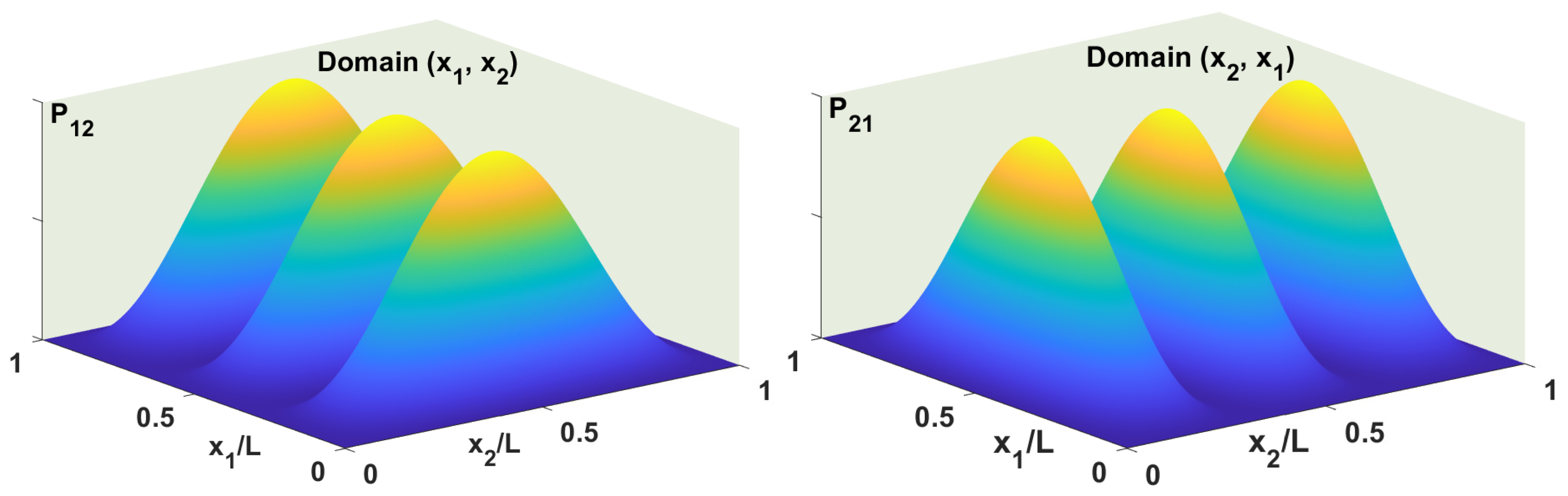
Figure 2.
Probability distribution for identical particles (, ). This is constructed as a physical superposition of both equivalent domains. Crucially, the shape depends strongly on the statistical phase and exhibits the required exchange symmetry.
Figure 2.
Probability distribution for identical particles (, ). This is constructed as a physical superposition of both equivalent domains. Crucially, the shape depends strongly on the statistical phase and exhibits the required exchange symmetry.
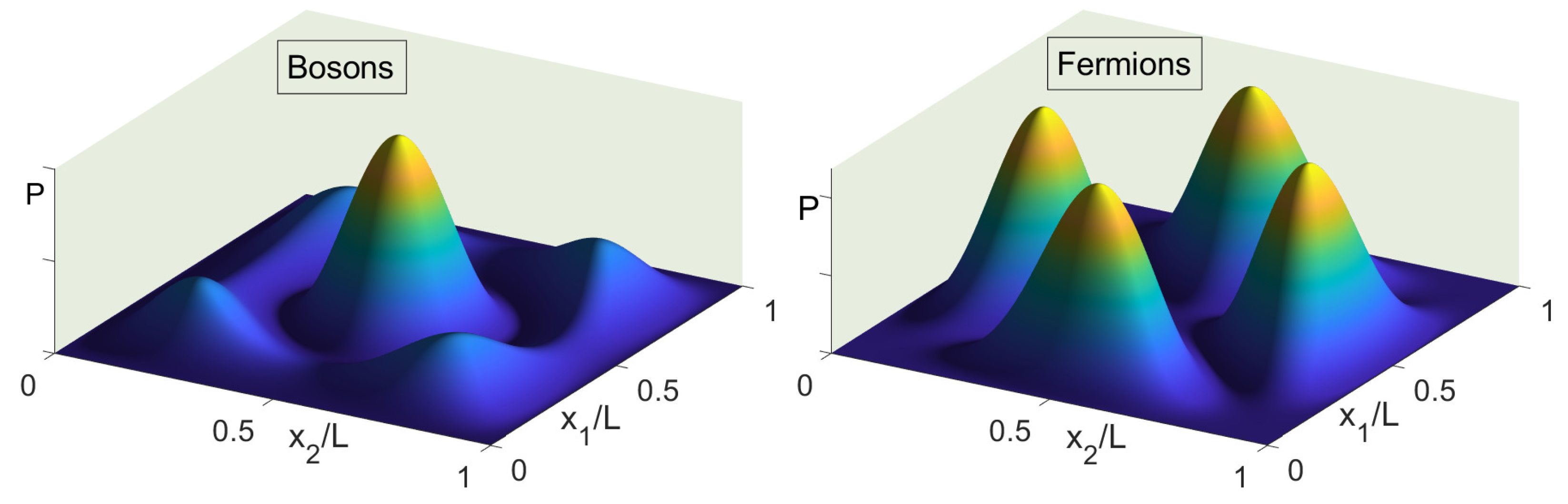
Figure 3.
The relationship of global phase, exchange phase, statistical phase, and wave function evolving over time. Switching particles in clockwise sense, the global phase is , and the phase relationship satisfies [2]. Switching particles in counter-clockwise sense, the global phase is , and the phase relationship yields . The wave function is thus double-valued.
Figure 3.
The relationship of global phase, exchange phase, statistical phase, and wave function evolving over time. Switching particles in clockwise sense, the global phase is , and the phase relationship satisfies [2]. Switching particles in counter-clockwise sense, the global phase is , and the phase relationship yields . The wave function is thus double-valued.
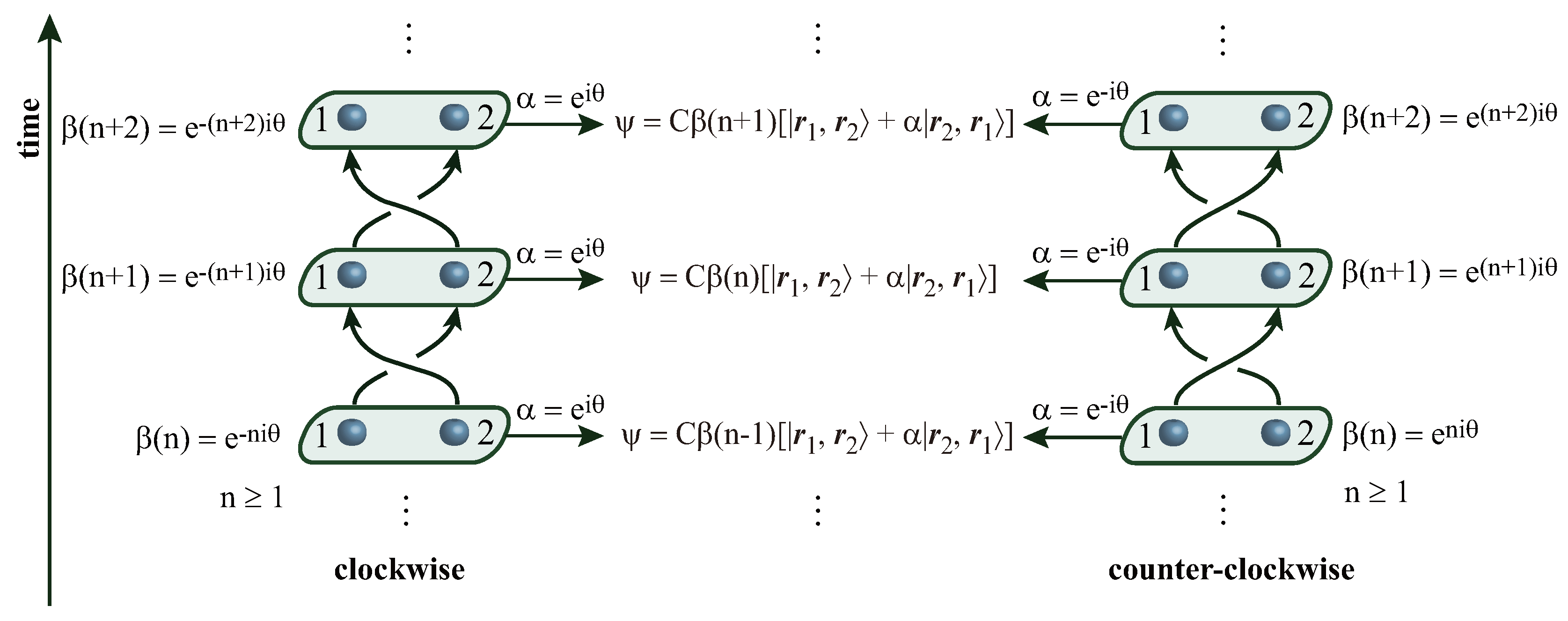
Figure 4.
The fundamental periodicity of quantum statistics. The exchange energy term exhibits -periodicity, with identical energy spectra for statistical angles related by .
Figure 4.
The fundamental periodicity of quantum statistics. The exchange energy term exhibits -periodicity, with identical energy spectra for statistical angles related by .
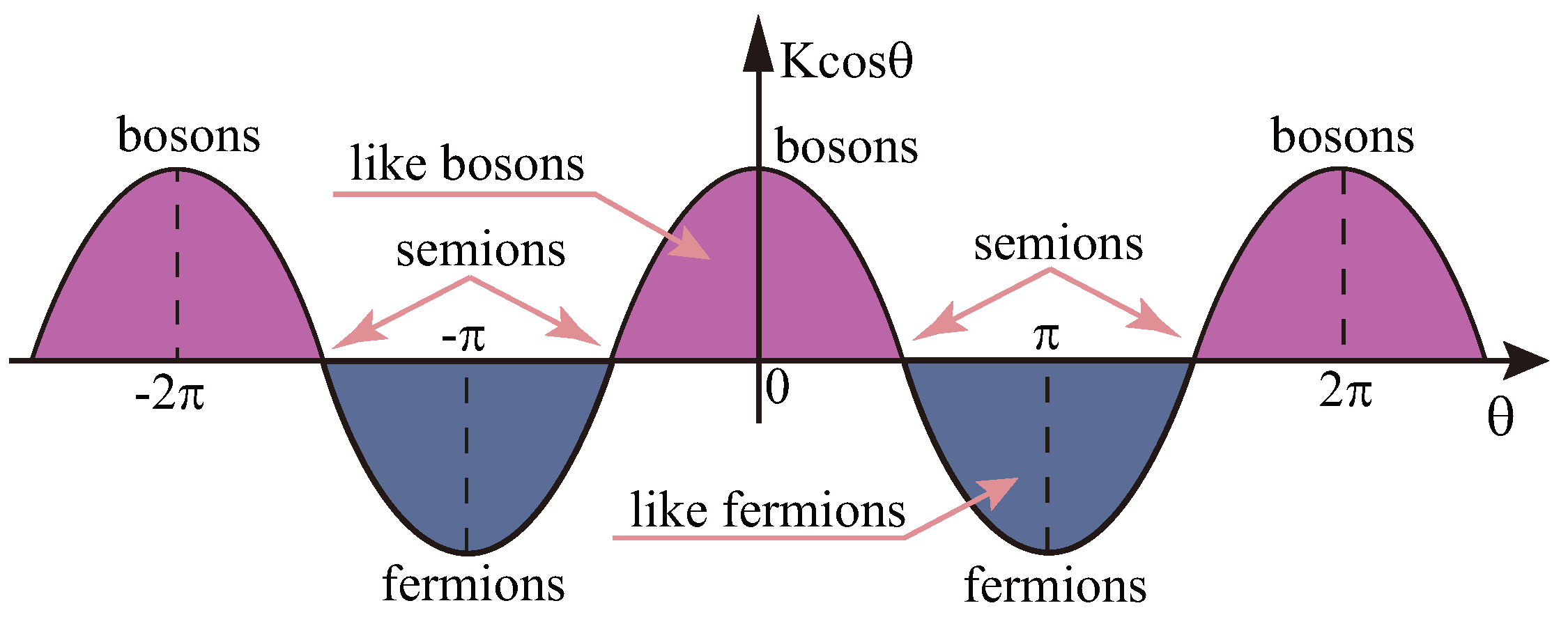

Table 1.
Two Physically Equivalent Domains of Identical Particles.
| Physical Quantity | Domain | Domain |
|---|---|---|
| Particle Configuration | ||
| Potential energy | ||
| Hamiltonian | ||
| Wave function | ||
| Probability Density |
Table 2.
Fundamental Statistical Parameters of Identical Particles.
| Type | Bosons | Fermions | Anyons |
|---|---|---|---|
| Parameter | |||
| Periodicity | |||
| Relative phase | |||
| Exchange phase | |||
| Phase Relation | |||
| Conserved quantity | |||
| Eigenvalue of | 1 | 1 | 1 |
Table 3.
Comparison of Two Fundamental Frameworks in Quantum Statistics.
| Conceptual Domain | Conventional Framework | This Framework |
|---|---|---|
| Phase Type | Global phase | Relative phase |
| Physical Foundation | Gauge invariance | Indistinguishability |
| Statistical Phase | Path-dependent | Path-independent |
| Wave Function | Multi-valued | Double-valued |
| Interference Term | Omitted | Included |
| Exchange Invariance | Fails to Satisfy | Strictly Satisfied |
Disclaimer/Publisher’s Note: The statements, opinions and data contained in all publications are solely those of the individual author(s) and contributor(s) and not of MDPI and/or the editor(s). MDPI and/or the editor(s) disclaim responsibility for any injury to people or property resulting from any ideas, methods, instructions or products referred to in the content. |
© 2025 by the authors. Licensee MDPI, Basel, Switzerland. This article is an open access article distributed under the terms and conditions of the Creative Commons Attribution (CC BY) license (http://creativecommons.org/licenses/by/4.0/).
Copyright: This open access article is published under a Creative Commons CC BY 4.0 license, which permit the free download, distribution, and reuse, provided that the author and preprint are cited in any reuse.


