

Submitted:
02 October 2025
Posted:
03 October 2025
You are already at the latest version
Abstract
This work uncovers an essential dual-phase structure of identical particles, revealing a fundamental limitation in existing quantum statistical theories. For a considerable period, it was commonly assumed that an interchange of two particles would be accompanied by a fixed phase factor. Here, the author discovers that the exchange process inherently involves two distinct phases: a relative phase α and an exchange phase β, rigorously related through α = β-1 = e±iθ. Specifically, α = β = 1 characterizes bosons, while α = β = -1 describes fermions. This finding necessitates a radical change in handling identical particles. Within this new framework, clockwise exchange yields α = eiθ and β = e-iθ, while counter-clockwise exchange gives α = e-iθ and β = eiθ. Crucially, both scenarios, despite their topological differences, are physically equivalent, governed by the universal constraint αβ = 1 for all identical particles. This framework not only fundamentally changes the conceptual basis of quantum statistics but also provides critical theoretical constraints on the existence conditions of non-Abelian anyons in two-dimensional topological systems.
Keywords:
identical particles
; quantum statistics
; exchange phase
; non-abelian anyons
1. Introduction
This is the second installment of the series on the theory of identical particles. In part I [1], we introduced an operator formalism to address the symmetry challenges [2,3,4] inherent to identical particles, rigorously demonstrating the physical equivalence between the operator formalism [1] and the wave function formalism. In particular, the operator formalism offers a more efficient alternative to traditional wave function techniques. For instance, while the wave function formalism [4,5,6,7] requires constructing explicit symmetric or antisymmetric wave functions, the operator formalism solves this challenge directly through the application of an operator. In the present work, our focus shifts to the phase dynamics of identical particles, with the goal of addressing quantum phase-related issues in many-body systems and statistical mechanics [8,9,10,11,12]. Building on the operator formalism established in Series I, this work extends the existing theory to the foundational phase dynamics of identical particles, ultimately providing a more rigorous theoretical foundation for quantum many-body systems.
The statistical behavior of identical particles is essentially characterized by the phase factor acquired by the wave function upon particle exchange. In conventional three-dimensional systems, this phase is restricted to discrete values: for bosons and for fermions, giving rise to the well-established Bose-Einstein and Fermi-Dirac statistics. A profound generalization emerges in two-dimensional systems [13,14,15,16,17], where the phase can assume any continuous value between 0 and , defining the novel particles known as anyons [18,19]. Unlike their bosonic and fermionic counterparts, the exchange statistics of anyons are not described by a unique phase. Crucially, the acquired phase depends on both the direction of the exchange rotation and the number of times one particle circulates around another. This path dependence implies that, under parity or time-reversal transformations [20,21,22], a system of anyons with statistical phase is transformed into a system with phase , a distinct physical state except for special cases of bosons and fermions. This Abelian framework naturally extends to an even more exotic possibility: non-Abelian braiding statistics [23,24,25,26,27,28]. Here, the act of exchanging particles is represented not by commutative phase factors, but by non-commutative matrices that operate in the subspace of degenerate ground states [11,29,30,31]. The statistical properties of these exotic quasiparticles are profoundly intertwined with topology. In a system of non-Abelian anyons, each braiding operation is interpreted as a topological transformation, where different sequences of exchanges correspond to distinct paths in the configuration space. Owing to this global topological nature, the resulting transformations are remarkably robust against local perturbations. This inherent topological stability forms the cornerstone of their proposed application in fault-tolerant topological quantum computation [32,33,34,35,36], where quantum information is encoded in the non-local state space of anyons and processed through their braiding operations. Despite considerable theoretical and experimental advances in the pursuit of non-Abelian anyons, conclusive verification of non-Abelian anyons remains an outstanding challenge. This enduring elusiveness is exemplified by the ongoing debate over key experimental signatures, as evidenced by studies of intricate interferometric patterns in fractional quantum Hall systems [37,38,39,40,41,42] and zero-bias conductance peaks in topological superconductors [43,44,45,46,47,48]. These results remain subject to alternative interpretations and have not yet been universally accepted as definitive proof [49,50,51,52,53].
This persistent ambiguity stems from a fundamental shortcoming in the prevailing theoretical framework for lower-dimensional systems: its reliance on a single path-dependent exchange phase [54,55,56]. This conventional approach is insufficient to fully capture the physical intricacies of particle exchange, as it inherently conflates topological distinction with direct observability. To address this inadequacy, the theory has to invoke symmetry-breaking effects, such as those imposed by external magnetic fields or geometric constraints, which may not genuinely reflect the intrinsic statistics of identical particles. At the core of this ambiguity lies a critical conceptual conflation in quantum theory regarding the phases associated with particle exchange. We often implicitly assume, or explicitly conflate, that the relative phase and the exchange phase represent the same physical quantity. To better elucidate the distinction between these two phases, we can adopt the phases from those of bosonic and fermionic systems. The quantum state for such particles is
where the phase factor is introduced as a relative phase. Applying the exchange operator to this state yields
where is the eigenvalue of , defined as the exchange phase. For bosons and fermions, the mathematics straightforwardly shows that . This has led to the widespread practice of treating these two phases as synonymous, a convention deeply entrenched in foundational texts [7,57,58,59,60]. However, this mathematical equivalence obscures a deeper physical question: are and fundamentally the same, or do they originate from distinct aspects of quantum behavior? This conceptual conflation directly leads to several unresolved questions. What is the precise relationship between the relative phase, the exchange phase, and the statistical phase? Do they represent the same physical concept, or do they capture different layers of quantum phase? And ultimately, which of these phases governs the emergent behavior of many-body systems?
Yet, despite the significant progress made in existing theoretical frameworks, a clear and conclusive resolution to these questions remains conspicuously absent within the framework of modern quantum theory. While traditional frameworks, such as Bose–Einstein and Fermi–Dirac statistics, employ probabilistic arguments to successfully predict thermodynamic behaviour [61,62,63], they provide no microscopic insight into the phase dynamics of individual particles during exchange. Conversely, the topological approach, which focuses on path topology in parameter space [64,65,66], captures global geometric properties but fails to explicitly resolve the relationships among different phase types or their interplay in many-body contexts. The persistence of these unresolved questions sustains a fundamental ambiguity that ultimately hinders a complete and unified understanding of quantum statistics. It is therefore a primary objective of this work to address these fundamental questions, as their resolution is indispensable for deepening our understanding of the conceptual foundations of quantum statistics. We now rigorously examine the physical interrelations among these phases to resolve this foundational discrepancy.
2. Rigorous Derivation of the Relationship Between and
In classical mechanics, particles remain distinguishable despite identical physical properties, as their distinct trajectories allow for unambiguous identification. The scenario in quantum mechanics is fundamentally different, owing to the fact that quantum particles are described by wave functions. The permutation of any two indistinguishable particles is considered physically equivalent [58,67]. Consider a state of two identical particles, denoted as . Exchanging their coordinates yields an exchange state , which differs from the original state by at most a phase factor [7,68,69,70]. This relationship is expressed as
The relative phase must satisfy and can be expressed as , which implies that
Multiplying both sides of Eq. (3) by gives:
We define an exchange operator by its action on the basis states such that:
The operator here is fundamentally equivalent to the conventional exchange operator , as both describe the exchange of particle positions. Notably, is associated with the permutation group where two consecutive exchanges always restore the initial state [6,13], whereas is relevant to both two- and three-dimensional systems. To avoid ambiguity, it is convenient to use the operator in two-dimensional systems, where an exchange can be implemented by clockwise or counterclockwise rotations of the particles around each other, corresponding to distinct topological operations in the braid group [71]. Here, two consecutive exchanges do not necessarily restore the initial state, reflecting the non-trivial topology of particle trajectories [8,9,13]. Now, substituting Eq. (6) into Eq. (5) yields:
It shows that is the eigenvalue of , which implies that in Eq. (3) is not the eigenvalue of the exchange operator as traditionally believed. Suppose that the operator acting on the wave function results in a phase factor [6,7,58]:
where is the exchange phase, the eigenvalue of . Comparing Eq. (7) and Eq. (8), we obtain:
This leads to the fundamental relation between the relative phase and the exchange phase:
which implies that the relative phase and the exchange phase are distinct yet related phase factors. It is noteworthy that the definitions can be derived from due to their deep physical interconnection. Specifically, the equation follows directly from Eq. (7), which itself originates from . One may find that we can get it if we just take into Eq. (7). The relationship derived above started from the definition of the relative phase. This fundamental inverse relationship can be equivalently derived by starting from the exchange phase , offering an alternative perspective that further reveals their intrinsic connection. Beginning with the eigenvalue definition of the exchange operator from Eqs. (6) and (8), we can have:
Since is a phase factor (), it follows that . Multiplying both sides of Eq. (11) by yields:
A direct comparison with Eq. (3), immediately reveals that and represent the same phase factors. From Eqs. (3) and (12), we can get
Therefore, we again arrive at the fundamental reciprocal relationship:
We get the same result as Eq. (10), providing clear confirmation of the inverse relationship between and . This relationship highlights that particle exchange involves two interdependent phases. Note that the definition can also be obtained from . It is clearly to see that emerges naturally from Eq. (12), as is identical to if we take in Eq. (12). Both derivations converge to the same fundamental relationship: , where is the statistical parameter defining the particle types. Furthermore, this inverse relationship can be expressed in an operator form. Substituting back into Eq. (12) gives:
Since the interchange of two identical particles involves two distinct phases, the relative phase and the exchange phase depend on the direction in which one particle winds around the other. It suggests that the fundamental entity governing interchange is not the exchange operator alone, but a combination of the exchange operation and its associated phase. Therefore, we introduce a phase operator , derived from Eq. (15), to characterize the phase evolution of identical particles, defined as:
This serves as a key conservation formula for identical particles, encapsulating the full phase dynamics during particle interchange. Compared with the exchange operator , more explicitly captures the essence of particle interchange. In Series I, we demonstrated that determines the symmetry properties of bosons and fermions. By definition, is a function of the relative phase and the exchange operator , integrating the variations of both and during particle exchange. Applying Eq. (15) again, we have:
The phase operator has a universal eigenvalue of for all identical particles, a key property that directly implies its time conservation. This conservation is path-independent (Figure 1), in contrast to the individual phases and , which may vary with the exchange path. Given that and , the Hamiltonian remains unchanged under an arbitrary permutation. Thus, commutes with , leading to:
Since is a constant phase factor for a given type of particle, the phase operator also commutes with :
This commutation relation confirms that , , and share a common set of eigenfunctions. The existence of the conserved phase operator with eigenvalue 1 is a profound result, generalizing the theory of quantum statistics and providing a unified foundation for understanding bosons, fermions, and anyons within a single framework.
3. Dynamical Dual-Phase Generation from Topology and Time Evolution
The dual-phase structure finds its origin in the interplay between the topological geometry of the configuration space and the unitary process of time evolution. In quantum mechanics, the Feynman path integral formulation assigns a phase factor to each path connecting initial and final points in spacetime [72]. Paths within the same homotopy class, those that can be continuously deformed into one another, must yield the same phase factor to maintain consistency of the quantum amplitude [66,73,74]. For identical particles, the configuration described by is physically indistinguishable from that described by , differing only by particle labeling. This indistinguishability implies that the configuration space of n particles in d dimensions is not the Cartesian product , but rather the quotient space , where denotes the set of points where two or more particles coincide, and is the symmetric group acting by permuting particle labels. This identification results in a multiply-connected space with non-contractible loops. Such non-contractible loops are precisely the paths that cannot be shrunk to a point without crossing , and they play a critical role in distinguishing particle types [13,75]. In two dimensions, paths can wind around specific singular locations with a well-defined sense of winding. For example, counterclockwise loops around the origin carry a distinct winding sense compared to clockwise ones. Consequently, the acquired phase may depend on both the winding number and the orientation of the path. In particular, the operation of exchanging two particles, which corresponds to a half-circle rotation (by an angle ) about one another [75,76], induces a statistical phase factor in the wave function [21,75]. The effect can be described algebraically using an operator . Its action on a two-particle state yields , where represents the fundamental exchange phase. Repeated application of then reveals the cumulative phase effect:
where the phase factor is determined by the topological properties of the particle exchange path, characterized by its winding direction and the integer n, which counts the number of exchanges. It is expressed as:
where the ∓ sign corresponds to clockwise or counterclockwise winding. In the configuration space, paths between initial and final positions fall into infinitely many homotopy classes. The integer n (where corresponds to no particle exchange) can be indexed by . For bosonic systems, for all n, whereas for fermionic systems, with even and odd values of n corresponding to phase factors of and respectively. Now, consider the relationship between successive exchange operations. Note that the state and the subsequent exchange state are physically equivalent, they can differ only by a phase factor :
Given that , Eq. (22) can be rewritten as:
Applying Eq. (20) to both sides of Eq. (23) further gives
This leads to the fundamental phase constraint:
which is identical to Eq. (14). This solution directly yields the dual-phase structure: . Additionally, from Eq. (24), the relative phase can be alternatively defined as
This formulation reveals the physical equivalence between the relations and . Furthermore, applying Eq. (24) enables the derivation of the fundamental exchange phase :
The relative phase and the exchange phase are intrinsically tied to the number of exchange trajectories. As indicated by Eqs. (26) and (27), these definitions establish a unified framework for different particle statistics. For bosonic systems, we obtain since , corresponding to symmetric wave functions. For fermionic systems, the antisymmetry requirement leads to with . Anyonic statistics emerge as the continuous interpolation between these two limits, where clockwise particle exchange yields with , while counter-clockwise exchange produces with . This result is consistent with the previous analysis, essentially because acts as a global phase. Using the relation , Eq. (23) can be rewritten as:
The phase factor can be eliminated from both sides of this equation, which naturally leads to the fundamental relations Eq. (3): . Furthermore, Eq. (28) also implies that
which is consistent with Eqs. (16) and (17) from the earlier discussion. This shows that applications of the exchange operator effectively reduce to a single exchange operation once the accumulated phase is eliminated. It appears that the system’s time evolution corresponds to the continuous deformation of trajectories in this space, without altering the fundamental nature of the physics. To further elucidate the phase evolution under continuous exchanges in a specific direction, we examine the application of the operator that encapsulates the exchange process. From Eq. (29), this operator satisfies the relation:
This recursive relation demonstrates the fact that the state is invariant under the combined operation of phase application and exchange. Furthermore, starting from the relation , we can derive the effect of n such operations:
where denotes the accumulated relative phase. This result indicates that the product acts as the identity operator on the two-particle state, independent of the number of exchanges n. To further clarify the relationship between phase accumulation and exchange history, we multiply both sides of Eq. (20) by , obtaining:
A direct comparison between Eq. (31) and Eq. (32) reveals a basic correspondence:
This relation shows that for a continuous sequence of n exchanges in a specific direction, the accumulated exchange phase and the accumulated relative phase are generated simultaneously throughout the exchange process of identical particles. This generalizes the fundamental dual-phase relation to an arbitrary number of exchanges as shown in Figure 2, demonstrating that the mutual inversion between the accumulated relative phase and the accumulated exchange phase is dynamically preserved throughout the entire braiding history. Crucially, as the exchange count n varies smoothly with time, both phases co-evolve continuously with n. This smooth evolution ensures that the fundamental relation is maintained at all times. Thus, the continuous accumulation of not only encodes the complete winding history of the particles but also dictates, through this mutual constraint, the simultaneous evolution of . This intertwined dynamics reflects the underlying topological structure of the braiding operations.
4. Phase Dynamics in Bosonic and Fermionic Systems
Bosons and fermions represent two fundamental aspects of identical particles in quantum mechanics. The wave function of such systems inherently depends on both spatial () and spin () degrees of freedom [6,7]. As established in our previous work, a dual-phase structure naturally arises in systems of identical particles, encompassing relative phases (, , ), exchange phases (, , ), and the corresponding phase operators (, , ) that interconnect them. In Series I, we demonstrated that the operators and emerge directly from the wave functions of bosons and fermions [1]. Specifically, the spatial part of the wave function adheres to the form:
where is a normalization coefficient and the spatial relative phase . The state is antisymmetric if and symmetric if . Similarly, the spin wave function is expressed as:
which accounts for the four possible spin configurations [1]. Here and is the normalization constant, and , represent spin-up or spin-down states. From Eqs. (34) and (35), we obtain:
These represent special cases of Eq. (16) which serves as a universal formula for all identical particles. The total permutation operator satisfies [1]. The complete phase operator is given by:
which corresponds to Eq. (16) for and . Here, the total relative phase , with for bosons and for fermions. The operator enables a unified description of symmetric and antisymmetric basis states, significantly simplifying many-body treatments [2,4,77]. Finally, the total wave function is given by:
where the symmetry component has an eigenvalue () and represents a conserved quantity [1]. Crucially, the symmetry properties of the wave function are entirely governed by the operator , which unifies both the relative phases and the permutation operator . The space permutation operator and the spin permutation operator respectively satisfy:
Here, both and can only take values and . This can be seen by examining the squared permutation operator: applying to the spin state yields through double exchange, while simultaneously . These two results together imply and consequently . The same argument applies to the spatial permutation, giving . The total permutation operator therefore satisfies:
from which it follows that . For bosons, the spin and spatial components must share the same symmetry, implying and . For fermions, the spin and spatial components must have opposite symmetry, giving and . Note that the relative phases satisfy and . In fact, the spin relations and , along with the spatial relations and , are mutually derivable, as discussed earlier. Using the identities and , exchange operations lead to the fundamental relations:
By comparing them with Eqs. (40) and (41), we can obtain:
which then yields and . Evidently, these are special cases of Eq. (10) or Eq. (14). Noting that and , we obtain
The eigenvalues of , , and can be obtained by using these formulas. Operating on with these operators we see that
Their eigenvalues are all 1, confirming the relations , , and . The conserved eigenvalue for reflects the fundamental invariance of particle exchange phases under time evolution. The complete set of phase parameters and symmetry properties for bosonic and fermionic systems is systematically summarized in Table 1, providing a comprehensive framework for understanding quantum statistical behavior.
5. Discussion
5.1. Dual-Phase Structure of Identical Particle
It demonstrates that the exchange dynamics of identical particles is governed by a dual-phase structure, comprising the relative phase and the exchange phase . This dual-phase structure offers a basis for understanding the exchange symmetry of identical particles and reveals a limitation of conventional quantum statistical theories, which traditionally assume that particle exchange can be fully described by a single phase. The relative phase represents the phase difference between the two equivalent states of identical particles, such that , while the exchange phase describes the action of the exchange operator on the quantum state: . These two phases are intrinsically linked through the relation where is the statistical angle, reflecting the continuous change of symmetry. This relation underpins a continuous spectrum of quantum statistics, where bosons () and fermions () emerge as special discrete cases.
This dual-phase structure emerges naturally from the topology of the configuration space, revealing it to be an intrinsic geometric property of identical particles. We establish a profound connection between the topological structure of the configuration space and the dynamical generation of dual phases that characterize particle statistics. Under time evolution, the phases accumulate continuously, with the number of exchanges n encoded in the accumulated phase . From this dynamical perspective, the two phases can be equivalently defined as and . Under this new definition, exchanging the two particles yields consistent results with the earlier formulation: a clockwise exchange gives , while a counter-clockwise exchange gives . The phase operator unifies both phases and their operations within a single framework. Despite this directional difference, both processes are physically equivalent for all identical particles.
5.2. Challenges to the Conventional Existence of Non-Abelian Anyons
The conventional understanding and experimental pursuit of non-Abelian anyons are fundamentally based on the assumption that breaking parity (P) or time-reversal (T) symmetry is necessary. This requirement arises because, in established topological theories, clockwise and counter-clockwise exchanges are treated as topologically distinct operations, each expected to produce physically distinguishable phase factors [11,20,76]. This symmetry-breaking condition has become a cornerstone in the search for non-Abelian anyons, directly informing theoretical model construction and guiding experimental efforts in systems such as fractional quantum Hall states [56,78,79,80] and topological superconductors [81,82,83,84,85].
The inherent dual-phase structure of identical particles, however, fundamentally challenges this paradigm. We have rigorously demonstrated that particle exchange is intrinsically governed by two phases, the relative phase and the exchange phase , linked by an inverse relationship such that . This universal constraint implies that the physical outcome of an exchange is independent of its direction. As illustrated in Figure 3, the limitation of conventional theory stems directly from its reliance on a single-phase description, which artificially necessitates the violation of discrete symmetries. In contrast, the dual-phase structure harmonizes topological path dependence through a conserved quantity which remains invariant under a change of exchange direction. Thus, despite topological differences between clockwise and counter-clockwise braids, they produce identical physical effects at the observable level.
This demonstration that topological distinctions do not necessarily translate into observable physical differences, offers a convincing explanation for the long-standing difficulty in experimentally identifying non-Abelian anyons. Within this new framework, the symmetry-breaking signatures previously deemed essential for their detection may fundamentally lack observable effects. The dual-phase property of identical particles does not merely tweak the existing picture of non-Abelian anyons, but poses a profound challenge to their conventional existence theorem [11,23,28]. It demands a fundamental transformation in both theoretical and experimental approaches, underscoring that topological distinctions in exchange paths need not give rise to measurable physical differences. This insight could help resolve why non-Abelian anyons have remained beyond experimental reach.
5.3. The -Operator Representation for Quantum Many-Body Systems
In contrast to traditional theoretical approaches, the treatment of quantum many-body problems becomes greatly streamlined within the dual-phase framework. This simplification arises from the fact that the dual-phase structure, an inherent property of all identical particles, is intrinsically linked to the operator formalism developed in Series I. Guided by the basic characteristics of the operator , one can obtain two fully equivalent descriptions, namely , for representing systems of identical particles: the wave function formalism , where the symmetry of identical particles is embedded in the wave function ; and the operator formalism , where the symmetry of identical particles is entirely encoded within the transformed Hamiltonian operator . Here, as given in Eq. (39) is a Hermitian operator that comprehensively encapsulates all symmetric information for any pair of bosons or fermions. In this -operator representation, the wave function and operator formalisms are fully equivalent and mutually derivable, thereby offering significant flexibility in technical applications. For a system of n particles, the total energy can be expressed exactly as [1]. Since each contains the complete symmetric information for the particle pair , the collective set provides a complete description of the symmetry properties of a system of n bosons or n fermions. For instance, in an n-electron system, this approach allows the direct acquisition of the common eigenfunctions corresponding to the full set of operators , , , , and . This is primarily because the symmetry of an n-electron system can be fully and accurately described by the operators . In contrast, traditional wave function methods, with their inherent limitations [2,3,4,5], are incapable of achieving such a comprehensive and symmetric representation. The -operator representation forms the foundation for the operator method developed in Series I, and thus offers a unified and powerful framework for many-body systems, possessing significant advantages over conventional techniques such as Slater determinants [4,86] or second quantization [7,59]. It eliminates the need for explicit construction of symmetric wave functions, embeds all symmetry requirements exactly within the operators , and allows the n-particle wave function to be expressed in a simple product form of elementary wave functions, rather than a complex, explicitly symmetrized entangled state. This formalism substantially improves computational efficiency and energy accuracy, and delivers complete and exact symmetric information of the system.
The dual-phase structure, an inherent property of all identical particles, has been shown to greatly simplify the theoretical description of bosonic and fermionic systems. When extending this framework to anyon systems, however, one must address additional challenges—particularly those related to path-dependent properties [21,75]. These aspects introduce deeper layers of topological and statistical complexity [87,88,89,90,91]. Nonetheless, the dual-phase construction offers a promising foundation for tackling these intriguing problems, providing a unified point of departure for future studies on fractional statistics. It is important to note that the fundamental questions regarding the relationship between the relative phase, the exchange phase, and the statistical phase, and their ultimate role in governing many-body behavior [92,93,94,95,96,97,98,99], extend beyond the scope of the present work. The exploration of the statistical phase and its profound connection to anyonic physics, building upon the established dual-phase foundation, constitutes a major focus of our ongoing research and will be addressed systematically in subsequent series of this study.
Data Availability Statement
The data that support the findings of this study are available within the article.
Acknowledgments
The author thanks Dr. Ting-Ting Geng for reading and editing of the manuscript.
References
- Wang, J.H. The operator approach for representing the symmetry of many-electron systems (series I). AIP Advances 2025, 15. [Google Scholar] [CrossRef]
- Schaefer, H.F. Methods of Electronic Structure Theory; Plenum: New York, 1977. [Google Scholar]
- Greiner, W.; Müller, B. Quantum Mechanics: Symmetries, 2nd ed.; Springer: Berlin, 1994. [Google Scholar]
- Weissbluth, M. Atoms and Molecules; Academic Press, 1978.
- Slater, J.C. The theory of complex spectra. Phys. Rev. 1929, 34, 1293–1322. [Google Scholar] [CrossRef]
- Messiah, A.; Greenberg, O.W. Phys. Rev. 1964, 136, B248–B267. [CrossRef]
- Landau, L.D.; Lifshitz, E.M. Quantum mechanics: non-relativistic theory; Pergamon: New York, 1977. [Google Scholar]
- Wilczek, F. Quantum Mechanics of Fractional-Spin Particles. Phys. Rev. Lett. 1982, 49, 957. [Google Scholar] [CrossRef]
- Arovas, D.P.; Schrieffer, R.; Wilczek, F.; Zee, A. Statistical Mechanics of Anyons. Nucl. Phys. B 1985, 251, 117–126. [Google Scholar] [CrossRef]
- Berry, M.V. Quantal phase factors accompanying adiabatic changes. Proc. R. Soc. Lond. A 1984, 392, 45–57. [Google Scholar] [CrossRef]
- Nayak, C.; Simon, S.H.; Stern, A.; Freedman, M.; Sarma, S.D. Non-Abelian anyons and topological quantum computation. Rev. Mod. Phys. 2008, 80, 1083–1159. [Google Scholar] [CrossRef]
- Nakamura, J.; Liang, S.; Gardner, G.C.; Manfra, M.J. Direct observation of anyonic braiding statistics. Nat. Phys. 2020, 16, 931. [Google Scholar] [CrossRef]
- Leinaas, J.M.; Myrheim, J. On the theory of identical particles. Nuovo Cimento B 1977, 37, 1–23. [Google Scholar] [CrossRef]
- Klitzing, K.V.; Dorda, G.; Pepper, M. New method for high-accuracy determination of the fine-structure constant based on quantized hall resistance. Phys. Rev. Lett. 1980, 45, 494–497. [Google Scholar] [CrossRef]
- Tsui, D.C.; Stormer, H.L.; Gossard, A.C. Two-Dimensional Magnetotransport in the Extreme Quantum Limit. Phys. Rev. Lett. 1982, 48, 1559–1562. [Google Scholar] [CrossRef]
- Laughlin, R.B. Anomalous Quantum Hall Effect: An Incompressible Quantum Fluid with Fractionally Charged Excitations. Phys. Rev. Lett. 1983, 50, 1395. [Google Scholar] [CrossRef]
- Wu, Y.S.; Zee, A. Broken SU(5) and proton decay. Phys. Lett. B 1984, 147, 325. [Google Scholar] [CrossRef]
- Wilczek, F. Magnetic flux, angular momentum, and statistics. Phys. Rev. Lett. 1982, 48, 1144–1146. [Google Scholar] [CrossRef]
- Wilczek, F. Quantum mechanics of fractional-spin particles. Phys. Rev. Lett. 1982, 49, 957–959. [Google Scholar] [CrossRef]
- Read, N.; Green, D. Paired states of fermions in two dimensions with breaking of parity and time-reversal symmetries and the fractional quantum hall effect. Phys. Rev. B 2000, 61, 10267. [Google Scholar] [CrossRef]
- Wen, X.G.; Zee, A. Quantum statistics and superconductivity in two spatial dimensions. Nucl. Phys. B 1990, 15, 135–156. [Google Scholar] [CrossRef]
- Halperin, B.I.; March-Russell, J.; Wilczek, F. Consequences of time-reversal-symmetry violation in models of high-Tc superconductors. Phys. Rev. B 1989, 40, 8726–8744. [Google Scholar] [CrossRef]
- Moore, G.; Read, N. Nonabelions in the Fractional Quantum Hall Effect. Nucl. Phys. B 1991, 360, 362. [Google Scholar] [CrossRef]
- Clarke, D.J.; Alicea, J.; Shtengel, K. Exotic Non-Abelian Anyons from Conventional Fractional Quantum Hall States. Nat. Commun. 2013, 4, 1348. [Google Scholar] [CrossRef]
- Barkeshli, M.; Jian, C.M.; Qi, X.L. Twist Defects and Projective Non-Abelian Braiding Statistics. Phys. Rev. B 2013, 87, 045130. [Google Scholar] [CrossRef]
- Lindner, N.H.; Berg, E.; Refael, G.; Stern, A. Fractionalizing Majorana Fermions: Non-Abelian Statistics on the Edges of Abelian Quantum Hall States. Phys. Rev. X 2012, 2, 041002. [Google Scholar] [CrossRef]
- Feldman, D.E.; Halperin, B.I. Fractional charge and fractional statistics in the quantum Hall effects. Rep. Prog. Phys. 2021, 84, 076501. [Google Scholar] [CrossRef]
- Ivanov, D.A. Non-Abelian Statistics of Half-Quantum Vortices in p-Wave Superconductors. Phys. Rev. Lett. 2001, 86, 268. [Google Scholar] [CrossRef]
- Moore, G.; Seiberg, N. Classical and Quantum Conformal Field Theory. Commun. Math. Phys. 1989, 123, 177. [Google Scholar] [CrossRef]
- Imbo, T.D.; Imbo, C.S.; Sudarshan, E.C.G. Identical Particles, Exotic Statistics and Braid Groups. Phys. Lett. B 1990, 234, 103. [Google Scholar] [CrossRef]
- Mong, R.S.K.; Clarke, D.J.; Alicea, J.; Lindner, N.H.; Fendley, P.; Nayak, C.; Oreg, Y.; Stern, A.; Berg, E.; Shtengel, K.; et al. Universal Topological Quantum Computation from a Superconductor-Abelian Quantum Hall Heterostructure. Phys. Rev. X 2014, 4, 011036. [Google Scholar] [CrossRef]
- Kitaev, A.Y. Fault-tolerant quantum computation by anyons. Ann. Phys. 2003, 303, 2. [Google Scholar] [CrossRef]
- Freedman, M.H.; Kitaev, A.; Larsen, M.J.; Wang, Z. Topological Quantum Computation. Bull. Am. Math. Soc. 2003, 40, 31. [Google Scholar] [CrossRef]
- Alicea, J.; Oreg, Y.; Refael, G.; von Oppen, F.; Fisher, M.P.A. Non-Abelian statistics and topological quantum information processing in 1D wire networks. Nat. Phys. 2011, 7, 412. [Google Scholar] [CrossRef]
- Stern, A.; Lindner, N.H. Topological Quantum Computation—From Basic Concepts to First Experiments. Science 2013, 339, 1179–1184. [Google Scholar] [CrossRef]
- Hutter, A.; Wootton, J.R.; Loss, D. Parafermions in a Kagome Lattice of Qubits for Topological Quantum Computation. Phys. Rev. X 2015, 5, 041040. [Google Scholar] [CrossRef]
- Banerjee, M.; Heiblum, M.; Umansky, V.; Feldman, D.E.; Oreg, Y.; Stern, A. Observation of half-integer thermal Hall conductance. Nature 2018, 559, 205–210. [Google Scholar] [CrossRef]
- Ma, K.K.W.; Feldman, D.E. Partial equilibration of integer and fractional edge channels in the thermal quantum Hall effect. Phys. Rev. B 2019, 99, 085309. [Google Scholar] [CrossRef]
- Nakamura, J.; Fallahi, S.; Sahasrabudhe, H.; Rahman, R.; Liang, S.; Gardner, G.C.; Manfra, M.J. Aharonov–Bohm interference of fractional quantum Hall edge modes. Nat. Phys. 2019, 15, 563–569. [Google Scholar] [CrossRef]
- Carrega, M.; Chirolli, L.; Heun, S.; et al. Anyons in quantum Hall interferometry. Nat. Rev. Phys. 2021, 3, 698–711. [Google Scholar] [CrossRef]
- Kundu, H.K.; Biswas, S.; Ofek, N.; Umansky, V.; Heiblum, M. Anyonic interference and braiding phase in a Mach-Zehnder interferometer. Nat. Phys. 2023, 19, 515–521. [Google Scholar] [CrossRef]
- Willett, R.L.; Shtengel, K.; Nayak, C.; Pfeiffer, L.N.; Chung, Y.J.; Peabody, M.L.; Baldwin, K.W.; West, K.W. Interference measurements of non-Abelian e/4 and Abelian e/2 quasiparticle braiding. Phys. Rev. X 2023, 13, 011028. [Google Scholar] [CrossRef]
- Mourik, V.; Zuo, K.; Frolov, S.M.; Plissard, S.R.; Bakkers, E.P.A.M.; Kouwenhoven, L.P. Signatures of Majorana fermions in hybrid superconductor-semiconductor nanowire devices. Science 2012, 336, 1003. [Google Scholar] [CrossRef]
- Deng, M.T.; Yu, C.L.; Huang, G.Y.; Larsson, M.; Caroff, P.; Xu, H.Q. Anomalous zero-bias conductance peak in a Nb-InSb nanowire-Nb hybrid device. Nano Lett. 2012, 12, 6414. [Google Scholar] [CrossRef]
- Das, A.; Ronen, Y.; Most, Y.; Oreg, Y.; Heiblum, M.; Shtrikman, H. Zero-bias peaks and splitting in an Al-InAs nanowire topological superconductor as a signature of Majorana fermions. Nat. Phys. 2012, 8, 887. [Google Scholar] [CrossRef]
- Albrecht, S.M.; Higginbotham, A.P.; Madsen, M.; Kuemmeth, F.; Jespersen, T.S.; Nygård, J.; Krogstrup, P.; Marcus, C.M. Exponential protection of zero modes in Majorana islands. Nature 2016, 531, 206. [Google Scholar] [CrossRef]
- Deng, M.T.; Vaitiekenas, S.; Hansen, E.B.; Danon, J.; Leijnse, M.; Flensberg, K.; Nygård, J.; Krogstrup, P.; Marcus, C.M. Majorana bound state in a coupled quantum-dot hybrid-nanowire system. Science 2016, 354, 1557. [Google Scholar] [CrossRef]
- Chen, J.; Yu, P.; Stenger, J.; Hocevar, M.; Car, D.; Plissard, S.R.; Bakkers, E.P.A.M.; Stanescu, T.D.; Frolov, S.M. Experimental phase diagram of zero-bias conductance peaks in superconductor/semiconductor nanowire devices. Sci. Adv. 2017, 3, e1701476. [Google Scholar] [CrossRef]
- Sola, R.A.; Kouwenhoven, L. Majorana qubits for topological quantum computing. Phys. Today 2020, 73, 44. [Google Scholar] [CrossRef]
- Kayyalha, M.; Xiao, D.; Zhang, R.; Shin, J.; Jiang, J.; Wang, F.; Zhao, Y.F.; Xiao, R.; Zhang, L.; Fijalkowski, K.M.; et al. Absence of evidence for chiral Majorana modes in quantum anomalous Hall-superconductor devices. Science 2020, 367, 64. [Google Scholar] [CrossRef] [PubMed]
- Halperin, B.I. APS Medal for exceptional achievement in research: Topology and other tools in condensed matter physics. Rev. Mod. Phys. 2020, 92, 045001. [Google Scholar] [CrossRef]
- Frolov, S. Quantum computing’s reproducibility crisis: Majorana fermions. Nature 2021, 592, 350. [Google Scholar] [CrossRef]
- de Leon, N.P.; Itoh, K.M.; Kim, D.; Mehta, K.K.; Northrup, T.E.; Paik, H.; Palmer, B.S.; Samarth, N.; Sangtawesin, S.; Steuerman, D.W. Materials challenges and opportunities for quantum computing hardware. Science 2021, 372, eabb2823. [Google Scholar] [CrossRef] [PubMed]
- Wen, X.G. Quantum Many-Body Theory: From the Origin of Phonons to the Origin of Photons and Electrons; Oxford Univ. Press, 2004.
- Bhattacharjee, S.M.; Mahan, M.J.; Bandyopadhyay, A., Eds. Topology and Condensed Matter Physics; Vol. 19, Texts and Readings in Physical Sciences, Springer Singapore: Singapore, 2017.
- Hansson, T.H.; Hermanns, M.; Simon, S.H.; Viefers, S.F. Quantum Hall physics: Hierarchies and conformal field theory techniques. Rev. Mod. Phys. 2017, 89, 025002. [Google Scholar] [CrossRef]
- Dirac, P.A.M. Principles of Quantum Mechanics, 4th ed.; Oxford University Press: Oxford, 1958. [Google Scholar]
- Schwabl, F. Quantum Mechanics, 4th ed.; Springer-Verlag: Berlin, Heidelberg, 2007. [Google Scholar]
- Nolting, W.; Brewer, W.D. Fundamentals of Many-body Physics; Springer Berlin Heidelberg: Berlin, Heidelberg, 2009. [Google Scholar]
- Basu, S. Topological Phases in Condensed Matter Physics; Springer Nature Singapore: Singapore, 2023. [Google Scholar]
- Burmistrov, S.N. Statistical and Condensed Matter Physics; Springer Nature Singapore: Singapore, 2025. [Google Scholar]
- Kita, T. Statistical Mechanics of Superconductivity; Graduate Texts in Physics, Springer Japan: Tokyo, 2015. [Google Scholar]
- Piazza, R. Statistical Physics: A Prelude and Fugue for Engineers; UNITEXT for Physics, Springer International Publishing: Cham, 2017. [Google Scholar]
- Laskin, N. Fractional Quantum Mechanics. Phys. Rev. E 2000, 62, 3135. [Google Scholar] [CrossRef]
- Hasan, M.Z.; Kane, C.L. Colloquium: Topological Insulators. Rev. Mod. Phys. 2010, 82, 3045–3067. [Google Scholar] [CrossRef]
- Laidlaw, M.G.G.; DeWitt, C.M. Feynman functional integrals for systems of indistinguishable particles. Phys. Rev. D 1971, 3, 1375–1378. [Google Scholar] [CrossRef]
- Griffiths, D.J.; Schroeter, D.F. Introduction to Quantum Mechanics, 3rd ed.; Cambridge University Press: Cambridge, 2018. [Google Scholar]
- Yakaboylu, E.; Lemeshko, M. Anyonic statistics of quantum impurities in two dimensions. Phys. Rev. B 2018, 98, 045402. [Google Scholar] [CrossRef]
- Forte, S. Quantum mechanics and field theory with fractional spin and statistics. Rev. Mod. Phys. 1992, 64, 193–236. [Google Scholar] [CrossRef]
- Kim, E.A.; Lawler, M.J.; Vishveshwara, S.; Fradkin, E. Measuring fractional charge and statistics in fractional quantum Hall fluids through noise experiments. Phys. Rev. B 2006, 74, 155324. [Google Scholar] [CrossRef]
- Wu, Y.S. Multiparticle quantum mechanics obeying fractional statistics. Phys. Rev. Lett. 1984, 53, 111–114. [Google Scholar] [CrossRef]
- Feynman, R.P. Space-time approach to non-relativistic quantum mechanics. Rev. Mod. Phys. 1948, 20, 367–387. [Google Scholar] [CrossRef]
- Schulman, L. A path integral for spin. Phys. Rev. 1968, 176, 1558–1569. [Google Scholar] [CrossRef]
- Canright, G.S.; Girvin, S.M. Fractional Statistics: Quantum Possibilities in Two Dimensions. Science 1990, 247, 1197–1205. [Google Scholar] [CrossRef]
- Greiter, M.; Wilczek, F. Fractional statistics. Annu. Rev. Condens. Matter Phys. 2024, 15, 131–157. [Google Scholar] [CrossRef]
- Beenakker, C.W.J. Search for non-Abelian Majorana braiding statistics in superconductors. SciPost Phys. Lect. Notes 2020, 15. [Google Scholar] [CrossRef]
- Wu, D.; Rossi, R.; Vicentini, F.; Carrasquilla, J.; Georges, A.; et al. Variational benchmarks for quantum many-body problems. Science 2024, 386, 296–301. [Google Scholar] [CrossRef]
- Chamon, C.D.C.; Freed, D.E.; Kivelson, S.A.; Sondhi, S.L.; Wen, X.G. Two point-contact interferometer for quantum Hall systems. Phys. Rev. B 1997, 55, 2331–2344. [Google Scholar] [CrossRef]
- Vaezi, A. Superconducting analogue of the parafermion fractional quantum hall states. Phys. Rev. X 2014, 4, 031009. [Google Scholar] [CrossRef]
- Nakamura, J.; Liang, S.; Gardner, G.C.; Manfra, M.J. Fabry-Pérot Interferometry at the ν=2/5 Fractional Quantum Hall State. Phys. Rev. X 2023, 13, 041012. [Google Scholar] [CrossRef]
- Qi, X.L.; Zhang, S.C. Topological Insulators and Superconductors. Rev. Mod. Phys. 2011, 83, 1057. [Google Scholar] [CrossRef]
- Alicea, J. New directions in the pursuit of Majorana fermions in solid state systems. Rep. Prog. Phys. 2012, 75, 076501. [Google Scholar] [CrossRef]
- Beenakker, C.W.J. Random-Matrix Theory of Majorana Fermions and Topological Superconductors. Rev. Mod. Phys. 2015, 87, 1037. [Google Scholar] [CrossRef]
- Pientka, F.; Keselman, A.; Berg, E.; Yacoby, A.; Stern, A.; Halperin, B.I. Topological Superconductivity in a Planar Josephson Junction. Phys. Rev. X 2017, 7, 021032. [Google Scholar] [CrossRef]
- Kotetes, P. Classification of engineered topological superconductors. New J. Phys. 2013, 15, 105027. [Google Scholar] [CrossRef]
- Slater, J.C. Quantum Theory of Atomic Structure; McGraw-Hill: New York, 1960. [Google Scholar]
- Troyer, M.; Wiese, U.J. Computational complexity and fundamental limitations to fermionic quantum Monte Carlo simulations. Phys. Rev. Lett. 2005, 94, 170201. [Google Scholar] [CrossRef] [PubMed]
- Carleo, G.; Troyer, M. Solving the quantum many-body problem with artificial neural networks. Science 2017, 355, 602–606. [Google Scholar] [CrossRef]
- Correggi, M.; Duboscq, R.; Lundholm, D.; Rougerie, N. Vortex patterns in the almost-bosonic anyon gas. EPL 2019, 126, 20005. [Google Scholar] [CrossRef]
- Lundholm, D.; Seiringer, R. Fermionic behavior of ideal anyons. Lett. Math. Phys. 2018, 108, 2523–2541. [Google Scholar] [CrossRef]
- Girardot, T. Average field approximation for almost bosonic anyons in a magnetic field. J. Math. Phys. 2020, 61, 071901. [Google Scholar] [CrossRef]
- Girardot, T.; Rougerie, N. Semiclassical Limit for Almost Fermionic Anyons. Commun. Math. Phys. 2021, 387, 427–480. [Google Scholar] [CrossRef]
- Correggi, M.; Fermi, D. Magnetic perturbations of anyonic and Aharonov-Bohm Schrödinger operators. J. Math. Phys. 2021, 62, 032101. [Google Scholar] [CrossRef]
- Muñoz de las Heras, A.; Macaluso, E.; Carusotto, I. Anyonic Molecules in Atomic Fractional Quantum Hall Liquids: A Quantitative Probe of Fractional Charge and Anyonic Statistics. Phys. Rev. X 2020, 10, 041058. [Google Scholar] [CrossRef]
- Valenti-Rojas, G.; Westerberg, N.; Öhberg, P. Synthetic flux attachment. Phys. Rev. Research 2020, 2, 033453. [Google Scholar] [CrossRef]
- Yakaboylu, E.; Ghazaryan, A.; Lundholm, D.; Rengerie, N.; Lemeshko, M.; Seiringer, R. Quantum impurity model for anyons. Phys. Rev. B 2020, 102, 144109. [Google Scholar] [CrossRef]
- Rougerie, N.; Yang, Q. Anyons in a tight wave-guide and the Tonks-Girardeau gas. SciPost Physics Core 2023, 6, 079. [Google Scholar] [CrossRef]
- Hu, Y.; Murthy, G.; Rao, S.; Jain, J.K. Kohn-Sham density functional theory of Abelian anyons. Phys. Rev. B 2021, 103, 035124. [Google Scholar] [CrossRef]
- Lundholm, D.; Rougerie, N. Emergence of Fractional Statistics for Tracer Particles in a Laughlin Liquid. Phys. Rev. Lett. 2016, 116, 170401. [Google Scholar] [CrossRef] [PubMed]
Figure 1.
Schematic of the interchange of two identical particles. Although different exchange paths may lead to distinct values of the relative phase and the exchange phase , the conserved quantity , which captures the fundamental and universal nature of identical-particle exchange, remains strictly path-independent.
Figure 1.
Schematic of the interchange of two identical particles. Although different exchange paths may lead to distinct values of the relative phase and the exchange phase , the conserved quantity , which captures the fundamental and universal nature of identical-particle exchange, remains strictly path-independent.
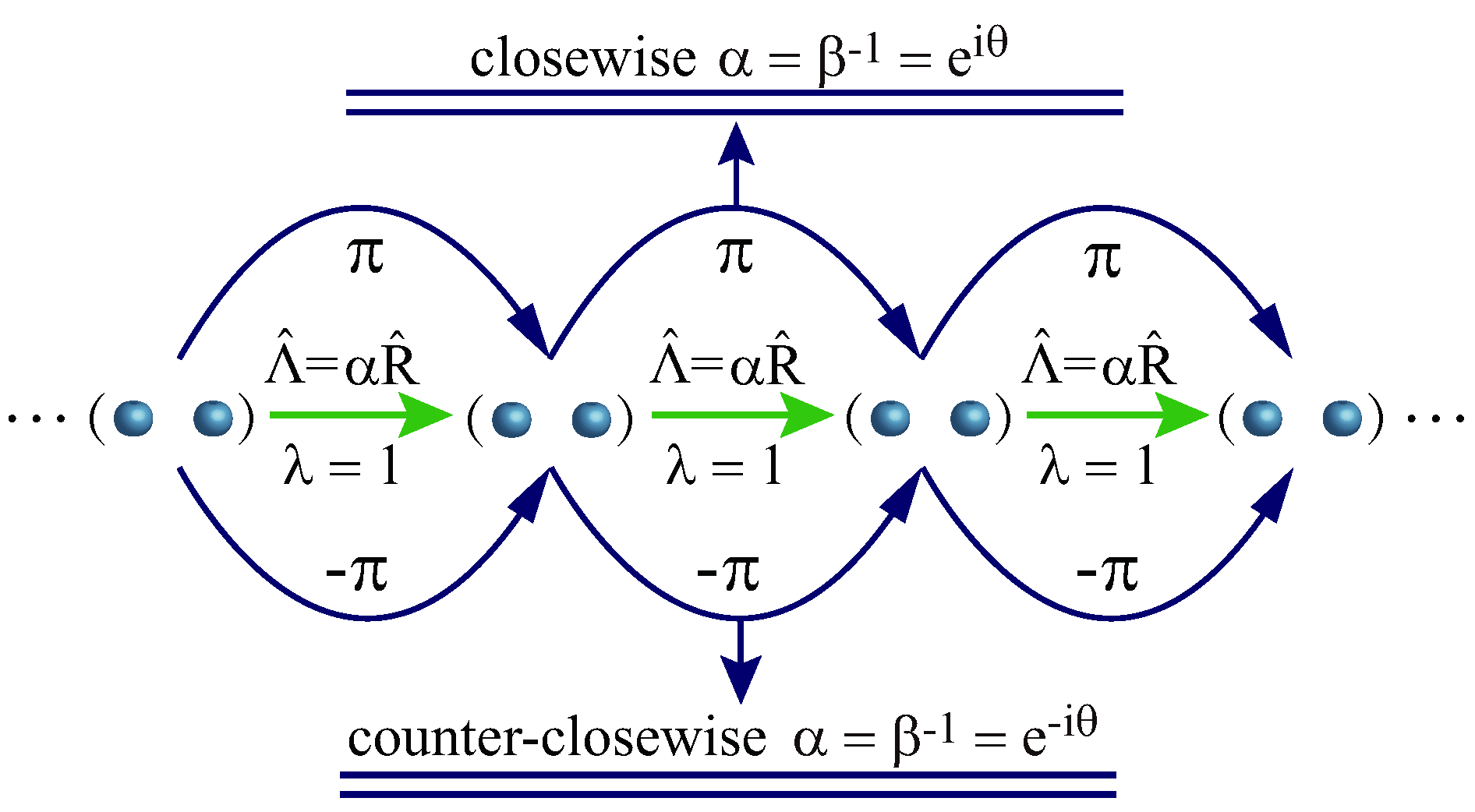
Figure 2.
Schematic illustration of the clockwise and counterclockwise particle exchange rotations, demonstrating the dynamic accumulation of both the exchange phase and the relative phase .
Figure 2.
Schematic illustration of the clockwise and counterclockwise particle exchange rotations, demonstrating the dynamic accumulation of both the exchange phase and the relative phase .
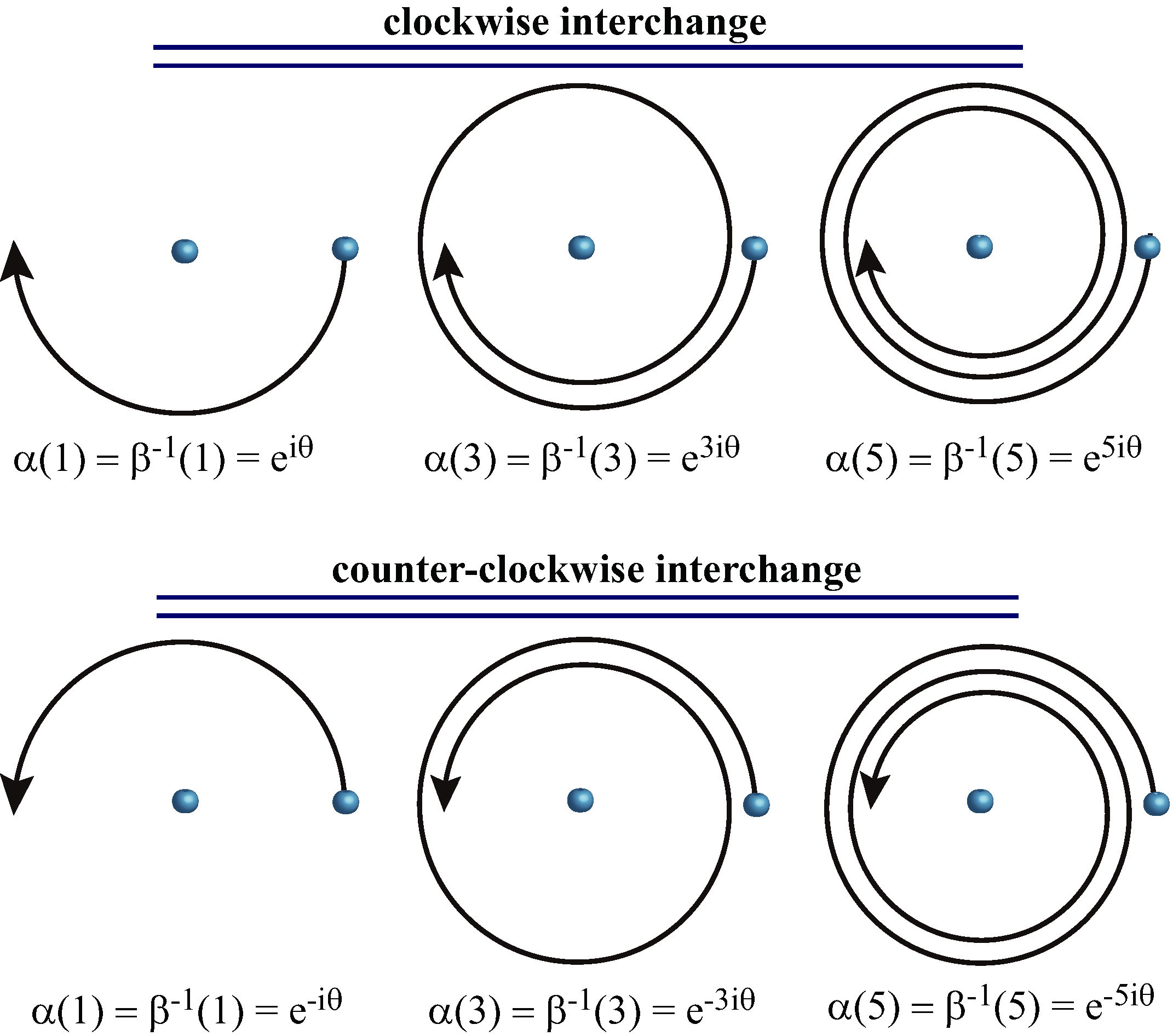
Figure 3.
Comparison between conventional anyon statistics and the dual-phase framework. (a) Single-phase structure: Under P or T transformations, the exchange phase transforms as , making clockwise and counter-clockwise exchanges physically distinct. This implies that anyonic statistics fundamentally violate parity and time reversal symmetries. (b) Dual-phase structure: Clockwise rotation results in and , while counter-clockwise rotation gives and . Despite their topological differences, the two exchange directions are physically equivalent, a property captured by a path-independent conserved quantity .
Figure 3.
Comparison between conventional anyon statistics and the dual-phase framework. (a) Single-phase structure: Under P or T transformations, the exchange phase transforms as , making clockwise and counter-clockwise exchanges physically distinct. This implies that anyonic statistics fundamentally violate parity and time reversal symmetries. (b) Dual-phase structure: Clockwise rotation results in and , while counter-clockwise rotation gives and . Despite their topological differences, the two exchange directions are physically equivalent, a property captured by a path-independent conserved quantity .
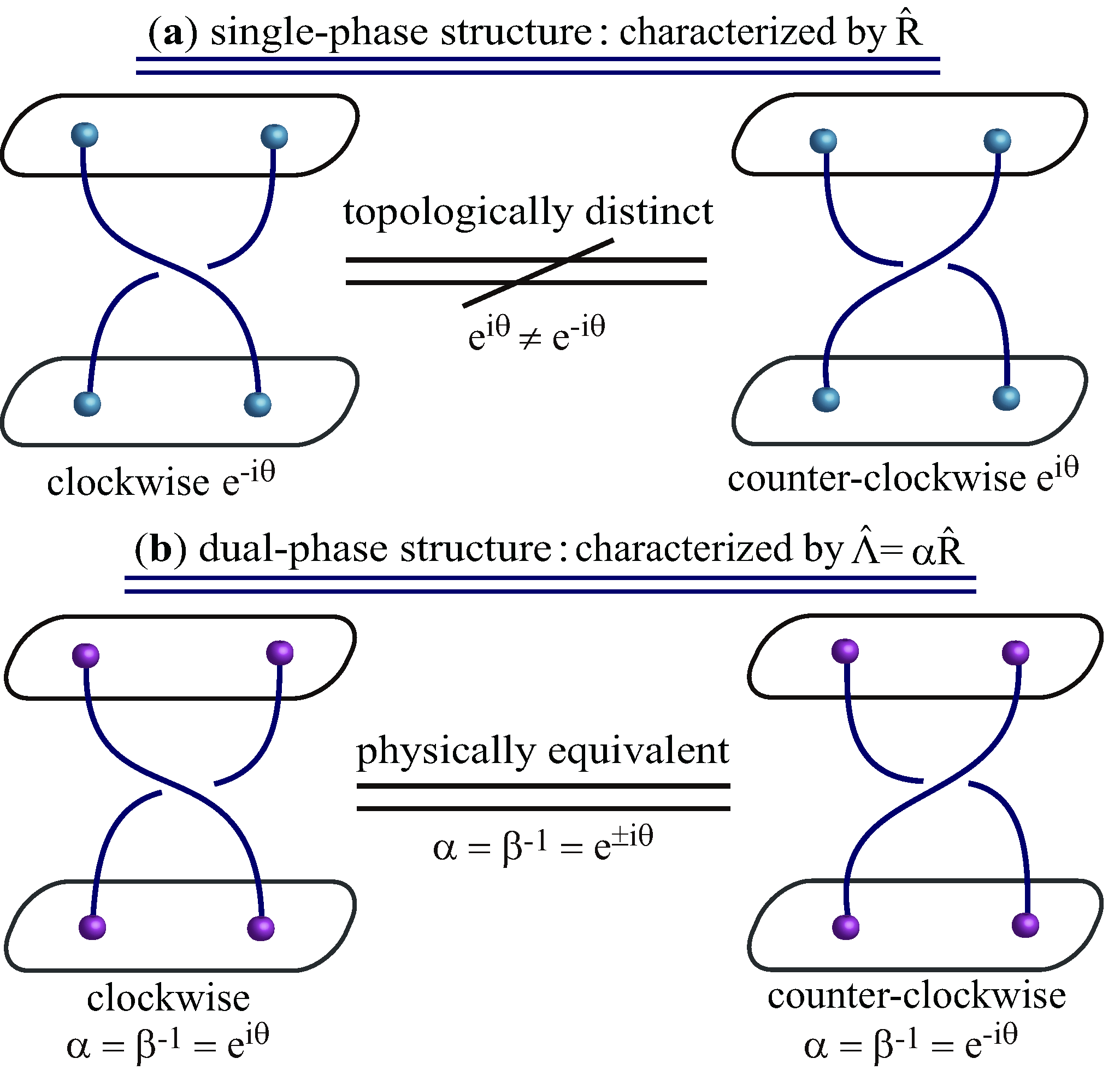

Table 1.
Dual-Phase Structure and Symmetry Properties of Bosons and Fermions
| Property | Fermions | Bosons |
|---|---|---|
| Relative phase | ||
| Exchange phase | ||
| Total phase operator | ||
| Spatial phase operator | ||
| Spin phase operator | ||
| Spatial wave function | ||
| Spin wave function | ||
| Relationship between and | ||
| Relationship between and | ||
| Relationship between and |
Disclaimer/Publisher’s Note: The statements, opinions and data contained in all publications are solely those of the individual author(s) and contributor(s) and not of MDPI and/or the editor(s). MDPI and/or the editor(s) disclaim responsibility for any injury to people or property resulting from any ideas, methods, instructions or products referred to in the content. |
© 2025 by the author. Licensee MDPI, Basel, Switzerland. This article is an open access article distributed under the terms and conditions of the Creative Commons Attribution (CC BY) license (https://creativecommons.org/licenses/by/4.0/).
Copyright: This open access article is published under a Creative Commons CC BY 4.0 license, which permit the free download, distribution, and reuse, provided that the author and preprint are cited in any reuse.


