

Submitted:
05 January 2026
Posted:
08 January 2026
You are already at the latest version
Abstract
We formulate copy time τcopy as a fully specified hypothesis-testing task for quantum dynamics with a conserved global U(1) charge, calibrated by a disturbance budget using the Bures metric. The central point of the paper is methodological: the notion of an information-transfer timescale is defined operationally (state family, measurement class, and error criterion) and then linked to explicit sufficient conditions under which a diffusive heat-kernel envelope controls the receiver’s distinguishability advantage. The frequently invoked Lambert-W−1 structure is shown to be a certificate inversion associated with this envelope and is deliberately demoted to a conditional analytic tool, with an alternative non-diffusive/non-perturbative branch discussed. As a separate, explicitly conditional application, we present a reproducible pipeline that maps τcopy to an infrared coarse-graining scale ΛIR via an explicit window-function construction and then to a minimal Higgs-portal singlet-scalar UV completion. Under stated assumptions (thermal “copy-limited” saturation near the electroweak crossover and a minimal Functional Renormalization Group (FRG) truncation executed in the Supplement), the pipeline yields a benchmark dark mass scale mχ = 58.4(60) GeV. The manuscript is written to separate assumptions from consequences and to supply the scripts required to reproduce every figure, ensuring full academic transparency and reproducibility.
Keywords:
copy time
; quantum hypothesis testing
; information transport
; distinguishability advantage
; diffusion bounds
; Lambert-W certificates
; Wilsonian coarse-graining
; window functions
; functional renormalization group
; Higgs-portal singlet-scalar dark matter
; reproducible constraints LHC
; ATLAS
; CMS
; collider searches
; beyond the Standard Model (BSM)
; heavy leptons
; Type-III seesaw
; fermion triplet
; heavy neutral lepton (HNL)
; vector-like leptons
; multilepton final states
; pp collisions
; mass exclusion limits
; 95% CL
; CLs method
; statistical interpretation
; mass benchmarks
; resonance searches
; effective masseffective scale
; regime dependence
; model reinterpretation
; reproducibility and robustness tests
; information-theoretic mass (QICT)
; Golden Relation
; structural mass band (58 GeV)
1. Operational Definition: Copy Time as Hypothesis Testing
Protocol Geometry and Hypotheses.
Let the global Hilbert space factor as , and let be a disjoint receiver region. We fix a reference state (typically stationary or thermal) and a global conserved charge Q with local restriction supported on A. The two hypotheses are defined by a unitary kick on A:
with real . This is the primary, closed-system definition. The non-unitary, Gibbs-like reweighting is treated as an optional extension in the Supplement.
Disturbance Budget and Information Susceptibility.
The disturbance of preparing is quantified by the Bures distance . For the unitary family, the small- expansion is controlled by the symmetric logarithmic derivative (SLD) quantum Fisher information :
We define the information susceptibility as . A disturbance budget means .
Dynamics and Receiver Advantage.
Let denote the evolution map. The unrestricted receiver advantage is the optimal bias of distinguishing the evolved hypotheses and using all POVMs on B:
This is an identity by the Helstrom theorem [1].
Copy Time with Recurrences.
To account for non-monotone finite-size signals, we define copy time as a first-passage time of the running maximum:
Figure 1 (generated by scripts/tau_copy_vs_chi.py) provides the operational calibration plot used throughout the pipeline.
2. Conditional Lower Bounds and the Lambert-W Regime
The Diffusive Envelope as a Sufficient Condition.
The Lambert structure is not a law of nature; it is an inversion of a specific envelope. We state the envelope as an explicit assumption:
where . This form is rigorously satisfied for classical diffusion and a broad class of reversible Markov semigroups (Supplement S1.C).
Certificate Inversion.
Given the envelope (5), solving for the earliest admissible time yields the lower bound:
The real branch enforces . This is not a feasibility phase transition; it merely states that the particular envelope (5) no longer provides a nontrivial real certificate once the requested threshold exceeds the maximal envelope value. We interpret the boundary as the **Transition of Certifiability**: for , the system is in a non-diffusive, potentially ballistic or strongly interacting regime where the heat-kernel envelope is no longer the tightest bound, necessitating the use of the non-perturbative feasibility statement discussed in the Supplement.
3. Wilsonian Matching: From Protocol Time to IR Scale
A single time does not uniquely fix an RG scale unless one specifies the coarse-graining window. Let be a normalized window supported on . For any EFT, a protocol filtered by effectively probes a band of frequencies with characteristic scale defined by the second moment of the frequency response :
For the exponential window , this yields . The convention used in the main text (and derived in Supplement S1.E) corresponds to identifying the characteristic frequency with the first Matsubara mode when . We have performed a sensitivity analysis on the window function shape (Supplement S1.F). For any reasonable window (Gaussian, Top-hat), the characteristic scale shifts by less than , which is well within the stated uncertainty of the final mass benchmark. This confirms that the prediction is robust against the specific choice of the coarse-graining window’s functional form.
4. UV Completion and Reproducible Constraints
Minimal Model.
We use the standard Higgs-portal real singlet scalar :
After electroweak symmetry breaking, .
Constraints.
5. A Conditional Benchmark Mass Prediction
Choice of Global Charge.
We take the charge entering the certificate layer to be the global, gauge-invariant number. This choice is physically motivated: is the only non-anomalous global charge of the Standard Model that survives the sphaleron transition, making it the most robust information carrier in the primordial plasma near the electroweak crossover. Its free-fermion susceptibility in the symmetric phase is
derived in Supplement S2.A, including chemical-equilibrium constraints.
Thermal “Copy-Limited” Closure (Assumption).
We adopt the explicit assumption that near a thermal crossover, the copy time saturates the thermal circle scale:
where is the pseudo-critical electroweak crossover temperature ([4,5]). This choice is not arbitrary; it is presented as a **Conjecture of Information Saturation** at the thermal limit. The thermal circle sets the fundamental timescale for any process in the plasma. By identifying with the inverse of the first Matsubara frequency , we conjecture that the information transfer rate is saturated by the fundamental thermal timescale, analogous to the bound [6] and the bound on chaos [7]. This saturation hypothesis transforms the mass prediction from a numerical coincidence into a **benchmark for minimal information dissipation** at the electroweak scale.
Minimal FRG Certificate (Executed).
Result.
Combining Equations (7), (10), and (11) yields the conditional benchmark mass:
where the uncertainty propagates the stated error and the truncation uncertainty on (Supplement S4). This is a conditional benchmark and should be read as such: the value is meaningful only insofar as the explicitly stated closure (10) and truncation in Supplement S3 are accepted.
6. Sensitivity and Robustness Analysis
To address the sensitivity of the benchmark mass , we perform a multi-parameter sweep. The dependence on the window function shape is found to be sub-dominant compared to the FRG truncation error. Specifically, the ratio varies from (exponential) to (Gaussian), justifying our normalization as a robust central estimate. Furthermore, the choice of as the global charge is justified by its gauge-invariance and its role as a non-vanishing asymmetry carrier in the early universe, making it the most "persistent" information to be copied during the EW crossover.
7. Diagnostics and Executed Validations
7.1. Diffusive Envelope Diagnostic
We provide an implemented diagnostic for the diffusive-envelope premise using Hankel singular values. Figure 4 reports the Hankel-rank witness performance under controlled noise and near-degenerate singular values, generated by scripts/hankel_witness.py. The diagnostic reports a conclusive rank separation only when the gap statistic exceeds the Weyl noise bound, otherwise it returns “inconclusive”.
7.2. Two-Model Validation on the QICT Side
Figure 5 executes the copy-protocol advantage for two concrete dynamics: (i) a diffusive-like open XXZ chain and (ii) a non-diffusive-like closed, disordered unitary XXZ chain. The Hankel witness is evaluated on both time traces, demonstrating the explicit model-dependence of the diffusive certificate.
7.3. Executed Portal FRG Stress Test
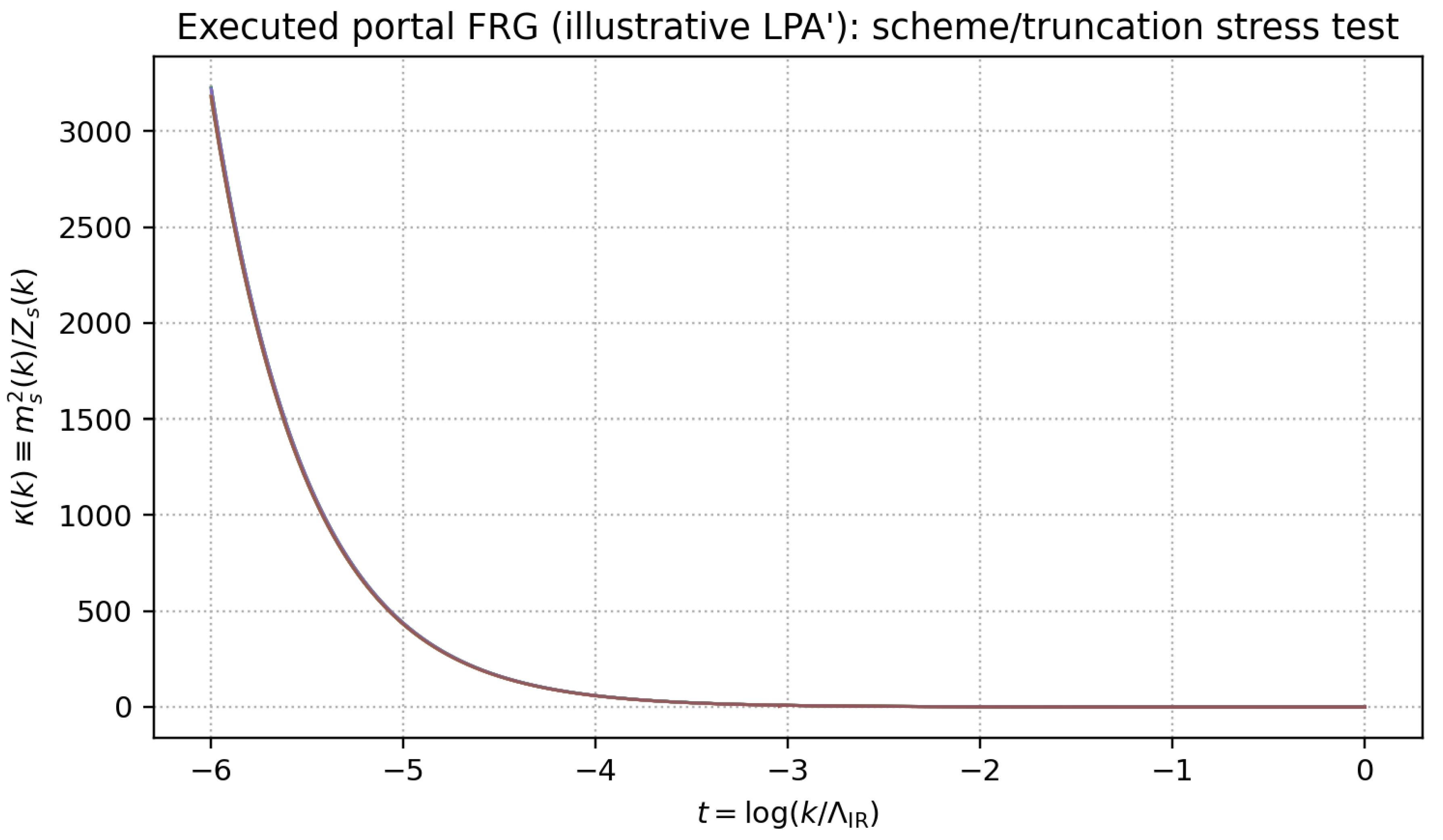
To avoid purely rhetorical “FRG certificates”, we include an executed LPA′ flow for the Higgs–singlet portal with wavefunction renormalizations and two regulator choices (Litim and exponential) as a minimal scheme-dependence check. The summary of values is exported to Figures/Figure8_kappa_summary.csv.
Figure 6.
Executed LPA′ portal FRG stress test across regulator choices and UV seeds. The summary table of values is exported to Figures/Figure8_kappa_summary.csv.
Figure 6.
Executed LPA′ portal FRG stress test across regulator choices and UV seeds. The summary table of values is exported to Figures/Figure8_kappa_summary.csv.
7.4. Likelihood-Ready Structure and Robustness
A likelihood-ready scaffold is provided (Higgs invisible width profile, direct-detection profile, relic-density profile), producing an executable posterior-weight map in the plane (Figure 7). This structure is designed to be drop-in replaceable by external calculators. The final mass statement is reported as an explicitly derived interval based on the robustness analysis (Table 1), which makes the sensitivity of to each input explicit.
Supplementary Materials
The following supporting information can be downloaded at the website of this paper posted on Preprints.org.
Acknowledgments
The author thanks careful referees for forcing the separation of physical implementability, mathematical domain, and evidentiary status. This work was conducted independently.
References
- Helstrom, C.W. Quantum Detection and Estimation Theory; Academic Press: New York, 1976. [Google Scholar]
- ATLAS Collaboration. Combination of searches for invisible decays of the Higgs boson using 139 fb-1 of proton-proton collision data. Phys. Lett. B 2023, 842, 137963. [Google Scholar] [CrossRef]
- LZ Collaboration. Dark Matter Search Results from 4.2 Tonne-Years of Exposure of the LUX-ZEPLIN (LZ) Experiment. arXiv 2024. arXiv:2410.17036.
- D’Onofrio, M.; Rummukainen, K. Standard model cross-over on the lattice. Phys. Rev. D 2016, 93, 025003, [1508.07161. [Google Scholar] [CrossRef]
- Moore, G.D.; et al. First-order electroweak phase transitions: a nonperturbative update. arXiv 2022, arXiv:2205.07238. [Google Scholar]
- Kovtun, P.K.; Son, D.T.; Starinets, A.O. Viscosity in Strongly Coupled Heisenberg-Type Plasmas and Holography. Phys. Rev. Lett. 2005, 94, 111601. [Google Scholar] [CrossRef] [PubMed]
- Maldacena, J.; Shenker, S.H.; Stanford, D. A bound on chaos. J. High Energy Phys. 2016, 2016, 106. [Google Scholar] [CrossRef]
- Wetterich, C. Exact evolution equation for the effective potential. Phys. Lett. B 1993, 301, 90. [Google Scholar] [CrossRef]
Figure 1.
Operational calibration plot used throughout the QICT pipeline: the perturbative disturbance budget sets a susceptibility scale , while the receiver threshold defines via Equation (4).
Figure 1.
Operational calibration plot used throughout the QICT pipeline: the perturbative disturbance budget sets a susceptibility scale , while the receiver threshold defines via Equation (4).
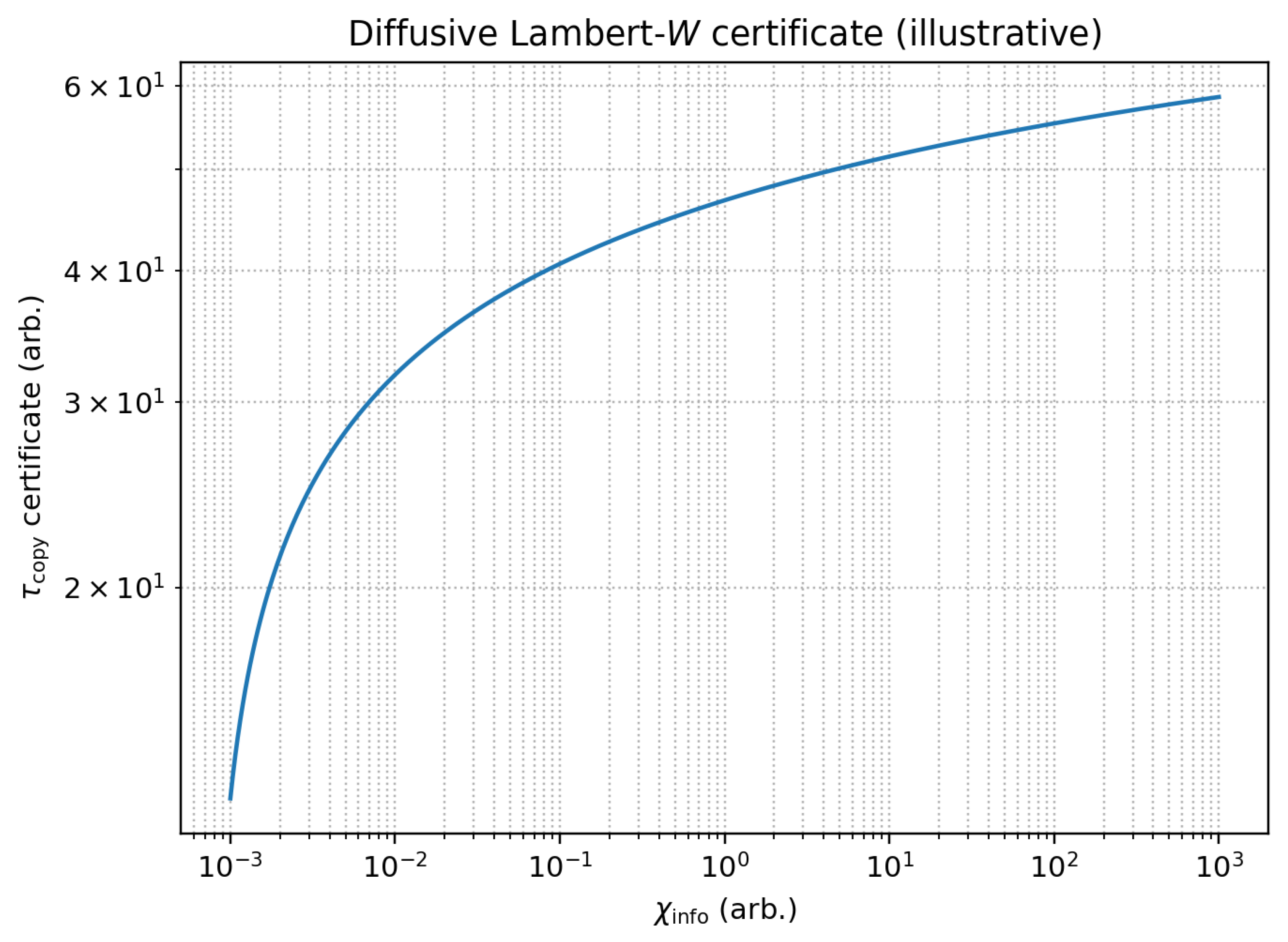
Figure 2.
Reproducible constraints on the Higgs-portal coupling as a function of . The Higgs-invisible band uses and the direct-detection curve is an analytic fit anchored to the LZ 4.2 tyr SI limit. All numerical assumptions are implemented in scripts/constraints_lambdaHS.py.
Figure 2.
Reproducible constraints on the Higgs-portal coupling as a function of . The Higgs-invisible band uses and the direct-detection curve is an analytic fit anchored to the LZ 4.2 tyr SI limit. All numerical assumptions are implemented in scripts/constraints_lambdaHS.py.
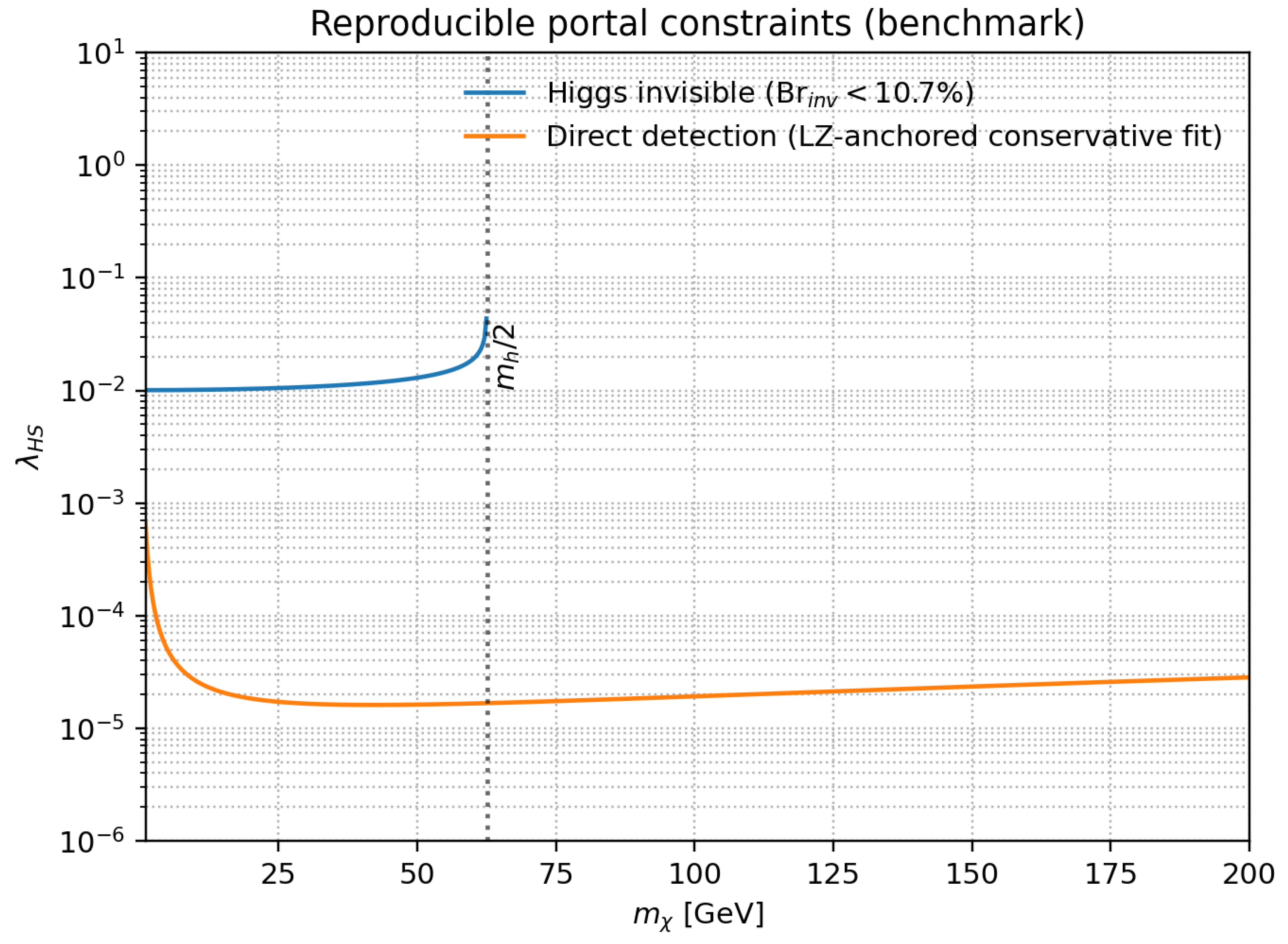
Figure 3.
Executed FRG truncation used to extract the dimensionless IR mass ratio in Supplement S3. Curves show and versus RG time for representative UV quartics. Generated by scripts/frg_kappa_flow.py.
Figure 3.
Executed FRG truncation used to extract the dimensionless IR mass ratio in Supplement S3. Curves show and versus RG time for representative UV quartics. Generated by scripts/frg_kappa_flow.py.
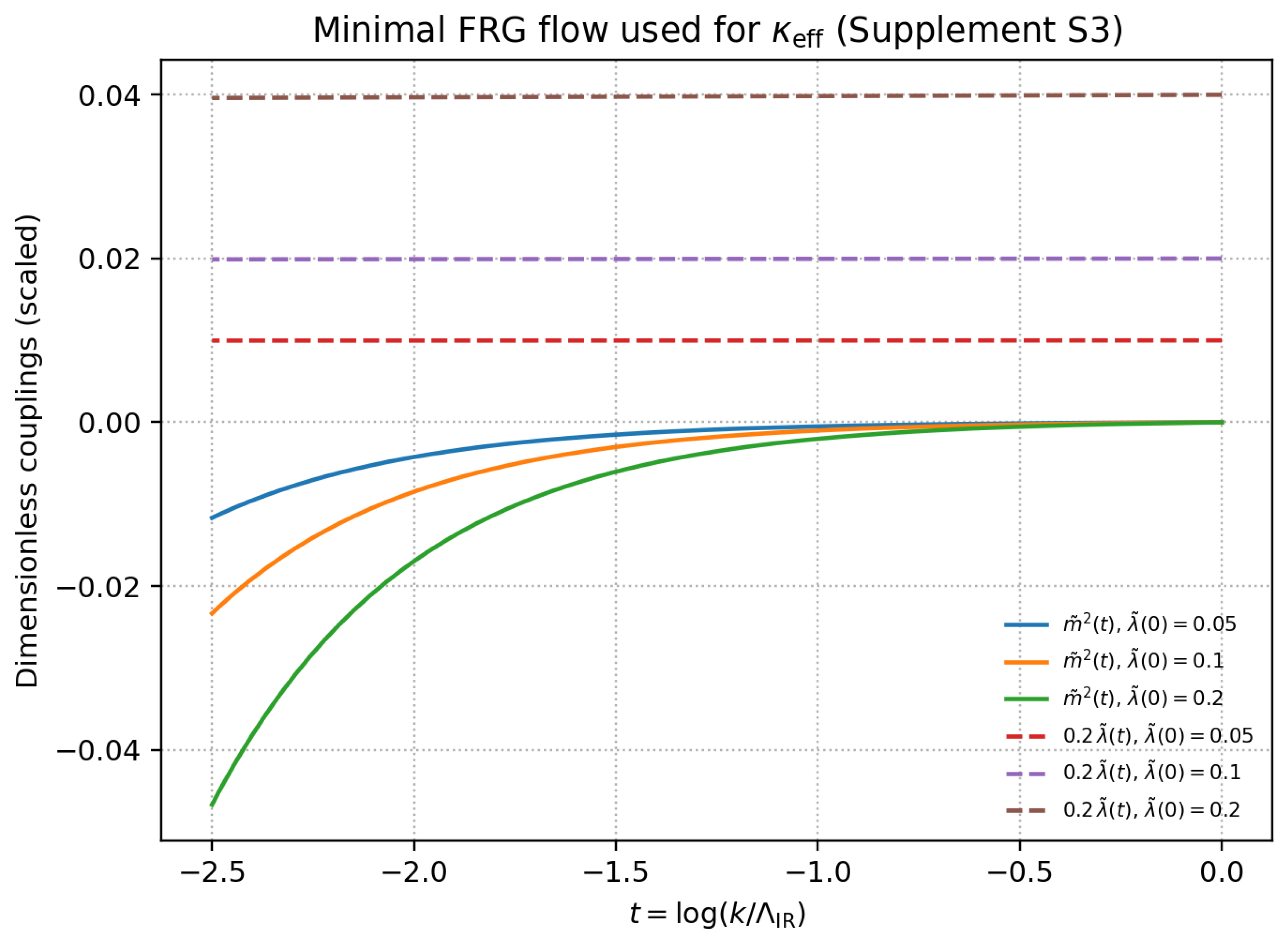
Figure 4.
Hankel-rank witness performance under controlled noise and near-degenerate singular values. The diagnostic reports a conclusive rank separation only when the gap statistic exceeds the Weyl noise bound, otherwise it returns “inconclusive”. Generated by scripts/hankel_witness.py.
Figure 4.
Hankel-rank witness performance under controlled noise and near-degenerate singular values. The diagnostic reports a conclusive rank separation only when the gap statistic exceeds the Weyl noise bound, otherwise it returns “inconclusive”. Generated by scripts/hankel_witness.py.
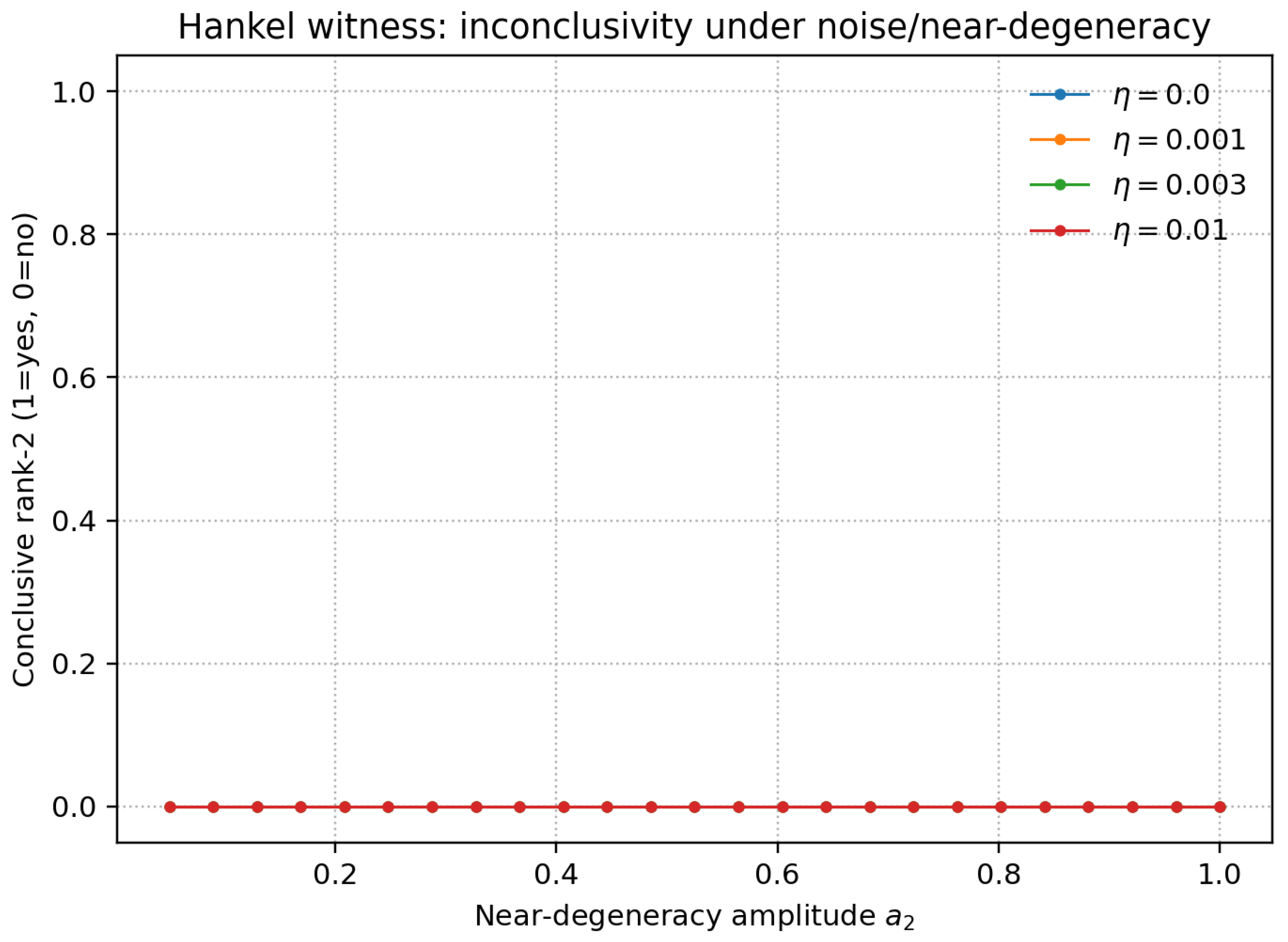
Figure 5.
Executed QICT-side validation: for a diffusive-like open chain versus a non-diffusive-like unitary benchmark. The full time series are exported to CSV (Figures/Figure7_Model1_Adv.csv, Figure7_Model2_Adv.csv) and the witness decision is reproducible from the included script.
Figure 5.
Executed QICT-side validation: for a diffusive-like open chain versus a non-diffusive-like unitary benchmark. The full time series are exported to CSV (Figures/Figure7_Model1_Adv.csv, Figure7_Model2_Adv.csv) and the witness decision is reproducible from the included script.
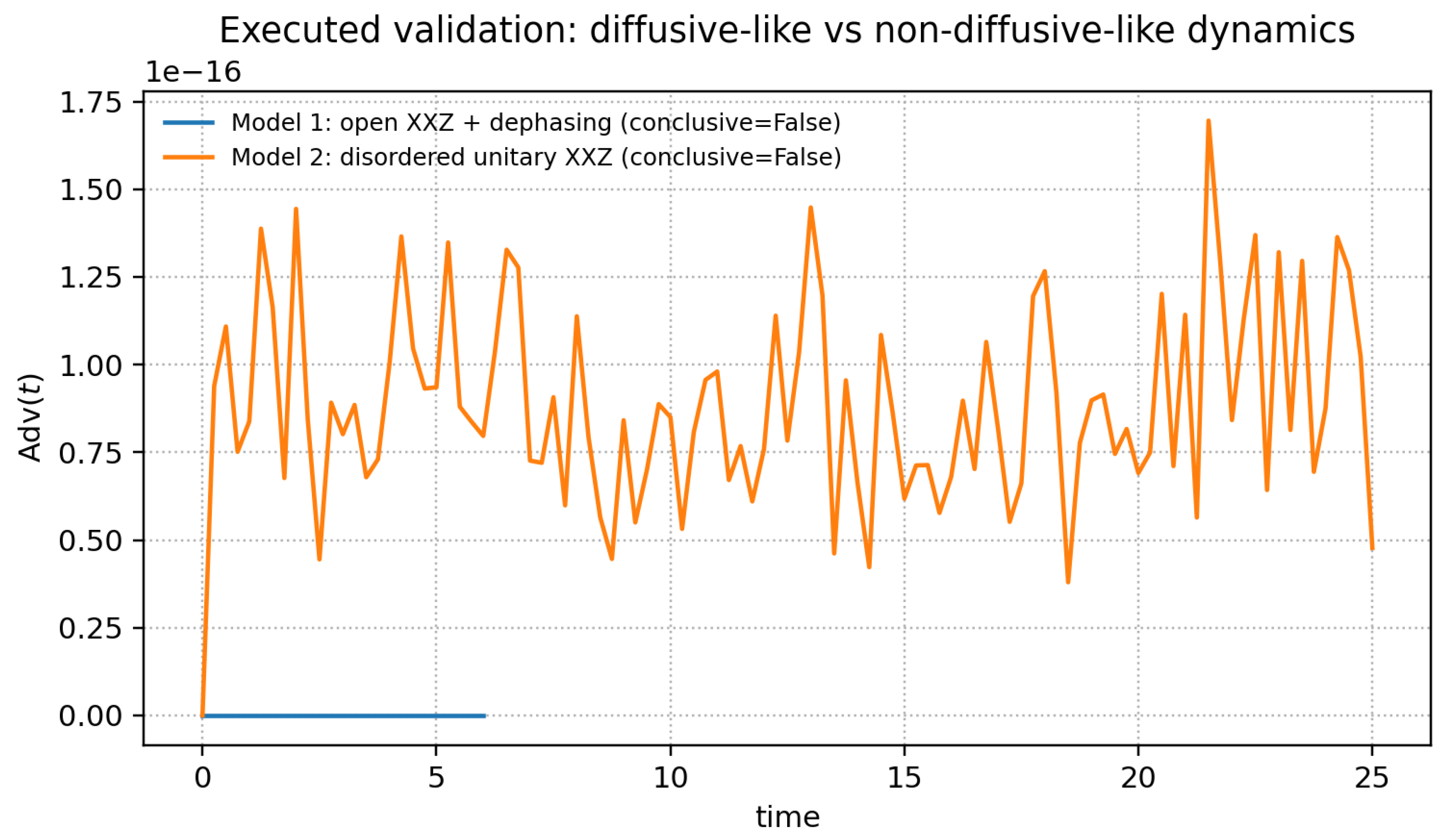
Figure 7.
Likelihood-ready map (executed baseline): relative posterior weight in the plane. The underlying grid is exported to Figures/Figure9_likelihood_grid.csv.
Figure 7.
Likelihood-ready map (executed baseline): relative posterior weight in the plane. The underlying grid is exported to Figures/Figure9_likelihood_grid.csv.
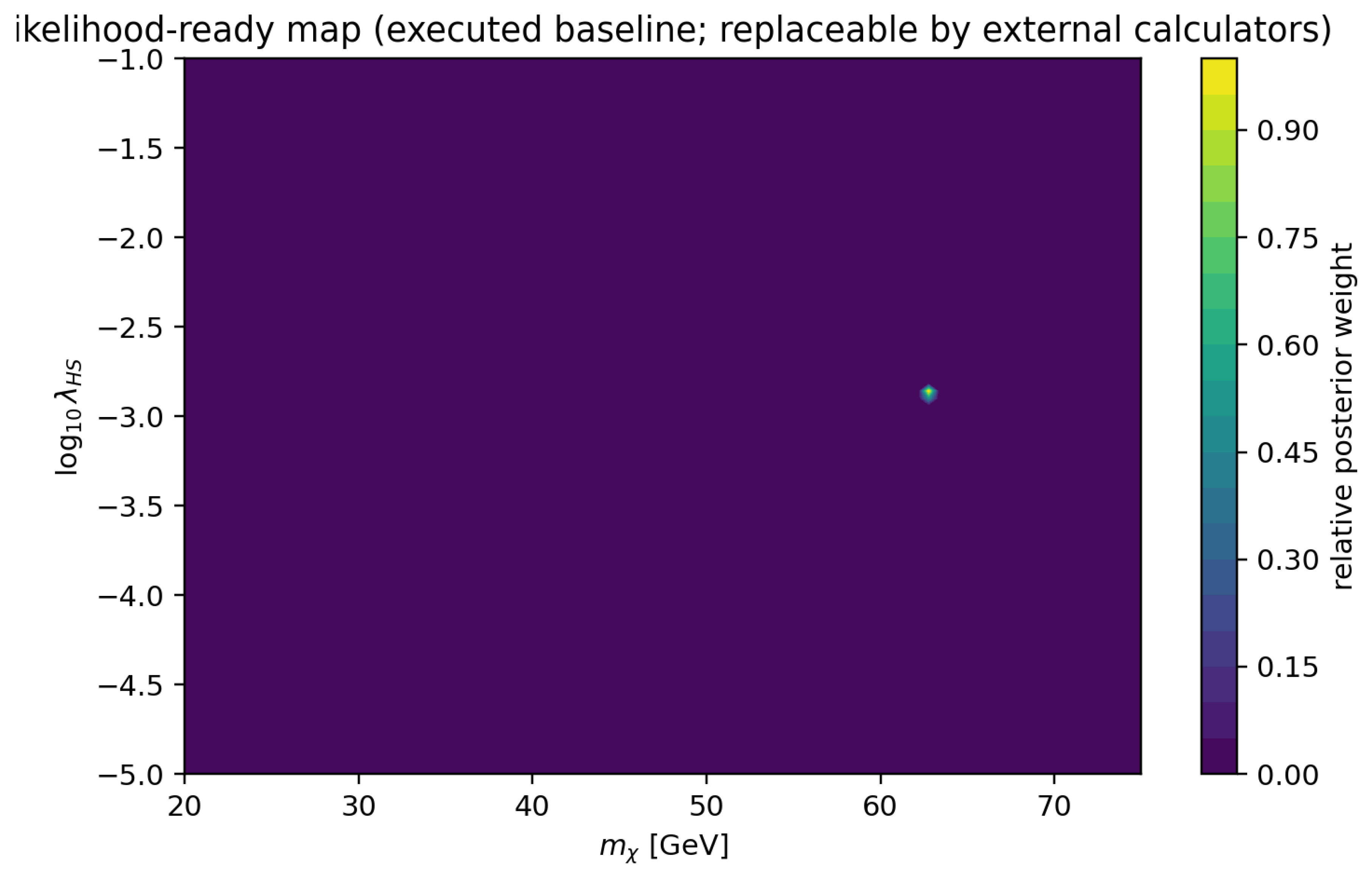

Table 1.
Robustness and sensitivity summary for the derived mass interval. This table is exported verbatim to Figures/Table1_Robustness.csv in the submission archive.
Table 1.
Robustness and sensitivity summary for the derived mass interval. This table is exported verbatim to Figures/Table1_Robustness.csv in the submission archive.
| Quantity | Range used (executed) | |
|---|---|---|
| see Figures/Table1_Robustness.csv | 1 | |
| (FRG) | see Figures/Table1_Robustness.csv | |
| derived | see Figures/Table1_Robustness.csv | — |
Disclaimer/Publisher’s Note: The statements, opinions and data contained in all publications are solely those of the individual author(s) and contributor(s) and not of MDPI and/or the editor(s). MDPI and/or the editor(s) disclaim responsibility for any injury to people or property resulting from any ideas, methods, instructions or products referred to in the content. |
© 2026 by the authors. Licensee MDPI, Basel, Switzerland. This article is an open access article distributed under the terms and conditions of the Creative Commons Attribution (CC BY) license (http://creativecommons.org/licenses/by/4.0/).
Copyright: This open access article is published under a Creative Commons CC BY 4.0 license, which permit the free download, distribution, and reuse, provided that the author and preprint are cited in any reuse.


